Ch.7 TrigonometricFunctions
7.1 AnglesandTheirMeasure
1 ConvertbetweenDecimalsandDegrees,Minutes,SecondsMeasuresforAngles
MULTIPLECHOICE.Choosetheonealternativethatbestcompletesthestatementoranswersthequestion.
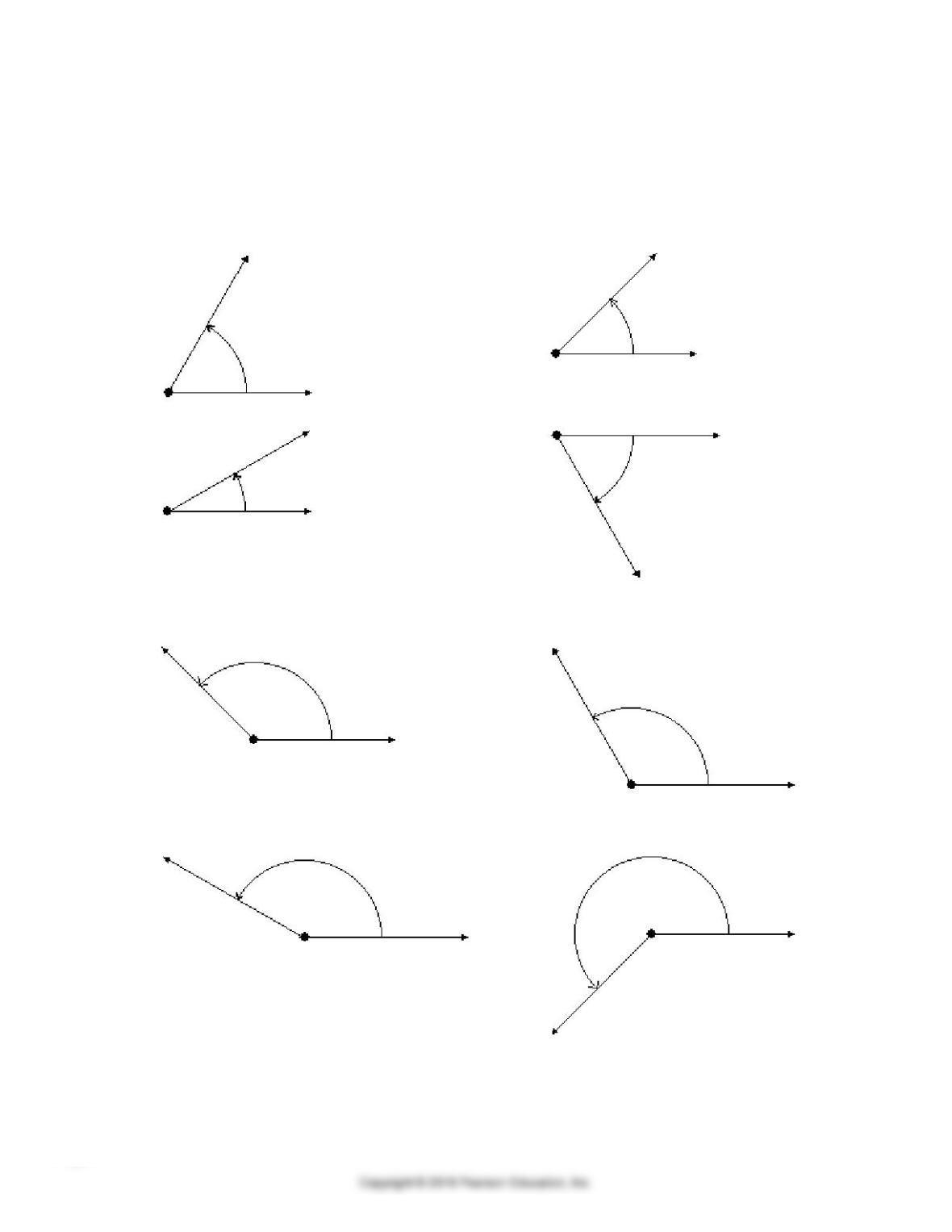
Drawtheangle.
1) 60°
A) B)
C) D)
2) 135°
A) B)
C) D)
Page1
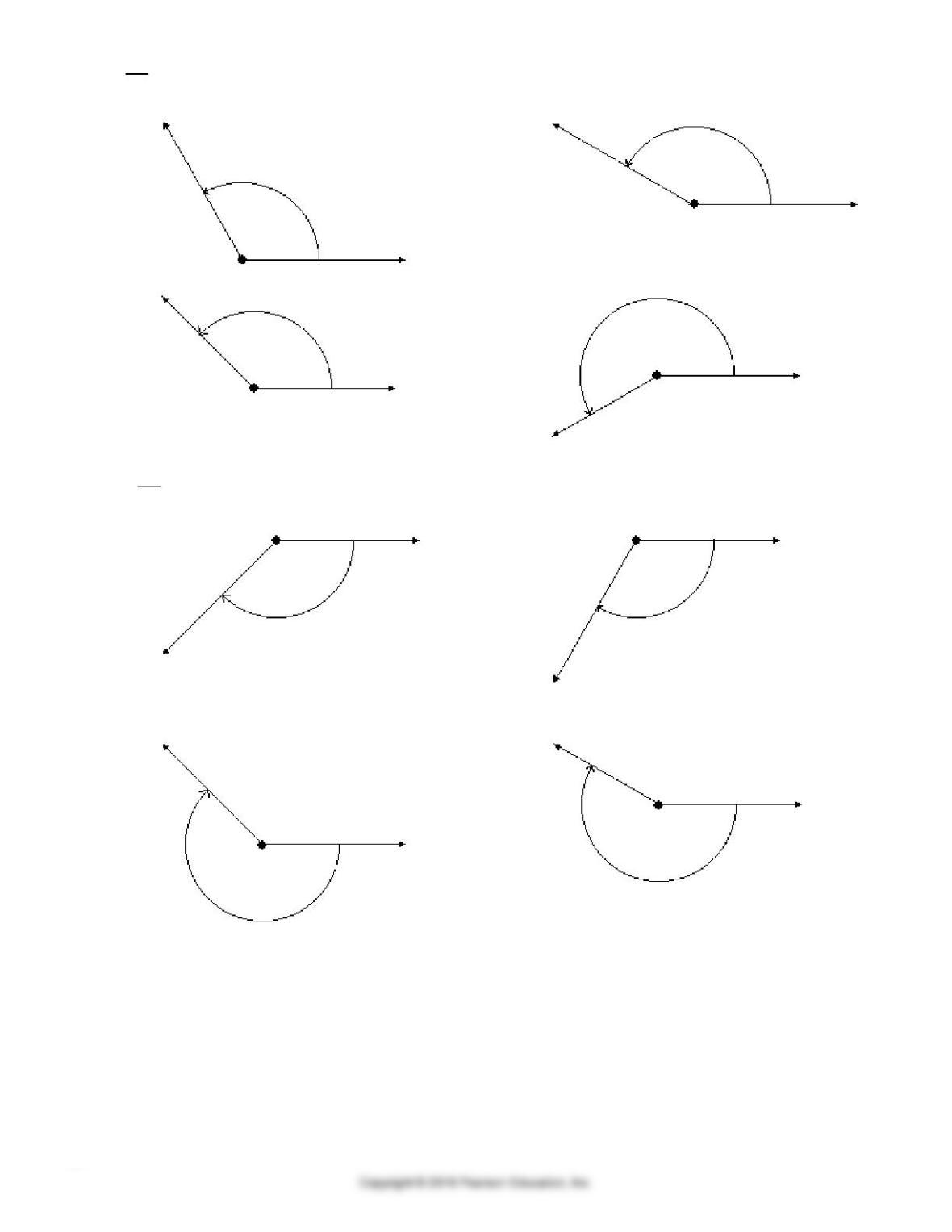
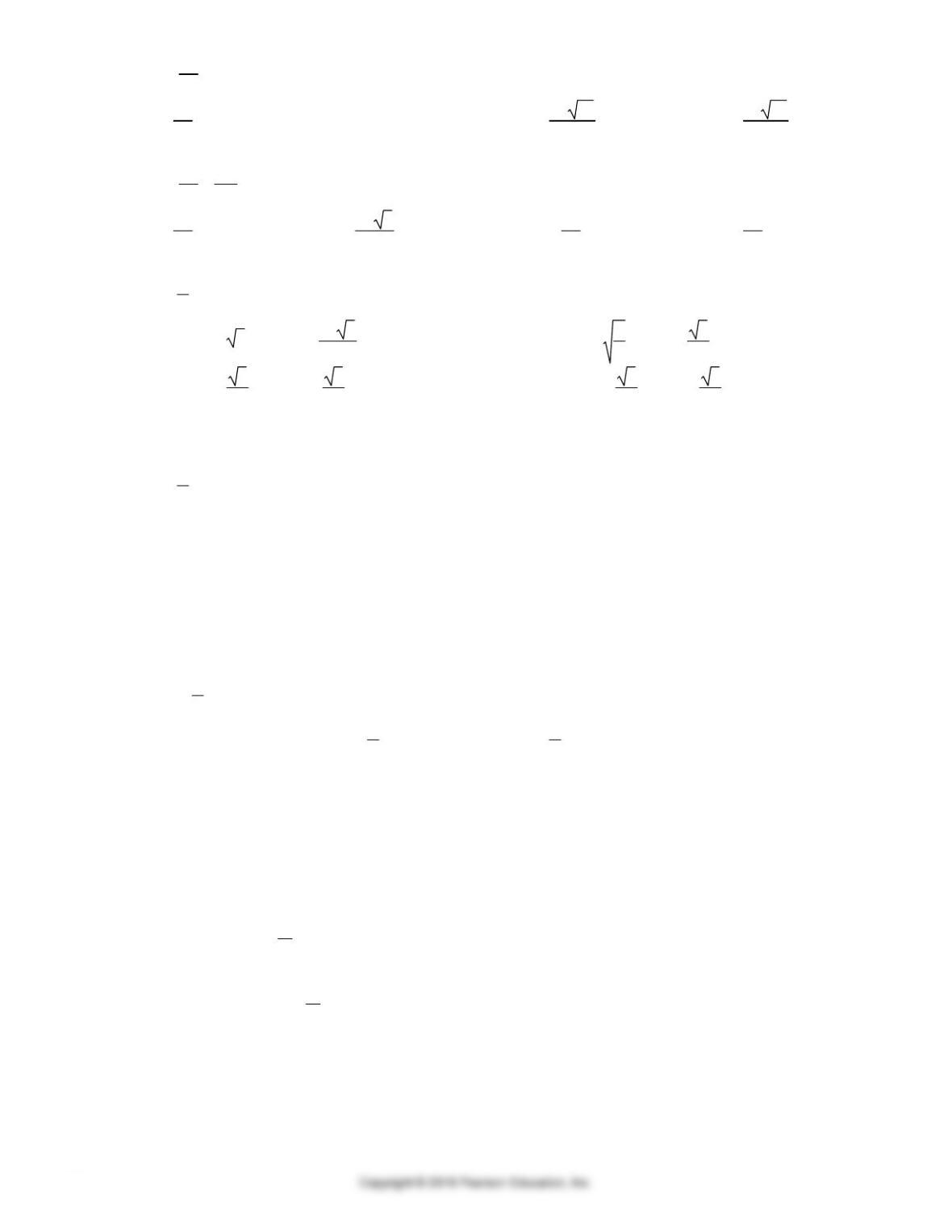
3) 2π
3
A) B)
C) D)
4) –3π
4
A) B)
C) D)
Page2
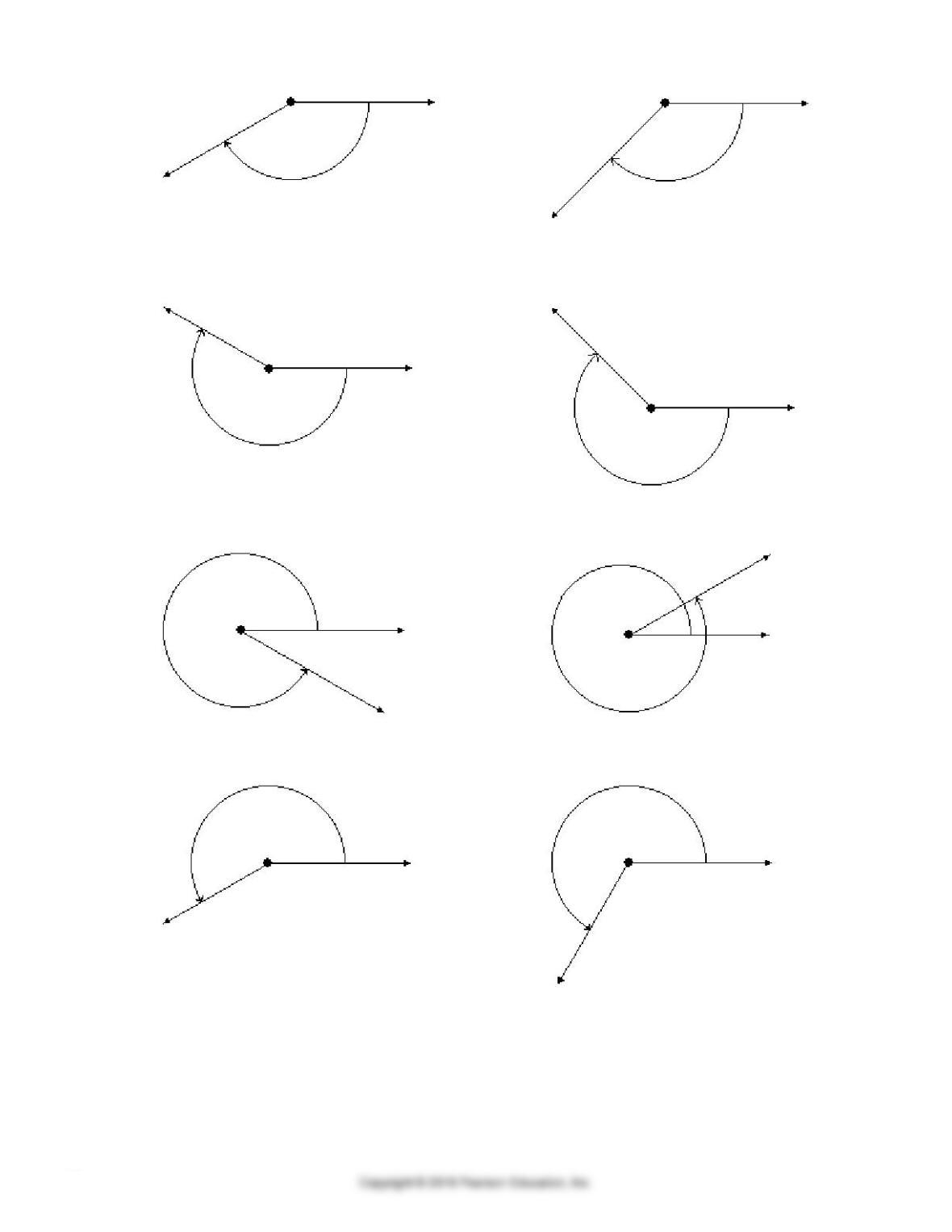
5) –150°
A) B)
C) D)
6) 330°
A) B)
C) D)
Page3
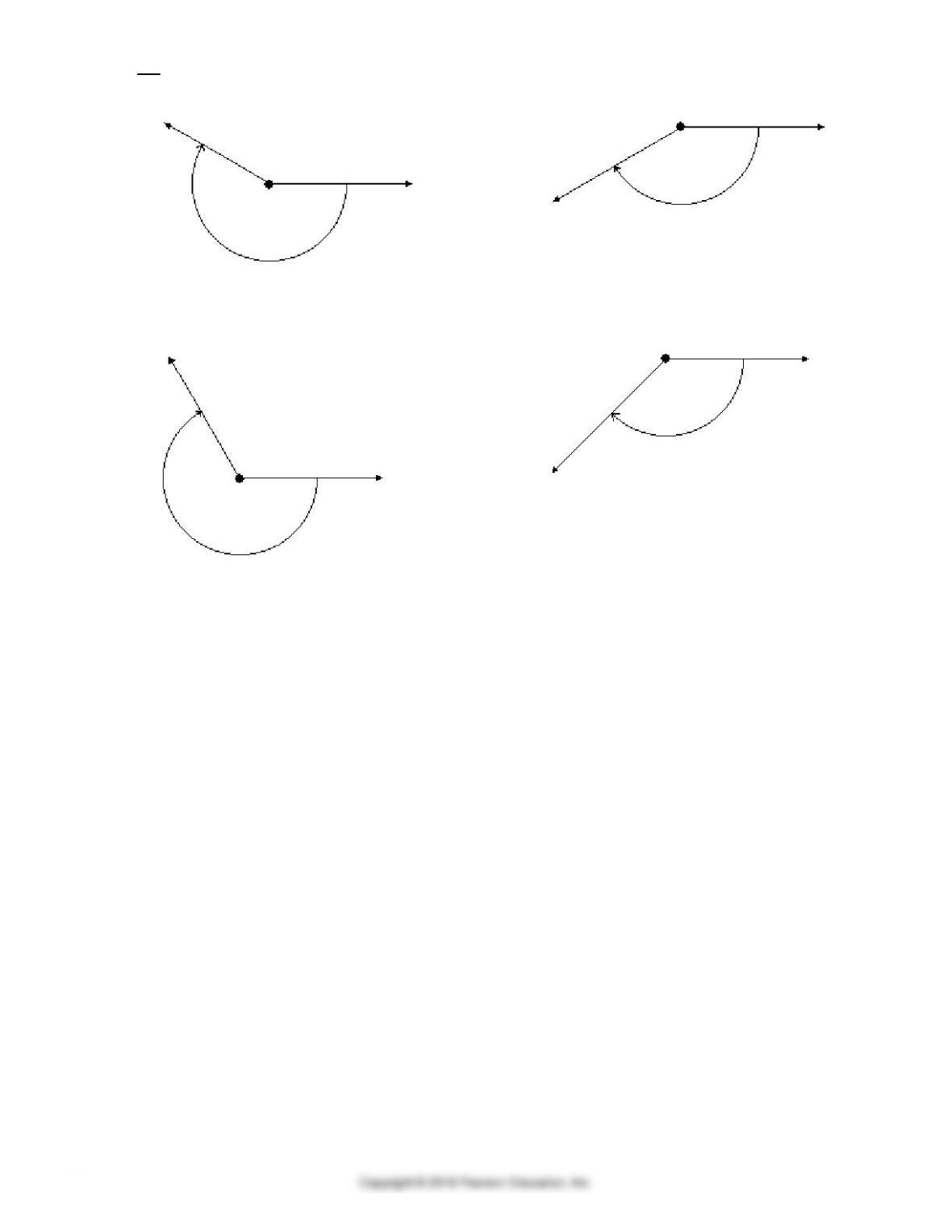
7) –7π
6
A) B)
C) D)
Page4
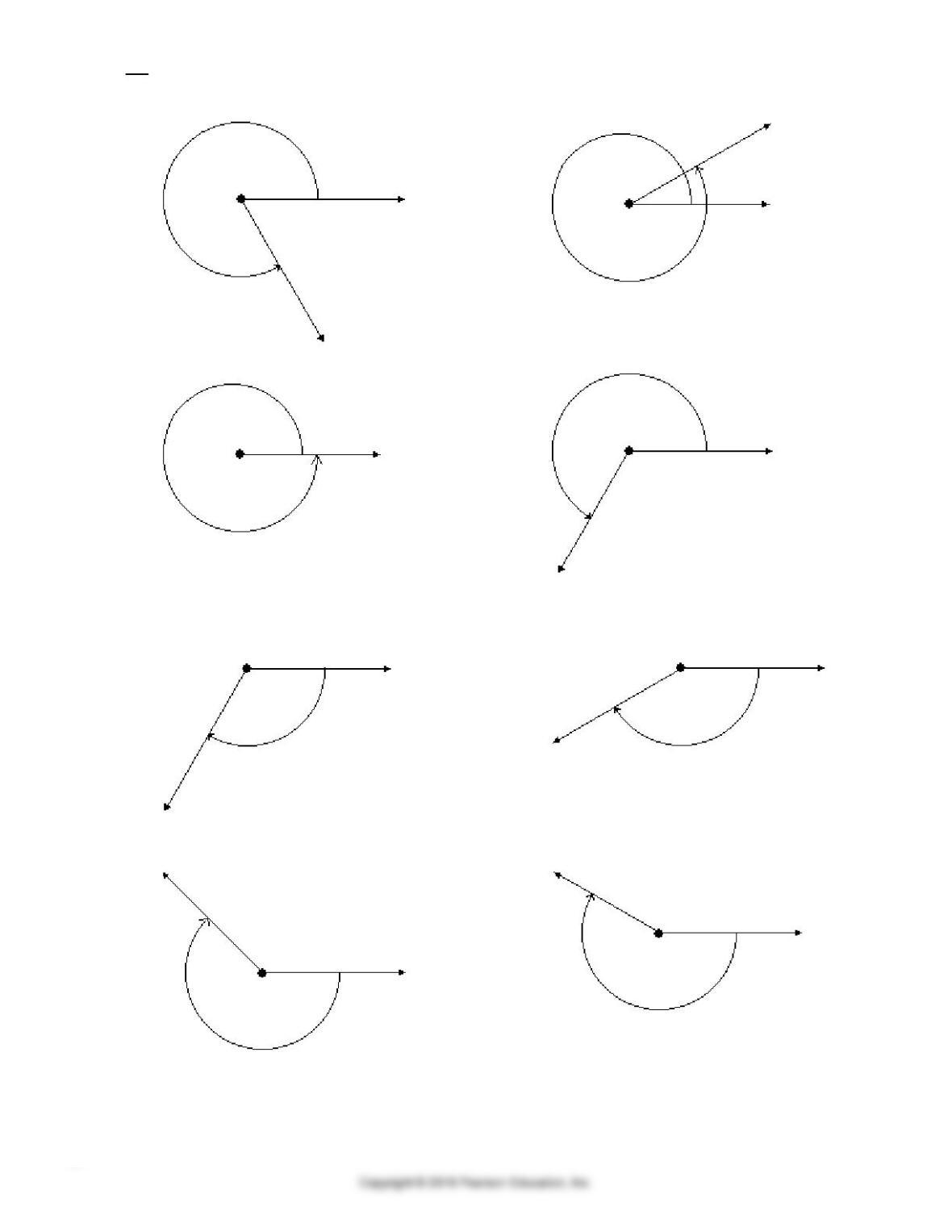
8) 5π
3
A) B)
C) D)
9) –120°
A) B)
C) D)
Page5
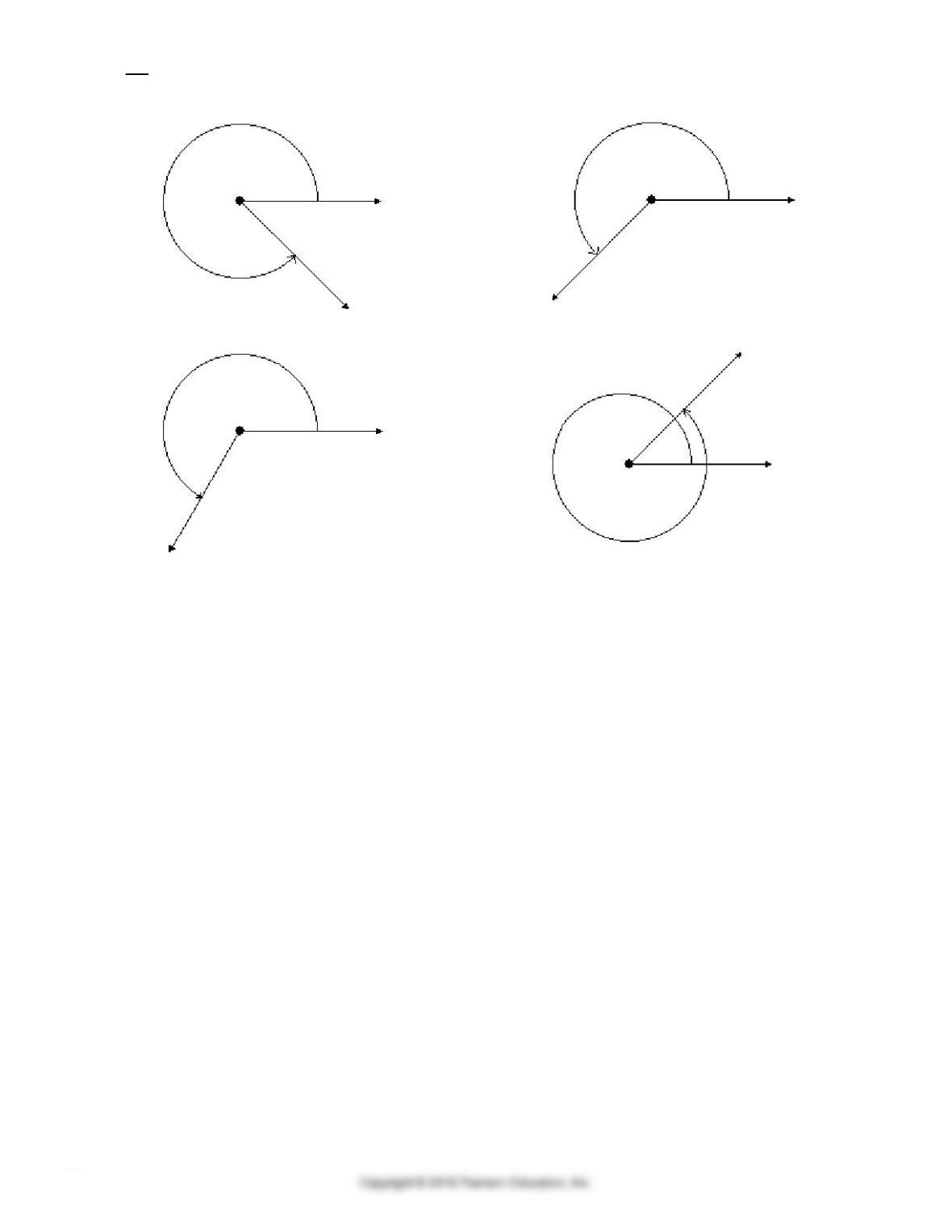
10) 7π
4
A) B)
C) D)
Converttheangletoadecimalindegrees.Roundtheanswertotwodecimalplaces.
11) 68°40ʹ18ʹʹ
A) 68.67° B) 68.68° C) 68.63° D) 68.73°
12) 113°22ʹ28ʹʹ
A) 113.37° B) 113.38° C) 113.33° D) 113.43°
13) 299°44ʹ43ʹʹ
A) 299.75° B) 299.76° C) 299.71° D) 299.81°
14) 23°47ʹ37ʹʹ
A) 23.79° B) 23.84° C) 23.52° D) 23.94°
15) 21°17ʹ34ʹʹ
A) 21.29° B) 21.34° C) 21.22° D) 21.37°
ConverttheangletoD°MʹSʹʹform.Roundtheanswertothenearestsecond.
16) 87.28°
A) 87°16ʹ48ʹʹ B) 87°16ʹ54ʹʹ C) 87°16ʹ36ʹʹ D) 87°16ʹ28ʹʹ
17) 170.33°
A) 170°19ʹ48ʹʹ B) 170°20ʹ48ʹʹ C) 170°17ʹ33ʹʹ D) 170°19ʹ33ʹʹ
18) 300.14°
A) 300°8ʹ24ʹʹ B) 300°8ʹ14ʹʹ C) 300°23ʹ14ʹʹ D) 300°9ʹ23ʹʹ
Page6
2 FindtheLengthofanArcofaCircle
MULTIPLECHOICE.Choosetheonealternativethatbestcompletesthestatementoranswersthequestion.
Ifsdenotesthelengthofthearcofacircleofradiusrsubtendedbyacentralangleθ,findthemissingquantity.
1) r=17.31centimeters,θ=6.2radians,s=?
A) 107.3cm B) 108.3 cm C) 106.3 cm D) 109.3 cm
2) r=13.2inches,θ=60°
,
s=?
A) 13.8in. B) 13.9 in. C) 14.0 in. D) 14.1 in.
3) r=1
5feet,s=4feet,θ=?
A) 20radians B) 4
5radians C) 20° D) 4
5°
4) s=4.35meters,θ=1.5radians,r=?
A) 2.9m B) 0.34 m C) 2.4 m D) 1.45 m
Findthelengths.Roundtheanswertothreedecimalplaces.
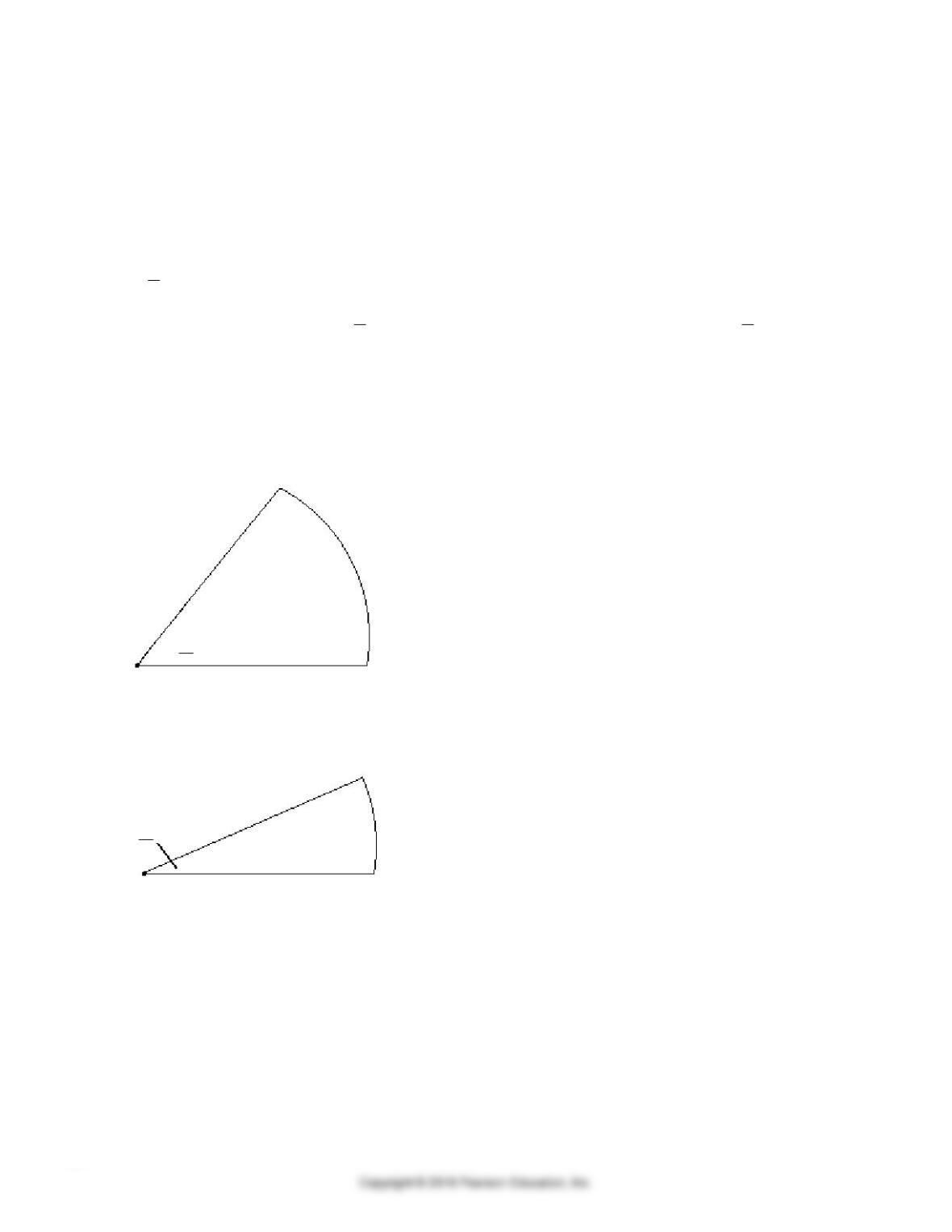
5)
s
π
4
6ft
A) 4.712ft B) 2.094 ft C) 9.424 ft D) 7.639 ft
6)
π
6s
7ft
A) 3.665ft B) 2.693 ft C) 7.33 ft D) 13.369 ft
Page7
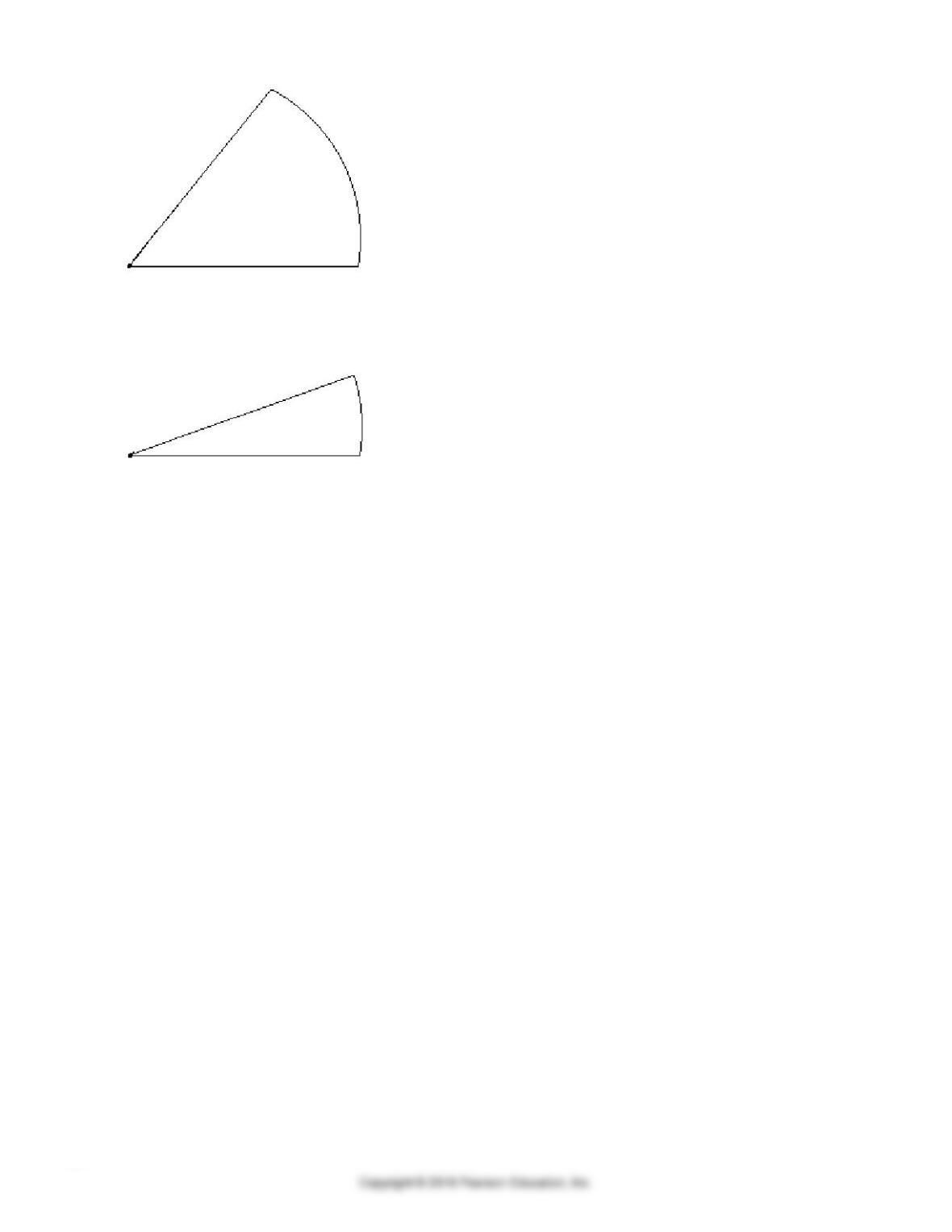
7)
s
55°
8ft
A) 7.679ft B) 8.447 ft C) 6.911 ft D) 6.143 ft
8)
s
40°
12m
A) 8.378m B) 9.216 m C) 7.54 m D) 6.702 m
Solvetheproblem.
9) Foracircleofradius4feet,findthearclengthssubtendedbyacentralangleof30°.Roundtothenearest
hundredth.
A) 376.99ft B) 6.28ft C) 2.09ft D) 4.19ft
10) Foracircleofradius4feet,findthearclengthssubtendedbyacentralangleof60°.Roundtothenearest
hundredth.
A) 4.19ft B) 4.25ft C) 4.35ft D) 4.40ft
11) AshipintheAtlanticOceanmeasuresitspositiontobe29°27ʹnorthlatitude.Anothershipisreportedto
beduenorthofthefirstshipat41°17ʹnorthlatitude.Approximatelyhowfarapartarethetwoships?
Roundtothenearestmile.AssumethattheradiusoftheEarthis3960miles.
A) 818mi B) 46,860 mi C) 838 mi D) 46,880 mi
SHORTANSWER.Writethewordorphrasethatbestcompleteseachstatementoranswersthequestion.
12) SaltLakeCity,Utah,isduenorthofFlagstaff,Arizona.FindthedistancebetweenSaltLakeCity(40°45ʹ
northlatitude)andFlagstaff(35°16ʹnorthlatitude).AssumethattheradiusoftheEarthis3960miles.
Roundtonearestwholemile.
MULTIPLECHOICE.Choosetheonealternativethatbestcompletesthestatementoranswersthequestion.
13) Theminutehandofaclockis4incheslong.Howfardoesthetipoftheminutehandmovein45 minutes?
Ifnecessary,roundtheanswertotwodecimalplaces.
A) 18.85in. B) 21.36 in. C) 20.08 in. D) 17.11 in.
14) Apendulumswingsthoughanangleof30° eachsecond.Ifthependulumis35incheslong,howfardoes
itstipmoveeachsecond?Ifnecessary,roundtheanswertotwodecimalplaces.
A) 18.33in. B) 20.76 in. C) 19.62 in. D) 16.48 in.
Page8

3 ConvertfromDegreestoRadiansandfromRadianstoDegrees
MULTIPLECHOICE.Choosetheonealternativethatbestcompletesthestatementoranswersthequestion.
Converttheangleindegreestoradians.Expresstheanswerasmultipleofπ.
1) 30°
A) π
6B) π
7C) π
8D) π
5
2) –30°
A) –π
6B) –π
7C) –π
8D) –π
5
3) 150°
A) 5π
6B) 6π
7C) 4π
5D) 6π
5
4) –480°
A) –8π
3B) –9π
4C) –7π
2D) –3π
8
5) 87°
A) 29π
60 B) 29π
90 C) 29π
30 D) 29π
120
6) 6°
A) π
30 B) π
60 C) π
15 D) π
18
Converttheangleinradianstodegrees.
7) 8π
3
A) 480° B) 481° C) 482° D) 479°
8) –5π
4
A) –225° B) –226° C) –227° D) –224°
9) π
4
A) 45° B) 1° C) 4° D) 45π°
10) –π
3
A) –60° B) –1° C) 1° D) –60π°
11) 5π
12
A) 75° B) 150° C) 144° D) 432π°
Page9

12) 31
9π
A) 620° B) 1240π° C) 11° D) 310°
13) π
6
A) 30° B) 60° C) 1080° D) 15°
14) 11π
12
A) 165° B) 160° C) 150° D) 210°
Converttheangleindegreestoradians.Expresstheanswerindecimalform,roundedtotwodecimalplaces.
15) 279°
A) 4.87 B) 4.86 C) 4.85 D) 4.84
16) –294°
A) –5.13 B) –5.12 C) –5.11 D) –5.1
Converttheangleinradianstodegrees.Expresstheanswerindecimalform,roundedtotwodecimalplaces.
17) 1
A) 57.3° B) 57.37° C) 0.02° D) –0.12°
18) 2.15
A) 123.19° B) 122.58° C) 0.04° D) –0.06°
19) 6
A) 140.35° B) 141.84° C) 0.04° D) 0.13°
4 FindtheAreaofaSectorofaCircle
MULTIPLECHOICE.Choosetheonealternativethatbestcompletesthestatementoranswersthequestion.
IfAdenotestheareaofthesectorofacircleofradiusrformedbythecentralangleθ,findthemissingquantity.If
necessary,roundtheanswertotwodecimalplaces.
1) r=19inches,θ=π
4radians,A=?
A) 141.69in2B) 283.39in2C) 7.46in2D) 14.92in2
2) r=2feet,A=76squarefeet,θ=?
A) 38radians B) 19radians C) 152 radians D) 304 radians
3) θ=π
3radians,A=87squaremeters,r=?
A) 12.89m B) 182.21 m C) 45.55 m D) 6.75 m
4) r=15inches,θ=90°
,
A=?
A) 176.63in2B) 353.25in2C) 11.78in2D) 23.55in2
5) r=18feet,A=47squarefeet,θ=?
A) 16.63° B) 8.32° C) 436,471.34° D) 872,942.68°
Page10
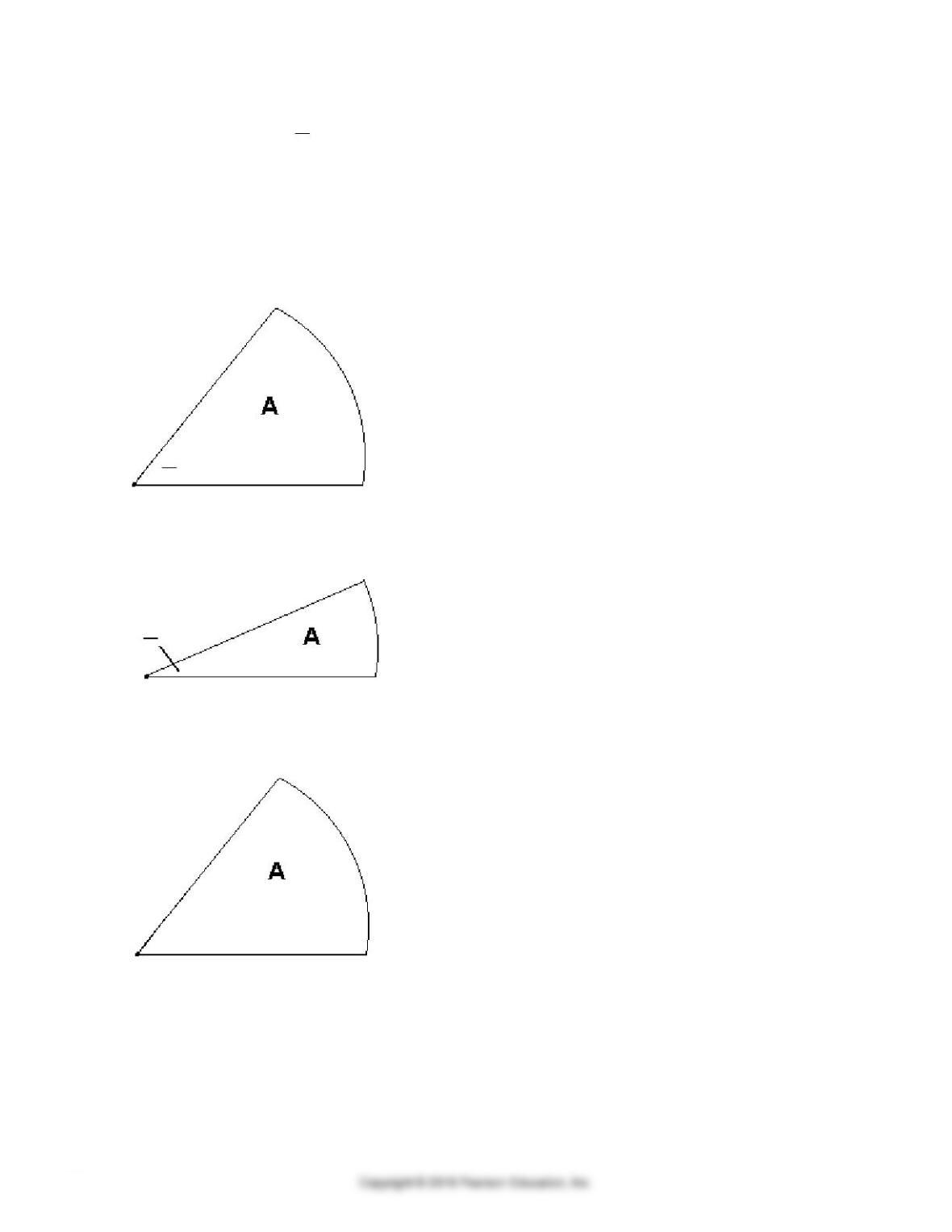
6) θ=30°
,
A=53squaremeters,r=?
A) 14.23m B) 55.47 m C) 13.87 m D) 3.72 m
7) r=46.3centimeters,θ=π
7radians,A=?
A) 481cm2B) 10.4cm2C) 153.1cm2D) 962cm2
8) r=20.2feet,θ=38.137°
,
A=?
A) 135.8ft2B) 138.8ft2C) 271.6ft2D) 274.6ft2
FindtheareaA.Roundtheanswertothreedecimalplaces.
9)
π
3
8m
A) 33.51m2B) 4.189m2C) 67.021m2D) 21.333m2
10)
π
5
2cm
A) 1.257cm2B) 0.628cm2C) 2.513cm2D) 0.8cm2
11)
65°
2ft
A) 2.269ft2B) 1.134ft2C) 4.538ft2D) 0.722ft2
Page11
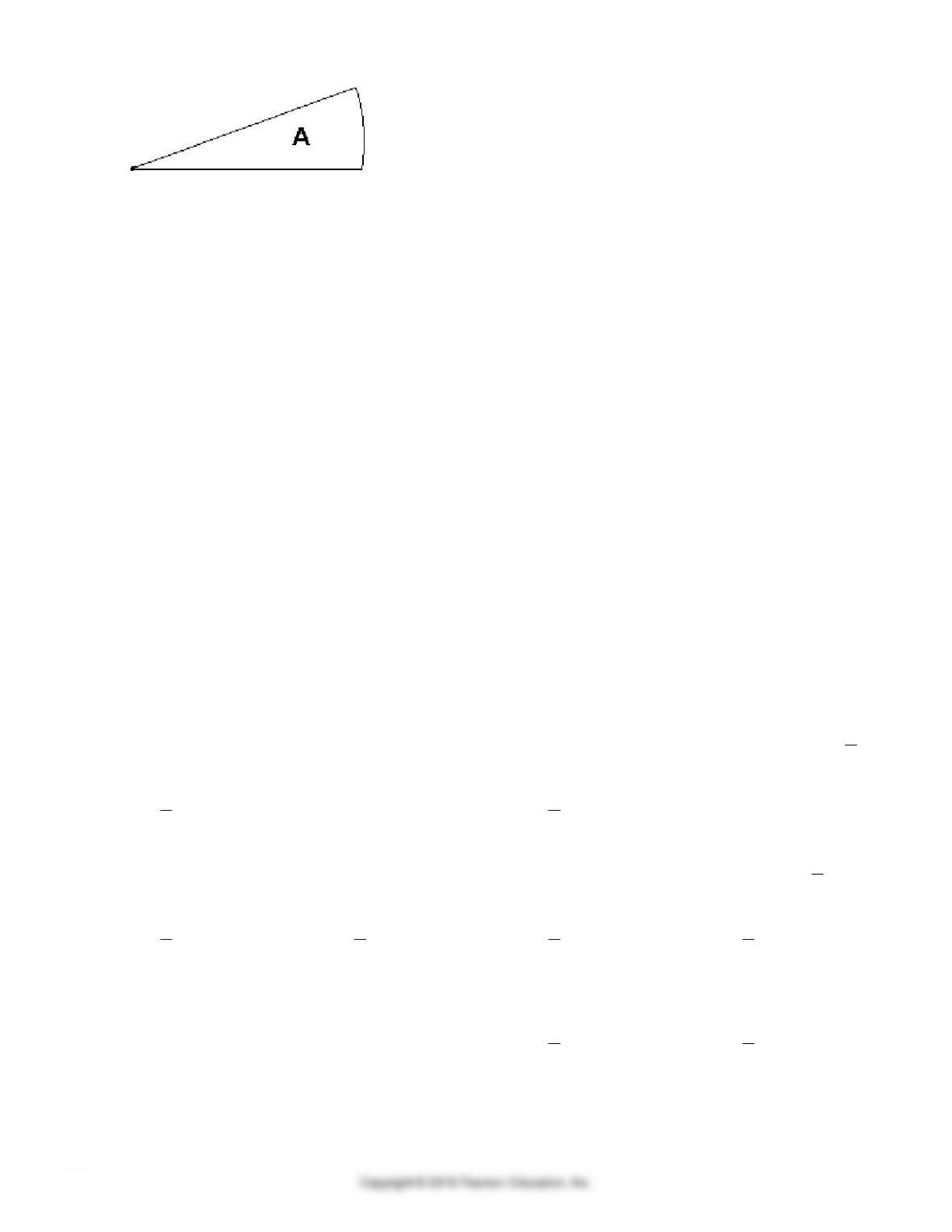
12)
25°
3cm
A) 1.963cm2B) 0.654cm2C) 3.927cm2D) 0.625cm2
Solvetheproblem.
13) Acirclehasaradiusof3centimeters.Findtheareaofthesectorofthecircleformedbyanangleof25°. If
necessary,roundtheanswertotwodecimalplaces.
A) 1.96cm2B) 0.65cm2C) 3.93cm2D) 0.63cm2
14) Anirrigationsprinklerinafieldoflettucesprayswateroveradistanceof40 feetasitrotatesthroughan
angleof135°.Whatareaofthefieldreceiveswater?Ifnecessary,roundtheanswertotwodecimalplaces.
A) 1884.96ft2B) 47.12ft2C) 3769.91ft2D) 600ft2
15) Aspartofanexperimenttotestdifferentliquidfertilizers,asprinklerhastobesettocoveranareaof130
squareyardsintheshapeofasectorofacircleofradius50yards.Throughwhatangleshouldthe
sprinklerbesettorotate?Ifnecessary,roundtheanswertotwodecimalplaces.
A) 5.96° B) 2.98° C) 4.47° D) 18.72°
16) Thebladeofawindshieldwipersweepsoutanangleof135° inonecycle.Thebaseofthebladeis12
inchesfromthepivotpointandthetipis32inchesfromthepivotpoint.Whatareadoesthewipercoverin
onecycle?(Roundtothenearest0.1squareinch.)
A) 1036.7in2B) 1105.3in2C) 1041.8in2D) 948.3in2
5 FindtheLinearSpeedofanObjectTravelinginCircularMotion
MULTIPLECHOICE.Choosetheonealternativethatbestcompletesthestatementoranswersthequestion.
Solvetheproblem.
1) Anobjectistravelingaroundacirclewitharadiusof10centimeters.Ifin20secondsacentralangleof1
3
radianissweptout,whatisthelinearspeedoftheobject?
A) 1
6cm/sec B) 6cm/sec C) 1
6radians/sec D) 6radians/sec
2) Anobjectistravelingaroundacirclewitharadiusof20meters.Ifin10secondsacentralangleof1
5radian
issweptout,whatisthelinearspeedoftheobject?
A) 2
5m/sec B) 1
5m/sec C) 1
4m/sec D) 1
8m/sec
3) Anobjectistravelingaroundacirclewitharadiusof10meters.Ifin15secondsacentralangleof3
radiansissweptout,whatisthelinearspeedoftheobject?
A) 2m/sec B) 3m/sec C) 2
3m/sec D) 1
3m/sec
Page12
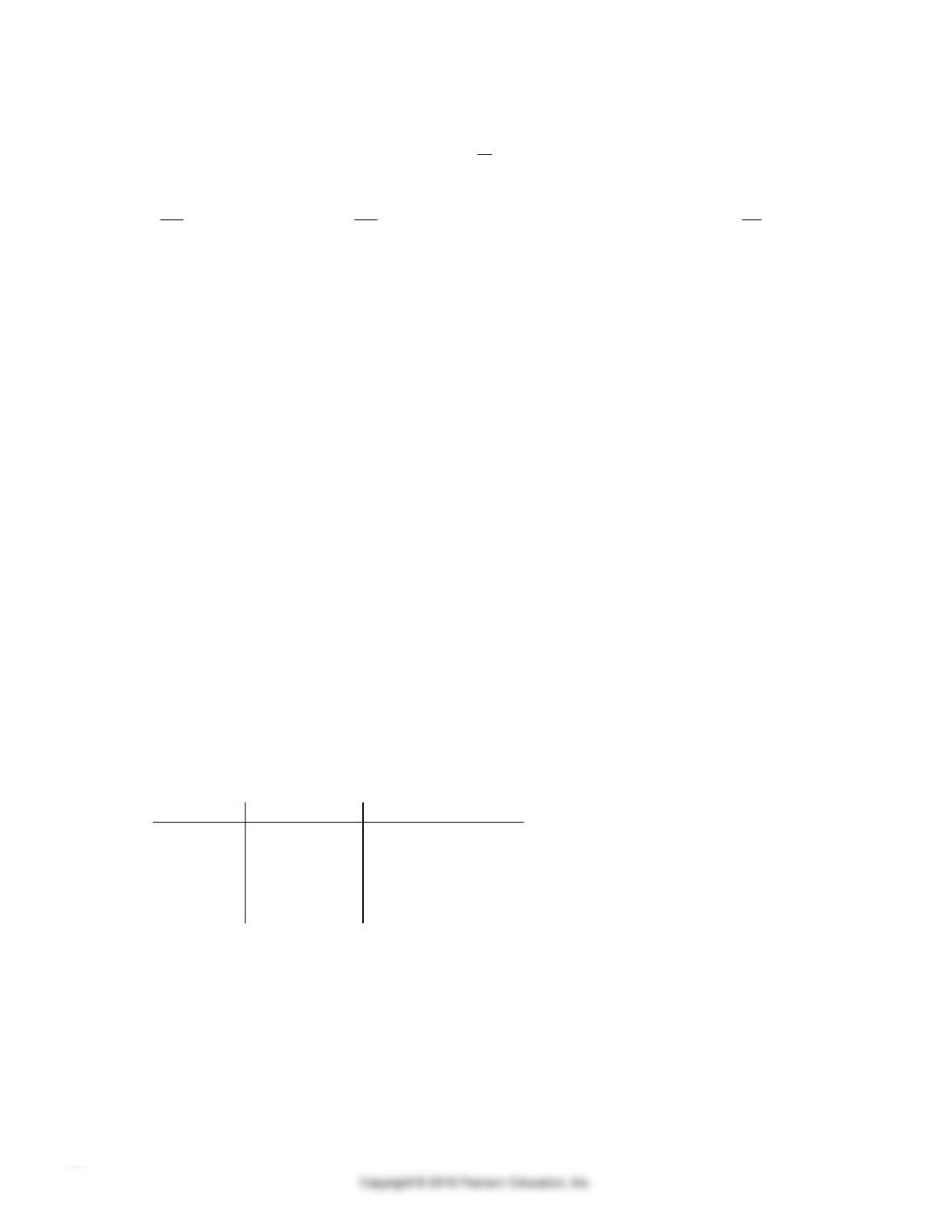
4) Aweighthangsfromarope20feetlong.Itswingsthroughanangleof27° eachsecond.Howfardoesthe
weighttraveleachsecond?Roundtothenearest0.1foot.
A) 9.4feet B) 8.7feet C) 9.0feet D) 8.1feet
5) Agearwitharadiusof2centimetersisturningatπ
9radians/sec.Whatisthelinearspeedatapointonthe
outeredgeofthegear?
A) 2π
9cm/sec B) 9π
2cm/sec C) 18πcm/sec D) π
18cm/sec
6) Awheelofradius9.5feetismovingforwardat17 feetpersecond.Howfastisthewheelrotating?
A) 1.8radians/sec B) 0.56 radians/sec C) 5.4 radians/sec D) 0.33 radians/sec
7) Acaristravelingat29mph.Ifitstireshaveadiameterof28 inches,howfastarethecarʹstiresturning?
Expresstheanswerinrevolutionsperminute.Ifnecessary,roundtotwodecimalplaces.
A) 348.14rpm B) 2187.43 rpm C) 354.14 rpm D) 696.28 rpm
8) Apick–uptruckisfittedwithnewtireswhichhaveadiameterof43 inches.Howfastwillthepick–up
truckbemovingwhenthewheelsarerotatingat335revolutionsperminute?Expresstheanswerinmiles
perhourroundedtothenearestwholenumber.
A) 43mph B) 7mph C) 48 mph D) 21mph
9) TheEarthrotatesaboutitspoleonceevery24hours.ThedistancefromthepoletoalocationonEarth21°
northlatitudeisabout3697miles.Therefore,alocationonEarthat21°northlatitudeisspinningona
circleofradius3697miles.ComputethelinearspeedonthesurfaceoftheEarthat21°northlatitude.
A) 968mph B) 154mph C) 23,229 mph D) 948 mph
10) Toapproximatethespeedofariver,acircularpaddlewheelwithradius0.63 feetisloweredintothe
water.Ifthecurrentcausesthewheeltorotateataspeedof13revolutionsperminute,whatisthespeedof
thecurrent?Ifnecessary,roundtotwodecimalplaces.
A) 0.58mph B) 0.09 mph C) 51.46 mph D) 0.29 mph
SHORTANSWER.Writethewordorphrasethatbestcompleteseachstatementoranswersthequestion.
11) ThefourGalileanmoonsofJupiterhaveorbitalperiodsandmeandistancesfromJupitergivenbythe
followingtable.
Distance(km) Period(Earthhours)
Io 4.214×10542.460
Europa 6.709×10585.243
Ganymeade 1.070×106171.709
Callisto 1.883×106400.536
Findthelinearspeedofeachmoon.Whichisthefastest(intermsoflinearspeed)?
MULTIPLECHOICE.Choosetheonealternativethatbestcompletesthestatementoranswersthequestion.
12) Inacomputersimulation,asatelliteorbitsaroundEarthatadistancefromtheEarthʹssurfaceof2.7x104
miles.Theorbitiscircular,andonerevolutionaroundEarthtakes10.8days.Assumingtheradiusofthe
Earthis3960miles,findthelinearspeedofthesatellite.Expresstheanswerinmilesperhourtothe
nearestwholemile.
A) 750mph B) 16,075 mph C) 119 mph D) 654 mph
Page13

13) Acarouselhasaradiusof15feetandtakes27 secondstomakeonecompleterevolution.Whatisthelinear
speedofthecarouselatitsoutsideedge?Ifnecessary,roundtheanswertotwodecimalplaces.
A) 3.49ft/sec B) 0.56 ft/sec C) 11.31 ft/sec D) 94.25 ft/sec
7.2 RightTriangleTrigonometry
1 FindtheValuesofTrigonometricFunctionsofAcuteAngles
MULTIPLECHOICE.Choosetheonealternativethatbestcompletesthestatementoranswersthequestion.
TwosidesofarighttriangleABC(Cistherightangle)aregiven.Findtheindicatedtrigonometricfunctionofthe
givenangle.Giveexactanswerswithrationaldenominators.
1) FindsinAwhena=8andb=9.
A) 8 145
145 B) 9 145
145 C) 145
8D) 145
9
2) FindsinBwhenb=8andc=9.
A) 8
9B) 917
17 C) 817
17 D) 17
9
3) FindcosAwhena=2andb=9.
A) 985
85 B) 85
2C) 85
9D) 285
85
4) FindcosAwhena=2andc=8.
A) 62
8B) 2
8C) 1
4D) 31
5) FindcscBwhena=5andb=9.
A) 106
9B) 106
5C) 9 106
106 D) 5 106
106
6) FindsecBwhena=4andb=7.
A) 65
4B) 465
65 C) 465
7D) 765
65
7) FindtanAwhena=9andb=7.
A) 9
7B) 7
9C) 130
7D) 130
9
8) FindtanBwhena=7andb=8.
A) 8
7B) 8 113
113 C) 7
8D) 7 113
113
9) FindcotAwhena=6andc=7.
A) 13
6B) 13
7C) 613
13 D) 713
13
10) FindcotAwhenb=3andc=4.
A) 37
7B) 47
7C) 7
3D) 7
4
Page14
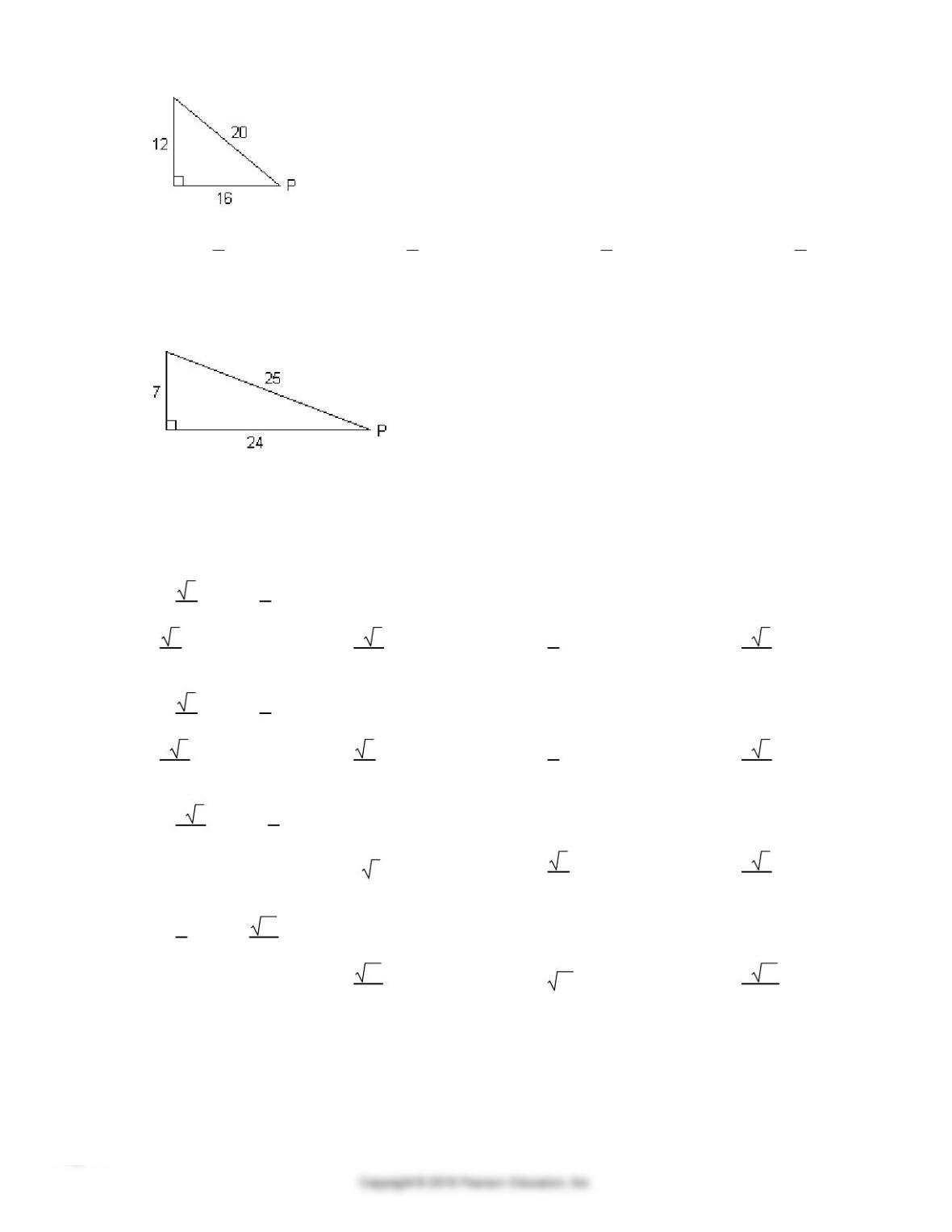
Solvetheproblem.
11) FindtanP.
A) tanP=3
5B) tanP=4
5C) tanP=4
3D) tanP=3
4
SHORTANSWER.Writethewordorphrasethatbestcompleteseachstatementoranswersthequestion.
12) FindtheexactvalueofeachofthesixtrigonometricfunctionsoftheangleP.
2 UsetheFundamentalIdentities
MULTIPLECHOICE.Choosetheonealternativethatbestcompletesthestatementoranswersthequestion.
Useidentitiestofindtheexactvalueoftheindicatedtrigonometricfunctionoftheacuteangleθ.
1) sinθ=7
4,cosθ=3
4Findtanθ.
A) 7
3B) 37
7C) 4
3D) 47
7
2) sinθ=5
3,cosθ=2
3Findcotθ.
A) 25
5B) 5
2C) 3
2D) 35
5
3) sinθ=22
3,cosθ=1
3Findsecθ.
A) 3 B) 2 2 C) 2
4D) 32
4
4) sinθ=1
4,cosθ=15
4Findcscθ.
A) 4 B) 15
15 C) 15 D) 415
15
UseFundamentalIdentitiesand/ortheComplementaryAngleTheoremtofindtheexactvalueoftheexpression.
Donotuseacalculator.
5) sin255°+cos255°
A) 1 B) 0 C) 2 D) –1
Page15
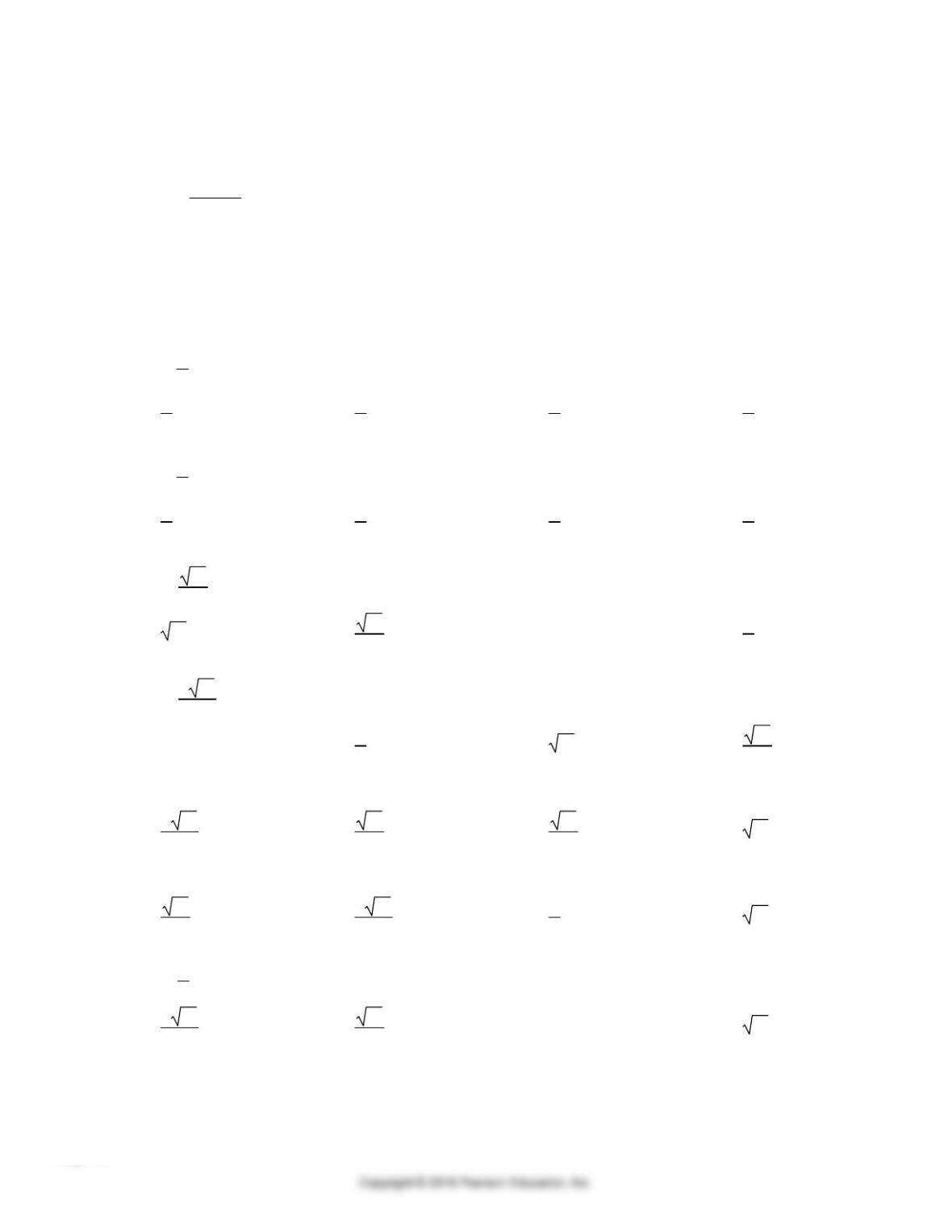
6) sec235°–tan235°
A) 1 B) 0 C) –1D)2
7) sin55°csc55°
A) 1 B) 0 C) 55 D) –1
8) tan20°–sin20°
cos20°
A) 0 B) 1 C) 20 D) undefined
3 FindtheValuesoftheRemainingTrigonometricFunctions,GiventheValueofOneofThem
MULTIPLECHOICE.Choosetheonealternativethatbestcompletesthestatementoranswersthequestion.
Usethedefinitionoridentitiestofindtheexactvalueoftheindicatedtrigonometricfunctionoftheacuteangleθ.
1) sinθ=4
5Findtanθ.
A) 4
3B) 3
4C) 5
3D) 5
4
2) sinθ=4
5Findcscθ.
A) 5
4B) 4
3C) 5
3D) 3
4
3) cosθ=10
10 Findsecθ.
A) 10 B) 10
3C) 3 D) 1
3
4) cosθ=310
10 Findcotθ.
A) 3 B) 1
3C) 10 D) 10
3
5) tanθ=3 Findsinθ.
A) 310
10 B) 10
10 C) 10
3D) 10
6) tanθ=3 Findcosθ.
A) 10
10 B) 310
10 C) 1
3D) 10
7) cotθ=1
3Findsinθ.
A) 310
10 B) 10
10 C) 3 D) 10
Page16
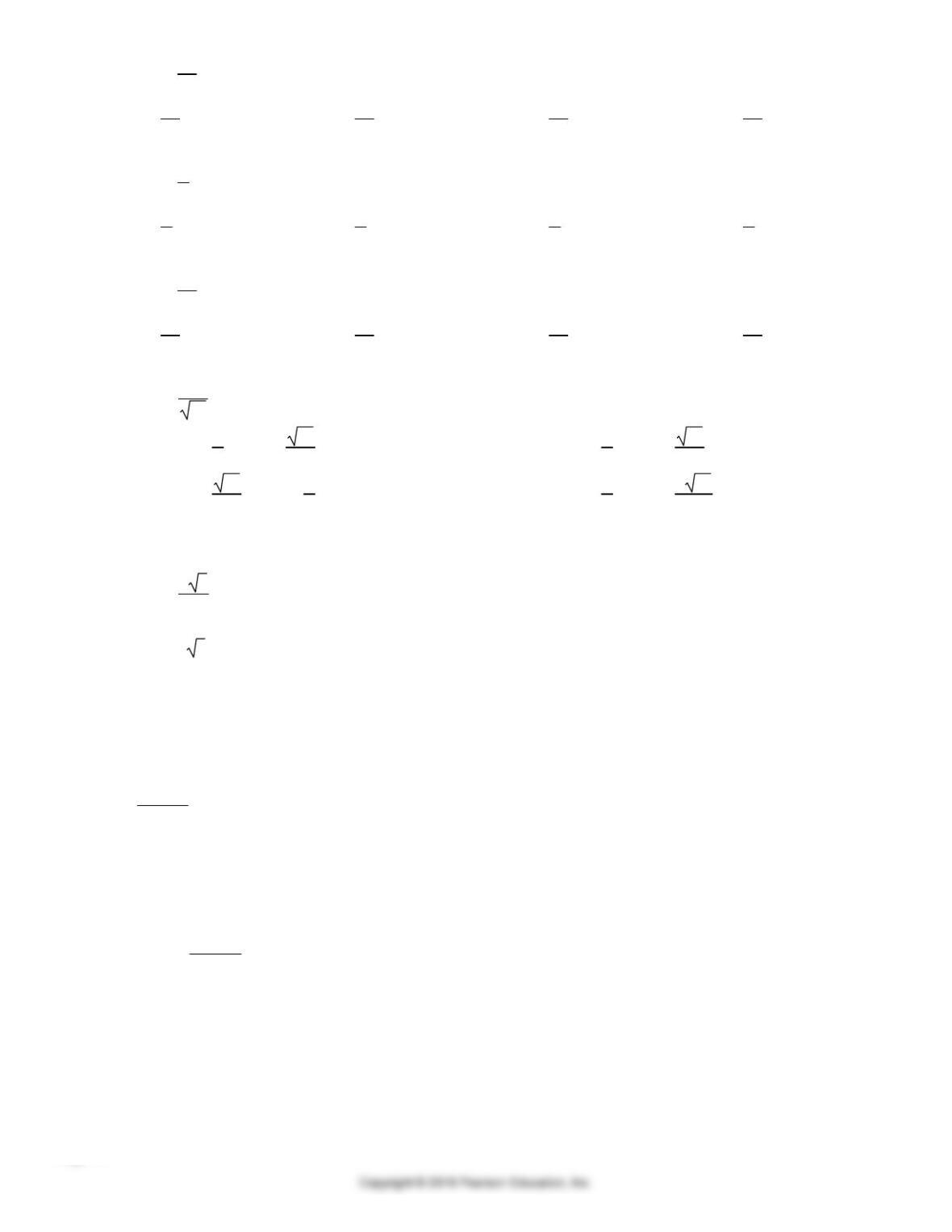
8) secθ=13
12 Findcscθ.
A) 13
5B) 5
13 C) 12
13 D) 12
5
9) secθ=5
3Findcotθ.
A) 3
4B) 4
5C) 3
5D) 5
4
10) cscθ=13
5Findcosθ.
A) 12
13 B) 5
13 C) 12
5D) 13
12
11) tanθ=7
15 Findsinθandcosθ.
A) sinθ=7
8,cosθ=15
8B) sinθ=8
7,cosθ=15
8
C) sinθ=15
8,cosθ=7
8D) sinθ=7
8,cosθ=815
15
SHORTANSWER.Writethewordorphrasethatbestcompleteseachstatementoranswersthequestion.
12) cosθ=26
5Findsinθandtanθ.
13) tanθ=26 Findtheremainingfivetrigonometricfunctionsoftheacuteangleθ.
4 UsetheComplementaryAngleTheorem
MULTIPLECHOICE.Choosetheonealternativethatbestcompletesthestatementoranswersthequestion.
UseFundamentalIdentitiesand/ortheComplementaryAngleTheoremtofindtheexactvalueoftheexpression.
Donotuseacalculator.
1) –sec40°
csc50°
A) –1 B) 0 C) 1 D) undefined
2) csc235°–tan255°
A) 1 B) 0 C) –1D)2
3) tan70°–cos20°
cos70°
A) 0 B) 1 C) –1D)2
4) cos75°sin15°+sin75°cos15°
A) 1 B) 0 C) –1D)2
5) Iftan2θ=6,findtheexactvalueofsec2θ.
A) 7 B) 6 C) 5 D) 12
Page17
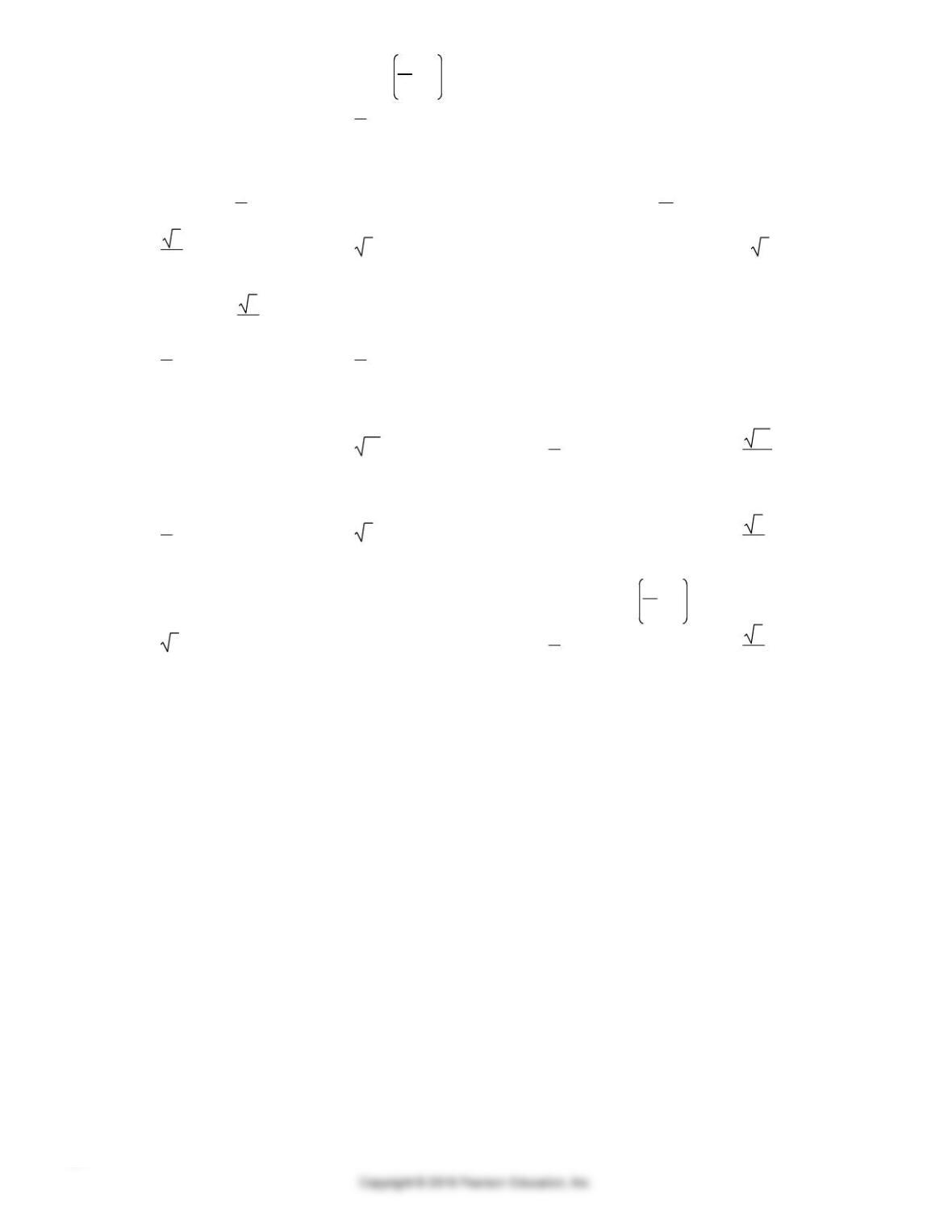
6) Iftanθ=7,findtheexactvalueofcotπ
2–θ .
A) 7 B) 1
7C) 6 D) 8
Solvetheproblem.
7) Givensin30°=1
2,usetrigonometricidentitiestofindtheexactvalueoftanπ
6.
A) 3
3B) 3 C) 3 D) 3 3
8) Givencos30°=3
2,usetrigonometricidentitiestofindtheexactvalueofsin230°.
A) 1
4B) 1
2C) 1 D) 3
9) Givencotθ=4,usetrigonometricidentitiestofindtheexactvalueofcsc2θ.
A) 17 B) 17 C) 1
4D) 17
4
10) Givencscθ=2,usetrigonometricidentitiestofindtheexactvalueofsinθ.
A) 1
2B) 2 C) 2 D) 3
2
11) Giventanθ=2,usetrigonometricidentitiestofindtheexactvalueofcscπ
2–θ .
A) 5 B) 2 C) 1
2D) 5
2
12) Giventheapproximationsin20°≈0.34
,
usetrigonometricidentitiestofindtheapproximatevalueofcos
20°.Roundtheanswertotwodecimalplaces.
A) 0.94 B) 0.34 C) 0.36 D) 1.06
13) Giventheapproximationsin20°≈0.34
,
usetrigonometricidentitiestofindtheapproximatevalueofcot
20°.Ifnecessary,roundtheanswertotwodecimalplaces.
A) 2.75 B) 0.36 C) 0.94 D) 1.06
14) Giventheapproximationcos25°≈0.91
,
usetrigonometricidentitiestofindtheapproximatevalueo
f
csc
25°.Ifnecessary,roundtheanswertotwodecimalplaces.
A) 2.37 B) 1.1 C) 0.42 D) 0.47
15) Giventheapproximationcos26°≈0.90
,
usetrigonometricidentitiestofindtheapproximatevalueo
f
sin
64°.Ifnecessary,roundtheanswertotwodecimalplaces.
A) 0.9 B) 0.44 C) 0.49 D) 1.11
16) Ifcscθ=2,findthevalueofcscθ+sec(90° –θ).Ifnecessary,roundtheanswertotwodecimalplaces.
A) 1.58 B) 2 C) –0.42 D) 4
Page18
SHORTANSWER.Writethewordorphrasethatbestcompleteseachstatementoranswersthequestion.
17) Ifcosθ=1
6,findtheexactvalueof(i)sin(90°–θ)and(ii)csc(π
2–θ).
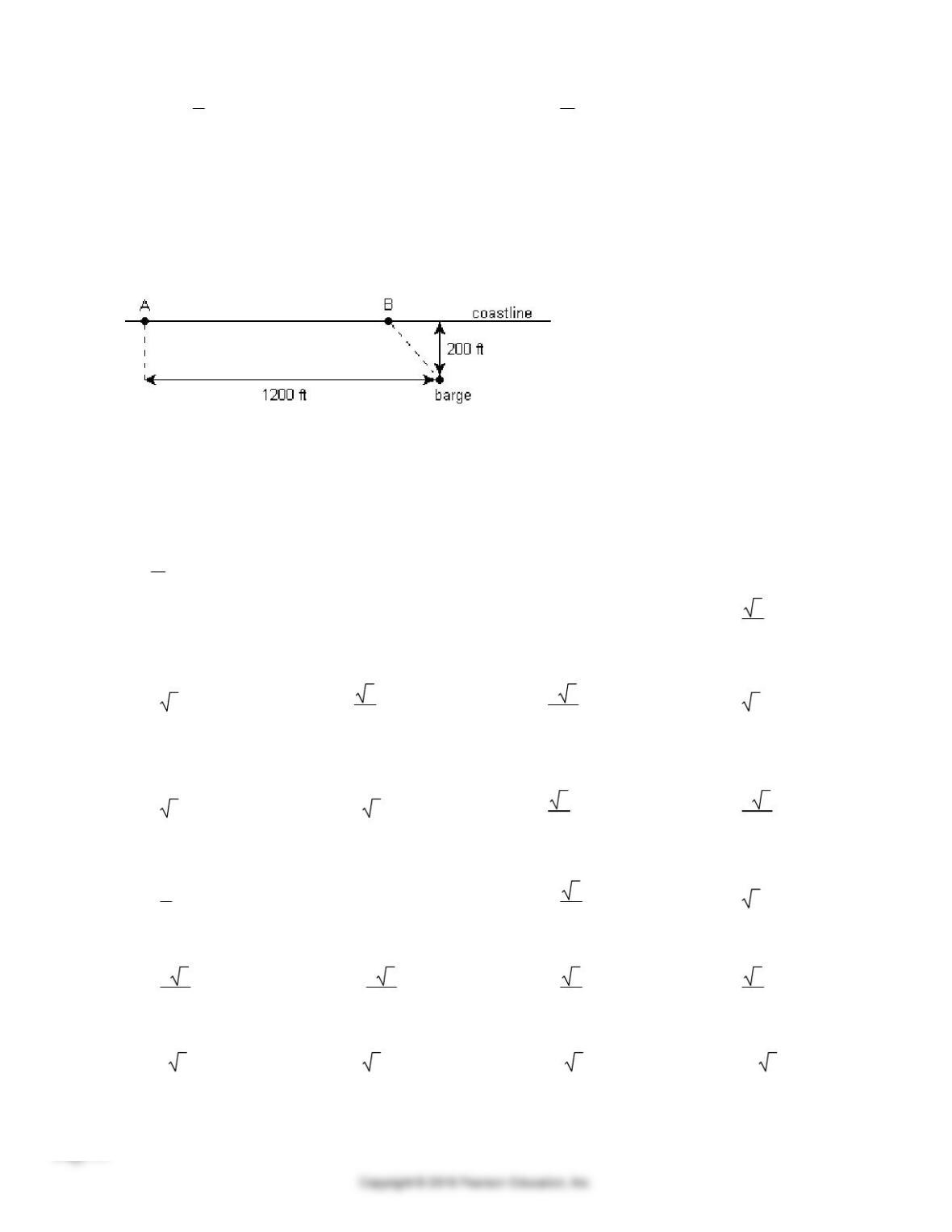
18) Abargeislocated200feetawayfromthecoastline1200feetdownthecoastfromapowersourceatpoint
A.Tosupplythebargewithelectricity,apowerlinewillberunfrompointAtoapointBonthecoastand
thenfrompointBtothebarge.Ifpowerlinesonlandcoast$3perfootandpowerlinesunderwatercost
$5perfoot,calculatethetotalcostofrunningapowerlinefrompointAtothebargewhenpointBis800
feetdownthecoastfrompointAinthedirectionofthebarge.Recalculatethetotalcostwhenthedistance
fromAtoBisincreasedin50–footincrements,untilyoulocateapossibleminimumcost.Interpretyour
solution.
7.3 ComputingtheValuesofTrigonometricFunctionsofAcuteAngles
1 FindtheExactValuesoftheTrigonometricFunctionsofπ/4=45°
MULTIPLECHOICE.Choosetheonealternativethatbestcompletesthestatementoranswersthequestion.
Findtheexactvalue.Donotuseacalculator.
1) tanπ
4
A) 1 B) –1C)0 D)
3
3
2) sec45°
A) 2 B) 2
2C) 23
3D) 3
Findtheexactvalueoftheexpressionifθ=45°.Donotuseacalculator.
3) f(θ)=secθ Findf(θ).
A) 2 B) –2 C) 2
2D) 23
3
4) g(θ)=cosθ Find[g(θ)]2.
A) 1
2B) 2 C) –2
2D) 2
5) f(θ)=cosθ Find5f(θ).
A) 52
2B) –52
2C) –2
2D) 2
2
6) g(θ)=sinθ Find4g(θ).
A) 2 2 B) 4 2 C) –22 D) –42
Page19
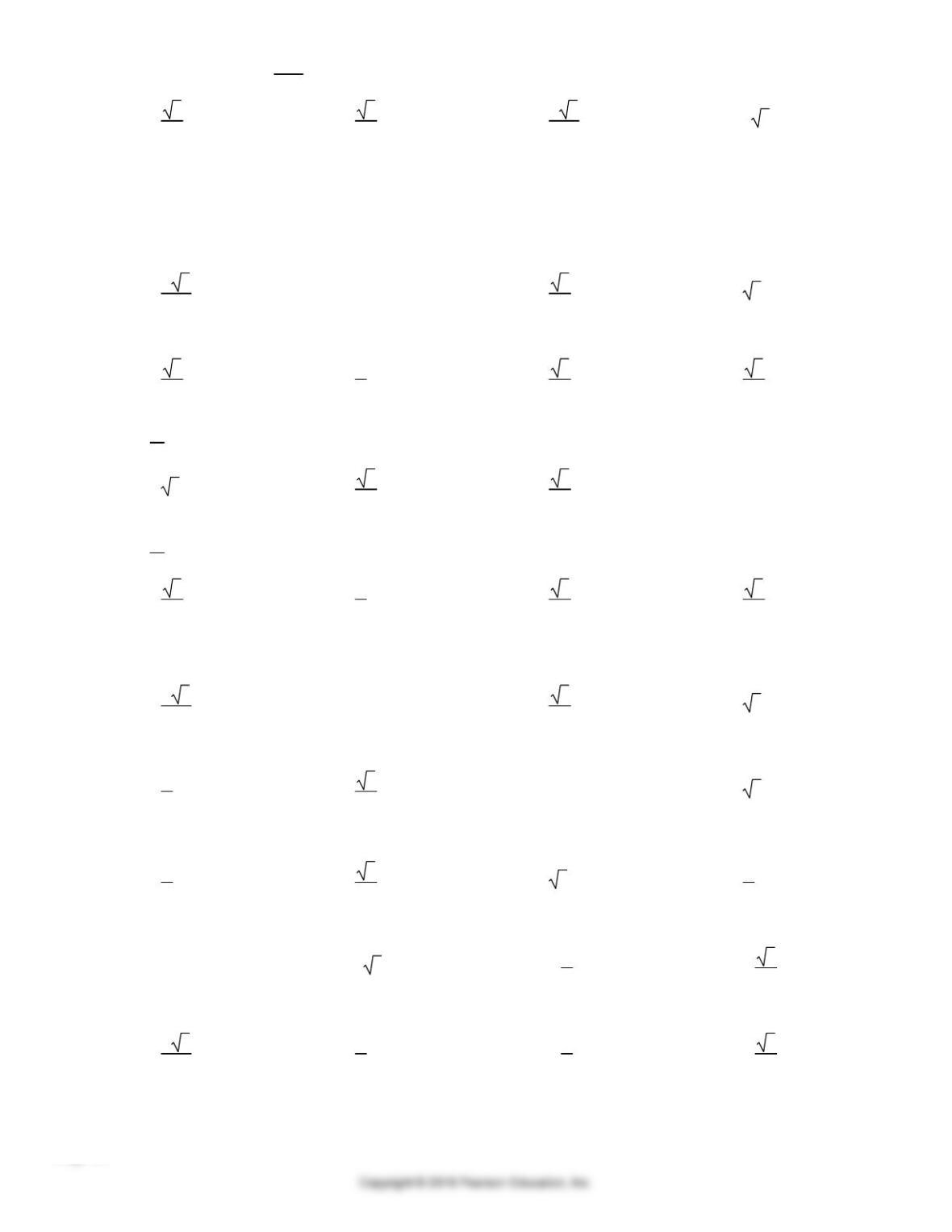
7) f(θ)=sinθ Findf(θ)
4.
A) 2
8B) 2
4C) 42
2D) 8 2
2 FindtheExactValuesoftheTrigonometricFunctionsofπ/6=30°andπ/3=60°
MULTIPLECHOICE.Choosetheonealternativethatbestcompletesthestatementoranswersthequestion.
Findtheexactvalue.Donotuseacalculator.
1) sec30°
A) 23
3B) 2 C) 3
2D) 2
2) sin60°
A) 3
2B) 1
2C) 3
3D) 2
2
3) cotπ
6
A) 3 B) 3
3C) 3
2D) 1
4) sinπ
3
A) 3
2B) 1
2C) 3
3D) 2
2
Findtheexactvalueoftheexpressionifθ=30°.Donotuseacalculator.
5) f(θ)=secθ Findf(θ).
A) 23
3B) 2 C) 3
2D) 2
6) g(θ)=cosθ Findg(2θ).
A) 1
2B) 3
2C) 1 D) 3
7) f(θ)=cosθ Find[f(θ)]2.
A) 3
4B) 3
2C) 3 D) 1
4
8) g(θ)=sinθ Find6g(θ).
A) 3 B) 3 3 C) –1
2D) –3
2
9) f(θ)=cosθ Find7f(θ).
A) 73
2B) 7
2C) –1
2D) –3
2
Page20
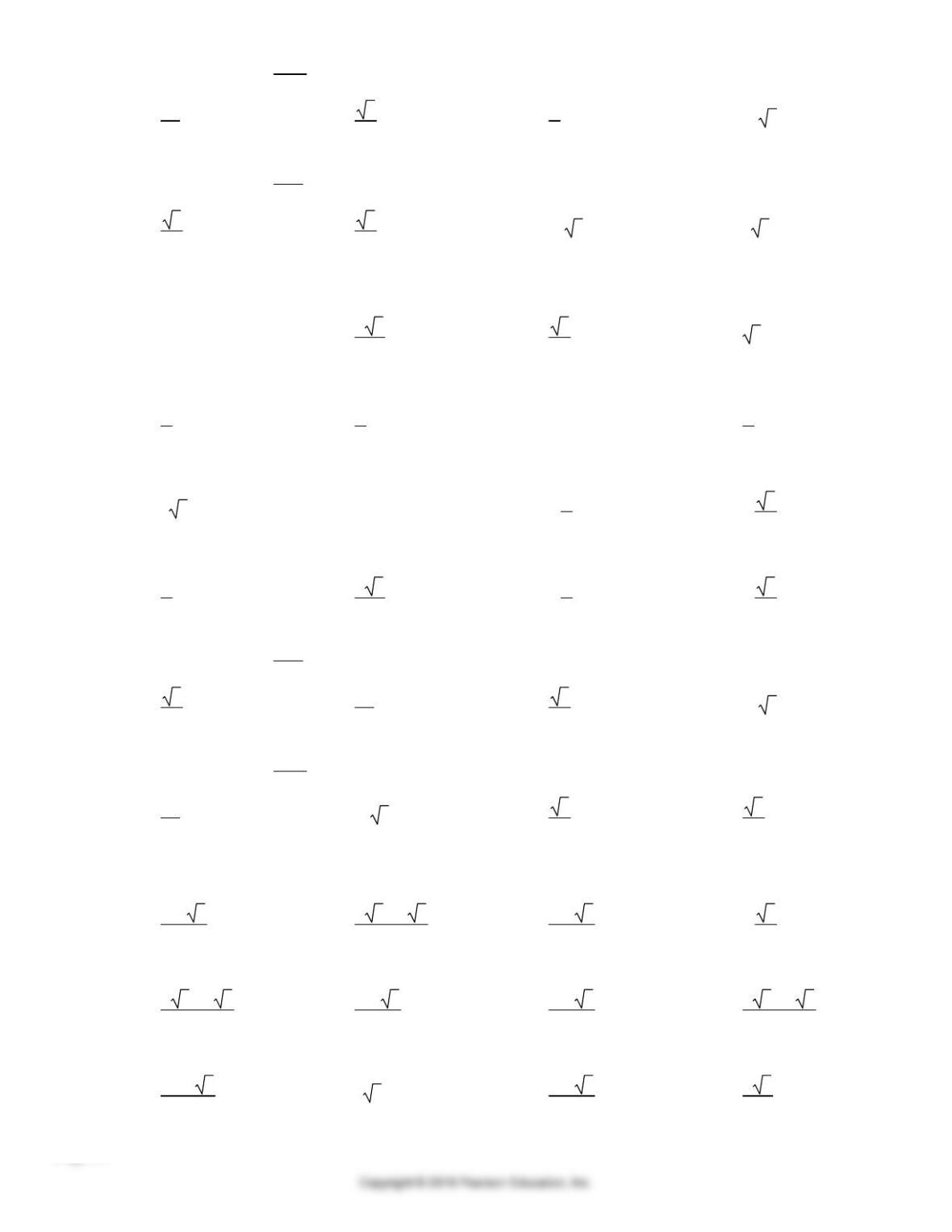
10) g(θ)=sinθ Findg(θ)
7.
A) 1
14 B) 3
14 C) 1
7D) 14 3
11) f(θ)=cosθ Findf(θ)
8.
A) 3
16 B) 3
4C) 16 3 D) 4 3
Findtheexactvalueoftheexpressionifθ=60°.Donotuseacalculator.
12) f(θ)=secθ Findf(θ).
A) 2 B) 23
3C) 3
2D) 2
13) g(θ)=sinθ Find[g(θ)]2.
A) 3
4B) 1
2C) 1 D) 1
4
14) f(θ)=sinθ Find4f(θ).
A) 2 3 B) 2 C) –1
2D) –3
2
15) g(θ)=cosθ Find9g(θ).
A) 9
2B) 93
2C) –1
2D) –3
2
16) f(θ)=sinθ Findf(θ)
12 .
A) 3
24 B) 1
24 C) 3
12 D) 24 3
17) g(θ)=cosθ Findg(θ)
6.
A) 1
12 B) 12 3 C) 3
12 D) 3
3
Findtheexactvalueoftheexpression.Donotuseacalculator.
18) cot45°–cos30°
A) 2–3
2B) 23
–32
6C) 2–2
2D) –3
6
19) sec30°–sin45°
A) 43
–32
6B) 4–2
2C) 4–3
2D) 42
–33
6
20) cos60°+tan60°
A) 1+23
2B) 2 3 C) 1+3
2D) 33
2
Page21
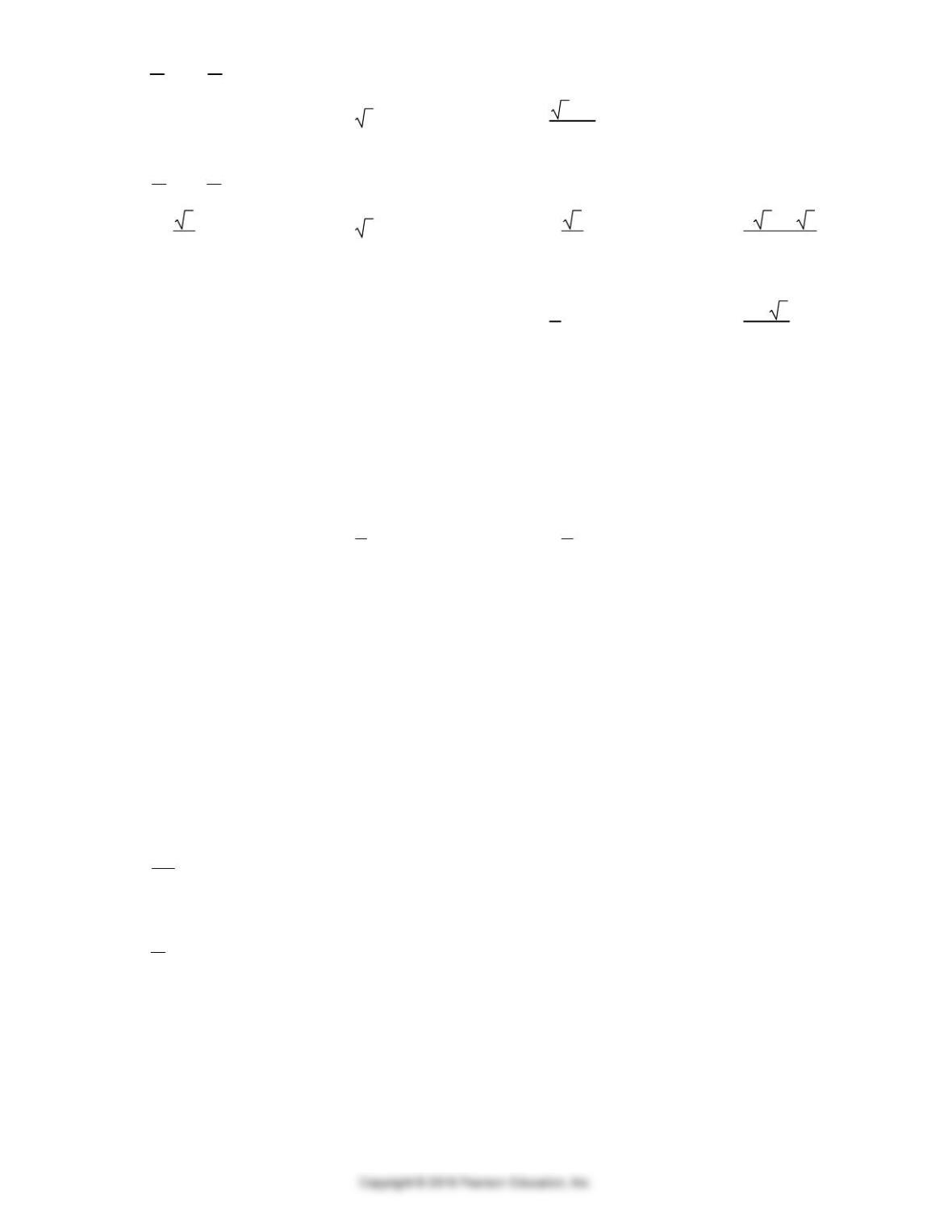
21) sinπ
3–cosπ
6
A) 0 B) 3 C) 3–1
2D) 1
22) tanπ
6–sinπ
3
A) –3
6B) 3 C) –6
2D) 23
–32
6
23) 1–sin230°–sin260°
A) 0 B) 1 C) 1
4D) 1–3
2
24) 1+cot230°–sec245°
A) 2 B) 1 C) 0 D) 3
25) 3cot245°+8sin230°
A) 5 B) πC) 3 D) 7
26) sin260°–cos245°–sin230°
A) 0 B) 3
2C) –1
2D) 3
3 UseaCalculatortoApproximatetheValuesoftheTrigonometricFunctionsofAcuteAngles
MULTIPLECHOICE.Choosetheonealternativethatbestcompletesthestatementoranswersthequestion.
Useacalculatortofindtheapproximatevalueoftheexpression.Roundtheanswertotwodecimalplaces.
1) sin20°
A) 0.34 B) 0.46 C) 0.91 D) 1.03
2) cos27°
A) 0.89 B) 1.02 C) –0.29 D) –0.16
3) tan38°
A) 0.78 B) 0.68 C) 0.31 D) 0.41
4) cos2π
5
A) 0.31 B) 0.25 C) 1.00 D) 1.06
5) secπ
7
A) 1.11 B) 1.16 C) 1.00 D) 0.95
6) csc31°
A) 1.94 B) 1.83 C) –2.48 D) –2.59
Page22
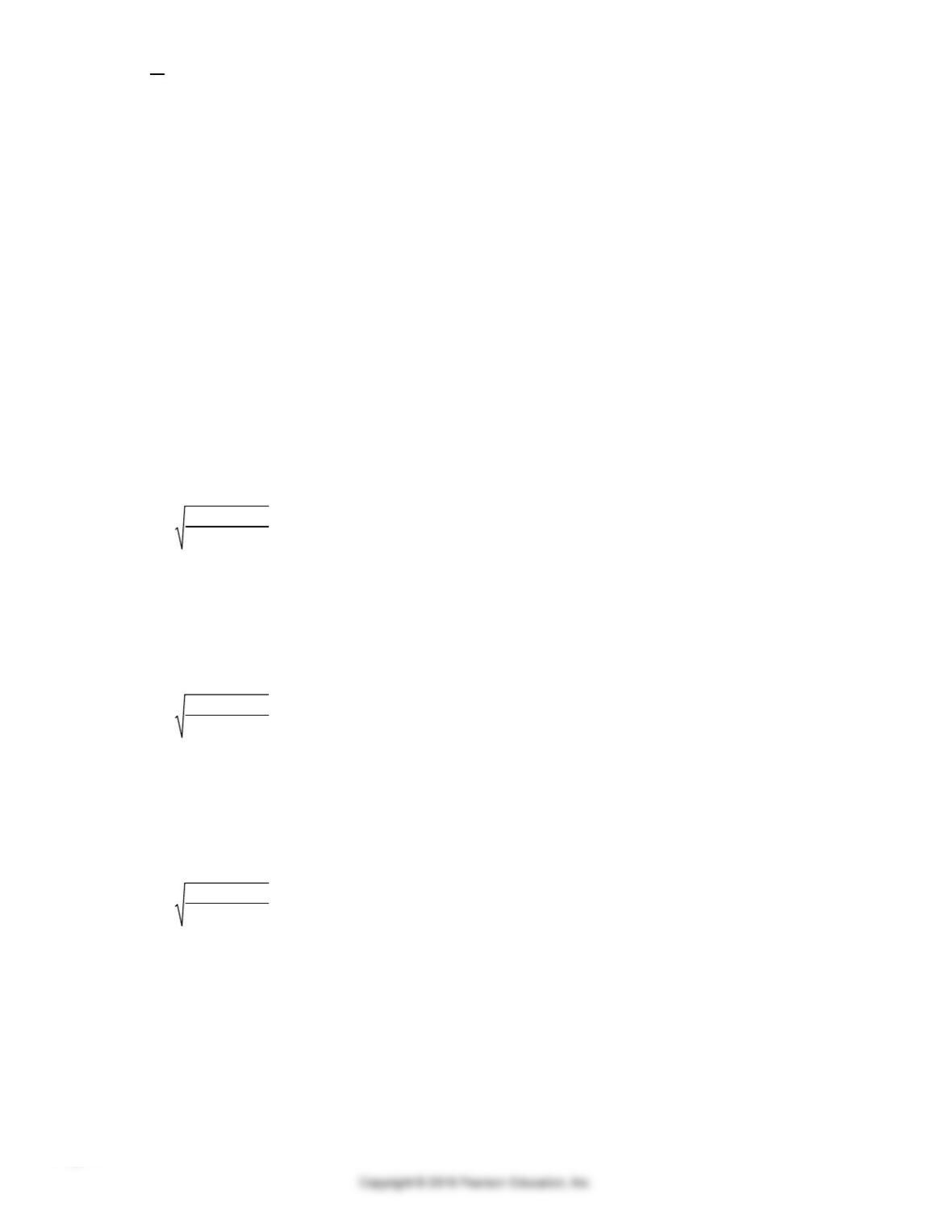
7) cotπ
7
A) 2.08 B) 2.19 C) 127.66 D) 127.77
8) cot0.2988
A) 3.25 B) 0.31 C) 0.96 D) 1.05
9) cos2
A) –0.42 B) 1.00 C) 0.42 D) –1.00
10) cos7°
A) 0.99 B) –0.75 C) –0.99 D) 0.75
11) tan37°
A) 0.75 B) –0.84 C) 0.80 D) 0.60
4 ModelandSolveAppliedProblemsInvolvingRightTriangles
MULTIPLECHOICE.Choosetheonealternativethatbestcompletesthestatementoranswersthequestion.
Solvetheproblem.
1) Iffrictionisignored,thetimet(inseconds)requiredforablocktoslidedownaninclinedplaneisgivenby
theformula
t=2a
gsinθcosθ
whereaisthelength(infeet)ofthebaseandg≈32feetpersecondpersecondistheaccelerationof
gravity.Howlongdoesittakeablocktoslidedownaninclinedplanewithbasea=12whenθ=45°?If
necessary,roundtheanswertothenearesttenthofasecond.
A) 1.2sec B) 1.3sec C) 0.3 sec D) 1sec
2) Iffrictionisignored,thetimet(inseconds)requiredforablocktoslidedownaninclinedplaneisgivenby
theformula
t=2a
gsinθcosθ
whereaisthelength(infeet)ofthebaseandg≈32feetpersecondpersecondistheaccelerationof
gravity.Howlongdoesittakeablocktoslidedownaninclinedplanewithbasea=14whenθ=60°?If
necessary,roundtheanswertothenearesttenthofasecond.
A) 1.4sec B) 1.7sec C) 0.4 sec D) 1.2sec
3) Iffrictionisignored,thetimet(inseconds)requiredforablocktoslidedownaninclinedplaneisgivenby
theformula
t=2a
gsinθcosθ
whereaisthelength(infeet)ofthebaseandg≈32feetpersecondpersecondistheaccelerationof
gravity.Howlongdoesittakeablocktoslidedownaninclinedplanewithbasea=14whenθ=67°?If
necessary,roundtheanswertothenearesttenthofasecond.
A) 1.6sec B) 1.4sec C) 0.5 sec D) 1.9sec
Page23

4) Theforceactingonapendulumtobringittoitsperpendicularrestingpointiscalledtherestoringforce.
TherestoringforceF,inNewtons,actingonastringpendulumisgivenbytheformula
F=mgsinθ
wheremisthemassinkilogramsofthependulumʹsbob,g≈9.8meterspersecondpersecondisthe
accelerationduetogravity,andθisangleatwhichthependulumisdisplacedfromtheperpendicular.
Whatisthevalueoftherestoringforcewhenm=0.5kilogramandθ=45°?Ifnecessary,roundtheanswer
tothenearesttenthofaNewton.
A) 3.5N B) 4.2N C) 3.3 N D) 3.7N
5) Theforceactingonapendulumtobringittoitsperpendicularrestingpointiscalledtherestoringforce.
TherestoringforceF,inNewtons,actingonastringpendulumisgivenbytheformula
F=mgsinθ
wheremisthemassinkilogramsofthependulumʹsbob,g≈9.8meterspersecondpersecondisthe
accelerationduetogravity,andθisangleatwhichthependulumisdisplacedfromtheperpendicular.
Whatisthevalueoftherestoringforcewhenm=0.9kilogramandθ=30°?Ifnecessary,roundtheanswer
tothenearesttenthofaNewton.
A) 4.4N B) 8.7N C) 7.6 N D) 4.3N
6) Theforceactingonapendulumtobringittoitsperpendicularrestingpointiscalledtherestoringforce.
TherestoringforceF,inNewtons,actingonastringpendulumisgivenbytheformula
F=mgsinθ
wheremisthemassinkilogramsofthependulumʹsbob,g≈9.8meterspersecondpersecondisthe
accelerationduetogravity,andθisangleatwhichthependulumisdisplacedfromtheperpendicular.
Whatisthevalueoftherestoringforcewhenm=0.9kilogramandθ=75°?Ifnecessary,roundtheanswer
tothenearesttenthofaNewton.
A) 8.5N B) 3.4N C) 2.3 N D) 8.7N
7) Asurveyorismeasuringthedistanceacrossasmalllake.Hehassetuphistransitononesideofthelake
110feetfromapilingthatisdirectlyacrossfromapierontheothersideofthelake.Fromhistransit,the
anglebetweenthepilingandthepieris30°.Whatisthedistancebetweenthepilingandthepiertothe
nearestfoot?
A) 64ft B) 55ft C) 95 ft D) 191 ft
8) Aradiotransmissiontoweris160feettall.Howlongshouldaguywirebeifitistobeattached12 feet
fromthetopandistomakeanangleof20°withtheground?Giveyouranswertothenearesttenthofa
foot.
A) 432.7ft B) 467.8 ft C) 157.5 ft D) 170.3 ft
9) Abuilding200feettallcastsa80footlongshadow.Ifapersonlooksdownfromthetopofthebuilding,
whatisthemeasureoftheanglebetweentheendoftheshadowandtheverticalsideofthebuilding(to
thenearestdegree)?(Assumethepersonʹseyesarelevelwiththetopofthebuilding.)
A) 22° B) 68° C) 66° D) 24°
10)
J
ohn(whoselineofsightis6ftabovehorizontal)istryingtoestimatetheheightofatalloaktree.Hefirst
measurestheangleofelevationfromwhereheisstandingas35°.Hewalks30feetclosertothetreeand
findsthattheangleofelevationhasincreasedby12°.Estimatetheheightofthetreeroundedtothenearest
wholenumber.
A) 67ft B) 90ft C) 86ft D) 61ft
Page24

11) Aphotographerpointsacameraatawindowinanearbybuildingforminganangleof42°withthe
cameraplatform.Ifthecamerais52mfromthebuilding,howhighabovetheplatformisthewindow,to
thenearesthundredthofameter?
A) 46.82m B) 0.9m C) 1.11m D) 57.75m
12) Atreecastsashadowof26meterswhentheangleofelevationofthesunis24°.Findtheheightofthetree
tothenearestmeter.
A) 12mB)11mC)10mD)13m
13) Atwenty–fivefootladderjustreachesthetopofahouseandformsanangleof41.5°withthewallofthe
house.Howtallisthehouse?Roundyouranswertothenearest0.1foot.
A) 18.7ft B) 18.6ft C) 18.8ft D) 19ft
14) Twohikersonoppositesidesofacanyoneachstandprecisely525metersabovethecanyonfloor.They
eachsightalandmarkonthecanyonflooronalinedirectlybetweenthem.Theanglesofdepressionfrom
eachhikertothelandmarkmeterare37°and21°.Howfarapartarethehikers?Roundyouranswertothe
nearestwholemeter.
A) 2064m B) 2065m C) 2063m D) 1064m
15) Fromtheedgeofa1000–footcliff,theanglesofdepressiontotwocarsinthevalleybeloware21° and28°.
Howfarapartarethecars?Roundyouranswerstothenearest0.1ft.
A) 724.4ft B) 724.5ft C) 714.4ft D) 713.4ft
7.4 TrigonometricFunctionsofAnyAngle
1 FindtheExactValuesoftheTrigonometricFunctionsforAnyAngle
MULTIPLECHOICE.Choosetheonealternativethatbestcompletesthestatementoranswersthequestion.
Apointontheterminalsideofangleθisgiven.Findtheexactvalueoftheindicatedtrigonometricfunction.
1) (12
,
16) Findsinθ.
A) 4
5B) 3
5C) 3
4D) 4
3
2) (18
,
24) Findcosθ.
A) 3
5B) 4
5C) 3
4D) 4
3
3) (–10
,
24) Findsinθ.
A) 12
13 B) 5
13 C) –5
13 D) –12
13
4) (12
,
16) Findcscθ.
A) 5
4B) 5
3C) 3
4D) 4
3
5) (–7
,
–2) Findtanθ.
A) 2
7B) 7
2C) –1D)
–2
7
6) (4
,
–3) Findsinθ.
A) –3
5B) 4
5C) 5
4D) –3
Page25
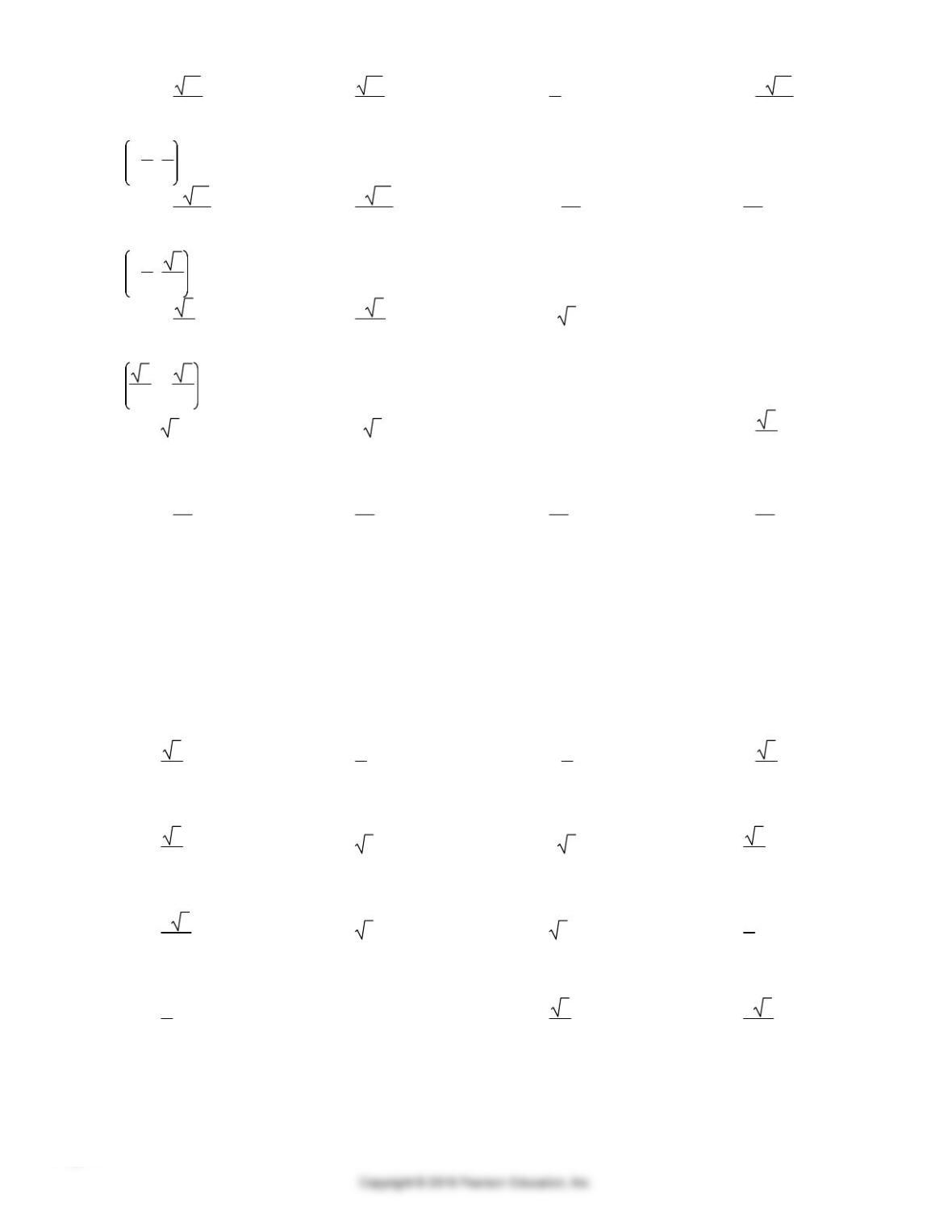
7) (–2
,
–3) Findsecθ.
A) –13
2B) 13
3C) 3
2D) –213
13
8) –1
2,1
5Findcosθ.
A) –529
29 B) 229
29 C) –29
2D) 29
5
9) –1
2,3
2Findcotθ.
A) –3
3B) 23
3C) –3 D) –2
10) 2
2,–2
2Findsecθ.
A) 2 B) –2 C) –1D)
–2
2
11) (–5,–12) Findcotθ.
A) –5
13 B) 5
12 C) 12
5D) –12
13
SHORTANSWER.Writethewordorphrasethatbestcompleteseachstatementoranswersthequestion.
12) (5,12) Findsinθ.
2 UseCoterminalAnglestoFindtheExactValueofaTrigonometricFunction
MULTIPLECHOICE.Choosetheonealternativethatbestcompletesthestatementoranswersthequestion.
Useacoterminalangletofindtheexactvalueoftheexpression.Donotuseacalculator.
1) sin405°
A) 2
2B) 1
2C) –1
2D) –2
2
2) cot780°
A) 3
3B) 3 C) –3 D) 3
2
3) sec390°
A) 23
3B) 2 C) 3 D) 1
2
4) cos420°
A) 1
2B) 2 C) 3
2D) 23
3
5) cot900°
A) –1 B) 0 C) 1 D) undefined
Page26
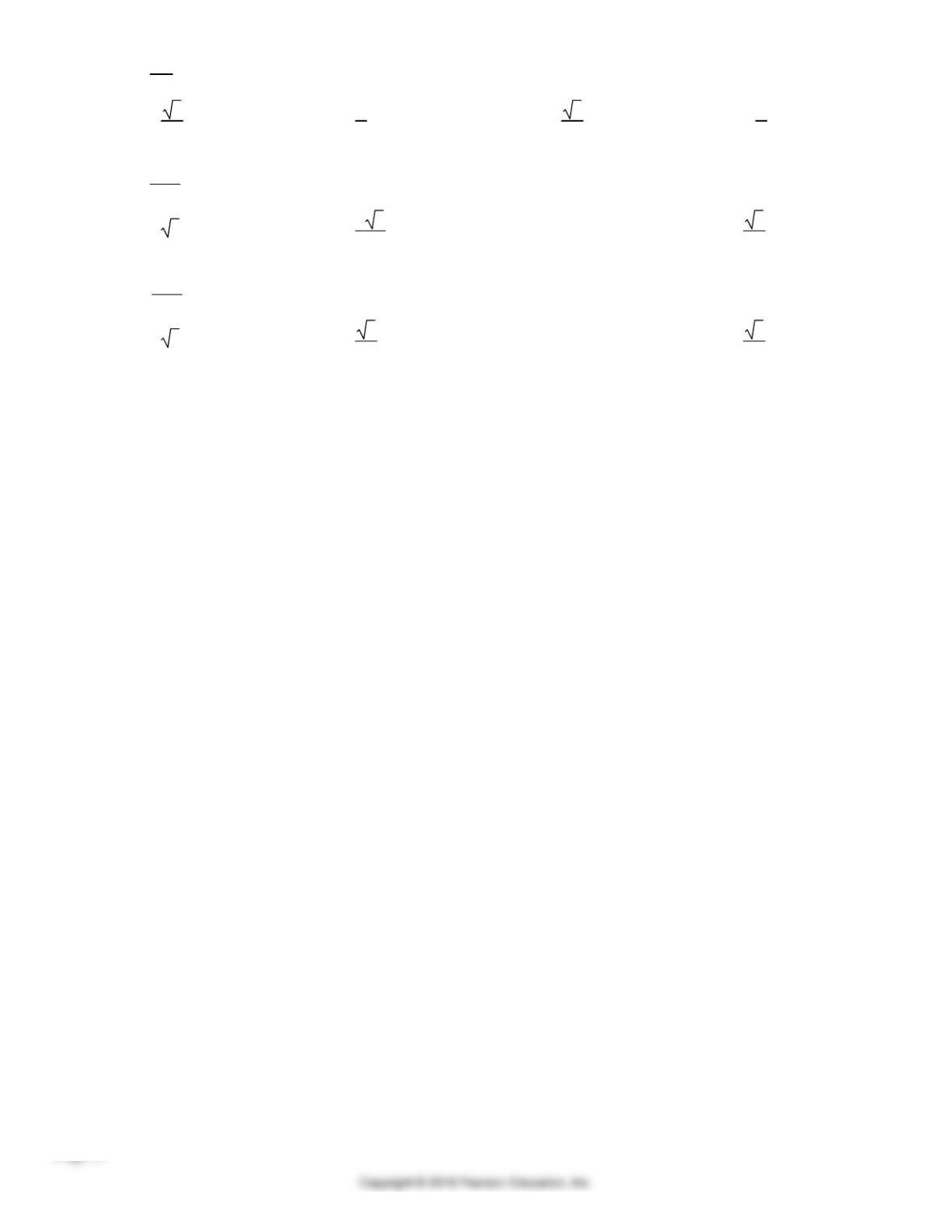
6) sin7π
3
A) 3
2B) 1
2C) –3
2D) –1
2
7) csc25π
4
A) 2 B) 23
3C) 2 D) 2
2
8) tan25π
3
A) 3 B) 3
3C) 1 D) 3
2
9) sin(7π)
A) 0 B) 1 C) –1 D) undefined
3 DeterminetheSignsoftheTrigonometricFunctionsofanAngleinaGivenQuadrant
MULTIPLECHOICE.Choosetheonealternativethatbestcompletesthestatementoranswersthequestion.
Namethequadrantinwhichtheangleθlies.
1) tanθ>0, sinθ
<
0
A) I B) II C) III D) IV
2) cosθ
<
0, cscθ
<
0
A) I B) II C) III D) IV
3) sinθ>0, cosθ
<
0
A) I B) II C) III D) IV
4) cotθ
<
0, cosθ>0
A) I B) II C) III D) IV
5) cscθ>0, secθ>0
A) I B) II C) III D) IV
6) secθ
<
0, tanθ
<
0
A) I B) II C) III D) IV
7) tanθ
<
0, sinθ
<
0
A) I B) II C) III D) IV
8) cosθ>0, cscθ
<
0
A) I B) II C) III D) IV
9) cotθ>0, sinθ
<
0
A) I B) II C) III D) IV
10) sinθ>0, cosθ>0
A) I B) II C) III D) IV
Page27

Solvetheproblem.
11) Whichofthefollowingtrigonometricvaluesarenegative?
I. sin(–292°)
II. tan(–193°)
III. cos(–207°)
IV. cot222°
A) IIIonly B) IIandIII C) II,III,andIV D) IandIII
SHORTANSWER.Writethewordorphrasethatbestcompleteseachstatementoranswersthequestion.
12) Determinethesignofthetrigonometricvalueslistedbelow.
(i)sin250°
(ii)tan330°
(iii)cos(–40°)
4 FindtheReferenceAngleofanAngle
MULTIPLECHOICE.Choosetheonealternativethatbestcompletesthestatementoranswersthequestion.
Findthereferenceangleofthegivenangle.
1) 42°
A) 42° B) 48° C) 138° D) 132°
2) 113°
A) 67° B) 23° C) 77° D) 33°
3) 443°
A) 83° B) 7° C) 97° D) 173°
4) –433°
A) 73° B) 17° C) 107° D) 163°
5) –36°
A) 36° B) 54° C) 144° D) 126°
6) –183°
A) 3° B) 87° C) 93° D) 177°
7) –517°
A) 113° B) 23° C) 157° D) 67°
8) 13π
12
A) π
12 B) 11π
12 C) π
24 D) 13π
12
9) 11π
12
A) π
12 B) 11π
12 C) 13π
12 D) π
24
Page28
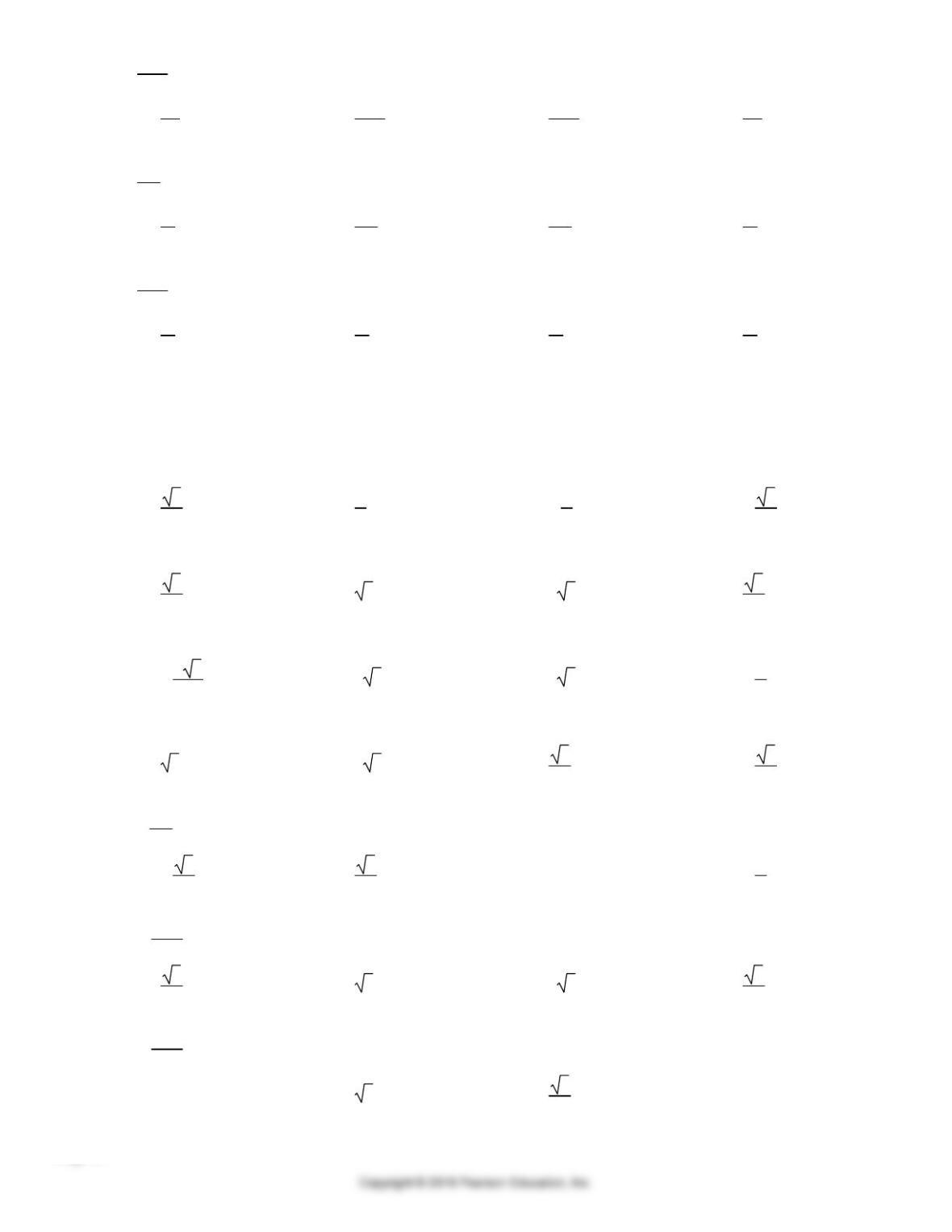
10) –13π
12
A) π
12 B) 11π
12 C) 13π
12 D) π
24
11) –3π
4
A) π
4B) 3π
4C) 5π
4D) π
8
12) –42π
8
A) π
4B) π
2C) π
3D) π
8
5 UseaReferenceAngletoFindtheExactValueofaTrigonometricFunction
MULTIPLECHOICE.Choosetheonealternativethatbestcompletesthestatementoranswersthequestion.
Usethereferenceangletofindtheexactvalueoftheexpression.Donotuseacalculator.
1) sin495°
A) 2
2B) 1
2C) –1
2D) –2
2
2) tan750°
A) 3
3B) 3 C) –3 D) 3
2
3) csc1020°
A) –23
3B) –2 C) –3 D) –1
2
4) cot570°
A) 3 B) –3 C) 3
3D) –3
3
5) sin5π
3
A) –3
2B) 3
2C) –1D)
–1
2
6) tan–5π
6
A) 3
3B) 3 C) –3 D) 3
2
7) tan–3π
4
A) 1 B) 3 C) 3
3D) –1
Page29
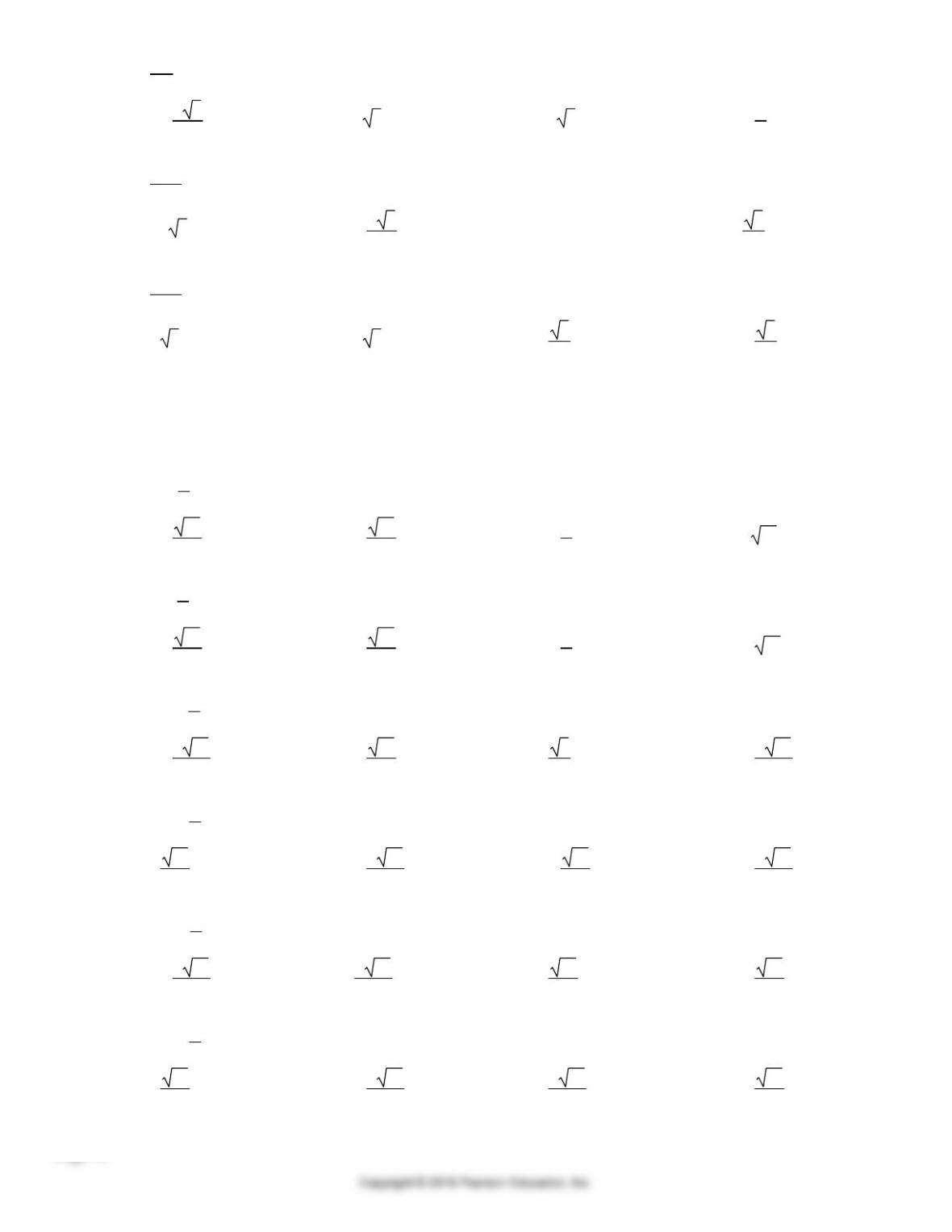
8) csc4π
3
A) –23
3B) –2 C) –3 D) –1
2
9) sec–5π
4
A) –2 B) –23
3C) –2D)
2
2
10) cot–5π
6
A) 3 B) –3 C) 3
3D) –3
3
6 FindtheExactValuesofTrigonometricFunctionsofanAngle,GivenInformationabouttheFunctions
MULTIPLECHOICE.Choosetheonealternativethatbestcompletesthestatementoranswersthequestion.
Findtheexactvalueoftheindicatedtrigonometricfunctionofθ.
1) cosθ=8
9,tanθ<0 Findsinθ.
A) –17
9B) –17
8C) –9
8D) –17
2) secθ=9
2,θinquadrantIV Findtanθ.
A) –77
2B) –77
9C) –9
2D) –77
3) sinθ=–8
9,tanθ>0 Findsecθ.
A) –917
17 B) –17
9C) 9
8D) –817
17
4) cscθ=–9
8,θinquadrantIII Findcotθ.
A) 17
8B) –917
17 C) –17
9D) –817
17
5) tanθ=–4
5,θinquadrantII Findcosθ.
A) –541
41 B) 541
41 C) 41
4D) –41
5
6) cotθ=–7
4,cosθ<0 Findcscθ.
A) 65
4B) –765
65 C) 765
65 D) –65
7
Page30
7) tanθ=15
8,180°<θ<270° Findcosθ.
A) –8
17 B) –8C)
–823
23 D) 15 23
23
8) cosθ=7
25,3π
2<θ<2πFindcotθ.
A) –7
24 B) –72
6C) –24
7D) 25
7
9) sinθ=1
2,secθ<0 Findcosθandtanθ.
A) cosθ=–3,tanθ=–10 3
3B) cosθ=3
2,tanθ=3
3
C) cosθ=–3
2,tanθ=–3
3D) cosθ=–3
2,tanθ=3
3
SHORTANSWER.Writethewordorphrasethatbestcompleteseachstatementoranswersthequestion.
10) sinθ=1
6,secθ<0 Findcosθandtanθ.
7 DemonstrateAdditionalUnderstandingandSkills
MULTIPLECHOICE.Choosetheonealternativethatbestcompletesthestatementoranswersthequestion.
Solvetheproblem.
1) Ifsinθ=0.6
,
findsin(θ+π).
A) –0.6 B) 0.6 C) 0.4 D) –0.4
2) Ifsinθ=1
6,findcscθ.
A) 6 B) –1
6C) 5
6D) undefined
3) Useacalculatortofindthevalueofcos118°.Roundtothenearesthundredth.
A) –0.47 B) –1.88 C) 0.88 D) 0.19
SHORTANSWER.Writethewordorphrasethatbestcompleteseachstatementoranswersthequestion.
4) Wildlifemanagementpersonnelusepredator–preyequationstomodelthepopulationsofcertain
predatorsandtheirpreyinthewild.SupposethepopulationMofapredatoraftertmonthsisgivenby
M=750+125sinπ
6t
whilethepopulationNofitsprimarypreyisgivenby
N=12,250+3050cosπ
6t.
CalculatebothMandNfort=3,t=15,andt=27months.Explaintheanswersintermsofreference
angles.Withoutcalculatingthem,whatwillbethevaluesofMandNfort=39months?
Page31
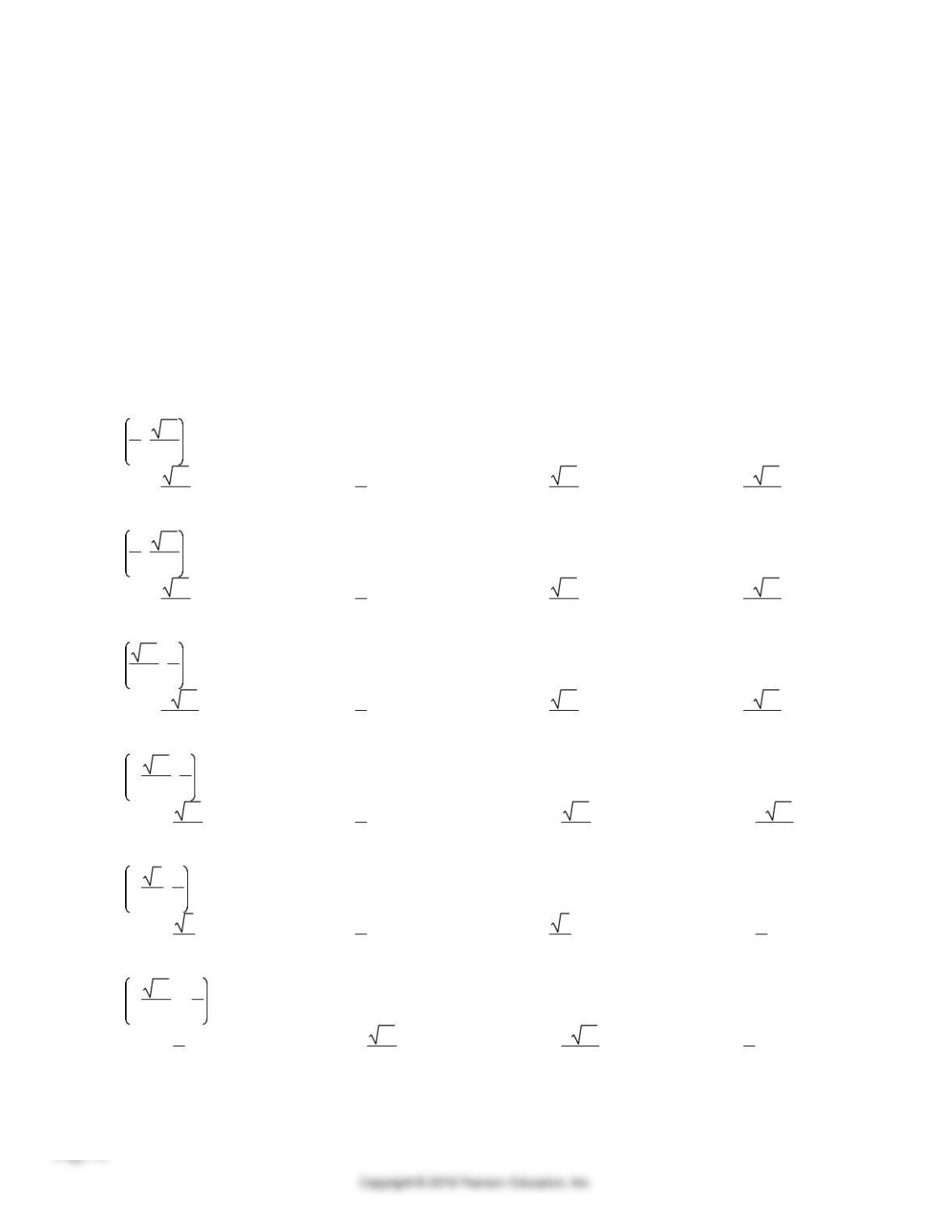
5) Thedisplacementd,ininches,fromequilibriumofaweightsuspendedfromaspringisgivenby
d=1+2sin(15t)°
wheretintimeinseconds.Findthedisplacementwhent=0,2,4,6,8,10,and12seconds.Donotusea
calculator.
6) Astudyoficecreamconsumptionover30four–weekperiodsintheearly1950sgivesrisetotheequation
C=0.3520+0.0786sin(0.4806θ–0.1691)
whereθisthenumber(from1to30)ofthefour–weekperiodandCistheicecreamconsumptioninpints
percapita.Determinetheconsumptionforthetenthfour–weekperiod.Roundanswertothenearest0.001
pint.
7.5 UnitCircleApproach;PropertiesoftheTrigonometricFunctions
1 FindtheExactValuesoftheTrigonometricFunctionsUsingtheUnitCircle
MULTIPLECHOICE.Choosetheonealternativethatbestcompletesthestatementoranswersthequestion.
ThepointPontheunitcirclethatcorrespondstoarealnumbertisgiven.Findtheindicatedtrigonometric
function.
1) 4
9,65
9Findsint.
A) 65
9B) 4
9C) 65
4D) 465
65
2) 4
7,33
7Findtant.
A) 33
4B) 7
4C) 33
7D) 433
33
3) 33
7,4
7Findsect.
A) 733
33 B) 7
4C) 33
4D) 433
33
4) –65
9,4
9Findcost.
A) –65
9B) 4
9C) –65
4D) –965
65
5) –7
4,3
4Findcott.
A) –7
3B) 3
4C) 7
4D) –4
3
6) –11
6,–5
6Findsint.
A) –5
6B) –11
6C) –611
11 D) 6
5
Page32
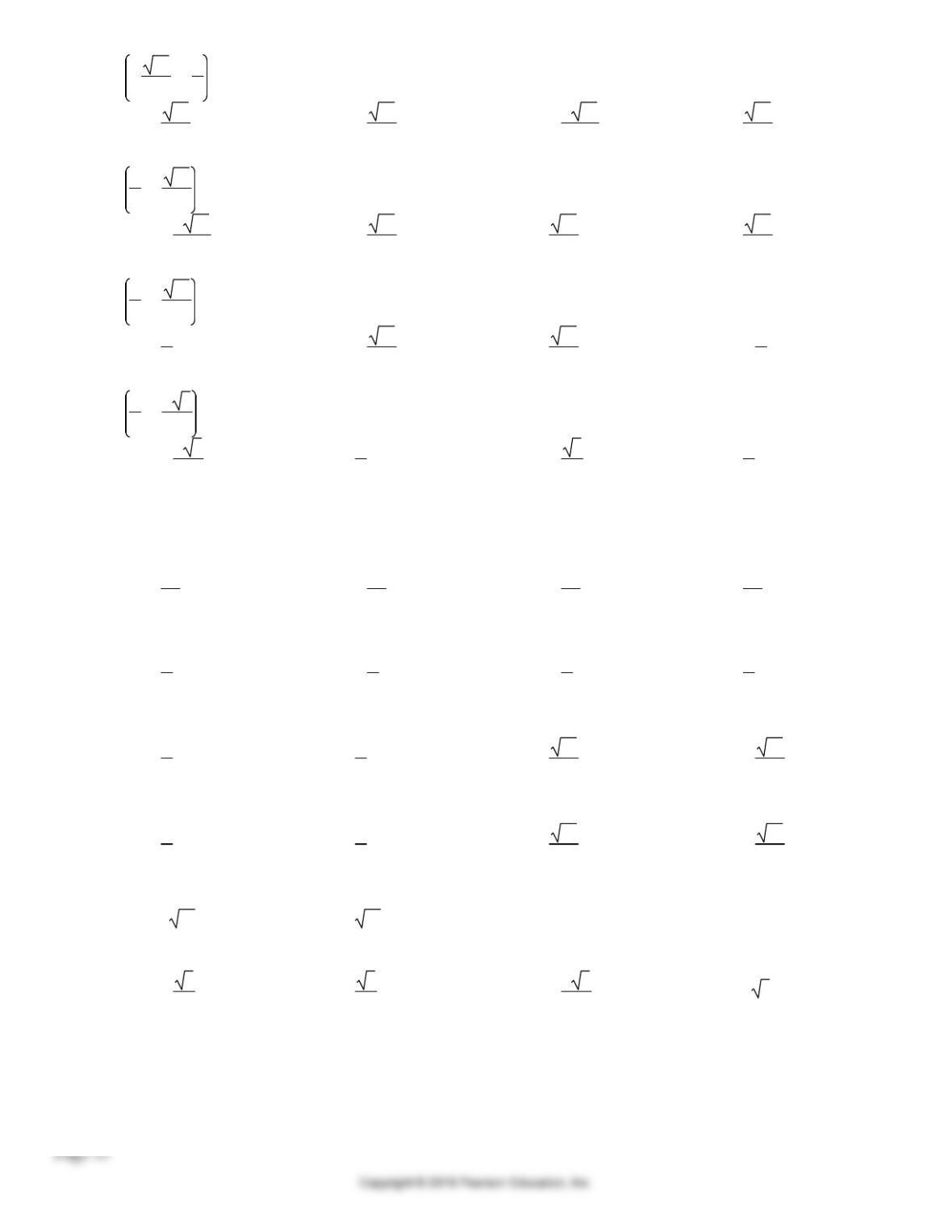
7) –65
9,–4
9Findcott.
A) 65
4B) –65
4C) –465
65 D) 65
9
8) 5
8,–39
8Findcsct.
A) –839
39 B) –39
8C) 39
5D) 39
8
9) 2
9,–77
9Findcost.
A) 2
9B) –77
9C) 77
9D) –2
9
10) 5
7,–26
7Findcsct.
A) –76
12 B) 7
5C) –6
10 D) 5
7
ThepointPonthecirclex2+y2=r2thatisalsoontheterminalsideofanangleθinstandardpositionisgiven.
Findtheindicatedtrigonometricfunction.
11) (–12
,
5) Findsinθ.
A) 5
13 B) –12
13 C) –5
13 D) 12
13
12) (4
,
–3) Findcosθ.
A) 4
5B) –3
5C) –4
5D) 3
5
13) (4
,
5) Findtanθ.
A) 5
4B) 4
5C) 41
4D) –41
4
14) (–2
,
–3) Findcotθ.
A) 2
3B) 3
2C) 13
2D) –13
2
15) (–4
,
–1) Findcscθ.
A) –17 B) 17 C) –4D)
–17
16) (–2
,
–1) Findsecθ.
A) –5
2B) 5
2C) –35
5D) –5

2 KnowtheDomainandRangeoftheTrigonometricFunctions
MULTIPLECHOICE.Choosetheonealternativethatbestcompletesthestatementoranswersthequestion.
Solvetheproblem.
1) Whatisthedomainofthecosinefunction?
A) allrealnumbers
B) allrealnumbersfrom–1to1,inclusive
C) allrealnumbers,exceptoddmultiplesofπ
2(90°)
D) allrealnumbers,exceptintegralmultiplesofπ (180°)
2) Forwhatnumbersθisf(θ)=tanθnotdefined?
A) oddmultiplesofπ
2(90°) B) integralmultiplesofπ(180°)
C) oddmultiplesofπ(180°) D) allrealnumbers
3) Forwhatnumbersθisf(θ)=cotθnotdefined?
A) integralmultiplesofπ(180°) B) oddmultiplesofπ
2(90°)
C) oddmultiplesofπ(180°) D) allrealnumbers
4) Whatistherangeofthecosinefunction?
A) allrealnumbersfrom–1to1,inclusive
B) allrealnumbers
C) allrealnumbersgreaterthanorequalto1orlessthanorequalto–1
D) allrealnumbersgreaterthanorequalto0
5) Whatistherangeofthetangentfunction?
A) allrealnumbers
B) allrealnumbersfrom–1to1,inclusive
C) allrealnumbersgreaterthanorequalto1orlessthanorequalto–1
D) allrealnumbers,exceptoddmultiplesofπ
2(90)°
6) Whatistherangeofthesecan
t
function?
A) allrealnumbersgreaterthanorequalto1orlessthanorequalto–1
B) allrealnumbersfrom–1to1,inclusive
C) allrealnumbers
D) allrealnumbers,exceptoddmultiplesofπ
2(90)°
Page34
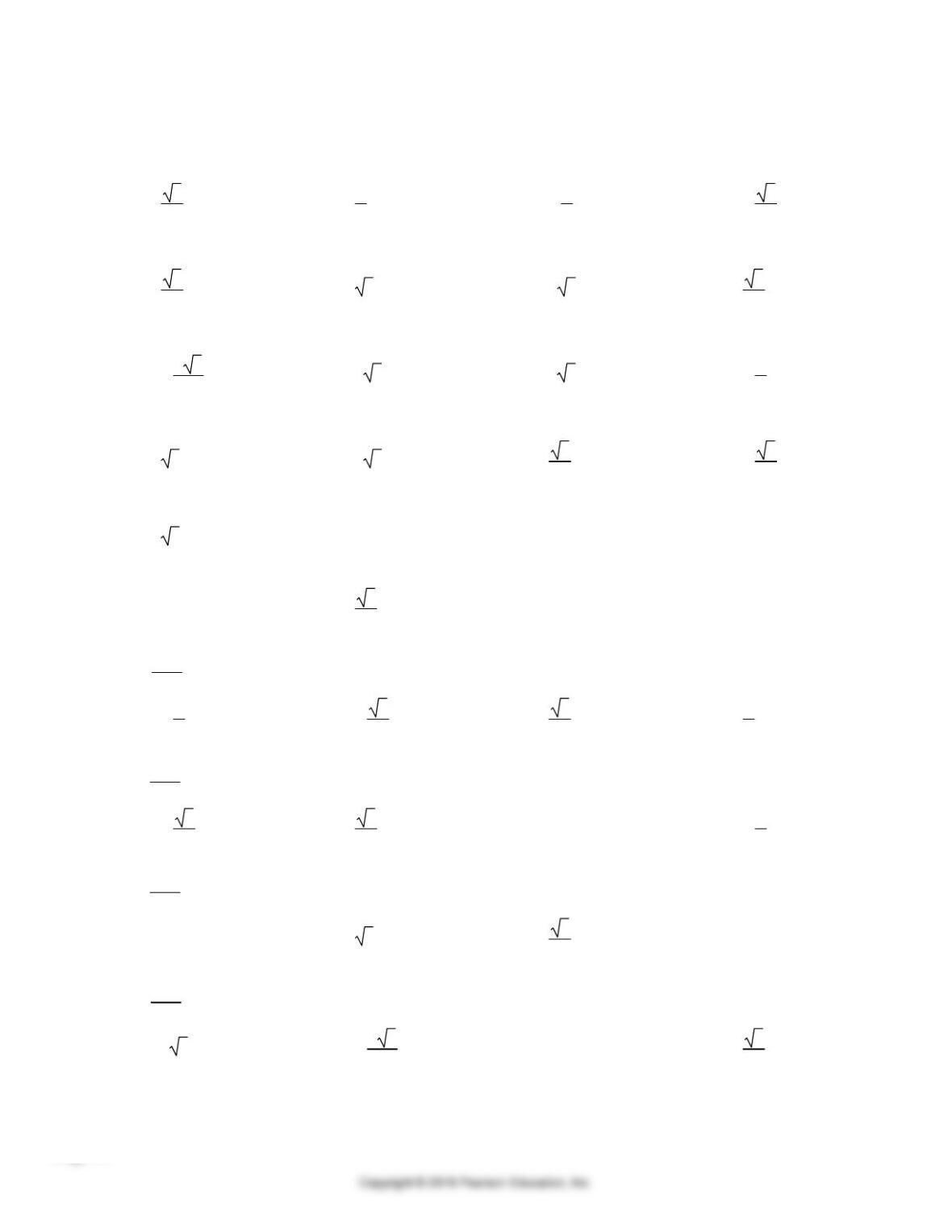
3 UsethePeriodicPropertiestoFindtheExactValuesoftheTrigonometricFunctions
MULTIPLECHOICE.Choosetheonealternativethatbestcompletesthestatementoranswersthequestion.
Usethefactthatthetrigonometricfunctionsareperiodictofindtheexactvalueoftheexpression.Donotusea
calculator.
1) sin405°
A) 2
2B) 1
2C) –1
2D) –2
2
2) tan570°
A) 3
3B) 3 C) –3 D) 3
2
3) csc600°
A) –23
3B) –2 C) –3 D) –1
2
4) cot750°
A) 3 B) –3 C) 3
3D) –3
3
5) cot720°
A) 3 B) 0 C) 1 D) undefined
6) tan720°
A) 0 B) 3
3C) 1 D) undefined
7) cos14π
3
A) –1
2B) –3
2C) 3
2D) 1
2
8) sin10π
3
A) –3
2B) 3
2C) –1D)
–1
2
9) cot17π
4
A) 1 B) 3 C) 3
3D) –1
10) sec13π
4
A) –2 B) –23
3C) –2D)
2
2
Page35
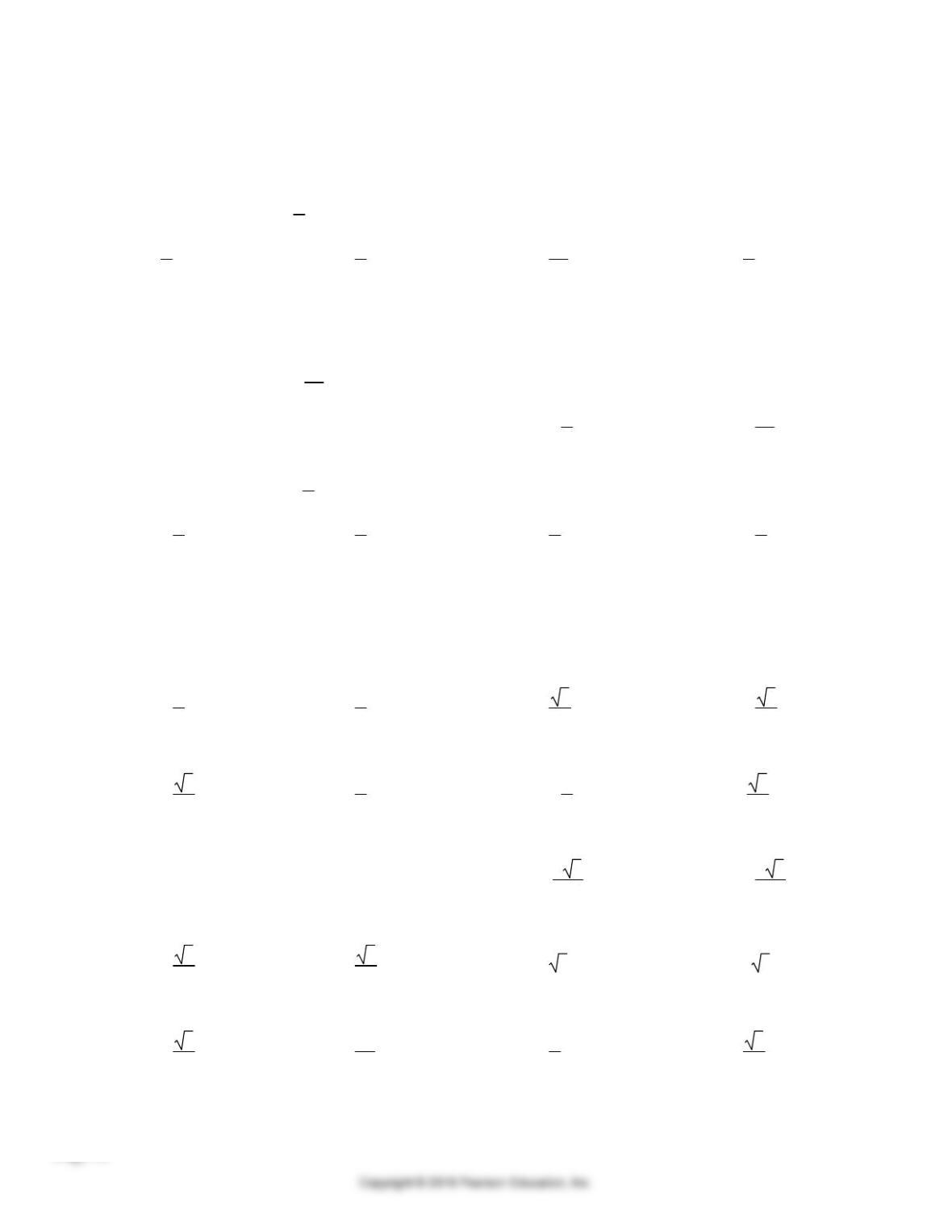
Solvetheproblem.
11) Ifsinθ=–0.9
,
findthevalueofsinθ +sin (θ+2π)+sin (θ+4π).
A) –2.7 B) –2.7 +6πC) –0.7 D) –0.9
12) Ifcotθ=8.4
,
findthevalueofcotθ+cot (θ+π)+cot (θ+2π).
A) 25.2 B) 25.2 +3πC) 27.2 D) undefined
13) Iff(θ)=sinθandf(a)=1
4,findtheexactvalueoff(a)+f(a+2π)+f(a+4π).
A) 3
4B) 3
4+6πC) 11
4D) 1
4
14) Iff(θ)=tanθandf(a)=–6
,
findtheexactvalueoff(a)+f(a+π)+f(a+3π).
A) –18 B) –18+4πC) –6 D) undefined
15) Iff(x)=cosxandf(a)=–1
12,findtheexactvalueoff(a)+f(a–2π)+f(a+4π).
A) –12 B) –36 C) –1
4D) –1
12
16) Iff(x)=sinxandf(a)=–1
9,findtheexactvalueoff(a)+f(a–4π)+f(a–2π).
A) –1
3B) 1
3C) 1
6D) –1
6
4 UseEven–OddPropertiestoFindtheExactValuesoftheTrigonometricFunctions
MULTIPLECHOICE.Choosetheonealternativethatbestcompletesthestatementoranswersthequestion.
Usetheeven–oddpropertiestofindtheexactvalueoftheexpression.Donotuseacalculator.
1) sin(–30°)
A) –1
2B) 1
2C) 3
2D) –3
2
2) sin(–60°)
A) –3
2B) 1
2C) –1
2D) 3
2
3) sec(–60°)
A) 2 B) –2C)
23
3D) –23
3
4) cot(–60°)
A) –3
3B) 3
3C) 3 D) –3
5) cos(–150°)
A) –3
2B) –1
2C) 1
2D) 3
2
Page36
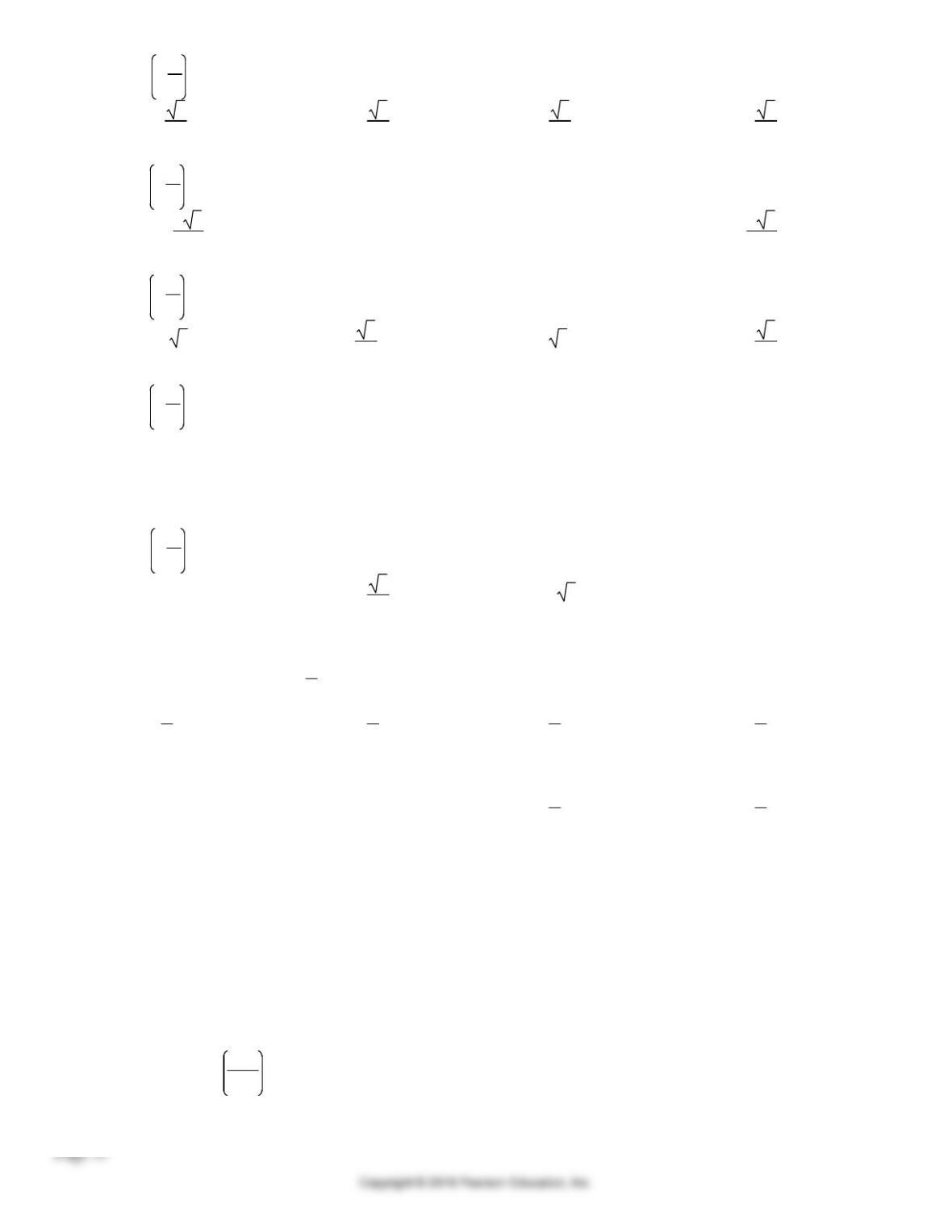
6) cos–π
4
A) 2
2B) –2
2C) 3
2D) –3
2
7) csc–π
3
A) –23
3B) –2C)2 D)
23
3
8) cot–π
6
A) –3 B) 3
3C) 3 D) –3
3
9) csc–π
2
A) –1 B) 1 C) 0 D) undefined
10) tan(–π)
A) 0 B) 1 C) –1 D) undefined
11) cot–π
4
A) –1B)
–3
3C) –3 D) 1
Solvetheproblem.
12) Iff(θ)=sinθandf(a)=–1
6,findtheexactvalueoff(–a).
A) 1
6B) –1
6C) 5
6D) –5
6
13) Iff(θ)=cscθandf(a)=3
,
findtheexactvalueoff(–a).
A) –3B)3 C)
1
3D) –1
3
SHORTANSWER.Writethewordorphrasethatbestcompleteseachstatementoranswersthequestion.
14) Isthefunctionf(θ)=sinθ+cosθeven,odd,orneither?
15) Isthefunctionf(θ)=sinθ+tanθeven,odd,orneither?
5 DemonstrateAdditionalUnderstandingandSkills
MULTIPLECHOICE.Choosetheonealternativethatbestcompletesthestatementoranswersthequestion.
Findtheexactvalueoftheexpression.Donotuseacalculator.
1) sin(2π)+cos–3π
2
A) 0 B) 1 C) –2D)
–1
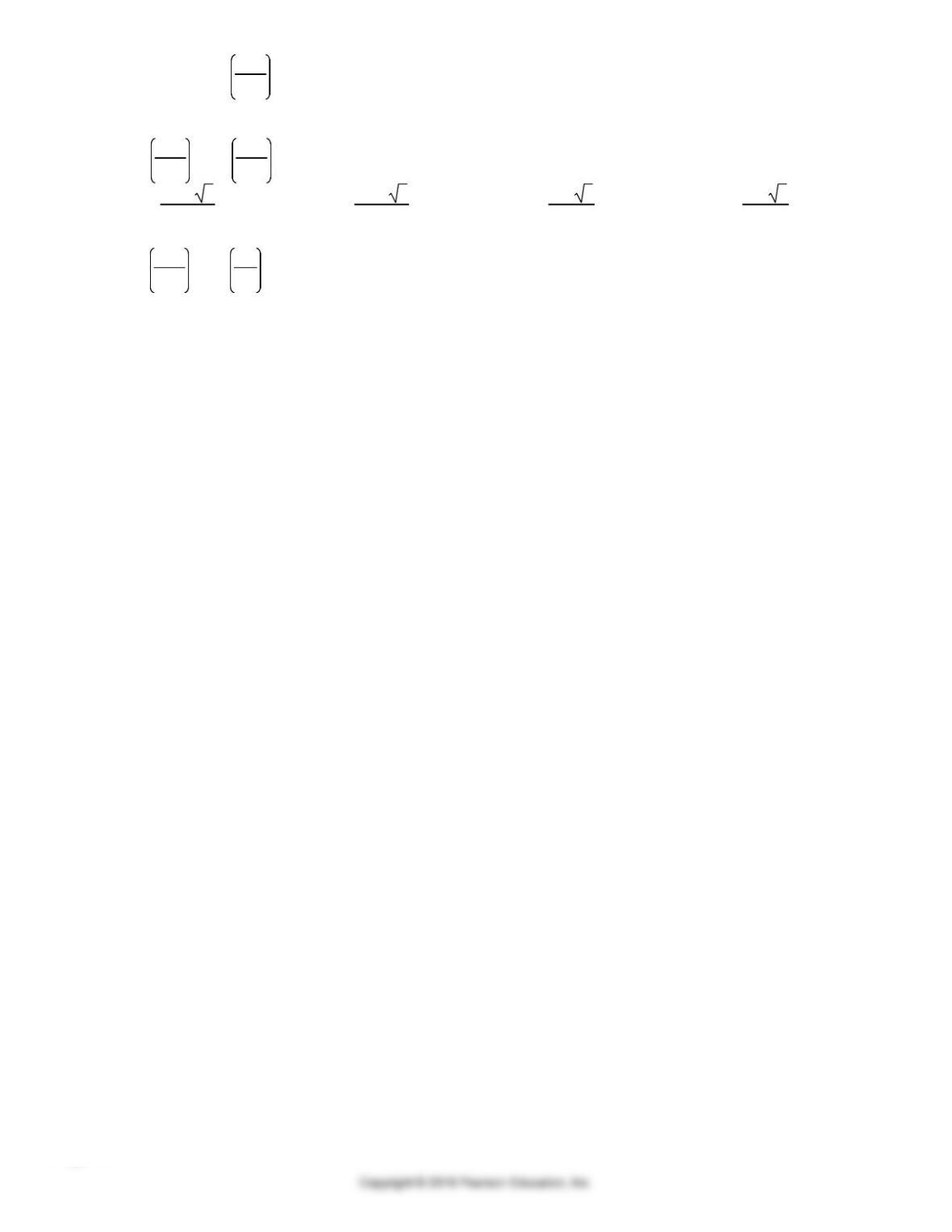
2) cos(–2π)+sin–3π
2
A) 2 B) 0 C) –2D)1
3) tan–9π
4–cos–9π
4
A) –2–2
2B) –2+2
2C) 2–2
2D) 2+2
2
4) csc–5π
2–sec7π
3
A) –3B)1 C)
–1D)3
Page38
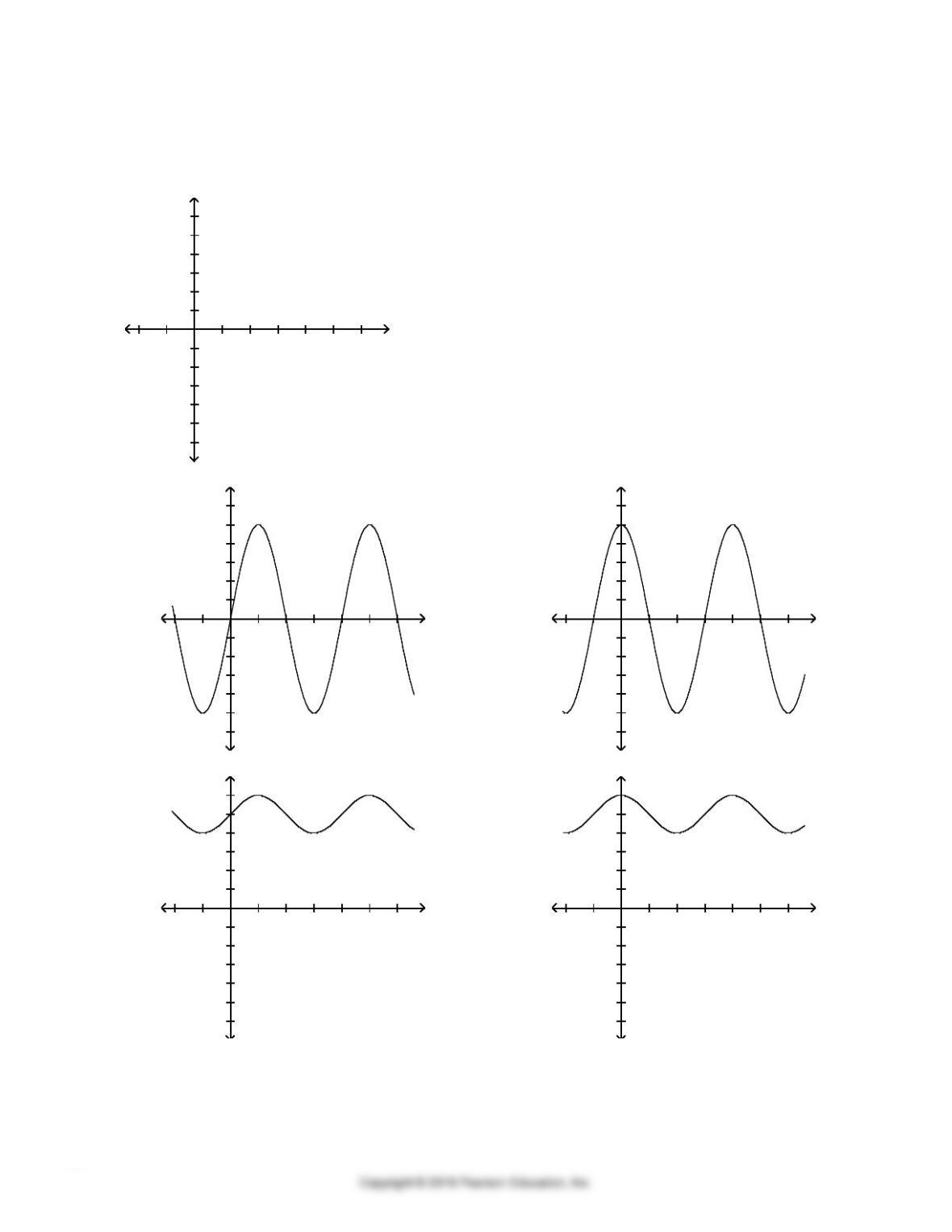
7.6 GraphsoftheSineandCosineFunctions
1 GraphFunctionsoftheFormy=Asin(ωx)UsingTransformations
MULTIPLECHOICE.Choosetheonealternativethatbestcompletesthestatementoranswersthequestion.
Usetransformationstographthefunction.
1) y=5sinx
x
–
23
y
6
4
2
-2
-4
-6
x
–
23
y
6
4
2
-2
-4
-6
A)
x
–
23
y
6
4
2
-2
-4
-6
x
–
23
y
6
4
2
-2
-4
-6
B)
x
–
23
y
6
4
2
-2
-4
-6
x
–
23
y
6
4
2
-2
-4
-6
C)
x
–
23
y
6
4
2
-2
-4
-6
x
–
23
y
6
4
2
-2
-4
-6
D)
x
–
23
y
6
4
2
-2
-4
-6
x
–
23
y
6
4
2
-2
-4
-6
Page39
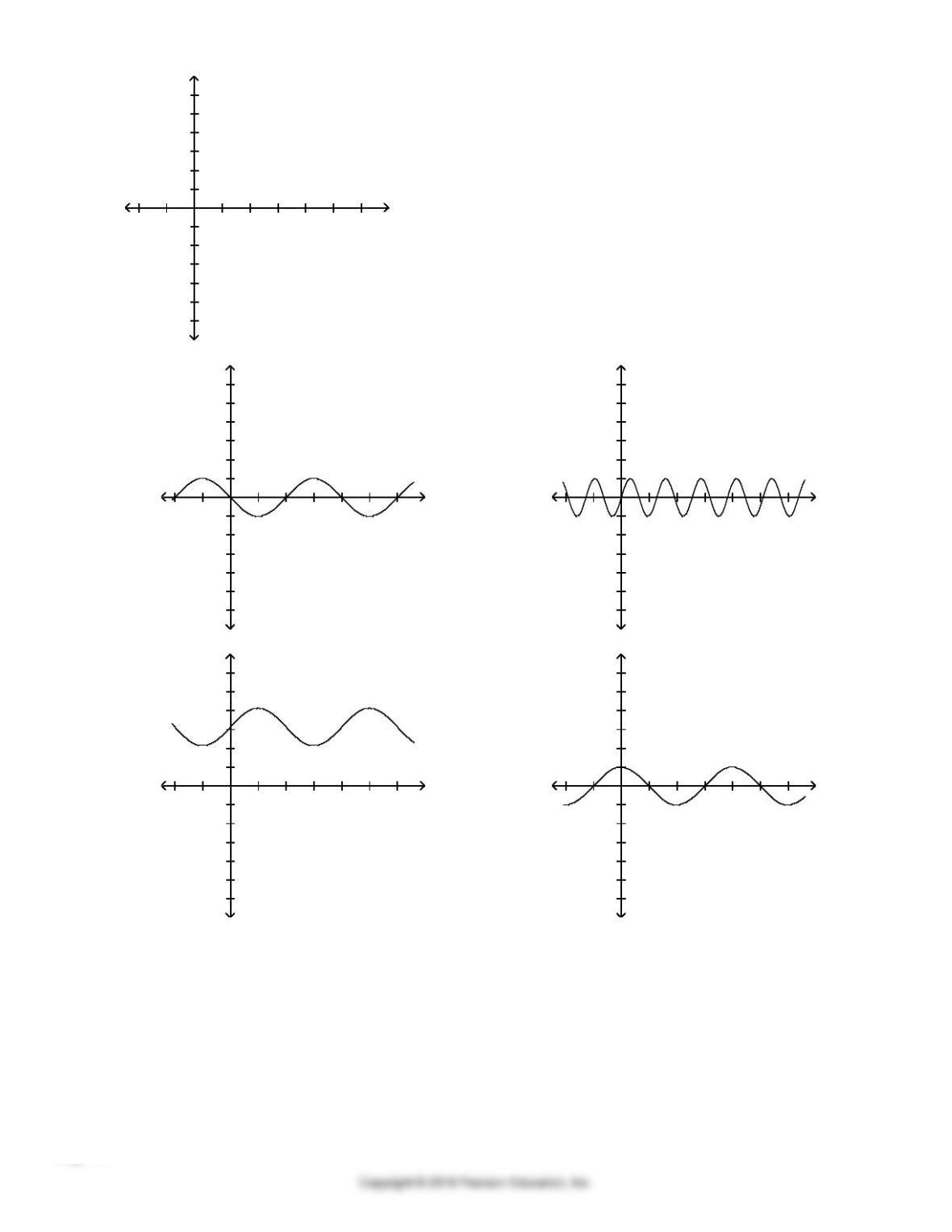
2) y=sin(x+π)
x
–
23
y
6
4
2
-2
-4
-6
x
–
23
y
6
4
2
-2
-4
-6
A)
x
–
23
y
6
4
2
-2
-4
-6
x
–
23
y
6
4
2
-2
-4
-6
B)
x
–
23
y
6
4
2
-2
-4
-6
x
–
23
y
6
4
2
-2
-4
-6
C)
x
–
23
y
6
4
2
-2
-4
-6
x
–
23
y
6
4
2
-2
-4
-6
D)
x
–
23
y
6
4
2
-2
-4
-6
x
–
23
y
6
4
2
-2
-4
-6
Page40
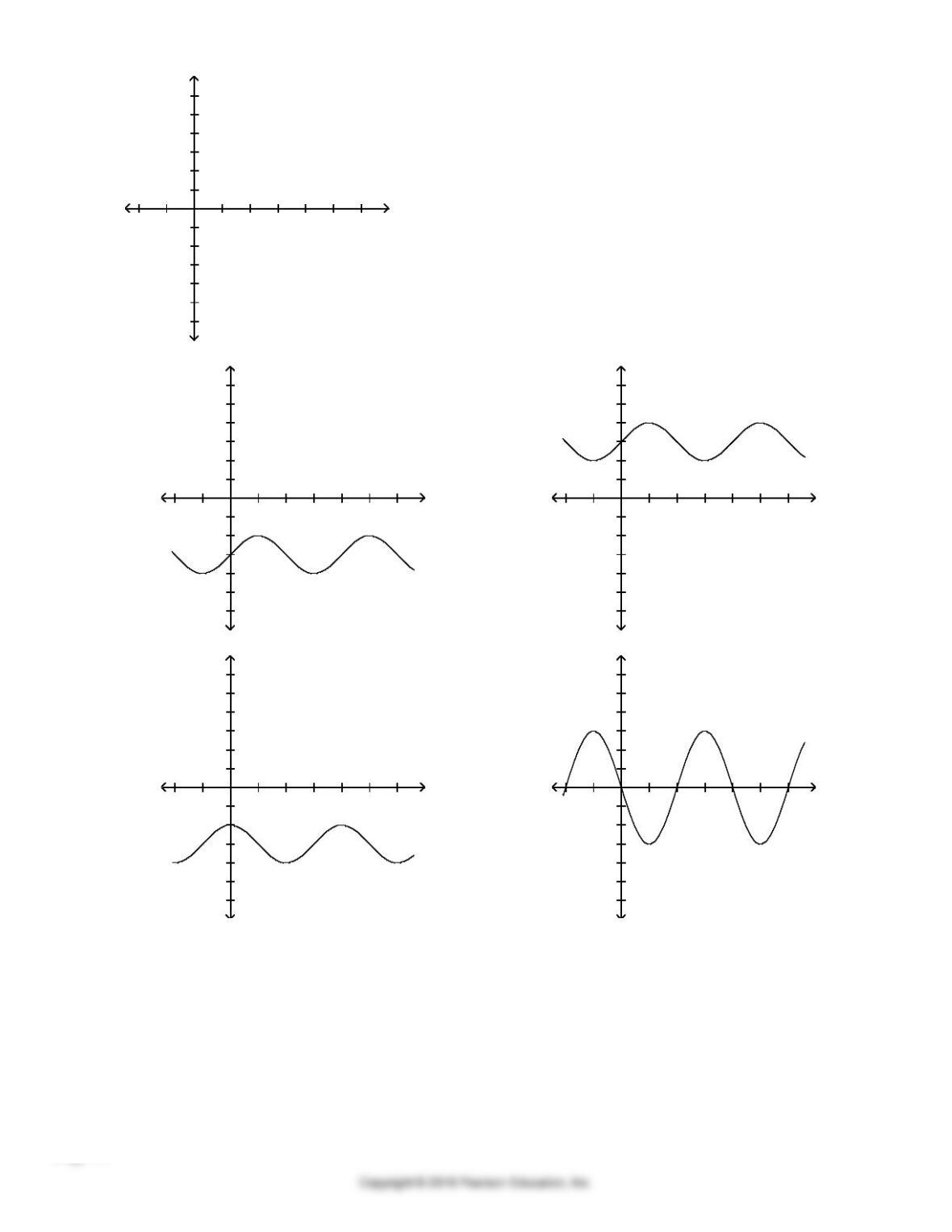
3) y=sinx–3
x
–
23
y
6
4
2
-2
-4
-6
x
–
23
y
6
4
2
-2
-4
-6
A)
x
–
23
y
6
4
2
-2
-4
-6
x
–
23
y
6
4
2
-2
-4
-6
B)
x
–
23
y
6
4
2
-2
-4
-6
x
–
23
y
6
4
2
-2
-4
-6
C)
x
–
23
y
6
4
2
-2
-4
-6
x
–
23
y
6
4
2
-2
-4
-6
D)
x
–
23
y
6
4
2
-2
-4
-6
x
–
23
y
6
4
2
-2
-4
-6
Page41
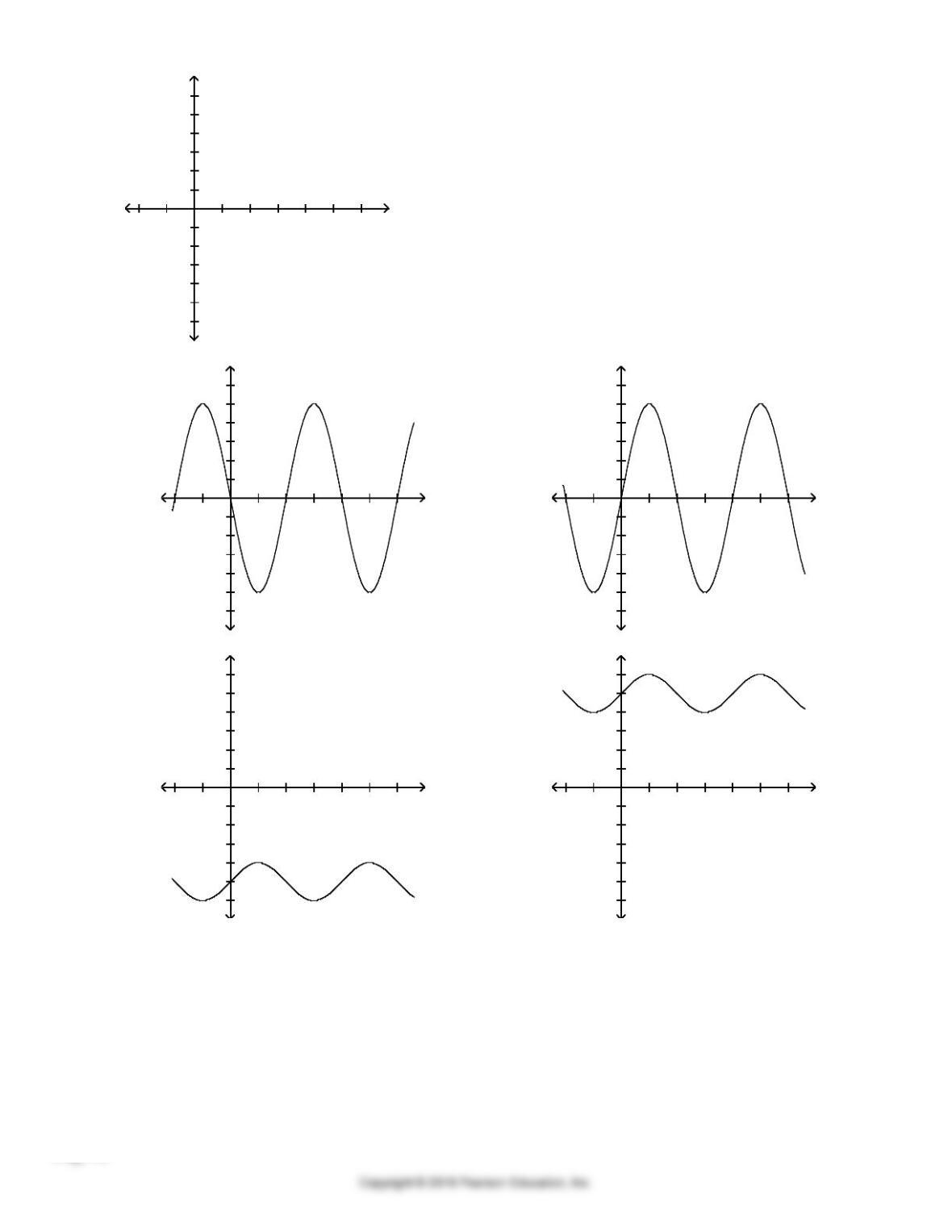
4) y=–5sinx
x
–
23
y
6
4
2
-2
-4
-6
x
–
23
y
6
4
2
-2
-4
-6
A)
x
–
23
y
6
4
2
-2
-4
-6
x
–
23
y
6
4
2
-2
-4
-6
B)
x
–
23
y
6
4
2
-2
-4
-6
x
–
23
y
6
4
2
-2
-4
-6
C)
x
–
23
y
6
4
2
-2
-4
-6
x
–
23
y
6
4
2
-2
-4
-6
D)
x
–
23
y
6
4
2
-2
-4
-6
x
–
23
y
6
4
2
-2
-4
-6
Page42
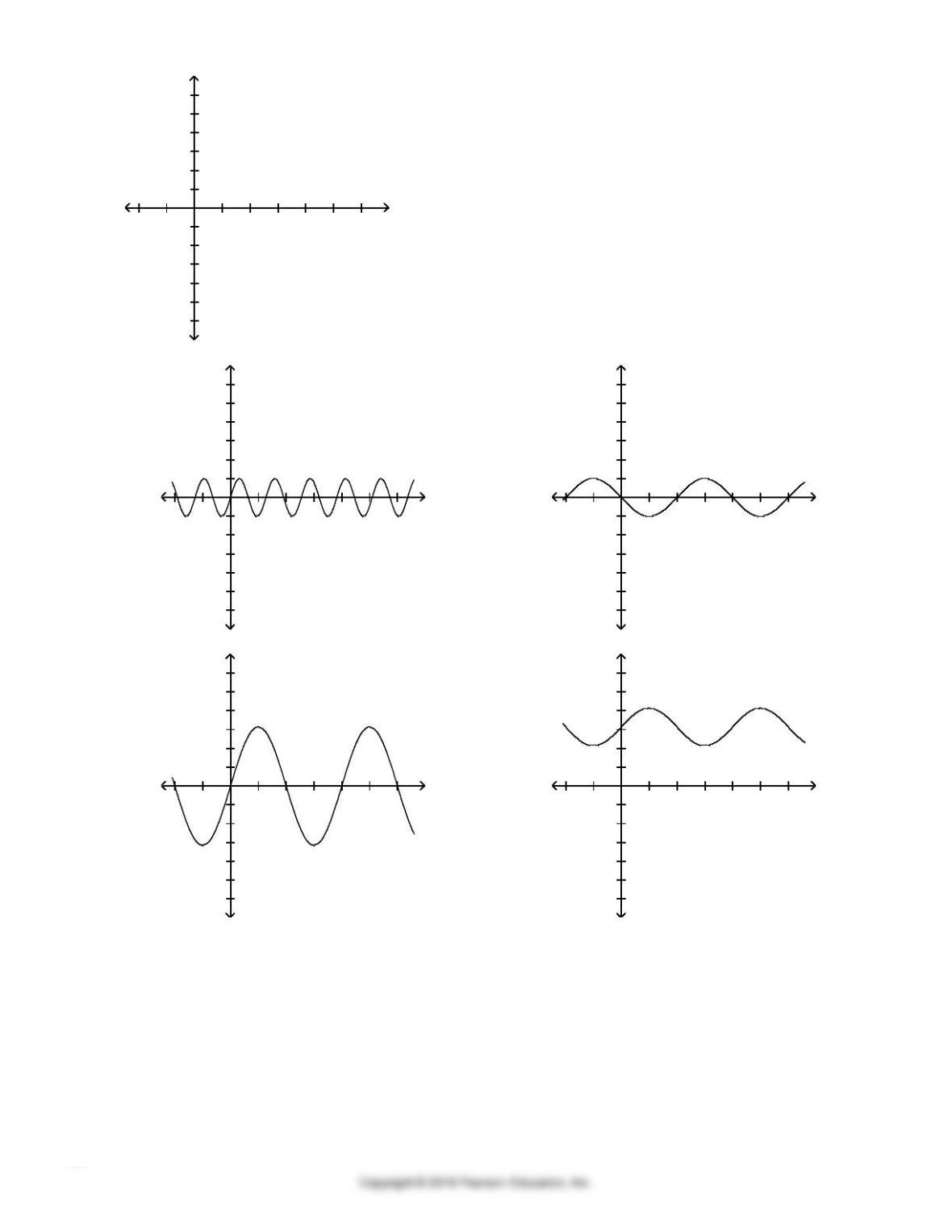
5) y=sin(πx)
x
–
23
y
6
4
2
-2
-4
-6
x
–
23
y
6
4
2
-2
-4
-6
A)
x
–
23
y
6
4
2
-2
-4
-6
x
–
23
y
6
4
2
-2
-4
-6
B)
x
–
23
y
6
4
2
-2
-4
-6
x
–
23
y
6
4
2
-2
-4
-6
C)
x
–
23
y
6
4
2
-2
-4
-6
x
–
23
y
6
4
2
-2
-4
-6
D)
x
–
23
y
6
4
2
-2
-4
-6
x
–
23
y
6
4
2
-2
-4
-6
Page43
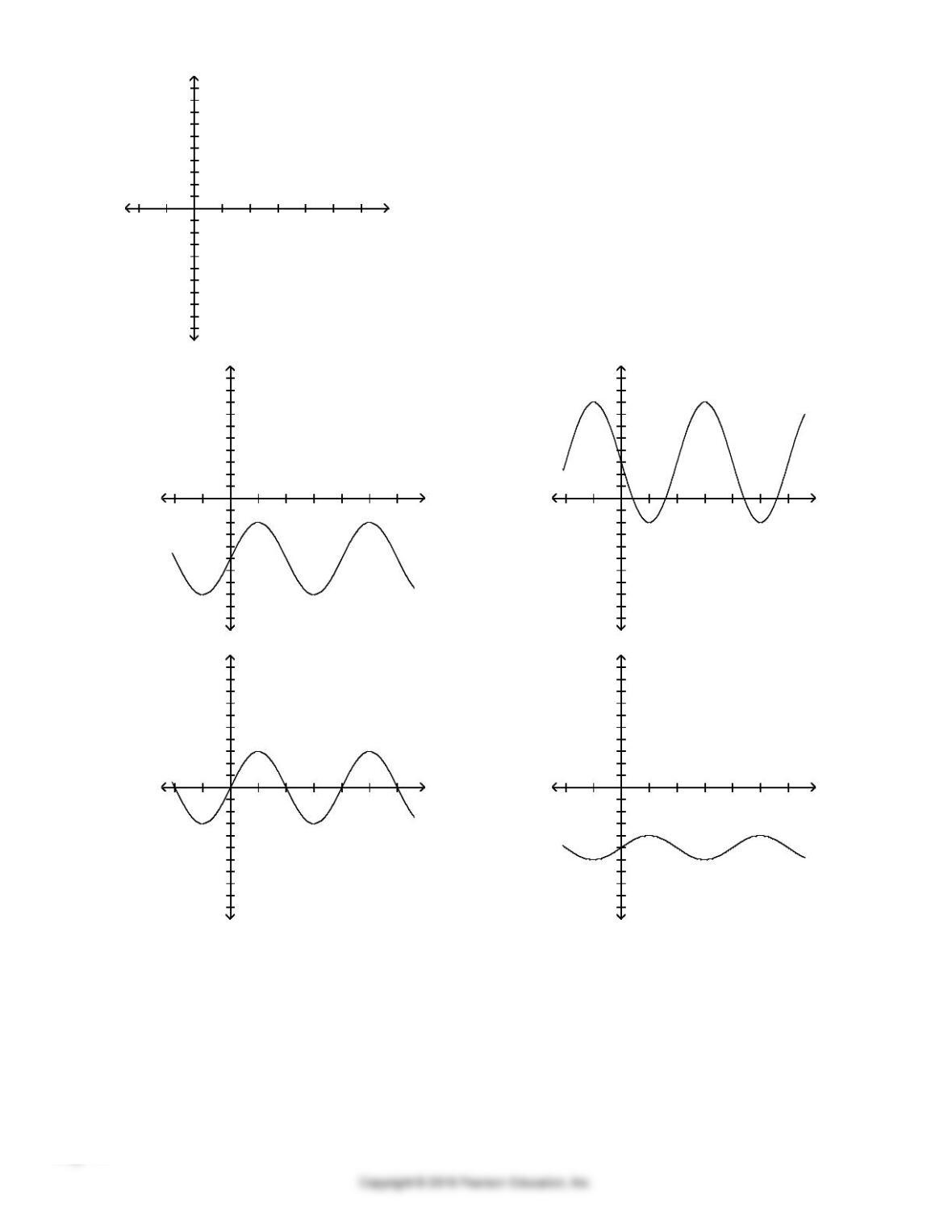
6) y=3sinx–5
x
–
23
y
10
8
6
4
2
-2
-4
-6
-8
-10
x
–
23
y
10
8
6
4
2
-2
-4
-6
-8
-10
A)
x
–
23
y
10
8
6
4
2
-2
-4
-6
-8
-10
x
–
23
y
10
8
6
4
2
-2
-4
-6
-8
-10
B)
x
–
23
y
10
8
6
4
2
-2
-4
-6
-8
-10
x
–
23
y
10
8
6
4
2
-2
-4
-6
-8
-10
C)
x
–
23
y
10
8
6
4
2
-2
-4
-6
-8
-10
x
–
23
y
10
8
6
4
2
-2
-4
-6
-8
-10
D)
x
–
23
y
10
8
6
4
2
-2
-4
-6
-8
-10
x
–
23
y
10
8
6
4
2
-2
-4
-6
-8
-10
Page44
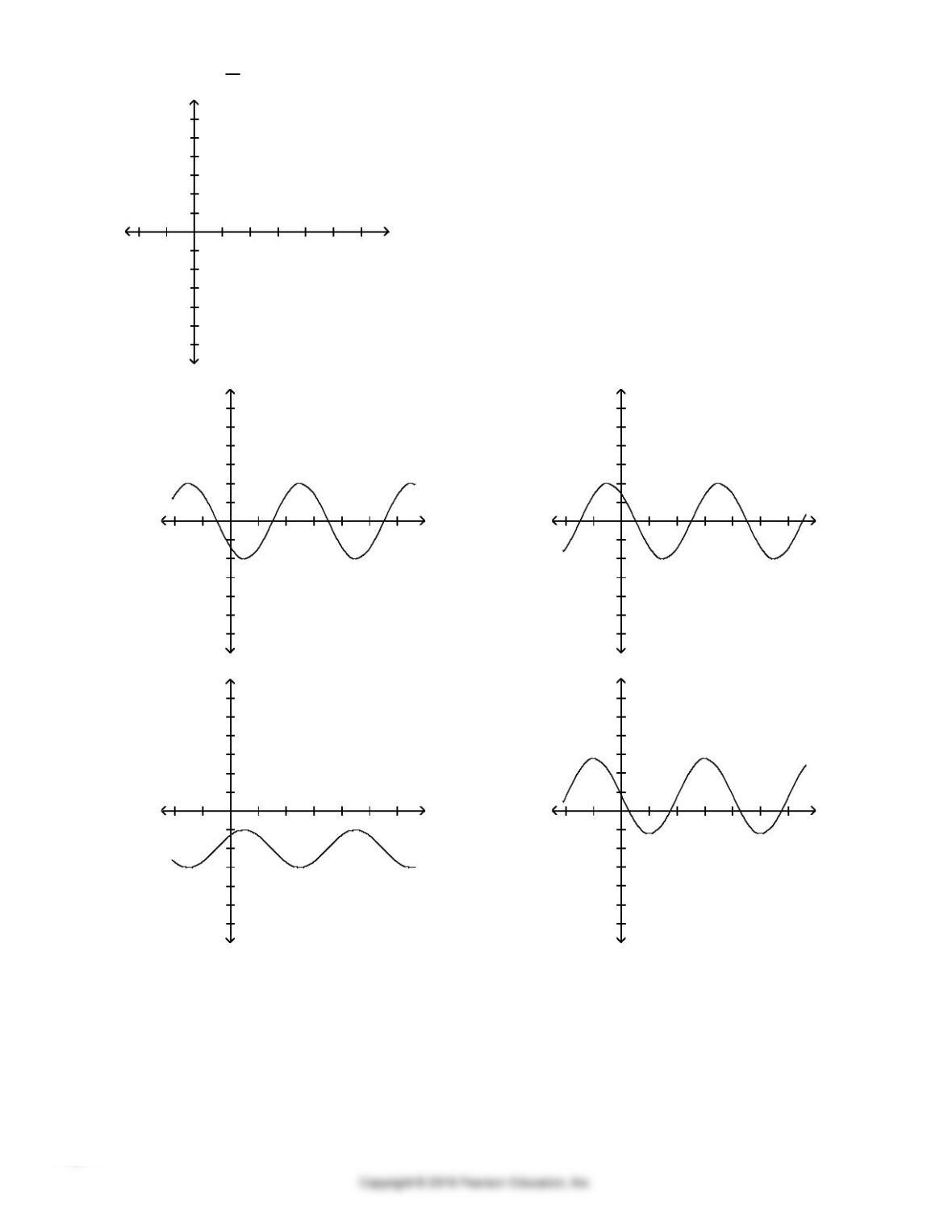
7) y=–2sin(x+π
4)
x
–
23
y
6
4
2
-2
-4
-6
x
–
23
y
6
4
2
-2
-4
-6
A)
x
–
23
y
6
4
2
-2
-4
-6
x
–
23
y
6
4
2
-2
-4
-6
B)
x
–
23
y
6
4
2
-2
-4
-6
x
–
23
y
6
4
2
-2
-4
-6
C)
x
–
23
y
6
4
2
-2
-4
-6
x
–
23
y
6
4
2
-2
-4
-6
D)
x
–
23
y
6
4
2
-2
-4
-6
x
–
23
y
6
4
2
-2
-4
-6
Page45
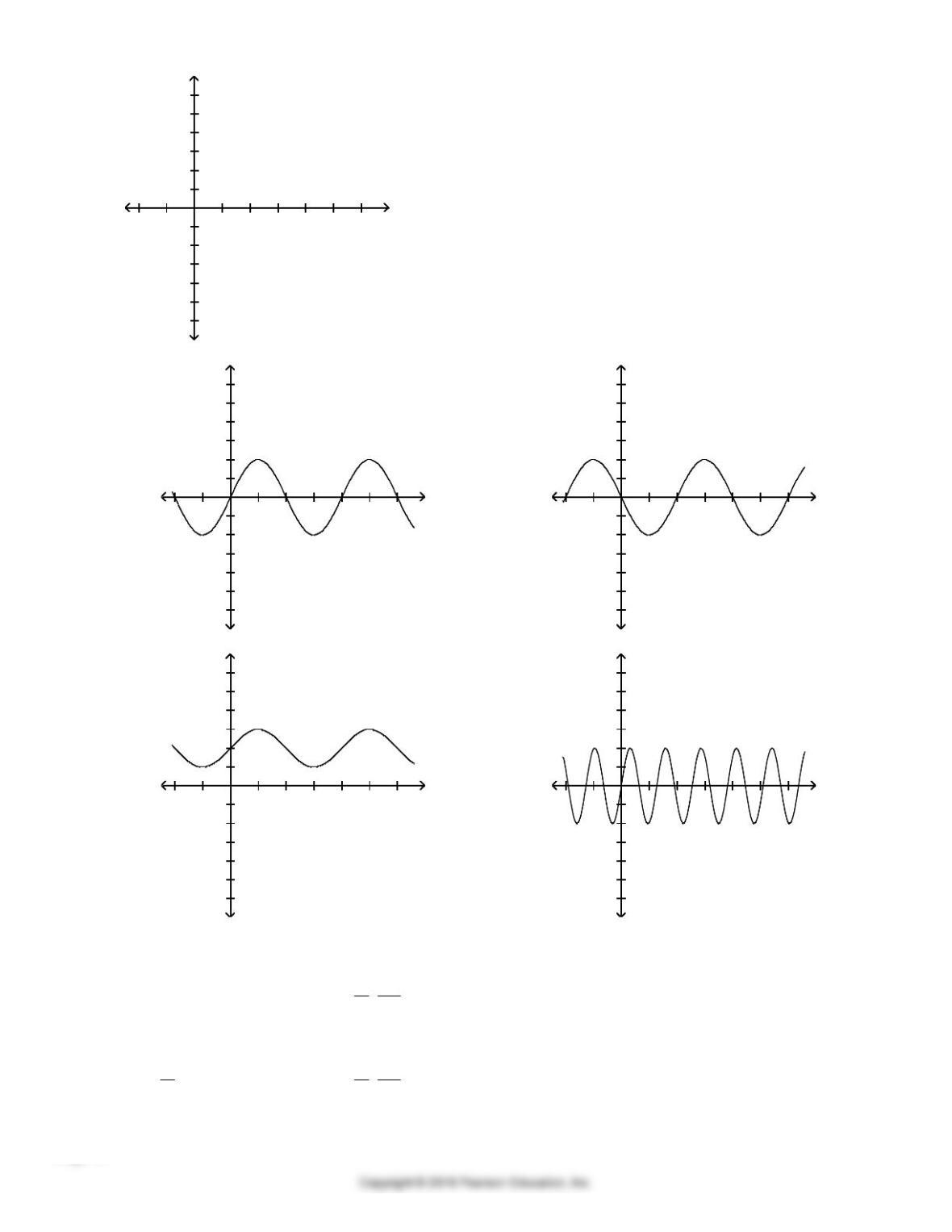
8) y=2sin(π–x)
x
–
23
y
6
4
2
-2
-4
-6
x
–
23
y
6
4
2
-2
-4
-6
A)
x
–
23
y
6
4
2
-2
-4
-6
x
–
23
y
6
4
2
-2
-4
-6
B)
x
–
23
y
6
4
2
-2
-4
-6
x
–
23
y
6
4
2
-2
-4
-6
C)
x
–
23
y
6
4
2
-2
-4
-6
x
–
23
y
6
4
2
-2
-4
-6
D)
x
–
23
y
6
4
2
-2
-4
-6
x
–
23
y
6
4
2
-2
-4
-6
Solvetheproblem.
9) Forwhatnumbersx,0≤x≤2π
,
doessinx=0?
A) 0,π
,
2πB) π
2,3π
2C) 0,1D)0,1,2
10) Forwhatnumbersx,0≤x≤2π
,
doessinx=1?
A) π
2B) π
2,3π
2C) 0,2πD) none
Page46
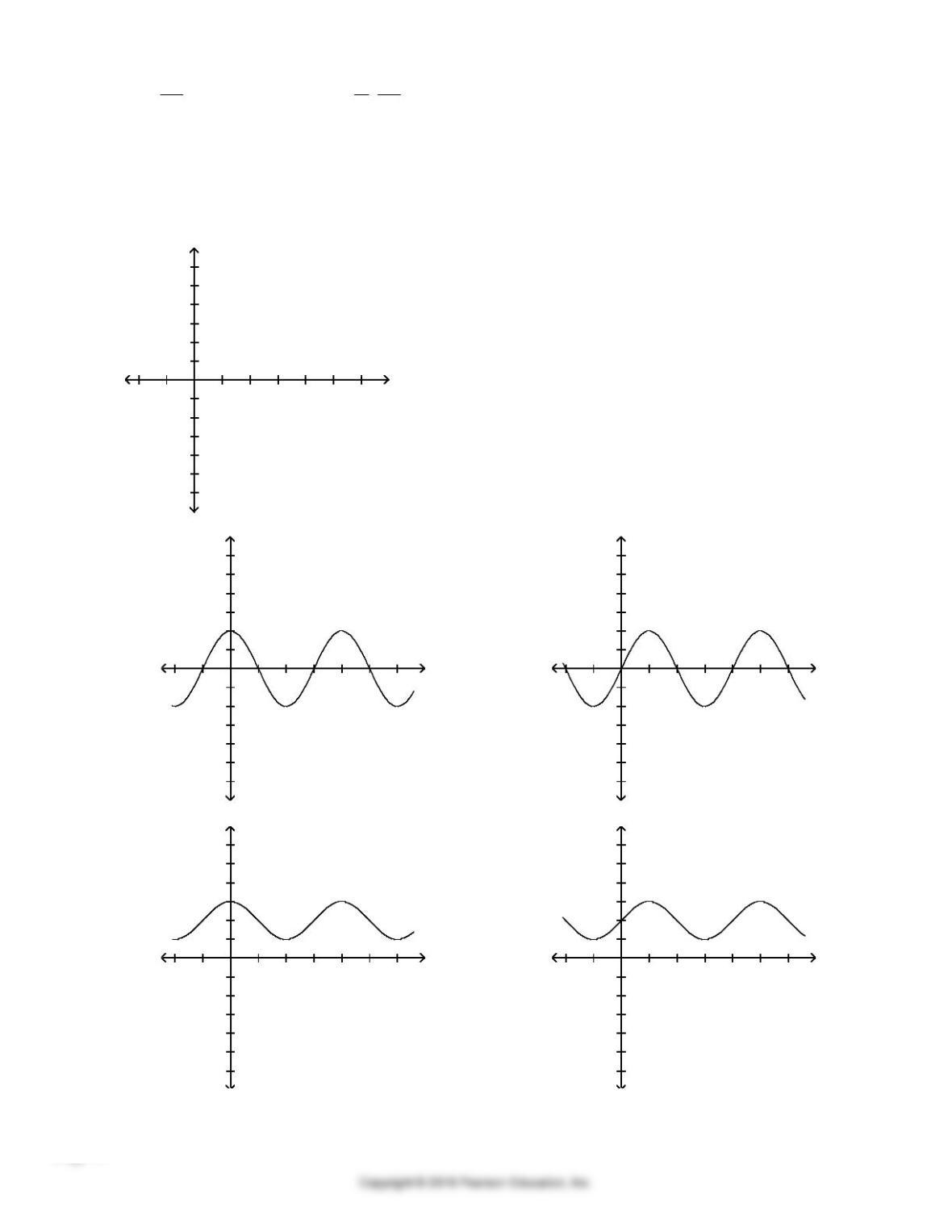
11) Forwhatnumbersx,0≤x≤2π
,
doessinx= –1?
A) 3π
2B) π
2,3π
2C) πD) none
2 GraphFunctionsoftheFormy=Acos(ωx)UsingTransformations
MULTIPLECHOICE.Choosetheonealternativethatbestcompletesthestatementoranswersthequestion.
Usetransformationstographthefunction.
1) y=2cosx
x
–
23
y
6
4
2
-2
-4
-6
x
–
23
y
6
4
2
-2
-4
-6
A)
x
–
23
y
6
4
2
-2
-4
-6
x
–
23
y
6
4
2
-2
-4
-6
B)
x
–
23
y
6
4
2
-2
-4
-6
x
–
23
y
6
4
2
-2
-4
-6
C)
x
–
23
y
6
4
2
-2
-4
-6
x
–
23
y
6
4
2
-2
-4
-6
D)
x
–
23
y
6
4
2
-2
-4
-6
x
–
23
y
6
4
2
-2
-4
-6
Page47
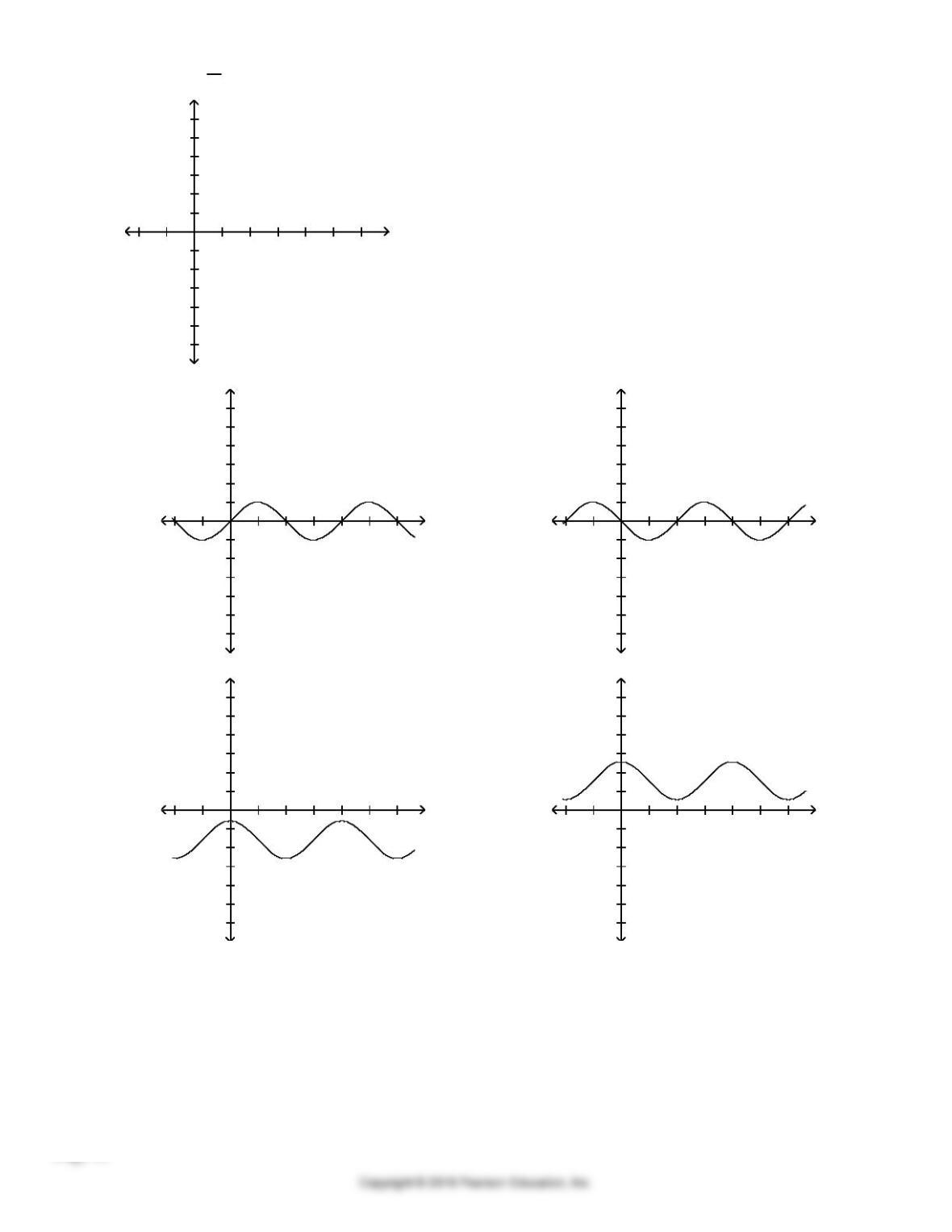
2) y=cos(x–π
2)
x
–
23
y
6
4
2
-2
-4
-6
x
–
23
y
6
4
2
-2
-4
-6
A)
x
–
23
y
6
4
2
-2
-4
-6
x
–
23
y
6
4
2
-2
-4
-6
B)
x
–
23
y
6
4
2
-2
-4
-6
x
–
23
y
6
4
2
-2
-4
-6
C)
x
–
23
y
6
4
2
-2
-4
-6
x
–
23
y
6
4
2
-2
-4
-6
D)
x
–
23
y
6
4
2
-2
-4
-6
x
–
23
y
6
4
2
-2
-4
-6
Page48
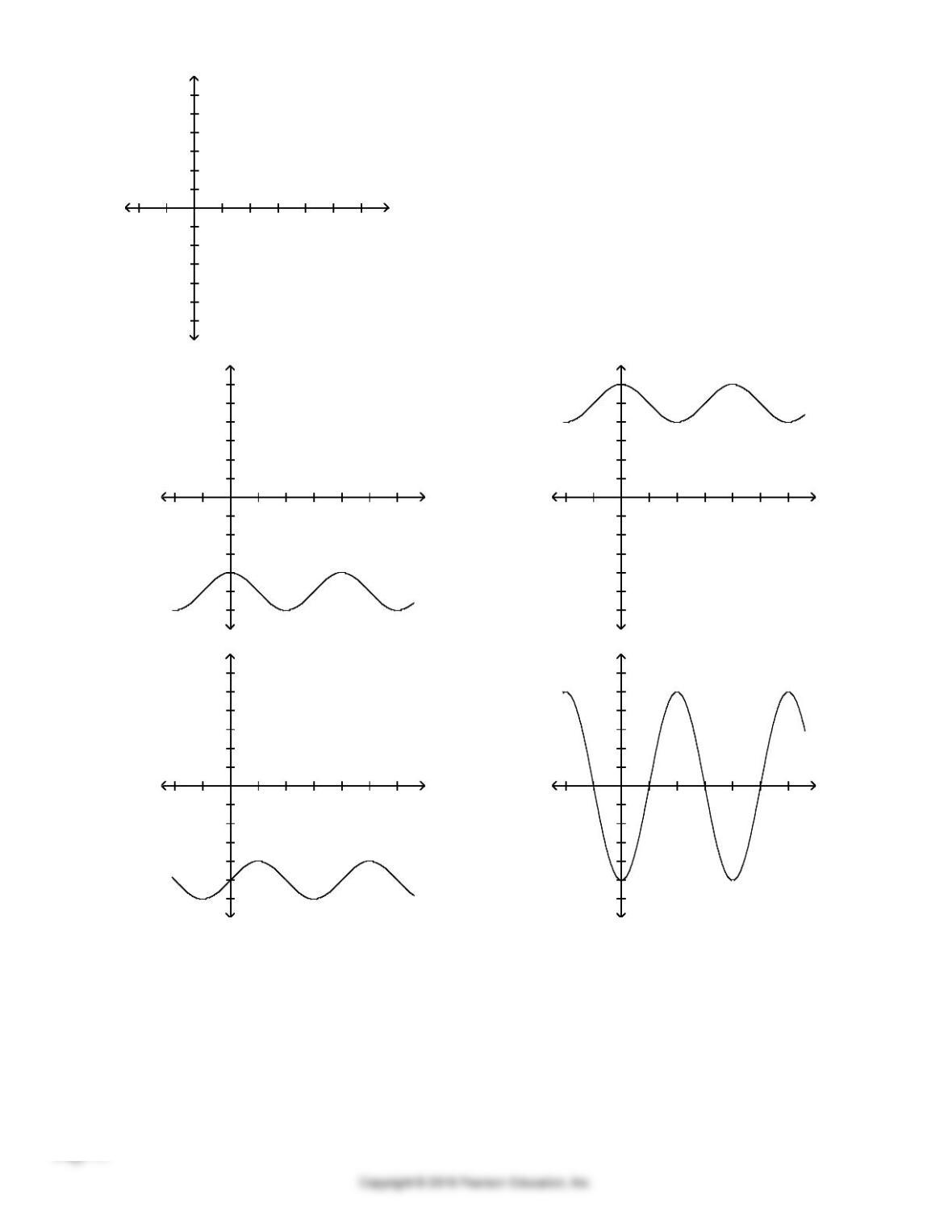
3) y=cosx–5
x
–
23
y
6
4
2
-2
-4
-6
x
–
23
y
6
4
2
-2
-4
-6
A)
x
–
23
y
6
4
2
-2
-4
-6
x
–
23
y
6
4
2
-2
-4
-6
B)
x
–
23
y
6
4
2
-2
-4
-6
x
–
23
y
6
4
2
-2
-4
-6
C)
x
–
23
y
6
4
2
-2
-4
-6
x
–
23
y
6
4
2
-2
-4
-6
D)
x
–
23
y
6
4
2
-2
-4
-6
x
–
23
y
6
4
2
-2
-4
-6
Page49
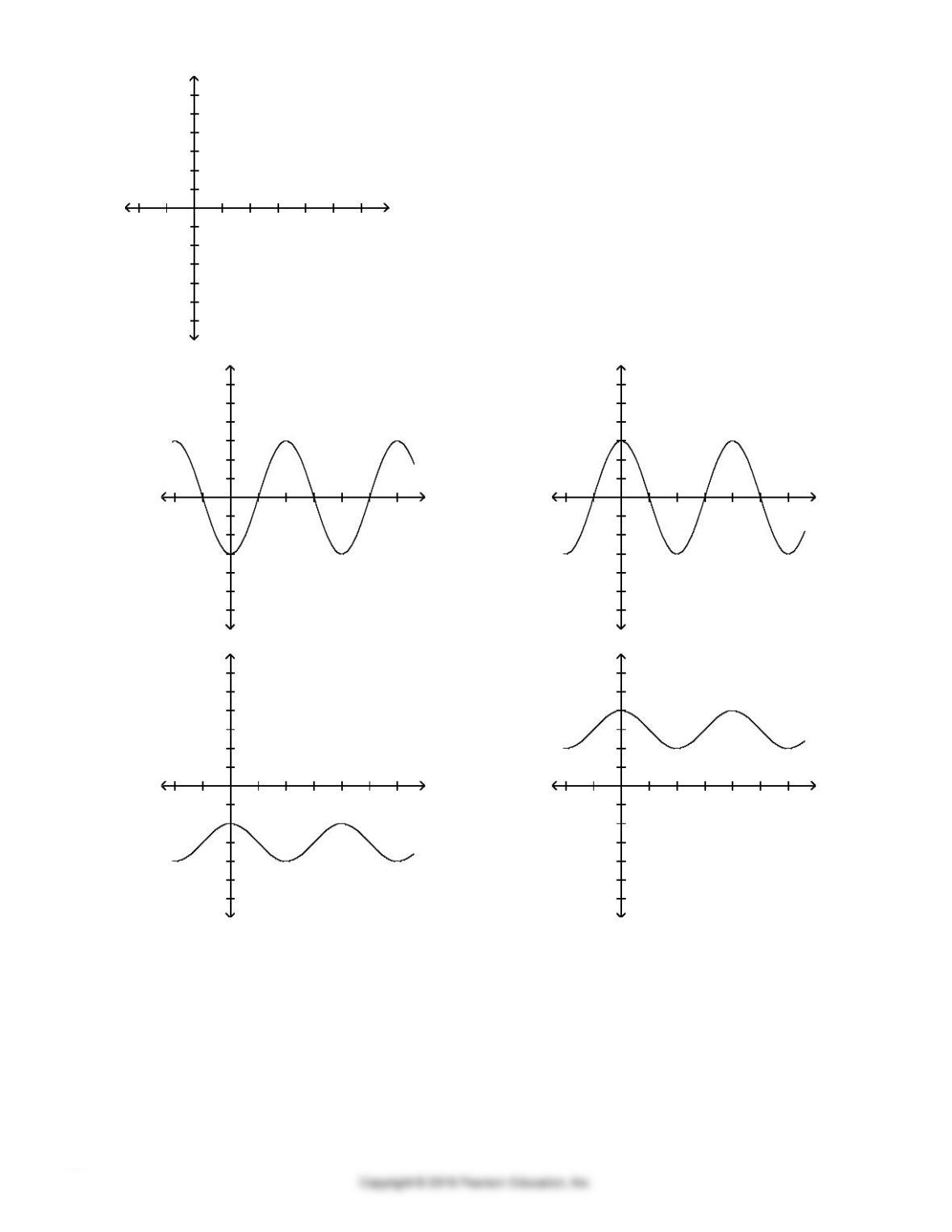
4) y=–3cosx
x
–
23
y
6
4
2
-2
-4
-6
x
–
23
y
6
4
2
-2
-4
-6
A)
x
–
23
y
6
4
2
-2
-4
-6
x
–
23
y
6
4
2
-2
-4
-6
B)
x
–
23
y
6
4
2
-2
-4
-6
x
–
23
y
6
4
2
-2
-4
-6
C)
x
–
23
y
6
4
2
-2
-4
-6
x
–
23
y
6
4
2
-2
-4
-6
D)
x
–
23
y
6
4
2
-2
-4
-6
x
–
23
y
6
4
2
-2
-4
-6
Page50
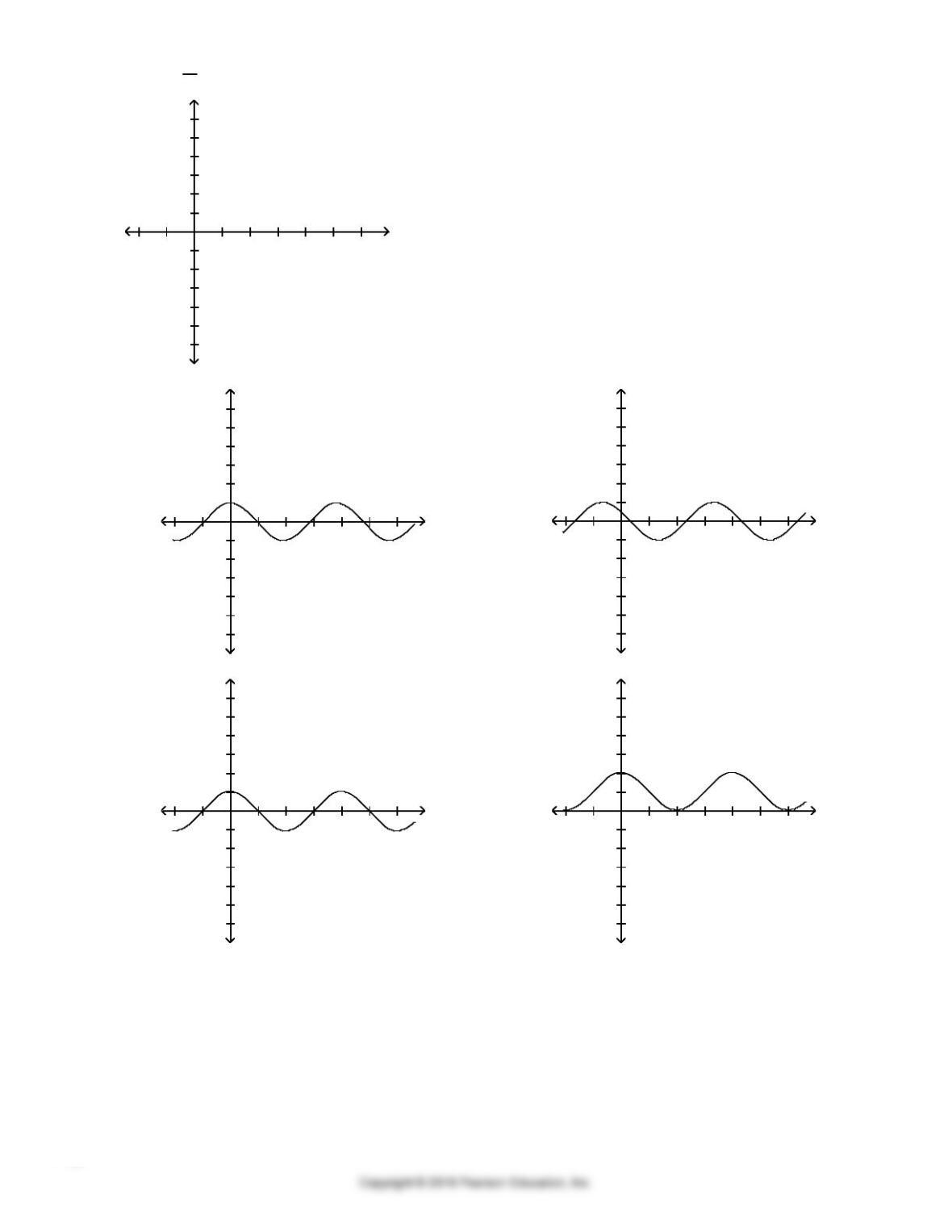
5) y=cos(π
3x)
x
–
23
y
6
4
2
-2
-4
-6
x
–
23
y
6
4
2
-2
-4
-6
A)
x
–
23
y
6
4
2
-2
-4
-6
x
–
23
y
6
4
2
-2
-4
-6
B)
x
–
23
y
6
4
2
-2
-4
-6
x
–
23
y
6
4
2
-2
-4
-6
C)
x
–
23
y
6
4
2
-2
-4
-6
x
–
23
y
6
4
2
-2
-4
-6
D)
x
–
23
y
6
4
2
-2
-4
-6
x
–
23
y
6
4
2
-2
-4
-6
Page51
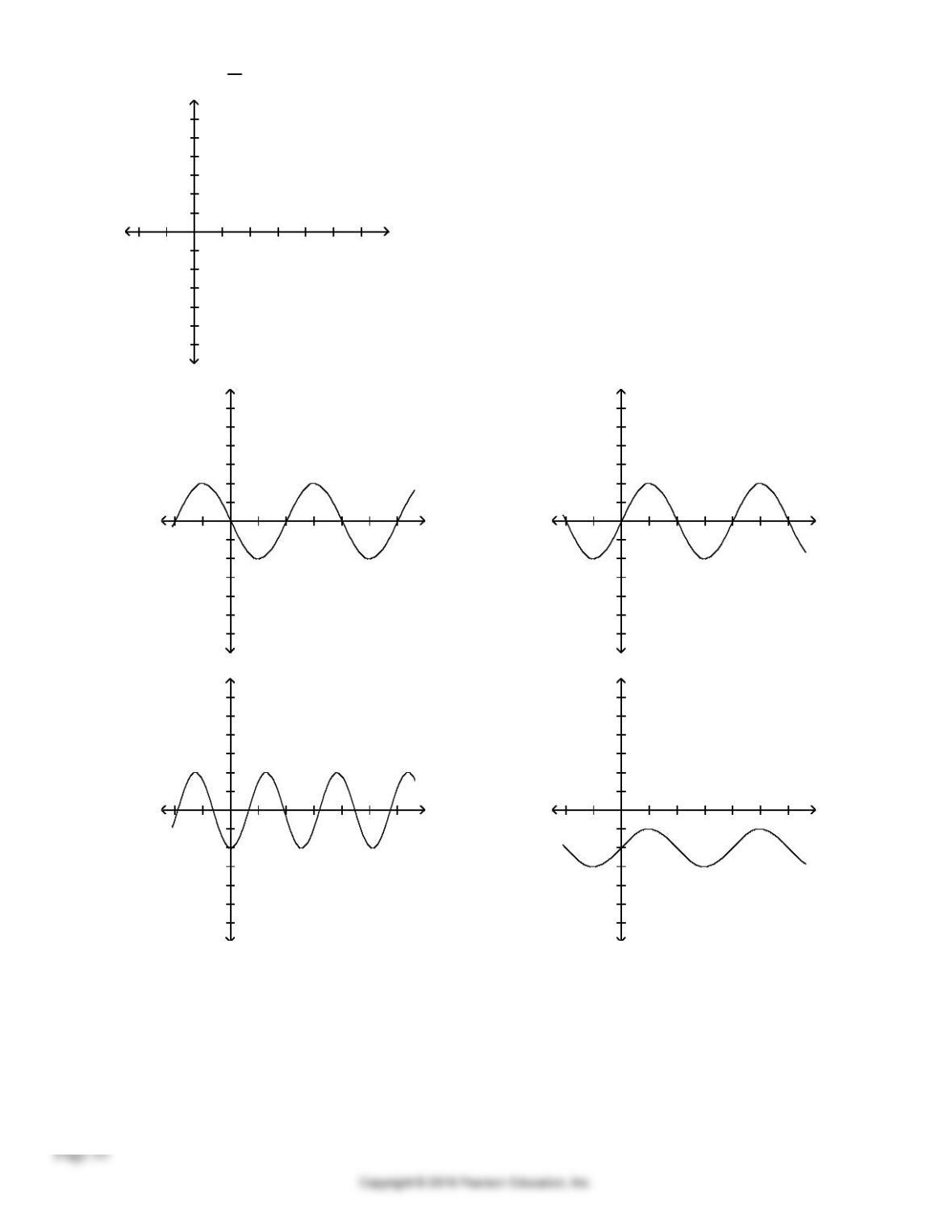
6) y=5cosx+1
x
–
23
y
10
8
6
4
2
-2
-4
-6
-8
-10
x
–
23
y
10
8
6
4
2
-2
-4
-6
-8
-10
A)
x
–
23
y
10
8
6
4
2
-2
-4
-6
-8
-10
x
–
23
y
10
8
6
4
2
-2
-4
-6
-8
-10
B)
x
–
23
y
10
8
6
4
2
-2
-4
-6
-8
-10
x
–
23
y
10
8
6
4
2
-2
-4
-6
-8
-10
C)
x
–
23
y
10
8
6
4
2
-2
-4
-6
-8
-10
x
–
23
y
10
8
6
4
2
-2
-4
-6
-8
-10
D)
x
–
23
y
10
8
6
4
2
-2
-4
-6
-8
-10
x
–
23
y
10
8
6
4
2
-2
-4
-6
-8
-10
Page52
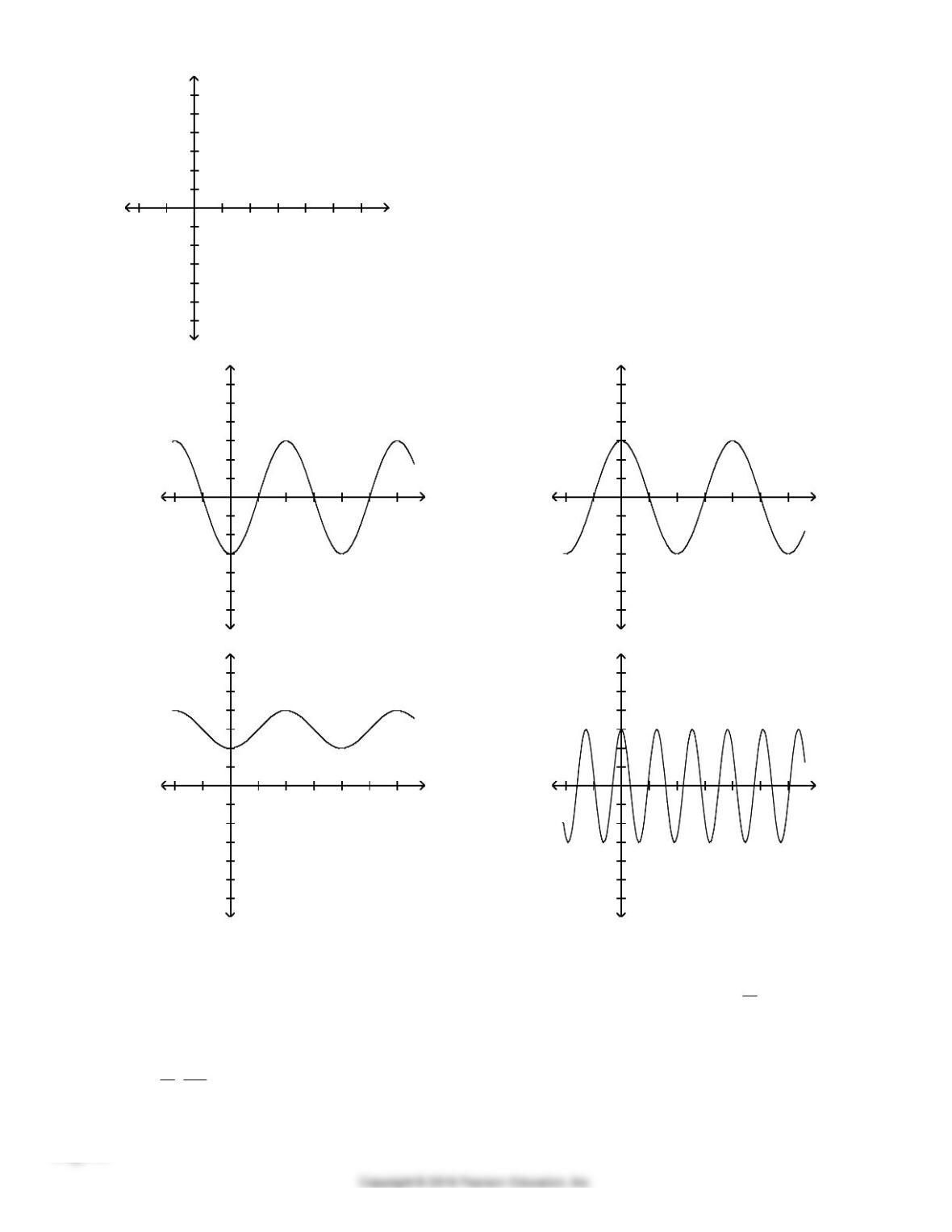
7) y=–2cos(x–π
2)
x
–
23
y
6
4
2
-2
-4
-6
x
–
23
y
6
4
2
-2
-4
-6
A)
x
–
23
y
6
4
2
-2
-4
-6
x
–
23
y
6
4
2
-2
-4
-6
B)
x
–
23
y
6
4
2
-2
-4
-6
x
–
23
y
6
4
2
-2
-4
-6
C)
x
–
23
y
6
4
2
-2
-4
-6
x
–
23
y
6
4
2
-2
-4
-6
D)
x
–
23
y
6
4
2
-2
-4
-6
x
–
23
y
6
4
2
-2
-4
-6
8) y=3cos(π–x)
x
–
23
y
6
4
2
-2
-4
-6
x
–
23
y
6
4
2
-2
-4
-6
A)
x
–
23
y
6
4
2
-2
-4
-6
x
–
23
y
6
4
2
-2
-4
-6
B)
x
–
23
y
6
4
2
-2
-4
-6
x
–
23
y
6
4
2
-2
-4
-6
C)
x
–
23
y
6
4
2
-2
-4
-6
x
–
23
y
6
4
2
-2
-4
-6
D)
x
–
23
y
6
4
2
-2
-4
-6
x
–
23
y
6
4
2
-2
-4
-6
Solvetheproblem.
9) Whatisthey–interceptofy=sinx?
A) 0 B) 1 C) πD) π
2
10) Forwhatnumbersx,0≤x≤2π
,
doescosx=0?
A) π
2,3π
2B) 0,π
,
2πC) 0,1D)0,1,2
Page54

11) Forwhatnumbersx,0≤x≤2π
,
doescosx=1?
A) 0,2πB) π
2,3π
2C) π
2D) none
12) Forwhatnumbersx,0≤x≤2π
,
doescosx= –1?
A) πB) π
2,3π
2C) π
2D) none
3 DeterminetheAmplitudeandPeriodofSinusoidalFunctions
MULTIPLECHOICE.Choosetheonealternativethatbestcompletesthestatementoranswersthequestion.
Withoutgraphingthefunction,determineitsamplitudeorperiodasrequested.
1) y=4sinx Findtheamplitude.
A) 4 B) 4πC) π
4D) 2π
2) y=–3sin1
4x Findtheamplitude.
A) 3 B) 3π
4C) π
3D) 8π
3) y=5sin2x Findtheamplitude.
A) 5 B) 5
2C) π
5D) π
2
4) y=sin5x Findtheperiod.
A) 2π
5B) 5 C) 2πD) 1
5) y=–5cos1
2x Findtheamplitude.
A) 5 B) 5π
2C) π
5D) 4π
6) y=cos5x Findtheperiod.
A) 2π
5B) 5 C) 2πD) 1
7) y=3cos1
4x Findtheperiod.
A) 8πB) 3 C) 3π
4D) π
4
8) y=–5cosx Findtheperiod.
A) 2πB) 5 C) π
5D) π
Page55

9) y=5
4cos(–6π
7x) Findtheperiod.
A) 7
3B) 12π
7C) 5π
2D) 2
5
10) y=7
6sin(–4π
3x) Findtheamplitude.
A) 7
6B) 3
2C) 6π
7D) 4π
3
SHORTANSWER.Writethewordorphrasethatbestcompleteseachstatementoranswersthequestion.
Solvetheproblem.
11) Wildlifemanagementpersonnelusepredator–preyequationstomodelthepopulationsofcertain
predatorsandtheirpreyinthewild.SupposethepopulationMofapredatoraftertmonthsisgivenby
M=750+125sinπ
6t
whilethepopulationNofitsprimarypreyisgivenby
N=12,250+3050cosπ
6t
Findtheperiodforeachofthesefunctions.
12) TheaveragedailytemperatureTofacityintheUnitedStatesisapproximatedby
T=55–23cos2π
365 (t–30)
wheretisindays,1≤t≤365,andt=1correspondstoJanuary1.FindtheperiodofT.
MULTIPLECHOICE.Choosetheonealternativethatbestcompletesthestatementoranswersthequestion.
13) ThecurrentI,inamperes,flowingthroughaparticularac(alternatingcurrent)circuitattimetsecondsis
I=120sin(45πt)
Whatistheperiodandamplitudeofthecurrent?
A) period=2
45second,amplitude=120 B) period=45πseconds,amplitude=2
45
C) period=1
270 second,amplitude=270 D) period=π
120 second,amplitude=45
Page56
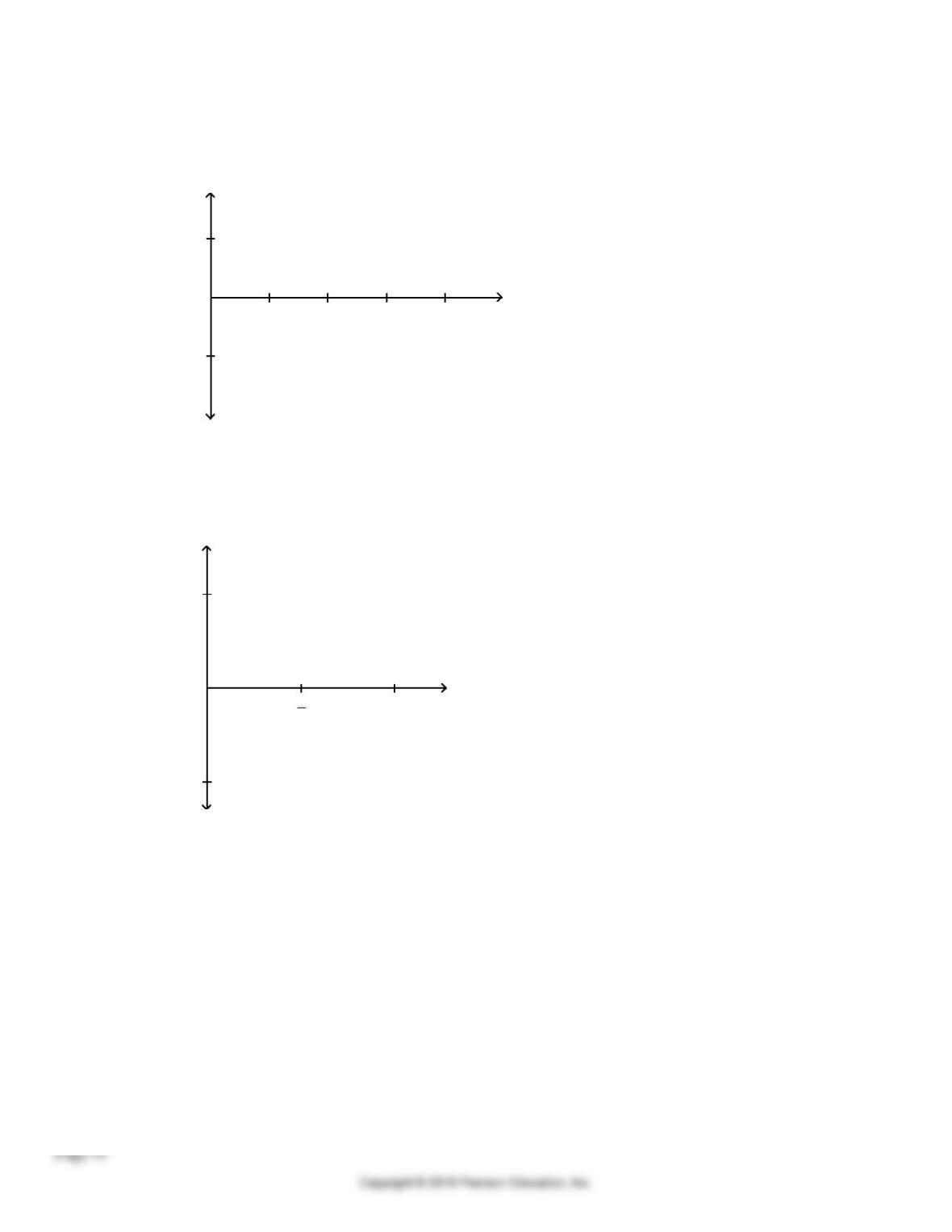
SHORTANSWER.Writethewordorphrasethatbestcompleteseachstatementoranswersthequestion.
14) ThecurrentI,inamperes,flowingthroughanac(alternatingcurrent)circuitattimet,inseconds,is
I=30sin(50πt)
Whatistheamplitude?Whatistheperiod?
Graphthisfunctionovertwoperiodsbeginningatt=0.
t
I
t
I
15) Amasshangsfromaspringwhichoscillatesupanddown.ThepositionPofthemassattimetisgivenby
P=4cos(4t)
Whatistheamplitude?Whatistheperiod?
Graphthisfunctionovertwoperiodsbeginningatt=0.
t
2
P
4
-4
t
2
P
4
-4
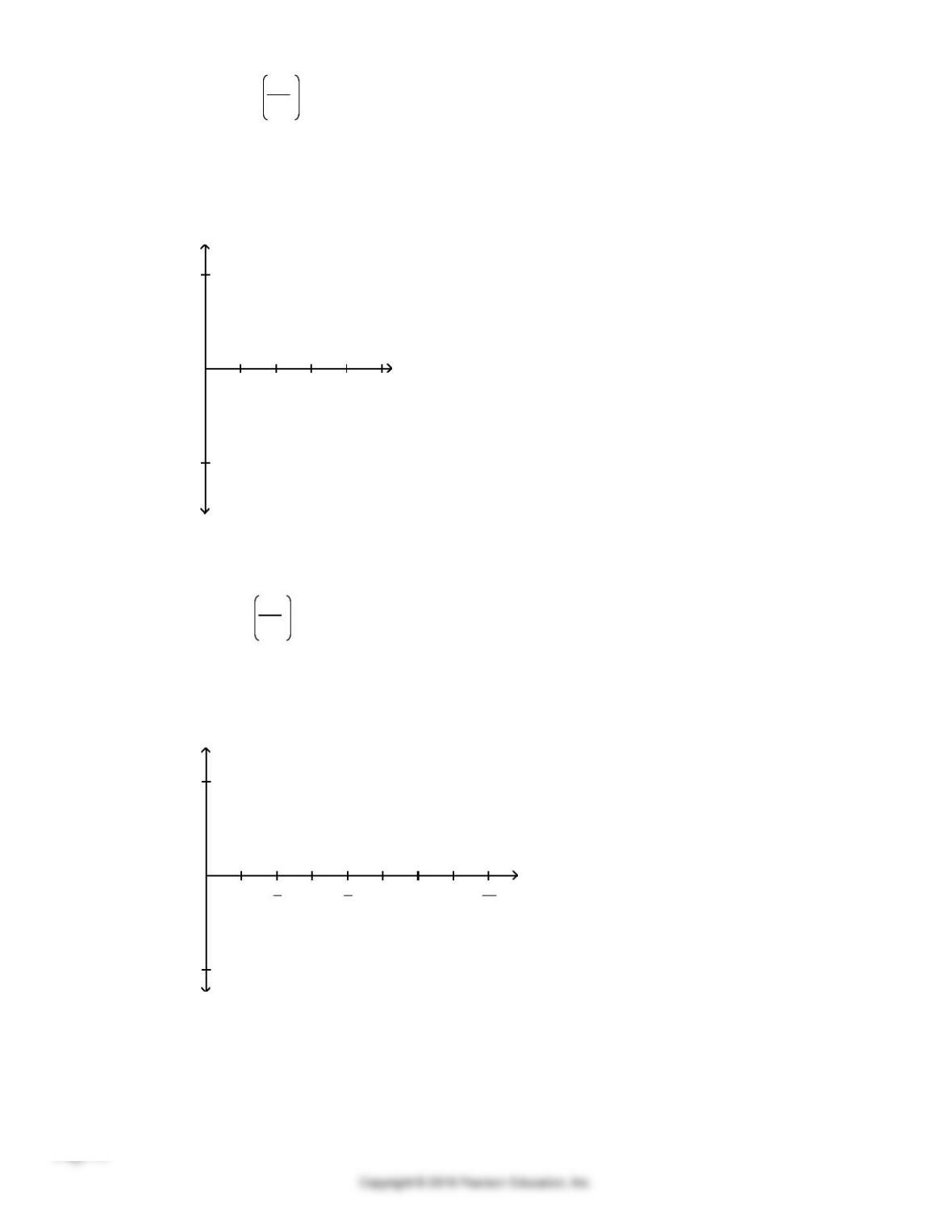
16) Beforeexercising,anathletemeasuresherairflowandobtains
a=0.65sin2π
5t
whereaismeasuredinliterspersecondandtisthetimeinseconds.Ifa>0,theathleteisinhaling;ifa<0,
theathleteisexhaling.Thetimetocompleteonecompleteinhalation/exhalationsequenceisarespiratory
cycle.
Whatistheamplitude?Whatistheperiod?Whatistherespiratorycycle?
Graphaovertwoperiodsbeginningatt=0.
t
510
a
1
-1
t
510
a
1
-1
17) Aboyisflyingamodelairplanewhilestandingonastraightline.Theplane,attheendofatwenty–five
footwire,fliesincirclesaroundtheboy.Thedirecteddistanceoftheplanefromthestraightlineisfound
tobe
d=25cos3π
4t
wheredismeasuredinfeetandtisthetimeinseconds.Ifd>0,theplaneisinfrontoftheboy;ifd<0,th
e
planeisbehindhim.
Whatistheamplitude?Whatistheperiod?
Graphdovertwoperiodsbeginningatt=0.
t
4
38
3416
3
d
25
-25
t
4
38
3416
3
d
25
-25
Page58
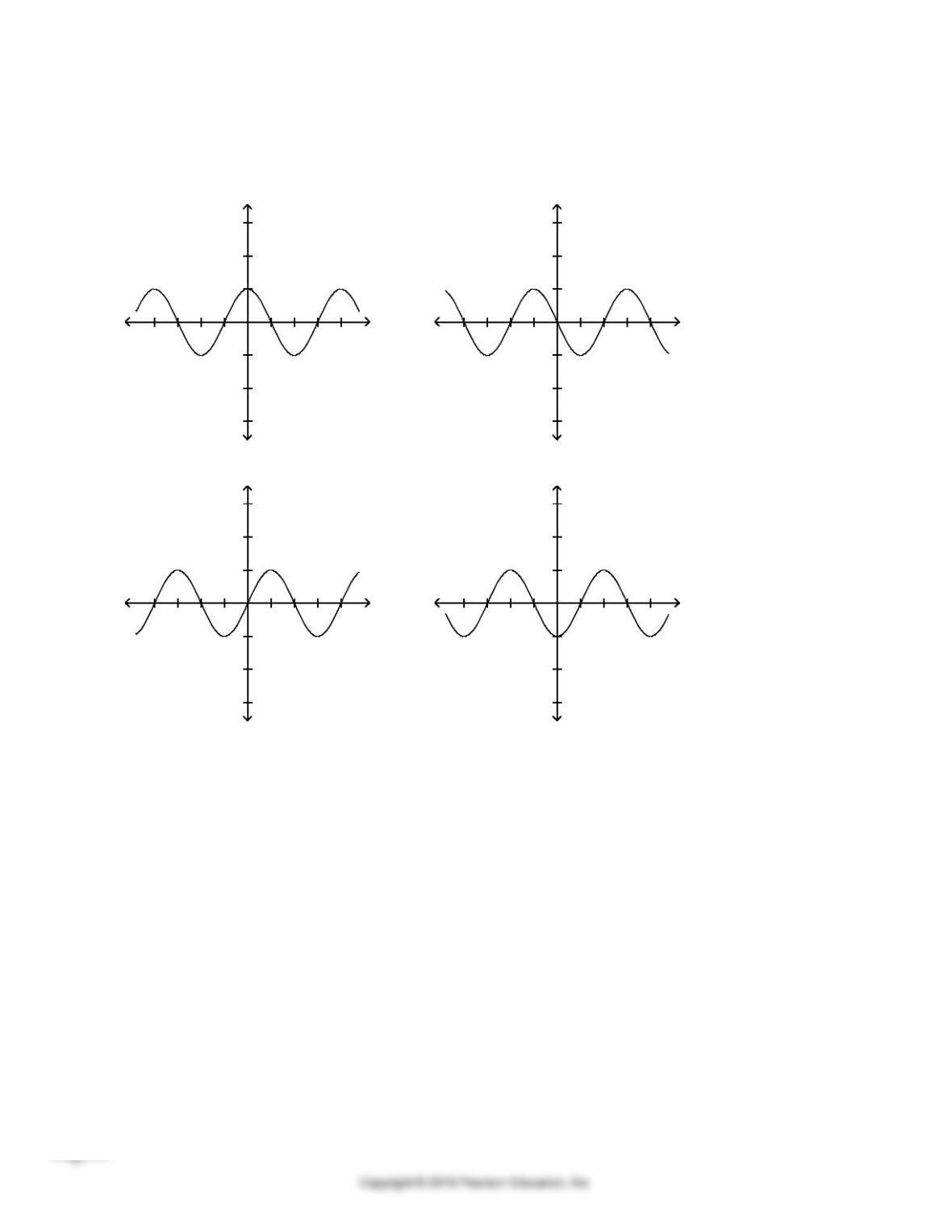
4 GraphSinusoidalFunctionsUsingKeyPoints
MULTIPLECHOICE.Choosetheonealternativethatbestcompletesthestatementoranswersthequestion.
Matchthegivenfunctiontoitsgraph.
1) 1)y=sinx2)y=cosx
3)y=–sinx4)y=–cosx
AB
x
-2–
2
y
3
2
1
-1
-2
-3
x
-2–
2
y
3
2
1
-1
-2
-3
x
-2–
2
y
3
2
1
-1
-2
-3
x
-2–
2
y
3
2
1
-1
-2
-3
CD
x
-2–
2
y
3
2
1
-1
-2
-3
x
-2–
2
y
3
2
1
-1
-2
-3
x
-2–
2
y
3
2
1
-1
-2
-3
x
-2–
2
y
3
2
1
-1
-2
-3
A) 1C,2A,3B,4D B) 1A,2D,3C,4B C) 1B,2D,3C,4A D) 1A,2B,3C,4D
Page59
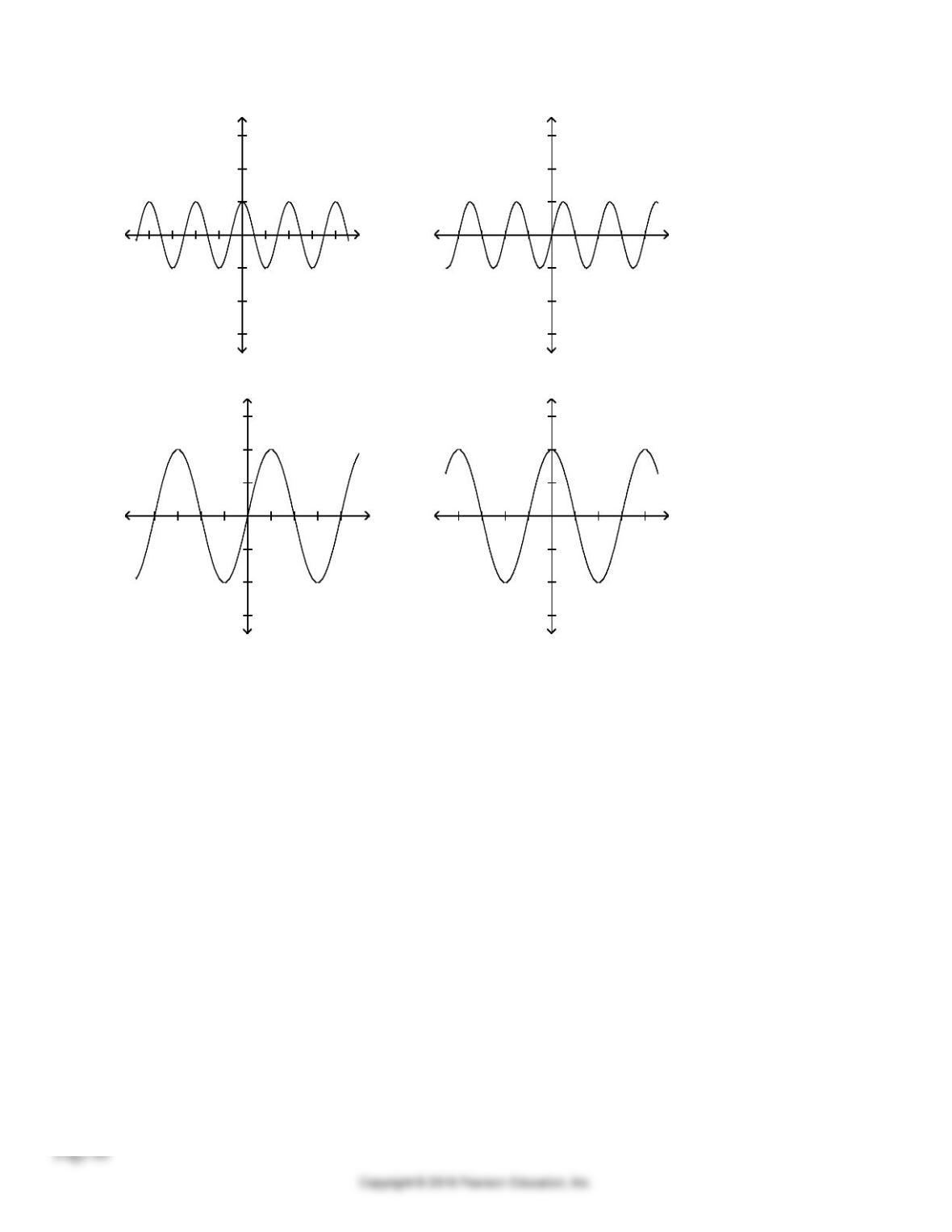
2) 1)y=sin2x 2)y=2cosx
3)y=2sinx4)y=cos2x
AB
x
-2–
2
y
3
2
1
-1
-2
-3
x
-2–
2
y
3
2
1
-1
-2
-3
x
-2–
2
y
3
2
1
-1
-2
-3
x
-2–
2
y
3
2
1
-1
-2
-3
CD
x
-2–
2
y
3
2
1
-1
-2
-3
x
-2–
2
y
3
2
1
-1
-2
-3
x
-2–
2
y
3
2
1
-1
-2
-3
x
-2–
2
y
3
2
1
-1
-2
-3
A) 1B,2D,3C,4A B) 1A,2D,3C,4B C) 1A,2C,3D,4B D) 1A,2B,3C,4D
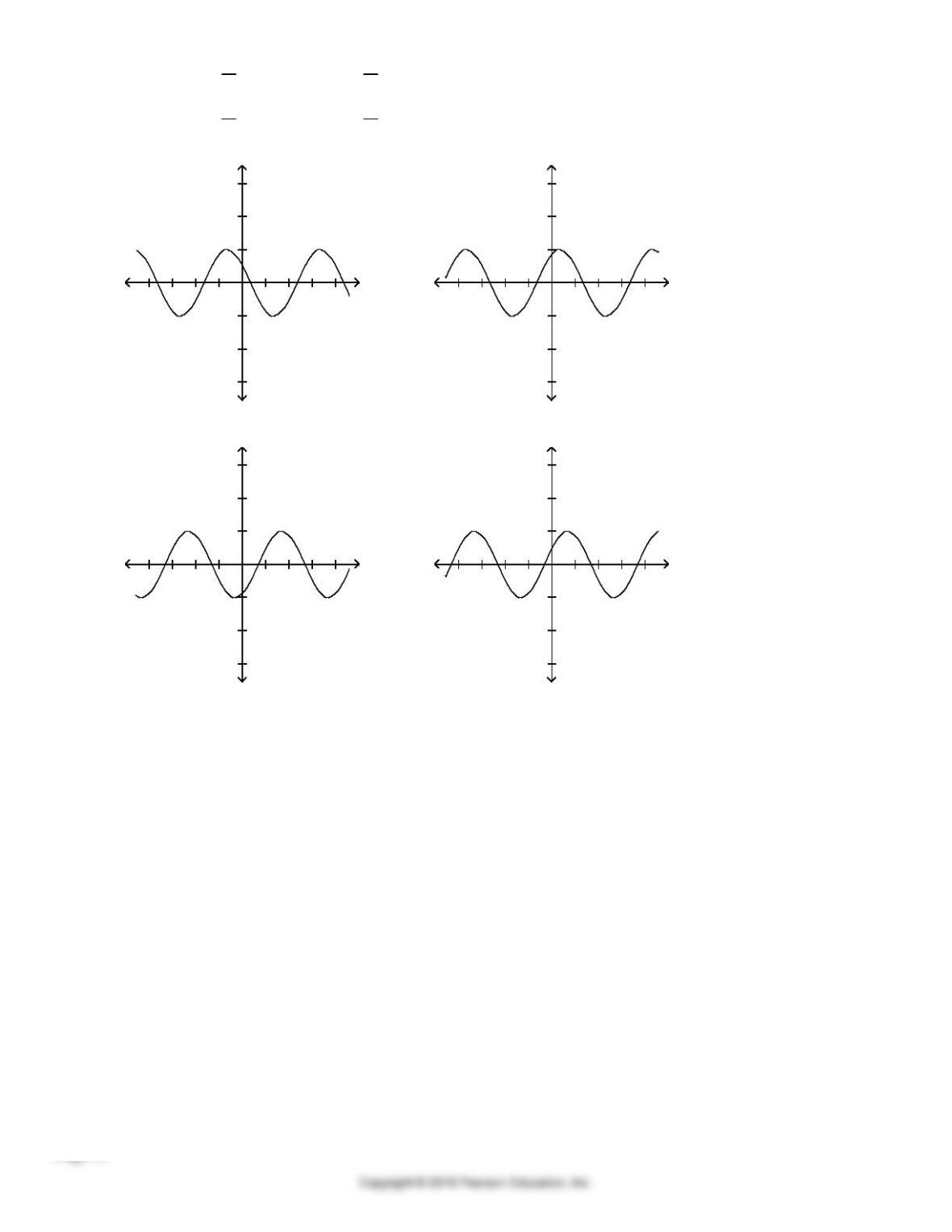
3) 1)y=sin(x–π
3)2)y=cos(x+π
3)
3)y=sin(x+π
3)4)y=cos(x–π
3)
AB
x
-2–
2
y
3
2
1
-1
-2
-3
x
-2–
2
y
3
2
1
-1
-2
-3
x
-2–
2
y
3
2
1
-1
-2
-3
x
-2–
2
y
3
2
1
-1
-2
-3
CD
x
-2–
2
y
3
2
1
-1
-2
-3
x
-2–
2
y
3
2
1
-1
-2
-3
x
-2–
2
y
3
2
1
-1
-2
-3
x
-2–
2
y
3
2
1
-1
-2
-3
A) 1C,2A,3B,4D B) 1A,2D,3C,4B C) 1B,2D,3C,4A D) 1A,2B,3C,4D
Page61
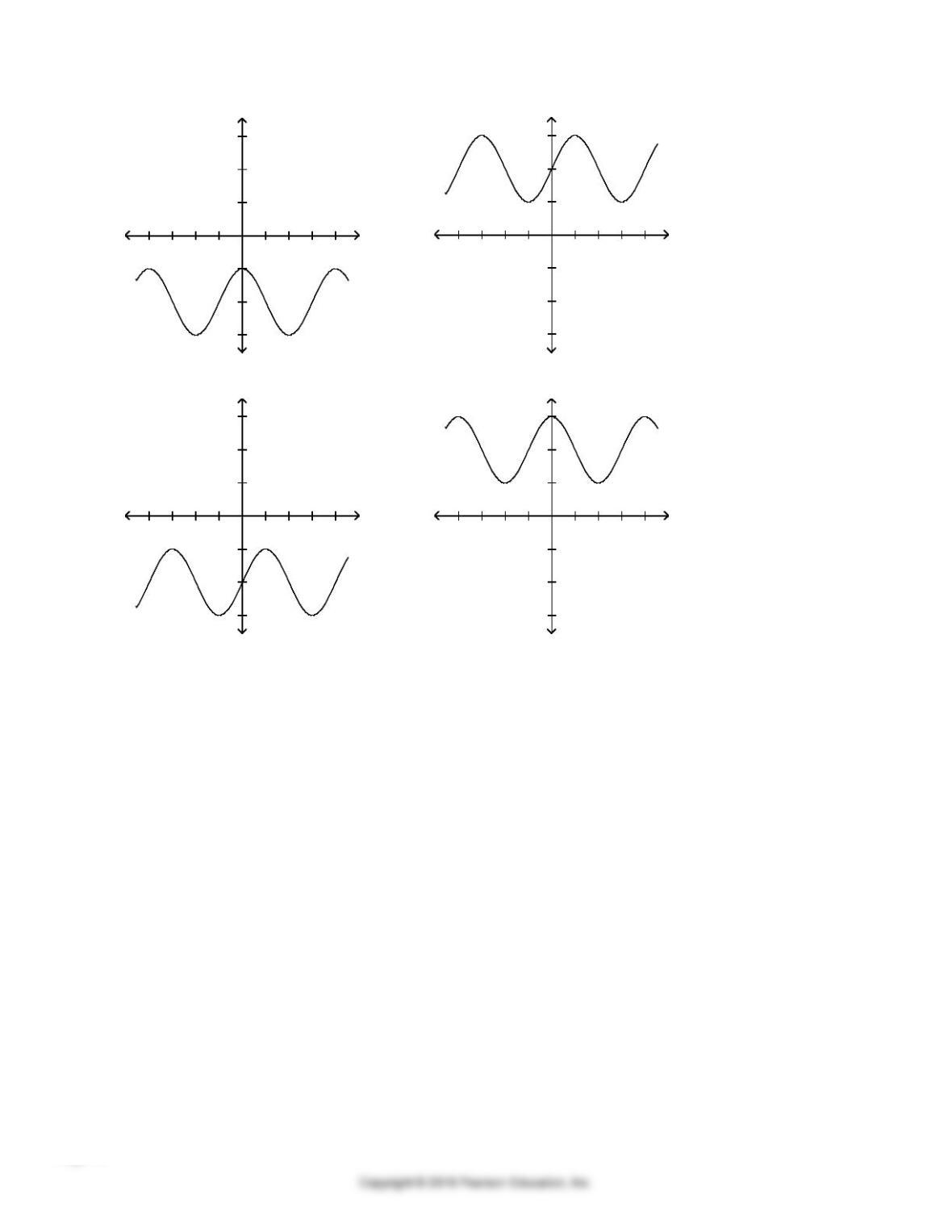
4) 1)y=2+sinx2)y=2+cosx
3)y=–2+sinx4)y=–2+cosx
AB
x
-2–
2
y
3
2
1
-1
-2
-3
x
-2–
2
y
3
2
1
-1
-2
-3
x
-2–
2
y
3
2
1
-1
-2
-3
x
-2–
2
y
3
2
1
-1
-2
-3
CD
x
-2–
2
y
3
2
1
-1
-2
-3
x
-2–
2
y
3
2
1
-1
-2
-3
x
-2–
2
y
3
2
1
-1
-2
-3
x
-2–
2
y
3
2
1
-1
-2
-3
A) 1B,2D,3C,4A B) 1A,2D,3C,4B C) 1A,2C,3D,4B D) 1A,2B,3C,4D
Page62
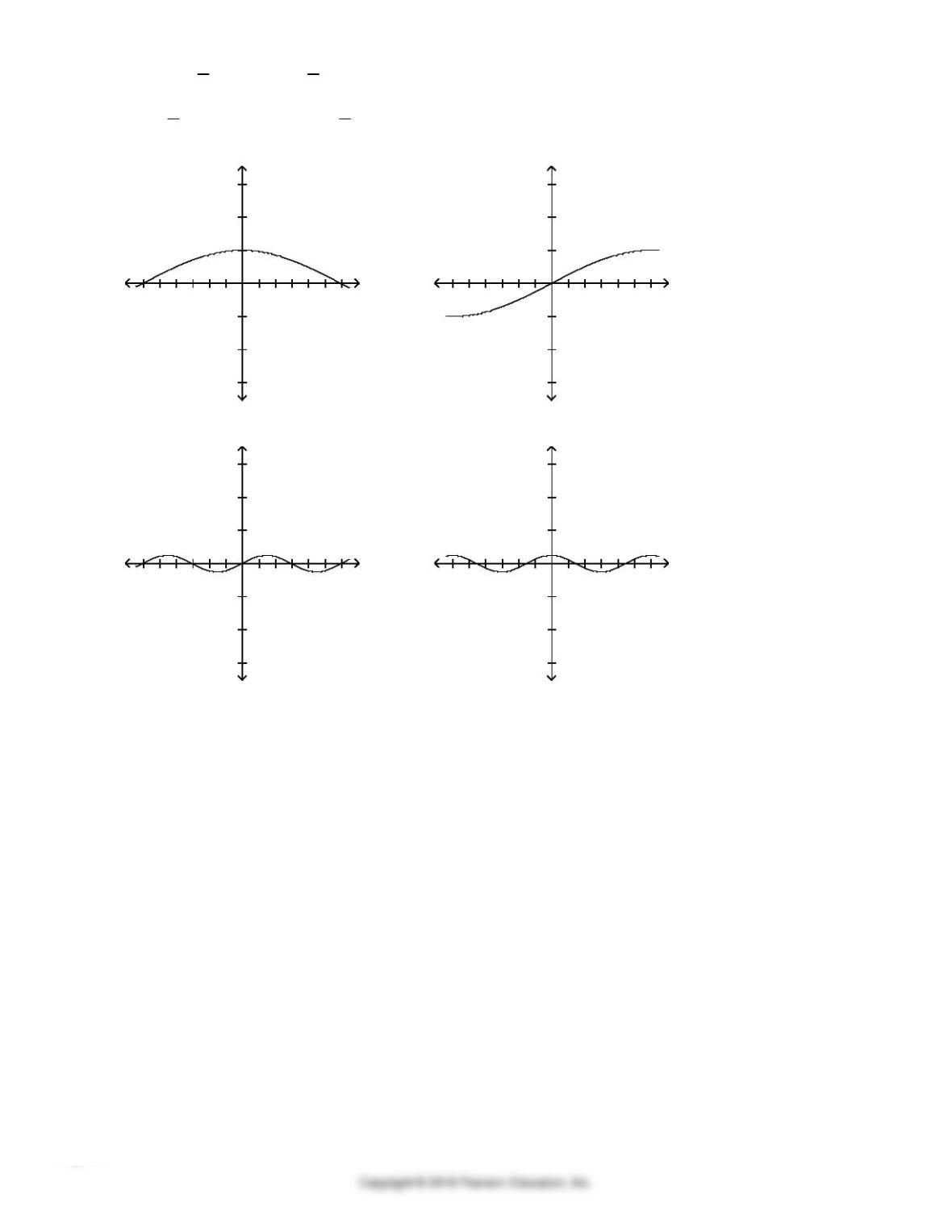
5) 1)y=sin(1
4x) 2)y=1
4cosx
3)y=1
4sinx4)y=cos(1
4x)
AB
x
-2–
2
y
3
-3
x
-2–
2
y
3
-3
x
-2–
2
y
3
-3
x
-2–
2
y
3
-3
CD
x
-2–
2
y
3
-3
x
-2–
2
y
3
-3
x
-2–
2
y
3
-3
x
-2–
2
y
3
-3
A) 1B,2D,3C,4A B) 1A,2D,3C,4B C) 1A,2C,3D,4B D) 1A,2B,3C,4D
Page63
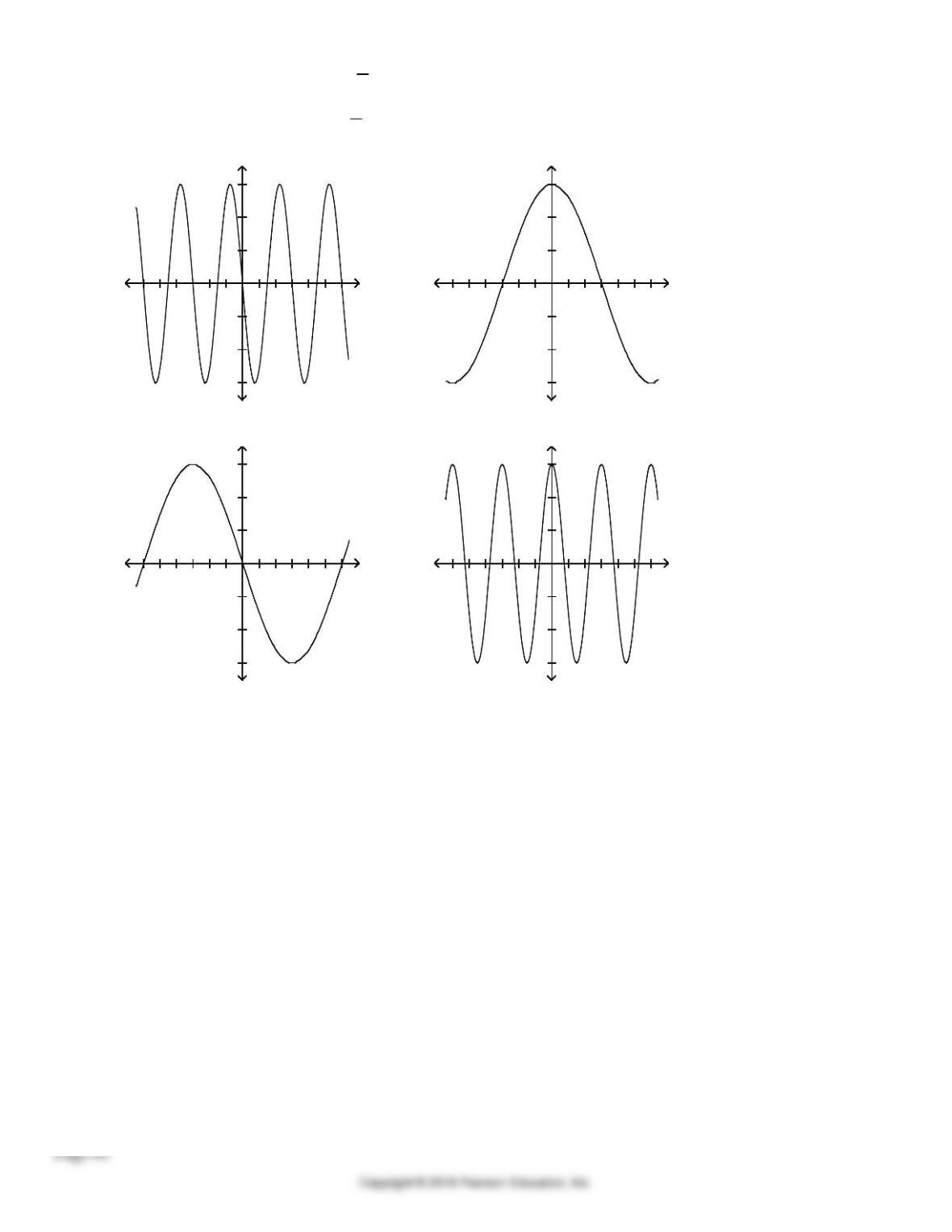
6) 1)y=–3sin(2x) 2)y=–3sin(1
2x)
3)y=3cos(2x) 4)y=3cos(1
2x)
AB
x
-2–
2
y
3
-3
x
-2–
2
y
3
-3
x
-2–
2
y
3
-3
x
-2–
2
y
3
-3
CD
x
-2–
2
y
3
-3
x
-2–
2
y
3
-3
x
-2–
2
y
3
-3
x
-2–
2
y
3
-3
A) 1A,2C,3D,4B B) 1C,2A,3B,4D C) 1C,2A,3D,4B D) 1D,2B,3A,4C
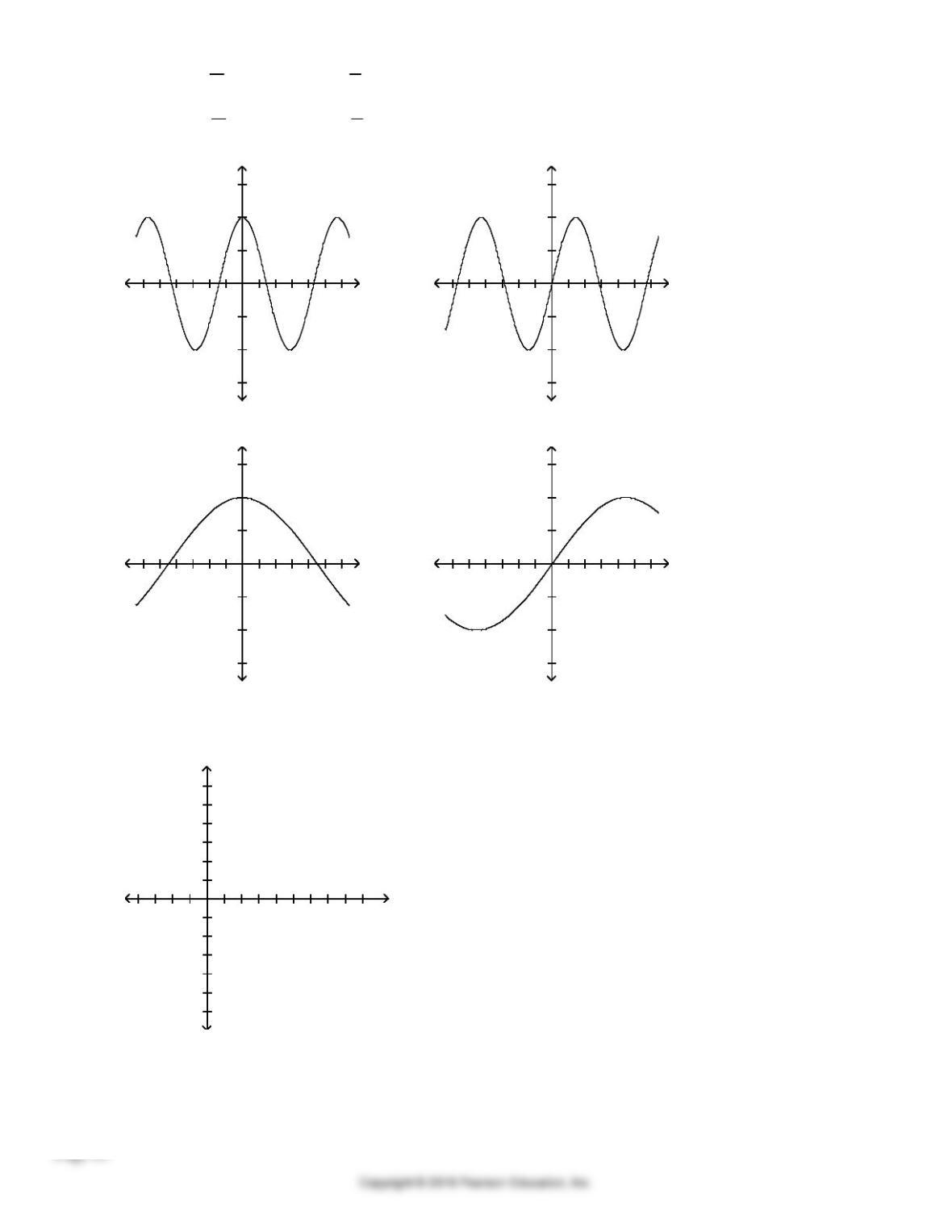
7) 1)y=2sin(π
3x) 2)y=2sin(1
3x)
3)y=2cos(π
3x) 4)y=2cos(1
3x)
A) B)
x
-2–
2
y
3
-3
x
-2–
2
y
3
-3
x
-2–
2
y
3
-3
x
-2–
2
y
3
-3
C) D)
x
-2–
2
y
3
-3
x
-2–
2
y
3
-3
x
-2–
2
y
3
-3
x
-2–
2
y
3
-3
A) 1B,2D,3A,4C B) 1A,2C,3B,4D C) 1C,2A,3D,4B D) 1A,2C,3D,4B
Graphthesinusoidalfunction.
8) y=–4sin(πx)
x
–
23
y
6
4
2
-2
-4
-6
x
–
23
y
6
4
2
-2
-4
-6
Page65
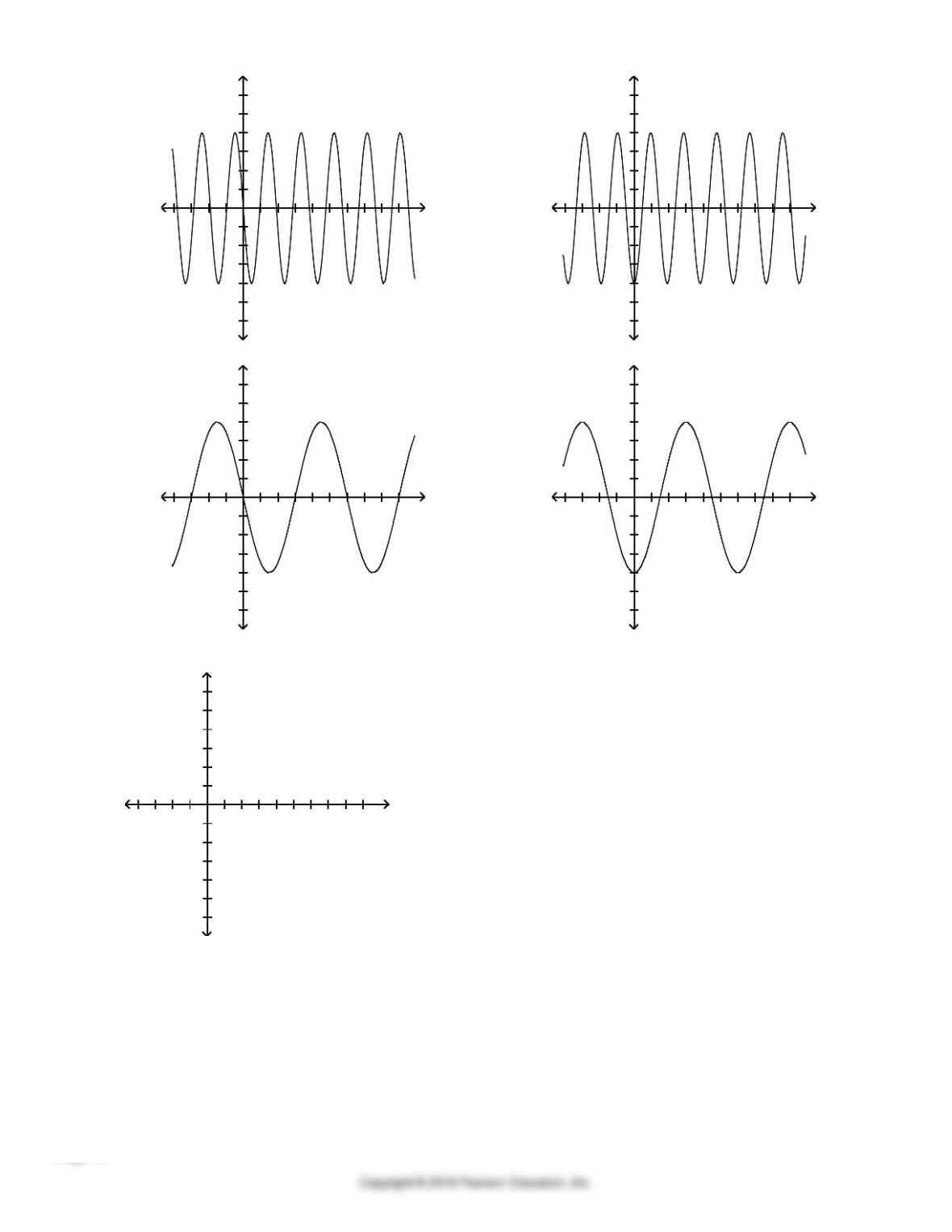
A)
x
–
23
y
6
4
2
-2
-4
-6
x
–
23
y
6
4
2
-2
-4
-6
B)
x
–
23
y
6
4
2
-2
-4
-6
x
–
23
y
6
4
2
-2
-4
-6
C)
x
–
23
y
6
4
2
-2
-4
-6
x
–
23
y
6
4
2
-2
-4
-6
D)
x
–
23
y
6
4
2
-2
-4
-6
x
–
23
y
6
4
2
-2
-4
-6
9) y=2cos(πx)
x
–
23
y
6
4
2
-2
-4
-6
x
–
23
y
6
4
2
-2
-4
-6
Page66
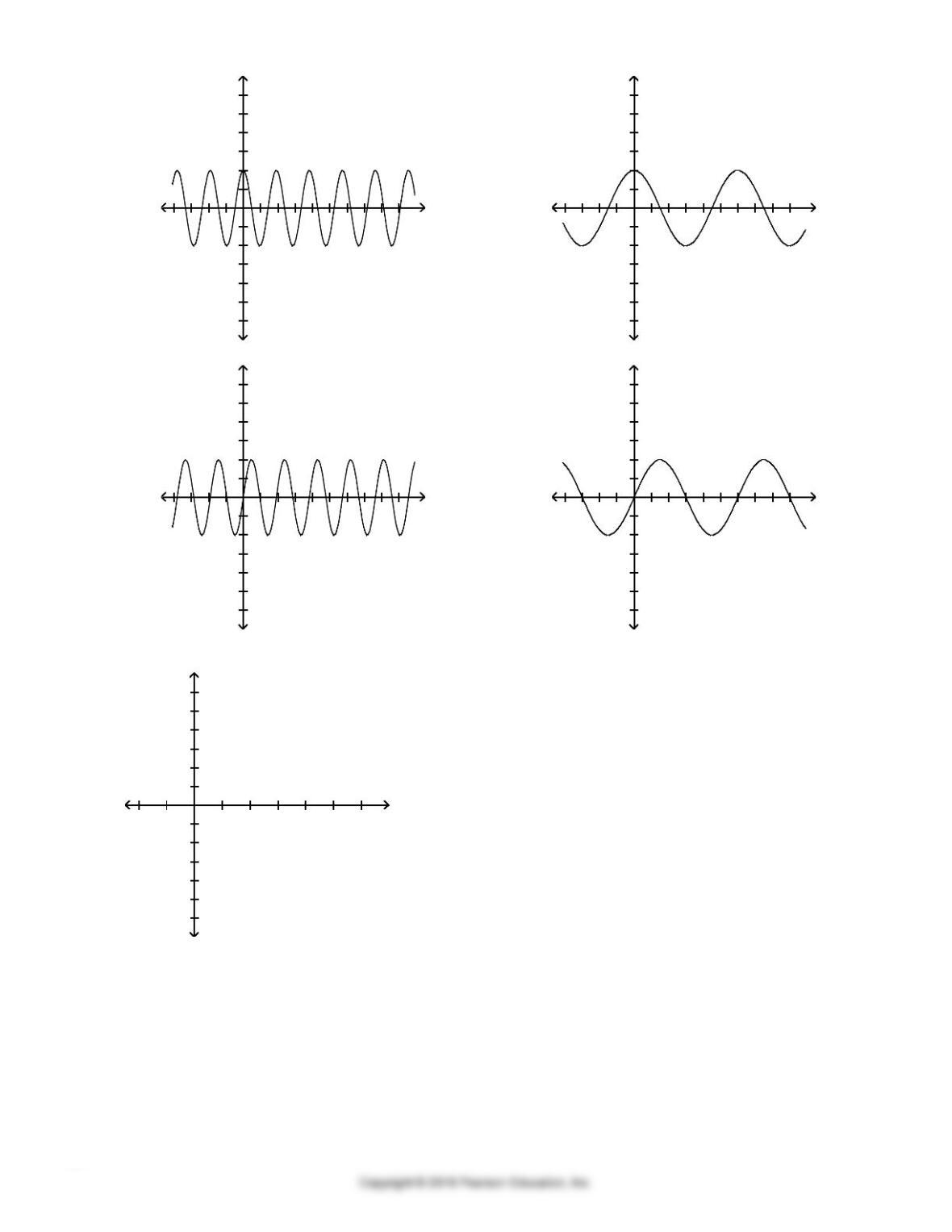
A)
x
–
23
y
6
4
2
-2
-4
-6
x
–
23
y
6
4
2
-2
-4
-6
B)
x
–
23
y
6
4
2
-2
-4
-6
x
–
23
y
6
4
2
-2
-4
-6
C)
x
–
23
y
6
4
2
-2
-4
-6
x
–
23
y
6
4
2
-2
-4
-6
D)
x
–
23
y
6
4
2
-2
-4
-6
x
–
23
y
6
4
2
-2
-4
-6
10) y=2sin(5x)
x
–
23
y
6
4
2
-2
-4
-6
x
–
23
y
6
4
2
-2
-4
-6
Page67
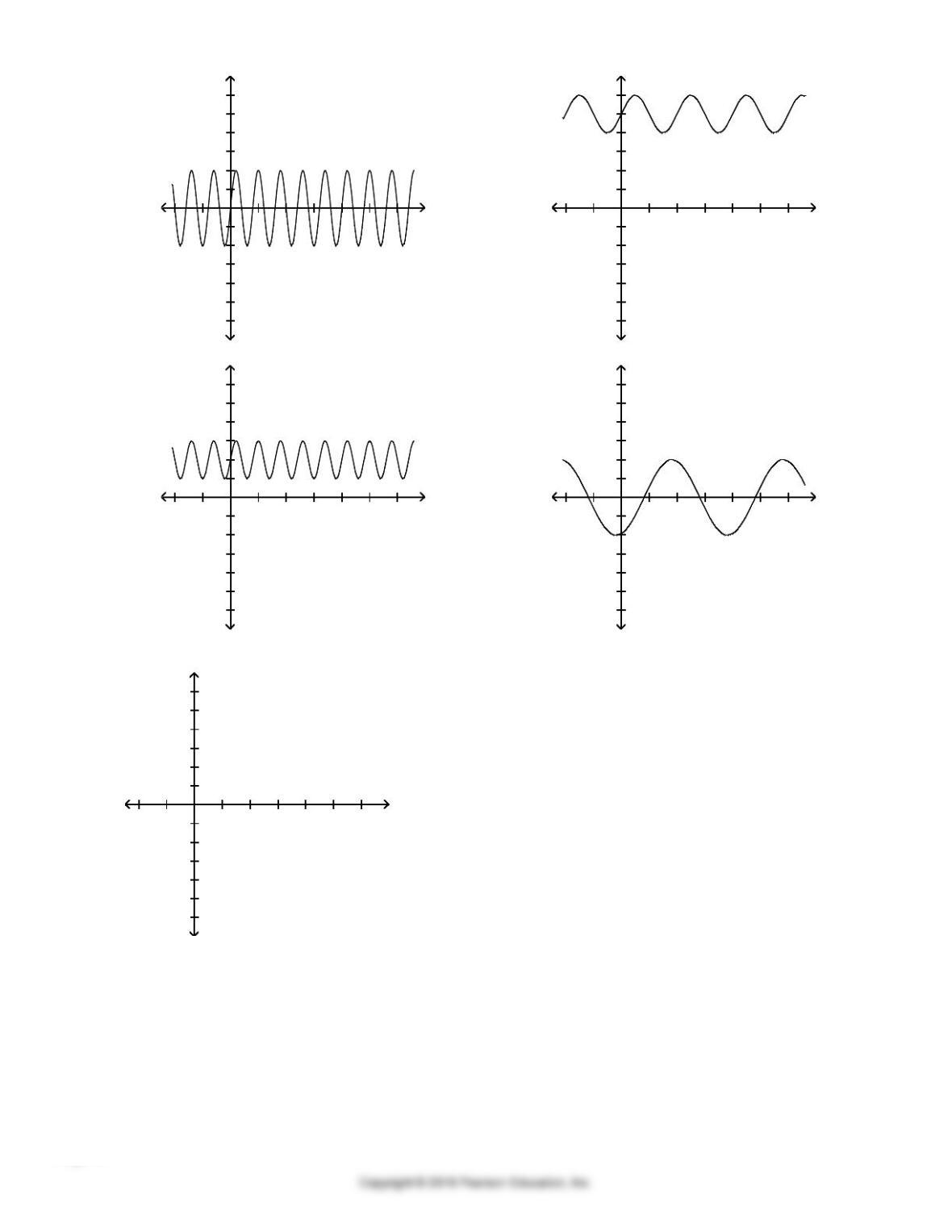
A)
x
–
23
y
6
4
2
-2
-4
-6
x
–
23
y
6
4
2
-2
-4
-6
B)
x
–
23
y
6
4
2
-2
-4
-6
x
–
23
y
6
4
2
-2
-4
-6
C)
x
–
23
y
6
4
2
-2
-4
-6
x
–
23
y
6
4
2
-2
-4
-6
D)
x
–
23
y
6
4
2
-2
-4
-6
x
–
23
y
6
4
2
-2
-4
-6
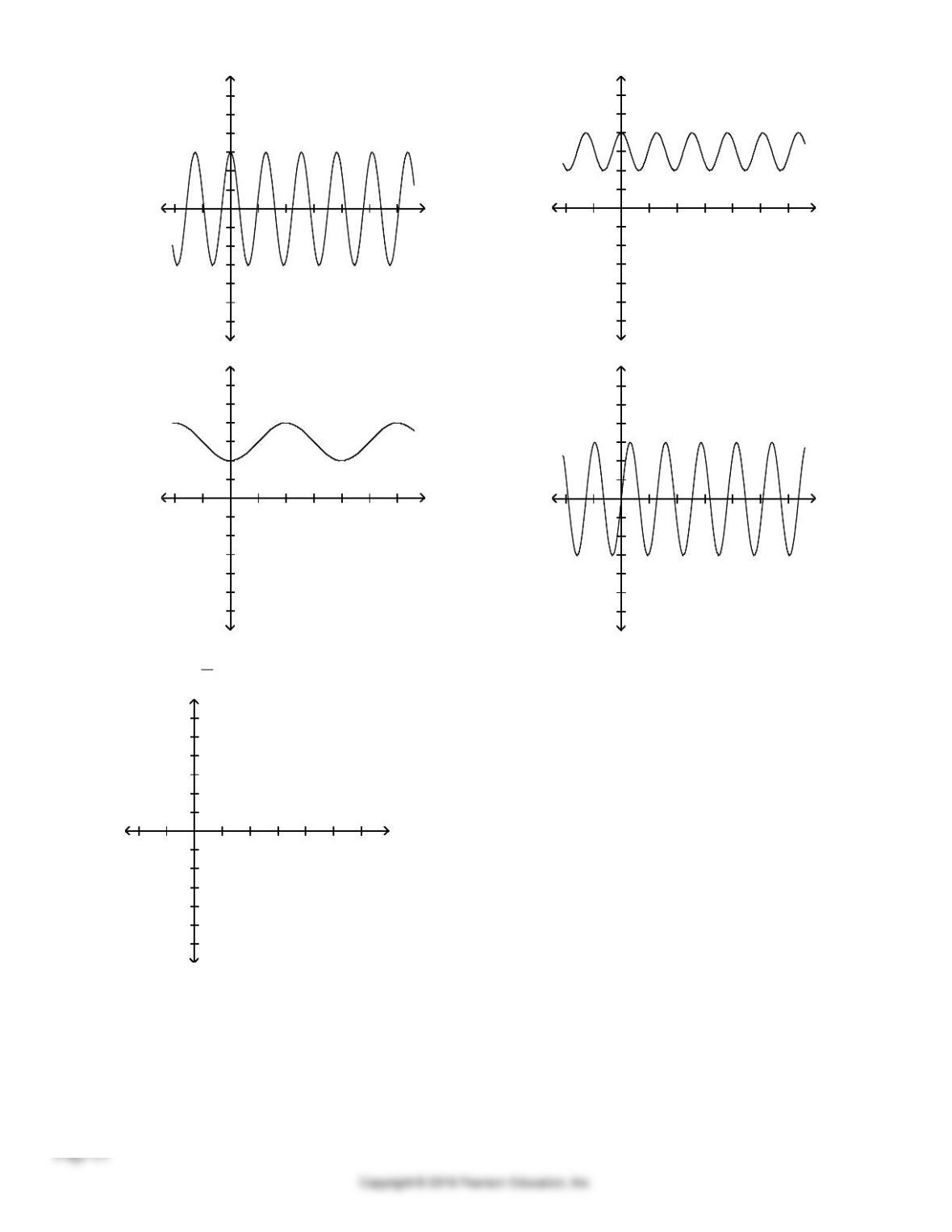
11) y=3cos(πx)
x
–
23
y
6
4
2
-2
-4
-6
x
–
23
y
6
4
2
-2
-4
-6
Page68
A)
x
–
23
y
6
4
2
-2
-4
-6
x
–
23
y
6
4
2
-2
-4
-6
B)
x
–
23
y
6
4
2
-2
-4
-6
x
–
23
y
6
4
2
-2
-4
-6
C)
x
–
23
y
6
4
2
-2
-4
-6
x
–
23
y
6
4
2
-2
-4
-6
D)
x
–
23
y
6
4
2
-2
-4
-6
x
–
23
y
6
4
2
-2
-4
-6
12) y=–2sin(1
2x)
x
–
23
y
6
4
2
-2
-4
-6
x
–
23
y
6
4
2
-2
-4
-6
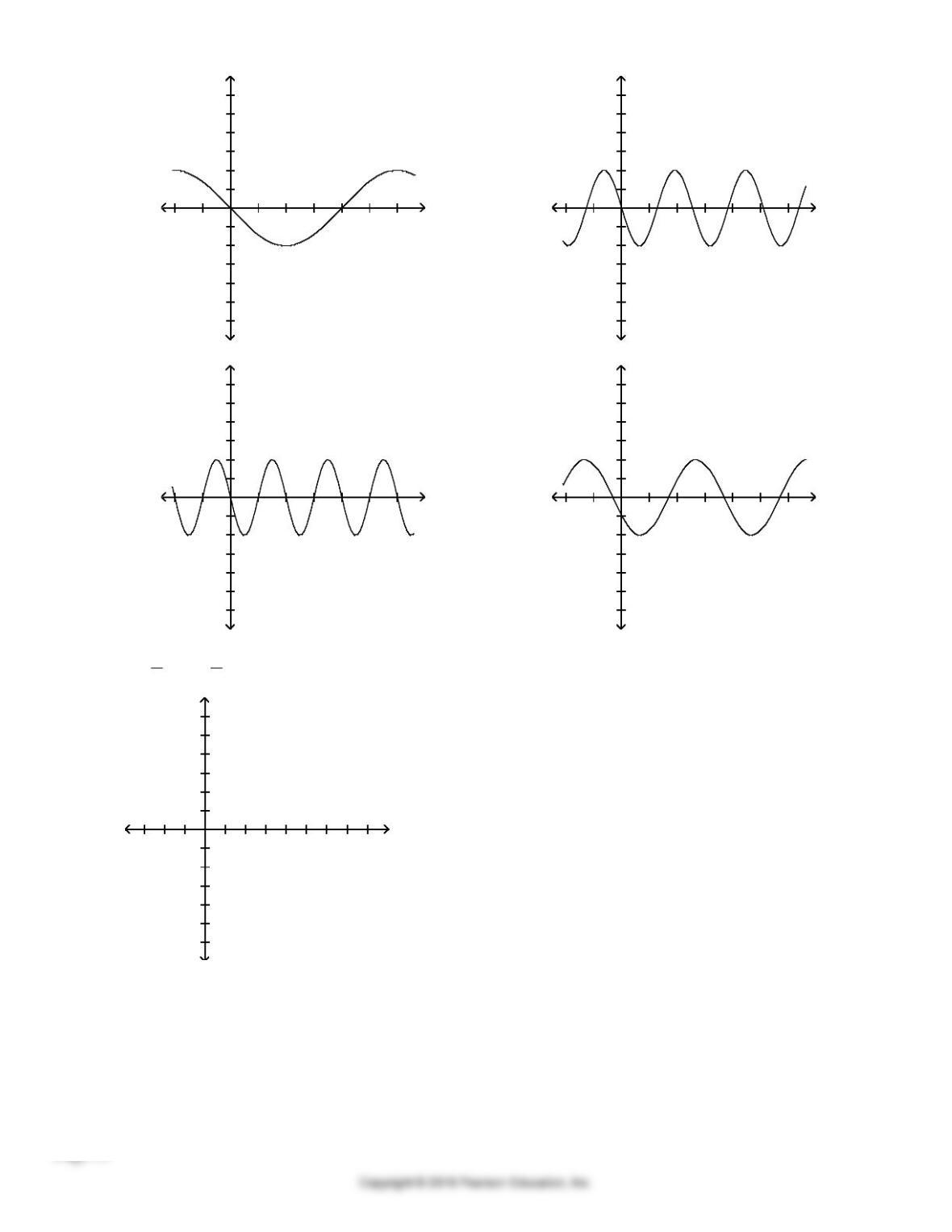
A)
x
–
23
y
6
4
2
-2
-4
-6
x
–
23
y
6
4
2
-2
-4
-6
B)
x
–
23
y
6
4
2
-2
-4
-6
x
–
23
y
6
4
2
-2
-4
-6
C)
x
–
23
y
6
4
2
-2
-4
-6
x
–
23
y
6
4
2
-2
-4
-6
D)
x
–
23
y
6
4
2
-2
-4
-6
x
–
23
y
6
4
2
-2
-4
-6
13) y=9
4cos(–1
4x)
x
-22468
y
6
4
2
-2
-4
-6
x
-22468
y
6
4
2
-2
-4
-6
Page70
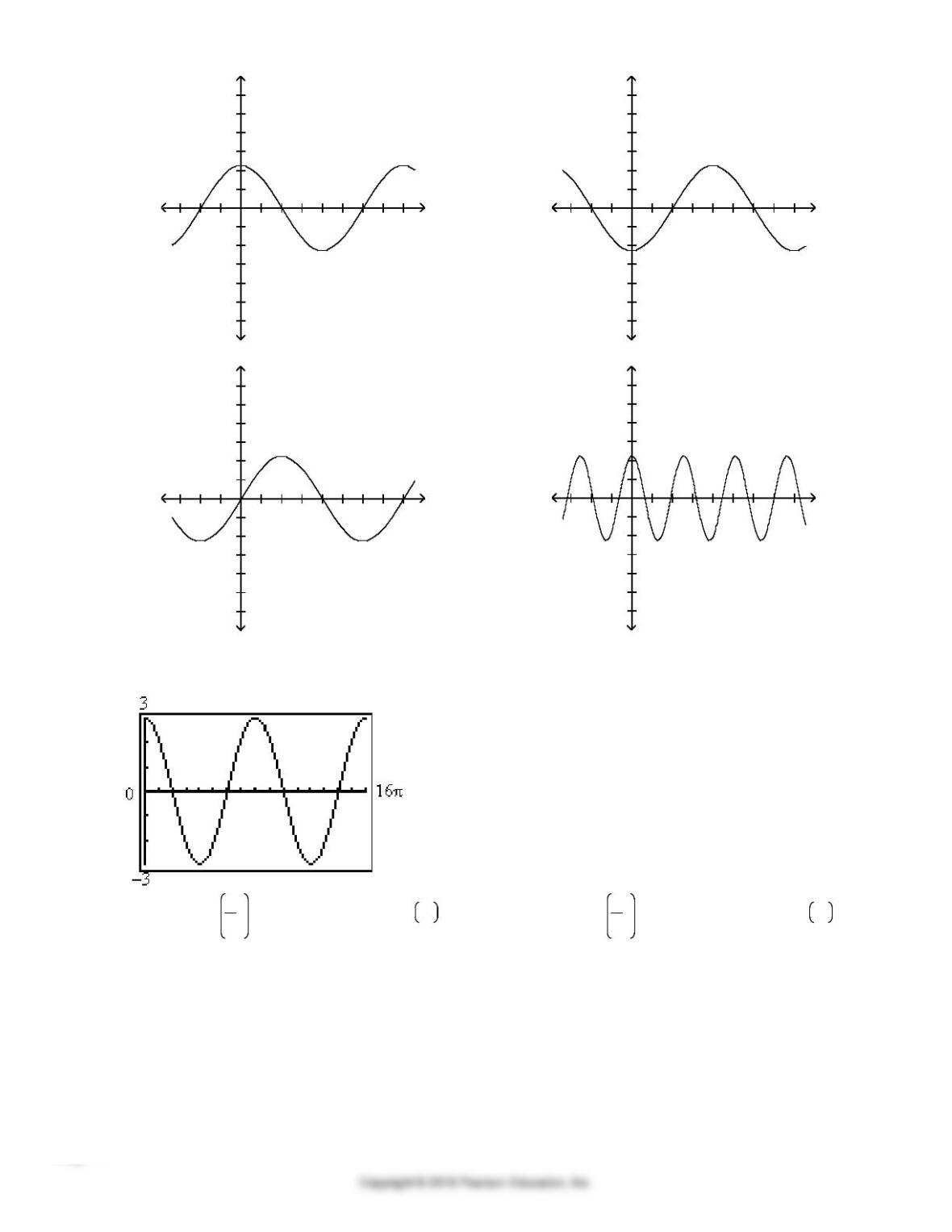
A)
x
-22468
y
6
4
2
-2
-4
-6
x
-22468
y
6
4
2
-2
-4
-6
B)
x
-22468
y
6
4
2
-2
-4
-6
x
-22468
y
6
4
2
-2
-4
-6
C)
x
-22468
y
6
4
2
-2
-4
-6
x
-22468
y
6
4
2
-2
-4
-6
D)
x
-22468
y
6
4
2
-2
-4
-6
x
-22468
y
6
4
2
-2
-4
-6
Answerthequestion.
14) Whichoneoftheequationsbelowmatchesthegraph?
A) y=3cos 1
4x B) y=3cos 4x C) y=3sin 1
4x D) y= –3sin 4x
Page71
15) Whichoneoftheequationsbelowmatchesthegraph?
A) y=4cos 2x B) y=4sin 1
2x C) y=2cos 1
4x D) y=4cos 1
2x
16) Whichoneoftheequationsbelowmatchesthegraph?
A) y=2sin 1
3x B) y=–2sin 1
3x C) y=2cos 1
3x D) y=2cos 3x
17) Whichoneoftheequationsbelowmatchesthegraph?
A) y=–2sin 3x B) y=–2sin 1
3x C) y=2sin 1
3x D) y= –2cos 3x
5 FindanEquationforaSinusoidalGraph
MULTIPLECHOICE.Choosetheonealternativethatbestcompletesthestatementoranswersthequestion.
Writetheequationofasinefunctionthathasthegivencharacteristics.
1) Amplitude:4
Period:6π
A) y=4sin1
3x B) y=4 sin(6x) C) y=sin(6x)+4D)y=6sin1
2x
2) Amplitude:3
Period:6
A) y=3sin1
3πx B) y=3 sin(6x) C) y=sin(6πx)+3D)y=6sin2
3πx
Findanequationforthegraph.
3)
x
-2–
2
y
5
4
3
2
1
-1
-2
-3
-4
-5
x
-2–
2
y
5
4
3
2
1
-1
-2
-3
-4
-5
A) y=3sin1
2x B) y=3 sin(2x) C) y=2sin1
3x D) y=2 sin(3x)
4)
x
-2–
2
y
5
4
3
2
1
-1
-2
-3
-4
-5
x
-2–
2
y
5
4
3
2
1
-1
-2
-3
-4
-5
A) y=4cos1
2x B) y=4 cos(2x) C) y=2cos1
4x D) y=2 cos(4x)
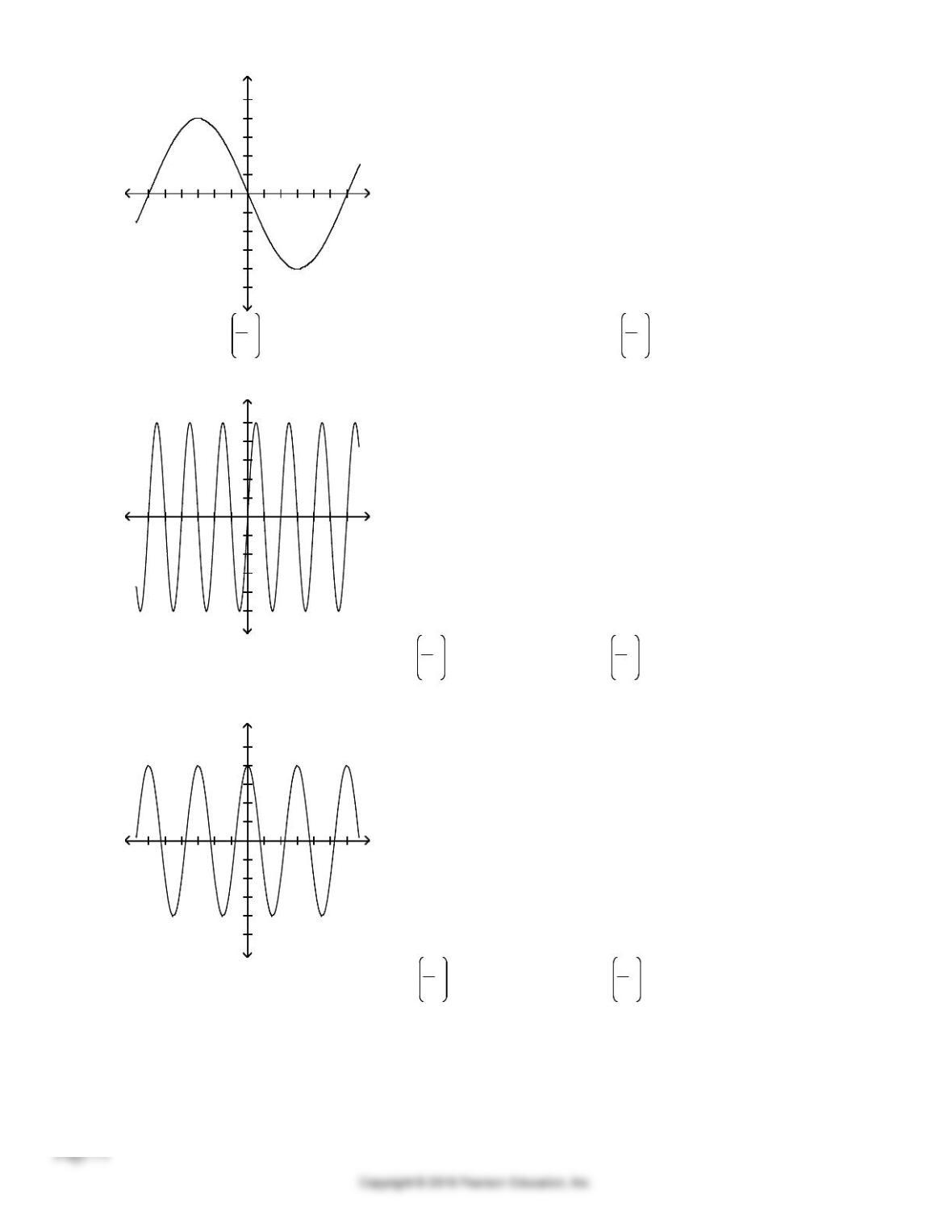
5)
x
-2–
2
y
5
4
3
2
1
-1
-2
-3
-4
-5
x
-2–
2
y
5
4
3
2
1
-1
-2
-3
-4
-5
A) y=–4sin1
2x B) y=–4 sin(2x) C) y=–4cos1
2x D) y= –4 cos(2x)
6)
x
-2–
2
y
5
4
3
2
1
-1
-2
-3
-4
-5
x
-2–
2
y
5
4
3
2
1
-1
-2
-3
-4
-5
A) y=5sin(3x) B) y=5sin1
3x C) y=3sin1
5x D) y=3 sin(5x)
7)
x
-2–
2
y
5
4
3
2
1
-1
-2
-3
-4
-5
x
-2–
2
y
5
4
3
2
1
-1
-2
-3
-4
-5
A) y=4cos(2x) B) y=4cos1
2x C) y=2cos1
4x D) y=2 cos(4x)
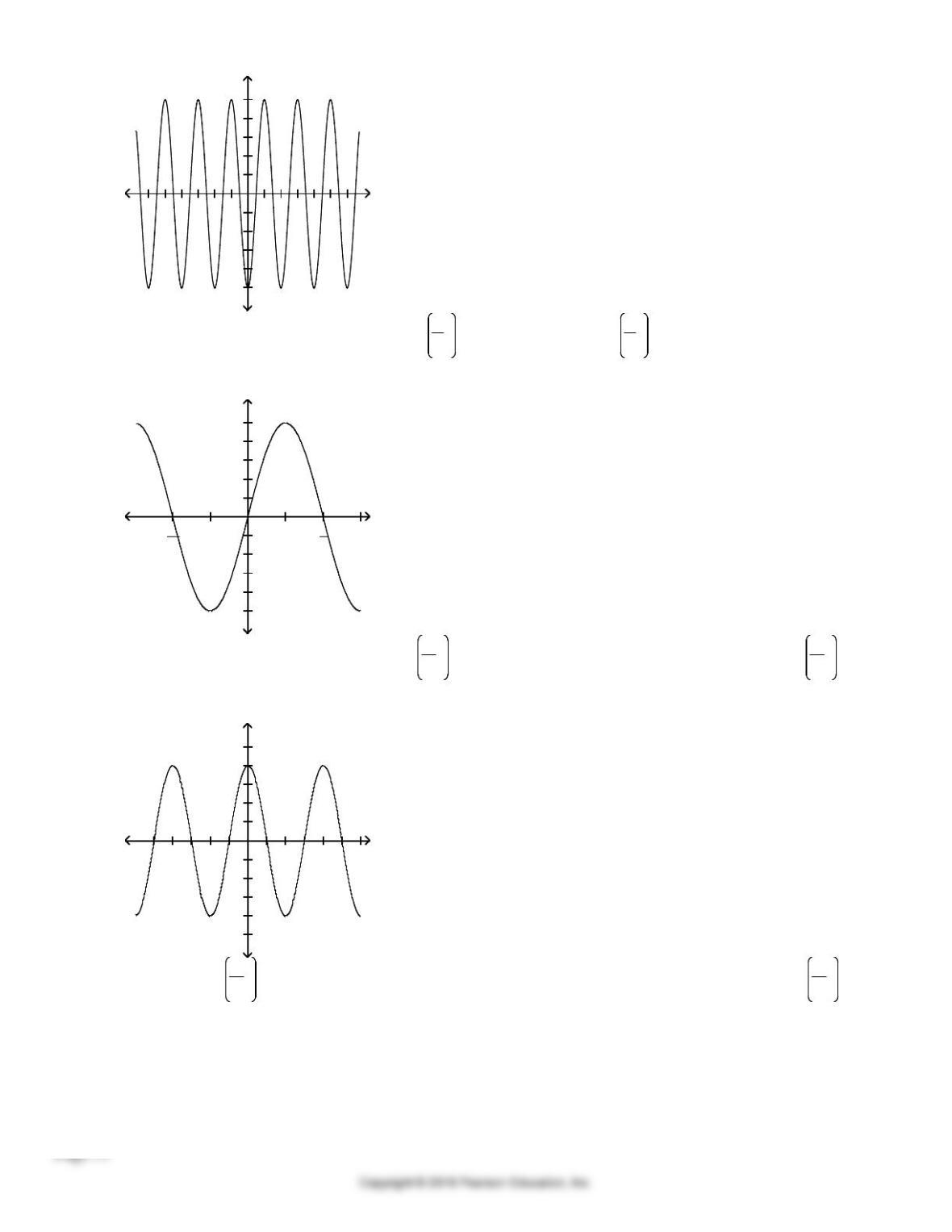
8)
x
-2–
2
y
5
4
3
2
1
-1
-2
-3
-4
-5
x
-2–
2
y
5
4
3
2
1
-1
-2
-3
-4
-5
A) y=–5cos(3x) B) y=–5cos1
3x C) y=–5sin1
3x D) y= –5 sin(3x)
9)
x
-1
31
3
y
5
4
3
2
1
-1
-2
-3
-4
-5
x
-1
31
3
y
5
4
3
2
1
-1
-2
-3
-4
-5
A) y=5sin(3πx) B) y=5sinπ
3x C) y=3 sin(5πx) D) y=3sinπ
5x
10)
x
-5 -4 -3 -2 -1 1 2 3 4 5 6
y
5
4
3
2
1
-1
-2
-3
-4
-5
x
-5 -4 -3 -2 -1 1 2 3 4 5 6
y
5
4
3
2
1
-1
-2
-3
-4
-5
A) y=4cosπ
2x B) y=4 cos(2πx) C) y=2 cos(4πx) D) y=2cosπ
4x
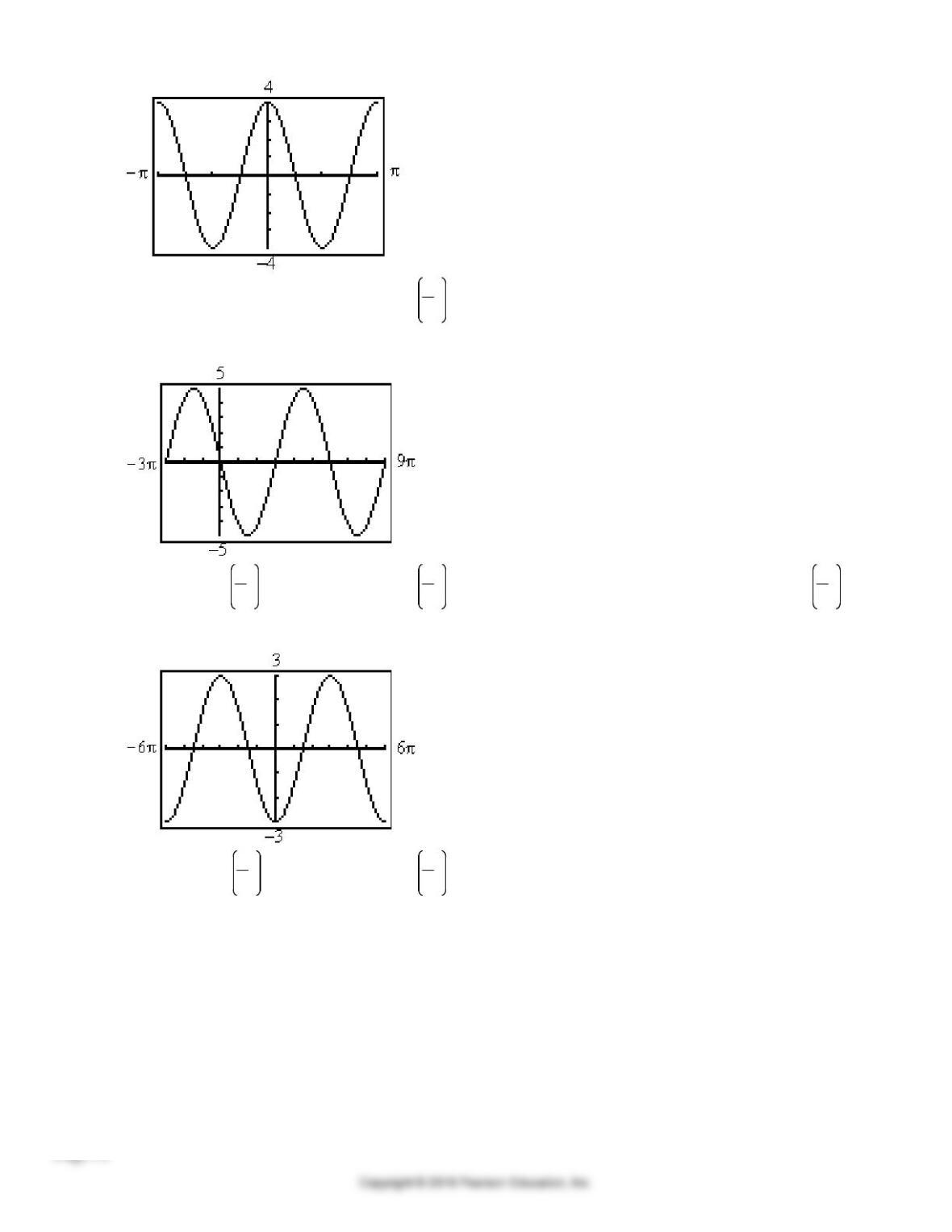
11)
A) y=4cos(2x) B) y=4cos1
2x C) y=4sin(2x) D) y= –4cos(2x)
12)
A) y=–5sin1
3x B) y=5cos1
3x C) y= –5sin(3x) D) y=–5sin2
3x
13)
A) y=–3cos1
3x B) y=3cos1
3x C) y= –3sin(3x) D) y= –3cos(3x)
Page76
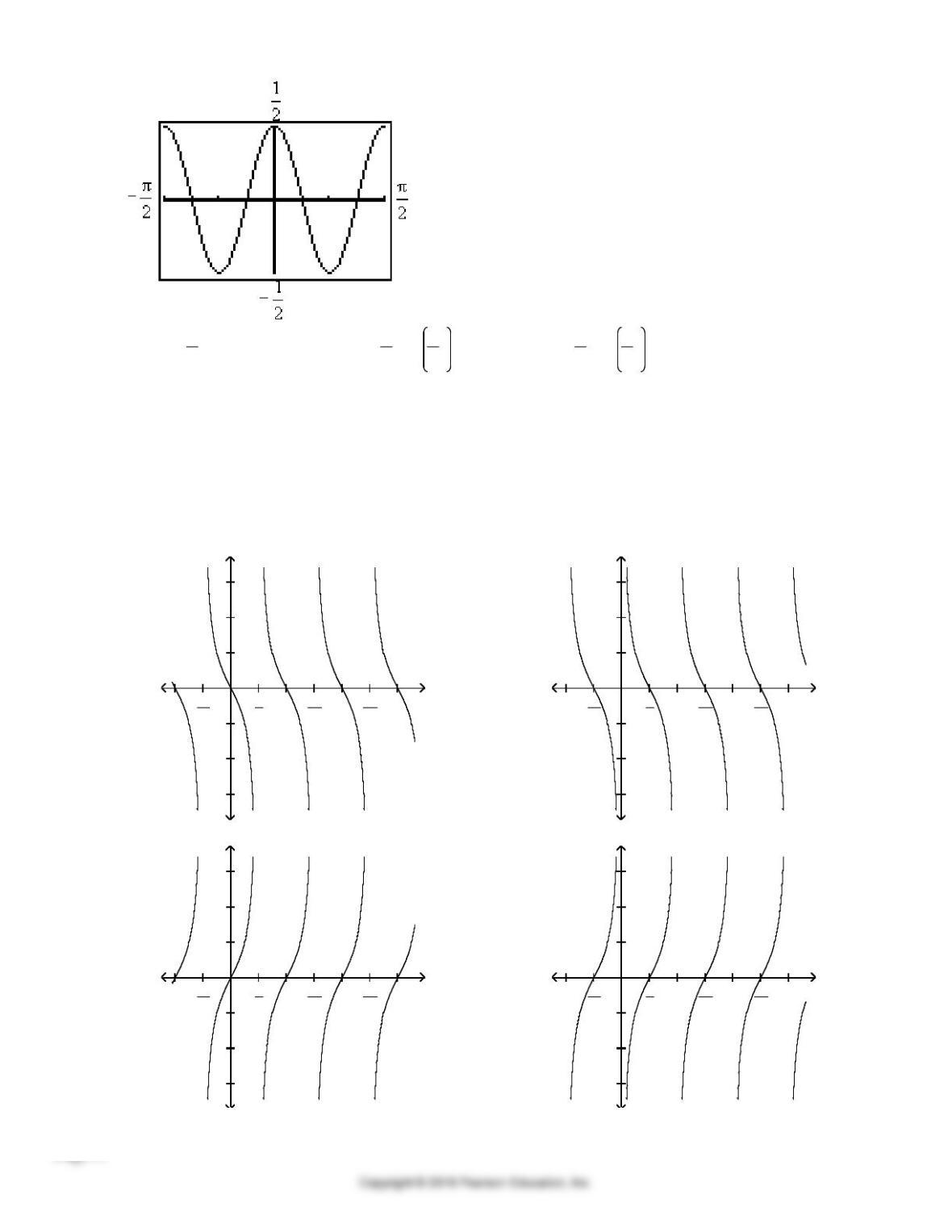
14)
A) y=1
2cos(4x) B) y=1
2cos1
2x C) y=1
2cos1
4x D) y=cos(4x)
7.7 GraphsoftheTangent,Cotangent,Cosecant,andSecantFunctions
1 GraphFunctionsoftheFormy=Atan(ωx)+Bandy=Acot(ωx)+B
MULTIPLECHOICE.Choosetheonealternativethatbestcompletesthestatementoranswersthequestion.
Matchthefunctiontoitsgraph.
1) y=–tanx
A)
x
––
2
23
225
23
y
3
-3
x
––
2
23
225
23
y
3
-3
B)
x
––
2
23
225
23
y
3
-3
x
––
2
23
225
23
y
3
-3
C)
x
––
2
23
225
23
y
3
-3
x
––
2
23
225
23
y
3
-3
D)
x
––
2
23
225
23
y
3
-3
x
––
2
23
225
23
y
3
-3
Page77
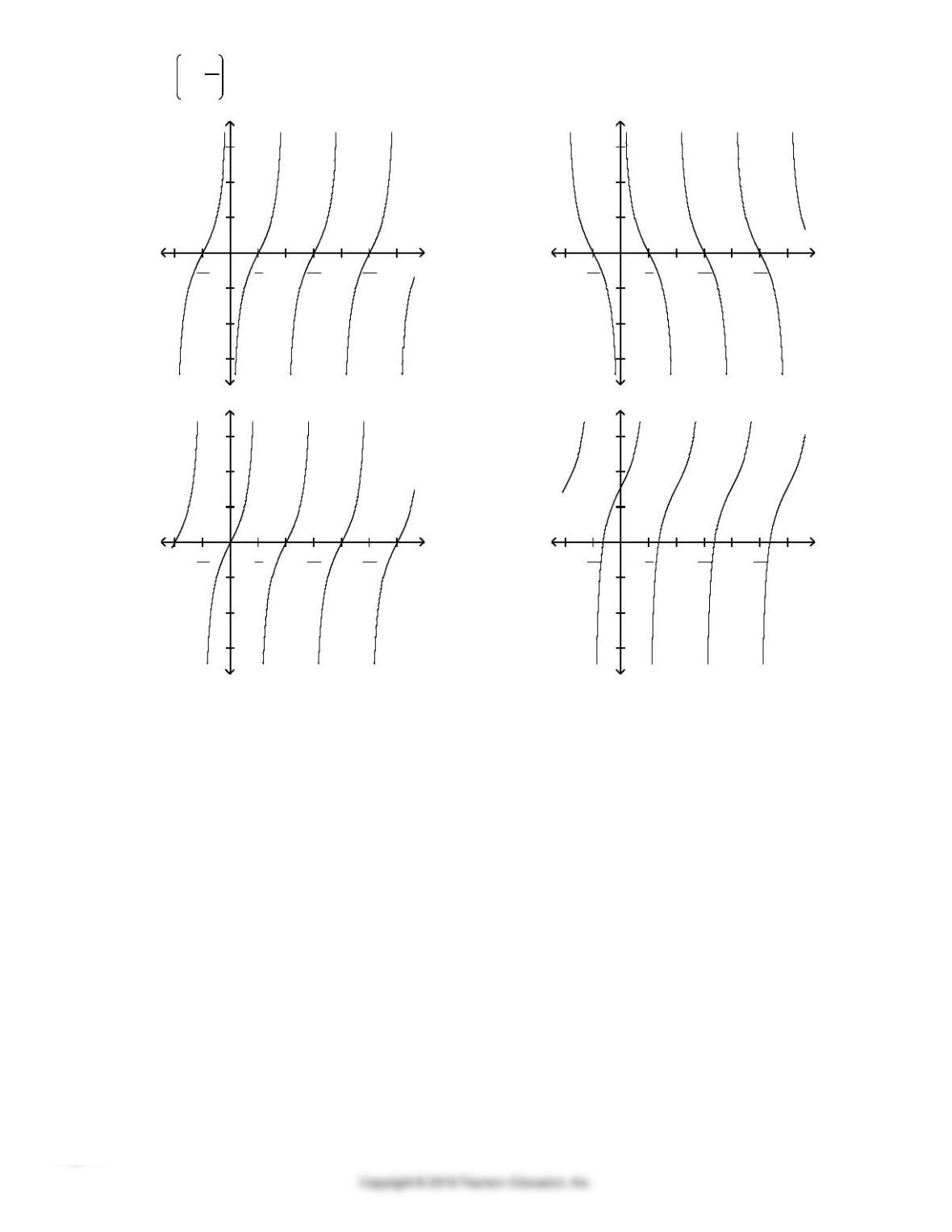
2) y=tanx+π
2
A)
x
––
2
23
225
23
y
3
-3
x
––
2
23
225
23
y
3
-3
B)
x
––
2
23
225
23
y
3
-3
x
––
2
23
225
23
y
3
-3
C)
x
––
2
23
225
23
y
3
-3
x
––
2
23
225
23
y
3
-3
D)
x
––
2
23
225
23
y
3
-3
x
––
2
23
225
23
y
3
-3
Page78
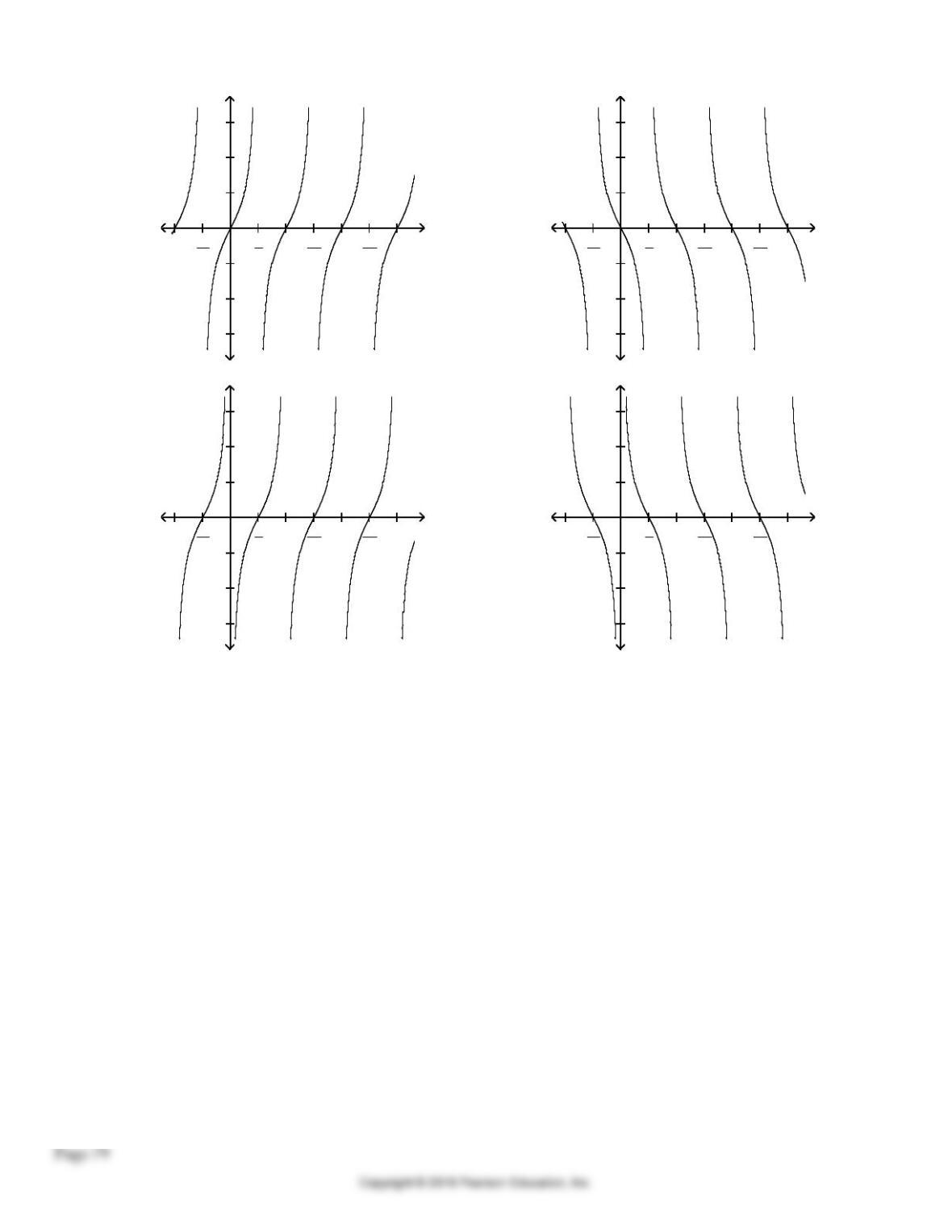
3) y=tan(x+π)
A)
x
––
2
23
225
23
y
3
-3
x
––
2
23
225
23
y
3
-3
B)
x
––
2
23
225
23
y
3
-3
x
––
2
23
225
23
y
3
-3
C)
x
––
2
23
225
23
y
3
-3
x
––
2
23
225
23
y
3
-3
D)
x
––
2
23
225
23
y
3
-3
x
––
2
23
225
23
y
3
-3
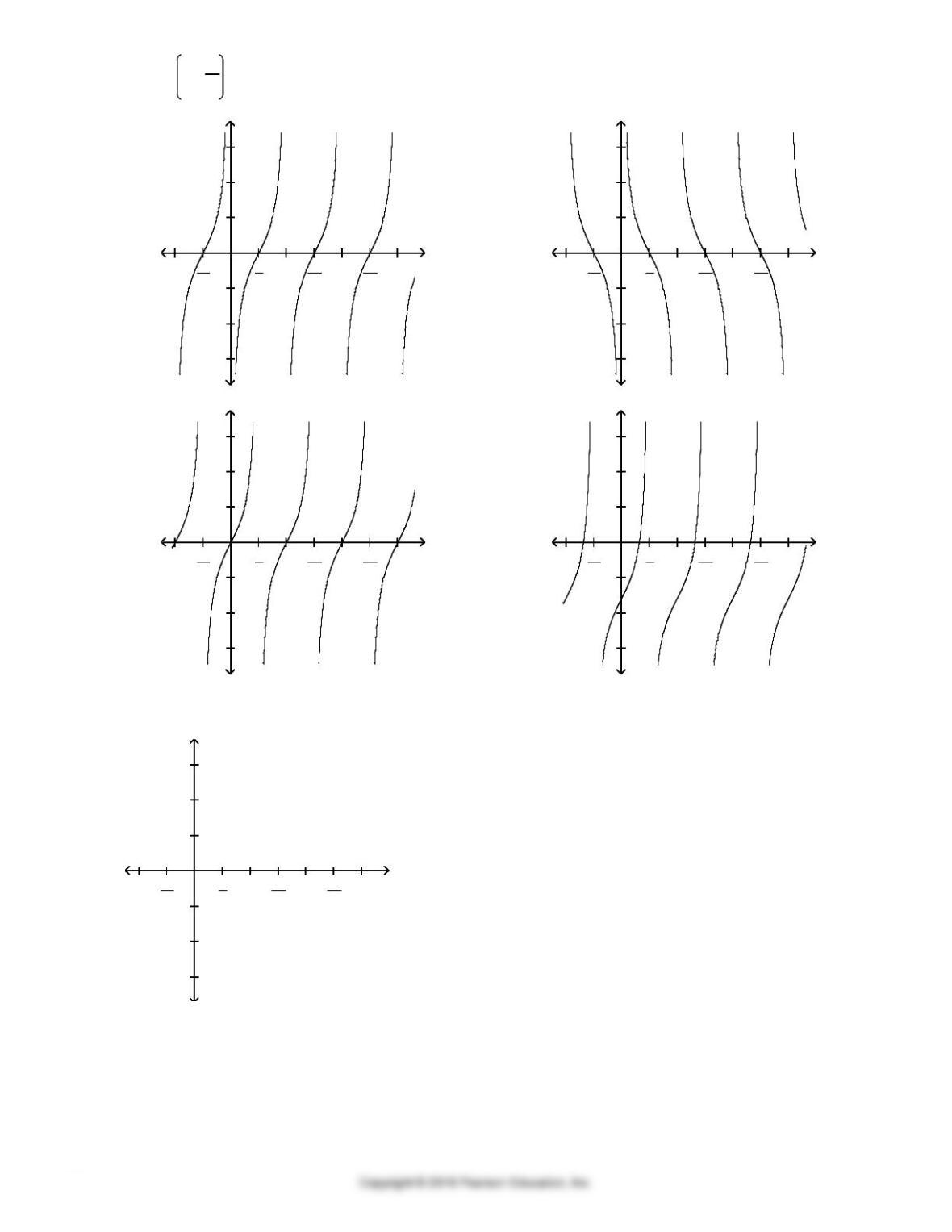
4) y=tanx–π
2
A)
x
––
2
23
225
23
y
3
-3
x
––
2
23
225
23
y
3
-3
B)
x
––
2
23
225
23
y
3
-3
x
––
2
23
225
23
y
3
-3
C)
x
––
2
23
225
23
y
3
-3
x
––
2
23
225
23
y
3
-3
D)
x
––
2
23
225
23
y
3
-3
x
––
2
23
225
23
y
3
-3
Graphthefunction.
5) y=–cotx
x
––
2
23
225
23
y
3
-3
x
––
2
23
225
23
y
3
-3
Page80
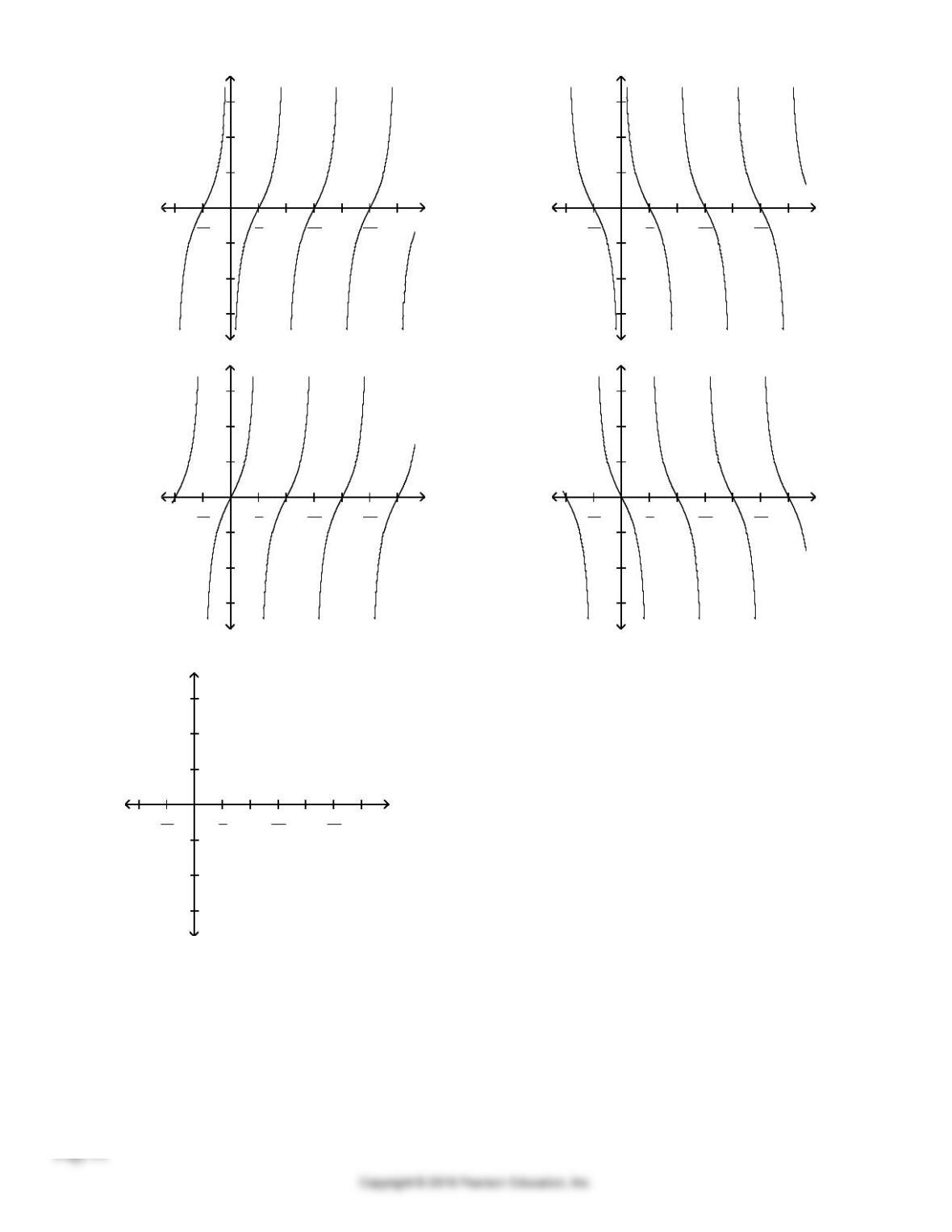
A)
x
––
2
23
225
23
y
3
-3
x
––
2
23
225
23
y
3
-3
B)
x
––
2
23
225
23
y
3
-3
x
––
2
23
225
23
y
3
-3
C)
x
––
2
23
225
23
y
3
-3
x
––
2
23
225
23
y
3
-3
D)
x
––
2
23
225
23
y
3
-3
x
––
2
23
225
23
y
3
-3
6) y=tan(x–π)
x
––
2
23
225
23
y
3
-3
x
––
2
23
225
23
y
3
-3
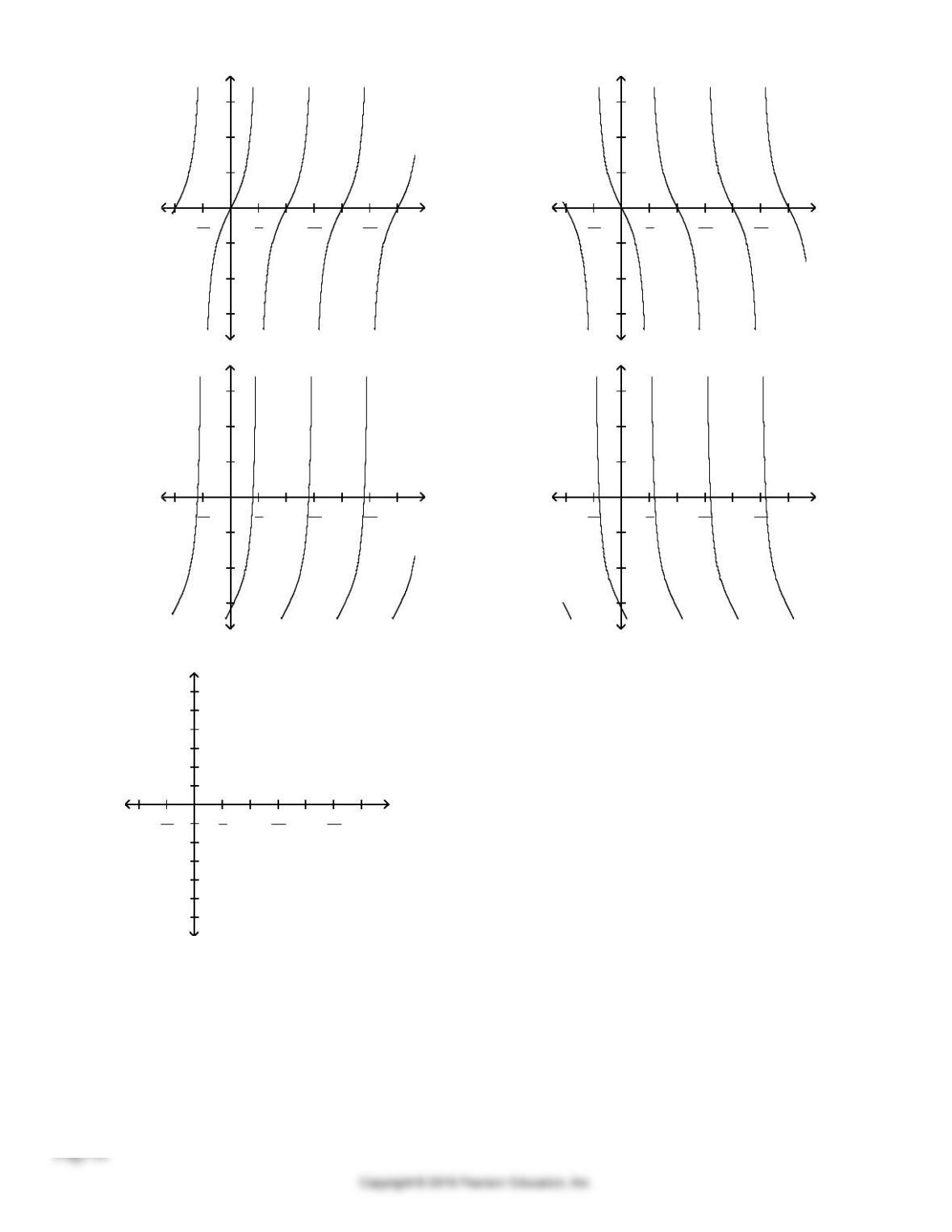
A)
x
––
2
23
225
23
y
3
-3
x
––
2
23
225
23
y
3
-3
B)
x
––
2
23
225
23
y
3
-3
x
––
2
23
225
23
y
3
-3
C)
x
––
2
23
225
23
y
3
-3
x
––
2
23
225
23
y
3
-3
D)
x
––
2
23
225
23
y
3
-3
x
––
2
23
225
23
y
3
-3
7) y=4tan(2x)
x
––
2
23
225
23
y
6
4
2
-2
-4
-6
x
––
2
23
225
23
y
6
4
2
-2
-4
-6
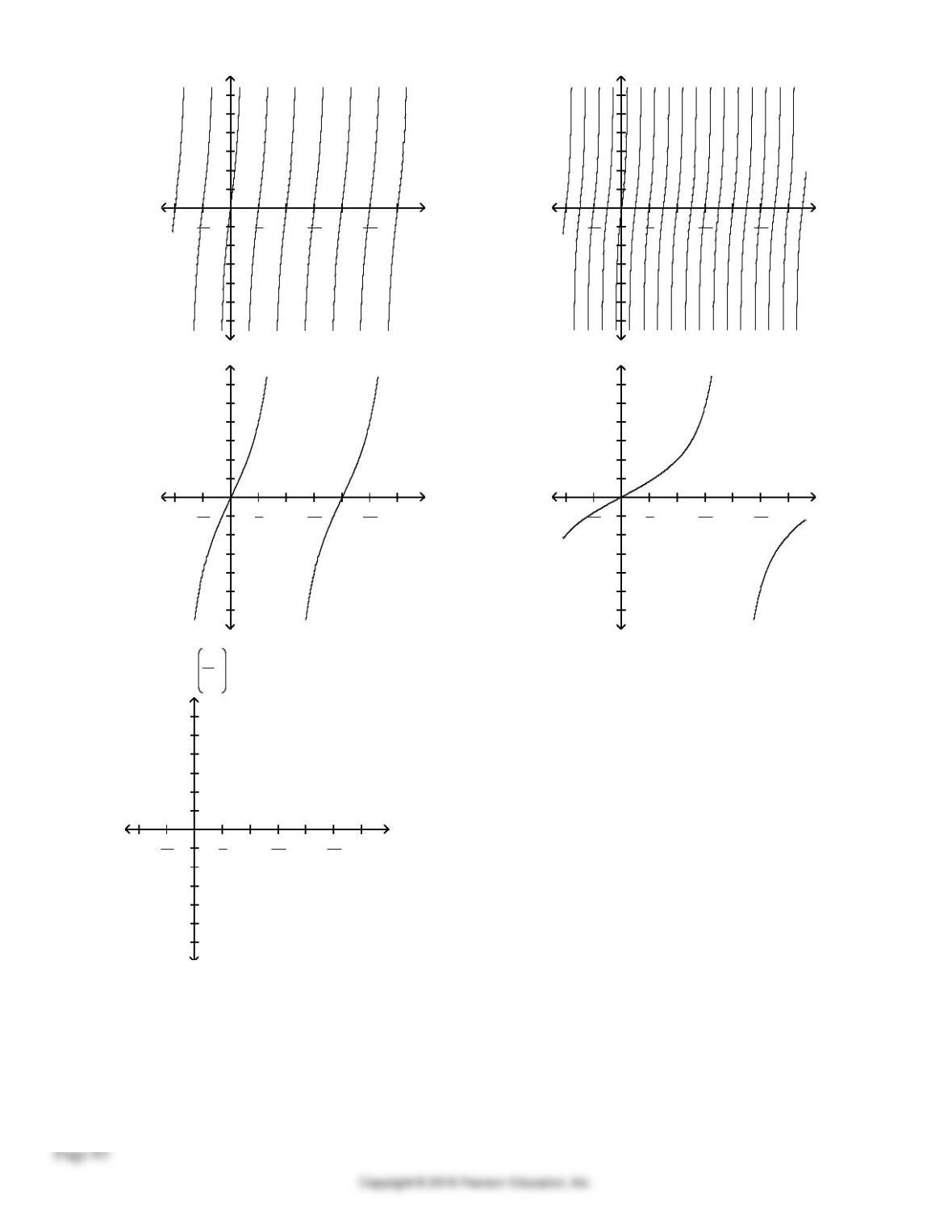
A)
x
––
2
23
225
23
y
6
4
2
-2
-4
-6
x
––
2
23
225
23
y
6
4
2
-2
-4
-6
B)
x
––
2
23
225
23
y
6
4
2
-2
-4
-6
x
––
2
23
225
23
y
6
4
2
-2
-4
-6
C)
x
––
2
23
225
23
y
6
4
2
-2
-4
-6
x
––
2
23
225
23
y
6
4
2
-2
-4
-6
D)
x
––
2
23
225
23
y
6
4
2
-2
-4
-6
x
––
2
23
225
23
y
6
4
2
-2
-4
-6
8) y=–4tan1
2x
x
––
2
23
225
23
y
6
4
2
-2
-4
-6
x
––
2
23
225
23
y
6
4
2
-2
-4
-6
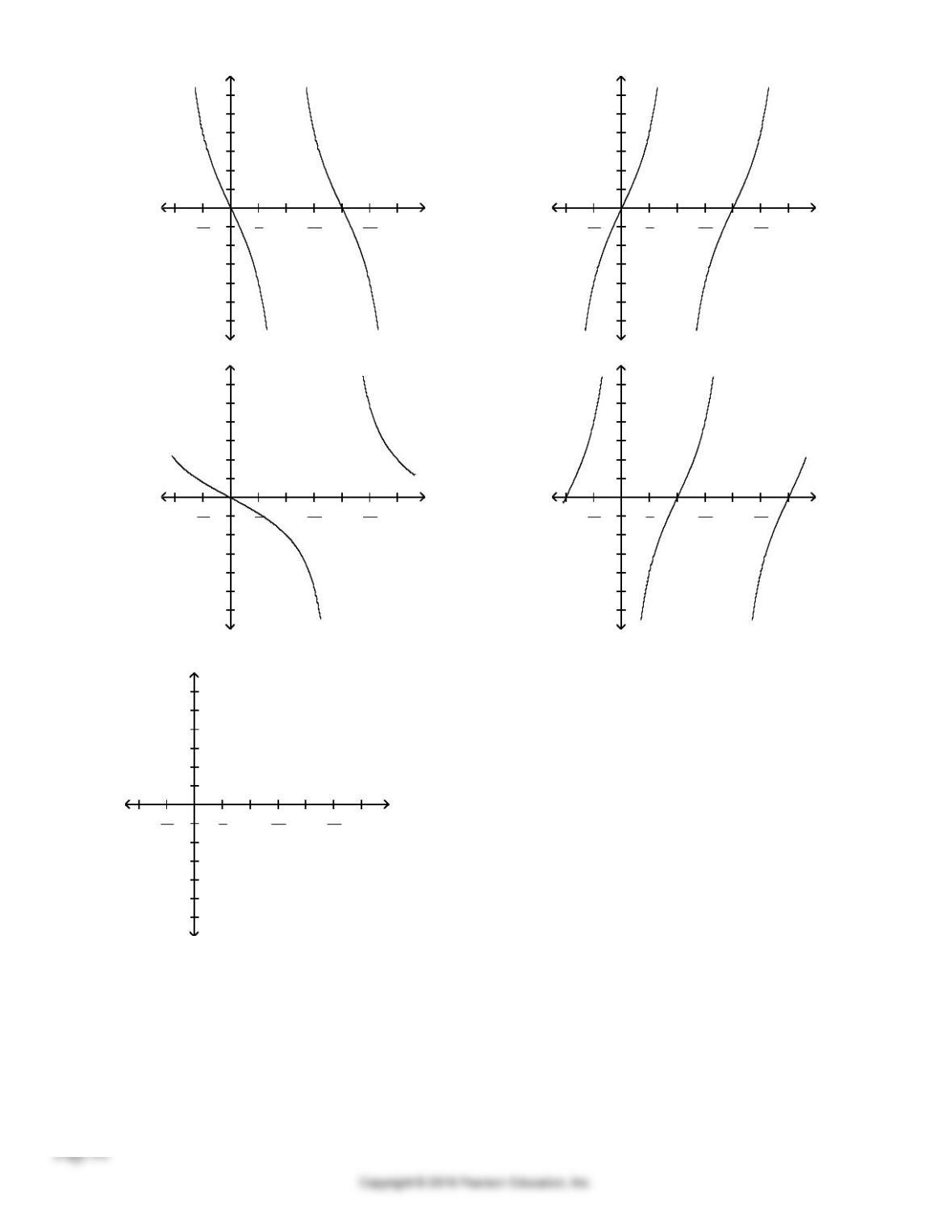
A)
x
––
2
23
225
23
y
6
4
2
-2
-4
-6
x
––
2
23
225
23
y
6
4
2
-2
-4
-6
B)
x
––
2
23
225
23
y
6
4
2
-2
-4
-6
x
––
2
23
225
23
y
6
4
2
-2
-4
-6
C)
x
––
2
23
225
23
y
6
4
2
-2
-4
-6
x
––
2
23
225
23
y
6
4
2
-2
-4
-6
D)
x
––
2
23
225
23
y
6
4
2
-2
-4
-6
x
––
2
23
225
23
y
6
4
2
-2
-4
-6
9) y=cot(πx)
x
––
2
23
225
23
y
6
4
2
-2
-4
-6
x
––
2
23
225
23
y
6
4
2
-2
-4
-6
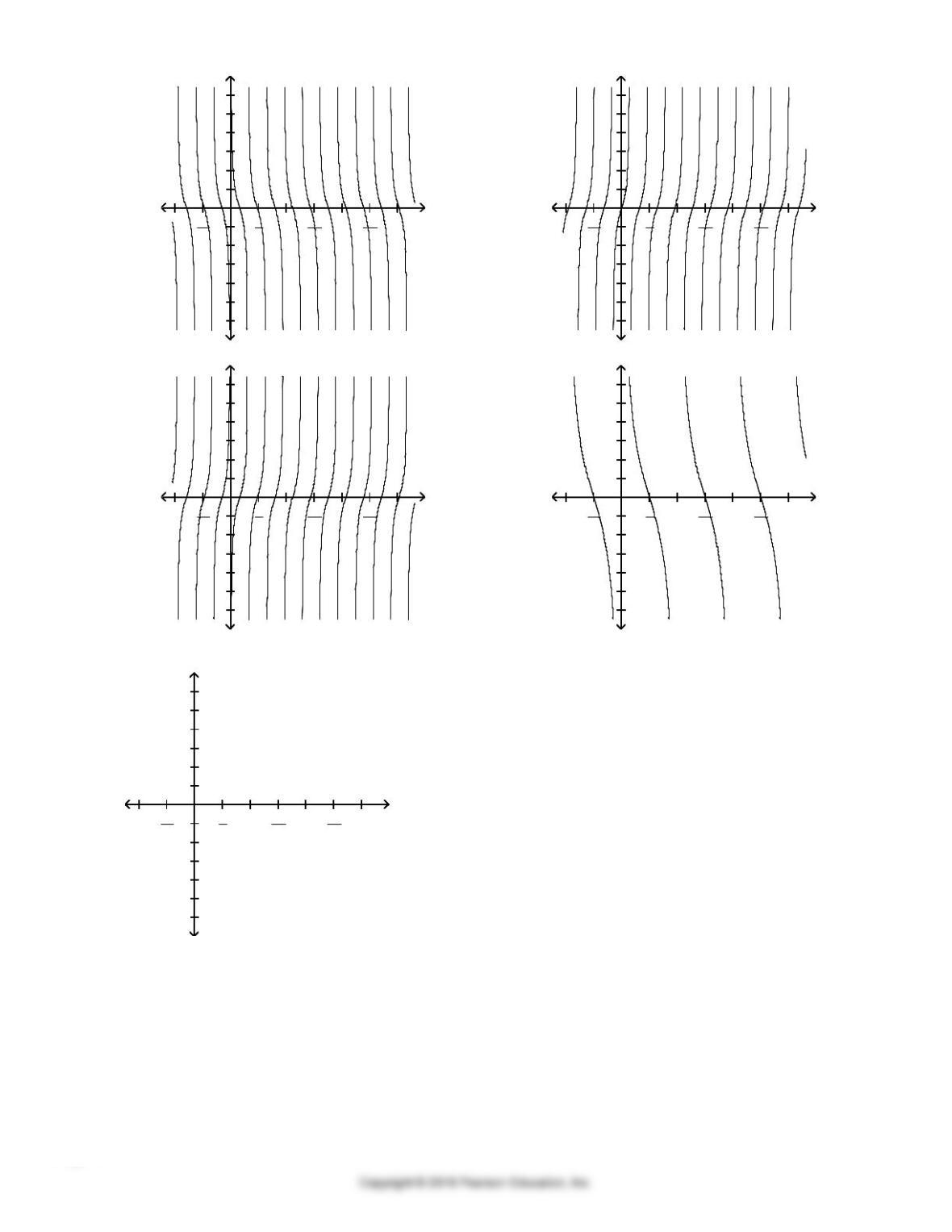
A)
x
––
2
23
225
23
y
6
4
2
-2
-4
-6
x
––
2
23
225
23
y
6
4
2
-2
-4
-6
B)
x
––
2
23
225
23
y
6
4
2
-2
-4
-6
x
––
2
23
225
23
y
6
4
2
-2
-4
-6
C)
x
––
2
23
225
23
y
6
4
2
-2
-4
-6
x
––
2
23
225
23
y
6
4
2
-2
-4
-6
D)
x
––
2
23
225
23
y
6
4
2
-2
-4
-6
x
––
2
23
225
23
y
6
4
2
-2
-4
-6
10) y=cot(4x)
x
––
2
23
225
23
y
6
4
2
-2
-4
-6
x
––
2
23
225
23
y
6
4
2
-2
-4
-6
Page85
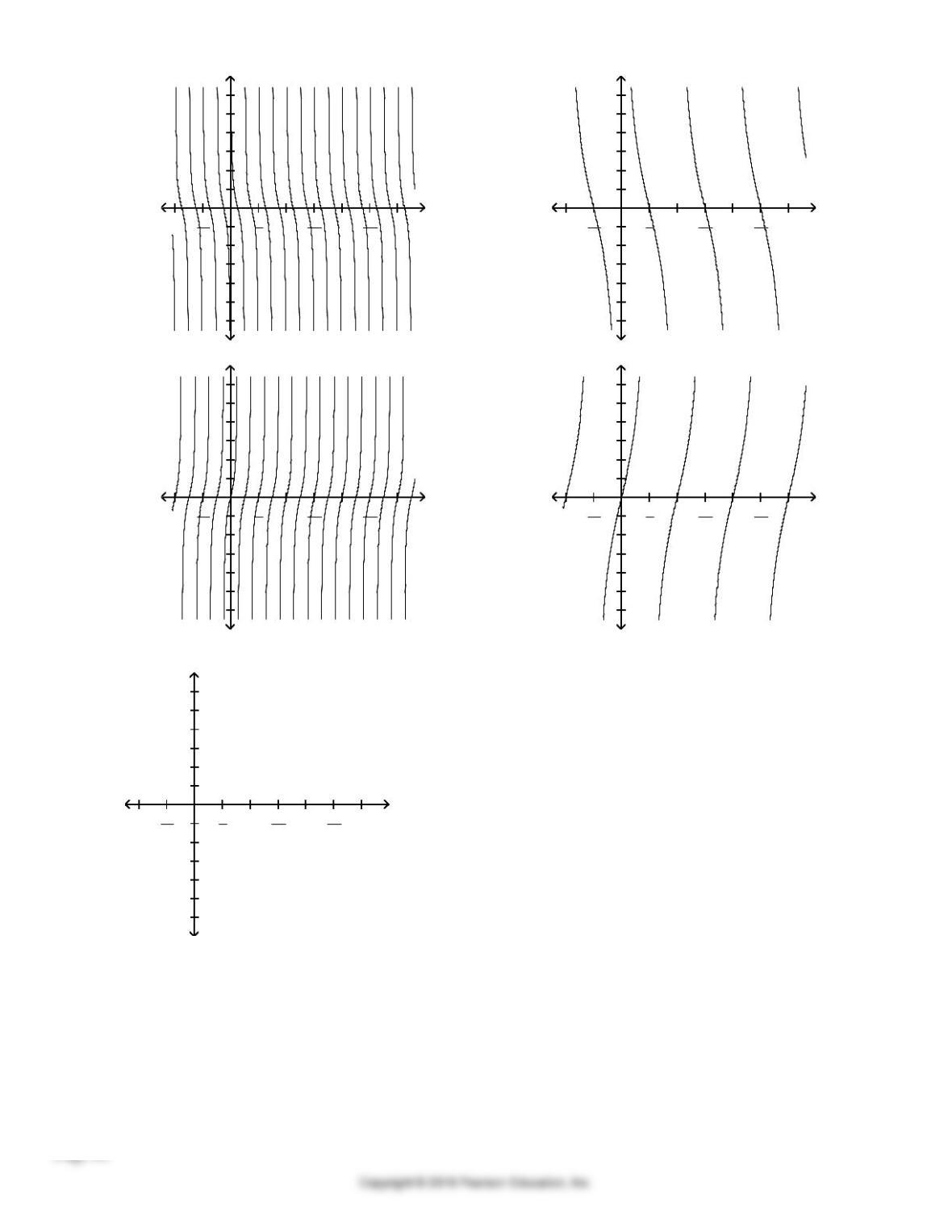
A)
x
––
2
23
225
23
y
6
4
2
-2
-4
-6
x
––
2
23
225
23
y
6
4
2
-2
-4
-6
B)
x
––
2
23
225
23
y
6
4
2
-2
-4
-6
x
––
2
23
225
23
y
6
4
2
-2
-4
-6
C)
x
––
2
23
225
23
y
6
4
2
-2
-4
-6
x
––
2
23
225
23
y
6
4
2
-2
-4
-6
D)
x
––
2
23
225
23
y
6
4
2
-2
-4
-6
x
––
2
23
225
23
y
6
4
2
-2
-4
-6
11) y=–3cot(2x)
x
––
2
23
225
23
y
6
4
2
-2
-4
-6
x
––
2
23
225
23
y
6
4
2
-2
-4
-6
Page86
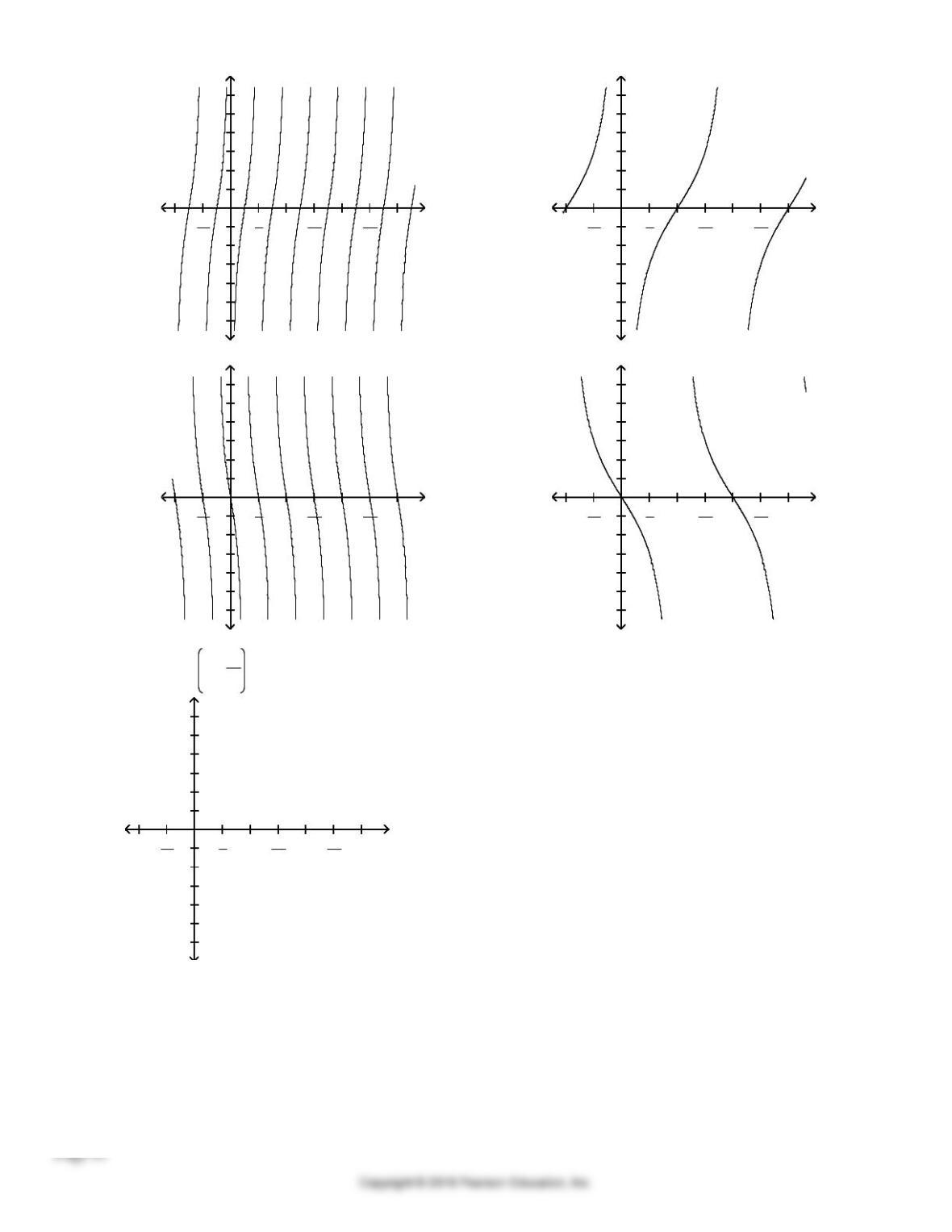
A)
x
––
2
23
225
23
y
6
4
2
-2
-4
-6
x
––
2
23
225
23
y
6
4
2
-2
-4
-6
B)
x
––
2
23
225
23
y
6
4
2
-2
-4
-6
x
––
2
23
225
23
y
6
4
2
-2
-4
-6
C)
x
––
2
23
225
23
y
6
4
2
-2
-4
-6
x
––
2
23
225
23
y
6
4
2
-2
-4
-6
D)
x
––
2
23
225
23
y
6
4
2
-2
-4
-6
x
––
2
23
225
23
y
6
4
2
-2
-4
-6
12) y=–2tanx–π
4
x
––
2
23
225
23
y
6
4
2
-2
-4
-6
x
––
2
23
225
23
y
6
4
2
-2
-4
-6
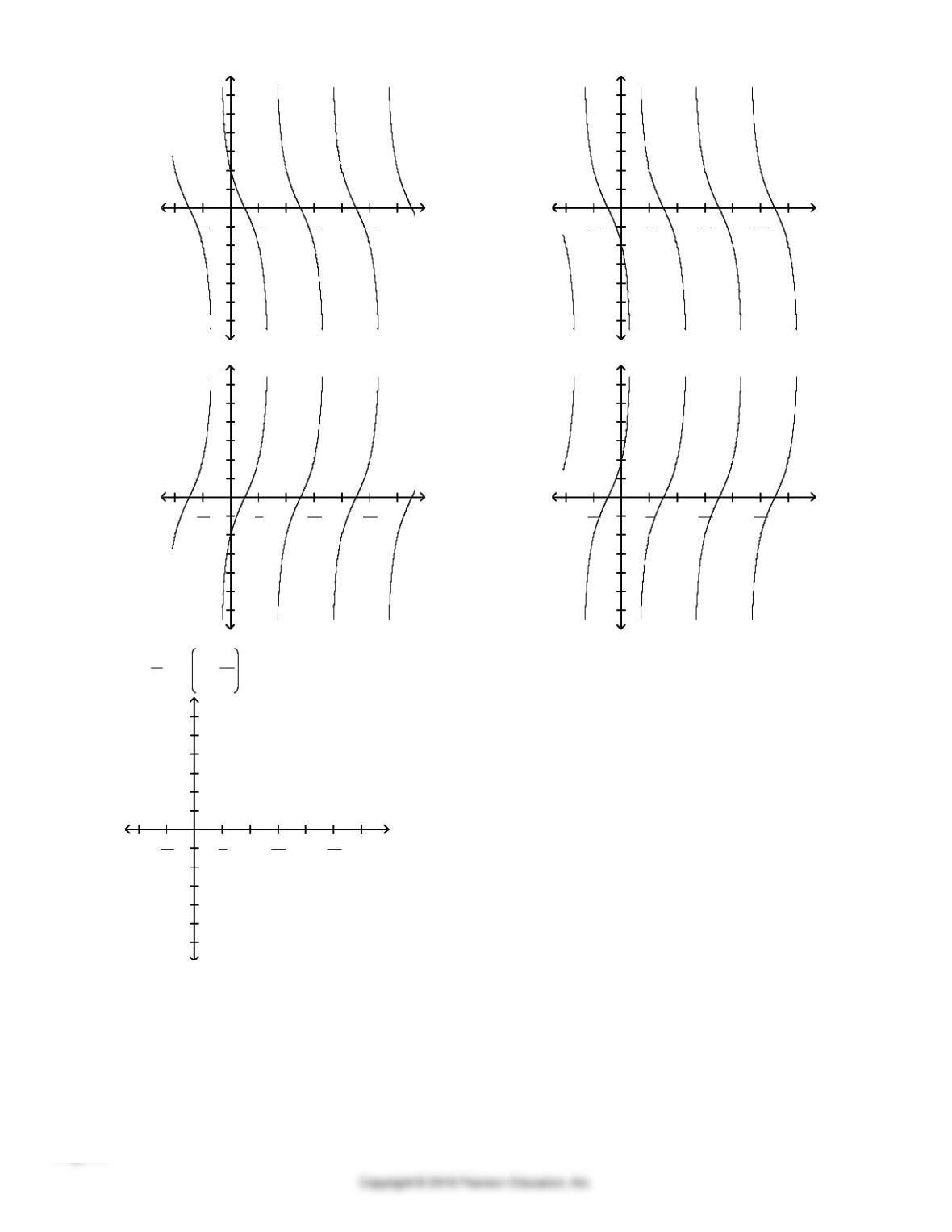
A)
x
––
2
23
225
23
y
6
4
2
-2
-4
-6
x
––
2
23
225
23
y
6
4
2
-2
-4
-6
B)
x
––
2
23
225
23
y
6
4
2
-2
-4
-6
x
––
2
23
225
23
y
6
4
2
-2
-4
-6
C)
x
––
2
23
225
23
y
6
4
2
-2
-4
-6
x
––
2
23
225
23
y
6
4
2
-2
-4
-6
D)
x
––
2
23
225
23
y
6
4
2
-2
-4
-6
x
––
2
23
225
23
y
6
4
2
-2
-4
-6
13) y=1
4cotx–π
4
x
––
2
23
225
23
y
6
4
2
-2
-4
-6
x
––
2
23
225
23
y
6
4
2
-2
-4
-6
Page88
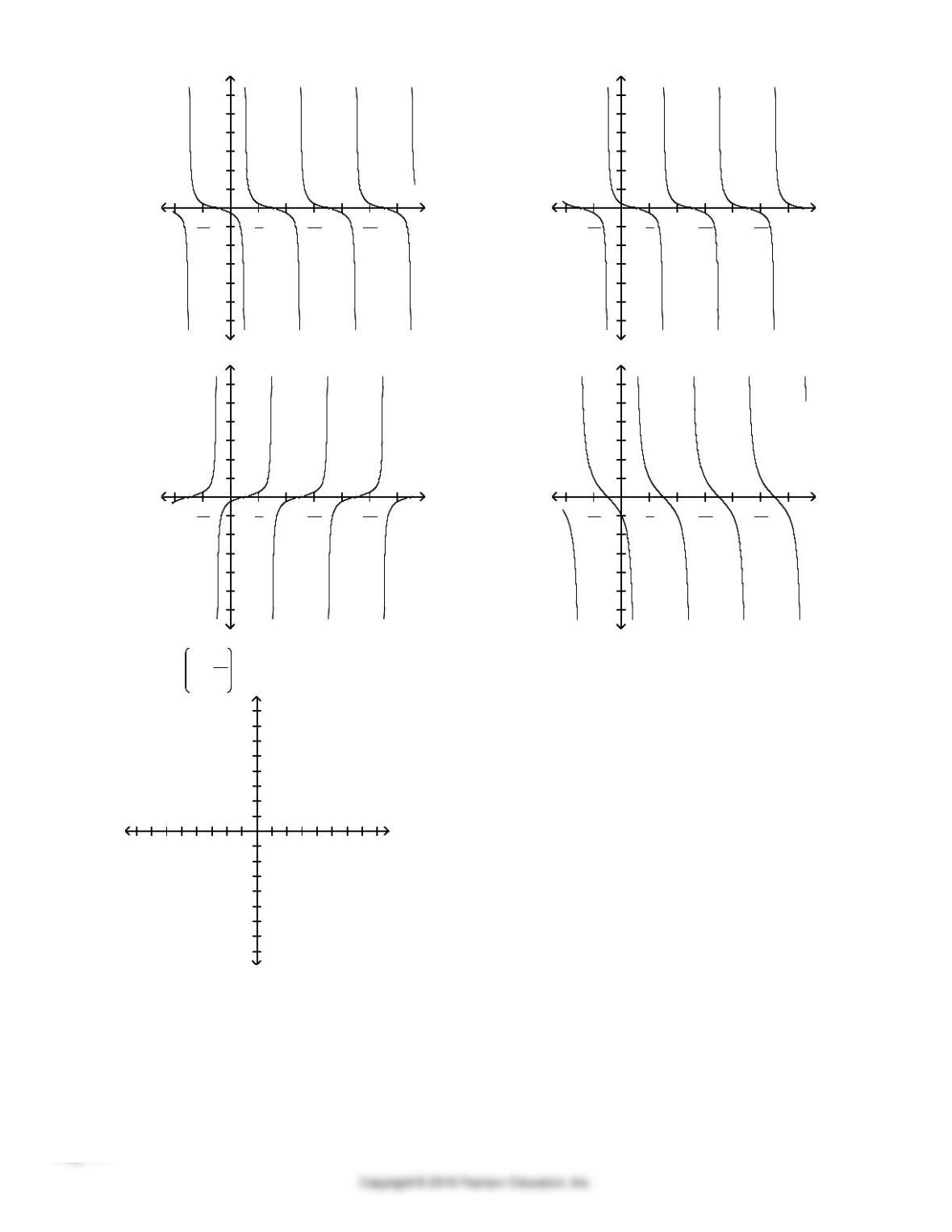
A)
x
––
2
23
225
23
y
6
4
2
-2
-4
-6
x
––
2
23
225
23
y
6
4
2
-2
-4
-6
B)
x
––
2
23
225
23
y
6
4
2
-2
-4
-6
x
––
2
23
225
23
y
6
4
2
-2
-4
-6
C)
x
––
2
23
225
23
y
6
4
2
-2
-4
-6
x
––
2
23
225
23
y
6
4
2
-2
-4
-6
D)
x
––
2
23
225
23
y
6
4
2
-2
-4
-6
x
––
2
23
225
23
y
6
4
2
-2
-4
-6
14) y=–tanx–π
4
x
-7 7
y
7
-7
x
-7 7
y
7
-7
Page89
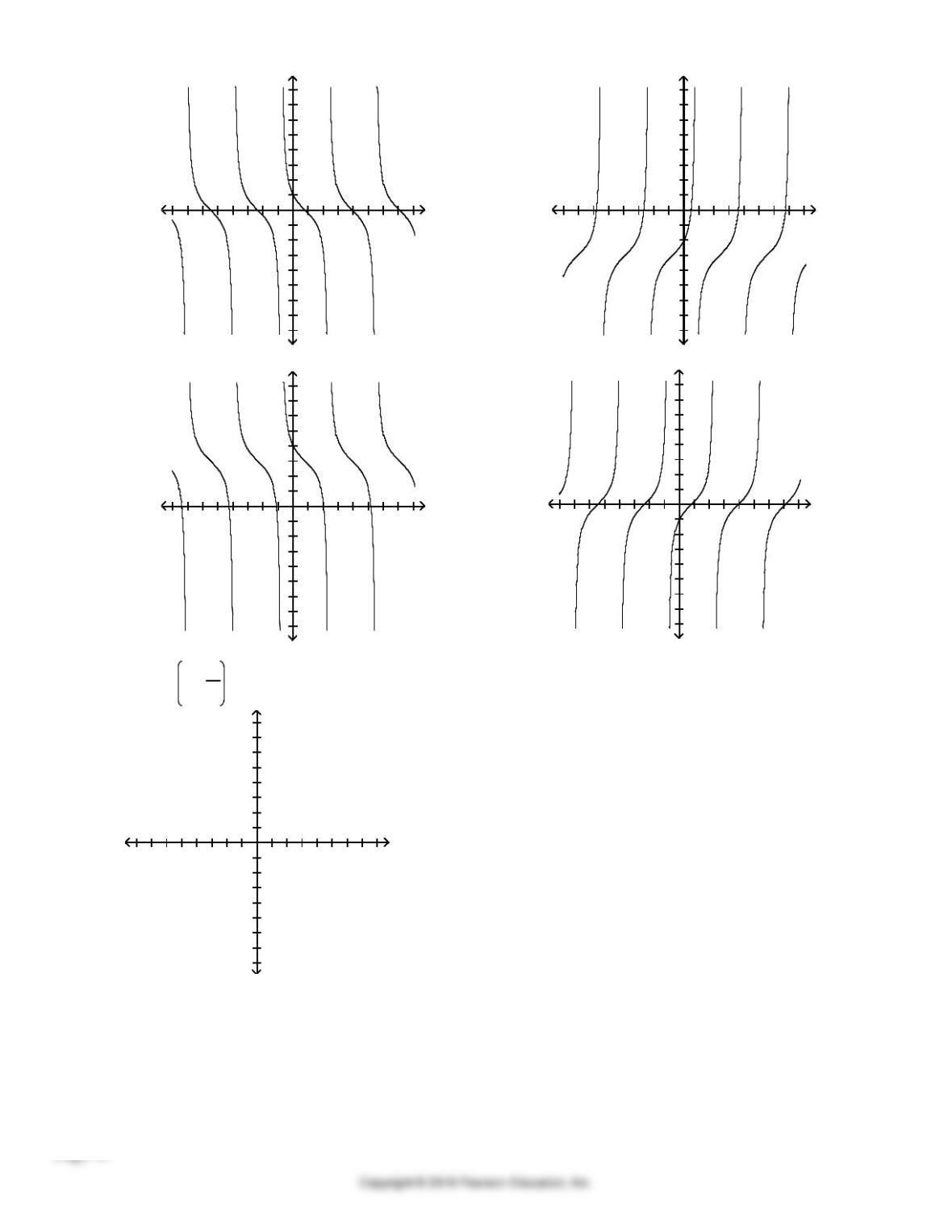
A)
x
-7 7
y
7
-7
x
-7 7
y
7
-7
B)
x
-7 7
y
7
-7
x
-7 7
y
7
-7
C)
x
-7 7
y
7
-7
x
-7 7
y
7
-7
D)
x
-7 7
y
7
-7
x
-7 7
y
7
-7
15) y=tanx–π
4
x
-7 7
y
7
-7
x
-7 7
y
7
-7
Page90
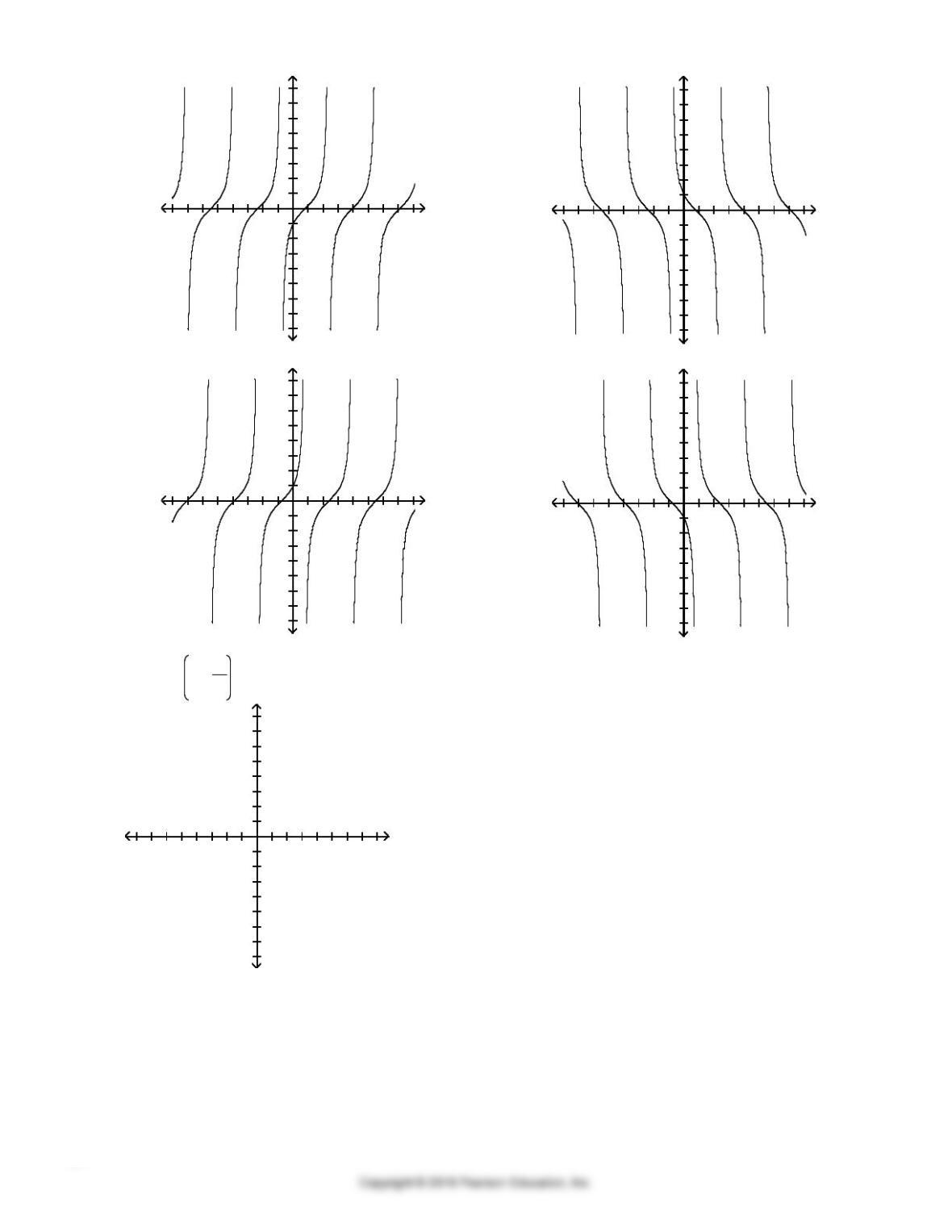
A)
x
-7 7
y
7
-7
x
-7 7
y
7
-7
B)
x
-7 7
y
7
-7
x
-7 7
y
7
-7
C)
x
-7 7
y
7
-7
x
-7 7
y
7
-7
D)
x
-7 7
y
7
-7
x
-7 7
y
7
-7
16) y=–cotx–π
4
x
-7 7
y
7
-7
x
-7 7
y
7
-7
Page91
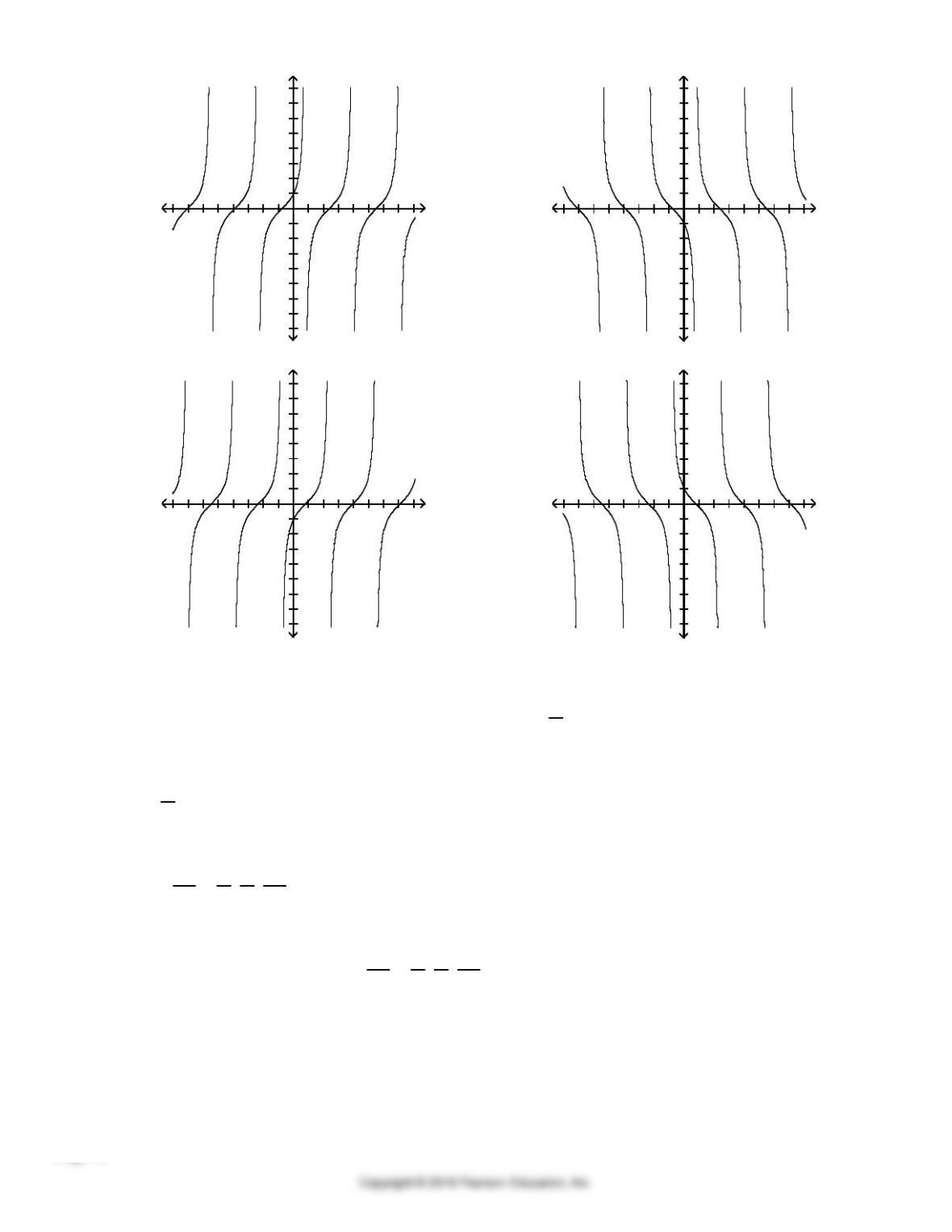
A)
x
-7 7
y
7
-7
x
-7 7
y
7
-7
B)
x
-7 7
y
7
-7
x
-7 7
y
7
-7
C)
x
-7 7
y
7
-7
x
-7 7
y
7
-7
D)
x
-7 7
y
7
-7
x
-7 7
y
7
-7
Solvetheproblem.
17) Whatisthey–interceptofy=tanx?
A) 0 B) 1 C) π
2D) none
18) Whatisthey–interceptofy=cscx?
A) π
2B) 0 C) 1 D) none
19) Forwhatnumbersx,–2π≤x≤2π
,
doesthegraphofy=sec xhaveverticalasymptotes.?
A) –3π
2,–π
2,π
2,3π
2B) –2π
,
–π
,
0,π
,
2πC) –2,–1,0,1,2 D) none
20) Forwhatnumbersx,–2π≤x≤2π
,
doesthegraphofy=cot xhaveverticalasymptotes?
A) –2π
,
–π
,
0,π
,
2πB) –3π
2,–π
2,π
2,3π
2C) –2,–1,0,1,2 D) none
Page92
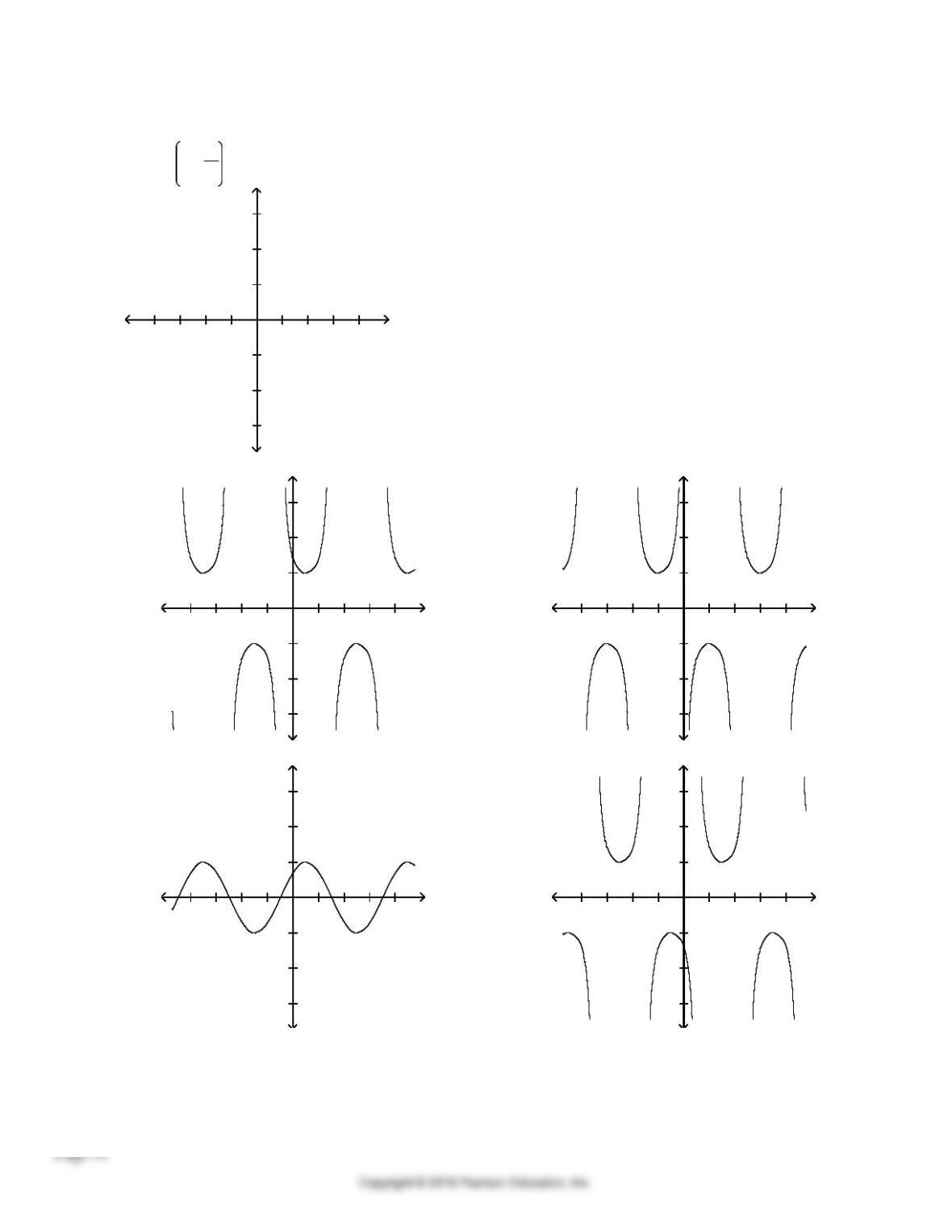
2 GraphFunctionsoftheFormy=Acsc(ωx)+Bandy=Asec(ωx)+B
MULTIPLECHOICE.Choosetheonealternativethatbestcompletesthestatementoranswersthequestion.
Graphthefunction.
1) y=cscx+π
4
x
-2–
2
y
3
-3
x
-2–
2
y
3
-3
A)
x
-2–
2
y
3
-3
x
-2–
2
y
3
-3
B)
x
-2–
2
y
3
-3
x
-2–
2
y
3
-3
C)
x
-2–
2
y
3
-3
x
-2–
2
y
3
-3
D)
x
-2–
2
y
3
-3
x
-2–
2
y
3
-3
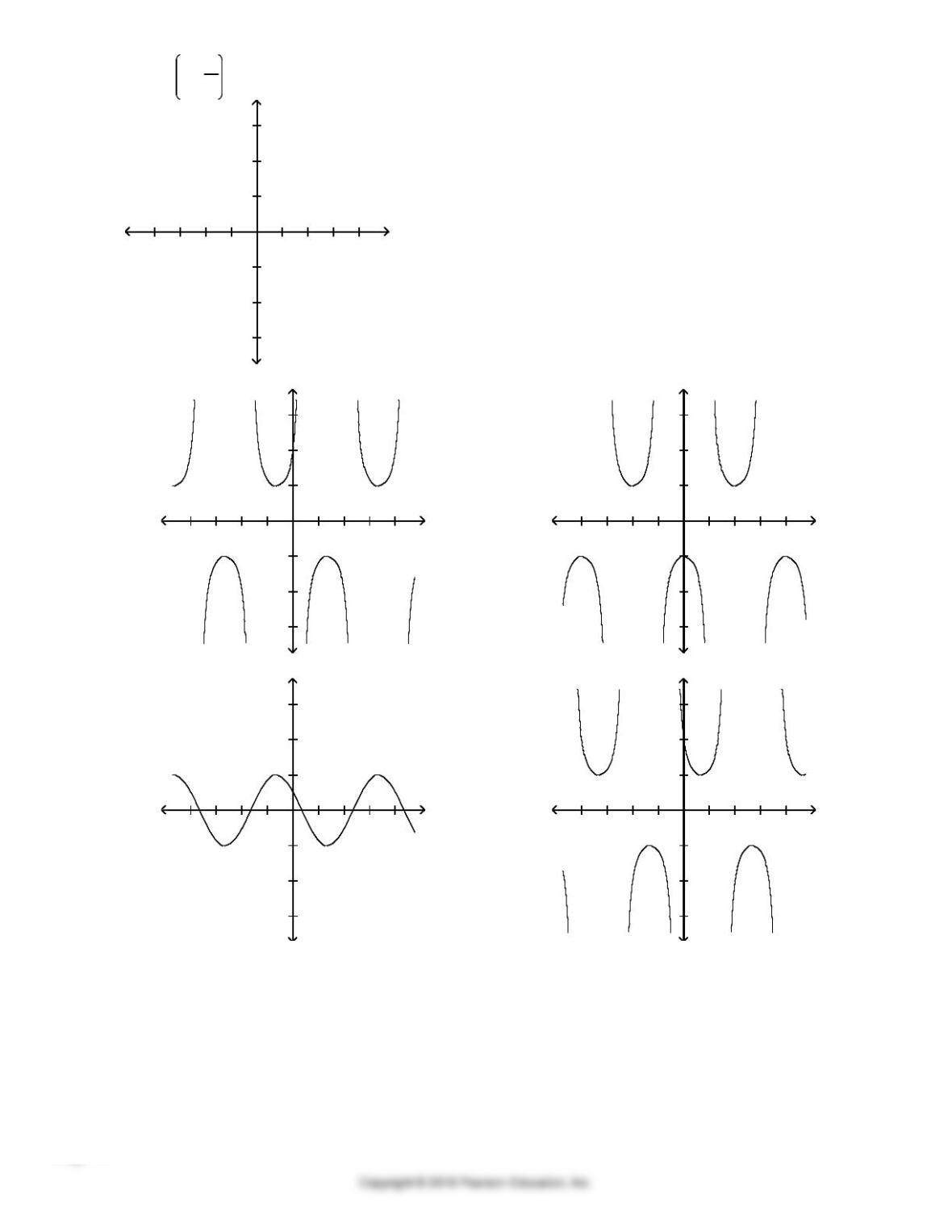
2) y=secx+π
3
x
-2–
2
y
3
-3
x
-2–
2
y
3
-3
A)
x
-2–
2
y
3
-3
x
-2–
2
y
3
-3
B)
x
-2–
2
y
3
-3
x
-2–
2
y
3
-3
C)
x
-2–
2
y
3
-3
x
-2–
2
y
3
-3
D)
x
-2–
2
y
3
-3
x
-2–
2
y
3
-3
Page94
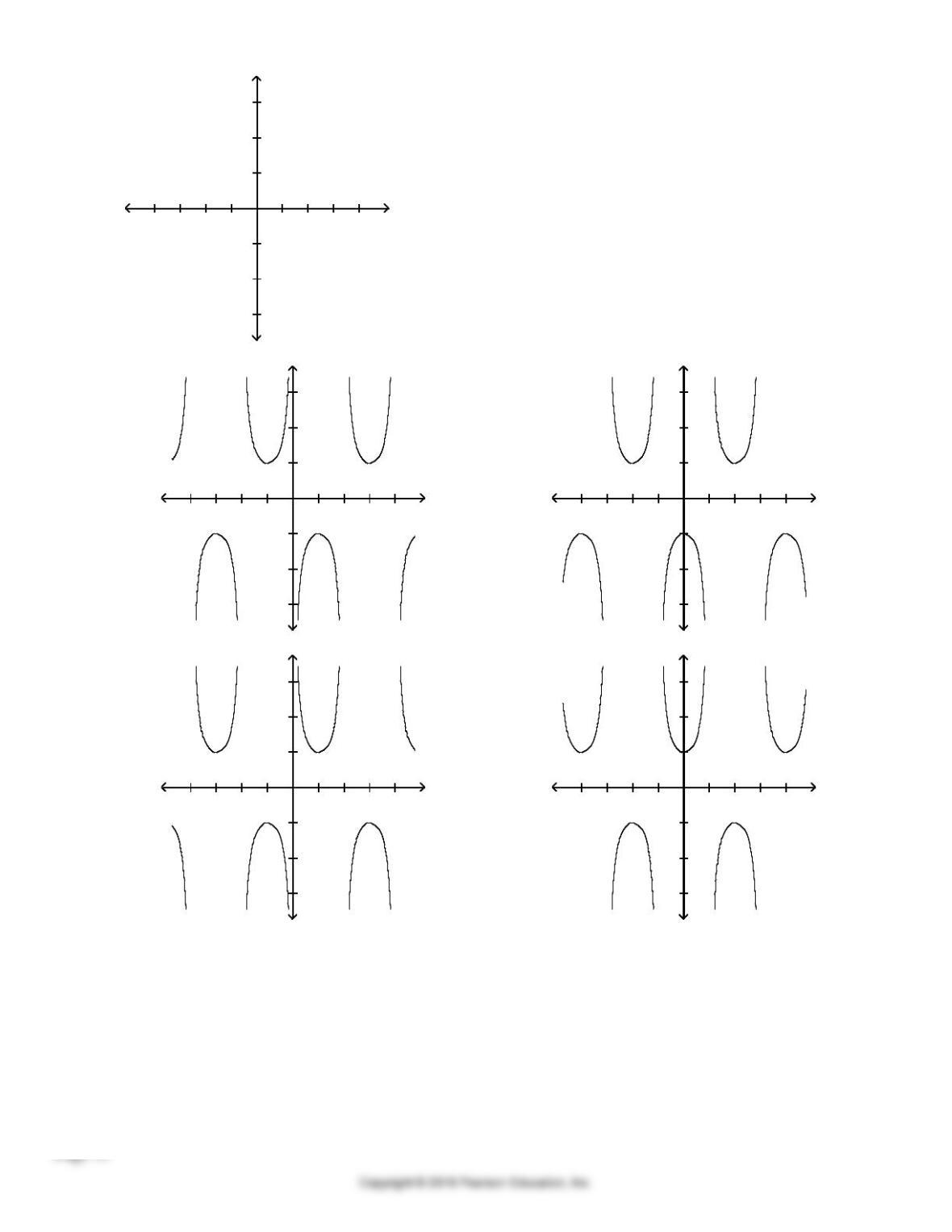
3) y=–cscx
x
-2
–
2
y
3
-3
x
-2
–
2
y
3
-3
A)
x
-2
–
2
y
3
-3
x
-2
–
2
y
3
-3
B)
x
-2
–
2
y
3
-3
x
-2
–
2
y
3
-3
C)
x
-2
–
2
y
3
-3
x
-2
–
2
y
3
-3
D)
x
-2
–
2
y
3
-3
x
-2
–
2
y
3
-3
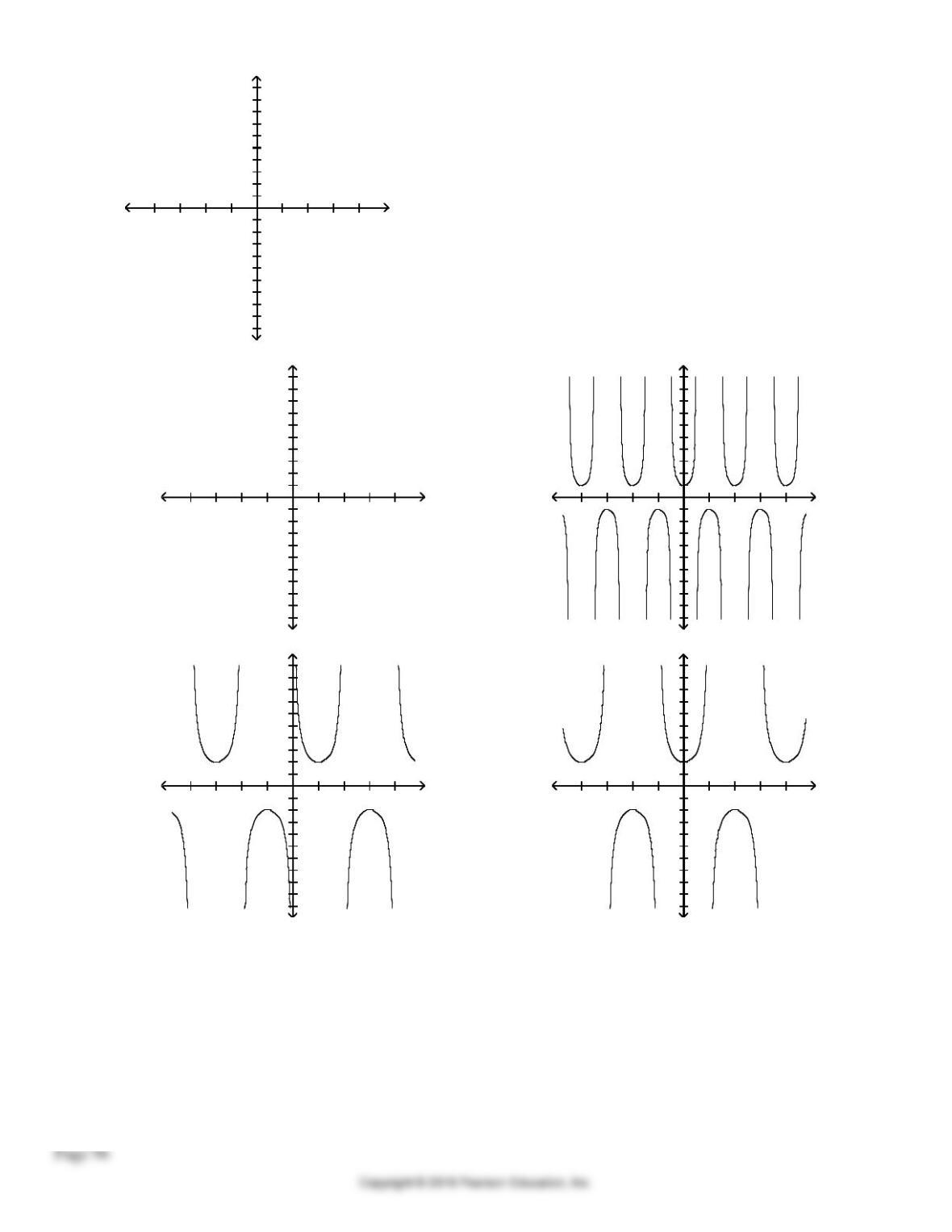
4) y=csc(2x)
x
-2–
2
y
10
8
6
4
2
-2
-4
-6
-8
-10
x
-2–
2
y
10
8
6
4
2
-2
-4
-6
-8
-10
A)
x
-2–
2
y
10
8
6
4
2
-2
-4
-6
-8
-10
x
-2–
2
y
10
8
6
4
2
-2
-4
-6
-8
-10
B)
x
-2–
2
y
10
8
6
4
2
-2
-4
-6
-8
-10
x
-2–
2
y
10
8
6
4
2
-2
-4
-6
-8
-10
C)
x
-2–
2
y
10
8
6
4
2
-2
-4
-6
-8
-10
x
-2–
2
y
10
8
6
4
2
-2
-4
-6
-8
-10
D)
x
-2–
2
y
10
8
6
4
2
-2
-4
-6
-8
-10
x
-2–
2
y
10
8
6
4
2
-2
-4
-6
-8
-10
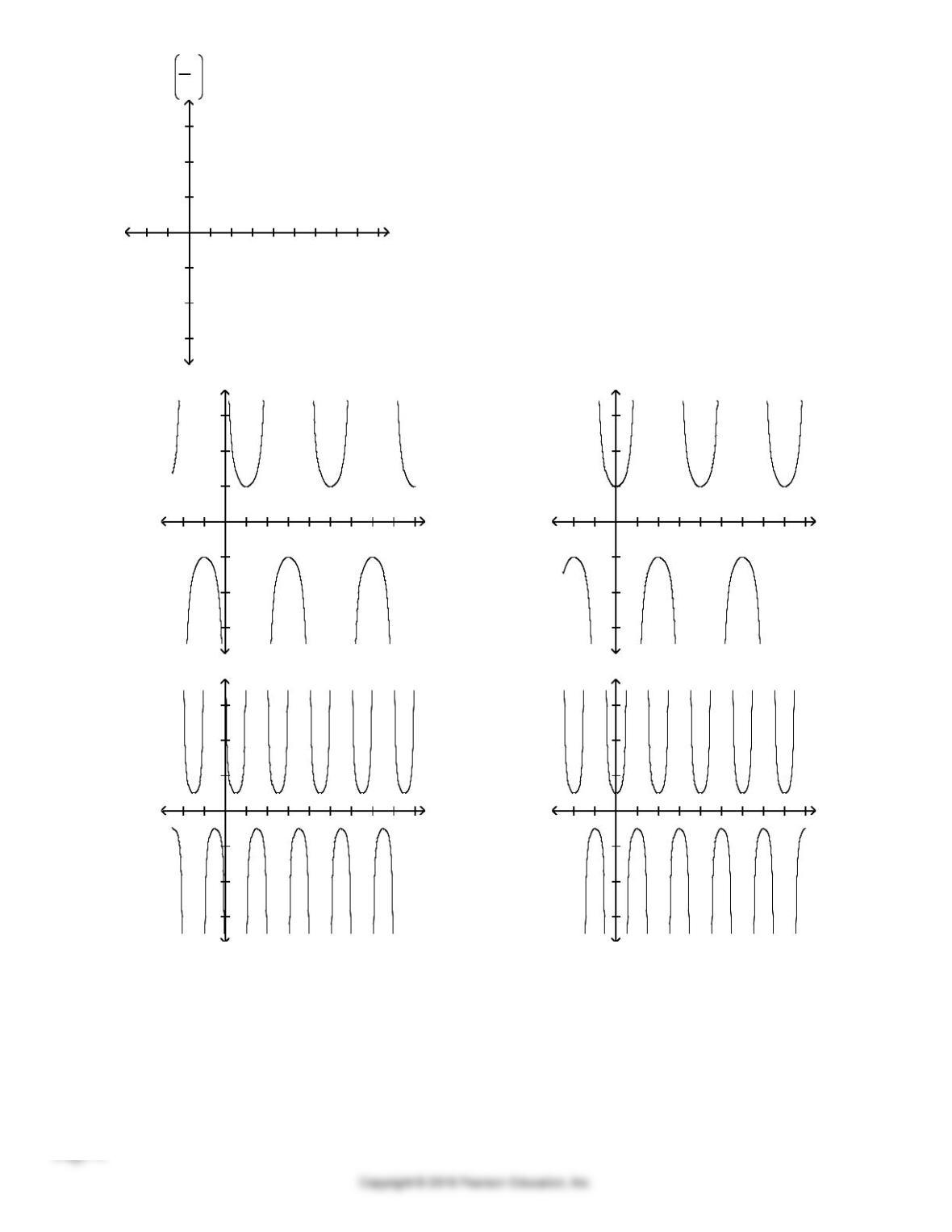
5) y=csc1
2x
x
-2
2
4
6
8
y
3
-3
x
-2
2
4
6
8
y
3
-3
A)
x
-22468
y
3
-3
x
-22468
y
3
-3
B)
x
-22468
y
3
-3
x
-22468
y
3
-3
C)
x
-22468
y
3
-3
x
-22468
y
3
-3
D)
x
-22468
y
3
-3
x
-22468
y
3
-3
Page97
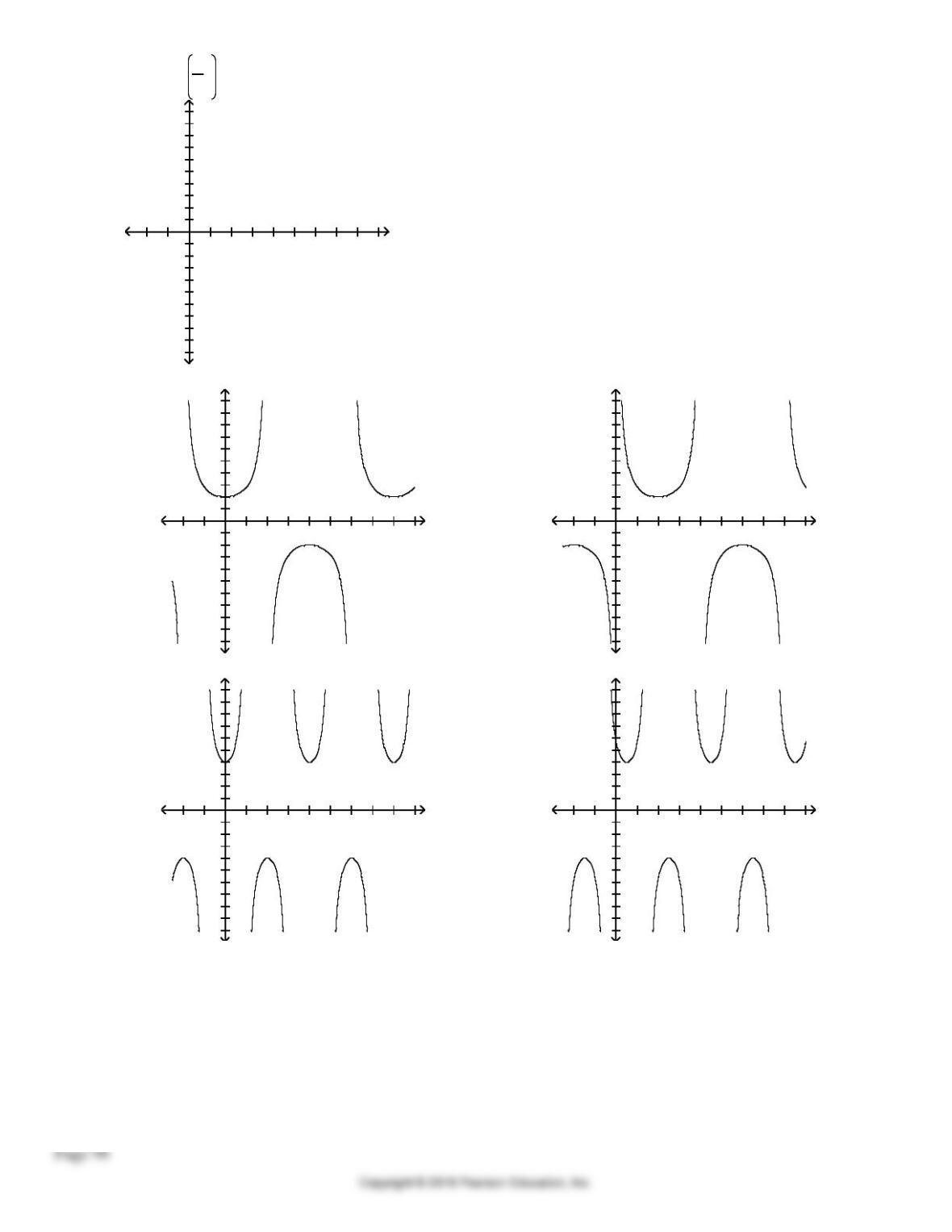
6) y=2sec1
4x
x
-22468
y
10
8
6
4
2
-2
-4
-6
-8
-10
x
-22468
y
10
8
6
4
2
-2
-4
-6
-8
-10
A)
x
-22468
y
10
8
6
4
2
-2
-4
-6
-8
-10
x
-22468
y
10
8
6
4
2
-2
-4
-6
-8
-10
B)
x
-22468
y
10
8
6
4
2
-2
-4
-6
-8
-10
x
-22468
y
10
8
6
4
2
-2
-4
-6
-8
-10
C)
x
-22468
y
10
8
6
4
2
-2
-4
-6
-8
-10
x
-22468
y
10
8
6
4
2
-2
-4
-6
-8
-10
D)
x
-22468
y
10
8
6
4
2
-2
-4
-6
-8
-10
x
-22468
y
10
8
6
4
2
-2
-4
-6
-8
-10
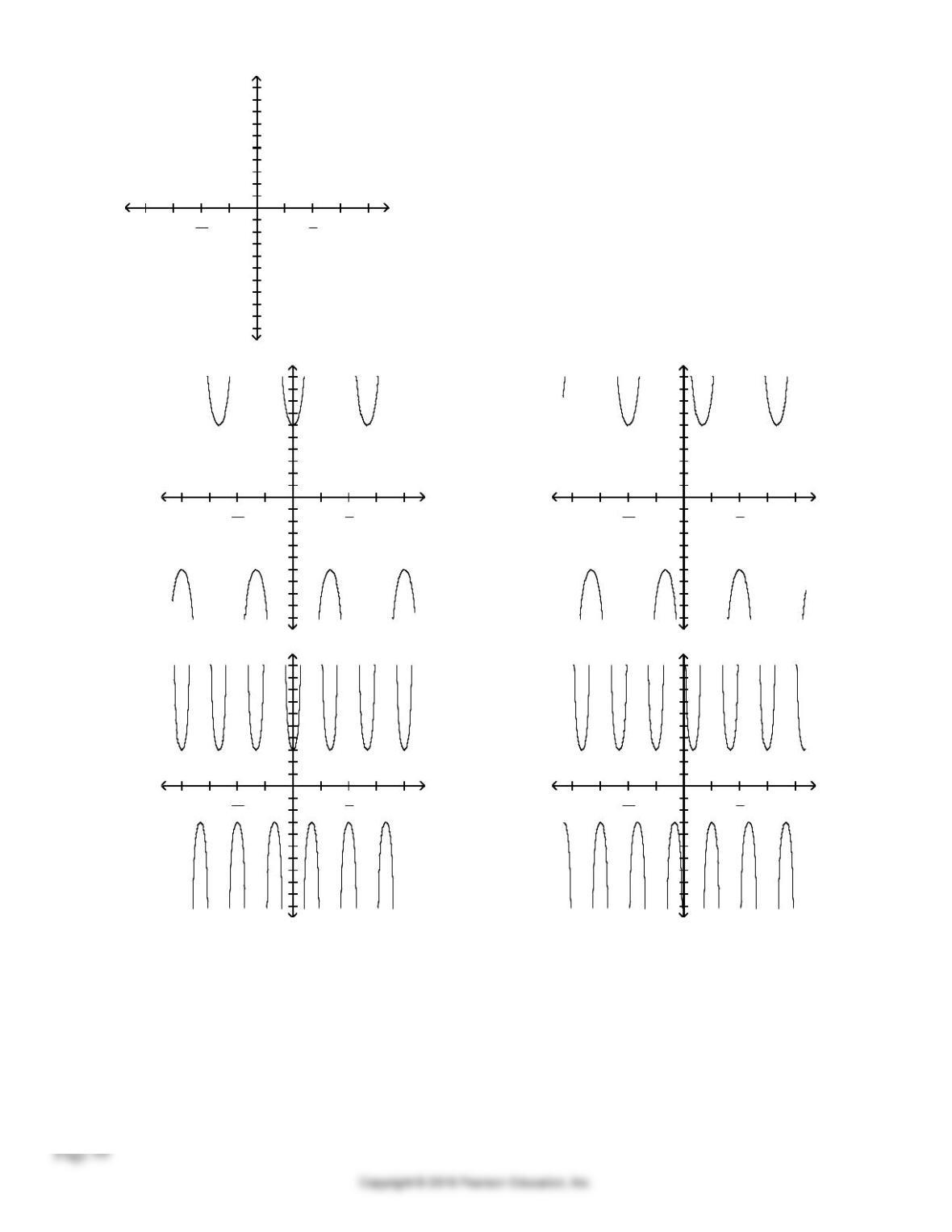
7) y=6sec(3x)
x
––
2
2
y
10
8
6
4
2
-2
-4
-6
-8
-10
x
––
2
2
y
10
8
6
4
2
-2
-4
-6
-8
-10
A)
x
––
2
2
y
10
8
6
4
2
-2
-4
-6
-8
-10
x
––
2
2
y
10
8
6
4
2
-2
-4
-6
-8
-10
B)
x
––
2
2
y
10
8
6
4
2
-2
-4
-6
-8
-10
x
––
2
2
y
10
8
6
4
2
-2
-4
-6
-8
-10
C)
x
––
2
2
y
10
8
6
4
2
-2
-4
-6
-8
-10
x
––
2
2
y
10
8
6
4
2
-2
-4
-6
-8
-10
D)
x
––
2
2
y
10
8
6
4
2
-2
-4
-6
-8
-10
x
––
2
2
y
10
8
6
4
2
-2
-4
-6
-8
-10
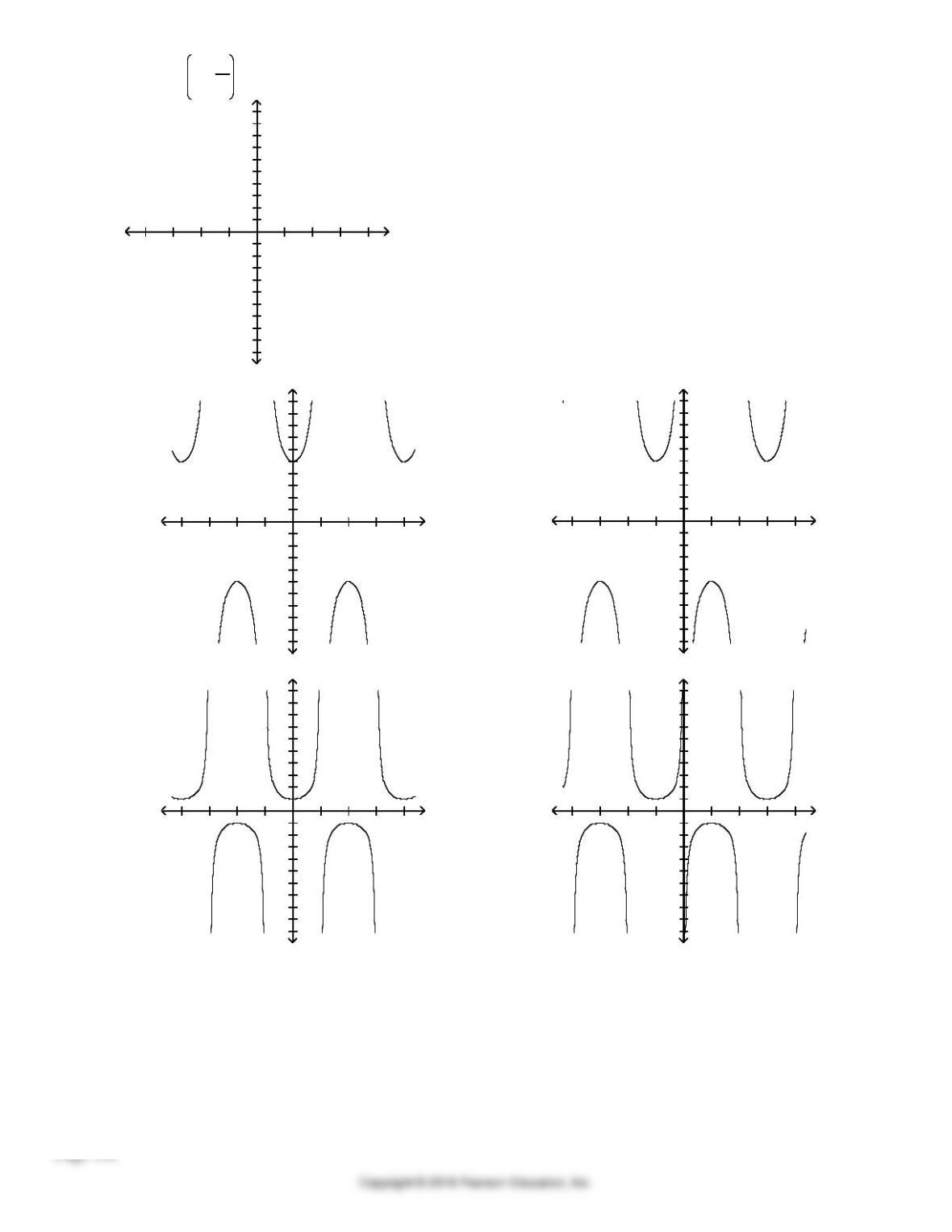
8) y=5cscx+π
2
x
-2–
2
y
10
8
6
4
2
-2
-4
-6
-8
-10
x
-2–
2
y
10
8
6
4
2
-2
-4
-6
-8
-10
A)
x
-2
–
2
y
10
8
6
4
2
-2
-4
-6
-8
-10
x
-2
–
2
y
10
8
6
4
2
-2
-4
-6
-8
-10
B)
x
-2–
2
y
10
8
6
4
2
-2
-4
-6
-8
-10
x
-2–
2
y
10
8
6
4
2
-2
-4
-6
-8
-10
C)
x
-2–
2
y
10
8
6
4
2
-2
-4
-6
-8
-10
x
-2–
2
y
10
8
6
4
2
-2
-4
-6
-8
-10
D)
x
-2–
2
y
10
8
6
4
2
-2
-4
-6
-8
-10
x
-2–
2
y
10
8
6
4
2
-2
-4
-6
-8
-10
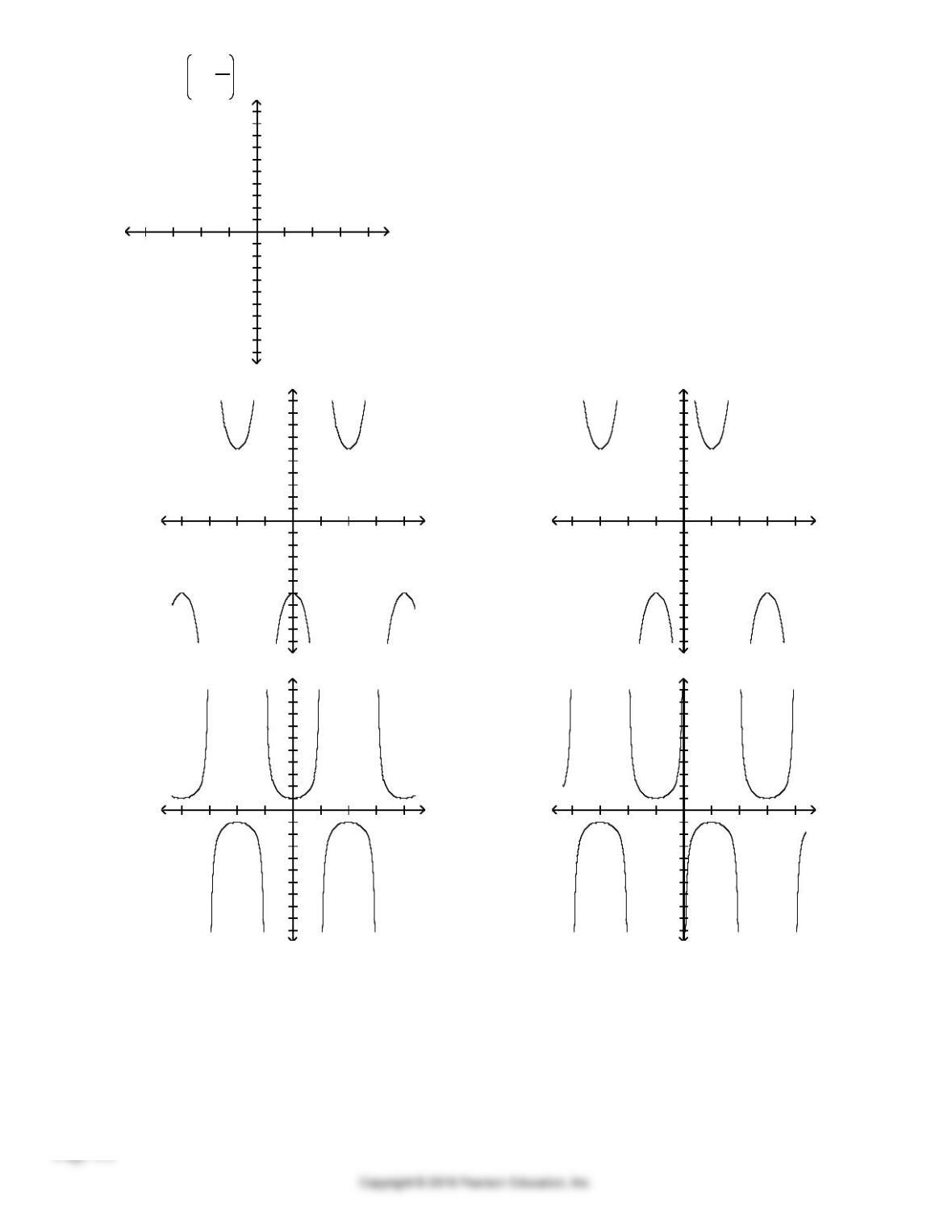
9) y=6cscx–π
2
x
-2–
2
y
10
8
6
4
2
-2
-4
-6
-8
-10
x
-2–
2
y
10
8
6
4
2
-2
-4
-6
-8
-10
A)
x
-2–
2
y
10
8
6
4
2
-2
-4
-6
-8
-10
x
-2–
2
y
10
8
6
4
2
-2
-4
-6
-8
-10
B)
x
-2–
2
y
10
8
6
4
2
-2
-4
-6
-8
-10
x
-2–
2
y
10
8
6
4
2
-2
-4
-6
-8
-10
C)
x
-2–
2
y
10
8
6
4
2
-2
-4
-6
-8
-10
x
-2–
2
y
10
8
6
4
2
-2
-4
-6
-8
-10
D)
x
-2–
2
y
10
8
6
4
2
-2
-4
-6
-8
-10
x
-2–
2
y
10
8
6
4
2
-2
-4
-6
-8
-10
Page101
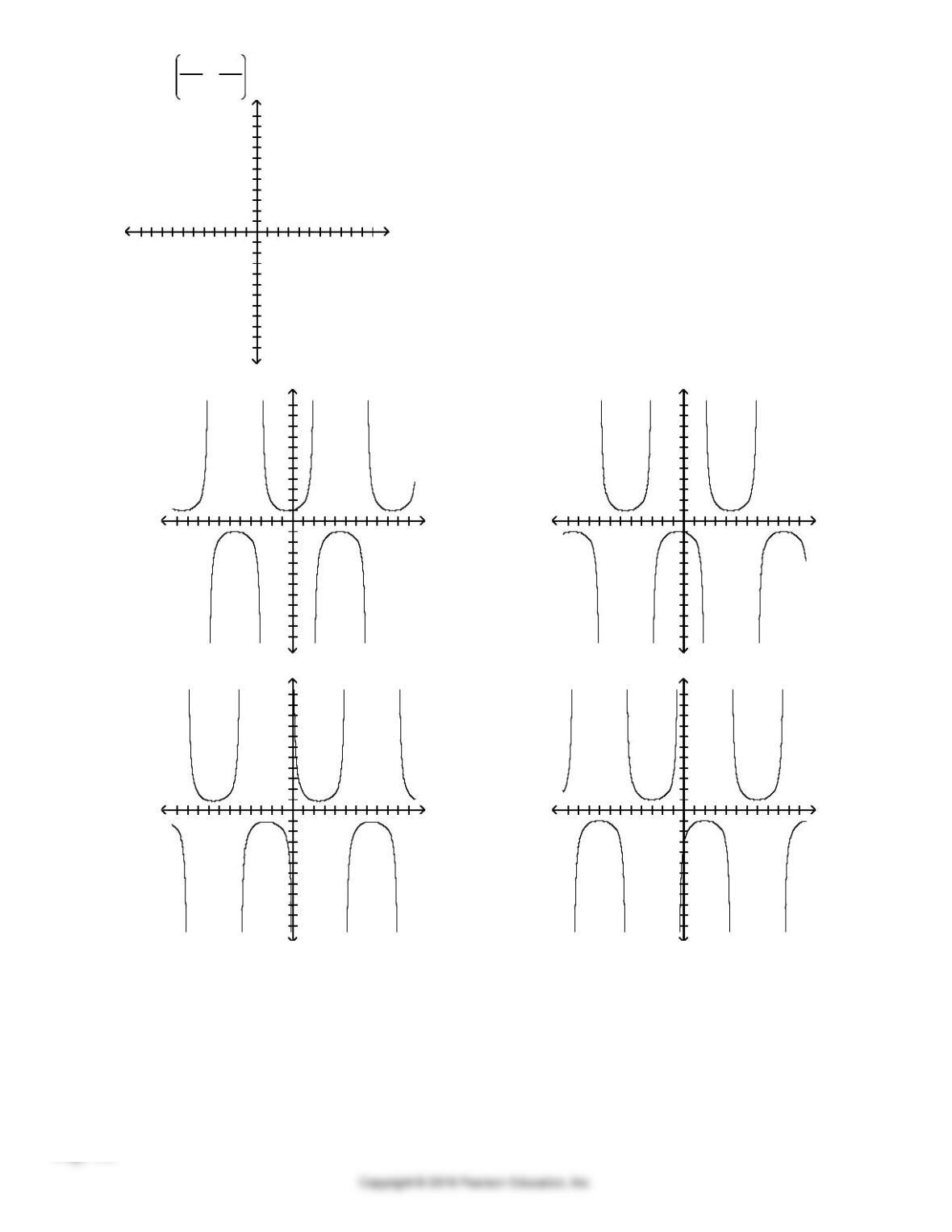
10) y=cscπx
5+3π
5
x
-10 10
y
10
-10
x
-10 10
y
10
-10
A)
x
-10 10
y
10
-10
x
-10 10
y
10
-10
B)
x
-10 10
y
10
-10
x
-10 10
y
10
-10
C)
x
-10 10
y
10
-10
x
-10 10
y
10
-10
D)
x
-10 10
y
10
-10
x
-10 10
y
10
-10
Solvetheproblem.
11) Arotatingbeaconislocated7ftfromawall.Ifthedistancefromthebeacontothepointonthewall
wherethebeaconisaimedisgivenby
a=7|sec2πt|,
wheretisinseconds,findawhent=0.40seconds.Roundyouranswertothenearesthundredth.
A) 8.65ft B) 22.65 ft C) 15.65 ft D) –8.65 ft
Page102
7.8 PhaseShift;SinusoidalCurveFitting
1 GraphSinusoidalFunctionsoftheFormy=Asin(ωx–φ)+B
MULTIPLECHOICE.Choosetheonealternativethatbestcompletesthestatementoranswersthequestion.
Findthephaseshiftofthefunction.
1) y=–2sinx–π
2
A) π
2unitstotheright B) π
2unitstotheleft
C) –2unitsup D) –2 unitsdown
2) y=–2cosx+π
4
A) π
4unitstotheleft B) π
4unitstotheright
C) –2unitsup D) –2 unitsdown
3) y=–2sin2x–π
2
A) π
4unitstotheright B) π
2unitstotheleft
C) 2πunitsup D) 2πunitsdown
4) y=–5cos(6x+π)
A) π
6unitstotheleft B) π
5unitstotheleft
C) 5πunitstotheright D) 6πunitstotheright
5) y=5sin1
2x–π
2
A) πunitstotheright B) π
2unitstotheright
C) π
4unitstotheleft D) π
5unitstotheleft
6) y=–2cos1
4x+π
4
A) πunitstotheleft B) π
4unitstotheleft
C) π
16unitstotheright D) 2πunitstotheright
Page103
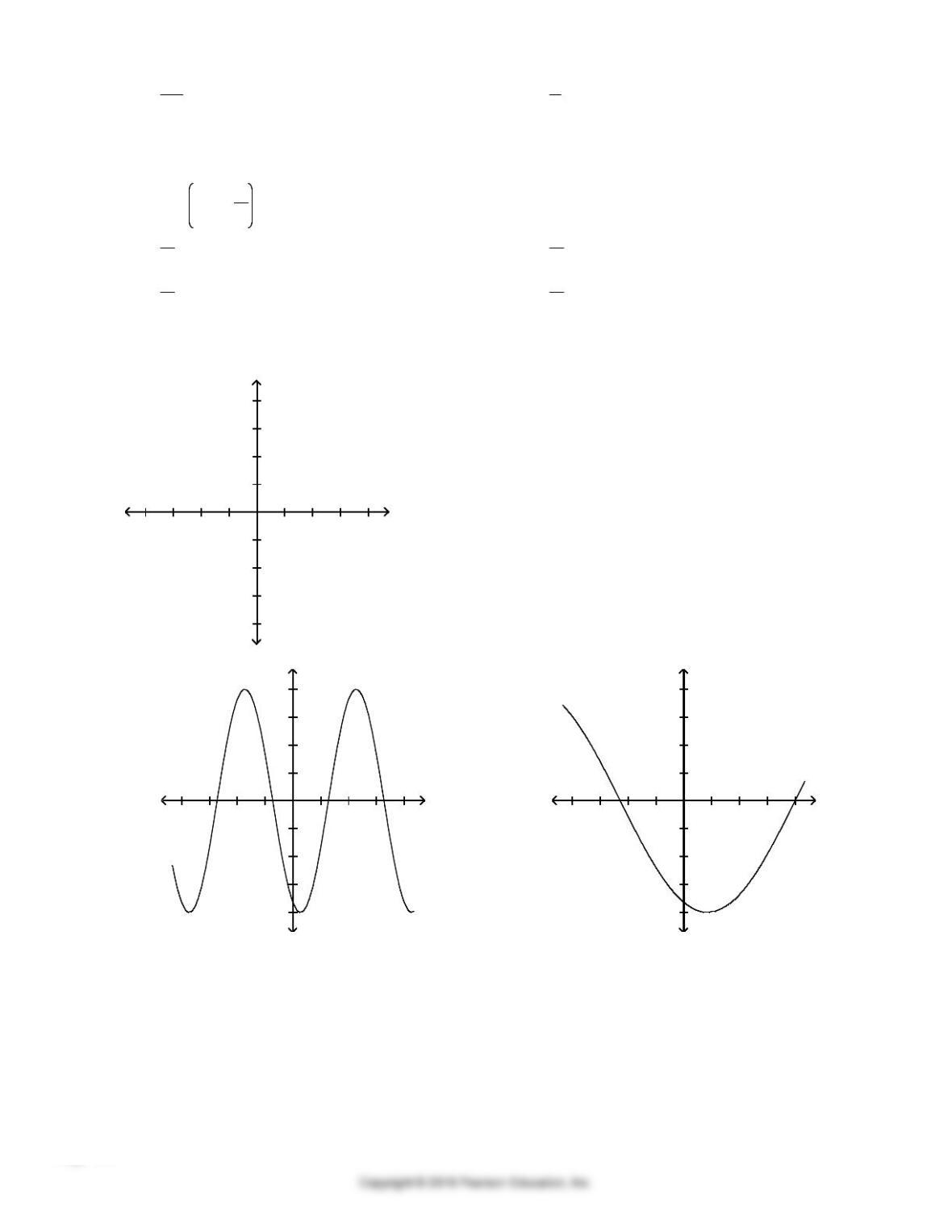
7) y=2sin(4πx+3)
A) 3
4πunitstotheleft B) 3
4unitstotheright
C) 3unitstotheleft D) 3 unitstotheright
8) y=2cos–3x+π
2
A) π
6unitstotheright B) π
6unitstotheleft
C) π
2unitstotheright D) π
2unitstotheleft
Graphthefunction.Showatleastoneperiod.
9) y=4sin(2πx–2)
x
-1 1
y
4
3
2
1
-1
-2
-3
-4
x
-1 1
y
4
3
2
1
-1
-2
-3
-4
A)
x
-1 1
y
4
3
2
1
-1
-2
-3
-4
x
-1 1
y
4
3
2
1
-1
-2
-3
-4
B)
x
-1 1
y
4
3
2
1
-1
-2
-3
-4
x
-1 1
y
4
3
2
1
-1
-2
-3
-4
Page104
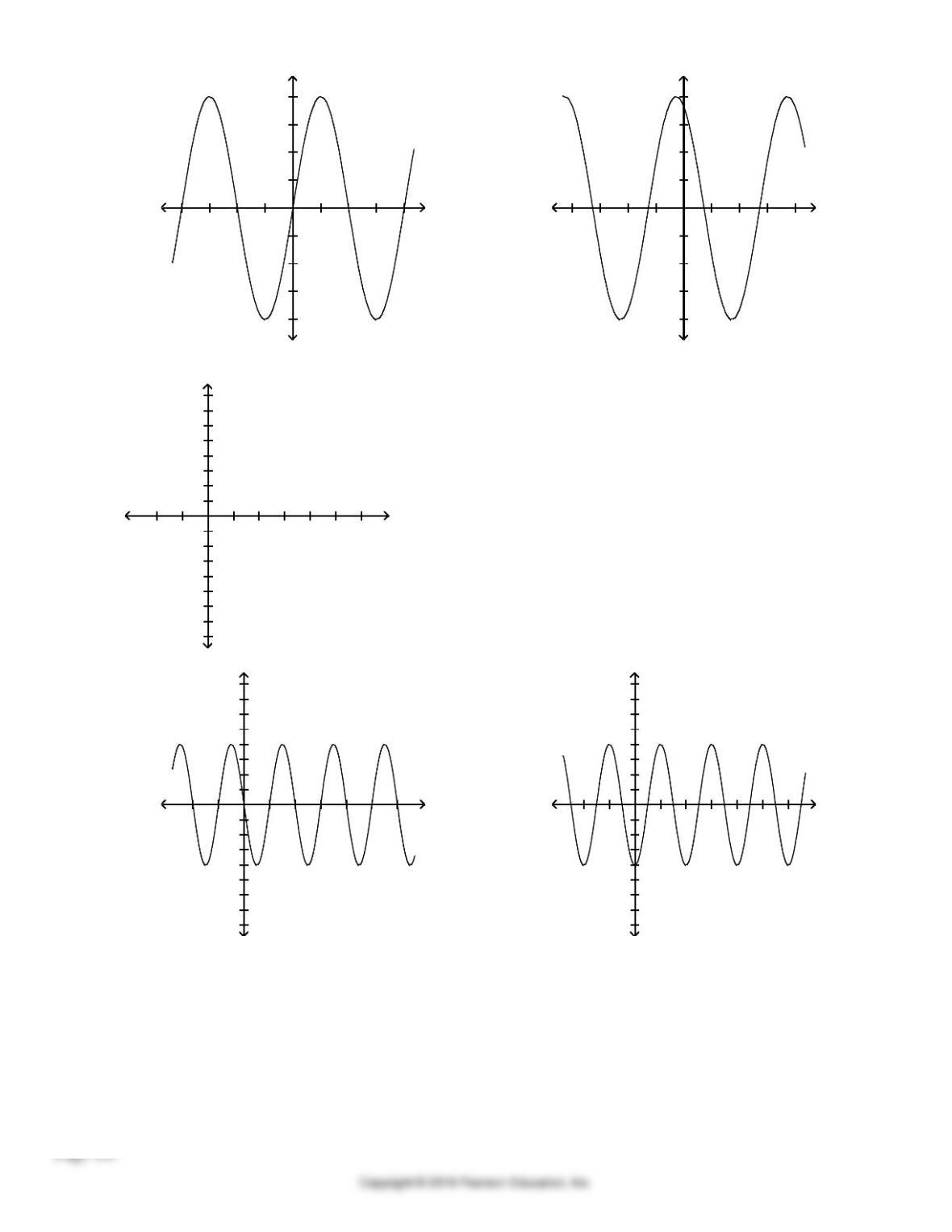
C)
x
-1 1
y
4
3
2
1
-1
-2
-3
-4
x
-1 1
y
4
3
2
1
-1
-2
-3
-4
D)
x
-1 1
y
4
3
2
1
-1
-2
-3
-4
x
-1 1
y
4
3
2
1
-1
-2
-3
-4
10) y=4sin(2x–π)
x
–
23
y
8
6
4
2
-2
-4
-6
-8
x
–
23
y
8
6
4
2
-2
-4
-6
-8
A)
x
–
23
y
8
6
4
2
-2
-4
-6
-8
x
–
23
y
8
6
4
2
-2
-4
-6
-8
B)
x
–
23
y
8
6
4
2
-2
-4
-6
-8
x
–
23
y
8
6
4
2
-2
-4
-6
-8
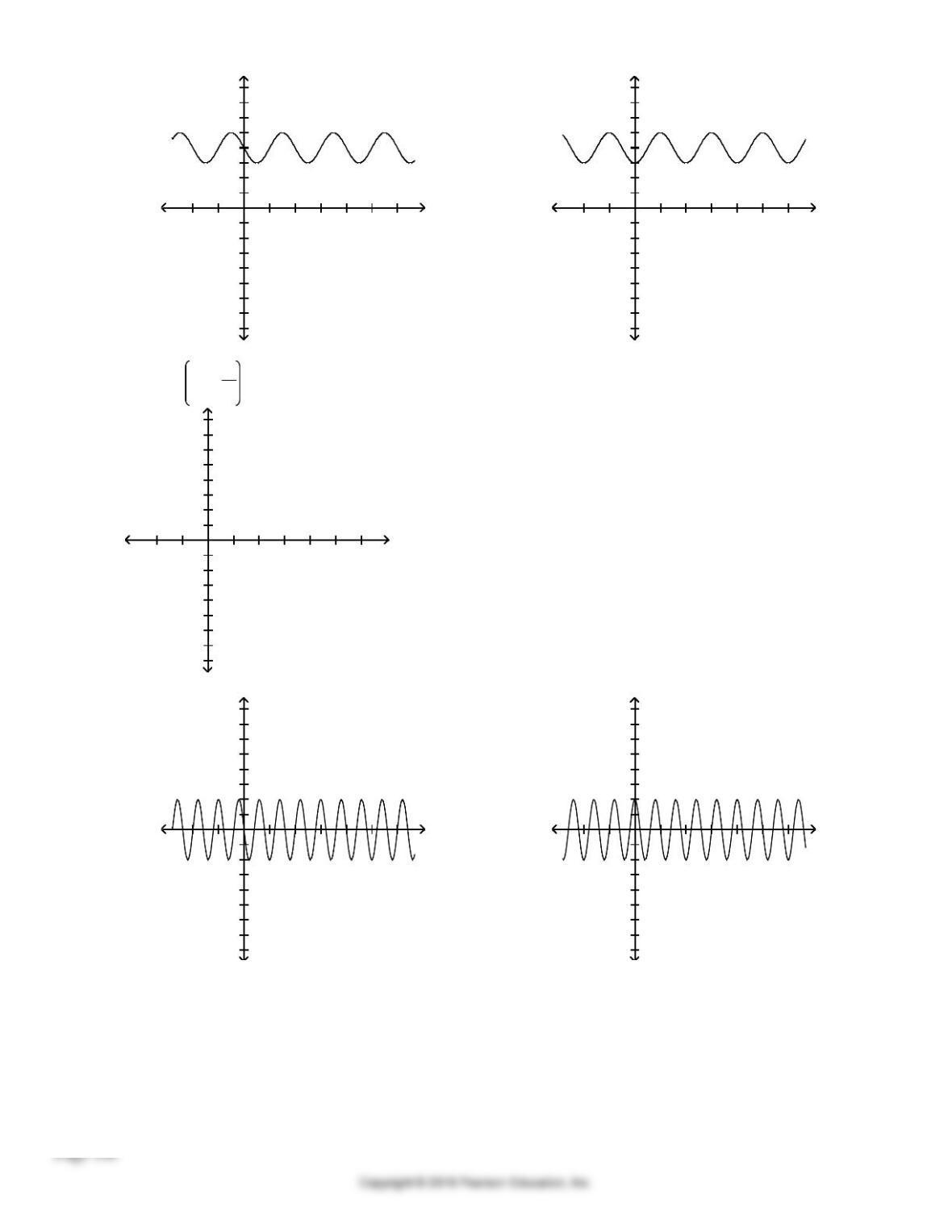
C)
x
–
23
y
8
6
4
2
-2
-4
-6
-8
x
–
23
y
8
6
4
2
-2
-4
-6
-8
D)
x
–
23
y
8
6
4
2
-2
-4
-6
-8
x
–
23
y
8
6
4
2
-2
-4
-6
-8
11) y=2cos 5x+π
2
x
–
23
y
8
6
4
2
-2
-4
-6
-8
x
–
23
y
8
6
4
2
-2
-4
-6
-8
A)
x
–
23
y
8
6
4
2
-2
-4
-6
-8
x
–
23
y
8
6
4
2
-2
-4
-6
-8
B)
x
–
23
y
8
6
4
2
-2
-4
-6
-8
x
–
23
y
8
6
4
2
-2
-4
-6
-8
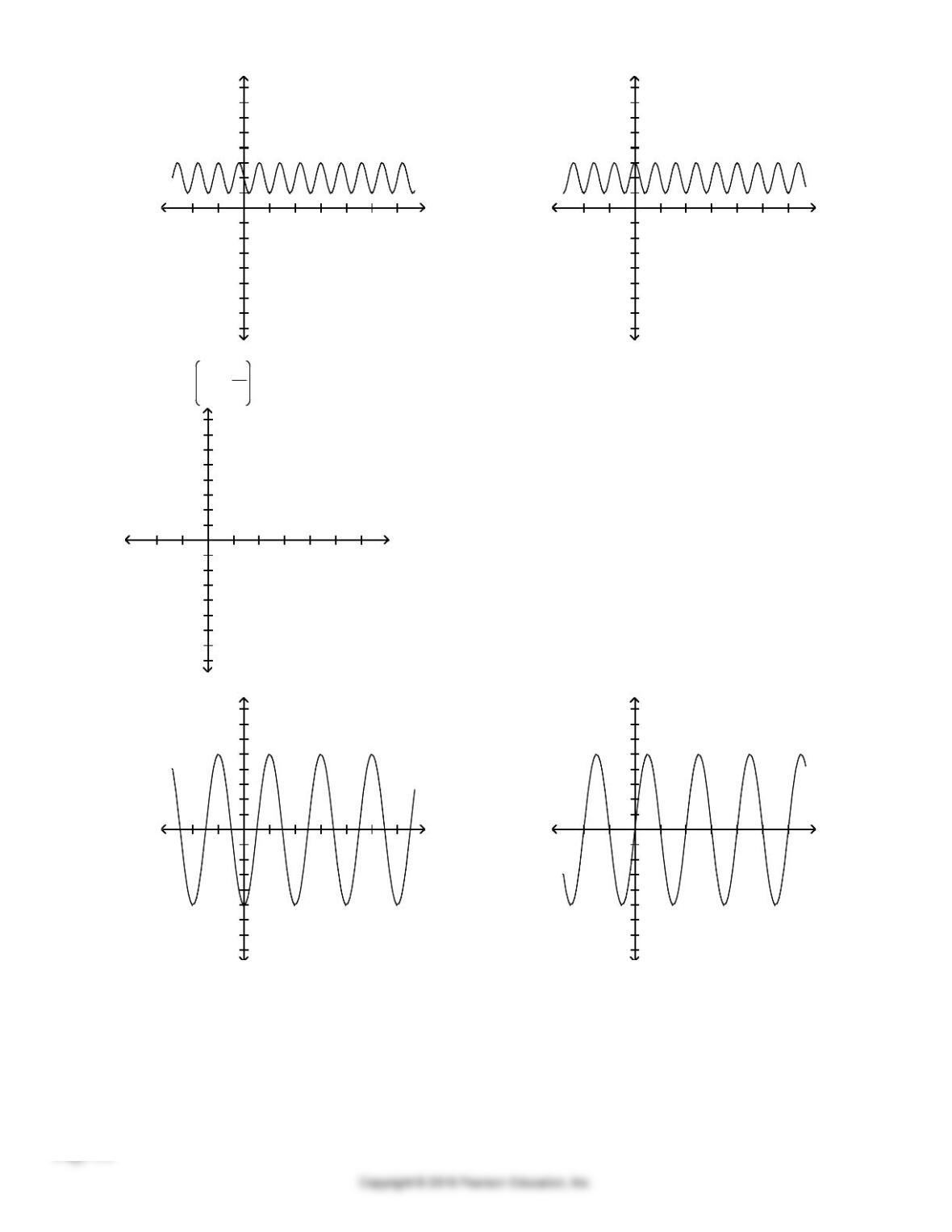
C)
x
–
23
y
8
6
4
2
-2
-4
-6
-8
x
–
23
y
8
6
4
2
-2
-4
-6
-8
D)
x
–
23
y
8
6
4
2
-2
-4
-6
-8
x
–
23
y
8
6
4
2
-2
-4
-6
-8
12) y=–5sin2x+π
2
x
–
23
y
8
6
4
2
-2
-4
-6
-8
x
–
23
y
8
6
4
2
-2
-4
-6
-8
A)
x
–
23
y
8
6
4
2
-2
-4
-6
-8
x
–
23
y
8
6
4
2
-2
-4
-6
-8
B)
x
–
23
y
8
6
4
2
-2
-4
-6
-8
x
–
23
y
8
6
4
2
-2
-4
-6
-8
Page107
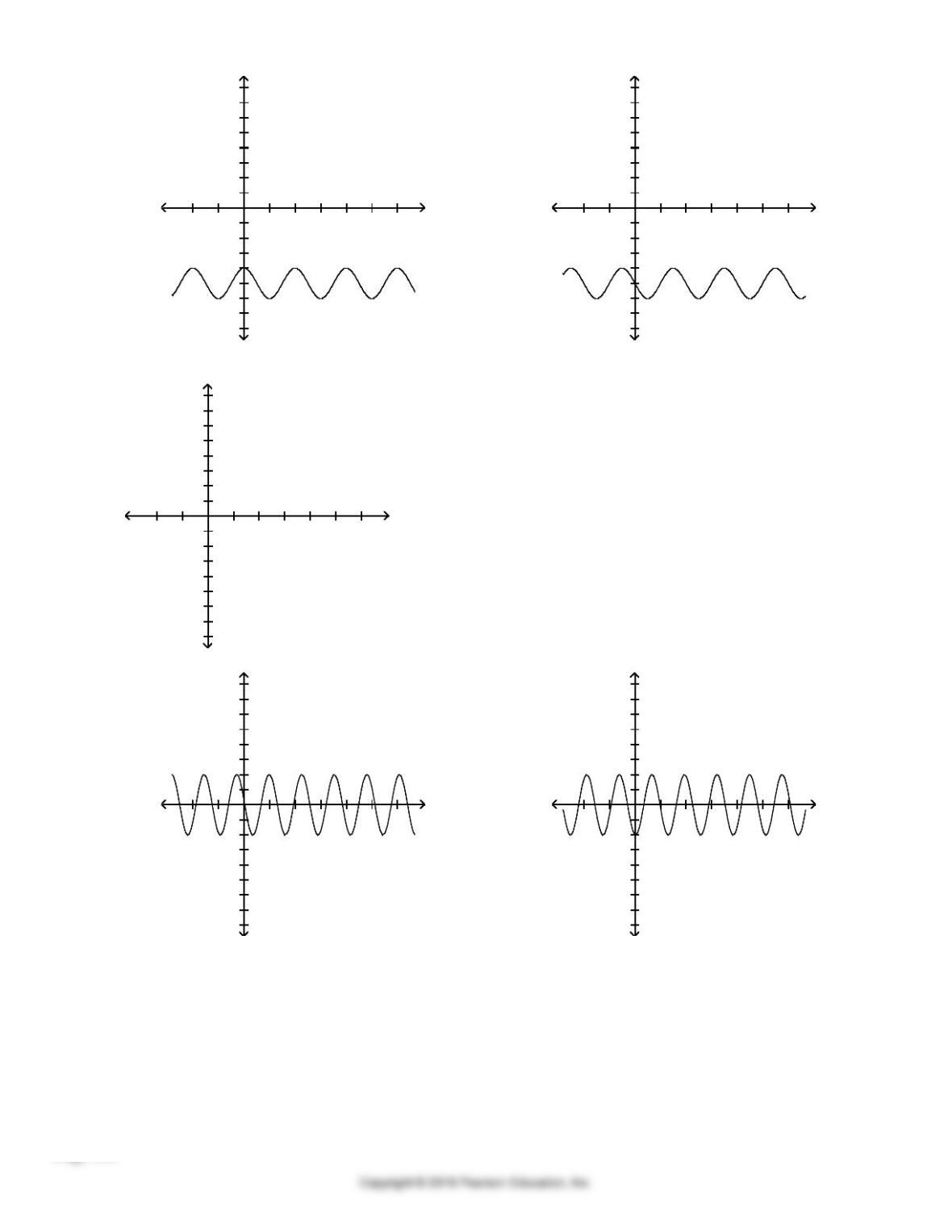
C)
x
–
23
y
8
6
4
2
-2
-4
-6
-8
x
–
23
y
8
6
4
2
-2
-4
-6
-8
D)
x
–
23
y
8
6
4
2
-2
-4
-6
-8
x
–
23
y
8
6
4
2
-2
-4
-6
-8
13) y=2sin(πx+3)
x
–
23
y
8
6
4
2
-2
-4
-6
-8
x
–
23
y
8
6
4
2
-2
-4
-6
-8
A)
x
–
23
y
8
6
4
2
-2
-4
-6
-8
x
–
23
y
8
6
4
2
-2
-4
-6
-8
B)
x
–
23
y
8
6
4
2
-2
-4
-6
-8
x
–
23
y
8
6
4
2
-2
-4
-6
-8
Page108
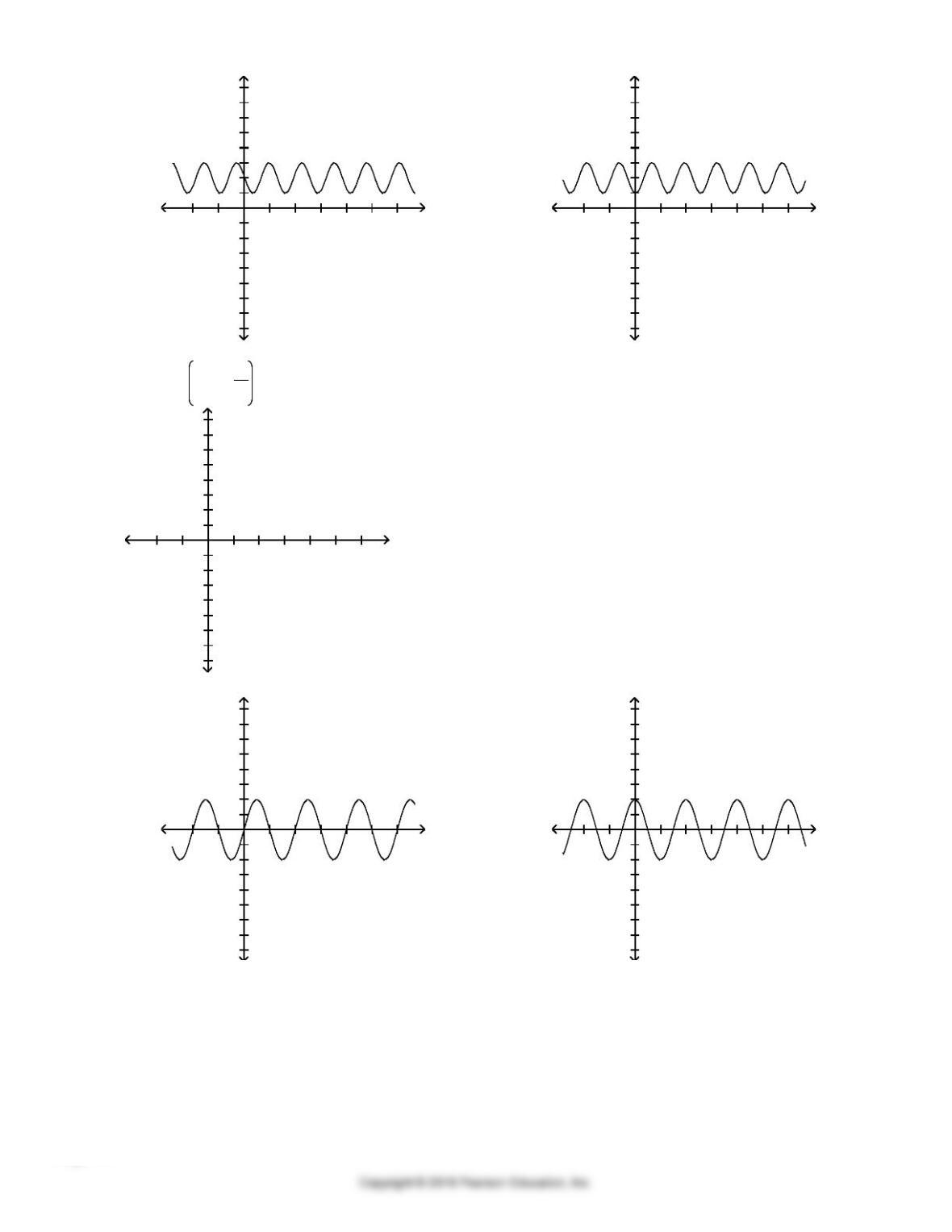
C)
x
–
23
y
8
6
4
2
-2
-4
-6
-8
x
–
23
y
8
6
4
2
-2
-4
-6
-8
D)
x
–
23
y
8
6
4
2
-2
-4
-6
-8
x
–
23
y
8
6
4
2
-2
-4
-6
-8
14) y=2cos–2x+π
2
x
–
23
y
8
6
4
2
-2
-4
-6
-8
x
–
23
y
8
6
4
2
-2
-4
-6
-8
A)
x
–
23
y
8
6
4
2
-2
-4
-6
-8
x
–
23
y
8
6
4
2
-2
-4
-6
-8
B)
x
–
23
y
8
6
4
2
-2
-4
-6
-8
x
–
23
y
8
6
4
2
-2
-4
-6
-8
Page109
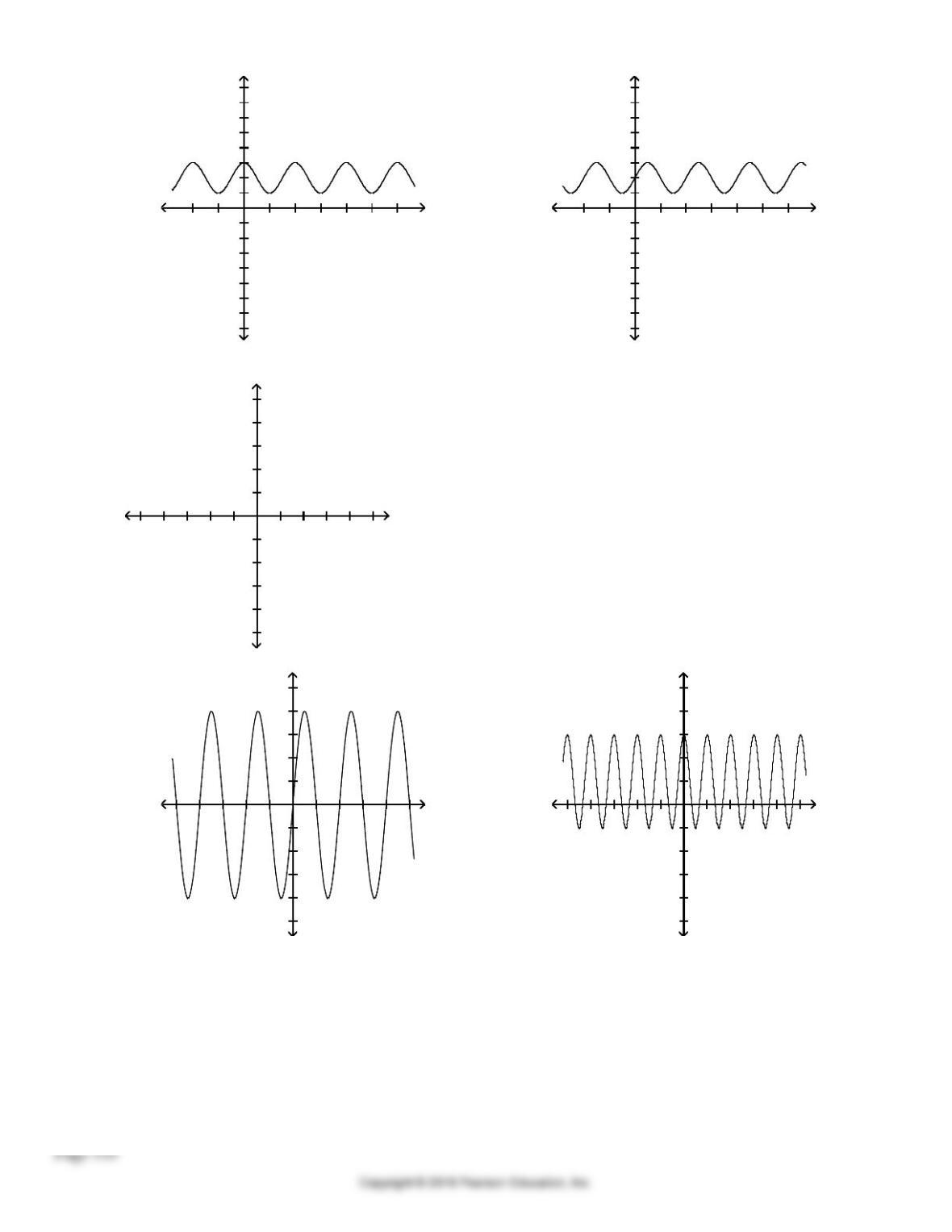
C)
x
–
23
y
8
6
4
2
-2
-4
-6
-8
x
–
23
y
8
6
4
2
-2
-4
-6
-8
D)
x
–
23
y
8
6
4
2
-2
-4
-6
-8
x
–
23
y
8
6
4
2
-2
-4
-6
-8
15) y=4sin(–2x–π)
x
-22
y
5
4
3
2
1
-1
-2
-3
-4
-5
x
-22
y
5
4
3
2
1
-1
-2
-3
-4
-5
A)
x
-22
y
5
4
3
2
1
-1
-2
-3
-4
-5
x
-22
y
5
4
3
2
1
-1
-2
-3
-4
-5
B)
x
-22
y
5
4
3
2
1
-1
-2
-3
-4
-5
x
-22
y
5
4
3
2
1
-1
-2
-3
-4
-5
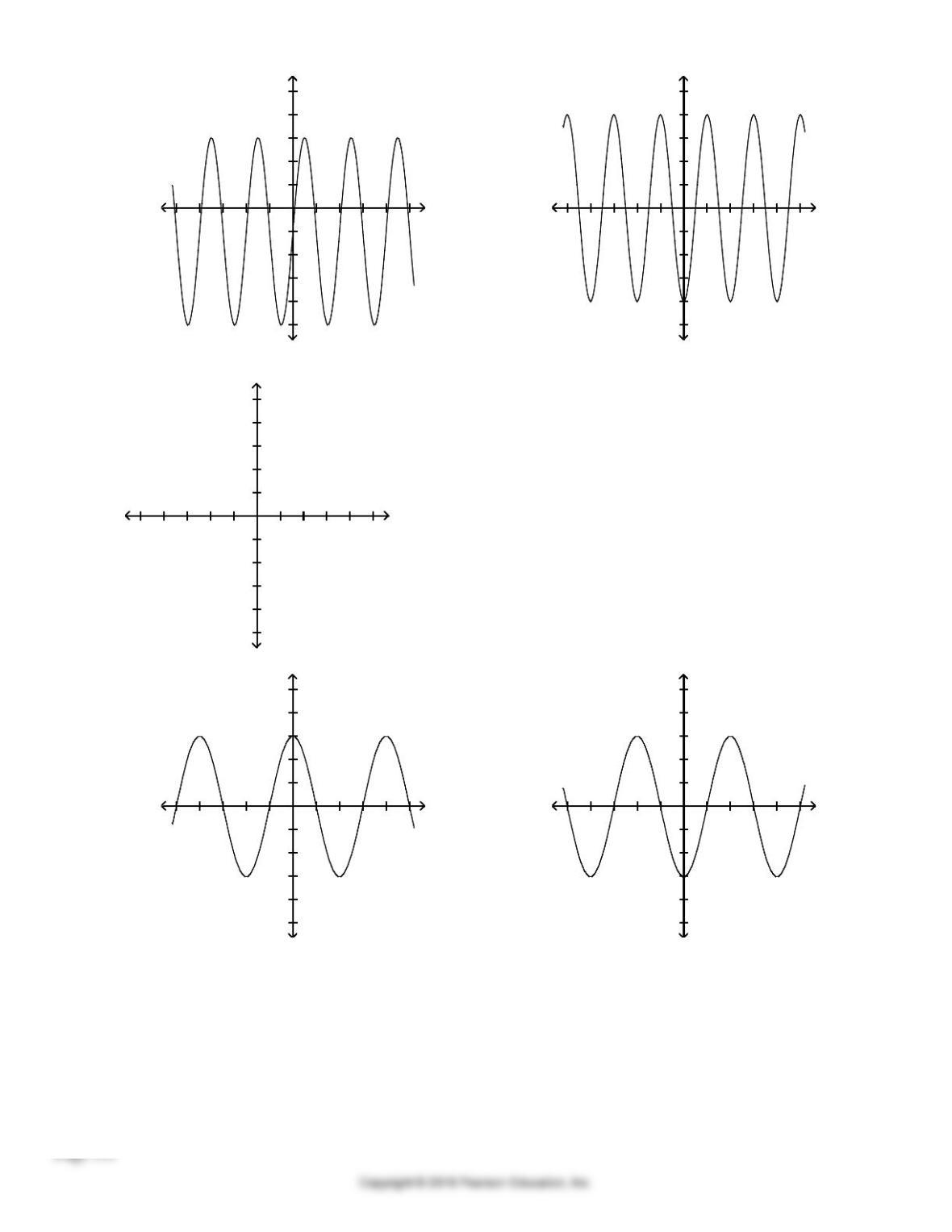
C)
x
-22
y
5
4
3
2
1
-1
-2
-3
-4
-5
x
-22
y
5
4
3
2
1
-1
-2
-3
-4
-5
D)
x
-22
y
5
4
3
2
1
-1
-2
-3
-4
-5
x
-22
y
5
4
3
2
1
-1
-2
-3
-4
-5
16) y=–3cos(x–π)
x
-2
2
y
5
4
3
2
1
-1
-2
-3
-4
-5
x
-2
2
y
5
4
3
2
1
-1
-2
-3
-4
-5
A)
x
-22
y
5
4
3
2
1
-1
-2
-3
-4
-5
x
-22
y
5
4
3
2
1
-1
-2
-3
-4
-5
B)
x
-22
y
5
4
3
2
1
-1
-2
-3
-4
-5
x
-22
y
5
4
3
2
1
-1
-2
-3
-4
-5
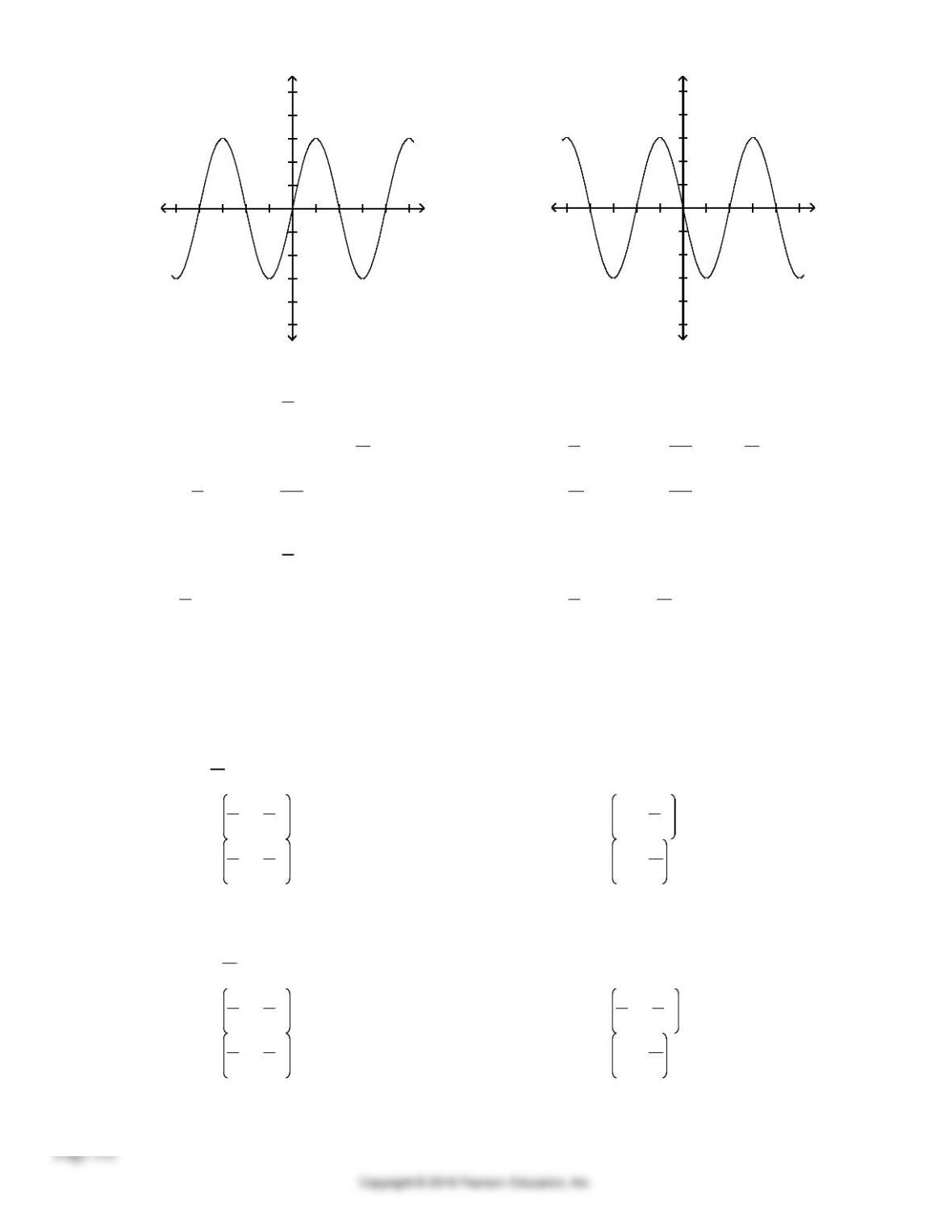
C)
x
-2
2
y
5
4
3
2
1
-1
-2
-3
-4
-5
x
-2
2
y
5
4
3
2
1
-1
-2
-3
-4
-5
D)
x
-22
y
5
4
3
2
1
-1
-2
-3
-4
-5
x
-22
y
5
4
3
2
1
-1
-2
-3
-4
-5
Solvetheproblem.
17) Fortheequationy=–1
2sin(4x+3π),identify(i)theamplitude,(ii)thephaseshift,and(iii)theperiod.
A) (i)2 (ii)3π(iii)π
2B) (i)1
2(ii)–3π
4(iii)π
2
C) (i)–1
2(ii)–4π
3(iii)4 D) (i)1
2(ii)–3π
4(iii)4
18) Fortheequationy=–1
2cos(2x–2π),identify(i)theamplitude,(ii)thephaseshift,and(iii)theperiod.
A) (i)1
2(ii)π (iii)π B) (i)1
2(ii)π
2(iii)π
C) (i)2 (ii)2π(iii)2πD) (i)2 (ii)π (iii)π
Writetheequationofasinefunctionthathasthegivencharacteristics.
19) Amplitude:5
Period:4π
PhaseShift:π
4
A) y=5sin1
2x–1
8πB) y=5sin2x+1
8π
C) y=5sin1
2x+1
8πD) y=5sin4x+π
4
20) Amplitude:5
Period:3π
PhaseShift:–π
3
A) y=5sin2
3x+2
9πB) y=5sin3
2x–2
9π
C) y=5sin2
3x–2
9πD) y=5sin3x–π
3
21) Amplitude:5
Period:π
PhaseShift:–4
A) y=5sin(2x+8) B) y=5sin1
2x–8 C) y=5 sin(x–4) D) y=sin(5x+4)
22) Amplitude:4
Period:π
PhaseShift:3
2
A) y=4sin(2x–3) B) y=4sin1
2x–6 C) y=4sin2x+3
2D) y=sin(4x+3)
2 BuildSinusoidalModelsfromData
MULTIPLECHOICE.Choosetheonealternativethatbestcompletesthestatementoranswersthequestion.
Solvetheproblem.
1) Anexperimentinawindtunnelgeneratescyclicwaves.Thefollowingdataiscollectedfor32 seconds:
Time
(inseconds)
Windspeed
(infeetpersecond)
019
843
16 67
24 43
32 19
LetVrepresentthewindspeed(velocity)infeetpersecondandlettrepresentthetimeinseconds.Writea
sineequationthatdescribesthewave.
A) V=24sinπ
16t–π
2+43 B) V=67 sin(32t–16)+19
C) V=67sinπ
16t–π
2+19 D) V=48 sin(32t–16)+24
Page113
2) Atownʹsaveragemonthlytemperaturedataisrepresentedinthetablebelow:
Month,x
AverageMonthly
Temperature,°F
January,1
February,2
March,3
April,4
May,5
June,6
July,7
August,8
September,9
October,10
November,11
December,12
24.7
29.9
41.6
55.1
70.0
83.5
86.6
83.5
81.5
54.7
38.8
29.4
Findasinusoidalfunctionoftheformy=Asin(ωx–φ)+Bthatfitsthedata.
A) y=30.95sinπ
6x–2π
3+55.65 B) y=86.6sinπ
6x–2π
3+24.7
C) y=55.65sinπ
6x–π
4+30.95 D) y=24.7sinπ
6x–π
4+86.6
3) Thenumberofhoursofsunlightinadaycanbemodeledbyasinusoidalfunction.Inthenorthern
hemisphere,thelongestdayoftheyearoccursatthesummersolsticeandtheshortestdayoccursatthe
wintersolstice.In2000,thesedateswereJune22(the172nddayoftheyear)andDecember21(the356th
dayoftheyear),respectively.
Atownexperiences11.06hoursofsunlightatthesummersolsticeand8.3hoursofsunlightatthewinter
solstice.Findasinusoidalfunctiony=Asin(ωx–φ)+Bthatfitsthedata,wherexisthedayoftheyear.
(Note:Thereare366daysintheyear2000.)
A) y=1.38sinπ
183 x–161π
366 +9.68 B) y=11.06sinπx–2π
3+8.3
C) y=1.38sinπ
183 x–2π
3+9.68 D) y=11.06sin172π
356 x–2π
3+9.68
Page114
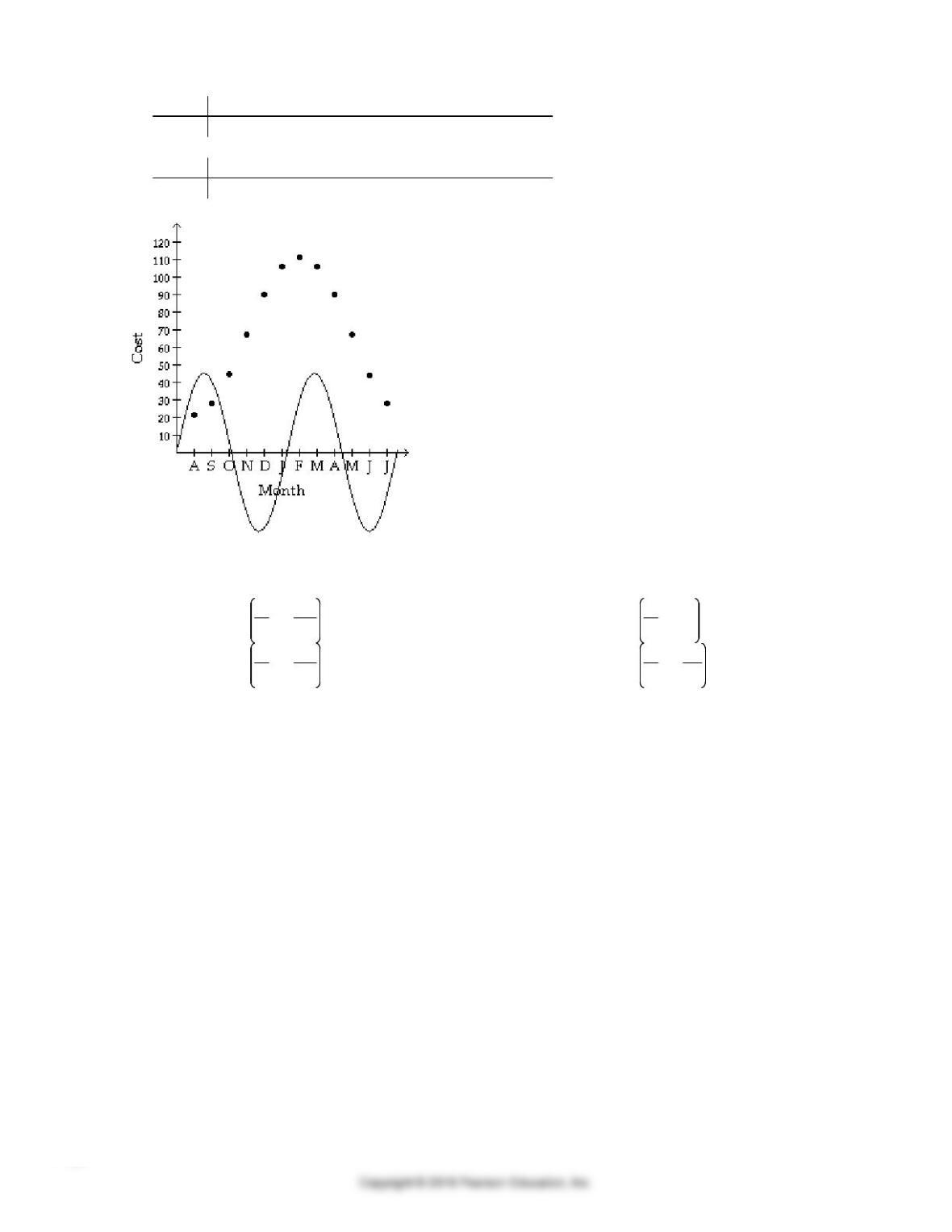
4) ThedatabelowrepresenttheaveragemonthlycostofnaturalgasinanOregonhome.
Month Aug Sep Oct Nov Dec Jan
Cost 21.20 28.24 44.73 67.25 89.77 106.26
Month Feb Mar Apr May Jun Jul
Cost 111.30 106.26 89.77 67.25 43.73 28.24
Aboveisthegraphof45.05sinxsuperimposedoverascatterdiagramofthedata.Findthesinusoidal
functionoftheformy=Asin(ωx–φ)+Bwhichbestfitsthedata.
A) y=45.05sinπ
6x–2π
3+66.25 B) y=45.05sinπ
8t+12 +21.20
C) y=45.05sinπ
4x–2π
3+21.20 D) y=45.05sinπ
6x–π
12 +66.25
Page115
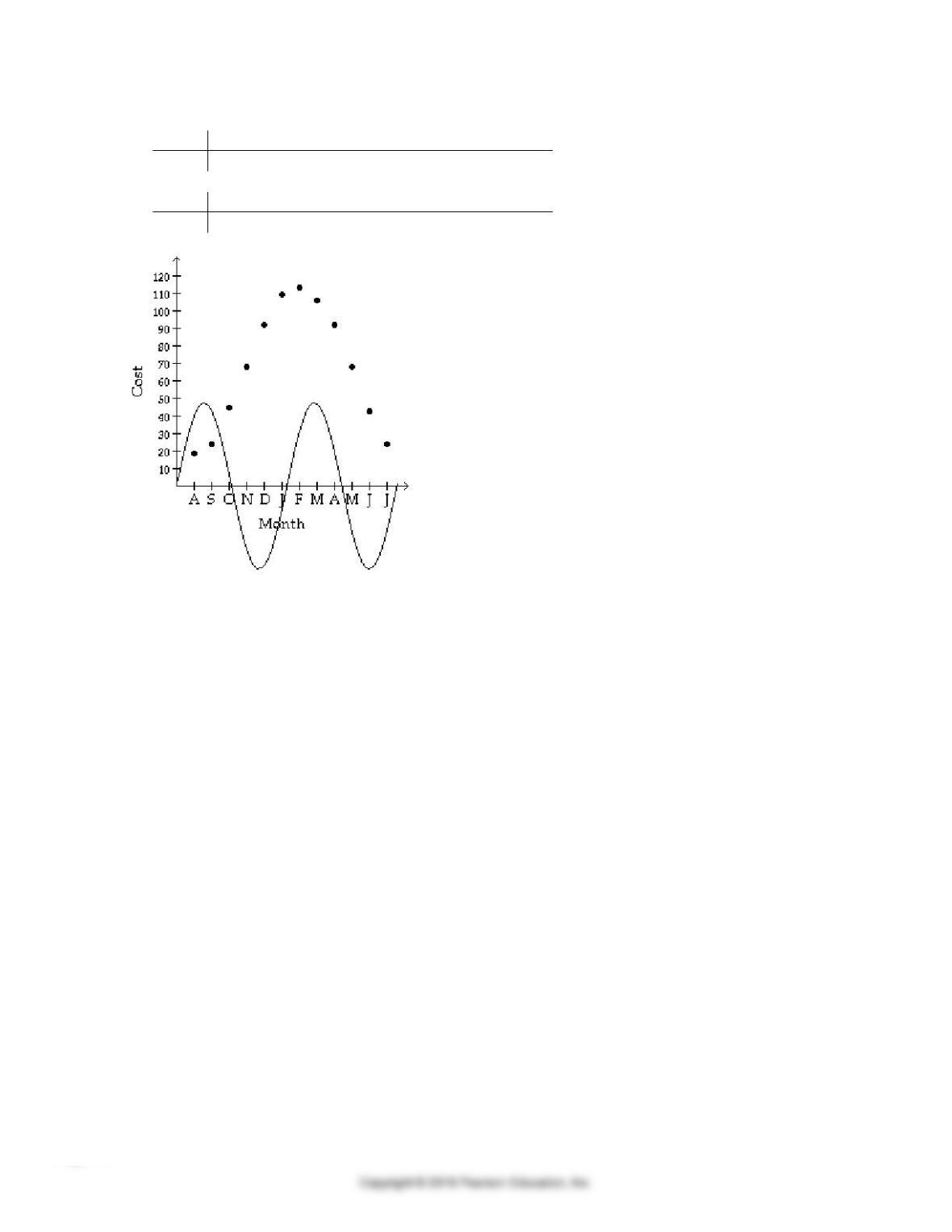
SHORTANSWER.Writethewordorphrasethatbestcompleteseachstatementoranswersthequestion.
5) ThedatabelowrepresenttheaveragemonthlycostofnaturalgasinanOregonhome.
Month Aug Sep Oct Nov Dec Jan
Cost 18.90 24.24 44.58 68.25 91.92 109.26
Month Feb Mar Apr May Jun Jul
Cost 113.60 106.26 91.92 68.25 42.58 24.24
Aboveisthegraphof47.35sinx.Makeascatterdiagramofthedata.Findthesinusoidalfunctionofthe
formy=Asin(ωx–φ)+Bwhichfitsthedata.
Page116
6) ThefollowingdatarepresentsthenormalmonthlyprecipitationforacertaincityinCalifornia.
Month,x
NormalMonthly
Precipitation,inches
January,1
February,2
March,3
April,4
May,5
June,6
July,7
August,8
September,9
October,10
November,11
December,12
6.06
4.45
4.38
2.08
1.27
0.56
0.17
0.46
0.91
2.24
5.21
5.51
Drawascatterdiagramofthedataforoneperiod.Findasinusoidalfunctionoftheform
y=Asin(ωx–φ)+Bthatfitsthedata.Drawthesinusoidalfunctiononthescatterdiagram.Usea
graphingutilitytofindthesinusoidalfunctionofbestfit.Drawthesinusoidalfunctionofbestfitonthe
scatterdiagram.
x
y
x
y
Page117
7) ThefollowingdatarepresentsthenormalmonthlyprecipitationforacertaincityinArkansas.
Month,x
NormalMonthly
Precipitation,inches
January,1
February,2
March,3
April,4
May,5
June,6
July,7
August,8
September,9
October,10
November,11
December,12
3.91
4.36
5.31
6.21
7.02
7.84
8.19
8.06
7.41
6.30
5.21
4.28
Drawascatterdiagramofthedataforoneperiod.Findthesinusoidalfunctionoftheform
y=Asin(ωx–φ)+Bthatfitsthedata.Drawthesinusoidalfunctiononthescatterdiagram.Usea
graphingutilitytofindthesinusoidalfunctionofbestfit.Drawthesinusoidalfunctionofbestfitonthe
scatterdiagram.
x
y
x
y
Page118
8) ThefollowingdatarepresentstheaveragemonthlyminimumtemperatureforacertaincityinCalifornia.
Month,x
AverageMonthly
Minimum
Temperature,°F
January,1
February,2
March,3
April,4
May,5
June,6
July,7
August,8
September,9
October,10
November,11
December,12
49.6
50.8
55.6
57.5
60.7
63.6
65.9
65.6
64.4
62.1
54.2
50.1
Drawascatterdiagramofthedataforoneperiod.Findasinusoidalfunctionoftheform
y=Asin(ωx–φ)+Bthatfitsthedata.Drawthesinusoidalfunctiononthescatterdiagram.Usea
graphingutilitytofindthesinusoidalfunctionofbestfit.Drawthesinusoidalfunctionofbestfitonthe
scatterdiagram.
x
y
x
y
Page119
9) ThefollowingdatarepresentstheaveragepercentofpossiblesunshineforacertaincityinIndiana.
Month,x
AveragePercentof
PossibleSunshine
January,1
February,2
March,3
April,4
May,5
June,6
July,7
August,8
September,9
October,10
November,11
December,12
46
51
55
60
68
73
75
74
68
62
41
38
Drawascatterdiagramofthedataforoneperiod.Findthesinusoidalfunctionoftheform
y=Asin(ωx–φ)+Bthatfitsthedata.Drawthesinusoidalfunctiononthescatterdiagram.Usea
graphingutilitytofindthesinusoidalfunctionofbestfit.Drawthesinusoidalfunctionofbestfitonthe
scatterdiagram.
x
y
x
y
Ch.7 TrigonometricFunctions
AnswerKey
7.1 AnglesandTheirMeasure
1 ConvertbetweenDecimalsandDegrees,Minutes,SecondsMeasuresforAngles
2 FindtheLengthofanArcofaCircle
3 ConvertfromDegreestoRadiansandfromRadianstoDegrees
4 FindtheAreaofaSectorofaCircle
5 FindtheLinearSpeedofanObjectTravelinginCircularMotion
7.2 RightTriangleTrigonometry
1 FindtheValuesofTrigonometricFunctionsofAcuteAngles
2 UsetheFundamentalIdentities
3 FindtheValuesoftheRemainingTrigonometricFunctions,GiventheValueofOneofThem
4 UsetheComplementaryAngleTheorem
7.3 ComputingtheValuesofTrigonometricFunctionsofAcuteAngles
1 FindtheExactValuesoftheTrigonometricFunctionsofπ/4=45°
2 FindtheExactValuesoftheTrigonometricFunctionsofπ/6=30°andπ/3=60°
3 UseaCalculatortoApproximatetheValuesoftheTrigonometricFunctionsofAcuteAngles
4 ModelandSolveAppliedProblemsInvolvingRightTriangles
7.4 TrigonometricFunctionsofAnyAngle
1 FindtheExactValuesoftheTrigonometricFunctionsforAnyAngle
2 UseCoterminalAnglestoFindtheExactValueofaTrigonometricFunction
3 DeterminetheSignsoftheTrigonometricFunctionsofanAngleinaGivenQuadrant
4 FindtheReferenceAngleofanAngle
5 UseaReferenceAngletoFindtheExactValueofaTrigonometricFunction
6 FindtheExactValuesofTrigonometricFunctionsofanAngle,GivenInformationabouttheFunctions
7 DemonstrateAdditionalUnderstandingandSkills
7.5 UnitCircleApproach;PropertiesoftheTrigonometricFunctions
1 FindtheExactValuesoftheTrigonometricFunctionsUsingtheUnitCircle
2 KnowtheDomainandRangeoftheTrigonometricFunctions
3 UsethePeriodicPropertiestoFindtheExactValuesoftheTrigonometricFunctions
4 UseEven–OddPropertiestoFindtheExactValuesoftheTrigonometricFunctions
5 DemonstrateAdditionalUnderstandingandSkills
7.6 GraphsoftheSineandCosineFunctions
1 GraphFunctionsoftheFormy=Asin(ωx)UsingTransformations
2 GraphFunctionsoftheFormy=Acos(ωx)UsingTransformations
3 DeterminetheAmplitudeandPeriodofSinusoidalFunctions
Page128
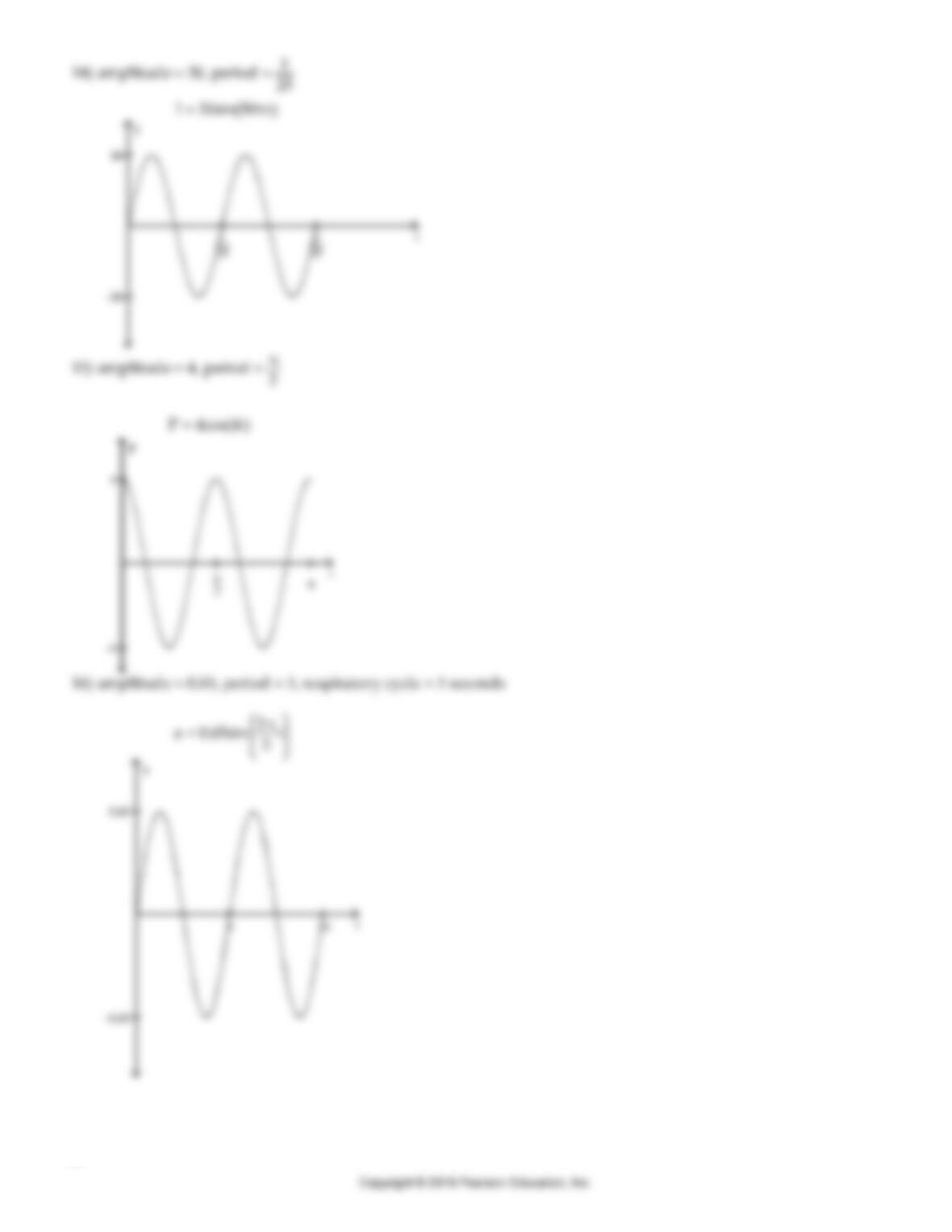
Page129
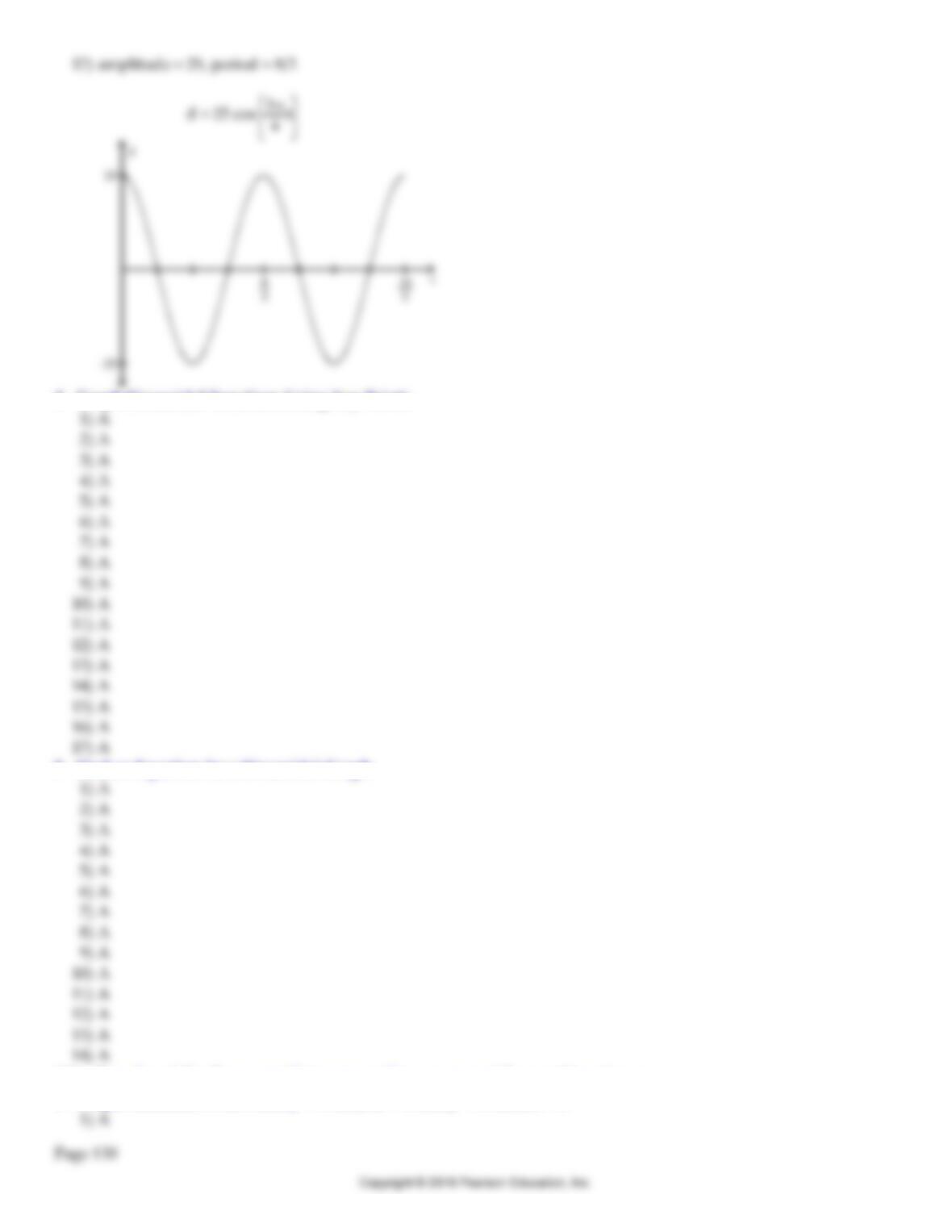
4 GraphSinusoidalFunctionsUsingKeyPoints
5 FindanEquationforaSinusoidalGraph
7.7 GraphsoftheTangent,Cotangent,Cosecant,andSecantFunctions
1 GraphFunctionsoftheFormy=Atan(ωx)+Bandy=Acot(ωx)+B
2 GraphFunctionsoftheFormy=Acsc(ωx)+Bandy=Asec(ωx)+B
7.8 PhaseShift;SinusoidalCurveFitting
1 GraphSinusoidalFunctionsoftheFormy=Asin(ωx–φ)+B
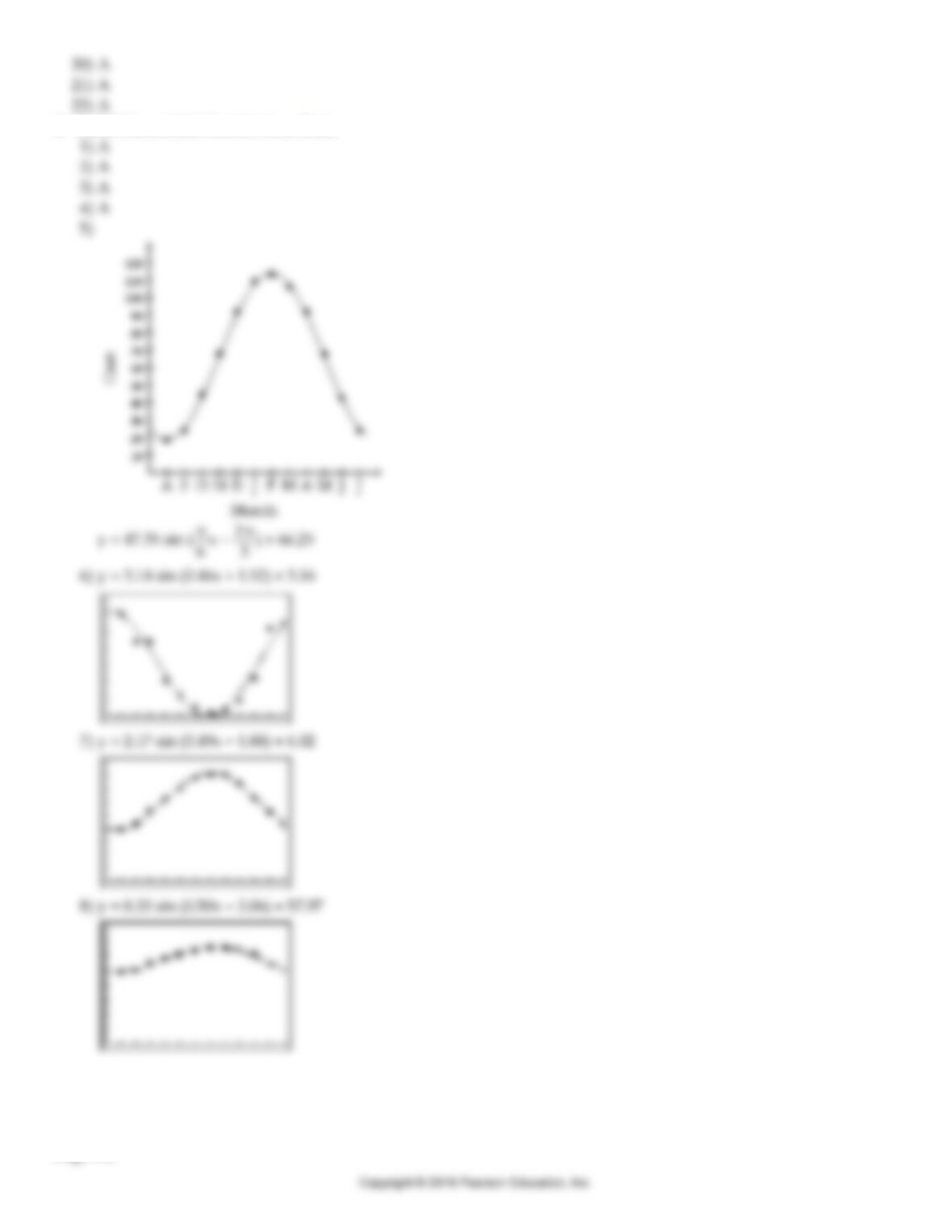
2 BuildSinusoidalModelsfromData
Page132
Page133