
Ch.0 ChapterR:Review
0.1 RealNumbers
1 WorkwithSets
MULTIPLECHOICE.Choosetheonealternativethatbestcompletesthestatementoranswersthequestion.
UseU=universalset={0,1,2,3,4,5,6,7,8,9},A={1,2,3,5,8},B={2,3,5,7},andC={1,4,9}tofindtheset.
1) B∪C
A) {1,2,3,4,5,7,9} B) {} C) {0} D) {1,2,3,5,7,9}
2) A∪C
A) {1,2,3,4,5,8,9} B) {4,6,7,9} C) {1} D) {1,2,3,5,7,9}
3) A∩B
A) {2,3,5} B) {1,2,3,5,7,8} C) {2,3,5,7} D) {1,2,3,5,8}
4) A∩C
A) {1} B) {1,2,3,4,5,7,8,9}
C) {4,6,7,9} D) {1,2,3,5,7,9}
5) (A∩B)∪C
A) {1,2,3,4,5,9} B) {1,2,3,5} C) {1,2,3} D) {2,3,5}
6) (B∪C)∩A
A) {1,2,3,5} B) {1,2,3,4,5,7,9} C) {} D) {1,2,3}
7) B
A) {0,1,4,6,8,9} B) {1,4,6,8,9} C) {0,1,4,6,7,8,9} D) {0,1,4,6,9}
8) A∪B
A) {0,4,6,9} B) {4,6,9} C) {1,4,6,8,9} D) {1,2,3,5,7,8}
9) A∩C
A) {0,2,3,4,5,6,7,8,9} B) {1}
C) {1,2,3,4,5,7,8,9} D) {1,2,3,4,5,6,7,8,9}
10) B∩C
A) {0,6,8} B) {6,8} C) {1,2,3,4,5,7,9} D) {}
2 ClassifyNumbers
MULTIPLECHOICE.Choosetheonealternativethatbestcompletesthestatementoranswersthequestion.
ListalltheelementsofBthatbelongtothegivenset.
1) B=15,6,–14,0,2
9,–9
2,8.6
Integers
A) {15
,
–14
,
0} B) {15
,
0} C) {15
,
–14} D) {15,0,6}
Page1

2) B=2,7,–19,0,2
3,–3
2,1.8
Naturalnumbers
A) {2} B) 2,0,–3
2C) {2,0} D) {–19
,
0,2}
3) B=9,7,–13,0,0
7
Realnumbers
A) 9,7,–13,0,0
7B) {9
,
–13
,
0} C) 9,–13,0,0
7D) 9
,
–13
4) B=8,6,–16,0,0
4,0.87
Rationalnumbers
A) 8,–16,0,0
4,0.87 B) {8
,
0} C) { 6}D)6,0
4,0.87
5) B=19,7,–6,0,0
8,0.46
Irrationalnumbers
A) { 7}B){7,0.46} C) 7,0
8D) 7,0
8,0.46
6) B={2,6,–12,0,2
7,–7
2,7.6,16π,0.166166166…}
Integers
A) {2
,
–12
,
0} B) {2
,
0} C) {2
,
–12} D) {2,0,6}
7) B={15,6,–2,0,7
9,–9
7,2.4,6π,0.625625625…}
Naturalnumbers
A) {15} B) 15,0,–9
7C) {15
,
0} D) {–2
,
0,15}
8) B={20,8,–24,0,0
1,16,0.3,–8π,0.161616…}
Rationalnumbers
A) 20,–24,0,0
1,16,0.3,0.161616… B) 20,–24,0,0
1,0.3
C) 20,–24,0,0
1,0.3,0.161616… D) 20,–24,0,0
1,16,0.3,–8π,0.161616…
Page2

9) B={17,5,–19,0,0
3,,0.23,–5π,0.161616…}
Irrationalnumbers
A) { 5,–5π}B){5
}
C) 5,0
3,–5πD) { 5,–5π,0.161616…}
Approximatethenumberroundedtothreedecimalplaces,andtruncatedtothreedecimalplaces.
10) 5.5469
A) 5.547
5.546
B) 5.548
5.546
C) 5.547
5.547
D) 5.546
5.547
11) 0.61538462
A) 0.615
0.615
B) 0.616
0.615
C) 0.615
0.616
D) 0.614
0.616
12) 11
7
A) 1.571
1.571
B) 1.572
1.571
C) 1.571
1.572
D) 1.572
1.572
3 EvaluateNumericalExpressions
MULTIPLECHOICE.Choosetheonealternativethatbestcompletesthestatementoranswersthequestion.
Writethestatementusingsymbols.
1) Thesumof14and7is21.
A) 14+7=21 B) 14
7
=2C)14
·7=98 D) 14–7=7
2) Thedifference3less1equals2.
A) 3–1=2B)
3
1
=3C)3
+1=4D)3·1=3
3) Theproductof6and2 equals12.
A) 6·2=12 B) 6
2
=3C)6
+2=8D)6–2=4
4) Thequotient28dividedby14is2.
A) 28
14
=2B)28·14 =392 C) 28 +14 =42 D) 28–14 =14
5) Thesumoffourtimesxand5decreasedby7is8.
A) 4x+5–7=8 B) 4(x+5)–7=8C)7–(4x+5)=8 D) 4(x+5–7)=8
6) Threetimesthedifferenceofxand8is–10.
A) 3(x–8)=–10 B) 3–x–8= –10 C) 3x–8= –10 D) 3+x–8= –10
7) Thequotientofxandthesumof5andx.
A) x
5+xB) x+5+x C) x(5+x) D) x+5
x
Page3
Evaluatetheexpression.
8) –4+9+7
A) 12 B) –2C)
–6D)
–20
9) 3+2
9
A) 29
9B) 27
9C) 29
2D) 27
2
10) 4·[6(8–5)–2]
A) 64 B) 48 C) 10 D) 44
11) 7·[5+7·(2+3)]
A) 280 B) 420 C) 70 D) 416
12) –9–(–6+3·–5+8)
A) 4 B) –22 C) 20 D) –8
13) 20
16
·2
5
A) 1
2B) 2 C) 5
4D) 8
5
14) 3
2
·4
5
+4
15
A) 8
5B) 6
5C) 8
15 D) 16
5
15) 1
4
·8–1
5
+9
A) 219
20 B) 54
5C) 84
5D) 12
5
16) 8+9
5+1
A) 17
6B) –1
6C) 17
4D) –1
4
17) 4–1
1–4
A) –1B)4 C)
–4D)3
18) 5
11
+1
13
A) 76
143 B) 1
4C) 1
143 D) 19
Page4
19) 5
8
–2
9
A) 29
72 B) 1
24 C) 3
8D) 29
8
20)
1
2
7
8
A) 4
7B) 7
4C) 7
16 D) 16
7
21) 1
3
+1
6
·1
4
A) 3
8B) 1
8C) 11
9D) 1
36
4 WorkwithPropertiesofRealNumbers
MULTIPLECHOICE.Choosetheonealternativethatbestcompletesthestatementoranswersthequestion.
UsetheDistributivePropertytoremovetheparentheses.
1) 4(x+4)
A) 4x+16 B) 4x+4C)x+16 D) 16x
2) 4x(x+8)
A) 4x2+32x B) 4x2+8C)x
2+32x D) 32x2
3) 4(2x+6)
A) 8x+24 B) 6x+10 C) 8x+6 D) 32x
4) 5 2
5x–1
10
A) 2x–1
2B) 2x–1
5C) 2x–1
10 D) 2
5x–1
2
5) (x+1)(x–11)
A) x2–10x–11 B) x2–11x–10 C) x2–11x–11 D) x2–10x–10
6) (x+10)(x+6)
A) x2+16x+60 B) x2+60x+16 C) x2+15x+60 D) x2+16x+16
7) (x+9)(x–9)
A) x2–81 B) x2–18 C) x2–18x–81 D) x2+18x–81
Page5
0.2 AlgebraEssentials
1 GraphInequalities
MULTIPLECHOICE.Choosetheonealternativethatbestcompletesthestatementoranswersthequestion.
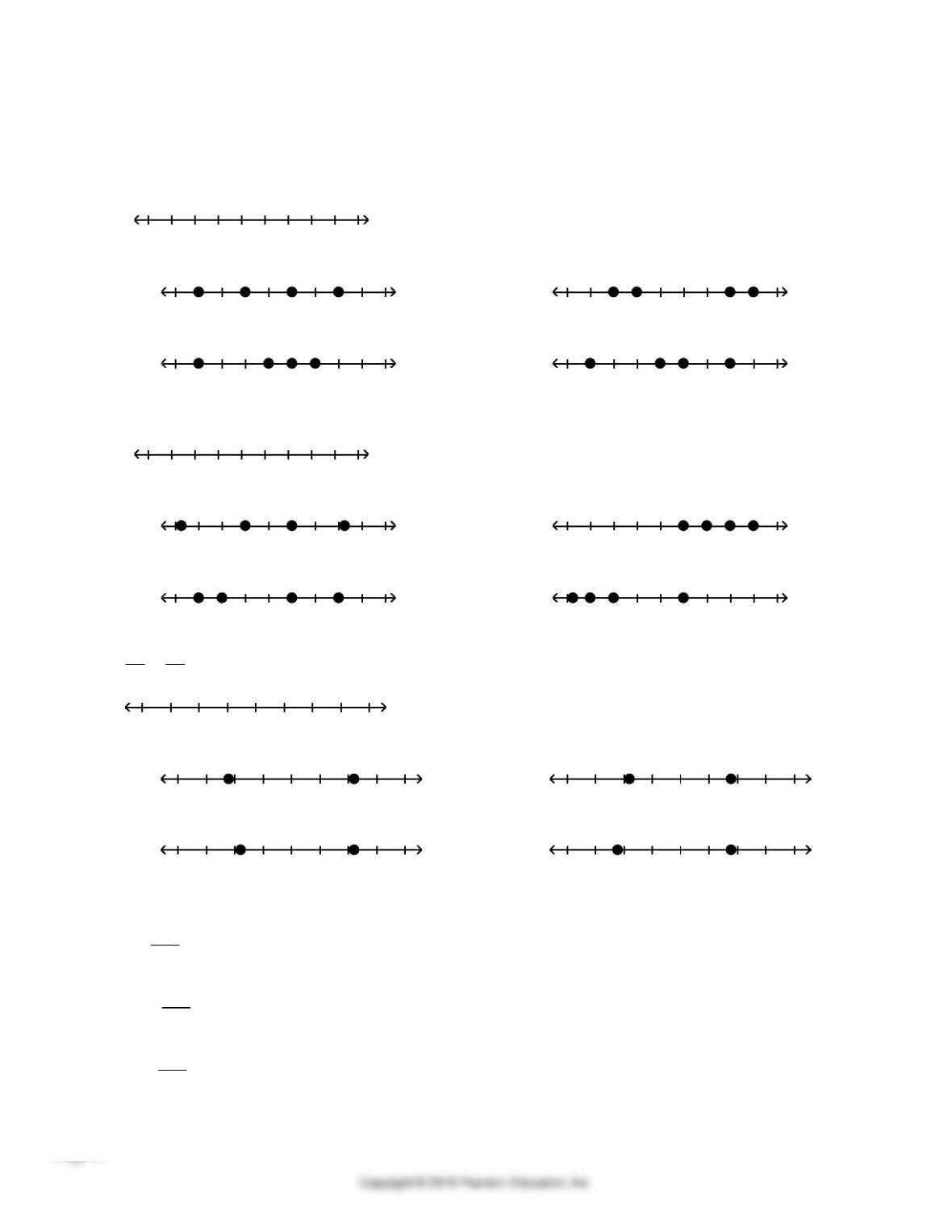
Ontherealnumberline,labelthepointswiththegivencoordinates.
1) –11
,
–9
,
–7
,
–5
–12–11–10–9-8-7-6-5-4-3–12–11–10–9-8-7-6-5-4-3
A)
–12–11–10–9-8-7-6-5-4-3–12–11–10–9-8-7-6-5-4-3
B)
–12–11–10–9-8-7-6-5-4-3–12–11–10–9-8-7-6-5-4-3
C)
–12–11–10–9-8-7-6-5-4-3–12–11–10–9-8-7-6-5-4-3
D)
–12–11–10–9-8-7-6-5-4-3–12–11–10–9-8-7-6-5-4-3
2) –3.75,–1
,
1
,
3.25
–4–3–2–1012345–4–3–2–1012345
A)
–4–3–2–1012345–4–3–2–1012345
B)
–4–3–2–1012345–4–3–2–1012345
C)
–4–3–2–1012345–4–3–2–1012345
D)
–4–3–2–1012345–4–3–2–1012345
3) 11
5,–11
5
-4 -3 -2 -1 0 1 2 3 4-4 -3 -2 -1 0 1 2 3 4
A)
-4 -3 -2 -1 0 1 2 3 4-4 -3 -2 -1 0 1 2 3 4
B)
-4 -3 -2 -1 0 1 2 3 4-4 -3 -2 -1 0 1 2 3 4
C)
-4 -3 -2 -1 0 1 2 3 4-4 -3 -2 -1 0 1 2 3 4
D)
-4 -3 -2 -1 0 1 2 3 4-4 -3 -2 -1 0 1 2 3 4
Insert<,>,or=tomakethestatementtrue.
4) –5 –6
A) >B)
<
C) =
5) –7.8 –7.7
A)
<
B) >C) =
6) –54 –62
A) >B)
<
C) =
Page6
7) 16 –16
A) >B)
<
C) =
8) 1
4
0.25
A) =B)
<
C) >
9) 1.73 3
A)
<
B) >C) =
10) 3.14 π
A)
<
B) >C) =
Writethestatementasaninequality.
11) yispositive
A) y>0B)y
<
0C)y
≤0D)y≥0
12) yisgreaterthan–43
A) y>–43 B) y
<
–43 C) y≥–43 D) y≤–43
13) yisgreaterthanorequalto50
A) y≥50 B) y>50 C) y
<
50 D) y≤50
14) zislessthanorequalto–2
A) z≤–2B)z
<
–2C)z> –2D)z= –2
15) xislessthan5
A) x
<
5B)x>5C)x≤5D)x≥5
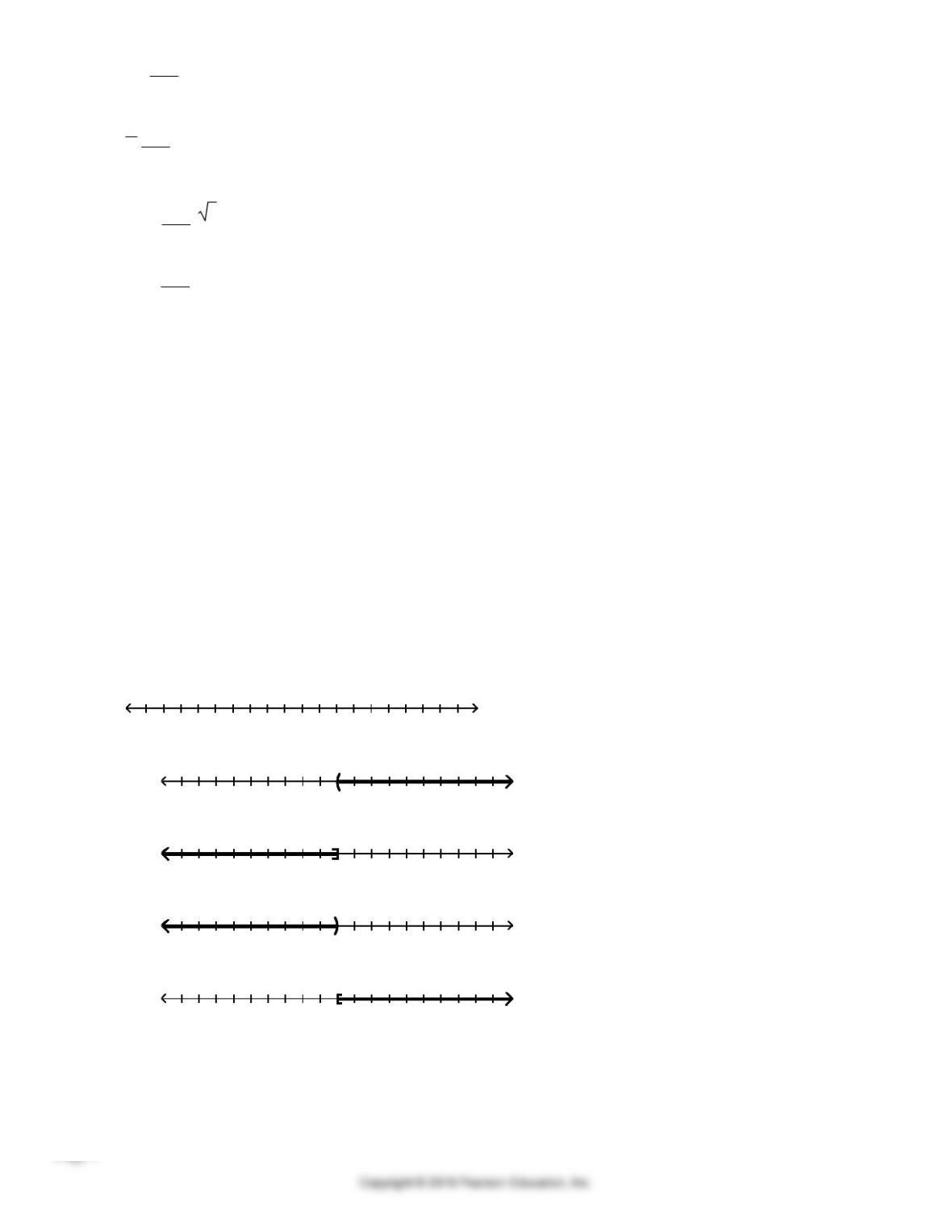
Graphthenumbersontherealnumberline.
16) x>0
–9–8–7–6–5–4–3–2–10123456789–9–8–7–6–5–4–3–2–10123456789
A)
–9–8–7–6–5–4–3–2–10123456789–9–8–7–6–5–4–3–2–10123456789
B)
–9–8–7–6–5–4–3–2–10123456789–9–8–7–6–5–4–3–2–10123456789
C)
–9–8–7–6–5–4–3–2–10123456789–9–8–7–6–5–4–3–2–10123456789
D)
–9–8–7–6–5–4–3–2–10123456789–9–8–7–6–5–4–3–2–10123456789
Page7
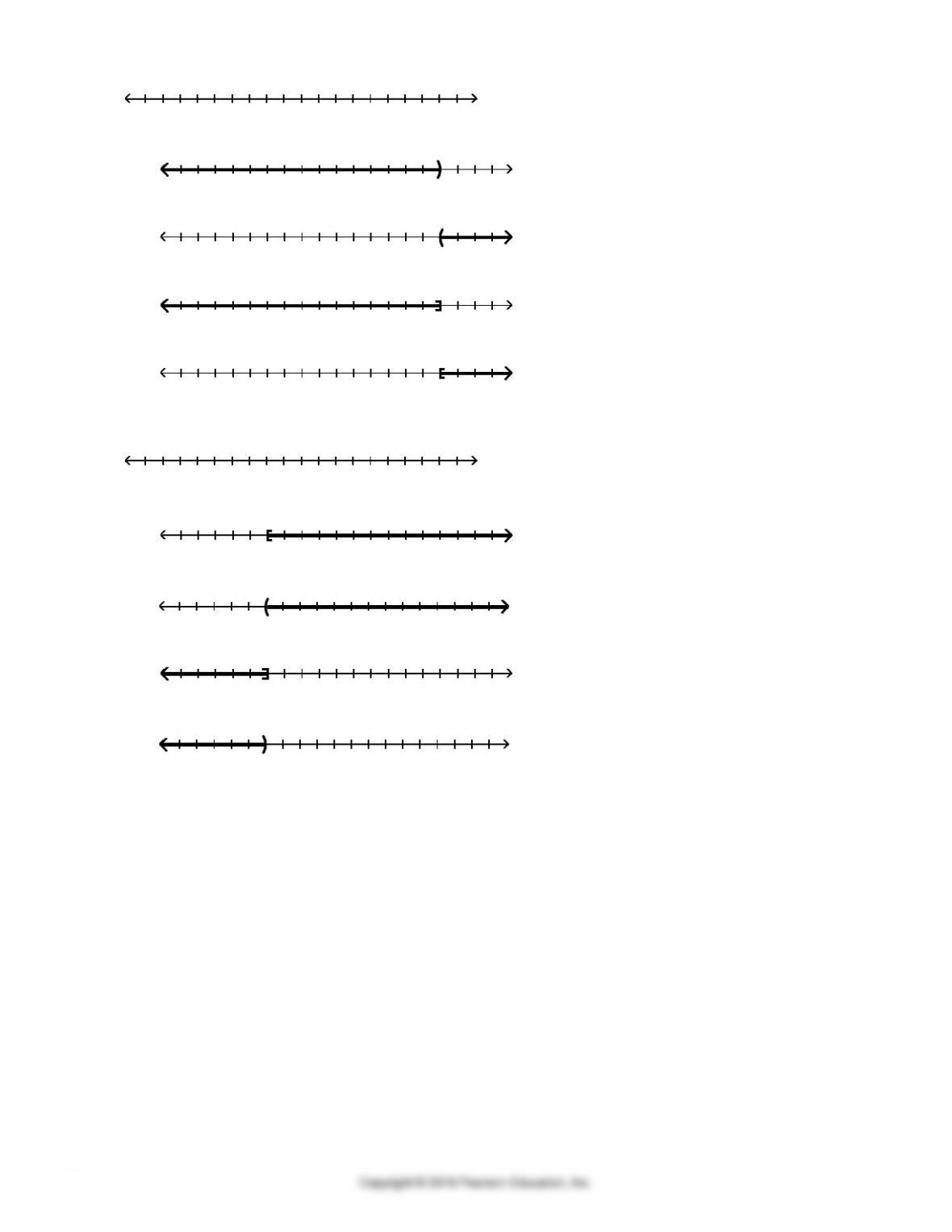
17) x
<
6
–9–8–7–6–5–4–3–2–10123456789–9–8–7–6–5–4–3–2–10123456789
A)
–9–8–7–6–5–4–3–2–10123456789–9–8–7–6–5–4–3–2–10123456789
B)
–9–8–7–6–5–4–3–2–10123456789–9–8–7–6–5–4–3–2–10123456789
C)
–9–8–7–6–5–4–3–2–10123456789–9–8–7–6–5–4–3–2–10123456789
D)
–9–8–7–6–5–4–3–2–10123456789–9–8–7–6–5–4–3–2–10123456789
18) x≥–4
–9–8–7–6–5–4–3–2–10123456789–9–8–7–6–5–4–3–2–10123456789
A)
–9–8–7–6–5–4–3–2–10123456789–9–8–7–6–5–4–3–2–10123456789
B)
–9–8–7–6–5–4–3–2–10123456789–9–8–7–6–5–4–3–2–10123456789
C)
–9–8–7–6–5–4–3–2–10123456789–9–8–7–6–5–4–3–2–10123456789
D)
–9–8–7–6–5–4–3–2–10123456789–9–8–7–6–5–4–3–2–10123456789
Page8
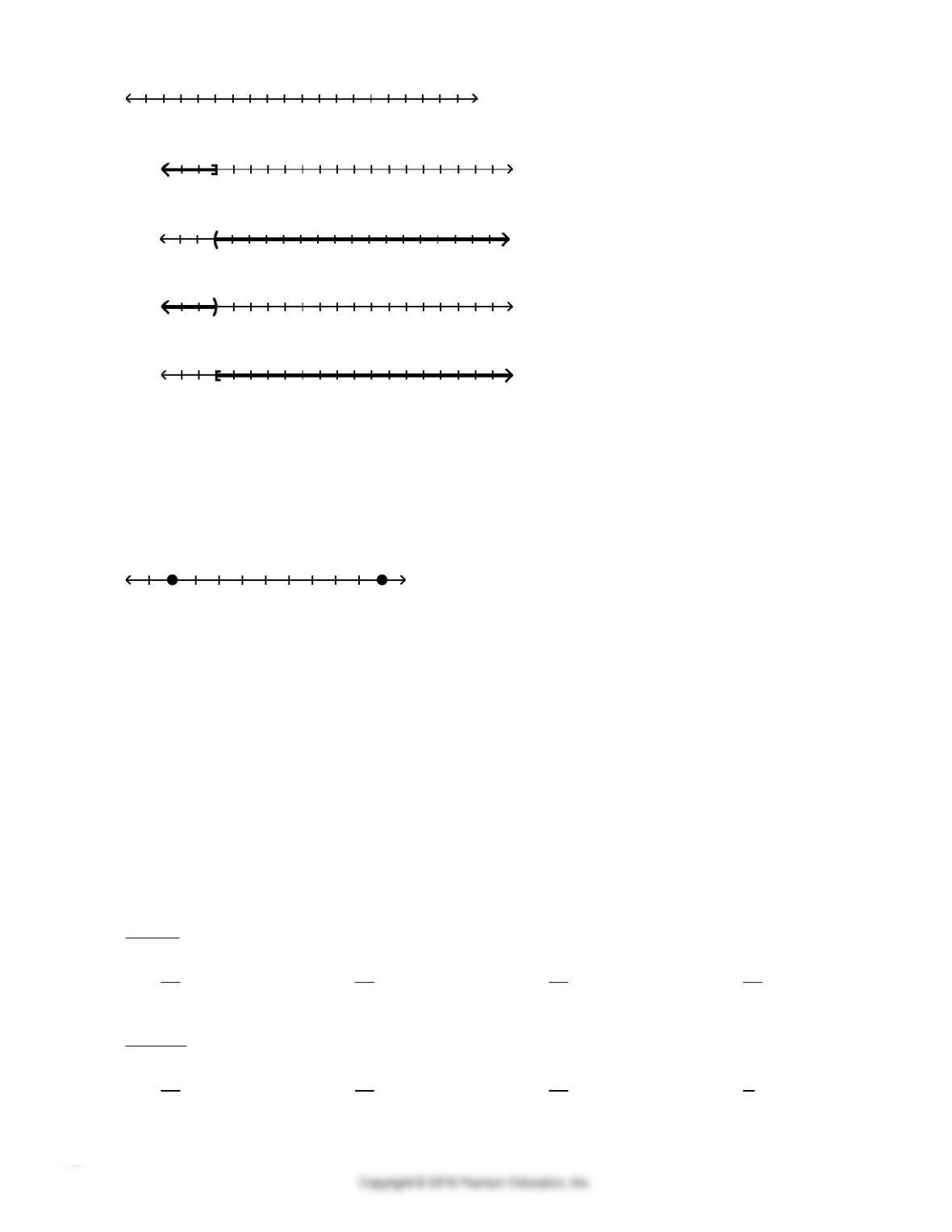
19) x≤–7
–9–8–7–6–5–4–3–2–10123456789–9–8–7–6–5–4–3–2–10123456789
A)
–9–8–7–6–5–4–3–2–10123456789–9–8–7–6–5–4–3–2–10123456789
B)
–9–8–7–6–5–4–3–2–10123456789–9–8–7–6–5–4–3–2–10123456789
C)
–9–8–7–6–5–4–3–2–10123456789–9–8–7–6–5–4–3–2–10123456789
D)
–9–8–7–6–5–4–3–2–10123456789–9–8–7–6–5–4–3–2–10123456789
2 FindDistanceontheRealNumberLine
MULTIPLECHOICE.Choosetheonealternativethatbestcompletesthestatementoranswersthequestion.
Usethegivenrealnumberlinetocomputethedistance.
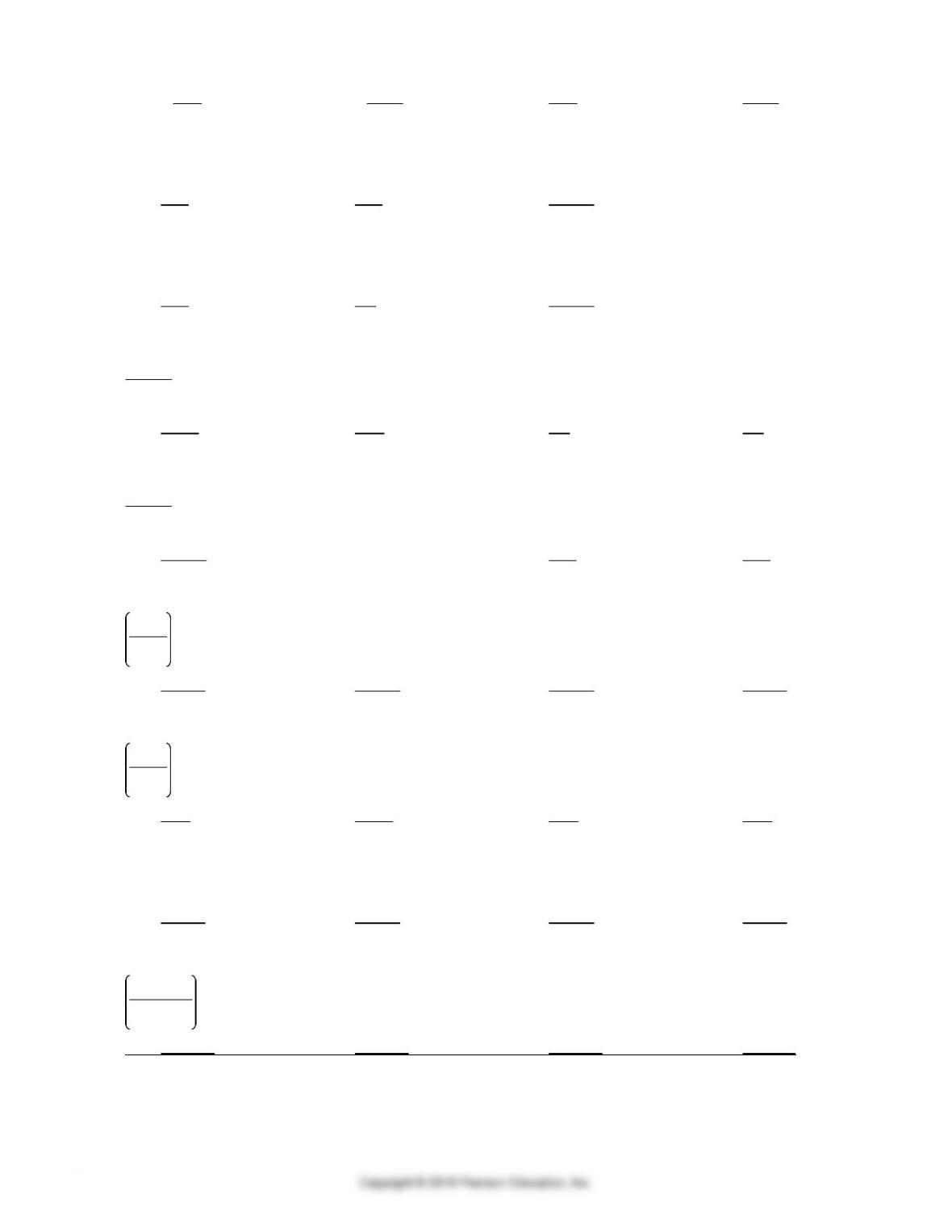
1) Findd(A,B)
–5–4–3–2–1012345
AB
–5–4–3–2–1012345
AB
A) 9 B) –9C)10D)8
3 EvaluateAlgebraicExpressions
MULTIPLECHOICE.Choosetheonealternativethatbestcompletesthestatementoranswersthequestion.
Evaluatetheexpressionusingthegivenvalues.
1) x+2y x=–2
,
y=–1
A) –4B)
–3C)
–5D)0
2) –9xy+8y–7x=2
,
y=2
A) –27 B) –20 C) –13 D) 45
3) –8x+yx=–4
,
y=3
A) 35 B) –29 C) –1D)
–5
4) 7x–3y
15 x=6,y=2
A) 12
5B) 13
5C) 16
5D) 4
15
5) 8x–12y
x+8x=5,y=2
A) 16
13 B) 44
13 C) 22
5D) 8
5
Page9

6) 5xy+30
xx=5,y=7
A) 41 B) 11 C) 65 D) 6
7) x+yx=–8
,
y=2
A) 6 B) 10 C) –6D)
–10
8) x –y x=–5
,
y=8
A) –3B)13C)3 D)
–13
9) 6x–7y x=5
,
y=7
A) 19 B) 79 C) –19 D) –79
10) |x|
x
+|y|
yx=3andy=–4
A) 0 B) 2 C) 1 D) –1
11) |–4x–9y| x=–4
,
y=3
A) 11 B) 43 C) 24 D) 48
12) 4 x +5y x=2
,
y=–9
A) 53 B) –37 C) –53 D) 37
UsetheformulaC=5
9(F–32)forconvertingdegreesFahrenheitintodegreesCelsiustofindtheCelsiusmeasureof
theFahrenheittemperature.
13) F=158°
A) 70°C B) 75°C C) 65° C D) 80° C
Expressthestatementasanequationinvolvingtheindicatedvariables.
14) TheareaAofarectangleistheproductofitslengthlanditswidthw.
A) A=lw B) A=l+wC)A=2(l+w) D) A=l
w
15) TheperimeterPofarectangleistwicethesumofitslengthlanditswidthw.
A) P=2(l+w) B) P=l+wC)P=lw D) P=2lw
16) ThecircumferenceCofacircleistheproductofπ anditsdiameterd.
A) C=πdB)C=π
dC) C=π+dD)C=2πd
17) TheareaAofatriangleisone–halftheproductofitsbasebanditsheighth.
A) A=1
2bh B) A=2bh C) A=1
2(b+h) D) A=bh
18) ThevolumeVofasphereis4
3
timesπtimesthecubeoftheradiusr.
A) V=4
3
πr3B) V=4
3
πr2C) V=4
3
π3r D) V=4
3
πr
Page10

19) ThesurfaceareaSofasphereis4timesπ timesthesquareoftheradiusr.
A) S=4πr2B) S=4πrC)S=4π rD) S=πr2
20) ThevolumeVofacubeisthecubeofthelengthxofaside.
A) V=x3B) V=3xC) V=3x D) V=x2
21) ThesurfaceareaSofacubeis6timesthesquareofthelengthxofaside.
A) S=6x2B) S=6x C) S=6+x2D) S=x2
Solvetheproblem.
22) TheweeklyproductioncostCofmanufacturingxcalendarsisgivenbyC(x)=34+6x,wherethevariable
Cisindollars.Whatisthecostofproducing270calendars?
A) $1654.00 B) $9186.00 C) $1620.00 D) $304.00
23) Atthebeginningofthemonth,Christopherhadabalanceof$240 inhischeckingaccount.Duringthenext
month,hewroteacheckfor$37,deposited$67,andwroteanothercheckfor$236.Whatwashisbalanceat
theendofthemonth?
A) $34 B) –$34 C) –$100 D) $100
4 DeterminetheDomainofaVariable
MULTIPLECHOICE.Choosetheonealternativethatbestcompletesthestatementoranswersthequestion.
Determinewhichvalue(s),ifany,mustbeexcludedfromthedomainofthevariableintheexpression.
1) x2–64
x
A) x=0B)x=8
,
x= –8C)x=8
,
x=0D)x= –8
2) 8x–5
x2–25
A) x=5
,
x=–5B)x=25 C) x=5D)x=5
8
3) x3+8x4
x2+25
A) x=0,x=–1
8B) x=–25 C) x= –5 D) none
4) x2+6x+7
x3–25x
A) x=5
,
x=–5
,
x=0B)x=5
,
x= –5C)x=0D)x=5
,
x=0
5) x
x–8
A) x=8B)x=–8C)x=0 D) none
6) 5
x+7
A) x=–7B)x=7C)x=0 D) none
Page11

7) x–8
x–3
A) x=3B)x=–3C)x=0 D) none
5 UsetheLawsofExponents
MULTIPLECHOICE.Choosetheonealternativethatbestcompletesthestatementoranswersthequestion.
Simplifytheexpression.
1) 53
A) 125 B) 15 C) –125 D) –15
2) –62
A) –36 B) 12 C) 36 D) –12
3) 4–2
A) 1
16 B) –16 C) 16 D) 1
8
4) (–2)–4
A) 1
16 B) –16 C) 16 D) –1
16
5) –5–4
A) –1
625 B) –625 C) 625 D) 1
20
6) (–5)3
A) –125 B) 125 C) –15 D) 15
7) 5–5·52
A) 1
125 B) 125 C) 25 D) 1
625
8) (2–3)–1
A) 8 B) 1
8C) 1
4D) 4
Simplifytheexpression.Expresstheanswersothatallexponentsarepositive.Wheneveranexponentis0or
negative,weassumethatthebaseisnot0.
9) (5xy)3
A) 125x3y3B) 125xy C) 5x3y3D) 1
125x3y3
10) (6x3)–2
A) 1
36x6B) 36x6C) x6
36 D) 36
x6
Page12
11) (–3x3)–1
A) –1
3x3B) –1
27x3C) 1
3x3D) 1
27x3
12) (x3y–1)9
A) x27
y9B) y9
x27 C) 1
x27y9D) x27y9
13) (x–7y)5
A) y5
x35 B) y5
x7C) 1
x35y5D) x35y5
14) x–2y6
xy8
A) 1
x3y2B) 1
xy2C) y2
x3D) x
y2
15) x–4y4
x6y13
A) 1
x10y9B) x10y9C) y9
x10 D) x10
y9
16) 4x–1
9y–1
–3
A) 729x3
64y3B) 64x3
729y3C) 729y3
64x3D) 64y3
729x3
17) 4x–3
7y–3
–1
A) 7x3
4y3B) 4x31
7y31 C) 7y3
4x3D) 4x3
7y3
18) (x–4y9)–8z6
A) x32z6
y72 B) y72z6
x32 C) x32
y72z6D) y72
x32z6
19) –4x3y–3
5z2
–2
A) 25y6z4
16x6B) 16x6
25y6z4C) 25z4
16x6y6D) 25y6
16x6z4
Page13

Evaluatetheexpressionusingthegivenvalueofthevariables.
20) (x+3y)2forx=4,y=2
A) 100 B) 10 C) 20 D) 49
21) –7x–1y2forx=–2,y=–2
A) 14 B) 2
7C) 7
8D) 56
22) 2x2+4y2forx=–2,y=–2
A) 24 B) 0 C) –8D)12
23) 2x3–3x2–3x–2forx=2
A) –4 B) 8 C) 20 D) 0
Solve.
24) Whatisthevalueof(6666)2
(2222)2?
A) 9 B) (3333)2C) 18 D) (2222)2
6 EvaluateSquareRoots
MULTIPLECHOICE.Choosetheonealternativethatbestcompletesthestatementoranswersthequestion.
Simplifytheexpression.
1) 9
A) 3 B) 81 C) 1
9D) notarealnumber
2) (–5)2
A) 5 B) 625 C) 1
25 D) notarealnumber
Findthevalueoftheexpressionusingthegivenvalues.
3) x2x=4
A) 4 B) 2 2 C) –4D)
–22
4) ( x)2x=3
A) 3 B) 9 C) 1
9D) 1
3
5) x2+y2x=15,y=20
A) 25 B) 13 C) 18 D) 24
6) x2+y2x=–5,y=3
A) 34 B) 8 C) –2D)15
7) x2+y2x=1,y=5
A) 6 B) –4C)26D)4
Page14

8) yxx=–2,y=4
A) 1
16 B) 16 C) –16 D) –1
16
7 UseaCalculatortoEvaluateExponents
MULTIPLECHOICE.Choosetheonealternativethatbestcompletesthestatementoranswersthequestion.
Useacalculatortoevaluatetheexpression.Roundtheanswertothreedecimalplaces.
1) (–2.86)–5
A) –0.005 B) 0.005 C) –191.351 D) 191.351
2) –(–3.51)–4
A) –0.007 B) 0.007 C) –151.785 D) 151.785
3) (–5.41)–2
A) 0.034 B) –0.034 C) –29.268 D) 29.268
8 UseScientificNotation
MULTIPLECHOICE.Choosetheonealternativethatbestcompletesthestatementoranswersthequestion.
Writethenumberinscientificnotation.
1) 1467
A) 1.467×10³B) 1.467×10⁴C) 1.467×10⁻³D) 1.467×101
2) 79.8
A) 7.98×101B) 7.98×10⁻¹C) 7.98×10²D) 7.98×10⁻²
3) 581.29
A) 5.8129×10²B) 5.8129×10⁻²C) 5.8129×101D) 5.8129×10⁻¹
4) 54
,
000
A) 5.4×10⁴B) 5.4×10⁻⁴C) 5.4×10³D) 5.4×10⁻³
5) 4,200,000
A) 4.2×10⁶B) 4.2×10⁻⁶C) 4.2×10⁷D) 4.2×10⁻⁷
6) 0.000134
A) 1.34∘10–4B) 1.34×10⁴C) 1.34×10⁻⁵D) 1.34×10⁻³
7) 0.000084119
A) 8.4119×10⁻⁵B) 8.4119×10⁵C) 8.4119±10–4D) 8.4119×10⁴
8) 0.0000042914
A) 4.2914×10⁻⁶B) 4.2914×10⁶C) 4.2914×10⁻⁵D) 4.2914×10⁻⁷
9) 0.000000351016
A) 3.51016×10⁻⁷B) 3.51016×10⁷C) 3.51016×10⁻⁶D) 3.51016×10⁶
Page15

10) 0.000000015102
A) 1.5102×10⁻⁸B) 1.5102×10⁸C) 1.5102×10⁻⁷D) 1.5102×10⁻⁹
11) Inacertaincity
,
thesubwaysystemcarriedatotalof1,240,000,000 passengers.
A) 1.24×10⁹B) 12.4×10⁹C) 1.24×10⁸D) 1.24×10¹⁰
12) Abusinessprojectsnextyearʹsprofitstobe$934,000,000.
A) 9.34×10⁸B) 9.34×10⁷C) 9.34×10⁹D) 9.34×10⁻⁹
13) Acomputercompilesaprogramin0.000575 seconds.
A) 5.75×10⁻⁴B) 5.75×10⁻⁵C) 5.75×10⁻⁶D) 5.75×10³
Writethenumberasadecimal.
14) 6.98×10⁵
A) 698,000 B) 6,980,000 C) 69,800 D) 349
15) 3.205×10⁵
A) 320,500 B) 3,205,000 C) 32,050 D) 160.25
16) 4.0056×10⁷
A) 40,056,000 B) 400,560,000 C) 4,005,600 D) 280.392
17) 4.47×10⁻⁴
A) 0.000447 B) 0.00447 C) 0.0000447 D) –447
,
000
18) 6.378×10⁻⁵
A) 0.00006378 B) 0.0006378 C) 0.000006378 D) –637,800
19) 6.141×10⁻⁶
A) 0.000006141 B) 0.00006141 C) 0.0000006141 D) –6
,
141
,
000
20) 2.0692×10⁻⁷
A) 0.00000020692 B) 0.0000020692 C) 0.000000020692 D) –206920
,
000
21) Thereare2.988×102milesofhighways,roads,andstreetsinacertaincity.
A) 298.8 B) 2988 C) 29.88 D) 29,880
0.3 GeometryEssentials
1 UsethePythagoreanTheoremandItsConverse
MULTIPLECHOICE.Choosetheonealternativethatbestcompletesthestatementoranswersthequestion.
Thelengthsofthelegsofarighttrianglearegiven.Findthehypotenuse.
1) a=12
,
b=5
A) 13 B) 10 C) 4 D) 169
2) a=6
,
b=8
A) 10 B) 5 C) 7 D) 9
Page16

Thelengthsofthesidesofatrianglearegiven.Determineifthetriangleisarighttriangle.Ifitis,identifythe
hypotenuse.
3) 5
,
12
,
13
A) righttriangle;13 B) righttriangle;12 C) righttriangle;5 D) notrighttriangle
4) 6
,
7
,
8
A) righttriangle;8 B) righttriangle;7 C) righttriangle;6 D) notrighttriangle
5) 12
,
16
,
20
A) righttriangle;20 B) righttriangle;16
C) righttriangle;12 D) notarighttriangle
6) 20
,
48
,
52
A) righttriangle;52 B) righttriangle;48
C) righttriangle;20 D) notarighttriangle
7) 28
,
96
,
100
A) righttriangle;100 B) righttriangle;96
C) righttriangle;28 D) notarighttriangle
8) 10
,
20
,
25
A) righttriangle;25 B) righttriangle;20
C) righttriangle;10 D) notarighttriangle
9) 6
,
8
,
12
A) righttriangle;12 B) righttriangle;8
C) righttriangle;6 D) notarighttriangle
Solve.UsethefactthattheradiusoftheEarthis3960milesand1mile=5280feet.
10) Aguardtoweratastateprisonstands108 feettall.Howfarcanaguardseefromthetopofthetower?
Roundtothenearesttenthofamile.
A) 12.7mi B) 5600.3 mi C) 18 mi D) 931.1 mi
11) Apersonwhois6feettallisstandingonthebeachandlooksoutontotheocean.Suddenly,aship
appearsonthehorizon.Howfaristheshipfromtheshore?Roundtothenearesttenthofamile.
A) 3mi B) 5600.3 mi C) 4.2 mi D) 218.1 mi
2 KnowGeometryFormulas
MULTIPLECHOICE.Choosetheonealternativethatbestcompletesthestatementoranswersthequestion.
Solvetheproblem.
1) FindtheareaAofarectanglewithlength9 in andwidth19 in.
A) A=171in2B) A=342in2C) A=28in2D) A=36in2
2) FindtheareaAofarectanglewithlength4.2 yd andwidth5.9 yd.
A) A=24.78yd2B) A=49.56yd2C) A=10.1yd2D) A=16.8yd2
3) FindtheareaAofatrianglewithheight2 cm andbase6 cm.
A) A=6cm2B) A=6 cm C) A=12cm2D) A=12 cm
Page17

4) FindtheareaAandcircumferenceCofacircleofradius3 ft.Expresstheanswerintermsofπ.
A) A=9πft2;C=6πft B) A=6πft2;C=6πft
C) A=36πft2;C=3πft D) A=12πft2;C=3πft
5) FindtheareaAandcircumferenceCofacircleofdiameter3 cm.Use3.14forπ.Roundtheresulttothe
nearesttenth.
A) A=7.1cm2;C=9.4cm B) A=9.4cm2;C=9.4cm
C) A=28.3cm2;C=4.7cm D) A=18.8cm2;C=4.7cm
6) FindthevolumeVofarectangularboxwithlength3 yd
,
width2 yd
,
andheight6yd.
A) V=36yd3B) V=12yd3C) V=72yd3D) V=54yd3
7) FindthesurfaceareaSofarectangularboxwithlength2 ft,width5 ft,andheight
2ft.
A) 48ft2B) 60ft2C) 24ft2D) 38ft2
8) FindthevolumeVandsurfaceareaSofasphereofradius4 centimeters.Expresstheanswerintermsofπ.
A) V=256
3
πcm3;S=64πcm2B) V=64
3
πcm3;S=256
3
πcm2
C) V=256πcm3;S=4πcm2D) V=64πcm3;S=16πcm2
9) FindthevolumeVofasphereofradius4 yd.Use3.14forπ.Ifnecessary,roundtheresulttothenearest
tenth.
A) V=267.9yd3B) V=67yd3C) V=150.7yd3D) V=2143.6yd3
10) FindthevolumeVofarightcircularcylinderwithradius5 ft andheight19 ft.Expresstheanswerinterms
ofπ.
A) V=475πft3B) V=475
4
πft3C) V=95πft3D) V=95
2
πft3
11) FindthesurfaceareaSofarightcircularcylinderwithradius5 cm,andheight7cm.Use3.14forπ.
Roundyouranswertoonedecimalplace.
A) 376.8cm2B) 188.4cm2C) 549.5cm2D) 266.9cm2
12) FindthevolumeVofasphereofdiameter6m.Use3.14forπ.Ifnecessary,roundtheresulttothenearest
tenth.
A) V=113m3B) V=37.7m3C) V=63.6m3D) V=904.3m3
Page18
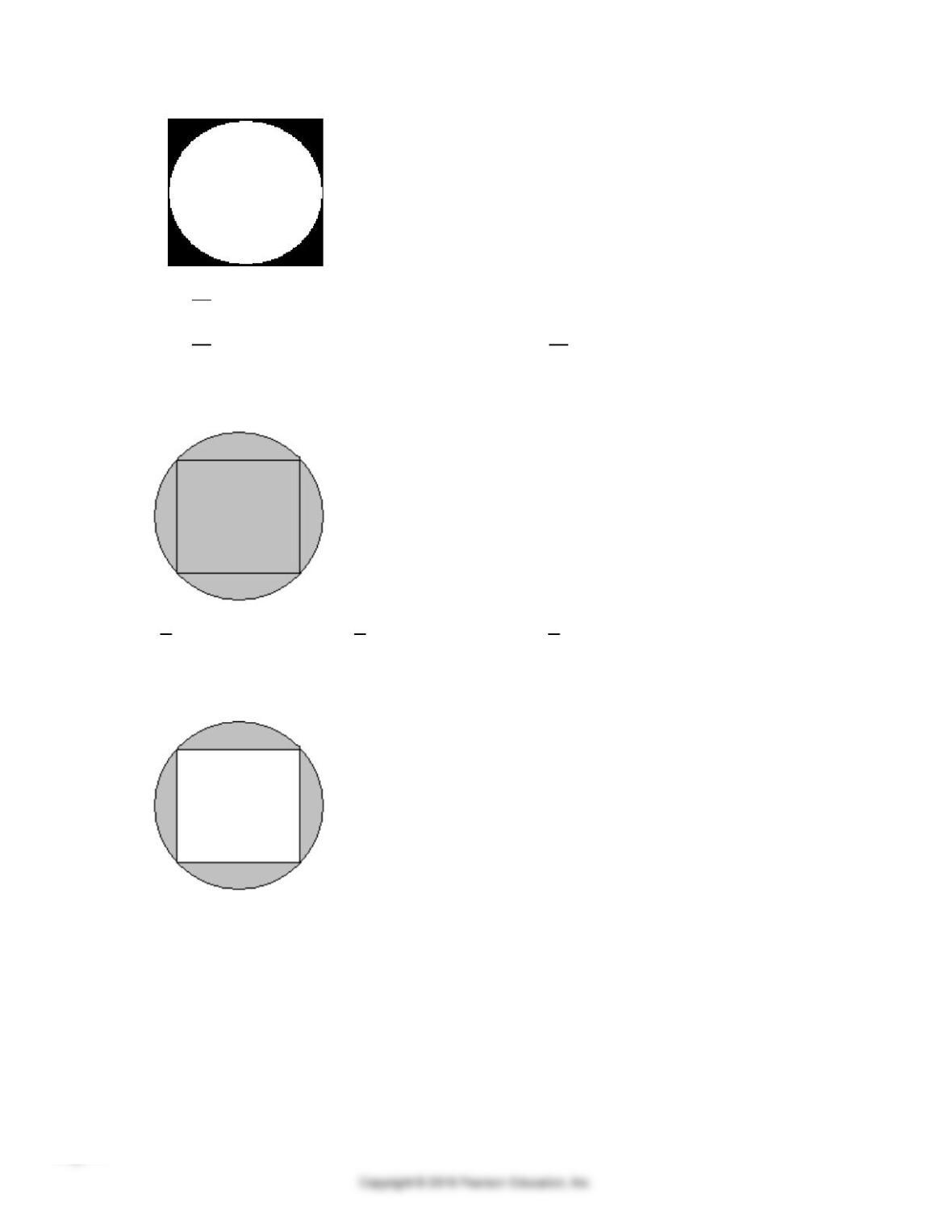
13) Findtheareaoftheshadedregion.Expresstheanswerintermsofπ.
7
7
A) 49–49
4
πsquareunits B) 196 –49πsquareunits
C) 49–49
2
πsquareunits D) 49
4
π+49squareunits
14) Findtheareaoftheshadedregion.Expresstheanswerintermsofπ.
1
1
A) 1
2
πsquareunits B) 1
4
πsquareunits C) 1
2
squareunits D) 1πsquareunits
15) Findtheareaoftheshadedregion.Expresstheanswerintermsofπ.
4
4
A) 8π–16squareunits B) 4π–16 squareunits
C) 16squareunits D) 4π–4 squareunits
16) Abicyclewheelmakes5revolutions.Determinehowfarthebicycletravelsininchesifthediameterofthe
wheelis23in.Useπ≈3.14.Roundtothenearesttenth.
A) 361.1in. B) 72.2 in. C) 115 in. D) 722.2 in.
17) Arectangularpatiohasdimensions10feetby15feet.Thepatioissurroundedbyaborderwithauniform
widthof3feet.Findtheareaoftheborder.
A) 186ft2B) 84ft2C) 162ft2D) 114ft2
Page19
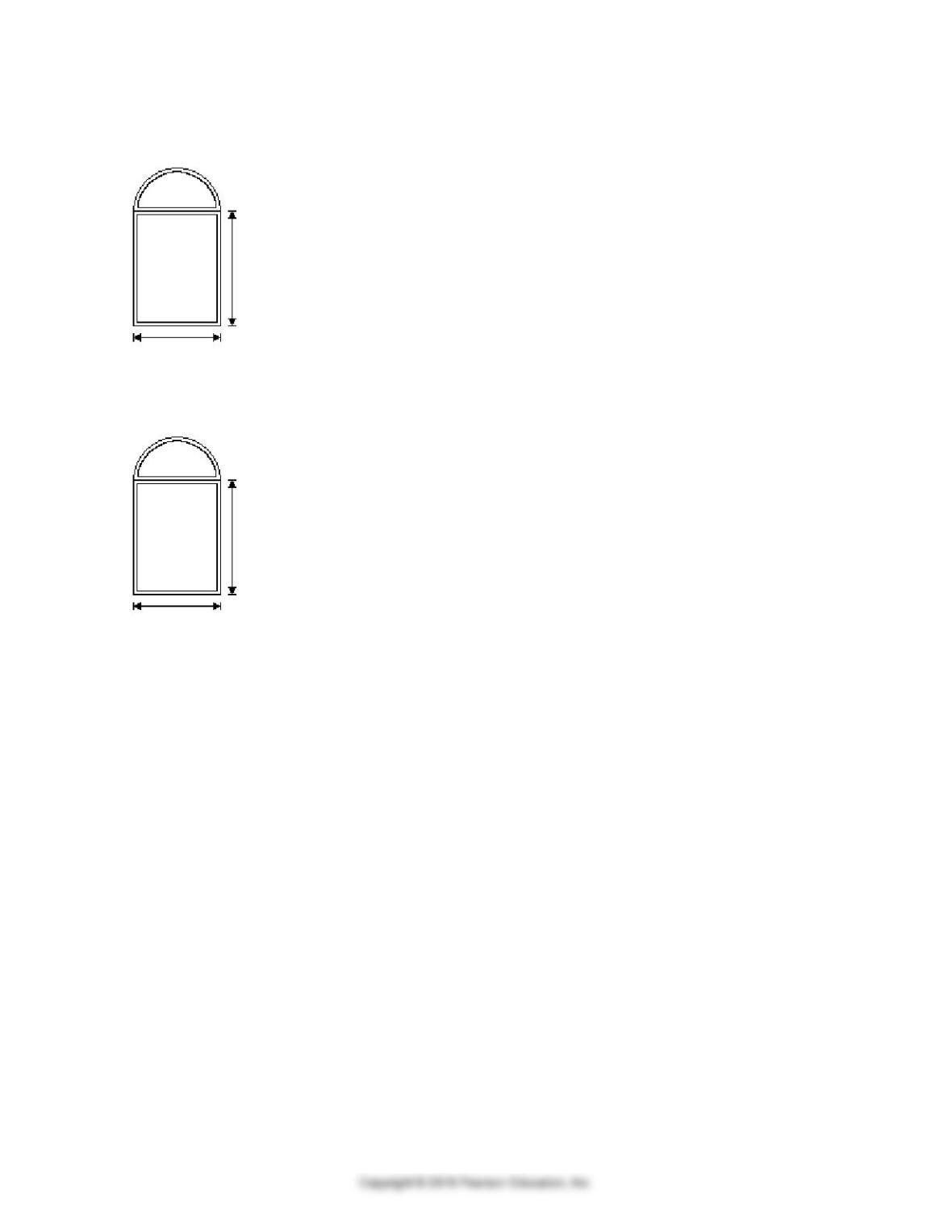
18) Acircularswimmingpool,20feetindiameter,isenclosedbyacirculardeckthatis6feetwide.Whatisthe
areaofthedeck?Useπ=3.1416.
A) 490.1ft2B) 772.8ft2C) 1206.4ft2D) 314.2ft2
19) Findtheperimeter.Approximatetheresulttothenearesttenthusing3.14forπ.
8ft
4ft
A) 26.3ft B) 32.6 ft C) 30.3 ft D) 36.6 ft
20) Findtheareaofthewindow.Approximatetheresulttothenearesttenthusing3.14forπ.
9ft
4ft
A) 42.3ft2B) 86.2ft2C) 61.1ft2D) 39.1ft2
Page20
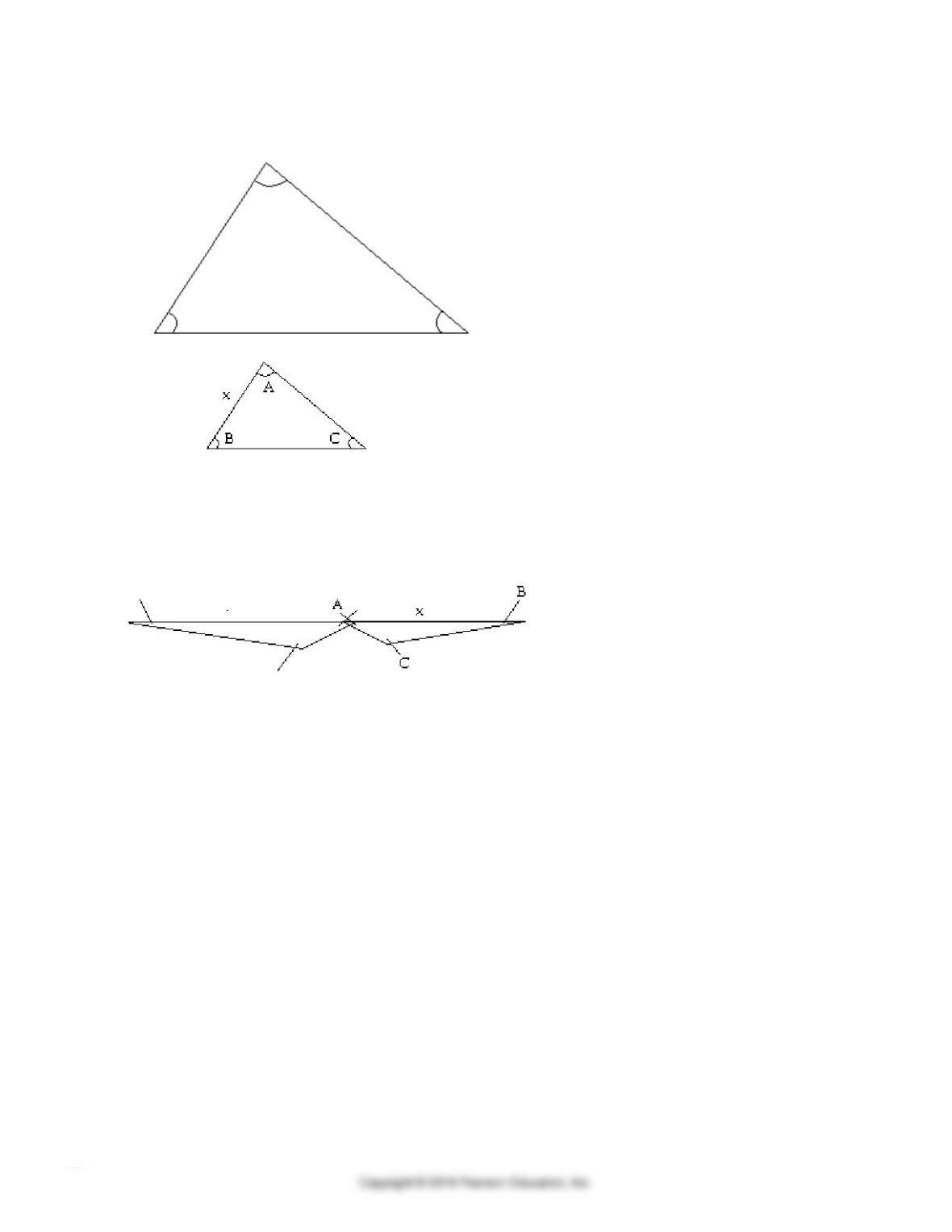
3 UnderstandCongruentTrianglesandSimilarTriangles
MULTIPLECHOICE.Choosetheonealternativethatbestcompletesthestatementoranswersthequestion.
Thetrianglesaresimilar.FindthemissinglengthxandthemissinganglesA,B,C.
1)
96°
16 28
39° 45°
14
A) x=8units;A=96°;B=39°;C=45° B) x=16 units;A=39°;B=96°;C=45°
C) x=8units;A=45°;B=39°;C=96° D) x=16 units;A=96°;B=39°;C=45°
2)
12°
33°
48
10
30
135°
A) x=16;A=33;B=12;C=135 B) x=48;A=12;B=33;C=135
C) x=16;A=135;B=12;C=33 D) x=48;A=33;B=12;C=135
Solve.Ifnecessary,roundtothenearesttenth.
3) Aflagpolecastsashadowof20feet.Nearby,a10–foottreecastsashadowof2feet.Whatistheheightof
theflagpole?
A) 100ft B) 4ft C) 1 ft D) 400 ft
4) Ifaflagpole15feettallcastsashadowthatis20 feetlong,findthelengthoftheshadowcastbyanantenna
whichis18feettall.
A) 24ft B) 13.5 ft C) 16.7 ft D) 23ft
5) Thezoohashiredalandscapearchitecttodesignthetriangularlobbyofthechildrenʹspettingzoo.Inhis
scaledrawing,thelongestsideofthelobbyis15cm.Theshortestsideofthelobbyis8cm.Thelongest
sideoftheactuallobbywillbe46m.Howlongwilltheshortestsideoftheactuallobbybe?
A) 24.5m B) 0.2m C) 86.3 m D) 0.9m
Page21

6) Ifatree62.5feettallcastsashadowthatis25 feetlong,findtheheightofatreecastingashadowthatis19
feetlong.
A) 47.5ft B) 7.6ft C) 82.2 ft D) 56.5 ft
0.4 Polynomials
1 RecognizeMonomials
MULTIPLECHOICE.Choosetheonealternativethatbestcompletesthestatementoranswersthequestion.
Tellwhethertheexpressionisamonomial.Ifitis,namethevariable(s)andcoefficient,andgivethedegreeofthe
monomial.
1) 13x
A) Monomial;variablex;coefficient13;degree1
B) Monomial,variablex;coefficient1;degree13
C) Monomial,;variablex;coefficient13;degree0
D) Notamonomial
2) 13x9
A) Monomial;variablex;coefficient13;degree9 B) Monomial;variablex;coefficient9;degree13
C) Monomial;variablex;coefficient9;degree0 D) Notamonomial
3) 7
x
A) Monomial;variablex;coefficient7;degree1 B) Monomial;variablex;coefficient7;degree–1
C) Monomial;variablex;coefficient7;degree0 D) Notamonomial
4) –6x–10
A) Monomial;variablex;coefficient–6;degree–10
B) Monomial;variablex;coefficient10;degree–6
C) Monomial;variablex;coefficient–6;degree10
D) Notamonomial
5) –9xy2
A) Monomial;variablesx,y;coefficient–9;degree3
B) Monomial;variablesx,y;coefficient–9;degree2
C) Monomial;variablesx,y;coefficient–9;degree1
D) Notamonomial
6) –9x3y6
A) Monomial;variablesx,y;coefficient–9;degree9
B) Monomial;variablesx,y;coefficient–9;degree3
C) Monomial;variablesx,y;coefficient–9;degree6
D) Notamonomial
7) 19x
y
A) Monomial;variablesx,y;coefficient19;degree1
B) Monomial;variablesx,y;coefficient19;degree–2
C) Monomial;variablesx,y;coefficient19;degree2
D) Notamonomial
Page22

8) ––2x12
y4
A) Monomial;variablesx,y;coefficient–2;degree12
B) Monomial;variablesx,y;coefficient–2;degree4
C) Monomial;variablesx,y;coefficient–2;degree8
D) Notamonomial
9) 7x3–4
A) Monomial;variablex;coefficient7;degree3 B) Monomial;variablex;coefficient4 ;degree3
C) Monomial;variablex;coefficient7;degree1 D) Notamonomial
2 RecognizePolynomials
MULTIPLECHOICE.Choosetheonealternativethatbestcompletesthestatementoranswersthequestion.
Tellwhethertheexpressionisapolynomial.Ifitis,giveitsdegree.
1) 5x3–2
A) Polynomial;degree3 B) Polynomial;degree2
C) Polynomial;degree5 D) Notapolynomial
2) 1–4x
A) Polynomial;degree1 B) Polynomial;degree4
C) Polynomial;degree–4 D) Notapolynomial
3) 15
A) Polynomial,degree0 B) Polynomial,degree1
C) Polynomial,degree15 D) Notapolynomial
4) 2π
A) polynomial,degree0 B) polynomial,degree1
C) polynomial,degree2 D) notapolynomial
5) 7x5–3
x
A) Polynomial;degree5 B) Polynomial;degree–1
C) Polynomial;degree1 D) Notapolynomial
6) 3
x
+1
A) Polynomial,degree0 B) Polynomial,degree–1
C) Polynomial,degree3 D) NotaPolynomial
7) –3y5–3
A) Polynomial;degree5 B) Polynomial;degree–3
C) Polynomial;degree3 D) Notapolynomial
8) –5z8+z
A) Polynomial;degree8 B) Polynomial;degree9
C) Polynomial;degree1 D) Notapolynomial
Page23

9) 9x11+24x7
3x3
A) Polynomial;degree7 B) Polynomial;degree11
C) Polynomial;degree0 D) Notapolynomial
3 AddandSubtractPolynomials
MULTIPLECHOICE.Choosetheonealternativethatbestcompletesthestatementoranswersthequestion.
Addorsubtractasindicated.Expresstheanswerasasinglepolynomialinstandardform.
1) (4x2+10x–11)+(20x+11)
A) 4x2+30x B) 4x2+30x–22 C) 4x2+10x+22 D) 34x3
2) (8x2+8x–9)+(2x2+3x+3)
A) 10x2+11x–6B)
–7x2+11x+11 C) 10x2–11x–6 D) 10x2+11x+6
3) (8x2+13x+14)–(2x2–3x–6)
A) 6x2+16x+20 B) 6x2+15x+8C)6x
2+16x+8D)6x
2+16x–20
4) (6x3–2x2)+(8x3–4x2)
A) 14x3–6x2B) 14x6–6x4C) 8x5D) 8x10
5) (12x5–16x4)–(2x5–15x4)
A) 10x5–1x4B) 10x5–31x4C) 9x9D) 14x5–31x4
6) (2x5+5x2)+(8x5+3x2–9)
A) 10x5+8x2–9 B) 10x5+5x2–9x C) –9x+8x5–7x2D) 11x8
7) (7x2–9)–(–x3–10x2+1)
A) x3+17x2–10 B) 8x3–19x2–1C)x
3–3x2–8D)8x
3–10x2–10
8) (3x5+4x3+4)–(5x5+17x3–14)
A) –2x5–13x3+18 B) –2x5+9x3–10 C) –2x5–13x3–10 D) 3x8
9) (6x7–19x4–9)–(12x4+4x7–2)
A) 2x7–31x4–7B)2x
7–15x4–11 C) 2x7–31x4–11 D) –36x11
10) (2x6–8x3–5x)+(9x6–6x3+2x)
A) 11x6–14x3–3x B) 4x6–4x3–6x C) 11x–14x6–3x3D) –6x10
11) –3(x2+9x+1)+(–3x2–x+4)
A) –6x2–28x+1B)0x
2–28x+1C)
–6x2–27x+1D)
–6x2–28x+5
12) 7(2x3+x2–1)–9(9x3–4x+2)
A) –67x3+7x2+36x–25 B) –67x3+7x2–36x–25
C) –67x3+x2+36x–25 D) –67x3+7x2+36x+25
Page24

13) (x2+1)–(9x2+9)+(x2+x–6)
A) –7x2+x–14 B) –9x2+x–14 C) –8x2+x–14 D) –7x2+10x–5
14) 8(1–y3)–5(1+y+y2+y3)
A) –13y3–5y2–5y+3B)
–13y3+5y2–5y–3
C) –13y3–5–ay2–5y+3 D) 13y3–5y2–5y+3
4 MultiplyPolynomials
MULTIPLECHOICE.Choosetheonealternativethatbestcompletesthestatementoranswersthequestion.
Performtheindicatedoperations.Expresstheanswerasasinglepolynomialinstandardform.
1) –4x(7x–10)
A) –28x2+40x B) 12x2C) –28x2–10x D) 7x2+40x
2) 5x7(–10x–2)
A) –50x8–10x7B) –50x–10 C) –50x8–2D)
–60x7
3) 8x4(–11x5–9)
A) –88x9–72x4B) –88x5–72 C) –88x9–9D)
–160x4
4) 3x2(–9x7–4x6–8)
A) –27x9–12x8–24x2B) –27x9–12x8
C) –27x9–4x6–8D)
–27x7–12x6–24
5) (x–12)(x2+7x–6)
A) x3–5x2–90x+72 B) x3+19x2+78x–72
C) x3–5x2–78x–72 D) x3+19x2+90x+72
6) (2y+11)(10y2–2y–4)
A) 20y3+106y2–30y–44 B) 20y3–4y2–8y+11
C) 130y2–26y–52 D) 20y3+114y2+30y+44
MultiplythepolynomialsusingtheFOILmethod.Expresstheanswerasasinglepolynomialinstandardform.
7) (x–5)(x+2)
A) x2–3x–10 B) x2–10x–3C)x
2–4x–10 D) x2–3x–3
8) (4x–10)(x+10)
A) 4x2+30x–100 B) 4x2–100x+30 C) 4x2+30x+30 D) 4x2+28x–100
9) (3x+8)(3x–6)
A) 9x2+6x–48 B) 6x2+6x–48 C) 9x2+6x+6D)6x
2+6x+6
10) (x+7y)(x–10y)
A) x2–3xy–70y2B) x–3xy–70y C) x2–3xy–3y2D) x2–6xy–70y2
Page25

11) (x+12y)(5x–10y)
A) 5x2+50xy–120y2B) x2+50xy–120y2
C) 5x2+50xy+50y2D) x2+50xy+50y2
12) (–4x+2y)(–3x–2y)
A) 12x2+2xy–4y2B) 12x2–6xy–4y2C) 12x2+8xy–4y2D) 12x2+2xy+2y2
5KnowFormulasforSpecialProducts
MULTIPLECHOICE.Choosetheonealternativethatbestcompletesthestatementoranswersthequestion.
Multiplythepolynomials.Expresstheanswerasasinglepolynomialinstandardform.
1) (x+13)(x–13)
A) x2–169 B) x2–26 C) x2–26x–169 D) x2+26x–169
2) (2x+11)(2x–11)
A) 4x2–121 B) x2–121 C) 4x2–44x–121 D) 4x2+44x–121
3) (x+3)2
A) x2+6x+9B)x
2+9C)9x
2+6x+9D)x+9
4) (x–10)2
A) x2–20x+100 B) x2+100 C) 100x2–20x+100 D) x+100
5) (8x+3)2
A) 64x2+48x+9 B) 64x2+9C)8x
2+48x+9D)8x
2+9
6) (x+13y)(x–13y)
A) x2–169y2B) x2–26y2C) x2–26xy–169y2D) x2+26xy–169y2
7) (3y+x)(3y–x)
A) 9y2–x2B) 6y2–x2C) 9y2–6xy–x2D) 9y2+6xy–x2
8) (6x–7)2
A) 36x2–84x+49 B) 36x2+49 C) 6x2–84x+49 D) 6x2+49
9) (t–b)2
A) t2–2tb+b2B) t2–tb+b2C) t2–2tb–b2D) t2+2tb+b2
10) (6x+7y)2
A) 36x2+84xy+49y2B) 36x2+49y2
C) 6x2+84xy+49y2D) 6x2+49y2
11) (3x–4y)2
A) 9x2–24xy+16y2B) 9x2+16y2C) 3x2–24xy+16y2D) 3x2+16y2
12) (x–4)3
A) x3–12x2+48x–64 B) x3–4x2+24x–64
C) x3–12x2+24x–64 D) x3–12x2+12x–64
Page26

13) (2x+4)3
A) 8x3+48x2+96x+64 B) 8x3+48x2+48x+64
C) 4x6+8x3+4096 D) 4x2+16x+16
6 DividePolynomialsUsingLongDivision
MULTIPLECHOICE.Choosetheonealternativethatbestcompletesthestatementoranswersthequestion.
Findthequotientandtheremainder.
1) 9x8–15x4dividedby3x
A) 3x7–5x3;remainder0B)9x
7–15x3;remainder0
C) 3x9–5x5;remainder0D)3x
8–5x4;remainder0
2) 16x2+8x–13dividedby4x
A) 4x+2;remainder–13 B) 4x2+2x–13
4;remainder0
C) 16x+8;remainder–13 D) 4x–11;remainder0
3) x2+11x+18dividedbyx+9
A) x+2;remainder0B)x–9;remainder0
C) x2+2;remainder0D)x
3–9;remainder0
4) 9x2+36x–45dividedbyx+5
A) 9x–9;remainder0B
)9x+9;remainder0
C) x–9;remainder0D)9x–9;remainder7
5) x2+3x–13dividedbyx+6
A) x–3;remainder5B)x–3;remainder0C)x+3;remainder5D)x–5;remainder3
6) x2+8x+7dividedbyx+2
A) x+6;remainder–5B)x+6;remainder5
C) x+6;remainder0D)x+7;remainder0
7) 3x3+18x2–73x+72dividedbyx+9
A) 3x2–9x+8;remainder0B)3x
2+9x+8;remainder0
C) x2+10x+11;remainder0D)x
2+9x+3;remainder0
8) 25x3–25x2–6x+3dividedby–5x+1
A) –5x2+4x+2;remainder1B)
–5x2+4x+2;remainder0
C) –5x2+4x+2;remainder4D)x
2+2;remainder4
9) 5x3–7x2+7x–8dividedby5x–2
A) x2–x+1;remainder–6B)x
2–x+1;remainder6
C) x2–x+1;remainder10 D) x2+x–1;remainder–6
10) x4+81dividedbyx–3
A) x3+3x2+9x+27;remainder162 B) x3+3x2+9x+27;remainder81
C) x3+3x2+9x+27;remainder0D)x
3–3x2+9x–27;remainder162
Page27

11) –25x3–35x2–37x–6dividedby–5x–3
A) 5x2+4x+5;remainder9B)5x
2+4x+5;remainder0
C) 5x2+4x+5;remainder12 D) x2+5;remainder4
12) –15x3–10x2+34x+20dividedby3x+5
A) –5x2+5x+3;remainder5B
)
–5x2+5x+3;remainder0
C) –5x2+5x+3;remainder8D)x
2+3;remainder5
13) x4+7x2+10dividedbyx2+1
A) x2+6;remainder4B)x
2+6x+3
2;remainder0
C) x2+6;remainder0D)x
2+6x+2;remainder4
14) x4+16dividedbyx–2
A) x3+2x2+4x+8;remainder32 B) x3+2x2+4x+8;remainder16
C) x3+2x2+4x+8;remainder0D)x
3–2x2+4x–8;remainder32
15) x2–25a2dividedbyx–5a
A) x+5a B) x–5a C) x2–10xa D) x2+10xa
7 WorkwithPolynomialsinTwoVariables
MULTIPLECHOICE.Choosetheonealternativethatbestcompletesthestatementoranswersthequestion.
MultiplythepolynomialsusingtheFOILmethod.Expresstheanswerasasinglepolynomialinstandardform.
1) (x+12y)(x+9y)
A) x2+21xy+108y2B) x+21xy+108y C) x2+21xy+21y2D) x2+18xy+108y2
2) (–4x+3y)(2x+10y)
A) –8x2–34xy+30y2B) –8x2+6xy+30y2
C) –8x2–40xy+30y2D) –8x2–34xy–34y2
Multiplythepolynomialsusingthespecialproductformulas.Expresstheanswerasasinglepolynomialin
standardform.
3) (x+8y)(x–8y)
A) x2–64y2B) x2–16y2C) x2–16xy–64y2D) x2+16xy–64y2
4) (4x+y)(4x–y)
A) 16x2–y2B) 8x2–y2C) 16x2–8xy–y2D) 16x2+8xy–y2
5) (4x+9y)(4x–9y)
A) 16x2–81y2B) 16x2–72xy–81y2
C) 8x2–18y2D) 16x2+72xy–81y2
6) (x–y)2
A) x2–2xy+y2B) x2–xy+y2C) x2–y2D) x2–2x2y2+y2
Page28

7) (x–7y)2
A) x2–14xy+49y2B) x2–7xy+49y2C) x2–y2D) x2+14xy+49y2
8) (6x–y)2
A) 36x2–12xy+y2B) 36x2–6xy+y2C) 36x2+y2D) 36x2–12xy–2y2
9) (2x+5y)2
A) 4x2+20xy+25y2B) 4x2+25y2C) 2x2+20xy+25y2D) 2x2+25y2
10) (3x–8y)2
A) 9x2–48xy+64y2B) 9x2+64y2C) 3x2–48xy+64y2D) 3x2+64y2
0.5 FactoringPolynomials
1 FactortheDifferenceofTwoSquaresandtheSumandDifferenceofTwoCubes
MULTIPLECHOICE.Choosetheonealternativethatbestcompletesthestatementoranswersthequestion.
Factorthepolynomialbyremovingthecommonmonomialfactor.
1) 6x–12
A) 6(x–2) B) 6(x+2) C) x(x–6) D) x(x+6)
2) 9x2–18x
A) 9x(x–2) B) 9x(x+2) C) 9(x2–2x) D) 9x2(x–2)
Factorthedifferenceoftwosquares.
3) x2–64
A) (x+8)(x–8) B) (x+64)(x–64) C) (x–8)(x–8) D) (x2+8)(x2–8)
4) 64x2–1
A) (8x–1)(8x+1) B) (8x+1)2C) (8x–1)2D) prime
5) 49–x2
A) (7–x)(7+x) B) (7+x)2C) (7–x)2D) prime
6) 49x2–16
A) (7x+4)(7x–4) B) (7x–4)2C) (7x+4)2D) (49x+1)(x–16)
Factorthesumordifferenceoftwocubes.
7) x3–27
A) (x–3)(x2+3x+9) B) (x+3)(x2–3x+9)
C) (x–3)(x2+9) D) (x+27)(x2–1)
8) x3+64
A) (x+4)(x2–4x+16) B) (x–4)(x2+4x+16)
C) (x+4)(x2+16) D) (x–64)(x2–1)
Page29

9) 729y3–1
A) (9y–1)(81y2+9y+1) B) (9y–1)(81y2+1)
C) (729y–1)(y2+9y+1) D) (9y+1)(81y2–9y+1)
10) 343x3+1
A) (7x+1)(49x2–7x+1) B) (7x+1)(49x2+1)
C) (7x+1)(49x2+7x+1) D) (7x+1)(49x2–7x–1)
11) 125–x3
A) (5–x)(25+5x+x2)B)(5+x)(25–5x+x2)
C) (5–x)(25+x2)D)(5+x)(25–x2)
12) 1000x3–729
A) (10x–9)(100x2+90x+81) B) (10x–9)(100x2+81)
C) (1000x–9)(x2+90x+81) D) (10x+9)(100x2–90x+81)
13) 343x3+729
A) (7x+9)(49x2–63x+81) B) (7x+9)(49x2+63x+81)
C) (343x–9)(x2+63x+81) D) (7x–9)(49x2+63x+81)
14) 27–8x3
A) (3–2x)(9+6x+4x2)B
)(3–2x)(9+4x2)
C) (27–2x)(1+6x+4x2)D)(3+2x2)(9–6x+4x2)
Factorcompletely.Ifthepolynomialcannotbefactored,sayitisprime.
15) 3x2–147
A) 3(x+7)(x–7) B) 3(x–7)2C) 3(x+7)2D) prime
16) x4–9
A) (x2+3)(x2–3) B) (x2+3)2C) (x2–3)2D) prime
17) x4–256
A) (x2+16)(x+4)(x–4) B) (x2+16)2
C) (x2–16)2D) prime
18) (x+9)2–49
A) (x+16)(x+2) B) (x+58)(x–40) C) (x–2)(x–16) D) x2+18x+32
19) (x–2)2–16
A) (x+2)(x–6) B) (x+14)(x–18) C) (x–2)(x+6) D) (x–6)2
20) x9+1
A) (x+1)(x2–x+1)(x6–x3+1) B) (x3+1)(x6–x3+1)
C) (x–1)(x2+x+1)(x6+x3+1) D) (x–1)(x+1)(x6–x3+1)
Page30

21) 125x4–x
A) x(5x–1)(25x2+5x+1) B) x(5x–1)(25x2+1)
C) x(125x–1)(x2+5x+1) D) x(5x+1)(25x2–5x+1)
22) (4x+1)3–512
A) (4x–7)(16x2+40x+73) B) (4x+9)(16x2–24x+57)
C) (4x–7)(16x2–24x+57) D) (4x–7)(16x2–24x+73)
23) (3–x)3–x3
A) (3–2x)(x2–3x+9) B) (3–x)(x2–3x+9)
C) (3–2x)(3x2–3x+9) D) (3+2x)(x2–3x+9)
2 FactorPerfectSquares
MULTIPLECHOICE.Choosetheonealternativethatbestcompletesthestatementoranswersthequestion.
Factortheperfectsquare.
1) x2+30x+225
A) (x+15)2B) (x–15)2C) (x+15)(x–15) D) x2+30x+225
2) x2–12x+36
A) (x–6)2B) (x–6)(x+6) C) (x+6)2D) (x–12)(x+12)
3) 49x2–70x+25
A) (7x–5)2B) (7x+5)2C) (7x+5)(7x–5) D) (7x–6)2
4) 9x2+12x+4
A) (3x+2)2B) (3x–2)2C) (3x+2)(3x–2) D) (3x–3)2
5) x4+8x2+16
A) (x2+4)2B) (x2–4)2C) (x +4)(x–4) D) (x+4)2
Factorcompletely.Ifthepolynomialcannotbefactored,sayitisprime.
6) 98x2+224x+128
A) 2(7x+8)2B) 2(7x–8)2C) 2(7x+8)(7x–8) D) prime
7) x3+24x2+144x
A) x(x+12)2B) x(x–12)2C) x(x+12)(x–12) D) prime
3 FactoraSecond–DegreePolynomial:x^2+Bx+C
MULTIPLECHOICE.Choosetheonealternativethatbestcompletesthestatementoranswersthequestion.
Factorthepolynomial.
1) x2–x–12
A) (x+3)(x–4) B) (x+4)(x–3) C) (x+1)(x–12) D) prime
2) x2+13x+42
A) (x+7)(x+6) B) (x–7)(x+6) C) (x–7)(x+1) D) prime
Page31

3) x2+7x–44
A) (x+11)(x–4) B) (x–11)(x+4) C) (x–11)(x+1) D) prime
4) x2+16
A) (x+4)(x–4) B) (x+4)2C) (x–4)2D) prime
Factorcompletely.Ifthepolynomialcannotbefactored,sayitisprime.
5) 7x2–7x–42
A) 7(x+2)(x–3) B) (7x+14)(x–3) C) 7(x–2)(x+3) D) prime
6) 2x2–18x+40
A) 2(x–4)(x–5) B) 2(x–20)(x+1) C) (x–4)(2x–10) D) prime
7) 4x3+4x2–80x
A) 4x(x–4)(x+5) B) 4x(x+4)(x–5) C) (4x2+16x)(x–5) D) (x–4)(4x2+20)
8) (x+8)2–11(x+8)+18
A) (x–1)(x+6) B) (x+17)(x+10)
C) (x2+8x–9)(x2+8x–2) D) (x2–8x+9)(x2–8x+2)
9) x4+10x2+24
A) (x2+6)(x2+4) B) (x2–6)(x2+4) C) (x2–6)(x2+1) D) Prime
4 FactorbyGrouping
MULTIPLECHOICE.Choosetheonealternativethatbestcompletesthestatementoranswersthequestion.
Factorthepolynomialbygrouping.
1) x2+3x+7x+21
A) (x+3)(x+7) B) (x–3)(x–7) C) (x–3)(x+7) D) prime
2) 3x2+2x+6x+4
A) (x+2)(3x+2) B) (3x+2)(3x+2) C) (3x+2)(2x+3) D) prime
3) 8x2–20x+6x–15
A) (4x+3)(2x–5) B) (4x–3)(2x+5) C) (8x+3)(x–5) D) (8x–3)(x+5)
4) 15x2–20x+6x–8
A) (5x+2)(3x–4) B) (5x–2)(3x+4) C) (15x+2)(x–4) D) (15x–2)(x+4)
Factorcompletely.Ifthepolynomialcannotbefactored,sayitisprime.
5) x3–4x+4x2–16
A) (x+2)(x–2)(x+4) B) (x2–4)(x+4)
C) (x–2)2(x+4) D) prime
6) 2x2–14x–8x+56
A) 2(x–7)(x–4) B) (x–7)(x–4) C) (x–7)(2x–8) D) 2(x+7)(x+4)
Page32

7) 2y3+12y2–14y2–84y
A) 2y(y+6)(y–7) B) (y+6)(y–7) C) (y+6)(2y2–14y) D) 2y(y–6)(y+7)
8) 15x4+20x2–12x2–16
A) (5x2–4)(3x2+4) B) (5x2+4)(3x2–4) C) (5x4–4)(3x+4) D) (15x2+4)(x2–4)
9) 20x2–25xy+8xy–10y2
A) (5x+2y)(4x–5y) B) (5x+2)(4x–5) C) (5x–2y)(4x–5y) D) (20x+2y)(x–5y)
10) 20x3–12x2y–25xy2+15y3
A) (4x2–5y2)(5x–3y) B) (4x2–5y)(5x–3y)
C) (4x2+5y2)(5x+3y) D) (20x2–5y2)(x–3y)
Anexpressionthatoccursincalculusisgiven.Factorcompletely.
11) 2(x+6)(x–5)3+(x+6)2·6(x–5)2
A) 2(x+6)(x–5)2(4x+13) B) (x+6)(x–5)2(4x+13)
C) (x+6)(x–5)2(8x+26) D) 2(x+5)(x–6)2(4x+13)
12) (2x+1)2+3(2x+1)–4
A) 2x(2x+5) B) 2x–6 C) 2x(2x+1) D) 2x–1
13) 3(x+5)2(2x–1)2+4(x+5)3(2x–1)
A) (x+5)2(2x–1)(10x+17) B) (x+5)2(2x–1)(x+17)
C) (x+5)2(10x+17) D) (x+5)(2x–1)(10x+17)
5 FactoraSecond–DegreePolynomial:Ax^2+Bx+C,A≠1
MULTIPLECHOICE.Choosetheonealternativethatbestcompletesthestatementoranswersthequestion.
Factorthepolynomial.
1) 12x2+17x+6
A) (3x+2)(4x+3) B) (3x–2)(4x–3) C) (12x+2)(x+3) D) prime
2) 6y2+13y+6
A) (2y+3)(3y+2) B) (2y–3)(3y–2) C) (6y+3)(y+2) D) prime
3) 15z2+8z–16
A) (3z+4)(5z–4) B) (3z–4)(5z+4) C) (15z+4)(z–4) D) prime
4) 20z2–7z–6
A) (4z–3)(5z+2) B) (4z+3)(5z–2) C) (20z–3)(z+2) D) prime
5) 6x2–5xt–6t2
A) (2x–3t)(3x+2t) B) (2x+3t)(3x–2t) C) (6x–3t)(x+2t) D) prime
6) 12z2–7z–12
A) (3z–4)(4z+3) B) (3z+4)(4z–3) C) (12z–4)(z+3) D) prime
7) x2–x–35
A) (x–35)(x+1) B) (x+5)(x–7) C) (x–5)(x+7) D) prime
Page33

Factorcompletely.Ifthepolynomialcannotbefactored,sayitisprime.
8) 21x2–91x–70
A) 7(3x+2)(x–5) B) 7(3x–2)(x+5) C) (21x+14)(x–5) D) prime
9) 10x2–35x–20
A) 5(2x+1)(x–4) B) 5(2x–1)(x+4) C) (10x–5)(x+4) D) prime
10) 14y2+63y–35
A) 7(2y–1)(y+5) B) 7(2y+1)(y–5) C) (14y–7)(y+5) D) prime
11) 24x2–87x+45
A) 3(8x–5)(x–3) B) 3(8x+5)(x+3) C) (8x–5)(3x–3) D) prime
12) 20x3+37x2+15x
A) x(4x+5)(5x+3) B) x(5x+5)(4x+3) C) (4x2+5)(5x+3) D) x2(4x+5)(5x+3)
13) 27x2+81x+60
A) 3(3x+4)(3x+5) B) 3(3x+1)(3x+20) C) 3(20x+4)(x+5) D) (3x+1)(3x+20)
14) 15(x–7)2–5(x–7)–10
A) (5x–40)(3x–19) B) (5x+12)(3x+9) C) (5x+5)(3x+2) D) (5x+37)(3x+26)
15) 8x4+18x2+9
A) (4x2+3)(2x2+3) B) (2x2–3)(4x2–3) C) (4x2+1)(2x2+9) D) (8x2+3)(x2+3)
16) 15x4–19x2–10
A) (3x2–5)(5x2+2) B) (5x–2)(3x+5) C) (3x2+1)(5x2–10) D) (15x2–5)(x2+2)
17) 15x6+11x3–12
A) (3x3+4)(5x3–3) B) (5x3+3)(3x3–4) C) 15(x3–3)(x3+4) D) (3x3+1)(5x3–12)
18) 7y6–37y3+10
A) (7y3–2)(y3–5) B) y2(7y2–2)(y2–5)
C) y4(7y–2)(y–5) D) (7y3–5y2+y–2)(y3–2y2+y–5)
6 CompletetheSquare
MULTIPLECHOICE.Choosetheonealternativethatbestcompletesthestatementoranswersthequestion.
Whatnumbershouldbeaddedtocompletethesquareoftheexpression?
1) x2+12x
A) 36 B) 6 C) 72 D) 18
2) x2–6x
A) 9 B) –3C)18D)5
Page34

3) x2+4
5x
A) 4
25 B) 8
25 C) 16
25 D) 1
5
4) x2–1
2x
A) 1
16 B) –1
8C) 1
4D) –1
4
5) x2–x
A) 1
4B) 1
2C) 1 D) 4
0.6 SyntheticDivisio
n
1 DividePolynomialsUsingSyntheticDivision
MULTIPLECHOICE.Choosetheonealternativethatbestcompletesthestatementoranswersthequestion.
Usesyntheticdivisiontofindthequotientandtheremainder.
1) x2+11x+16isdividedbyx+8
A) x+3;remainder–8B)x+3;remainder8
C) x+3;remainder0D
)x+4;remainder0
2) x3–x2+6isdividedbyx+2
A) x2–3x+6;remainder–6B)x
2–3x+6;remainder2
C) x2+x+2;remainder–6D)3x
2–4x+2;remainder0
3) x5+x2–2isdividedbyx–2
A) x4+2x3+4x2+9x+18;remainder34 B) x4+2x3+5x2+10x+20;remainder38
C) x4+3x2;remainder4D)x
4+3;remainder4
4) 2x3+6x2–4x+16isdividedbyx+4
A) 2x2–2x+4;remainder0B)
–2x2–4x+4;remainder0
C) 1
2x2+3
2x–1;remainder0D)2x
2x+3
2
+4;remainder0
5) x5–2x4–13x3–8x2–7x–14isdividedbyx–5
A) x4+3x3+2x2+2x+3;remainder1B)x
3+3x2+2x+2;remainder1
C) x4+3x3+2x2+2x–3;remainder3D)x
4+3x3+2x2+2x+1;remainder0
6) x4–4isdividedbyx–2
A) x3+2x2+4x+8;remainder12 B) x3+2x2+4x+8;remainder254
C) x3+6x2+4x+2;remainder12 D) x3+4x2+16x+64;remainder254
Page35

7) x4+1296isdividedbyx–6
A) x3+6x2+36x+216;remainder2592 B) x3+6x2+36x+216;remainder1296
C) x3+6x2+36x+216;remainder0D)x
3–6x2+36x–216;remainder2592
8) 6x5–5x4+x–4isdividedbyx+1
2
A) 6x4–8x3+4x2–2x+2;remainder–5B)6x
4–2x3–x2+1
2x+5
4;remainder–27
8
C) 6x4–8x3+5;remainder–13
2D) 6x4–2x3+x2–1
2x+5
4;remainder–37
8
Usesyntheticdivisiontodeterminewhetherx–cisafactorofthegivenpolynomial.
9) x3–8x2+20x–16;x–4
A) Yes B) No
10) x3+13x2+31x–45;x–3
A) Yes B) No
11) x3–5x2–22x+56;x+4
A) Yes B) No
12) x3–12x2+20x+100;x+6
A) Yes B) No
13) 3x3–22x2+47x–28;x–6
A) Yes B) No
14) 2x3–14x2–28x+96;x+2
A) Yes B) No
15) 4x3–27x2+8x+60;x–6
A) Yes B) No
16) 4x3–27x2+20x+75;x–5
A) Yes B) No
17) 6x5–5x4+x–4;x+1
2
A) Yes B) No
Page36

0.7 RationalExpressions
1 ReduceaRationalExpressiontoLowestTerms
MULTIPLECHOICE.Choosetheonealternativethatbestcompletesthestatementoranswersthequestion.
Reducetherationalexpressiontolowestterms.
1) x2–36
x–6
A) x+6B)x–6C)
1
x–6D) 1
x+6
2) 4x+2
12x2+22x+8
A) 1
3x+4B) 4x+2
12x2+22x+8
C) 4x+3
3x+22 D) 4x
3x+4
3) y2+5y+6
y2+10y+16
A) y+3
y+8B) 5y+6
10y+16 C) 5y+3
10y+8D) –y2+5y+6
y2+10y+16
4) 3x2–18x+24
x–4
A) 3x–6B)
3x2–18x+24
x–4C) 3x2–24 D) 1
x–4
5) x2+9x+20
x2+11x+28
A) x+5
x+7B) 9x+20
11x+28 C) 9x+5
11x+7D) –x2+9x+20
x2+11x+28
6) 2x2+13x+6
2x2+7x–30
A) 2x+1
2x–5B) x–1
x+5C) 2x+6
2x–6D) x+2
x–4
7) 7x2+21x3
11x+33x2
A) 7x
11 B) 7x2+21x3
11x+33x2C) 7+21x3
11x+33 D) 7
11
8) y3–343
y–7
A) y2+7y+49 B) y3–343
y–7C) y2–49 D) 1
y–7
Page37

Anexpressionthatoccursincalculusisgiven.Reducetheexpressiontolowestterms.
9) (x2+3)·8–(8x+9)·4x
(x2+3)3
A) –24x2–36x+24
(x2+3)3B) –32x2–36x+8
(x2+3)2C) 24x2+36x–24
(x2+3)3D) –40x2–36x+24
(x2+3)3
10) (2x+5)4x–2x2(2)
(2x+5)2
A) 4x(x+5)
(2x+5)2B) 2x
(x+5)2C) 4x
(2x+5)2D) 4(x+5)
(2x+5)2
2 MultiplyandDivideRationalExpressions
MULTIPLECHOICE.Choosetheonealternativethatbestcompletesthestatementoranswersthequestion.
Performtheindicatedoperationsandsimplifytheresult.Leavetheanswerinfactoredform.
1) 6x
12x+6
·14x+7
3
A) 7x
3B) 7
3C) 7x
18 D) x
3
2) 2x–2
x
·8x2
6x–6
A) 8x
3B) 3
8x C) 16x3–16x2
6x2–6x D) 12x2+24x+12
8x3
3) x3+1
x3–x2+x
·6x
–18x–18
A) –1
3B) x+1
3(–x–1) C) –x3+1
3(x+1) D) –x2+1
3
4) x2+6x+8
x2+4x+4
·x2+4x+4
x2+6x+8
A) 1 B) 1
x+2C) x+2
x+2D) x+4
x+2
5) x2–8x+15
x2–18x+72
·x2–16x+48
x2–11x+24
A) (x–5)(x–4)
(x–6)(x–8) B) (x+5)(x+4)
(x+6)(x+8)
C) (x2–8x+15)(x2–16x+48)
(x2–18x+72)(x2–11x+24)
D) (x–5)
(x–8)
Page38

6) x2+10x+24
x2+12x+32
·x2+8x
x2+3x–18
A) x
x–3B) 1
x–3C) x(x+8)
x–3D) x
x2+12x+32
7) 9x4–72x
3x2–12
·x2+x–2
4x3+8x2+16x
A) 3(x–1)
4B) 3x(x–1)
4C) 3x(x–1)(x–2)2
4(x+2)2D) 3x(x+1)
4
8) x2+13x+40
x2+15x+56
·x2+7x
x2+13x+40
A) x
x+8B) 1
x+8C) x2+7x
x+8D) x
x2+15x+56
9) 10x2–3x–4
5x2–x–4
·15x2+12x
1–4x2
A) 3x(5x–4)
(1–2x)(x–1) B) 3x
(1–2x)(x–1) C) (5x+4)(5x–4)
(1–2x)(x–1) D) 3x(5x+4)
(1–2x)(x–1)
10)
9x–9
5
3x–3
40
A) 24 B) 27(x–1)2
200 C) 1
24 D) 8(9x–9)
3x–3
11)
2x–2
x
6x–6
5x2
A) 5x
3B) 3
5x C) 10x2(x–1)
6x(x–1) D) 12(x+1)2
5x3
12)
x2+4x+4
x2+6x+8
x2+2x
x2+10x+24
A) x+6
xB) x+6C)
x+6
x(x+4) D) x
(x+4)(x+2)
Page39

13)
x2–16x+64
7x–56
6x–48
42
A) 1 B) (x–8)2
49 C) x2–16x+64
(x–8)2D) 42
14)
1
x+6
3
x2–36
A) x–6
3B) x+6
3C) x–6D)
3
x–6
15)
x2–81
x
x+9
x–10
A) (x–9)(x–10)
xB) (x–9)(x–10) C) (x+9)(x2+9)
x(x–10) D) x
(x–9)(x–10)
16)
16x2–49
x2–16
4x–7
x+4
A) 4x+7
x–4B) 4x–7
x+4
C) (4x–7)(16x2–49)
(x2+4)(x+4)
D) x–4
4x+7
3 AddandSubtractRationalExpressions
MULTIPLECHOICE.Choosetheonealternativethatbestcompletesthestatementoranswersthequestion.
Performtheindicatedoperationsandsimplifytheresult.Leavetheanswerinfactoredform.
1) x
8
–15
7
A) 7x–120
56 B) x–15
15 C) x–15
56 D) 7x+120
120
2) 5x+7
2
–5x–7
2
A) 7 B) 5x C) 0 D) 49
Page40

3) 8x2
x–1
–8x
x–1
A) 8x B) 8x(x+1)
x–1C) 0 D) 8x
x–1
4) 7
12x
–1
6x
A) 5
12x B) 12
5x C) 1 D) 5
24x
5) 3
11x
+5
11x
A) 8
11x B) 11
8x C) 1 D) 8
22x
6) 5x+6
x
+7x–3
9x
A) 52x+51
9x B) 52x–57
9x C) 38x+51
9x D) 52x+51
9x2
7) 6
x2
–8
x
A) 2(3–4x)
x2B) 2(3+4x)
x2C) 2(4x–3)
xD) 2(3x+4)
x2
8) 4
x
+5
x–9
A) 9x–36
x(x–9) B) 36x–9
x(x–9) C) 9x–36
x(9–x) D) 36x–9
x(9–x)
9) 2
x+6
–5
x–6
A) –3x–42
(x+6)(x–6) B) –3x+18
(x+6)(x–6) C) –3
(x+6)(x–6) D) –3x+42
(x+6)(x–6)
10) 20
x–4
+4
x–4
A) 24
x–4B) 16
x–4C) 16
xD) 20(x–4)
4(x–4)
11) 6x2
x–1
–6x
x–1
A) 6x B) 6x(x+1)
x–1C) 0 D) 6x
x–1
Page41

12) 6–x
x–4
–2x+1
4–x
A) x+7
x–4B) x+5
x–4C) –x+7
x–4D) –x+5
x–4
13) x+9
x+3
–x+9
x–7
A) –10(x+9)
(x+3)(x–7) B) –4(x+9)
(x+3)(x–7) C) 0 D) 10(x+9)
(x+3)(x–7)
14) 7x
x–2
+2
2–x
A) 7x–2
x–2B) 7x+2
x–2C) 7x–2
2–xD) 5x
x–2
15) x2–9x
x–6
+18
x–6
A) x–3B)x+6C)x+3D)x–6
4 UsetheLeastCommonMultipleMethod
MULTIPLECHOICE.Choosetheonealternativethatbestcompletesthestatementoranswersthequestion.
FindtheLCMofthegivenpolynomials.
1) x,x–9
A) x(x–9) B) x–9 C) x D) x2(x–9)
2) 5x+35,x2+7x
A) 5x(x+7) B) 5x+7C)5x
2+7D)5x
2+35
3) x2+8x+16,x2+4x
A) x(x+4)2B) x(x+1)(x+4) C) (x+4)2D) x(x+4)
4) x2+2x–8,3x–6
A) 3(x+4)(x–2) B) 3(x–4)(x+2) C) 3(x+4)(x+2) D) 3(x–4)(x–2)
5) x2+4x–5,x2+11x+30
A) (x–1)(x+5)(x+6) B) (x–1)(x+5)
C) (x+5)(x+6) D) (x+1)(x–5)(x+6)
6) x–10
,
10–x
A) (x–10)or(10–x) B) (x–10)(10 –x) C) –1D)x+10
7) 3x–4
,
3x+4
A) (3x–4)(3x+4) B) (3x–4)or(3x+4) C) (3x–4) D) (3x+4)
8) x2–9x,(x–9)2
A) x(x–9)2B) x(x–9) C) (x+9)(x–9)2D) x(x+9)2
Page42

9) x2–6x–27,x2–9,x2–12x+27
A) (x–9)(x+3)(x–3) B) (x+9)(x+3)(x–3)
C) (x–9)(x+3) D) (x+9)(x–3)2
Performtheindicatedoperationsandsimplifytheresult.Leavetheanswerinfactoredform.
10) 4
x
+7
x–9
A) 11x–36
x(x–9) B) 36x–11
x(x–9) C) 11x–36
x(9–x) D) 36x–11
x(9–x)
11) –1
6
–6
5x
A) –5x–36
30x B) –11
30–5x C) 5x–36
30x D) –5x+36
30x
12) 1
(x+2)(x+5)
–3
(x+5)(x+4)
A) –2(x+1)
(x+2)(x+5)(x+4) B) 2(2x+5)
(x+2)(x+5)(x+4)
C) –2(x+3)
(x+2)(x+5)(x+4) D) 2(x+1)
(x+2)(x+5)(x+4)
13) x–4
x2–8x+15
+2x+3
x2+5x–24
A) 3x2–3x–47
(x–3)(x–5)(x+8) B) 3x2–3x–47
(x+3)(x+5)(x–8)
C) 3x–1
2x2–3x–9D) 3x–1
14) 2
x2–3x+2
+5
x2–1
A) 7x–8
(x–1)(x+1)(x–2) B) 7x–8
(x–1)(x–2)
C) 8x–7
(x–1)(x+1)(x–2) D) 20x–8
(x–1)(x+1)(x–2)
15) x
x2–16
–8
x2+5x+4
A) x2–7x+32
(x–4)(x+4)(x+1) B) x2+7x+32
(x–4)(x+4)(x+1)
C) x2–7x+32
(x–4)(x+4) D) x2–7
(x–4)(x+4)(x+1)
Page43

16) 8
x2+2x
+7
x
+4
x+2
A) 11
xB) 4
xC) 7
xD) 28
x
17) 3x
x+1
+4
x–1
–6
x2–1
A) 3x–2
x–1B) 3x–2
x+1C) x+1
x–1D) 3x
x–1
18) 3x
x2–5x–36
–x–1
x2–16
+1
x2–13x+36
A) 2x2–x–5
(x–9)(x+4)(x–4) B) 2x2–21x+13
(x–9)(x+4)(x–4)
C) 2x–1
(x–9)(x+4) D) 2x–1
(x–9)(x–4)
5 SimplifyComplexRationalExpressions
MULTIPLECHOICE.Choosetheonealternativethatbestcompletesthestatementoranswersthequestion.
Performtheindicatedoperationsandsimplifytheresult.Leavetheanswerinfactoredform.
1)
2
x
+2
2
x
–2
A) 1+x
1–xB) 2(1+x)
1–xC) 2–x2D) x2
2–x2
2)
1–10
x
1+10
x
A) x–10
x+10 B) x+10
x–10 C) x–10 D) x+10
3)
3
x
+1
3
x
–1
A) 3+x
3–xB) 3 C) x2+3D)
x2
x2+3
Page44

4)
1–1
x
5+1
x
A) x–1
5x+1B) x–1
5x C) x+1
5x–1D) 5x+1
x–1
5)
1–4
x
x–16
x
A) 1
x+4B) 1
x–4C) x+4D)x–4
6)
x
4
–1
x
1+2
x
A) x–2
4B) x+2
4C) 4
x–2D) 4
x+2
7)
9+3
x
x
4
+1
12
A) 36
xB) x
36 C) 1 D) 36
8)
3
x
+4
x2
9
x2
–16
x
A) 3x+4
9–16x B) 1
3x–4C) 1
3–4x D) 3x2+4
9–16x
9)
5
x
+2
25
x2
–4
A) x
5–2x B) x
5x–2C) 1
5–2x D) 1
5x–2
Page45

10)
x–x
x–5
x–6
A) x
x–5B) x
x–6C) x2
x–5D) x
x+5
11)
7
7x–1
–7
7
7x–1
+7
A) 2–7x
7x B) 2+7x
7x C) 2–x
xD) 7x
2–7x
12)
13
14–x
+14
x–14
5
x
+9
x–14
A) x
14x–70 B) 27x
14x–70 C) –x
14x–70 D) –27x
14x–70
13)
x
x–2
+1
3
x2–4
+1
A) 2x+4
x+1B) x+2
x+1C) 2x+4
x–1D) 2x–4
x–1
14)
2
x+7
+4
x+3
3x+17
x2+10x+21
A) 2 B) 1
2C) 3x+17 D) 6
15)
x+7
x–7
+x–7
x+7
x+7
x–7
–x–7
x+7
A) x2+49
14x B) 1 C) (x+7)3
28x(x+8) D) (x+7)2
14x
Page46

16)
1
x+5
+1
x–5
1
x2–25
A) 2x B) x2C) 10 D) –10
17)
2
x2–3x–10
–1
x–5
1
x+2
+1
A) –x
x2–2x–15
B) x
x2–4x–15
C) –x
x2–3x–10
D) –1
Solvetheproblem.
18) Thefocallengthfofalenswithindexofrefractionnis1
f
=(n–1)
1
R1
+1
R2whereR1andR2aretheradii
ofcurvatureofthefrontandbacksurfacesofthelens.Expressfasarationalexpression.
A) f=R1R2
(n–1)(R1+R2)B) f=(n–1)(R1+R2)
R1R2
C) f=R1R2
(n+1)(R1–R2)D) f=n(R1–R2)
R1R2
19) Anelectricalcircuitcontainstworesistorsconnectedinparallel.IftheresistanceofeachisR1andR2
ohms,respectively,thentheircombinedresistanceRisgiventheformula
R=1
1
R1
+1
R2
IftheircombinedresistanceRis2ohmsandR2is3ohms,findR1.
A) 6ohms B) 1
6
ohm C) 2 ohms D) 1ohms
0.8 nthRoots;RationalExponents
1 WorkwithnthRoots
MULTIPLECHOICE.Choosetheonealternativethatbestcompletesthestatementoranswersthequestion.
Simplifytheexpression.Assumethatallvariablesarepositivewhentheyappear.
1) 327
A) 3 B) 9 C) ±3D)5
2) 3–512
A) –8B)
±8C)64D)23
Page47

3) 4625
A) 5 B) –5 C) 625 D) notarealnumber
2 SimplifyRadicals
MULTIPLECHOICE.Choosetheonealternativethatbestcompletesthestatementoranswersthequestion.
Simplifytheexpression.Assumethatallvariablesarepositivewhentheyappear.
1) 16y28
A) 4y14 B) 4y28 C) 16y14 D) 4y26
2) 343x2
A) 7x 7 B) 7 7x C) 343x D) 7x27
3) 3–27x30y24
A) –3x10y8B) –3x15y12 C) 3x10y8D) 9x10y8
4) –3–27x18y36
A) 3x6y12 B) 3x6y18 C) –3x18y12 D) 9x6y12
5) 245x7y8
A) 7x3y45x B) 7x7y85x C) 7x3y45 D) 7y45x7
6) 3343x4y5
A) 7xy3xy2B) 5xy 3xy2C) 7xy3xy D) 7xy xy2
7) 48x2y
25
A) 4x 3y
5B) 43x
2y
5C) x48y
5D) 16x 3y
8) y11
A) y5y B) y11 C) y10 y D) y y9
9) 3–64x21
A) –4x7B) 4x7C) –4x21 D) –4x18
10) 3x23
A) x73x2B) x 3x20 C) x9D) 3x23
Page48
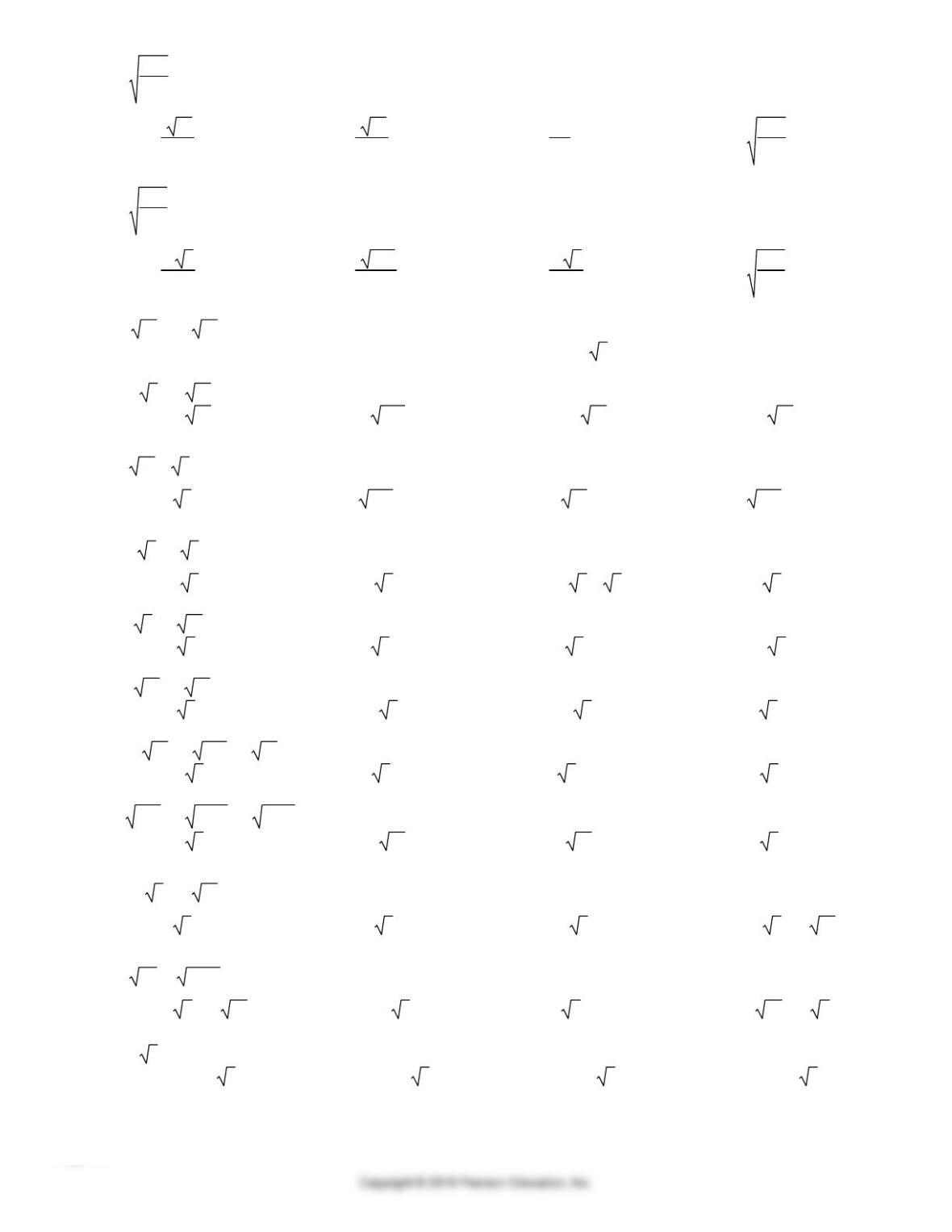
11) 313
y18
A)
313
y6B)
313
y15 C) 13
y6D) 313
y18
12) 3375
x15
A) 533
x5B)
3375
x5C) 533
x12 D) 3375
x15
13) ( 11+3)( 11–3)
A) 2 B) 20 C) 11–23 D) 8
14) (7 6)(12 60)
A) 504 10 B) 84 360 C) 3024 10 D) 504 60
15) 321·39
A) 3 37 B) 3189 C) 3 321 D) 6189
16) 9 33·732
A) 6336 B) 16 36 C) 6333·32 D) 6335
17) 8 3+875
A) 48 3 B) 32 3 C) 16 3 D) –48 3
18) 2 98+550
A) 39 2 B) –39 2 C) –11 2 D) 11 2
19) –580–3 245+520
A) –31 5 B) –55 C) 3 5 D) –35
20) 5x2+2 45x2+4 45x2
A) 19x 5 B) 19x 69 C) 6x 69 D) 6x 5
21) 1732–3354
A) 8 32 B) 14 32 C) –832 D) 1732–3354
22) 38y–3128y
A) 2 3y–432y B) 2–432 C) 6 3y D) 4 32y–23y
23) (7 2+4)2
A) 114+56 2 B) 114–56 2 C) 82+56 2 D) 102+56 2
Page49
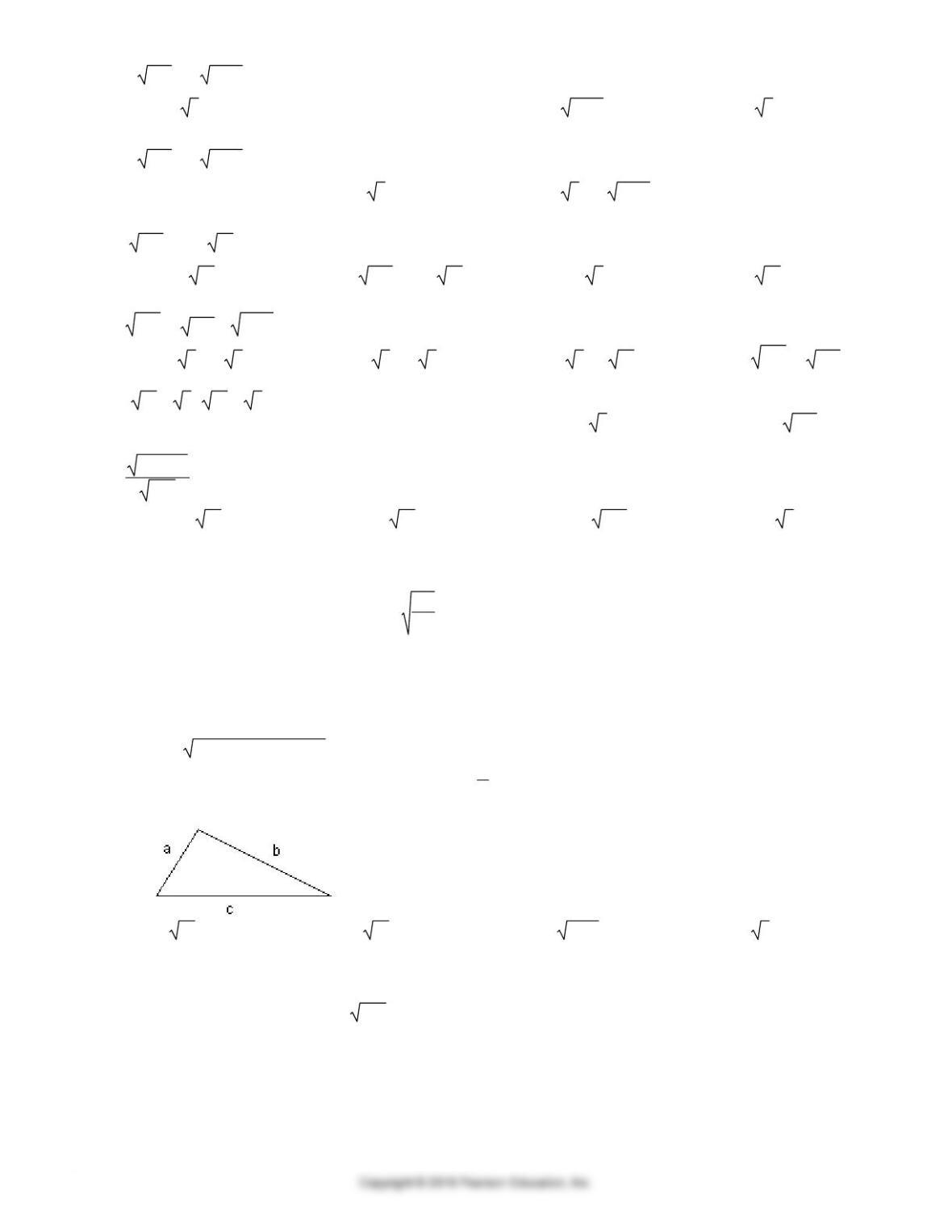
24) 3 327x+33125x
A) 243x B) 24x C) 3 3152x D) 8 3x
25) 4 316x–23128x
A) 0 B) 8 3x C) 8 3x–23128x D) cannotsimplify
26) 3125+4–312
A) 9–312 B) 3125+4–312 C) 9–236 D) 9 312
27) 2x2–3375+72x2
A) 7x 2–533 B) 6x 2–533 C) 7x 2–515 D) 7 2x2–3375
28) ( 12+z)( 12–z)
A) 12–z B) 12z C) 12–2z D) 12–2 12z
29) 56x5y6
2y4
A) 2x2y7x B) 4x2y7x C) 2x4y27xy D) 28xy x
Solve.
30) Whenanobjectisdroppedtothegroundfromaheightofhmeters,thetimeittakesfortheobjecttoreach
thegroundisgivenbytheequationt=h
4.9,wheretismeasuredinseconds.Ifanobjectfalls44.1meters
beforeithitstheground,findthetimeittookfortheobjecttofall.
A) 3seconds B) 4seconds C) 9 seconds D) 6seconds
31) Ifthethreelengthsofthesidesofatriangleareknown,Heronʹsformulacanbeusedtofinditsarea.Ifa,b,
andcarethethreelengthsofthesides,Heronʹsformulaforareais:
A=s(s–a)(s–b)(s–c)
wheresishalftheperimeterofthetriangle,ors=1
2(a+b+c).
Usethisformulatofindtheareaofthetriangleifa=5cm,b=11cmandc=12cm.
A) 6 21sq.cm B) 6 42sq.cm C) 8 2737sq.cm D) 3 6sq.cm
Solvetheproblem.
32) Aformulausedtodeterminethevelocityvinfeetpersecondofanobject(neglectingairresistance)afteri
t
hasfallenacertainheightisv=2gh,wheregistheaccelerationduetogravityandhistheheightthe
objecthasfallen.IftheaccelerationgduetogravityonEarthisapproximately32feetpersecond,findthe
velocityofabowlingballafterithasfallen60feet.(Roundtothenearesttenth.)
A) 62.0ftpersec B) 43.8 ftpersec C) 11.0 ftpersec D) 3840 ftpersec
Page50
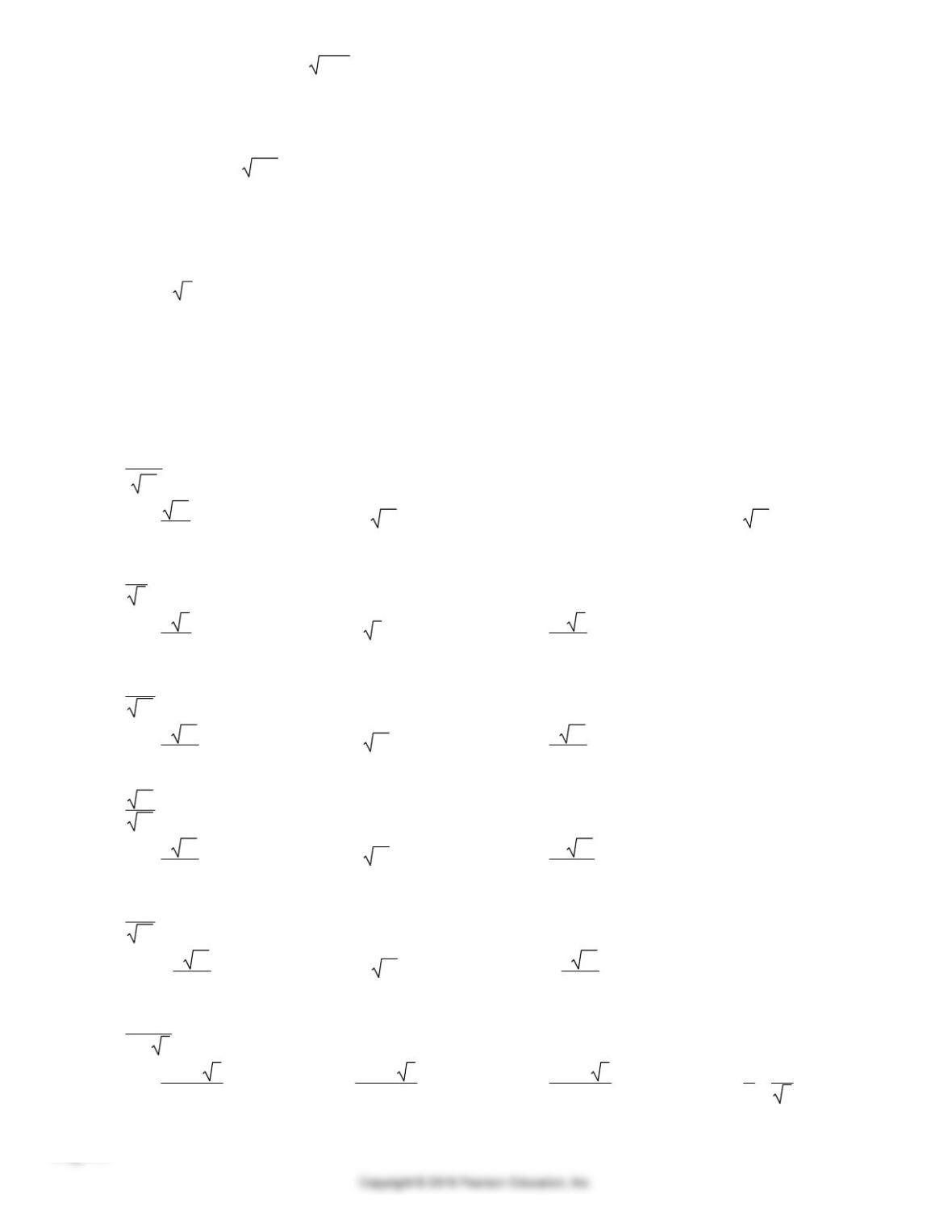
33) Policeusetheformulas=30fdtoestimatethespeedsofacarinmilesperhour,wheredisthedistance
infeetthatthecarskiddedandfisthecoefficientoffriction.Ifthecoefficientoffrictiononacertaingravel
roadis0.26andacarskidded320feet,findthespeedofthecar,tothenearestmileperhour.
A) 50mph B) 98mph C) 274 mph D) 2496 mph
34) Theformulav=2.5rcanbeusedtoestimatethemaximumsafevelocityv,inmilesperhour,atwhicha
carcantravelalongacurvedroadwitharadiusofcurvaturer,infeet.Tothenearestwholenumber,find
themaximumsafespeedforacurveinaroadwitharadiusofcurvatureof350feet.
A) 30mph B) 47mph C) 19 mph D) 12mph
35) Themaximumdistancedinkilometersthatyoucanseefromaheighthinmetersisgivenbytheformula
d=3.5 h.Howfarcanyouseefromthetopofa347–meterbuilding?(Roundtothenearesttenthofa
kilometer.)
A) 65.2km B) 34.8 km C) 18.6 km D) 649.2 km
3 RationalizeDenominators
MULTIPLECHOICE.Choosetheonealternativethatbestcompletesthestatementoranswersthequestion.
Simplifytheexpression.Assumethatallvariablesarepositivewhentheyappear.
1) 1
22
A) 22
22 B) 22 22 C) 22 D) 22
2) 9
2
A) 92
2B) 9 2 C) 81 2
2D) 13
3) 3
17
A) 317
17 B) 3 17 C) 917
17 D) 292
4) 25
11
A) 511
11 B) 5 11 C) 25 11
11 D) 126
5) –7
40
A) –710
20 B) –710 C) –710
10 D) –40
6) 3
6–5
A) 18+35
31 B) 18–35
31 C) 18+35
–1D) 3
6
–3
5
Page51
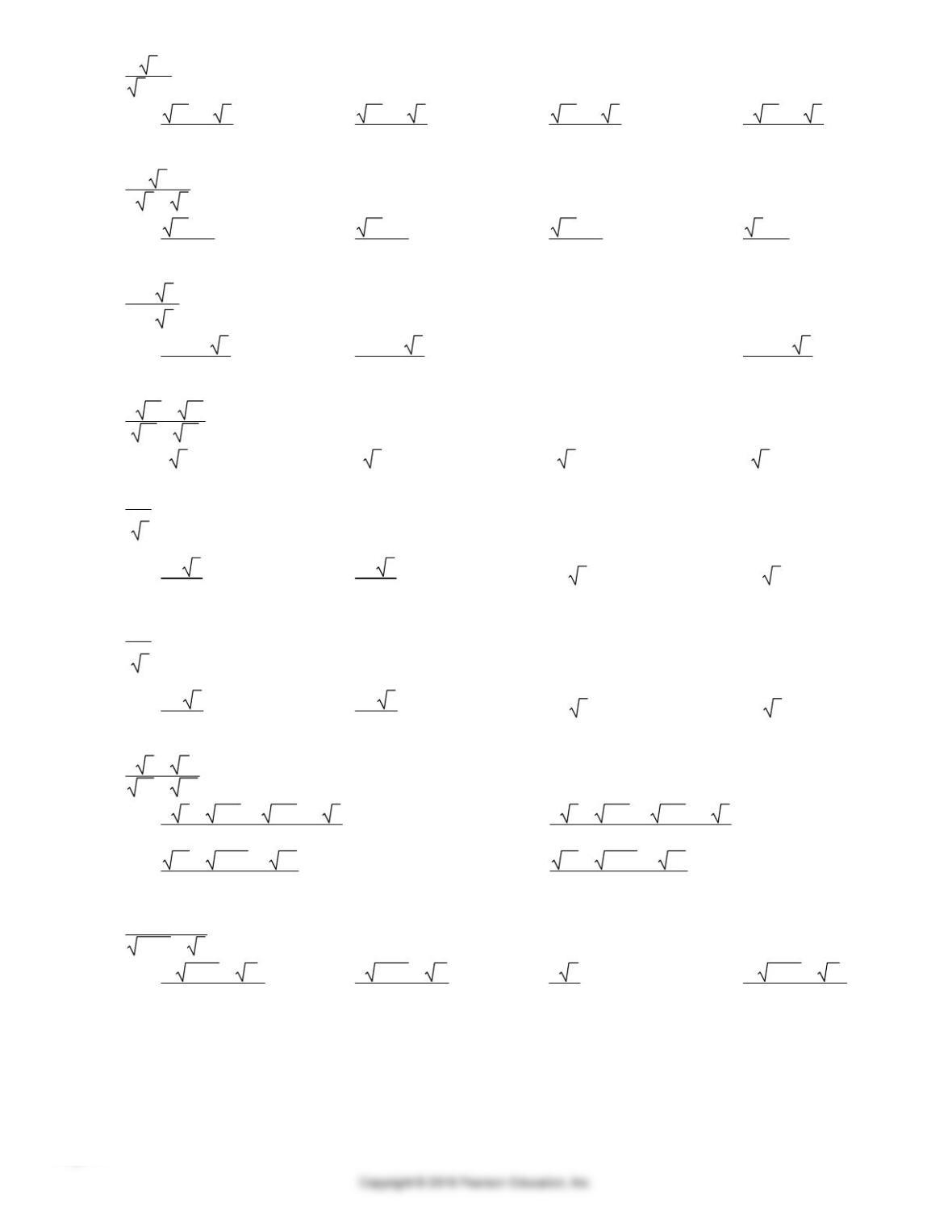
7) 6
7+4
A) 42–46
–9B) 42+46
–9C) 42–46
11 D) 342
+76
28
8) 5
53–5
A) 15+1
14 B) 15–1
14 C) 15+1
16 D) 3+1
14
9) 7–2
7+2
A) 51–14 2
47 B) 51+14 2
47 C) 1 D) 47–14 2
51
10) 411
+22
22+11
A) 3 2–2B)52+6C)42–6D)42–2
11) 13
32
A) 1334
2B) 1332
2C) 1334 D) 1332
12) –7
39
A) –733
3B) –739
3C) –739 D) –733
13) x–y
7x+3y
A) x7
–3xy–7xy+y3
7x–3y B) x7
–3xy–7xy+y3
7x+3y
C) 7x–10xy+3y
7x–3y D) 7x–10xy+3y
7x+3y
14) 4
x+h–x
A) 4( x+h+x)
hB) 4x+h+x
hC) 4h
hD) 4( x+h–x)
h
Page52
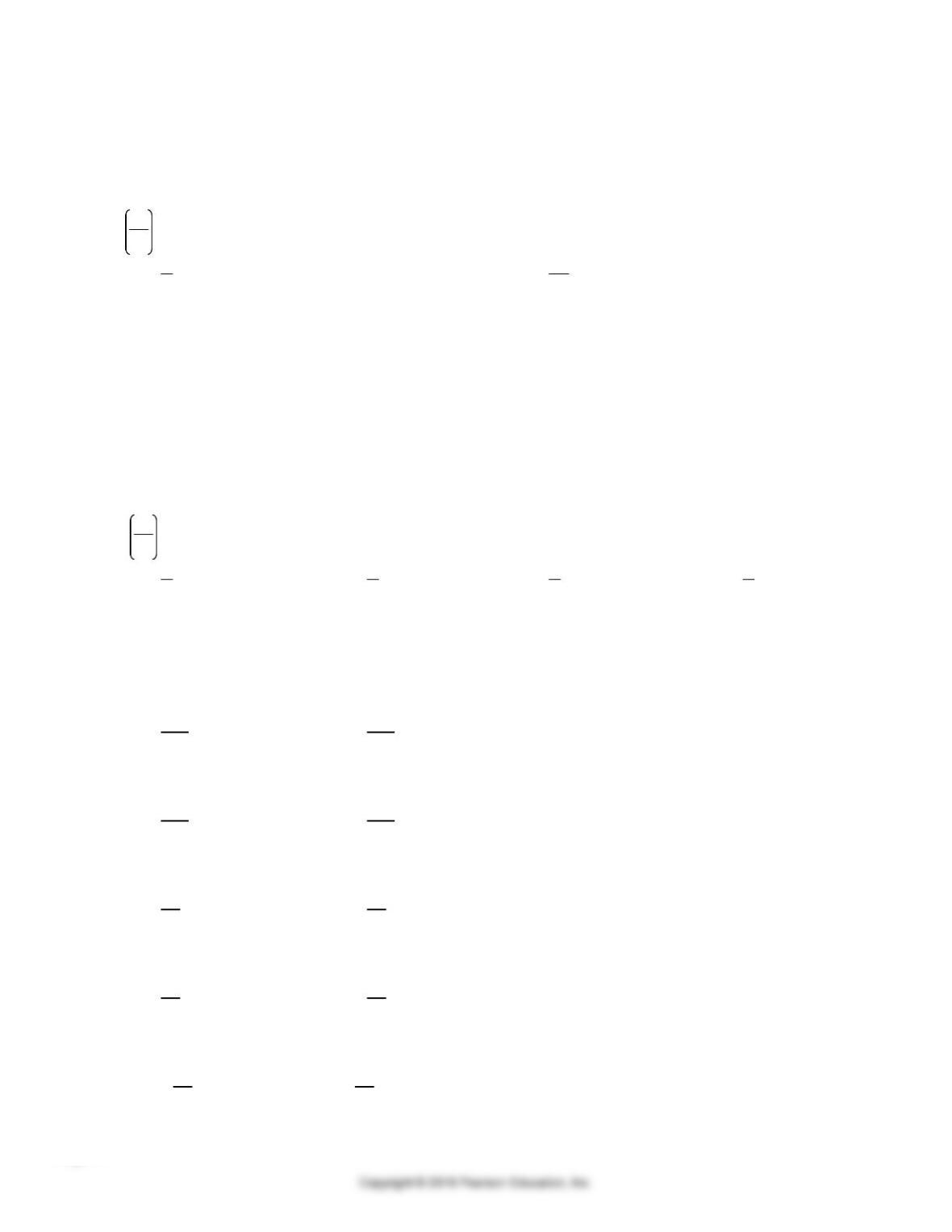
4 SimplifyExpressionswithRationalExponents
MULTIPLECHOICE.Choosetheonealternativethatbestcompletesthestatementoranswersthequestion.
Simplifytheexpression.
1) –321/5
A) –2B)16C)32D)
–8
2) 1
32
1
/
5
A) 1
2B) –2C)
–1
2D) 2
3) 274/3
A) 81 B) 729 C) 243 D) 2187
4) 165/4
A) 32 B) 256 C) 128 D) 512
5) 2434/5
A) 81 B) 6561 C) 2187 D) 19,683
6) 8
64
2/3
A) 1
4B) –1
4C) 1
6D) 1
2
7) (–27)4/3
A) 81 B) 729 C) –81 D) notarealnumber
8) 49–3/2
A) 1
343 B) –1
343 C) 343 D) –343
9) 64–4/3
A) 1
256 B) –1
256 C) 256 D) notarealnumber
10) 16–5/4
A) 1
32 B) –1
32 C) 32 D) notarealnumber
11) 32–4/5
A) 1
16 B) –1
16 C) 16 D) notarealnumber
12) –27–4/3
A) –1
81 B) 1
81 C) 81 D) notarealnumber
Page53

13) –243–4/5
A) –1
81 B) 1
81 C) 81 D) notarealnumber
14) 6251/2
A) 25 B) 50 C) 12.5 D) 100
15) 641/3
A) 4 B) 12 C) 256 D) 768
16) 161/4
A) 2 B) 8 C) 16 D) 32
17) 165/4
A) 32 B) 1024 C) 58D) 35
18) 2164/3
A) 1296 B) 46,656 C) 7776 D) 279,936
19) 815/4
A) 243 B) 6561 C) 2187 D) 19,683
20) 16–1/2
A) 1
4B) 4 C) –4D)
–1
4
21) 512–1/3
A) 1
8B) 1
24 C) –8D)8
22) 64–4/3
A) 1
256 B) –1
256 C) –256 D) 256
23) 16–5/4
A) 1
32 B) –1024 C) –1
32 D) –32
24) 4
9
3/2
A) 8
27 B) 27
8C) –27
8D) –8
27
25) 49
64
–1/2
A) 8
7B) 49
128 C) 7
8D) notarealnumber
Page54
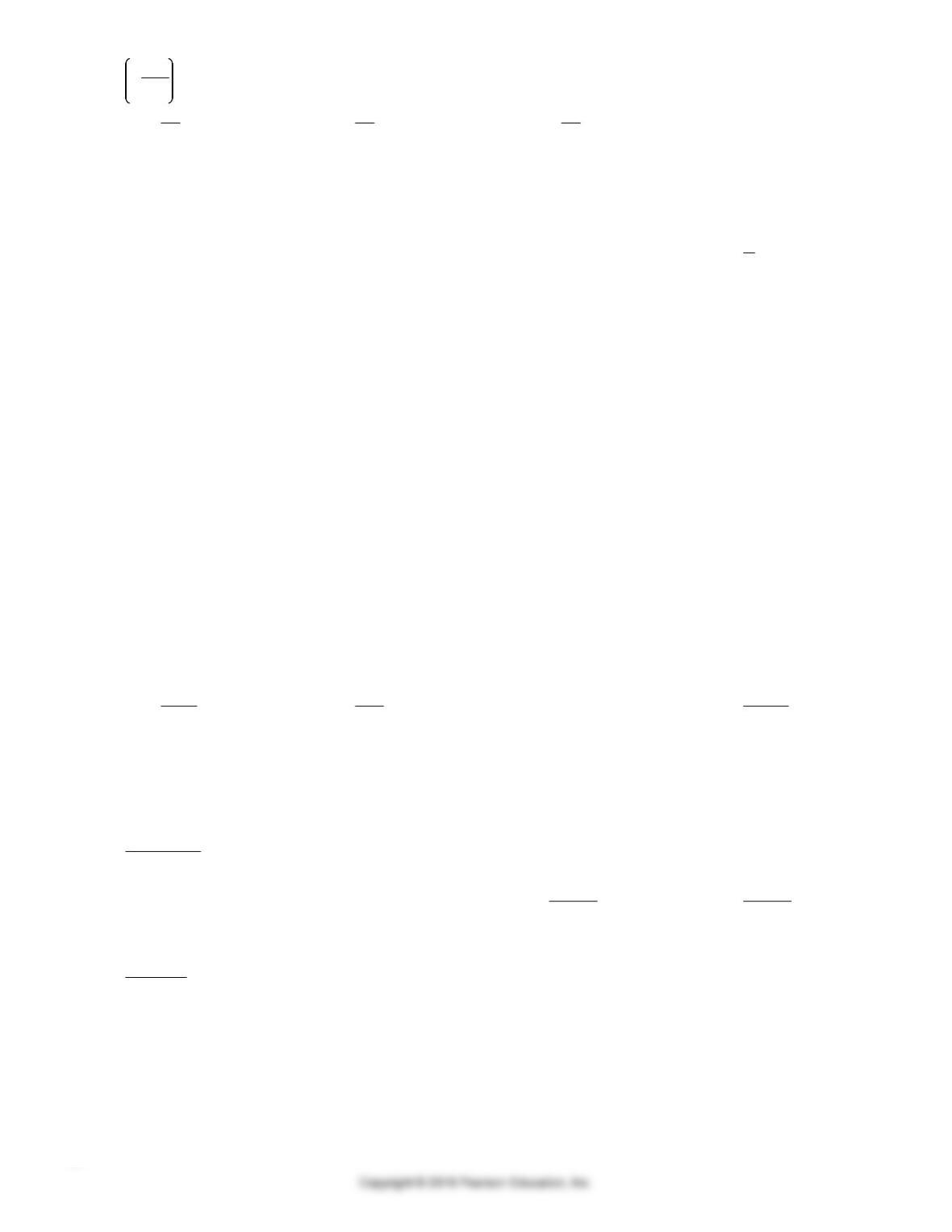
26) –125
27
–2/3
A) 9
25 B) 25
9C) –25
9D) notarealnumber
Simplifytheexpression.Expresstheanswersothatonlypositiveexponentsoccur.Assumethatallvariablesare
positive.
27) x5/8·x3/8
A) x B) x15/8 C) x15
/
64 D) 1
x
28) x–2
/
5·x3
/
5
A) x1
/
5B) x–1
/
5C) x6
/
5D) x5/6
29) (x14y7)1
/
7
A) x2yB)x
2|y| C) x14yD)x
2
30) (16x8y4)1
/
2
A) 4x4y2B) 4x4yC)x
4y2D) 4x8y2
31) (5x2
/
3)(9x1
/
4)
A) 45x11
/
12 B) 45x1
/
4C) 45x11
/
7D) 45x2
/
3
32) (x5y3)7
/
4
A) x35
/
4y21
/
4B) x27
/
4y19
/
4C) x21
/
4y35
/
4D) x20
/
7y12
/
7
33) (9x4y–14)3/2
A) 27x6
y21 B) 9x6
y21 C) 27x6y21 D) 27
x6y21
34) (9x1/5·y1/5)2
A) 81x2
/
5y2
/
5B) 81x1
/
25y1
/
25 C) 81x1
/
10y1
/
10 D) 81x2y2
35) x4
/
3·x1
/
2
x–6/5
A) x91
/
30 B) x19
/
30 C) 1
x91/30 D) 1
x19/30
36) (5x1/5)2
x1/6
A) 25x7
/
30 B) 25x17
/
30 C) 5x7
/
30 D) 5x17
/
30
Page55

Anexpressionthatoccursincalculusisgiven.Writetheexpressionasasinglequotientinwhichonlypositive
exponentsand/orradicalsappear.
37) (49–x2)1/2+3x2(49–x2)–1/2
49–x2
A) 49+2x2
(49–x2)3/2 B) 49–4x2
(49–x2)3/2 C) 3x2
(49–x2)3/2 D) 3x2
49–x2
38) 4x3/2(x3+x2)–6x5/2–6x3/2
A) 2x3/2(x+1)(2x2–3) B) 4x3/2(x3–1)+4x3–2x3/2(x–1)
C) x3/2(x–1)[4(x2–1)–2]+4x3D) 4x3/2(x+1)(2x2–3)
39) (x2–1)1/2·3
2(2x+5)1/2·2+(2x+5)3/2·1
2(x2–1)–1/2·2x
A) (2x+5)1/2(5x2+5x–3)
(x2–1)1/2 B) (2x+5)1/2(5x2+5x–3)
(x2–1)–1/2
C) (x2–1)1/2(2x+5)1/2(5x2+5x–3) D) (x2–1)1/2(2x+5)–1/2(5x2+5x–3)
40)
(x2+2)1/2·3
2(2x+1)1/2·2–(2x+1)3/2·1
2(x2+2)–1/2·2x
x2+2
A) (2x+1)1/2(x2–x+6)
(x2+2)3/2 B) (2x+1)1/2(x2–x+6)
(x2+2)–3/2
C) (x2+2)3/2(2x+1)1/2(x2–x+6) D) (x2+2)3/2(2x+1)–1/2(x2–x+6)
Factortheexpression.Expressyouranswersothatonlypositiveexponentsoccur.
41) x3
/
7+3x2
/
7
A) x2/7(x1
/
7+3) B) x2/7(x–1
/
7+3) C) x1/7(x3
/
7+3) D) x1/7(x1
/
7+3)
42) 13x1
/
7–7x–3
/
7
A) x–3
/
7(13x4
/
7–7) B) x1/3(13–7x4
/
7)
C) x–3
/
7(13x4
/
7–7x) D) x1
/
7(13x4
/
7–7x4
/
7)
43) x3
/
5+x2
/
5
A) x2
/
5(x1
/
5+1) B) x2
/
5(x1
/
5)C)x
2
/
5(x1
/
5–1) D) x2
/
5(x1
/
5+x)
44) x–2
/
7–x–3
/
7
A) x–3
/
7(x1
/
7–1) B) x–3
/
7(x1
/
7)C)x
–3
/
7(x1
/
7+1) D) x–3
/
7(x1
/
7–x)
45) (x+5)–3
/
5+(x+5)–1
/
5+(x+5)1/5
A) (x+5)–3
/
5[1+(x+5)2/5+(x+5)4
/
5]B)(x+5)–3
/
5[1+(x+5)–2
/
5+(x+5) –4
/
5]
C) (x+5)–3
/
5[1+(x+5)4
/
5+(x+5)6
/
5]D)(x+5)–3
/
5[1+(x+5)1
/
5+(x+5)3
/
5]
Page56

46) (2m+3)–2/5+(2m+3)1/5+(2m+3) 7/5
A) (2m+3)–2/5[1+(2m+3)3/5+(2m+3) 9
/
5]B)(2m+3)–2
/
5[1+(2m+3)4/5+(2m+3) 7
/
5]
C) (2m+3)–2/5[1+(2m+3)–3/5+(2m+3) –9
/
5]D)(2m+3)–2
/
5[1+(2m+3)3/5–(2m+3) 9
/
5]
Page57
Ch.0 ChapterR:Review
AnswerKey
0.1 RealNumbers
1 WorkwithSets
2 ClassifyNumbers
3 EvaluateNumericalExpressions
4 WorkwithPropertiesofRealNumbers
0.2 AlgebraEssentials
1 GraphInequalities
2 FindDistanceontheRealNumberLine
3 EvaluateAlgebraicExpressions
4 DeterminetheDomainofaVariable
5 UsetheLawsofExponents
6 EvaluateSquareRoots
7 UseaCalculatortoEvaluateExponents
8 UseScientificNotation
0.3 GeometryEssentials
1 UsethePythagoreanTheoremandItsConverse
2 KnowGeometryFormulas
3 UnderstandCongruentTrianglesandSimilarTriangles
0.4 Polynomials
1 RecognizeMonomials
2 RecognizePolynomials
3 AddandSubtractPolynomials
4 MultiplyPolynomials
5 KnowFormulasforSpecialProducts
6 DividePolynomialsUsingLongDivision
7 WorkwithPolynomialsinTwoVariables
0.5 FactoringPolynomials
1 FactortheDifferenceofTwoSquaresandtheSumandDifferenceofTwoCubes
2 FactorPerfectSquares
3 FactoraSecond–DegreePolynomial:x^2+Bx+C
4 FactorbyGrouping
5 FactoraSecond–DegreePolynomial:Ax^2+Bx+C,A≠1
6 CompletetheSquare
0.6 SyntheticDivisio
n
1 DividePolynomialsUsingSyntheticDivision
0.7 RationalExpressions
1 ReduceaRationalExpressiontoLowestTerms
2 MultiplyandDivideRationalExpressions
3 AddandSubtractRationalExpressions
4 UsetheLeastCommonMultipleMethod
5 SimplifyComplexRationalExpressions
0.8 nthRoots;RationalExponents
1 WorkwithnthRoots
2 SimplifyRadicals
3 RationalizeDenominators
4 SimplifyExpressionswithRationalExponents
Page69