
Ch. 0 Chapter R: Review
0.1 Real Numbers
1 Work with Sets
MULTIPLE CHOICE. Choose the one alternative that best completes the statement or answers the question.
Use U = universal set = {0, 1, 2, 3, 4, 5, 6, 7, 8, 9}, A ={1, 2, 3, 5, 8}, B ={2, 3, 5, 7}, and C = {1, 4, 9} to find the set.
1) B ∪ C
A) {1, 2, 3, 4, 5, 7, 9} B) { } C) {0} D) {1, 2, 3, 5, 7, 9}
2) A ∪ C
A) {1, 2, 3, 4, 5, 8, 9} B) {4, 6, 7, 9} C) {1} D) {1, 2, 3, 5, 7, 9}
3) A ∩ B
A) {2, 3, 5} B) {1, 2, 3, 5, 7, 8} C) {2, 3, 5, 7} D) {1, 2, 3, 5, 8}
4) A ∩ C
A) {1} B) {1, 2, 3, 4, 5, 7, 8, 9}
C) {4, 6, 7, 9} D) {1, 2, 3, 5, 7, 9}
5) (A ∩ B) ∪ C
A) {1, 2, 3, 4, 5, 9} B) {1, 2, 3, 5} C) {1, 2, 3} D) {2, 3, 5}
6) (B ∪ C) ∩ A
A) {1, 2, 3, 5} B) {1, 2, 3, 4, 5, 7, 9} C) { } D) {1, 2, 3}
7) B
A) {0, 1, 4, 6, 8, 9} B) {1, 4, 6, 8, 9} C) {0, 1, 4, 6, 7, 8, 9} D) {0, 1, 4, 6, 9}
8) A ∪ B
A) {0, 4, 6, 9} B) {4, 6, 9} C) {1, 4, 6, 8, 9} D) {1, 2, 3, 5, 7, 8}
9) A ∩ C
A) {0, 2, 3, 4, 5, 6, 7, 8, 9} B) {1}
C) {1, 2, 3, 4, 5, 7, 8, 9} D) {1, 2, 3, 4, 5, 6, 7, 8, 9}
10) B ∩ C
A) {0, 6, 8} B) {6, 8} C) {1, 2, 3, 4, 5, 7, 9} D) { }
2 Classify Numbers
MULTIPLE CHOICE. Choose the one alternative that best completes the statement or answers the question.
List all the elements of B that belong to the given set.
1) B = 11, 7, –9, 0, 3
7, – 7
3, 1.7
Integers
A) {11
,
–9
,
0} B) {11
,
0} C) {11
,
–9} D) {11, 0, 7}
Page 1

2) B = 7, 5, –6, 0, 2
3, –3
2, 7.5
Natural numbers
A) {7} B) 7, 0, – 3
2C) {7, 0} D) {–6
,
0, 7}
3) B = 8, 5, –15, 0, 0
3
Real numbers
A) 8, 5, –15, 0, 0
3B) {8
,
–15
,
0} C) 8, –15, 0, 0
3D) 8
,
–15
4) B = 5, 8, –5, 0, 0
8, 0.23
Rational numbers
A) 5, –5, 0, 0
8, 0.23 B) {5
,
0} C) { 8}D)8, 0
8, 0.23
5) B = 16, 5, –22, 0, 0
6, 0.73
Irrational numbers
A) { 5}B){5, 0.73} C) 5, 0
6D) 5, 0
6, 0.73
6) B = {1, 5, –11, 0, 3
5, – 5
3, 3.1, 16π, 0.165165165…}
Integers
A) {1
,
–11
,
0} B) {1
,
0} C) {1
,
–11} D) {1, 0, 5}
7) B = {13, 5, –18, 0, 1
4, –4, 7.8, 5π, 0.545454…}
Natural numbers
A) {13} B) 13
,
0, –4 C) {13
,
0} D) {–18
,
0, 13}
8) B = {20, 8, –13, 0, 0
6, 4, 0.53, –8π, 0.444…}
Rational numbers
A) 20, –13, 0, 0
6, 4, 0.53, 0.444... B) 20, –13, 0, 0
6, 0.53
C) 20, –13, 0, 0
6, 0.53, 0.444... D) 20, –13, 0, 0
6, 4, 0.53, –8π, 0.444…
Page 2

9) B = {19, 7, –16, 0, 0
6, , 0.06, –7π, 0.444…}
Irrational numbers
A) { 7, –7π}B){7
}C)7, 0
6 ,–7πD) { 7, –7π, 0.444…}
Approximate the number rounded to three decimal places, and truncated to three decimal places.
10) 2.9851
A) 2.985
2.985
B) 2.986
2.985
C) 2.985
2.986
D) 2.984
2.986
11) 0.66666667
A) 0.667
0.666
B) 0.668
0.666
C) 0.667
0.667
D) 0.666
0.667
12) 20
7
A) 2.857
2.857
B) 2.858
2.857
C) 2.857
2.858
D) 2.858
2.858
3 Evaluate Numerical Expressions
MULTIPLE CHOICE. Choose the one alternative that best completes the statement or answers the question.
Write the statement using symbols.
1) The sum of 52 and 13 is 65.
A) 52 + 13 = 65 B) 52
13 = 4C)52
·13 =676 D) 52 –13 =39
2) The difference 12 less 6 equals 6.
A) 12 – 6 = 6B)
12
6 = 2C)12
+6=18 D) 12 ·6=72
3) The product of 15 and 5 equals 75.
A) 15 · 5 = 75 B) 15
5 = 3C)15
+5=20 D) 15 –5=10
4) The quotient 60 divided by 12 is 5.
A) 60
12 = 5 B) 60 · 12 =720 C) 60 +12 =72 D) 60 –12 =48
5) The sum of four times x and 5 decreased by 7 is 8.
A) 4x + 5 – 7 = 8 B) 4(x +5) –7 =8C)7
–(4x +5) =8 D) 4(x +5 –7) =8
6) Three times the difference of x and 8 is –10.
A) 3(x – 8) = –10 B) 3 – x –8 = –10 C) 3x –8 = –10 D) 3 + x –8 = –10
7) The quotient of x and the sum of 5 and x.
A) x
5 + x B) x + 5 +x C) x(5 +x) D) x +5
x
Page 3

Evaluate the expression.
8) –9 + 3 + 8
A) 2 B) –14 C) –4D)
–20
9) 3 + 2
3
A) 11
3B) 9
3C) 11
2D) 9
2
10) 3 · [7(8 – 2) – 6]
A) 108 B) 18 C) 24 D) 14
11) 8 · [4 + 6 · (5 + 6)]
A) 560 B) 880 C) 98 D) 876
12) 5 – (–1 + 2 · –5 – 3)
A) 19 B) –9C)13D)17
13) 14
30 · 5
7
A) 1
3B) 3 C) 7
15 D) 6
7
14) 4
5 · 2
3 + 1
6
A) 2
3B) 8
15 C) 1
6D) 10
3
15) 1
6 · 9
– 1
5 + 10
A) 172
15 B) 113
10 C) 94
5D) 9
5
16) 1 + 2
7 + 6
A) 3
13 B) – 1
13 C) 3 D) – 1
17) 1 – 7
7 – 1
A) –1B)
1
7C) – 1
7D) –6
18) 5
8 + 4
15
A) 107
120 B) 9
23 C) 3
40 D) 107
23
Page 4
19) 5
7 – 2
6
A) 8
21 B) 1
14 C) 3
7D) 16
7
20)
5
12
4
7
A) 35
48 B) 48
35 C) 5
21 D) 21
5
21) 1
4 + 1
6 · 1
7
A) 23
84 B) 5
84 C) 31
24 D) 1
84
4 Work with Properties of Real Numbers
MULTIPLE CHOICE. Choose the one alternative that best completes the statement or answers the question.
Use the Distributive Property to remove the parentheses.
1) 8(x + 4)
A) 8x + 32 B) 8x +4C)x
+32 D) 32x
2) 3x(x + 2)
A) 3x2 + 6x B) 3x2 + 2C)x
2 + 6x D) 6x2
3) 3(6x + 10)
A) 18x + 30 B) 9x +13 C) 18x +10 D) 48x
4) 5 4
5x + 1
20
A) 4x + 1
4B) 4x + 1
5C) 4x + 1
20 D) 4
5x + 1
4
5) (x + 9)(x + 5)
A) x2 + 14x + 45 B) x2 + 45x + 14 C) x2 + 13x + 45 D) x2 + 14x + 14
6) (x – 6)(x + 1)
A) x2 – 5x – 6B)x
2 – 6x – 5C)x
2 – 6x – 6D)x
2 – 5x – 5
7) (x + 10)(x – 10)
A) x2 – 100 B) x2 – 20 C) x2 – 20x – 100 D) x2 + 20x – 100
Page 5
0.2 Algebra Essentials
1 Graph Inequalities
MULTIPLE CHOICE. Choose the one alternative that best completes the statement or answers the question.
On the real number line, label the points with the given coordinates.
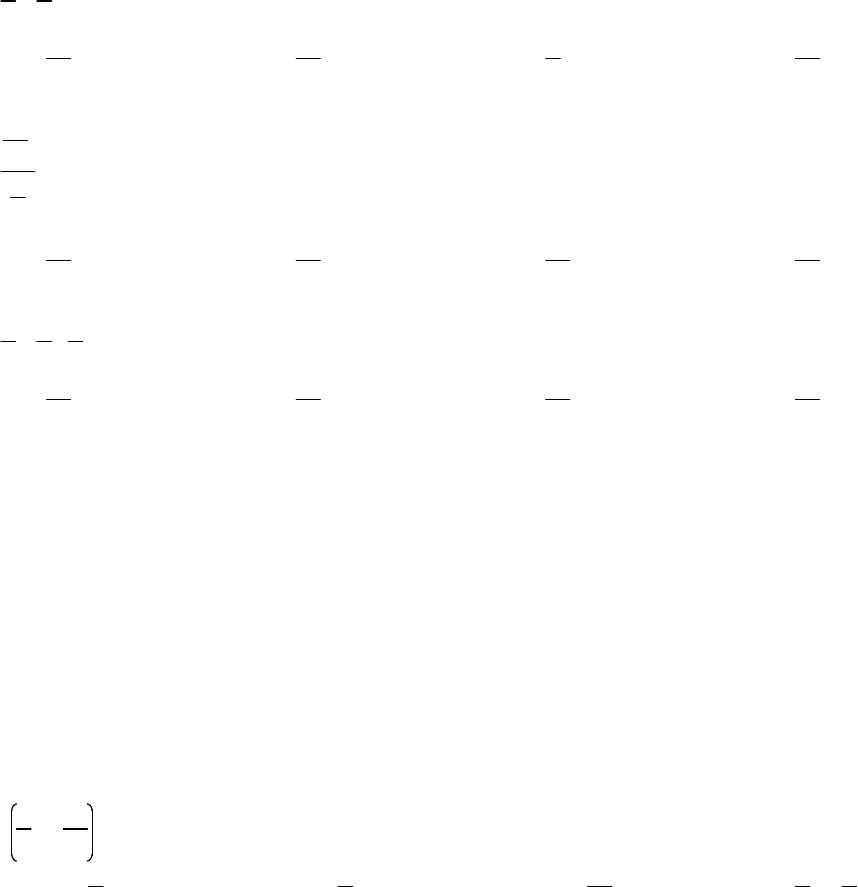
1) –7
,
–5
,
–3
,
–1
-8 -7 -6 -5 -4 -3 -2 -1 0 1-8 -7 -6 -5 -4 -3 -2 -1 0 1
A)
-8 -7 -6 -5 -4 -3 -2 -1 0 1-8 -7 -6 -5 -4 -3 -2 -1 0 1
B)
-8 -7 -6 -5 -4 -3 -2 -1 0 1-8 -7 -6 -5 -4 -3 -2 -1 0 1
C)
-8 -7 -6 -5 -4 -3 -2 -1 0 1-8 -7 -6 -5 -4 -3 -2 -1 0 1
D)
-8 -7 -6 -5 -4 -3 -2 -1 0 1-8 -7 -6 -5 -4 -3 -2 -1 0 1
2) –5.75, –3
,
–1
,
1.25
–6–5–4–3–2–10123–6–5–4–3–2–10123
A)
–6–5–4–3–2–10123–6–5–4–3–2–10123
B)
–6–5–4–3–2–10123–6–5–4–3–2–10123
C)
–6–5–4–3–2–10123–6–5–4–3–2–10123
D)
–6–5–4–3–2–10123–6–5–4–3–2–10123
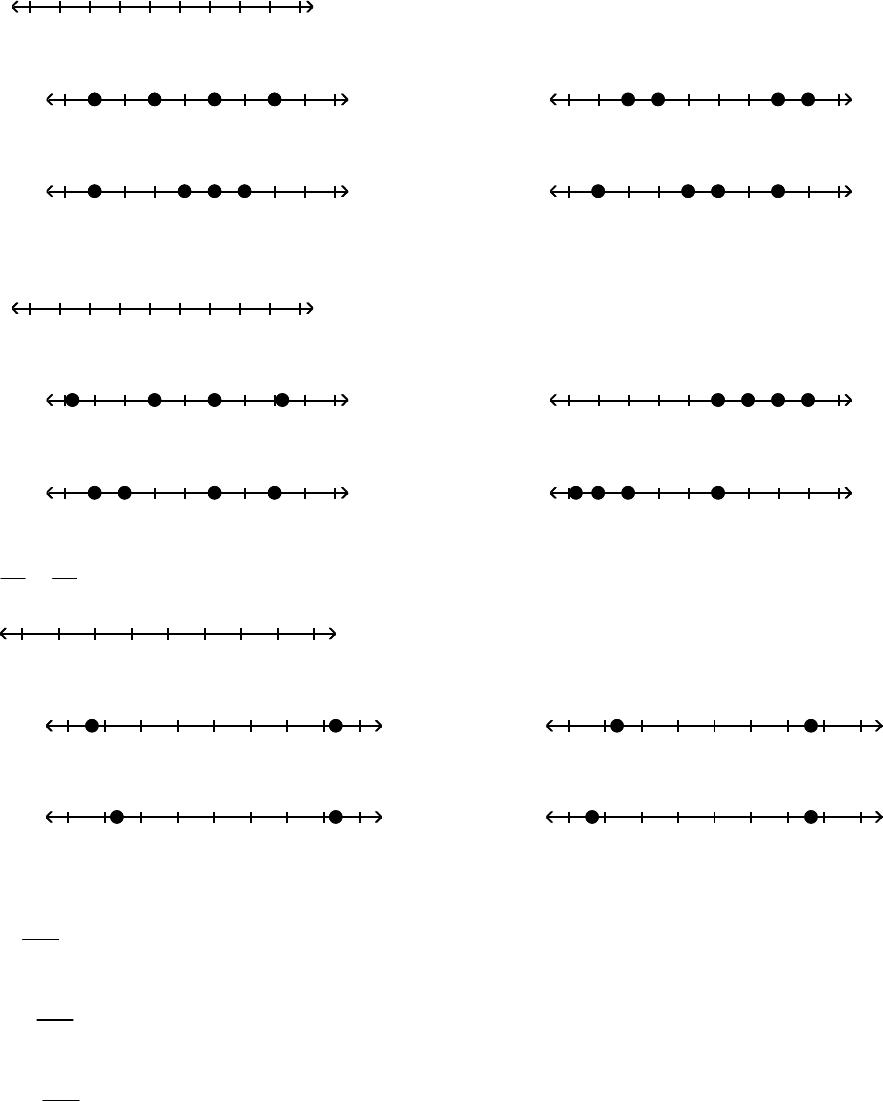
3) 10
3, – 10
3
-4 -3 -2 -1 0 1 2 3 4-4 -3 -2 -1 0 1 2 3 4
A)
-4 -3 -2 -1 0 1 2 3 4-4 -3 -2 -1 0 1 2 3 4
B)
-4 -3 -2 -1 0 1 2 3 4-4 -3 -2 -1 0 1 2 3 4
C)
-4 -3 -2 -1 0 1 2 3 4-4 -3 -2 -1 0 1 2 3 4
D)
-4 -3 -2 -1 0 1 2 3 4-4 -3 -2 -1 0 1 2 3 4
Insert <, >, or = to make the statement true.
4) 6 –1
A) >B)
<
C) =
5) 4.3 7.5
A)
<
B) >C) =
6) –22 –25
A) >B)
<
C) =
Page 6
7) 42 –42
A) >B)
<
C) =
8) 1
2 0.5
A) =B)
<
C) >
9) 2.23 5
A)
<
B) >C) =
10) 3.14 π
A)
<
B) >C) =
Write the statement as an inequality.
11) z is negative
A) z
<
0B)z > 0C)z
≤0D)z
≥ 0
12) y is greater than –92
A) y > –92 B) y
<
–92 C) y ≥–92 D) y ≤–92
13) y is greater than or equal to 55
A) y ≥ 55 B) y > 55 C) y
<
55 D) y ≤55
14) z is less than or equal to –6
A) z ≤ –6B)z
<
–6C)z
> –6D)z
= –6
15) x is less than 6
A) x
<
6B)x > 6C)x ≤6D)x
≥ 6
Graph the numbers on the real number line.
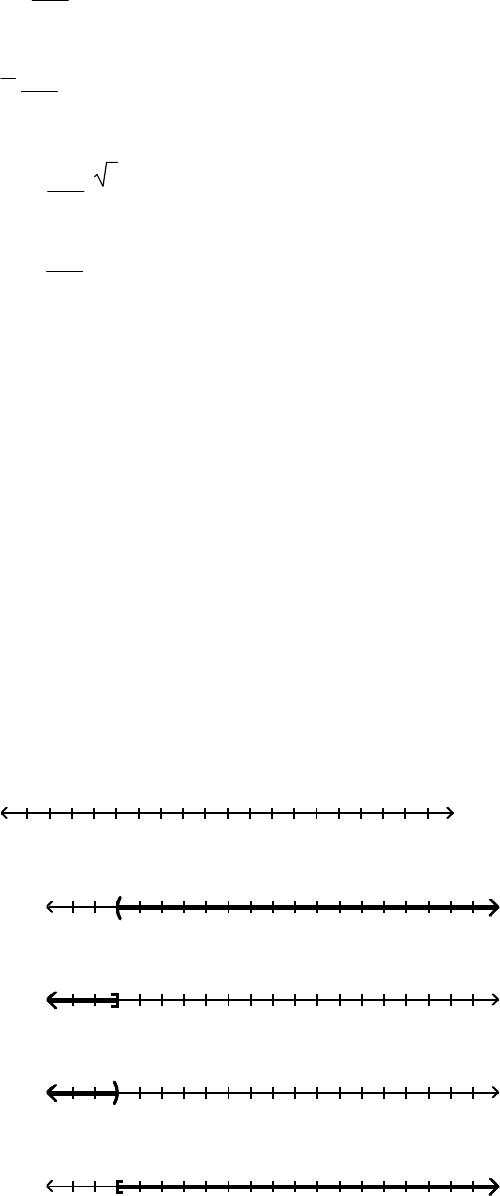
16) x > –7
–9–8–7–6–5–4–3–2–10123456789–9–8–7–6–5–4–3–2–10123456789
A)
–9–8–7–6–5–4–3–2–10123456789–9–8–7–6–5–4–3–2–10123456789
B)
–9–8–7–6–5–4–3–2–10123456789–9–8–7–6–5–4–3–2–10123456789
C)
–9–8–7–6–5–4–3–2–10123456789–9–8–7–6–5–4–3–2–10123456789
D)
–9–8–7–6–5–4–3–2–10123456789–9–8–7–6–5–4–3–2–10123456789
Page 7
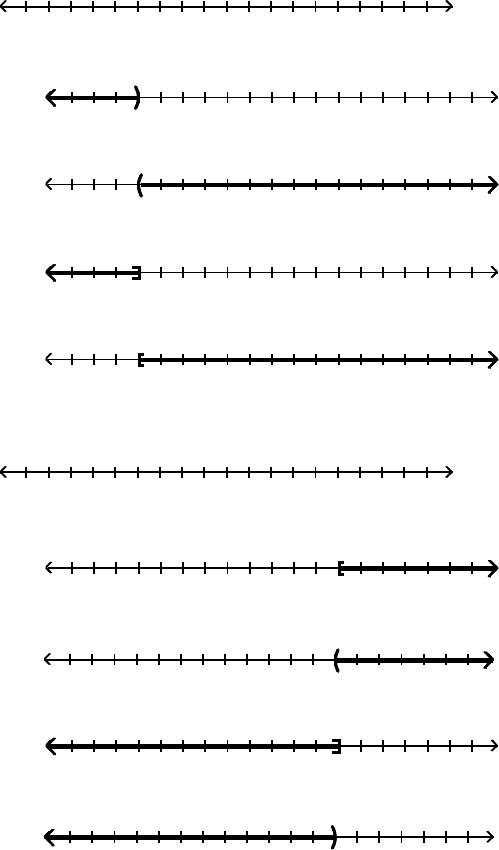
17) x
<
–6
–9–8–7–6–5–4–3–2–10123456789–9–8–7–6–5–4–3–2–10123456789
A)
–9–8–7–6–5–4–3–2–10123456789–9–8–7–6–5–4–3–2–10123456789
B)
–9–8–7–6–5–4–3–2–10123456789–9–8–7–6–5–4–3–2–10123456789
C)
–9–8–7–6–5–4–3–2–10123456789–9–8–7–6–5–4–3–2–10123456789
D)
–9–8–7–6–5–4–3–2–10123456789–9–8–7–6–5–4–3–2–10123456789
18) x ≥ 3
–9–8–7–6–5–4–3–2–10123456789–9–8–7–6–5–4–3–2–10123456789
A)
–9–8–7–6–5–4–3–2–10123456789–9–8–7–6–5–4–3–2–10123456789
B)
–9–8–7–6–5–4–3–2–10123456789–9–8–7–6–5–4–3–2–10123456789
C)
–9–8–7–6–5–4–3–2–10123456789–9–8–7–6–5–4–3–2–10123456789
D)
–9–8–7–6–5–4–3–2–10123456789–9–8–7–6–5–4–3–2–10123456789
Page 8
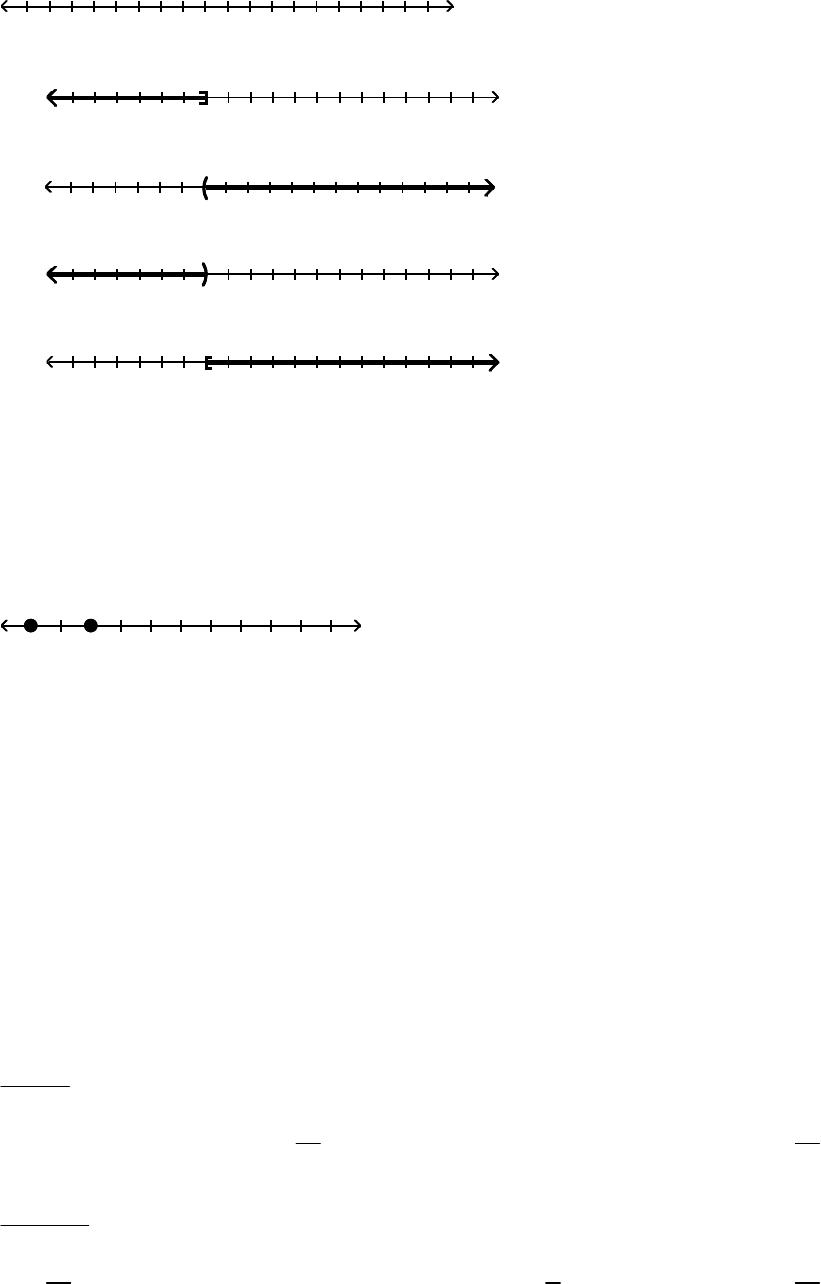
19) x ≤ –3
–9–8–7–6–5–4–3–2–10123456789–9–8–7–6–5–4–3–2–10123456789
A)
–9–8–7–6–5–4–3–2–10123456789–9–8–7–6–5–4–3–2–10123456789
B)
–9–8–7–6–5–4–3–2–10123456789–9–8–7–6–5–4–3–2–10123456789
C)
–9–8–7–6–5–4–3–2–10123456789–9–8–7–6–5–4–3–2–10123456789
D)
–9–8–7–6–5–4–3–2–10123456789–9–8–7–6–5–4–3–2–10123456789
2 Find Distance on the Real Number Line
MULTIPLE CHOICE. Choose the one alternative that best completes the statement or answers the question.
Use the given real number line to compute the distance.
1) Find d(A, B)
–5–4–3–2–1012345
A B
–5–4–3–2–1012345
A B
A) 2 B) –2 C) 3 D) 1
3 Evaluate Algebraic Expressions
MULTIPLE CHOICE. Choose the one alternative that best completes the statement or answers the question.
Evaluate the expression using the given values.
1) x + 8y x = 4
,
y = –3
A) –20 B) 1 C) 29 D) 12
2) –8xy + 9y – 4x = 5
,
y = –3
A) 89 B) 93 C) 97 D) –151
3) –9x + yx = 3
,
y = 3
A) –24 B) 30 C) 6 D) –6
4) 6x – 7y
8x = 10, y = 4
A) 4 B) 53
8C) 11 D) 23
4
5) 14x – 15y
x + 10 x = 8, y = 6
A) 11
9B) 2 C) 9
4D) 11
8
Page 9

6) 6xy + 20
xx = 5, y = 7
A) 46 B) 10 C) 62 D) 4
7) x + y x = –3
,
y = 2
A) 1 B) 5 C) –1D)
–5
8) x – y x = –6
,
y = 7
A) –1B)13C)1 D)
–13
9) 6x – 7y x = 5
,
y = 8
A) 26 B) 86 C) –26 D) –86
10) |x|
x + |y|
yx = 4 and y = –2
A) 0 B) 2 C) 1 D) –1
11) |2x – 6y| x = 5
,
y = 1
A) 4 B) 16 C) 28 D) 32
12) 4 x + 5y x = 6
,
y = –7
A) 59 B) –11 C) –59 D) 11
Use the formula C = 5
9(F – 32) for converting degrees Fahrenheit into degrees Celsius to find the Celsius measure of
the Fahrenheit temperature.
13) F = 212°
A) 100° C B) 105° C C) 95° C D) 110° C
Express the statement as an equation involving the indicated variables.
14) The area A of a rectangle is the product of its length l and its width w.
A) A = lw B) A = l +wC)A
=2(l +w) D) A = l
w
15) The perimeter P of a rectangle is twice the sum of its length l and its width w.
A) P = 2(l + w) B) P = l +wC)P
=lw D) P =2lw
16) The circumference C of a circle is the product of πand its diameter d.
A) C = πdB)C
= π
dC) C =π+dD)C
=2πd
17) The area A of a triangle is one–half the product of its base b and its height h.
A) A = 1
2bh B) A = 2bh C) A = 1
2(b + h) D) A =bh
18) The volume V of a sphere is 4
3 times π times the cube of the radius r.
A) V = 4
3
πr3B) V = 4
3
πr2C) V = 4
3
π 3r D) V = 4
3
πr
Page 10

19) The surface area S of a sphere is 4 times πtimes the square of the radius r.
A) S = 4πr2B) S = 4πrC)S
= 4π r D) S = πr2
20) The volume V of a cube is the cube of the length x of a side.
A) V = x3B) V = 3xC) V =3x D) V = x2
21) The surface area S of a cube is 6 times the square of the length x of a side.
A) S = 6x2B) S = 6x C) S = 6 + x2D) S = x2
Solve the problem.
22) The weekly production cost C of manufacturing x calendars is given by C(x) = 22 + 3x, where the variable
C is in dollars. What is the cost of producing 264 calendars?
A) $814.00 B) $5811.00 C) $792.00 D) $286.00
23) At the beginning of the month, Christopher had a balance of $165 in his checking account. During the next
month, he wrote a check for $50, deposited $110, and wrote another check for $68. What was his balance at
the end of the month?
A) $157 B) –$157 C) –$63 D) $63
4 Determine the Domain of a Variable
MULTIPLE CHOICE. Choose the one alternative that best completes the statement or answers the question.
Determine which value(s), if any, must be excluded from the domain of the variable in the expression.
1) x2 – 25
x
A) x = 0B)x = 5
,
x = –5C)x
=5
,
x =0D)x
= –5
2) 7x – 4
x2 – 4
A) x = 2
,
x = –2B)x
= 4C)x =2D)x
= 4
7
3) x3 + 8x4
x2 + 81
A) x = 0, x = – 1
8B) x = –81 C) x = –9 D) none
4) x2 + 10x + 7
x3 – 16x
A) x = 4
,
x = –4
,
x = 0B)x = 4
,
x = –4C)x
=0D)x
=4
,
x =0
5) x
x – 8
A) x = 8B)x = –8C)x
=0 D) none
6) 2
x + 3
A) x = –3B)x
= 3C)x =0 D) none
Page 11

7) x – 8
x – 3
A) x = 3B)x = –3C)x
=0 D) none
5 Use the Laws of Exponents
MULTIPLE CHOICE. Choose the one alternative that best completes the statement or answers the question.
Simplify the expression.
1) 53
A) 125 B) 15 C) –125 D) –15
2) –42
A) –16 B) 8 C) 16 D) –8
3) 2–4
A) 1
16 B) –16 C) 16 D) 1
8
4) (–3)–2
A) 1
9B) –9C)9 D)
– 1
9
5) –3–4
A) – 1
81 B) –81 C) 81 D) 1
12
6) (–5)3
A) –125 B) 125 C) –15 D) 15
7) 3–8 · 37
A) 1
3B) 3 C) 1 D) 1
9
8) (3–2)–1
A) 9 B) 1
9C) 1
3D) 3
Simplify the expression. Express the answer so that all exponents are positive. Whenever an exponent is 0 or
negative, we assume that the base is not 0.
9) (5xy)2
A) 25x2y2B) 25xy C) 5x2y2D) 1
25x2y2
10) (10x3)–2
A) 1
100x6B) 100x6C) x6
100 D) 100
x6
Page 12
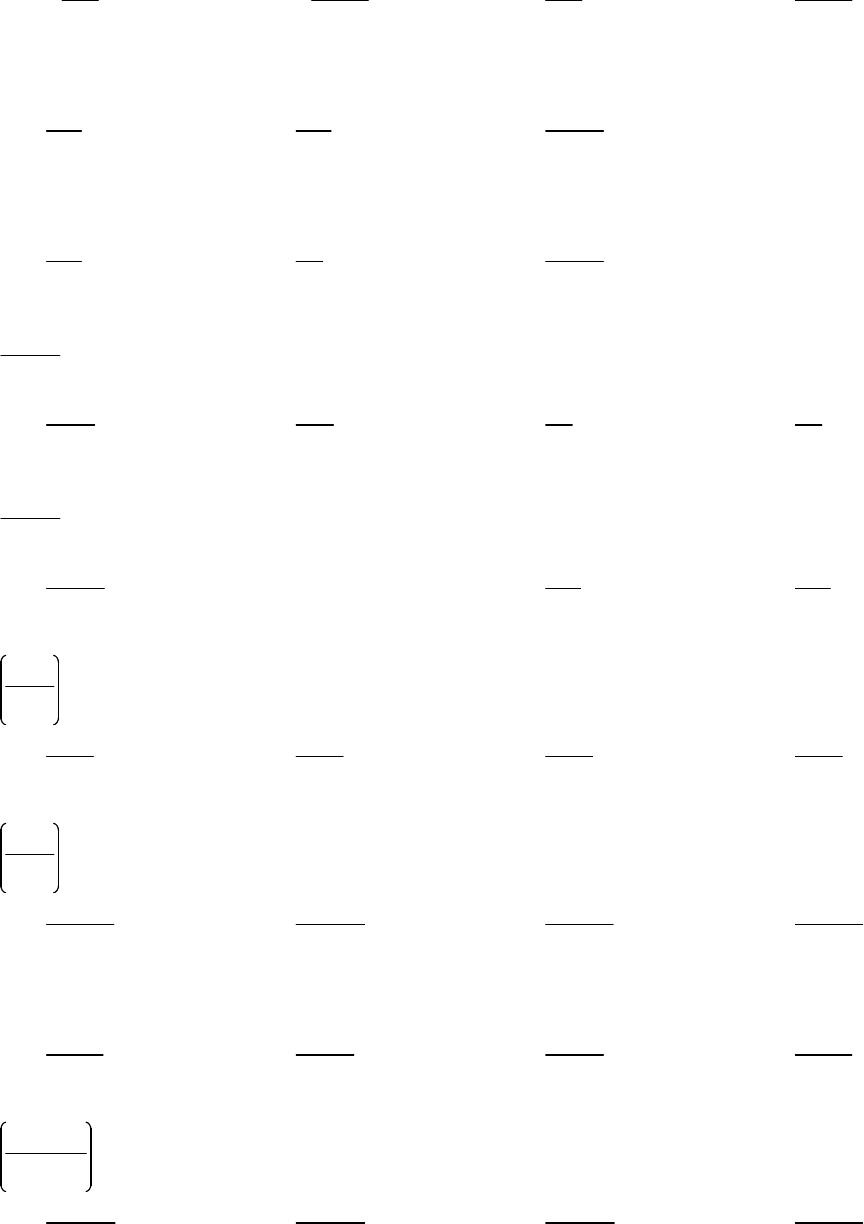
11) (–6x3)–1
A) – 1
6x3B) – 1
216x3C) 1
6x3D) 1
216x3
12) (x4y–1)4
A) x16
y4B) y4
x16 C) 1
x16y4D) x16y4
13) (x–4y)4
A) y4
x16 B) y4
x4C) 1
x16y4D) x16y4
14) x–2y6
xy9
A) 1
x3y3B) 1
xy3C) y3
x3D) x
y3
15) x–6y5
x7y13
A) 1
x13y8B) x13y8C) y8
x13 D) x13
y8
16) 6x–1
7y–1
–2
A) 49x2
36y2B) 36x2
49y2C) 49y2
36x2D) 36y2
49x2
17) 9x–4
8y–4
–3
A) 512x12
729y12 B) 729x43
512y43 C) 512y12
729x12 D) 729x12
512y12
18) (x–3y5)–4z7
A) x12z7
y20 B) y20z7
x12 C) x12
y20z7D) y20
x12z7
19) –6x4y–3
7z2
–2
A) 49y6z4
36x8B) 36x8
49y6z4C) 49z4
36x8y6D) 49y6
36x8z4
Page 13

Evaluate the expression using the given value of the variables.
20) (x + 3y)2 for x = 4, y = 2
A) 100 B) 10 C) 20 D) 49
21) 5x–1y2 for x = 2, y = 2
A) 10 B) 2
5C) 5
8D) 40
22) 3x2 + 2y2 for x = –2, y = 2
A) 20 B) 16 C) 4 D) 2
23) 6x3 – 5x2 – 5x + 9 for x = 2
A) 27 B) 47 C) 67 D) 9
Solve.
24) What is the value of (6666)2
(2222)2?
A) 9 B) (3333)2C) 18 D) (2222)2
6 Evaluate Square Roots
MULTIPLE CHOICE. Choose the one alternative that best completes the statement or answers the question.
Simplify the expression.
1) 4
A) 2 B) 16 C) 1
4D) not a real number
2) (–4)2
A) 4 B) 256 C) 1
16 D) not a real number
Find the value of the expression using the given values.
3) x2x = –9
A) 9 B) 3 2 C) –9D)
–32
4) ( x)2x = 3
A) 3 B) 9 C) 1
9D) 1
3
5) x2 + y2x = 9, y = 12
A) 15 B) 8 C) 11 D) 14
6) x2 + y2x = –1, y = 2
A) 5 B) 3 C) 1 D) 2
7) x2 + y
2x = 5, y = 9
A) 14 B) –4 C) 106 D) 4
Page 14

8) yxx = –3, y = 6
A) 1
216 B) 216 C) –216 D) – 1
216
7 Use a Calculator to Evaluate Exponents
MULTIPLE CHOICE. Choose the one alternative that best completes the statement or answers the question.
Use a calculator to evaluate the expression. Round the answer to three decimal places.
1) (–3.54)–3
A) –0.023 B) 0.023 C) –44.362 D) 44.362
2) –(0.09)–2
A) –123.457 B) 123.457 C) –0.008 D) 0.008
3) (1.85)–5
A) 0.046 B) –0.046 C) –21.670 D) 21.670
8 Use Scientific Notation
MULTIPLE CHOICE. Choose the one alternative that best completes the statement or answers the question.
Write the number in scientific notation.
1) 3,164,760
A) 3.16476 × 10⁶B) 3.16476 × 10⁷C) 3.16476 × 10⁻⁶D) 3.16476 × 101
2) 410.1
A) 4.101 × 10²B) 4.101 × 10⁻²C) 4.101 × 10³D) 4.101 × 10⁻³
3) 415.4
A) 4.154 × 10²B) 4.154 × 10⁻²C) 4.154 × 101D) 4.154 × 10⁻¹
4) 420
,
000
A) 4.2 × 10⁵B) 4.2 × 10⁻⁵C) 4.2 × 10⁶D) 4.2 × 10⁻⁶
5) 63,000,000
A) 6.3 × 10⁷B) 6.3 × 10⁻⁷C) 6.3 × 10⁶D) 6.3 × 10⁻⁶
6) 0.000167
A) 1.67 ∘ 10–4B) 1.67 × 10⁴C) 1.67 × 10⁻⁵D) 1.67 × 10⁻³
7) 0.000043511
A) 4.3511 × 10⁻⁵B) 4.3511 × 10⁵C) 4.3511 ± 10–4D) 4.3511 × 10⁴
8) 0.0000049414
A) 4.9414 × 10⁻⁶B) 4.9414 × 10⁶C) 4.9414 × 10⁻⁵D) 4.9414 × 10⁻⁷
9) 0.00000078402
A) 7.8402 × 10⁻⁷B) 7.8402 × 10⁷C) 7.8402 × 10⁻⁶D) 7.8402 × 10⁶
Page 15
10) 0.0000000875013
A) 8.75013 × 10⁻⁸B) 8.75013 × 10⁸C) 8.75013 × 10⁻⁷D) 8.75013 × 10⁻⁹
11) In a certain city
,
the subway system carried a total of 1,970,000,000 passengers.
A) 1.97 × 10⁹B) 19.7 × 10⁹C) 1.97 × 10⁸D) 1.97 × 10¹⁰
12) A business projects next year’s profits to be $543,000,000.
A) 5.43 × 10⁸B) 5.43 × 10⁷C) 5.43 × 10⁹D) 5.43 × 10⁻⁹
13) A computer compiles a program in 0.00000747 seconds.
A) 7.47 × 10⁻⁶B) 7.47 × 10⁻⁷C) 7.47 × 10⁻⁸D) 7.47 × 10⁵
Write the number as a decimal.
14) 1.19 × 10³
A) 1190 B) 11,900 C) 119 D) 35.7
15) 3.971 × 10⁵
A) 397,100 B) 3,971,000 C) 39,710 D) 198.55
16) 7.1948 × 10⁷
A) 71,948,000 B) 719,480,000 C) 7,194,800 D) 503.636
17) 3.27 × 10⁻⁴
A) 0.000327 B) 0.00327 C) 0.0000327 D) –327
,
000
18) 4.704 × 10⁻⁵
A) 0.00004704 B) 0.0004704 C) 0.000004704 D) –470,400
19) 5.546 × 10⁻⁶
A) 0.000005546 B) 0.00005546 C) 0.0000005546 D) –5
,
546
,
000
20) 3.0495 × 10⁻⁷
A) 0.00000030495 B) 0.0000030495 C) 0.000000030495 D) –304950
,
000
21) There are 2.248 × 10⁶ miles of highways, roads, and streets in a certain country.
A) 2,248,000 B) 22,480,000 C) 224,800 D) 224,800,000
0.3 Geometry Essentials
1 Use the Pythagorean Theorem and Its Converse
MULTIPLE CHOICE. Choose the one alternative that best completes the statement or answers the question.
The lengths of the legs of a right triangle are given. Find the hypotenuse.
1) a = 24
,
b = 7
A) 25 B) 20 C) 5 D) 625
2) a = 6
,
b = 8
A) 10 B) 5 C) 7 D) 9
Page 16

The lengths of the sides of a triangle are given. Determine if the triangle is a right triangle. If it is, identify the
hypotenuse.
3) 7
,
24
,
25
A) right triangle; 25 B) right triangle; 24 C) right triangle; 7 D) not right triangle
4) 5
,
6
,
7
A) right triangle; 7 B) right triangle; 6 C) right triangle; 5 D) not right triangle
5) 15
,
20
,
25
A) right triangle; 25 B) right triangle; 20
C) right triangle; 15 D) not a right triangle
6) 15
,
36
,
39
A) right triangle; 39 B) right triangle; 36
C) right triangle; 15 D) not a right triangle
7) 21
,
72
,
75
A) right triangle; 75 B) right triangle; 72
C) right triangle; 21 D) not a right triangle
8) 4
,
8
,
10
A) right triangle; 10 B) right triangle; 8
C) right triangle; 4 D) not a right triangle
9) 6
,
8
,
12
A) right triangle; 12 B) right triangle; 8
C) right triangle; 6 D) not a right triangle
Solve. Use the fact that the radius of the Earth is 3960 miles and 1 mile =5280 feet.
10) A guard tower at a state prison stands 114 feet tall. How far can a guard see from the top of the tower?
Round to the nearest tenth of a mile.
A) 13.1 mi B) 5600.3 mi C) 18.5 mi D) 957 mi
11) A person who is 6 feet tall is standing on the beach and looks out onto the ocean. Suddenly, a ship
appears on the horizon. How far is the ship from the shore? Round to the nearest tenth of a mile.
A) 3 mi B) 5600.3 mi C) 4.2 mi D) 218.1 mi
2 Know Geometry Formulas
MULTIPLE CHOICE. Choose the one alternative that best completes the statement or answers the question.
Solve the problem.
1) Find the area A of a rectangle with length 22 ft and width 24 ft.
A) A = 528 ft2B) A = 1056 ft2C) A = 46 ft2D) A = 88 ft2
2) Find the area A of a rectangle with length 2.6 m and width 11.8 m.
A) A = 30.68 m2B) A = 61.36 m2C) A = 14.4 m2D) A = 10.4 m2
3) Find the area A of a triangle with height 7 in and base 3 in.
A) A = 21
2 in2B) A = 21
2 in C) A = 21 in2D) A =21 in
Page 17

4) Find the area A and circumference C of a circle of radius 11 yd. Express the answer in terms of π.
A) A = 121π yd2; C = 22π yd B) A = 22π yd2; C = 22π yd
C) A = 484π yd2; C = 11π yd D) A = 44π yd2; C = 11π yd
5) Find the area A and circumference C of a circle of diameter 9 ft. Use 3.14 for π. Round the result to the
nearest tenth.
A) A = 63.6 ft2; C = 28.3 ft B) A = 28.3 ft2; C = 28.3 ft
C) A = 254.3 ft2; C = 14.1 ft D) A = 56.5 ft2; C = 14.1 ft
6) Find the volume V of a rectangular box with length 8 in.
,
width 6 in.
,
and height 9 in..
A) V = 432 in.3B) V = 288 in.3C) V = 486 in.3D) V = 576 in.3
7) Find the surface area S of a rectangular box with length 3 ft, width 5 ft, and height
3 ft.
A) 78 ft2B) 90 ft2C) 39 ft2D) 63 ft2
8) Find the volume V and surface area S of a sphere of radius 7 centimeters. Express the answer in terms of π.
A) V = 1372
3
π cm3; S = 196π cm2B) V = 343
3
π cm3; S = 1372
3
π cm2
C) V = 1372π cm3; S = 49
4
π cm2D) V = 343π cm3; S = 49π cm2
9) Find the volume V of a sphere of radius 2.5 cm. Use 3.14 for π. If necessary, round the result to the nearest
tenth.
A) V = 65.4 cm3B) V = 26.2 cm3C) V = 36.8 cm3D) V = 523.3 cm3
10) Find the volume V of a right circular cylinder with radius 13 yd and height 18 yd. Express the answer in
terms of π.
A) V = 3042π yd3B) V = 1521
2
π yd3C) V = 234π yd3D) V = 117π yd3
11) Find the surface area S of a right circular cylinder with radius 6 cm, and height 5 cm. Use 3.14 for π.
Round your answer to one decimal place.
A) 414.4 cm2B) 207.2 cm2C) 565.2 cm2D) 320.3 cm2
12) Find the volume V of a sphere of diameter 6 in. Use 3.14 for π. If necessary, round the result to the nearest
tenth.
A) V = 113 in3B) V = 37.7 in3C) V = 63.6 in3D) V = 904.3 in3
Page 18
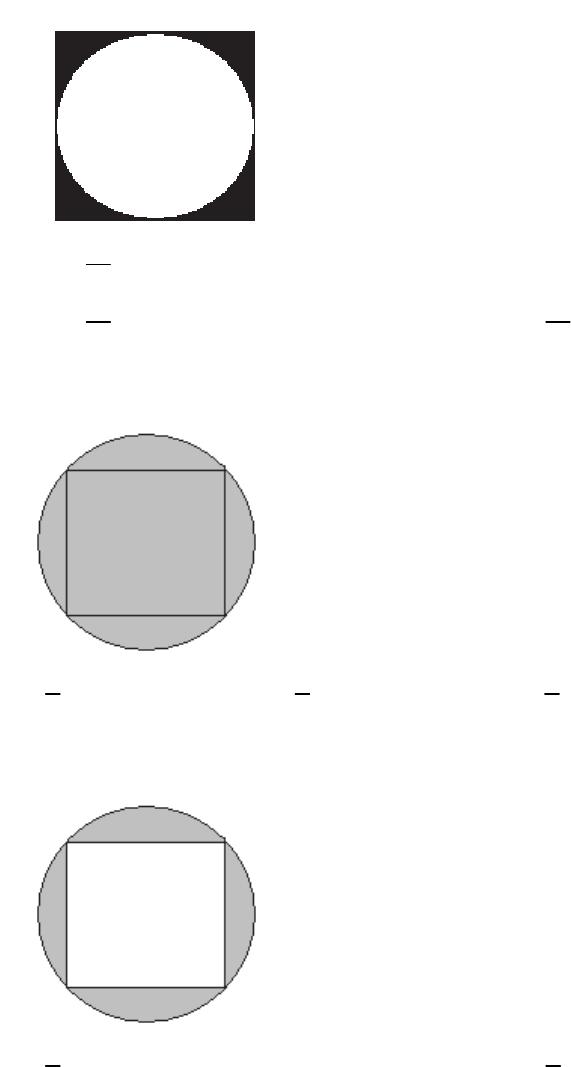
13) Find the area of the shaded region. Express the answer in terms of π.
5
5
A) 25 – 25
4
π square units B) 100 –25πsquare units
C) 25 – 25
2
π square units D) 25
4
π + 25 square units
14) Find the area of the shaded region. Express the answer in terms of π.
3
3
A) 9
2
π square units B) 9
4
π square units C) 9
2 square units D) 3π square units
15) Find the area of the shaded region. Express the answer in terms of π.
1
1
A) 1
2
π – 1 square units B) 1
4
π– 1 square units
C) 1 square units D) 1π–1 square units
16) A bicycle wheel makes 3 revolutions. Determine how far the bicycle travels in inches if the diameter of the
wheel is 22 in. Use π ≈ 3.14. Round to the nearest tenth.
A) 207.2 in. B) 69.1 in. C) 66 in. D) 414.5 in.
Page 19
17) A rectangular patio has dimensions 10 feet by 15 feet. The patio is surrounded by a border with a uniform
width of 3 feet. Find the area of the border.
A) 186 ft2B) 84 ft2C) 162 ft2D) 114 ft2
18) A circular swimming pool, 20 feet in diameter, is enclosed by a circular deck that is 6 feet wide. What is the
area of the deck? Use π = 3.1416.
A) 490.1 ft2B) 772.8 ft2C) 1206.4 ft2D) 314.2 ft2
19) Find the perimeter. Approximate the result to the nearest tenth using 3.14 for π.
7 cm
5 cm
A) 26.9 cm B) 34.7 cm C) 31.9 cm D) 39.7 cm
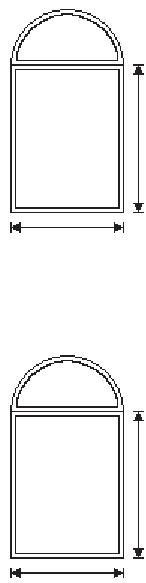
20) Find the area of the window. Approximate the result to the nearest tenth using 3.14 for π.
9 ft
6 ft
A) 68.1 ft2B) 167 ft2C) 110.5 ft2D) 58.7 ft2
Page 20
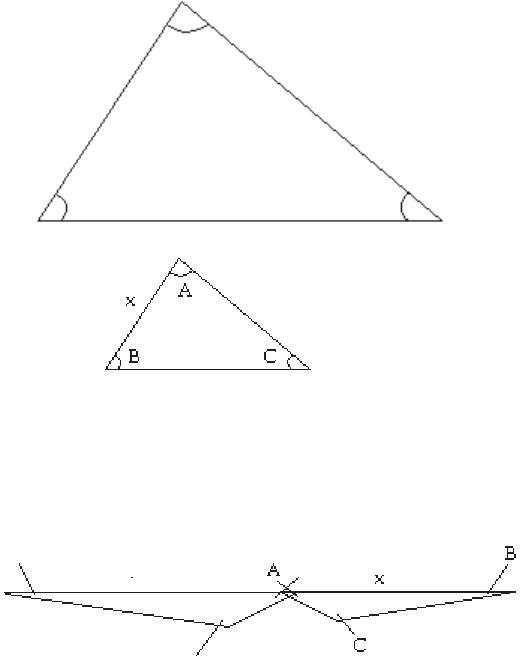
3 Understand Congruent Triangles and Similar Triangles
MULTIPLE CHOICE. Choose the one alternative that best completes the statement or answers the question.
The triangles are similar. Find the missing length x and the missing angles A, B, C.
1)
97°
27 30
38° 45°
10
A) x = 9 units; A = 97°; B = 38°; C =45° B) x =27 units; A =38°; B = 97°; C =45°
C) x = 9 units; A = 45°; B = 38°; C =97° D) x =27 units; A =97°; B = 38°; C =45°
2)
9°
35°
57
8
24
136°
A) x = 19; A = 35; B =9; C = 136 B) x =57; A =9; B = 35; C = 136
C) x = 19; A = 136; B = 9; C = 35 D) x =57; A =35; B = 9; C = 136
Solve. If necessary, round to the nearest tenth.
3) A flagpole casts a shadow of 28 feet. Nearby, a 10–foot tree casts a shadow of 6 feet. What is the height of
the flagpole?
A) 46.7 ft B) 16.8 ft C) 2.1 ft D) 1680 ft
4) If a flagpole 12 feet tall casts a shadow that is 16 feet long, find the length of the shadow cast by an antenna
which is 42 feet tall.
A) 56 ft B) 31.5 ft C) 4.6 ft D) 46 ft
5) The zoo has hired a landscape architect to design the triangular lobby of the children’s petting zoo. In his
scale drawing, the longest side of the lobby is 9 cm. The shortest side of the lobby is 6 cm. The longest side
of the actual lobby will be 35 m. How long will the shortest side of the actual lobby be?
A) 23.3 m B) 0.2 m C) 52.5 m D) 0.5 m
Page 21

6) If a tree 37.5 feet tall casts a shadow that is 15 feet long, find the height of a tree casting a shadow that is 11
feet long.
A) 27.5 ft B) 4.4 ft C) 51.1 ft D) 33.5 ft
0.4 Polynomials
1 Recognize Monomials
MULTIPLE CHOICE. Choose the one alternative that best completes the statement or answers the question.
Tell whether the expression is a monomial. If it is, name the variable(s) and coefficient, and give the degree of the
monomial.
1) 20x
A) Monomial; variable x; coefficient 20; degree 1
B) Monomial, variable x; coefficient 1; degree 20
C) Monomial,; variable x; coefficient 20; degree 0
D) Not a monomial
2) –16x6
A) Monomial; variable x; coefficient –16; degree 6
B) Monomial; variable x; coefficient 6; degree –16
C) Monomial; variable x; coefficient 6; degree 0
D) Not a monomial
3) 13
x
A) Monomial; variable x; coefficient 13; degree 1
B) Monomial; variable x; coefficient 13; degree –1
C) Monomial; variable x; coefficient 13; degree 0
D) Not a monomial
4) 5x–2
A) Monomial; variable x; coefficient 5; degree –2 B) Monomial; variable x; coefficient 2; degree 5
C) Monomial; variable x; coefficient 5; degree 2 D) Not a monomial
5) –6xy7
A) Monomial; variables x, y; coefficient –6; degree 8
B) Monomial; variables x, y; coefficient –6; degree 7
C) Monomial; variables x, y; coefficient –6; degree 1
D) Not a monomial
6) 4x4y2
A) Monomial; variables x, y; coefficient 4; degree 6
B) Monomial; variables x, y; coefficient 4; degree 4
C) Monomial; variables x, y; coefficient 4; degree 2
D) Not a monomial
Page 22

7) 15x
y
A) Monomial; variables x, y; coefficient 15; degree 1
B) Monomial; variables x, y; coefficient 15; degree –2
C) Monomial; variables x, y; coefficient 15; degree 2
D) Not a monomial
8) – –5x9
y3
A) Monomial; variables x, y; coefficient –5; degree 9
B) Monomial; variables x, y; coefficient –5; degree 3
C) Monomial; variables x, y; coefficient –5; degree 6
D) Not a monomial
9) 5x2 – 4
A) Monomial; variable x; coefficient 5; degree 2 B) Monomial; variable x; coefficient 4 ; degree 2
C) Monomial; variable x; coefficient 5; degree 1 D) Not a monomial
2 Recognize Polynomials
MULTIPLE CHOICE. Choose the one alternative that best completes the statement or answers the question.
Tell whether the expression is a polynomial. If it is, give its degree.
1) 7x4 – 3
A) Polynomial; degree 4 B) Polynomial; degree 3
C) Polynomial; degree 7 D) Not a polynomial
2) 1 – 5x
A) Polynomial; degree 1 B) Polynomial; degree 5
C) Polynomial; degree –5 D) Not a polynomial
3) 16
A) Polynomial, degree 0 B) Polynomial, degree 1
C) Polynomial, degree 16 D) Not a polynomial
4) 5π
A) polynomial, degree 0 B) polynomial, degree 1
C) polynomial, degree 5 D) not a polynomial
5) 7x5 – 3
x
A) Polynomial; degree 5 B) Polynomial; degree –1
C) Polynomial; degree 1 D) Not a polynomial
6) 9
x + 1
A) Polynomial, degree 0 B) Polynomial, degree –1
C) Polynomial, degree 9 D) Not a Polynomial
7) –5y4 – 2
A) Polynomial; degree 4 B) Polynomial; degree –5
C) Polynomial; degree 2 D) Not a polynomial
Page 23

8) –8z5 + z
A) Polynomial; degree 5 B) Polynomial; degree 6
C) Polynomial; degree 1 D) Not a polynomial
9) 12x11 – 36x7
4x3
A) Polynomial; degree 7 B) Polynomial; degree 11
C) Polynomial; degree 0 D) Not a polynomial
3 Add and Subtract Polynomials
MULTIPLE CHOICE. Choose the one alternative that best completes the statement or answers the question.
Add or subtract as indicated. Express the answer as a single polynomial in standard form.
1) (14x2 + 12x – 15) + (24x + 15)
A) 14x2 + 36x B) 14x2 + 36x – 30 C) 14x2 + 12x + 30 D) 50x3
2) (8x2 + 4x + 3) + (6x2 + 4x + 9)
A) 14x2 + 8x + 12 B) 9x2 + 12x + 13 C) 14x2 – 8x + 12 D) 14x2 + 8x – 12
3) (9x2 + 16x + 13) – (3x2 + 12x – 9)
A) 6x2 + 4x + 22 B) 6x2 + 19x + 4C)6x
2 + 4x + 4D)6x
2 + 4x – 22
4) (2x3 – 9x2) + (6x3 – 9x2)
A) 8x3 – 18x2B) 8x6 – 18x4C) –10x5D) –10x10
5) (–6x5 + 5x2) – (–10x5 – 3x2)
A) 4x5 + 8x2B) 4x5 + 2x2C) 12x7D) –16x5 + 2x2
6) (6x6 + 7x4) + (2x6 + 5x4 + 4)
A) 8x6 + 12x4 + 4B)4x
6 + 11x4 + 4x C) 4x + 12x6 + 6x4D) 26x11
7) (–5x2 – 5) – (–x3 + 10x2 + 8)
A) x3 – 15x2 – 13 B) –4x3 + 5x2 – 8C)x
3 + 5x2 + 3D)
–4x3 + 10x2 – 13
8) (9x7 – 3x6 – 9) – (5x7 + 7x6 – 18)
A) 4x7 – 10x6 + 9B)4x
7 + 2x6 – 27 C) 4x7 – 10x6 – 27 D) 3x13
9) (9x6 + 14x4 – 11) – (3x4 + 5x6 + 11)
A) 4x6 + 11x4 – 22 B) 4x6 + 19x4 + 0C)4x
6 + 11x4 + 0D)
–7x10
10) (7x7 – 5x6 – 8x) + (3x7 – 9x6 – 7x)
A) 10x7 – 14x6 – 15x B) –5x7 – 2x6 – 12x C) 10x – 14x7 – 15x6D) –19x14
11) –3(x2 + 6x + 1) + (–5x2 – x + 1)
A) –8x2 – 19x – 2B)2x
2 – 19x – 2C)
–8x2 – 18x – 2D)
–8x2 – 19x + 2
Page 24
12) 5(2x3 + x2 – 1) – 4(9x3 – 2x + 2)
A) –26x3 + 5x2 + 8x – 13 B) –26x3 + 5x2 – 8x – 13
C) –26x3 + x2 + 8x – 13 D) –26x3 + 5x2 + 8x + 13
13) (x2 + 1) – (4x2 + 6) + (x2 + x – 9)
A) –2x2 + x – 14 B) –4x2 + x – 14 C) –3x2 + x – 14 D) –2x2 + 7x – 8
14) 7(1 – y3) – 5(1 + y + y2 + y3)
A) –12y3 – 5y2 – 5y + 2B)
–12y3 + 5y2 – 5y – 2
C) –12y3 – 5 – ay2 – 5y + 2 D) 12y3 – 5y2 – 5y + 2
4 Multiply Polynomials
MULTIPLE CHOICE. Choose the one alternative that best completes the statement or answers the question.
Perform the indicated operations. Express the answer as a single polynomial in standard form.
1) –10x(–2x + 5)
A) 20x2 – 50x B) –30x2C) 20x2 + 5x D) –2x2 – 50x
2) –6x3(–10x – 12)
A) 60x4 + 72x3B) 60x + 72 C) 60x4 – 12 D) 132x3
3) 10x5(–10x7 – 5)
A) –100x12 – 50x5B) –100x7 – 50 C) –100x12 – 5D)
–150x5
4) 6x3(7x7 + 4x6 + 5)
A) 42x10 + 24x9 + 30x3B) 42x10 + 24x9
C) 42x10 + 4x6 + 5 D) 42x7 + 24x6 + 30
5) (x – 12)(x2 + 4x – 8)
A) x3 – 8x2 – 56x + 96 B) x3 + 16x2 + 40x – 96
C) x3 – 8x2 – 40x – 96 D) x3 + 16x2 + 56x + 96
6) (5y + 11)(3y2 – 2y – 8)
A) 15y3 + 23y2 – 62y – 88 B) 15y3 – 10y2 – 40y + 11
C) 48y2 – 32y – 128 D) 15y3 + 43y2 + 62y + 88
Multiply the polynomials using the FOIL method. Express the answer as a single polynomial in standard form.
7) (x + 4)(x + 3)
A) x2 + 7x + 12 B) x2 + 12x + 7C)x
2 + 6x + 12 D) x2 + 7x + 7
8) (2x – 7)(x – 7)
A) 2x2 – 21x + 49 B) 2x2 + 49x – 21 C) 2x2 – 21x – 21 D) 2x2 – 23x + 49
9) (3x – 4)(5x – 4)
A) 15x2 – 32x + 16 B) 8x2 – 32x + 16 C) 15x2 – 32x – 32 D) 8x2 – 32x – 32
Page 25
10) (x + 7y)(x + 2y)
A) x2 + 9xy + 14y2B) x + 9xy +14y C) x2 + 9xy + 9y2D) x2 + 6xy + 14y2
11) (x + 2y)(3x + 8y)
A) 3x2 + 14xy + 16y2B) x2 + 14xy + 16y2C) 3x2 + 14xy + 14y2D) x2 + 14xy + 14y2
12) (–2x + 2y)(–5x – 12y)
A) 10x2 + 14xy – 24y2B) 10x2 – 10xy – 24y2
C) 10x2 + 24xy – 24y2D) 10x2 + 14xy + 14y2
5 Know Formulas for Special Products
MULTIPLE CHOICE. Choose the one alternative that best completes the statement or answers the question.
Multiply the polynomials. Express the answer as a single polynomial in standard form.
1) (x + 8)(x – 8)
A) x2 – 64 B) x2 – 16 C) x2 – 16x – 64 D) x2 + 16x – 64
2) (7x + 2)(7x – 2)
A) 49x2 – 4B)x
2 – 4 C) 49x2 – 28x – 4 D) 49x2 + 28x – 4
3) (x + 3)2
A) x2 + 6x + 9B)x
2 + 9C)9x
2 + 6x + 9D)x + 9
4) (x – 2)2
A) x2 – 4x + 4B)x
2 + 4C)4x
2 – 4x + 4D)x + 4
5) (5x + 7)2
A) 25x2 + 70x + 49 B) 25x2 + 49 C) 5x2 + 70x + 49 D) 5x2 + 49
6) (x + 4y)(x – 4y)
A) x2 – 16y2B) x2 – 8y2C) x2 – 8xy – 16y2D) x2 + 8xy – 16y2
7) (5y + x)(5y – x)
A) 25y2 – x2B) 10y2 – x2C) 25y2 – 10xy – x2D) 25y2 + 10xy – x2
8) (7x – 11)2
A) 49x2 – 154x + 121 B) 49x2 + 121 C) 7x2 – 154x + 121 D) 7x2 + 121
9) (x – s)2
A) x2 – 2xs + s2B) x2 – xs + s2C) x2 – 2xs – s2D) x2 + 2xs + s2
10) (5x + 9y)2
A) 25x2 + 90xy + 81y2B) 25x2 + 81y2
C) 5x2 + 90xy + 81y2D) 5x2 + 81y2
11) (8x – 9y)2
A) 64x2 – 144xy + 81y2B) 64x2 + 81y2
C) 8x2 – 144xy + 81y2D) 8x2 + 81y2
Page 26

12) (x + 3)3
A) x3 + 9x2 + 27x + 27 B) x3 + 3x2 + 3x + 27
C) x3 + 9x2 + 3x + 27 D) x3 + 9x2 + 9x + 27
13) (2x + 5)3
A) 8x3 + 60x2 + 150x + 125 B) 8x3 + 60x2 + 60x + 125
C) 4x6 + 10x3 + 15,625 D) 4x2 + 20x + 25
6 Divide Polynomials Using Long Division
MULTIPLE CHOICE. Choose the one alternative that best completes the statement or answers the question.
Find the quotient and the remainder.
1) 27x8 – 45x4 divided by 9x
A) 3x7 – 5x3; remainder 0 B) 27x7 – 45x3; remainder 0
C) 3x9 – 5x5; remainder 0 D) 3x8 – 5x4; remainder 0
2) 30x2 + 10x – 12 divided by 5x
A) 6x + 2; remainder –12 B) 6x2 + 2x – 12
5; remainder 0
C) 30x + 10; remainder –12 D) 6x –10; remainder 0
3) x2 + 16x + 63 divided by x + 9
A) x + 7; remainder 0 B) x –54; remainder 0
C) x2 + 7; remainder 0 D) x3 – 54; remainder 0
4) 3x2 + 10x – 8 divided by x + 4
A) 3x – 2; remainder 0 B) 3x +2; remainder 0
C) x – 2; remainder 0 D) 3x –2; remainder 7
5) x2 + 3x – 26 divided by x + 7
A) x – 4; remainder 2 B) x – 4; remainder 0 C) x +4; remainder 2 D) x – 2; remainder 4
6) x2 + 5x + 4 divided by x + 2
A) x + 3; remainder –2B)x
+3; remainder 2
C) x + 3; remainder 0 D) x +4; remainder 0
7) 7x3 + 38x2 – 20x + 24 divided by x + 6
A) 7x2 – 4x + 4; remainder 0 B) 7x2 + 4x + 4; remainder 0
C) x2 + 5x + 6; remainder 0 D) x2 + 4x + 7; remainder 0
8) 10x3 – 14x2 – 27x – 2 divided by 5x + 3
A) 2x2 – 4x – 3; remainder 7 B) 2x2 – 4x – 3; remainder 0
C) 2x2 – 4x – 3; remainder 10 D) x2 – 3; remainder –4
9) 5x3 – 7x2 + 7x – 8 divided by 5x – 2
A) x2 – x + 1; remainder –6B)x
2 – x + 1; remainder 6
C) x2 – x + 1; remainder 10 D) x2 + x –1; remainder –6
Page 27

10) x4 + 256 divided by x – 4
A) x3 + 4x2 + 16x + 64; remainder 512 B) x3 + 4x2 + 16x + 64; remainder 256
C) x3 + 4x2 + 16x + 64; remainder 0 D) x3 – 4x2 + 16x – 64; remainder 512
11) 12x3 – 27x2 – 5x + 37 divided by 4x – 5
A) 3x2 – 3x – 5; remainder 12 B) 3x2 – 3x – 5; remainder 0
C) 3x2 – 3x – 5; remainder 15 D) x2 – 5; remainder –3
12) –12x3 – 23x2 – 26x – 13 divided by –4x – 5
A) 3x2 + 2x + 4; remainder 7 B) 3x2 + 2x + 4; remainder 0
C) 3x2 + 2x + 4; remainder 10 D) x2 + 4; remainder 2
13) x4 + 3x2 + 7 divided by x2 + 1
A) x2 + 2; remainder 5 B) x2 + 2x + 2; remainder 0
C) x2 + 2; remainder 0 D) x2 + 2x + 5
2; remainder 5
14) x4 + 1296 divided by x – 6
A) x3 + 6x2 + 36x + 216; remainder 2592 B) x3 + 6x2 + 36x + 216; remainder 1296
C) x3 + 6x2 + 36x + 216; remainder 0 D) x3 – 6x2 + 36x – 216; remainder 2592
15) x2 – 16a2 divided by x – 4a
A) x + 4a B) x – 4a C) x2 – 8xa D) x2 + 8xa
7 Work with Polynomials in Two Variables
MULTIPLE CHOICE. Choose the one alternative that best completes the statement or answers the question.
Multiply the polynomials using the FOIL method. Express the answer as a single polynomial in standard form.
1) (x + 9y)(x – 3y)
A) x2 + 6xy – 27y2B) x + 6xy –27y C) x2 + 6xy + 6y2D) x2 + 3xy – 27y2
2) (4x – 3y)(–5x – 7y)
A) –20x2 – 13xy + 21y2B) –20x2 + 15xy + 21y2
C) –20x2 – 28xy + 21y2D) –20x2 – 13xy – 13y2
Multiply the polynomials using the special product formulas. Express the answer as a single polynomial in
standard form.
3) (x + 3y)(x – 3y)
A) x2 – 9y2B) x2 – 6y2C) x2 – 6xy – 9y2D) x2 + 6xy – 9y2
4) (3x + y)(3x – y)
A) 9x2 – y2B) 6x2 – y2C) 9x2 – 6xy – y2D) 9x2 + 6xy – y2
5) (5x + 9y)(5x – 9y)
A) 25x2 – 81y2B) 25x2 – 90xy – 81y2
C) 10x2 – 18y2D) 25x2 + 90xy – 81y2
Page 28
6) (x – y)2
A) x2 – 2xy + y2B) x2 – xy + y2C) x2 – y2D) x2 – 2x2y2 + y2
7) (x – 5y)2
A) x2 – 10xy + 25y2B) x2 – 5xy + 25y2C) x2 – y2D) x2 + 10xy + 25y2
8) (7x – y)2
A) 49x2 – 14xy + y2B) 49x2 – 7xy + y2C) 49x2 + y2D) 49x2 – 14xy – 2y2
9) (7x + 3y)2
A) 49x2 + 42xy + 9y2B) 49x2 + 9y2C) 7x2 + 42xy + 9y2D) 7x2 + 9y2
10) (3x – 5y)2
A) 9x2 – 30xy + 25y2B) 9x2 + 25y2C) 3x2 – 30xy + 25y2D) 3x2 + 25y2
0.5 Factoring Polynomials
1 Factor the Difference of Two Squares and the Sum and Difference of Two Cubes
MULTIPLE CHOICE. Choose the one alternative that best completes the statement or answers the question.
Factor the polynomial by removing the common monomial factor.
1) 4x – 28
A) 4(x – 7) B) 4(x +7) C) x(x –4) D) x(x +4)
2) 7x2 – 49x
A) 7x(x – 7) B) 7x(x +7) C) 7(x2 – 7x) D) 7x2(x – 7)
Factor the difference of two squares.
3) x2 – 36
A) (x + 6)(x – 6) B) (x + 36)(x –36) C) (x –6)(x –6) D) (x2 + 6)(x2 – 6)
4) 100x2 – 1
A) (10x – 1)(10x + 1) B) (10x + 1)2C) (10x – 1)2D) prime
5) 144 – x2
A) (12 – x)(12 + x) B) (12 + x)2C) (12 – x)2D) prime
6) 49x2 – 16
A) (7x + 4)(7x – 4) B) (7x – 4)2C) (7x + 4)2D) (49x + 1)(x – 16)
Factor the sum or difference of two cubes.
7) x3 – 27
A) (x – 3)(x2 + 3x + 9) B) (x + 3)(x2 – 3x + 9)
C) (x – 3)(x2 + 9) D) (x + 27)(x2 – 1)
8) x3 + 729
A) (x + 9)(x2 – 9x + 81) B) (x – 9)(x2 + 9x + 81)
C) (x + 9)(x2 + 81) D) (x – 729)(x2 – 1)
Page 29
9) 8y3 – 1
A) (2y – 1)(4y2 + 2y + 1) B) (2y – 1)(4y2 + 1)
C) (8y – 1)(y2 + 2y + 1) D) (2y + 1)(4y2 – 2y + 1)
10) 64x3 + 1
A) (4x + 1)(16x2 – 4x + 1) B) (4x + 1)(16x2 + 1)
C) (4x + 1)(16x2 + 4x + 1) D) (4x + 1)(16x2 – 4x – 1)
11) 64 – x3
A) (4 – x)(16 + 4x + x2)B)(4
+ x)(16 – 4x + x2)
C) (4 – x)(16 + x2)D)(4
+ x)(16 – x2)
12) 343x3 – 512
A) (7x – 8)(49x2 + 56x + 64) B) (7x – 8)(49x2 + 64)
C) (343x – 8)(x2 + 56x + 64) D) (7x + 8)(49x2 – 56x + 64)
13) 343x3 + 216
A) (7x + 6)(49x2 – 42x + 36) B) (7x + 6)(49x2 + 42x + 36)
C) (343x – 6)(x2 + 42x + 36) D) (7x – 6)(49x2 + 42x + 36)
14) 8 – 27x3
A) (2 – 3x)(4 + 6x + 9x2)B)(2
– 3x)(4 + 9x2)
C) (8 – 3x)(1 + 6x + 9x2)D)(2
+ 3x2)(4 – 6x + 9x2)
Factor completely. If the polynomial cannot be factored, say it is prime.
15) 3x2 – 108
A) 3(x + 6)(x – 6) B) 3(x – 6)2C) 3(x + 6)2D) prime
16) x4 – 100
A) (x2 + 10)(x2 – 10) B) (x2 + 10)2C) (x2 – 10)2D) prime
17) x4 – 625
A) (x2 + 25)(x + 5)(x – 5) B) (x2 + 25)2
C) (x2 – 25)2D) prime
18) (x + 10)2 – 49
A) (x + 17)(x + 3) B) (x + 59)(x –39) C) (x –3)(x –17) D) x2 + 20x + 51
19) (x – 7)2 – 36
A) (x – 1)(x – 13) B) (x + 29)(x –43) C) (x +1)(x +13) D) (x – 13)2
20) x9 + 1
A) (x + 1)(x2 – x + 1)(x6 – x3 + 1) B) (x3 + 1)(x6 – x3 + 1)
C) (x – 1)(x2 + x + 1)(x6 + x3 + 1) D) (x – 1)(x + 1)(x6 – x3 + 1)
Page 30
21) 216x4 – x
A) x(6x – 1)(36x2 + 6x + 1) B) x(6x – 1)(36x2 + 1)
C) x(216x – 1)(x2 + 6x + 1) D) x(6x + 1)(36x2 – 6x + 1)
22) (5x – 5)3 – 512
A) (5x – 13)(25x2 – 10x + 49) B) (5x + 3)(25x2 – 90x + 129)
C) (5x – 13)(25x2 – 90x + 129) D) (5x – 13)(25x2 – 90x + 49)
23) (3 – x)3 – x3
A) (3 – 2x)(x2 – 3x + 9) B) (3 – x)(x2 – 3x + 9)
C) (3 – 2x)(3x2 – 3x + 9) D) (3 + 2x)(x2 – 3x + 9)
2 Factor Perfect Squares
MULTIPLE CHOICE. Choose the one alternative that best completes the statement or answers the question.
Factor the perfect square.
1) x2 + 20x + 100
A) (x + 10)2B) (x – 10)2C) (x +10)(x –10) D) x2 + 20x + 100
2) x2 + 8x + 16
A) (x + 4)2B) (x + 4)(x –4) C) (x – 4)2D) (x +8)(x –8)
3) 25x2 – 90x + 81
A) (5x – 9)2B) (5x + 9)2C) (5x +9)(5x –9) D) (5x – 10)2
4) 49x2 + 112x + 64
A) (7x + 8)2B) (7x – 8)2C) (7x +8)(7x –8) D) (7x – 9)2
5) x4 – 6x2 + 9
A) (x2 – 3)2B) (x2 + 3)2C) (x – 3)(x + 3) D) (x – 3)2
Factor completely. If the polynomial cannot be factored, say it is prime.
6) 147x2 – 84x + 12
A) 3(7x – 2)2B) 3(7x + 2)2C) 3(7x –2)(7x +2) D) prime
7) x3 + 16x2 + 64x
A) x(x + 8)2B) x(x – 8)2C) x(x +8)(x –8) D) prime
3 Factor a Second–Degree Polynomial: x^2 + Bx +C
MULTIPLE CHOICE. Choose the one alternative that best completes the statement or answers the question.
Factor the polynomial.
1) x2 – x – 30
A) (x + 5)(x – 6) B) (x + 6)(x –5) C) (x +1)(x –30) D) prime
2) x2 – 4x – 45
A) (x – 9)(x + 5) B) (x + 9)(x +5) C) (x +9)(x +1) D) prime
Page 31
3) x2 + 2x – 120
A) (x + 12)(x – 10) B) (x – 12)(x +10) C) (x –12)(x +1) D) prime
4) x2 + 36
A) (x + 6)(x – 6) B) (x + 6)2C) (x – 6)2D) prime
Factor completely. If the polynomial cannot be factored, say it is prime.
5) 4x2 – 4x – 24
A) 4(x + 2)(x – 3) B) (4x +8)(x –3) C) 4(x –2)(x +3) D) prime
6) 4x2 – 36x + 80
A) 4(x – 4)(x – 5) B) 4(x –20)(x +1) C) (x –4)(4x –20) D) prime
7) 2x3 + 2x2 – 40x
A) 2x(x – 4)(x + 5) B) 2x(x +4)(x –5) C) (2x2 + 8x)(x – 5) D) (x – 4)(2x2 + 10)
8) (x + 7)2 – 13(x + 7) + 36
A) (x + 3)(x – 2) B) (x +11)(x +16)
C) (x2 + 7x – 4)(x2 + 7x – 9) D) (x2 – 7x + 4)(x2 – 7x + 9)
9) x4 – 3x2 – 28
A) (x2 – 7)(x2 + 4) B) (x2 + 7)(x2 + 4) C) (x2 + 7)(x2 + 1) D) Prime
4 Factor by Grouping
MULTIPLE CHOICE. Choose the one alternative that best completes the statement or answers the question.
Factor the polynomial by grouping.
1) x2 + 3x + 5x + 15
A) (x + 3)(x + 5) B) (x – 3)(x –5) C) (x –3)(x +5) D) prime
2) 3x2 + 4x + 12x + 16
A) (x + 4)(3x + 4) B) (3x +4)(3x +4) C) (3x +4)(4x +3) D) prime
3) 12x2 + 15x – 8x – 10
A) (3x – 2)(4x + 5) B) (3x +2)(4x –5) C) (12x –2)(x +5) D) (12x +2)(x –5)
4) 8x2 + 6x – 20x – 15
A) (2x – 5)(4x + 3) B) (2x +5)(4x –3) C) (8x –5)(x +3) D) (8x +5)(x –3)
Factor completely. If the polynomial cannot be factored, say it is prime.
5) x3 – 9x + 5x2 – 45
A) (x + 3)(x – 3)(x + 5) B) (x2 – 9)(x + 5)
C) (x – 3)2(x + 5) D) prime
6) 4x2 – 8x – 16x + 32
A) 4(x – 2)(x – 4) B) (x – 2)(x –4) C) (x –2)(4x –16) D) 4(x +2)(x +4)
Page 32
7) 2y3 + 4y2 – 14y2 – 28y
A) 2y(y + 2)(y – 7) B) (y +2)(y –7) C) (y + 2)(2y2 – 14y) D) 2y(y –2)(y +7)
8) 20x6 – 12x3 – 25x3 + 15
A) (4x3 – 5)(5x3 – 3) B) (4x3 + 5)(5x3 + 3) C) (4x6 – 5)(5x – 3) D) (20x3 + 5)(x3 + 3)
9) 12x2 – 16xy – 15xy + 20y2
A) (4x – 5y)(3x – 4y) B) (4x –5)(3x –4) C) (4x +5y)(3x –4y) D) (12x –5y)(x –4y)
10) 30x3 – 25x2y + 12xy2 – 10y3
A) (5x2 + 2y2)(6x – 5y) B) (5x2 + 2y)(6x – 5y)
C) (5x2 – 2y2)(6x + 5y) D) (30x2 + 2y2)(x – 5y)
An expression that occurs in calculus is given. Factor completely.
11) 2(x + 6)(x – 5)3 + (x + 6)2 · 6(x – 5)2
A) 2(x + 6)(x – 5)2(4x + 13) B) (x + 6)(x – 5)2(4x + 13)
C) (x + 6)(x – 5)2(8x + 26) D) 2(x + 5)(x – 6)2(4x + 13)
12) (2x + 1)2 + 3(2x + 1) – 4
A) 2x(2x + 5) B) 2x –6 C) 2x(2x +1) D) 2x –1
13) 3(x + 5)2(2x – 1)2 + 4(x + 5)3(2x – 1)
A) (x + 5)2(2x – 1)(10x + 17) B) (x + 5)2(2x – 1)(x + 17)
C) (x + 5)2(10x + 17) D) (x +5)(2x –1)(10x + 17)
5 Factor a Second–Degree Polynomial: Ax^2 +Bx +C, A ≠1
MULTIPLE CHOICE. Choose the one alternative that best completes the statement or answers the question.
Factor the polynomial.
1) 15x2 + 29x + 12
A) (3x + 4)(5x + 3) B) (3x –4)(5x –3) C) (15x +4)(x +3) D) prime
2) 9y2 + 18y + 8
A) (3y + 4)(3y + 2) B) (3y –4)(3y –2) C) (9y +4)(y +2) D) prime
3) 15z2 + 14z – 8
A) (3z + 4)(5z – 2) B) (3z –4)(5z +2) C) (15z +4)(z –2) D) prime
4) 15z2 + 2z – 8
A) (3z – 2)(5z + 4) B) (3z +2)(5z –4) C) (15z –2)(z +4) D) prime
5) 6x2 + 17xt + 12t2
A) (3x + 4t)(2x + 3t) B) (3x –4t)(2x –3t) C) (6x +4t)(x +3t) D) prime
6) 12z2 – 7z – 12
A) (3z – 4)(4z + 3) B) (3z +4)(4z –3) C) (12z –4)(z +3) D) prime
7) x2 – x – 54
A) (x – 54)(x + 1) B) (x + 6)(x –9) C) (x –6)(x +9) D) prime
Page 33
Factor completely. If the polynomial cannot be factored, say it is prime.
8) 27x2 – 117x – 90
A) 9(3x + 2)(x – 5) B) 9(3x –2)(x +5) C) (27x +18)(x –5) D) prime
9) 12x2 – 42x – 24
A) 6(2x + 1)(x – 4) B) 6(2x –1)(x +4) C) (12x –6)(x +4) D) prime
10) 16y2 + 72y – 40
A) 8(2y – 1)(y + 5) B) 8(2y +1)(y –5) C) (16y –8)(y +5) D) prime
11) 14x2 – 133x + 245
A) 7(2x – 5)(x – 7) B) 7(2x +5)(x +7) C) (2x –5)(7x –7) D) prime
12) 6x3 – 5x2 – 6x
A) x(2x – 3)(3x + 2) B) x(3x –3)(2x +2) C) (2x2 – 3)(3x + 2) D) x2(2x – 3)(3x + 2)
13) 32x2 + 104x + 60
A) 4(2x + 5)(4x + 3) B) 4(2x +1)(4x +15) C) 4(15x +5)(x +3) D) (2x +1)(4x +15)
14) 15(x – 5)2 – 12(x – 5) – 36
A) (3x – 21)(5x – 19) B) (3x +11)(5x +11) C) (3x +6)(5x +6) D) (3x +21)(5x +31)
15) 6x4 + 13x2 + 6
A) (2x2 + 3)(3x2 + 2) B) (3x2 – 2)(2x2 – 3) C) (2x2 + 1)(3x2 + 6) D) (6x2 + 3)(x2 + 2)
16) 10x4 – 7x2 – 12
A) (2x2 – 3)(5x2 + 4) B) (5x –4)(2x +3) C) (2x2 + 1)(5x2 – 12) D) (10x2 – 3)(x2 + 4)
17) 8x6 – 6x3 – 9
A) (4x3 + 3)(2x3 – 3) B) (2x3 + 3)(4x3 – 3) C) 8(x3 – 3)(x3 + 3) D) (4x3 + 1)(2x3 – 9)
18) 2y6 – 17y3 + 35
A) (2y3 – 7)(y3 – 5) B) y2(2y2 – 7)(y2 – 5)
C) y4(2y – 7)(y – 5) D) (2y3 – 5y2 + y – 7)(y3 – 7y2 + y – 5)
6 Complete the Square
MULTIPLE CHOICE. Choose the one alternative that best completes the statement or answers the question.
What number should be added to complete the square of the expression?
1) x2 + 6x
A) 9 B) 3 C) 18 D) 5
2) x2 – 12x
A) 36 B) –6C)72D)18
Page 34

3) x2 + 2
5x
A) 1
25 B) 2
25 C) 4
25 D) 1
5
4) x2 – 1
2x
A) 1
16 B) – 1
8C) 1
4D) – 1
6
5) x2 – x
A) 1
4B) 1
2C) 1 D) 4
0.6 Synthetic Divisio
n
1 Divide Polynomials Using Synthetic Division
MULTIPLE CHOICE. Choose the one alternative that best completes the statement or answers the question.
Use synthetic division to find the quotient and the remainder.
1) x2 + 11x + 18 is divided by x + 8
A) x + 3; remainder –6B)x
+3; remainder 6
C) x + 3; remainder 0 D) x +4; remainder 0
2) x3 – x2 + 6 is divided by x + 2
A) x2 – 3x + 6; remainder –6B)x
2 – 3x + 6; remainder 2
C) x2 + x + 2; remainder –6D)3x
2 – 4x + 2; remainder 0
3) x5 + x3 – 2 is divided by x + 3
A) x4 – 3x3 + 10x2 – 30x + 90; remainder –272 B) x4 – 3x3 + 9x2 – 26x + 78; remainder –236
C) x4 – 2x2; remainder 4 D) x4 – 2; remainder 4
4) 6x3 + 26x2 – 15x + 25 is divided by x + 5
A) 6x2 – 4x + 5; remainder 0 B) –6x2 – 5x + 5; remainder 0
C) 6
5x2 + 26
5x – 3; remainder 0 D) 6x2 x + 26
5 + 5; remainder 0
5) x5 + 8x4 + 18x3 + 17x2 + 7x – 12 is divided by x + 5
A) x4 + 3x3 + 3x2 + 2x – 3; remainder 3 B) x3 + 3x2 + 3x + 2; remainder 3
C) x4 + 3x3 + 3x2 + 2x + 3; remainder 5 D) x4 + 3x3 + 3x2 + 2x + 3; remainder 0
6) x4 – 3 is divided by x – 2
A) x3 + 2x2 + 4x + 8; remainder 13 B) x3 + 2x2 + 4x + 8; remainder 79
C) x3 + 6x2 + 4x + 2; remainder 13 D) x3 + 3x2 + 9x + 27; remainder 79
Page 35

7) x4 + 16 is divided by x – 2
A) x3 + 2x2 + 4x + 8; remainder 32 B) x3 + 2x2 + 4x + 8; remainder 16
C) x3 + 2x2 + 4x + 8; remainder 0 D) x3 – 2x2 + 4x – 8; remainder 32
8) 6x5 – 5x4 + x – 4 is divided by x + 1
2
A) 6x4 – 8x3 + 4x2 – 2x + 2; remainder –5B)6x
4 – 2x3 – x2 + 1
2x + 5
4; remainder – 27
8
C) 6x4 – 8x3 + 5; remainder – 13
2D) 6x4 – 2x3 + x2 – 1
2x + 5
4; remainder – 37
8
Use synthetic division to determine whether x –c is a factor of the given polynomial.
9) x3 – 10x2 + 32x – 32; x – 4
A) Yes B) No
10) x3 + 13x2 + 31x – 45; x – 5
A) Yes B) No
11) x3 – 6x2 – 19x + 84; x + 4
A) Yes B) No
12) x3 – 9x2 + 8x + 64; x + 3
A) Yes B) No
13) 2x3 – 15x2 + 34x – 21; x – 5
A) Yes B) No
14) 4x3 – 35x2 + 14x + 80; x + 3
A) Yes B) No
15) 2x3 – 9x2 – 15x + 50; x – 5
A) Yes B) No
16) 4x3 – 33x2 + 14x + 147; x – 7
A) Yes B) No
17) 6x5 – 5x4 + x – 4; x + 1
2
A) Yes B) No
Page 36

0.7 Rational Expressions
1 Reduce a Rational Expression to Lowest Terms
MULTIPLE CHOICE. Choose the one alternative that best completes the statement or answers the question.
Reduce the rational expression to lowest terms.
1) x2 – 36
x – 6
A) x + 6B)x – 6C)
1
x – 6 D) 1
x + 6
2) 2x + 2
10x2 + 18x + 8
A) 1
5x + 4 B) 2x +2
10x2 + 18x + 8
C) 2x +5
5x + 18 D) 2x
5x + 4
3) y2 + 6y + 8
y2 + 13y + 36
A) y + 2
y + 9 B) 6y +8
13y + 36 C) 6y +2
13y + 9 D) – y2 + 6y + 8
y2 + 13y + 36
4) 6x2 – 61x + 63
x – 9
A) 6x – 7B)
6x2 – 61x + 63
x – 9 C) 6x2 – 68 D) 1
x – 9
5) x2 + 7x + 10
x2 + 8x + 15
A) x + 2
x + 3 B) 7x +10
8x + 15 C) 7x +2
8x + 3 D) – x2 + 7x + 10
x2 + 8x + 15
6) 3x2 + 4x – 4
3x2 + 11x + 10
A) 3x– 2
3x + 5 B) x+ 2
x – 5 C) 3x +2
3x – 2 D) x –1
x + 6
7) 5x2 + 15x3
7x + 21x2
A) 5x
7B) 5x2 + 15x3
7x + 21x2C) 5 + 15x3
7x + 21 D) 5
7
8) y3 – 216
y – 6
A) y2 + 6y + 36 B) y3 – 216
y – 6 C) y2 – 36 D) 1
y – 6
Page 37

An expression that occurs in calculus is given. Reduce the expression to lowest terms.
9) (x2 + 8) · 6 – (6x + 7) · 9x
(x2 + 8)3
A) –48x2 – 63x + 48
(x2 + 8)3B) –54x2 – 63x + 6
(x2 + 8)2C) 48x2 + 63x – 48
(x2 + 8)3D) –60x2 – 63x + 48
(x2 + 8)3
10) (2x + 5)4x – 2x2(2)
(2x + 5)2
A) 4x(x + 5)
(2x + 5)2B) 2x
(x + 5)2C) 4x
(2x + 5)2D) 4(x +5)
(2x + 5)2
2 Multiply and Divide Rational Expressions
MULTIPLE CHOICE. Choose the one alternative that best completes the statement or answers the question.
Perform the indicated operations and simplify the result. Leave the answer in factored form.
1) 3x
6x + 3 · 4x + 2
5
A) 2x
5B) 2
5C) 2x
15 D) x
5
2) 3x – 3
x · 9x2
8x – 8
A) 27x
8B) 8
27x C) 27x3 – 27x2
8x2 – 8x D) 24x2 + 48x + 24
9x3
3) x3 + 1
x3 – x2 + x
· 7x
–84x – 84
A) – 1
12 B) x +1
12(–x – 1) C) – x3 + 1
12(x + 1) D) – x2 + 1
12
4) x2 + 6x + 8
x2 + 9x + 20
· x2 + 8x + 15
x2 + 5x + 6
A) 1 B) 1
x + 3 C) x +5
x + 3 D) x +2
x + 5
5) x2 – 12x + 35
x2 – 15x + 36
· x2 – 20x + 96
x2 – 18x + 77
A) (x – 5)(x – 8)
(x – 3)(x – 11) B) (x +5)(x +8)
(x + 3)(x + 11)
C) (x2 – 12x + 35)(x2 – 20x + 96)
(x2 – 15x + 36)(x2 – 18x + 77)
D) (x –5)
(x – 11)
Page 38

6) x2 + 5x + 6
x2 + 6x + 9
· x2 + 3x
x2 – 7x – 18
A) x
x – 9 B) 1
x – 9 C) x(x +3)
x – 9 D) x
x2 + 6x + 9
7) 9x4 – 72x
3x2– 12
· x2 + x – 2
4x3+ 8x2 +16x
A) 3(x – 1)
4B) 3x(x –1)
4C) 3x(x – 1)(x – 2)2
4(x + 2)2D) 3x(x +1)
4
8) x2 + 13x + 42
x2 + 15x + 56
· x2 + 8x
x2 + 10x + 24
A) x
x + 4 B) 1
x + 4 C) x2 + 8x
x + 4 D) x
x2 + 15x + 56
9) 10x2 – 3x – 4
5x2 – x – 4
· 15x2 + 12x
1 – 4x2
A) 3x(5x – 4)
(1 – 2x)(x – 1) B) 3x
(1 – 2x)(x – 1) C) (5x +4)(5x –4)
(1 – 2x)(x – 1) D) 3x(5x +4)
(1 – 2x)(x – 1)
10)
9x – 9
11
3x – 3
88
A) 24 B) 27(x – 1)2
968 C) 1
24 D) 8(9x –9)
3x – 3
11)
7x – 7
x
10x – 10
9x2
A) 63x
10 B) 10
63x C) 63x2(x – 1)
10x(x – 1) D) 70(x + 1)2
9x3
12)
x2 + 8x + 16
x2 + 11x+ 28
x2 + 4x
x2 + 10x + 21
A) x + 3
xB) x + 3C)
x +3
x(x + 7) D) x
(x + 7)(x + 4)
Page 39

13)
x2 – 10x + 25
4x – 20
12x – 60
48
A) 1 B) (x – 5)2
16 C) x2 – 10x + 25
(x – 5)2D) 48
14)
1
x + 6
5
x2 – 36
A) x – 6
5B) x + 6
5C) x –6D)
5
x – 6
15)
x2– 1
x
x + 1
x + 6
A) (x – 1)(x + 6)
xB) (x – 1)(x +6) C) (x + 1)(x2 + 1)
x(x + 6) D) x
(x – 1)(x + 6)
16)
25x2 – 49
x2 – 25
5x – 7
x – 5
A) 5x + 7
x + 5 B) 5x –7
x – 5
C) (5x – 7)(25x2 – 49)
(x2 – 5)(x –5)
D) x +5
5x + 7
3 Add and Subtract Rational Expressions
MULTIPLE CHOICE. Choose the one alternative that best completes the statement or answers the question.
Perform the indicated operations and simplify the result. Leave the answer in factored form.
1) x
6 – 13
11
A) 11x – 78
66 B) x – 13
17 C) x –13
66 D) 11x +78
78
2) 4x + 5
2 – 4x – 5
2
A) 5 B) 4x C) 0 D) 25
Page 40

3) 9x2
x – 1 – 9x
x – 1
A) 9x B) 9x(x +1)
x – 1 C) 0 D) 9x
x – 1
4) 5
12x – 5
6x
A) –5
12x B) 12
-5x C) 1 D) –5
24x
5) 8
11x + 7
11x
A) 15
11x B) 11
15x C) 1 D) 15
22x
6) –9x – 4
x + 9x + 2
6x
A) –45x – 22
6x B) –45x +26
6x C) –63x –22
6x D) –45x –22
6x2
7) 6
x2 – 8
x
A) 2(3 – 4x)
x2B) 2(3 +4x)
x2C) 2(4x –3)
xD) 2(3x +4)
x2
8) 8
x + 9
x – 2
A) 17x – 16
x(x – 2) B) 16x –17
x(x – 2) C) 17x –16
x(2 – x) D) 16x –17
x(2 – x)
9) 5
x + 6 – 3
x – 6
A) 2x – 48
(x + 6)(x – 6) B) 2x –12
(x + 6)(x – 6) C) 2
(x + 6)(x – 6) D) 2x +48
(x + 6)(x – 6)
10) 19
x – 8 + 8
x – 8
A) 27
x – 8 B) 11
x – 8 C) 11
xD) 19(x –8)
8(x – 8)
11) 9x2
x – 1 – 9x
x – 1
A) 9x B) 9x(x +1)
x – 1 C) 0 D) 9x
x – 1
Page 41

12) 8 – x
x – 3 – 2x – 1
3 – x
A) x + 7
x – 3 B) x + 9
x – 3 C) – x +7
x – 3 D) – x +9
x – 3
13) x – 8
x + 2 – x – 8
x + 8
A) 6(x – 8)
(x + 2)(x + 8) B) 10(x –8)
(x + 2)(x + 8) C) 0 D) –6(x –8)
(x + 2)(x + 8)
14) 3x
x – 9 + 7
9 – x
A) 3x – 7
x – 9 B) 3x +7
x – 9 C) 3x –7
9 – x D) –4x
x – 9
15) x2 – 5x
x – 2 + 6
x – 2
A) x – 3B)x + 2C)x +3D)x
– 2
4 Use the Least Common Multiple Method
MULTIPLE CHOICE. Choose the one alternative that best completes the statement or answers the question.
Find the LCM of the given polynomials.
1) x, x – 7
A) x(x – 7) B) x – 7 C) x D) x2(x – 7)
2) 4x + 32, x2 + 8x
A) 4x(x + 8) B) 4x +8C)4x
2 + 8D)4x
2 + 32
3) x2 + 4x + 4, x2 + 2x
A) x(x + 2)2B) x(x +1)(x +2) C) (x + 2)2D) x(x +2)
4) x2 + 4x + 3, –5x – 15
A) –5(x + 1)(x + 3) B) –5(x –1)(x –3) C) –5(x +1)(x –3) D) –5(x –1)(x +3)
5) x2 + 4x – 12, x2 – 6x + 8
A) (x + 6)(x – 2)(x – 4) B) (x +6)(x –2)
C) (x – 2)(x – 4) D) (x –6)(x +2)(x –4)
6) x – 13
,
13 – x
A) (x – 13) or (13 – x) B) (x – 13)(13 –x) C) –1D)x
+ 13
7) 11x – 19
,
11x + 19
A) (11x – 19)(11x + 19) B) (11x –19) or (11x + 19)
C) (11x – 19) D) (11x +19)
8) x2 – 4x, (x – 4)2
A) x(x – 4)2B) x(x –4) C) (x + 4)(x – 4)2D) x(x + 4)2
Page 42

9) x2 – 5x – 36, x2 – 16, x2 – 13x + 36
A) (x – 9)(x + 4)(x – 4) B) (x +9)(x +4)(x –4)
C) (x – 9)(x + 4) D) (x + 9)(x – 4)2
Perform the indicated operations and simplify the result. Leave the answer in factored form.
10) 2
x + 5
x – 7
A) 7x – 14
x(x – 7) B) 14x –7
x(x – 7) C) 7x –14
x(7 – x) D) 14x –7
x(7 – x)
11) – 4
35 – 5
5x
A) –4x – 35
35x B) –9
35 – 5x C) 4x –35
35x D) –4x +35
35x
12) 1
(x + 4)(x – 5) – 3
(x – 5)(x + 6)
A) –2(x + 3)
(x + 4)(x – 5)(x + 6) B) 2(2x +9)
(x + 4)(x – 5)(x + 6)
C) –2(x + 5)
(x + 4)(x – 5)(x + 6) D) 2(x +3)
(x + 4)(x – 5)(x + 6)
13) x + 8
x2 + 5x – 14
+ 4x + 1
x2 – 3x + 2
A) 5x2 + 36x – 1
(x – 2)(x + 7)(x – 1) B) 5x2 + 36x – 1
(x + 2)(x – 7)(x + 1)
C) 5x + 9
2x2 + 2x – 12 D) 5x +9
14) 3
x2 – 3x + 2
+ 7
x2 – 1
A) 10x – 11
(x – 1)(x + 1)(x – 2) B) 10x –11
(x – 1)(x – 2)
C) 11x – 10
(x – 1)(x + 1)(x – 2) D) 42x –11
(x – 1)(x + 1)(x – 2)
15) x
x2 – 16
– 4
x2 + 5x + 4
A) x2 – 3x + 16
(x – 4)(x + 4)(x + 1) B) x2 + 3x + 16
(x – 4)(x + 4)(x + 1)
C) x2 – 3x + 16
(x – 4)(x + 4) D) x2 – 3
(x – 4)(x + 4)(x +1)
Page 43

16) 20
x2 + 5x
+ 3
x + 4
x + 5
A) 7
xB) 4
xC) 3
xD) 12
x
17) 4x
x + 1 + 5
x – 1 – 8
x2 – 1
A) 4x – 3
x – 1 B) 4x –3
x + 1 C) x +1
x – 1 D) 4x
x – 1
18) 3x
x2 – 5x – 36
– x – 1
x2 – 16
+ 1
x2 – 13x + 36
A) 2x2 – x – 5
(x – 9)(x + 4)(x – 4) B) 2x2 – 21x + 13
(x – 9)(x + 4)(x – 4)
C) 2x – 1
(x – 9)(x + 4) D) 2x –1
(x – 9)(x – 4)
5 Simplify Complex Rational Expressions
MULTIPLE CHOICE. Choose the one alternative that best completes the statement or answers the question.
Perform the indicated operations and simplify the result. Leave the answer in factored form.
1)
5
x + 5
5
x – 5
A) 1 + x
1 – x B) 5(1 +x)
1 – x C) 5 – x2D) x2
5 – x2
2)
1 – 5
x
1 + 5
x
A) x – 5
x + 5 B) x + 5
x – 5 C) x –5D)x
+ 5
3)
6
x + 1
6
x – 1
A) 6 + x
6 – x B) 6 C) x2 + 6D)
x2
x2 + 6
Page 44

4)
1 – 1
x
7 + 1
x
A) x – 1
7x + 1 B) x – 1
7x C) x +1
7x – 1 D) 7x +1
x – 1
5)
1 – 2
x
x – 4
x
A) 1
x + 2 B) 1
x – 2 C) x +2D)x
– 2
6)
x
16 – 1
x
1 + 4
x
A) x – 4
16 B) x + 4
16 C) 16
x – 4 D) 16
x + 4
7)
4 + 2
x
x
4 + 1
8
A) 16
xB) x
16 C) 1 D) 16
8)
5
x + 4
x2
25
x2 – 16
x
A) 5x + 4
25 – 16x B) 1
5x – 4 C) 1
5 – 4x D) 5x2 + 4
25 – 16x
9)
3
x + 2
9
x2 – 4
A) x
3 – 2x B) x
3x – 2 C) 1
3 – 2x D) 1
3x – 2
Page 45

10)
x – x
x – 3
x – 4
A) x
x – 3 B) x
x – 4 C) x2
x – 3 D) x
x + 3
11)
5
9x – 1 – 5
5
9x – 1 + 5
A) 2 – 9x
9x B) 2 + 9x
9x C) 2 –x
xD) 9x
2 – 9x
12)
10
11 – x + 11
x – 11
3
x + 8
x – 11
A) x
11x – 33 B) 21x
11x – 33 C) – x
11x – 33 D) – 21x
11x – 33
13)
x
x + 6 + 1
27
x2 – 36
+ 1
A) 2x – 12
x – 3 B) x – 6
x – 3 C) 2x –12
x + 3 D) 2x +12
x + 3
14)
7
x + 5 + 21
x + 7
2x + 11
x2 + 12x + 35
A) 14 B) 1
14 C) 2x +11 D) 28
15)
x + 5
x – 5 + x – 5
x + 5
x + 5
x – 5 – x – 5
x + 5
A) x2 + 25
10x B) 1 C) (x + 5)3
20x(x + 6) D) (x + 5)2
10x
Page 46

16)
1
x + 5 + 1
x – 5
1
x2 – 25
A) 2x B) x2C) 10 D) –10
17)
2
x2 – 6x – 16
– 1
x – 8
1
x + 2 + 1
A) – x
x2 – 5x – 24
B) x
x2 – 7x – 24
C) – x
x2 – 6x – 16
D) –1
Solve the problem.
18) The focal length f of a lens with index of refraction n is 1
f = (n – 1)
1
R1 +1
R2 where R1and R2 are the radii
of curvature of the front and back surfaces of the lens. Express f as a rational expression.
A) f = R1 R2
(n – 1)(R1 + R2)B) f = (n –1)(R1+R2)
R1 R2
C) f = R1 R2
(n + 1)(R1 – R2)D) f = n(R1–R2)
R1 R2
19) An electrical circuit contains two resistors connected in parallel. If the resistance of each is R1and R2
ohms, respectively, then their combined resistance R is given the formula
R = 1
1
R1 + 1
R2
If their combined resistance R is 3 ohms and R2 is 4 ohms, find R1.
A) 12 ohms B) 1
12 ohm C) 2 ohms D) 1 ohms
0.8 nth Roots; Rational Exponents
1 Work with nth Roots
MULTIPLE CHOICE. Choose the one alternative that best completes the statement or answers the question.
Simplify the expression. Assume that all variables are positive when they appear.
1) 3125
A) 5 B) 25 C) ±5D)11
2) 3–729
A) –9B)
±9C)81D)27
Page 47

3) 416
A) 2 B) –2 C) 16 D) not a real number
2 Simplify Radicals
MULTIPLE CHOICE. Choose the one alternative that best completes the statement or answers the question.
Simplify the expression. Assume that all variables are positive when they appear.
1) 4y16
A) 2y8B) 2y16 C) 4y8D) 2y14
2) 320x2
A) 8x 5 B) 8 5x C) 320x D) 5x28
3) 3–27x36y30
A) –3x12y10 B) –3x18y15 C) 3x12y10 D) 9x12y10
4) –3–125x24y12
A) 5x8y4B) 5x8y6C) –5x24y4D) 25x8y4
5) 128x7y8
A) 8x3y4 2x B) 8x7y8 2x C) 8x3y4 2 D) 8y4 2x7
6) 3125x4y5
A) 5xy3xy2B) 3xy3xy2C) 5xy3xy D) 5xy xy2
7) 27x2y
49
A) 3x 3y
7B) 33x
2y
7C) x 27y
7D) 9x 3y
8) y7
A) y3y B) y7C) y6y D) y y5
9) 3–27x27
A) –3x9B) 3x9C) –3x27 D) –3x24
10) 3x32
A) x10 3x2B) x 3x29 C) x12 D) 3x32
Page 48

11) 310
y33
A)
310
y11 B)
310
y30 C) 10
y11 D) 310
y33
12) 332
x36
A) 234
x12 B)
332
x12 C) 234
x33 D) 332
x36
13) ( 6 + 5)( 6 – 5)
A) –19 B) 31 C) 6 – 25 D) 1
14) (12 5)(4 15)
A) 240 3 B) 48 75 C) 1200 3 D) 240 15
15) 315 · 39
A) 3 35 B) 3135 C) 3 315 D) 6135
16) 7 311 · 10 32
A) 70322 B) 17 322 C) 70311 · 32 D) 70313
17) –66 – 824
A) –22 6 B) –10 6 C) –14 6 D) 22 6
18) 7 200 + 5 128
A) 110 2 B) –110 2 C) 30 2 D) –30 2
19) –932 + 3 128 – 498
A) –40 2 B) –92 C) –11 2 D) 11 2
20) 5x2 + 7 180x2 – 5 180x2
A) 13x 5 B) 13x 198 C) 2x 198 D) 2x 5
21) 1132 – 43128
A) –532 B) 7 32 C) 5 32 D) 1132 – 43128
22) 327y – 3128y
A) 3 3y – 4 32y B) 3 – 432 C) 7 3y D) 4 32y – 33y
23) (6 7 + 4)2
A) 268 + 48 7 B) 268 – 48 7 C) 236 + 48 7 D) 256 + 48 7
Page 49
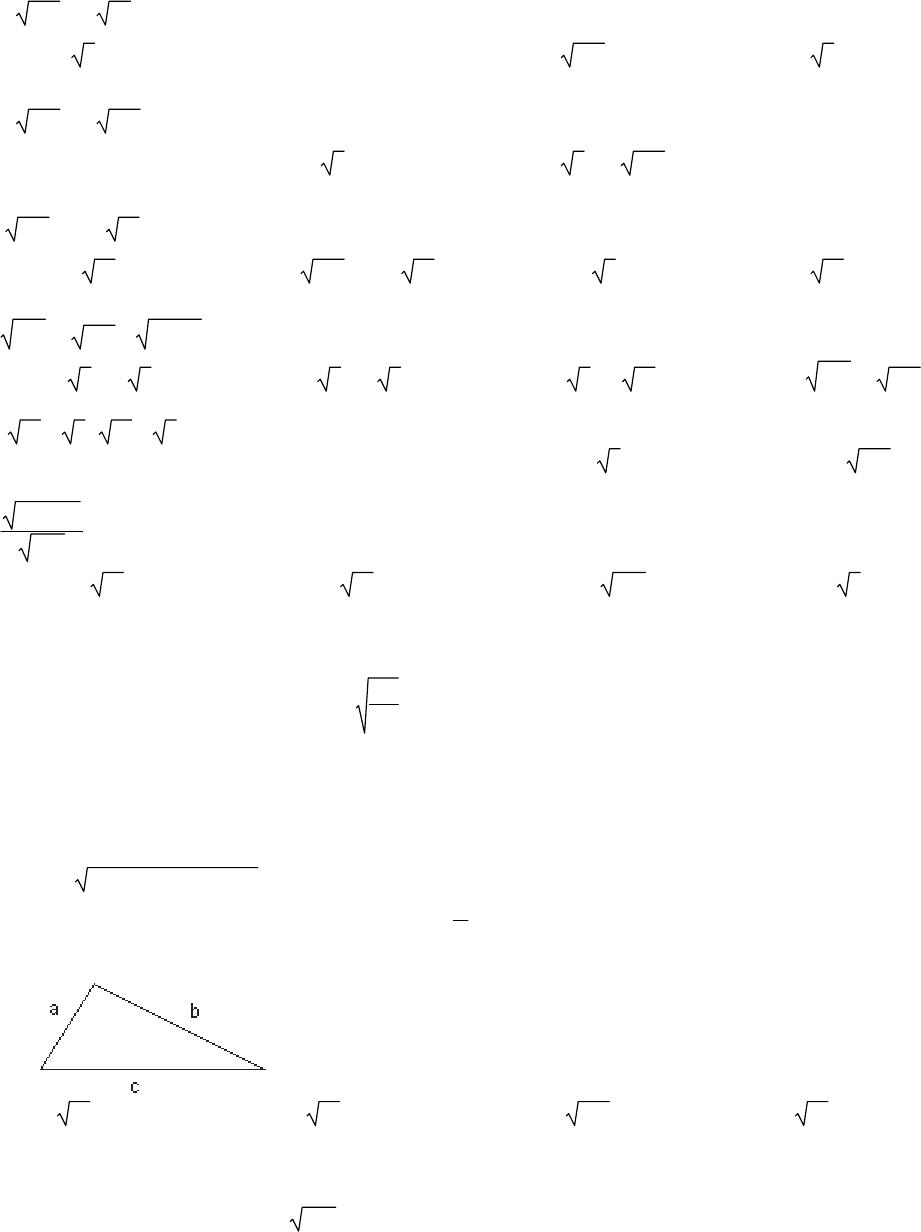
24) 4 327x + 4 38x
A) 203x B) 20x C) 4 335x D) 5 3x
25) 2 381x – 3 324x
A) 0 B) 123x C) 6 3x – 3324x D) cannot simplify
26) 3343 + 2 – 312
A) 9 – 312 B) 3343 + 2 – 312 C) 9 – 236 D) 9 312
27) 3x2 – 3320 + 192x2
A) 9x 3 – 4 35 B) 8x 3 – 4 35 C) 9x 3 – 420 D) 9 3x2 – 3320
28) ( 10 + z)( 10 – z)
A) 10 – z B) 10z C) 10 – 2z D) 10 – 2 10z
29) 56x5y6
2y4
A) 2x2y7x B) 4x2y7x C) 2x4y27xy D) 28xy x
Solve.
30) When an object is dropped to the ground from a height of h meters, the time it takes for the object to reach
the ground is given by the equation t = h
4.9, where t is measured in seconds. If an object falls 240.1 meters
before it hits the ground, find the time it took for the object to fall.
A) 7 seconds B) 8 seconds C) 49 seconds D) 10 seconds
31) If the three lengths of the sides of a triangle are known, Heron’s formula can be used to find its area. If a, b,
and c are the three lengths of the sides, Heron’s formula for area is:
A = s(s
– a)(s – b)(s – c)
where s is half the perimeter of the triangle, or s = 1
2(a + b + c).
Use this formula to find the area of the triangle if a = 4 cm, b = 6 cm and c = 8 cm.
A) 3 15 sq. cm B) 3 30 sq. cm C) 12 210 sq. cm D) 15 sq. cm
Solve the problem.
32) A formula used to determine the velocity v in feet per second of an object (neglecting air resistance) after i
t
has fallen a certain height is v = 2gh, where g is the acceleration due to gravity and h is the height the
object has fallen. If the acceleration g due to gravity on Earth is approximately 32 feet per second, find the
velocity of a bowling ball after it has fallen 50 feet. (Round to the nearest tenth.)
A) 56.6 ft per sec B) 40.0 ft per sec C) 10.0 ft per sec D) 3200 ft per sec
Page 50
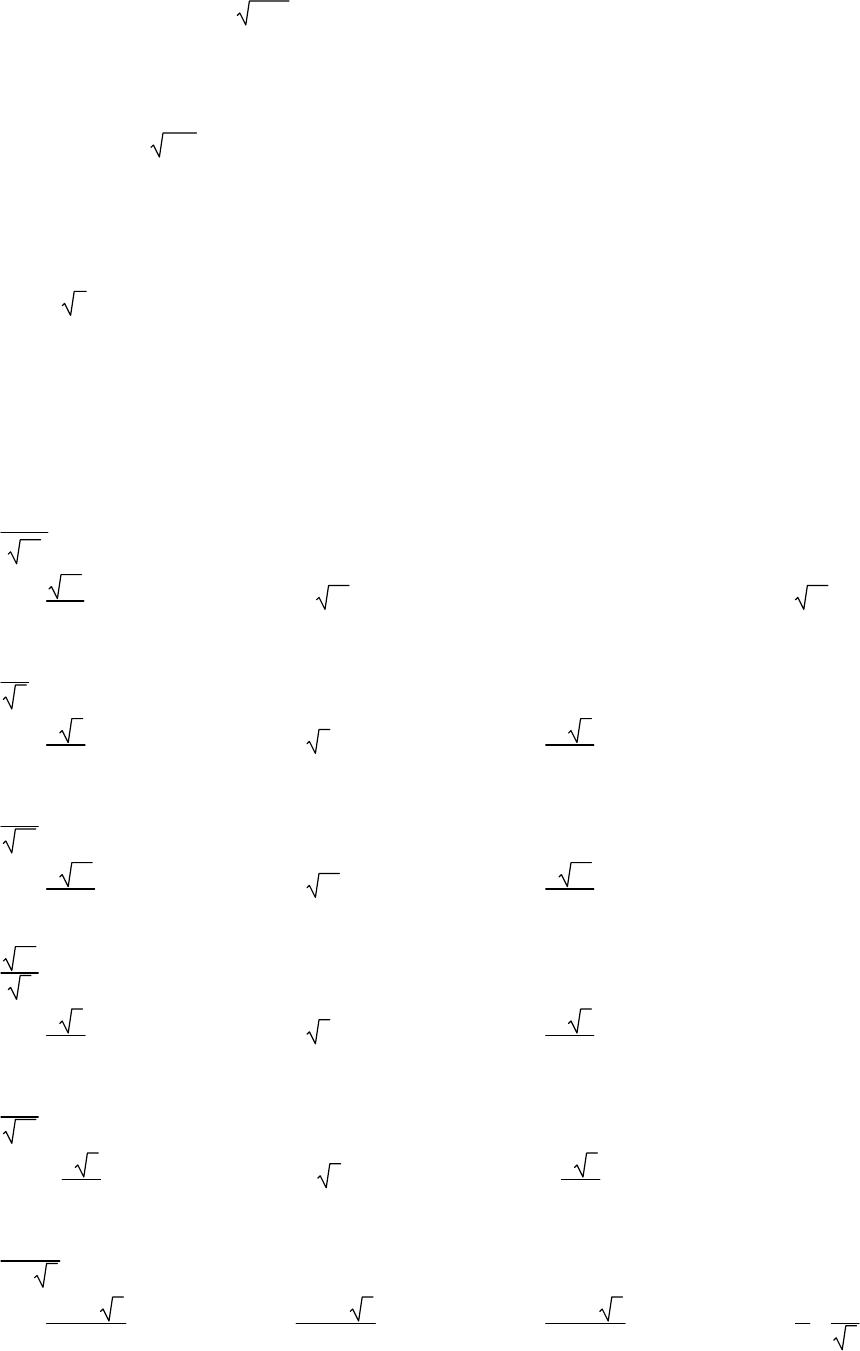
33) Police use the formula s = 30fd to estimate the speed s of a car in miles per hour, where d is the distance
in feet that the car skidded and f is the coefficient of friction. If the coefficient of friction on a certain gravel
road is 0.25 and a car skidded 300 feet, find the speed of the car, to the nearest mile per hour.
A) 47 mph B) 95 mph C) 260 mph D) 2250 mph
34) The formula v = 2.5r can be used to estimate the maximum safe velocity v, in miles per hour, at which a
car can travel along a curved road with a radius of curvature r, in feet. To the nearest whole number, find
the maximum safe speed for a curve in a road with a radius of curvature of 400 feet.
A) 32 mph B) 50 mph C) 20 mph D) 13 mph
35) The maximum distance d in kilometers that you can see from a height h in meters is given by the formula
d = 3.5 h. How far can you see from the top of a 353–meter building? (Round to the nearest tenth of a
kilometer.)
A) 65.8 km B) 35.1 km C) 18.8 km D) 660.4 km
3 Rationalize Denominators
MULTIPLE CHOICE. Choose the one alternative that best completes the statement or answers the question.
Simplify the expression. Assume that all variables are positive when they appear.
1) 1
11
A) 11
11 B) 11 11 C) 11 D) 11
2) 7
2
A) 72
2B) 7 2 C) 49 2
2 D) 11
3) 3
11
A) 311
11 B) 3 11 C) 911
11 D) 124
4) 25
7
A) 57
7B) 5 7 C) 25 7
7D) 54
5) –3
20
A) – 35
10 B) –35 C) – 35
5D) –20
6) 5
8 – 3
A) 40 + 53
61 B) 40 – 53
61 C) 40 + 53
–5D) 5
8 – 5
3
Page 51
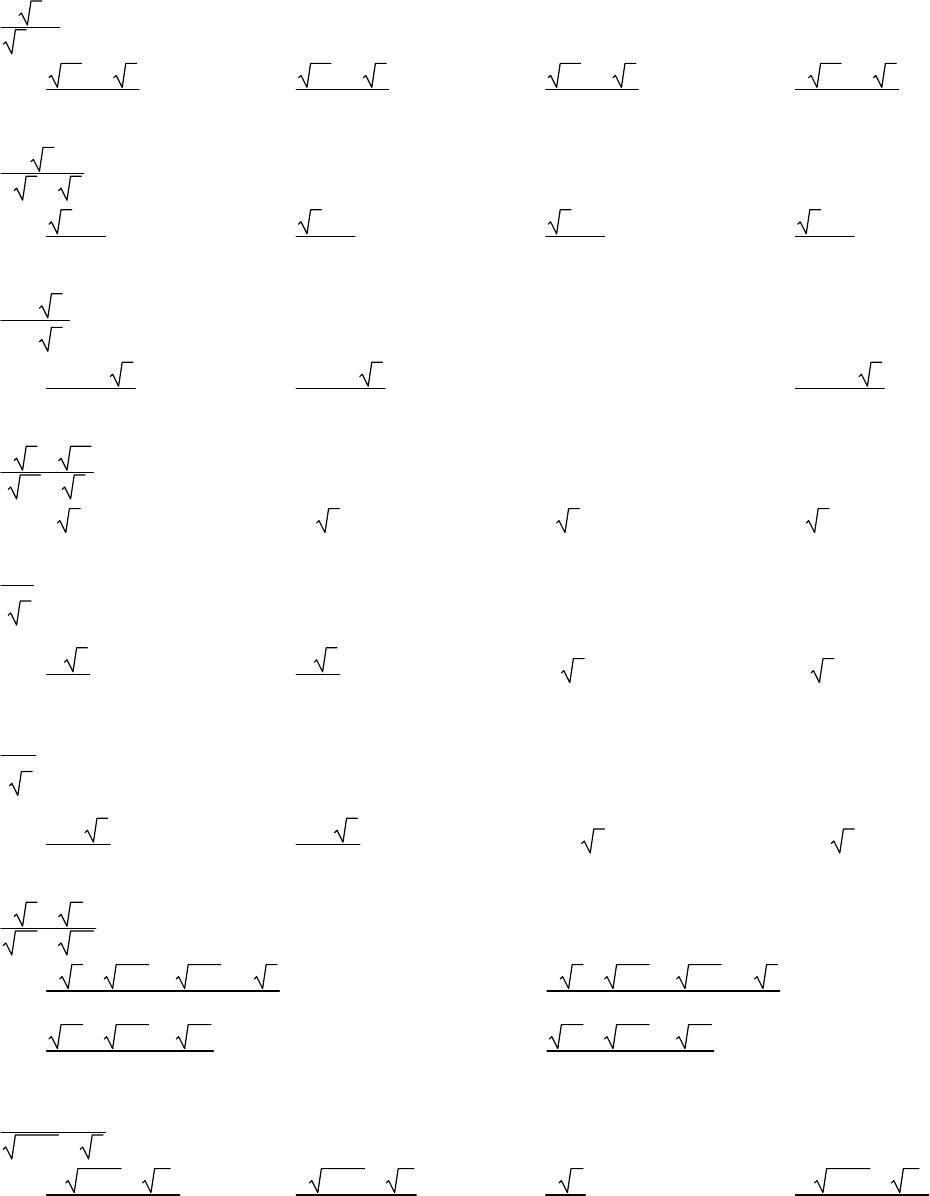
7) 6
7 + 2
A) 42 – 26
3B) 42 + 26
3C) 42 – 26
9D) 342
+ 76
14
8) 2
23 – 2
A) 6 + 1
5 B) 6 – 1
5 C) 6 + 1
7 D) 3 + 1
5
9) 5 – 2
5 + 2
A) 27 – 10 2
23 B) 27 + 10 2
23 C) 1 D) 23 – 10 2
27
10) 97
+ 14
14 + 7
A) 8 2 – 7B)102 + 11 C) 9 2 – 11 D) 9 2 – 7
11) 5
32
A) 534
2B) 532
2C) 5 34 D) 5 32
12) –11
34
A) –1132
2B) –1134
2C) –1134 D) –1132
13) x – y
3x + 2y
A) x3
– 2xy – 3xy + y2
3x – 2y B) x3
– 2xy – 3xy + y2
3x + 2y
C) 3x – 5xy + 2y
3x – 2y D) 3x – 5xy + 2y
3x + 2y
14) 4
x + h – x
A) 4( x + h + x)
hB) 4x
+ h + x
hC) 4h
hD) 4( x + h – x)
h
Page 52

4 Simplify Expressions with Rational Exponents
MULTIPLE CHOICE. Choose the one alternative that best completes the statement or answers the question.
Simplify the expression.
1) –321/5
A) –2B)16C)32D)
–8
2) 1
343
1
/
3
A) 1
7B) –7C)
–1
7D) 7
3) 644/3
A) 256 B) 4096 C) 1024 D) 16,384
4) 165/4
A) 32 B) 256 C) 128 D) 512
5) 2434/5
A) 81 B) 6561 C) 2187 D) 19,683
6) 1
64
2/3
A) 1
16 B) – 1
16 C) 1
24 D) 1
8
7) (–8)4/3
A) 16 B) 64 C) –16 D) not a real number
8) 25–3/2
A) 1
125 B) – 1
125 C) 125 D) –125
9) 64–4/3
A) 1
256 B) – 1
256 C) 256 D) not a real number
10) 16–5/4
A) 1
32 B) – 1
32 C) 32 D) not a real number
11) 32–4/5
A) 1
16 B) – 1
16 C) 16 D) not a real number
12) –64–4/3
A) – 1
256 B) 1
256 C) 256 D) not a real number
Page 53

13) –243–4/5
A) – 1
81 B) 1
81 C) 81 D) not a real number
14) 2251/2
A) 15 B) 30 C) 7.5 D) 60
15) 3431/3
A) 7 B) 21 C) 2401 D) 7203
16) 24011/4
A) 7 B) 28 C) 196 D) 16,807
17) 167/4
A) 128 B) 16,384 C) 78D) 131
18) 274/3
A) 81 B) 729 C) 243 D) 2187
19) 165/4
A) 32 B) 256 C) 128 D) 512
20) 25–1/2
A) 1
5B) 5 C) –5D)
– 1
5
21) 125–1/3
A) 1
5B) 1
15 C) –5D)5
22) 8–4/3
A) 1
16 B) – 1
16 C) –16 D) 16
23) 16–3/4
A) 1
8B) –64 C) – 1
8D) –8
24) 25
4
3/2
A) 125
8B) 8
125 C) – 8
125 D) – 125
8
25) 25
81
–1/2
A) 9
5B) 25
162 C) 5
9D) not a real number
Page 54

26) – 27
64
–2/3
A) 16
9B) 9
16 C) – 9
16 D) not a real number
Simplify the expression. Express the answer so that only positive exponents occur. Assume that all variables are
positive.
27) x1/8 · x7/8
A) x B) x7/8 C) x7
/
64 D) 1
x
28) x–2
/
5 · x3
/
5
A) x1
/
5B) x–1
/
5C) x6
/
5D) x5/6
29) (x6y3)1
/
3
A) x2yB)x
2|y| C) x6yD)x
2
30) (4x4y4)1
/
2
A) 2x2y2B) 2x2yC)x
2y2D) 2x4y2
31) (7x2
/
3)(8x3
/
2)
A) 56x13
/
6B) 56x5
/
6C) 56x13
/
5D) 56x2
/
3
32) (x2y5)7
/
4
A) x7
/
2y35
/
4B) x15
/
4y27
/
4C) x35
/
4y7
/
2D) x8
/
7y20
/
7
33) (9x4y–4)5/2
A) 243x10
y10 B) 9x10
y10 C) 243x10y10 D) 243
x10y10
34) (9x1/5 · y1/5)2
A) 81x2
/
5y2
/
5B) 81x1
/
25y1
/
25 C) 81x1
/
10y1
/
10 D) 81x2y2
35) x5
/
4 · x6
/
5
x–5/7
A) x443
/
140 B) x243
/
140 C) 1
x443/140 D) 1
x243/140
36) (3x3/5)2
x–1/4
A) 9x29
/
20 B) 9x19
/
20 C) 3x29
/
20 D) 3x19
/
20
Page 55

An expression that occurs in calculus is given. Write the expression as a single quotient in which only positive
exponents and/or radicals appear.
37) (49 – x2)1/2 + 3x2(49 – x2)–1/2
49 – x2
A) 49 + 2x2
(49 – x2)3/2 B) 49 – 4x2
(49 – x2)3/2 C) 3x2
(49 – x2)3/2 D) 3x2
49 – x2
38) 8x3/2(x3 + x2) – 10x5/2 – 10x3/2
A) 2x3/2(x + 1)(4x2 – 5) B) 8x3/2(x3 – 1) + 8x3 – 2x3/2(x – 1)
C) x3/2(x – 1)[8(x2 – 1) – 2] + 8x3D) 8x3/2(x + 1)(4x2 – 5)
39) (x2 – 1)1/2 · 3
2(2x + 5)1/2 · 2 + (2x + 5)3/2 · 1
2(x2 – 1)–1/2 · 2x
A) (2x + 5)1/2(5x2 + 5x – 3)
(x2 – 1)1/2 B) (2x + 5)1/2(5x2 + 5x – 3)
(x2 – 1)–1/2
C) (x2 – 1)1/2 (2x + 5)1/2(5x2 + 5x – 3) D) (x2 – 1)1/2 (2x + 5)–1/2(5x2 + 5x – 3)
40)
(x2 + 2)1/2 · 3
2(2x + 1)1/2 · 2 – (2x + 1)3/2 · 1
2(x2 + 2)–1/2 · 2x
x2 + 2
A) (2x + 1)1/2(x2 – x + 6)
(x2 + 2)3/2 B) (2x + 1)1/2(x2 – x + 6)
(x2 + 2)–3/2
C) (x2 + 2)3/2(2x + 1)1/2(x2 – x + 6) D) (x2 + 2)3/2(2x + 1)–1/2(x2 – x + 6)
Factor the expression. Express your answer so that only positive exponents occur.
41) x3
/
6 + 3x2
/
6
A) x1/3(x1
/
6 + 3) B) x1/3(x–1
/
6 + 3) C) x1/6(x3
/
6 + 3) D) x1/6(x1
/
6 + 3)
42) 4x3
/
7 – 13x–6
/
7
A) x–6
/
7(4x9
/
7 – 13) B) x1/3(4 – 13x9
/
13)
C) x–6
/
7(4x9
/
7 – 13x) D) x3
/
7(4x9
/
7 – 13x9
/
13)
43) x5
/
3 + x1
/
3
A) x1
/
3(x4
/
3 + 1) B) x1
/
3(x4
/
3)C)x
1
/
3(x4
/
3 – 1) D) x1
/
3(x4
/
3 + x)
44) x7
/
4 – x1
/
4
A) x1
/
4(x3
/
2 – 1) B) x1
/
4(x3
/
2)C)x
1
/
4(x3
/
2 + 1) D) x1
/
4(x3
/
2 – x)
45) (x + 5)–3
/
17 + (x + 5)–1
/
17 + (x + 5) 1/17
A) (x + 5)–3
/
17 [1 + (x + 5) 2/17 + (x + 5)4
/
17] B) (x + 5)–3
/
17 [1 + (x + 5) –2
/
17 + (x + 5) –4
/
17]
C) (x + 5)–3
/
17 [1 + (x + 5)4
/
17 + (x + 5)6
/
17] D) (x + 5)–3
/
17 [1 + (x + 5)1
/
17 + (x + 5)3
/
17]
Page 56
46) (3m + 5)–2/5 + (3m + 5) 1/5 + (3m + 5) 7/5
A) (3m + 5)–2/5 [1 + (3m + 5) 3/5 + (3m + 5) 9
/
5]B)(3m
+ 5)–2
/
5 [1 + (3m + 5) 4/5 + (3m + 5) 7
/
5]
C) (3m + 5)–2/5 [1 + (3m + 5)–3/5 + (3m + 5) –9
/
5]D)(3m
+ 5)–2
/
5 [1 + (3m + 5) 3/5 – (3m + 5) 9
/
5]
Page 57
Ch. 0 Chapter R: Review
Answer Key
0.1 Real Numbers
0.2 Algebra Essentials
1 Graph Inequalities
Page 59
0.3 Geometry Essentials
1 Use the Pythagorean Theorem and Its Converse
Page 61
0.4 Polynomials
1 Recognize Monomials
Page 62
0.5 Factoring Polynomials
1 Factor the Difference of Two Squares and the Sum and Difference of Two Cubes
Page 63
Page 64
0.6 Synthetic Divisio
n
1 Divide Polynomials Using Synthetic Division
0.7 Rational Expressions
1 Reduce a Rational Expression to Lowest Terms
Page 65
Page 66
0.8 nth Roots; Rational Exponents
1 Work with nth Roots
Page 67
Page 68
Page 69