Exam
Name___________________________________
MULTIPLE CHOICE. Choose the one alternative that best completes the statement or answers the question.
1)
If a 1 µF, 2.2 µF and 0.05 µF capacitor are connected in series, CT is less than ________.
1)
A)
2.2 µF
B)
0.001 µF
C)
1 µF
D)
0.05 µF
2)
If an uncharged capacitor, a resistor, a switch and a 12 V battery are connected in series, what is the
voltage across the capacitor at the instant the switch is closed?
2)
A)
24 V
B)
0 V
C)
6 V
D)
12 V
3)
How long will it take to completely charge a 0.047 µF capacitor through a 1 M resistor?
3)
A)
0.235 s
B)
0.047 s
C)
0.47 s
D)
0.029 s
4)
If a 0.1 µF capacitor and a 2.2 k resistor are connected in series across 30 VDC, how much voltage
will the capacitor drop after charging for just one time constant?
4)
A)
29.4 V
B)
19.0 V
C)
25.9 V
D)
28.5 V
5)
At what frequency is a 2000 pF capacitor operating if its reactance is 745 ?
5)
A)
10.1 kHz
B)
1010 Hz
C)
107 kHz
D)
1.01 kHz
6)
Reactive power (Pr) in a capacitor is defined as the rate at which a capacitor stores or returns
energy and is measured in:
6)
A)
watts reactive.
B)
volt–ampere reactive.
C)
current per time constant.
D)
volts per time constant.
7)
How long will it take a 0.047 µF capacitor to fully charge through a 100 k resistor?
7)
A)
235 ms
B)
0.235 ms
C)
2.35 s
D)
23.5 ms
8)
If a 0.047 µF, 0.047 µF and 0.47 µF capacitor are connected in series across a 25 V source, the total
capacitance equals ________ and each 0.047 µF capacitor drops ________.
8)
A)
0.564 µF, 1.2 V
B)
0.564 µF, 11.9 V
C)
0.022 µF, 25 V
D)
0.022 µF, 11.9 V
9)
The time constant of a capacitor is:
9)
A)
directly proportional to the capacitance in the circuit.
B)
directly proportional to the resistance in the circuit.
C)
the time required to charge to 63% or discharge to 37%.
D)
all of these.
10)
When capacitors are connected in series, their total capacitance act like:
10)
A)
resistance connected in parallel.
B)
resistance connected in series.
C)
resistance connected in series–parallel.
D)
all of these.
11)
A common use for electrolytic capacitors found in power supplies is ________.
11)
A)
decoupling
B)
filtering
C)
blocking DC
D)
passing AC
12)
What is the small amount of power lost in a capacitive circuit due to the internal resistance of the
capacitors?
12)
A)
true power
B)
instantaneous power
C)
reactive power
D)
ideal power
13)
If a 47 µF capacitor is connected to a 20 V, 400 Hz source, the current is ________.
13)
A)
425 A
B)
8.51 A
C)
2.36 A
D)
0.851 A
14)
How long will it take a 1 µF capacitor to completely discharge through a 47 k resistor?
14)
A)
235 ms
B)
47 s
C)
235 s
D)
47 ms
15)
If a 1 µF capacitor and a 10 k resistor are connected in series across 20 VDC, approximately how
much voltage will the capacitor drop after charging for just one time constant?
15)
A)
17 V
B)
11.0 V
C)
12.6 V
D)
12.1 V
16)
If a 0.047 µF capacitor operates at 220 kHz, XC equals ________.
16)
A)
1.54 k
B)
154
C)
15.4 k
D)
15.4
17)
If the frequency applied to a capacitor increases, the capacitive reactance ________.
17)
A)
varies up and down
B)
increases
C)
decreases
D)
remains the same
18)
If a 0.05 µF and 0.1 µF capacitor are connected in parallel across a 20 V source, the total capacitance
equals ________ and each capacitor drops ________.
18)
A)
0.10 µF, 20 V
B)
0.05 µF, 15 V
C)
0.15 µF, 20 V
D)
0.15 µF, 10 V
19)
A commonplace use for capacitors in electronics is to:
19)
A)
block DC voltages.
B)
pass both AC and DC voltages.
C)
pass DC voltages only.
D)
block AC voltages.
20)
If four 0.022 µF capacitors are connected in parallel, CT equals ________.
20)
A)
0.049 µF
B)
0.088 µF
C)
0.022 µF
D)
0.044 µF
21)
Electrolytic capacitors differ from many other capacitors in construction in that they are:
21)
A)
sensitized.
B)
polarized.
C)
smaller.
D)
larger.
22)
What is the capacitance that stores 1.175 µC of charge and drops 25 V?
22)
A)
4.7 µF
B)
0.047 µF
C)
47 µF
D)
0.47 µF
23)
If a 4.7 µF capacitor and a 10 k resistor are connected in series across 25 VDC, approximately how
much voltage will the resistor drop after charging for just one time constant?
23)
A)
23.8 V
B)
21.6 V
C)
15.8 V
D)
9.20 V
24)
A capacitor that transfers an ac signal from one stage to another is called a ________ capacitor.
24)
A)
bypass
B)
filter
C)
transfer
D)
coupling
25)
How much charge is stored in a 0.47 µF capacitor that drops 18 V?
25)
A)
8.46 µC
B)
0.846 µC
C)
84.6 µC
D)
846 µC
26)
The removal of high frequency transient voltages with a capacitor is called:
26)
A)
bypassing.
B)
ac blocking.
C)
decoupling.
D)
coupling.
27)
If a 0.1 µF, 0.1 µF and 0.05 µF capacitor are connected in series across a 75 V source, the voltage
drop across the smallest capacitor equals ________.
27)
A)
18.8 V
B)
37.5 V
C)
100 V
D)
50 V
28)
Upon checking the voltage output of a power supply with an oscilloscope, you notice an unusually
large amount of ripple. What could possibly be the problem?
28)
A)
shorted filter capacitor
B)
open filter capacitor
C)
shorted load
D)
either B or C
29)
In a capacitive AC circuit, the phase relationship between the voltage and the current is such that
the:
29)
A)
voltage is 360 degrees out of phase with current.
B)
current is leading the voltage.
C)
current is 180 degrees out of phase with voltage.
D)
voltage is leading the current.
30)
How long will it take for a 22 µF capacitor to completely discharge through a 4.7 k resistor?
30)
A)
0.103 s
B)
0.827 s
C)
0.517 s
D)
0.207 s
31)
If a 22 µF capacitor is connected to a 15 V 400 Hz source, its current equals ________.
31)
A)
55 mA
B)
829 mA
C)
18.1 mA
D)
1.81 A
32)
Electrolytic capacitors must be connected into a circuit such that:
32)
A)
positive lead to positive voltage; negative lead to negative voltage.
B)
reversal of polarity does not happen.
C)
voltage rating marked is not exceeded.
D)
all of these.
33)
A test instrument designed to be used for the testing of capacitors is the ________.
33)
A)
oscilloscope
B)
analog multimeter
C)
LCR Meter
D)
digital multimeter
34)
How much charge is stored in a 0.022 µF capacitor that drops 22 V?
34)
A)
48.4 µC
B)
0.484 µC
C)
0.0484 µC
D)
4.84 µC
35)
If a 4.7 µF capacitor operates at 10 kHz, XC equals ________.
35)
A)
3.39
B)
294
C)
339
D)
infinite
36)
If a 0.022 µF, 0.022 µF and 0.05 µF capacitor are connected in series across a 25 V source, the voltage
drop across the largest capacitor equals ________.
36)
A)
11.8 V
B)
17.5 V
C)
10.2 V
D)
4.51 V
37)
What is one time constant of a 4.7 µF capacitor in series with a 22 k resistor?
37)
A)
1.03 ms
B)
10.3 ms
C)
0.103 ms
D)
103 ms
38)
The time constant for a capacitor for each time period is:
38)
A)
63% of the increase in value.
B)
a constant factor.
C)
37% of the decrease in value.
D)
all of these.
39)
At what frequency is a 0.001 µF capacitor operating if its reactance is 45 k?
39)
A)
3.54 MHz
B)
3.54 kHz
C)
35.4 kHz
D)
354 kHz
40)
When capacitors are connected in parallel, their total capacitance act like:
40)
A)
resistance connected in series.
B)
resistance connected in series–parallel.
C)
resistance connected in parallel.
D)
all of these.
41)
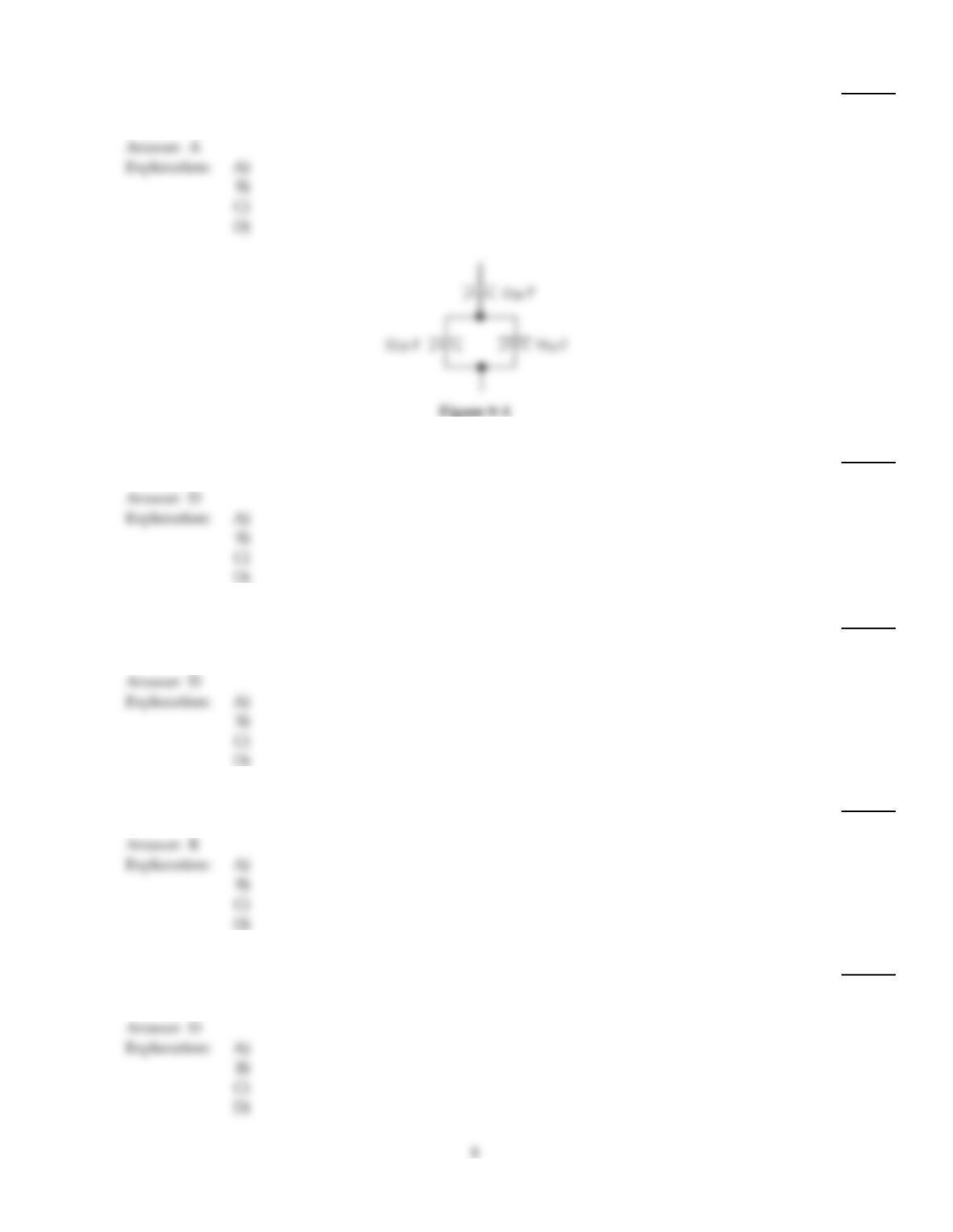
What is CT in Figure 9–1?
41)
A)
25.2 µF
B)
82 µF
C)
70.1 µF
D)
8.78 µF
42)
How much voltage is dropped across a 150 µF capacitor after 3.33 seconds if it is charged by a 50 V
source through a 22 K resistor?
42)
A)
43.3 V
B)
49 V
C)
47.5 V
D)
31.8 V
43)
How long will it take for a 22 µF capacitor to completely charge through a 47 k resistor?
43)
A)
2.068 s
B)
5.17 s
C)
8.272 s
D)
1.034 s
44)
A 65 Vrms signal is applied to a 10 F capacitor. What is the total peak current?
44)
A)
6.5 kA
B)
153 mA
C)
6.5 A
D)
not enough information
45)
What is the minimum dc working voltage rating for a capacitor that must drop 120 VRMS?
45)
A)
170 V
B)
120 V
C)
84.8 V
D)
339 V
46)
What is the capacitance of a capacitor that drops 50 V and stores 0.500 µC of charge?
46)
A)
0.1 µF
B)
0.01 µF
C)
0.001 µF
D)
1 µF
B
47)
With three capacitors in series, the current lags the voltage by:
47)
A)
30 degrees.
B)
90 degrees.
C)
45 degrees.
D)
none of the above.
D
48)
What is one time constant of a 47 µF capacitor in series with a 120 k resistor?
48)
A)
5.64 s
B)
54.6 s
C)
0.564 ms
D)
564 ms
A
49)
If a 22 µF and 100 µF capacitor are connected in parallel across a 15 V source, the total capacitance
equals ________ and the 22 µF capacitor drops ________.
49)
A)
18 µF, 15 V
B)
122 µF, 15 V
C)
18 µF, 5.2 V
D)
1220 µF, 30 V
B
50)
When connecting a large electrolytic capacitor to a circuit with a 100 VDC source, place the
negative end of the capacitor ________.
50)
A)
towards the negative side of the source
B)
towards the positive side of the source
C)
in either position; the polarity is not important
A
A
51)
If an uncharged capacitor, a resistor, a switch and a 12 V battery are connected in series, at
approximately what time will the capacitor reach full charge?
51)
A)
5 × R × C
B)
R × C
C)
12 × R × C
D)
The time cannot be predicted.
52)
If the dc working voltage of a capacitor is 100 V, the dielectric must withstand ________.
52)
A)
220 VPP
B)
85 VRMS
C)
100 VDC
D)
75 VRMS
53)
If an uncharged capacitor, a resistor, a switch and a 12 V battery are connected in series, what is the
voltage across the capacitor after it is fully charged?
53)
A)
6 V
B)
12 V
C)
–6 V
D)
24 V
TRUE/FALSE. Write ‘T’ if the statement is true and ‘F’ if the statement is false.
54)
Capacitance is a capacitor’s ability to store resistance.
54)
55)
A capacitor will fully charge in about five time constants.
55)
56)
Capacitance is the ability to store voltage.
56)
57)
Efficient filtering is directly related to RC time constant.
57)
58)
When two capacitors are connected in series across a dc source, the smallest capacitor drops the
largest voltage.
58)
59)
To find the total capacitance of two capacitors in parallel, you must combine them using a similar
procedure as resistors in parallel.
59)
60)
If the plate area of a capacitor decreases, the capacitance decreases.
60)
61)
If the distance between the plates of a capacitor increases, the capacitance decreases.
61)
62)
Leakage through a capacitor is undesirable.
62)
63)
The voltage rating of a capacitor indicates the voltage it will charge up to.
63)
64)
When two capacitors are connected in parallel across a dc source, the smaller capacitor drops the
larger voltage.
64)
65)
A capacitor blocks dc and passes ac.
65)
66)
A capacitor can fully charge in one time constant.
66)
67)
Electrolytic capacitors are ideal for alternating current applications.
67)
Answer Key
Testname: C9

Answer Key
Testname: C9
13