Exam
Name___________________________________
MULTIPLE CHOICE. Choose the one alternative that best completes the statement or answers the question.
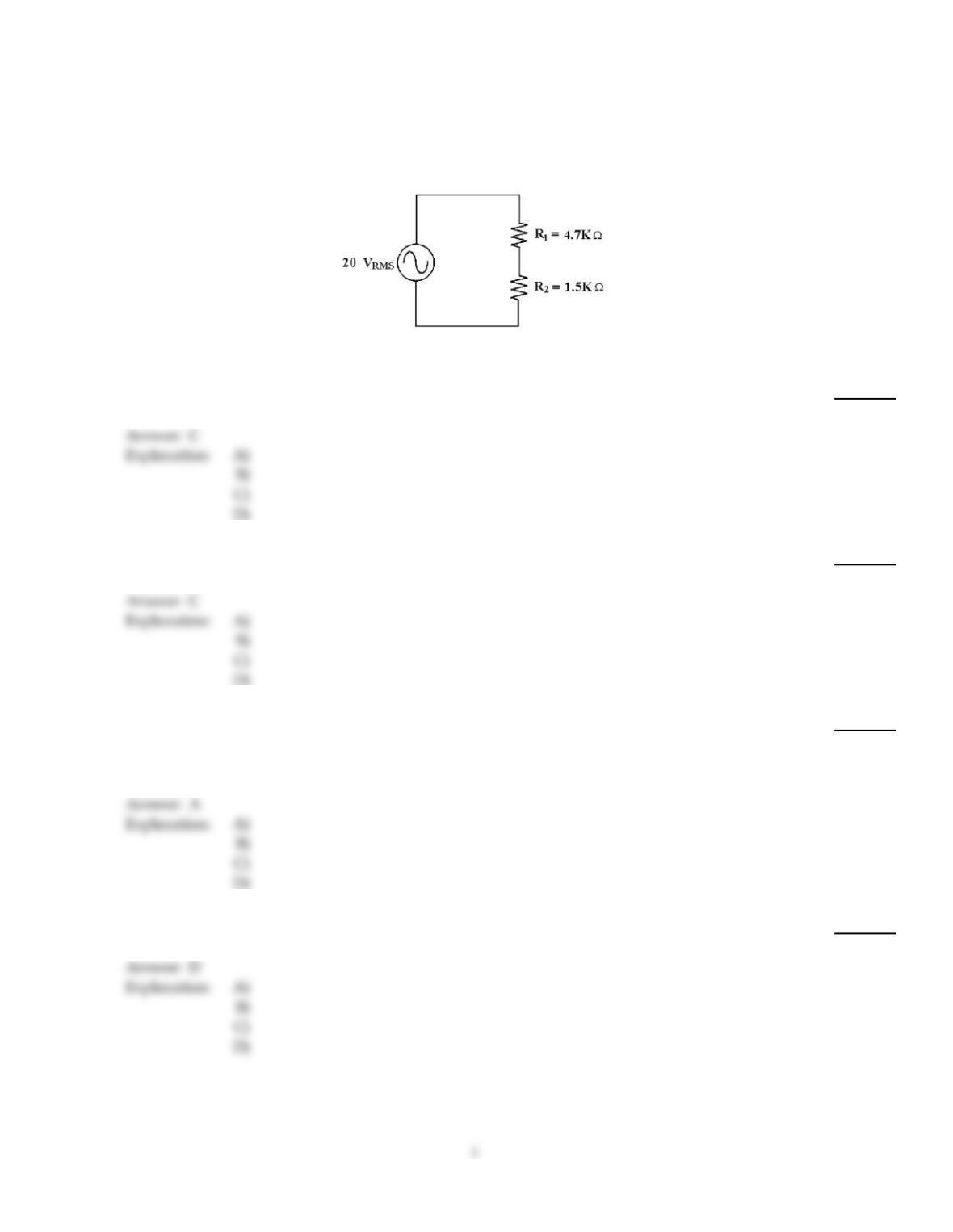
Figure 8–2
1)
Find RT in Figure 8–2.
1)
A)
4.7 k
B)
4.77 k
C)
6.2 k
D)
1.13 k
2)
Find PR1 in Figure 8–2.
2)
A)
0 W
B)
196 mW
C)
48.9 mW
D)
97.8 mW
3)
An oscilloscope’s seconds/division switch is set on 20 ms/div. If a sine wave measures 4 divisions
horizontally, what frequency is being measured?
3)
A)
12.5 Hz
B)
25 Hz
C)
50 Hz
D)
More information is needed.
4)
A sine wave‘s instantaneous voltage is 0 V at ________ degrees.
4)
A)
180
B)
360
C)
0
D)
all of these
5)
The AC sine wave varies from zero to its maximum value in accordance with:
5)
A)
a geometric progression.
B)
an algebraic function.
C)
a mathematical formula.
D)
a trigonometric relationship.
6)
What is the approximate peak input voltage to the circuit in Figure 8–2?
6)
A)
28.3 VP
B)
20 VP
C)
14.1 VP
D)
10 VP
7)
In Figure 8–2, what is the instantaneous voltage across R1 at an angle of 22°?
7)
A)
2.56 V
B)
12.0 V
C)
8.03 V
D)
20.3 V
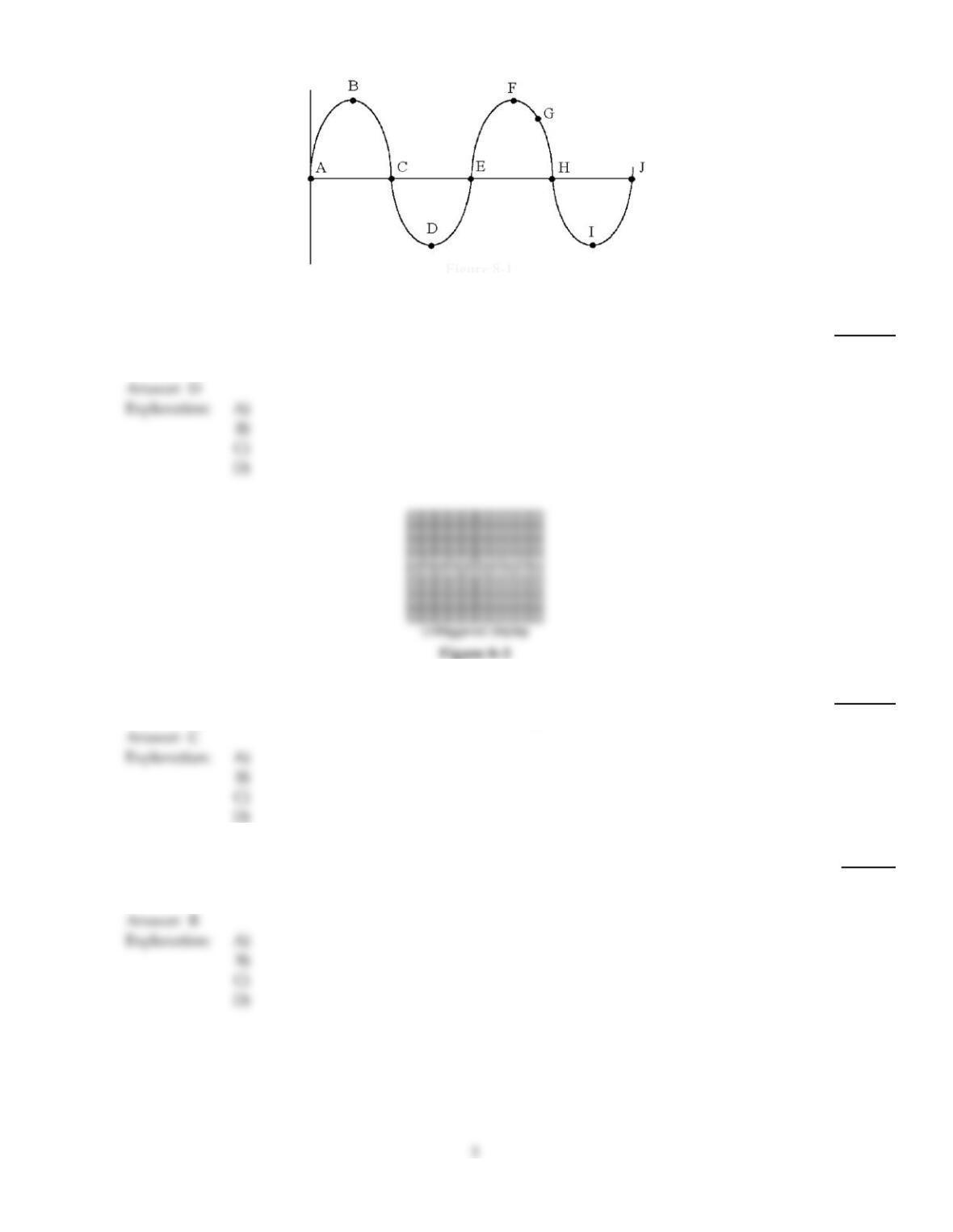
Figure 8–1
8)
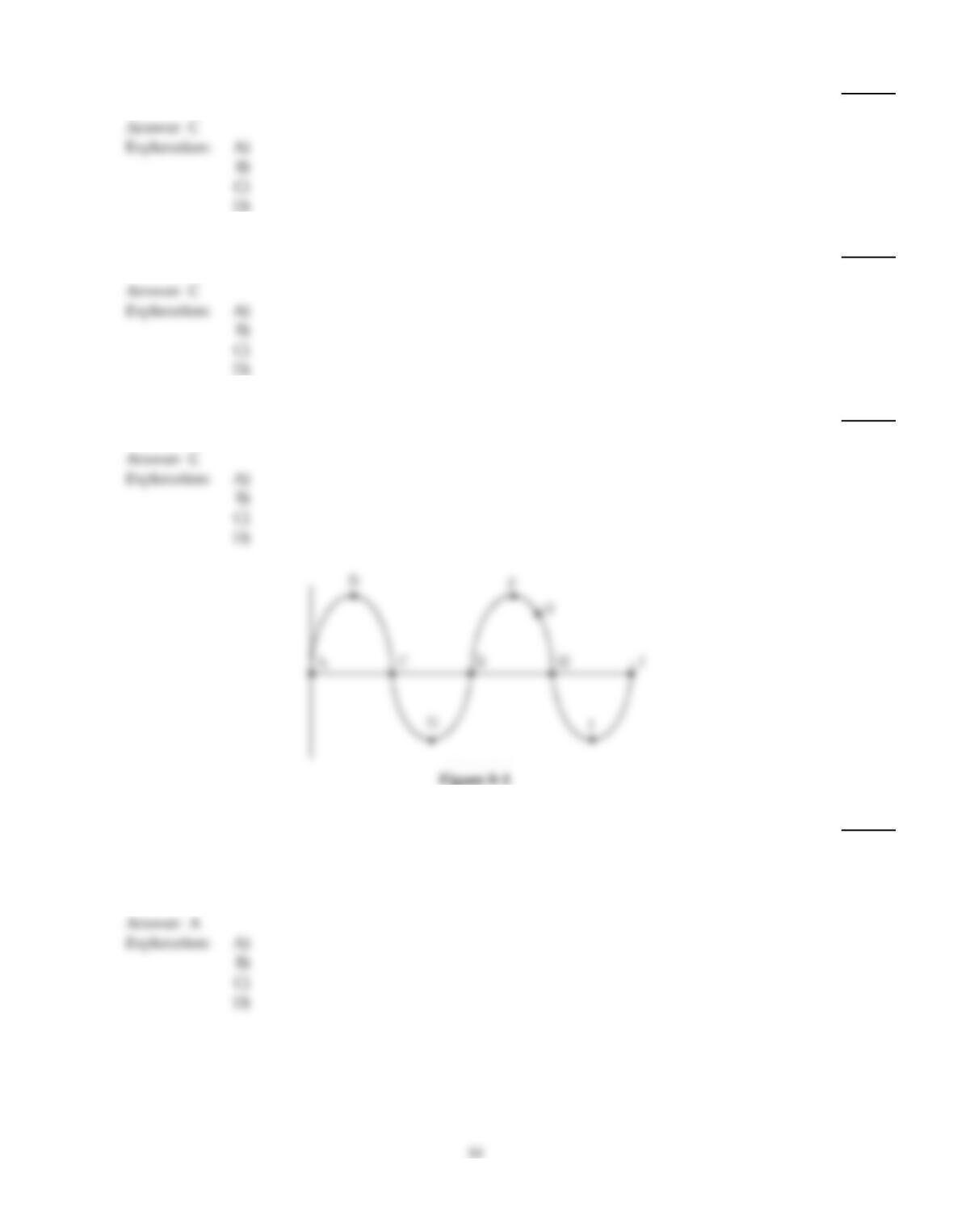
In Figure 8–1, which of the following can be measured from point E to point F?
8)
A)
one cycle of voltage
B)
the RMS voltage
C)
the peak to peak voltage
D)
the peak voltage
9)
This display in Figure 8–3 illustrates maladjustment of which control on the oscilloscope?
9)
A)
volts/div
B)
coupling
C)
trigger level
D)
intensity
10)
Superimposing an AC voltage of 3.54 Vrms with a DC source of 10 V results in a waveform that:
10)
A)
peaks at 20 V.
B)
peaks at 15 V.
C)
peaks at 13.54 V.
D)
both B and C
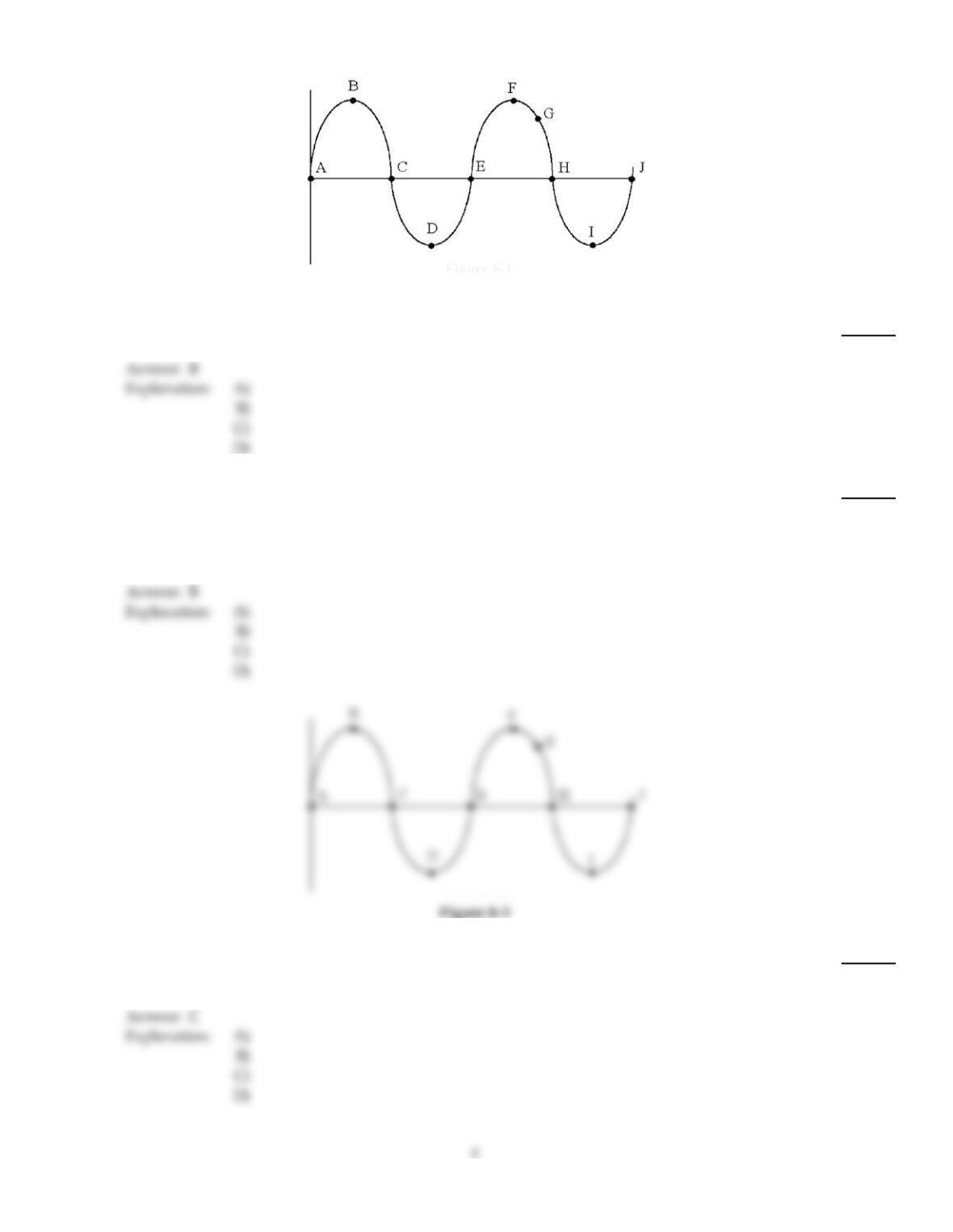
Figure 8–1
11)
In Figure 8–1, the time from point C to E is called ________.
11)
A)
a cycle
B)
a half–cycle
C)
the period
D)
peak voltage
12)
The square wave is made up of:
12)
A)
just the fundamental frequency.
B)
the fundamental frequency and all the odd harmonics.
C)
the fundamental frequency and both the odd and even harmonics.
D)
the fundamental frequency and all the even harmonics.
Figure 8–1
13)
Which one of the following represents the value at point G in Figure 8–1?
13)
A)
the peak voltage
B)
the period
C)
the RMS voltage
D)
the frequency
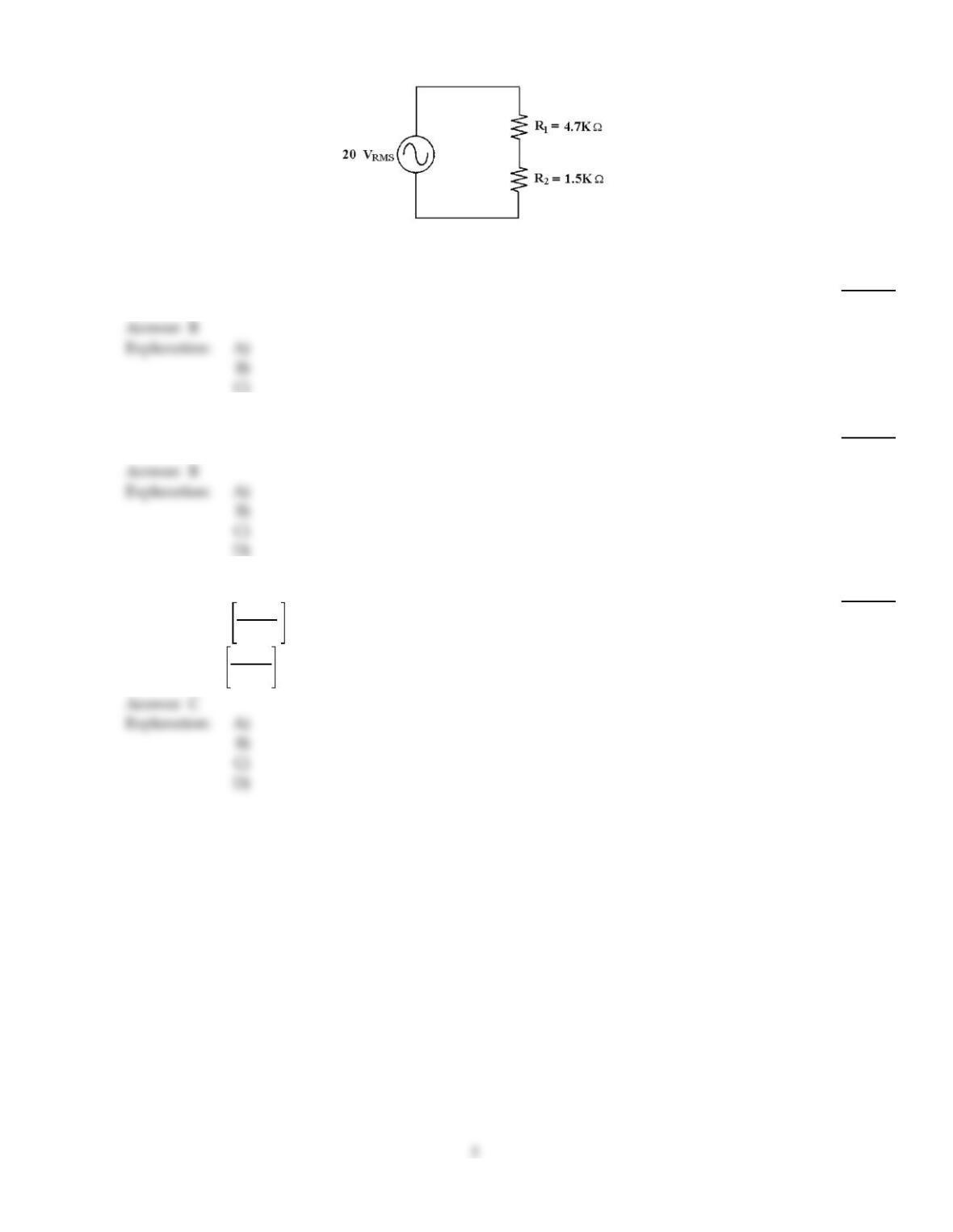
Figure 8–2
14)
If R1 shorts in Figure 8–2, VR2 ________.
14)
A)
remains the same
B)
increases
C)
decreases
15)
The period of most AC waveforms is measured in units of:
15)
A)
revolutions.
B)
seconds.
C)
cycles.
D)
alternations.
16)
The formula to convert degrees to radians is:
16)
A)
degrees =180°
rad × radians.
B)
180°= radians.
C)
radians = rad
180°× degrees.
D)
all of these.
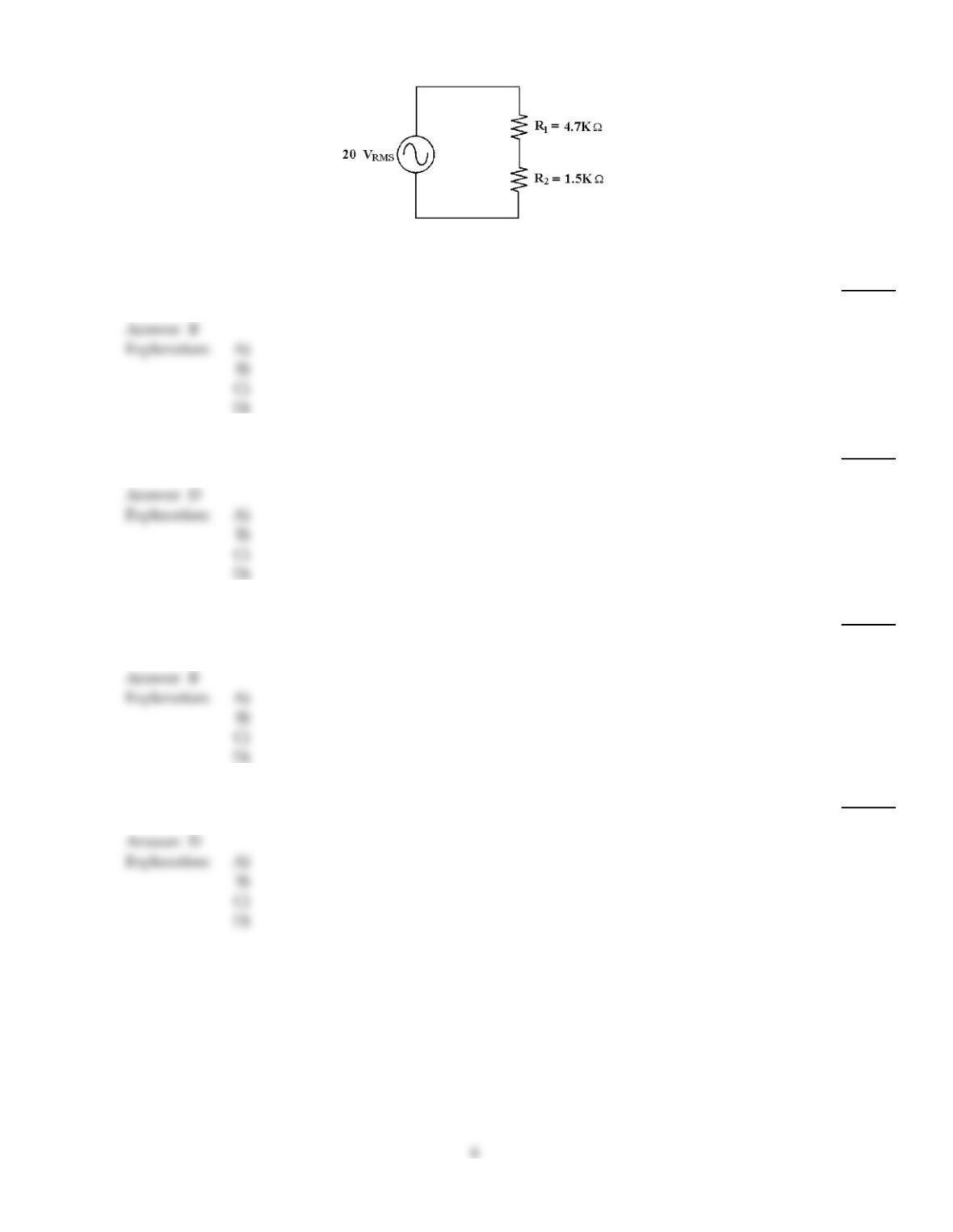
Figure 8–2
17)
Calculate VR1 in Figure 8–2.
17)
A)
6.84 VP
B)
21.4 VP
C)
13.7 VP
D)
13.2 VP
18)
What is the instantaneous voltage at 42° on a 230 VP sine wave?
18)
A)
76.1 V
B)
149 V
C)
115 V
D)
154 V
19)
The average value of a rectangular pulse wave is calculated as:
19)
A)
Vavg = 1.57 Vp.
B)
Vavg = Vbaseline + (duty cycle) × Vp.
C)
Vavg = 0.637 Vp.
D)
Vavg = Vbaseline + Vp.
20)
The largest numerical value in the measurement of alternating current is:
20)
A)
rms.
B)
peak.
C)
average.
D)
peak to peak.
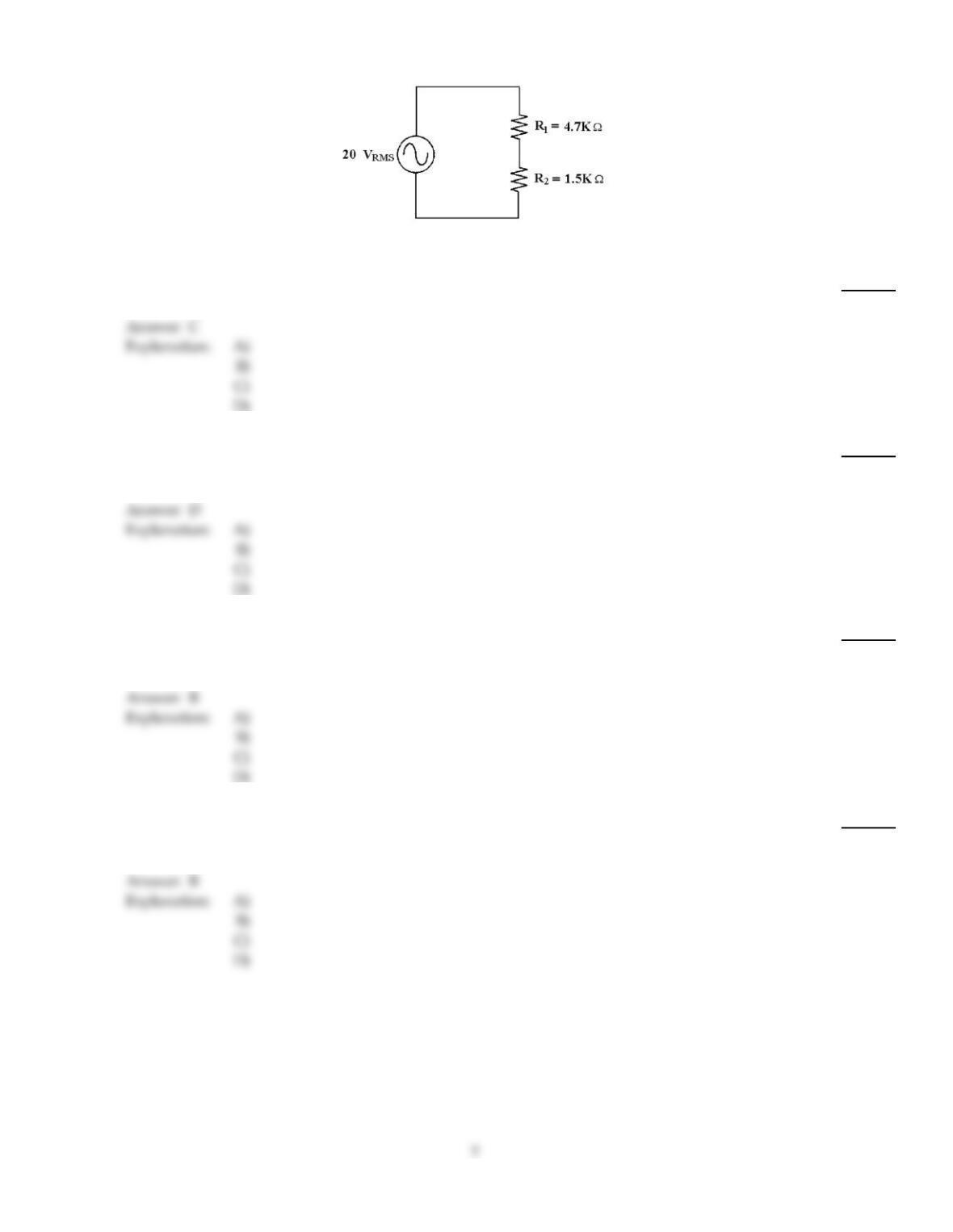
Figure 8–2
21)
In Figure 8–2, what is the instantaneous voltage across R1 at 122°?
21)
A)
11.6 V
B)
11.2 V
C)
18.2 V
D)
5.8 V
22)
Troubleshooting an AC circuit can be performed with which of the following tools?
22)
A)
oscilloscope
B)
digital multimeter
C)
analog voltmeter
D)
any of the above
23)
In a two–resistor series circuit VR1 = 6.5 VRMS and VR2 = 3.2 VRMS. The source voltage is
________.
23)
A)
9.7 VP
B)
13.7 VP
C)
4.53 VP
D)
9.19 VP
24)
Superimposed DC and AC voltages mean the two voltages are combined:
24)
A)
in parallel aiding or opposing.
B)
in series aiding or opposing.
C)
in series–parallel aiding or opposing.
D)
all of these
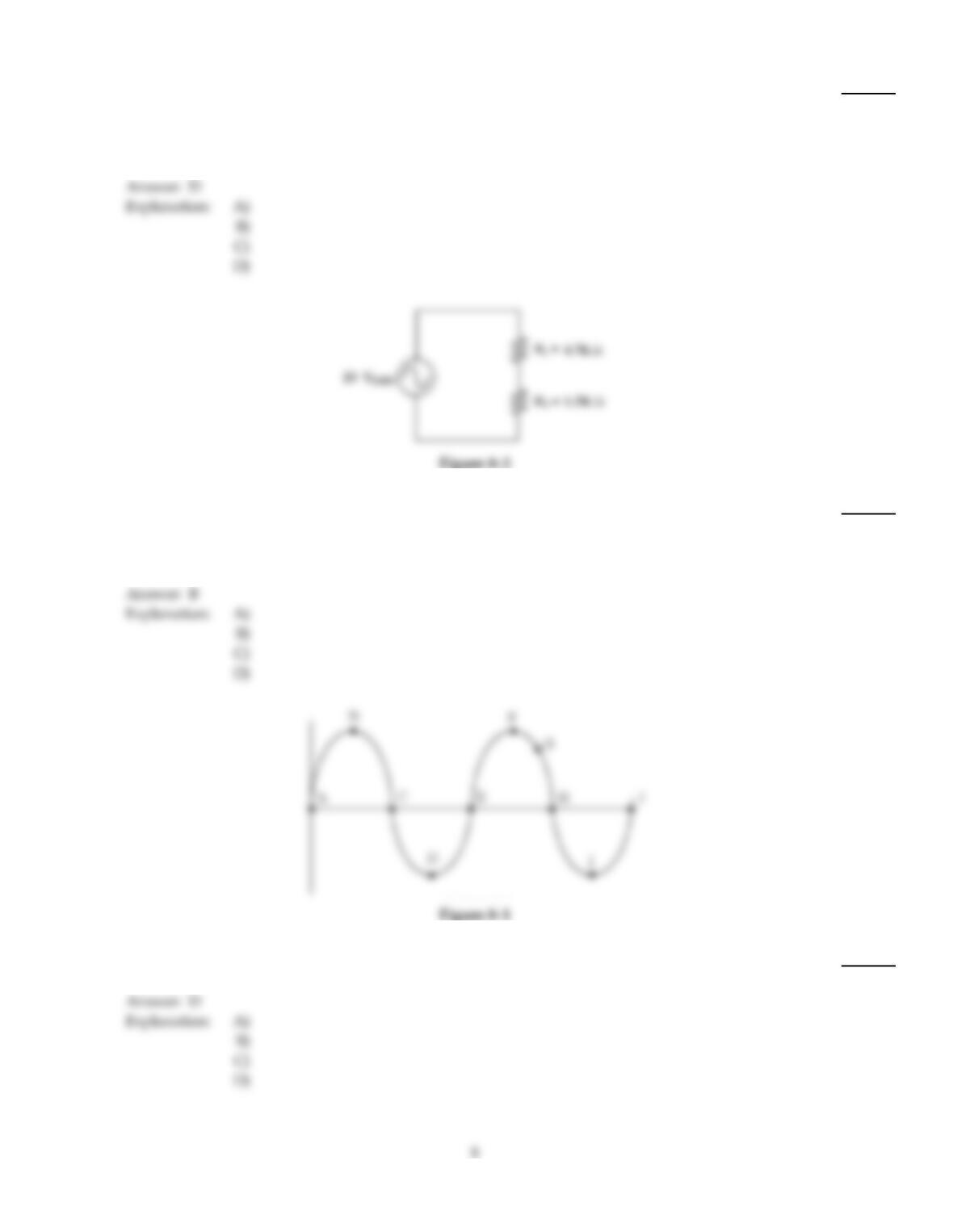
25)
A square wave is a unique form of the rectangular pulse wave in that:
25)
A)
the wave is symmetrical.
B)
the positive and negative halves are equal.
C)
the duty cycle is 50%.
D)
all of these
26)
In Figure 8–2, if you look at VR1 with an oscilloscope and you find no trace, a possible trouble
might be that ________.
26)
A)
R2 is shorted
B)
R2 is open
C)
R1 is open
D)
the resistance of R2 has changed
27)
VPP is measured between points ________ in Figure 8–1.
27)
A)
G and I
B)
A and B
C)
C and H
D)
D and F
28)
What is the approximate instantaneous voltage at 37° on a 169 VP sine wave?
28)
A)
119 V
B)
239 V
C)
102 V
D)
135 V
29)
which of the following can be measured from points B to F in Figure 8–1?
29)
A)
the peak–to–peak voltage
B)
the angle
C)
the period
D)
the frequency
30)
The value of a AC sine wave at any instant can be represented by:
30)
A)
a phasor whose angle and magnitude are representative of the AC signal.
B)
the formula Vi= Vp× sin .
C)
a graph of the voltage or current vs. the angular measurement.
D)
all of these.
31)
What is the instantaneous voltage at 284° on a 22 VPP sine wave?
31)
A)
–10.7 V
B)
–2.66 V
C)
10.7 V
D)
0.33 V
32)
The time (T) and the frequency (f) of an AC waveform are related as:
32)
A)
universally proportional.
B)
directly proportional.
C)
inversely proportional.
D)
complimentary proportional.
33)
Calculate the total power dissipation in the circuit in Figure 8–2.
33)
A)
182 mW
B)
9.12 mW
C)
45.6 mW
D)
64.5 mW
D
34)
If you measure about 56 VPP across the source in Figure 8–2, what is the trouble?
34)
A)
R2 is open.
B)
R1 is open.
C)
Both R1 and R2 are open.
D)
There is no trouble. 56 VPP is a normal measurement for the source voltage.
E)
any of these
E
35)
The time required by a 10 V square wave to change from 1 V to 9 V is known as the ________.
35)
A)
fall time
B)
rise time
C)
period
D)
pulse width
B
C
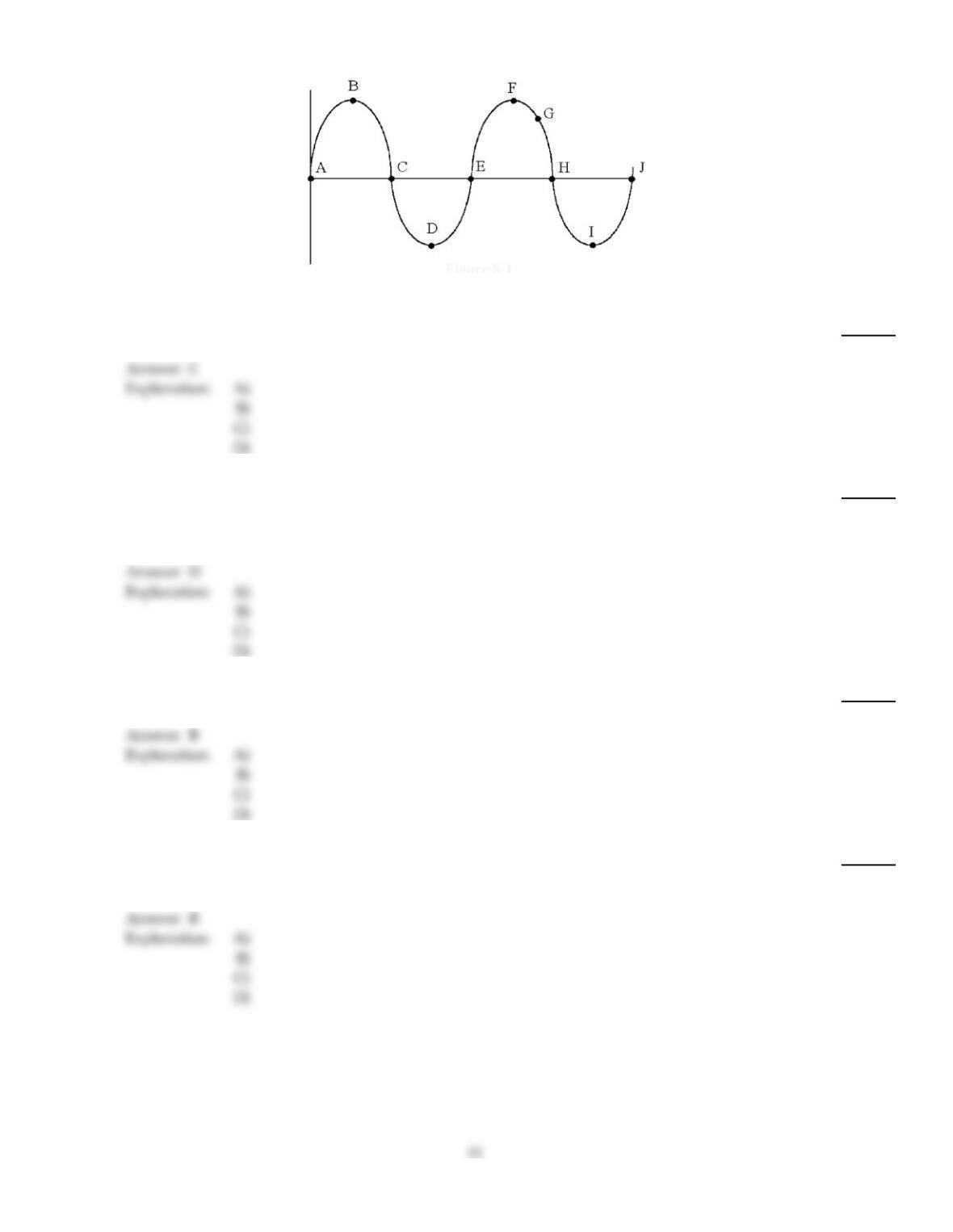
Figure 8–1
36)
Which point in Figure 8–1 is 180° away from point E?
36)
A)
A
B)
B
C)
C
D)
D
37)
While troubleshooting a circuit the voltage seems to be zero; what if any adjustment should be
checked on the oscilloscope?
37)
A)
time division setting
B)
focus setting
C)
trigger level
D)
AC/GND/DC switch
38)
The symbol for the period of a wave form is:
38)
A)
P.
B)
T.
C)
F.
D)
W.
39)
An oscilloscope’s volts/division switch is set on 50 mV/div. If the vertical deflection of the
oscilloscope’s trace is 1.6 division, what voltage is being measured?
39)
A)
50 mV
B)
80 mV
C)
1.6 mV
D)
0.008 V
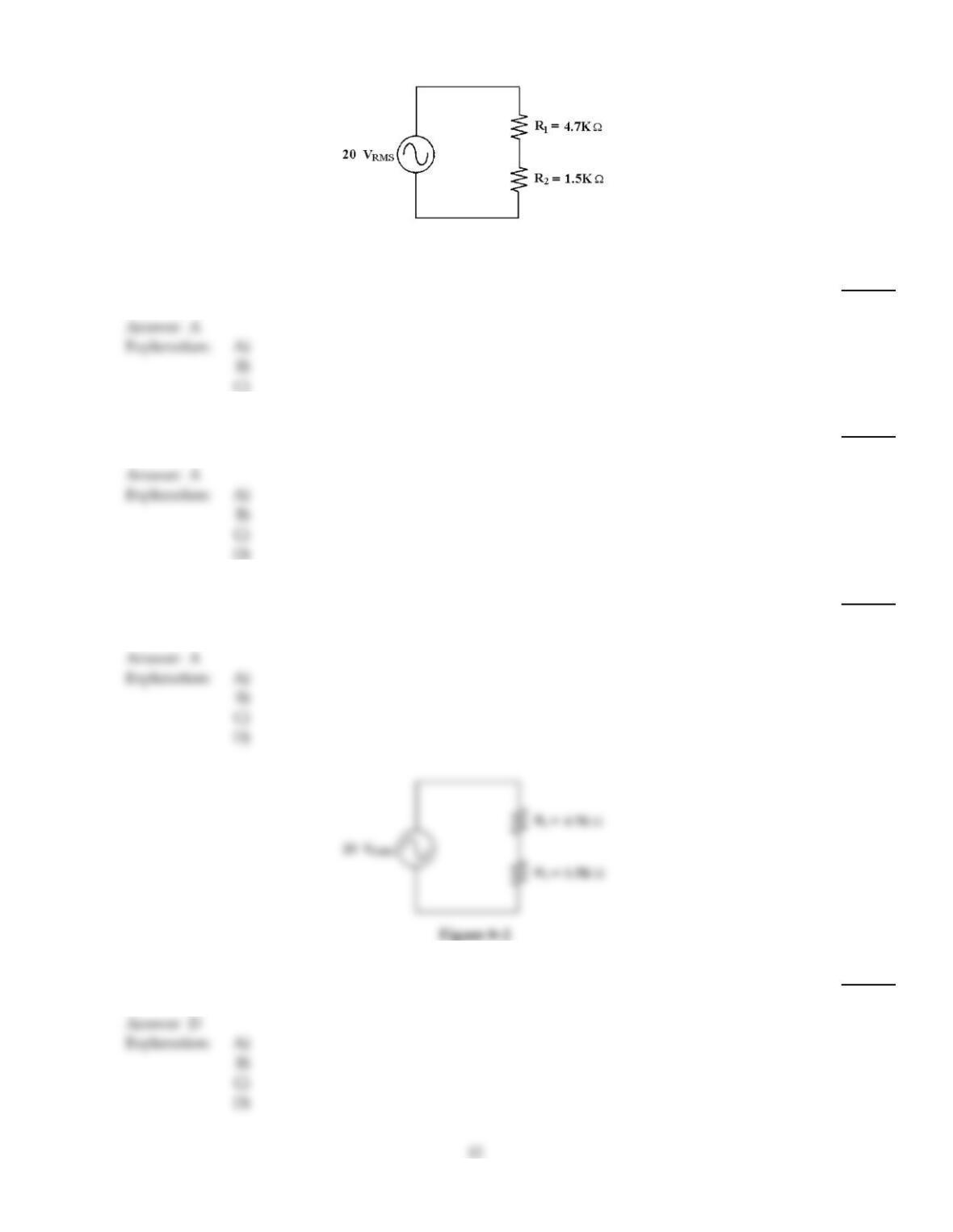
Figure 8–2
40)
VR2 ________ if R1 opens in Figure 8–2.
40)
A)
decreases
B)
remains the same
C)
increases
41)
Calculate VR2 in Figure 8–2.
41)
A)
6.84 VP
B)
6.84 VPP
C)
13.15 VP
D)
4.84 VP
42)
An oscilloscope’s seconds/division switch is set on 20 µs/cm. If the trace is 7.5 cm long, what is the
period?
42)
A)
150 µs
B)
1.5 µs
C)
0.0015 s
D)
5 µs
Figure 8–2
43)
Calculate IT in Figure 8–2.
43)
A)
6.44 mAPP
B)
4.55 mAPP
C)
3.22 mAPP
D)
9.12 mAPP
44)
If a 10 k resistor carries 5 mARMS of current, its voltage drop equals ________.
44)
A)
50 VRMS
B)
7.07 VRMS
C)
70.7 VRMS
D)
5 VRMS
45)
A 10 VP sine wave is equal to ________.
45)
A)
20 VPP
B)
100 VPP
C)
5 VPP
D)
none of the above
46)
The RMS value of a sine wave means ________.
46)
A)
the same as IP× R
B)
the root mean square value
C)
the same as IPP × R
D)
the heating effect of an ac generator of the same voltage
47)
A 12 VP sine wave equals ________.
47)
A)
24 VPP
B)
7.64 VAVG
C)
8.48 VRMS
D)
all of these
48)
What is the instantaneous voltage at 17° on a 169 VP sine wave?
48)
A)
161 V
B)
98.8 V
C)
49.4 V
D)
80.5 V
49)
If a rectangular wave‘s pulse width is 50 µS and its frequency is 4 kHz, its duty cycle is ________.
49)
A)
98.75%
B)
80%
C)
20%
D)
1.25%
50)
A 60 Hz sine wave completes ________ cycles every 10 seconds.
50)
A)
1/16
B)
6
C)
600
D)
10
51)
A formula for VRMS is ________.
51)
A)
2.8 × VP
B)
0.707 × VPP
C)
0.707 × VP
D)
2 × VP
52)
In Figure 8–1, if the time from point A to H is 60 µs the frequency is ________.
52)
A)
16.7 kHz
B)
50 kHz
C)
25 kHz
D)
More information is required to calculate the frequency.
53)
If the period of a square wave is 22 ms, what is its frequency?
53)
A)
22 kHz
B)
22 Hz
C)
45.5 kHz
D)
45.5 Hz
TRUE/FALSE. Write ‘T’ if the statement is true and ‘F’ if the statement is false.
54)
RMS is another name for peak.
54)
55)
A sine wave’s frequency equals the reciprocal of its period.
55)
56)
The period of a 5 Hz wave form is 200 ms.
56)
57)
7.07 VPP is approximately equal to 2.5 VRMS.
57)
58)
Commercial line voltages are usually square waves at a frequency of 60 Hz.
58)
59)
Only frequency increases with the speed of an AC generator.
59)
60)
20 Vrms of alternating current will illuminate a given lamp at the same intensity as 20 V of direct
current.
60)
61)
A sine wave‘s peak value is smaller than its RMS value.
61)
62)
Rise time, fall time, and duty cycle are all terms associated with sine wave measurement.
62)
63)
Current flows both ways simultaneously in an AC circuit.
63)
64)
One complete sine wave contains 360°.
64)
65)
The term RMS stands for “root–mean–square.”
65)
66)
The higher a sine wave’s frequency, the shorter its period.
66)
67)
An ac current is inversely proportional to an ac voltage.
67)
68)
Kirchhoff‘s voltage law can be used with resistive ac circuits.
68)
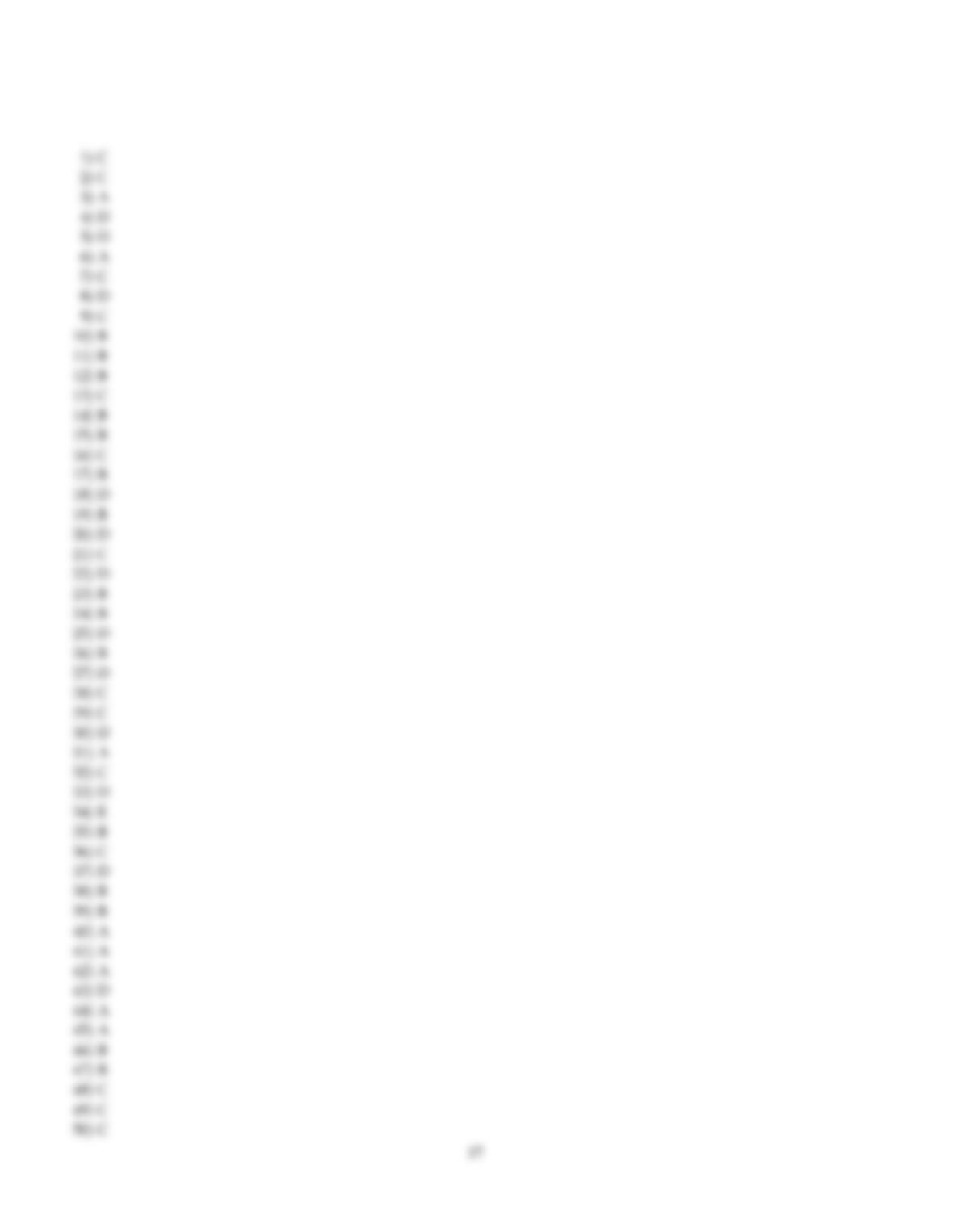
Answer Key
Testname: C8
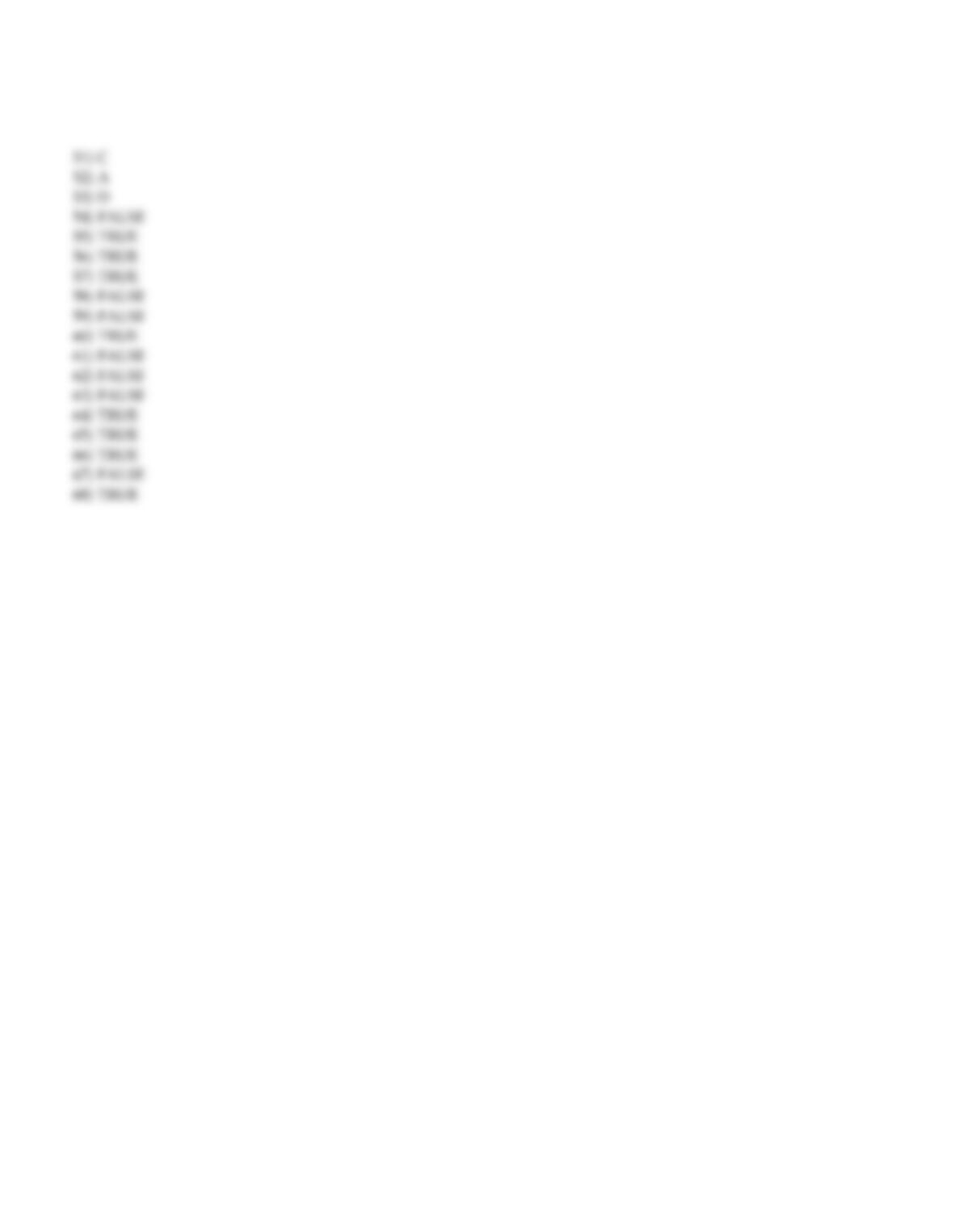
Answer Key
Testname: C8
18