Exam
Name___________________________________
MULTIPLE CHOICE. Choose the one alternative that best completes the statement or answers the question.
1)
An ampere–turn is a unit of ________.
1)
A)
resistance
B)
reactance
C)
magnetomotive force (mmf)
D)
permeability
2)
If a higher voltage is needed from a generator, what must be done?
2)
A)
Increase the distance between the coil and magnetic field.
B)
Decrease the number of coils.
C)
Turn the coil faster.
D)
both B and C.
3)
According to the left–hand rule for the magnetic field around a conductor, what points in the
direction of current flow?
3)
A)
thumb
B)
fingers
C)
meter
D)
index finger
4)
Which one of the statements below does NOT apply to the voltage induced into a wire when it is
moved through a magnetic field?
4)
A)
It depends on the strength of the magnetic field.
B)
It depends on the current flowing in the wire.
C)
It depends on the length of moving wire in the field.
D)
It depends on the speed of wire motion.
5)
Applying an ac voltage to an electromagnet‘s coil will produce a ________.
5)
A)
north magnetic field
B)
changing magnetic field
C)
south magnetic field
D)
steady magnet field
6)
Electromagnetic induction is best defined as the process by which a voltage is produced in a
conductor when there is:
6)
A)
motion between the conductor and the magnetic field.
B)
energy produced by the rotating coils.
C)
motion between the magnetic poles.
D)
motion around the magnetic fields.
A
7)
Like magnetic poles ________.
7)
A)
repel each other
B)
attract each other
C)
have the same current through them
D)
have no effect on each other
A
8)
The permeability of air is ________.
8)
A)
1
B)
22
C)
19.2
D)
7
A
9)
A simple electric doorbell probably uses ________ to ring the bell.
9)
A)
transistor
B)
an electromagnet
C)
a permanent magnet
D)
a DPDT switch
B
B
10)
Reversing the current through an electromagnet ________ the magnetic field.
10)
A)
collapses
B)
increases
C)
reverses
D)
decreases
11)
Faraday’s law and Lenz’s law are related in that they deal with:
11)
A)
a resulting current flow.
B)
an induced voltage.
C)
varying magnetic field.
D)
all of these.
D
12)
A ________ is a type of electromagnetic device that has a movable iron core called a plunger.
12)
A)
solenoid
B)
analog meter
C)
relay
D)
speaker
A
13)
How will two permanent bar magnets react if they are brought close to each other?
13)
A)
They will attract if their north poles are together.
B)
They will repel if the north and south poles are together.
C)
They will attract if their south poles are together.
D)
They will attract if the north and south poles are together.
D
14)
If two north magnetic poles are brought close to each other, ________.
14)
A)
an electromagnet is created
B)
a current is induced
C)
a force of attraction pulls them together
D)
a force of repulsion pushes them apart
D
C
15)
The polarity of an induced voltage depends on the ________.
15)
A)
direction of motion of a conductor in a magnetic field
B)
amount of current flowing
C)
length of a conductor in a magnetic field
D)
time that the conductor remains stationary in a magnetic field
16)
If a tape recorder’s output voltage increases and decreases when you shake the recorder, a possible
problem might be ________.
16)
A)
an open circuit in the speaker
B)
too high a source voltage
C)
an open capacitor
D)
a loose circular magnet around the speaker’s voice coil
D
17)
A relay is a device that ________.
17)
A)
isolates the actuating signal from the control signal
B)
has a coil to actuate some contacts that control other circuits
C)
uses an electromagnet to open and close contacts
D)
all of these
D
18)
In which one of the following applications is electromagnetism used?
18)
A)
tape recorders
B)
relays
C)
loudspeakers
D)
all of these
D
19)
An iron core electromagnet has a higher ________ than an air core electromagnet.
19)
A)
current
B)
resistance
C)
reactance
D)
permeability
D
A
20)
A tesla is a unit of ________.
20)
A)
permeability
B)
magnetic flux density
C)
reluctance
D)
magnetomotive force
21)
The quantity of lines of force per unit of area is known as ________.
21)
A)
permeability
B)
ampere–turns
C)
flux density
D)
magnetic flux
22)
The ________ electromagnet cannot be further magnetized.
22)
A)
open
B)
shorted
C)
capacitive
D)
saturated
23)
The term reluctance in magnetic circuits is like the term ________ in electrical circuits.
23)
A)
resistance
B)
voltage
C)
capacitance
D)
current
24)
Magnetic lines that are close to each other are said to have a high ________.
24)
A)
inductance
B)
flux density
C)
reluctance
D)
current
25)
The amount of voltage that is induced in a conductor depends on the ________.
25)
A)
direction of the current flowing
B)
length of time a conductor remains stationary in the magnetic field
C)
direction of motion of the conductor in the magnetic field
D)
length of the conductor in the magnetic field
26)
If the contacts fail to open when a relay is de–energized, what is the trouble?
26)
A)
Dirt is causing the relay armature to stick.
B)
The return spring tension is too large.
C)
There is too little current in the relay coil.
D)
There is no trouble. The relay is operating normally.
27)
The magnetic field around an electromagnet is produced by ________.
27)
A)
the laminated iron core
B)
a current flowing through the winding
C)
the conductor’s permeability
D)
a permanent magnet
B
28)
Induced voltage resulting from electromagnetic induction is proportional to:
28)
A)
the angle at which the conductor cuts the magnetic field.
B)
the rate at which the conductor and magnetic fields move relative to each other.
C)
the number of turns of wire in the coil.
D)
all of these.
D
29)
If a basic one–loop, dc generator rotates at 60 revolutions each second, how many times each
second does its dc output voltage reach a peak value?
29)
A)
0
B)
120
C)
240
D)
60
B
30)
The voltage produced by a magnetic field cutting through a conductor depends on the ________.
30)
A)
length of the conductor
B)
direction of motion
C)
speed of motion
D)
all of the above
D
A
31)
If some turns of wire are removed from an electromagnet, the magnetic field will ________.
31)
A)
be the same as the original electromagnet
B)
be less than the original electromagnet
C)
be more than the original electromagnet
32)
Permeability is ________.
32)
A)
the shielding effect of a material
B)
the ability of a magnetic material to conduct a current
C)
the ease of a material to be magnetized
D)
the opposition to being magnetized
33)
A coil of wire with current flowing through it is called a(n) ________.
33)
A)
electromagnet
B)
south pole
C)
north pole
D)
capacitor
34)
Hysteresis is a characteristic of magnetic materials wherein a change in magnetization:
34)
A)
occurs exactly with the application of a magnetic force.
B)
occurs after the application of a magnetic force.
C)
varies according to the current flow.
D)
occurs before the application of a magnetizing force.
35)
The movable part of the relay is the:
35)
A)
the armature.
B)
magnetic field.
C)
electromagnetic coil.
D)
all of these.
36)
Increasing the speed at which a magnet moves through a coil of wire causes the induced voltage to
________.
36)
A)
decrease
B)
remain the same
C)
increase
37)
The movable part of the solenoid is the:
37)
A)
electromagnetic coil.
B)
magnetic field.
C)
the plunger.
D)
all of these.
38)
If a relay picks up and makes a contact but does not stay picked up, what’s the trouble?
38)
A)
The magnetic field is too weak.
B)
The magnetic field is too strong.
C)
The relay coil is open.
D)
There is no trouble. The relay is operating normally.
39)
Unlike magnetic poles ________ and like poles ________.
39)
A)
attract, repel
B)
repel, repel
C)
attract, attract
D)
repel, attract
40)
If the number of turns of wire on an electromagnet increases, the magnetomotive force mmf
________.
40)
A)
remains the same
B)
decreases
C)
increases
41)
Faraday’s law states that the voltage induced across a coil of wire is proportional to these two
factors.
41)
A)
the size of the coil and the rate of change of the magnetic flux
B)
the diameter of the conductor and the rate of change of the magnetic flux
C)
the size of the magnets and the rate of change of the magnetic flux
D)
the number of turns in the coil and the rate of change of the magnetic flux
42)
The principal difference between a solenoid and a relay is that:
42)
A)
relays relay electricity, solenoids do not.
B)
relays use magnets, solenoids do not.
C)
solenoids do mechanical work, relays do electrical work.
D)
solenoids do electrical work, relays do mechanical work.
43)
The magnetic term that is equivalent to voltage is ________.
43)
A)
magnetomotive force
B)
flux density
C)
reluctance
D)
current
44)
If more turns of wire are added to a coil and then that coil is moved through a magnetic field, the
voltage produced will ________.
44)
A)
be the same as the original coil
B)
be less than the original coil
C)
be more than the original coil
45)
Soft iron has a high ________.
45)
A)
reactance
B)
permeability
C)
mmf
D)
resistance
46)
A solenoid consists of ________.
46)
A)
a permanent magnet
B)
two plates separated by an insulator
C)
a burglar alarm relay
D)
a coil of wire wound around a core
47)
How does the magnetic field change around a conducting wire if the current increases?
47)
A)
The field grows weaker.
B)
There is no magnetic field around a conducting wire.
C)
It is impossible to predict.
D)
The field grows stronger.
48)
If the cross–sectional area of a magnetic field decreases, the flux density ________.
48)
A)
remains the same
B)
decreases
C)
increases
49)
The purpose of a commutator in a dc generator is to:
49)
A)
keep current flowing in one direction.
B)
provide filtration.
C)
concentrate flux density.
D)
maximize the current generated.
50)
For a high current switching application where it is not practical to route heavy wiring to the
switch location which device would be used?
50)
A)
relay
B)
electromagnet
C)
generator
D)
solenoid
51)
A weber is a unit of ________.
51)
A)
reluctance
B)
permeability
C)
magnetic flux
D)
magnetomotive force
TRUE/FALSE. Write ‘T’ if the statement is true and ‘F’ if the statement is false.
52)
A conductor with no current through it will still have a magnetic field around it.
52)
53)
A permanent magnet will retain its magnetism for a long period of time.
53)
54)
Unlike magnetic poles repulse one another.
54)
55)
The opposition to being magnetized is called permeability.
55)
56)
Aluminum, brass, and iron make good magnets.
56)
57)
Soft iron, copper, and silver make good magnets.
57)
58)
A DC generator produces a smooth DC voltage output.
58)
59)
The speed of movement of the coil of a generator affects the direction of current produced.
59)
60)
A strong magnetic field around a conductor indicates a small current flowing through the
conductor.
60)
C
61)
Two north magnetic poles attract one another.
61)
62)
Flux lines are concentrated at the center of a magnet.
62)
63)
A magnetic field around a conductor is a good indication that current is flowing.
63)
64)
A solenoid converts electrical energy into mechanical energy.
64)
65)
Magnetic flux is another name for a magnetic field.
65)
66)
The left–hand rule can be used to determine the amount of magnetomotive force.
66)
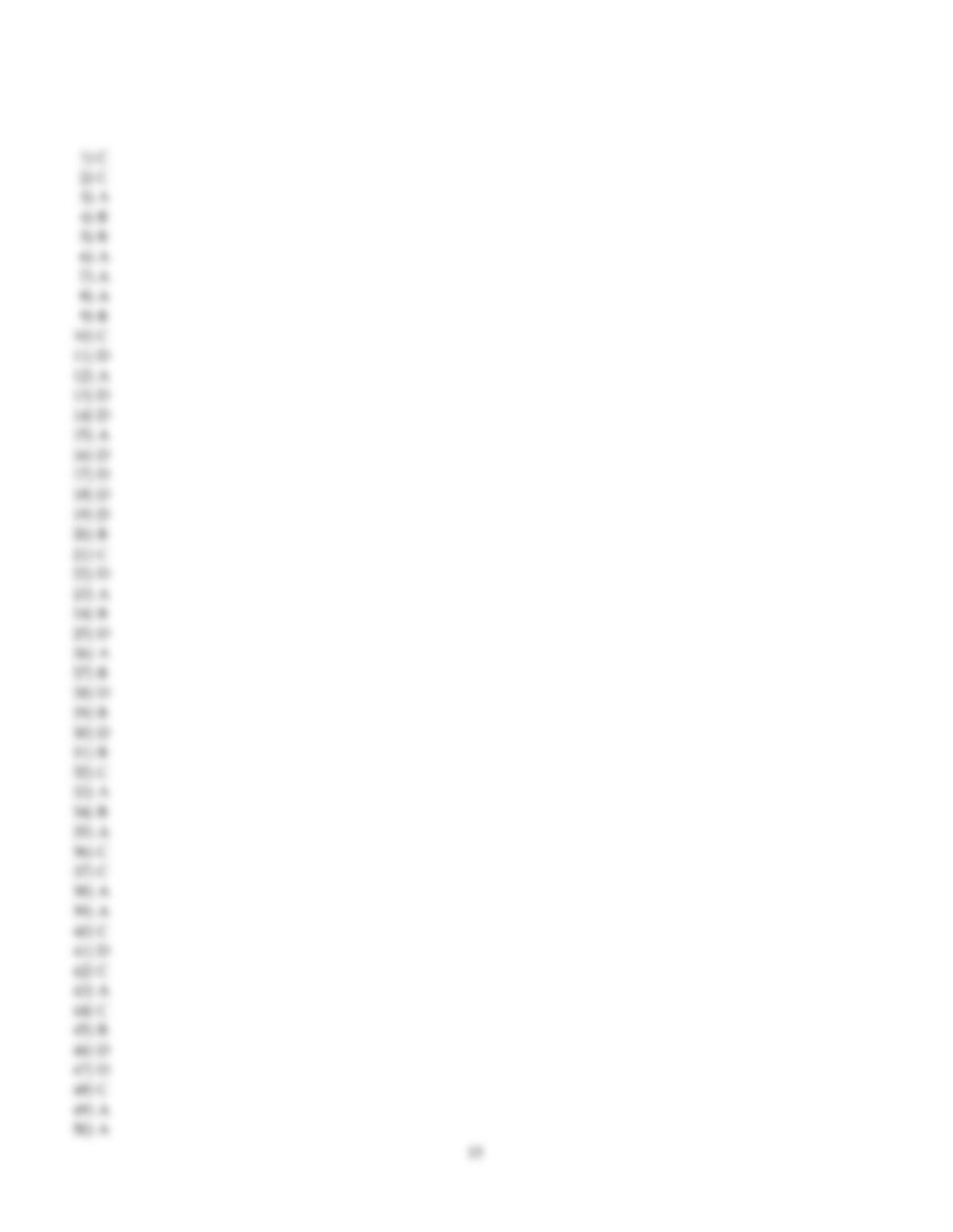
Answer Key
Testname: C7
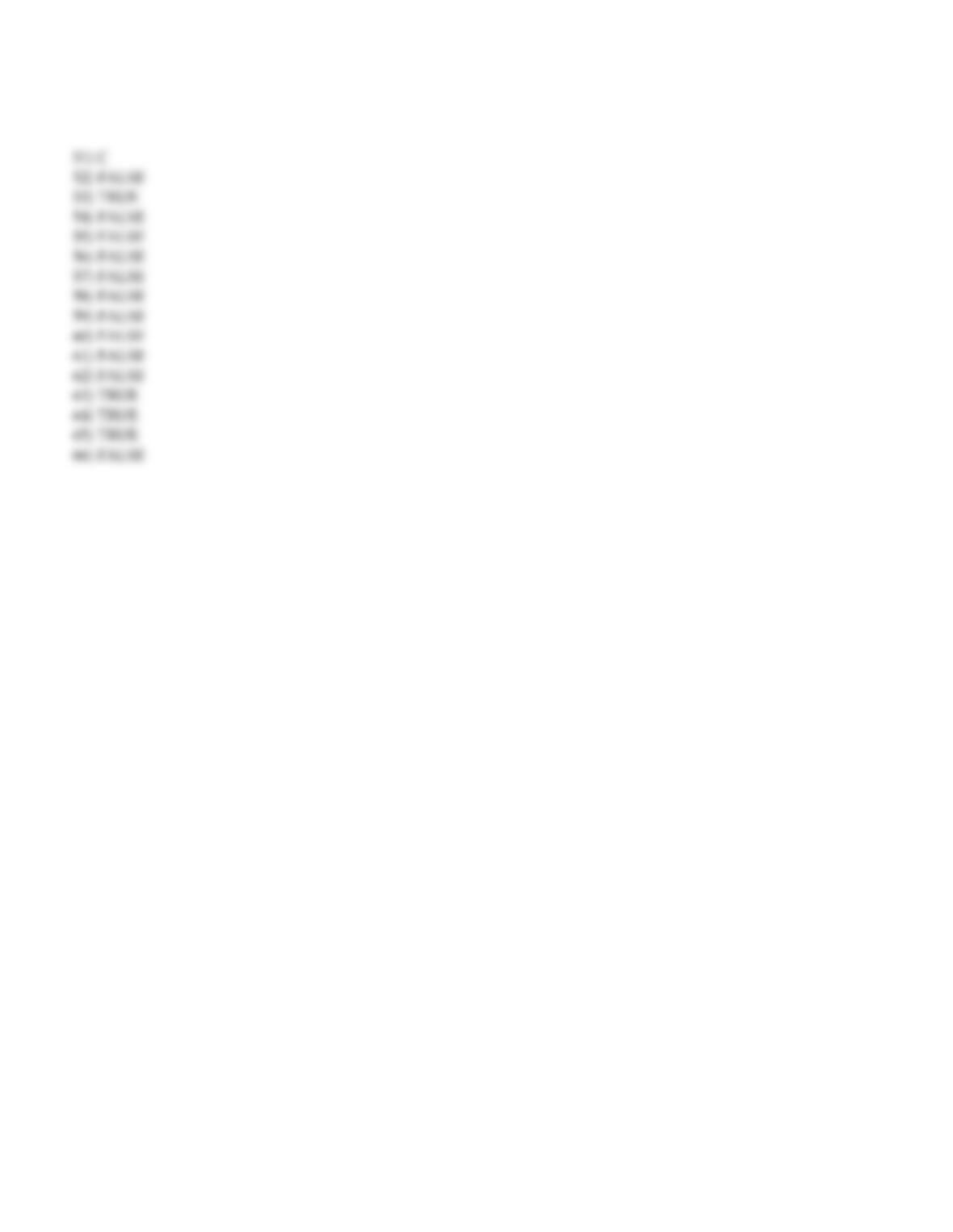
Answer Key
Testname: C7
14