Exam
Name___________________________________
MULTIPLE CHOICE. Choose the one alternative that best completes the statement or answers the question.
1)
If a 1 M resistor, 0.47 M resistor and 0.5 M resistor are connected in parallel across an 18 V
source, what is the total current if the 1 M resistor opens?
1)
A)
74.3 µA
B)
92.3 mA
C)
92.3 µA
D)
74.3 mA
2)
IT equals 0.1 mA in a 3–branch parallel circuit. If I1= 0.022 mA and I2= 0.007 mA, I3= ?
2)
A)
0.142 mA
B)
0.029 mA
C)
0.213 mA
D)
0.071 mA
3)
If one resistor shorts in a parallel circuit, the total current ________.
3)
A)
decreases
B)
equals 0 A
C)
increases
D)
decreases momentarily, then returns to the original value
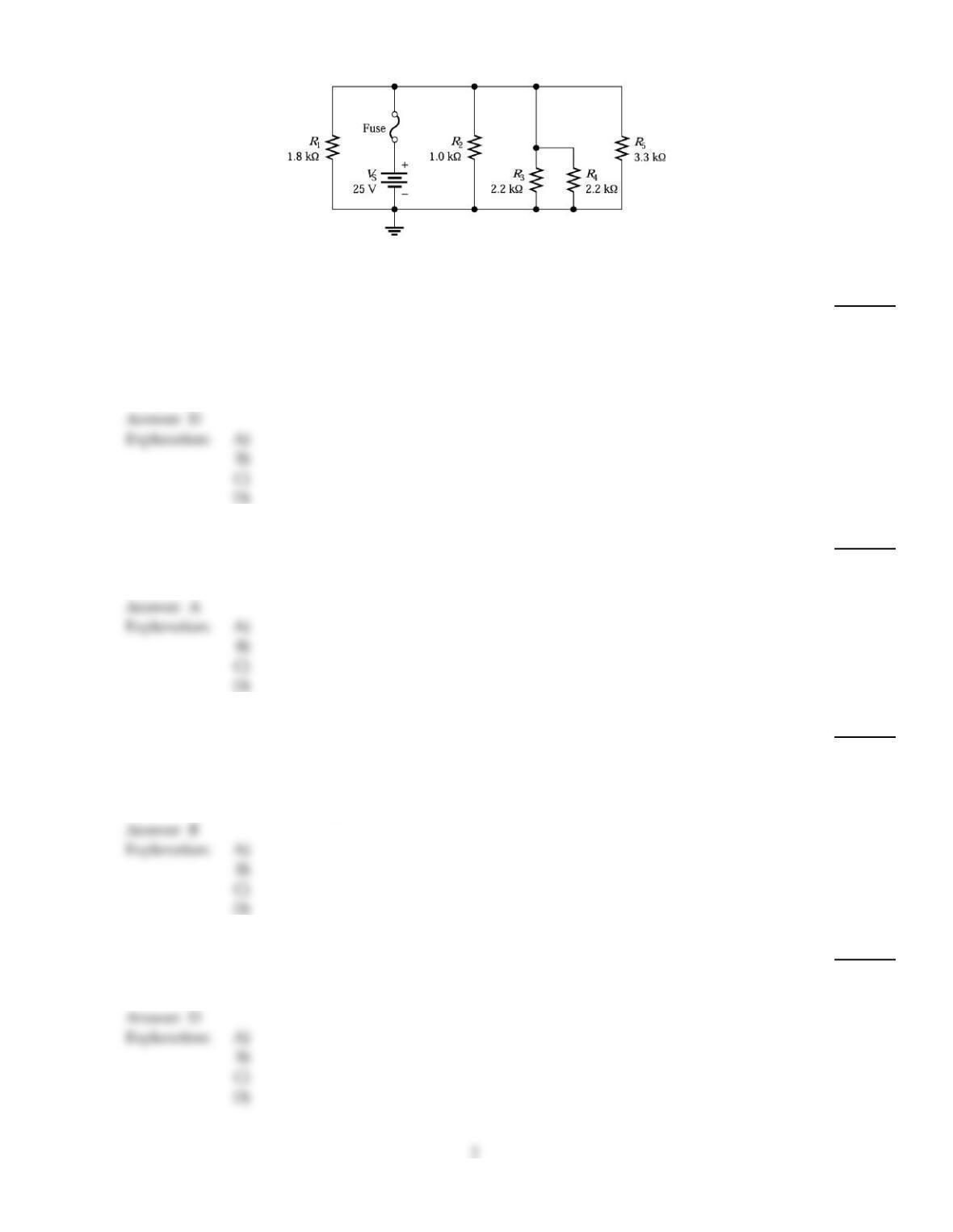
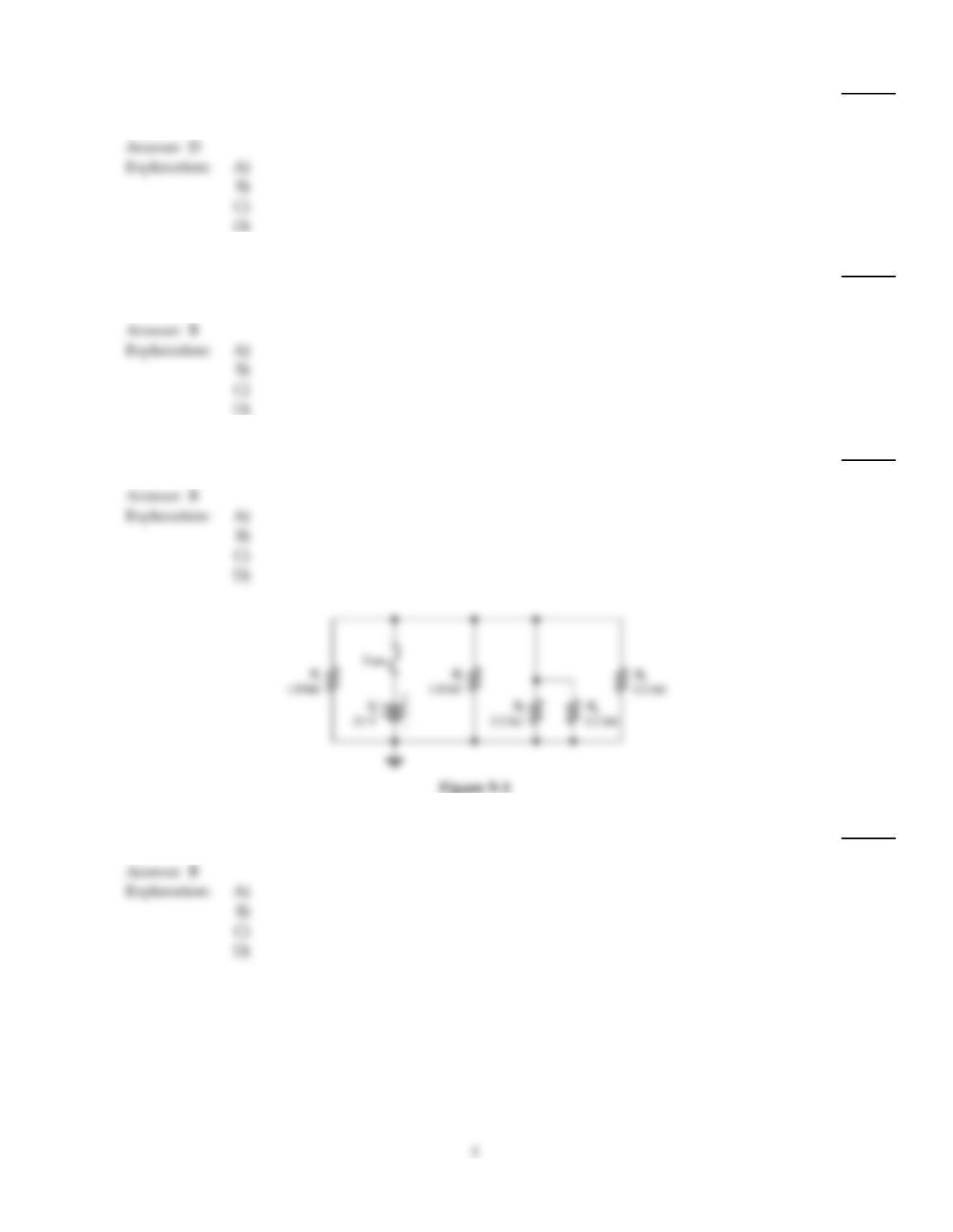
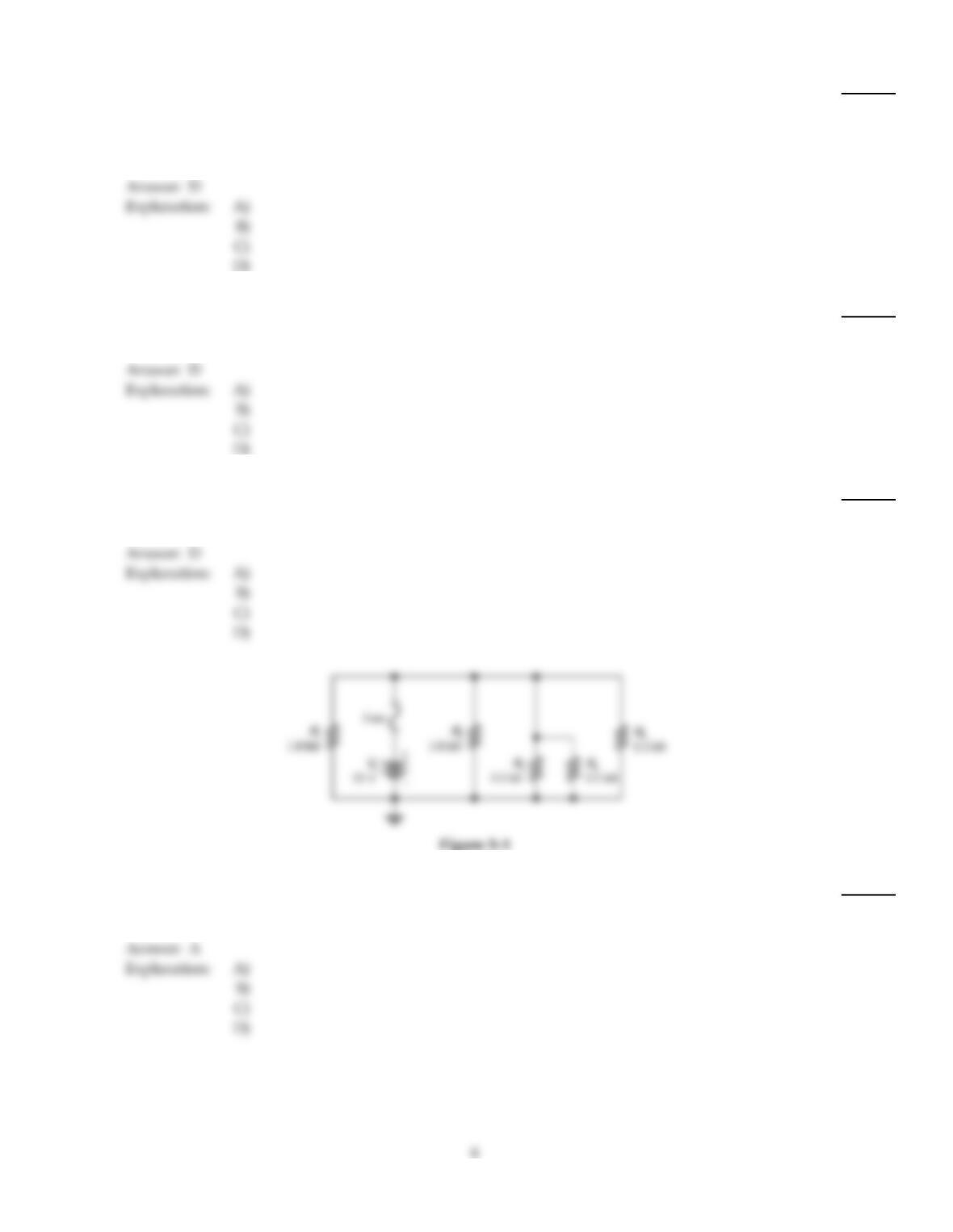
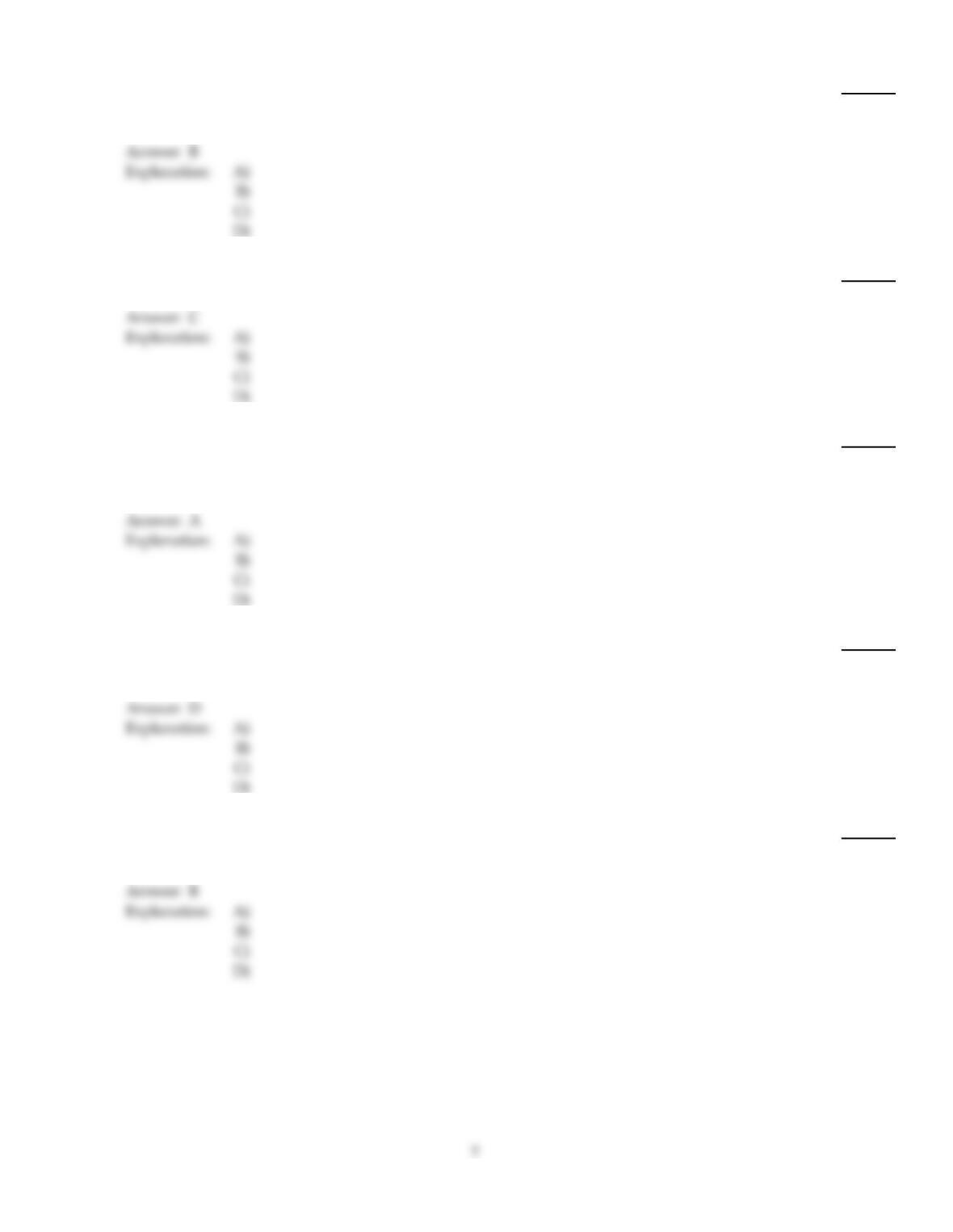
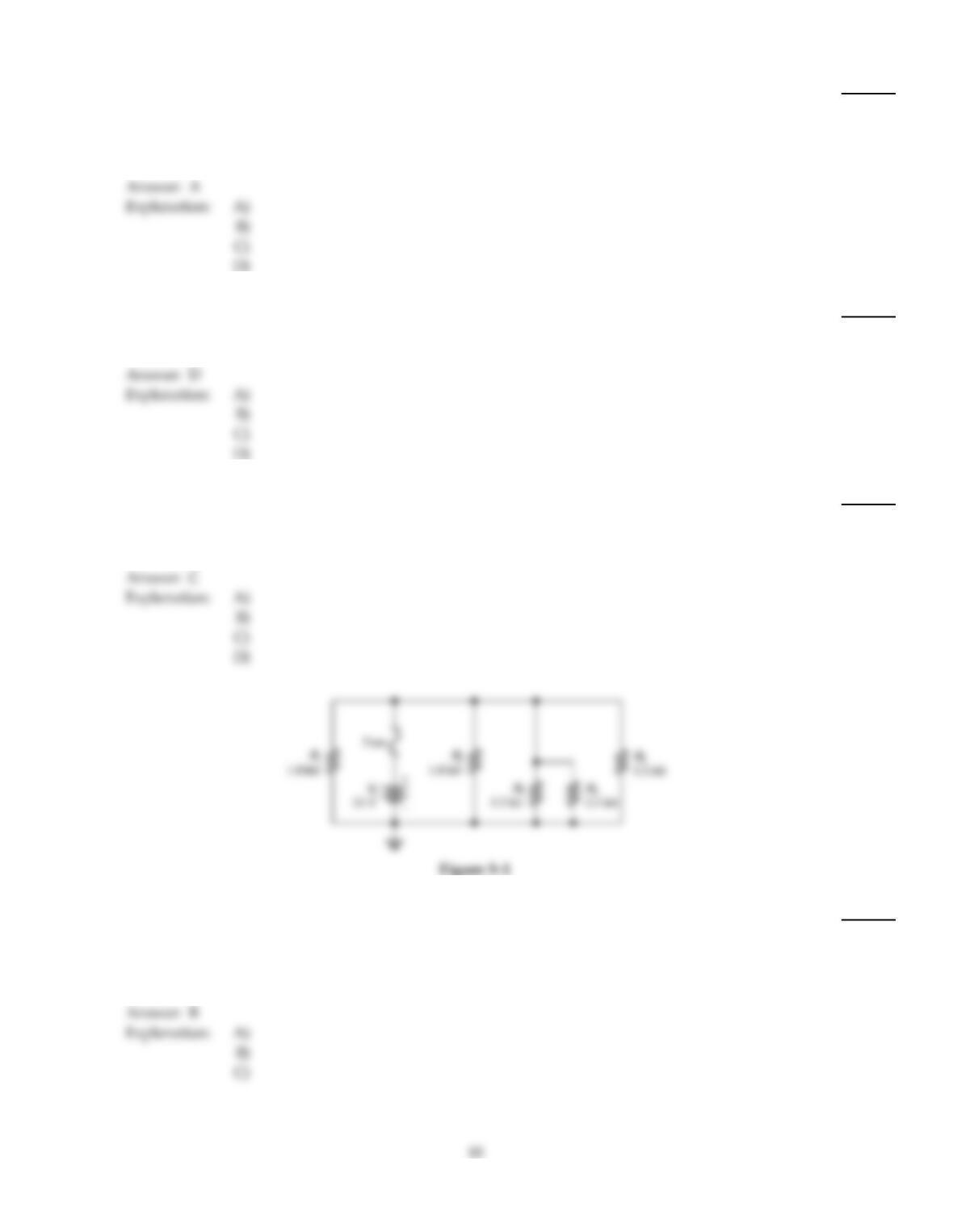
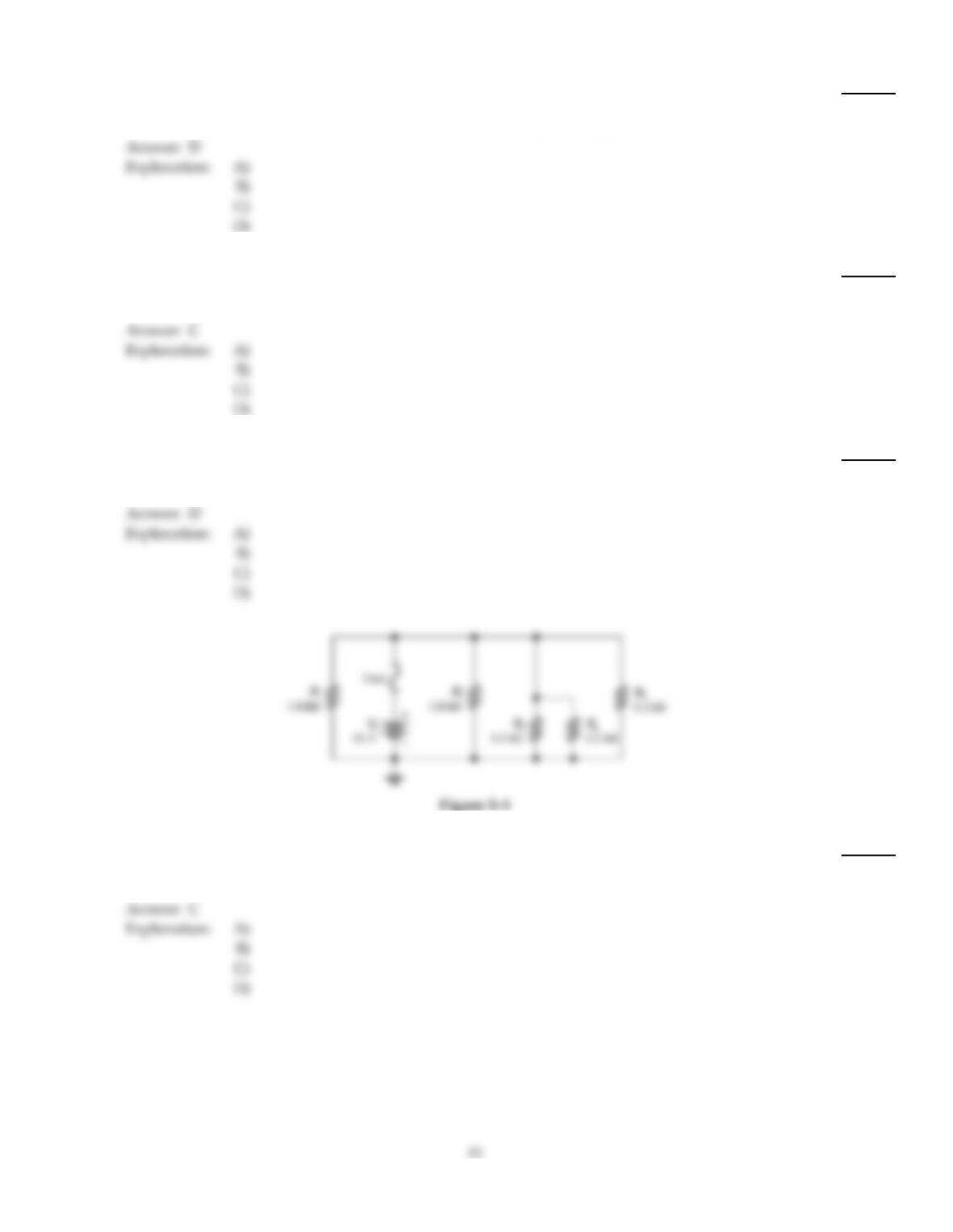
Figure 5–1
4)
Refer to Figure 5–1. To accurately measure the total current for this circuit, how must the ammeter
be connected?
4)
A)
between the positive terminal and the fuse
B)
between R1 and the fuse
C)
between the negative terminal and the supply and ground
D)
either A or C
5)
A two–branch parallel circuit contains these values: R1= 1200 , IT= 0.005 mA, I2= 0.003 mA.
What is the value of VR1?
5)
A)
2.4 m V
B)
6 m V
C)
3.6 m V
D)
18 m V
6)
A short in one branch of a parallel circuit results in:
6)
A)
increased voltage drops in the remaining branches.
B)
increased current flow.
C)
increased circuit resistance.
D)
decreased power consumption.
7)
A three–branch parallel circuit carries a total current of 1.2 mA. If I1= 0.2 mA and I2= 0.7 mA,
then what is the value of I3?
7)
A)
8.7 mA
B)
7.2 mA
C)
2.4 mA
D)
0.3 mA
8)
If the RT= 6.8 k and R1= 10 k in a two–branch parallel circuit, what is the value of R2?
8)
A)
16.8 k
B)
21.3 k
C)
3.2 k
D)
12 k
9)
If the power dissipation in each of four parallel branches is 1 W, PT equals ________.
9)
A)
1 W
B)
0 W
C)
4 W
D)
0.25 W
10)
Each branch in a four–branch parallel circuit carries 10 mA. If one of the branches opens, then the
current in each of the other three branches equals ________.
10)
A)
0 A
B)
13.33 mA
C)
10 mA
D)
30 mA
11)
The most popular application for a parallel circuit in electronics is as a:
11)
A)
voltage divider.
B)
power divider.
C)
current divider.
D)
resistance divider.
12)
If a 330 resistor, 270 resistor and 68 resistor are connected in parallel, what is the
approximate value for RT?
12)
A)
68
B)
47
C)
22
D)
668
13)
The total resistance of a three–branch parallel circuit is 76.92 . If R1= 100 and R2= 500 , what
is the value of R3?
13)
A)
1000
B)
140
C)
1850
D)
More information is needed to calculate R3.
14)
If three 22 k resistors are connected in parallel across a 10 V source, PT equals ________.
14)
A)
4.5 m W
B)
13.6 m W
C)
22.6 m W
D)
18.1 m W
15)
If four 100 W lamps are connected in parallel across a 120 V source, what is the total current?
15)
A)
8.33 A
B)
833 mA
C)
33.3 A
D)
3.33 A
16)
If a 2.2 k resistor and a 3.3 k resistor are connected in parallel, RT equals ________.
16)
A)
3.3 k
B)
2.2 k
C)
greater than 2.2 k
D)
less than 2.2 k
17)
A formula that applies to a two–branch parallel circuit is ________.
17)
A)
RT= R1+ R2
B)
IT= IR1 + IR2
C)
VT= VR1 + VR2
D)
RT= V1÷ R2
18)
If a 2.2 k resistor, 10 k resistor and 1.2 k resistor are connected in parallel, the total resistance
equals ________.
18)
A)
2.27 k
B)
13.4 k
C)
1.2 k
D)
721
19)
If one resistor opens in a parallel circuit, the total current ________.
19)
A)
varies wildly
B)
decreases
C)
increases
D)
remains unchanged
20)
If a 5.5 k, 22 k and 500 resistor are connected in parallel, what is RT?
20)
A)
28.1 k
B)
449
C)
27.6 k
D)
330
21)
Refer to Figure 5–1. What is the power dissipation of R3?
21)
A)
568 mW
B)
284 mW
C)
11.4 mW
D)
25 mW
22)
The power dissipated by any branch of a parallel circuit ________.
22)
A)
depends on the power rating of the resistor
B)
only depends on the total current
C)
only depends on the circuit voltage
D)
depends on the voltage and value of the resistor
23)
An open in one branch of a parallel circuit results in:
23)
A)
decreased or reduced current flow.
B)
increased circuit resistance.
C)
decreased power consumption.
D)
all of these.
24)
If there is 100 mA of current flowing into a three–branch parallel circuit and two of the branch
currents are 40 mA and 20 mA, the third branch current is ________.
24)
A)
20 mA
B)
160 mA
C)
60 mA
D)
40 mA
25)
Refer to Figure 5–1. The voltage across R2 is 0 V. What is most likely the problem?
25)
A)
fuse open
B)
R2 open
C)
R1 open
D)
none of the above
26)
As additional branch resistors are connected in a parallel circuit, ________.
26)
A)
IT increases and RT increases
B)
IT increases and RT decreases
C)
IT decreases and RT decreases
D)
IT decreases and RT increases
27)
RT= 330 and R1= 470 in a two–branch parallel circuit. What is the value of R2?
27)
A)
194
B)
770
C)
1108
D)
110
28)
If 5 A and 3 A enter a junction from two separate paths, how much current flows out of the
junction?
28)
A)
8 A
B)
3 A
C)
2 A
D)
the larger of the two
29)
As resistors are disconnected from a parallel circuit, ________.
29)
A)
IT increases and RT decreases
B)
IT increases and RT increases
C)
IT decreases and RT decreases
D)
IT decreases and RT increases
30)
To measure the current through one branch of a parallel circuit, the meter is connected ________.
30)
A)
in parallel with the branch resistor
B)
in series with the branch resistor
C)
across the source
D)
in series with the source
31)
In a parallel circuit, total power PT is calculated as:
31)
A)
P1× P2× P3× etc.
B)
1/P1+ 1/P2+ 1/P3+ etc.
C)
P1÷ P2÷ P3÷ etc.
D)
P1+ P2+ P3+ etc.
32)
If three 75 W lamps are connected in parallel across a 125 V source, IT equals ________.
32)
A)
1.8 A
B)
180 mA
C)
18 A
D)
18 mA
33)
If three 4.7 k resistors are connected in parallel across a 12 V source, what is the value of PT?
33)
A)
141 mW
B)
91.9 mW
C)
14.1 mW
D)
1.41 W
34)
If twelve 1.5 M resistors are connected in parallel across 50 V, RT equals ________.
34)
A)
1 M
B)
1.5 M
C)
1.25 M
D)
0.125 M
35)
The current through any branch of a parallel circuit ________.
35)
A)
depends only on the circuit voltage
B)
is directly proportional to the branch resistance
C)
is inversely proportional to the branch resistance
D)
depends on the power rating of the resistor
36)
If you measure a lower than normal total current in a parallel circuit, ________.
36)
A)
the power supply is off
B)
all of the resistors are opened
C)
a resistor shorted
D)
a resistor opened
37)
If a 4.7 k resistor, a 3.3 k resistor and a 5.43 k resistor are connected in parallel across a 50 V
source, what is the current through the 5.43 k resistor?
37)
A)
15.15 mA
B)
4.72 mA
C)
10.64 mA
D)
9.21 mA
D
38)
If eight 47 k resistors are connected in parallel across a 25 V source, RT equals ________.
38)
A)
6.71 k
B)
5.88 k
C)
376 k
D)
4.7 k
B
39)
If you want to measure a load voltage with a DVM, connect the meter ________.
39)
A)
in parallel with the load
B)
in series with the load
C)
in series with the source
D)
across the source
A
40)
In a three–branch parallel circuit, R1= 1.2 M, R2= 1 M and RT= 0.5 M. Calculate R3.
40)
A)
2 M
B)
6 M
C)
1.7 M
D)
7.7 M
B
41)
If a 470 resistor, 680 resistor and 830 resistor are connected in parallel, the total resistance
equals ________.
41)
A)
1150
B)
208
C)
1980
D)
1510
B
D
42)
In a parallel circuit, the largest amount of power is dissipated by:
42)
A)
the smallest resistor.
B)
the first resistor.
C)
the largest resistor.
D)
any resistor, since the voltage is the same across each of the branch circuits.
43)
In a three–resistor parallel circuit, R1= 0.22 M and R2= 1 M. If RT= 0.1166 M, then what is
the value of R3?
43)
A)
0.134 M
B)
13,400
C)
1.34 M
D)
0.33 M
D
44)
If one resistor opens in a parallel circuit, the total circuit resistance ________ and the total circuit
current ________.
44)
A)
decreases, decreases
B)
decreases, increases
C)
increases, decreases
D)
increases, increases
C
45)
Refer to Figure 5–1. The fuse in this circuit is rated at 100 mA. Would the fuse blow if an additional
1 k were placed in parallel with R5?
45)
A)
yes
B)
no
C)
Fuse has nothing to do with this part of the circuit.
B
A
46)
If the total current equals 0 A in a four–branch parallel circuit, the trouble is that ________.
46)
A)
one resistor has opened
B)
three of the resistors have opened
C)
one of the resistors has shorted
D)
the power supply is off
47)
A 5.2 M resistor, 1.2 M resistor and 1 M resistor are connected in parallel across a 15 V source.
What is the total current if the 1.2 M resistor opens?
47)
A)
2.41 µA
B)
2.88 µA
C)
17.9 µA
D)
12.5 µA
48)
If a 500 , 1200 and 10 k resistor are connected in parallel across a 25 V source, how much
current flows through the 1200 resistor?
48)
A)
2.4 mA
B)
2.5 mA
C)
50 mA
D)
20.8 mA
49)
Refer to Figure 5–1. The total current for this circuit is measured and the ammeter reads 57.8 mA.
What is the problem, if any?
49)
A)
R1 open
B)
R2 open
C)
R3 open
D)
This is normal.
50)
If a 4.7 k resistor and 2.2 k resistor are connected in parallel, the total resistance is ________.
50)
A)
4700
B)
2200
C)
greater than 2200
D)
less than 2200
TRUE/FALSE. Write ‘T’ if the statement is true and ‘F’ if the statement is false.
51)
If IR1 = 75 mA and IR2 = 12.7 mA in a two branch parallel circuit, IT= 85.7 mA.
51)
52)
Measurement of total current is accomplished with the ammeter in series with the source voltage.
52)
53)
If three equal resistors are connected in parallel across 12 V, each resistor drops 4 V.
53)
54)
PR1 = 0.25 W and PR2 = 1.2 W in a parallel circuit. The total power dissipated is 1.25 W.
54)
55)
Total power for a parallel circuit can be determined by the same method as a series circuit.
55)
56)
The total power dissipated by a parallel circuit can be found by adding the individual powers.
56)
57)
If IR1 = 0.065 mA and IR2 = 0.098 mA in a two branch parallel circuit, IT= 0.163 mA.
57)
58)
The total resistance of four resistors in parallel is always less than the smallest resistance.
58)
59)
If one branch of a parallel circuit opens, the total resistance decreases.
59)
60)
A parallel circuit can be easily identified because only one end of each component is connected to
each other.
60)
61)
Kirchhoff’s Current Law states that the sum of the currents into a junction must equal the sum of
the currents out of that junction.
61)
62)
If one branch of a parallel circuit shorts, the total resistance decreases.
62)
63)
The total resistance of three parallel resistors equals the sum of the individual resistor values.
63)
64)
Accurate troubleshooting of a parallel circuit cannot be performed with a voltmeter.
64)
Answer Key
Testname: C5
Answer Key
Testname: C5
15