Exam
Name___________________________________
MULTIPLE CHOICE. Choose the one alternative that best completes the statement or answers the question.
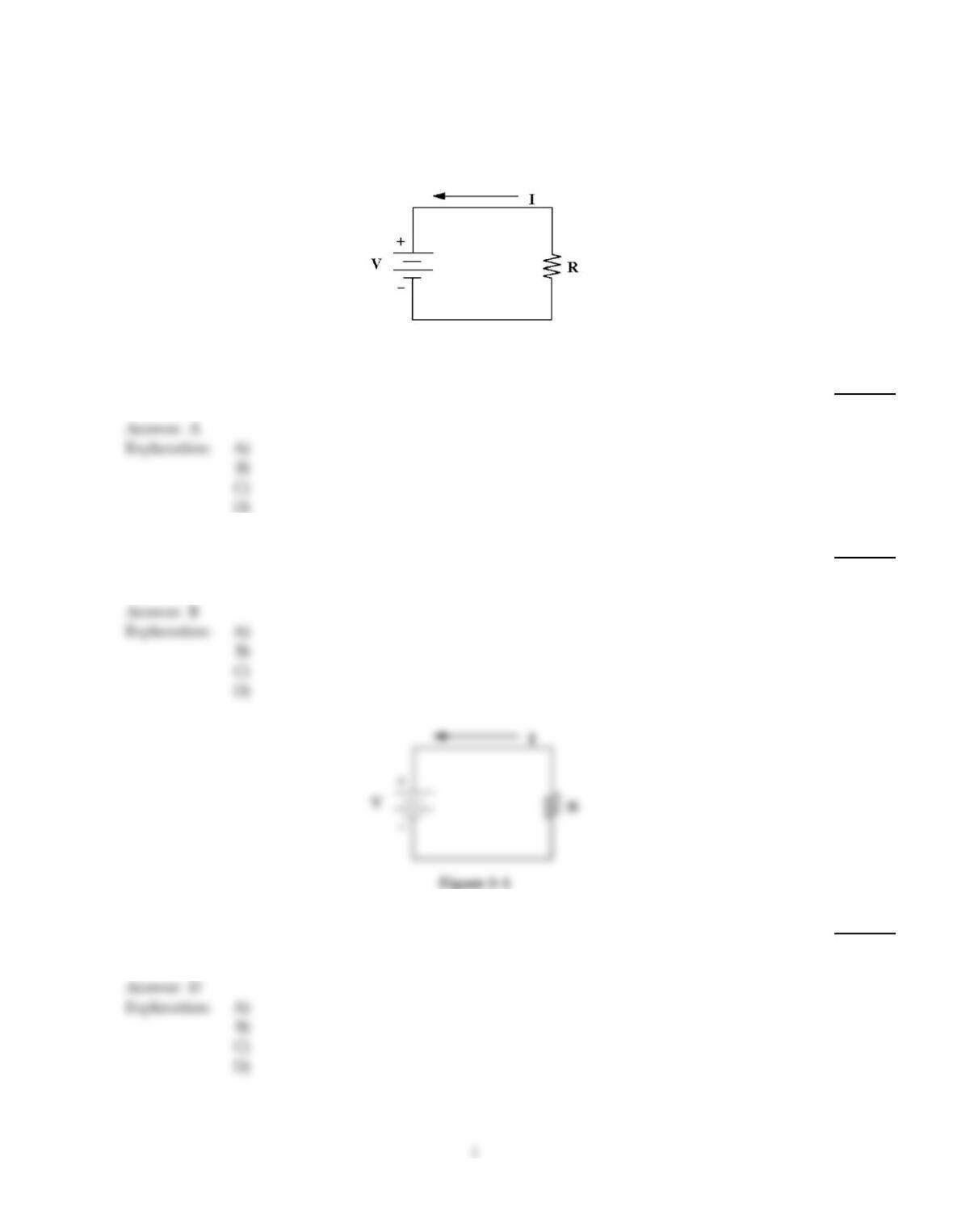
Figure 3–1
1)
If V = 60 V and R = 47 k in Figure 3–1, the current equals ________.
1)
A)
1.28 mA
B)
12.8 mA
C)
0.128 mA
D)
128 mA
2)
Which is the most unlikely resistor failure?
2)
A)
resistance change
B)
shorting
C)
opening
D)
All are common failures.
Figure 3–1
3)
If the resistor opens in Figure 3–1, the following circuit conditions would exist.
3)
A)
resistor would read infinite resistance
B)
no power dissipation
C)
no current flow
D)
all of the above
4)
The ampere–hour rating of a battery is defined as the:
4)
A)
number of amperes supplied over the number of hours at a given current.
B)
number of hours per amperes supplied.
C)
number of amperes supplied in 1 hour.
D)
all of these.
5)
A kilowatt–hour is best defined as:
5)
A)
1,000 watts multiplied by 1 hour.
B)
a kilo divided by 1 watt–hour.
C)
1,000 watts divided by 1 hour.
D)
a kilo multiplied by 1 watt–hour.
6)
According to Ohm’s Law, if resistance were to decrease while voltage remained the same, current
would
6)
A)
remain the same
B)
increase
C)
decrease
D)
no way to determine
7)
The symbol for a certain amount of energy used over time is ________.
7)
A)
I
B)
P
C)
W
D)
V
8)
The voltage of a power supply drops to 0 V when connected to a lamp circuit. What is a possible
problem?
8)
A)
the lamp is open
B)
the lamp is shorted
C)
the lamp requires more current than the power supply can deliver
D)
both B and C
9)
A 250 µA current flowing through a 4.7 k resistor produces a ________ voltage drop.
9)
A)
1.18 V
B)
53.2 V
C)
18.8 V
D)
1.18 mV
10)
If the current flow for a given circuit has doubled, then the ________ has been halved.
10)
A)
current
B)
voltage
C)
resistance
D)
power
C
11)
If V=12V and a 12k resistor were to open in Figure 3–1, the current is ________.
11)
A)
1 mA
B)
0 A
C)
10 mA
D)
extremely high
B
12)
If V = 50 V and R = 25 k in Figure 3–1, the current equals ________.
12)
A)
5 mA
B)
2 mA
C)
0.5 mA
D)
50 mA
B
13)
If a 10 k resistor dissipates 0.5 W in Figure 3–1, then the supply voltage equals ________.
13)
A)
50 V
B)
7.07 mV
C)
5000 V
D)
70.7 V
D
A
14)
Which is the correct formula for Ohm’s Law?
14)
A)
P = V × I
B)
I = V ÷ R
C)
V = I ÷ R
D)
R = V × I
15)
If a resistor that is color coded yellow–violet–red is placed across a 25 V source voltage, what value
resistor and wattage rating could be used?
15)
A)
47000 , 1/4 W
B)
4700 , 1/4 W
C)
470 , 1/2 W
D)
4700 , 1/8 W
16)
If a resistor that is color–coded red–red–brown–silver is connected to a 15 V source, what is the
maximum current that can flow?
16)
A)
75.8 mA
B)
68.2 mA
C)
71.9 mA
D)
62 mA
17)
If the voltage across a circuit increases, ________.
17)
A)
the resistance increases
B)
the current decreases
C)
the resistance decreases
D)
the current increases
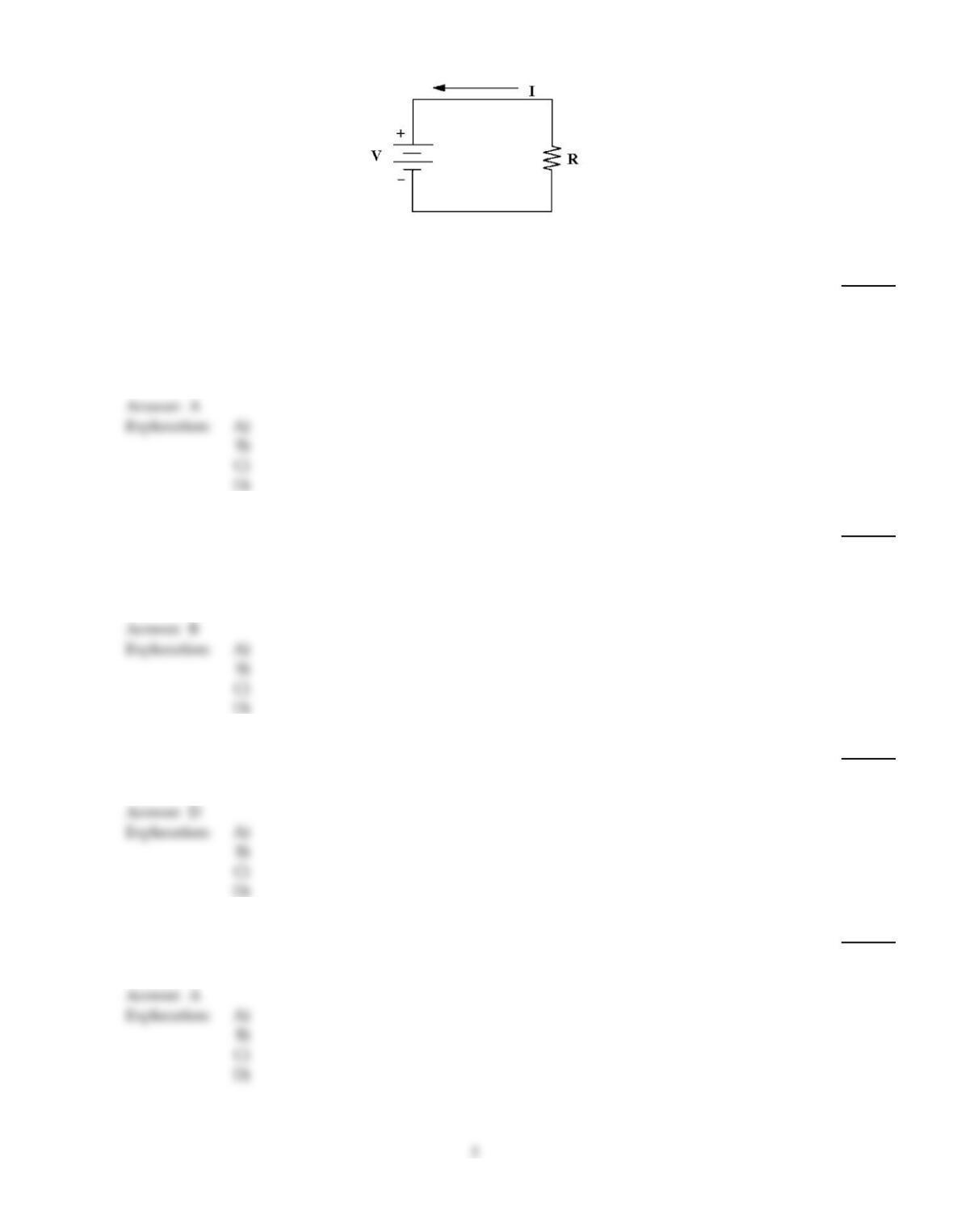
Figure 3–1
18)
If the voltage is 15 V and resistance is color coded red–red–brown–silver in Figure 3–1, what are
the maximum and minimum possible current?
18)
A)
IMINIMUM = 62.0 mA, IMAXIMUM = 75.8 mA
B)
IMINIMUM = 56.8 mA, IMAXIMUM = 85.2 mA
C)
IMINIMUM = 64.9 mA, IMAXIMUM = 71.8 mA
D)
none of these
19)
If a 1/2 W resistor is used in the circuit in Figure 3–1, the current value ________.
19)
A)
is less than 12 mA
B)
depends upon the circuit’s voltage and resistance
C)
depends upon the voltage applied
D)
is over 12 mA
20)
If a resistor that is color–coded yellow–violet–brown–gold is connected to a 12 V source, then what
is the current flow?
20)
A)
24.3 mA
B)
26.9 mA
C)
255 mA
D)
25.5 mA
21)
Power as it is used in electric circuits can be best defined as:
21)
A)
the rate energy is used over time.
B)
the rate motion is exerted over time.
C)
the rate voltage is applied over time.
D)
the rate current flows over time.
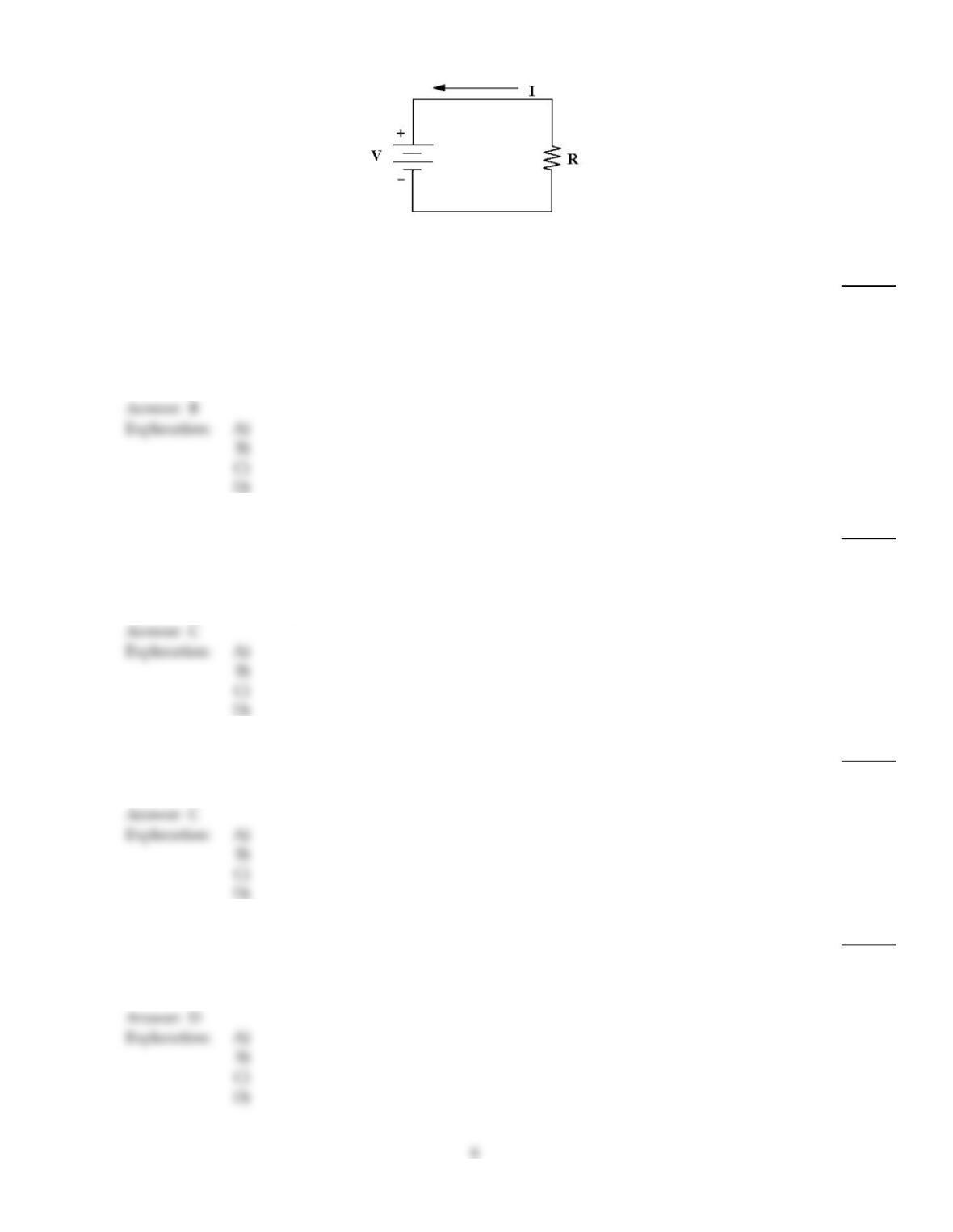
Figure 3–1
22)
If voltage is 12 V and the resistance is color–coded brown–black–orange in Figure 3–1, what are the
minimum and maximum possible currents?
22)
A)
IMINIMUM = 0.8 mA, IMAXIMUM = 1.2 mA
B)
IMINIMUM = 1 mA, IMAXIMUM = 1.5 mA
C)
IMINIMUM = 1 mA, IMAXIMUM = 1.6 mA
D)
IMINIMUM = 1.2 mA, IMAXIMUM = 1.4 mA
23)
If the voltage were suddenly switched on in Figure 3–1, ________.
23)
A)
the current would be zero
B)
the current would gradually decrease
C)
the current would flow
D)
the current would gradually decrease and then increase
24)
A 220 1/2 W resistor has burned open, so you look in your parts box to find a replacement.
Which one of the following resistors could you use to repair the circuit?
24)
A)
220 1/4 W
B)
220 1/8 W
C)
220 1 W
D)
2200 1/2 W
25)
According to Ohm’s Law, if voltage were to increase while resistance remained the same, current
would
25)
A)
no way to determine
B)
decrease
C)
remain the same
D)
increase
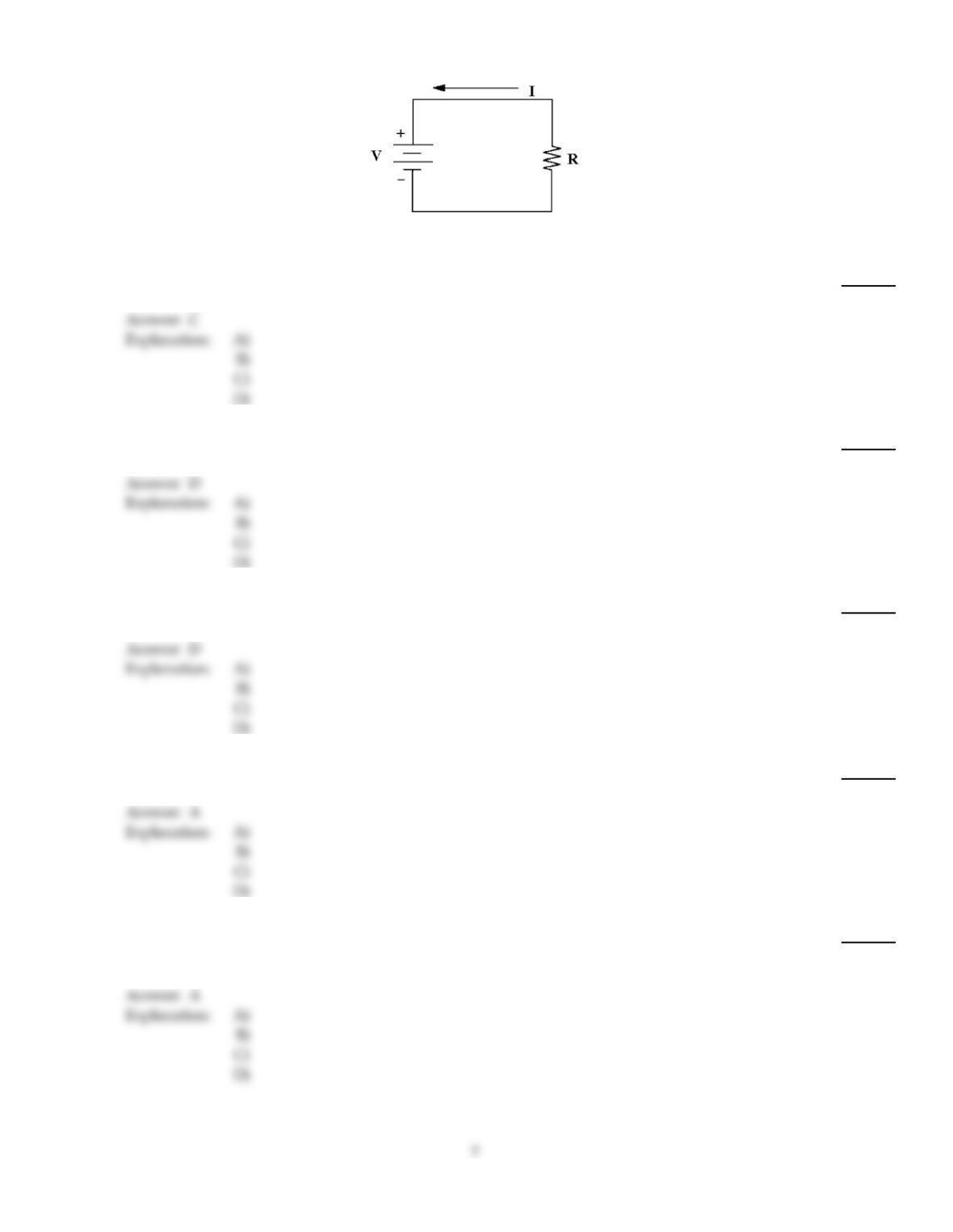
Figure 3–1
26)
If V = 25 V and R = 50 k in Figure 3–1, the current equals ________.
26)
A)
2 mA
B)
5 mA
C)
0.5 mA
D)
50 mA
27)
If I = 45 mA and R = 40 k in Figure 3–1, the voltage equals ________.
27)
A)
18 V
B)
1.8 V
C)
1.125 V
D)
1800 V
28)
Which is the correct formula for finding power?
28)
A)
P = I2 × R
B)
P = V2÷ R
C)
P = V × I
D)
all of these
29)
If a 330 resistor dissipates 2 W, its voltage drop equals ________.
29)
A)
25.7 V
B)
6.6 V
C)
660 V
D)
2.57 V
30)
If a resistor that is color–coded yellow–violet–orange–gold is placed across a 15 V source, the
resistance and wattage rating could be ________.
30)
A)
47 k 1/4 W
B)
4700 1/4 W
C)
4.7 k 1/8 W
D)
0.47 M 1/4 W
31)
Resistance and current are ________.
31)
A)
similar to voltage
B)
not related
C)
inversely proportional
D)
directly proportional
32)
Which of the following terms is not a resistor rating?
32)
A)
resistor tolerance
B)
current
C)
power rating
D)
resistor value in ohms
33)
What is the resistance of a 100 W bulb when it is operating in a circuit with a supply of 120 V?
33)
A)
560
B)
2.14
C)
56
D)
144
34)
If I = 32 mA and R = 469 in Figure 3–1, the voltage equals ________.
34)
A)
12 V
B)
22 V
C)
15 V
D)
19 V
35)
Typically, which is the first type of measurement taken in a known defective circuit?
35)
A)
resistance
B)
current
C)
power
D)
voltage
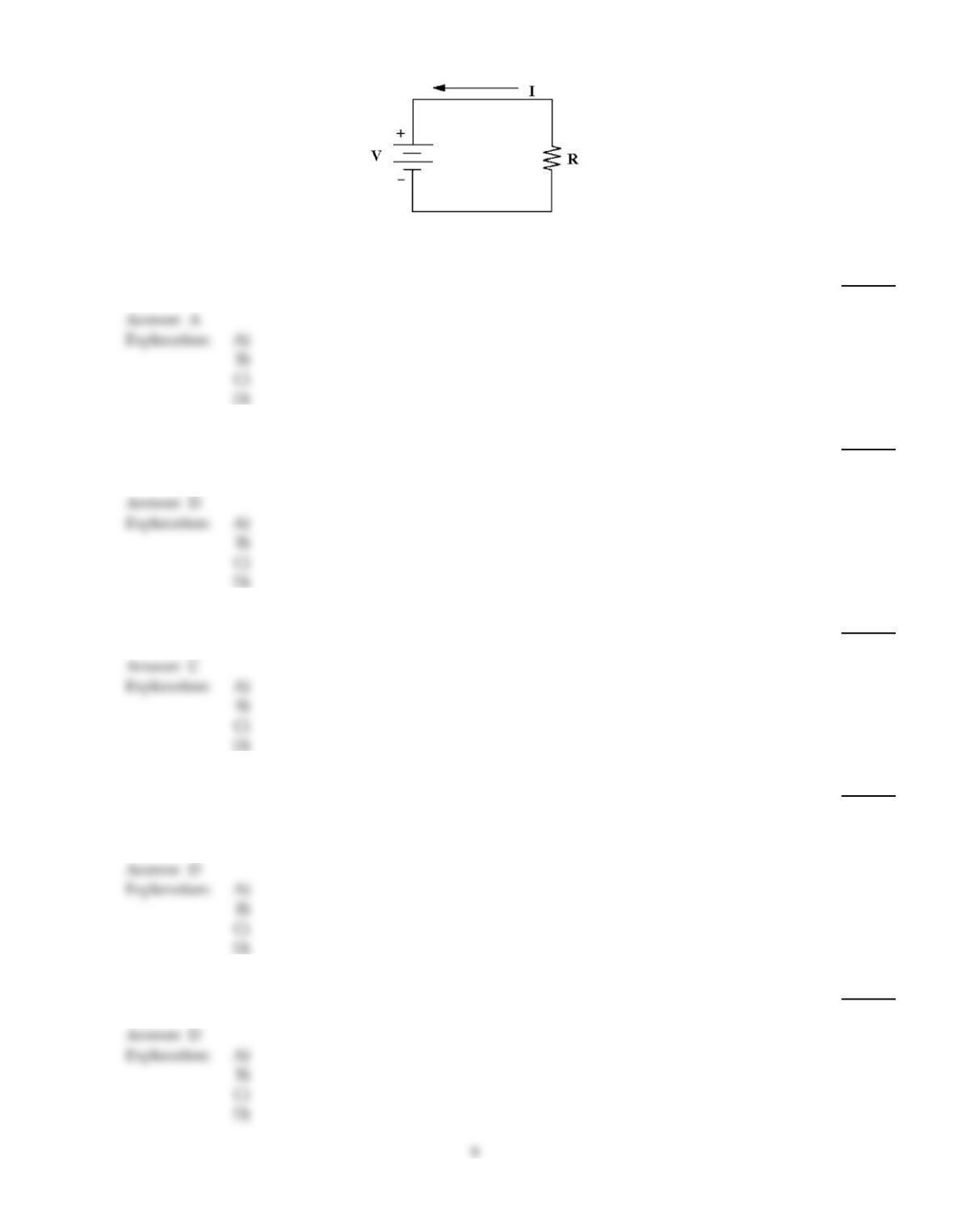
Figure 3–1
36)
If I = 64 mA and R = 47 in Figure 3–1, the voltage equals ________.
36)
A)
3.01 V
B)
30.1 V
C)
73.4 V
D)
7.34 V
37)
Voltage and current are ________.
37)
A)
unrelated
B)
quantities that add
C)
inversely proportional
D)
directly proportional
38)
The power rating of a resistor that must dissipate up to 1.1 W should be ________.
38)
A)
1 W
B)
0.25 W
C)
2 W
D)
5 W
39)
According to Ohm’s Law, if voltage were to decrease while resistance remained the same, current
would
39)
A)
remain the same
B)
increase
C)
no way to determine
D)
decrease
40)
Using Watt’s law and substituting power can be calculated as ________.
40)
A)
P = I2R
B)
P = V2/R
C)
P = VI
D)
all of these
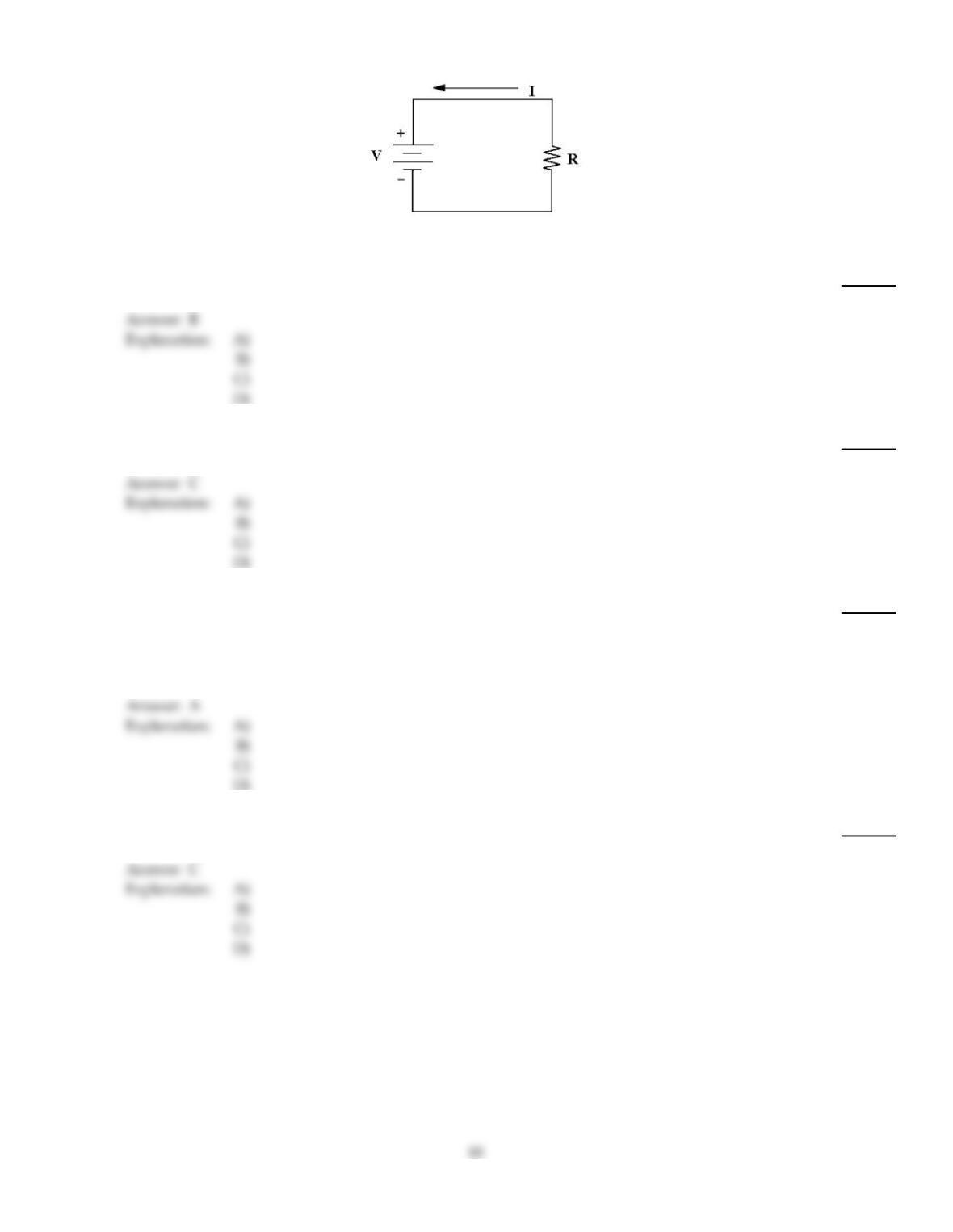
Figure 3–1
41)
If V = 50 V and I = 37 mA in Figure 3–1, ________ is dissipated by the resistor.
41)
A)
135 m W
B)
1.85 W
C)
0.185 m W
D)
1.35 W
42)
If I = 27 mA and R = 4.7 in Figure 3–1, the voltage equals ________.
42)
A)
7.8 V
B)
5.74 V
C)
127 mV
D)
174 mV
43)
If a resistor is rated at 1/2 W, it ________.
43)
A)
can safely dissipate 1/2 W of power
B)
always provides 1/2 W of power
C)
always dissipates 1/2 W
D)
can only dissipate more than 1/2 W of power
44)
If a resistance of 2.2 M is connected across a 1 kV source, current equals about ________.
44)
A)
0.455 A
B)
2.2 mA
C)
0.455 mA
D)
45.5 µA
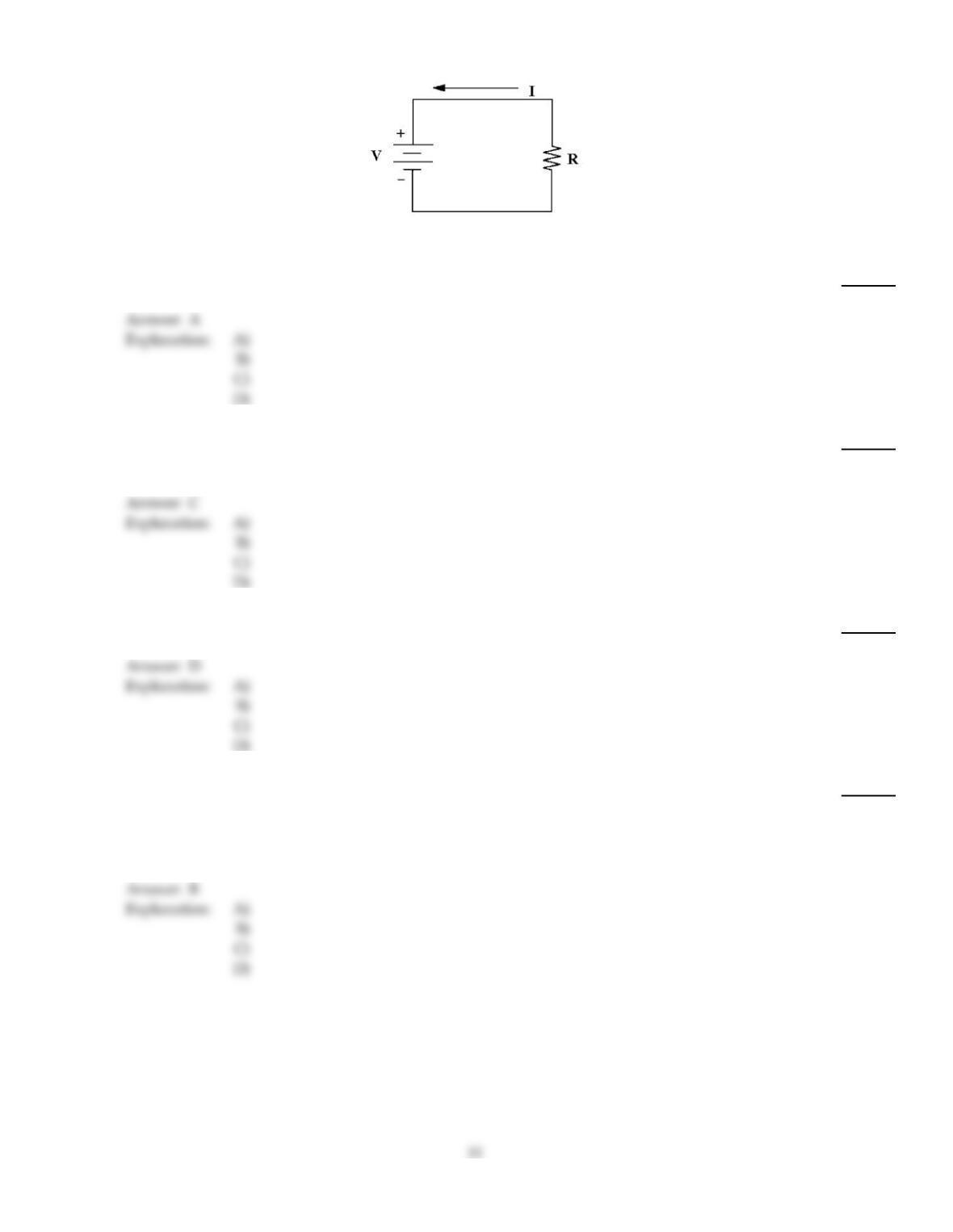
Figure 3–1
45)
If V = 85 V and I = 15 mA in Figure 3–1, the resistance equals ________.
45)
A)
5.67 k
B)
1.28
C)
567
D)
52.3
46)
If the resistor opens in Figure 3–1, the ________.
46)
A)
resistance decreases
B)
power dissipation increases
C)
circuit current drops to 0 A
D)
source voltage decreases to 0 V
47)
If I = 64 mA and R = 470 in Figure 3–1, the voltage equals ________.
47)
A)
7.34 V
B)
3.01 V
C)
73.4 V
D)
30.1 V
48)
If the voltage is suddenly switched off in Figure 3–1, ________.
48)
A)
the current will first increase and then decrease to 0 A
B)
the current will suddenly drop to 0 A
C)
the current will gradually decrease to 0 A
D)
there is no way to predict the current
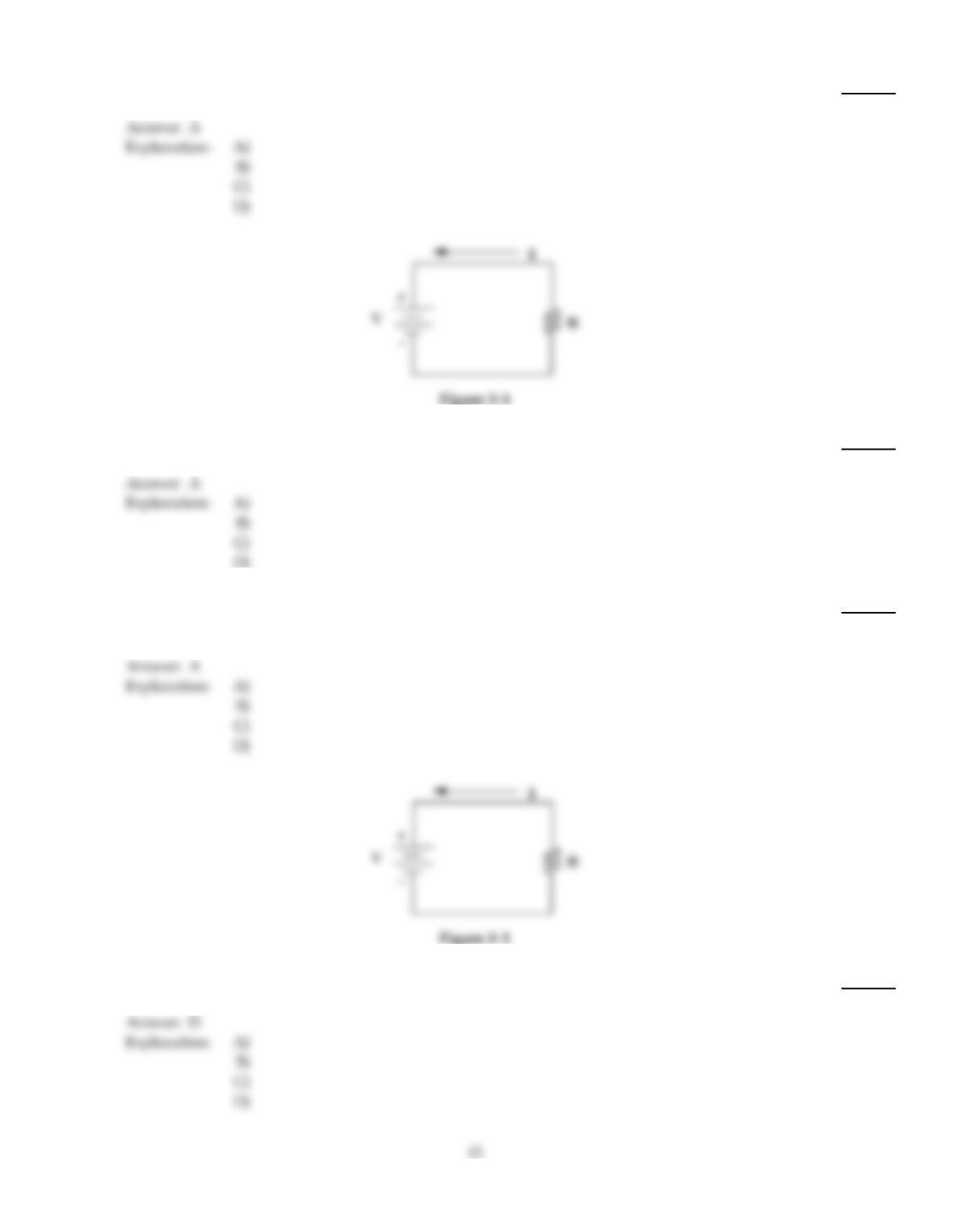
49)
What is the resistance of a 150 W bulb when it is operating in a circuit with a supply of 125 V?
49)
A)
104
B)
2.14
C)
75
D)
9375
50)
If V = 100 V and I = 1 mA in Figure 3–1, the power dissipated by the resistor equals ________.
50)
A)
100 mW
B)
10 mW
C)
1 W
D)
10 W
Explanation:
51)
In the operation of electrical circuits, which, in most cases, is an unwanted by–product?
51)
A)
heat
B)
light
C)
mechanical motion
D)
both B and C
Explanation:
52)
If V = 12 V and a 12 k resistor shorts in Figure 3–1, the current is ________.
52)
A)
1 mA
B)
0 A
C)
10 mA
D)
extremely high
Explanation:
Explanation:
53)
If V = 72 V and I = 12 mA in Figure 3–1, the resistance equals ________.
53)
A)
6 k
B)
47 k
C)
0.166
D)
864
TRUE/FALSE. Write ‘T’ if the statement is true and ‘F’ if the statement is false.
54)
If a 47 k resistor carries 5 mA, it’s safe to use a 1 W resistor.
54)
55)
If a circuit’s resistance decreases, its current also decreases.
55)
56)
If a circuit‘s supply voltage is 20 V and its resistance is 3300 , its current is 6.06 mA.
56)
57)
If a 12 k resistor carries 12 mA, the resistor drops 1 V.
57)
58)
If the voltage applied to a circuit doubles, then power dissipation doubles.
58)
59)
If the current is constant, voltage and resistance are directly proportional.
59)
60)
If a 2.5 k resistor carries 45 mA, it is dissipating 5.0625 W.
60)
61)
If a 1 k resistor has 32 mA flowing through it, it dissipates 1.024 W.
61)
62)
If a circuit’s resistance increases, its current decreases.
62)
63)
If a circuit‘s supply voltage is 15 V and its resistance is 4700 , its current is 3.19 mA.
63)
64)
An electronic power supply with a rated current capacity of 500 mA can adequately illuminate a 10
V @ 5 W lamp.
64)
65)
Power rating for a resistor is mainly based on the physical size.
65)
66)
When taking current measurements, it is extremely important not to accidentally place the meter
across the voltage source.
66)
67)
If a 56 k resistor carries 10 mA, it is safe to use a 10 W resistor.
67)
Answer Key
Testname: C3
15
Answer Key
Testname: C3
16