Exam
Name___________________________________
MULTIPLE CHOICE. Choose the one alternative that best completes the statement or answers the question.
1)
In some respects an isolation amplifier is nothing more than an elaborate:
1)
A)
instrumentation amplifier.
B)
op amp.
C)
rectifier and filter.
D)
both A and B
2)
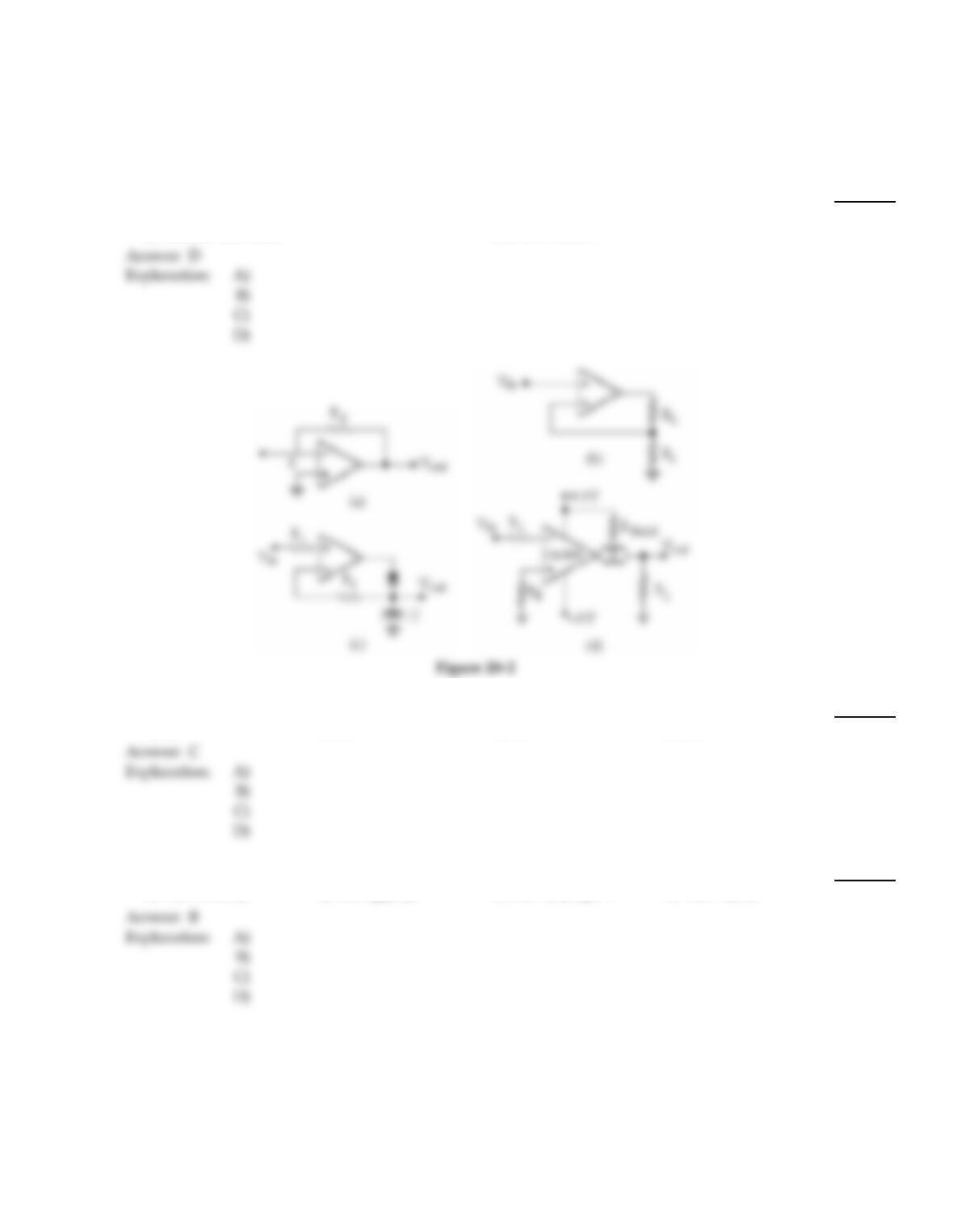
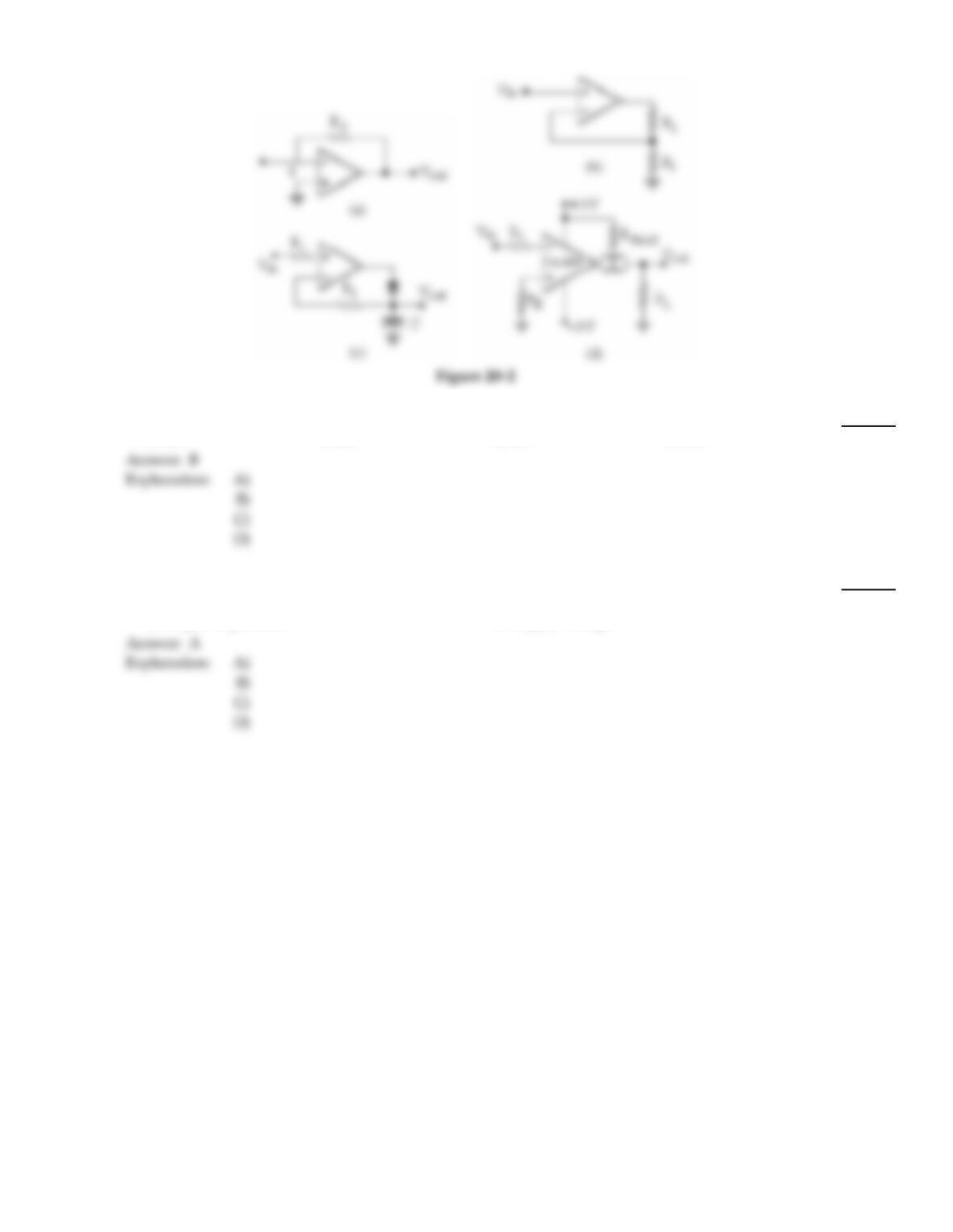
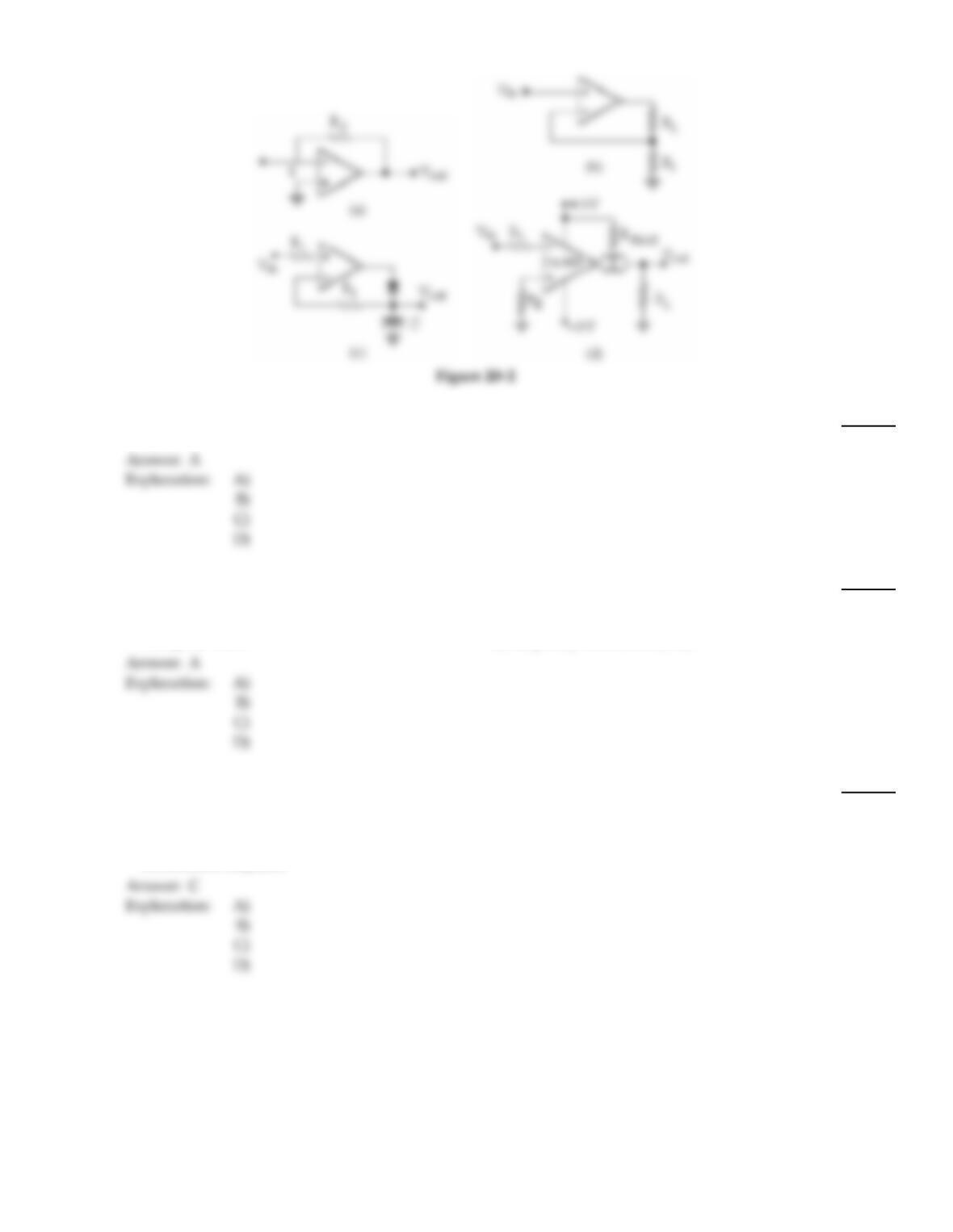
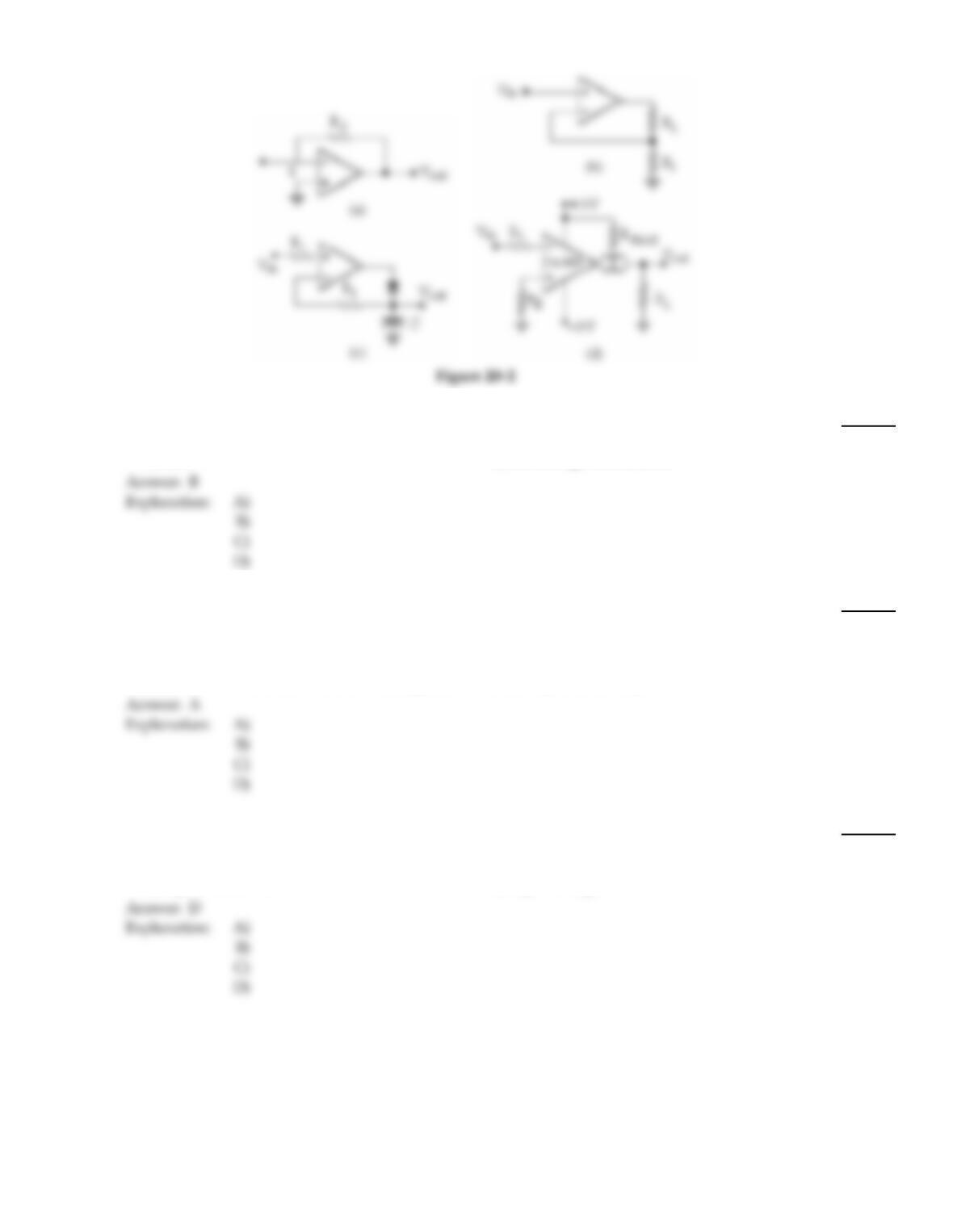
Refer to Figure 20–2. Which of these circuits is known as a peak detector?
2)
A)
(a)
B)
(b)
C)
(c)
D)
(d)
C
3)
The voltage gain of an OTA can be calculated using the formula:
3)
A)
AV= 2 Rf/Ri.
B)
AV= gmRL.
C)
AV= (Rf/Ri) +1.
D)
AV= Rf/Ri.
B
1
D

4)
The primary function of the oscillator in an isolation amplifier is to:
4)
A)
rectify high frequency ac to dc.
B)
convert dc to low frequency ac.
C)
produce dual polarity dc voltages for the input to the demodulator.
D)
convert dc to high frequency ac.
5)
How many op–amps does the basic instrumentation amplifier consist of?
5)
A)
2
B)
3
C)
4
D)
5
B
6)
An active limiter includes an op–amp which:
6)
A)
keeps the circuit from oscillating.
B)
allows a reference level to be set.
C)
increases the output voltage.
D)
works better under loaded conditions.
B
7)
Which statement best differentiates between limiter and clamper circuits?
7)
A)
A limiter sets the limit of the peak output of a given signal while the clamper establishes a dc
reference level based on the peak output of the signal from which the ac signal will vary.
B)
A limiter limits the both peaks of the output of a given signal, while the clamper limits only
one.
C)
A limiter sets a dc reference voltage that the ac signal varies upon while the clamper limits the
peak output.
D)
none of the above
A
8)
In the classic three op–amp instrumentation amplifier, the differential voltage gain is usually
produced by the:
8)
A)
first stage.
B)
output op amp.
C)
second stage.
D)
mismatched resistors.
A
2
D
9)
The input signal for an instrumentation amplifier usually comes from:
9)
A)
a transducer.
B)
an inverting amplifier.
C)
a differential amplifier.
D)
a wheatstone bridge.
10)
The output of a peak detector is always:
10)
A)
equal to the max value of the peak level received since the last reset pulse.
B)
70.7% of input.
C)
equal to the min value of the peak level received since the last reset pulse.
D)
none of the above.
A
11)
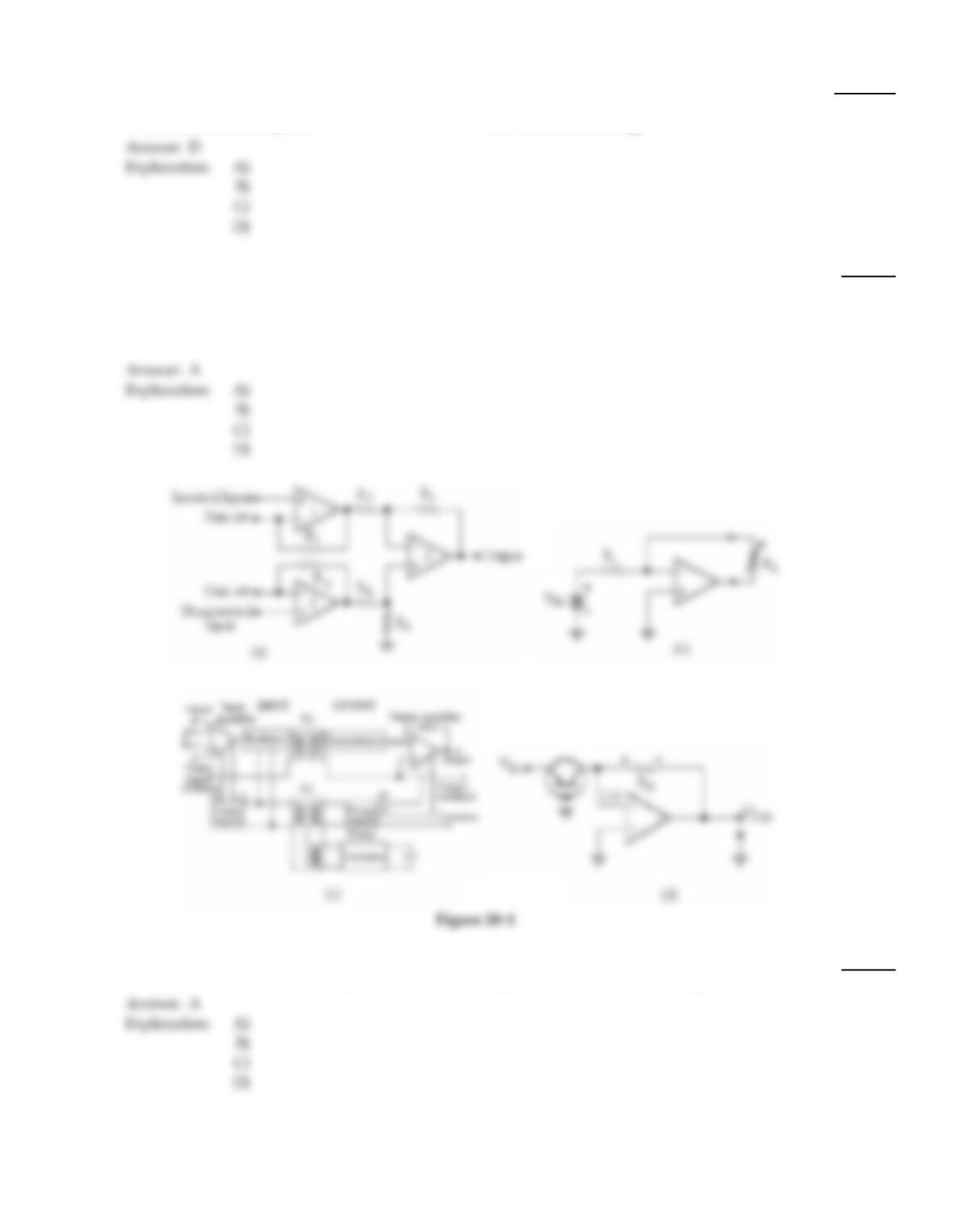
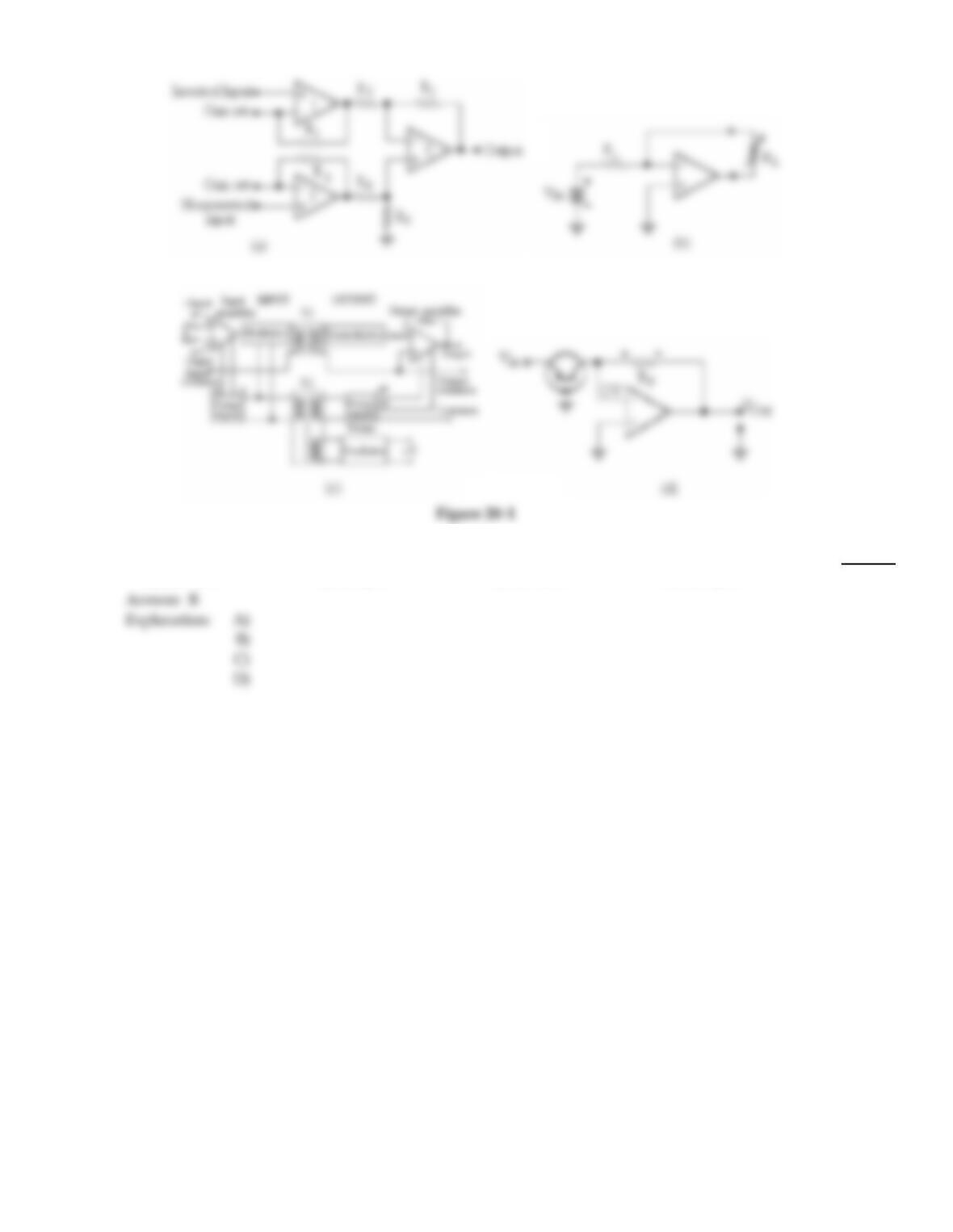
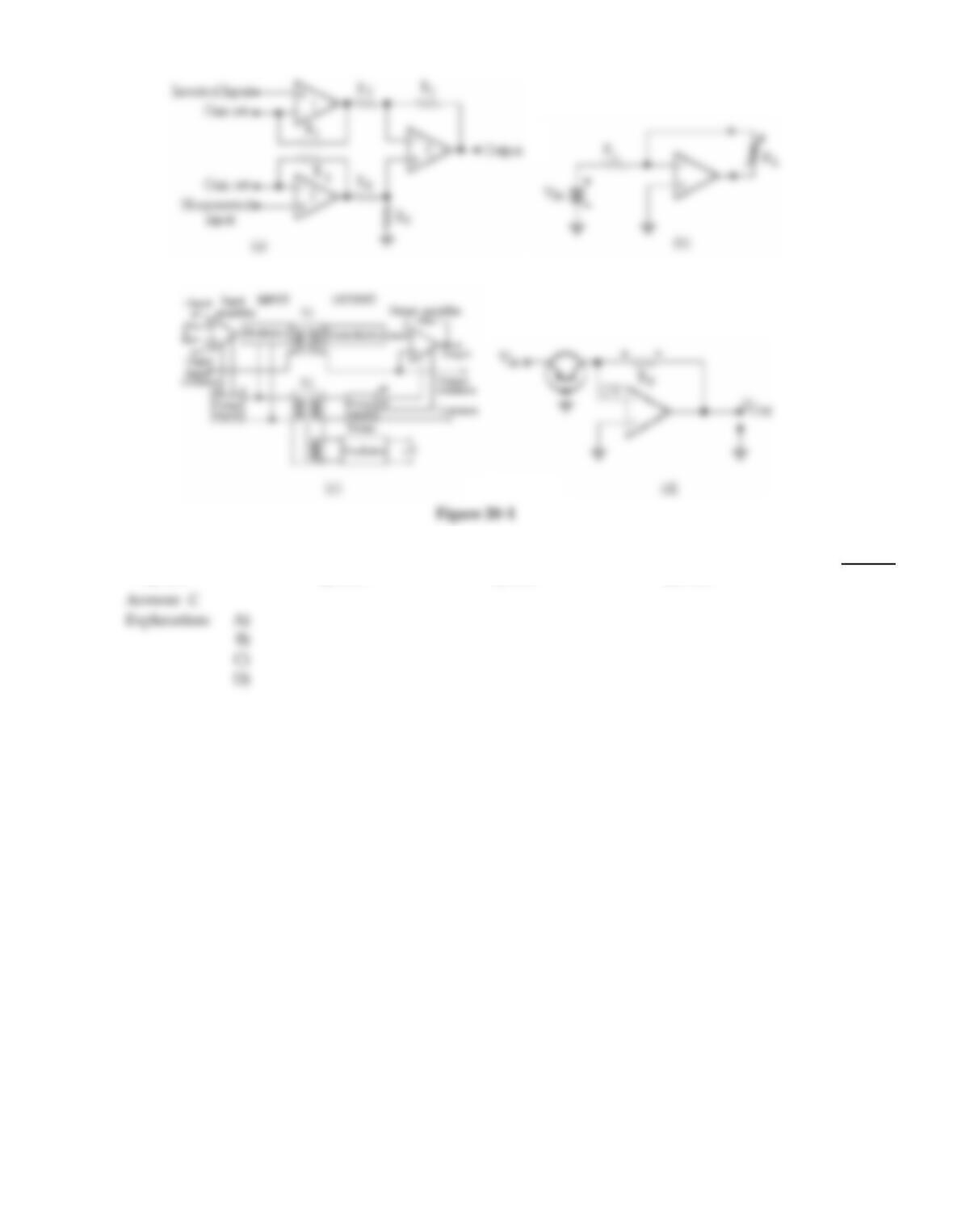
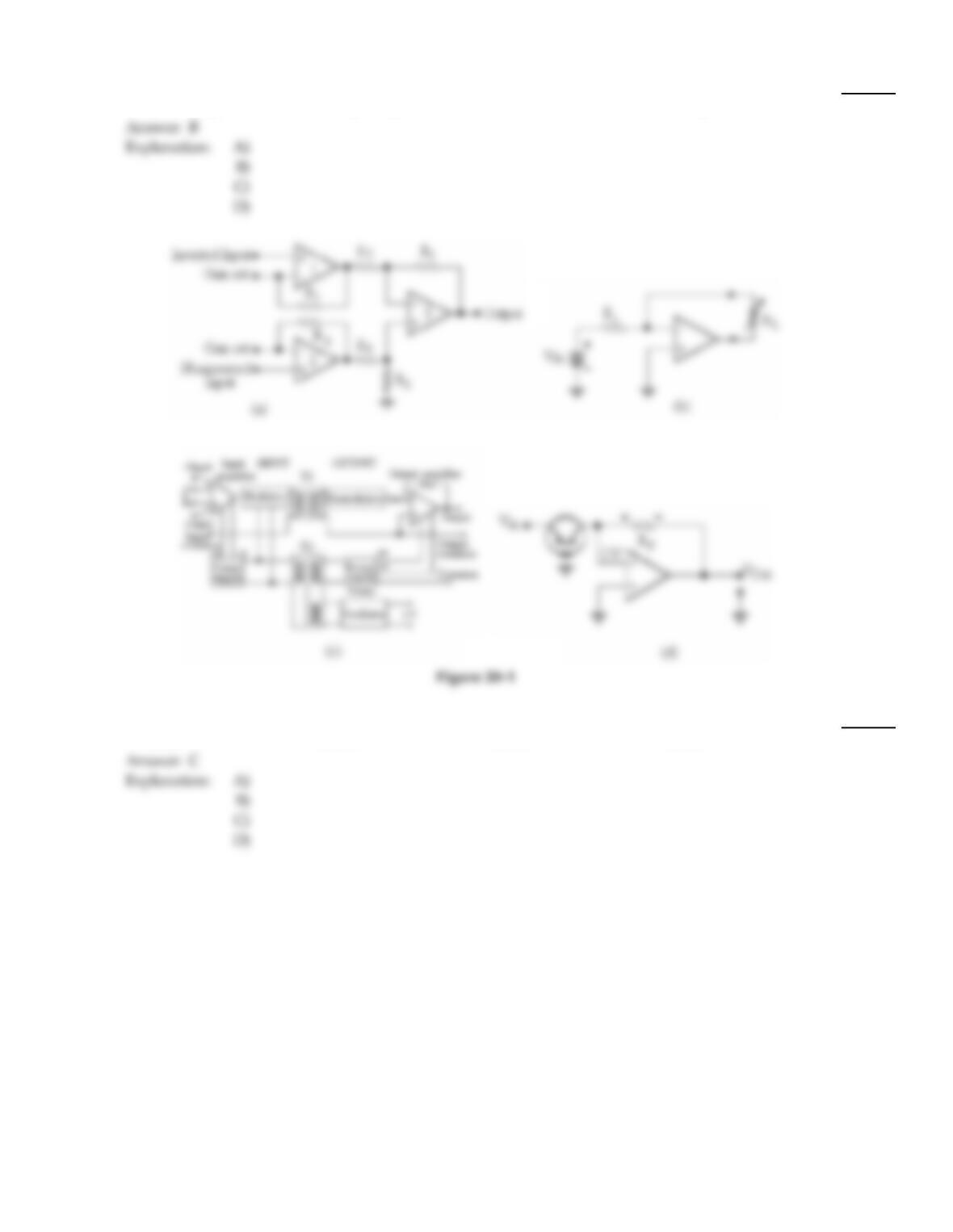
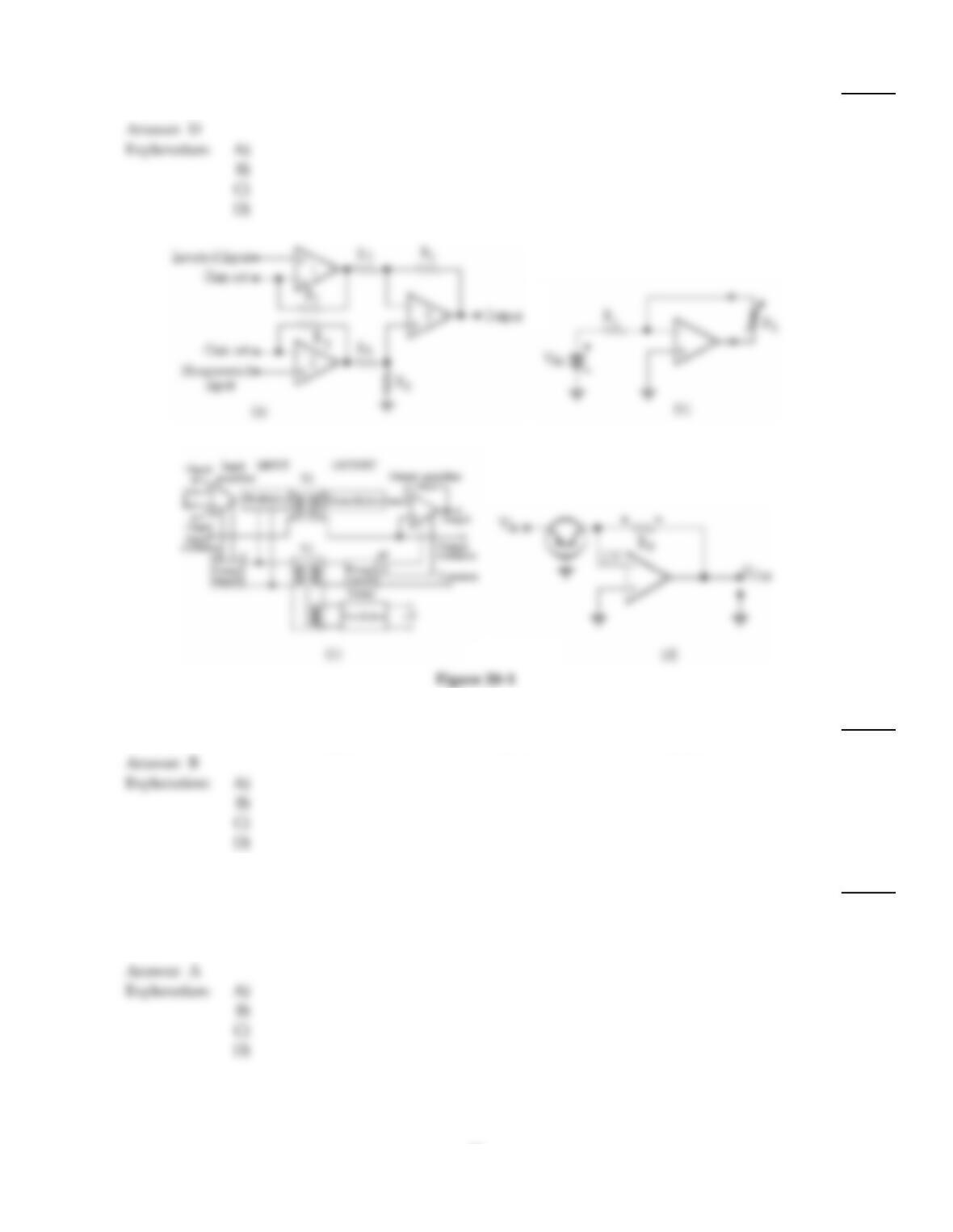
Refer to Figure 20–1. Which of these circuits is known as an instrumentation amplifier?
11)
A)
(a)
B)
(b)
C)
(c)
D)
(d)
A
3
D
12)
Two zener diodes are used in a limiter circuit to:
12)
A)
better regulate a power supply.
B)
limit both positive and negative peaks.
C)
reduce interelectrode capacitance at high frequencies.
D)
none of the above
13)
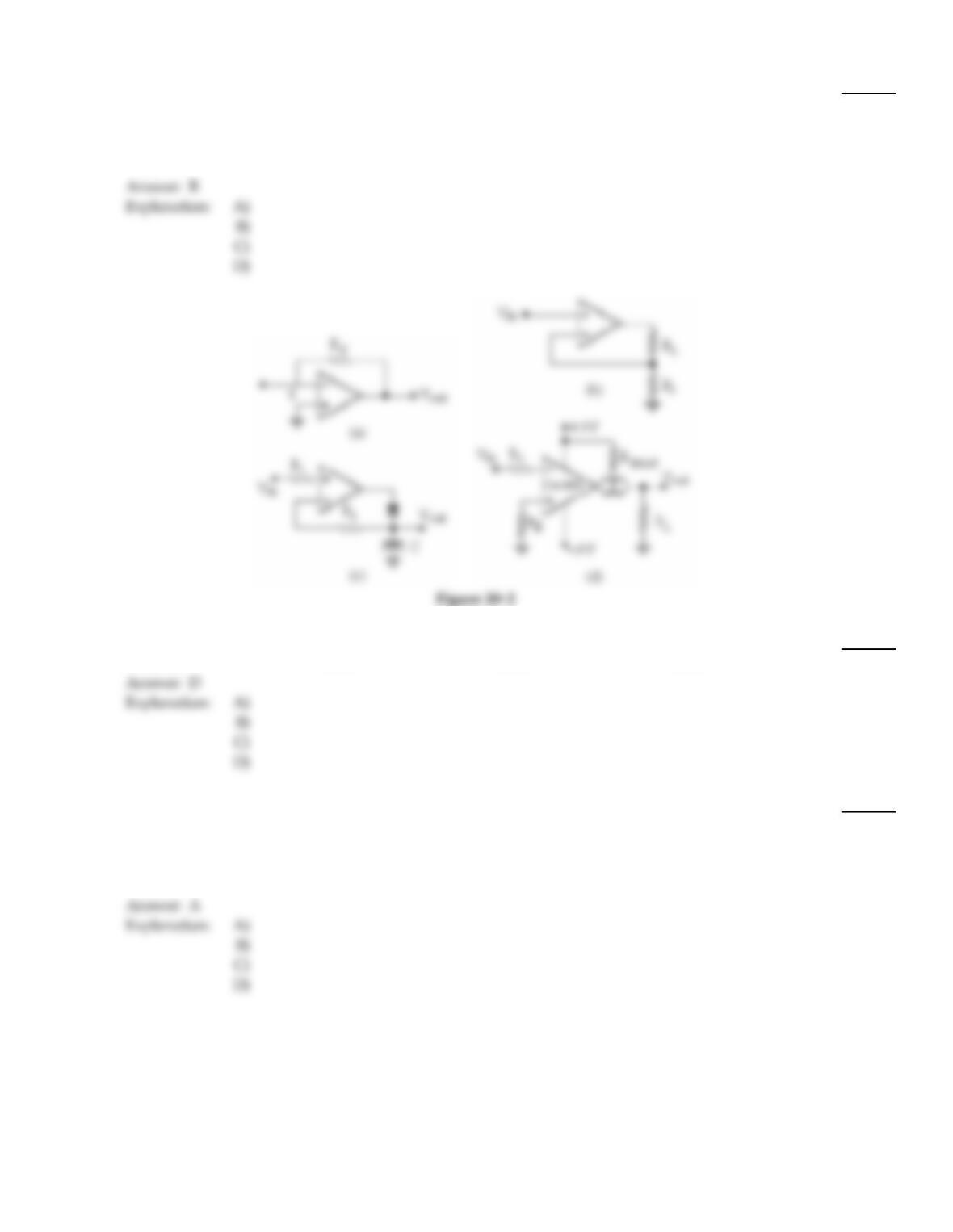
Refer to Figure 20–2. Which of these circuits contains an OTA?
13)
A)
(a)
B)
(b)
C)
(c)
D)
(d)
Explanation:
14)
An instrumentation amp with one open input:
14)
A)
will allow common–mode noise to be present on the output.
B)
will not work at all.
C)
may work correctly in a low noise environment.
D)
both A and C
Explanation:
4
Explanation:
15)
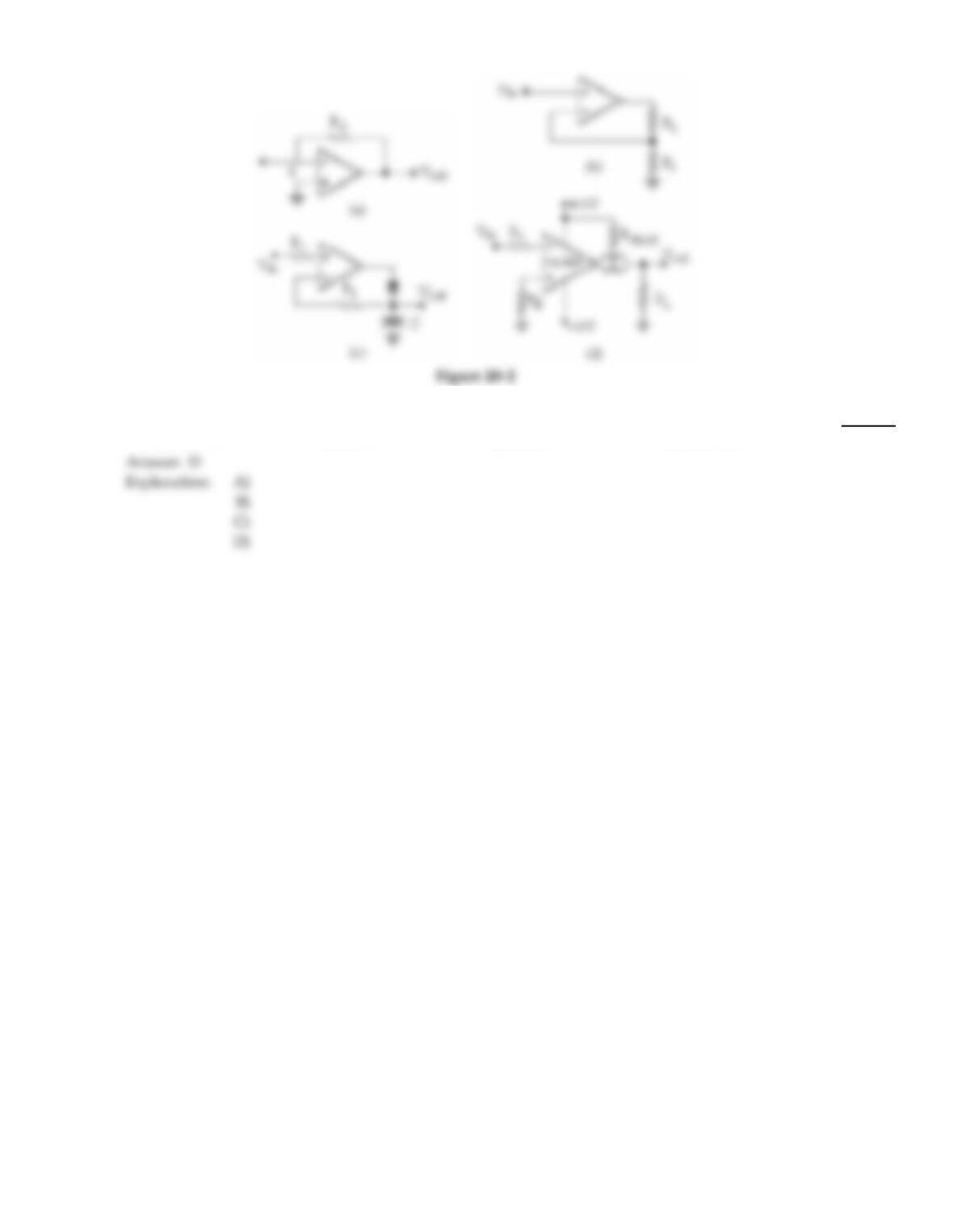
Refer to Figure 20–2 (b). If RL= 20 k, R1= 1.2 k, and Vin = 2.5 V, the load current IL would be:
15)
A)
20.8 mA.
B)
208 A.
C)
2.08 A.
D)
2.08 mA.
5
16)
Refer to Figure 20–1 (b). If Vin = 5 V and Rin = 22 k, the current thru the load RL would be:
16)
A)
22.7 mA.
B)
227 µA.
C)
227 mA.
D)
22.7 µA.
6
17)
Refer to Figure 20–2. Which of these circuits is known as a voltage–to–current converter?
17)
A)
(a)
B)
(b)
C)
(c)
D)
(d)
Explanation:
18)
An instrumentation amplifier has a high:
18)
A)
CMRR.
B)
power gain.
C)
output impedance.
D)
supply voltage.
Explanation:
7
19)
Refer to Figure 20–1 (a). If R1= R2= 28 k and RG= 100, the Acl would be:
19)
A)
560.
B)
56.1.
C)
551.
D)
5.61.
8
20)
Refer to Figure 20–2. Which of these circuits is known as a current–to–voltage converter?
20)
A)
(a)
B)
(b)
C)
(c)
D)
(d)
A
21)
If an operational transconductance amplifier (OTA) is used as a nonlinear mixer and an audio
signal is mixed with an RF signal, the output will be a(n) ________ signal.
21)
A)
amplitude modulated (AM)
B)
triangular wave
C)
square wave
D)
frequency modulated (FM)
A
22)
Which op–amp circuit would be useful to switch to an “on” condition at a specified voltage?
22)
A)
voltage–to–current converter
B)
instrumentation amp
C)
operational transconductance amplifier configured as a Schmitt–trigger
D)
isolation amplifier
C
9
23)
The OTA has a ________ input impedance and a ________ CMRR.
23)
A)
low, high
B)
high, high
C)
low, low
D)
high, low
24)
Refer to Figure 20–1. Which of these circuits is known as an isolation amplifier?
24)
A)
(a)
B)
(b)
C)
(c)
D)
(d)
10
25)
Refer to Figure 20–2 (d). If gm= 25 mS and RL= 25 k, the voltage gain would be:
25)
A)
6.25.
B)
625.
C)
62.5.
D)
not enough information.
26)
Which statement best describes the action of an OTA amplitude modulator?
26)
A)
The variations of voltages applied to the current bias input adjusts the gain of the amplifier.
B)
The power supply bias adjusts the output level.
C)
Variations of light intensity adjust the gain of the amplifier.
D)
The OTA is versatile and can be configured to work in any of these ways.
27)
A voltage–to–current converter is used in applications where it’s necessary to have an output load
current that is controlled by ________.
27)
A)
input frequency
B)
output resistance
C)
input resistance
D)
input voltage
11
28)
When using an OTA in a Schmitt–trigger configuration, the trigger points are controlled by:
28)
A)
the IBIAS.
B)
the IOUT.
C)
the VOUT.
D)
both A and B.
29)
Refer to Figure 20–1. Which of these circuits is known as a constant–current source?
29)
A)
(a)
B)
(b)
C)
(c)
D)
(d)
B
30)
Refer to Figure 20–1 (a). If R1= R2= 30 k and the closed loop gain is 450, the value of the external
gain–setting resistor RG is:
30)
A)
134 .
B)
13.4 .
C)
134 k.
D)
none of the above.
A
12
D

TRUE/FALSE. Write ‘T’ if the statement is true and ‘F’ if the statement is false.
31)
A basic instrumentation amplifier has three op–amps.
31)
32)
One of the key characteristics of an instrumentation amplifier is its low input impedance.
32)
33)
Most isolation amplifiers use transformer coupling for isolation.
33)
34)
OTA stands for operational transistor amplifier.
34)
35)
An active clamping circuit negates the opposite polarity 0.7 V peak by using two diodes in series.
35)
36)
A peak detector’s output continually changes based on the input.
36)
37)
The OTA is a voltage–to–current amplifier.
37)
38)
Active limiting and clamping employs an amplifier circuit.
38)
39)
The diode clamper circuit output is an ac signal that has a dc reference point of the peak voltage of
the ac.
39)
40)
A voltage limiter that limits both positive and negative peaks uses two zener diodes connected
anode to cathode.
40)
41)
A voltage–to–current converter has a JFET in the feedback loop.
41)
13

42)
The voltage gain of an instrumentation amplifier is set with an external resistor.
42)
43)
The main purpose of an instrumentation amplifier is to amplify common mode voltage.
43)
44)
A voltage–to–current converter works by controlling current proportional to the input voltage.
44)
45)
A basic isolation amplifier has two electrically isolated sections.
45)
14

Answer Key
Testname: C20
15