Exam
Name___________________________________
MULTIPLE CHOICE. Choose the one alternative that best completes the statement or answers the question.
1)
A DC voltage that sets the operating conditions of a semiconductor device is called the ________.
1)
A)
battery
B)
bias
C)
barrier potential
D)
depletion voltage
2)
Doping a semiconductor material with pentavalent impurities results in:
2)
A)
N–P type material.
B)
P–type material.
C)
N–type material.
D)
P–N type material.
3)
Zener diodes are widely used as ________.
3)
A)
variable resistors
B)
power distributors
C)
current limiters
D)
voltage regulators
4)
If the filter capacitor opens in Figure 16–2, ________.
4)
A)
a loud hum will be heard
B)
the output dc will be very low
C)
the diodes would open
D)
the ripple voltage increases

5)
If a 75 VP sine wave is applied to a half–wave rectifier, the diode’s peak inverse voltage is
________.
5)
A)
0 V
B)
150 V
C)
75 V
D)
37.5 V
6)
If the source voltage increases in a simple zener regulator, ________.
6)
A)
the load current increases
B)
the voltage across the series resistor decreases
C)
the voltage across the zener increases
D)
the zener current increases
D
7)
If the load current increases in a simple zener regulator, the ________.
7)
A)
zener current increases
B)
total current decreases
C)
current through the series resistor decreases
D)
zener current decreases
D
8)
If a half–wave rectifier outputs 36 VP, the PIV of the diode should be more than ________.
8)
A)
29 V
B)
116 V
C)
15 V
D)
36 V
D
9)
In a semiconductor diode, the two bias conditions are ________.
9)
A)
forward and reverse
B)
positive and negative
C)
blocking and non–blocking
D)
open and closed
A
C
10)
The PN junction is found in ________.
10)
A)
transistors
B)
semiconductor diodes
C)
all semiconductor materials
D)
both A and B
11)
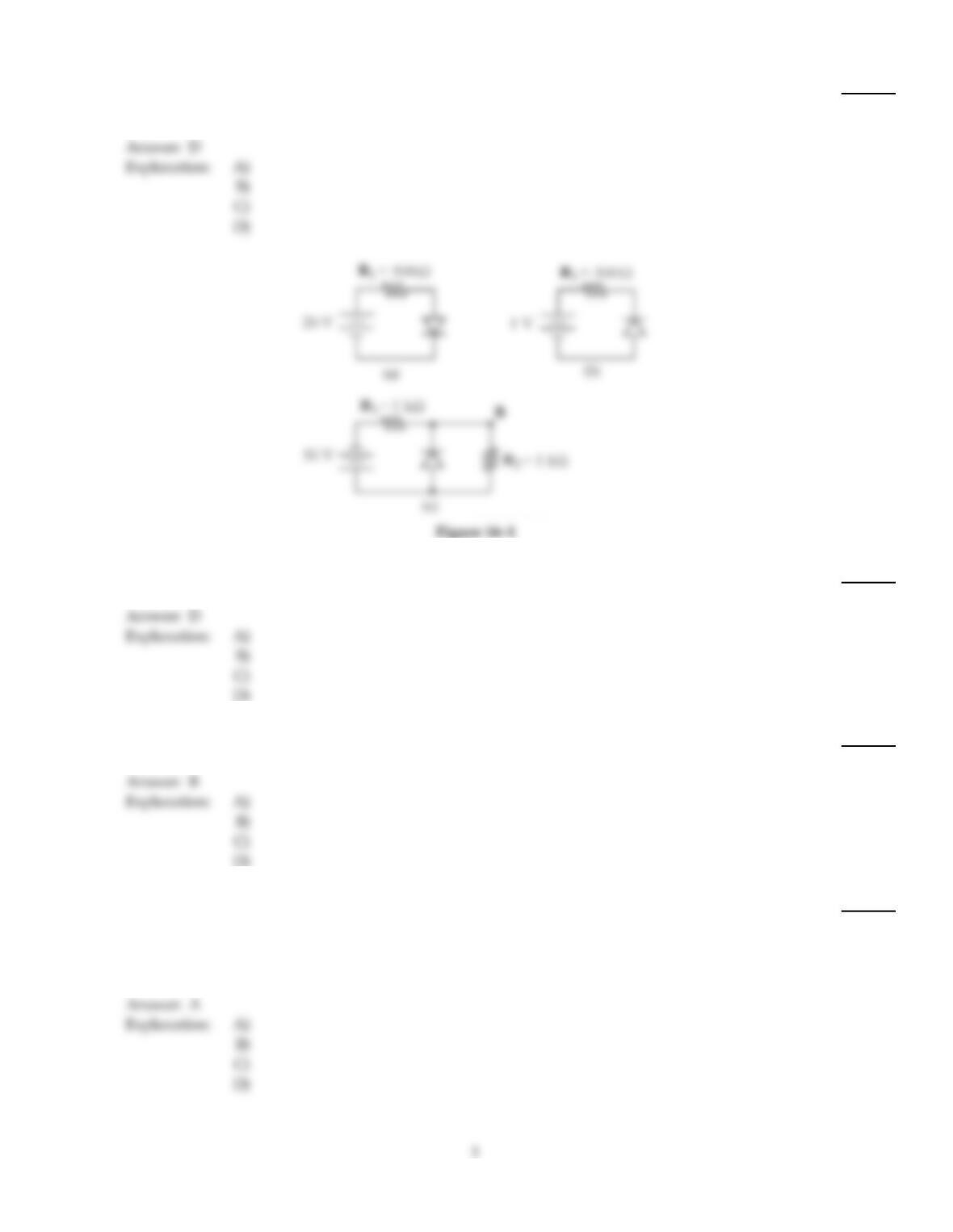
If the diode is silicon, what is the voltage across the resistor in Figure 16–1(a)?
11)
A)
0.7 V
B)
0 V
C)
20 V
D)
19.3 V
12)
If the polarity of the silicon diode is reversed in Figure 16–1(c), VR2 is ________.
12)
A)
49.3 V
B)
25 V
C)
0.7 V
D)
0 V
13)
If the diode in a half–wave rectifier shorts, the ________.
13)
A)
output voltage would equal the transformer secondary voltage
B)
output voltage would be zero
C)
output voltage would not change
D)
output ripple would be very small

14)
If a forward biased silicon diode is in series with a 22 k resistor and a 10 V source, the voltage
across the diode is ________ and the voltage across the resistor is ________.
14)
A)
9.7 V, 0.3 V
B)
0.3 V, 9.7 V
C)
0.7 V, 9.3 V
D)
9.3 V, 0.7 V
15)
If the load current decreases in a simple zener regulator, the ________.
15)
A)
current through the series resistor decreases
B)
zener current increases
C)
zener current decreases
D)
voltage across the series resistor decreases
16)
The forward bias on a P–N diode to make the diode conduct must be greater than the:
16)
A)
barrier potential.
B)
conduction bond.
C)
reverse bias.
D)
volence bond.
17)
The purpose of Block 4 in Figure 16–2 is to ________.
17)
A)
maintain a constant output current when the load current changes
B)
make sure that the fuse will not blow
C)
keep the dc output voltage constant as the load changes
D)
adjust the output voltage to the correct ac value

18)
If the diode in a half–wave rectifier opens, ________.
18)
A)
the output voltage would be zero
B)
the output voltage would not change
C)
the output ripple would be very small
D)
the output voltage would equal the transformer secondary voltage
19)
Materials whose molecules arrange themselves into a crystal structure are bound together by:
19)
A)
covalent bonding.
B)
full valence shells.
C)
sharing valence electrons.
D)
all of these.
D
20)
To generate light, an LED requires:
20)
A)
zener breakdown.
B)
reverse DC bias.
C)
forward DC bias.
D)
avalanche breakdown.
C
21)
If a full–wave rectifier outputs 38 VP, its average output equals ________.
21)
A)
24.2 V
B)
19.3 V
C)
38 V
D)
76.7 V
A
22)
To forward bias a silicon diode with –1.6 V on the anode, you must apply a voltage of ________ on
the cathode.
22)
A)
0.9 V
B)
–0.9 V
C)
2.3 V
D)
–2.3 V
D
A

23)
To detect light, a photodiode requires:
23)
A)
avalanche breakdown.
B)
reverse bias.
C)
zener breakdown.
D)
forward bias.
24)
Current flow through a diode is normally caused by ________.
24)
A)
depletion layer breakdown
B)
a reverse voltage across the diode
C)
forward voltage across the diode
D)
thermally produced electron–hole pairs
25)
A full–wave rectifier uses ________ diode(s) and its output frequency is ________ the input
frequency.
25)
A)
two, twice
B)
one, twice
C)
two, equal to
D)
one, equal to
26)
If the filter capacitor becomes leaky in Figure 16–2, ________.
26)
A)
a loud hum will be heard
B)
the output dc will be very low
C)
the ripple voltage will increase
D)
the diodes would open
27)
The arrowhead in the schematic symbol for a diode represents:
27)
A)
the anode.
B)
the semiconductor lead.
C)
the cathode.
D)
all of these.

28)
The small variation in the output voltage of a dc power supply is called ________.
28)
A)
ac to dc conversion
B)
residual voltage
C)
average voltage
D)
ripple voltage
29)
If an aircraft full–wave, dc power supply operates from a 400 Hz sine wave, the ripple frequency is
________.
29)
A)
800 Hz
B)
60 Hz
C)
120 Hz
D)
400 Hz
30)
If a diode in a half–wave rectifier opens in Figure 16–2, ________.
30)
A)
the output dc voltage increases and the ripple voltage decreases
B)
the output dc voltage increases and the ripple frequency decreases
C)
the output dc voltage decreases and the ripple voltage decreases
D)
the output dc voltage decreases and the ripple voltage increases
31)
You test a diode with an ohmmeter. The two readings indicate a very low value of resistance. The
diode is probably ________.
31)
A)
conducting heavily
B)
open
C)
shorted
D)
normal
32)
If the “+” lead on an ohmmeter is connected to a diode’s anode and the “–” lead on the ohmmeter is
connected to the diode’s cathode, the measured resistance is normally ________.
32)
A)
140 k
B)
very low
C)
very high
D)
0
33)
If the measured resistance of a diode is high in both directions, the diode is probably ________.
33)
A)
reverse biased
B)
open
C)
shorted
D)
forward biased
34)
Which block in Figure 16–2 changes ac to pulsating dc?
34)
A)
1
B)
2
C)
3
D)
4
35)
To forward bias a silicon diode with a –71.6 V anode voltage, apply a ________ cathode voltage.
35)
A)
+70.9 V
B)
+72.3 V
C)
–70.9 V
D)
–72.3 V
36)
When the positive lead of an ohmmeter is connected to the cathode of a diode and the negative lead
is connected to the anode, the meter reads ________.
36)
A)
an infinitely high resistance
B)
a high resistance initially, decreasing to about 100
C)
a gradually increasing resistance
D)
a very low resistance
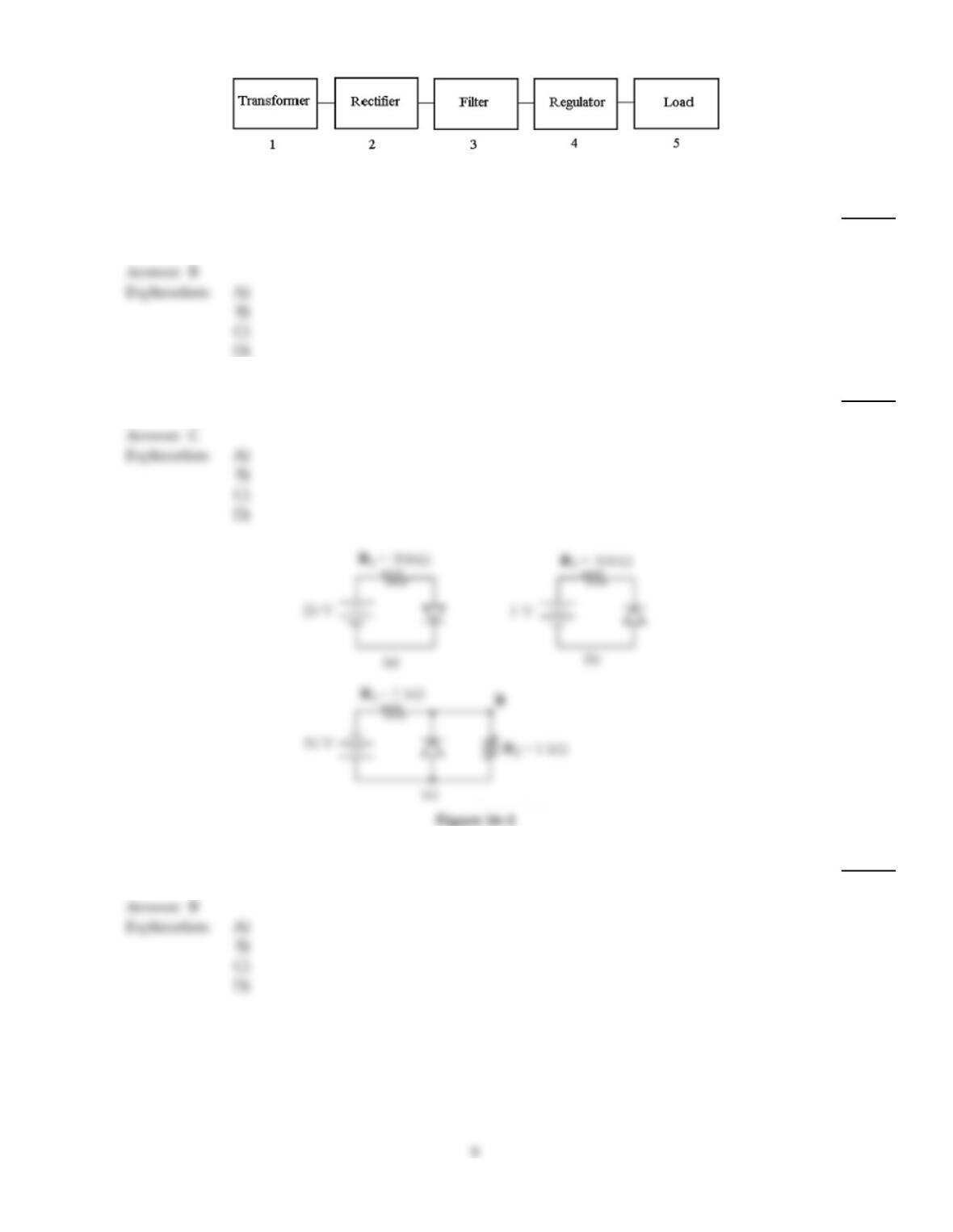
Figure 16–2
37)
The output of Block 2 in Figure 16–2 is:
37)
A)
a pulsating AC voltage.
B)
a pulsating DC voltage.
C)
a steady DC current.
D)
a steady DC voltage.
38)
Which block will smooth out the pulsating dc in Figure 16–2?
38)
A)
1
B)
2
C)
3
D)
4
39)
If the polarity of the source voltage is reversed in Figure 16–1(c), VR2 is ________.
39)
A)
0 V
B)
25 V
C)
49.3 V
D)
0.7 V

40)
If a diode in a full–wave rectifier opens, ________.
40)
A)
the dc output voltage will increase and the ripple voltage will decrease
B)
the dc output voltage will decrease and the ripple frequency will decrease
C)
the dc output voltage will decrease and the ripple voltage will decrease
D)
the dc output voltage will increase and the ripple frequency will decrease
41)
In the simplest sense, a zener diode is really a:
41)
A)
voltage regulator.
B)
reference voltage.
C)
reference current.
D)
current regulator.
42)
When a diode is forward biased it is ________.
42)
A)
similar to an open switch
B)
conducting current
C)
blocking current
D)
similar to a closed switch
E)
both B and D
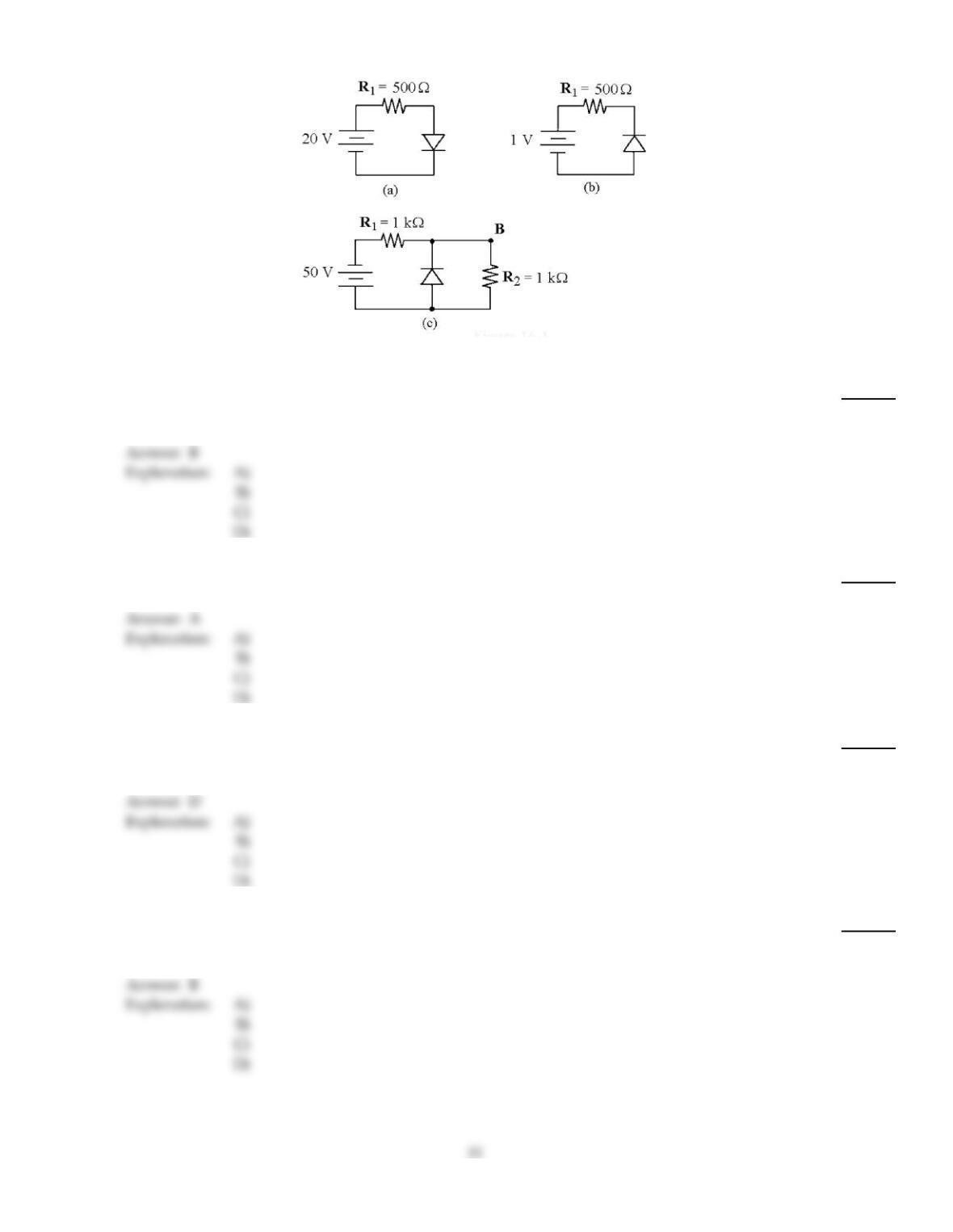
Figure 16–1
43)
What is the current in Figure 16–1(b) if the diode is made of silicon and the polarity of the source
voltage is reversed?
43)
A)
5 mA
B)
0.6 mA
C)
0 A
D)
10 mA
44)
What is the voltage across R1 in Figure 16–1(c) if the diode is silicon?
44)
A)
49.3 V
B)
25 V
C)
49.7 V
D)
50 V
45)
If the measured resistance of a diode is very low in both directions, the diode is probably ________.
45)
A)
open
B)
normal
C)
conducting heavily
D)
shorted
46)
Applying the reverse breakdown voltage to a diode will ________.
46)
A)
never do any harm
B)
usually damage the diode
C)
cause it to act like a capacitor
D)
cause it to act like a switch
47)
If a diode shorts in a full–wave rectifier, ________.
47)
A)
the output current would increase
B)
no change would occur in the output
C)
the output dc voltage will increase
D)
the output dc voltage will decrease and possibly damage the power supply
48)
A full–wave bridge rectifier requires ________.
48)
A)
a center–tapped transformer
B)
a high voltage to operate it
C)
four diodes and a transformer with a single secondary
D)
two diodes and a transformer with a single secondary
49)
What is the current through R2 in Figure 16–1(c) if the diode is silicon?
49)
A)
0.3 mA
B)
0.7 mA
C)
25 mA
D)
0 A