Chapter 09 – Pure Competition in the Long Run
51. In the context of analyzing economic efficiency, we can interpret the market demand
curve to be showing:
52. In the context of analyzing economic efficiency, we can interpret the market supply curve
to be showing:
53. Pure competition produces a socially optimal allocation of resources in the long run
because:
Chapter 09 – Pure Competition in the Long Run
54. When a purely competitive firm is in long-run equilibrium and is allocatively efficient:
55. Which is true of a purely competitive firm in the long-run equilibrium?
56. Resources are efficiently allocated when production occurs at that output at which:
Chapter 09 – Pure Competition in the Long Run
57. Resources are efficiently allocated when production occurs at that output level where
price:
58. When a purely competitive firm is in long-run equilibrium, price is equal to:
Chapter 09 – Pure Competition in the Long Run
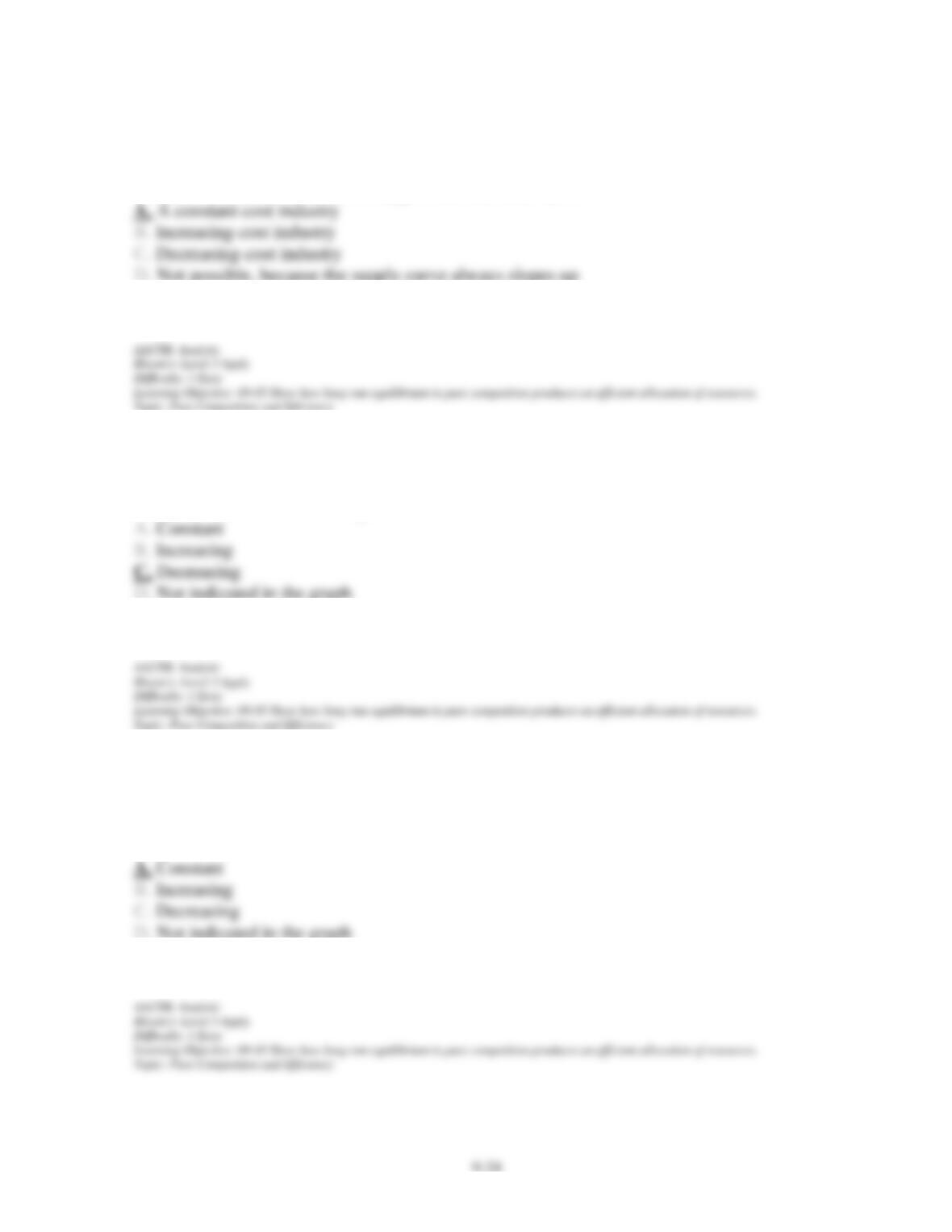
59. Refer to the graph above, showing the long-run supply and demand curves in a purely
competitive market. The curves suggest that this industry is:
60. Refer to the graph above, showing the long-run supply and demand curves in a purely
competitive market. The curves suggest that in this industry, the marginal benefit to
consumers of each unit of the product is:
61. Refer to the graph above, showing the long-run supply and demand curves in a purely
competitive market. The curves suggest that in this industry, the dollars’ worth of other
products that have to be sacrificed in order to produce each unit of the output of this industry
is:
Chapter 09 – Pure Competition in the Long Run
62. Refer to the graph above, showing the long-run supply and demand curves in a purely
competitive market. We know that in this market, the marginal:
63. Refer to the graph above, showing the long-run supply and demand curves in a purely
competitive market. We know that when this market reaches equilibrium, the marginal:
64. In a purely competitive industry, an optimal allocation of scarce resources occurs when:
Chapter 09 – Pure Competition in the Long Run
9-26
65. The difference between the maximum price a consumer is willing to pay for a product and
the actual price the consumer pays is:
66. The difference between the actual price that a producer receives and the minimum
acceptable price a producer is willing to accept is:
Chapter 09 – Pure Competition in the Long Run
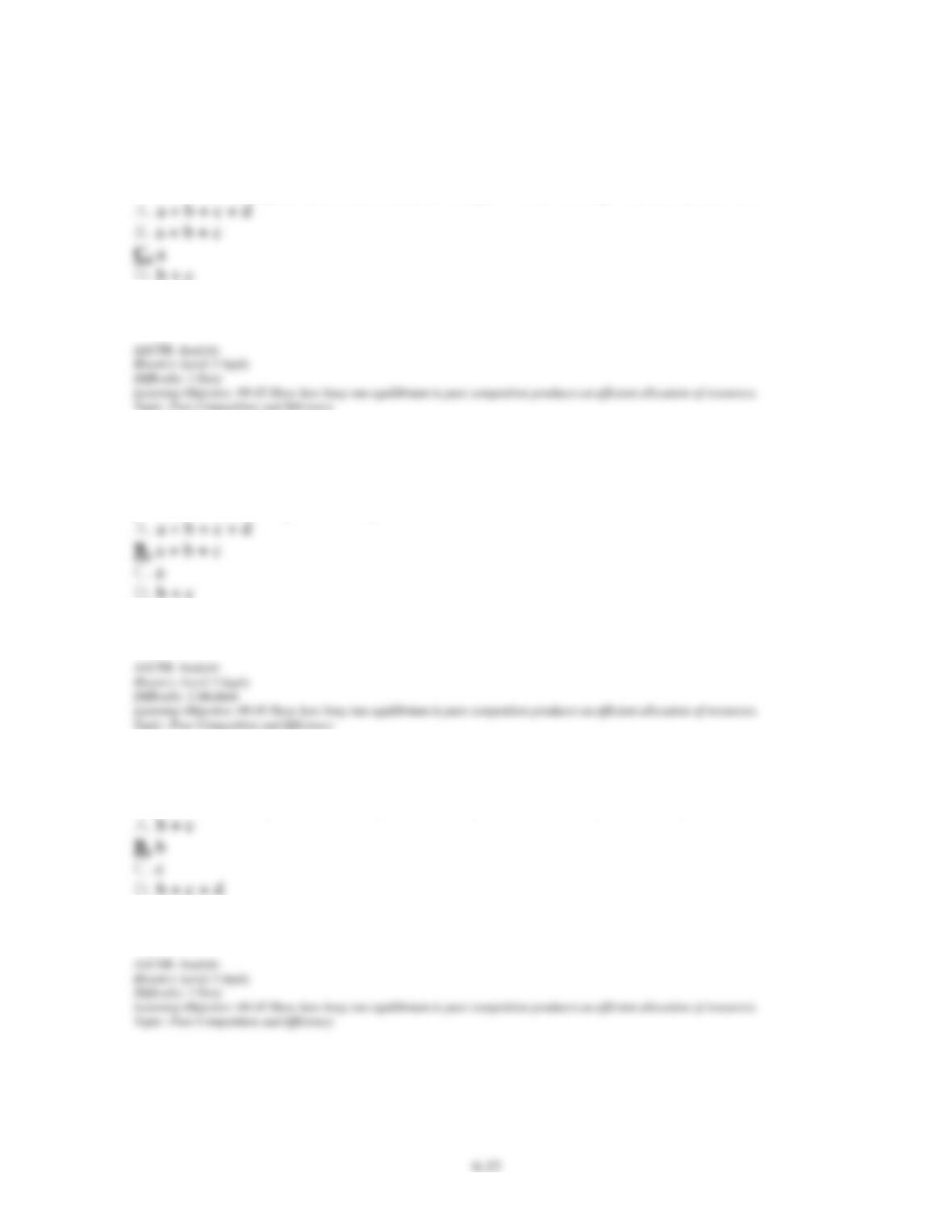
67. Refer to the graph above representing the purely competitive market for a product. When
the market is at equilibrium, the consumer surplus would be represented by the area:
68. Refer to the graph above representing the purely competitive market for a product. When
the market is at equilibrium, the value of the total benefits derived by consumers from this
product would be represented by the area:
69. Refer to the graph above representing the purely competitive market for a product. When
the market is at equilibrium, the producer surplus would be represented by the area:
Chapter 09 – Pure Competition in the Long Run
70. Refer to the graph above representing the purely competitive market for a product. When
the market is at equilibrium, the total opportunity cost of producing the equilibrium output
level would be represented by the area:
71. Refer to the graph above representing the purely competitive market for a product. When
the market is at equilibrium, the total revenues from selling the equilibrium output level
would be represented by the area:
72. Refer to the graph above representing the purely competitive market for a product. When
Chapter 09 – Pure Competition in the Long Run
73. Refer to the graph above representing the purely competitive market for a product. When
allocative efficiency is attained in this market, the sum of the consumer and producer surplus
will be areas:
74. If there is allocative efficiency in a purely competitive market for a product, the maximum
price consumers are willing to pay is:
75. When there is allocative efficiency in a purely competitive market for a product, the
minimum price producers are willing to accept is:
Chapter 09 – Pure Competition in the Long Run
76. A patent gives a firm the power to charge a price that:
77. If the maker of a patented drug sells the drug at a price above the equilibrium price, then
there:
78. If the patent on a drug expires and the average price of the drug falls to a lower
equilibrium price, there will be:
Chapter 09 – Pure Competition in the Long Run
79. If a competitive firm successfully adopts a better production technology ahead of the
others, then:
80. Competitive firms will always try to earn more than a normal profit by doing the
following, except:
81. Creative destruction is most often associated with:

Chapter 09 – Pure Competition in the Long Run
82. Creative destruction is illustrated by which of the following pairs of products:
83. In the long run for a purely competitive market, there are no fixed costs.
84. When a competitive firm decides to produce no output because the product’s price is
below the average variable cost, that is a long-run decision.
Chapter 09 – Pure Competition in the Long Run
85. The short-run supply curve of a purely competitive industry tends to be steeper than the
long-run supply curve.
86. When a competitive firm is in long-run equilibrium, its accounting profits are greater than
zero.
87. When a competitive firm finds itself with an average total cost that is higher than the price
of the product in the long run, it will decide that it could do better in another industry or
market.
Chapter 09 – Pure Competition in the Long Run
88. When a competitive firm finds itself with positive profits in the long run, then it will
decide that it could do better by moving to a different industry.
89. When a competitive firm finds that in its short-run equilibrium situation, its marginal cost
is higher than its average total cost, if things are not expected to change, then the firm will
exit the industry in the long run.
90. It is possible for a competitive firm that is maximizing profits in the short run to make its
profits even bigger in the long run by expanding its plant.
Chapter 09 – Pure Competition in the Long Run
91. In long-run equilibrium, a competitive firm produces where P = MR = MC = minimum
ATC and earns normal economic profits.
92. When firms in a purely competitive industry are earning profits that are greater than
normal, the supply of the product will tend to decrease in the long run.
93. When new firms enter a purely competitive industry, the market supply curve will shift to
the left.
94. When some firms leave a purely competitive industry, the market supply curve will shift
in such a way that the remaining firms’ profits will increase.

Chapter 09 – Pure Competition in the Long Run
95. In the long run, pure competition forces firms to produce at the minimum of average total
cost and charge a price consistent with that cost.
96. A purely competitive firm that is earning positive profits in its short-run equilibrium
situation will continue to earn positive profits at the long-run equilibrium.
97. The long-run supply curve for a competitive, decreasing-cost industry is downsloping.
98. The reason why the long-run supply curve for a purely competitive industry may be
upsloping is because of diminishing marginal returns.
Chapter 09 – Pure Competition in the Long Run
99. An upward-sloping long-run supply curve indicates a constant-cost industry.
100. Productive efficiency refers to long-run market conditions where marginal cost is equal
to marginal revenue.
101. An under-allocation of resources is occurring in a purely competitive industry whenever
the price of the product is greater than marginal cost.
102. In pure competition, resources are optimally allocated when production occurs at the
output level where P=MC.
Chapter 09 – Pure Competition in the Long Run
103. Consumer surplus is the difference between the minimum price a consumer is willing to
pay for a good and the market price of the product.
104. Producer surplus is the difference between the market price a producer receives for a
product and the minimum price producers are willing to accept for a product.
105. Competitive markets produce equilibrium prices and quantities that maximize the sum of
consumer and producer surpluses.
106. If a market is allocatively efficient, it means that at the equilibrium price, the maximum
price consumers are willing to pay is equal to the minimum acceptable price for producers.
Chapter 09 – Pure Competition in the Long Run
107. Efficiency or deadweight losses occur in purely competitive markets when P = MC =
lowest ATC.
108. The operation of the “invisible hand” means the pursuit of private interests promotes
social interests in pure competition.
109. The transformative effects of competition that foster the development of new products or
new production methods benefit everyone in society.
110. From the viewpoint of a firm, competition can come even from other firms that are not in
the same industry.
Chapter 09 – Pure Competition in the Long Run
111. Creative destruction is something that our society should try to avoid, through
government regulation of business.
112. Creative destruction entails both costs as well as benefits.
113. The costs of competition’s creative destruction are often widespread, while the benefits
often accrue to only a few.