Chapter 09 – Pure Competition in the Long Run
45. Allocative efficiency is achieved when the production of a good occurs where:
46. A firm is producing an output such that the benefit from one more unit is more than the
cost of producing that additional unit. This means the firm is:
Chapter 09 – Pure Competition in the Long Run
47. Resources are efficiently allocated when production occurs where:
48. The term productive efficiency refers to:
49. If the price of product Y is $25 and its marginal cost is $18:
Chapter 09 – Pure Competition in the Long Run
50. The term allocative efficiency refers to:
51. Under pure competition in the long run:
52. If for a firm P = minimum ATC = MC, then:
Chapter 09 – Pure Competition in the Long Run
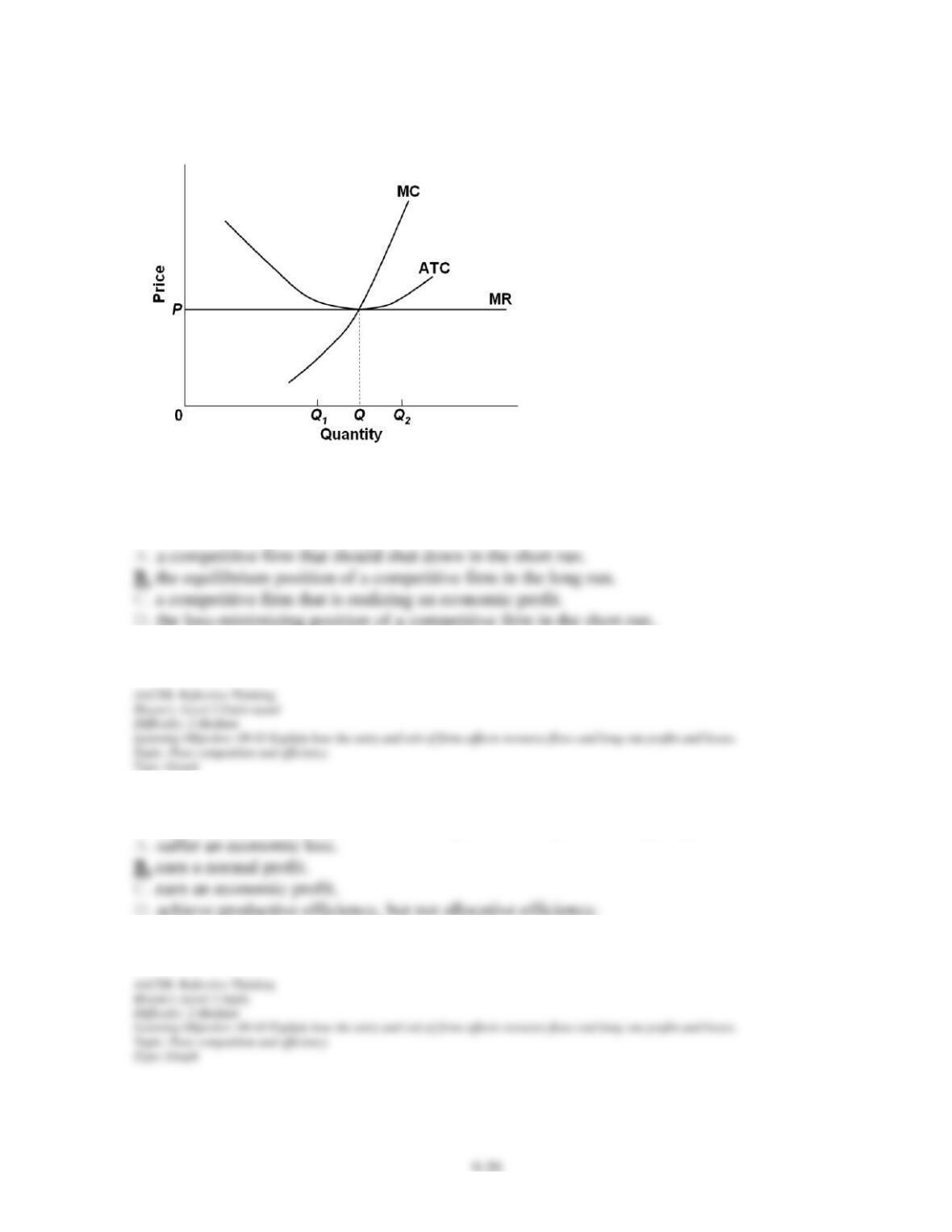
53. The above diagram portrays:
54. Refer to the above diagram. If this competitive firm produces output Q, it will:
Chapter 09 – Pure Competition in the Long Run
55. Refer to the above diagram. By producing output level Q:
56. Refer to the above diagram. At output level Q1:
57. Refer to the above diagram. At output level Q1:
Chapter 09 – Pure Competition in the Long Run
58. Refer to the above diagram. At output level Q2:
59. Assume that society places a higher value on the last unit of X produced than the value of
the resources used to produce that unit. With no spillovers, this information means that:
60. If production is occurring where marginal cost exceeds price, the purely competitive firm
will:
Chapter 09 – Pure Competition in the Long Run
61. If a purely competitive firm is producing where price exceeds marginal cost, then:
62. Which of the following conditions is true for a purely competitive firm in long-run
63. Allocative efficiency occurs whenever:
Chapter 09 – Pure Competition in the Long Run
64. In long-run equilibrium, purely competitive markets:
65. Which of the following would not be expected to occur in a purely competitive market in
long-run equilibrium?
66. Which of the following outcomes is consistent with a purely competitive market in long-
run equilibrium?
Chapter 09 – Pure Competition in the Long Run
67. Entrepreneurs in purely competitive industries:
68. Innovations that lower production costs or create new products:
69. The process by which new firms and new products replace existing dominant firms and
products is called:
Chapter 09 – Pure Competition in the Long Run
70. Creative destruction is:
71. The theory of creative destruction was advanced many years ago by:
72. Creative destruction is least beneficial to:
Chapter 09 – Pure Competition in the Long Run
73. Which of the following is an example of creative destruction?
74. (Consider This) The average life expectancy of a U.S. business is approximately:
75. (Consider This) Approximately what percentage of start-up firms in the U.S. go bankrupt
within the first two years?
Chapter 09 – Pure Competition in the Long Run
76. (Consider This) Which of the following statements is true about U.S. firms?
77. (Last Word) The entry of generic drugs into a previously monopolized pharmaceutical
market will:
78. (Last Word) When patents on new medications expire, the market for those drugs:
Chapter 09 – Pure Competition in the Long Run
79. (Last Word) Patents give pharmaceutical companies exclusive rights to produce and sell
the patented medications:
80. After all long-run adjustments have been completed, a firm in a competitive industry will
produce that level of output where average total cost is at a minimum.
81. The long-run supply curve for a decreasing-cost industry is downsloping.
Chapter 09 – Pure Competition in the Long Run
9-30
82. Marginal cost is a measure of the alternative goods which society forgoes in using
resources to produce an additional unit of some specific product.
83. Because the equilibrium position of a purely competitive seller entails an equality of price
and marginal costs, competition produces an efficient allocation of economic resources.
Chapter 09 – Pure Competition in the Long Run
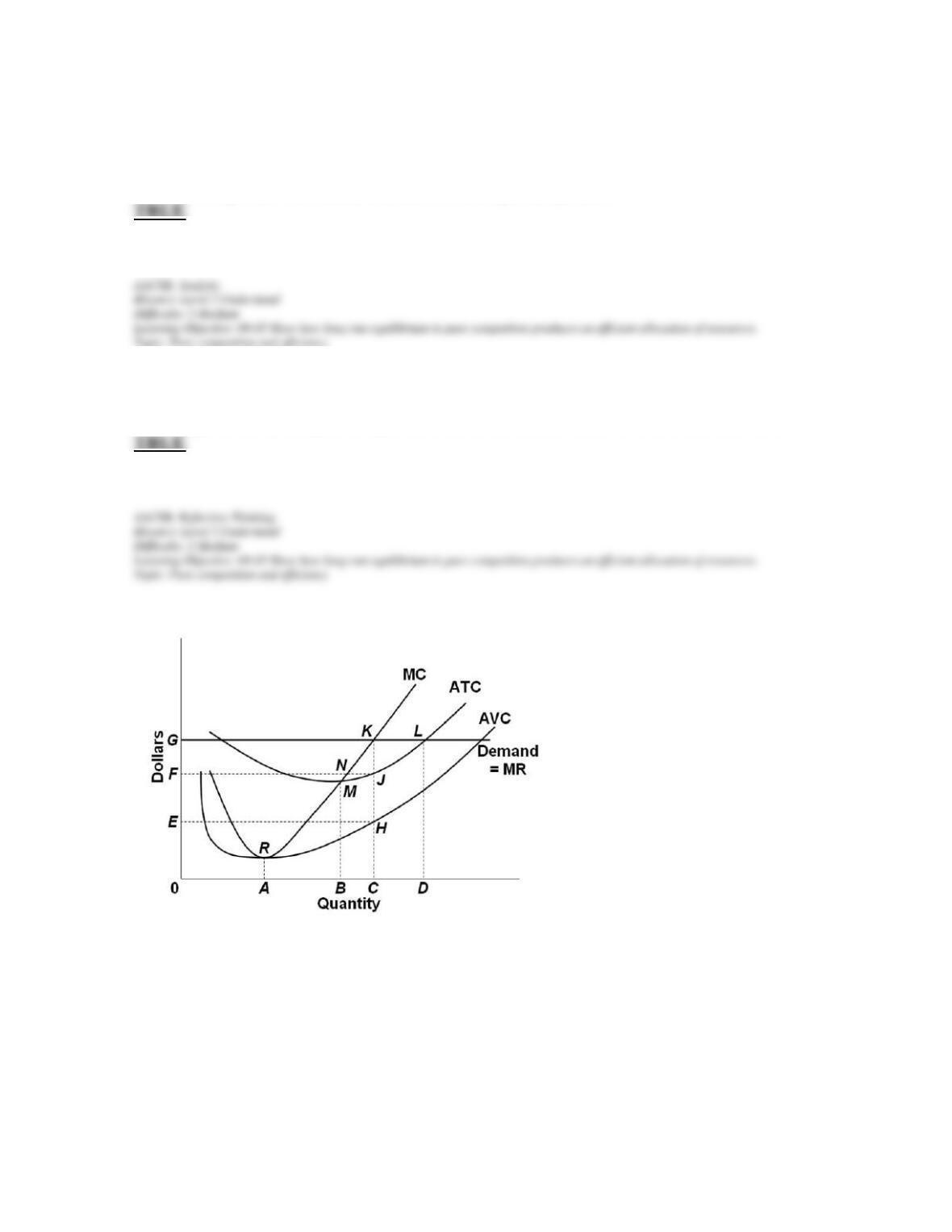
84. Refer to the above diagram. If this represents a typical firm in the industry and the firm is
producing at the profit-maximizing level of output in the short run, then in the long run we
would expect more firms to enter the market.
85. Refer to the above diagram. If this represents a typical firm in the industry and the firm is
producing at the profit-maximizing level of output in the short run, then in the long run we
would expect economic profits in this market to rise.
86. Refer to the above diagram. If this firm is producing at the profit-maximizing level of
output in the short run, then it is achieving productive and allocative efficiency.
Chapter 09 – Pure Competition in the Long Run
87. When entrepreneurs in competitive industries successfully innovate to lower production
costs, it usually results in long-run economic profits for the firm.
88. The process by which new firms and new products destroy existing dominant firms and
their products is called creative destruction.