Chapter 09 – Pure Competition in the Long Run
1. Which of the following distinguishes the short run from the long run in pure competition?
2. The primary force encouraging the entry of new firms into a purely competitive industry
is:
Chapter 09 – Pure Competition in the Long Run
3. In a purely competitive industry:
4. Suppose a firm in a purely competitive market discovers that the price of its product is
above its minimum AVC point but everywhere below ATC. Given this, the firm:
5. Which of the following is true concerning purely competitive industries?
Chapter 09 – Pure Competition in the Long Run
6. If a purely competitive firm is producing at the MR = MC output level and earning an
economic profit, then:
7. Long-run competitive equilibrium:
8. We would expect an industry to expand if firms in that industry are:
Chapter 09 – Pure Competition in the Long Run
9. Which of the following statements is correct?
10. Suppose a purely competitive, increasing-cost industry is in long-run equilibrium. Now
assume that a decrease in consumer demand occurs. After all resulting adjustments have been
completed, the new equilibrium price:
Chapter 09 – Pure Competition in the Long Run
11. Which of the following statements is correct?
12. A constant-cost industry is one in which:
13. Which of the following will not hold true for a competitive firm in long-run equilibrium?
Chapter 09 – Pure Competition in the Long Run
14. Assume a purely competitive increasing-cost industry is initially in long-run equilibrium
and that an increase in consumer demand occurs. After all economic adjustments have been
completed product price will be:
15. Assume a purely competitive, increasing-cost industry is in long-run equilibrium. If a
decline in demand occurs, firms will:
16. When a purely competitive firm is in long-run equilibrium:
Chapter 09 – Pure Competition in the Long Run
17. A purely competitive firm:
18. A constant-cost industry is one in which:
19. An increasing-cost industry is associated with:
Chapter 09 – Pure Competition in the Long Run
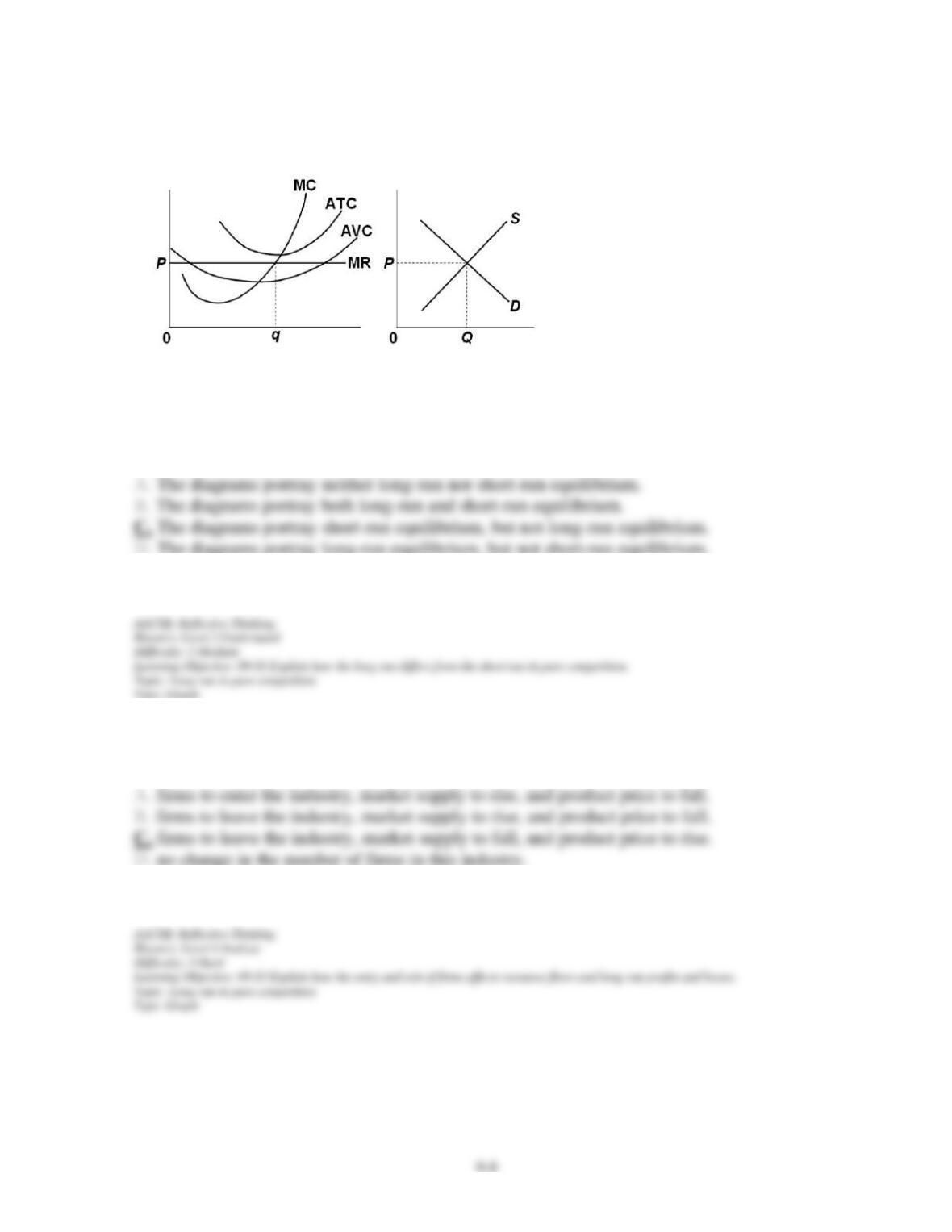
20. Refer to the above diagrams which pertain to a purely competitive firm producing output
q and the industry in which it operates. Which of the following is correct?
21. Refer to the above diagrams which pertain to a purely competitive firm producing output
q and the industry in which it operates. In the long run we should expect:
Chapter 09 – Pure Competition in the Long Run
22. Refer to the above diagrams, which pertain to a purely competitive firm producing output
q and the industry in which it operates. The predicted long-run adjustments in this industry
might be offset by:
23. Assume a purely competitive firm is maximizing profit at some output at which long-run
average total cost is at a minimum. Then:
24. An increasing-cost industry is the result of:
Chapter 09 – Pure Competition in the Long Run
25. A purely competitive firm is precluded from making economic profit in the long run
because:
26. If a purely competitive constant-cost industry is realizing economic profits, we can expect
industry supply to:
27. Assume that a decline in consumer demand occurs in a purely competitive industry which
is initially in long-run equilibrium. We can:
Chapter 09 – Pure Competition in the Long Run
28. Under what conditions would an increase in demand lead to a lower long-run equilibrium
price?
29. In a decreasing-cost industry:
30. A decreasing-cost industry is one in which:
Chapter 09 – Pure Competition in the Long Run
31. When LCD televisions first came on the market, they sold for at least $1,000, and some
for much more. Now many units can be purchased for under $400. These facts imply that:
32. Suppose that an industry’s long-run supply curve is downsloping. This suggests that:
33. Suppose an increase in product demand occurs in a decreasing-cost industry. As a result:
Chapter 09 – Pure Competition in the Long Run
9-13
34. Purely competitive industry X has constant costs and its product is an inferior good. The
industry is currently in long-run equilibrium. The economy now goes into a recession and
average incomes decline. The result will be:
35. Suppose losses cause industry X to contract and, as a result, the prices of relevant inputs
decline. Industry X is:
Chapter 09 – Pure Competition in the Long Run
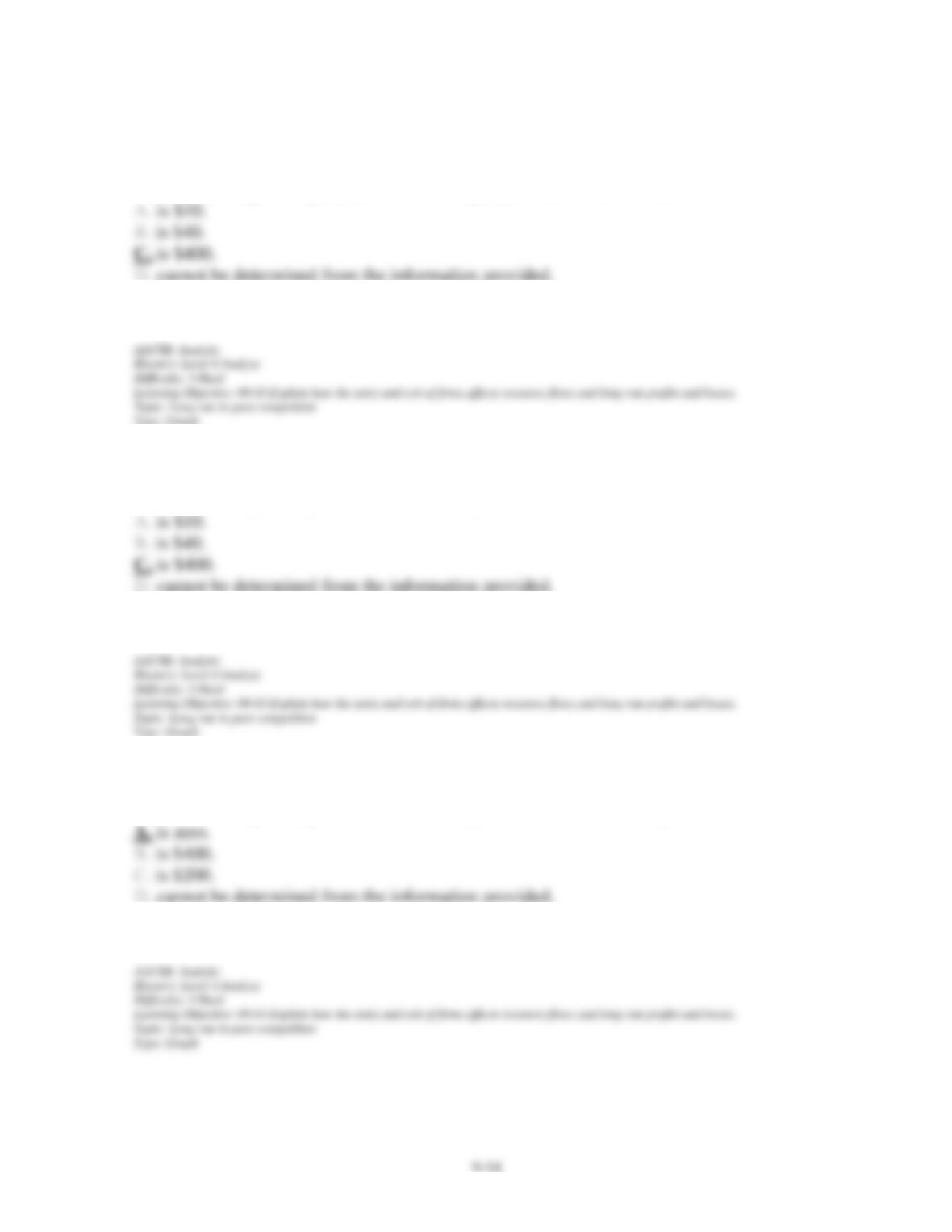
36. Refer to the above diagram showing the average total cost curve for a purely competitive
firm. At the long-run equilibrium level of output, this firm’s total revenue:
37. Refer to the above diagram showing the average total cost curve for a purely competitive
firm. At the long-run equilibrium level of output, this firm’s total cost:
38. Refer to the above diagram showing the average total cost curve for a purely competitive
firm. At the long-run equilibrium level of output, this firm’s economic profit:
Chapter 09 – Pure Competition in the Long Run
9-15
39. The MR = MC rule applies:
40. If the long-run supply curve of a purely competitive industry slopes upward, this implies
that the prices of relevant resources:
Chapter 09 – Pure Competition in the Long Run
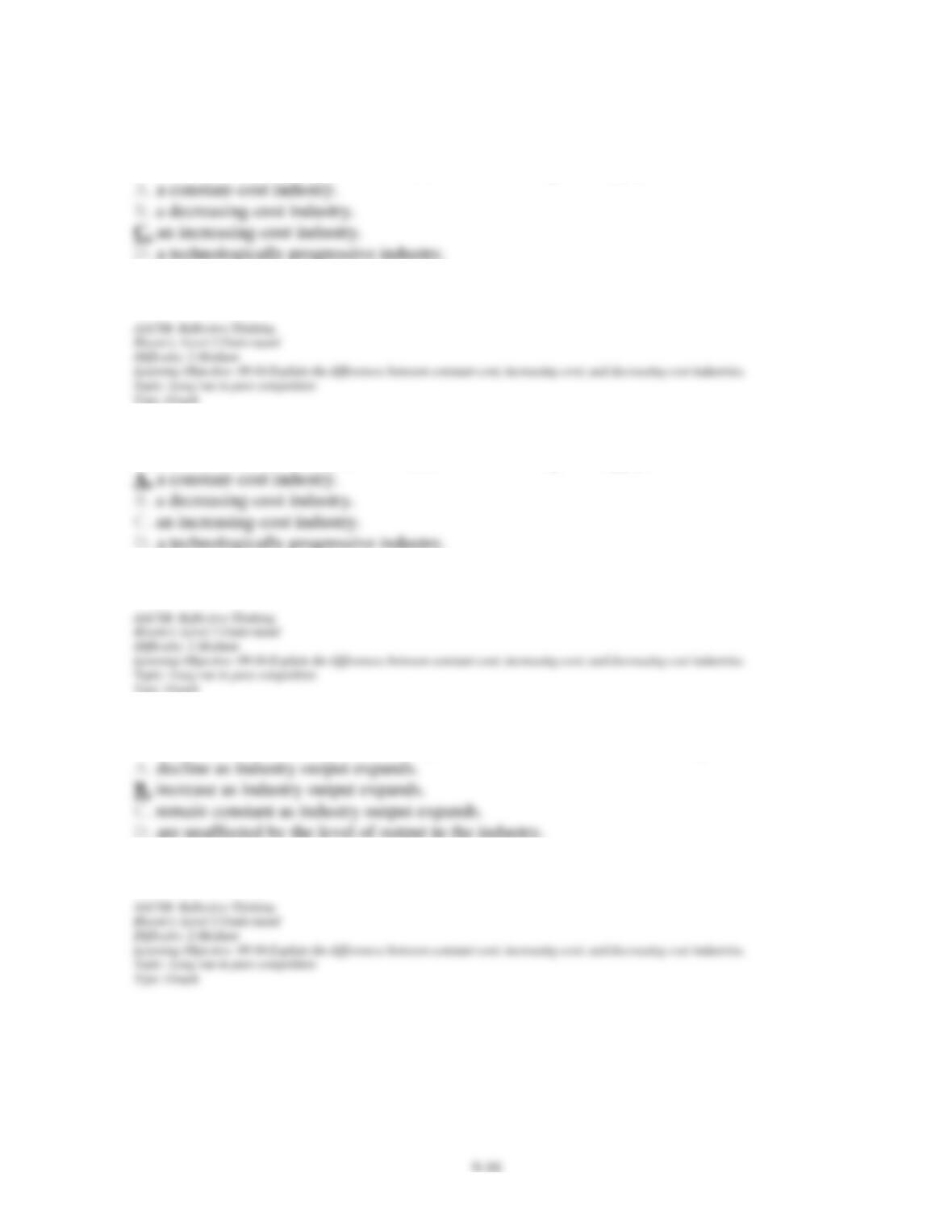
41. Refer to the above diagram. Line (1) reflects the long-run supply curve for:
42. Refer to the above diagram. Line (2) reflects the long-run supply curve for:
43. Refer to the above diagram. Line (1) reflects a situation where resource prices: