a.
output, 3; maximum profit, $3 loss
b.
output, 5; maximum profit, zero
c.
output, 5; maximum profit, slightly less than $5
d.
output, 6; maximum profit, slightly less than $6
176. If the market price in Figure 9-5 fell to $2.50, what should the firm do?
a.
raise its price
b.
shut down and wait for conditions to improve
c.
continue operating in the short run if it expects conditions to improve
d.
go out of business immediately
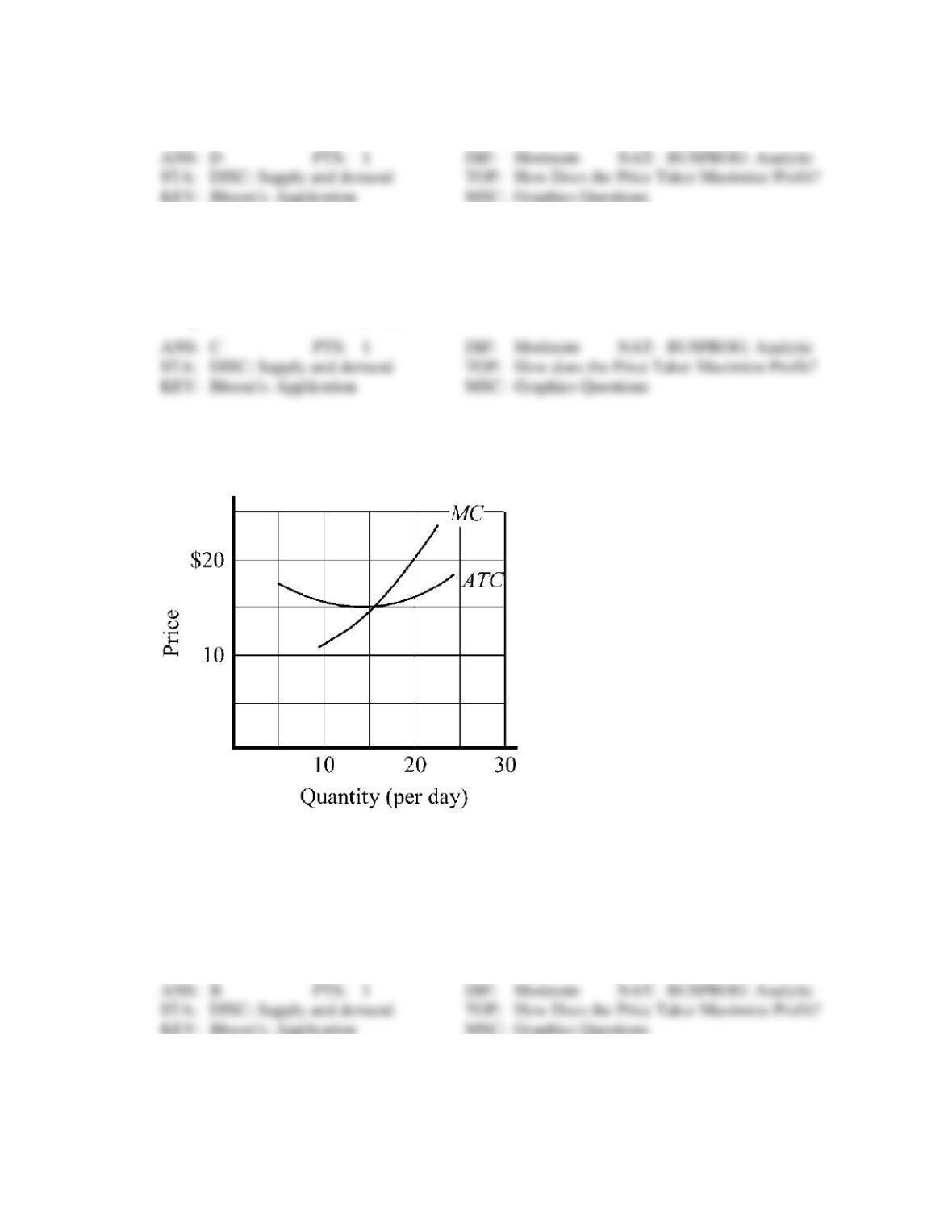
Use the figure to answer the following question(s).
Figure 9-6
177. The average total cost (ATC) and marginal costs (MC) of a firm producing in a price-taker industry are
depicted in Figure 9-6. If the current market price of the firm’s product is $15, what output should this
firm produce?
a.
10
b.
15
c.
20
d.
25
178. If the market price in Figure 9-6 increases to $20, what should the firm do?
a.
produce an output of 15
b.
expand output to 20
c.
expand output to 25
d.
increase its price to $25
179. When the market price in Figure 9-6 is $20, the firm’s maximum profit will be approximately
a.
zero.
b.
$3.
c.
$60.
d.
$400.
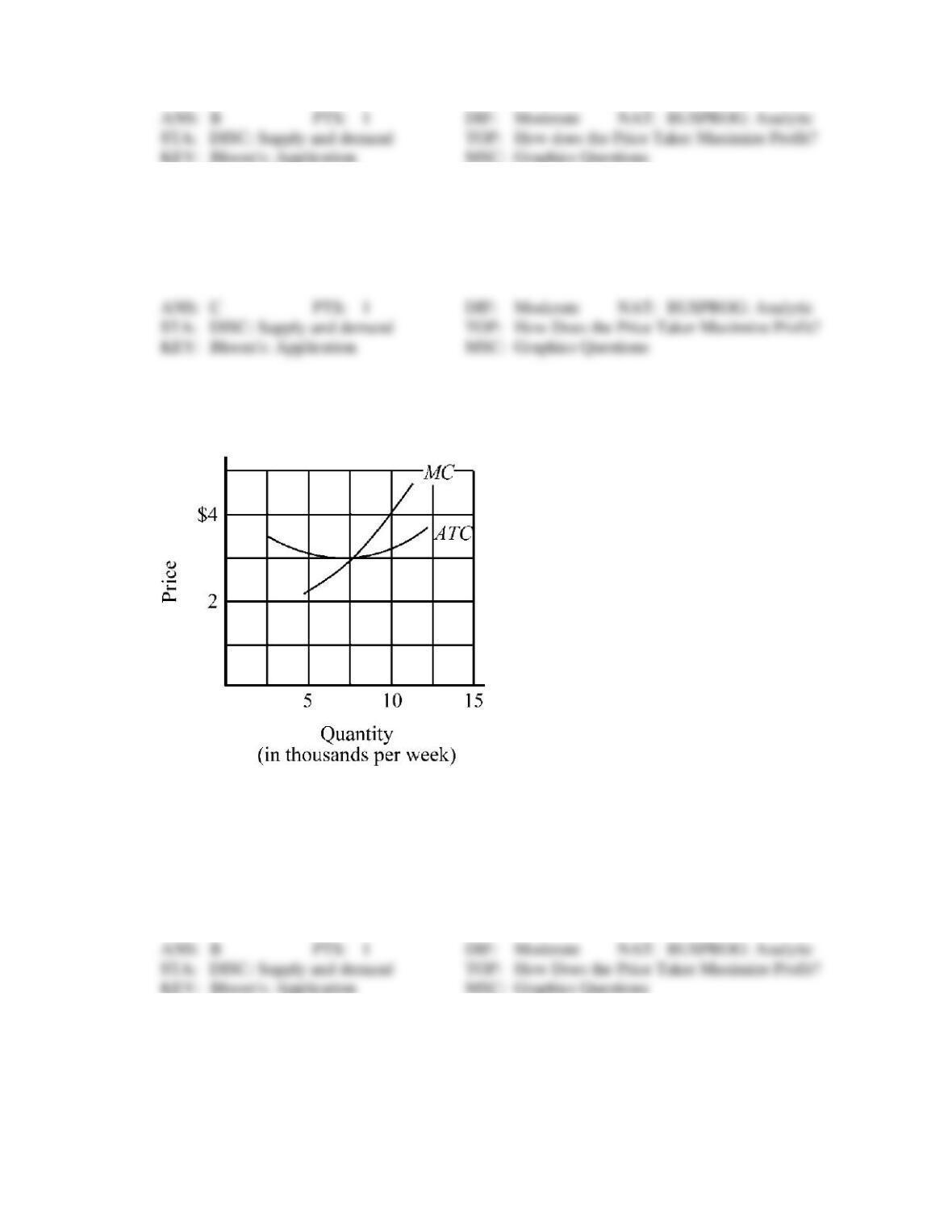
Use the figure to answer the following question(s).
Figure 9-7
180. The average total cost (ATC) and marginal costs (MC) of a firm producing in a price-taker industry are
depicted in Figure 9-7. If the current market price of the firm’s product is $3, what output should this
firm produce per week?
a.
5,000
b.
7,500
c.
10,000
d.
12,500
181. If the market price in Figure 9-7 increases to $4, what should the firm do?
a.
produce 5,000 per week
b.
produce 7,500 per week
c.
produce 10,000 per week
d.
increase its price to $5
182. When the market price in Figure 9-7 is $4, the firm’s maximum weekly profit will be approximately
a.
zero.
b.
$40.
c.
$6,000.
d.
$40,000.
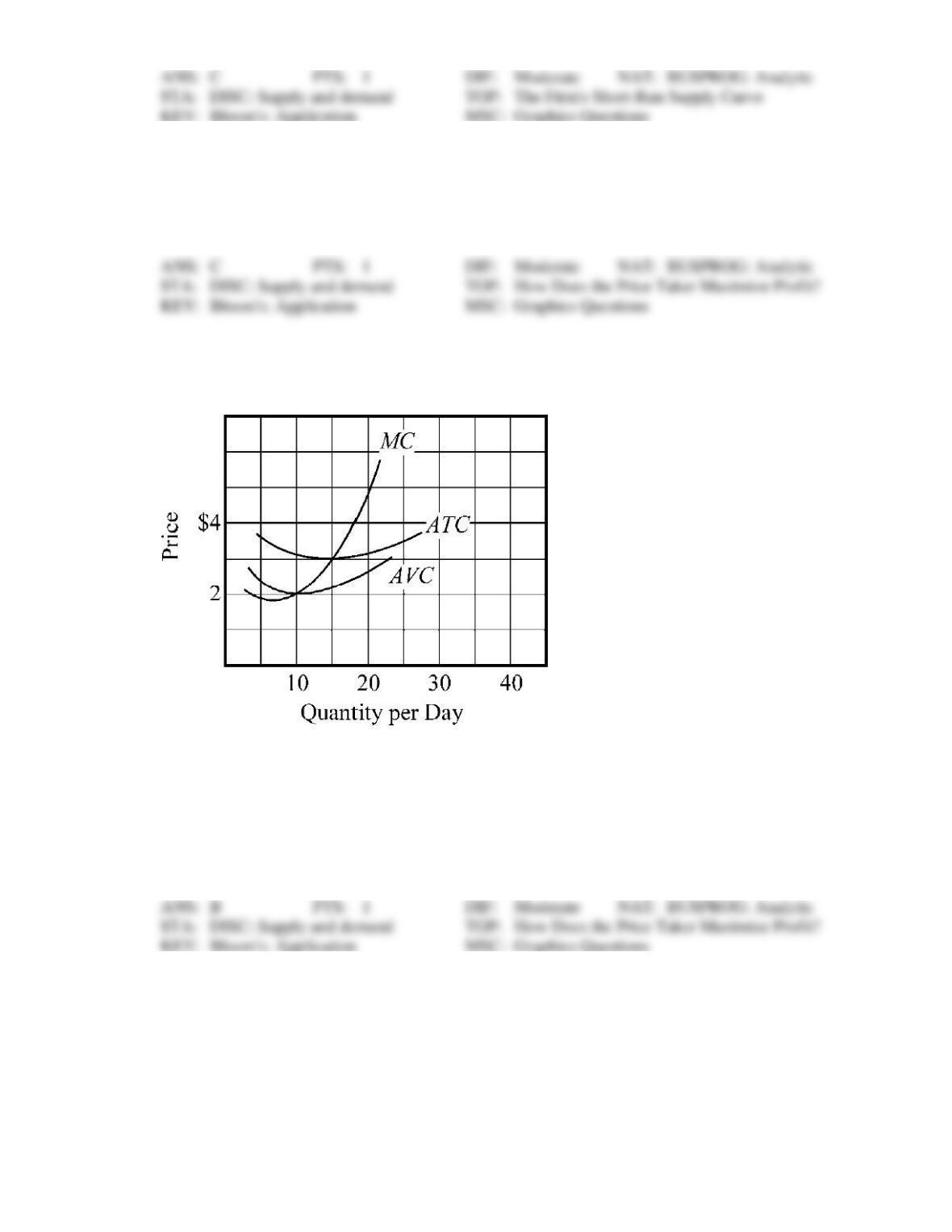
Use the figure to answer the following question(s).
Figure 9-8
183. The average total cost (ATC) and marginal costs (MC) of a firm producing in a price-taker industry are
depicted in Figure 9-8. If the current market price of the firm’s product is $3, what output should this
firm produce per day?
a.
10
b.
15
c.
20
d.
25
184. At the market price of $3 in Figure 9-8, indicate the firm’s total revenue and total cost at its
profit-maximizing level of output.
a.
total revenue, $45; total cost, $37 (approx.)
b.
total revenue, $45; total cost, $45
c.
total revenue, $60; total cost, $45
d.
total revenue, $80; total cost, $65 (approx.)
185. If the market price in Figure 9-8 increases to $4, indicate the firm’s profit-maximizing output and total
revenue.
a.
output, 15; total revenue, $45
b.
output, 15; total revenue, $60
c.
output, 17; total revenue, $68 (approx.)
d.
output, 20; total revenue, $80
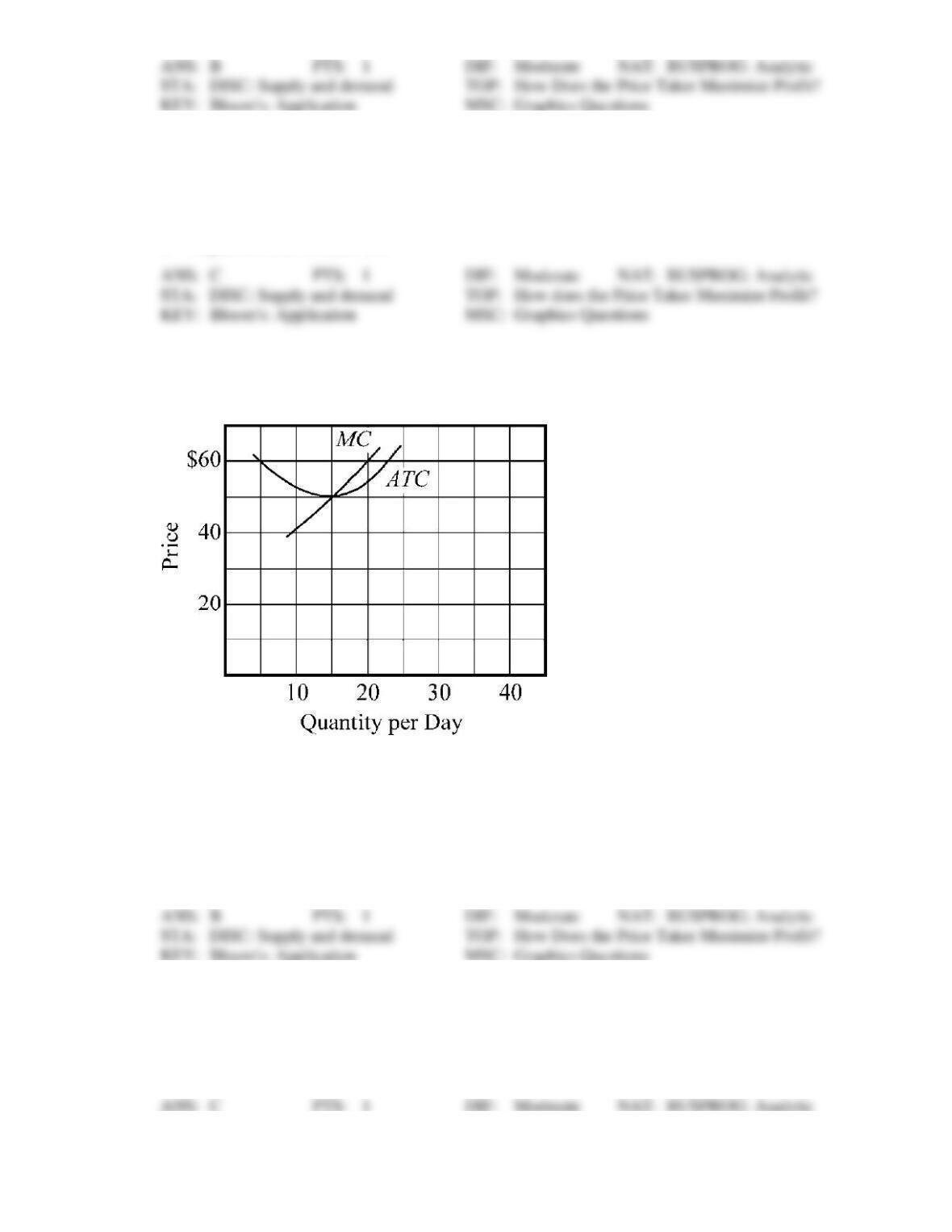
Use the figure to answer the following question(s).
Figure 9-9
186. The average total cost (ATC) and marginal costs (MC) of a firm producing in a price-taker industry are
depicted in Figure 9-9. If the current market price of the firm’s product is $50, what output should this
firm produce per day?
a.
10
b.
15
c.
20
d.
25
187. If the market price in Figure 9-9 increases to $60, what should the firm do?
a.
produce 10 per day
b.
produce 15 per day
c.
produce 20 per day
d.
increase its price to $70
188. When the market price is $60 in Figure 9-9, the firm’s maximum daily profit will be approximately
a.
zero.
b.
$100.
c.
$900.
d.
$1,200.
Figure 9-10
189. In Figure 9-10, the movement from points A to B to C can best be explained by which of the following
factors?
a.
a decrease in demand, followed by the entry of new firms and an expansion in supply in a
constant cost industry.
b.
an increase in demand, followed by the entry of new firms and an expansion in supply in
an increasing cost industry.
c.
a decrease in demand, followed by the exit of firms and a decline in supply in an
increasing cost industry.
d.
an increase in demand, followed by the exit of firms and a decline in supply in a constant
cost industry.
Use the figure to answer the following question(s).
Figure 9-11
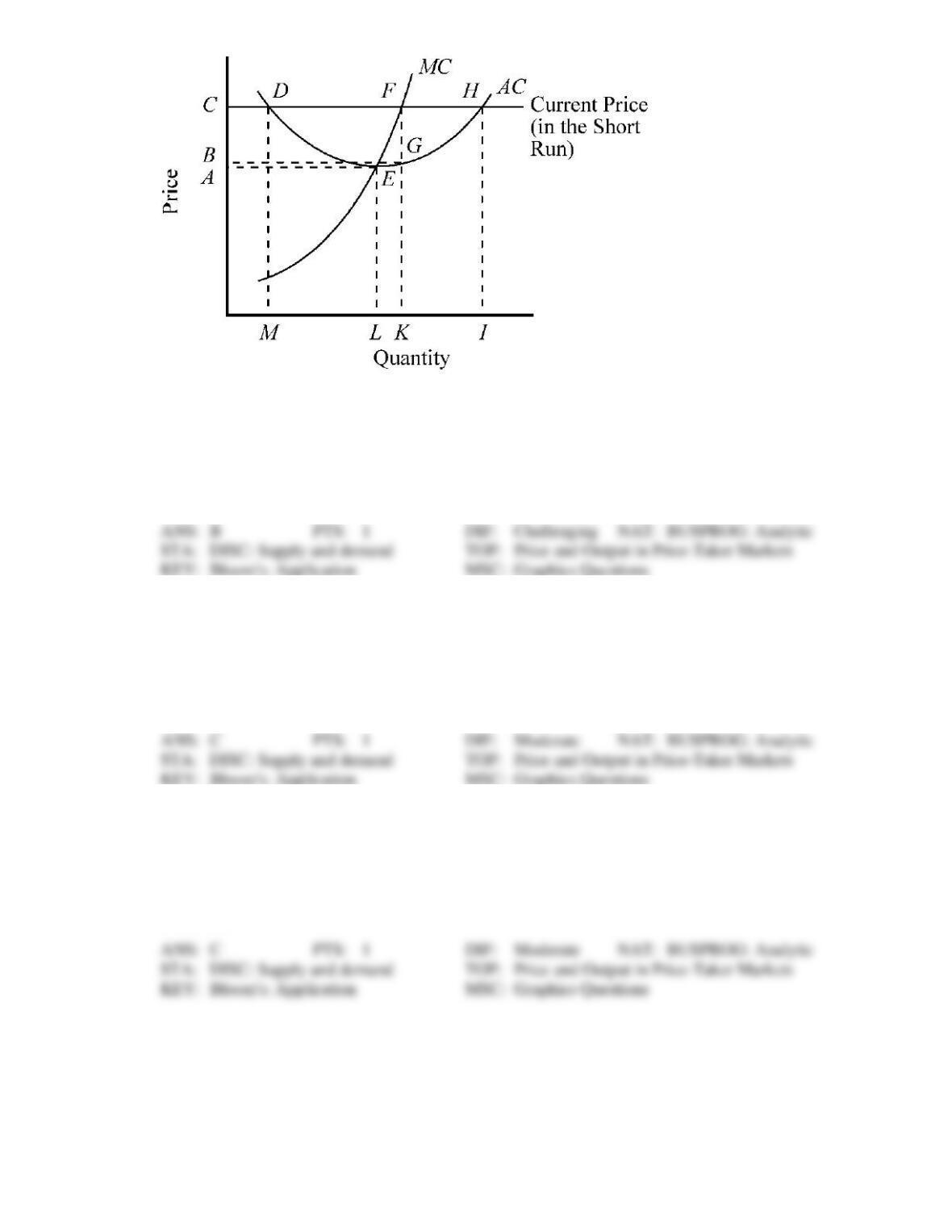
190. If the current market price for the firm depicted in Figure 9-11 is A, given the firm’s cost conditions,
which output should it produce?
a.
OM
b.
OL
c.
OK
d.
OI
191. Which of the following represents the firm’s total cost of producing the profit-maximizing output in
Figure 9-11?
a.
OCFK
b.
OBGK
c.
OAEL
d.
OCHI
192. Which of the following indicates the firm’s profit (or loss) at the profit-maximizing output in Figure
9-11?
a.
profit BCFG
b.
profit OCDM
c.
zero economic profit
d.
loss AEFC
Figure 9-12
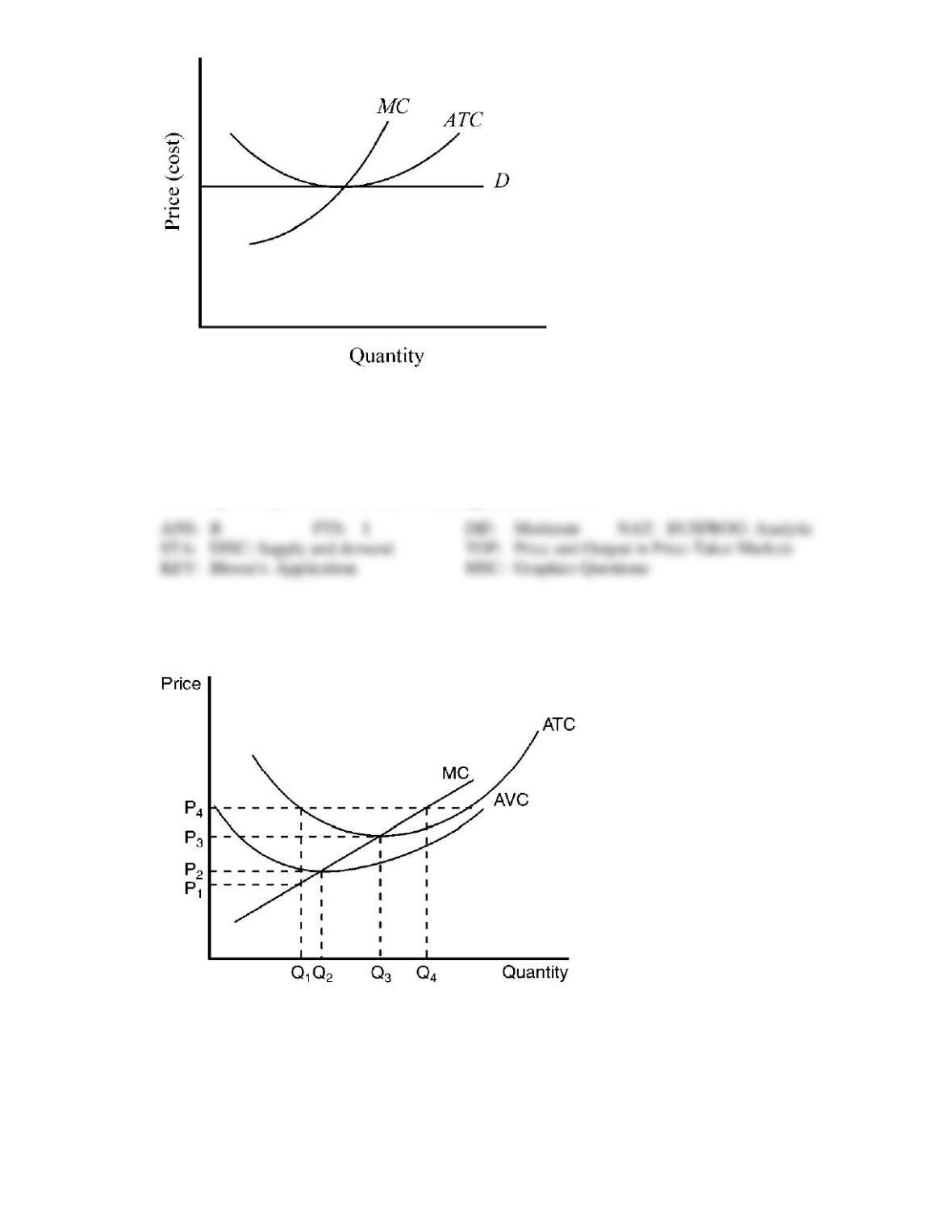
193. Figure 9-12 illustrates a
a.
competitive price-taker firm that is earning economic profit.
b.
competitive price-taker firm that is only able to break even when it is maximizing
economic profit.
c.
firm that should shut down immediately.
d.
competitive price-taker firm that is making economic losses.
The graph below depicts the cost structure for a firm in a competitive market.
Figure 9-13
194. Refer to Figure 9-13. When price rises from P2 to P3, the firm finds that
a.
marginal cost exceeds marginal revenue at a production level of Q2.
b.
if it produces at output level Q3 it will earn a positive profit.
c.
expanding output to Q4 would leave the firm with losses.
d.
it could increase profits by lowering output from Q3 to Q2.
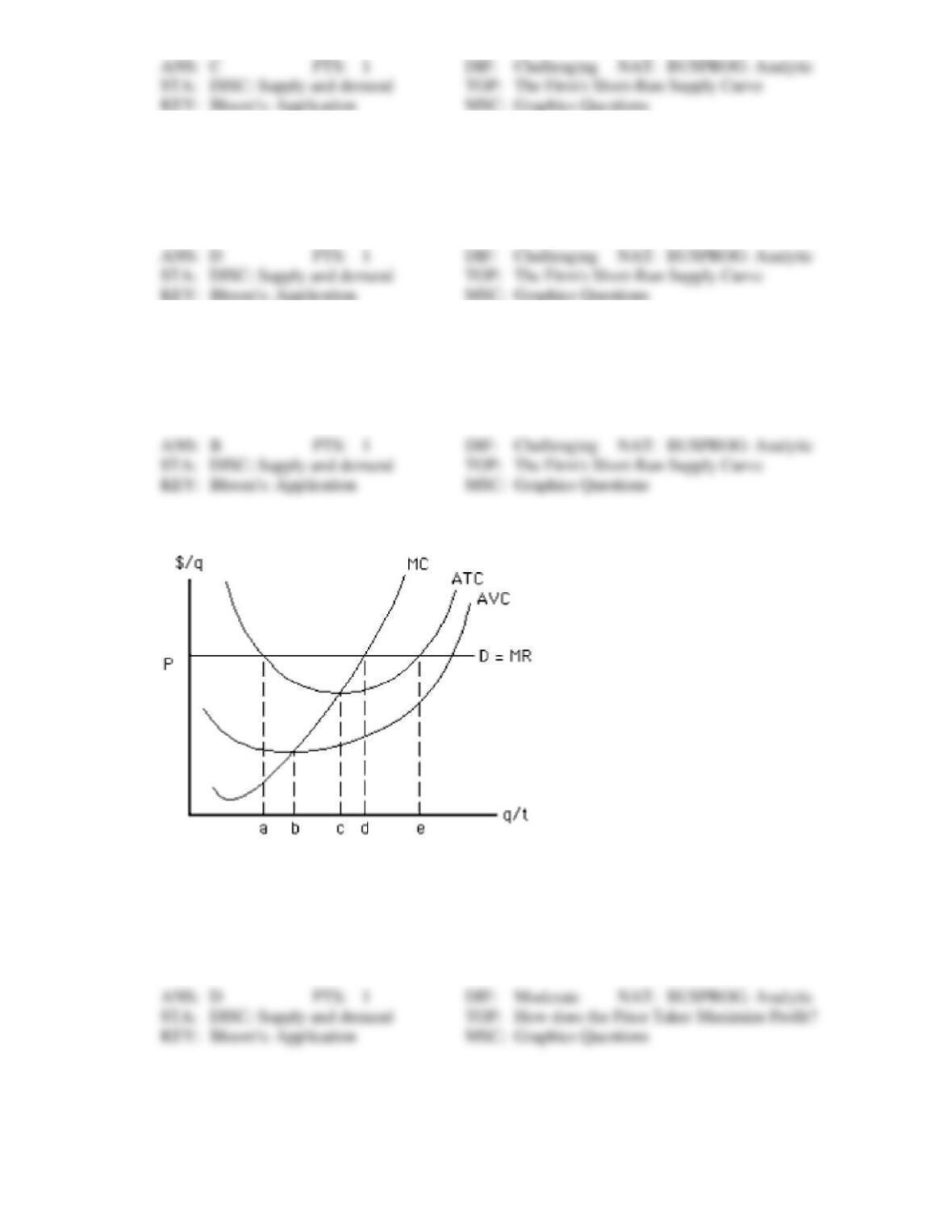
195. Refer to Figure 9-13. When price falls from P3 to P1, the firm finds that
a.
fixed cost is higher at a production level of Q1 than it is at Q3.
b.
it should produce Q1 units of output.
c.
it should produce Q3 units of output.
d.
it should shut down immediately.
196. Refer to Figure 9-13. When price rises from P3 to P4, the firm finds that
a.
fixed costs are lower at a production level of Q4.
b.
it can earn a positive profit by increasing production to Q4.
c.
profit is still maximized at a production level of Q3.
d.
average revenue exceeds marginal revenue at a production level of Q4.
Figure 9-14
197. Consider Figure 9-14. At which quantity will this firm maximize profit?
a.
point a
b.
point b
c.
point c
d.
point d
e.
point e
Figure 9-15
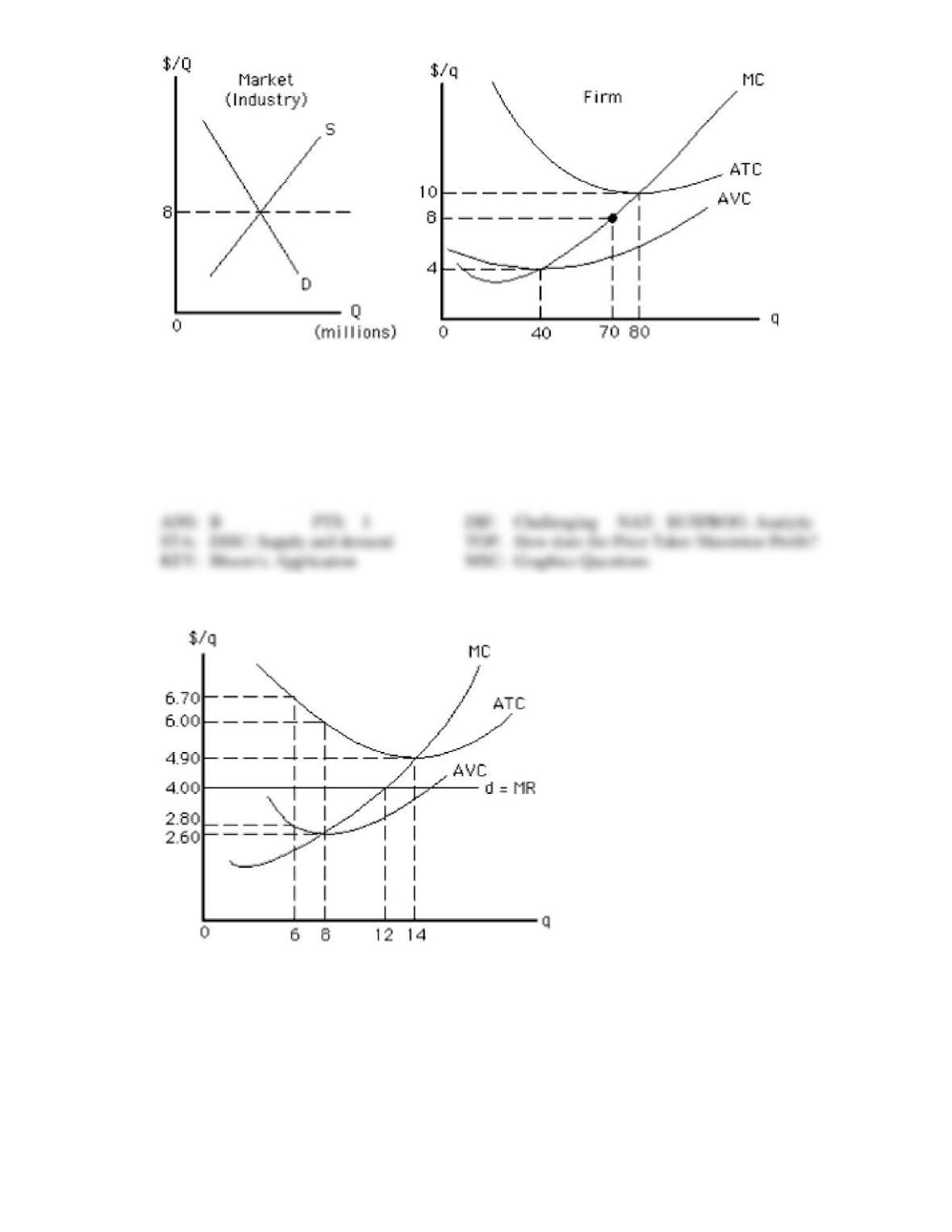
198. At which price and quantity is profit maximized for the competitive price-taker firm represented in
Figure 9-15?
a.
$40 and 80
b.
$8 and 70
c.
$4 and 40
d.
$40 and 70
e.
$8 and zero output
Figure 9-16
199. If the price-taker firm in Figure 9-16 is currently producing 6 units, then to maximize profit in the
short run, it should
a.
keep producing 6 units
b.
increase production to 12 units
c.
increase production to 14 units
d.
increase production to 8 units
e.
shut down
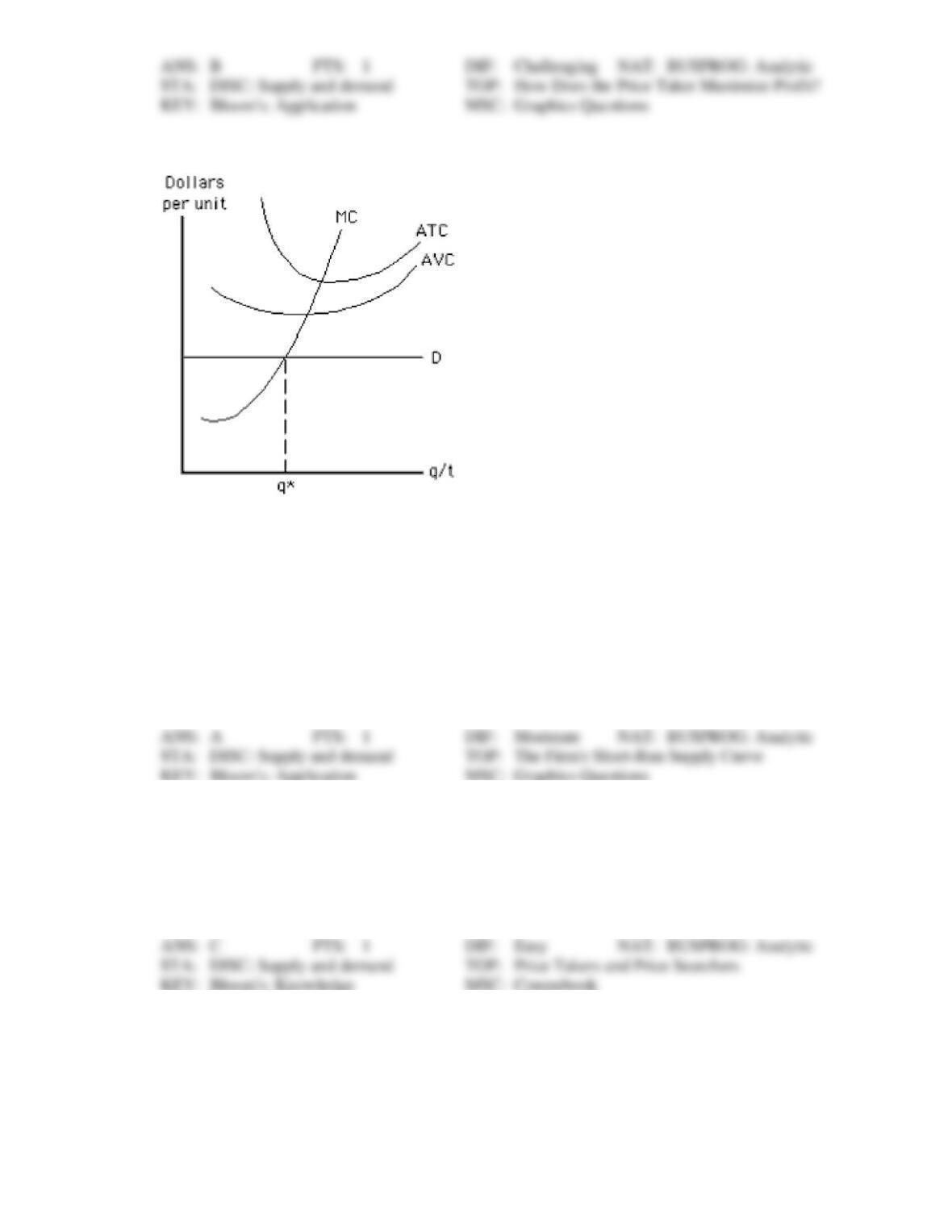
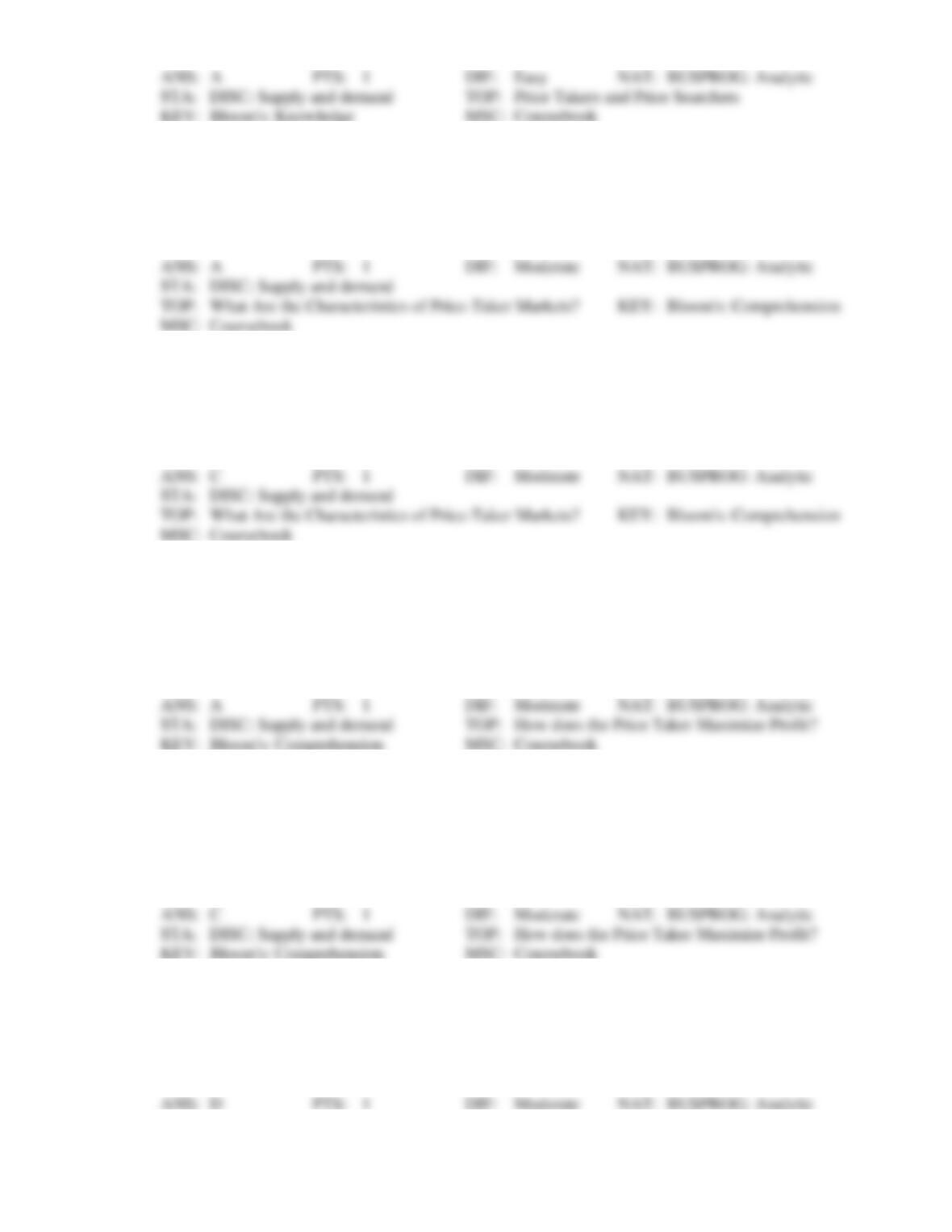
Figure 9-17
200. Which of the following statements about the competitive price-taker firm represented in Figure 9-17 is
false?
a.
Short-run losses are minimized at output level q* because MR = MC there.
b.
The firm should shut down in the short run.
c.
If the firm shuts down in the short run, it will suffer a loss equal to the amount of its fixed
cost.
d.
If the firm operates in the short run, it will suffer a loss greater than the amount of its fixed
cost.
e.
If the firm operates in the short run, it will suffer a loss equal to the amount of its fixed
cost plus the uncovered portion of its variable cost.
201. In a price-taker market,
a.
all firms in the market charge different prices depending upon their respective costs of
production.
b.
there are generally a small number of very large firms.
c.
the firms all produce identical products.
d.
firms will usually make economic losses in the long run.
202. A firm that must sell its output at a market-determined price is called a
a.
price-taker firm.
b.
price-searcher firm.
c.
price-setter firm.
d.
price-maker firm.
203. For a firm in a price-taker market, the firm’s demand curve is
a.
a horizontal line at the market price that is equal to the firm’s marginal revenue curve.
b.
an upward-sloping line that is equal to the firm’s marginal cost above AVC.
c.
a downward-sloping line that lies below the firm’s marginal revenue curve.
d.
undefined because it cannot determine the price it charges for its output.
204. To maximize profits, a firm should always produce the level of output where
a.
marginal cost equals average total cost.
b.
average total cost equals price.
c.
marginal cost equals marginal revenue.
d.
marginal revenue equals price.
205. If you were the owner of a price-taker firm operating at an output level where the marginal cost of
producing another unit was $5, and the market price was $7, then you
a.
could increase your profit by expanding output.
b.
could increase your profit by decreasing output.
c.
are maximizing your profit at your current output level.
d.
will be able to earn positive economic profits in the long run.
206. A price-taker firm is currently producing 50 units of output at an average total cost of $3 per unit. If
the market price is $7, then the firm’s total economic profit is
a.
$4.
b.
$150.
c.
$200.
d.
$350.
207. For a price-taker firm, marginal revenue is
a.
equal to price.
b.
equal to zero when the market is in long-run equilibrium.
c.
equal to the change in total revenue divided by the change in output.
d.
both a and c.
208. If a firm in a price-taker market is earning zero economic profit, it
a.
will shut down in the long run but not the short run.
b.
will also be earning zero accounting profit.
c.
is doing as well as typical firms in other markets.
d.
will shut down in the short run.
209. If marginal revenue exceeds marginal cost at the current level of output, profit will increase when
output is expanded because
a.
other firms in the industry will shut down as the firm expands output.
b.
the market price will rise as the firm expands output.
c.
producing and selling an additional unit will add more to total revenue than it adds to total
cost.
d.
marginal cost will decline as output is expanded.
210. Historically, most economists have referred to markets where firms are price takers as
a.
purely competitive markets.
b.
monopoly markets.
c.
open-door markets.
d.
price-searcher markets.
211. Which of the following is true?
a.
When firms in a price-taker market are earning zero economic profit, they will shut down.
b.
When firms in a price-taker market are earning positive economic profits, new firms will
enter the industry causing the market price to fall until the firms in the industry are earning
only zero economic profit.
c.
When firms in a price-taker market are earning economic losses, some firms will exit the
industry causing the market price to rise until the remaining firms are earning zero
economic profit.
d.
Both b and c are true.
212. Beginning from a point of long-run equilibrium, an increase in the market demand for wheat would
result in
a.
an increase in the market price of wheat.
b.
existing wheat producers increasing output in the short run and earning positive economic
profits.
c.
new firms entering the wheat industry in the long run.
d.
all of the above.
213. If the market price in a price-taking industry was currently above the average total cost of production
for firms in the industry,
a.
firms in the industry would earn short-run economic profits that would be offset by
long-run economic losses.
b.
new firms would enter the industry, which would drive price down to the average total
cost of production in the long run.
c.
firms in the industry would earn positive economic profits in the long run.
d.
most firms in the industry would shut down in the long run.
214. Which of the following statements is correct?
a.
In order to maximize profits in the short run, a price taker should always produce at the
output level where marginal cost is equal to price.
b.
In long-run equilibrium, a price taker will produce at an output level where average total
cost is at its minimum.
c.
A price taker will remain open in the short run, even if it is earning an economic loss, so
long as price is sufficient to cover average variable cost.
d.
All of the above are true.
215. When consumer demand for a good produced in a price-taker market decreases,
a.
firms in the industry will continue to produce at the same output levels as before.
b.
total market output will generally rise, but each individual firm will reduce its output.
c.
the market price of the good will rise, causing additional resources to flow into the
industry in the long run.
d.
some firms will shut down in the long run, making their resources available for the
production of other goods.
216. (I) A firm’s short-run supply curve is equal to its average variable cost curve above marginal revenue.
(II) The short-run supply curve for a price-taker market is the horizontal sum of the supply curves of
all firms in the industry.
a.
I is true; II is false.
b.
I is false; II is true.
c.
Both I and II are true.
d.
Both I and II are false.
217. The long-run supply curve is
a.
a horizontal line for a constant-cost industry.
b.
upward sloping for a decreasing-cost industry.
c.
downward sloping for an increasing-cost industry.
d.
all of the above.
218. If the demand for a product increases in an increasing-cost industry, as the market adjusts in the long
run, production costs for all firms will
a.
rise as new firms enter the industry.
b.
fall as new firms enter the industry.
c.
remain unchanged.
d.
fall as firms exit the industry.
219. If firms in a price-taker industry were forced to install antipollution devices that increased their
production costs, we should expect
a.
the cost curves for the firms in this industry to shift downward.
b.
the market price of the product to decrease.
c.
that the firms in the industry would suffer long-run economic losses.
d.
that the firms in the industry would earn normal economic profits in the long run, as the
higher production costs were passed along to consumers in the form of higher prices.
220. A price-taker market tends toward a state of long-run equilibrium in which firms earn only a normal
rate of return (zero economic profits) because
a.
firms will keep their prices low under fear of government regulation.
b.
with firms able to enter and leave the industry freely, competition will drive prices down
to the level of production costs.
c.
by definition, production costs always rise to equal the market price.
d.
mismanagement on the part of owners generally results in the firms not equating marginal
revenue and marginal cost.
221. Which portion of the marginal cost curve is used to create a firm’s short-run supply curve?
a.
the entire marginal cost curve
b.
the marginal cost curve above its intersection with the average variable cost curve because
below this price, firms will shut down in the short run
c.
the marginal cost curve above its intersection with the marginal revenue (demand) curve
d.
the marginal cost curve above its intersection with the average total cost curve because
below this price, firms will shut down in the short run
222. You are the owner of an ice cream shop that earns a profit most of the year except during the cold
winter months. During the month of December, your rent and other fixed costs amount to a total of
$200. If you remain open, your total variable costs (workers, ice cream cones, etc.) will amount to
$300. If you would be able to sell 100 ice cream cones at $4 each during December, then
a.
to maximize profits, you should remain open in December.
b.
to maximize profits, you should shut down in December.
c.
you will be able to avoid making a loss by shutting down in December.
d.
you should go out of business in the long run if there is any single month in which you do
not earn a profit.
223. FYI Sanitation is currently eight months into a year-long lease contract on a garbage truck at a cost
that averages $500 per month. Other variable costs (fuel, workers, etc.) for operating the truck amount
to $300 per month. If the monthly revenue from operating the truck is $400, and these conditions are
expected to continue into the future, to maximize its profit, FYI Sanitation should
a.
stop operating the truck immediately and not renew the lease for next year.
b.
continue operating the truck indefinitely.
c.
continue operating the truck until the lease expires, then not renew the lease for next year.
d.
stop operating the truck now but renew the lease and begin operating the truck again next
year.
224. “I have been making furniture for 27 years. I have never heard of either marginal cost or marginal
revenue. Fancy economic theories mean nothing to me. I just know how to do well in business.
Whenever I can sell something for more than it cost me to produce it, I make it, and whenever I can’t
sell it for enough to cover my cost, I don’t. That’s how I stay in business and earn income for my
family. Common sense and watching the market are good enough for me.” For producers like this,
economic models
a.
accurately describe their behavior and allow predictions to be made as to how they will
respond to changes in market conditions.
b.
indicate nothing about the behavior of such producers.
c.
will generally only apply if the person has a college education.
d.
do not apply because the producers do not understand the terminology.
225. If consumers suddenly began desiring more apples and fewer oranges,
a.
the market price of apples would rise, creating short-run economic profits in the apple
industry. Current firms will expand output and new firms will enter the industry.
b.
the market price of oranges would fall, creating short-run economic losses in the orange
industry. Current firms will reduce output and some will go out of business in the long
run.
c.
neither a nor b are correct.
d.
both a and b are correct.
226. The schedule of total cost for a firm in a price-taker market is given in the table. If the market price for
this product is $50, which of the following output levels should this firm produce if it wants to
maximize its profit?
Output
Total Cost
0
$ 25
1
65
2
95
3
140
4
195
5
255
a.
1
b.
2
c.
3
d.
4
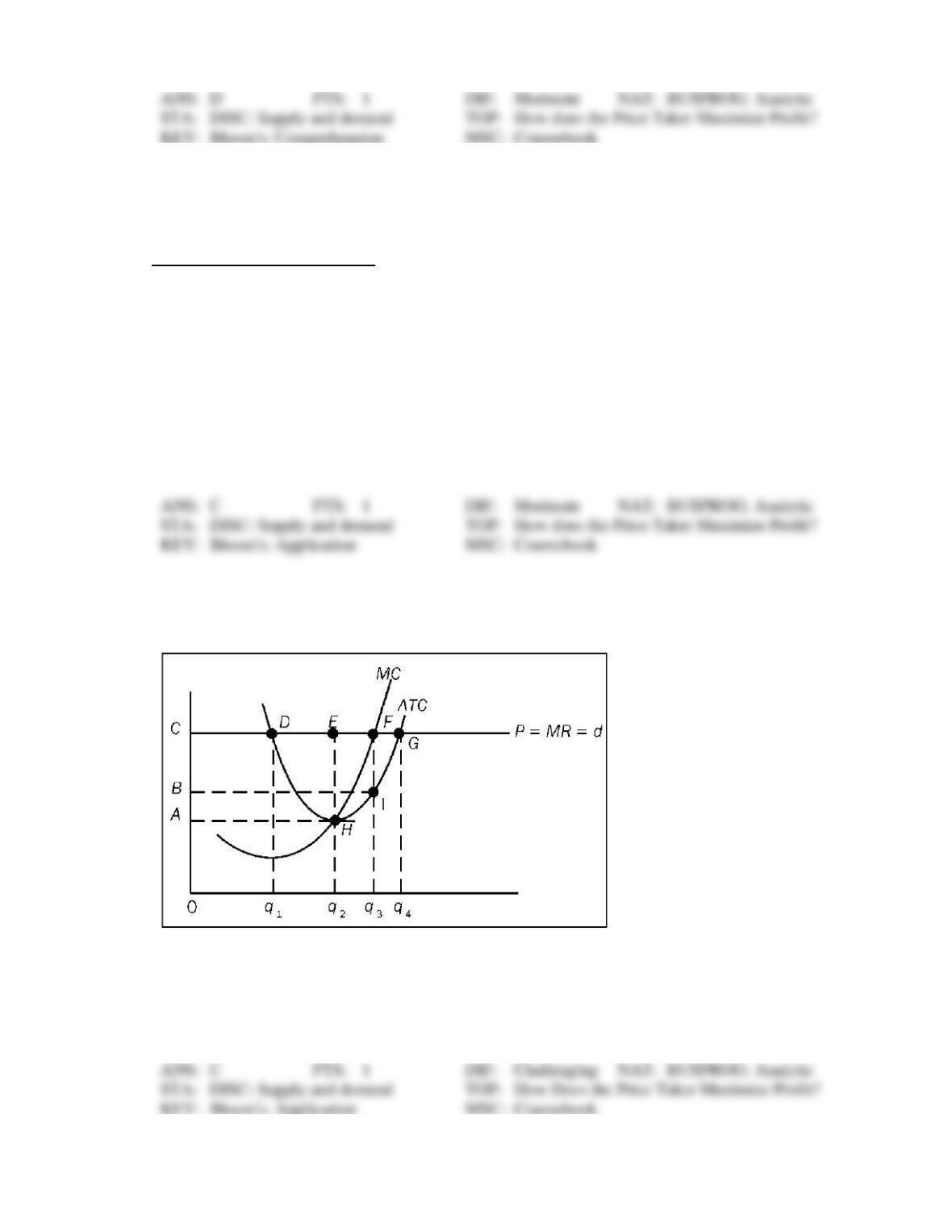
The figure depicts a firm in a price-taker market. Use this figure to answer the following question(s).
Figure 9-18
227. Refer to Figure 9-18. To maximize profit, the firm should produce an output level of
a.
q1.
b.
q2.
c.
q3.
d.
q4.
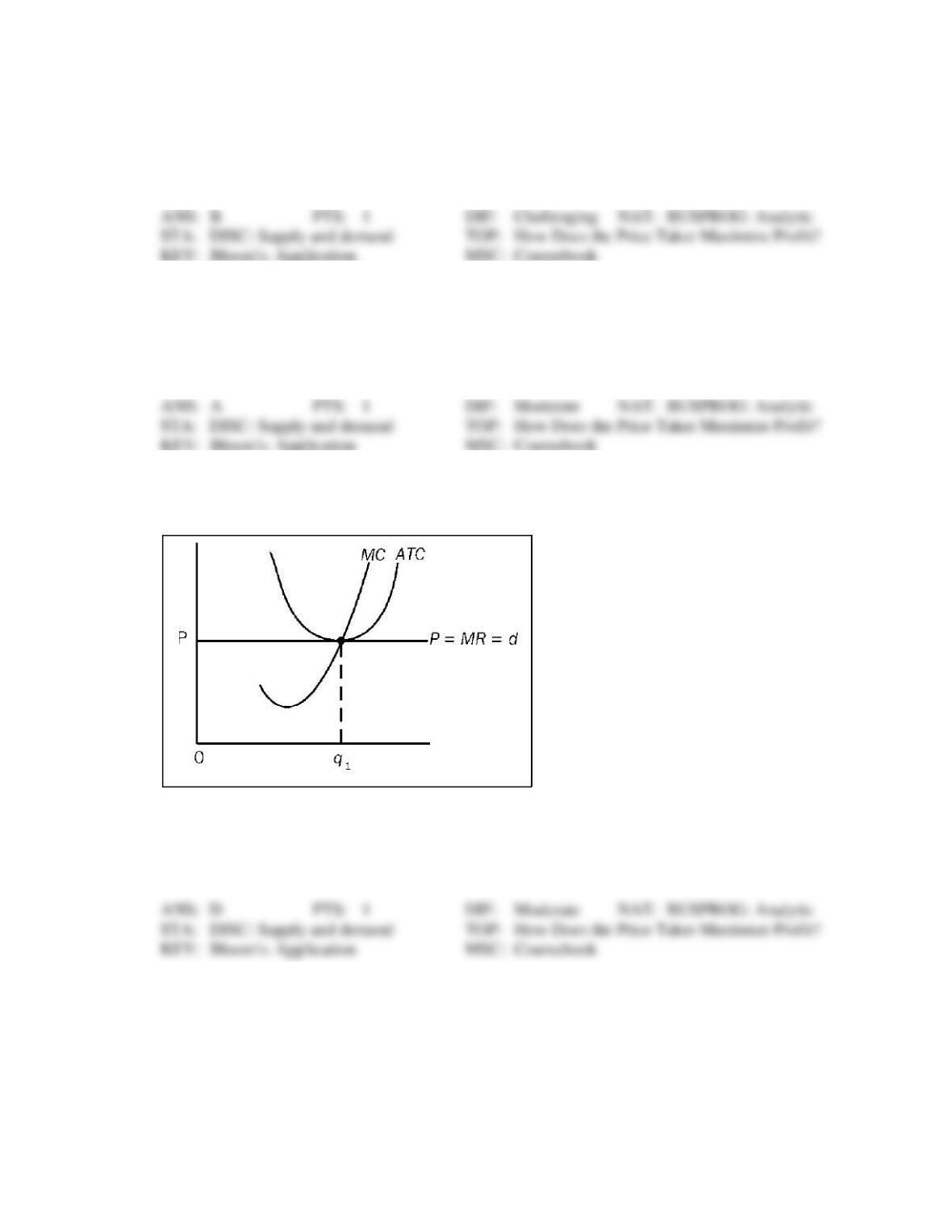
228. Refer to Figure 9-18. At the profit-maximizing level of output, the firm will earn an economic (Hint:
Areas in the exhibit are referenced by the four letters on the corners of the respective area.)
a.
profit of AHEC.
b.
profit of BIFC.
c.
loss of AHEC.
d.
loss of BIFC.
229. Refer to Figure 9-18. Given the current market conditions, in the long run,
a.
new firms will enter the industry and market price will fall.
b.
firms will exit the industry and market price will rise.
c.
firms will neither enter nor exit because the market is in long-run equilibrium.
d.
firms will maintain their current level of economic profit.
230. The figure shows a representative firm in a price-taker market. Which of the following is true
regarding the situation depicted in the figure?
a.
This firm shown is earning zero economic profit.
b.
The industry is in long-run equilibrium.
c.
Firms will neither enter nor exit the market.
d.
All of the above are true.
The figure depicts a firm in a price-taker market. Use this figure to answer the following question(s).
Figure 9-19
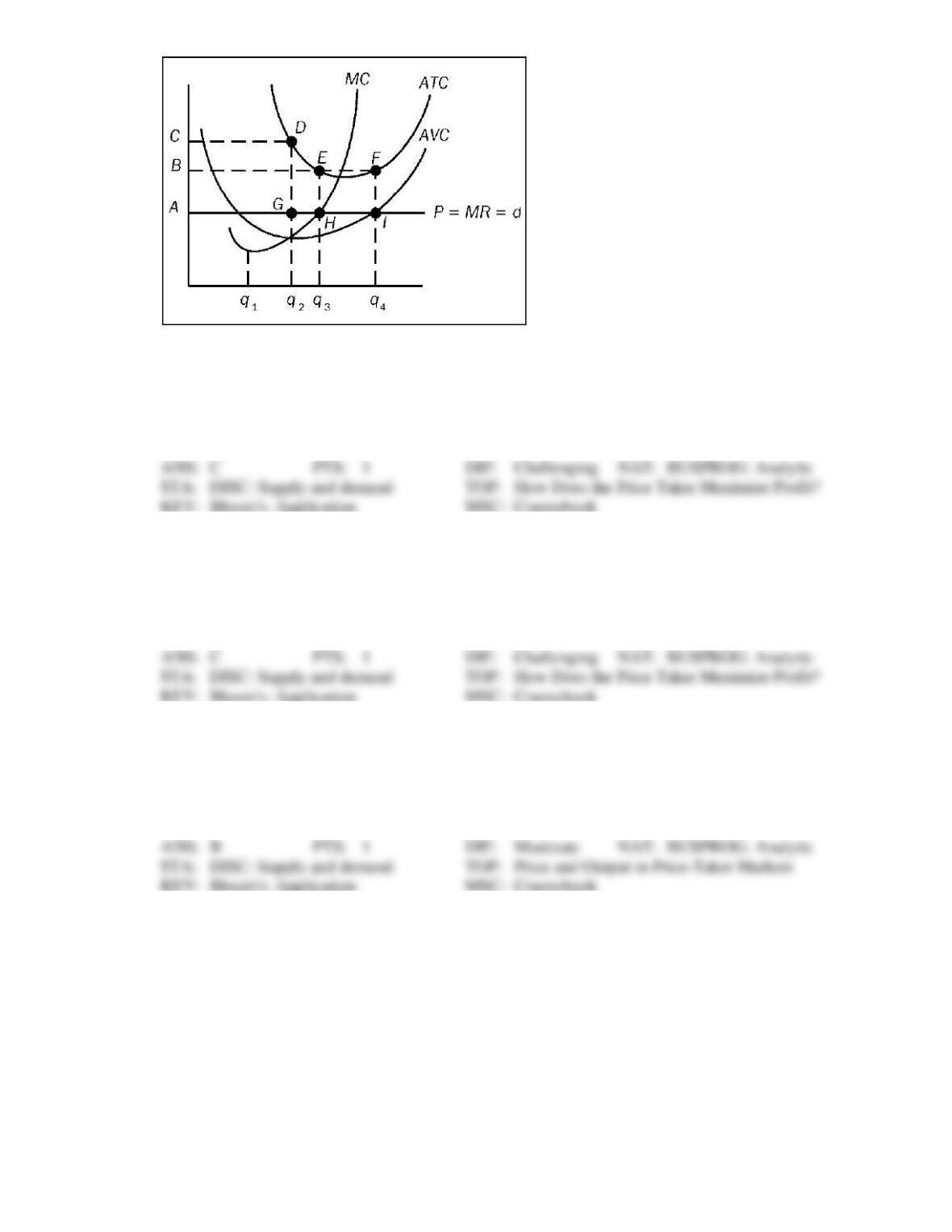
231. Refer to Figure 9-19. To maximize profit, the firm should produce an output level of
a.
zero; the firm should shut down immediately.
b.
q2.
c.
q3.
d.
q4.
232. Refer to Figure 9-19. At the profit-maximizing level of output, the firm will earn an economic
a.
profit of AHEB.
b.
loss of AGDC.
c.
loss of AHEB.
d.
loss of AIFB.
233. Refer to Figure 9-19. Given the current market conditions, in the long run,
a.
new firms will enter the industry and market price will fall.
b.
firms will exit the industry and market price will rise.
c.
firms will neither enter nor exit because the market is in long-run equilibrium.
d.
firms will continue to suffer economic losses.
234. The figure shows a representative firm in a price-taker market. Which of the following is true
regarding the situation depicted in the figure?
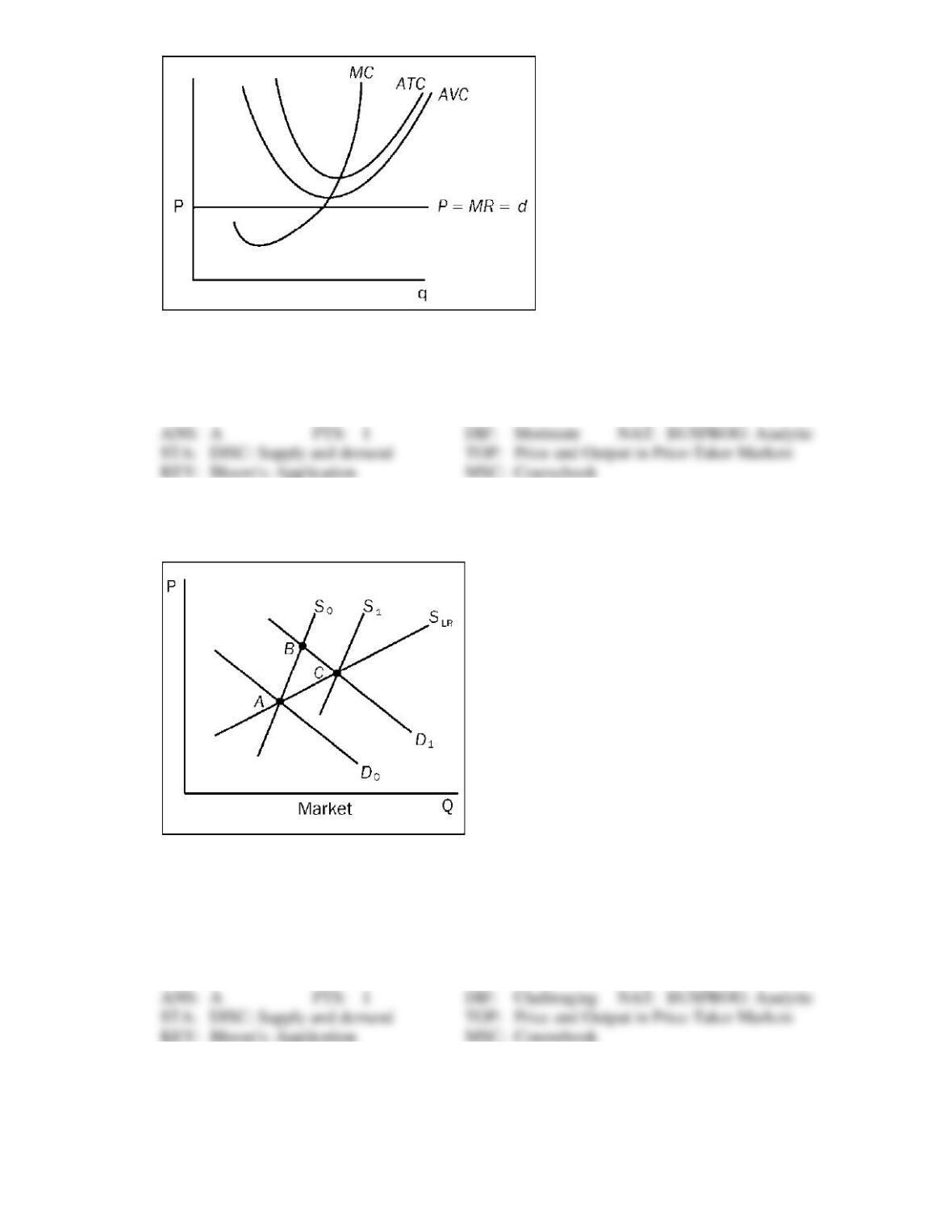
a.
This firm should shut down immediately.
b.
This firm is earning positive economic profit.
c.
This firm is able to cover its variable cost but not its total cost.
d.
All of the above are true.
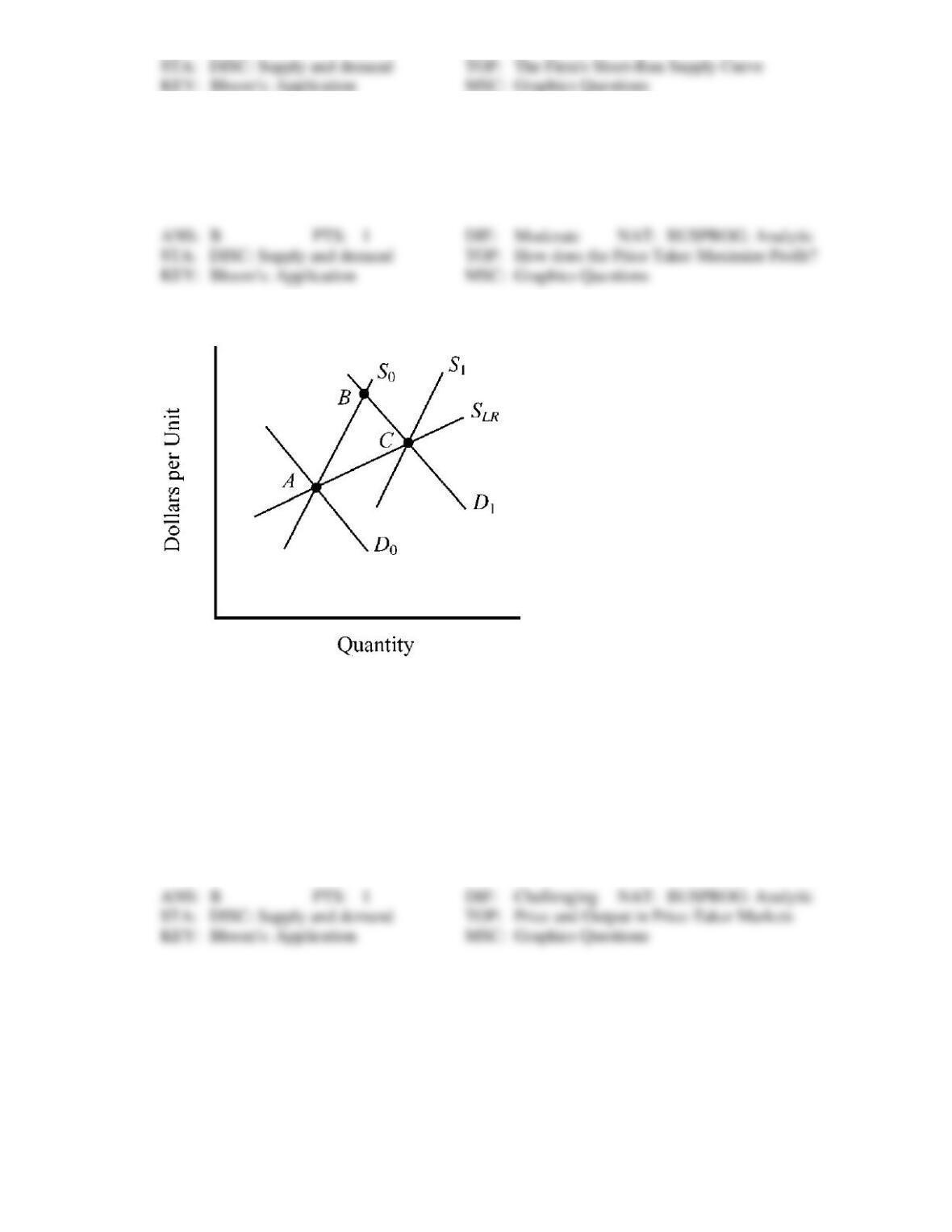
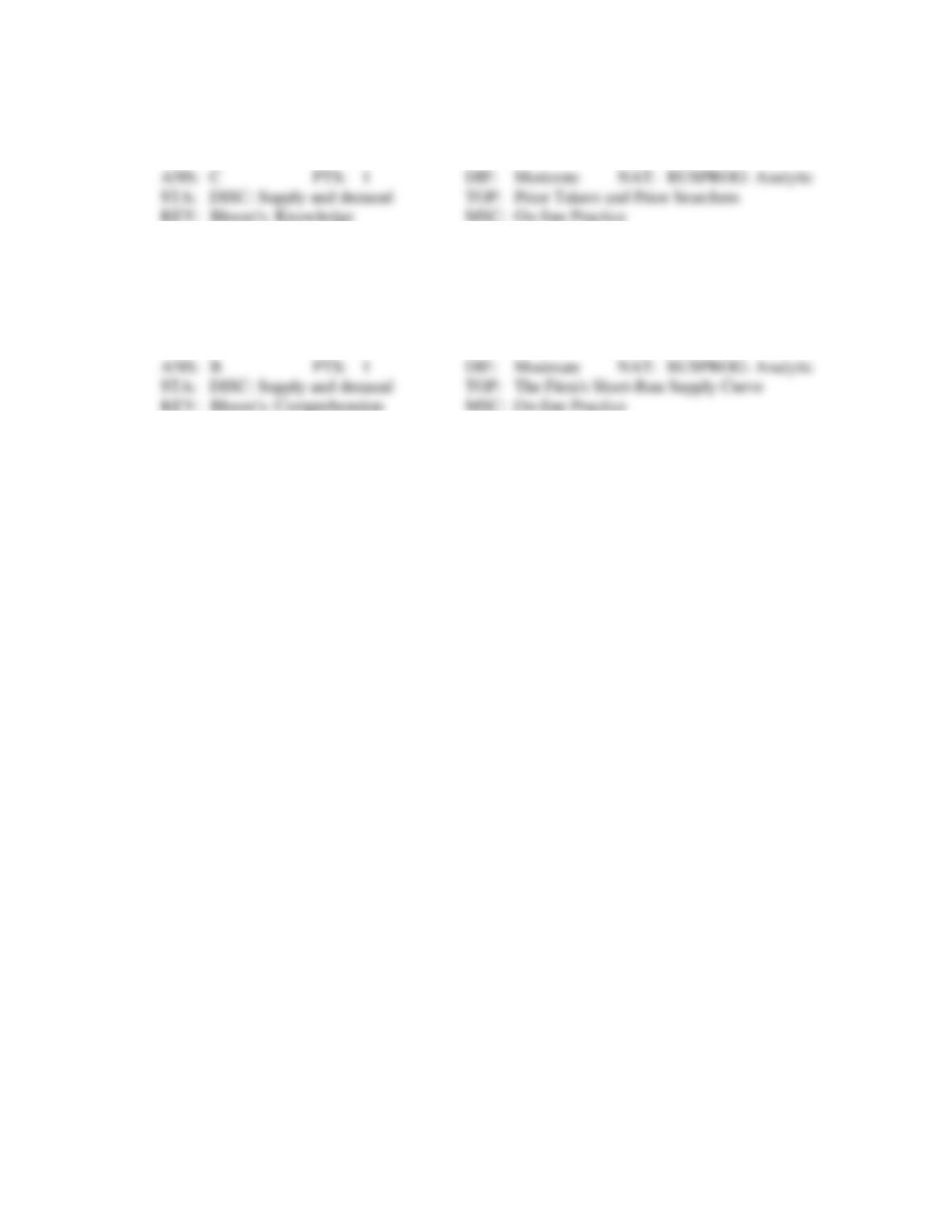
235. Which of the following best describes the series of events shown in the figure? The original conditions
prior to the change are shown by D0 and S0 (point A), and SLR is the market long-run supply curve.
a.
an increase in demand and an expansion in the number of firms in an increasing cost
industry
b.
an increase in demand and an expansion in the number of firms in a decreasing cost
industry
c.
an increase in demand and an expansion in the number of firms in a constant cost industry
d.
none of the above
236. The dynamic process of competition
a.
provides profit-seeking sellers with little incentive to heed consumer preferences.
b.
was shown by Adam Smith to be a major source of economic inefficiency.
c.
provides consumers with alternative suppliers and thus a mechanism with which they can
discipline sellers.
d.
will permit business decision makers to earn long-run economic profit unless they are
regulated by government officials.
237. In the short run, a profit-maximizing price taker will expand output as long as the market price exceeds
a.
average variable cost.
b.
marginal cost.
c.
average total cost.
d.
average fixed cost.