12) What happens in the foreign exchange market if the U.S. interest rate increases? What is the
effect on the exchange rate?
13) How will an increase in the expected future exchange rate affect the current supply and
demand curves for dollars?
14) What is purchasing power parity?
15) “Fluctuations in exchange rates, other things remaining the same, creates a situation in which
money buys the same amount of goods and services in different currencies.” What does the
previous statement describe? Will these fluctuations occur in the short run or the long run?
16) What role can the Fed play in the foreign exchange market?
17) How does the Fed intervene in the foreign exchange market and what the effects are of the
Fed’s actions?
18) If the Fed wants to lower the U.S. exchange rate, what action should it take in the foreign
exchange market? Why does the action lower the exchange rate?
19) What are the three balance of payments accounts? Briefly describe them. What is the
relationship among the three?
20) “The current account records foreign investment in a nation minus investment abroad.” Is the
previous statement correct or incorrect?
21) What are the main components of the current account? What has been the recent U.S.
experience with these items?
22) What balance of payment account records foreign investment between countries?
23) How do the capital account and the current account differ?
24) Define official settlements account and U.S. official reserves. Discuss the differences
between the two terms.
25) If U.S. official reserves increase, is the official settlements account balance positive,
negative, or unaffected?
26) “If the official settlements balance is zero, a current account surplus must equal the capital
account deficit.” Is the previous statement correct or incorrect? Briefly explain your answer.
27) Looking at the U.S. balance of payments for the last two decades, how have the current
account and the capital account changed?
28) Define net borrower, net lender, creditor nation, and debtor nation. Discuss the difference
between a net borrower and a debtor nation.
29) What is the relationship between net borrower, net lender, debtor nation, and creditor nation?
30) When a nation has no funds to finance economic development, how can it acquire the needed
funds? Is the country a net lender or a net borrower?
31) “Although the United States is running a large current account deficit, it is still ranked as a
major international net lender.” Is the previous statement correct or incorrect? Briefly explain
your answer.
32) What is a “debtor nation?” Is the United States a debtor nation?
125
33) What is the relationship between net exports, the government sector surplus or deficit, and
the private sector surplus or deficit?
34) Saving is S, investment is I, net taxes is NT, government expenditure is G, exports is X, and
imports is M. Using these symbols, what is the relationship among the saving, investment, net
taxes, government expenditure, exports, and imports?
7 Numeric and Graphing Questions
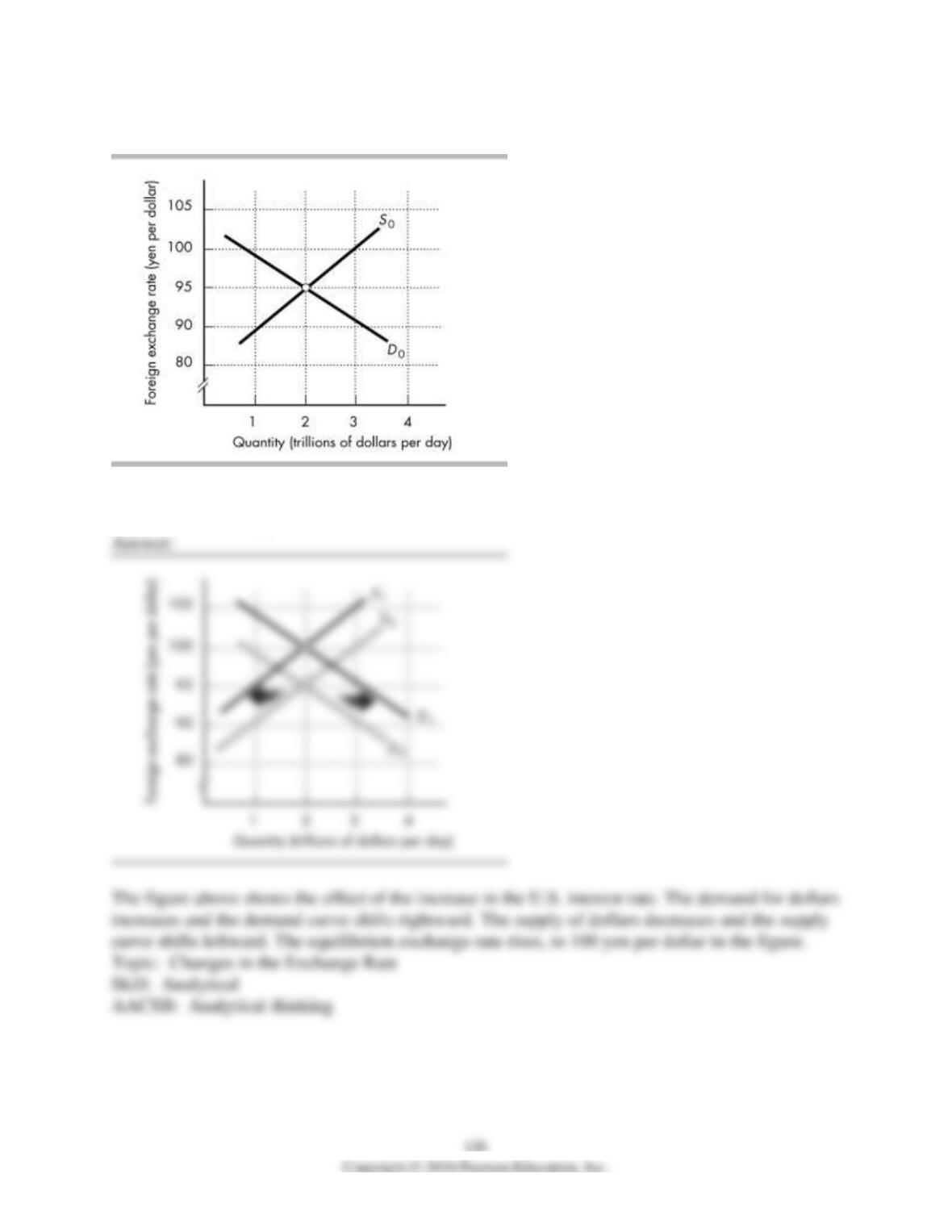
1) In the figure above, illustrate the effect of an increase in the U.S. interest rate. What is the
effect on the exchange rate?
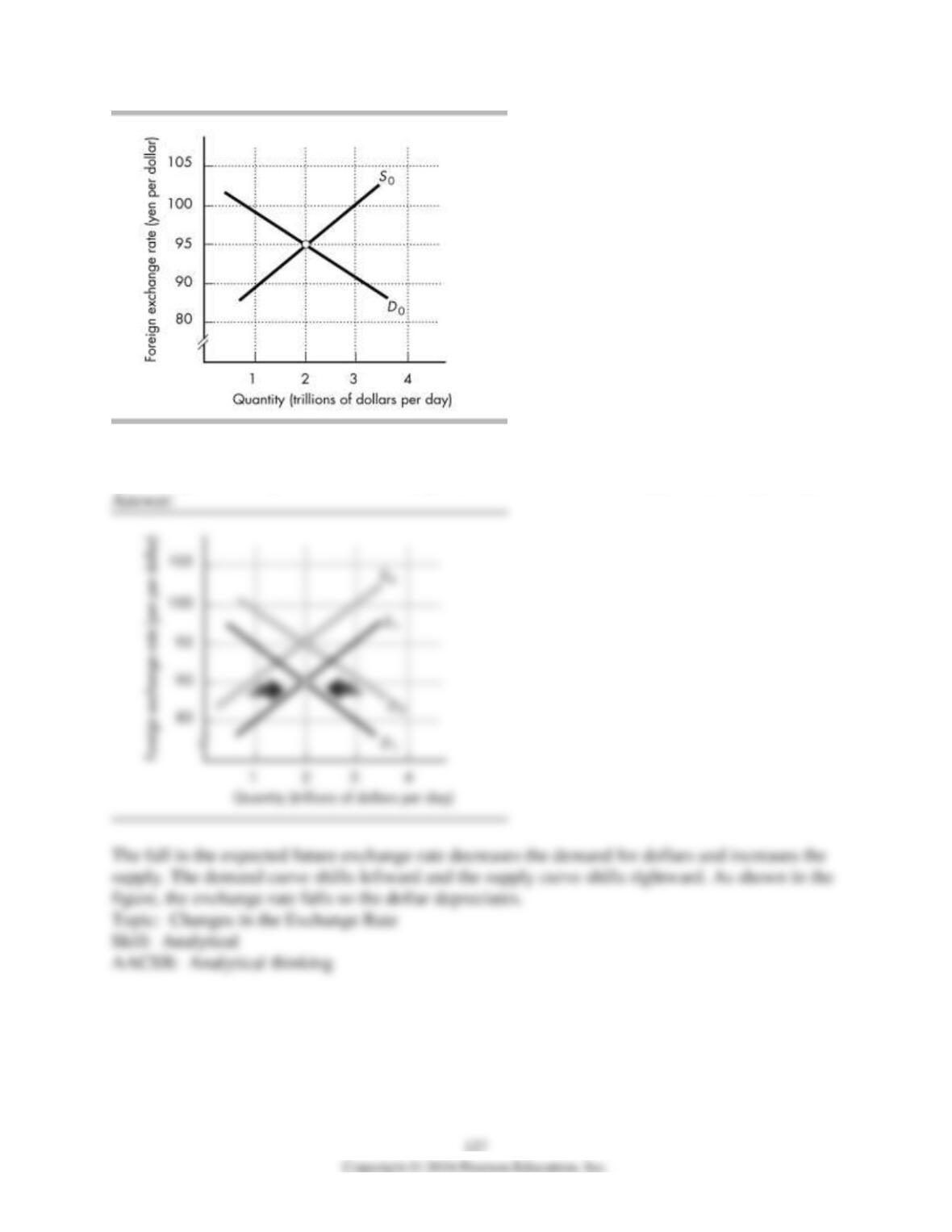
2) The figure above illustrates the U.S. foreign exchange market. Illustrate how the exchange
rate changes if the expected future exchange rate falls. Does the dollar appreciate or depreciate?
128
3) If imports are $1,200 billion and exports are $1,300 billion, while net interest income and net
transfers are zero, what is the current account balance?
4) During this year a country reports imports of $1,000 billion, exports of $1,100 billion, foreign
investment in the country of $900 billion, investment abroad of $1,200 billion, net interest and
net transfers of zero. What is the country’s current account balance?
5) If the current account balance is $235 billion and U.S. official reserves increased by $35
billion, what is the official settlements account balance and the capital account balance?
129
Item
Amount
(billions of dollars)
Imports of goods and
services
1,400
Exports of goods and
services
1,600
Net interest
0
Net transfers
0
Foreign investment in
the United States
480
U.S. investment abroad
700
6) The above gives some of the balance of payments accounts of the United States in 2020.
a) What is the current account balance?
b) What is the capital account balance?
c) What is the official settlements account balance?
Item
Amount
(billions of dollars)
Investment
1,900
Saving
1,600
Government
expenditure
1,000
Net taxes
1,700
7) The table above gives some of the accounts of the United States in 2020.
a) What is the private sector balance?
b) What is the government sector balance?
c) What is net exports?
8) The United States has net exports of -$350 billion and the private sector balance is
-$400 billion. What is the government sector balance?
8 True or False
1) An exchange rate is the price of one country’s currency in terms of another country’s currency.
2) “Currency appreciation” means the price of the currency is decreasing.
3) If the exchange rate rises from 100 yen per dollar to 120 yen per dollar, the dollar has
appreciated.
4) If the exchange rate falls from 120 yen per dollar to 110 yen per dollar, the dollar has
depreciated.
5) If the yen appreciates in value against the dollar, the dollar must have depreciated against the
yen.
6) The demand for one money is the supply of another money.
7) A rise in the exchange rate leads to a decrease in the quantity of dollars demanded.
8) The lower the exchange rate, the cheaper are foreign-produced goods and services.
9) Other things remaining the same, the higher the current exchange rate, the larger is the
expected profit from buying dollars.
10) In the foreign exchange market, a decrease in the exchange rate increases the quantity of
dollars supplied.
11) According to the law of supply in the foreign exchange market, when the U.S. exchange rate
rises, the quantity of U.S. dollars supplied will decrease.
12) An increase in the U.S. interest rate differential increases the demand for dollars.
13) If the Fed raises the interest rate, in the foreign exchange market the demand for the U.S.
dollar increases.
14) If U.S. interest rates are rise relative to foreign interest rates, in the foreign exchange market
the demand for U.S. dollars will decrease.
15) In the foreign exchange market, a decrease in the supply of dollars leads to an appreciation of
the U.S. dollar.
16) Purchasing power parity means that the expected exchange rate is such that the returns from
investing in two nations are equal.
17) Purchasing power parity means equal rates of return.
18) In the short run, a change in the nominal exchange rate brings an equivalent change in the
real exchange rate.
19) The exchange rate can be influenced by a nation’s central bank.
20) In the foreign exchange market, if the demand for dollars permanently decreases, the Fed can
maintain the exchange rate at its old equilibrium level indefinitely by buying dollars.
21) When the demand for a currency permanently increases, that nation’s central bank can
maintain its fixed exchange rate indefinitely.
22) A country’s balance of payment accounts include its government budget deficit or surplus.
23) The current account records foreign investment in the United States minus U.S. investment
abroad.
24) The official settlements account records the change in official U.S. reserves.
25) The sum of the current, capital and official settlements accounts is always zero.
26) If the official settlements account is zero, whenever the United States has a current account
deficit, it must also have a capital account deficit.
27) Over the past decade, the United States has had a current account deficit and capital account
deficit.
28) In the market for international loans, most countries, including the United States, are net
borrowers.
29) The United States is a creditor nation.
30) Currently, the United States is both a net borrower and a debtor nation.
31) A net borrower country must also be a debtor nation.
32) If net exports increases, but neither government expenditure nor net taxes change, saving
9 Extended Problems
1) The price of a computer in the United States is $1,000. The price of a car in Germany is
10,000 euros. The current exchange rate is 0.9 euros per dollar.
a) If a computer is exported from the United States to Germany with no barriers to trade, what
will be the price of the computer in Germany?
b) If a car is imported to the United States from Germany with no barriers to trade, what will be
the price of the car in the United States?
c) Suppose the dollar appreciates by 10 percent against the euro. How will the price of a
computer exported from the United States change in Germany?
d) Suppose the dollar appreciates by 10 percent against the euro. How will the price of a car
imported to the United States from Germany change in the United States?
136
2) Suppose that the price of a Big Mac is a good approximation of the price level in the country.
A Big Mac costs £2 in London and $3 in New York.
a) If purchasing power parity holds, what is the exchange rate between the U.S. dollar and the
British pound?
b) If the current exchange rate is $1.6 per pound, what is the dollar price of a Big Mac in
London? What do you predict will happen to the exchange rate? Explain.
c) The exchange rate between the U.S. dollar and the Russian ruble is 30 rubles per dollar. If
purchasing power parity holds, what is the price of a Big Mac in Moscow?
Item
Billions of buns
Imports of goods and
services
600
Exports of goods and
services
700
Foreign investment in Exland
350
Exland’s investment abroad
430
Increase in the official
holdings of foreign currency
20
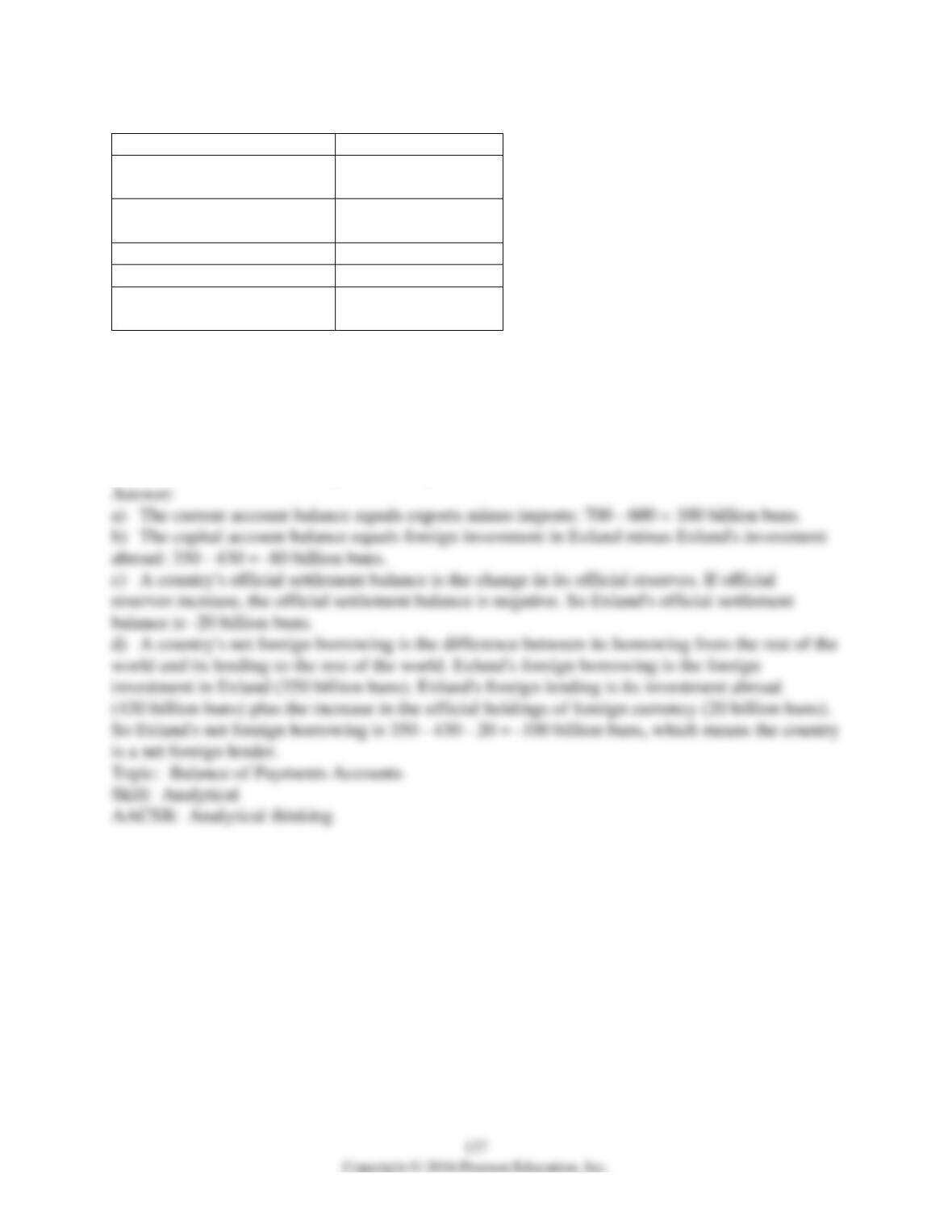
3) The citizens of Exland, whose currency is the bun, conduct the transactions outlined in the
table above.
a) What is Exland’s current account balance?
b) What is Exland’s capital account balance?
c) What is Exland’s official settlement balance?
d) What is Exland’s net foreign borrowing?
Item
Billions of bonts
GDP
320
Consumption expenditure
200
Government expenditure on
goods and services
60
Investment
80
Exports of goods and
services
40
Government budget deficit
25
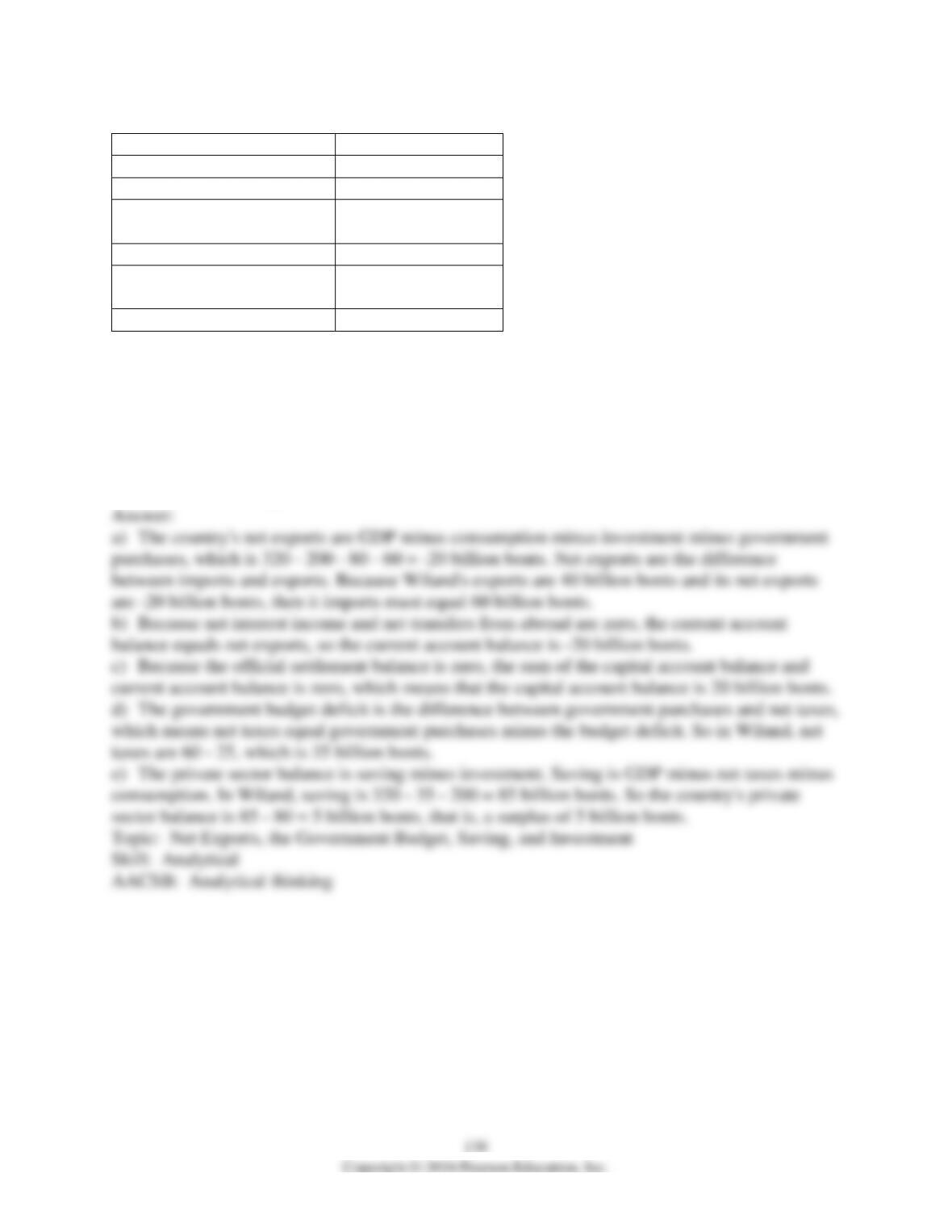
4) The table above shows some data for Wiland, a country whose currency is the bont. The
official settlement balance, net interest income, and net transfers from abroad are zero.
a) What is Wiland’s imports of goods and services?
b) What is Wiland’s current account balance?
c) What is Wiland’s capital account balance?
d) What is Wiland’s net taxes?
e) What is Wiland’s private sector balance?