79) A factor determining the supply of U.S. dollars in the foreign exchange market is the
A) expected future exchange rate.
B) expected future interest rate in the United States.
C) U.S. supply of exports.
D) expected future interest rate in foreign countries.
80) The ________ the expected profit from holding a foreign currency, the greater is the
________ in the foreign exchange market.
A) larger; quantity demanded of dollars
B) smaller; quantity demanded of foreign currency
C) larger; quantity supplied of dollars
D) None of the above is correct because the expected profit has nothing to do with the supply
and demand for dollars or foreign currency.
81) The higher the dollar’s exchange rate, the ________ the expected profit from holding dollars
and so ________ dollars are supplied.
A) larger; more
B) larger; fewer
C) smaller; more
D) smaller; fewer
82) Consider the market for dollars. The higher the exchange rate, the ________ is the expected
profit from holding foreign currency and the greater is the ________.
A) larger; quantity of dollars supplied
B) larger; leftward shift in the demand curve for dollars
C) smaller; quantity of dollars supplied
D) smaller; leftward shift in the demand curve for dollars
83) If the equilibrium exchange rate for the dollar is 110 yen per dollar and the current exchange
rate is 120 yen per dollar, then the
A) supply curve of U.S. dollars shifts rightward.
B) dollar will depreciate.
C) dollar will appreciate.
D) demand curve for U.S. dollars shifts rightward.
84) Consider the market for euros. Suppose the exchange rate is ________ its equilibrium. This
means that the quantity of euros ________ is greater than the quantity of euros ________ and the
exchange rate will ________.
A) above; supplied; demanded; fall
B) below; supplied; demanded; rise
C) above; demanded; supplied; fall
D) below; demanded; supplied; fall
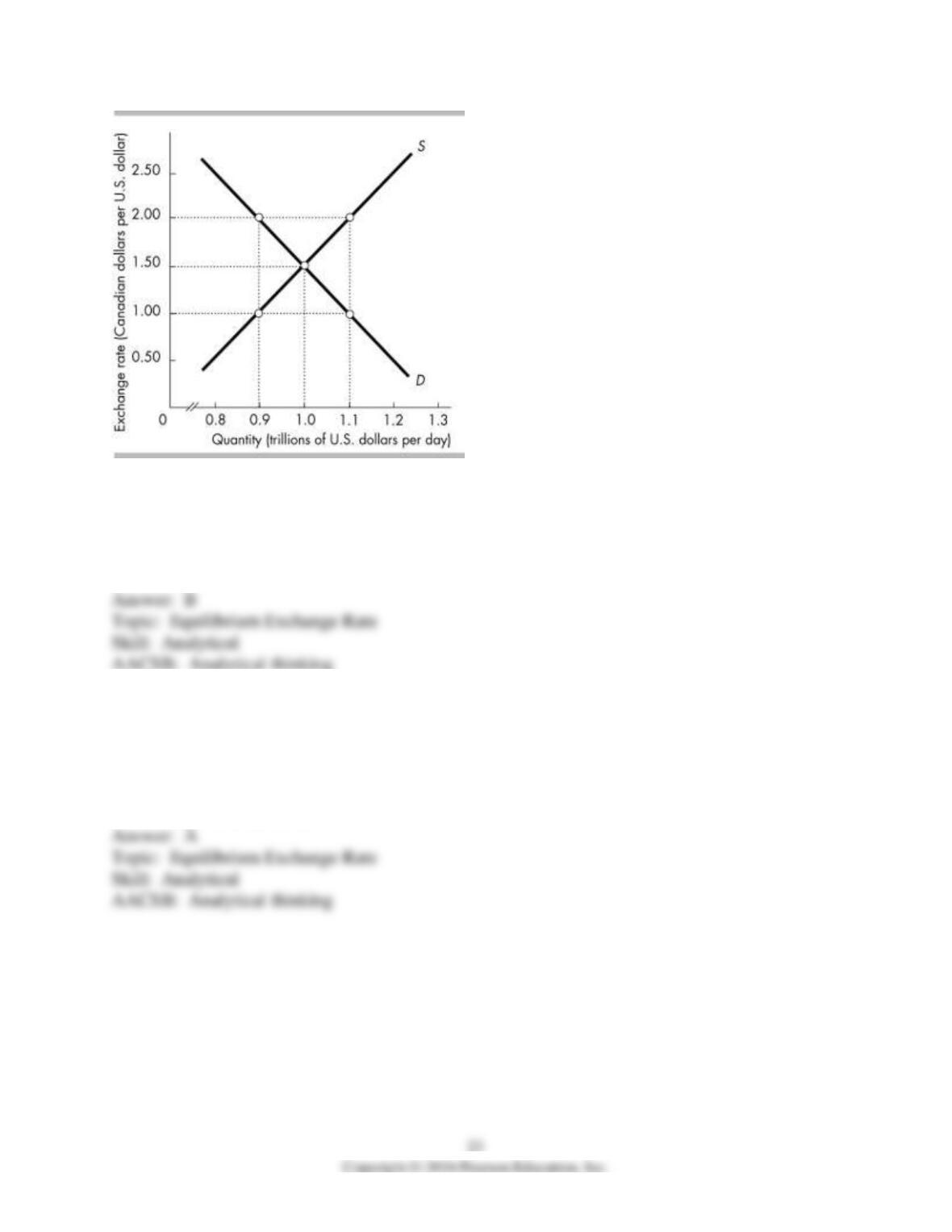
85) In the figure above, the equilibrium exchange rate is expressed as $1 U.S. equals
A) $2.00 Canadian.
B) $1.50 Canadian.
C) $0.50 Canadian.
D) none of the above
86) In the figure above, if the exchange rate is equal to 2 Canadian dollars per U.S. dollar, there
is a ________ of ________currency and the exchange rate will________.
A) surplus; domestic; fall
B) surplus; foreign; fall
C) surplus; domestic; rise
D) shortage; domestic; fall
87) In the figure above, if the exchange rate is equal to 1 Canadian dollar per U.S. dollar, there is
a ________ of ________currency and the exchange rate will________.
A) shortage; domestic; rise
B) surplus; domestic; rise
C) shortage; foreign; rise
D) surplus; foreign; fall
88) If the exchange rate between the dollar and Japanese yen is below the equilibrium exchange
rate, there will be a ________ of dollars, and the exchange rate will ________.
A) surplus; fall to the equilibrium level
B) shortage; change only when the supply curve shifts leftward
C) shortage; rise to the equilibrium level
D) surplus; rise to the equilibrium level
89) If the exchange rate is above equilibrium, there will be ________ in the foreign exchange
market.
A) a surplus
B) a shortage
C) a decrease in the demand for domestic currency
D) an increase in the demand for domestic currency
90) Suppose the exchange rate between the U.S. dollar and the French franc is 0.25 francs per
dollar. If a television sells for 100 francs in France, what is the dollar price of the television set?
A) $400
B) $25
C) $50
D) $200
91) Suppose that a dollar buys 120 yen. If a VCR sells for 18,600 yen in Japan, the price of the
VCR in dollars is ________.
A) $186.00
B) $223.20
C) $120.00
D) $155.00
92) Suppose that the yen-dollar foreign exchange rate changes from 130 yen per dollar to 140
yen per dollar. Then the yen has
A) depreciated against the dollar, and the dollar has appreciated against the yen.
B) depreciated against the dollar, and the dollar has depreciated against the yen.
C) appreciated against the dollar, and the dollar has appreciated against the yen.
D) appreciated against the dollar, and the dollar has depreciated against the yen.
93) Suppose the peso-dollar foreign exchange rate changes from 50 pesos per dollar to 30 pesos
per dollar. Then the peso has ________ against the dollar and the dollar has ________ against
the peso.
A) appreciated; depreciated
B) appreciated; appreciated
C) depreciated; appreciated
D) depreciated; depreciated
94) If the U.S. exchange rate rises, the price to foreigners of U.S.-produced goods and services
________ and the quantity of U.S. dollars demanded ________.
A) rises; decreases
B) rises; increases
C) falls; decreases
D) falls; increases
2 Exchange Rate Fluctuations
1) Important factors that change the demand for dollars and hence shift the demand curve for
dollars include which of the following?
I. interest rates around the world
II. the current exchange rate
III. the expected future exchange rate
A) I and II
B) I and III
C) II
D) I, II, and III
2) With everything else the same, which of the following would increase the demand for U.S.
dollars in the foreign exchange market?
I. a rise in the U.S. interest rate
II. a fall in interest rates in foreign countries
III. a rise in the expected future exchange rate
A) I only
B) I and II only
C) I and III only
D) I, II, and III
3) The demand for dollars in the foreign exchange market will increase (so that the demand
curve shifts rightward) if
A) the U.S. interest rate differential falls.
B) the expected future exchange rate falls.
C) the exchange rate for the dollar falls.
D) None of the above answers is correct.
4) In the foreign exchange market, an increase in the world demand for U.S. exports shifts the
A) demand curve for U.S. dollars rightward.
B) demand curve for U.S. dollars leftward.
C) supply curve for U.S. dollars leftward.
D) supply curve for U.S. dollars rightward.
5) Airbus is an European jet airline producer. Indian Airlines wants to buy 23 Airbus planes from
Airbus, due to increased demand for world travel. As a result, the
A) demand curve for euros shifts rightward.
B) demand curve for euros shifts leftward.
C) supply curve for euros shifts rightward.
D) quantity demanded for euros decreases.
6) Hyundai is a large South Korean company that produces finished steel products. Hyundai
plans to buy raw steel from U.S. Steel. As a result, the
A) demand curve for U.S. Dollars shifts rightward.
B) demand curve for U.S. Dollars shifts leftward.
C) demand curve for South Korean Won shifts rightward.
D) demand curve for South Korean Won shifts leftward.
7) Hyundai is a large South Korean company that produces finished steel products. Hyundai
plans to buy raw steel from U.S. Steel. As a result, the demand curve for U.S. Dollars ________
and the demand curve for South Korean Won ________.
A) shifts rightward; does not shift
B) shifts rightward; shifts leftward
C) does not shift; shifts leftward
D) shifts leftward; shifts rightward
8) Airbus is a European jet airline producer. Indian Airlines wants to buy 23 Airbus planes from
Airbus, due to increased demand for world travel. As a result
A) the demand curve for European euros and the supply curve for Indian rupees both shift
rightward.
B) the demand curve for European euros shifts rightward and the supply curve for Indian rupees
shifts leftward.
C) only the demand curve for Indian rupees shifts rightward.
D) only the demand curve for European euros shifts rightward.
9) The U.S. interest rate minus the foreign interest rate is called the ________.
A) foreign interest rate differential
B) U.S. bond rate differential
C) U.S. interest rate differential
D) U.S. stock yield differential
10) Suppose the U.S. interest rate is 6 percent and the world interest rate is 5 percent. The U.S.
interest differential is
A) -1 percent.
B) 1.2 percent.
C) 1 percent.
D) -0.83 percent.
11) Other things remaining the same, the U.S. interest rate differential increases if the U.S.
interest rate
A) rises and foreign interest rates remain constant.
B) falls and foreign interest rates remain constant.
C) falls and foreign interest rates rise.
D) remains constant and foreign interest rates rise.
12) Other things remaining the same, the U.S. interest rate differential increases if the U.S.
interest rate
A) remains constant and foreign interest rates fall.
B) falls and foreign interest rates remain constant.
C) falls and foreign interest rates rise.
D) remains constant and foreign interest rates rise.
13) Which of the following occurrences would NOT shift the demand curve for U.S. dollars in
the foreign exchange market?
A) an increase in the U.S. exchange rate
B) an increase in the expected future U.S. exchange rate
C) an increase in U.S. interest rates
D) an increase in foreign interest rates
14) The interest rate in Canada rises while the interest rate in the United States does not change.
The
A) demand curve for Canadian dollars will shift leftward.
B) demand curve for Canadian dollars will shift rightward.
C) demand curve for U.S. dollars will shift rightward.
D) demand curves for both Canadian and U.S. dollars will remain unchanged.
15) If the U.S. interest rate rises while interest rates in the rest of the world do not change, the
higher U.S. interest rate
A) decreases the demand for dollars.
B) increases the demand for dollars.
C) has no effect on the demand for dollars.
D) will stop all trading between the currencies of the U.S. and other countries.
16) An increase in the interest rate in the United States compared to the interest rate in Great
Britain will
A) increase the U.S. interest rate differential.
B) increase the demand for pounds.
C) shift the demand curve for dollars rightward.
D) Both answers A and C are correct.
17) The demand for dollars in the foreign exchange market will decrease and hence the demand
curve for dollars will shift leftward if
A) the U.S. interest rate differential decreases.
B) the expected future exchange rate rises.
C) the exchange rate for the dollar rises.
D) the U.S. interest rate differential increases.
18) Suppose the current exchange rate between the euro and the United States dollar is 1.15
euros per dollar. If interest rates in the United States increase and interest rates in Europe remain
unchanged then
A) the demand for dollars will increase.
B) the demand for dollars will decrease.
C) the demand for euros will increase.
D) None of the above answers is correct.
19) Everything else being the same, if the interest rate in the United States increases, then in the
foreign exchange market the
A) demand for U.S. dollars will remain unchanged.
B) demand for U.S. dollars will increase.
C) demand for U.S. dollars will decrease.
D) supply of U.S. dollars will increase.
20) If the interest rate on Japanese yen assets falls while interest rates in the United States remain
constant, the
A) quantity of dollars demanded will increase.
B) quantity of dollars demanded will decrease.
C) demand for dollars will increase.
D) demand for dollars will decrease.
21) If the interest rate on Swiss franc assets increases while interest rates in the United States
remain constant, the
A) quantity of dollars demanded will decrease.
B) demand for dollars will increase.
C) demand for dollars will decrease.
D) quantity of dollars demanded will increase.
22) Today, the dollar is worth 1.15 euros. Due to changes in economic conditions, people expect
that the dollar will be worth 1.20 euros in the next month. This belief
A) increases the demand for dollars.
B) decreases the demand for dollars.
C) increases the demand for euros.
D) increases the value of exports to Europe.
23) If there is an increase in the expected future U.S. exchange rate, there is
A) an upward movement along the demand curve for dollars.
B) a downward movement along the demand curve for dollars.
C) a leftward shift of the demand curve for dollars.
D) a rightward shift of the demand curve for dollars.
24) If people expect the foreign exchange rate for dollars to rise in the future
A) the demand for dollars today decreases.
B) the demand for dollars today increases.
C) the demand for dollars today is unaffected.
D) there is a movement along the demand curve for dollars.
25) U.S. residents come to believe that the dollar will depreciate in the future, that is, the
exchange rate in the future will be lower than the current exchange rate. As a result
A) the demand curve for dollars shifts rightward.
B) the demand curve for dollars shifts leftward.
C) there is a movement upward along the demand curve for dollars.
D) None of the above answers are correct.
26) U.S. residents come to believe that the dollar will appreciate in the future, that is, the
exchange rate in the future will be higher than the current exchange rate. As a result
A) the demand curve for dollars shifts rightward.
B) the demand curve for dollars shifts leftward.
C) there is a movement downward along the demand curve for dollars.
D) None of the above answers are correct.
27) If growth in the United States speeds up so that investors believe they can make a bigger
profit from U.S. assets, the ________ U.S. dollars will ________.
A) demand for; increase
B) demand for; decrease
C) supply of; increase
D) supply of; decrease
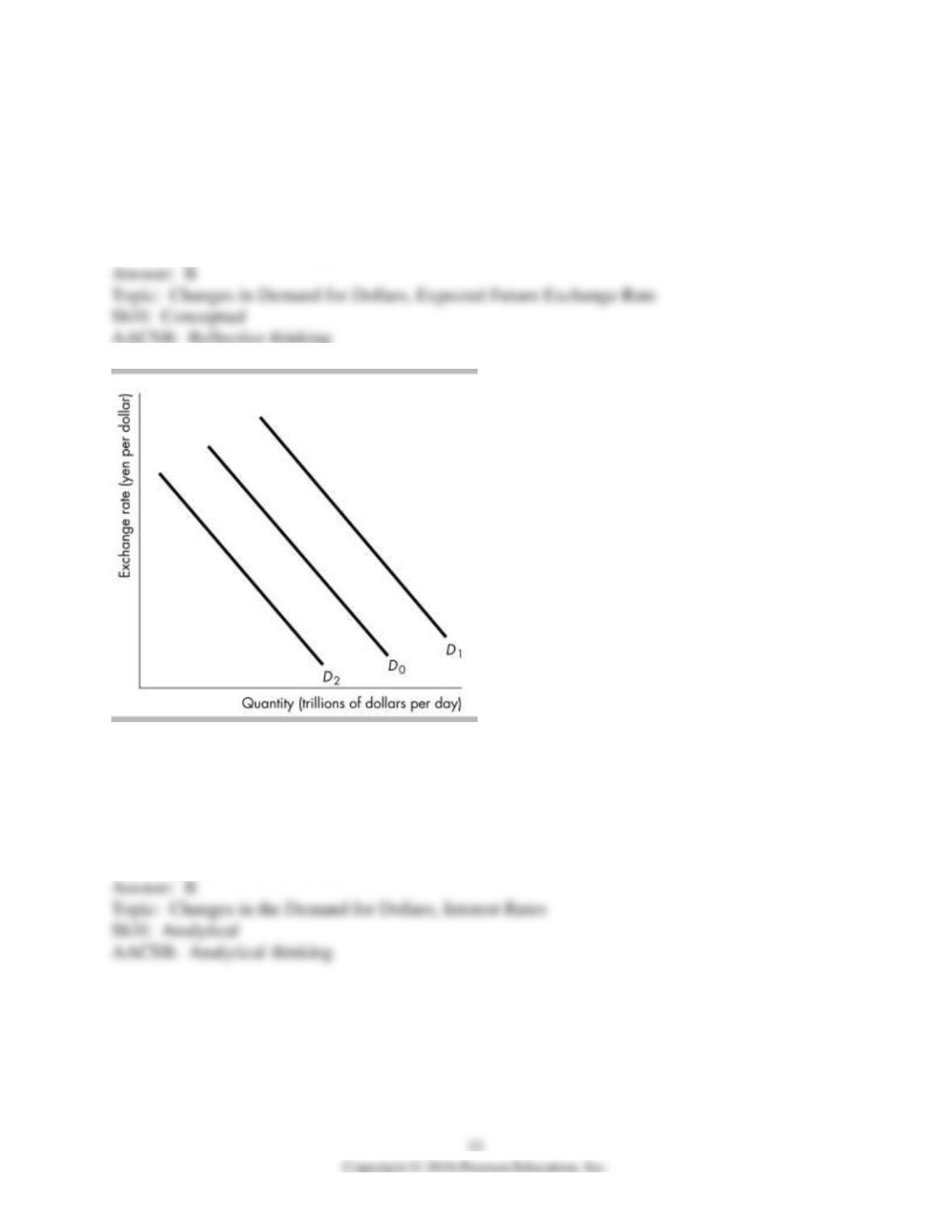
28) Today the U.S. dollar is worth 1.5 Canadian dollars. Because of changes in economic
conditions, people come to believe that by the end of the month the U.S. dollar will be worth 1.2
Canadian dollars. This belief
A) increases the demand for U.S. dollars today.
B) decreases the demand for U.S. dollars today.
C) decreases the demand for Canadian dollars today.
D) decreases the value of exports to Canada.
29) In the figure above, the shift in the demand curve for U.S. dollars from D0 to D1 could occur
when
A) the expected future exchange rate decreases.
B) the U.S. interest rate rises.
C) people expect that the dollar will depreciate.
D) foreign interest rates increase.
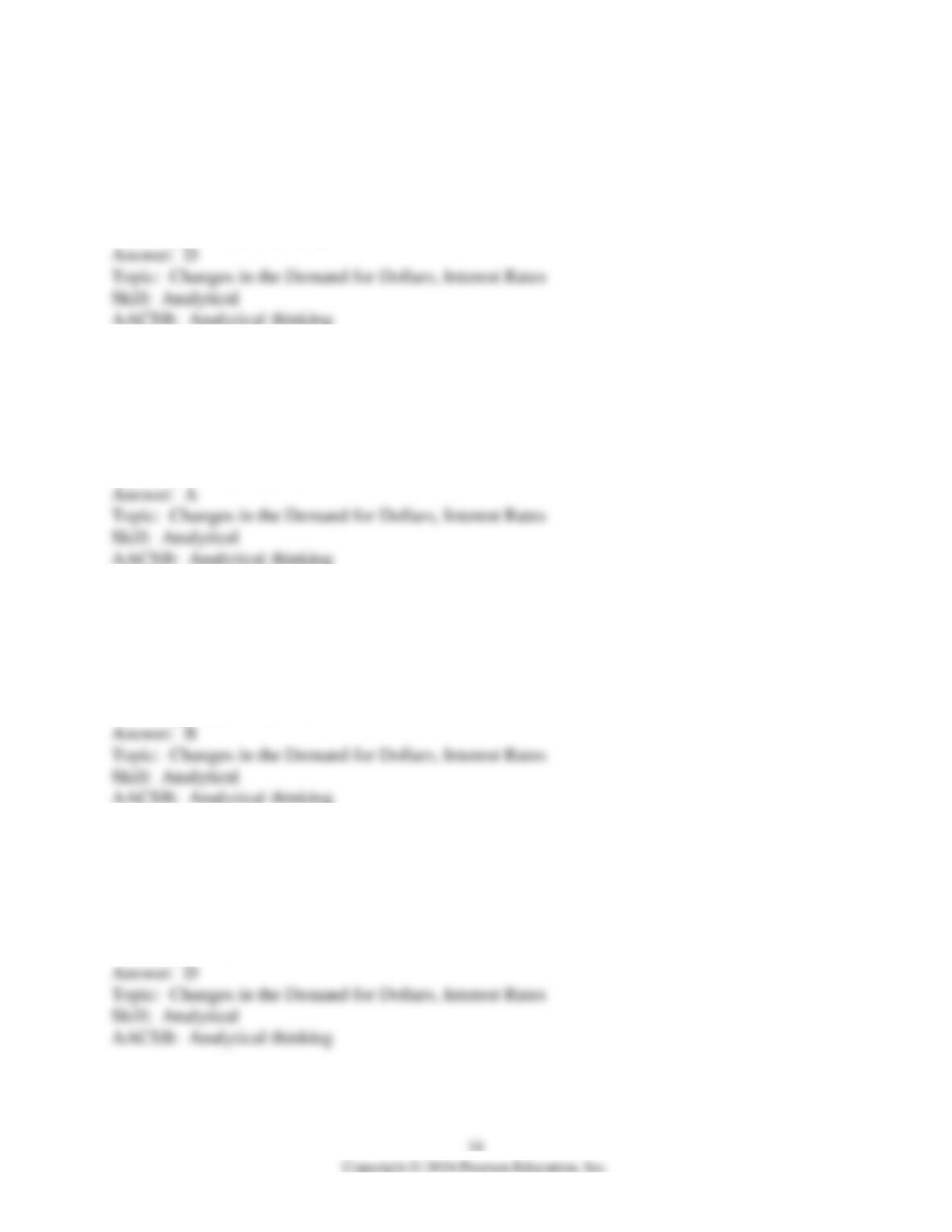
30) In the figure above, the shift in the demand curve for U.S. dollars from D0 to D1 could occur
when
A) the expected future exchange rate falls.
B) the U.S. interest rate drops.
C) people expect that the dollar will depreciate.
D) foreign interest rates drop.
31) In the figure above, the shift in the demand curve for U.S. dollars from D0 to D2 could occur
when
A) the U.S. interest rate falls.
B) the U.S. interest rate rises.
C) people expect that the dollar will appreciate.
D) foreign interest rates fall.
32) In the figure above, the shift in the demand curve for U.S. dollars from D0 to D2 could occur
when
A) the expected future exchange rate increases.
B) the U.S. interest rate falls.
C) people expect that the dollar will appreciate.
D) foreign interest rates fall.
33) In the figure above, the shift in the demand curve for U.S. dollars from D0 to D2 could occur
when
A) the expected future exchange rate increases.
B) the U.S. interest rate rises.
C) people expect that the dollar will appreciate.
D) foreign interest rates rise.
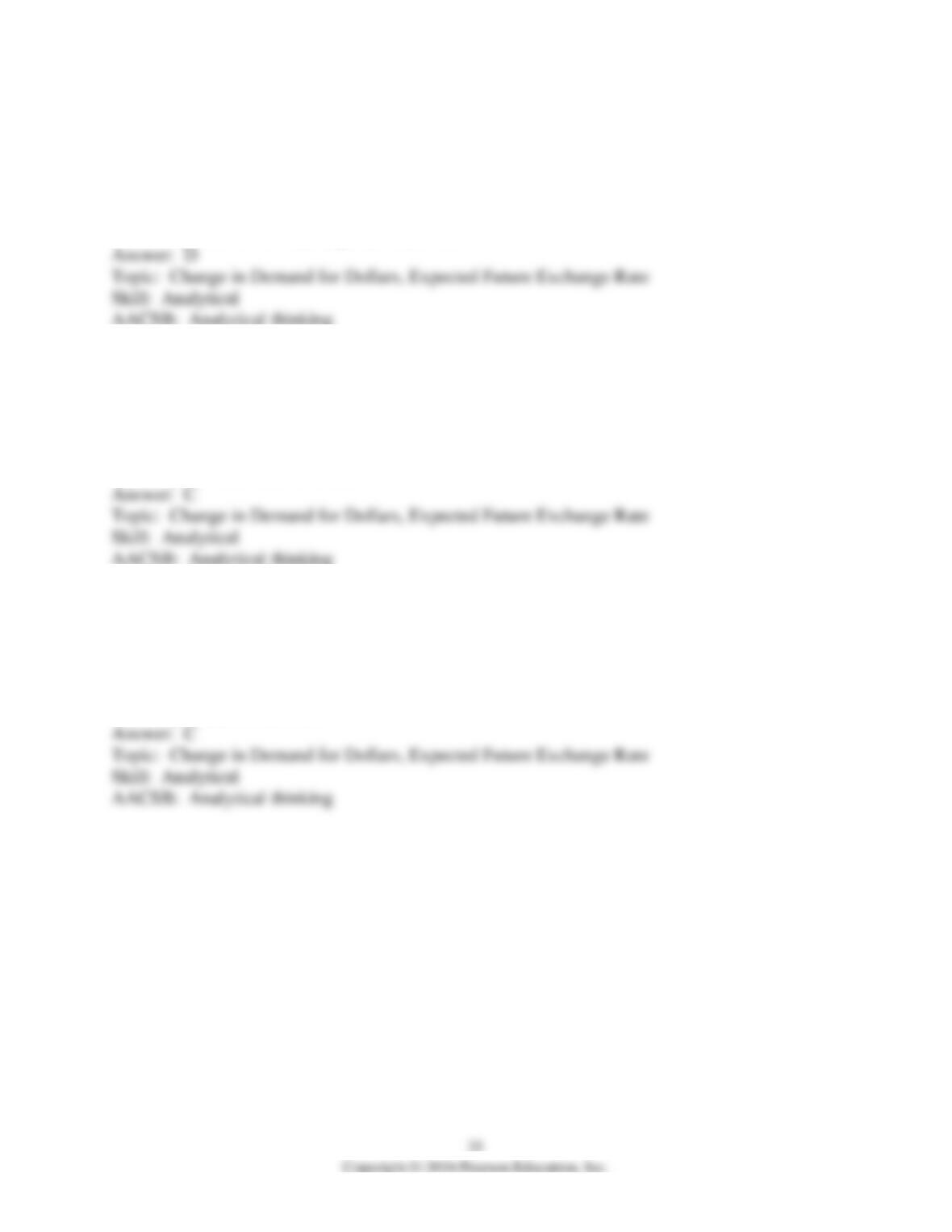
34) In the figure above, the shift in the demand curve for U.S. dollars from D0 to D1 could occur
when
A) foreign interest rates increase.
B) the U.S. interest rate falls.
C) people expect that the dollar will depreciate.
D) the expected future exchange rate increases.
35) In the figure above, the shift in the demand curve for U.S. dollars from D0 to D1 could occur
when
A) the expected future exchange rate falls.
B) the U.S. interest rate decreases.
C) people expect that the dollar will appreciate.
D) foreign interest rates increase.
36) In the figure above, the shift in the demand curve for U.S. dollars from D0 to D2 could occur
when
A) the expected future exchange rate increases.
B) the U.S. interest rate rises.
C) people expect that the dollar will depreciate.
D) foreign interest rates fall.
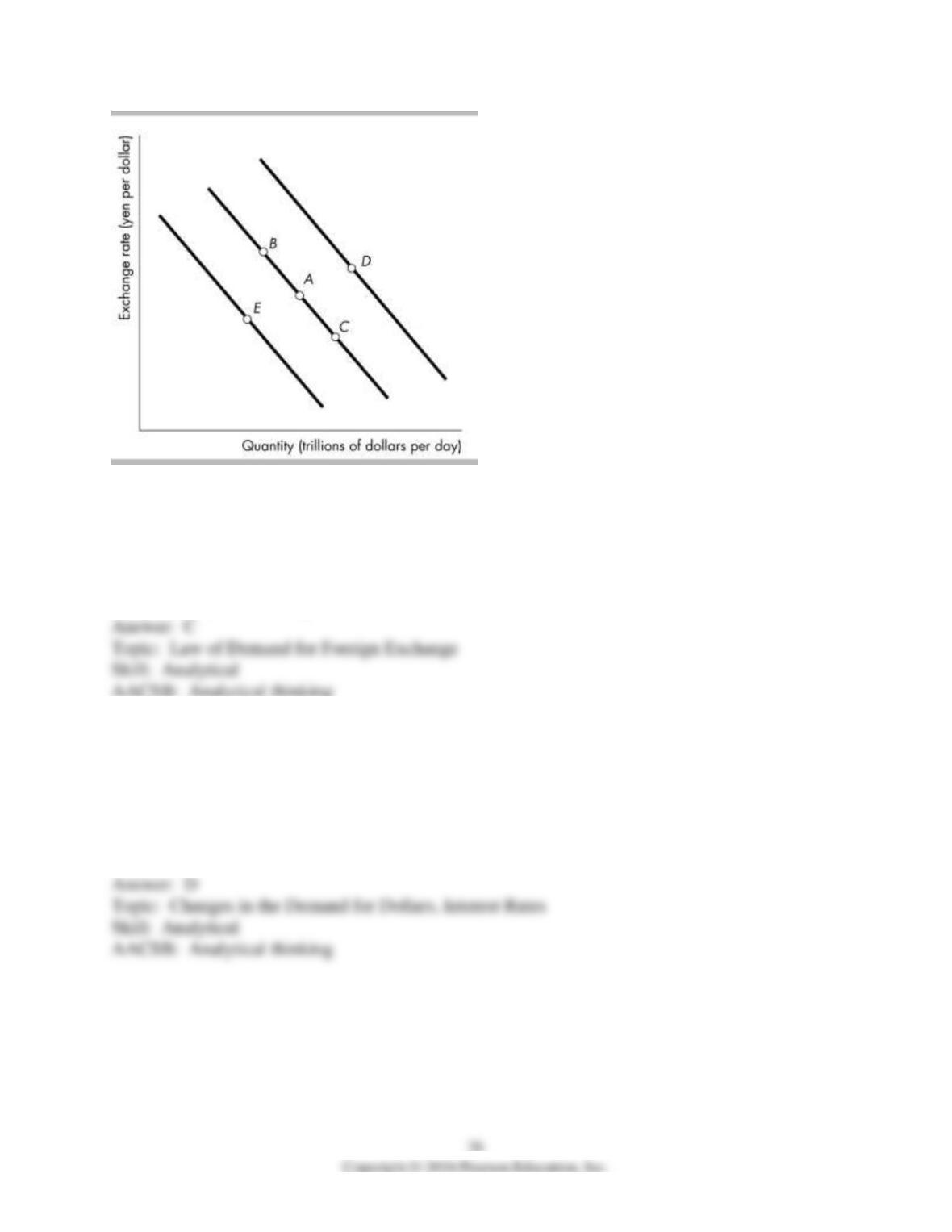
37) The above figure shows the demand curve for dollars in the yen/dollar exchange market. A
movement from point A to point B means that the
A) quantity supplied of dollars has increased.
B) quantity demanded of dollars has increased.
C) quantity demanded of dollars has decreased.
D) quantity demanded of yen has decreased.
38) In the above figure, suppose the economy is initially at point A. The interest rate in Japan
rises relative to the interest rate in the United States. As a result, there will be a change from
point A to a point such as ________.
A) point B
B) point C
C) point D
D) point E
39) In the above figure, suppose the economy is initially at point A. People come to expect the
future U.S. exchange rate to be lower. As a result, there is a change from point A to a point such
as ________.
A) point B
B) point C
C) point D
D) point E
40) In the above figure, suppose the economy is initially at point A. People come to expect the
future U.S. exchange rate to be higher. As a result there is a change from point A to a point such
as ________.
A) point B
B) point C
C) point D
D) point E
41) A change in which of the following changes the supply of dollars and shifts the supply curve
of dollars?
I. an increase in the exchange rate
II. a change in interest rates
III. a decrease in the expected future exchange rate
A) I
B) I and II
C) II and III
D) I, II, and III
42) Interest rates in the United States rise relative to interest rates in other countries. As a result,
in the foreign exchange market
A) the supply curve of dollars shifts leftward.
B) the supply curve of dollars shifts rightward.
C) the demand curve for dollars shifts leftward.
D) there is an upward movement along the supply curve of dollars.
43) With everything else the same, in the foreign exchange market which of the following
increases the supply of U.S. dollars?
I. a fall in the U.S. interest rate
II. a fall in interest rates in foreign countries
III. a rise in expected future exchange rate
A) I only
B) I and II only
C) I and III only
D) I, II, and III
44) If interest rates in Mexico decrease while the interest rates in the United States remain
unchanged then
A) the supply of Mexican pesos will increase.
B) the supply of Mexican pesos will decrease.
C) the supply of U.S. dollars will increase.
D) None of the above answers is correct.
45) If interest rates in Japan rise and those in the United States do not change, there is
A) a decrease in the supply of dollars.
B) an increase in the supply of dollars.
C) a downward movement along the supply curve for dollars.
D) None of the above answers is correct.
46) If the U.S. interest rate differential increases, then in the foreign exchange market the
A) quantity of U.S. dollars supplied increases.
B) supply of U.S. dollars decreases.
C) demand for U.S. dollars does not change.
D) supply of U.S. dollars increases.
47) The supply curve of U.S. dollars shifts leftward. This could have been influenced by
________.
A) a rise in the U.S. interest rate differential
B) a fall in the expected future exchange rate
C) an increase in the U.S. exchange rate
D) a decrease in the U.S. exchange rate
48) As the expected future exchange rate for dollars increases
A) the demand for U.S. dollars increases.
B) the supply of U.S. dollars decreases.
C) both the demand for U.S. dollars and the supply of U.S. dollars increase
D) Both answers A and B are correct.
49) People expect that the exchange rate for the dollar will rise from 90 yen per dollar to 111 yen
per dollar in a month. As a result
A) the supply curve of dollars shifts leftward.
B) the supply curve of dollars shifts rightward.
C) the demand curve for dollars shifts leftward.
D) there is a downward movement along the supply curve of dollars.
50) If the expected future exchange rate rises, the currency’s
A) quantity supplied increases.
B) supply decreases.
C) supply increases.
D) exchange rate falls.
51) The supply of dollars in the foreign exchange market decreases and that means that the
supply curve of dollars shifts leftward if
A) the U.S. interest rate differential decreases.
B) the expected future exchange rate rises.
C) the exchange rate for the dollar rises.
D) the U.S. interest rate decreases.