International Economics, 9e (Husted/Melvin)
Chapter 9 Preferential Trade Arrangements
9.1 Multiple-Choice Questions
1) ________ are a form of regional integration where member countries lower internal trade
barriers but maintain existing barriers against nonmembers.
A) Customs unions
B) Free trade areas
C) Reciprocal trade agreements
D) None of the above.
2) ________ are a form of regional integration where member countries lower internal trade
barriers and establish a common barrier against nonmembers.
A) Customs unions
B) Free trade areas
C) Reciprocal trade agreements
D) None of the above.
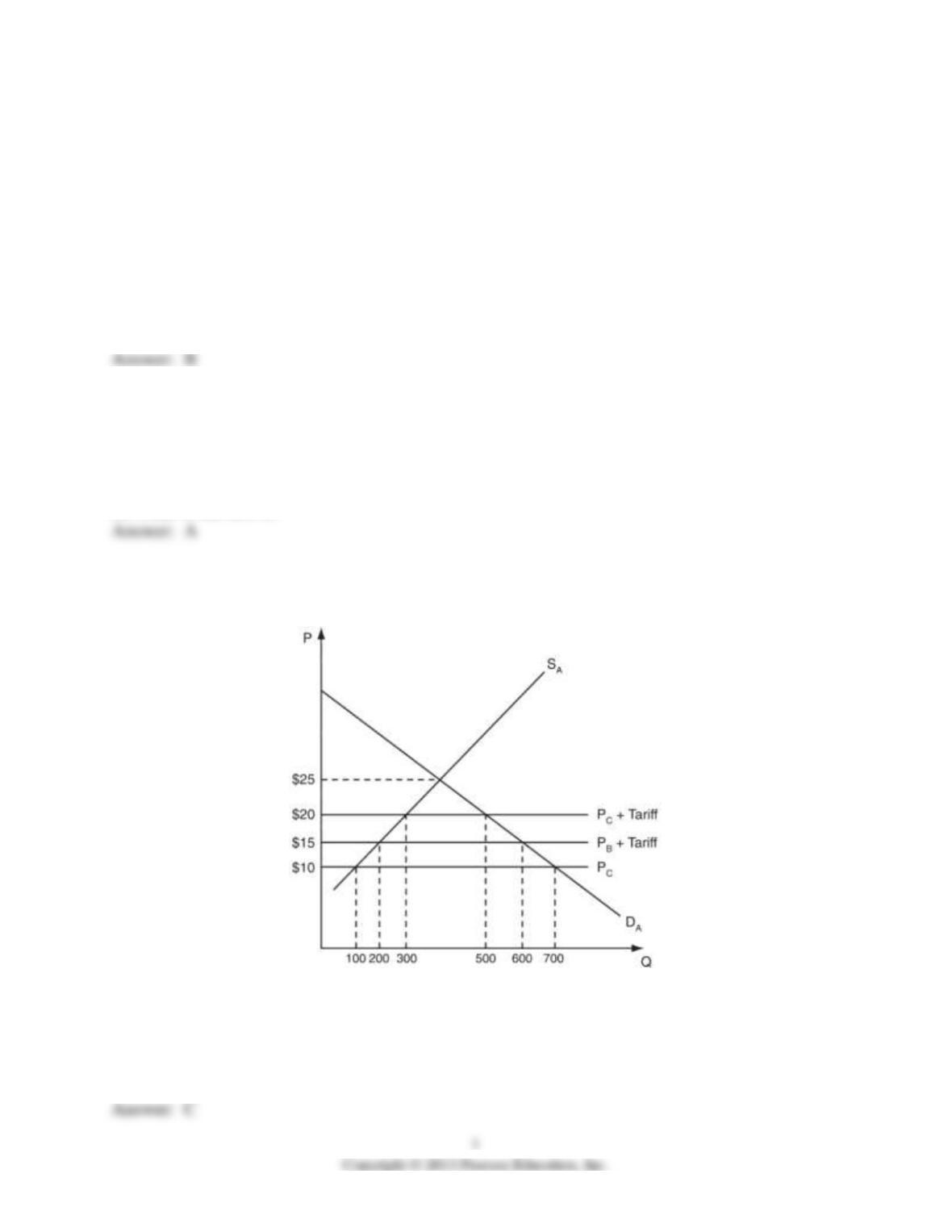
Answer the question(s) below based upon the following diagram which depicts country A’s
market for its importable.
3) Refer to the figure above. In free trade A will import
A) 700 units from country C.
B) 700 units from C and 600 units from B.
C) 600 units from C.
D) 600 units from C and 400 units from B.

4) Refer to the figure above. If A imposes a per unit tariff of $10 on imports from both B and C,
it will import
A) 400 units from B.
B) 200 units from C.
C) 200 units from each.
D) 400 units from B and 200 units from C.
5) Refer to the figure above. If A forms a customs union with B, it will import
A) 400 units from B.
B) 200 units from C.
C) 200 units from each.
D) 400 units from B and 200 units from C.
6) Refer to the figure above. If A forms a customs union with C, the value of trade diversion will
be
A) $0.
B) $10,000.
C) $20,000.
D) $40,000.
7) The European Union (EU) is an example of a
A) customs union.
B) free trade area.
C) reciprocal trade agreement.
D) None of the above.
8) ________ is said to exist when the formation of a regional trading group leads to the reduction
of trade with nonmember countries in favor of member countries.
A) Trade creation
B) Trade diversion
C) Trade exclusion
D) Trade distortion
9) ________ is said to exist when the formation of a regional trading group leads to an expansion
of trade above pre-group levels.
A) Trade creation
B) Trade diversion
C) Trade exclusion
D) Trade distortion

10) In addition to tariff lowering provisions, the NAFTA agreement includes two side
agreements on
A) Mexican exchange rate policy and Mexican foreign policy.
B) U.S. exchange rate policy and U.S. foreign policy.
C) environmental and labor market issues.
D) All of the above.
11) In leading the opposition to the adoption of NAFTA, H. Ross Perot argued that NAFTA
would lead to
A) a loss of U.S. competitiveness with Canada.
B) a loss of U.S. manufacturing jobs to Mexico.
C) a loss of U.S. willingness to negotiate the Uruguay Round.
D) All of the above.
12) One of the more unique aspects of NAFTA compared with other preferential trade
arrangements is the fact that the NAFTA countries have
A) similar cultures.
B) fixed exchange rates.
C) common borders.
D) very different standards of living.
13) The U.S. factor of production that is most likely to be made worse off because of NAFTA
(because its factor payment will fall) is
A) unskilled labor.
B) skilled labor
C) capital
D) All of the above will be made worse off.
14) The ________ is the chief executive body of the European Union (EU).
A) European Parliament
B) European Executive Branch
C) European Trade Body
D) European Commission
15) The goal of the Single European Act (or Europe 1992 initiative) is to
A) develop uniform product standards for all EU countries.
B) remove nontariff barriers to trade between EU countries.
C) deregulate economic activities in transportation and financial services.
D) All of the above.
16) As of 2002 the European Union has announced that 10 new members will be allowed to join
the union? Which of the following countries is included in that group?
A) Poland
B) Russia
C) Turkey
D) All of the above.
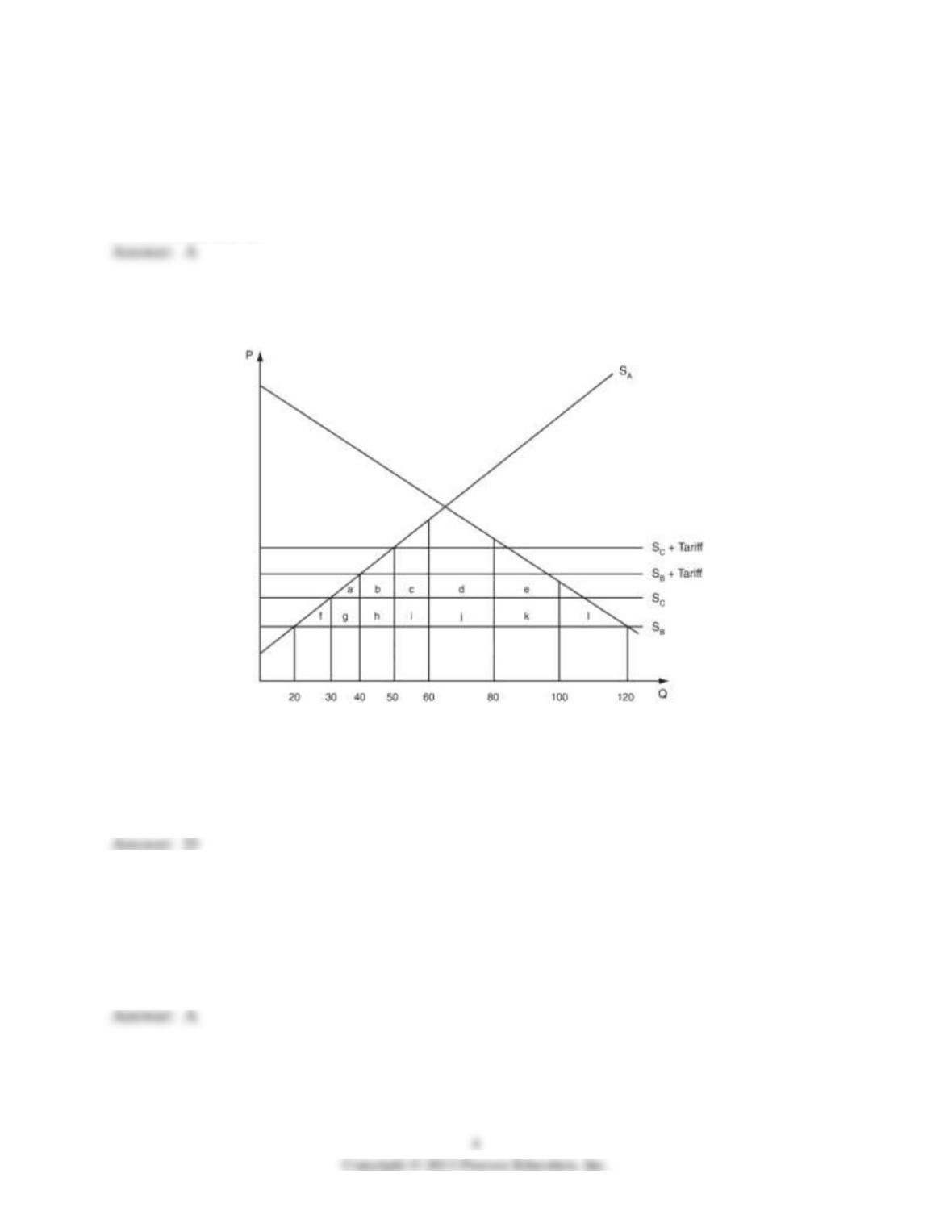
Answer the question(s) below based upon the following diagram which depicts country A’s
market for its importable.
17) Refer to the figure above. In free trade A will import
A) 70 units from country C.
B) 70 units from C and 100 units from B.
C) 120 units from B.
D) 100 units from B.
18) Refer to the figure above. If A imposes a per unit tariff of $10 on imports from both B and C,
it will import
A) 40 units from B.
B) 10 units from C.
C) 40 units from each.
D) 40 units from B and 10 units from C.

19) Refer to the figure above. If A forms a customs union with C, it will import
A) 40 units from B.
B) 70 units from C.
C) 70 units from each.
D) 40 units from B and 70 units from C.
20) Refer to the figure above. If A forms a customs union with B, the value of trade diversion
will be
A) $0.
B) $10,000.
C) $20,000.
D) $40,000.
21) Refer to the figure above. If A forms a customs union with C, the quantity of trade creation
will be
A) 100 units.
B) 70 units.
C) 30 units.
D) None of the above.
22) Refer to the figure above. If A forms a customs union with C, A’s welfare will change by
A) $a + $e
B) $a + $b + $c + $d + $e
C) $a + $e – $b – $c – $d
D) $a + $e – $h – $i – $j
23) Refer to the figure above. If A forms a customs union with C, the post agreement price will
be
A) $10
B) $15
C) $20
D) $25
24) Refer to the figure above. Domestic producers of this product in A would most prefer
A) a customs union with C.
B) a customs union with B.
C) a free trade agreement with both B and C.
D) no agreement with either country.

25) Refer to the figure above. Domestic consumers of this product in A would most prefer
A) a customs union with C.
B) a customs union with B.
C) a free trade agreement with C.
D) no agreement with either country.
26) Which of the following countries is not a member of the European Union?
A) Portugal
B) Switzerland
C) Slovakia
D) Malta
27) Which of the following countries became the newest members of the European Union in
2007?
A) Bulgaria and Romania
B) Greece and Sweden
C) Albania and Cyprus
D) None of the above
28) Which of the following countries is not a member of NAFTA?
A) Canada.
B) The United States of America.
C) Mexico.
D) All three countries form part of NAFTA.
9.2 True or False Questions
1) Customs unions and free trade areas are identical in the manner in which member countries
treat imports from nonmember countries.
2) If a customs union leads to a large amount of trade creation relative to trade diversion, it may
be beneficial to world welfare.
3) A long term goal of the EU member countries is to integrate their economies into a single
economic entity with a common currency as well as common trade policies and internal factor
mobility.
4) A long term goal of the NAFTA member countries is to integrate their economies into a single
economic entity with a common currency as well as common trade policies and internal factor
mobility.
5) If a customs union leads to a large amount of trade diversion relative to trade creation, it may
be beneficial to world welfare.
6) Most economists estimate that the U.S. factor of production most likely to be hurt by the
formation of the NAFTA is unskilled U.S. labor.
7) The political debate over joining NAFTA was especially contentious in the United States
because Mexico’s standard of living (including wage rates, labor standards, and environmental
standards) is low relative to the U.S. standard of living.
8) Prior to agreeing to join NAFTA, Mexico had followed a free trade policy for more than 30
years.
9) The EU currently is a preferential trade agreement with no governmental institutions.
10) An argument in favor of multilateral trade liberalization (multilateralism) over preferential
trade agreements (regionalism) is that multilateralism results in less trade diversion.
11) NAFTA was a controversial issue in the 2008 presidential campaign, particularly in the
Democratic primaries.
12) Russia is a member of the European Union.
13) The ultimate purpose of the NAFTA free trade agreement is to balance trade between the
member nations.
14) Recent studies have shown that NAFTA has had a tremendous negative impact on the
economic welfare of the U.S.
15) The welfare impact of a preferential trade agreement depends on the difference between the
amount of new trade that takes place because of the agreement and the change in international
trade patterns that arises because of it.
9.3 Essay Questions
1) Membership in a customs union may be either welfare improving or welfare worsening.
Illustrate and explain.
2) Compare and contrast NAFTA and the EU in terms of the types of agreements that they are,
the institutions that operate under the agreement, and the long term goals of the arrangements.
3) The push toward creating more regional trade agreements necessarily harms the multilateral
liberalization process that is at the heart of the WTO.
4) Summarize the type of agreement that NAFTA is, its history, the process by which it has been
implemented in the last 15 years.

9