1. Keynesian economics developed in response to:
a.
the Great Depression of the 1930s.
b.
the inflation following World War II.
c.
economic growth during the 1950s.
d.
the Vietnam War.
e.
the oil embargo in the 1970s.
2. A key assumption of the Keynesian model of macroeconomics is a fixed _____.
a.
interest rate
b.
price level
c.
exchange rate
d.
growth rate
e.
unemployment level
MACR.BOYE.16.41 – ch. 09, 1
3. The sum of consumption and saving is called _____.
a.
net investment
b.
net income
c.
personal income
d.
disposable income
e.
transfer payment
MACR.BOYE.16.41 – ch. 09, 1
Consumption and Saving
MACR.BOYE.16.41 – ch. 09, 1
4. The income net of taxes is called _____.
a.
real income
b.
disposable income
c.
nominal income
d.
taxable income
e.
personal income
5. The part of the disposable income that is not consumed by households is:
a.
given away in the form of taxes.
b.
given away as charity.
c.
saved.
d.
deducted as a depreciation cost.
e.
spent on imports.
Easy
MACR.BOYE.16.41 – ch. 09, 1
Consumption and Saving
Knowledge
6. Which of the following is a stock variable?
a.
Government spending
b.
Investment
c.
Daily household consumption
d.
Saving
e.
Wealth
Easy
MACR.BOYE.16.41 – ch. 09, 1
Consumption and Saving
Knowledge
7. Which of the following variables is a flow concept?
a.
Gross domestic product
b
Easy
MACR.BOYE.16.41 – ch. 09, 1
Consumption and Saving
Knowledge
b.
Assets
c.
Wealth
d.
Money supply
e.
Saving
8. The consumption function illustrates that:
a.
saving increases as disposable income decreases.
b.
consumption increases as saving increases.
c.
consumption increases as disposable income increases.
d.
consumption increases as disposable income decreases.
e.
consumption increases as investment increases.
MACR.BOYE.16.41 – ch. 09, 1
Consumption and Saving
Knowledge
9. The 45-degree line used in a consumption function represents:
a.
the saving function.
b.
all points at which saving equals disposable income.
c.
all points at which consumption equals saving.
d.
all points at which all disposable income is consumed.
e.
the aggregate income of the economy.
d
MACR.BOYE.16.41 – ch. 09, 1
Consumption and Saving
Knowledge
Easy
MACR.BOYE.16.41 – ch. 09, 1
Consumption and Saving
Knowledge
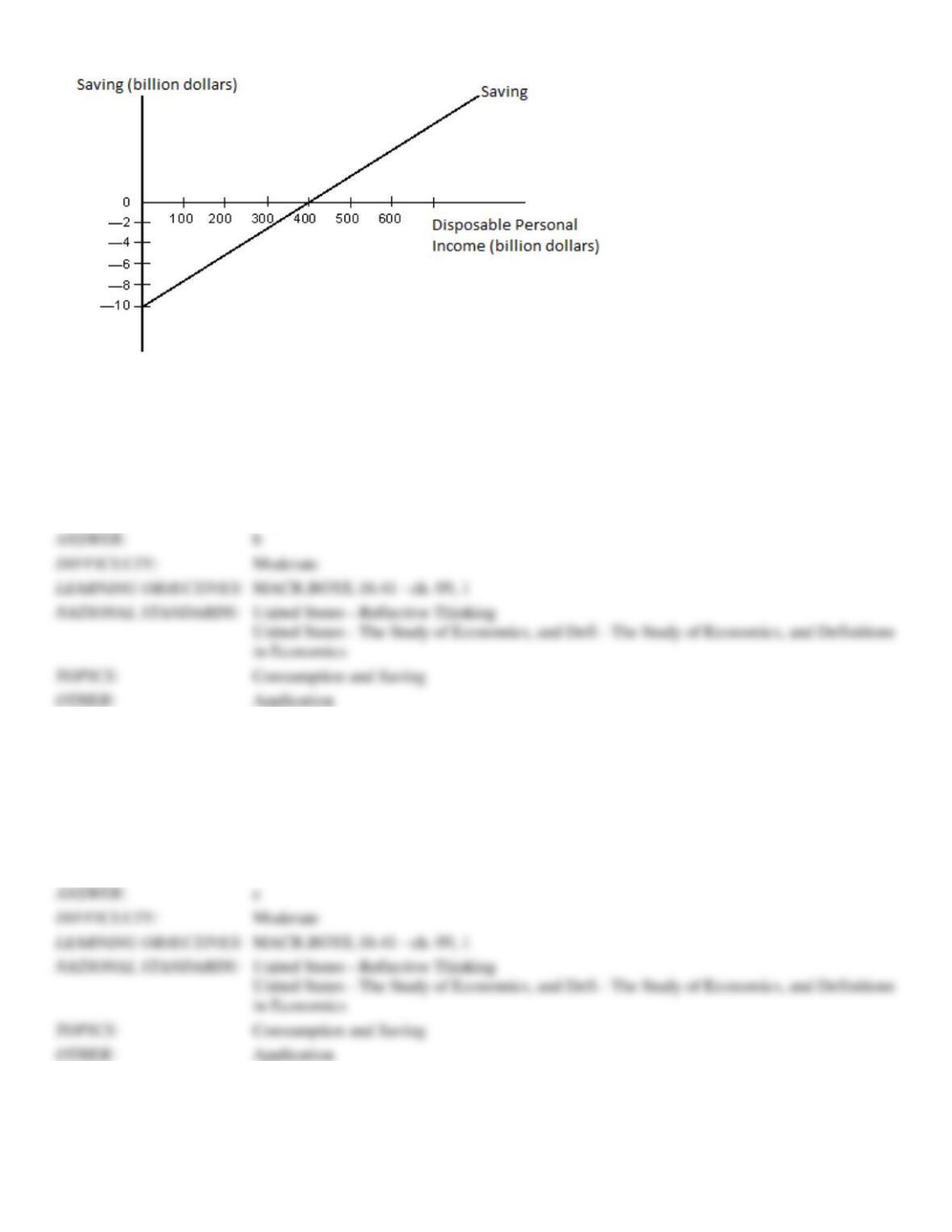
10. Refer to Figure 9.1. Which of the following statements is true for real GDP levels below $400 billion?
a.
Saving exists because consumption is smaller than disposable income.
b.
Saving does not exist because consumption exceeds disposable income.
c.
The corresponding section of the consumption function lies below the 45-degree line.
d.
Autonomous consumption is equal to zero.
e.
The slope of the consumption function becomes negative.
11. Refer to Figure 9.1. At the real GDP level of $400 billion, which of the following statements is true?
a.
There is dissaving.
b.
Saving is equal to $10 billion.
c.
Consumption is equal to disposable income.
d.
The slope of the saving function is equal to zero.
e.
The slope of the consumption function is equal to zero.
MACR.BOYE.16.41 – ch. 09, 1
Consumption and Saving
12. Refer to Figure 9.1. When disposable income equals zero:
a.
autonomous consumption equals zero.
b.
the maximum amount of saving equals $10 billion.
MACR.BOYE.16.41 – ch. 09, 1
Consumption and Saving
c.
autonomous income equals $10 billion.
d.
autonomous consumption equals $10 billion.
e.
consumption is negative.
13. Refer to Figure 9.1. An increase in autonomous consumption would be illustrated by:
a.
an upward shift of the saving function.
b.
a downward shift of the saving function.
c.
a downward shift of the corresponding consumption function.
d.
a movement to the right along the saving function.
e.
a movement to the left along the saving function.
MACR.BOYE.16.41 – ch. 09, 1
Consumption and Saving
14. Autonomous consumption is defined as:
a.
the level of consumption that depends only on the exchange rate.
b.
the consumption expenditures incurred by the government.
c.
the level of consumption that does not depend on income.
d.
an equilibrium condition that needs to be met for the aggregate expenditure model to work.
e.
the part of consumption that is related to investment.
MACR.BOYE.16.41 – ch. 09, 1
Consumption and Saving
15. Dissaving occurs when:
a.
disposable income is greater than consumption.
b.
consumption is greater than disposable income.
c.
consumption is equal to disposable income.
MACR.BOYE.16.41 – ch. 09, 1
Consumption and Saving
d.
consumption is greater than personal income.
e.
consumption is less than personal income.
16. Identify the correct statement with respect to consumption and saving function.
a.
Both the consumption function and the saving function have negative slopes.
b.
As disposable income declines, consumption and saving increase.
c.
The consumption function has a negative slope while the saving function has a positive slope.
d.
As disposable income rises, consumption and saving increases.
e.
The consumption function has a positive slope while the saving function has a negative slope.
MACR.BOYE.16.41 – ch. 09, 1
Consumption and Saving
17. Identify the correct statement.
a.
Autonomous consumption equals saving when disposable income is equal to zero.
b.
Saving is equal to consumption when autonomous consumption is zero.
c.
The savings function always has a positive intercept when autonomous consumption is positive.
d.
The consumption and saving function intersect each other when disposable income is zero.
e.
Autonomous consumption is positive even when disposable income is zero.
MACR.BOYE.16.41 – ch. 09, 1
Consumption and Saving
18. The amount of autonomous consumption in an economy is measured by the:
a.
the intercept of the consumption function when disposable income is positive.
b.
the intercept of the consumption function where actual consumption is above the 45-degree line.
c.
the intercept of the consumption function when disposable income is zero.
d.
the intercept of the consumption function where actual consumption is below the 45-degree line.
MACR.BOYE.16.41 – ch. 09, 1
Consumption and Saving
e.
the intercept of the consumption function when disposable income is negative.
19. Suppose two successive levels of disposable personal income are $16 and $21 billion, respectively, and the change in
consumption spending between these two levels of disposable personal income is $2 billion, then the MPC will be equal
to _____.
a.
0.12
b.
0.8
c.
0.7
d.
0.4
e.
0.04
d
Moderate
MACR.BOYE.16.41 – ch. 09, 1
Consumption and Saving
Application
Revised
20. In the country of Marzipana, total consumption in Year 1 was $56,000 million and in Year 2 was $60,000 million. It
has been observed that each time disposable income changes in this country by $100, consumption changes by $70. Using
this information compute the change in disposable income from Year 1 to Year 2.
a.
Disposable income increased by $2,800 million in Year 2.
b.
Disposable income decreased by $2,000 million in Year 2.
c.
Disposable income increased by $2,000 million in Year 2.
d.
Disposable income increased by $4,500 million in Year 2.
e.
Disposable income decreased by $2,600 million in Year 2.
Challenging
MACR.BOYE.16.41 – ch. 09, 1
Consumption and Saving
Application
Revised
21. The sum of the MPC and the MPS is always:
Easy
MACR.BOYE.16.41 – ch. 09, 1
Consumption and Saving
Knowledge
Revised
a.
greater than 1.
b.
less than 1.
c.
equal to 1.
d.
equal to zero.
e.
between 0 and 1.
22. Suppose total disposable income in Country X rises by $500 billion while total consumption rises by $50 billion. What
would be the slope of the consumption function for this nation?
a.
1
b.
0.1
c.
0.5
d.
0.25
e.
0.4
b
Challenging
MACR.BOYE.16.41 – ch. 09, 1
Consumption and Saving
Application
23. If a household experiences a $880 increase in consumption with a $1,100 increase in disposable income, what is the
slope of that household’s saving function?
a.
0.20
b.
2.0
c.
0.80
d.
0.08
e.
0.25
Moderate
MACR.BOYE.16.41 – ch. 09, 1
Consumption and Saving
Application
Easy
MACR.BOYE.16.41 – ch. 09, 1
Consumption and Saving
Knowledge
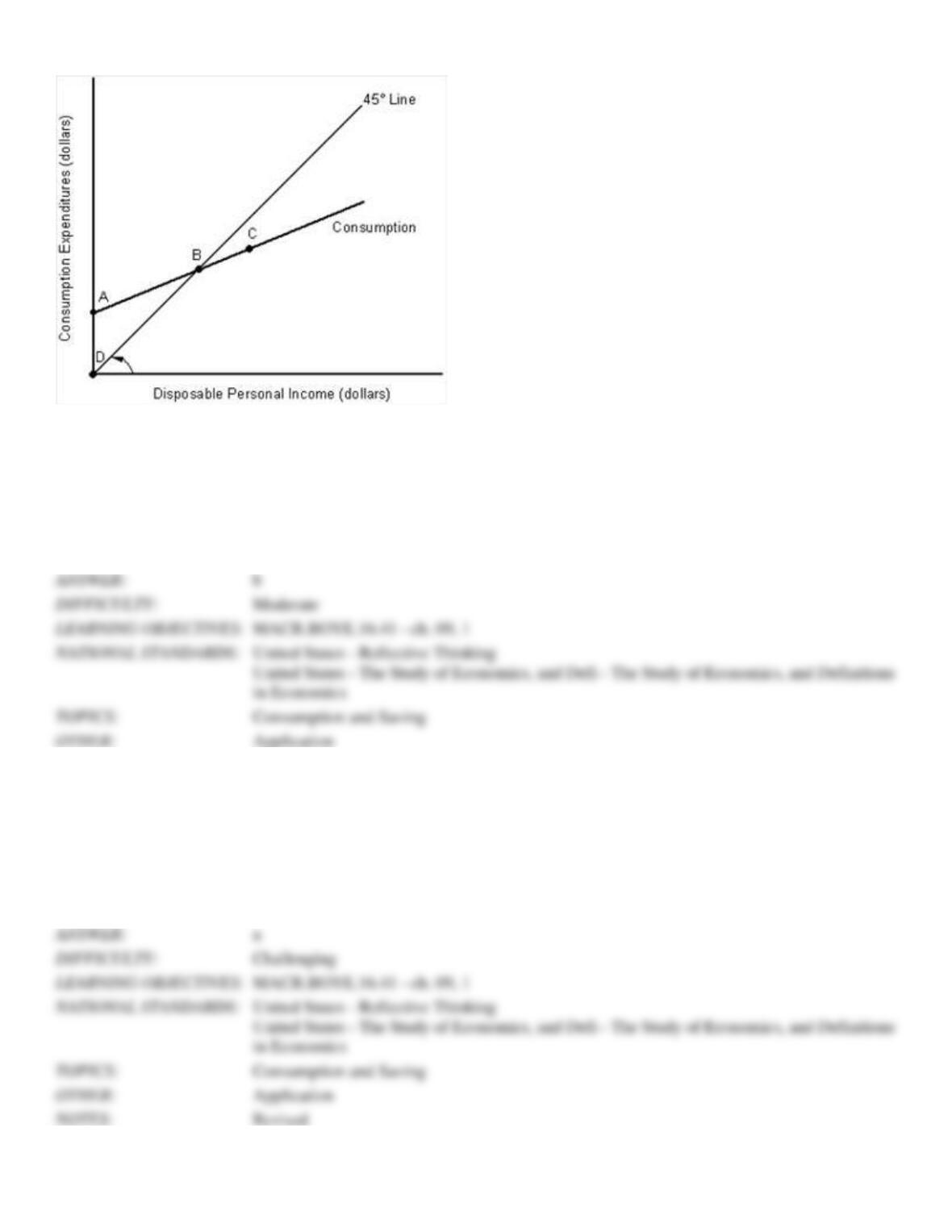
Figure 9.2
24. In Figure 9.2, consumption equals disposable income:
a.
at point A only.
b.
at point B only.
c.
at point C only.
d.
at points A and C only.
e.
at all points on the consumption function.
25. In Figure 9.2, the line segment AD represents:
a.
autonomous consumption.
b.
the maximum amount of saving.
c.
negative consumption.
d.
zero consumption.
e.
autonomous expenditure.
MACR.BOYE.16.41 – ch. 09, 1
Consumption and Saving
MACR.BOYE.16.41 – ch. 09, 1
Consumption and Saving
26. In Figure 9.2, at any point to the left of point B:
a.
autonomous consumption is less than zero.
b.
saving occurs.
c.
disposable income is negative
d.
consumption is greater than disposable income.
e.
autonomous consumption is zero.
27. In Figure 9.2, a decrease in disposable income would be illustrated by:
a.
an upward shift of the consumption function.
b.
a downward shift of the consumption function.
c.
a leftward movement along the consumption function.
d.
a rightward movement along the consumption function.
e.
a movement from point A to point D.
MACR.BOYE.16.41 – ch. 09, 1
Consumption and Saving
28. In Figure 9.2, an increase in autonomous consumption would be illustrated by:
a.
a movement from point A to point D.
b.
a movement from point A to point B.
c.
an upward shift of the consumption function.
d.
a downward shift of the consumption function.
e.
a movement from point C to point B.
MACR.BOYE.16.41 – ch. 09, 1
Consumption and Saving
MACR.BOYE.16.41 – ch. 09, 1
Consumption and Saving
29. The consumption function becomes flatter if:
a.
the average propensity to spend increases.
b.
the marginal propensity to spend increases.
c.
the marginal propensity to save increases.
d.
the autonomous consumption increases.
e.
the autonomous consumption decreases.
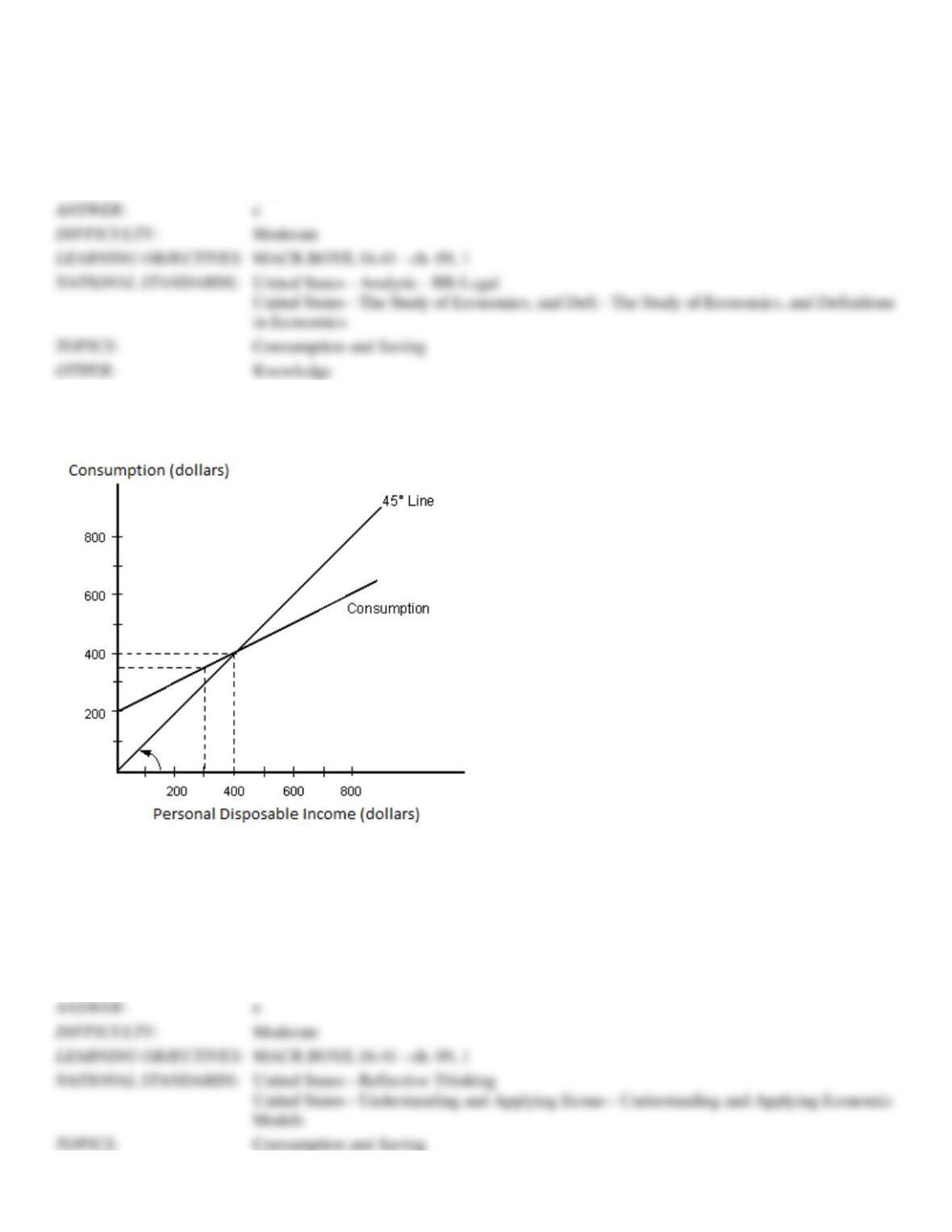
The figure given below represents the consumption function of a country.
Figure 9.3
30. Refer to Figure 9.3. Calculate the marginal propensity to consume.
a.
0.7
b.
0.1
c.
0.4
d.
0.25
e.
0.5
Moderate
MACR.BOYE.16.41 – ch. 09, 1
Consumption and Saving
Moderate
MACR.BOYE.16.41 – ch. 09, 1
Consumption and Saving
Knowledge
31. Refer to Figure 9.3. We can infer that the marginal propensity to save would be _____.
a.
0.7
b.
0.1
c.
0.4
d.
0.25
e.
0.5
Challenging
Consumption and Saving
Application
32. According to Figure 9.3, saving is zero when disposable income is _____.
a.
$0
b.
$400
c.
$250
d.
$800
e.
$300
b
Moderate
Consumption and Saving
Application
33. Refer to Figure 9.3. When disposable income is $800, consumption spending must equal:
a.
$200.
b.
$700.
c.
$600.
d.
$800.
e.
$400.
Challenging
Consumption and Saving
Application
34. According to Figure 9.3, autonomous consumption equals:
a.
-$200.
b.
$0.
c.
$100.
d.
$200.
e.
$400.
35. Refer to Figure 9.3. If the marginal propensity to consume is equal to 0.3, then:
a.
autonomous consumption would decrease.
b.
the total amount of dissaving would increase.
c.
consumption spending would equal disposable income at an income level greater than $400.
d.
consumption spending would equal disposable income at an income level less than $400.
e.
consumption spending would equal disposable income at the income level of $400.
d
Challenging
MACR.BOYE.16.41 – ch. 09, 1
Consumption and Saving
Analysis
Revised
36. Refer to Figure 9.3. The savings function of the country will have a positive intercept at all income levels _____.
a.
less than $200
b.
greater than $200
c.
less than $600
d.
greater than $400
e.
less than $800
d
Challenging
MACR.BOYE.16.41 – ch. 09, 1
Consumption and Saving
Analysis
Revised
d
Moderate
MACR.BOYE.16.41 – ch. 09, 1
Consumption and Saving
Application
37. If a household’s disposable income increases from $50,000 to $100,000 and its consumption increases from $40,000
to $80,000, the MPS must be _____.
a.
0.4
b.
0.8
c.
0.7
d.
0.2
e.
0.5
38. As disposable income rises:
a.
consumption falls, but not by as much as the disposable income rises.
b.
the average propensity to consume increases.
c.
saving falls as a percentage of disposable income.
d.
the average propensity to consume remains unchanged.
e.
saving rises as a percentage of disposable income.
Easy
MACR.BOYE.16.41 – ch. 09, 1
Models
Consumption and Saving
Knowledge
Revised
39. A change in the marginal propensity to save can be graphically represented by:
a.
a movement along the investment function.
b.
a movement along the saving function.
c.
a parallel shift of the consumption function.
d.
a parallel shift of the saving function.
e.
a change in the slope of the saving function.
Challenging
MACR.BOYE.16.41 – ch. 09, 1
Consumption and Saving
Analysis
d
Moderate
MACR.BOYE.16.41 – ch. 09, 1
Consumption and Saving
Application
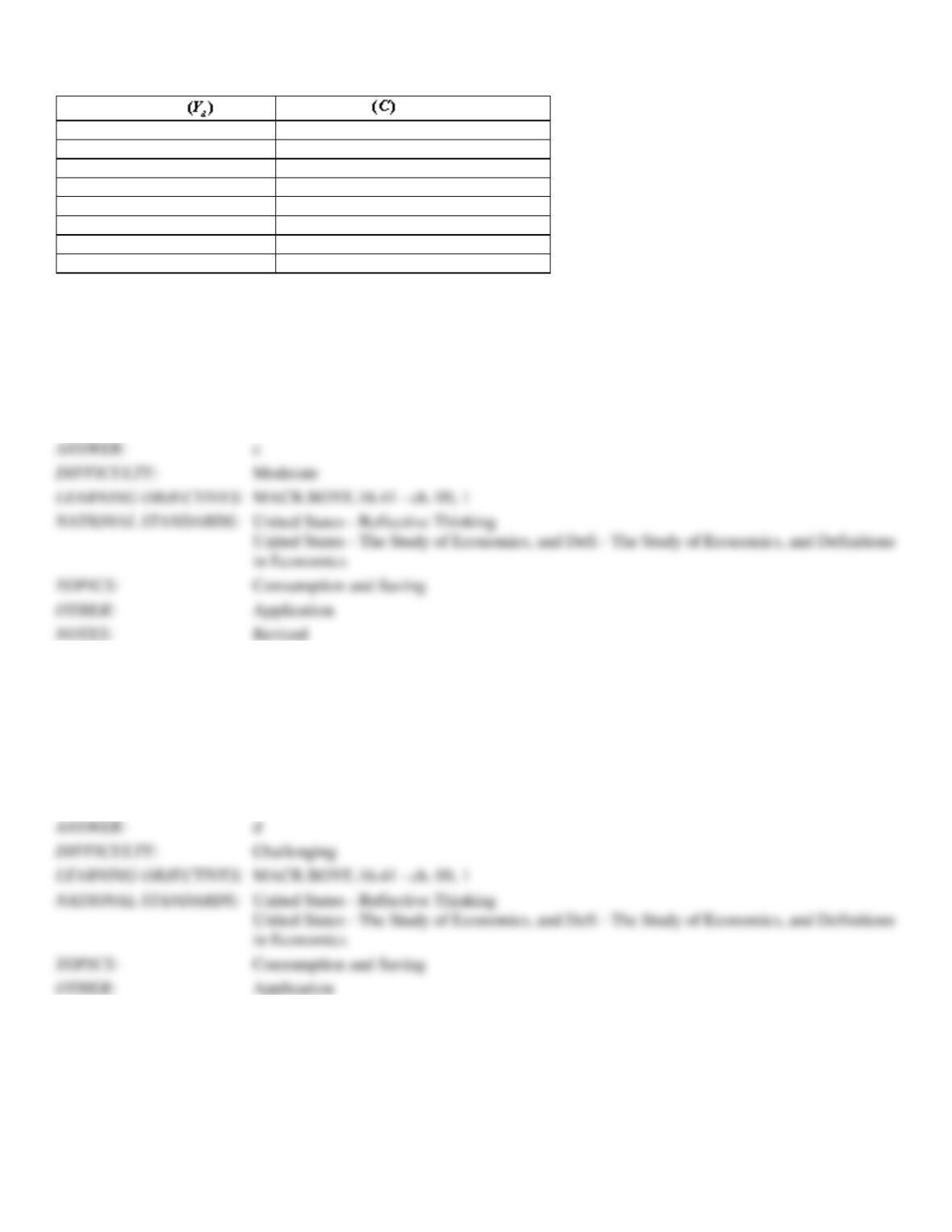
The table given below reports the consumption expenditure of a nation at different levels of disposable income.
Table 9.1
Disposable Income
Consumption
$ 0
$ 4,500
$10,000
$12,000
$15,000
$15,750
$25,000
$23,250
$30,000
$27,000
$35,000
$30,750
$40,000
$34,500
$50,000
$42,000
40. Refer to Table 9.1. Autonomous consumption expenditure in this nation will be equal to:
a.
$10,000.
b.
$5,500.
c.
$4,500.
d.
$3,000.
e.
$4,000.
41. Refer to Table 9.1. When disposable income is $20,000, consumption spending equals:
a.
$24,500.
b.
$15,000.
c.
$18,500.
d.
$19,500.
e.
$18,000.
d
Challenging
MACR.BOYE.16.41 – ch. 09, 1
Consumption and Saving
Application
42. Refer to Table 9.1. The income level of $18,000 coincides with:
a.
the origin of the graph.
b.
the point where the consumption function touches the vertical axis.
c.
the point where the MPC equals 1.00.
d.
the point where the APC equals 1.00.
e.
the point where the consumption function crosses the 45-degree line.
Moderate
MACR.BOYE.16.41 – ch. 09, 1
Consumption and Saving
Application
43. Refer to Table 9.1. At an income level of $10,000, the APS equals -0.20. Therefore, the APC has to be equal to:
a.
0.20.
b.
0.80.
c.
-1.20.
d.
1.20.
e.
1.80.
d
Challenging
MACR.BOYE.16.41 – ch. 09, 1
Consumption and Saving
Application
Revised
44. Refer to Table 9.1. At an income level of $45,000, the average propensity to save would be equal to:
a.
0.15.
b.
0.75.
c.
0.25.
d.
0.20.
e.
0.80.
Challenging
MACR.BOYE.16.41 – ch. 09, 1
Consumption and Saving
Application
Revised
45. Which of the following variables do not change autonomous consumption?
a.
Demographics
b.
Taxation
c.
Expectation
d.
Wealth
e.
Disposable income
Challenging
MACR.BOYE.16.41 – ch. 09, 1
Consumption and Saving
Analysis
46. _____ is the primary determinant of consumption and is usually measured in terms of current disposable income.
a.
Household income
b.
Wealth
c.
Expectation
d.
Interest rate
e.
Tax liability
Easy
MACR.BOYE.16.42 – ch. 09, 2
Consumption and Saving
Knowledge
47. A change in consumption caused by a change in disposable income is shown by:
a.
a movement along the consumption function.
b.
a rightward shift of the consumption function.
c.
a change in the slope of the consumption function.
d.
a leftward shift of the consumption function.
e.
the point where the consumption function touches the 45 degree line.
Easy
MACR.BOYE.16.42 – ch. 09, 2
Consumption and Saving
Knowledge
Revised
48. If it is assumed that there are absolutely no taxes in an economy, then aggregate consumption will be drawn as a
function of:
a.
disposable income.
b.
real GDP.
c.
government expenditure.
d.
private income.
e.
government transfers.
Easy
MACR.BOYE.16.42 – ch. 09, 2
Consumption and Saving
Knowledge
49. As an household’s wealth increases, it will experience a(n):
a.
increase in its MPC.
b.
decrease in autonomous consumption.
c.
decrease in its MPS.
d.
increase in autonomous consumption.
e.
increase in autonomous saving.
MACR.BOYE.16.42 – ch. 09, 2
Consumption and Saving
50. Any increase in autonomous consumption is associated with:
a.
an equivalent increase in autonomous saving.
b.
an equivalent decrease in autonomous saving.
c.
an equivalent increase in the slope of the saving function.
d.
an equivalent decrease in the slope of the consumption function.
e.
an equivalent movement along the consumption function.
MACR.BOYE.16.42 – ch. 09, 2
Consumption and Saving
51. The consumer confidence index can be defined as:
a.
an economic index that measures how consumers feel about their government.
b.
an economic index that measures how confident companies are about keeping their current consumers.
c.
an economic index that measures household expectations about the economy.
d.
an economic index that measures how investors feel about their investments in the stock market.
e.
an economic index used to measure consumers’ confidence on a particular brand.
MACR.BOYE.16.42 – ch. 09, 2
Consumption and Saving
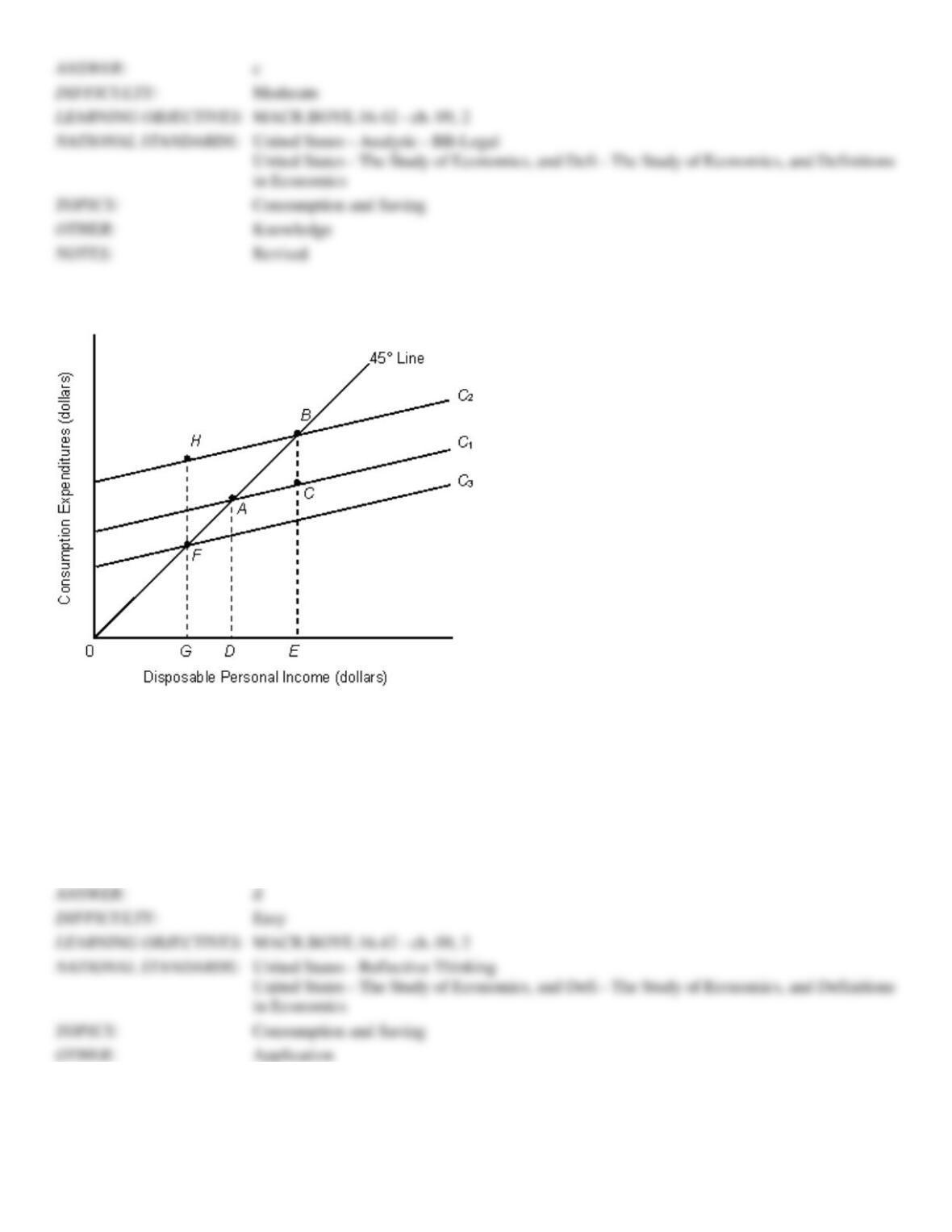
The figure given below shows the consumption functions of an economy.
Figure 9.4
52. Refer to Figure 9.4. Which of the following could explain a downward shift of the consumption function from C1 to
C3?
a.
An increase in household wealth
b.
A decrease in the proportion of young people in the population
c.
An increase in the size of the population
d.
A decrease in consumer confidence
e.
An autonomous decrease in saving
MACR.BOYE.16.42 – ch. 09, 2
Consumption and Saving
53. Refer to the Figure 9.4. If the economy is in equilibrium at A, which of the following is most likely to occur if
consumers expect a period of rapid economic expansion?
a.
The equilibrium will move from point A to point F.
MACR.BOYE.16.42 – ch. 09, 2
Consumption and Saving
b.
The equilibrium will move from point A to point C.
c.
There will be a new equilibrium disposable income at point G.
d.
The equilibrium will remain at point A.
e.
There will be a new equilibrium disposable income at point E.
54. Refer to Figure 9.4. The shift of the consumption function from C1 to C2 has caused autonomous saving to:
a.
decrease by the distance between H and B.
b.
increase by the distance between C and B.
c.
decrease by the distance between C and B.
d.
increase by the distance between H and G.
e.
decrease by the distance between D and E.
MACR.BOYE.16.42 – ch. 09, 2
Consumption and Saving
55. Which of the following statements concerning the effects of demographics on consumption is not true?
a.
The size of the population affects the slope of the consumption function.
b.
The age of the population affects the slope of the consumption function.
c.
Other things equal, the level of consumption will rise with increases in population.
d.
Younger households tend to have higher MPCs than older households.
e.
Older households tend to have higher MPSs than younger households.
MACR.BOYE.16.42 – ch. 09, 2
Consumption and Saving
56. Which of the following is true of long-run consumption functions?
a.
Autonomous consumption is equal to zero in the long-run.
b.
The long run consumption functions are steeper than short run consumption functions.
MACR.BOYE.16.42 – ch. 09, 2
Consumption and Saving