CHAPTER 9
Socialist Protest Against Industrial Capitalism
MULTIPLE CHOICE
15. Gracchus Babeuf is important in the socialist tradition because
a. he is the only French socialist.
b. he was the first to advance the idea if an egalitarian socialist state is to be achieved, then
the existing government must be toppled by force.
c. he was the first to advance the idea if an egalitarian socialist state is to be achieved, then
it must come about peacefully through the democratic process.
d. he was the first socialist to be elected to the French parliament.
16. In his factory at New Lanark, Robert Owen
a. provided decent working conditions, livable wages, and education for working-class
children.
b. was known for lax discipline, minimal oversight of workers, and low wages.
c.
d. employed only women and children.
17. William Godwin
a. believed that corrupt and unjust social institutions were responsible for most of the moral
defects of individuals.
b. defended private property because of the necessity for providing incentives to produce.
c. was the first socialist to advocate overthrow of the government by force.
d. believed government could act effectively to redress the evils of capitalism
18. Henri de Saint-Simon
a. was a member of the aristocracy and defender of the idle rich.
b. believed the government was incapable of defending or protecting the welfare of the
masses.
c. believed in the necessity of active government intervention in production, distribution
and commerce in the interest of promoting the welfare of the masses.
d. popularized the idea of cooperatives (or phalanxes, as he called them).
19. Charles Fourier
a. was a member of the aristocracy and defender of the idle rich.
b. believed the government was incapable of defending or protecting the welfare of the
masses.
c. believed in the necessity of active government intervention in production, distribution
and commerce in the interest of promoting the welfare of the masses.
d. popularized the idea of cooperatives (or phalanxes, as he called them).
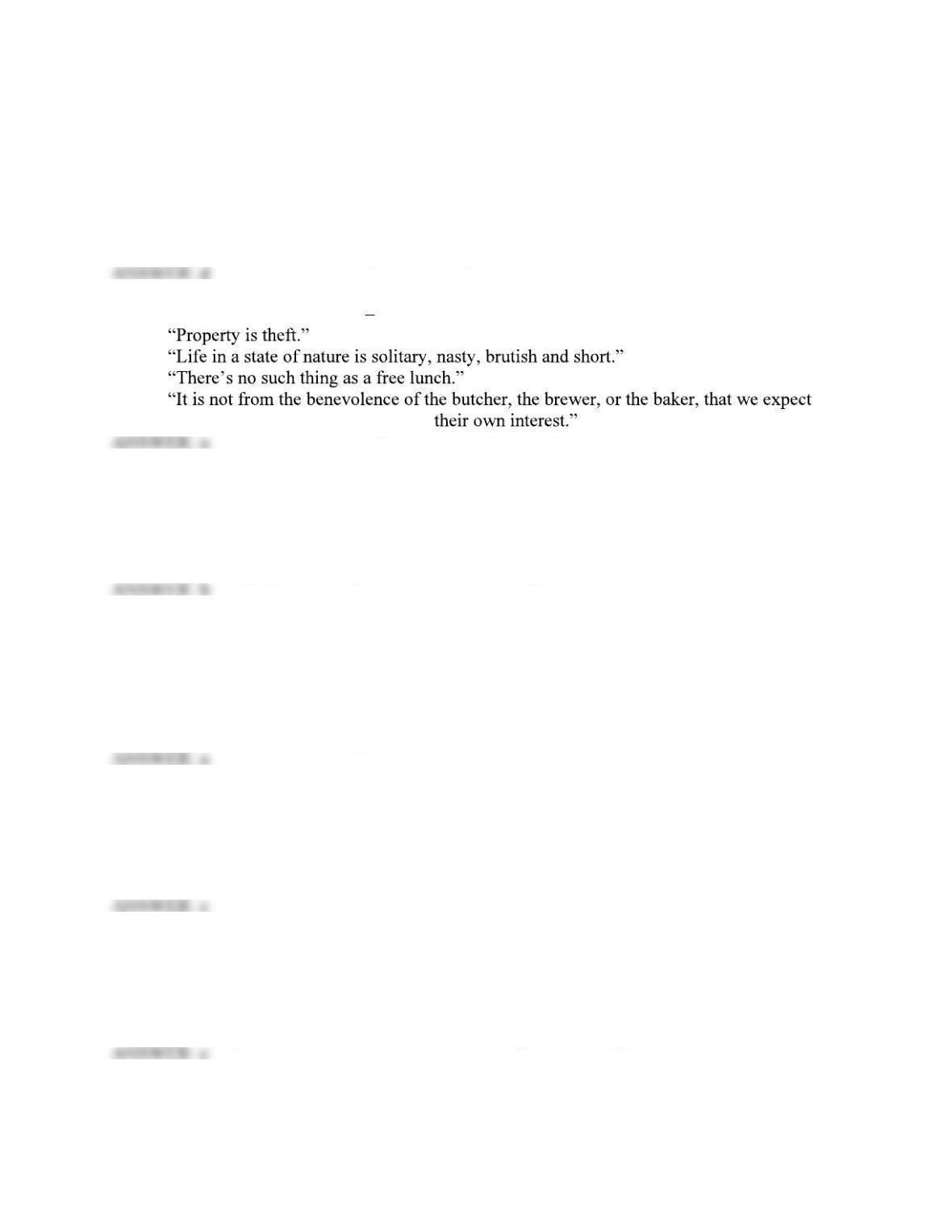
20. Pierre Joseph Proudhon (1809 1865) is famous for the slogan
a.
b.
c.
d.
our dinner, but from their regard to
21. The origins of socialism can be traced to a protest against
a. the paternalism of the system of feudalism in England.
b. the inequality of capitalism and the social evils associated with this inequality.
c. the political repression of communism.
d. high unemployment and poverty of the Great Depression
22. During the early 19th century, there were two groups or traditions in socialism. These two
traditions were
a. individualistic socialism and cooperative socialism.
b. liberal socialism and libertarian socialism.
c. market socialism and government socialism.
d. egalitarian socialism and paternalistic socialism.
23. In the opinion of all socialists, inequality results primarily from
a. the institution of marriage.
b. the institution of the market.
c. the institution of private property.
d. the institution of liberalism
24. According to Thomas Hodgskin, when a fisherman catches a fish with a net
a. both the fisherman and the net are productive.
b. the net is productive but the fisherman is not.
c. the fisherman is productive and the workers who made the net are productive.
d. the entrepreneur who hired the worker and bought the net is productive.