Chapter 9: Capital Budgeting and Cash Flow Analysis
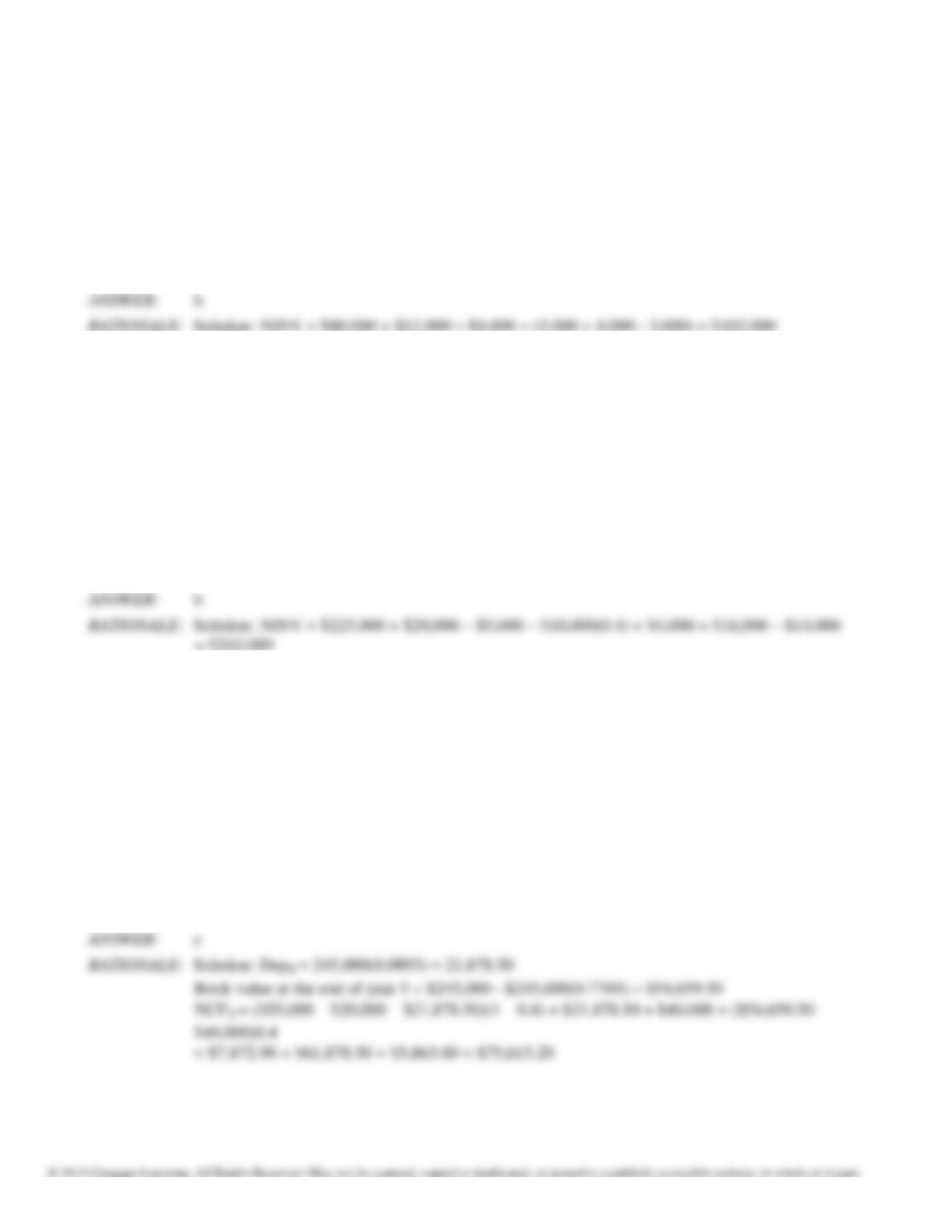
60. Rupp Pumps is purchasing an extruder for $80,000. The extruder will require an expenditure of $12,000 for
installation and $4,000 for training new operators. The new equipment will require an increase of $5,000 in
inventory, $4,000 in accounts receivable, and $3,000 in accounts payable. What is the net investment for this
project?
a. $108,000
b. $102,000
c. $98,000
d. $99,000
61. Airstat is replacing an old stamping line that cost $80,000 five years ago, with a new, more efficient machine
that will cost $225,000. Shipping and installation will cost an additional $20,000. The old machine has a book
value of $15,000 but will be sold as scrap for $5,000. The new machine will be depreciated with a 7 year life
under MACRS guidelines. With the increased production, inventories will increase $4,000, accounts receivable
will increase $16,000, and accounts payable will increase $14,000. If Airstat has a marginal tax rate of 40
percent, what is the net investment?
a. $274,000
b. $242,000
c. $260,000
d. $274,000
62. Ripstart is replacing an old, fully depreciated stamping line with a more efficient machine that will cost
$245,000. The line will be depreciated as a 7-year MACRS asset. With the increased production, Ripstart
expects revenues to increase by $55,000, and operating expenses to increase by $20,000. If Ripstart expects to
sell the new machine at the end of year 5 for $40,000, compute the net cash flow in the fifth year. The MACRS
depreciation rate during the fifth year is 8.93% and the accumulated MACRS depreciation after five years
totals 77.69 percent of the cost of the asset. Assume the firm’s marginal tax rate is 40 percent and that company
does get to take the full benefit of year 5 depreciation.
a. $29,751
b. $53,736
c. $75,615
d. $69,751
Chapter 9: Capital Budgeting and Cash Flow Analysis
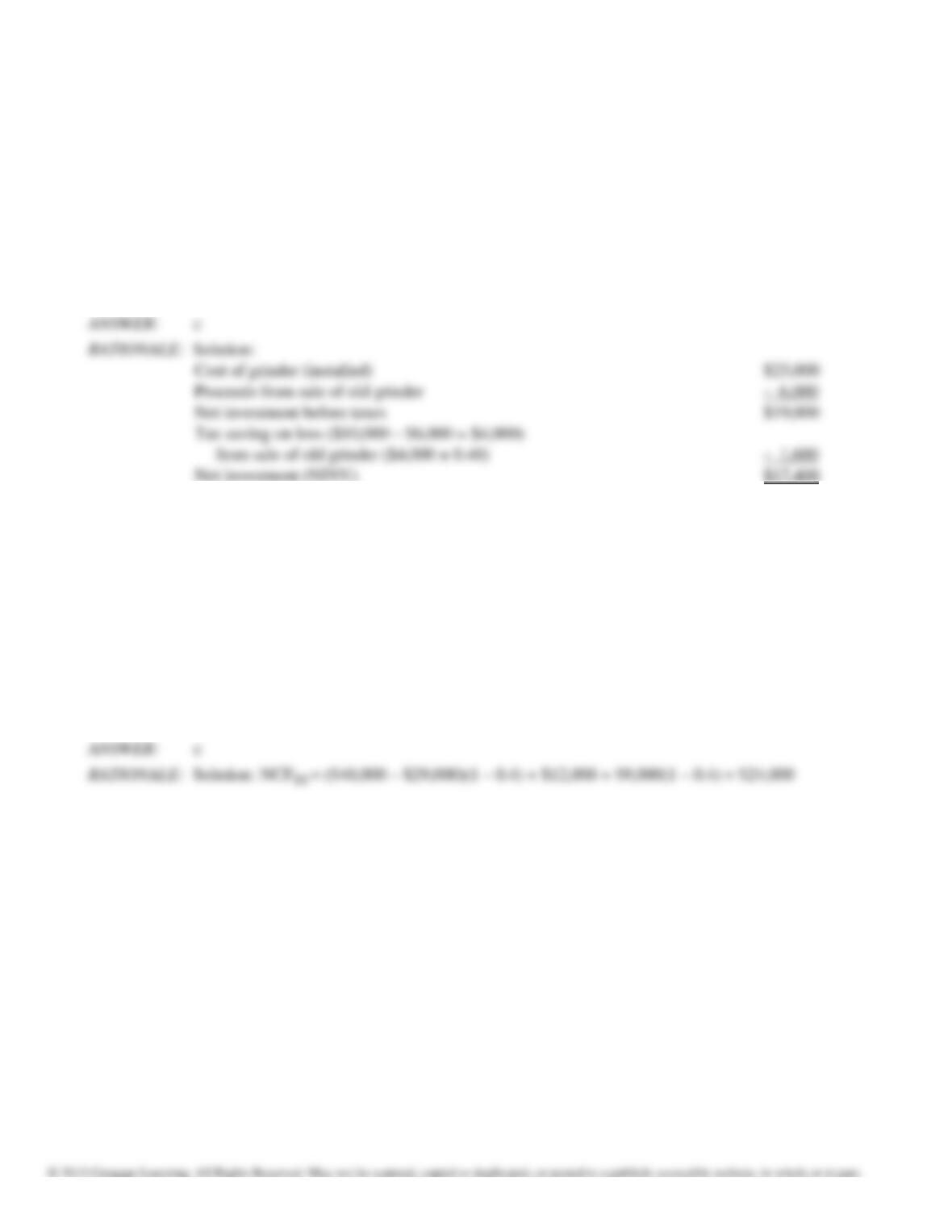
63. Felix Industries purchased a grinder 5 years ago for $15,000. It is being depreciated on a straight–line basis
over 15 years to an estimated salvage value of zero. It could be sold now for $6,000. The firm is considering
selling it and purchasing a new one. The new grinder would cost $25,000 installed and would be depreciated
on a straight-line basis over 10 years to a zero estimated salvage value. The company’s marginal tax rate is
40%. Determine the net investment if the old grinder is sold and the new one purchased.
a. $19,000
b. $16,600
c. $17,400
b. cannot be computed
64. Consider a capital expenditure project with an expected 10-year economic life and forecasted revenues equal to
$40,000 per year; cash expenses are estimated to be $29,000 per year. The cost of the project equipment is
$23,000, and the equipment’s estimated salvage value at the end of the project is $9000.The equipment’s
$23,000 cost will be depreciated using MACRS depreciation (7-year asset). The project requires a $7,000
working capital investment in year 0 and another $5,000 in year 5. The company’s marginal tax rate is 40%.
Calculate the expected net cash flow in year 10 of the project.
a. $32,000
b. $27,000
c. $24,000
d. $18,000
Chapter 9: Capital Budgeting and Cash Flow Analysis
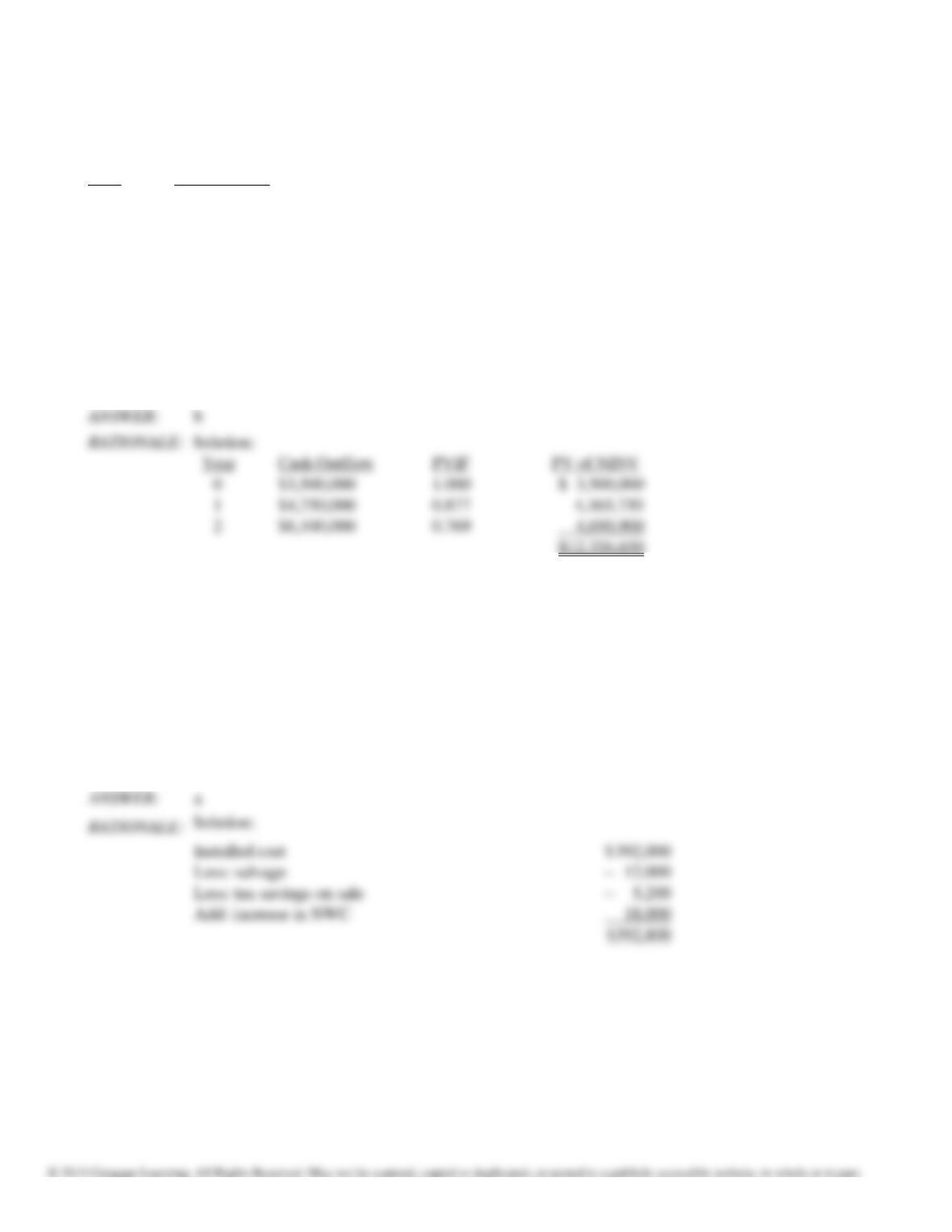
65. The Johnson Drum Company is planning to build a new factory. The purchase of the land, building the plant,
and installation of equipment will take place over a two year period. The following are planned cash outflows:
Year Cash Outflow
0 $3,500,000
1 $4,750,000
2 $6,100,000
Johnson Drum’s cost of capital is 14%, and its marginal tax rate is 35%. What is the NINV measured in present
value terms today?
a. $14,350,000
b. $12,356,650
c. $9,327,500
d. $8,035,788
66. Anderson Clayton will purchase a new pellet mill that replace an older, less efficient, mill. The new mill costs
$360,000 and shipping costs are $10,000. Improving the steam lines to the new mill will cost an additional
$22,000. The old mill has a book value of $25,000 and can be sold for $12,000. The installation of the new mill
will cause inventories to increase by $8,000, accounts receivable will go up $20,000, and accounts payable will
increase $10,000. If Anderson Clayton has a marginal tax rate of 40%, what is the NINV for the new mill?
a. $392,800
b. $412,800
c. $374,800
d. $398,000
Chapter 9: Capital Budgeting and Cash Flow Analysis
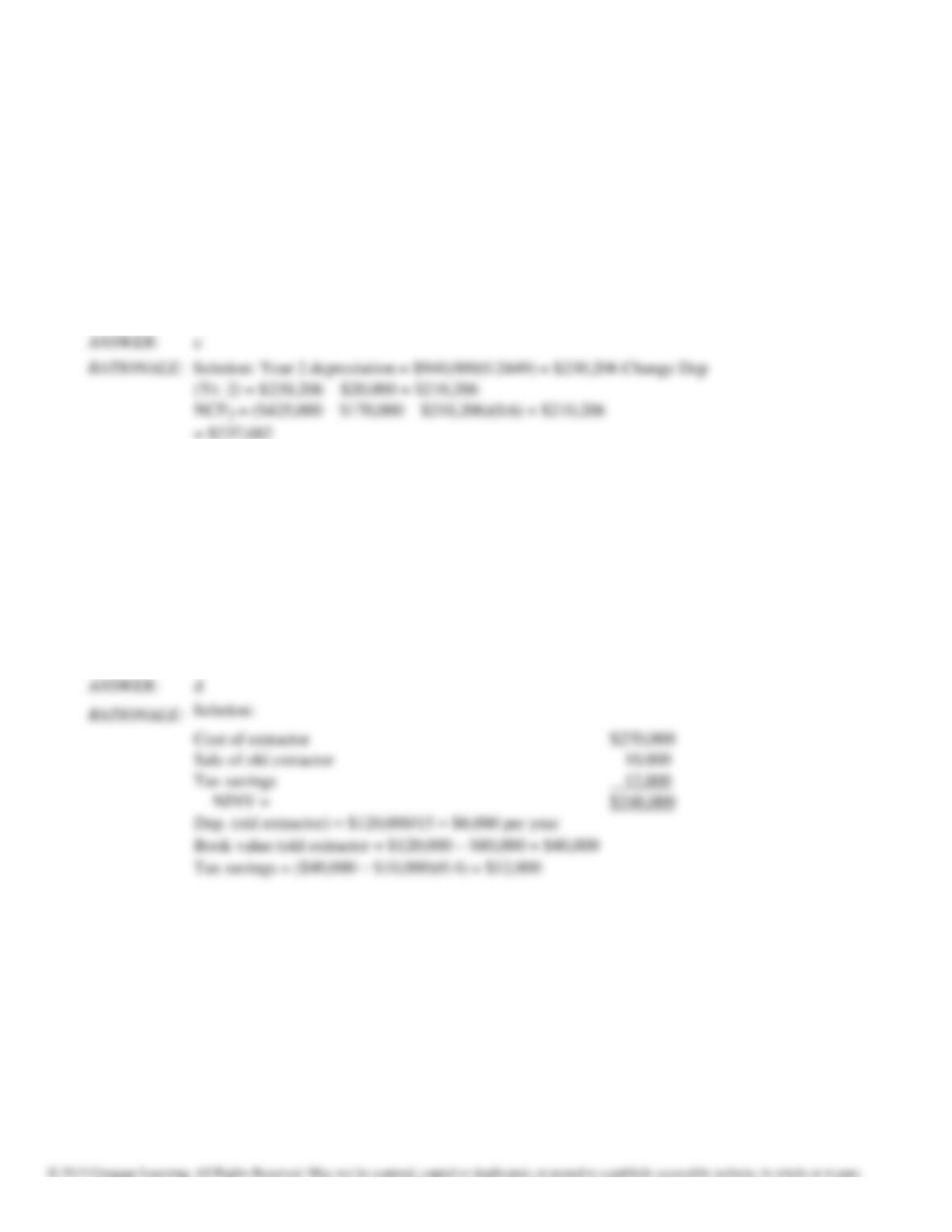
67. A Lotta Bread Corp. is replacing an entire baking line that was purchased for $420,000 and currently has a
book value of $60,000. The new, more efficient line, will cost $940,000 installed and can be depreciated as a 7-
year MACRS asset. With the increased efficiency, Lotta expects annual revenues to increase by $425,000, and
operating expenses to increase by $170,000. The older machine, which was being depreciated at the straight–
line rate of $20,000/year, will be sold for $30,000. What are the net cash flows for year 2? Assume the firm’s
marginal tax rate is 40% and that the year 2 depreciation rate is 24.49%.
a. $26,996
b. $332,206
c. $237,082
d. $383,206
68. Parker Chemicals purchased a hexene extractor 10 years ago for $120,000. It is being depreciated on a straight–
line basis over 15 years to an estimated salvage value of zero. It can be sold today for $10,000. Parker is
considering purchasing a new more efficient extractor that would cost $270,000 installed and would be
depreciated as a 10-year MACRS asset. The company’s marginal tax rate is 40%. Determine the NINV if the
old extractor is sold and the new one is purchased.
a. $252,000
b. $228,000
c. $260,000
d. $248,000
Chapter 9: Capital Budgeting and Cash Flow Analysis
69. Parker Chemicals purchased a hexene extractor 10 years ago for $120,000. It is being depreciated on a straight-
line basis over 15 years to an estimated salvage value of zero. It can be sold today for $10,000. Parker is
considering purchasing a new more efficient extractor that would cost $270,000 installed and would be
depreciated as a 10-year MACRS asset. (The depreciation rate for year one is 10 percent for this asset.) The
company’s marginal tax rate is 40%. If the new extractor is purchased, annual revenues will increase by
$10,000 and annual operating expenses will decrease by $10,000. What is the net cash flow in year 1?
a. $7,600
b. $19,600
c. $24,200
d. $600
70. Com-Cat is considering expanding their current production facility. This year Com-Cat had an operating
income (EBIT) of $760,000, interest expenses of $120,000, depreciation expenses of $45,000, and capital
expenditures of $160,000. Next year, after the expansion is completed, operating income is expected to be
$880,000, interest expenses will remain at $120,000, but depreciation will increase to $61,000. To support the
expansion, cash is expected to increase by $5,000, accounts receivable by $12,000, inventories by $8,000, and
accounts payable by $7,000. What is the change in Com-Cat’s net operating cash flows attributable to this
project, if the tax rate is 40%?
a. $80,400
b. $88,000
c. $106,000
d. $70,000
71. The Weis Corp. purchased a new conveyor system to replace an older less automated system. The old system,
which was 10 years old, was being depreciated on a straight line basis over its 20-year life at $25,000 per year.
The new system will be depreciated as a 7-year asset for MACRS purposes. The more efficient machine, which
costs $520,000 installed, will reduce operating costs by $74,000 per year. Compute the net cash flows in year 3
for the new system. Assume a 40% tax rate. Use the rounded MACRS schedule listed below:
(7-Year Depreciation Schedule: 14%, 25%, 18%, 12%, 9%, 9%, 9%, 4%)
a. $71,840
b. $80,779
c. $68,600
d. $149,917
Chapter 9: Capital Budgeting and Cash Flow Analysis
72. Seduck has just replaced a set of hydraulic screens that had been in operation for 6 years with a newer
screening system that cost $180,000 installed. The old system cost $140,000 and had been depreciated as a 10-
year MACRS asset. Its salvage value is $10,000. What is the NINV for the new equipment? Assume a 40% tax
rate. Use the rounded MACRS schedule listed below:
(10-Year Depreciation Schedule: 10%, 18%, 14%, 12%, 9%, 7%, 7%, 7%, 7%, 6%, 3%)
a. $170,000
b. $157,200
c. $202,514
d. $151,228
73. Martin Tartans, Inc. is considering the purchase of a new argyle sock knitting machine to replace a less
automated one. The new machine will cost $220,000 plus $30,000 for shipping and installation. The machine
being replaced was purchased five years ago for $140,000 and depreciated as a 7-year MACRS property. It can
be sold for $24,000. Boll Mills has a marginal tax rate of 35%. Compute the NINV for the project. Use the
rounded MACRS schedule listed below:
(7-Year Depreciation Schedule: 14%, 25%, 18%, 12%, 9%, 9%, 9%, 4%)
a. $250,000
b. $226,000
c. $221,298
d. $223,620
Chapter 9: Capital Budgeting and Cash Flow Analysis
74. Pixaire purchased a new mixer to replace an older system. The older system which cost $100,000 is 5 years old
now and was being depreciated over a MACRS life at 7 years. The new mixer, which will cost $270,000, will
also be depreciated as a 7 year asset for MACRS purposes. The new mixer is expected to increase revenues by
$64,000 with no additional operating expenses. Determine the net operating cash flows in year 2 for the new
mixer. Assume a 40% tax rate. Use the rounded MACRS schedule listed below:
(7-Year Depreciation Schedule: 14%, 25%, 18%, 12%, 9%, 9%, 9%, 4%)
a. $66,974
b. $66,124
c. $61,277
d. $64,229
75. Rough & Tumble Clothiers is considering the purchase of a new loom to replace a less efficient one. The new
machine will cost $240,000 including installation. The machine being replaced was purchased 5 years ago for
$150,000 and is being depreciated as a 7-year MACRS property. It can be sold for $40,000. Compute the
NINV for this project if KC has a marginal tax rate of 40%. Use the rounded MACRS schedule listed below:
(7-Year Depreciation Schedule: 14%, 25%, 18%, 12%, 9%, 9%, 9%, 4%)
a. $200,000
b. $197,386
c. $202,614
d. $216,000
Chapter 9: Capital Budgeting and Cash Flow Analysis
76. Adler is replacing its old packing line with a more efficient line. The old line was being depreciated on a
straight-line basis at a rate of $20,000 per year. The old machine has a current book value of $100,000. The
new line, which costs $910,000, will be depreciated on a 10-year MACRS schedule. The more efficient
operation is expected to increase revenues by $50,000 per year and reduce annual operating costs by $80,000.
Compute the net cash flows for Adler in year 2. Assume Adler has a marginal tax rate of 40%. Use the rounded
MACRS schedule listed below:
(10-Year Depreciation Schedule: 10%, 18%, 14%, 12%, 9%, 7%, 7%, 7%, 7%, 6%, 3%)
a. $143,520
b. $135,520
c. $39,520
d. $47,520
77. The difference between a capital expenditure and an operating expenditure is that a capital expenditure:
a. is expected to generate returns greater than 10%
b. involves replacement of a money market account with three-month treasury bills.
c. is expected to generate future cash benefits lasting longer than one year.
d. involves a combined effort of the accounting department and the marketing department.
78. Of the following, an example of a component of a firm’s cost of capital is:
a. Repurchase of company stock.
b. Investment of corporate funds into a money market account.
c. The purchase of another company’s bonds.
d. The return on common stock required by investors.
79. A contractor has a team of plumbers and assigns those plumbers to a new construction site. The fact that the
plumbers are unavailable for any other job makes the construction site project a/an:
a. independent project
b. qualified project
c. mutually exclusive project
d. contingent project
Chapter 9: Capital Budgeting and Cash Flow Analysis
80. All of the following are reasons that capital investment analysis must be performed correctly EXCEPT:
a. Determine synergy of the venture.
b. Establish global markets.
c. Determine potential risks.
d. Chart the future course of a company.
81. A term meaning that the firm has limited funds and must choose only those projects that will be profitable is:
a. capital refunding
b. capital debt
c. capital rationing
d. capital choice
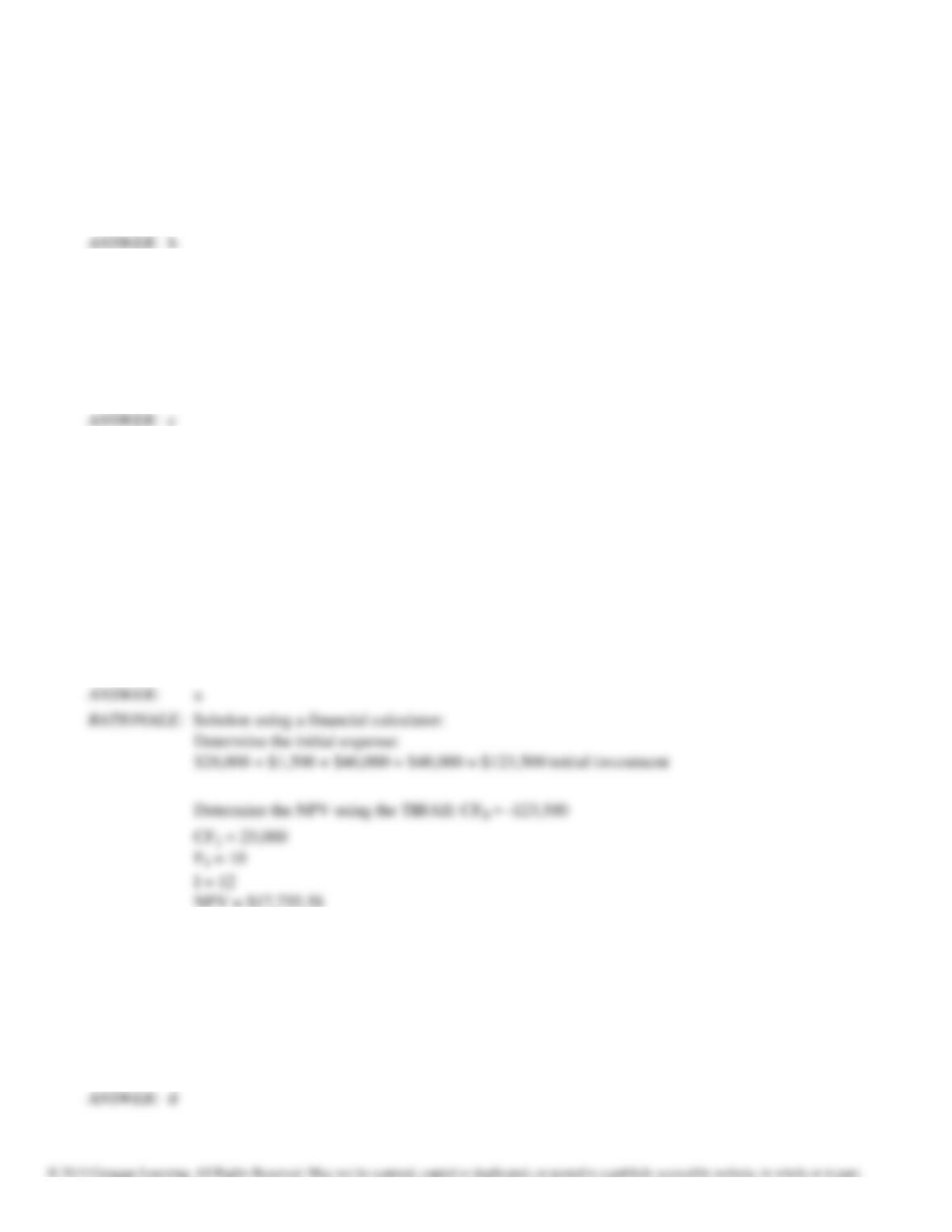
82. Determine if this project is profitable under the following circumstances:
A company is undertaking a new project. The specialized equipment that needs to be bought has an expense of
$28,000. In addition, permits and licenses are required which will cost $1500. Employee training will be an
additional $46,000 expenditure. To produce the merchandise, raw materials are required that will cost $48,000
and this project will generate cash flows of $25,000 per year for 10 years. The cost of capital for this project is
12%.
a. Yes, the project is acceptable with a net present value equaling about $17,756.
b. Yes, the project is acceptable with a net present value equaling about $48,257.
c. No, the project is not acceptable with a net present value equaling about –$15,275.
d. No, the project is not acceptable with a net present value equaling about –$18,000.
83. Projects are often classified based on the type of capital expenditure. All of the following are project
classifications EXCEPT:
a. projects generated by growth opportunities
b. projects generated by cost reduction opportunities
c. projects generated to meet legal requirements and health and safety standards
d. projects generated to meet the needs of customers
Chapter 9: Capital Budgeting and Cash Flow Analysis
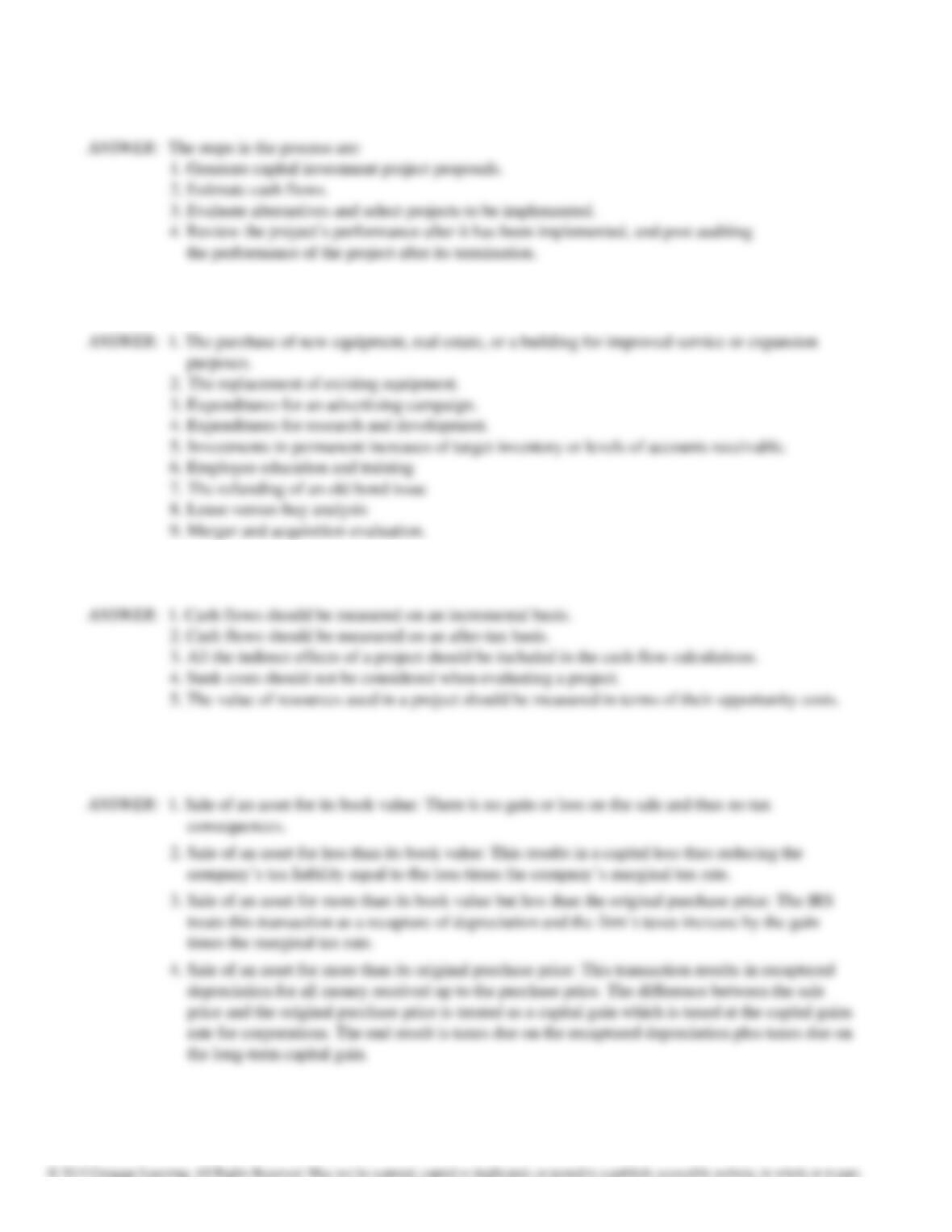
84. List the steps that a firm uses in the capital budgeting process:
85. What are some of the different outlays that may be classified as capital expenditures?
86. What are the principles that should be applied when estimating cash flows for capital budgeting purposes?
87. There are four ways tax consequences may affect the after-tax net proceeds received from the sale of an asset.
Describe the four ways and the tax impact.
Chapter 9: Capital Budgeting and Cash Flow Analysis
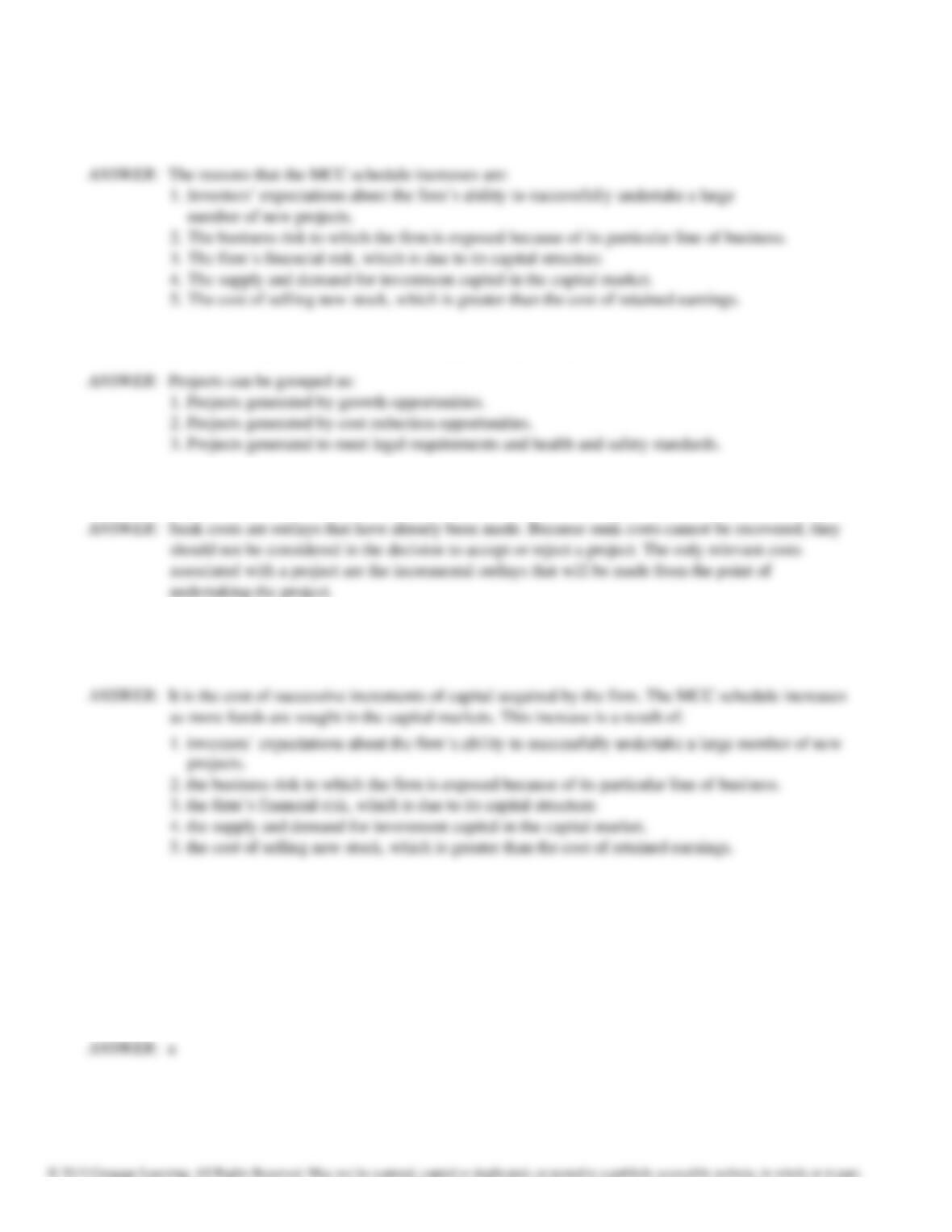
88. List the reasons that the marginal cost of capital schedule increases as more funds are sought in the capital
markets.
89. In classifying investment projects, there are several types of capital expenditures. List them.
90. Why should sunk costs not be considered when evaluating a project?
91. What is the marginal cost of capital and why does the MCC schedule increase as more funds are sought in the
capital markets?
92. Most existing products become obsolete. For a firm to continue to grow they must do all of the following
EXCEPT:
a. move all production to the firm’s existing facilities for economies of scale
b. generate research and development investment proposals
c. invest in marketing research
d. invest in new plants
93. Projects that begin with an initial investment and then is expected to generate a stream of cash inflows is
considered:
a. a contingent project
b. a nonconventional project
c. a normal project
d. a non-normal project
94. What type of tax consequence is associated with the recovery of net working capital?
a. A firm must pay tax and a penalty.
b. There is no tax consequence
c. The firm must pay capital gains tax
d. The firm must pay ordinary income tax
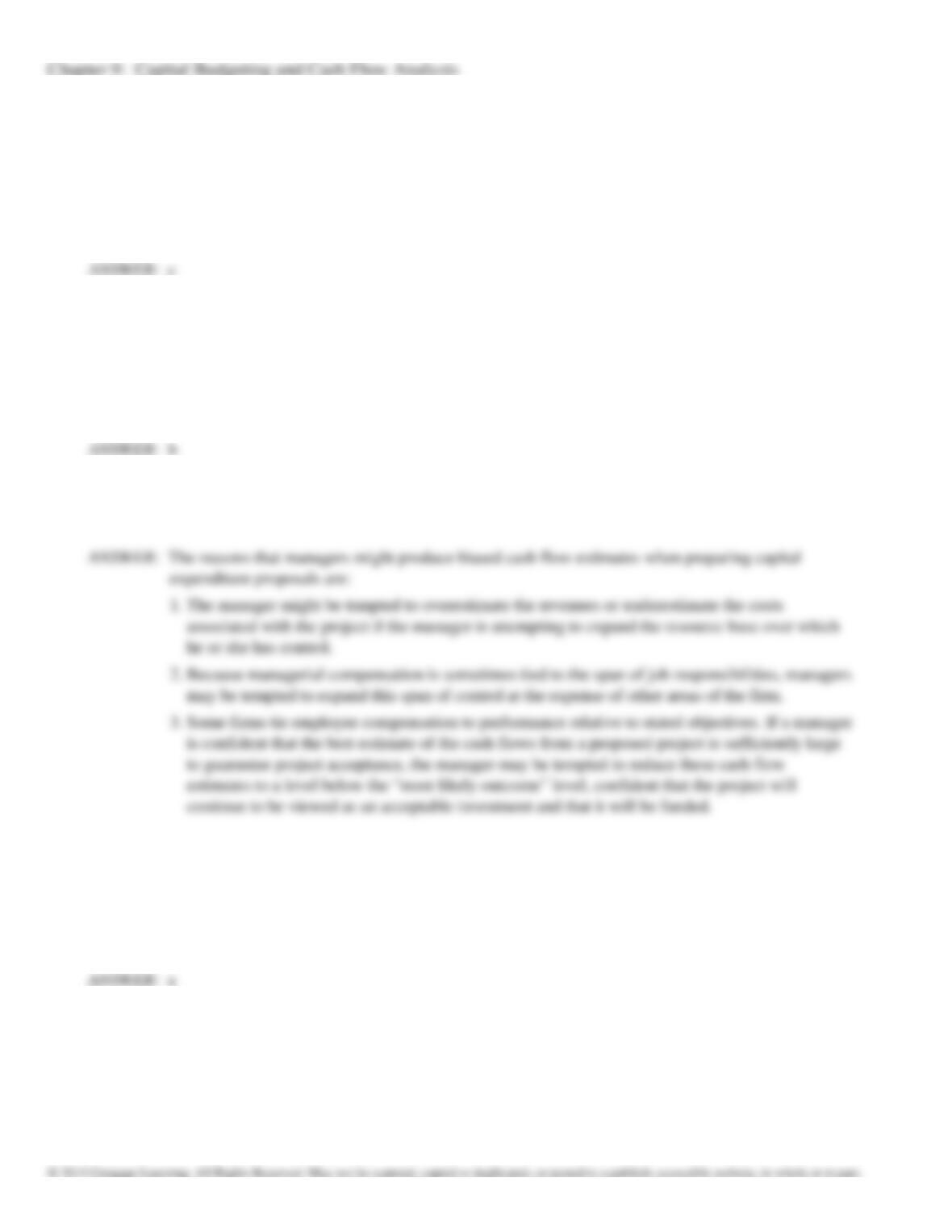
95. There are several reasons why managers might produce biased cash flow estimates when preparing capital
expenditure project proposals. List some of them.
96. A conventional project can also be considered:
a. a normal project
b. a project that has both positive and negative cash flow patterns
c. one that has a high required rate of return
d. non-normal project