114) If X – M = $0 and the government sector has a deficit of $250 billion, the private sector
A) has a deficit that equals $250 billion.
B) has a deficit that equals $500 billion.
C) has a surplus that equals $250 billion.
D) has a surplus that equals $500 billion.
115) If net exports is 100 and the private sector balance is 150, then the government sector
balance is
A) -50.
B) 50.
C) 250.
D) 0.
116) Suppose U.S. net exports are -$400 billion and the U.S. government sector surplus is $200
billion. Then in the private sector, saving minus investment equals
A) -$600 billion.
B) -$200 billion.
C) +$600 billion.
D) +$200 billion.
117) If the government sector is running a deficit of $120 million and the private sector is
running a surplus of $200 million, then net exports equal
A) $80 million surplus.
B) $320 million surplus.
C) $80 million deficit.
D) $320 million deficit.
118) Hong Kong has imports of $1,130 billion and exports of $1,255 billion. Hong Kong
definitely has ________.
A) negative net exports of $125 billion
B) positive net exports of $125 billion
C) a government budget surplus
D) Both answers B and C are correct.
119) On the island country of Sunshine where the unit of currency is fish, net exports are 50 fish,
saving is 250 fish, net taxes are 100 fish, and the government budget deficit is 175 fish. What is
the value of investment?
A) 375 fish
B) -375 fish
C) 25 fish
D) -25 fish
120) On the island country of Sunshine where the unit of currency is fish, net exports are 50 fish,
saving is 250 fish, net taxes are 100 fish, and the government budget deficit is 175 fish. The
private sector has a ________.
A) deficit of 125 fish
B) surplus of 125 fish
C) deficit of 225 fish
D) surplus of 225 fish
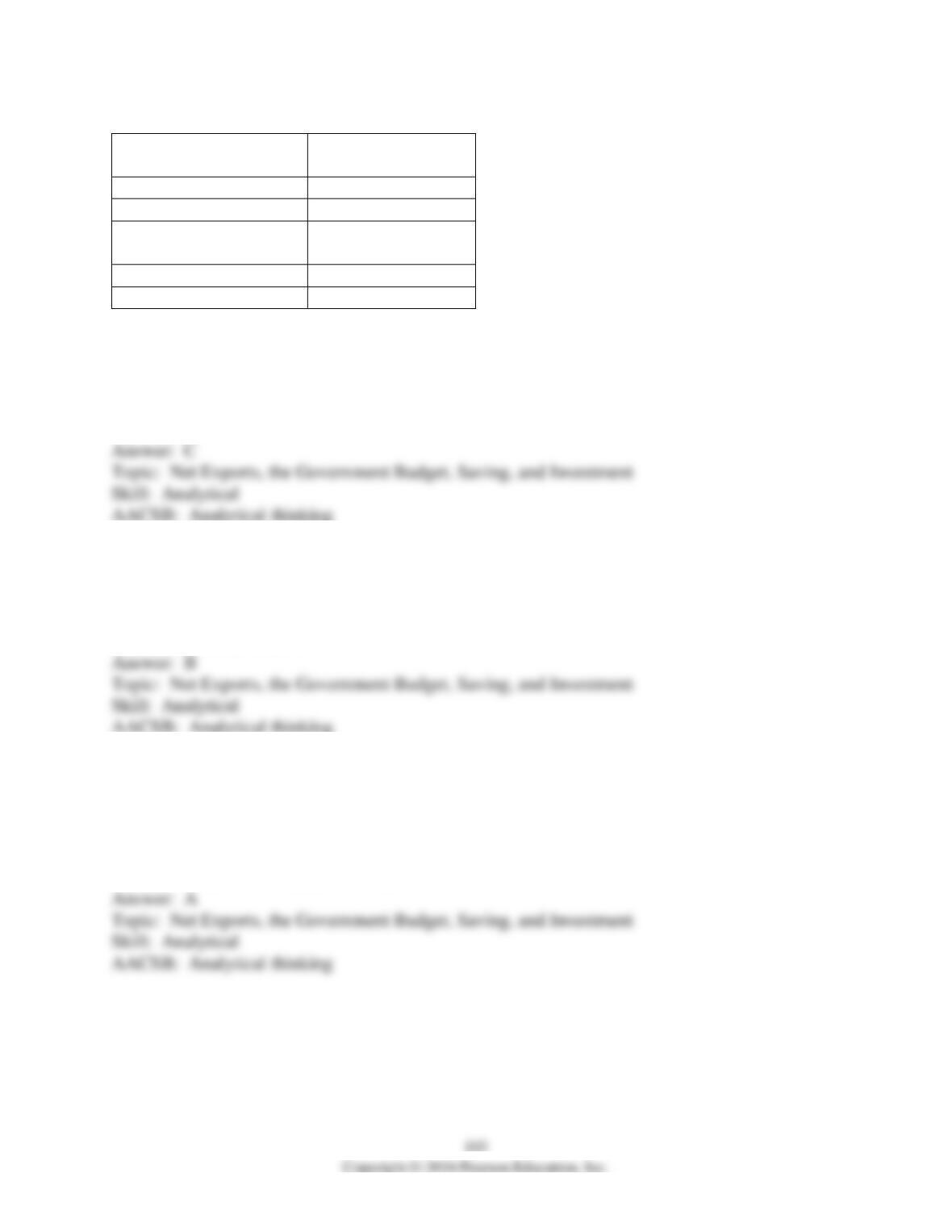
Component
Amount
(billions of dollars)
Investment, I
700
Net taxes, T
1,300
Government expenditure,
G
1,200
Exports, X
1,500
Imports, M
1,700
121) In the above table, the government sector balance is a
A) surplus of $200 billion.
B) deficit of $200 billion.
C) surplus of $100 billion.
D) deficit of $100 billion.
122) In the above table, net exports equal a
A) surplus of $200 billion.
B) deficit of $200 billion.
C) surplus of $100 billion.
D) deficit of $100 billion.
123) In the above table, the government sector balance runs a ________ and net exports runs a
________.
A) surplus of $100 billion; deficit of $200 billion
B) deficit of $100 billion; surplus of $200 billion
C) surplus of $100 billion; surplus of $200 billion
D) deficit of $100 billion; deficit of $200 billion
124) In the above table, the private sector has a
A) surplus of $300 billion.
B) deficit of $300 billion.
C) deficit of $200 billion.
D) deficit of $400 billion.
125) In the above table, saving must be
A) -$300 billion.
B) $300 billion.
C) $400 billion.
D) -$400 billion.
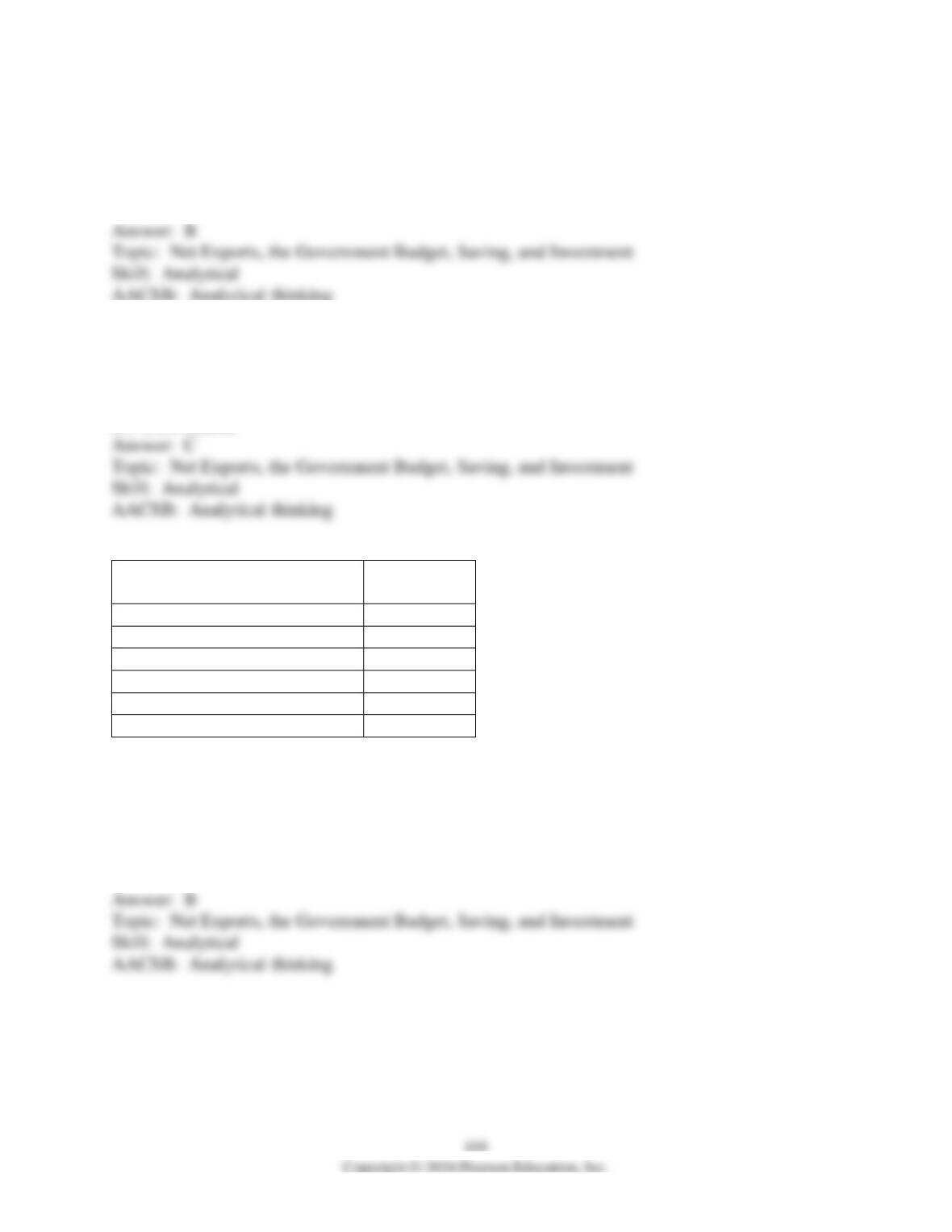
Item
Billions of
dollars
Exports of goods and services, X
500
Imports of goods and services, M
Net taxes, T
750
Government expenditure, G
Saving, S
1,000
Investment, I
126) In the above table, suppose imports = $750 billion and government expenditures = $1,000
billion. Hence investment equals
A) -$500 billion.
B) $1,000 billion.
C) $500 billion.
D) $0.
127) Using the data in the above table, suppose imports equal $250 billion and investment equals
$1,000 billion. Hence government expenditure equals
A) $1,000 billion.
B) $750 billion.
C) $500 billion.
D) $250 billion.
128) Using the data in the above table, if the private sector runs a surplus of $250 billion, imports
will equal $1,000 billion if
A) government expenditure equals -$750 billion.
B) investment equals -$1000 billion.
C) government expenditure equals -$1000 billion.
D) the government sector runs a deficit of $750 billion.
Item
Billions of
dollars
Exports of goods and services, X
Imports of goods and services, M
1,000
Net taxes, T
Government expenditure, G
1,300
Saving, S
Investment, I
650
129) Using the data in the above table, if exports = $1,150 billion and the private sector runs a
surplus of $300 billion, the government sector will run
A) a surplus of $150 billion.
B) a surplus of $450 billion.
C) a deficit of $150 billion.
D) a deficit of $450 billion.
130) Using the data in the above table, if the government sector runs a deficit of $250 billion and
net exports equal -$500 billion, then saving must equal
A) $450 billion.
B) $250 billion.
C) $1,350 billion.
D) $400 billion.
131) Using the data in the above table, if net exports = -$500 billion and the government
balances its budget, then
A) the private sector must balance its budget.
B) savings must equal $150 billion.
C) the private sector runs a surplus of $850 billion.
D) saving must equal $650 billion.
132) Using the data in the above table, if saving equals $650 billion and exports are greater than
imports,
A) the government sector must run a deficit.
B) net taxes will be greater than $1300 billion.
C) net taxes will be less than $650 billion.
D) government expenditures must increase.
Item
Billions of dollars
Exports
234
Imports
277
Government
expenditure
887
Net taxes
855
Investment
760
Saving
749
133) The above table gives data for the nation of Sueland. What is the value of net exports?
A) $43 billion
B) $234 billion
C) -$43 billion
D) $511 billion
134) The above table gives data for the nation of Sueland. What is the government sector
balance?
A) $1,772 billion
B) $32 billion
C) -$43 billion
D) -$32 billion
135) The above table gives data for the nation of Sueland. What is the private sector balance?
A) $11 billion
B) -$11 billion
C) -$43 billion
D) $43 billion
Item
Billions of dollars
Imports of goods and services, M
275
Net taxes, T
300
Government expenditure, G
250
Savings, S
125
Investment, I
100
136) The table above gives some of the entries in the national income and product accounts. The
government sector has a ________, and the private sector has a ________.
A) surplus of $50 billion; surplus of $25 billion
B) deficit of $50 billion; surplus of $25 billion
C) surplus of $50 billion; deficit of $25 billion
D) deficit of $50 billion; deficit of $25 billion
137) The table above gives some of the entries in the national income and product accounts.
What is the value of exports?
A) $350 billion
B) $300 billion
C) -$25 billion
D) $25 billion
Item
Dollars
Exports
500
Imports
400
Government sector
surplus
250
Private sector deficit
-150
138) The above table describes the accounts for the country of Pacifica. Using this information,
net exports for Pacifica equals
A) $100.
B) $900.
C) -$100.
D) $650.
139) In the United States -since 1981– which two of the following have almost always moved in
the same direction?
A) net exports and the government sector balance
B) net exports and the private sector balance
C) the government sector balance and the private sector balance
D) none of the above
140) Which of the following is one of the balance of payments accounts?
A) government expenditure account
B) capital and financial account
C) reserve account
D) net borrowing account
141) Suppose the United States initially has a trade deficit. Then U.S. firms increase their
imports from Canada, financing that increase by borrowing from Canada. The current account
deficit is now ________ and the capital and financial account surplus is now ________.
A) larger; larger
B) larger; smaller
C) smaller; larger
D) smaller; smaller
Component
Amount
(billions of dollars)
Government expenditure, G
700
Net taxes, T
600
Investment, I
350
Savings, S
500
142) In the table above, what is the government’s sector balance?
A) a deficit of $700 billion
B) a surplus of $600 billion
C) a deficit of $100 billion
D) a surplus of #100 billion
143) In the table above, what does the private sector surplus equal?
A) $500 billion
B) $350 billion
C) $150 billion
D) $0
144) In the table above, what do net exports equal?
A) a deficit of $700 billion
B) a deficit of $350 billion
C) a surplus of $50 billion
5 News Based Questions
1) When the U.S. government buys aircraft from BAe, a British corporation, it pays for them
using
A) euros.
B) pounds.
C) dollars.
D) foreign exchange rates.
2) In 2007, the U.S. sold $73 million of cigarettes to Iran. Iran paid for these cigarettes using
A) dollars.
B) rials, the Iranian currency.
C) euros.
D) pounds.
3) In July 2008, a British pound could buy $2. By October 2008, a pound could buy $1.55. Over
the four months, the
A) pound depreciated against the dollar.
B) the real exchange rate did not change.
C) pound appreciated against the dollar.
D) the U.S. inflation rate increased.
4) In June 2008, $1 bought 0.5 pounds and in October, $1 bought 0.65 pounds. As a result of this
change, ________ between June and October.
A) the demand for dollars increased
B) the dollar appreciated and the quantity of dollars demanded decreased
C) the dollar depreciated and the quantity of dollars demanded decreased
D) the demand for dollars decreased
5) In June 2008, $1 bought 104 yen and in October, $1 bought 93 yen. This change means
A) U.S. exports became more expensive for Japanese buyers.
B) there will be a movement down along the demand curve for dollars.
C) there was an increase in the value in the dollar, relative to the yen.
D) the dollar appreciated relative to the yen.
6) In June 2008, the dollar bought 1.6 Brazilian reals and in October, the dollar bought 2.4 reals.
This resulted in a
A) a movement upward along the supply curve for dollars.
B) a movement downward along the supply curve for dollars.
C) rightward shift in the supply curve for dollars.
D) leftward shift in the supply curve for dollars.
7) In June 2008, the dollar bought 1.6 Brazilian reals and in October, the dollar bought 2.4 reals.
This resulted in a
A) a decrease in the quantity of dollars supplied.
B) an increase in the quantity of dollars supplied.
C) a rightward shift in the supply curve of dollars.
D) a depreciation of the dollar.
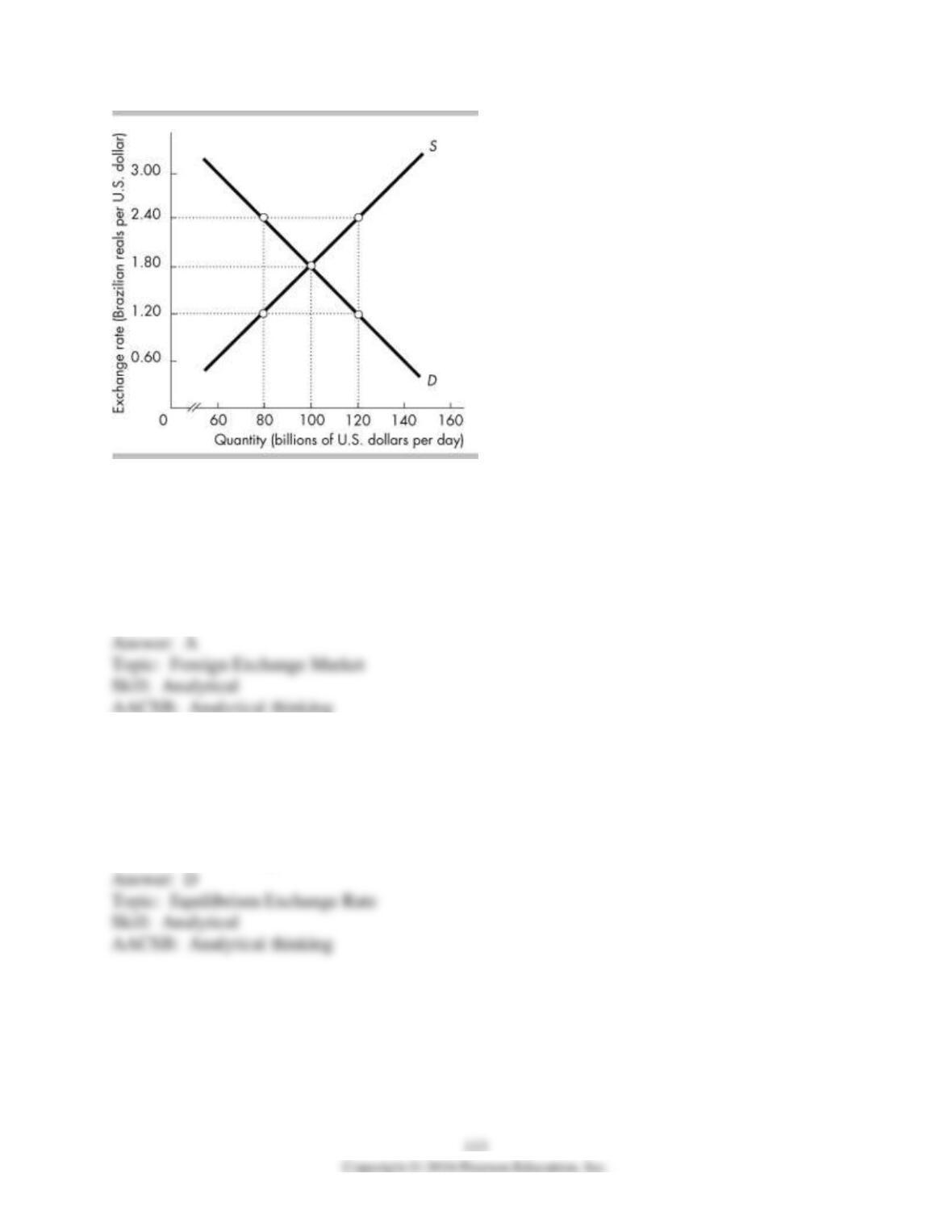
8) The figure above shows the demand and supply of dollars in the foreign exchange market. The
equilibrium in the market occurs at a price of ________ Brazilian reals per dollar and a quantity
of ________ billion dollars.
A) 2.0; 100
B) 2.4; 120
C) 1.6; 100
D) 100; 2.0
9) The figure above shows the demand and supply of dollars in the foreign exchange market. At
a price of 2.40 Brazilian reals per dollar
A) there will be a shortage of dollars.
B) $40 billion dollars will be demanded.
C) $40 billion dollars will be supplied.
D) there will be a surplus of dollars.
10) The figure above shows the demand and supply of dollars in the foreign exchange market. At
a price of 1.20 Brazilian reals per dollar
A) there will be a shortage of dollars.
B) $120 billion dollars will be supplied.
C) $40 billion dollars will be demanded.
D) there will be a surplus of dollars.
11) As a result of the 2008-2009 financial crisis and the decrease in GDP in many European
economies, we would expect
A) an increase in the demand for U.S. exports and a leftward shift in the demand curve for
dollars.
B) a decrease in the demand for U.S. exports and a leftward shift in the demand curve for dollars.
C) a decrease in the demand for U.S. exports and a rightward shift in the demand curve for
dollars.
D) a decrease in the demand for U.S. imports and a movement up along the demand curve for
dollars.
12) In October 2008, Iceland’s central bank increased its lending rate to 18% in an “effort to prop
up the country’s frozen current and markets.” (www.nytimes.com, October, 29, 2008)
As a result, the ________ curve for Icelandic krona shifted ________, holding all else the same.
A) supply; rightward
B) demand; rightward
C) demand; leftward
D) A and C are both correct.
13) In October 2008, Iceland’s central bank increased its lending rate to 18% in an “effort to prop
up the country’s frozen currency and markets.” (www.nytimes.com, October, 29, 2008)
As a result, the ________ and demand curve for Icelandic krona shifted ________, holding all
else the same.
A) interest rate differential between U.S. and Icelandic interest rates increased; rightward
B) interest rate differential between U.S. and Icelandic interest rates decreased; leftward
C) dollar appreciated relative to the krona; rightward
D) value of U.S. exports to Iceland increased; leftward
14) In October 2008, Iceland’s central bank increased its lending rate to 18% in an “effort to prop
up the country’s frozen current and markets.” (www.nytimes.com, October, 29, 2008)
As a result, there was ________, holding all else the same.
A) a movement upward along the supply curve for krona
B) a leftward shift in the supply curve for krona
C) a rightward shift in the supply curve for krona
D) an increase in the quantity supplied of krona
15) In late 2010 the National Bank of Australia offered a 4 percent interest rate on a savings
account while Bank of America offered 2 percent. This difference means that
A) people expect the U.S. dollar to appreciate to 8 percent against the Australian dollar and
interest rate parity to occur.
B) there will be a surplus of U.S. dollars in the foreign exchange market.
C) people expect the U.S. dollar to appreciate by 2 percent against the Australian dollar and
interest rate parity to occur.
D) there will be a shortage of Australian dollars in the foreign exchange markets.
16) On www.yodobashi.com, you can buy a Canon EOS camera for 298,000 yen. The same
camera costs $2700 on www.calumetphoto.com. If the exchange rate is ________ yen per dollar,
we can determine ________ for this camera.
A) 92; interest rate parity doesn’t occur
B) 92; purchasing power parity occurs
C) 110; interest rate parity occurs
D) 110; purchasing power parity occurs
17) In 2009, Germany’s capital account was -$135 million. This implies that
A) Germany invested more in other countries than those countries invested in Germany.
B) Germany’s currency must have appreciated during 2009.
C) Germany imported more goods from its trading partners than it exported.
D) Germany’s official settlements account in 2009 must have been positive.
18) In 2007, Japan reported that its overseas assets totaled more than $4.6 trillion. This implies
that Japan
A) is debtor nation.
B) has a current account deficit.
C) has a capital account deficit.
D) is a creditor nation.
19) Over a month in late 2008, the Federal Reserve Bank reduced the interest rate by 1
percentage point. Given that the United States operates under a ________ exchange rate regimes,
the primary purpose of these changes was ________ exchange rate of each currency.
A) flexible; not designed to influence
B) flexible; designed to influence
C) fixed; designed to influence
D) fixed; not designed to influence
6 Essay Questions
1) Give an example of currency depreciation and appreciation.
2) In the foreign exchange market, what factor leads to a movement along the demand curve for
dollars?
3) In the foreign exchange market, how does the quantity of U.S. dollars demanded respond to a
change in the U.S. exchange rate? Why is there this response?
4) In the foreign exchange market, how does each of the following influences affect the demand
for dollars and the demand curve for dollars?
a) an increase in the exchange rate.
b) an increase in the U.S. interest rate.
c) a fall in the expected future exchange rate.
5) Name three factors in the foreign exchange market that affect either the quantity of dollars
demanded or the demand for dollars. Discuss whether the factor increases or decreases the
number of dollars people want to hold.
6) Explain the effect on the demand for dollars in the foreign exchange market of an increase in
the U.S. interest rate differential.
7) In the foreign exchange market, how does a change in the expected future U.S. exchange rate
affect the demand for dollars?
8) Why do people and firms in the United States supply dollars to the foreign exchange market?
9) In the foreign exchange market, how does a fall in the U.S. interest rate affect the supply of
dollars?
10) In the foreign exchange market, how does a change in expected future U.S. exchange rate
affect the supply of dollars?
11) “In the foreign exchange market, if the demand for the U.S. dollar increases, the U.S. dollar
appreciates in value.” Briefly explain whether the previous statement is correct or incorrect.