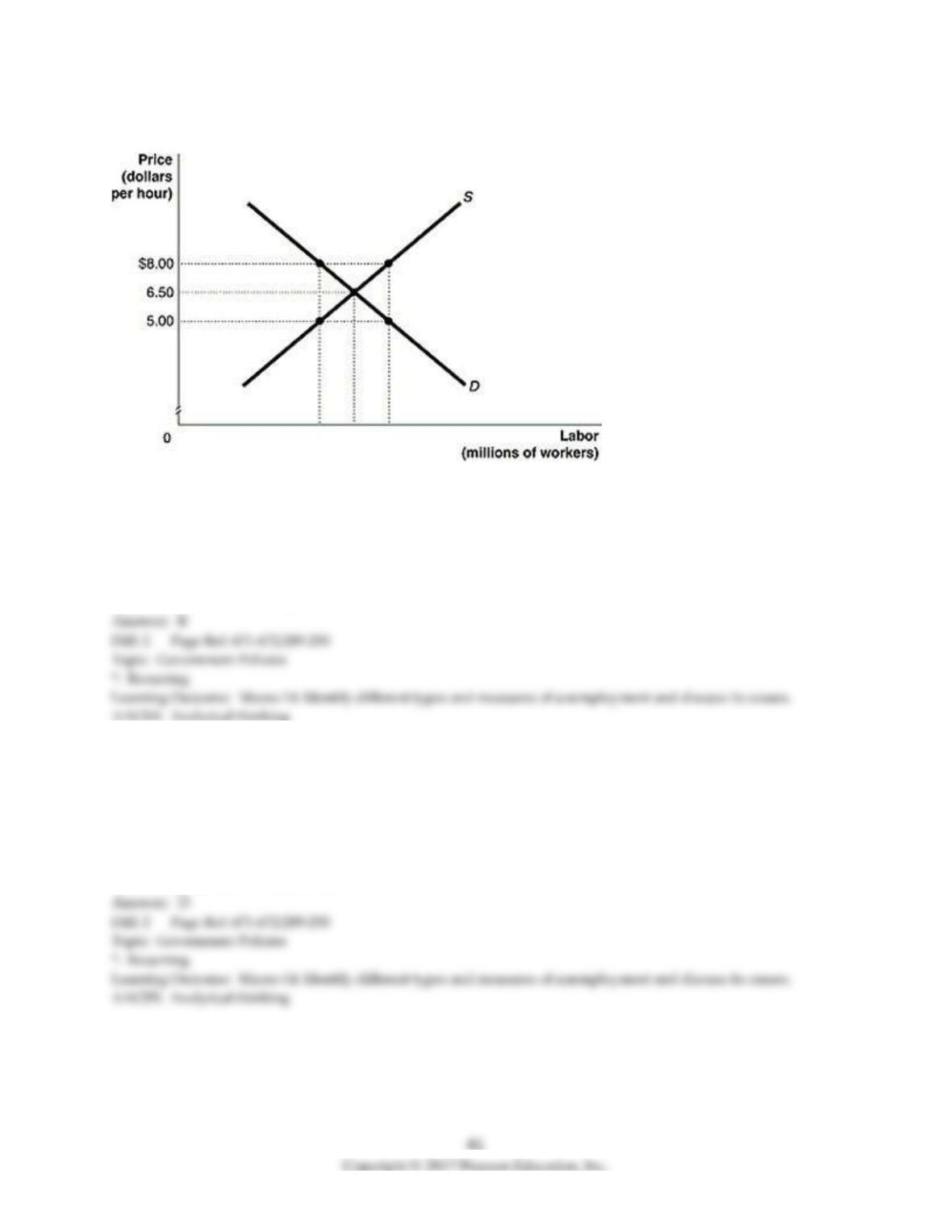
Figure 9-1
23) Refer to Figure 9-1. Based on the graph of the labor market above, if a minimum wage of $8 per hour
is imposed, which of the following will result?
A) The quantity of labor demanded by firms will rise.
B) The quantity of labor demanded by firms will fall.
C) The unemployment rate will fall.
D) Both A and C will occur.
24) Refer to Figure 9-1. Based on the graph of the labor market above, if a minimum wage is set at $5 per
hour, which of the following will occur?
A) The unemployment rate will rise.
B) The unemployment rate will fall.
C) The level of unemployment will rise, but the percentage of the labor force unemployed will not
change.
D) None of the above will occur.
25) Labor unions cause unemployment because the union contract wage is set
A) below the market wage, causing a shortage of labor.
B) below the market wage, causing a surplus of labor.
C) above the market wage, causing a surplus of labor.
D) above the market wage, causing a shortage of labor.
26) The unemployment rate in the United States is typically lower than in Western Europe because the
United States has tougher requirements for the unemployed to receive government payments.
27) Most economists believe that labor unions significantly increase the overall unemployment rate in
the United States.
28) Efficiency wage is another name for the minimum wage.
29) The unemployment rate tends to be higher in the European Union as compared to the United States.
30) The unemployment rate is higher with a minimum wage law than it would be without a minimum
wage law.
31) Paying efficiency wages are a way for a company to cut costs and become more efficient, and are
therefore lower than market wages.
32) What effect does the payment of government unemployment insurance have on the unemployment
rate?
33) Why would a firm pay efficiency wages?
34) Discuss the likely impact of each of the following on the unemployment rate:
a. The length of time workers are eligible to receive unemployment insurance payments is cut in half.
b. The government passes a law making labor unions illegal.
c. The minimum wage is raised by 50 percent.
d. The government funds an Internet site where companies can post job openings at no charge.
35) What are some reasons why the unemployment rate is typically lower in the United States as
compared to Canada and some Western European countries?
9.4 Measuring Inflation
1) The average price of goods and services in the economy is also known as
A) the price level.
B) the inflation rate.
C) a market basket.
D) the cost of living.
2) If the price level rose in three consecutive years from 100 to 120 to 140, then the annual inflation rate
over those years would
A) increase.
B) remain the same.
C) decrease.
D) equal 20%.
3) Which of the following is true about the consumer price index?
A) It accounts for people switching to goods whose prices have fallen.
B) It assumes that consumers purchase the same amount of each product in the market basket each
month.
C) It frequently updates the price changes of new products added to the market basket, as these have a
tendency to fall.
D) It filters out the part of price increases that occurs because of quality improvements in products.
4) Which of the following price indices comes closest to measuring the cost of living of the typical
household?
A) GDP deflator
B) producer price index
C) consumer price index
D) household price index
5) Which of the following would be the best measure of the cost of living?
A) real GDP
B) real GDP per person
C) GDP deflator
D) consumer price index
6) The consumer price index is the
A) cost of a market basket of goods and services typically consumed in the base year.
B) cost of a market basket of goods and services typically consumed in the current period.
C) average of the prices of the goods and services purchased by a typical urban family of four.
D) average of the prices of new final goods and services produced in the economy over a period of time.
Table 9-2
Base Year (2011) 2016
Product
Quantity
Price
Price
Milk
50
$1.20
$1.50
Bread
100
1.00
1.10
7) Refer to Table 9-2. Assume the market basket for the consumer price index has two products —
bread and milk — with the following values in 2011 and 2016 for price and quantity: The Consumer
Price Index for 2016 equals
A) 118.
B) 116.
C) 86.
D) 85.
Table 9-3
Base Year (2011) 2016
Product
Quantity
Price
Price
Cokes
100
$0.50
$0.75
Hamburgers
200
2.00
2.50
CDs
10
20.00
21.00
8) Refer to Table 9-3. Assume the market basket for the consumer price index has three products —
Cokes, hamburgers, and CDs — with the following values in 2011 and 2016 for price and quantity: The
Consumer Price Index for 2016 equals
A) 75.
B) 93.
C) 108.
D) 121.
Table 9-4
Base Year (2011) 2016
Product
Quantity
Price
Quantity
Price
Meat
100
$10
120
$12
Potatoes
200
2
180
3
9) Refer to Table 9-4. Assume the market basket for the consumer price index has two products — meat
and potatoes — with the following values in 2011 and 2016 for price and quantity: The Consumer Price
Index for 2016 equals
A) 125.
B) 129.
C) 135.
D) 141.
10) The percent increase in the CPI from one year to the next is a measure of the
A) GDP deflator.
B) unemployment rate.
C) real interest rate.
D) inflation rate.
11) Assume the average annual CPI values for 2015 and 2016 were 207.3 and 215.3, respectively. What
was the percent increase in the CPI between these two years?
A) 0.96
B) 1.04
C) 3.86
D) 8.0
12) A consumer price index of 160 in 1996 with a base year of 1982-1984 would mean that the cost of the
market basket
A) equaled $160 in 1996.
B) equaled $160 in 1983.
C) rose 160% from the cost of the market basket in the base year.
D) rose 60% from the cost of the market basket in the base year.
Table 9-5
Year
CPI
2015
207
2016
215
13) Refer to Table 9-5. Consider the following values of the consumer price index for 2015 and 2016.
The inflation rate for 2016 was equal to
A) 215 percent.
B) 21.5 percent.
C) 8.0 percent.
D) 3.9 percent.
Table 9-6
Year
CPI
1996
157
1997
161
1998
163
14) Refer to Table 9-6. Consider the following values of the consumer price index for 1996, 1997, and
1998: The inflation rate for 1997 was equal to
A) 1.2 percent.
B) 2.0 percent.
C) 2.5 percent.
D) 4.0 percent.
15) Your grandfather tells you that he earned $7,000/year in his first job in 1961. You earn $35,000/year
in your first job in 2016. You know that average prices have risen steadily since 1961. You earn
A) 5 times as much as your grandfather in terms of real income.
B) more than 5 times as much as your grandfather in terms of real income.
C) less than 5 times as much as your grandfather in terms of real income.
D) less than 5 times as much as your grandfather in terms of nominal income.
16) If we want to use a measure of inflation that foreshadows price changes before they affect prices at
the retail level, we would base our measure of inflation on
A) the producer price index.
B) the consumer price index.
C) the GDP deflator.
D) the household price index.
17) The substitution bias in the consumer price index refers to the idea that consumers ________ the
quantity of products they buy in response to price, and the CPI does not reflect this and ________ the
cost of the market basket.
A) change; overestimates
B) change; underestimates
C) do not change; overestimates
D) do not change; underestimates
18) The increase in quality bias in the consumer price index refers to the idea that price increases in the
CPI reflect pure inflation, but ________ quality increases. This causes the CPI to ________ the cost of the
market basket.
A) also; understate
B) also; overstate
C) not; understate
D) not; overstate
19) The “new product bias” in the consumer price index refers to the idea that
A) consumers switch to new goods when the prices of old goods increase, and the CPI overestimates the
cost to consumers.
B) consumers switch to old goods when the prices of new goods increase, and the CPI underestimates
the cost to consumers.
C) consumers prefer new goods, even if they are worse in quality than old goods, and this causes the
CPI to underestimate the cost to consumers.
D) new products’ prices often decrease after their initial introduction, and the CPI is adjusted
infrequently and overestimates the cost to consumers.
20) The consumer price index implicitly assumes that the demand curve for each good and service in
the representative market basket is
A) positively sloped.
B) negatively sloped.
C) vertical.
D) horizontal.
21) Most economists believe that the biases in the consumer price index cause the CPI to overstate the
true inflation rate by about
A) one-half to one percentage point.
B) one to two percentage points.
C) one quarter percentage point.
D) one and one-half percentage points.
22) Which of the following would be a consequence of substitution bias in the CPI?
A) Social Security payments would not adequately compensate retired workers for inflation.
B) Businesses would overcompensate employees for inflation when giving cost of living raises.
C) The inflation rate based on the CPI would underestimate the true level of inflation.
D) Judges would award child support payments that would not adequately keep up with the true cost
of inflation.
23) To reduce the bias in the consumer price index, the Bureau of Labor Statistics
A) updates the market basket every two years, rather than every 10 years.
B) updates the market basket every 10 years, rather than every two years.
C) incorporates substitutions by consumers when prices of specific products rise rapidly.
D) incorporates substitutions by consumers when prices of specific products fall rapidly.
24) The Bureau of Labor Statistics has taken several steps to reduce the bias in the consumer price index.
Which of the following is not one of the steps taken to reduce the bias?
A) using statistical methods to reduce the size of the quality bias
B) updating the market basket every two years, rather than every 10 years
C) incorporating substitutions by consumers when prices of specific products rise rapidly
D) conducting a point-of-purchase survey to track where consumers actually make their purchases
25) The producer price index measures the prices that firms
A) pay for imported natural resources that go into the production process.
B) receive for the goods and services they export.
C) receive for the goods and services they use at all stages of production.
D) pay for labor, whether or not the labor is foreign or domestic.
26) The broadest measure of the price level that includes all final goods and services is
A) the producer price index.
B) the consumer price index.
C) the GDP deflator.
D) the wholesale price index.
27) The most widely used measure of inflation is based on which of the following price indices?
A) the producer price index
B) the consumer price index
C) the GDP deflator
D) the wholesale price index
28) The CPI is also referred to as
A) the GDP deflator.
B) the inflation-consumption index.
C) the cost-of-living index.
D) the producer price index.
29) Which of the following is the smallest portion of the market basket of goods that makes up the CPI?
A) housing
B) food and beverages
C) transportation
D) apparel
Table 9-7
Year
CPI
(1982-1984 = 100)
2015
175
2016
180
30) Refer to Table 9-7. Suppose that the data in the table above reflect price levels in the economy. What
is the inflation rate between 2015 and 2016?
A) 2.9%
B) 3.5%
C) 4.6%
D) 5%
E) 7.5%
Table 9-8
Year
CPI
(1982-1984 =100)
2015
100
2016
120
31) Refer to Table 9-8. Suppose that the data in the table above reflect the price levels in the economy.
What is the inflation rate in between 2015 and 2016?
A) 2%
B) 5%
C) 10%
D) 12%
Table 9-9
Year
CPI
(1982-1984 =100)
2015
100
2016
113
32) Refer to Table 9-9. Suppose that the data in the table above reflect the price levels in the economy.
Given that data, we can say that the cost of living rose by ________ between 2015 and 2016?
A) 2%
B) 5%
C) 8%
D) 11%
E) 13%
33) Monthly expenditures for a family of 4 in 2015 averaged $1,400. In 2016, the cost of the same
purchases was $1,500. If 2015 is the base year, what was the CPI in 2016?
A) 110
B) 107
C) 100
D) 93
34) If the CPI changes from 125 to 120 between 2015 and 2016, how did prices change between 2015 and
2016?
A) Prices increased by 5%.
B) Prices decreased by 5%
C) Prices increased by 25%.
D) Prices decreased by 4%.
35) Which of the following describes the accuracy of the Consumer Price Index?
A) Changes in the CPI accurately reflect the true rate of inflation.
B) Changes in the CPI understate the true rate of inflation.
C) Changes in the CPI overstate the true rate of inflation.
D) Changes in the CPI are unrelated to the true rate of inflation.
36) If the CPI rises from 206.7 to 212.7 between two consecutive years, by how much has the cost of
living changed between these two years?
A) The cost of living has increased by 6%.
B) The cost of living has increased by 2.9%.
C) The cost of living has increased by 12.7%.
D) The cost of living has decreased by 6%.
57
37) If consumers purchase fewer of those products that increase most in price and more of those
products that decrease in price as compared to the CPI basket, then
A) changes in the CPI accurately reflect the true rate of inflation.
B) changes in the CPI understate the true rate of inflation.
C) changes in the CPI overstate the true rate of inflation.
D) changes in the CPI are unrelated to the true rate of inflation.
38) Most economists believe that biases cause changes in the CPI to overstate the inflation rate by
________ percentage points.
A) 0.1 to 0.2
B) 0.2 to 2.0
C) 0.4
D) 0.5 to 1.0
E) 1.0 to 3.0
39) The formula for calculating the CPI is
A) (Expenditures in the current year/Expenditures in the base year) × 100.
B) (Expenditures in the current year × Expenditures in the base year)/100.
C) (Expenditures in the base year/Expenditures in the current year).
D) (Expenditures in the base year × 100)/(Expenditures in the current year).
40) When the price of gasoline rises, some consumers begin riding their bikes more frequently or riding
the bus instead of driving their cars. The fact that the CPI does not fully account for such changes in
consumer behavior is called
A) outlet bias.
B) increase in quality bias.
C) substitution bias.
D) discrimination bias.
41) The base period for CPI calculations is generally 1982-84. In 2005, 50% of households accessed the
Internet through a broadband connection that would not have existed in the 1980s. This potential for
bias in the CPI is referred to as ________ bias and results in ________.
A) outlet; the CPI underestimating the true change in the cost of living
B) new product; the CPI overestimating the true change in the cost of living
C) outlet; the CPI overestimating the true change in the cost of living
D) net product; the CPI underestimating the true change in the cost of living
42) What is outlet bias?
A) the tendency for households to spend more money over time
B) the tendency for households to spend their money at discount stores as prices rise
C) the tendency for the quality of products to improve over time even though the CPI does not measure
changes in quality
D) the tendency for consumers to purchase newer, more technologically advanced products even
though they have higher prices
43) In 1986, an Apple IIe computer with 65 kilobytes of memory cost around $1,500. Today, a $1,500
iMac computer (also made by Apple) comes with 8 gigabytes of memory. This illustrates the potential
for what kind of bias in CPI calculations?
A) new product bias
B) increase in quality bias
C) substitution bias
D) outlet bias
Table 9-10
Product
Quantity
(2011)
Price (2011)
Expenditure
(2011)
Price
(2016)
Expenditure
(on base year
quantities)
(2016)
Computers
1
$1,200
$1,200
$900
$900
Books
10
25
250
30
300
Burgers
50
3
150
4
200
Total
$1,600
$1,400
44) Refer to Table 9-10. Suppose an economy has only three goods and the typical family purchases the
amounts given in the table above. If 2011 is the base year, then what is the CPI for 2016?
A) 14.3
B) 87.5
C) 114.3
D) 160
Table 9-11
Product
Quantity
(2011)
Price
(2011)
Expenditure
(2011)
Price
(2016)
Expenditure
(on base year
quantities)
(2016)
Hair cuts
6
$50
$300
$70
$420
Backpacks
4
25
100
30
120
Tacos
100
1
100
5
500
Total
$500
$1,040
45) Refer to Table 9-11. Suppose an economy has only three goods and the typical family purchases the
amounts given in the table above. If 2011 is the base year, then what is the CPI for 2016?
A) 40.08
B) 100
C) 180
D) 208
46) The PPI is the
A) price parity index.
B) prime producer index.
C) producer price index.
D) production performance indicator.
47) What does the PPI measure?
A) the average change in the prices paid for all goods produced in the economy over a given year
B) the average of the prices received by producers of goods and services at all stages of the production
process
C) the level of production of goods and services generated in the economy in a given year
D) the difference between the prices consumers pay for goods and services and the prices producers
pay for goods and services