Macroeconomics, 12e (Parkin)
Chapter 9 The Exchange Rate and the Balance of Payments
1 The Foreign Exchange Market
1) The term “foreign currency” refers to foreign
I. coins
II. notes
III. bank deposits
A) II only
B) II and III only
C) I and II only
D) I, II, and III
2) If portable disk players made in China are imported into the United States, the Chinese
manufacturer is paid with
A) dollars.
B) yuan, the Chinese currency.
C) international monetary credits.
D) euros, or any other third currency.
3) If the United States sells beef to Japan, the U.S. beef producer is paid with
A) dollars.
B) yen, the Japanese currency.
C) international monetary credits.
D) euros, or any other third currency.
4) When Safeway supermarkets in the United States buys strawberries from Mexico
A) it uses dollars to pay Mexican farmers.
B) it uses pesos to pay Mexican farmers.
C) it may use any currency it chooses.
D) the transaction shows up in the U.S. capital account.
5) Americans demand Japanese yen in order to
A) buy Japanese products.
B) supply American goods in Japanese markets.
C) allow the Japanese to buy U.S. products.
D) balance the current account.
6) Which of the following statements is CORRECT?
I. The exchange rate is a price.
II. The exchange rate is different from other prices because it is NOT determined by supply and
demand.
A) only I
B) only II
C) I and II
D) neither I nor II
7) The exchange rate is the
A) opportunity cost of pursuing a nation’s comparative advantage.
B) price of one country’s currency expressed in terms of another country’s currency.
C) ratio between imports and exports.
D) interest rate that is charged on risk-free international capital flow.
8) The exchange rate is the price at which the ________ of one country exchanges for the
________ of another country.
A) currency; goods
B) goods; goods
C) currency; currency
D) currency; financial instruments
9) A decrease in the value of a currency in terms of other currencies is known as
A) an appreciation.
B) a depreciation.
C) a par value.
D) a gold point.
10) When the value of one currency falls relative to another currency, the exchange rate for the
first currency has
A) depreciated.
B) appreciated.
C) demanded.
D) revalued.
11) By definition, currency depreciation occurs when the value of
A) all currencies fall relative to gold.
B) one currency falls relative to another currency.
C) one currency rises relative to another currency.
D) gold falls relative to the value of currencies.
12) Suppose that the exchange rate between the dollar and the peso changed from 6 pesos per
dollar to 8 pesos per dollar. This change means that the
A) peso appreciated.
B) dollar depreciated.
C) peso depreciated.
D) Both answers A and B are correct.
13) If the dollar’s value changes from 120 yen per dollar to 110 yen per dollar, the dollar has
A) depreciated.
B) appreciated.
C) demanded.
D) devalued.
14) Which of the following examples definitely illustrates a depreciation of the U.S. dollar?
A) The dollar exchanges for 120 euros and then exchanges for 100 euros.
B) The dollar exchanges for 100 euros and then exchanges for 110 euros.
C) The dollar exchanges for 275 euros and then exchanges for 250 yen.
D) The dollar exchanges for 250 yen and then exchanges for 275 euros.
15) When the U.S. dollar depreciates against the yen, the yen becomes ________ expensive and
the U.S. exchange rate ________.
A) more; rises
B) less; rises
C) more; falls
D) less; falls
16) When the U.S. dollar depreciates against the yen, the yen ________ and the exchange rate
________.
A) appreciates; rises
B) depreciates; rises
C) appreciates; falls
D) depreciates; falls
17) Last year the exchange rate between U.S. dollars and Mexican pesos was 10 pesos per dollar.
Today is it 11 pesos per dollar. Here, the dollar ________ against the peso, and the peso
________ against the dollar
A) appreciated; depreciated
B) depreciated; appreciated
C) appreciated; appreciated
D) depreciated; depreciated
18) Suppose the exchange rate of the U.S. dollar was 1.50 British pounds = $1.00 (U.S.) on
Wednesday, and on the following Monday the exchange rate was $0.75 (U.S.) = 1.00 British
pound. Which of the following best describes what happened between Wednesday and the
following Monday?
A) The U.S. dollar appreciated against the British pound.
B) The British pound appreciated against the U.S. dollar.
C) The U.S. dollar depreciated against the British pound.
D) Both answers B and C are correct.
19) An increase in the value of a domestic currency in terms of other currencies is known as
A) an appreciation.
B) a depreciation.
C) a flexible exchange rate.
D) a term not given in the above answers.
20) Which of the following examples definitely illustrates an appreciation of the U.S. dollar?
A) The dollar exchanges for 120 euros and then exchanges for 100 euros.
B) The dollar exchanges for 100 yen and then exchanges for 125 euros.
C) The dollar exchanges for 1 pound and then exchanges for 1.2 pounds.
D) none of the above
21) Suppose the exchange rate of the U.S. dollar was 1.00 euro = $0.50 on Thursday, and on
Friday the exchange rate was $1.00 = 2.10 euros. Which of the following best explains what has
happened between Thursday and Friday?
A) The U.S. dollar appreciated against the euro.
B) The euro appreciated against the U.S. dollar.
C) The U.S. dollar depreciated against the euro.
D) Both answers B and C are correct.
22) If the pound-dollar exchange rate changes from £0.60 per dollar to £0.65 per dollar, then the
pound has ________ against the dollar and the dollar has ________ against the pound.
A) depreciated; depreciated
B) appreciated; depreciated
C) appreciated; appreciated
D) depreciated; appreciated
23) If 100 Japanese yen buy more U.S. dollars today than yesterday, the dollar has ________ and
the yen has ________.
A) depreciated; appreciated
B) appreciated; depreciated
C) depreciated; depreciated
D) appreciated; appreciated
24) If the value of a dollar rises in terms of yen, the dollar has ________ and the yen has
________.
A) appreciated; appreciated
B) appreciated; depreciated
C) depreciated; appreciated
D) depreciated; depreciated
25) If the Japanese yen was 123 per dollar and now it is 114 yen per dollar, it can be said that
A) the yen has appreciated against the dollar.
B) the yen has depreciated against the dollar.
C) the dollar has appreciated against the yen.
D) Both answers C and B are correct
26) If the exchange rate falls from 120 yen per dollar to 100 yen per dollar, the dollar has
________ and the yen has ________.
A) depreciated; appreciated
B) appreciated; depreciated
C) depreciated; depreciated
D) appreciated; appreciated
27) Suppose $1 buys 1.20 euros in January and then it buys 1.10 euros in the following
December. As a result
A) the dollar has appreciated.
B) the euro has appreciated.
C) the euro has depreciated.
D) both answers A and C are correct.
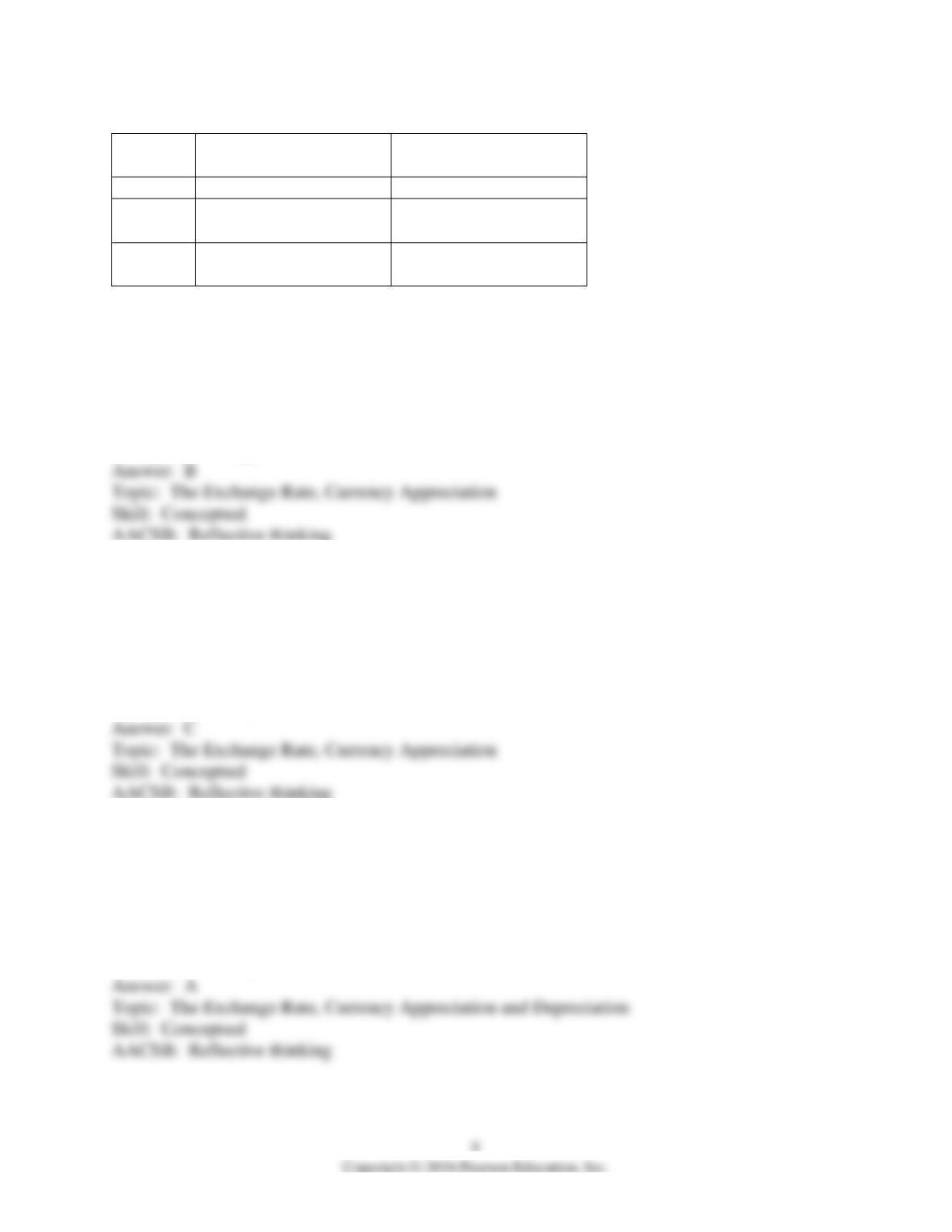
Currency
Nov. 2015 exchange rate
(per U.S. dollar)
Nov. 2016 exchange rate
(per U.S. dollar)
Euro
0.7466
0.8009
Japanese
yen
100.2
114.61
Canadian
dollar
1.0436
1.1331
28) The table above shows the exchange rates between various currencies and the U.S. dollar.
Between 2015 and 2016, the U.S. dollar ________ against the Euro and ________ against the
Japanese yen.
A) depreciated; depreciated
B) appreciated; appreciated
C) appreciated; depreciated
D) depreciated; appreciated
29) The table above shows the exchange rates between various currencies and the U.S. dollar.
Between 2015 and 2016, the Japanese yen ________ against the U.S dollar and the Euro
________ against the U.S. dollar.
A) appreciated; appreciated
B) depreciated; appreciated
C) depreciated; depreciated
D) appreciated; depreciated
30) The table above shows the exchange rates between various currencies and the U.S. dollar.
Between 2015 and 2016, the U.S. dollar ________ against the Canadian dollar and the Euro
________ against the U.S. dollar
A) appreciated, depreciated
B) appreciated, appreciated
C) depreciated, appreciated
D) depreciated, depreciated
31) The table above shows the exchange rates between various currencies and the U.S. dollar.
Between 2015 and 2016, the Canadian dollar ________ against the U.S. dollar and the Japanese
yen ________ against the U.S. dollar
A) depreciated, depreciated
B) appreciated, appreciated
C) appreciated, depreciated
D) depreciated, appreciated
32) The table above shows the exchange rates between various currencies and the U.S. dollar.
Between 2015 and 2016, the Euro ________ against the U.S. dollar, the Japanese yen ________
against the U.S. dollar and the Canadian dollar ________ against the U.S. dollar
A) depreciated, depreciated, depreciated
B) appreciated, depreciated, appreciated
C) appreciated, appreciated, appreciated
D) depreciated, depreciated, appreciated
33) The table above shows the exchange rates between various currencies and the U.S. dollar.
Between 2015 and 2016, the Euro ________ against the U.S. dollar, the U.S. dollar ________
against the Japanese yen and the U.S. dollar ________ against the Canadian dollar
A) depreciated, appreciated, appreciated
B) depreciated, depreciated, appreciated
C) appreciated, appreciated, appreciated
D) appreciated, depreciated, depreciated
34) When people who are holding the money of some other country want to exchange it for U.S.
dollars, they ________ U.S. dollars and ________ that other country’s money.
A) demand; supply
B) supply; supply
C) supply; demand
D) demand; demand
35) Which of the following creates a demand for U.S. dollars?
A) Toyota, a Japanese firm, purchasing land in Texas
B) a U.S. restaurant purchasing Mexican tomatoes
C) a U.S. tourist catching a show in London
D) a Japanese tourist catching a show in London
36) When the exchange rate falls, in the foreign exchange market the
A) quantity demanded of the currency increases.
B) demand for the currency increases.
C) quantity demanded of the currency decreases.
D) demand for the currency decreases.
37) The law of demand in the foreign exchange market refers to the relationship between the
A) exchange rate and the quantity of U.S. dollars demanded.
B) interest rate and the exchange rate.
C) interest rate and the quantity of U.S. dollars demanded.
D) U.S. price level and the exchange rate.
38) The law of demand for dollars in the foreign exchange market means that the
A) lower the exchange rate, the greater the quantity of dollars demanded.
B) higher the exchange rate, the smaller the quantity of dollars demanded.
C) lower the exchange rate, the smaller the quantity of U.S. exports demanded.
D) Both answers A and B are correct.
39) With everything else the same, in the foreign exchange market the
A) larger the value of U.S. exports, the greater is the quantity of dollars demanded.
B) lower the exchange rate, the smaller the amount of U.S. exports.
C) the lower the exchange rate, the smaller is the expected profit from buying dollars.
D) the higher the exchange rate, the cheaper are U.S.-produced goods and services.
40) In the foreign exchange market, a change in which of the following will result in a movement
along the demand curve for U.S. dollars?
A) the exchange rate
B) the U.S. interest rate
C) the interest rate in the foreign country
D) the expected future exchange rate
41) The dollar is regarded as the “safe haven” currency; investors flock to it when they are
worried about the outlook for the global economy. Fears were at their greatest in late 2008 and
early 2009 after the collapse of the Lehman Brothers investment bank in September 2008. As
investors flocked to the dollar
A) the demand for dollars increased and the exchange rate increased.
B) the demand for dollars decreased and the exchange rate decreased.
C) the supply of dollars increased and the exchange rate decreased.
D) the supply of dollars decreased and the exchange rate increased.
42) The dollar is regarded as the “safe haven” currency; investors flock to it when they are
worried about the outlook for the global economy. Fears were at their greatest in late 2008 and
early 2009 after the collapse of the Lehman Brothers investment bank in September 2008. If
investors flocked to the dollar
A) the exchange rate would increase.
B) the exchange rate would decrease.
C) the exchange rate would not change.
D) the exchange rate could increase or decrease.
43) The demand curve for U.S. dollars slopes downward because as the dollar ________ U.S.
goods become ________ expensive to foreign residents, so they purchase fewer U.S. goods, and
the quantity of dollars demanded decreases.
A) appreciates; more
B) appreciates; less
C) depreciates; more
D) depreciates; less
44) When the U.S. exchange rate falls, U.S. goods become ________ to foreign residents and
U.S. exports ________.
A) less expensive; increase
B) less expensive; decrease
C) more expensive; decrease
D) more expensive; increase
45) As the exchange rate ________, the ________ is the value of U.S. ________.
A) falls; greater; imports
B) falls; greater; exports
C) rises; greater; exports
D) rises; smaller; imports
46) As the value of U.S. exports ________, the quantity of ________ demanded increases.
A) increases; foreign currencies
B) increases; dollars
C) decreases; dollars
D) None of the above is correct because the value of U.S. exports has nothing to do with the
quantity of dollars or foreign currency demanded.
47) The quantity of dollars demanded by foreign nations increases as
A) U.S. residents purchase more foreign goods.
B) foreigners purchase more U.S. goods.
C) more U.S. residents travel abroad.
D) U.S. exports fall.
48) Exports of U.S. goods create a ________ U.S. dollars and create a ________ foreign
currencies.
A) demand for; demand for.
B) supply of; supply of
C) demand for; supply of
D) supply of; demand for
49) Suppose China Airlines wants to purchase a French Airbus. The price of the Airbus is 95
million Euro. If the exchange rate is 1 euro per 10 yuan, the price of this airplane to China
Airlines is
A) 950 million yuan.
B) 10.52 million yuan.
C) 10 million yuan.
D) 9.5 million yuan.
50) Suppose China Airlines wants to purchase a French Airbus. The price of the Airbus is 95
million Euro. If the exchange rate is 1 euro per 9 yuan, the price of this airplane to China
Airlines is
A) 855 million yuan.
B) 85.5 million yuan.
C) 11.11 million yuan.
D) 10.6 million yuan.
51) If nothing else changes, the ________ the current exchange rate, the ________ is the
expected profit from holding dollars, all other things remaining the same.
A) higher; larger
B) lower; smaller
C) lower; larger
D) The premise of the question is wrong because the exchange rate has nothing to do with
expected profit from holding dollars.
52) A factor that helps to determine the demand for the dollar in the foreign exchange market is
A) the expected future exchange rate.
B) the expected future interest rate.
C) the amount of U.S. imports.
D) the supply of U.S. dollars.
53) If the exchange rate falls, then the expected profit from holding the currency
A) does not change.
B) increases.
C) decreases.
D) can either increase or decrease.
54) As the expected profit from holding dollars ________, the quantity of ________.
A) increases; dollars demanded increases
B) increases; dollars demanded decreases
C) decrease; foreign currency demanded decreases
D) None of the above answers is correct.
55) The lower the exchange rate today, ceteris paribus, the
A) greater is the expected profit from buying U.S. dollars today and holding them.
B) smaller is the expected profit from buying U.S. dollars today and holding them.
C) greater is the expected profit from buying foreign currency today and holding it.
D) smaller the quantity of U.S. dollars demanded in the foreign exchange market today.
56) The higher the exchange rate today, the
A) smaller is the expected profit from buying U.S. dollars today and holding them.
B) greater is the expected profit from buying U.S. dollars today and holding them.
C) smaller is the expected profit from buying foreign currency today and holding it.
D) greater the quantity of U.S. dollars demanded in the foreign exchange market today.
57) When the U.S. exchange rate rises and the expected future exchange rate does not change,
the expected profit from buying U.S. dollars today
A) also rises.
B) falls.
C) does not change.
D) may rise, fall, or stay the same.
58) Suppose Mitsubishi Bank (a Japanese bank) expects the exchange rate to be 125 yen per U.S.
dollar at the end of the year. If today’s exchange rate is 120 yen per U.S. dollar, Mitsubishi bank
A) buys U.S. dollars today because it expects profit from buying U.S. dollars and holding them.
B) sells U.S. dollars today because it expects losses from buying U.S. dollars and holding them.
C) does not buy or sell any U.S. dollars today because it expects zero profit from buying U.S.
dollars and holding them.
D) None of the above answers is correct because a foreign commercial bank cannot buy or sell
U.S. dollars.
Investor
Expected future value of a
dollar (francs per dollar)
Investor A
120
Investor B
100
Investor C
85
59) Using the table above, if the current market value of the dollar is 125 francs per dollar
A) investor A expects dollar appreciation, but B and C expect depreciation.
B) investor A expects dollar depreciation, but B and C expect appreciation.
C) all three investors expect the dollar to appreciate.
D) all three investors expect the dollar to depreciate.
60) Using the table above, if the current market value of the dollar is 125 francs
A) investor A holds dollars, but B and C hold francs.
B) investor A holds francs, but B and C hold dollars.
C) all three investors hold francs.
D) all three investors hold dollars.
61) Using the table above, if the current market value of the dollar is 70 francs
A) investor A expects dollar appreciation, but B and C expect depreciation.
B) investor A expects dollar depreciation, but B and C expect appreciation.
C) all three investors expect the dollar to appreciate.
D) all three investors expect the dollar to depreciate.
62) Using the table above, if the current market value of the dollar is 70 francs
A) investor A holds dollars, but B and C hold francs.
B) investor A holds francs, but B and C hold dollars.
C) all three investors hold francs.
D) all three investors hold dollars.
63) Using the table above, if the current market value of the dollar is 90 francs
A) investor A expects dollar appreciation, but B and C expect depreciation.
B) investor C expects dollar depreciation, but A and B expect appreciation.
C) all three investors expect the dollar to appreciate.
D) all three investors expect the dollar to depreciate.
64) Using the table above, if the current market value of the dollar is 110 francs
A) investor A expects dollar appreciation, but B and C expect depreciation.
B) investor C expects dollar depreciation, but A and B expect appreciation.
C) all three investors expect the dollar to appreciate.
D) all three investors expect the dollar to depreciate.
65) When you arrive at the airport in Paris and go to the bank window to exchange dollars into
euros, you are
A) selling euros to the French.
B) avoiding the use of foreign exchange markets.
C) contributing to U.S. exports.
D) None of the above answers is correct.
66) In the foreign exchange market, the higher the dollar’s exchange rate, the
A) larger the supply of dollars.
B) smaller the quantity supplied of dollars.
C) smaller the supply of dollars.
D) larger the quantity supplied of dollars.
67) When the U.S. exchange rate rises, foreign goods become ________ and U.S. imports
________.
A) less expensive; increase
B) more expensive; decrease
C) less expensive; decrease
D) more expensive; increase
68) Other things remaining the same, the ________ the exchange rate for dollars, the greater the
________ in the foreign exchange market.
A) higher; quantity of dollars supplied
B) higher; quantity of dollars demanded
C) lower; value of U.S. imports
D) higher; expected profits from holding dollars
69) The demand for Mexican tomatoes by an American food grocery chain creates a
A) demand for the U.S. dollar.
B) demand for an interest rate differential.
C) supply of Mexican pesos.
D) supply of U.S. dollars.
70) Consider the market for dollars. If the exchange rate rises from 2 pesos per dollar to 4 pesos
per dollar
A) the supply curve of dollars shifts leftward.
B) the supply curve of dollars shifts rightward.
C) there is an upward movement along the supply curve for dollars.
D) there is a downward movement along the supply curve for dollars.
71) As the exchange rate ________, the quantity of dollars ________ in the foreign exchange
market ________.
A) rises; supplied; increases
B) falls; supplied; increases
C) rises; demanded; increases
D) falls; demanded; decreases
72) In the foreign exchange market, the supply curve for dollars slopes upwards because
A) as the exchange rate rises, imports become more expensive, and more dollars are supplied to
pay for the imports.
B) as the exchange rate rises, imports become cheaper, and more dollars are supplied to pay for
the increase in the quantity of imports.
C) as the exchange rate rises, more dollars are supplied since the profit from selling dollars falls.
D) supply curves always slope upwards.
73) In the foreign exchange market, which of the following results in a movement along the
supply curve of dollars?
A) a change in the expected future exchange rate
B) a change in the U.S. interest rate
C) a change in the current exchange rate
D) None of the above answers are correct.
74) When a good is imported into the United States, a ________is created.
A) supply of foreign currency with no effect on the market for the dollar
B) demand for dollars with no effect on markets for foreign currencies
C) supply of foreign currencies and a demand for dollars
D) demand for foreign currencies and a supply of dollars
75) Other things remaining the same, the
A) larger the value of U.S. imports, the smaller is the quantity of foreign currency demanded.
B) larger the value of U.S. imports, the greater is the quantity of U.S. dollars supplied to the
foreign exchange market.
C) lower the exchange rate, the cheaper are foreign-produced goods and services.
D) higher the exchange rate, the greater is the expected profit from selling dollars.
76) The larger the value of U.S. imports, the greater the quantity of ________ causing the
quantity supplied of dollars to ________.
A) U.S. dollars demanded; increase
B) U.S. dollars demanded; decrease
C) foreign currency demanded; increase
D) foreign currency demanded; decrease
77) The ________ the exchange rate, the ________ are foreign-produced goods and hence the
greater the quantity of dollars supplied.
A) higher; cheaper
B) lower; cheaper
C) higher; more expensive
D) lower; more expensive
78) The ________ the exchange rate, the ________ are foreign-produced goods and hence the
smaller the quantity of dollars supplied.
A) lower; more expensive
B) lower; cheaper
C) greater; cheaper
D) greater; more expensive