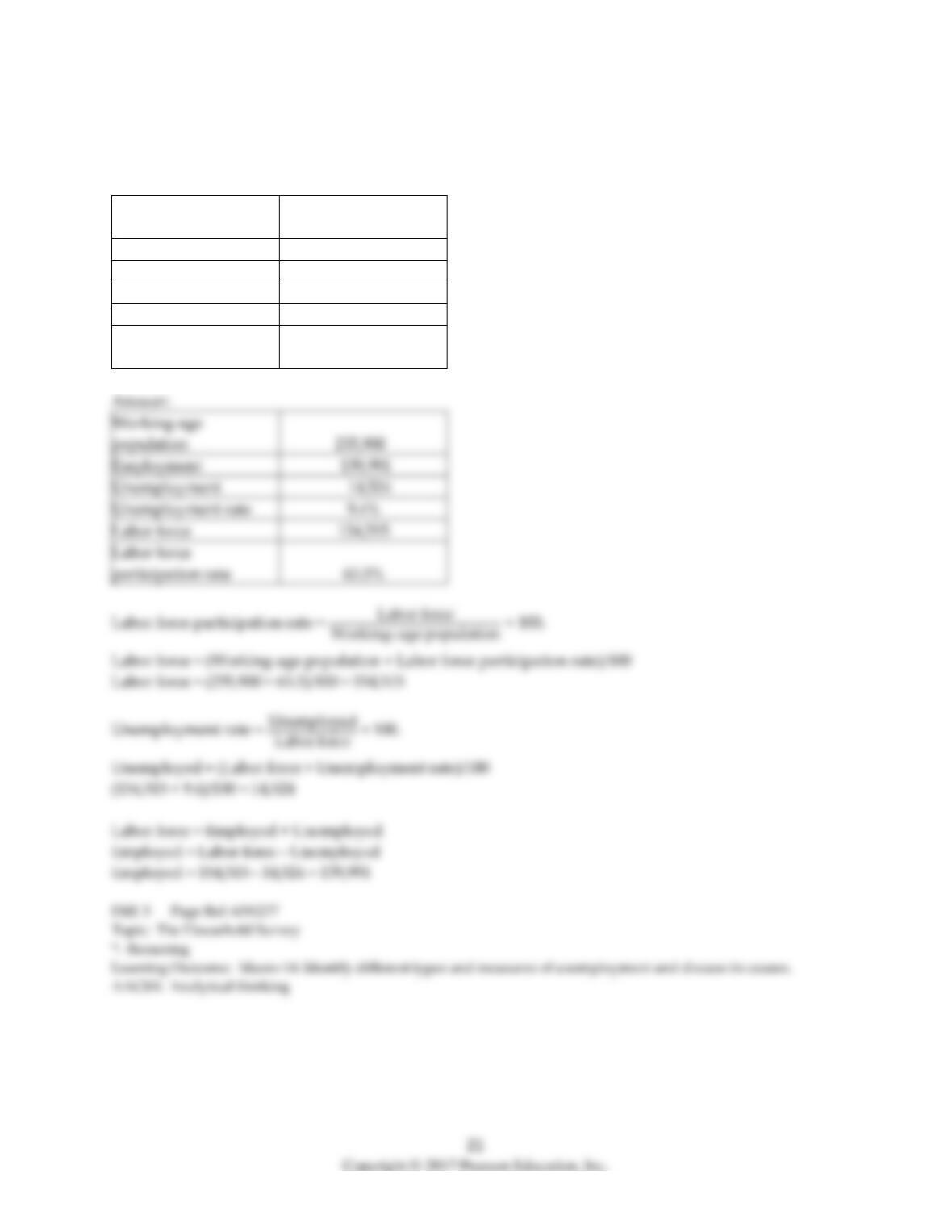
68) Fill in the missing values in the table of data collected in the household survey for November, 2009.
The working-age population, employment, unemployment, and labor force are measured in thousands.
Show your work.
Working-age
population
235,900
Employment
Unemployment
Unemployment rate
9.4%
Labor force
Labor force
participation rate
65.5%
Working-age
population
Employment
Unemployment
Unemployment rate
Labor force
Labor force
participation rate
65.5%
9.2 Types of Unemployment
1) Frictional unemployment is the result of
A) a persistent mismatch between the skills and characteristics of workers and the requirements of the
jobs.
B) the search process of matching workers with jobs.
C) the ups and downs in inflation.
D) a slowdown in the economy.
2) The advice to “keep searching, there are plenty of jobs around here for which you are qualified,”
would be most appropriate for which of the following types of unemployment?
A) frictional unemployment
B) structural unemployment
C) cyclical unemployment
D) seasonal unemployment
3) A student who just graduated from college but has not found a job would most likely be
A) frictionally unemployed.
B) structurally unemployed.
C) cyclically unemployed.
D) seasonally unemployed.
4) Cyclical unemployment is the result of
A) a persistent mismatch between the skills and characteristics of workers and the requirements of the
jobs.
B) the search process of matching workers with jobs.
C) the ups and downs in inflation.
D) a slowdown in the economy.
5) Structural unemployment is the result of
A) a persistent mismatch between the skills and characteristics of workers and the requirements of the
jobs.
B) the search process of matching workers with jobs.
C) the ups and downs in inflation.
D) a slowdown in the economy.
6) In 2015, JP Morgan Chase announced that it was laying off 5,000 employees. The laid-off employees
who were not able to find jobs at another bank due to a permanent decline in demand in the banking
industry would be considered
A) structurally unemployed.
B) frictionally unemployed.
C) seasonally unemployed.
D) cyclically unemployed.
7) According to the text, economists consider full employment to occur when
A) everyone who wants a job has a job.
B) frictional unemployment equals zero.
C) the sum of frictional unemployment and structural unemployment equals zero.
D) the unemployment rate consists of only frictional and structural unemployment.
8) If cyclical unemployment is eliminated in the economy, then
A) the economy is considered to be at full employment.
B) the unemployment rate is below the natural rate of unemployment.
C) the unemployment rate is above the natural rate of unemployment.
D) the economy is at less than full employment.
9) Full employment is not considered to be zero unemployment, because
A) some cyclical unemployment always exists.
B) some people do not want a job.
C) there are not enough jobs for everyone who wants one.
D) people do not find jobs instantaneously.
10) The natural rate of unemployment is the amount of unemployment
A) associated with the business cycle.
B) equal to frictional plus structural unemployment.
C) that exists when the economy goes into recession.
D) that exists when the economy is in an expansion.
11) During the Great Depression, cyclical unemployment increased as the recession continued. This
increase in cyclical unemployment
A) increased the natural rate of unemployment.
B) decreased the natural rate of unemployment.
C) had no effect on the natural rate of unemployment.
D) could have increased or decreased the natural rate of unemployment.
12) A lumberjack loses his job because timber cutting restrictions were imposed by the EPA to protect
the spotted owl habitat. This lumberjack would be
A) frictionally unemployed.
B) cyclically unemployed.
C) structurally unemployed.
D) seasonally unemployed.
13) If you have trouble finding a job because of a slowdown in the overall economy, we would say that
you are
A) frictionally unemployed.
B) structurally unemployed.
C) cyclically unemployed.
D) seasonally unemployed.
14) The advice to “retrain” would be most appropriate for which of the following types of
unemployment?
A) frictional unemployment
B) structural unemployment
C) cyclical unemployment
D) core unemployment
15) Most of the unemployment that occurred during the Great Depression was
A) frictional unemployment.
B) structural unemployment.
C) cyclical unemployment.
D) core unemployment.
26
16) If the federal government implements programs so that the unemployed are more quickly matched
with jobs, then
A) the natural rate of unemployment will increase.
B) the natural rate of unemployment will decrease.
C) the natural rate of unemployment will not change.
D) the natural rate of unemployment could either increase or decrease.
17) The short-term unemployment arising from the process of matching workers with jobs is called
A) frictional unemployment.
B) structural unemployment.
C) cyclical unemployment.
D) seasonal unemployment.
E) unnatural unemployment.
18) Unemployment arising from a persistent mismatch between the skills and characteristics of workers
and the requirements of jobs is called
A) frictional unemployment.
B) structural unemployment.
C) cyclical unemployment.
D) seasonal unemployment.
E) unnatural unemployment.
19) Workers laid off as a result of a recession suffer
A) frictional unemployment.
B) structural unemployment.
C) cyclical unemployment.
D) seasonal unemployment.
E) natural unemployment.
20) People who lost their jobs as hand-drawn animators because of the popularity of computer-
generated 3D animation are examples of persons who are suffering
A) frictional unemployment.
B) structural unemployment.
C) cyclical unemployment.
D) seasonal unemployment.
E) unnatural unemployment.
21) Which of the following is an example of a worker experiencing cyclical unemployment?
A) a worker who changes jobs to move closer her family
B) an assembly line worker who loses his job because of automation
C) a freightliner employee that got laid off because of the recession of 2007-2009
D) a lifeguard who was hired during the summer season is laid off after summer is over
E) a worker who quits his job because he does not get along with his boss
22) Jack just told his boss that he thinks his boss is an idiot. It is likely that Jack will be experiencing
________ unemployment in the near future.
A) permanent
B) cyclical
C) frictional
D) structural
23) Sarah is a full-time student who is not looking for work. What kind of unemployment is Sarah
experiencing?
A) cyclical
B) structural
C) frictional
D) Sarah is not experiencing unemployment of any kind, because she is not currently part of the labor
force.
24) Emma is a road construction worker. During the winter months, Emma finds it more difficult to get
work. The unemployment Emma experiences in the winter is
A) structural.
B) cyclical.
C) seasonal.
D) functional.
25) Which of the following is an example of a worker experiencing frictional unemployment?
A) A worker quits his job at the Post Office to find more interesting work.
B) A computer programmer loses her job because it is outsourced to India.
C) An employee is laid off because the economy is suffering a recession.
D) A United Airlines pilot loses her job because of lack of demand for air travel.
26) An example of a seasonally unemployed worker would be
A) a software engineer who is laid off because of declining demand for the software he writes.
B) a day care provider who quits his job to go back to school.
C) a General Motors employee loses her job because the company is downsizing its work force.
D) a ski lift operator who loses his job when the snow melts in the spring.
E) a mother who quits her job to stay home with her children.
27) What are the three main kinds of unemployment?
A) frictional, seasonal, and cyclical
B) temporary, permanent, and volunteer
C) cyclical, structural, and temporary
D) structural, frictional, and cyclical
28) When the labor market is at full employment
A) there is only cyclical unemployment in the economy.
B) there is only structural unemployment in the economy.
C) the unemployment rate is 0%.
D) there is no cyclical unemployment in the economy.
29) When an economy is at its natural rate of unemployment, which of the following will be true?
A) The unemployment rate will be 0%.
B) The labor force participation rate will be 100%.
C) The unemployment rate will be greater than 0%.
D) Only structural unemployment as a result of technological change will exist in the economy.
30) The natural rate of unemployment is made up of
A) frictional, cyclical, and structural unemployment.
B) frictional and cyclical unemployment.
C) cyclical and structural unemployment.
D) frictional and structural unemployment.
E) seasonal and structural unemployment.
31) An increase in cyclical unemployment will result in
A) an increase in the natural rate of unemployment.
B) an increase in the unemployment rate.
C) an increase in structural unemployment.
D) a decrease in frictional unemployment.
32) We say that the economy is at full employment if the unemployment rate is equal to
A) zero.
B) the natural rate of unemployment.
C) the amount of cyclical unemployment.
D) the sum of frictional and cyclical unemployment.
E) the sum of structural and cyclical unemployment.
33) In 2015, JPMorgan Chase announced it was laying off employees. The employees who were laid off
due to the business cycle would be considered
A) structurally unemployed.
B) frictionally unemployed.
C) seasonally unemployed.
D) cyclically unemployed.
34) Eliminating frictional unemployment would be good for the economy.
35) Unemployment caused by a business cycle recession is called cyclical unemployment.
36) The natural rate of unemployment consists of frictional unemployment plus structural
unemployment.
37) The natural rate of unemployment consists of frictional unemployment plus cyclical unemployment.
38) Eliminating structural unemployment would be good for the economy.
39) The full-employment rate of unemployment is zero.
40) Describe the three types of unemployment.
41) Explain what economists mean by full employment and why this rate of unemployment is not zero.
42) What is the natural rate of unemployment, and what types of unemployment constitute the natural
rate of unemployment?
43) To understand why someone cannot get a job, it helps to know the three types of unemployment.
List the three types of unemployment and explain what causes each type. What advice for finding a job
would be appropriate for someone in each type of unemployment?
44) The reasons why someone cannot get a job are similar to the reasons why someone cannot get a
date. Using the ideas of frictionally unemployed, structurally unemployed, and cyclically unemployed,
describe and explain how a student at your university might be frictionally “undated,” structurally
“undated,” and cyclically “undated.”
45) A central concept in macroeconomics is the idea of the natural rate of unemployment. Why does it
make sense to define full employment to occur when the unemployment rate equals the natural rate of
unemployment, instead of when the unemployment rate equals zero? Elaborate and explain carefully.
9.3 Explaining Unemployment
1) An increase in unemployment insurance payments would, in effect, ________ the amount of time
spent searching for a job, which would increase ________ unemployment.
A) increase; cyclical
B) increase; frictional
C) decrease; cyclical
D) decrease; frictional
2) Which of the following would increase the unemployment rate?
A) a law making it illegal to work more than 35 hours per week
B) a cut in unemployment compensation
C) an increase in unemployment insurance payments
D) a decrease in the minimum wage
3) Which of the following would decrease the unemployment rate?
A) an increase in the minimum wage
B) an increase in the efficiency wage
C) an increase in labor union membership
D) government aid to retrain unemployed workers
4) Which of the following policies would reduce structural unemployment?
A) an increase in the minimum wage
B) a job retraining program
C) implementing an unemployment insurance policy
D) building an online job database that helps workers find jobs
5) Which of the following policies would reduce frictional unemployment?
A) a decrease in the minimum wage
B) a job retraining program
C) implementing an unemployment insurance policy
D) building an online job database that helps workers find jobs
6) An unemployment insurance program has which of the following effects?
A) It decreases the amount of personal income of the unemployed.
B) It contributes to the severity of a recession or economic downturn.
C) It increases the amount of time spent searching for a job.
D) It lowers the overall unemployment rate.
7) The United States has ________ social insurance programs, and generally has a ________
unemployment rate, as compared to Canada and Western Europe.
A) less generous; lower
B) less generous; greater
C) more generous; lower
D) more generous; greater
8) The increased generosity of unemployment insurance programs in Canada as compared to the
United States should
A) decrease the duration of unemployment in Canada as compared to the United States.
B) increase the duration of unemployment in Canada as compared to the United States.
C) have no impact on the duration of unemployment in Canada.
D) raise the duration of unemployment in the United States.
9) If the minimum wage is set above the market wage,
A) the quantity of labor supplied will be below the quantity of labor demanded.
B) unemployment will rise.
C) highly-skilled workers will have a harder time finding jobs.
D) All of the above are correct.
10) Minimum wage laws cause unemployment because the legal minimum wage is set
A) below the market wage, causing labor demand to be greater than labor supply.
B) below the market wage, causing labor demand to be less than labor supply.
C) above the market wage, causing labor demand to be greater than labor supply.
D) above the market wage, causing labor demand to be less than labor supply.
E) too low.
11) Suppose that the labor movement has a revival in the United States and the majority of workers join
labor unions. As a result we would expect
A) the labor force participation rate to fall.
B) the unemployment rate to fall.
C) the unemployment rate to rise.
D) no change in the unemployment rate or labor force participation rate.
12) If firms pay what are called “efficiency wages,” they pay wages that
A) motivate workers to increase their productivity.
B) are lower than average to ensure maximum profit.
C) will eventually lower the unemployment rate.
D) are mandated by the government.
13) Efficiency wages cause unemployment because
A) firms pay wages that are below the market wage, causing the quantity of labor demanded to be
greater than the quantity of labor supplied.
B) firms pay wages that are below the market wage, causing the quantity of labor demanded to be less
than the quantity of labor supplied.
C) firms pay wages that are above the market wage, causing the quantity of labor demanded to be
greater than the quantity of labor supplied.
D) firms pay wages that are above the market wage, causing the quantity of labor demanded to be less
than the quantity of labor supplied.
14) The U.S. unemployment insurance program
A) increases the amount of time the unemployed spend searching for a job.
B) decreases the level of frictional unemployment.
C) pays the unemployed a benefit equal to twice the average wage.
D) eliminates structural unemployment.
15) By offering training to workers whose firms laid them off because of competition from foreign firms,
the federal government is attempting to reduce
A) frictional unemployment.
B) structural unemployment.
C) cyclical unemployment.
D) seasonal unemployment.
E) unnatural unemployment.
16) Establishing a state employment agency that speeds up the process of matching unemployed
workers with unfilled jobs is an attempt to lower
A) frictional unemployment.
B) structural unemployment.
C) cyclical unemployment.
D) seasonal unemployment.
E) unnatural unemployment.
17) Which of the following explains why many European countries have unemployment rates that are
higher than in the United States?
A) Technological change occurs at a faster rate in Europe, so structural unemployment is higher in
Europe.
B) European countries offer higher unemployment benefits than the United States.
C) Firms in European countries offer employees higher wages and higher benefits than do firms in the
United States.
D) The minimum wage in Europe is lower than it is in the United States.
18) With the exception of during recessions, workers in Canada are eligible for unemployment benefits
for about twice as long a period of time as workers in the United States. As a result,
A) the average duration of unemployment is longer in the United States than in Canada.
B) the unemployment rate in Canada is usually higher than in the United States.
C) the opportunity cost of job search in Canada is lower than in the United States.
D) frictional unemployment is higher, on average, in the United States than in Canada.
19) Which of the following has a tendency to raise the unemployment rate?
A) implementing a minimum wage in an economy
B) reducing unemployment insurance in an economy
C) offering wages at the market-clearing rate
D) reducing labor union membership in an economy
20) An efficiency wage
A) is higher than the market wage and tends to increase productivity.
B) is lower than the market wage and tends to increase productivity.
C) is higher than the market wage and tends to decrease productivity.
D) is lower than the market wage and tends to decrease productivity.
21) Why might firms pay wages that are above the equilibrium wage in a market?
A) to increase the productivity of their workers
B) to reduce the unemployment rate
C) to encourage workers to form labor unions
D) to reduce profit
22) The equilibrium wage in a local labor market is $10 per hour. If a minimum wage of $15 per hour is
imposed, which of the following will occur?
A) There will be an increase in unemployment.
B) There will be an increase in the quantity of labor demanded by firms.
C) There will be a decrease in the quantity of labor supplied by households.
D) All of the above will occur.