Macroeconomics: Policy and Practice, 2e (Mishkin)
Chapter 9 The IS Curve
9.1 Planned Expenditure
1) Actual expenditure is to planned expenditure as ________ is to ________.
A) desire; accomplishment
B) aggregate demand; aggregate supply
C) output; income
D) observed; theoretical
E) fluctuation; equilibrium
2) Only when the goods market is in equilibrium is it true that ________.
A) actual expenditure equals output
B) the amount of goods and services produced equals actual expenditure
C) planned expenditure equals the amount of goods and services produced
D) demand for foreign goods equals foreigners’ demand for domestic goods
E) none of the above
1) Total aggregate demand includes ________.
A) planned investment spending
B) consumption expenditures
C) net exports
D) all of the above
E) none of the above
2) The consumption function shows how ________.
A) the marginal propensity to consume varies with disposable income
B) income varies as a result of changes in consumption
C) consumption depends on the decision to save
D) all of the above
E) none of the above
3) Consumption expenditures decrease when ________.
A) the real interest rate falls
B) disposable income increases
C) autonomous consumption increases
D) all of the above
E) none of the above
4) If disposable income falls, consumption expenditure falls ________.
A) by an amount that depends on the real interest rate
B) so that planned expenditure remains constant
C) by an amount smaller than the decrease in disposable income
D) all of the above
E) none of the above
5) Total planned expenditure (equals total output) is 14,000 when autonomous consumption
expenditure is 450. When autonomous consumption expenditure falls to 400, total planned
expenditure (equals total output) is 13,800. The marginal propensity to consume is ________.
A) 0.89
B) 0.75
C) 0.99
D) 0.44
E) 0.03
6) Total planned expenditure (equals income) is 13,500, autonomous consumption expenditure is
600, the marginal propensity to consume is 0.8, government purchases are 2,700, taxes are 2,500
and planned investment spending is 2,900. Net exports is ________.
A) 3,840
B) negative 1,500
C) negative 1,380
D) negative 1,340
E) 2,100
7) Consumption expenditure is 15,000, government purchases are 5,000, planned investment
spending is 4,000 and net exports are 1,500. If total output is 25,000, then unplanned inventory
investment is ________.
A) negative 500
B) 2,500
C) 3,500
D) 4,000
E) negative 450
8) An increase in the real interest rate will cause an increase in ________.
A) saving
B) planned investment
C) net exports
D) all of the above
E) none of the above
9) An decrease in the real interest rate will cause an increase in ________.
A) consumption
B) planned investment
C) net exports
D) all of the above
E) none of the above
10) When firms spend more on additional holdings of raw materials, parts and finished goods
________.
A) they are increasing their fixed investment
B) they are increasing their inventory investment
C) they are increasing their private consumption
D) all of the above
E) none of the above
11) Fixed investment is typically ________.
A) smaller than inventory investment
B) calculated as the change in holdings of raw materials and finished goods
C) planned spending on equipment, structures, and new residential housing
D) all of the above
E) none of the above
12) Planned investment spending ________.
A) is equal to planned fix investment spending plus the amount of inventory investment planned
by firms
B) is closely related to the real interest rate
C) is heavily influenced by expectations about the future
D) all of the above
E) none of the above
13) Planned investment spending ________.
A) is equal to planned fixed investment spending plus government investment
B) is unrelated to the real interest rate
C) is heavily influenced by expectations about the future
D) all of the above
E) none of the above
14) The interest rate at which businesses borrow to fund their investments is higher than the real
interest rate for short-term, safe loans, because ________.
A) business borrowers sometimes default on their loans
B) autonomous investment is not dependent on borrowed funds
C) the central bank controls the short-term, safe interest rate
D) the interest rate is negatively-related to business optimism
E) all of the above
15) A decrease in “financial frictions” is associated with ________.
A) a decrease in the credit spread
B) more efficient functioning of financial markets
C) reduced real cost of borrowing for businesses
D) an increase in planned investment spending
E) all of the above
16) Investment spending ________.
A) is comprised of fixed and inventory investment
B) is negatively related to the real interest rate
C) is heavily influenced by what Keynes coined as “animal spirits”
D) all of the above
E) none of the above
17) When the U.S. real interest rate falls ________.
A) U.S. dollar assets earn a higher return relative to foreign assets
B) it makes U.S. exports more expensive in foreign currencies
C) imports will decrease
D) all of the above
E) none of the above
18) When the U.S. real interest rate rises ________.
A) U.S. dollar assets earn a lower return relative to foreign assets
B) makes U.S. exports more expensive in foreign currencies
C) imports will decrease
D) all of the above
E) none of the above
19) When the U.S. real interest rate rises ________.
A) U.S. dollar assets earn a higher return relative to foreign assets
B) makes U.S. exports cheaper in foreign currencies
C) imports will decrease
D) all of the above
E) none of the above
20) Net exports ________.
A) are heavily determined by foreign demand for domestic goods
B) are heavily determined by domestic demand for domestic goods
C) are independent of domestic interest rate fluctuations
D) all of the above
E) none of the above
21) Planned expenditures ________.
A) are directly affected by government purchases
B) increase when there is a reduction in taxes
C) decrease when disposable income decreases
D) all of the above
E) none of the above
22) The difference between the interest rate on loans to households and firms and the interest rate
on completely safe assets is known as ________.
A) the fed funds rate
B) the discount rate
C) asymmetric information
D) the credit spread
23) What is the meaning of “animal spirits”? How do these relate to planned investment
spending and to unplanned investment spending?
24) The investment function implies that current output does not influence investment. Does that
make sense?
25) Acme Brands invested $5 million in 2010 on new equipment, spent $750 thousand to
increase its inventory of intermediate components, and added $25 thousand to its inventory of
finished goods. At year’s end, the components inventory is found to be $200 thousand above its
beginning-of-the- year level, and finished goods inventory is up $30 thousand over its starting
level. Calculate planned investment, unplanned investment, and actual (total) investment.
9.3 Goods Market Equilibrium
1) The IS curve ________.
A) shows the relationship between aggregate output and the real interest rate when the goods
market is in equilibrium
B) tells us that increases in autonomous consumption, investment, government purchases, or net
exports raise output for any real interest rate
C) tells us that a decrease in taxes or in financial frictions leads to an increase in output for any
given real interest rate
D) all of the above
E) none of the above
2) A change in which of the following causes a movement along — not a shift in — the IS
curve?
A) autonomous consumption
B) government purchases
C) financial frictions
D) all of the above
E) none of the above
3) A change in which of the following causes a movement along — not a shift in — the IS
curve?
A) autonomous investment
B) autonomous net exports
C) taxes
D) all of the above
E) none of the above
4) A change in which of the following causes a shift in the IS curve?
A) autonomous investment
B) autonomous net exports
C) taxes
D) all of the above
E) none of the above
9
5) According to the IS equation, a change in which of the following will cause a change in
output?
A) real interest rate
B) autonomous investment
C) marginal propensity to consume
D) all of the above
E) none of the above
6) In the IS equation, which of the following is an endogenous variable?
A) autonomous investment
B) autonomous net exports
C) taxes
D) all of the above
E) none of the above
7) In the IS equation, which of the following is an endogenous variable?
A) government purchases
B) real interest rate
C) financial frictions
D) all of the above
E) none of the above
9.4 Understanding the IS Curve
1) The IS curve ________.
A) traces out the points at which the goods market is in equilibrium
B) tells us that consumption expenditures fall as the real interest rises
C) tells us that as the real interest rate rises planned expenditures go down leading to decreases in
output that satisfy the goods market equilibrium
D) all of the above
E) none of the above
2) If aggregate output is below its equilibrium level ________.
A) there is an excess demand for goods
B) actual output is below planned expenditure
C) firms will tend to replenish their low inventories driving output up toward equilibrium
D) all of the above
E) none of the above
3) If aggregate output is above its equilibrium level ________.
A) there is an excess supply of goods
B) actual output is below planned expenditure
C) firms will tend to replenish their low inventories driving output up toward equilibrium
D) all of the above
E) none of the above
4) In the IS curve, if Y falls for any given level of the real interest rate ________.
A) consumption decreases
B) output increases
C) saving increases
D) all of the above
E) none of the above
5) In the IS curve, if Y increases for any given level of the real interest rate ________.
A) consumption increases
B) output decreases
C) saving decreases
D) all of the above
E) none of the above
6) In the IS curve, if Y falls for any given level of the real interest rate ________.
A) consumption increases
B) output increases
C) saving increases
D) all of the above
E) none of the above
7) In the IS equation, which of the following is an endogenous variable?
A) government purchases
B) real interest rate
C) consumption
D) all of the above
E) none of the above
8) In the IS equation, which of the following is an exogenous variable?
A) planned investment spending
B) real interest rate
C) consumption
D) all of the above
E) none of the above
9) When the goods market is returning to equilibrium following a decrease in the real interest
rate, ________.
A) saving and output are both rising
B) saving and output are both declining
C) saving is rising, while output declines
D) all of the above
E) none of the above
10) We may infer from the downward slope of the IS curve that lower interest rates are
associated with ________.
A) higher output
B) higher saving and/or lower net exports
C) higher investment
D) all of the above
E) none of the above
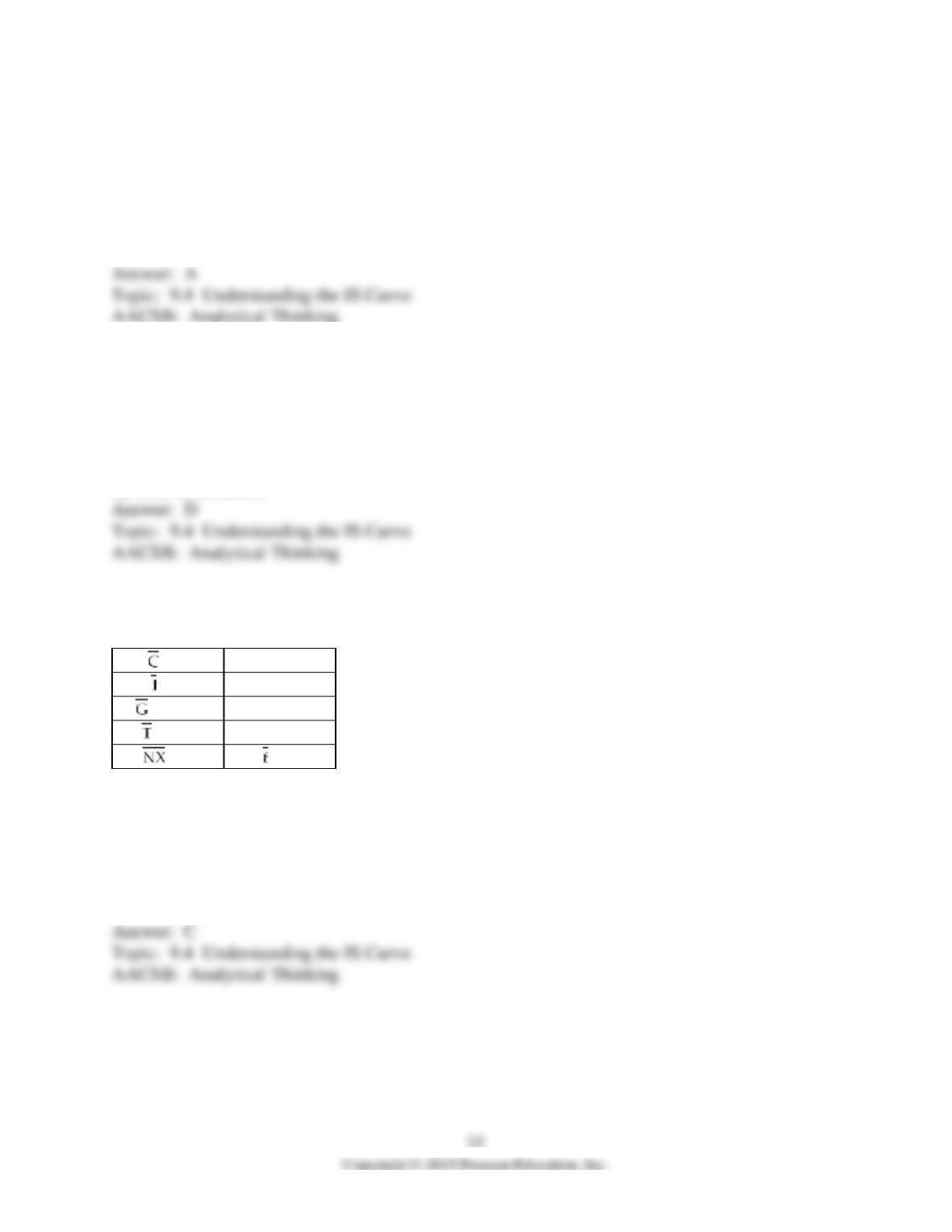
IS Curve Exogenous Variables and Parameters
Table 1
= 2
mpc = 0.75
= 3
c = 0.05
= 1.45
d = 0.3
= 1.6
x = 0.15
= 1
= 2
11) Given the values in the table above, the IS curve is ________.
A) Y = 34.6 – 2r
B) Y = 8.65 – 2r
C) Y = 22.6 – 2r
D) Y = 8.33 – 0.67r
E) none of the above
12) Given the values in the table above, equilibrium output Y = ________ when the real interest
rate r = 4.
A) 26.6
B) 0.65
C) 14.6
D) 5.65
E) none of the above
13) Given the values in the table above, the real interest rate r = ________ when equilibrium
output Y = 15.
A) 9.8
B) 3.8
C) 3.18
D) 10
E) none of the above
14) Given the values in the table above, consumption is ________ when equilibrium output is
15.
A) 12.3
B) 11.86
C) 12.05
D) 11.55
E) none of the above
15) Given the values in the table above, if the real interest rate rises from 5 to 6, the change in
household saving is ________.
A) negative 0.5
B) negative 1.55
C) negative 0.45
D) 1.55
E) none of the above
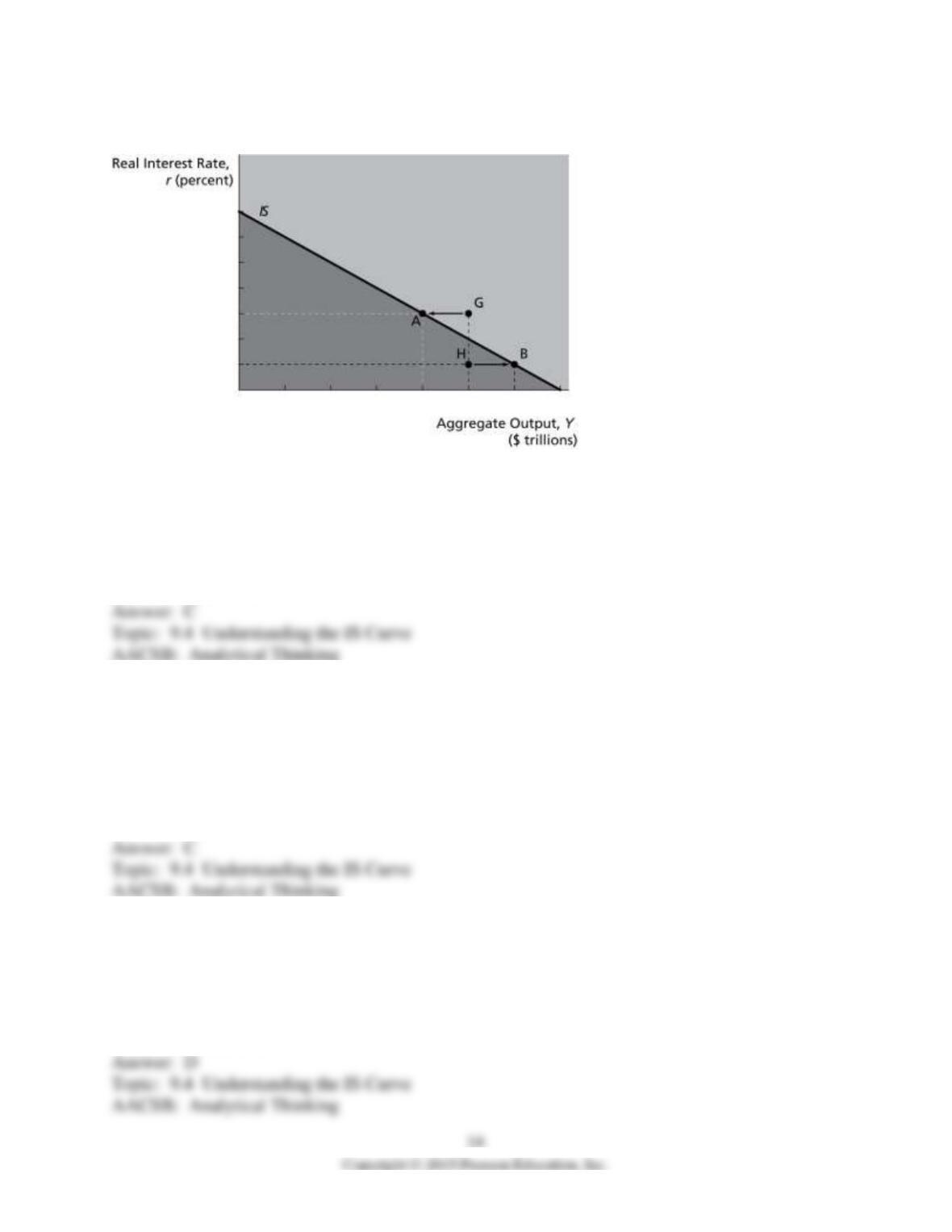
IS Graph 1
16) On the graph above, output is above planned expenditures at point ________.
A) A
B) B
C) G
D) H
E) none of the above
17) On the graph above, assuming that G = 0 and NX = 0, saving is above planned investment at
point ________.
A) A
B) B
C) G
D) H
E) none of the above
18) On the graph above, unplanned inventory investment is negative at point ________.
A) A
B) B
C) G
D) H
E) none of the above