119) If the nominal exchange rate rises and price levels stay constant, the real exchange rate will
A) rise.
B) fall.
C) stay constant.
D) could rise, fall or stay constant.
120) Given the U.S. price level P, the foreign country price level P*, and the nominal exchange
rate E expressed in foreign currency per U.S. dollar, the real exchange rate RER is given by
A) RER = E × (P/P*).
B) RER = E × (P*/P).
C) RER = (P/P*) / E.
D) RER = P / (E/P*).
121) Given the U.S. price level P, the foreign country price level P*, and the real exchange rate
RER in foreign currency per U.S. dollar, the nominal exchange rate E would be given by
A) E = RER × (P/P*).
B) E = RER × (P*/P).
C) E = (P/P*) / RER.
D) E = P × (RER/P*).
122) Initially the nominal exchange rate between the South Korean won and the U.S. dollar is
950 won per dollar. If the nominal exchange rate increases to 1000 won per dollar and the U.S
and Korean price levels do not change, the real exchange rate
A) is the same as before.
B) is greater than before.
C) is less than before.
D) More information is needed to answer the question.
123) If the price level in the U.S. is 120, the price level in South Africa is 140, and the nominal
exchange rate is 7 South African rands per dollar, then the real exchange rate is
A) 6 South African goods per U.S. good.
B) 8.4 South African goods per U.S. good.
C) 9.8 South African goods per U.S. good.
D) 1.4 South African goods per U.S. good.
124) Suppose that your firm wants to import sugarcane from Brazil. The exchange rate is 3
Brazilian reals per U.S. dollar and sugarcane costs 36 reals per ton. How much is a ton of
sugarcane in U.S. dollars?
A) $12
B) $39
C) $108
D) $109
125) In the long run, the nominal exchange rate
A) is a monetary phenomenon, determined by the quantities of money in two countries.
B) is not related to the real exchange rate, since the real exchange rate is the true value of
currencies.
C) will not change if prices in one country change, since prices are nominal variables.
D) is fixed by world central banks, as indicated by the fixed exchange rate system.
126) A decrease in the demand for U.S. exports ________ the demand for U.S. dollars and shifts
the demand curve for U.S. dollars ________.
A) increases; rightward
B) decreases; rightward
C) decreases; leftward
D) increases; leftward
127) A decrease in the expected future exchange rate ________ the demand for U.S. dollars and
shifts the demand curve for U.S. dollars ________.
A) increases; rightward
B) decreases; rightward
C) decreases; leftward
D) increases; leftward
128) Of the following, when would the U.S. exchange rate rise the most?
A) when the supply of and demand for U.S. dollars increase
B) when the supply of U.S. dollars increases and the demand for them decreases
C) when the supply of U.S. dollars decreases and the demand for them increases
D) when the supply of and demand for U.S. dollars decrease
1) The Fed in the U.S.
A) allows a flexible exchange rate, though their actions can impact the exchange rate.
B) has no influence on the exchange rate.
C) sells U.S. dollars to China in an attempt to depreciate the U.S. dollar.
D) alternates between a flexible, fixed, and crawling peg exchange rate policy depending on
economic conditions.
2) Which of the following exchange rate policies uses a target exchange rate, but allows the
target to change?
A) crawling peg
B) flexible exchange rate
C) fixed exchange rate
D) moving target
3) ________ can intervene directly in the foreign exchange market by buying or selling dollars.
A) Congress
B) The Fed
C) The International Monetary Fund
D) The U.S. Treasury department
4) The Federal Reserve can influence the exchange rate by
A) changing interest rates.
B) buying or selling dollars.
C) Both answers A and B are correct.
D) None of the above answers is correct.
5) The Fed ________ intervene in the foreign exchange market by supplying dollars and the Fed
________ intervene in the foreign exchange market by demanding dollars.
A) can; can
B) cannot; can
C) can; cannot
D) cannot; cannot
6) How does a country maintain a fixed exchange rate?
A) By intervening in the foreign exchange markets and buying or selling currency as needed to
achieve the desired exchange rate.
B) By forbidding foreign exchange markets to trade currency at anything other than the official
exchange rate.
C) By setting domestic interest rates to achieve purchasing power parity as the desired exchange
rate.
D) By intervening in import and export markets to achieve the desired current account and
exchange rate.
7) Suppose the Fed wants to fix the U.S. dollar/Mexican peso rate at 11 pesos per dollar under a
fixed exchange rate policy. If the exchange rate falls to 10 pesos per dollar, the Fed can
A) buy dollars.
B) sell dollars.
C) attempt to freeze all sales of dollars.
D) any of the above actions could take place.
8) Suppose the target exchange rate set by the Fed is 100 yen per dollar. If the demand for dollars
temporarily increases, to maintain the target exchange rate, the Fed can
A) sell dollars.
B) buy dollars.
C) violate interest rate parity.
D) violate purchasing power parity.
9) Suppose the target exchange rate set by the Fed is 100 guilders per dollar. If the demand for
dollars temporarily decreases, to maintain the target exchange rate, the Fed can
A) sell dollars.
B) buy dollars.
C) increase U.S. exports.
D) increase U.S. imports.
10) Suppose the target exchange rate set by the Fed is 150 yen per dollar. If the demand for
dollars permanently decreases, then the Fed
A) can permanently meet the target by selling dollars.
B) can permanently meet the target by buying dollars.
C) must violate both interest rate parity and purchasing power parity to permanently meet the
target.
D) cannot permanently maintain the target rate.
11) If the Fed sets a target exchange rate that is higher than the current exchange rate, then
A) the Fed must sell dollars.
B) the Fed must buy dollars.
C) the Fed can do nothing in the short run.
D) will try to print more dollars for foreign distribution.
12) If the current exchange rate is higher than the Fed’s target exchange rate, the Fed would
A) implement purchasing power parity.
B) implement interest rate parity.
C) buy dollars.
D) sell dollars.
13) If the Fed wants to depreciate the dollar against the yen, the Fed will
A) increase the supply of dollars by selling yen.
B) increase the demand for dollars by selling yen.
C) decrease the supply of dollars by selling yen.
D) increase the supply of dollars by buying yen.
14) Suppose the current exchange rate between the Chinese yuan and the United States dollar is
7 yuan per dollar. If the Fed sought to drive up the exchange rate to 8 yuan per dollar then it
would
A) buy dollars.
B) sell dollars.
C) buy yuan.
D) sell dollars and buy yuan.
15) If the target exchange rate is 100 yen per dollar and the current exchange rate is 90 yen per
dollar, the Fed will
A) sell dollars and the demand for dollars will increase.
B) sell dollars and the demand for dollars will decrease.
C) buy dollars and the demand for dollars will increase.
D) buy dollars and the demand for dollars will decrease.
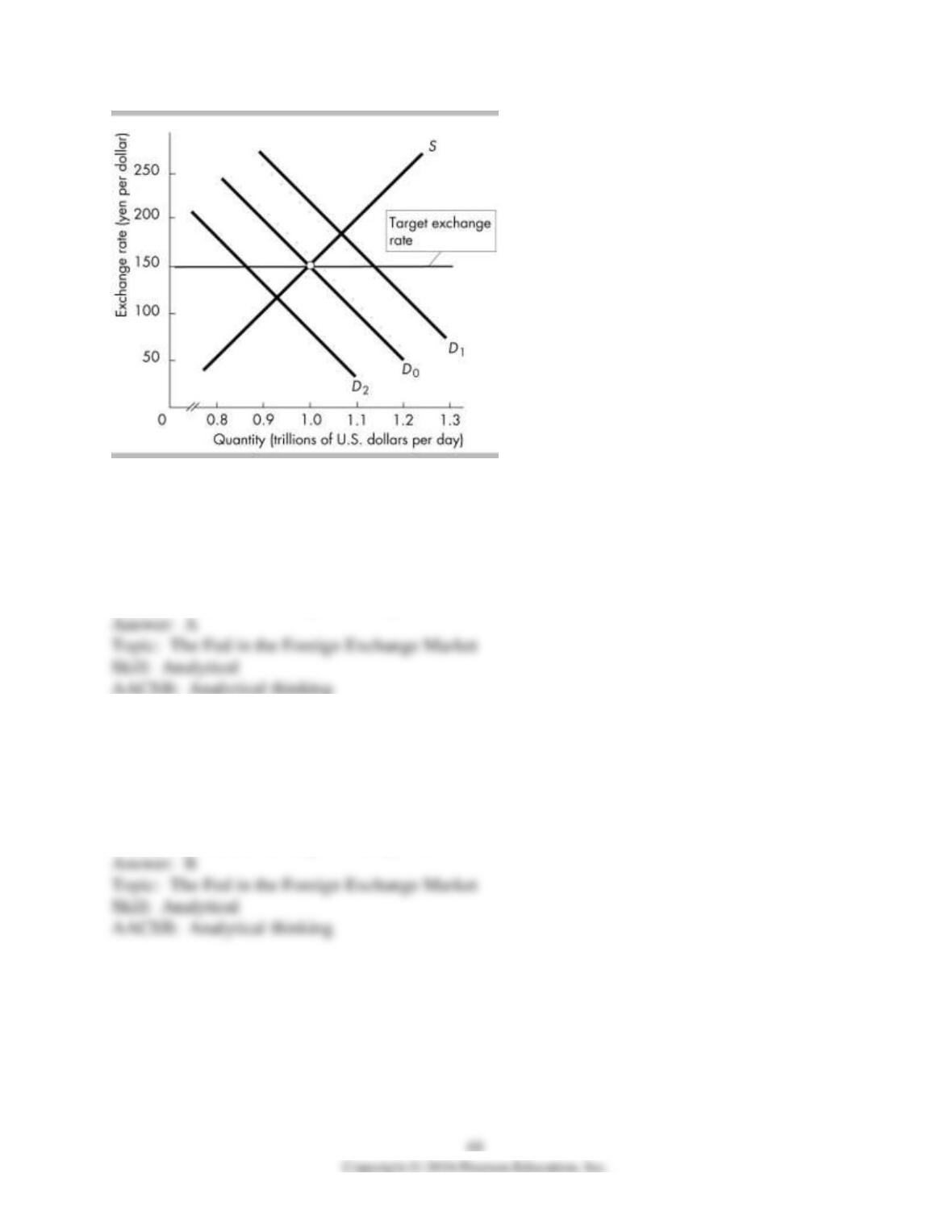
16) In the above figure, suppose the demand for dollars temporarily increases so that the demand
curve shifts to D1. To maintain the target exchange rate, the Fed
A) can sell dollars.
B) can buy dollars.
C) must violate interest rate parity but not purchasing power parity.
D) cannot maintain the target exchange rate.
17) In the figure above, suppose the demand for dollars temporarily decreases so that the demand
curve shifts to D2. To maintain the target exchange rate, the Fed
A) can sell dollars.
B) can buy dollars.
C) must violate both interest rate parity and purchasing power parity.
D) cannot maintain the target exchange rate.
18) In the above figure, suppose the demand for dollars permanently decreases to D2. To
maintain the target, the Fed
A) can buy dollars.
B) can sell dollars.
C) must decrease the nation’s net exports.
D) cannot permanently maintain the exchange rate target of 150 yen per dollar.
19) If the Fed raises the U.S. interest rate, the demand for dollars ________ and the exchange
rate ________.
A) increases; rises
B) increases; falls
C) decreases; rises
D) decreases; falls
20) Epsilon is a country whose unit of currency is the omega. New information leads people to
expect that the omega will appreciate next year. To keep the foreign exchange value of the
omega fairly steady, the Bank of Epsilon will ________ enough omegas on the foreign exchange
market so that the ________ omegas will ________.
A) buy; demand for; increase
B) sell; supply of; increase
C) buy; demand for; decrease
D) buy; supply of; decrease
21) If the Fed wants to depreciate the U.S. dollar against the British pound, it will ________.
A) sell foreign exchange
B) decrease the money supply
C) sell British pounds
D) sell U.S. dollars
22) If a nation’s central bank increased domestic interest rates, the nation’s exchange rate would
change if the country’s exchange rate was a
A) a flexible exchange rate.
B) a fixed exchange rate.
C) a crawling peg.
D) a nominally fixed exchange rate.
23) China has used a fixed yuan exchange rate and a crawling peg exchange rate. In both cases,
China pegs its currency to the
A) U.S. dollar.
B) Japanese yen.
C) euro.
D) Mexican peso.
24) If the People’s Bank of China adopted a flexible exchange rate policy
A) the U.S. dollar would depreciate.
B) the U.S. dollar would appreciate.
C) the yuan would depreciate.
D) the yuan-U.S. dollar exchange rate would rise.
25) The People’s Bank of China has
A) allowed a flexible exchange rate to boost exports.
B) managed its exchange rate to help control inflation.
C) strictly followed a fixed exchange rate to boost exports.
D) purchased U.S. dollars to appreciate the yuan.
26) By fixing its exchange rate, China is most likely
A) achieving a low inflation rate by anchoring to the U.S. inflation rate.
B) keeping its export prices low.
C) making it easier to compete in world markets.
D) Both B and C.
27) All of the following statements are correct EXCEPT
A) China’s exchange rate policy boosts exports in the long run.
B) China’s exchange rate policy is mainly an attempt to control inflation.
C) China’s exchange rate policy results in a depreciated yuan.
D) China’s exchange rate policy does not impact the real exchange rate in the long run.
28) If a country’s central bank does not intervene in the foreign exchange market, the country has
A) a crawling peg exchange rate policy.
B) a fixed exchange rate policy.
C) a flexible exchange rate policy.
D) no exchange rate policy.
29) If the Fed sells U.S. dollars, the exchange rate
A) rises.
B) does not change.
C) falls.
D) changes, but the direction depends on whether the Fed affected the demand for dollars or the
supply of dollars.
4 Financing International Trade
1) A country’s balance of payments accounts record
A) the country’s net indebtedness to foreigners.
B) its international trading, borrowing, and lending.
C) the flow of human and nonhuman resources between it and its trading partners.
D) only its official transactions with other governments.
2) When the United States imports goods and services from the rest of the world
A) we receive payments from the rest of the world.
B) we make payments to the rest of the world.
C) we increase our inflation rate.
D) we decrease our inflation rate.
3) When we export goods to foreign countries, we
A) receive payments from the rest of the world.
B) make payments to the rest of the world.
C) increase our inflation rate.
D) decrease our inflation rate.
4) Balance of payments accounts include
A) the net interest income account.
B) the current account.
C) Both answers A and B are correct.
D) Neither answer A nor B is correct.
5) Which of the following is recorded in the U.S. balance of payments account?
I. foreign investment in the United States
II. U.S. investment abroad
III. the U.S. government deficit or surplus
A) III only
B) I and II
C) I and III
D) I, II and III
6) A country’s balance of payments accounts records
A) only the goods and services purchases among countries over a period of time.
B) the international trading, borrowing, and lending positions of a country over a period of time.
C) the flow of human and non-human capital among countries over a period of time.
D) only official transactions between governments over a period of time.
7) A country’s balance of payments accounts include all of the following EXCEPT the
A) military account.
B) current account.
C) capital and financial account.
D) official settlements account.
8) In part, a country’s current account measures
A) its current debt as opposed to its long-term debt.
B) borrowing and lending activity between the country’s residents and foreigners.
C) net increases and decreases in a country’s holdings of foreign currency.
D) receipts from the sale of goods and services to foreigners and payments for goods and
services bought from foreigners.
9) The account that records the receipts from the exports of goods and services sold abroad, the
payments for imports of goods and services from abroad, net interest income paid abroad, and
net transfers is the ________.
A) current account
B) official settlements account
C) international capital account
D) capital and financial account
10) Which international account is used to record payments for imports, receipts from exports,
net interest paid abroad and net transfers?
A) the capital and financial account
B) the current account
C) the official settlements account
D) the trade account
11) Which of the following is included in a nation’s current account?
I. the import of services
II. a change of foreign currency holdings
III. net transfers, such as foreign aid payments
A) I and III
B) I and II
C) II and III
D) III only
12) The current account
A) measures our exports minus our imports taking into account interest payments paid to and
received from the rest of the world.
B) measures our imports minus our exports.
C) does not account for interest payments paid to and received from the rest of the world.
D) is part of GDP.
13) The current account is
A) the difference between exports and imports, also taking into account interest payments to and
from the rest of the world.
B) the amount of money the government keeps on hand to pay its bills taking account of the
interest payments on its debt.
C) is the amount of tax revenue that the government expects to collect.
D) is the total amount of interest payments that the U.S. owes to foreign countries.
14) The largest part of the U.S. current account consists of
A) Fed transfers of U.S. dollars to other central banks.
B) net transfer payments between the United States and Mexico.
C) receipts from exports and payments for imports.
D) net borrowing between the United States and other countries.
15) Suppose that the U.S. government gives foreign aid to Turkey. This transaction would
directly
A) increase the U.S. current account.
B) decrease the U.S. current account.
C) increase the U.S. capital and financial account.
D) decrease the U.S. capital and financial account.
16) An American consumer buys a French luxury product in New York. In the U.S. balance of
payments accounts, this transaction directly appears in
A) the official settlements account.
B) the imports part of the current account.
C) the net transfers part of the current account.
D) the capital and financial account.
17) Which of the following contributes to a current account surplus for a country?
A) having tourists visit the country
B) importing textiles
C) having foreigners buy government securities from the country’s government
D) importing financial services
18) The current account records all transactions below EXCEPT for
A) net exports of goods and services.
B) net interest income.
C) net foreign investment.
D) net transfers.
19) Which of the following is NOT included in the U.S. current account?
A) U.S. investment abroad
B) net interest income
C) net transfers
D) imports of goods and services
20) The balance of payments account which records foreign investment in the United States and
U.S. investments abroad is the
A) capital and financial account.
B) current account.
C) official settlements account.
D) None of the above because foreign investment in the United States is included in one account
and U.S. investment abroad is included in another account.
21) The account that records foreign investment in the United States minus U.S. investment
abroad is the
A) capital and financial account.
B) official settlements account.
C) current account.
D) U.S. official reserves account.
22) The capital and financial account measures ________.
A) foreign investment in the United States minus U.S. investment abroad
B) capital produced outside of the United States minus capital produced inside the United States
C) capital used inside the United States but manufactured outside the United States
D) capital used outside the United States but manufactured inside the United States
23) Which of the following is included in a nation’s capital and financial account?
I. the purchase of foreign stocks and bonds
II. the sale of foreign stocks and bonds
III. importing a piece of capital equipment
A) I only
B) I and II
C) III only
D) I, II and III
24) Which of the following transactions is NOT recorded in the capital and financial account?
A) foreign investment in the United States
B) U.S. investment abroad
C) statistical discrepancy
D) net interest income
25) A negative balance in the capital and financial account means the economy is
A) lending to the rest of the world.
B) running a capital account surplus.
C) borrowing from the rest of the world.
D) importing more than it is exporting.
26) Which of the following transactions directly leads to a surplus on the U.S. capital and
financial account?
A) An American purchases a share of stock on the Tokyo exchange.
B) An American sells wheat to an African nation.
C) A Japanese resident purchases a U.S. government bond.
D) A resident of France visits the United States.
27) A German publishing company buys an American publishing company based in New York.
In the U.S. balance of payments accounts, this transaction directly appears in
A) the official settlements account.
B) the imports part of the current account.
C) the net transfers part of the current account.
D) the capital and financial account.
28) The official settlements account records the change in ________.
A) international trade
B) U.S. official reserves
C) foreign investment and domestic investment
D) the reserves held by banks and the Fed
29) Which of the following accounts records the change in U.S. official reserves?
A) current account
B) capital and financial account
C) official settlements account
D) none of the above
30) The account that records changes in the U.S. government’s holdings of foreign currency is
the
A) capital and financial account.
B) official settlements account.
C) current account.
D) U.S. official reserves account.
31) If the U.S. government increased its holdings of British pounds, definitely
A) the capital and financial account would increase.
B) the capital and financial account would decrease.
C) there would be an increase in U.S. official reserves.
D) there would be a decrease in U.S. official reserves.
32) If the U.S. government decreased its holdings of Mexican pesos, definitely
A) the capital and financial account would increase.
B) the capital and financial account would decrease.
C) there would be an increase in U.S. official reserves.
D) there would be a decrease in U.S. official reserves.
33) Which of the following statements is INCORRECT?
A) Payments for imports and receipts from exports are recorded in the current account.
B) Foreign investment in the United States and U.S. investment abroad are recorded in the
capital and financial account.
C) A change in U.S. official reserves is recorded in the official settlements account.
D) Net interest income is recorded in the official settlements account.
34) The official settlements account of a country measures
A) the receipts from goods and services bought and sold and transfers to and from foreigners.
B) borrowing and lending between the country’s residents and foreigners.
C) the net increase or decrease in the country’s official reserves.
D) net transfer payments between the country’s citizens and foreigners.
35) U.S. official reserves are the ________.
A) reserves of U.S. dollars held by the World Bank
B) U.S. government’s holdings of foreign currency
C) reserves of U.S. dollars held by foreign banks
D) holdings of foreign currency by the public and the banks
36) The change in U.S. official reserves is equal to
A) borrowing from abroad plus the current account deficit.
B) the current account balance plus the capital and financial account balance.
C) the current account balance minus the capital and financial account balance.
D) foreign investment in the United States minus U.S. investment abroad.