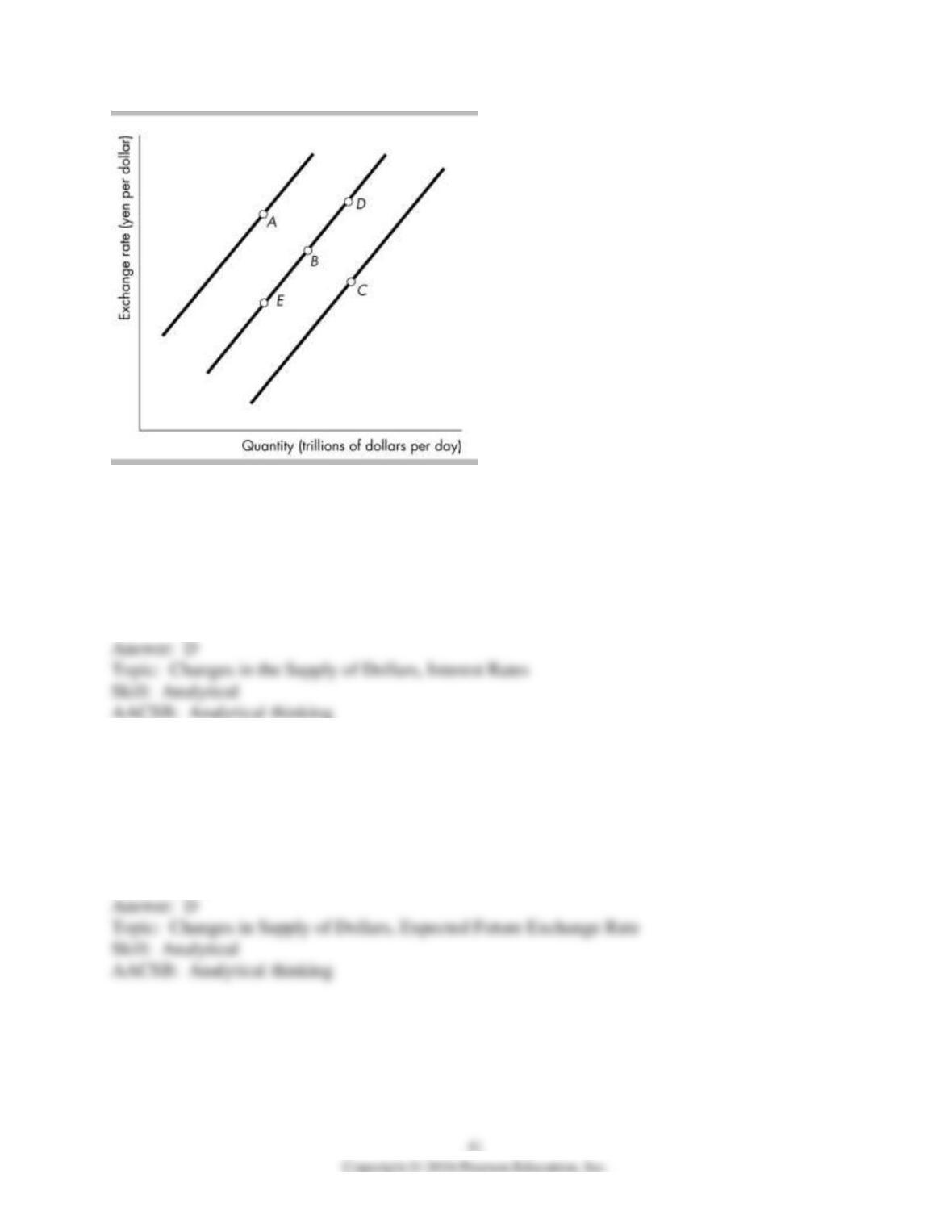
52) In the figure above, suppose the economy is initially at point B. Then the interest rate in
Japan rises relative to the interest rate in the United States. This change ________ the supply of
dollars and the market moves to a point such as ________.
A) decreases; A
B) decreases; E
C) increases; D
D) increases; C
53) In the figure above, suppose the economy is initially at point B. If people come to believe
that the exchange rate will fall in the future, the supply of dollars ________ and the market
moves to point such as ________.
A) decreases; A
B) decreases; E
C) increases; D
D) increases; C
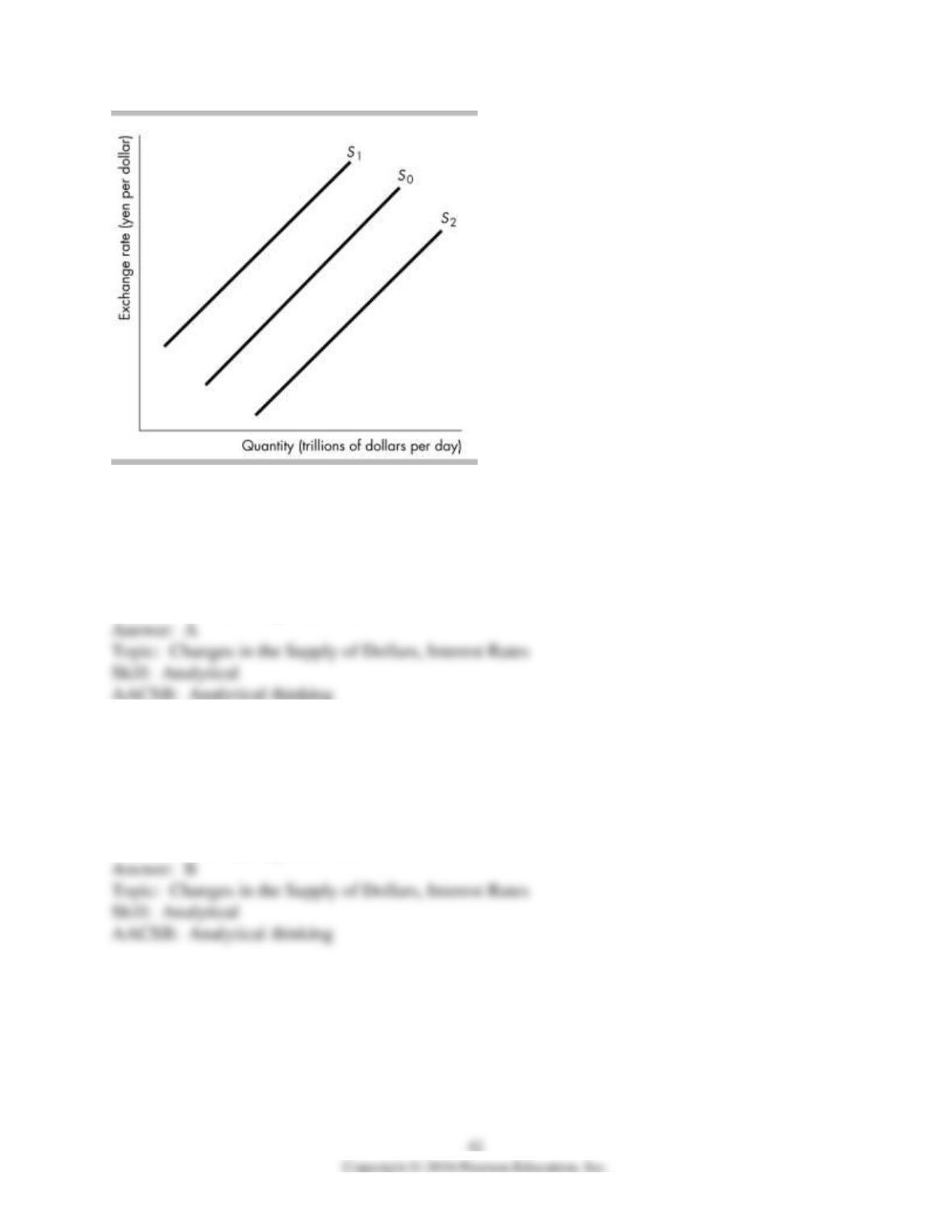
54) In the figure above, the shift in the supply curve for U.S. dollars from S0 to S1 could occur
when
A) the U.S. interest rate differential increases.
B) the U.S. interest rate differential decreases.
C) the expected future exchange rate falls.
D) the current exchange rate falls.
55) In the figure above, the shift in the supply curve for U.S. dollars from S0 to S1 could occur
when
A) the U.S. interest rate falls.
B) foreign interest rates fall.
C) the expected future exchange rate falls.
D) the current exchange rate falls.
56) In the figure above, the shift in the supply curve for U.S. dollars from S0 to S1 could occur
when
A) the U.S. interest rate rises.
B) foreign interest rates rise.
C) the expected future exchange rate falls.
D) the current exchange rate rises.
57) In the figure above, the shift in the supply curve for U.S. dollars from S0 to S2 could occur
when
A) the U.S. interest rate falls.
B) the expected future exchange rate rises.
C) the U.S. interest rate differential increases.
D) the current exchange rate falls.
58) In the figure above, the shift in the supply curve for U.S. dollars from S0 to S2 could occur
when
A) the foreign interest rates rises.
B) the expected future exchange rate rises.
C) the U.S. interest rate rises.
D) the current exchange rate falls.
59) In the figure above, the shift in the supply curve for U.S. dollars from S0 to S1 could occur
when
A) the expected future exchange rate rises.
B) the U.S. interest rate differential decreases.
C) the expected future exchange rate falls.
D) the current exchange rate falls.
60) In the figure above, the shift in the supply curve for U.S. dollars from S0 to S2 could occur
when
A) the current exchange rate rises.
B) the current exchange rate falls.
C) the expected future exchange rate rises.
D) the expected future exchange rate falls.
61) In the figure above, the shift in the supply curve for U.S. dollars from S0 to S2 could occur
when
A) the expected future exchange rate falls.
B) the U.S. interest rate differential increases.
C) the expected future exchange rate rises.
D) the current exchange rate falls.
62) If the U.S. interest rate differential increases, in the foreign exchange market the demand for
U.S. dollars ________ and the supply of U.S. dollars ________.
A) increases; increases
B) increases; decreases
C) decreases; increases
D) decreases; decreases
63) When the U.S. interest rate rises relative to that in other counties, in the foreign exchange
market the demand for U.S. dollars ________ and the supply of U.S. dollars ________.
A) increases; increases
B) increases; decreases
C) decreases; increases
D) decreases; decreases
64) Other things remaining the same, if the U.S. interest rate differential increases, the demand
curve for U.S. dollars shifts ________ and the supply curve of U.S. dollars shifts ________.
A) rightward; rightward
B) rightward; leftward
C) leftward; rightward
D) leftward; leftward
65) If the Federal Reserve increases interest rates
A) the demand curve for U.S. dollars shifts rightward and the supply curve of U.S. dollars shifts
leftward.
B) the demand curve for U.S. dollars shifts leftward and the supply curve of U.S. dollars shifts
rightward.
C) the demand curve for U.S. dollars and the demand curve for European euros both shift
rightward.
D) the demand curve for U.S dollars shifts leftward and the demand curve for European euros
shifts rightward.
66) If the Federal Reserve increases interest rates, ceteris paribus
A) the supply curve of U.S. dollars shifts leftward and the supply curve of European euros shifts
rightward.
B) the demand curve for U.S. dollars shifts leftward and the supply curve of U.S. dollars shifts
rightward.
C) the demand curve for U.S. dollars and the demand curve for European euros both shift
rightward.
D) the supply curve of U.S. dollars shifts rightward and the supply curve of European euros
shifts leftward
67) If the European Central Bank increases interest rates
A) the demand curve for European euros shifts rightward and the supply curve of European
euros shifts leftward.
B) the demand curve for European euros shifts leftward and the supply curve of European euros
shifts rightward.
C) the demand curve for European euros and the demand curve for U.S. dollars both shift
rightward.
D) the demand curve for European euros shifts leftward and the demand curve for U.S. dollars
shifts rightward.
68) Other things remaining the same, if the expected future exchange rate rises, the demand
curve for U.S. dollars shifts ________ and the supply curve of U.S. dollars shifts ________.
A) rightward; rightward
B) rightward; leftward
C) leftward; rightward
D) leftward; leftward
69) Relative to the yen, from 2007-2012 the U.S. dollar
A) appreciated due to an increase in the interest rate differential and expectations of a higher
future exchange rate.
B) appreciated due to a decrease in the interest rate differential and expectations of a lower future
exchange rate.
C) depreciated due to an increase in the interest rate differential and expectations of a higher
future exchange rate.
D) depreciated due to a decrease in the interest rate differential and expectations of a lower
future exchange rate.
70) Relative to the yen, from 2012-2014 the U.S. dollar
A) depreciated due to an anticipated decrease in the interest rate differential and expectations of
a lower future exchange rate.
B) appreciated due to an anticipated decrease in the interest rate differential and expectations of a
lower future exchange rate.
C) depreciated due to an anticipated increase in the interest rate differential and expectations of a
higher future exchange rate.
D) appreciated due to an anticipated increase in the interest rate differential and expectations of a
higher future exchange rate.
71) The U.S. dollar will depreciate in value if
A) the demand curve for U.S. dollars shifts rightward.
B) the demand curve for U.S. dollars shifts leftward.
C) the supply curve of U.S. dollars shifts rightward.
D) Both answers B and C are correct.
72) The U.S. dollar will depreciate in value if
A) the demand for the dollar increases.
B) the demand for the dollar decreases.
C) the supply of foreign exchange decreases.
D) U.S. citizens choose to buy fewer foreign goods.
73) The U.S. dollar will appreciate in value if
A) the demand curve for U.S. dollars shifts rightward.
B) the demand curve for U.S. dollars shifts leftward.
C) the supply curve of U.S. dollars shifts rightward.
D) Americans choose to buy more foreign goods.
74) Suppose $1 will buy 150 yen in January and 200 yen the following December. This change
could have occurred if the
A) demand curve for dollars shifted rightward.
B) demand curve for dollars shifted leftward.
C) supply curve of dollars shifted rightward.
D) demand curve for yen shifted rightward.
75) If the demand for a country’s currency increases, the currency
A) appreciates.
B) depreciates.
C) stays the same.
D) could either appreciate, depreciate, or stay the same.
76) An increase in the U.S. demand for imports will ________ the supply of dollars and lead the
dollar to ________.
A) increase; appreciate
B) decrease; appreciate
C) increase; depreciate
D) decrease; depreciate
77) Which of the following will lead to an appreciation of the U.S. dollar against the British
pound?
A) an increase in British demand for U.S. imports
B) an increase in U.S. demand for British imports
C) an increase in British interest rates
D) a decrease in British demand for U.S. assets
78) Assume that there is an increased demand in the United States for European wines. If all
other factors are held constant, this change will result in
A) an increase in the exchange rate for euros.
B) an appreciation of the dollar.
C) a movement along the demand curve for euros.
D) a decrease in the value of the euro.
79) An increase in foreign demand for U.S. exports will ________ the demand for dollars and
lead the dollar to ________.
A) increase; appreciate
B) increase; depreciate
C) decrease; appreciate
D) decrease; depreciate
80) An increase in the Japanese interest rate will ________ the demand for dollars and lead the
dollar to ________.
A) increase; appreciate
B) increase; depreciate
C) decrease; appreciate
D) decrease; depreciate
81) An increase in the Japanese interest rate will ________ the supply of dollars and lead the
dollar to ________.
A) increase; appreciate
B) increase; depreciate
C) decrease; appreciate
D) decrease; depreciate
82) Which of the following will lead to a depreciation of the dollar against the British pound?
A) an increase in British demand for U.S. imports
B) an increase in U.S. interest rates
C) a decrease in British demand for U.S. assets
D) a decrease in U.S. demand for British goods
83) If the Federal Reserve raises the U.S. interest rate, foreigners’
A) demand for U.S. dollars will increase and the exchange rate will rise.
B) demand for U.S. dollars will decrease and the exchange rate will fall.
C) demand for U.S. dollars will increase and the exchange rate will fall.
D) demand for U.S. dollars will decrease and the exchange rate will rise.
84) Suppose the exchange rate for the U.S. dollar rises. This could be caused by
A) an increase in U.S. import demand.
B) a decrease in the world demand for U.S. exports.
C) a fall in the expected future exchange rate.
D) an increase in the U.S. interest rate differential.
85) Suppose that the U.S. exchange rate is expected to fall in the future. As a result, in the
foreign exchange market, there will be
A) an increase in the demand for dollars, a decrease in the supply of dollars, and a rise in the
equilibrium exchange rate.
B) an increase in the demand for dollars, a decrease in the supply of dollars, and a fall in the
equilibrium exchange rate.
C) a decrease in the demand for dollars, an increase in the supply of dollars, and a rise in the
equilibrium exchange rate.
D) a decrease in the demand for dollars, an increase in the supply of dollars, and a fall in the
equilibrium exchange rate.
86) Suppose the market for dollars is in equilibrium, then the expected future exchange rate rises.
What effect does this change have on the current exchange rate?
A) It will rise.
B) It will fall.
C) It will remain unchanged.
D) Because both the supply and demand curves shift, the effect on the exchange rate is
unpredictable.
87) If people expect the dollar to depreciate, then the
A) demand for dollars will decrease, the supply of dollars will increase, and the exchange rate
will fall.
B) demand for dollars will decrease, the supply of dollars will not change, and the exchange rate
will fall.
C) supply of dollars will increase, the demand for dollars will not change, and the exchange rate
will fall.
D) demand for dollars will increase, the supply of dollars will decrease, and the exchange rate
will rise.
88) Suppose the exchange rate for the U.S. dollar falls. This could be caused by
A) a decrease in U.S. import demand.
B) an increase in the world demand for U.S. exports.
C) an increase in the U.S. interest rate differential.
D) a fall in the expected future exchange rate.
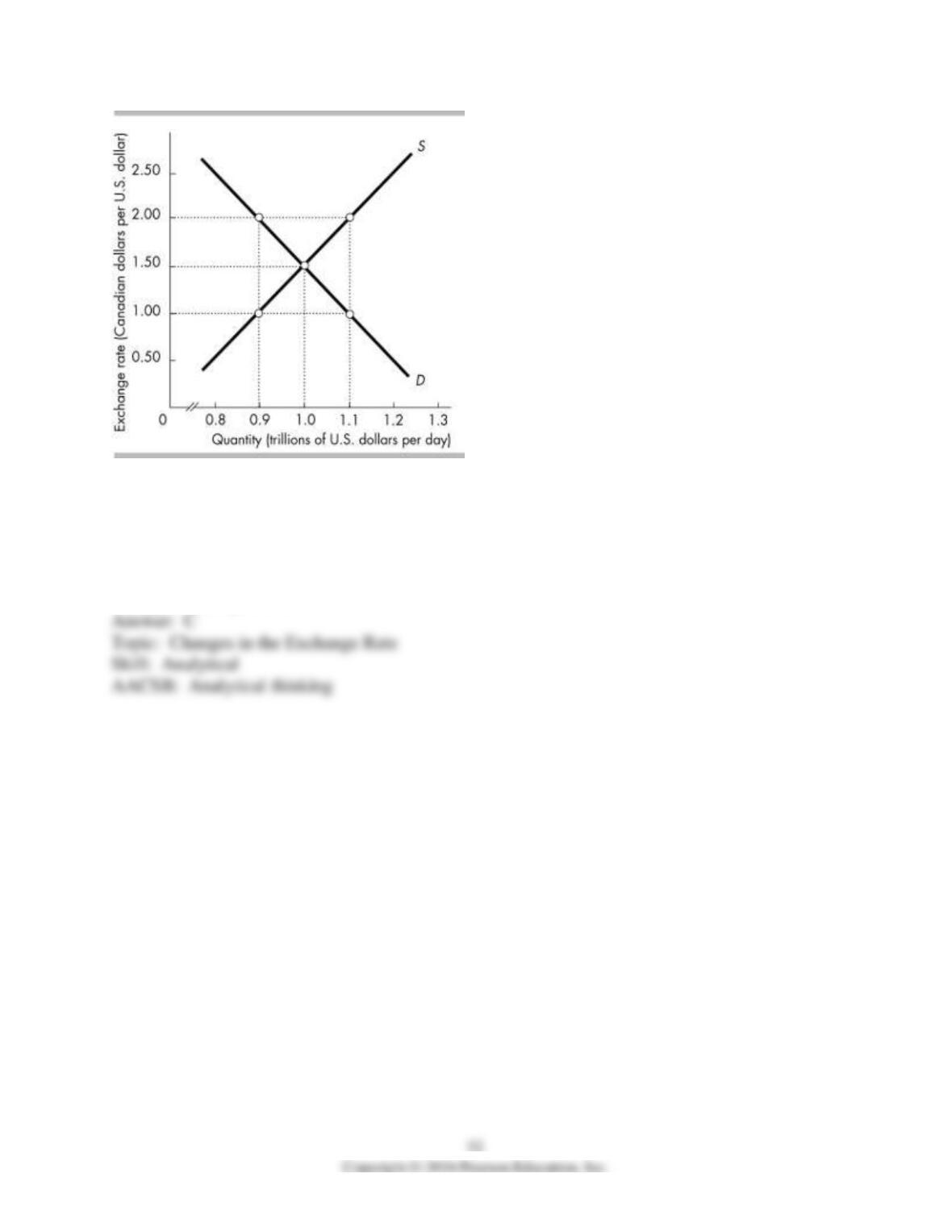
89) In the figure above, an increase in the U.S. interest rate relative to that in Canada shifts the
demand curve for U.S. dollars ________ and shifts the supply curve of U.S. dollars ________.
A) leftward; leftward
B) leftward; rightward
C) rightward; leftward
D) rightward; rightward
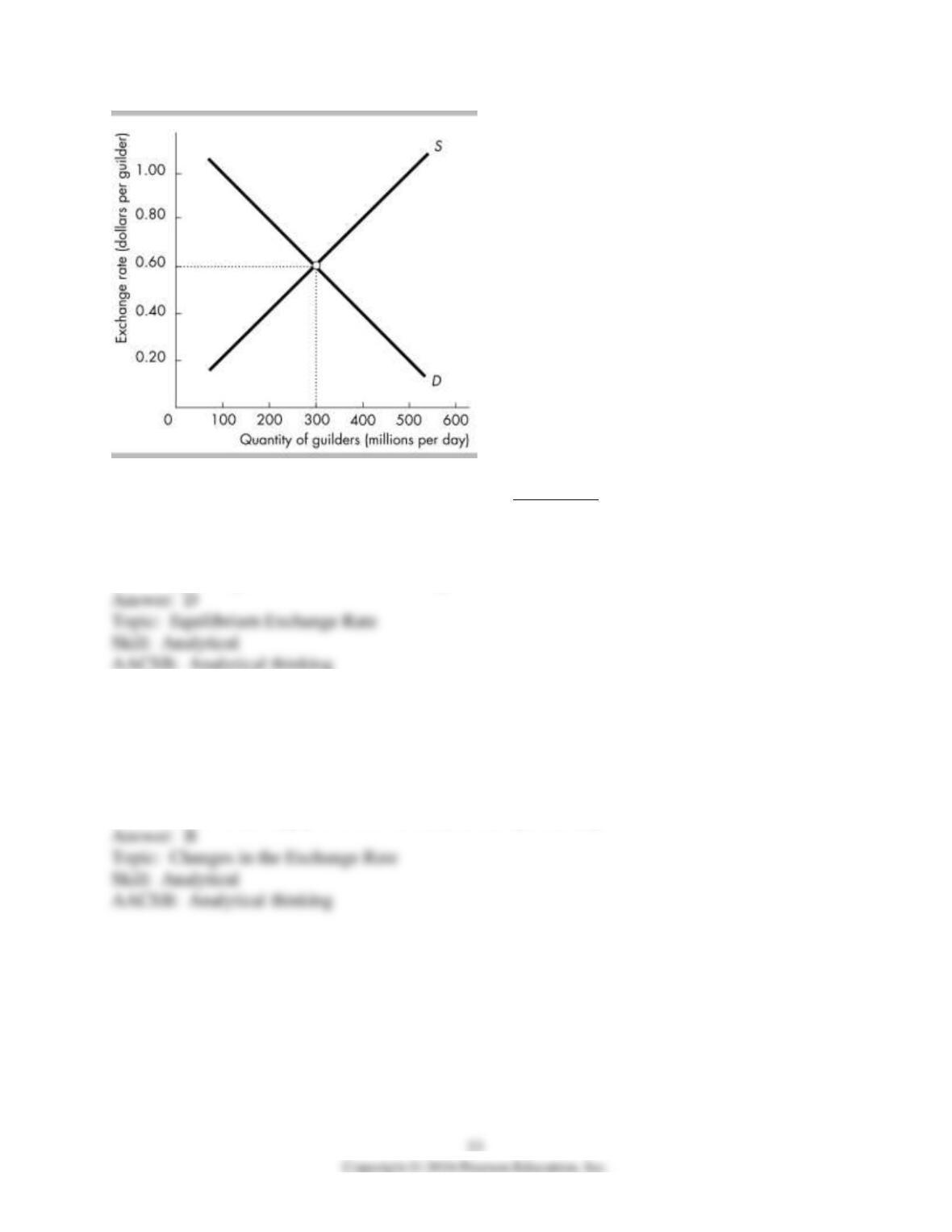
90) Using the above figure, which of the following is CORRECT?
A) 1 guilder will sell for $2.
B) 1 dollar will sell for 1/2 guilder.
C) A shortage of guilders exists at an exchange rate above $0.60.
D) A surplus of guilders exists at an exchange rate above $0.60.
91) Using the above figure, an increase in the demand for Dutch goods by U. S. consumers will
lead to
A) a depreciation in the Dutch currency.
B) an appreciation in the Dutch currency.
C) an increase in the supply of Dutch currency as foreign exchange.
D) a decrease in the supply of Dutch currency as foreign exchange.
92) Arbitrage in the foreign exchange market, international loans markets, and goods markets
results in
A) purchasing power parity, interest rate parity and law of one price.
B) purchasing power parity, interest rate parity and price parity.
C) purchasing power parity, interest rate parity and round-trip profit.
D) purchasing power parity, price parity and no round-trip profit.
93) What factors can change expectations about the exchange rate?
A) interest rate parity
B) purchasing power parity
C) real GDP parity
D) Both answers A and B are correct.
94) Adjusted for risk, interest rate parity
A) holds only for larger countries.
B) holds only between the U.S. and Canada.
C) holds only when purchasing parity holds.
D) always holds.
95) If there are equal rates of return between assets in two currencies, then there is
A) purchasing power parity.
B) interest rate parity.
C) parity of exchange.
D) foreign exchange parity.
96) If in Chicago the interest rate is 5 percent a year and in Vancouver it is 4 percent a year,
________.
A) the quantity of Canadian dollars purchased will increase
B) the Canadian dollar is expected to depreciate
C) interest rate parity does not exist
D) the U.S. dollar is expected to depreciate
97) Suppose that the U.S. interest rate is 5 percent and the Turkish interest rate is 50 percent. The
effect of this difference in the foreign exchange market is that
A) financial capital stops moving.
B) an American investor is guaranteed to make an additional 45 percent in dollar terms by
investing in Turkey.
C) investors expect the Turkish currency to rise in value (appreciate) against the dollar.
D) investors expect the Turkish currency to fall in value (depreciate) against the dollar.
98) Suppose that the U.S. interest rate is 5 percent and the Japanese interest rate is 1 percent. The
effect of this difference in the foreign exchange market is that
A) financial capital stops moving.
B) a Japanese investor is guaranteed to make an additional 4 percent in yen terms by investing in
the United States.
C) investors expect the yen to appreciate against the dollar.
D) investors expect the yen to depreciate against the dollar.
99) Suppose a deposit in New York earns 6 percent a year and a deposit in London earns 4
percent a year. Interest rate parity holds if the
A) U.S. dollar appreciates by 2 percent a year.
B) U.S. dollar depreciates by 2 percent a year.
C) U.K. pound depreciates by 2 percent a year.
D) None of the above answers is correct because interest rate parity requires that the interest
rates be the same in both countries.
100) Suppose a British bank offers a 3 percent interest rate while a U.S. bank offers a 7 percent
interest rate. People must expect the U.S. dollar will
A) depreciate 4 percent.
B) appreciate 4 percent.
C) appreciate 10 percent.
D) depreciate 10 percent.
101) According to interest rate parity, if the interest rate is 1 percent in the European Union and
the euro is expected to appreciate 3 percent, the comparable interest rate in the United States will
be
A) 4 percent.
B) 3 percent.
C) 2 percent.
D) 1 percent.
102) Suppose a Japanese bank offers a 4 percent interest rate and U.S. banks offer a 2 percent
interest rate. People must expect the yen to
A) depreciate by 2 percent.
B) appreciate by 2 percent.
C) depreciate by 6 percent.
D) appreciate by 6 percent.
103) The idea that the value of money is equal across countries is known as
A) interest rate parity.
B) the expected profit parity effect.
C) purchasing power parity.
D) exchange rate parity.
104) If the prices in the United States rise faster than those in other countries,
A) the exchange rate rises.
B) the exchange rate falls.
C) then interest rate parity must not hold.
D) the interest rate in the United States falls.
105) Suppose the exchange rate between the U.S. dollar and the Mexican peso was $1 = 5 pesos.
A can of Pepsi sells for $2 in Boston and for 12 pesos in Mexico City.
A) Purchasing power parity prevails with these prices.
B) Purchasing power parity does not prevail with these prices.
C) The U.S. dollar would be expected to depreciate.
D) None of the above answers is correct.
106) Suppose the exchange rate between the U.S. dollar and the Jamaican dollar was $1 U.S. =
$40 Jamaican dollars. A beach towel sells for $20 in Miami and $60 Jamaican in Negril.
A) Purchasing power parity does not prevail with these prices.
B) The U.S. dollar would be expected to depreciate.
C) The Jamaican dollar would be expected to appreciate.
D) All of the above are correct.
107) If the price level rises in the United States but not in foreign nations and the current
exchange rate does not change, the expected future exchange rate
A) rises.
B) falls.
C) stays the same.
D) You can’t tell from the given information.
108) According to purchasing power parity, a rise in inflation in the United States. relative to the
rest of the world will lead to
A) a balance of payments surplus.
B) a balance of payments deficit.
C) an exchange rate appreciation.
D) an exchange rate depreciation.
109) Suppose that U.S. inflation is 3 percent and Turkish inflation is 70 percent. The effect of
this discrepancy on the foreign exchange market is that
A) the Turkish currency will depreciate.
B) the dollar will depreciate.
C) it is impossible for interest rate parity to hold.
D) the Turkish currency will appreciate.
110) According to purchasing power parity, the foreign exchange market will
A) undervalue the dollar if inflation in the United States is greater than it is elsewhere.
B) no longer demand dollars if the inflation rate in the United States exceeds that of other
nations.
C) adjust the value of the exchange rate to reflect differing inflation rates between nations.
D) result in a flow of dollars out of the United States whenever its rate of inflation is below that
of other nations.
111) When a nation’s currency depreciates, the country might
A) have an inflation rate that exceeds the inflation rate in nations with which it trades.
B) have an inflation rate below the inflation rate in nations with which it trades.
C) be responding to an increase in the demand for its currency.
D) be responding to a decrease in the domestic demand for foreign currencies.
112) Suppose that the price of an identical sport-utility vehicle is $32,000 in U.S. dollars in the
United States and $32,000 in Canadian dollars in Canada. Suppose in addition that the exchange
rate between Canada and the United States is one Canadian dollar equals $0.75 U.S. dollar. Does
purchasing power parity hold for SUVs between the United States and Canada?
A) Yes, because SUVs have the same price in each local currency.
B) No, because SUVs are more expensive in Canada than the United States.
C) No, because SUVs are more expensive in the United States than in Canada.
D) Without knowing interest rates, we can’t say.
113) Suppose that the price of an identical sport-utility vehicle is $32,000 in U.S. dollars in the
United States and $32,000 in Canadian dollars in Canada. Suppose in addition that the exchange
rate between Canada and the United States is one Canadian dollar equals $0.75 U.S. dollar.
Based on this information what will happen to the exchange rate between the United States and
Canada?
A) The value of the U.S. dollar will fall as U.S. residents purchase SUVs in Canada.
B) The value of the Canadian dollar will fall as Canadians purchase SUVs in the United States.
C) The exchange rate will stay the same because purchasing power parity already holds.
D) The value of the Canadian dollar will fall because Canadian prices are lower than U.S. prices.
114) Suppose that $1 U.S. costs $1.50 Canadian. If in St. Louis a CD costs $10 U.S. and in
Montreal it costs $15 Canadian, then ________.
A) purchasing power parity holds
B) Canadians will buy CDs in St. Louis
C) Americans will buy CDs in Montreal
D) Virgin Records will have an incentive to build more stores in North America
115) “The Big Mac index is The Economist‘s burger-based measure of whether currencies are
over- or undervalued…. [E]xchange rates should eventually adjust to make the price of a basket
of goods the same in each country. Our basket contains just one item: the Big Mac hamburger,
which is pretty much the same around the world.”
The Economist, July 28, 2012
Which principle is The Economist relying on when using the Big Mac to value exchange rates?
A) interest rate parity
B) market price parity
C) purchasing power parity
D) exchange rate parity
116) The nominal exchange rate is
A) the value of the U.S. dollar expressed in units of foreign currency per U.S. dollar.
B) the real exchange rate multiplied by the ratio of the U.S. price level to the foreign price level.
C) the relative price of U.S. produced goods to foreign produced goods.
D) a measure of the quantity of the nominal GDP of other countries that we get per unit of U.S.
nominal GDP.
117) The real exchange rate is the
A) relative price of U.S. produced output relative to foreign-produced output.
B) price of foreign goods relative to the price of domestic goods.
C) trade-weighted index.
D) current account balance.
118) The real exchange rate is
A) the relative price of U.S. produced goods to foreign produced goods.
B) the nominal exchange rate multiplied by the ratio of the foreign price level to the U.S. price
level.
C) the money price of foreign produced goods relative to the money price of U.S. produced
goods.
D) a measure of how much currency exchanges for a unit of another currency.