7 True or False
1) To draw your budget line between steak and lobster, all you need to know is the price of a
steak and the price of a lobster.
2) To draw your budget line between steak and lobster, all you need to know is your income.
3) The lower the price of the good measured on the vertical axis, other thing remaining the same,
the flatter the budget line.
4) The higher the price of the good measured on the vertical axis, other thing remaining the
same, the flatter the budget line.
5) For a person who consumes only steak and lobster, a fall in either the price of a steak or the
price of a lobster shifts the budget line for the two leftward and does not change its slope.
6) An increase in income shift a person’s budget line rightward and does not change its slope.
7) A change in a person’s money income changes real income and therefore changes the slope of
the person’s budget line.
8) For a person who consumes only steak and lobster, the slope of the budget line is called the
marginal rate of substitution between steak and lobster.
9) The marginal rate of substitution is the rate at which a person is willing to substitute one good
for another good while remaining on the same indifference curve.
10) The magnitude of the slope of the indifference curve between steak and lobster is called the
marginal rate of substitution.
11) Consumption at points on a steeper part of the indifference curve will reflect a higher
marginal rate of substitution than consumption points on a flatter part of the indifference curve.
12) The slope of the indifference curve between steak and lobster is always equal to the ratio of
their prices.
13) The larger the marginal rate of substitution, the larger is the amount of one good that the
consumer is willing to give up in exchange for another good and still remain at the same level of
satisfaction.
14) If you considered steak and lobster to be perfect substitutes for each other, your indifference
curves between them would be L-shaped.
15) When two goods are perfect substitutes, their indifference curves are straight lines.
16) In order for you to consider steak and lobster to be perfect substitutes, their prices per pound
must be identical.
17) When your budget line is just tangent to your indifference curve, you are at the point on the
budget line that you least prefer.
18) When your budget line is just tangent to your indifference curve, you are at your best
affordable point.
19) A consumer will maximize utility, given income and prices, when the marginal rate of
substitution is equal to the ratio of the prices of the two goods.
20) A decrease in price allows a consumer to attain a higher indifference curve.
21) Holding your income and the price of lobster constant, you can derive your demand curve for
steak from an indifference curve/budget line diagram by determining how your consumption of
steak changes when the price of a steak changes.
22) You consume only steak and lobster. Your substitution effect from a drop in the price of
lobster is measured by a movement along your indifference curve between steak and lobster.
23) You consume only steak and lobster. Your income effect from a drop in the price of lobster
is measured by a movement along your indifference curve between steak and lobster.
8 Extended Problems
1) Margo spends $108 a year on music CDs and movies on DVDs. Initially the price of a music
CD is $18 and the price of a movie on DVD is $18. Then record companies, faced with the
growing competitions from digital music download services, lower the price of a music CD to
$13.50.
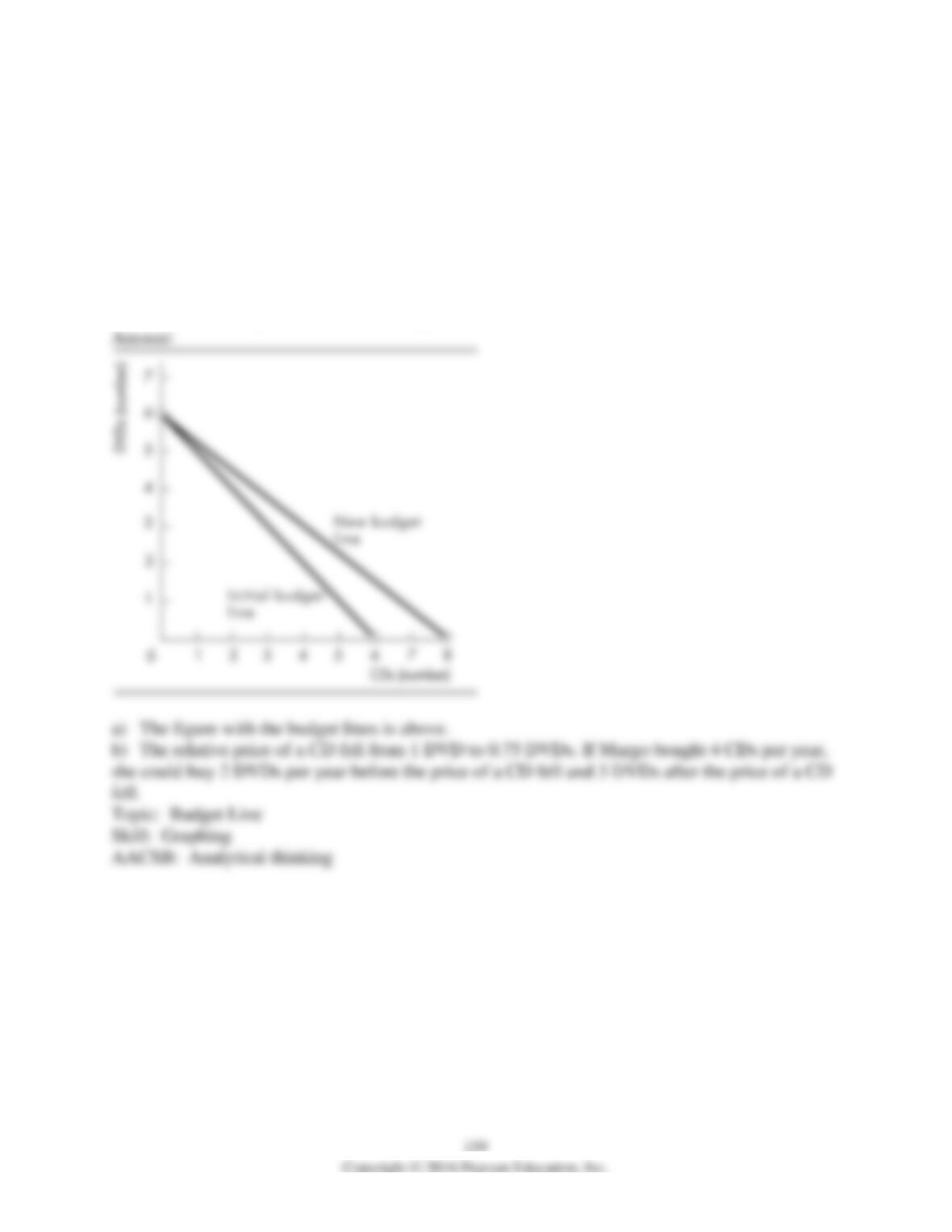
a) Draw graphs showing Margo’s consumption possibilities before and after the price of a CD
fell.
b) How has the relative price of a CD changed? If Margo bought 4 CDs per year, how many
DVDs could she buy before and after the price of a CD fell?
2) Olivia’s income is $216 a year and she spends all of it on music CDs and movies on DVDs.
The price of a music CD is $18 and the price of a DVD is $18.
a) What is Olivia’s real income in terms of CDs? What is her real income in terms of DVDs?
b) What is the relative price of a CD in terms of DVDs? What is the opportunity cost of a
DVD?
c) Calculate the equation for Olivia’s budget line. Place the quantity of DVDs on the left side of
the equation.
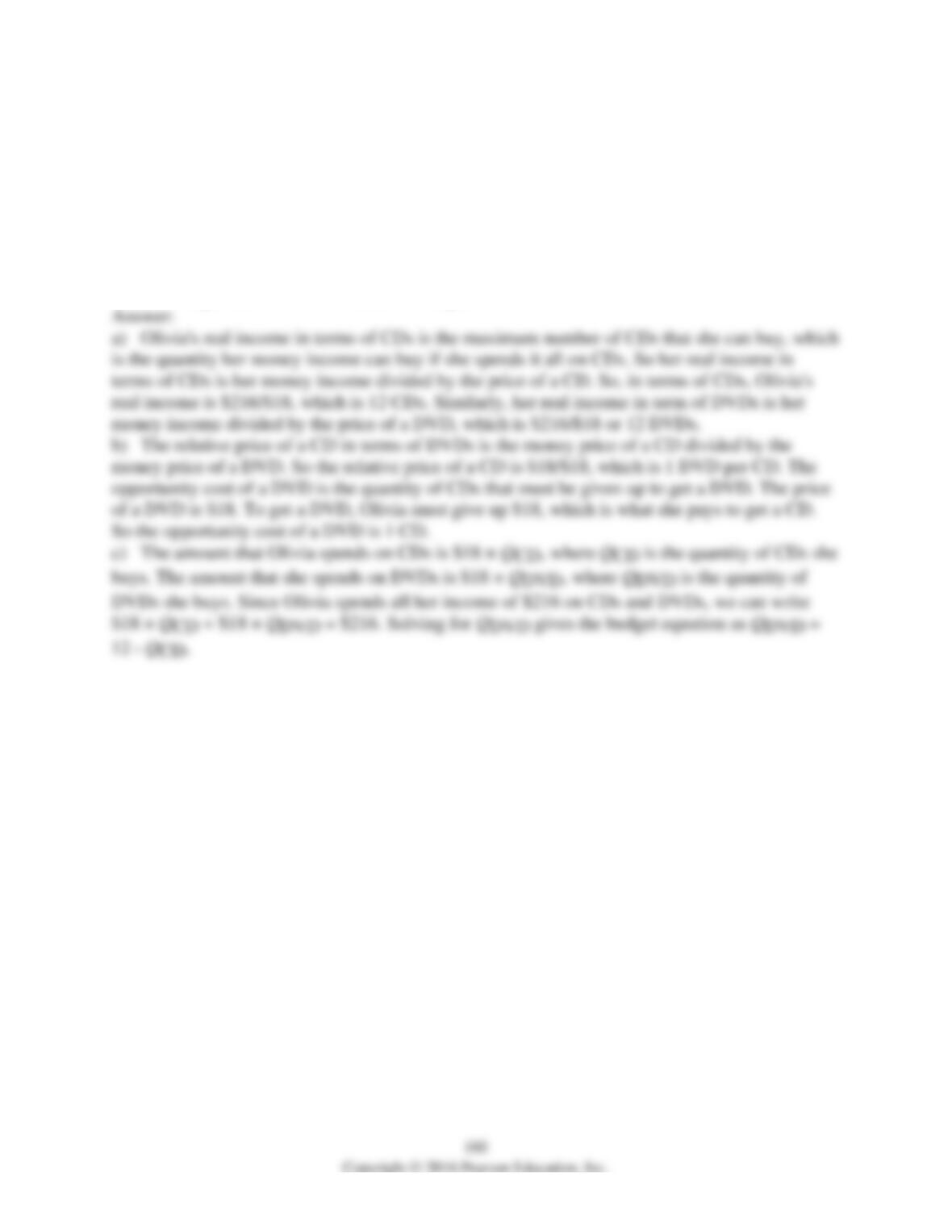
d) Draw a graph of Olivia’s budget line (with CDs on the horizontal axis). What is the slope of
Olivia’s budget line? What determines its magnitude?
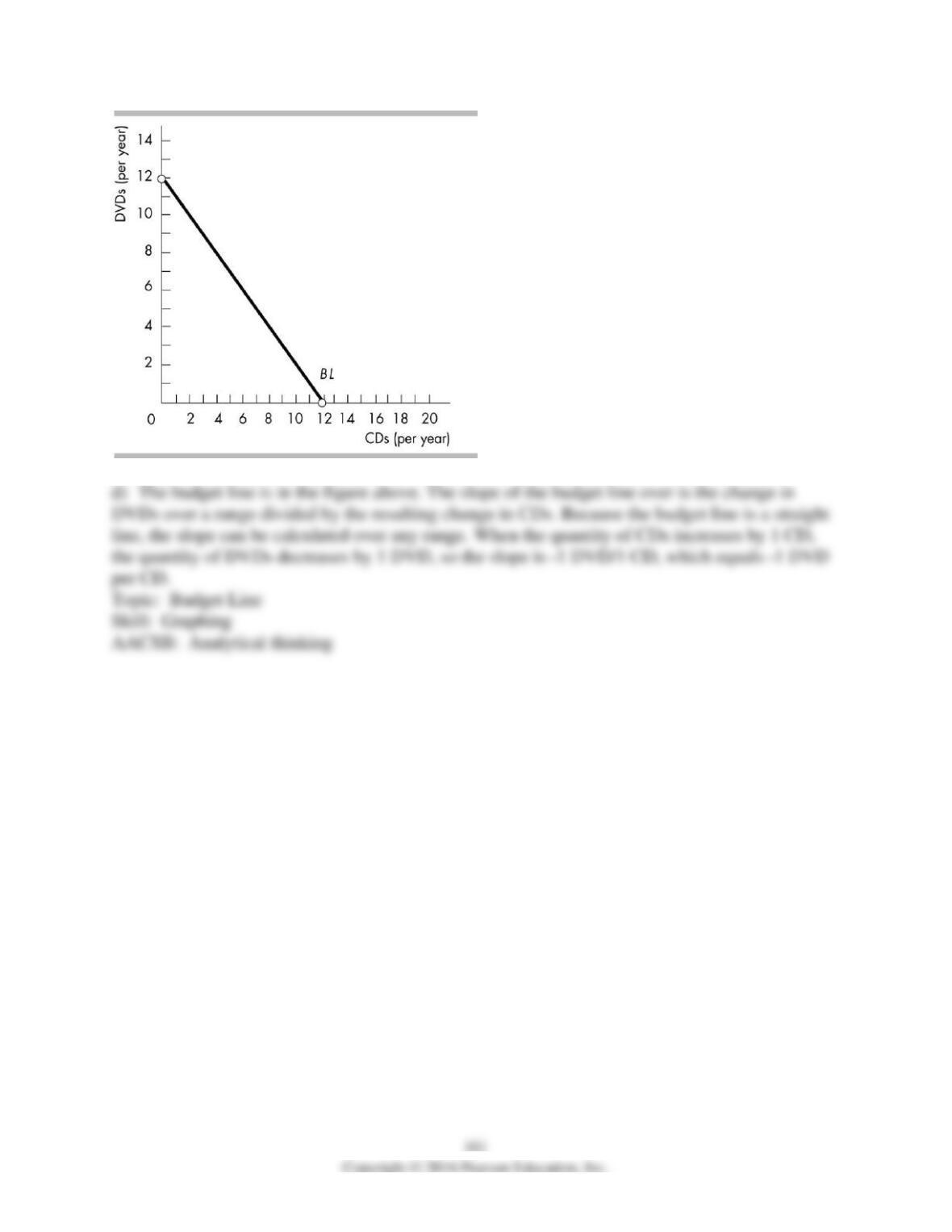
3) Olivia’s income is $216 a year and she spends all of it on music CDs and movies on DVDs.
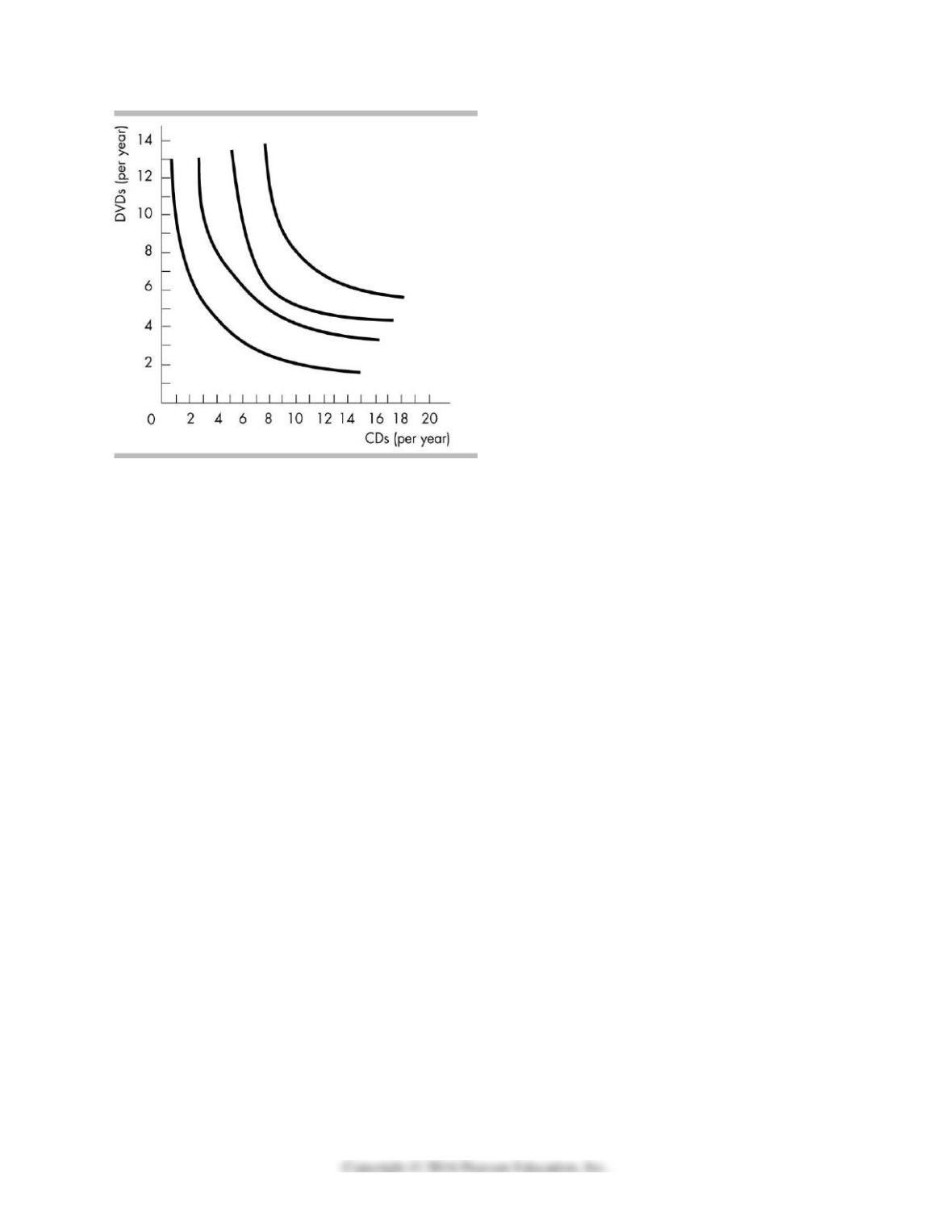
The price of a music CD is $18 and the price of a DVD is $18. The figure above illustrates
Olivia’s preferences.
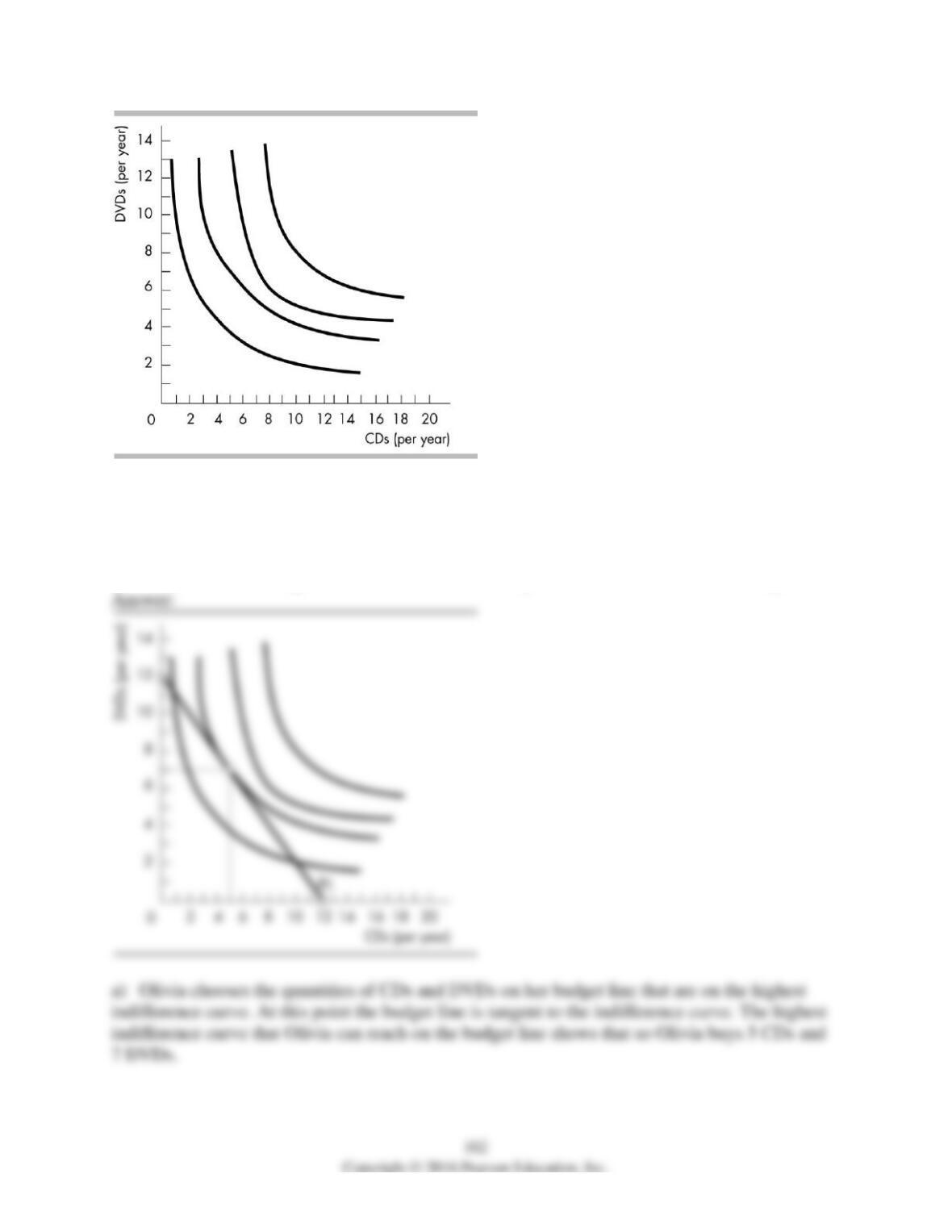
a) What quantities of CDs and DVDs does Olivia buy? Explain your solution.
b) What is Olivia’s marginal rate of substitution at the point at which she consumes? Explain.
164
4) Record companies, faced with the growing competitions from digital music download
services, lower the price of a music CD from $18.00 to $13.50. The price of a DVD is $18.
Olivia’s income is $216 a year and she spends all of it on music CDs and movies on DVDs.
a) What is Olivia’s real income in terms of CDs? What is her real income in terms of DVDs?
b) What is the relative price of a CD in terms of DVDs? What is the opportunity cost of a
DVD?
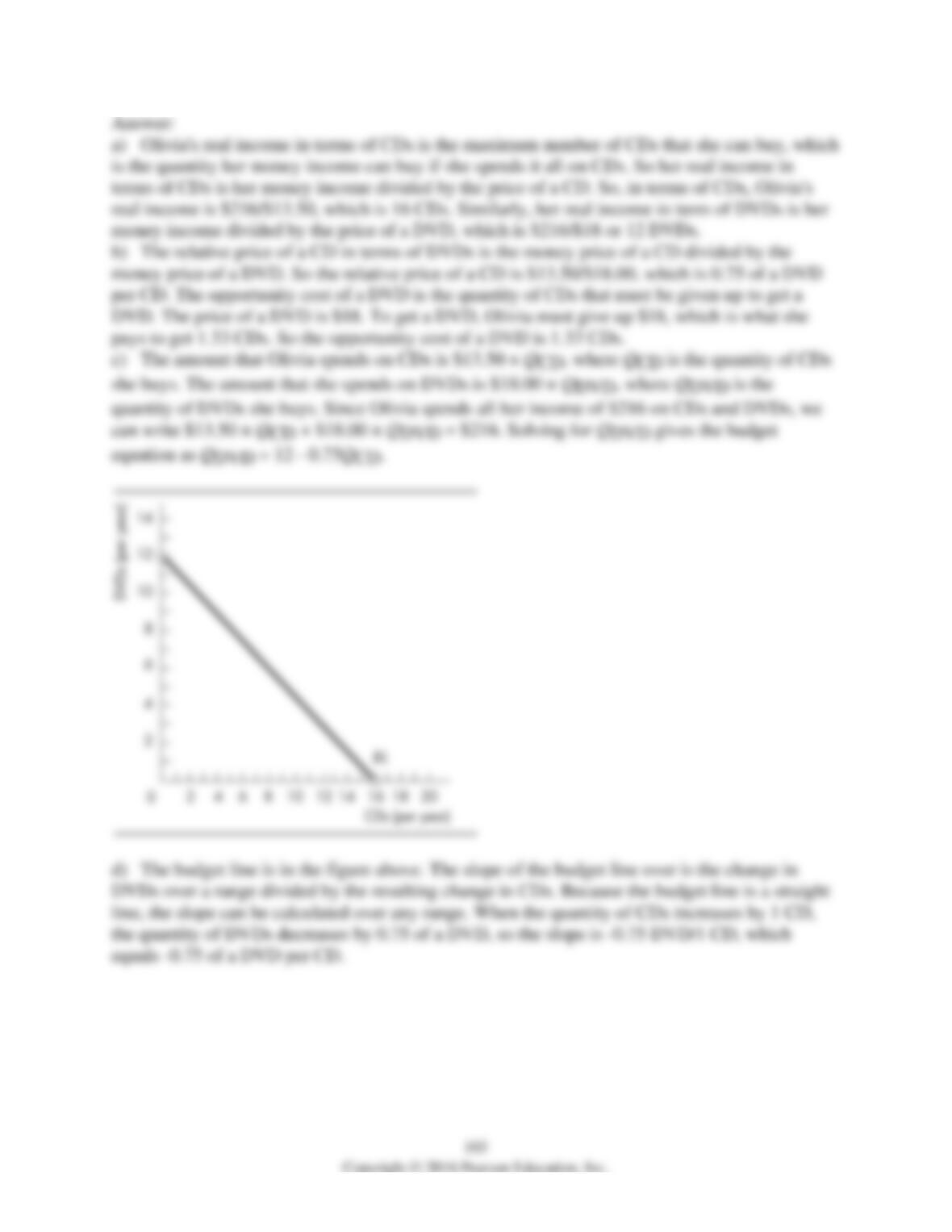
c) Calculate the equation for Olivia’s budget line. Place the quantity of DVDs on the left side of
the equation.
d) Draw a graph of Olivia’s budget line (with CDs on the horizontal axis). What is the slope of
Olivia’s budget line? What determines its magnitude?
The figure above illustrates Olivia’s preferences.
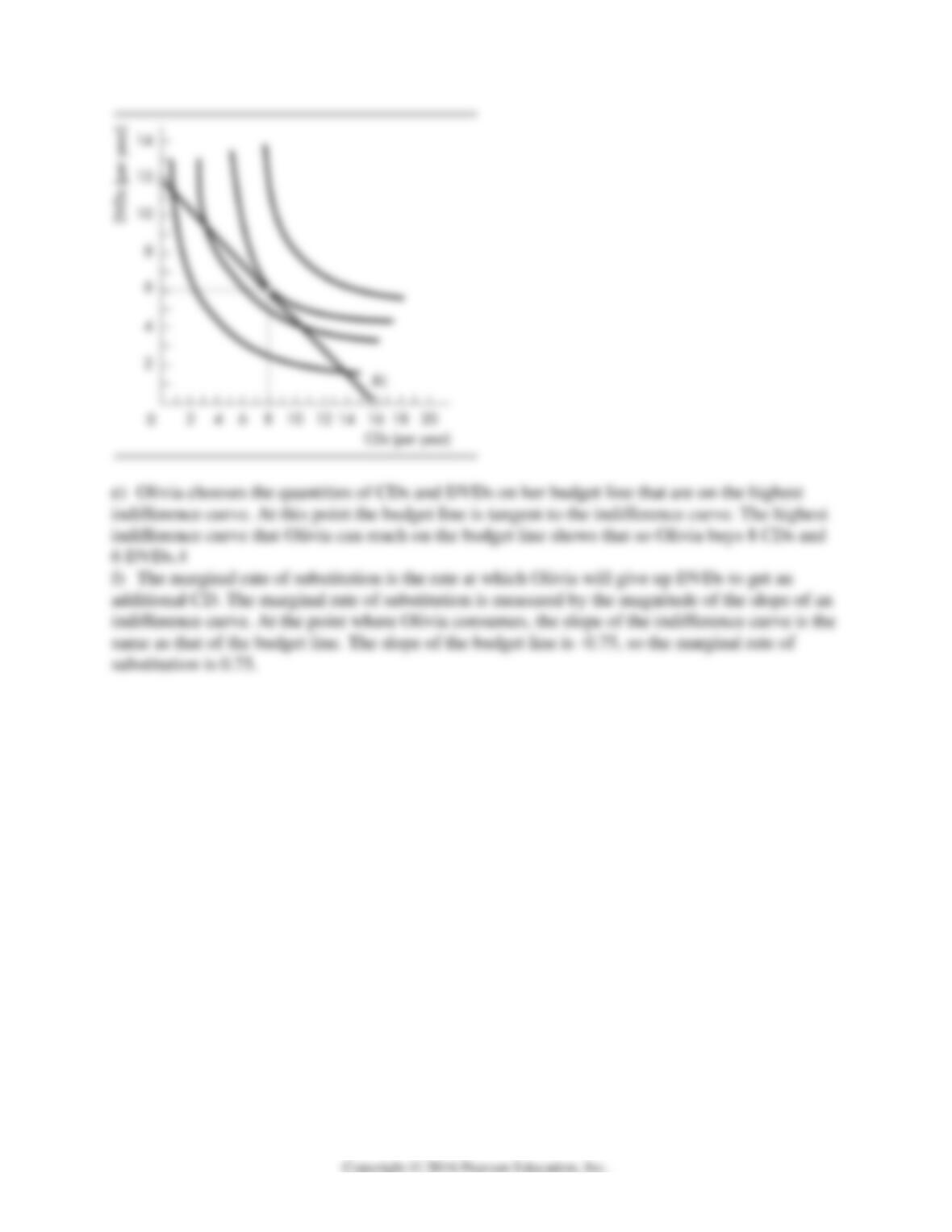
e) Given the price of a CD, the price of a DVD, and Olivia’s income, what quantities of CDs
and DVDs does Olivia buy? Explain your solution.
f) What is Olivia’s marginal rate of substitution at the point at which she consumes? Explain.
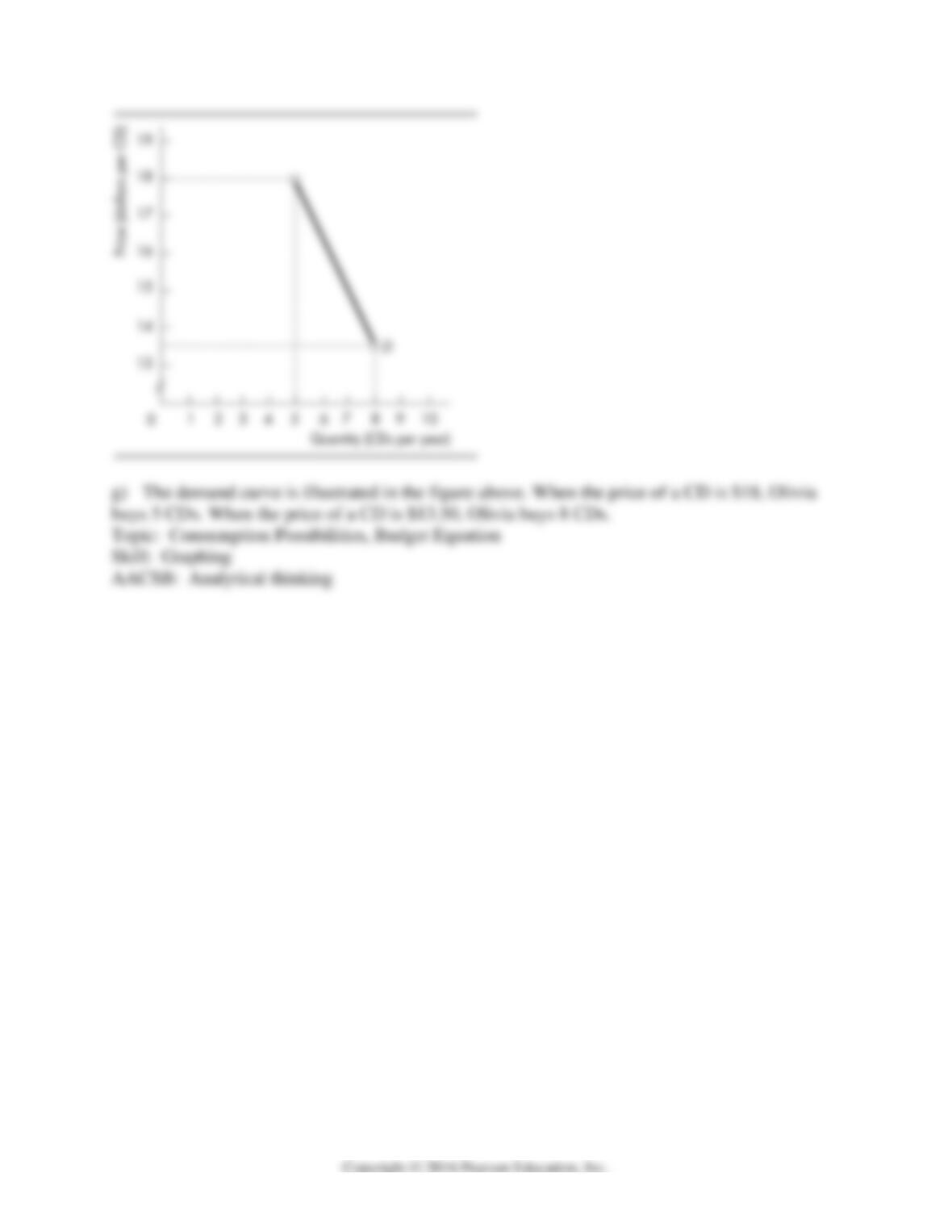
g) Determine how many CDs Olivia buys if the price of a CD is $18 and there is no change in
the price of DVD nor in Olivia’s income. Derive Olivia’s demand curve for CDs for the price
change from $18 to $13.50 per CD.
166
167