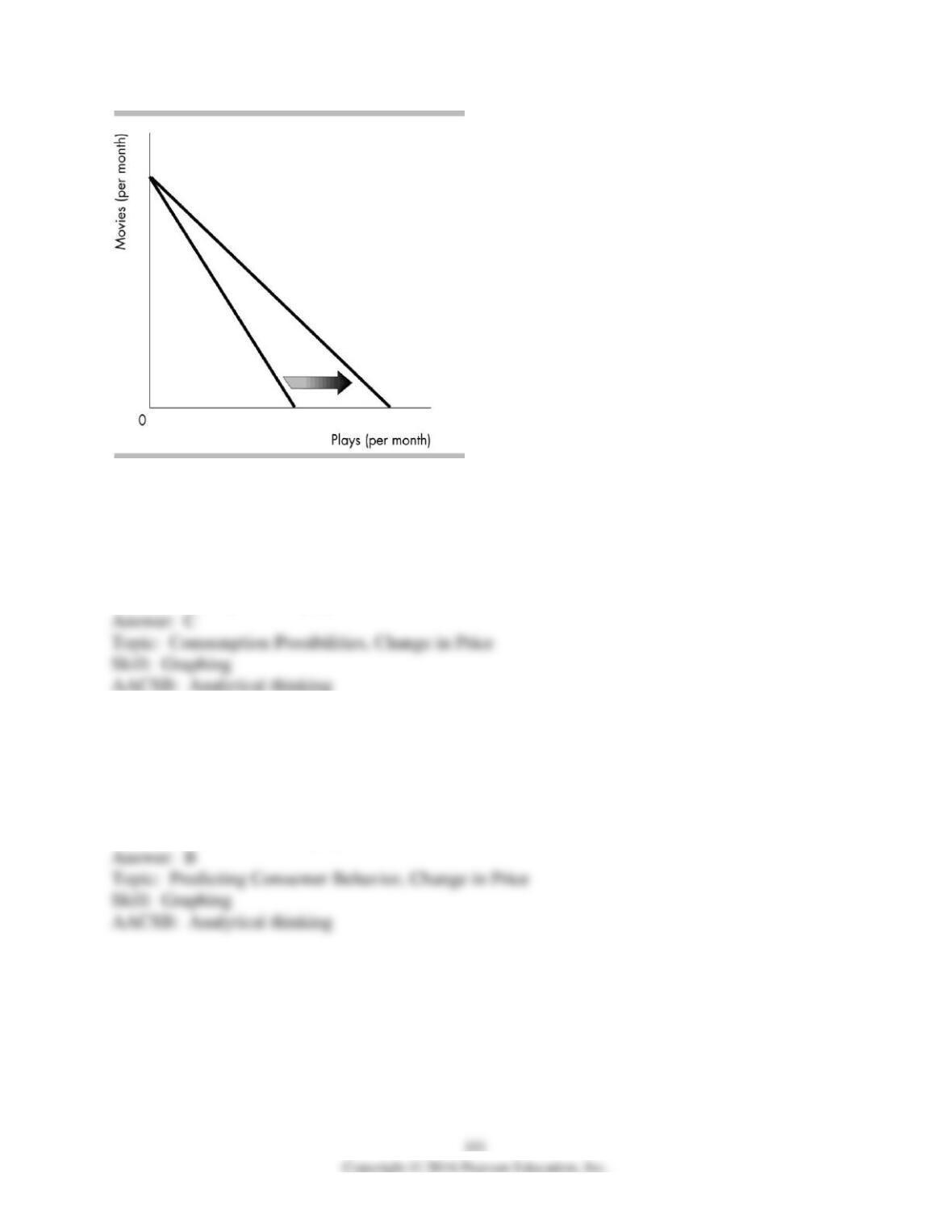
31) In the above figure, Mark’s monthly budget line for movies and plays changed, as shown by
the arrow. The change was caused by
A) a decrease in Mark’s income.
B) an increase in Mark’s income.
C) a fall in the price of a play.
D) a rise in the price of a play.
32) In the above figure, Mark’s monthly budget line for movies and plays changed, as shown by
the arrow. Responding to this change, Mark probably will see
A) fewer movies and fewer plays.
B) fewer movies and more plays.
C) more movies and fewer plays.
D) more movies and more plays.
33) Suppose the quantity of sodas and the quantity of popcorn are on an indifference
curve/budget line diagram. An increase in income shifts the budget line ________ and, if
popcorn is a normal good, shifts the demand curve for popcorn ________.
A) rightward; rightward
B) rightward; leftward
C) leftward; rightward
D) leftward; leftward
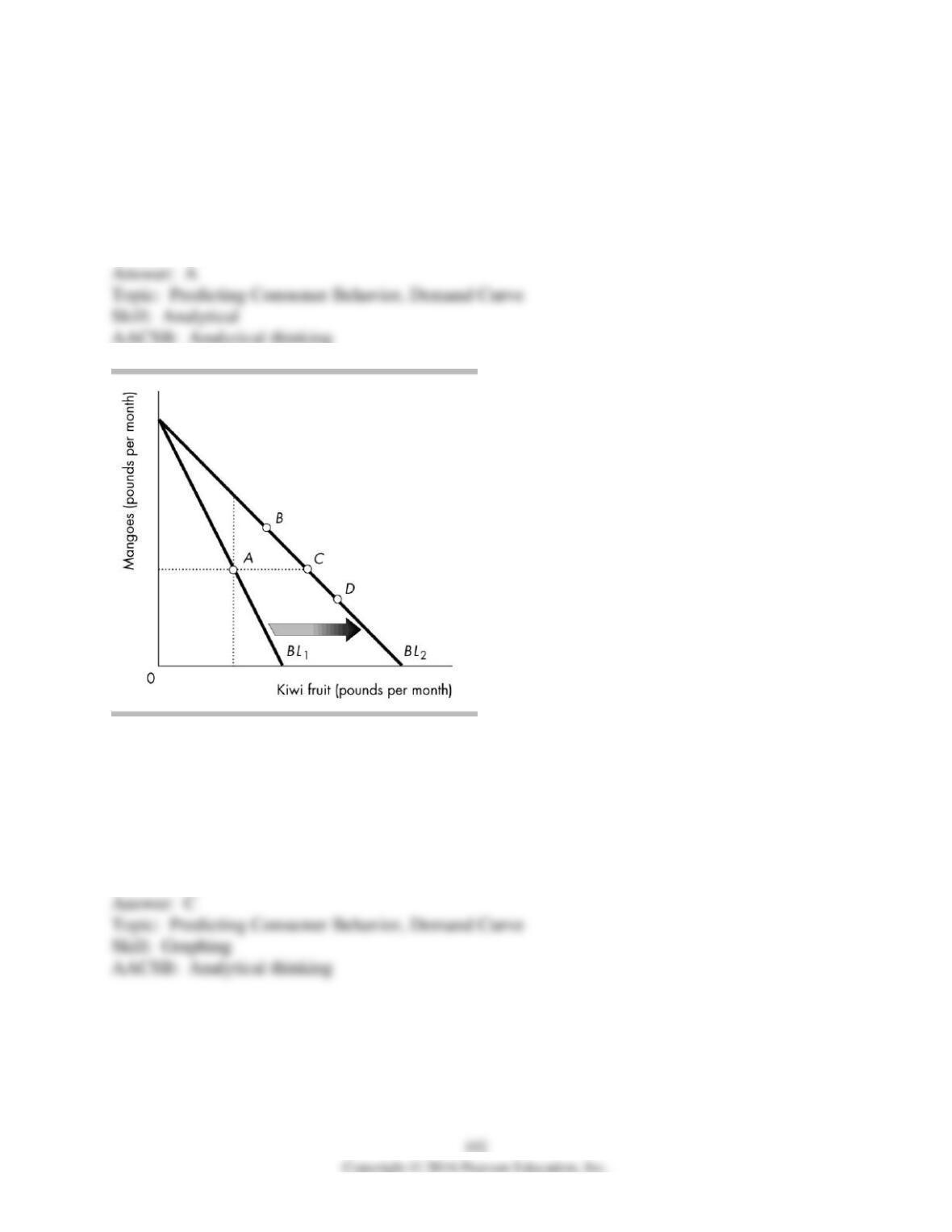
34) In the above figure, Reggie’s budget line rotates outward from BL1 to BL2. He initially
consumes at point A. If his new consumption bundle is at point C, this implies that his demand
curve for kiwi fruit
A) has shifted.
B) is a vertical line.
C) slopes downward.
D) is a horizontal line.
35) In the above figure, Reggie’s budget line rotates outward from BL1 to BL2. He initially
consumes at point A. If his new consumption bundle is at point B, this implies that kiwi fruit and
mangoes are
A) both lower in price.
B) both inferior goods.
C) neither substitutes nor complements.
D) None of the above answers is correct.
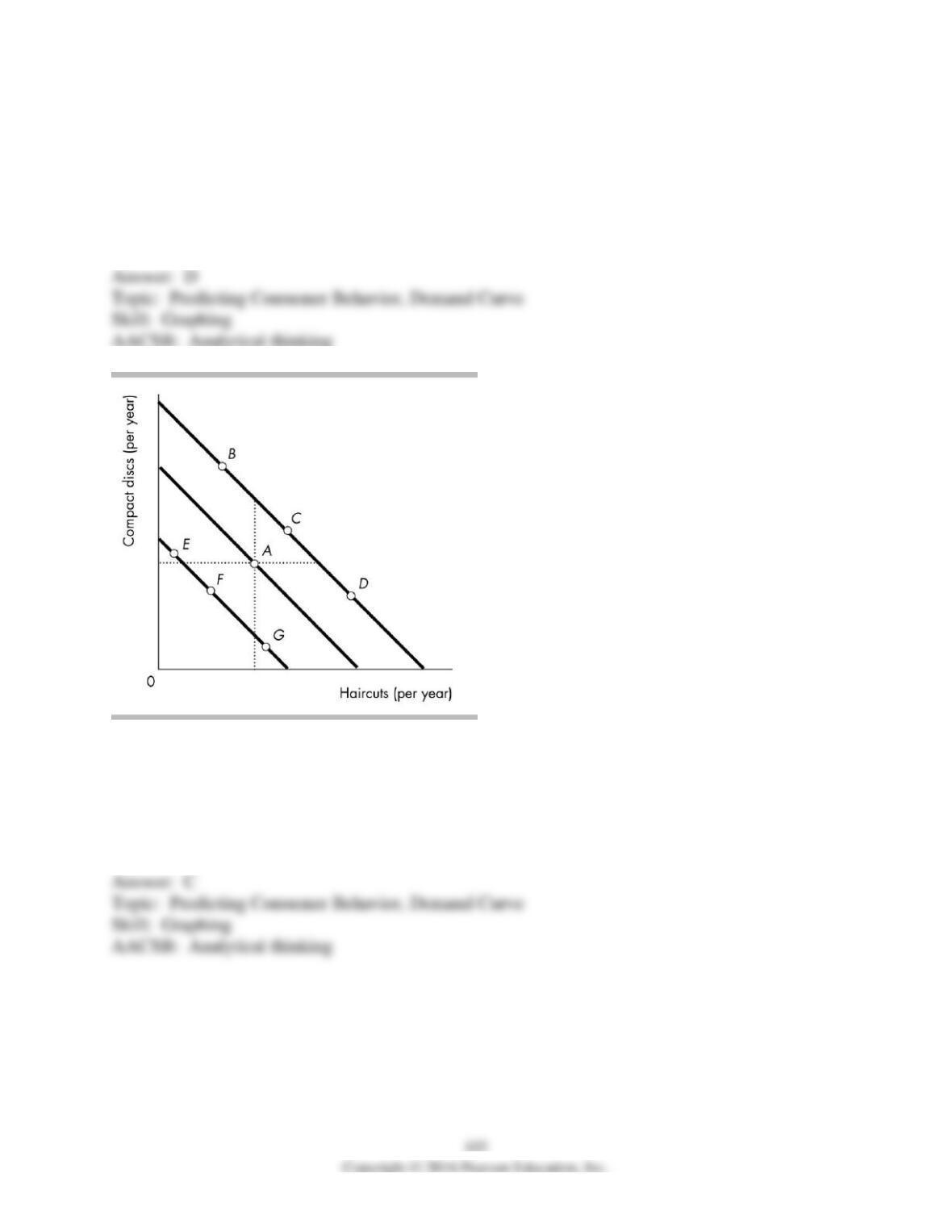
36) In the above figure, Brendan originally consumes at point A. If his income rises and both
compact discs and haircuts are normal goods then he will begin consuming at a point such as
A) F.
B) B.
C) C.
D) D.
37) In the above figure, Brendan originally consumes at point A. If his income rises and compact
discs are a normal good but haircuts are an inferior good then he will begin consuming at a point
such as
A) E.
B) B.
C) C.
D) D.
38) In the above figure, Brendan originally consumes at point A. If his income falls and compact
discs are a normal good but haircuts are an inferior good then he will begin consuming at a point
such as
A) B.
B) E.
C) F.
D) G.
39) In the above figure, Brendan originally consumes at point A. If his income rises and both
compact discs and haircuts are normal goods then he could begin consuming at point
A) B, C, or D.
B) B.
C) C.
D) D.
40) In the above figure, as Brendan’s income rises his consumption bundle moves from point A
to point B. This implies that for Brendan, compact discs are ________ good and haircuts are
________ good.
A) a normal; an inferior
B) a normal; a normal
C) an inferior; an inferior
D) an inferior; a normal
41) In the above figure, as Brendan’s income rises his consumption bundle moves from point A
to point C. This implies that for Brendan, compact discs are ________ good and haircuts are
________ good.
A) a normal; an inferior
B) a normal; a normal
C) an inferior; an inferior
D) an inferior; a normal
42) In the above figure, as Brendan’s income falls his consumption bundle moves from point A to
point E. This implies that for Brendan, compact discs are ________ good and haircuts are
________ good.
A) a normal; an inferior
B) a normal; a normal
C) an inferior; an inferior
D) an inferior; a normal
43) The price effect refers to how changes in
A) price affect real income.
B) price affect the quantity of a good consumed.
C) income affect prices.
D) preference affect prices.
44) The price effect is the effect of a ________ on the quantity of the good ________.
A) decrease in the price; demanded
B) change in the price; supplied
C) change in price and income; consumed
D) change in the price; consumed
45) The ________ effect can be divided into the ________ effect and the ________ effect.
A) marginal; substitution; price
B) income; substitution; price
C) substitution; price; income
D) price; substitution; income
46) The price effect is equal to the
A) substitution effect.
B) substitution effect plus the income effect.
C) marginal rate of substitution minus relative prices.
D) substitution effect minus the income effect.
47) Gasoline is a normal good. If the price of gasoline falls, a consumer buys more gasoline
because of
A) only an income effect.
B) only a substitution effect.
C) an increase in the marginal rate of substitution.
D) both an income effect and a substitution effect.
48) When the price of a normal good decreases, the ________ can be divided between the
________, which keeps the best affordable point on the same indifference curve and the
________, which moves the best affordable point farther away from the origin.
A) substitution effect; price effect; income effect
B) price effect; income effect; substitution effect
C) income effect; substitution effect; price effect
D) price effect; substitution effect; income effect
49) The effect of a change in price on the quantity bought while keeping the consumer on the
same indifference curve, is called the
A) price effect.
B) income effect.
C) substitution effect.
D) real effect.
50) The substitution effect reflects a movement along a given
A) horizontal line.
B) vertical line.
C) indifference curve.
D) budget line.
51) The change in consumption that results from a change in the relative price of goods while
staying on the same indifference curve is the
A) income effect.
B) substitution effect.
C) indifference effect.
D) price effect.
52) The effect of a change in price on the quantity bought when the consumer remains indifferent
between the original and the new situation is called the
A) income effect.
B) indifference effect.
C) substitution effect.
D) demand effect.
53) According to the substitution effect along an indifference curve, when the relative price of a
good falls, the consumer ________ substitutes ________ of that good for the other good.
A) always; more
B) always; less
C) sometimes; more
D) sometimes; less
54) The substitution effect
A) is always larger than the price effect.
B) always decreases purchases of a good as the price of a good rises.
C) increases purchases of the good as the price rises if the good is a normal good.
D) is always smaller than the income effect.
55) The substitution effect from a rise in the price of pizza
A) leads to a movement along the fixed budget line, due to a change in relative prices.
B) increases the quantity demanded of pizza.
C) decreases the quantity demanded of pizza.
D) Both answers A and B are correct.
56) If consumers spend their money only on beef and vegetables, then the substitution effect of
an increase in the price of beef would result in consuming ________ beef and ________
vegetables.
A) more; more
B) less; fewer
C) more; fewer
D) less; more
57) When the price of a normal good decreases, people buy ________ of the good due to
________.
A) more; the substitution effect only
B) more; the substitution and income effects
C) less; the substitution effect only
D) less; the income effect only
58) Bart consumes food and clothing, which are both normal goods. Suppose that the price of
food falls. The substitution effect of this price decrease is ________ and the income effect of this
price decrease is ________.
A) that Bart buys more clothing and less food; that Bart buys more of both food and clothing
B) reflected by a change in the relative prices of food and clothing; is represented by a
movement along the original indifference curve
C) reflected by a parallel shift outward of the budget line; that Bart earns more money each
month
D) reflected by the change in the slope of the budget line; that Bart has greater purchasing power
59) Wendy spends $30 a week on movies and magazines. The price of a movie is $8, the price of
a magazine is $2, and Wendy sees 3 movies a week and buys 3 magazines. The price of a
magazine now increases to $4 and Wendy’s brother gives her $6 a week so that she can still see 3
movies a week and buy 3 magazines. In this situation, Wendy will see ________ movies and buy
________ magazines.
A) 3; 3
B) less than 3; less than 3
C) more than 3; fewer than 3
D) less than 3; more than 3
60) Sue consumes only sandwiches and soda and is at her best affordable point. The price of a
sandwich falls. The substitution effect is that Sue substitutes ________ for ________. The
income effect is that Sue ________.
A) sandwiches; soda; buys less of both goods
B) soda; sandwiches; buys more soda and fewer sandwiches
C) sandwiches; soda; buys more of both goods
D) soda; sandwiches; buys less soda and more sandwiches
61) Nick considers macaroni and cheese to be an inferior good. As a result of macaroni and
cheese being an inferior good, the
A) substitution effect must be larger in magnitude than the income effect so that less is purchased
as the price falls.
B) substitution effect must be smaller in magnitude than the income effect so that less is
purchased as the price falls.
C) income effect is positive, so that more is purchased as income increases.
D) income effect is negative, so that less is purchased as income increases.
62) Suppose the price of a good rises. The income effect
A) shows the change in consumption that results from the change in relative price while staying
on the same indifference curve.
B) shows the change in consumption that results from the change in relative price while keeping
income constant.
C) is shown by decreasing income at the new relative price in order to move from the old
indifference curve to the new indifference curve after the price change.
D) is shown by increasing income at the new relative price in order to move from the old
indifference curve to the new indifference curve after the price change.
63) The income effect for an inferior good
A) is negative.
B) is zero.
C) is positive.
D) could be negative, zero, or positive.
64) Which of the following statements is FALSE?
A) When the relative price of a good falls, the substitution effect always leads the consumer to
substitute more of that good for the other good.
B) For a normal good, the income effect reinforces the substitution effect.
C) For an inferior good, the income effect offsets the substitution effect.
D) For an inferior good, the income effect is positive.
65) The concept of inferior goods can be used to show that
A) lower prices signal poorer quality.
B) indifference curves can have positive slopes.
C) being able to consume more of all goods does not mean that a person will consume more of
every good.
D) consumers will always buy more of all products if their incomes increase.
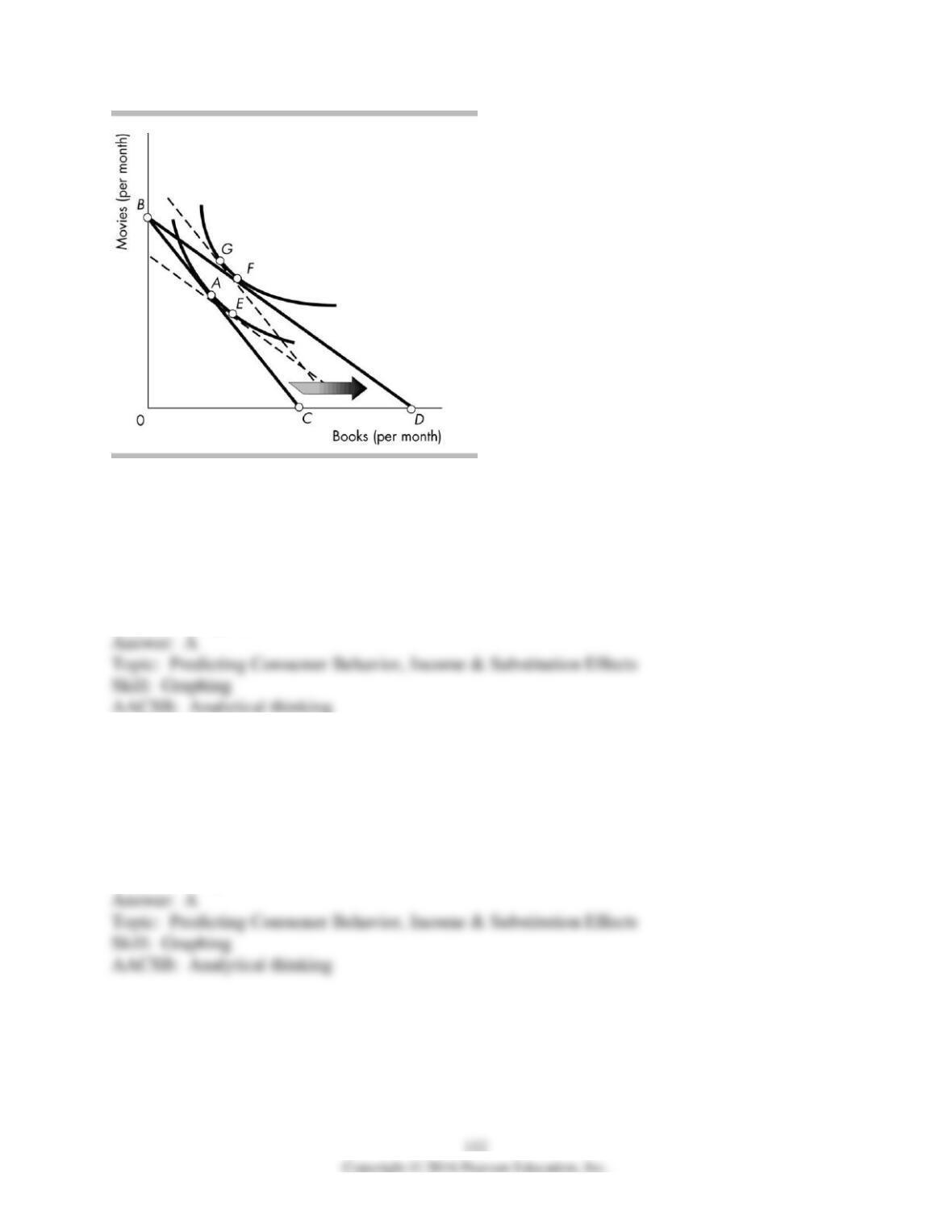
66) Consider the change in the price of a book depicted in the above figure. The original budget
line is BC. The new budget line is BD. As a result of this price change, the substitution effect can
be represented by a movement from
A) point A to point E.
B) point A to point G.
C) point F to point G.
D) point A to point F.
67) Consider the change in the price of a book depicted in the above figure. The original budget
line is BC. The new budget line is BD. As a result of this price change, the income effect can be
represented by a movement from
A) point E to point F.
B) point G to point A.
C) point G to point F.
D) point A to point F.
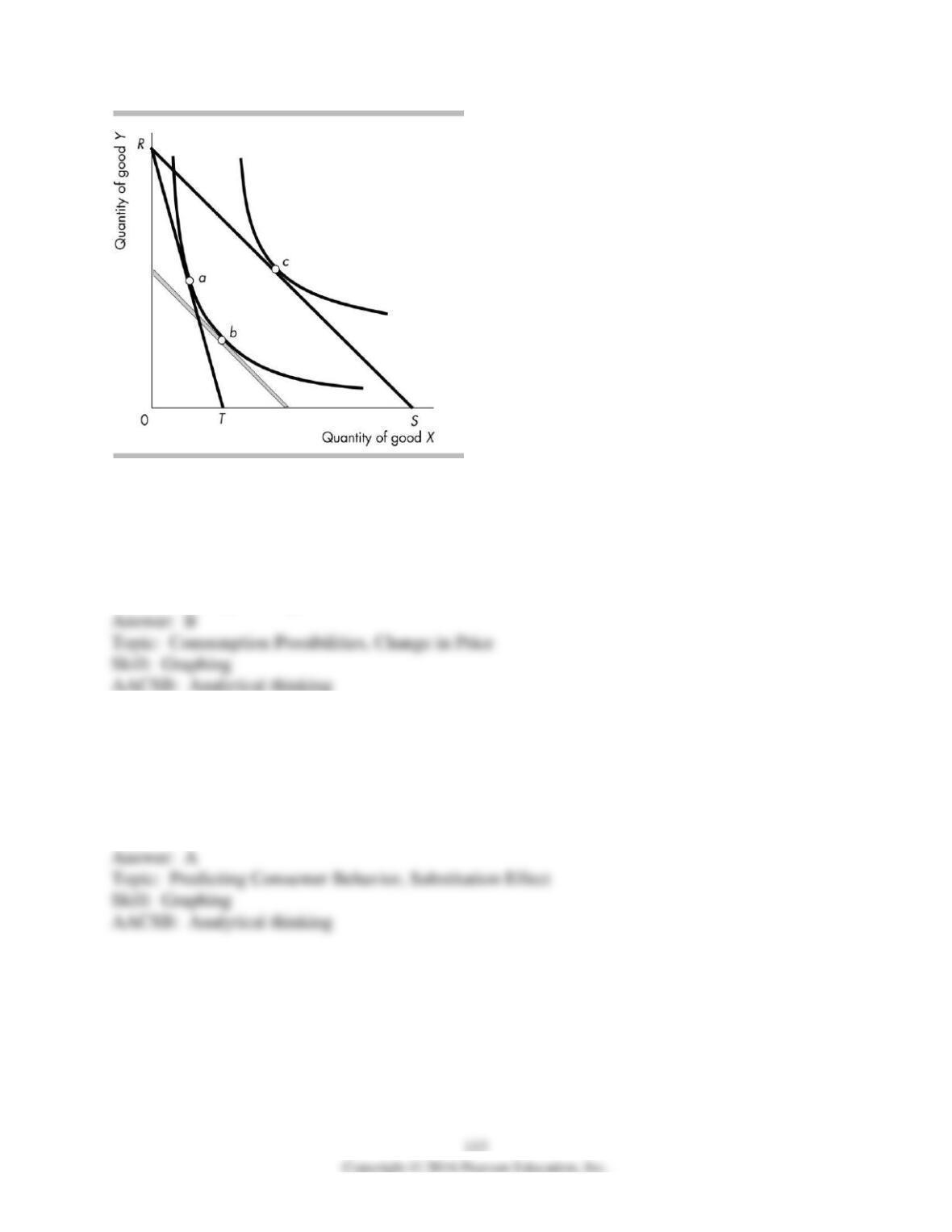
68) Consider the budget line labeled RT in the above figure. What would shift the budget line to
RS?
A) a rise in the price of good X
B) a fall in the price of good X
C) a rise in the price of good Y
D) a fall in the price of good Y
69) In the above figure, if the budget line shifts from RT to RS, the substitution effect is
illustrated by the move from
A) a to b.
B) a to c.
C) b to c.
D) T to S.
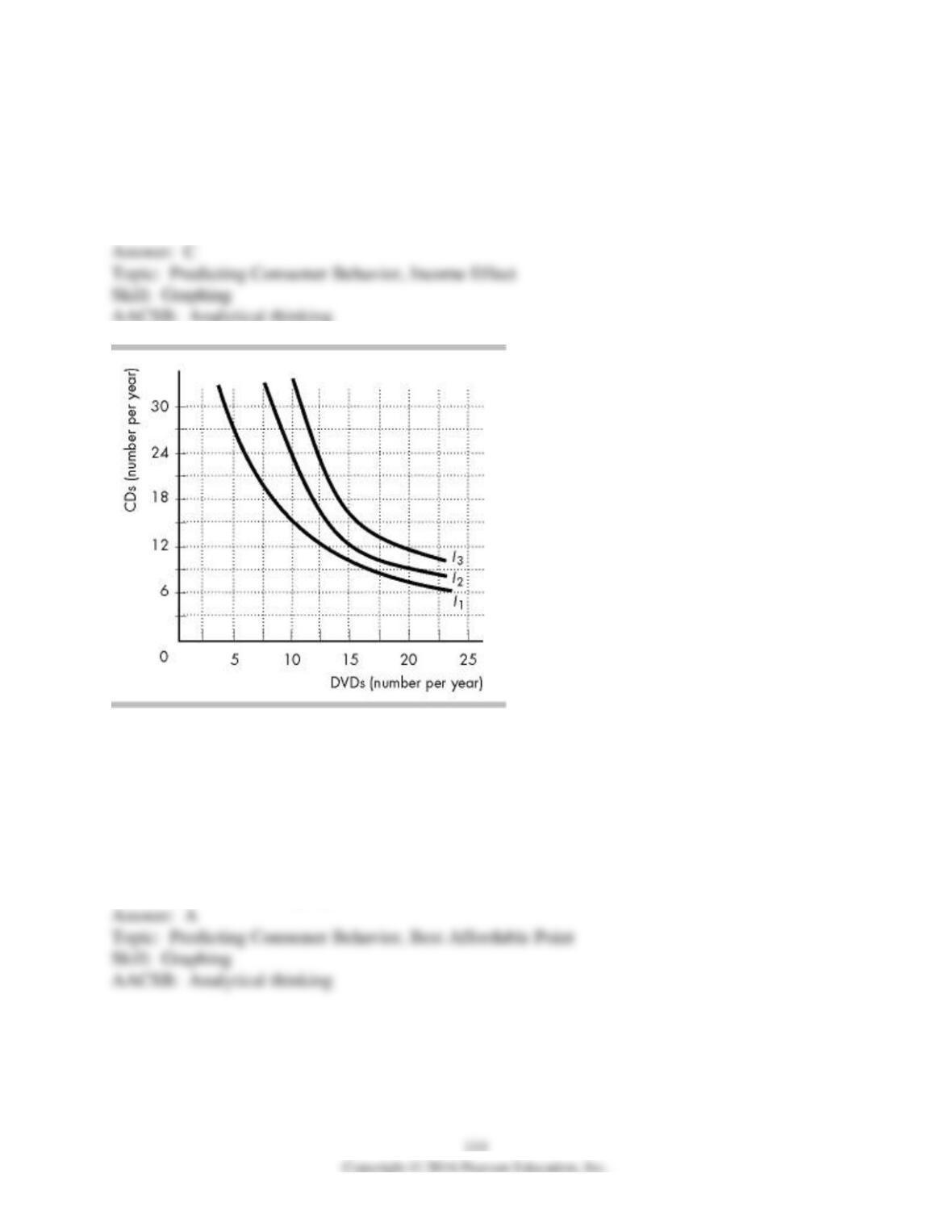
70) In the above figure, if the budget line shifts from RT to RS, the income effect is illustrated by
the move from
A) a to b.
B) a to c.
C) b to c.
D) T to S.
71) Kristen has an income of $450 per year to spend on music CDs and movies on DVDs. The
price of a CD is $15 and the price of a DVD is $22.50. The indifference curves in the figure
above (I1, I2, and I3) reflect Kristen’s preferences. What is Kristen’s best affordable combination
of DVDs and CDs?
A) 10 DVDs and 15 CDs per year
B) 15 DVDs and 12 CDs per year
C) 12.5 DVDs and 12 CDs per year
D) 5 DVDs and 18 CDs per year
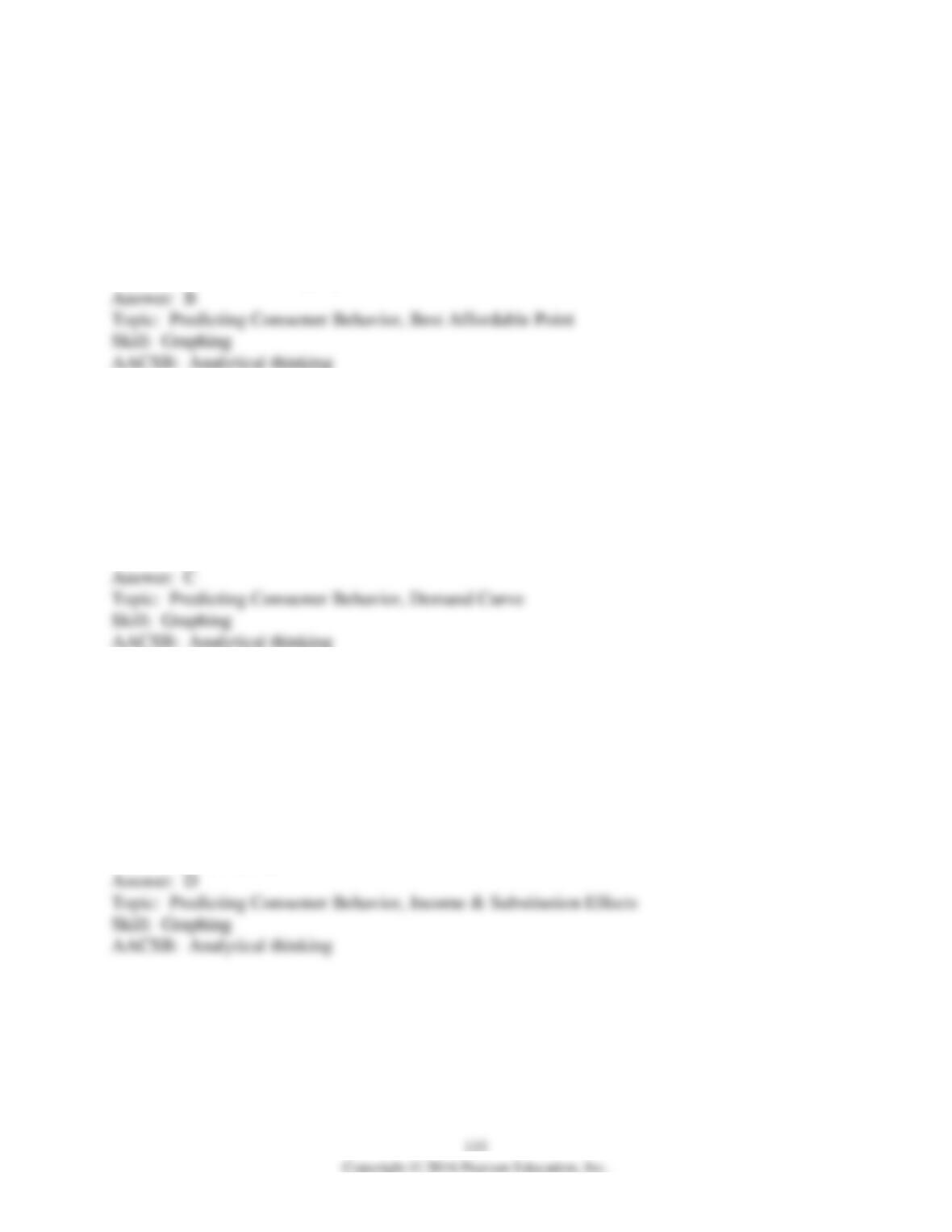
72) Kristen has an income of $450 per year to spend on music CDs and movies on DVDs.
Initially the price of a CD is $15 and the price of a DVD is $22.50. The indifference curves in the
figure above (I1, I2, and I3) reflect Kristen’s preferences. If the price of a DVD falls to $18,
Kristen will buy
A) 10 DVDs and 15 CDs per year.
B) 15 DVDs and 12 CDs per year.
C) 12.5 DVDs and 11 CDs per year.
D) 13 DVDs and 15 CDs per year.
73) Kristen has an income of $450 per year to spend on music CDs and movies on DVDs. The
price of a CD is $15. The indifference curves in the figure above (I1, I2, and I3) reflect Kristen’s
preferences. If the price of a DVD is $22.50, then Kristen buys ________ DVDs; if the price of a
DVD is $18.00, then Kristen buys ________ DVDs.
A) 12; 14
B) 5; 10
C) 10; 15
D) 7.5; 12.5
74) Kristen has an income of $450 per year to spend on music CDs and movies on DVDs. The
price of a CD is $15 and the initial price of a DVD is $22.50. The indifference curves in the
figure above (I1, I2, and I3) reflect Kristen’s preferences. If the price of a DVD falls to $18, the
income effect on Kristen’s consumption of DVDs ________ the substitution effect, so a DVD is
________ good.
A) partly offsets; an inferior
B) partly offsets; a normal
C) reinforces; an inferior
D) reinforces; a normal
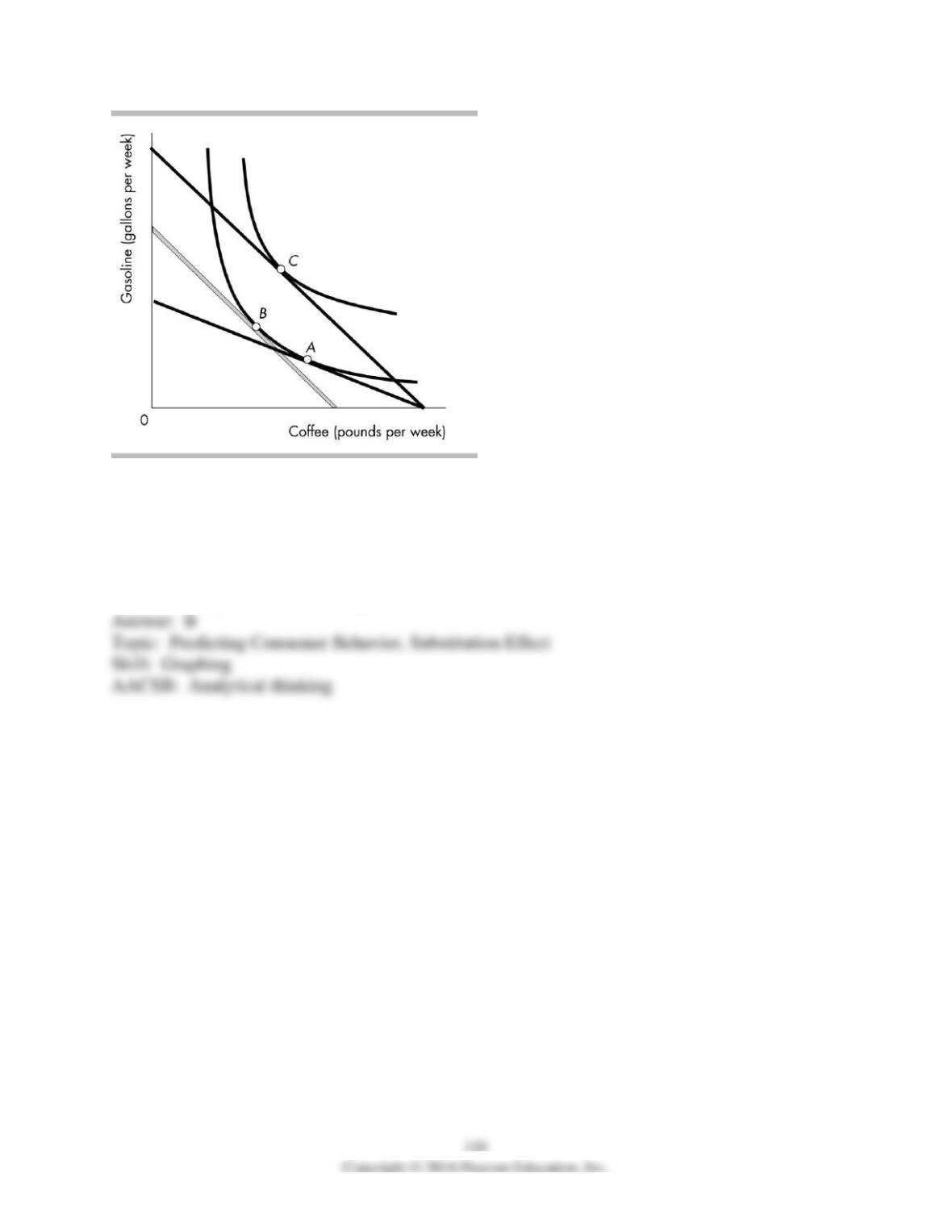
75) The substitution effect from a fall in the price of a gallon of gasoline is shown in the above
figure by the movement from
A) point A to point C.
B) point A to point B.
C) point B to point C.
D) point A to point B and then to point C.
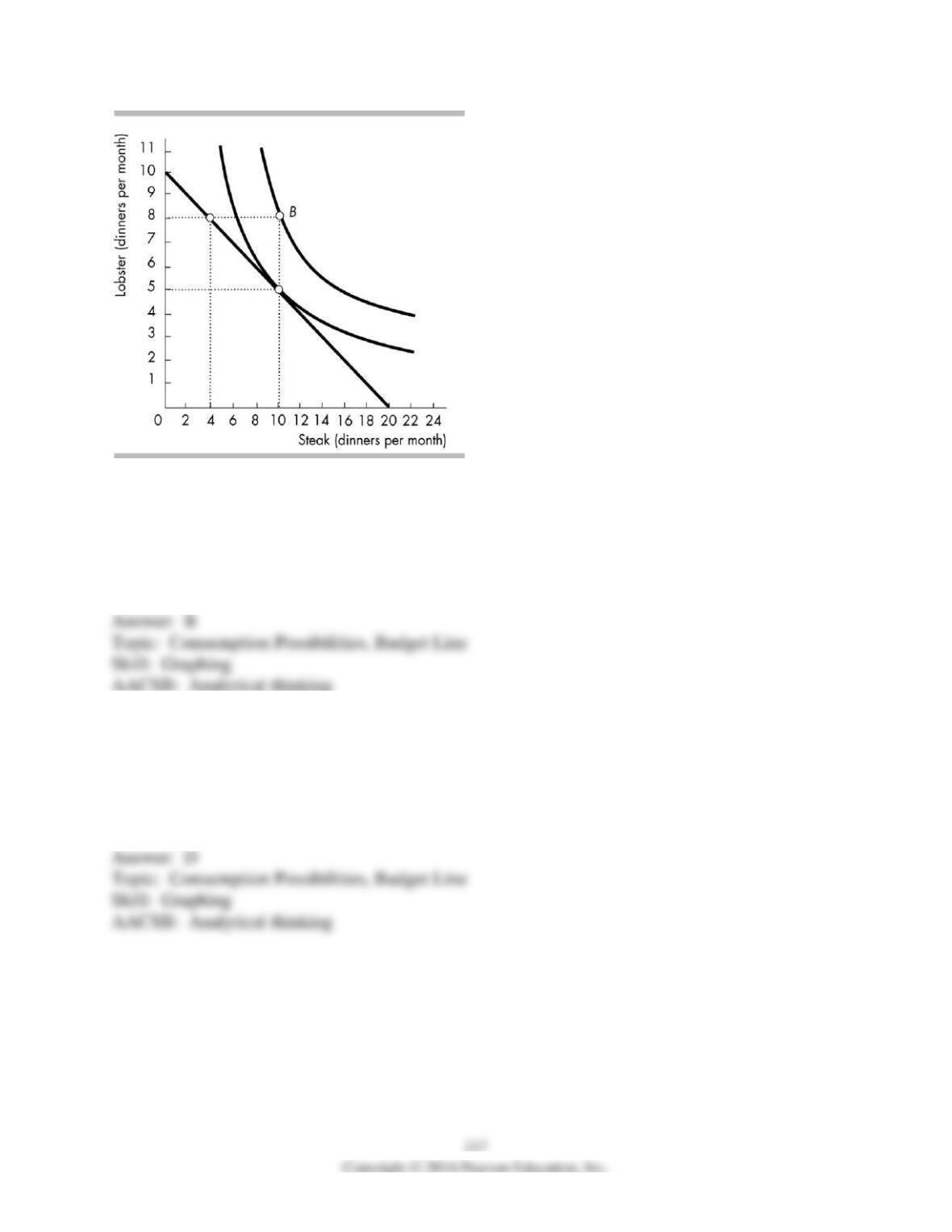
76) Jane spends her monthly dining-out budget of $300.00 on either steak or lobster dinners.
Using the above figure, what is the price of a steak dinner?
A) $10.00
B) $15.00
C) $20.00
D) $30.00
77) Jane spends her monthly dining-out budget of $300.00 on either steak or lobster dinners.
Using the above figure, what is the price of a lobster dinner?
A) $10.00
B) $15.00
C) $20.00
D) $30.00
78) Jane spends her monthly dining-out budget of $300.00 on either steak or lobster dinners.
Using the above figure, what is the opportunity cost of a lobster dinner in terms of steak dinners?
A) 0.5 steak dinners per lobster dinner
B) 2.0 steak dinners per lobster dinner
C) 5.0 steak dinners per lobster dinner
D) 10.0 steak dinners per lobster dinner
79) The above figure shows Jane’s budget line and two of her indifference curves. Which of the
following happens to Jane’s budget line if the price of a lobster dinner fell?
A) It would rotate inward around the vertical intercept, 10 lobster dinners.
B) It would rotate outward around the vertical intercept, 10 lobster dinners.
C) It would rotate inward around the horizontal intercept, 20 steak dinners.
D) It would rotate outward around the horizontal intercept, 20 steak dinners.
80) The above figure shows Jane’s budget line and two of her indifference curves. Which of the
following happens to Jane’s budget line if the price of a lobster dinner increased?
A) It would rotate inward around the vertical intercept, 10 lobster dinners.
B) It would rotate outward around the vertical intercept, 10 lobster dinners.
C) It would rotate inward around the horizontal intercept, 20 steak dinners.
D) It would rotate outward around the horizontal intercept, 20 steak dinners.
81) The above figure shows Jane’s budget line and two of her indifference curves. Which of the
following happens to Jane’s budget line if the price of a steak dinner fell?
A) It would rotate inward around the vertical intercept, 10 lobster dinners.
B) It would rotate outward around the vertical intercept, 10 lobster dinners.
C) It would rotate inward around the horizontal intercept, 20 steak dinners.
D) It would rotate outward around the horizontal intercept, 20 steak dinners.
82) The above figure shows Jane’s budget line and two of her indifference curves. Which of the
following happens to Jane’s budget line if there were an increase in her monthly dining-out
budget?
A) It would bend toward the origin, becoming more convex.
B) It would bend away from the origin, becoming more concave.
C) It would shift rightward and not change its slope.
D) It would shift leftward and not change its slope.
83) The above figure shows Jane’s budget line and two of her indifference curves. Which of the
following happens to Jane’s budget line if there were a decrease in her monthly dining out
budget?
A) It would bend toward the origin, becoming more convex.
B) It would bend away from the origin, becoming more concave.
C) It would shift rightward and not change its slope.
D) It would shift leftward and not change its slope.
84) The above figure shows Jane’s budget line and two of her indifference curves. How many
steak dinners will Jane purchase each month?
A) 4 steak dinners
B) 6 steak dinners
C) 8 steak dinners
D) 10 steak dinners
85) The above figure shows Jane’s budget line and two of her indifference curves. How many
lobster dinners will Jane purchase each month?
A) 4 lobster dinners
B) 5 lobster dinners
C) 8 lobster dinners
D) 10 lobster dinners
86) The above figure shows Jane’s budget line and two of her indifference curves. Jane’s
marginal rate of substitution is
A) the rate at which she would give up a lobster dinner for a steak dinner and consider herself
just as well off.
B) equal to the ratio of the price of a steak dinner to the price of a lobster dinner when she is at
her best affordable point.
C) equal to 2 lobster dinners per steak dinner at her best affordable point.
D) Both answers A and B are correct.
87) The above figure shows Jane’s budget line and two of her indifference curves. When Jane is
consuming at her best affordable point, what is her marginal rate of substitution?
A) 2.0 lobster dinners per steak dinner
B) 1.0 lobster dinners per steak dinner
C) 0.5 lobster dinners per steak dinner
D) 0.33 lobster dinners per steak dinner
88) The above figure shows Jane’s budget line and two of her indifference curves. If the price of
a lobster dinner falls so that Jane can now purchase the combination represented by Point B, Jane
would experience
A) an increase in the opportunity cost of a lobster dinner.
B) no change in her marginal rate of substitution.
C) an income and a substitution effect.
D) Both answers B and C are correct.