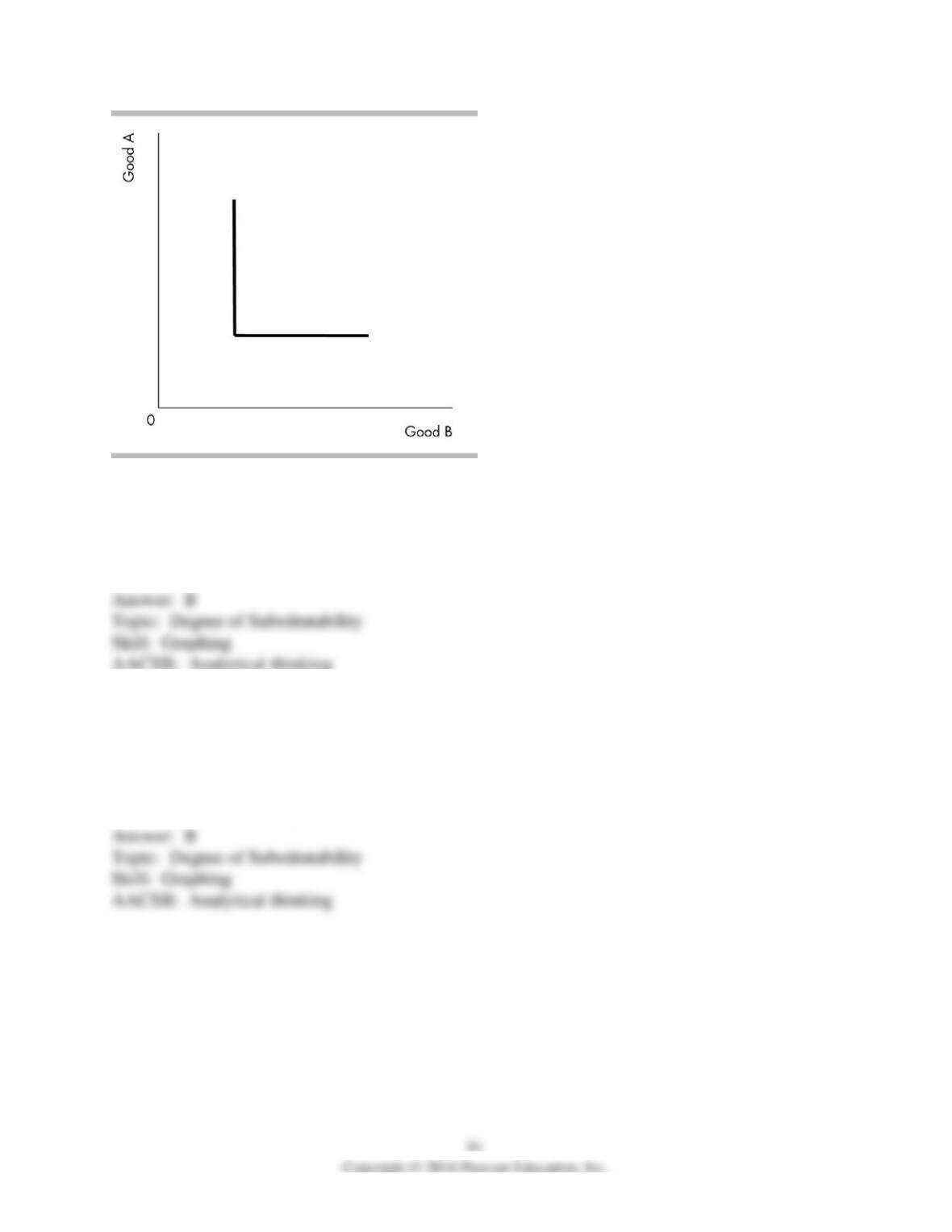
73) The indifference curve in the above figure
A) illustrates two goods that are perfect substitutes.
B) illustrates two goods that are perfect complements.
C) violates assumptions about preferences.
D) None of the above statements is correct.
74) The indifference curve in the above figure
A) could illustrate a person’s preferences for identical computer disks made by two different
companies.
B) could illustrate a person’s preferences for right-handed and left-handed gloves.
C) has a constant marginal rate of substitution.
D) None of the above statements is correct.
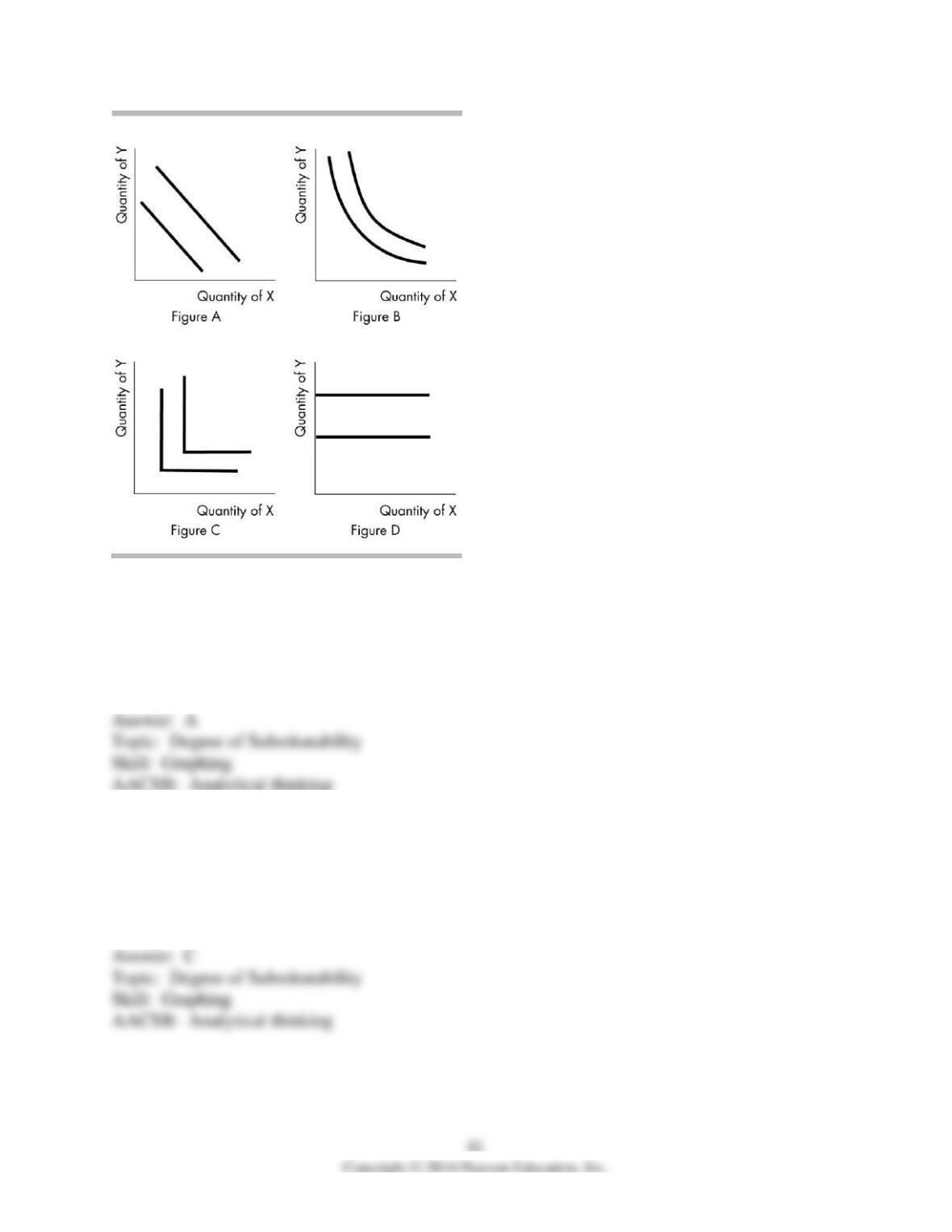
75) Consider the indifference maps shown above. If X and Y are perfect substitutes, your
indifference curves between them would look like those in
A) Figure A.
B) Figure B.
C) Figure C.
D) Figure D.
76) Consider the indifference maps shown above. If eyeglass frames and eyeglass lenses were
perfect complements, your indifference curves between them would look like those in
A) Figure A.
B) Figure B.
C) Figure C.
D) Figure D.
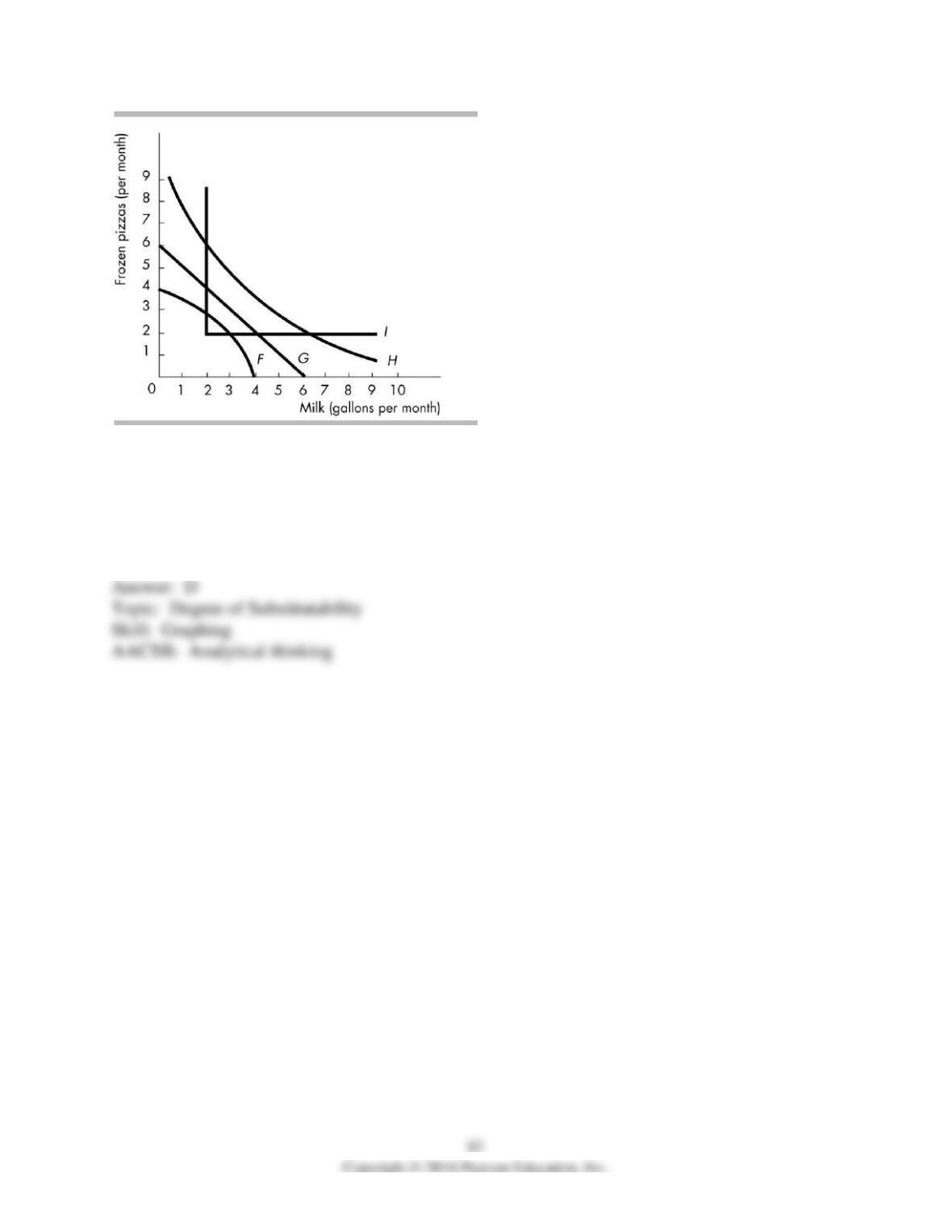
77) In the above figure, which curve is an indifference curve for someone who views frozen
pizzas and milk as perfect complements?
A) indifference curve F
B) indifference curve G
C) indifference curve H
D) indifference curve I
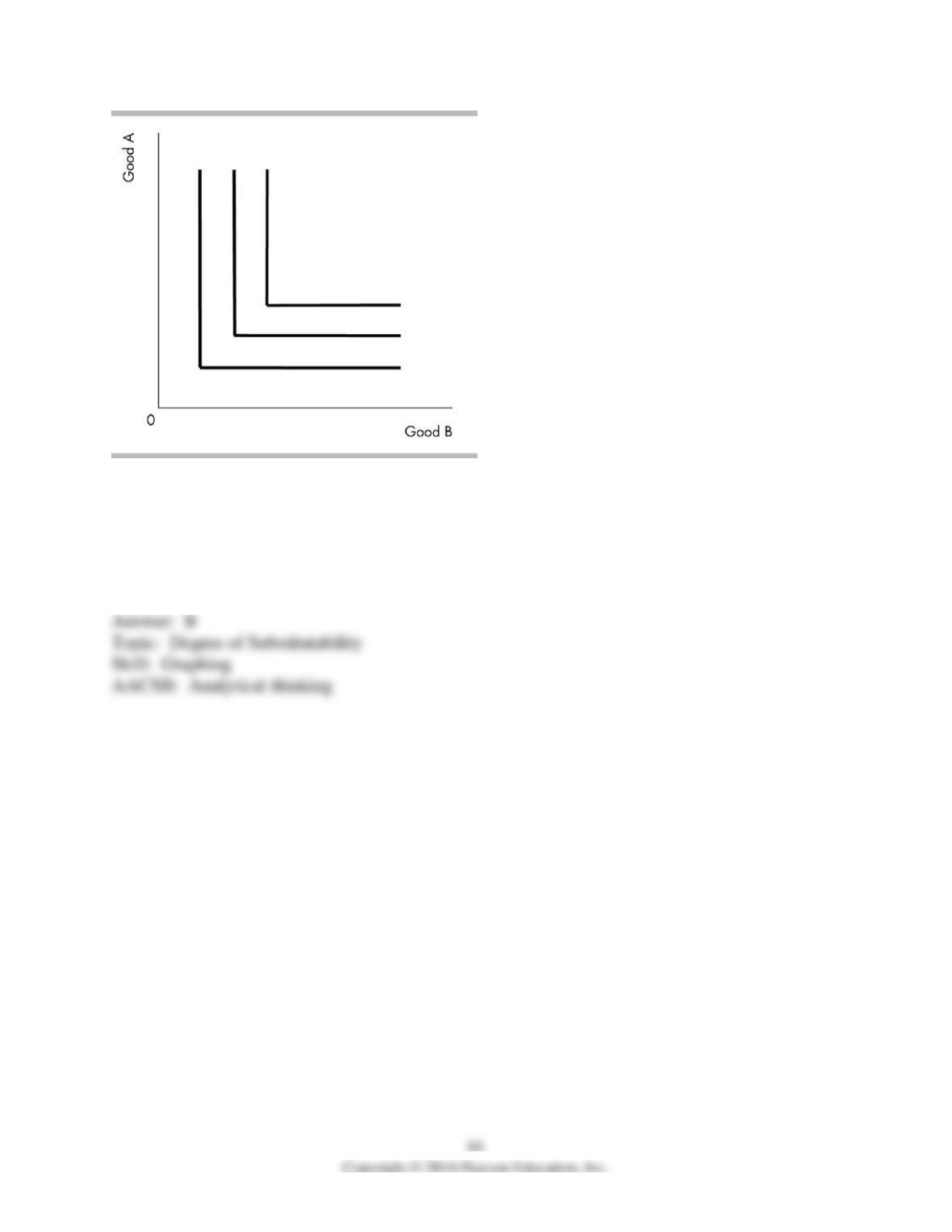
78) The indifference curves in the above figure could represent your indifference curves between
A) Coke and Pepsi, which you consider perfect substitutes.
B) eyeglass frames and eyeglass lenses, which you think are perfect complements.
C) hot dogs and textbooks, which you think are neither perfect substitutes nor perfect
complements.
D) none of the above.
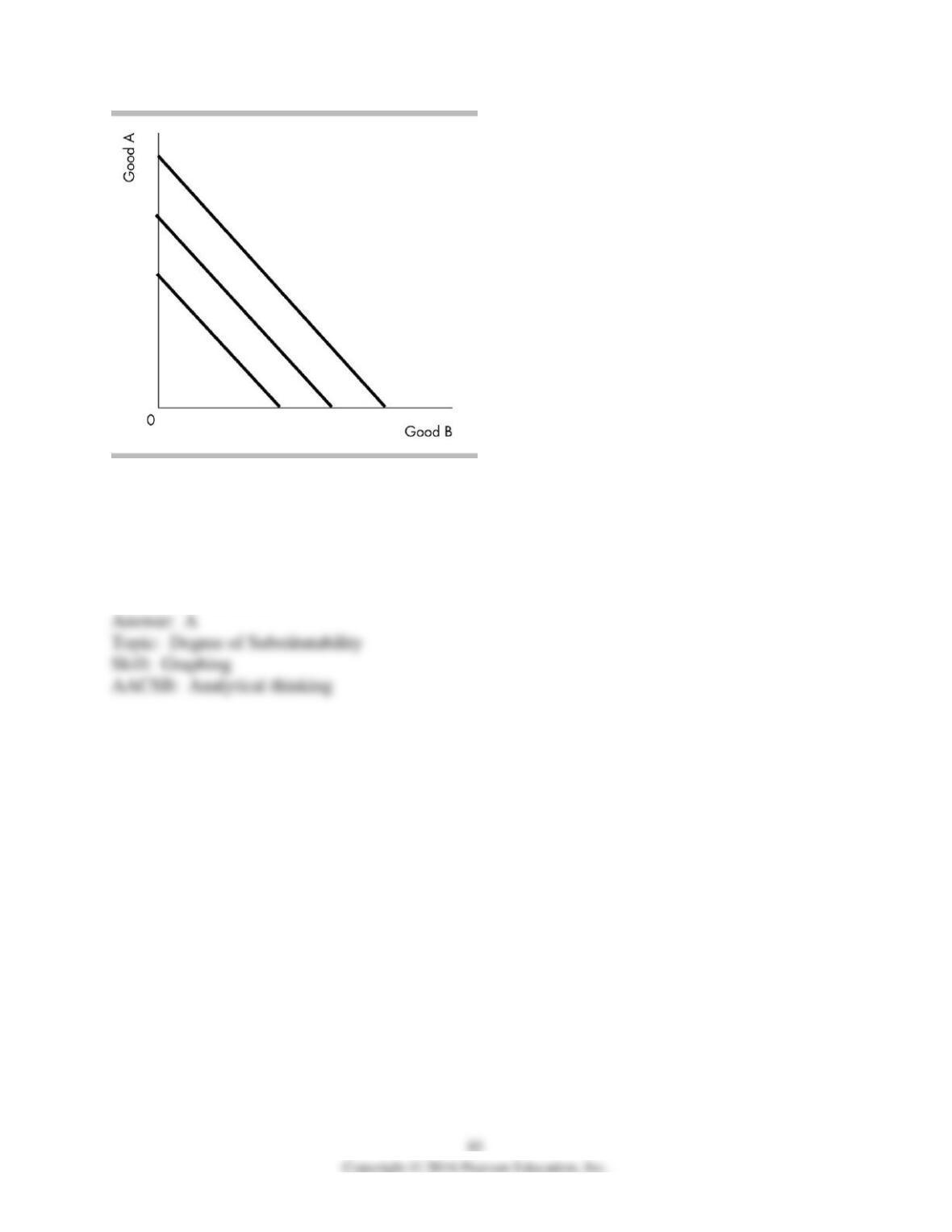
79) The indifference curves in the above figure could represent your indifference curves between
A) Coke and Pepsi, which you consider perfect substitutes.
B) eyeglass frames and eyeglass lenses, which you think are perfect complements.
C) hot dogs and textbooks, which you think are neither perfect substitutes nor perfect
complements.
D) none of the above.
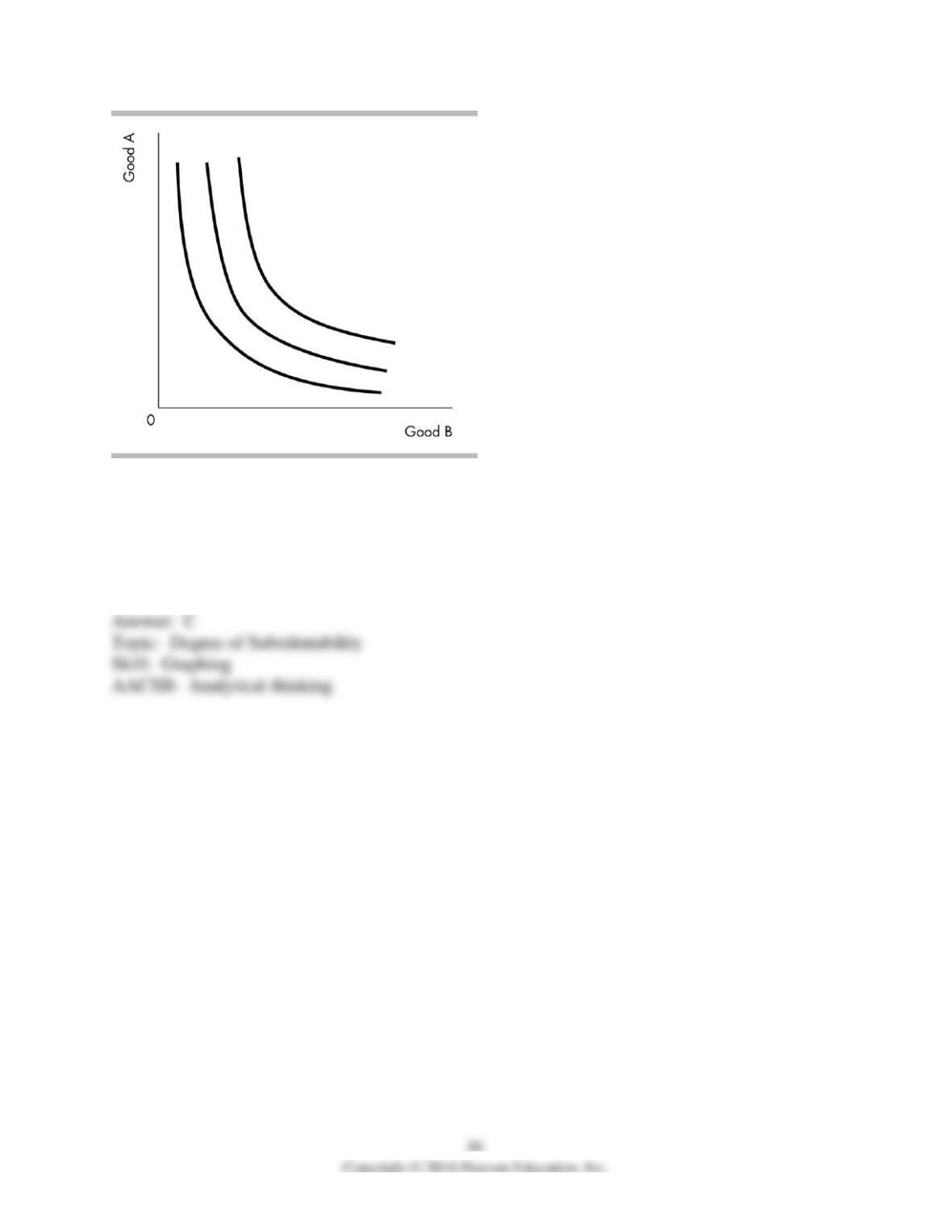
80) The indifference curves in the above figure could represent your indifference curves between
A) Coke and Pepsi, which you consider perfect substitutes.
B) eyeglass frames and eyeglass lenses, which you think are perfect complements.
C) hot dogs and textbooks, which you think are neither perfect substitutes nor perfect
complements.
D) none of the above.
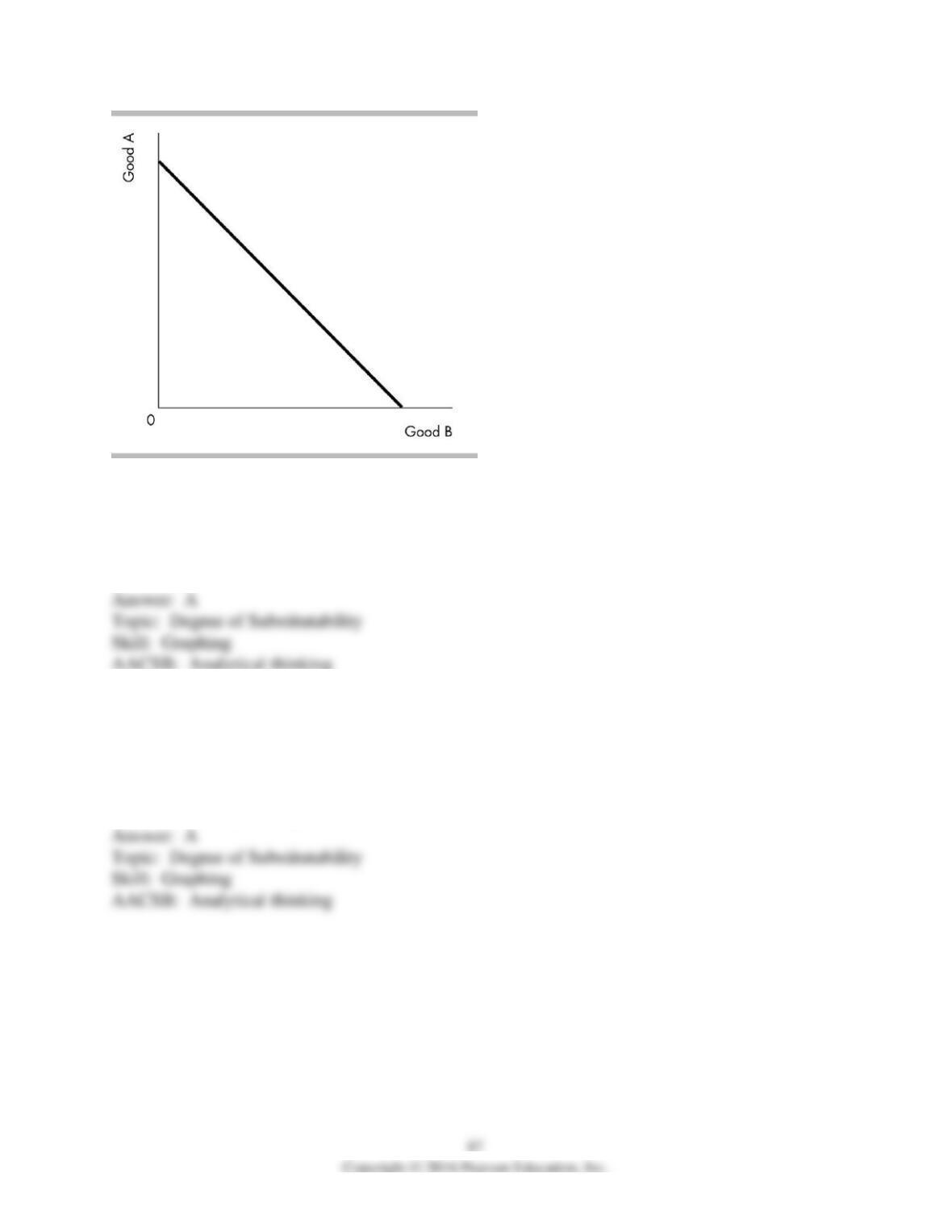
81) The indifference curve in the above figure
A) illustrates two goods that are perfect substitutes.
B) illustrates two goods that are perfect complements.
C) violates assumptions about preferences.
D) None of the above statements is correct.
82) The indifference curve in the above figure
A) could illustrate a person’s preferences for identical computer disks made by two different
companies.
B) could illustrate a person’s preferences for right-handed and left-handed gloves.
C) has a marginal rate of substitution that at first decreases and then increases.
D) None of the above statements is correct.
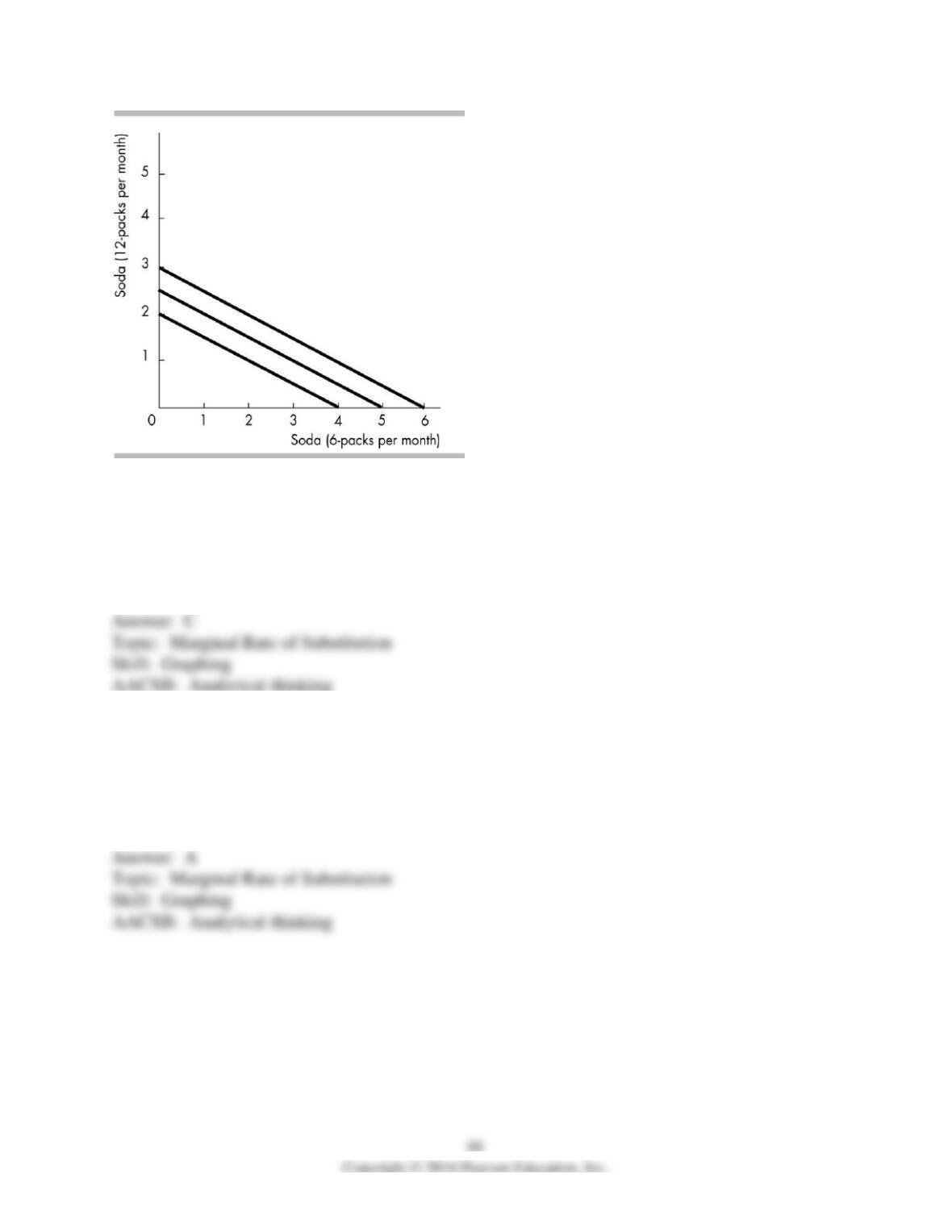
83) In the figure above, as more six-packs of soda are consumed, moving along any of the
illustrated indifference curves, the MRS between twelve-packs of soda and six-packs of soda
A) increases.
B) decreases.
C) stays constant.
D) first increases, then decreases.
84) The MRS of the indifference curves in the above figure
A) equals 1/2.
B) equals 2.
C) changes when moving along any one of the curves.
D) is constant along a particular indifference curve, but changes from one indifference curve to
the next.
85) In the above figure, the indifference curves indicate that the two goods are
A) perfect complements.
B) perfect substitutes.
C) ordinary goods.
D) normal goods.
86) As a consumer moves rightward along an indifference curve, the
A) consumer remains indifferent among the different combinations of goods.
B) consumer generally prefers the combinations of goods farther rightward along the
indifference curve.
C) income required to buy the combinations of the goods always increases.
D) relative price of both goods falls.
87) Indifference curves shift or rotate
A) only when income changes.
B) only when prices change.
C) when either income or prices change.
D) with none of the above because changes in income and prices do not shift indifference curves.
88) If the newspaper reported that wearing plaid clothing was a sure way to obtain good grades,
students’
A) budget lines would shift rightward to compensate for the higher price of plaid clothing.
B) budget lines would rotate so that more plaid clothing would be purchased.
C) preferences would change in favor of more plaid clothing.
D) none of the above
89) The assumption of diminishing marginal rate of substitution means that
A) the budget line has a negative slope.
B) the budget line does not shift when people’s preferences change.
C) indifference curves might have a positive slope.
D) indifference curves will be concave.
90) If two goods are complements, then their
A) indifference curves are positively sloped straight lines.
B) indifference curves are negatively sloped straight lines.
C) indifference curves are L-shaped.
D) marginal rate of substitution is infinity.
91) If the indifference curves between two goods are L-shaped, the goods are
A) complementary goods.
B) substitute goods.
C) normal goods.
D) inferior goods.
1) In an indifference curve/budget line diagram, a consumer’s equilibrium consumption
combination will occur
A) inside the budget line.
B) outside the budget line.
C) on the budget line.
D) at the origin.
2) Which of the following statements is TRUE?
A) Every point on a budget line lies on an indifference curve.
B) To determine a consumer’s best affordable point, we need only the budget line or the
indifference curve.
C) The price effect is shown by moving up or down a fixed budget line.
D) Both A and B are true.
3) The point where the indifference curve is tangent to the budget line
A) is the best affordable point.
B) is where the marginal rate of substitution exceeds the relative price by as much as possible.
C) is a point on consumer’s demand curve.
D) All of the above answers are correct.
4) In an indifference curve/budget line diagram, a consumer will select the combination of goods
that is on the budget line and for which the
A) marginal rate of substitution between two goods is equal to the relative price of the two
goods.
B) marginal rate of substitution between two goods is greater than the relative price of the two
goods.
C) slope of the indifference curve is less than the relative price of the two goods.
D) slope of the indifference curve is greater than the relative price of the two goods.
5) When the consumer is at his or her best affordable consumption point, it is the case that the
marginal rate of substitution is
A) greater than the price ratio.
B) equal to the price ratio.
C) less than the price ratio.
D) maximized.
6) Samara’s income is $30 a month and she spends all of it on music downloads and gasoline.
The price of a music download is $1.50 and the price of a gallon of gasoline is $3. At Samara’s
best affordable point, her marginal rate of substitution is ________ per video tape.
A) 0.5 of a download
B) 1 download
C) 1.5 downloads
D) 2 downloads
7) Samara’s income is $30 a month and she spends all of it on music downloads and gasoline.
The price of a music download is $3 and the price of a gallon of gasoline is $3. At Samara’s best
affordable point, her marginal rate of substitution is ________ gallon of gasoline per music
download.
A) 0.5
B) 1
C) 1.5
D) More information is needed to determine the marginal rate of substitution.
8) When a consumer is at his or her best affordable point, the budget line
A) is flatter than the highest attainable indifference curve.
B) is tangent to the highest attainable indifference curve.
C) is steeper than the highest attainable indifference curve.
D) does not touch the highest attainable indifference curve.
9) In a budget line/indifference curve diagram, at the consumer equilibrium
A) any movement upward or downward on the budget line will move the consumer to a less
preferred point.
B) any movement to the northeast to higher indifference curves moves the consumer to a less
preferred point.
C) the slope of the budget line is as much larger as possible than the marginal rate of
substitution.
D) All of the above statements are correct.
10) If Rachel is at her best affordable point, then ________.
A) her marginal rate of substitution equals 1
B) her marginal rate of substitution is maximized
C) the relative price of the goods she buys equals the marginal rate of substitution
D) she is indifferent among other points on her budget line
11) If consumers buy only gasoline and food, at their best affordable choice the marginal rate of
substitution between food and gasoline ________ the relative price of food and gasoline.
A) must exceed
B) must be less than the
C) must equal
D) might exceed or be less than but not equal to
12) In an indifference curve/budget line diagram, at your consumer equilibrium, that is, your best
affordable point, which of the following statements is CORRECT?
A) Any movement upward or downward on your budget line will move you to a less preferred
point.
B) Any movement upward or downward on your indifference curve will move you to a less
preferred point.
C) Your marginal rate of substitution is greater than the magnitude of the budget line by as much
as possible.
D) All of the above are correct.
13) Tunitra consumes at a point on her budget line where her marginal rate of substitution
exceeds the magnitude of the slope of her budget line. As Tunitra moves toward her consumer
equilibrium point, she will move to a
A) lower budget line.
B) higher budget line.
C) lower indifference curve.
D) higher indifference curve.
14) Larry consumes at a point on his budget line where his marginal rate of substitution is less
than the magnitude of the slope of his budget line. As Larry moves toward his consumer
equilibrium point, he will move to a
A) lower budget line.
B) higher budget line.
C) lower indifference curve.
D) higher indifference curve.
15) The price of one good changes and Sue is now at a point on her indifference curve where the
marginal rate of substitution exceeds the relative price. Sue will now choose to buy ________ of
the good that is measured on the ________.
A) more; x-axis
B) more; y-axis
C) the same quantity; x-axis
D) less; x-axis
16) When a consumer is consuming at a point where his or her budget line is not as steep as his
or her indifference curve, then he or she should
A) consume more of the good that is measured on the horizontal axis.
B) consume less of the good that is measured on the horizontal axis.
C) not change his or her behavior.
D) consume none of the good that is measured on the horizontal axis.
17) At the best affordable point, consumers equate their marginal rates of substitution to
A) their money income.
B) their real income.
C) relative prices.
D) relative quantities.
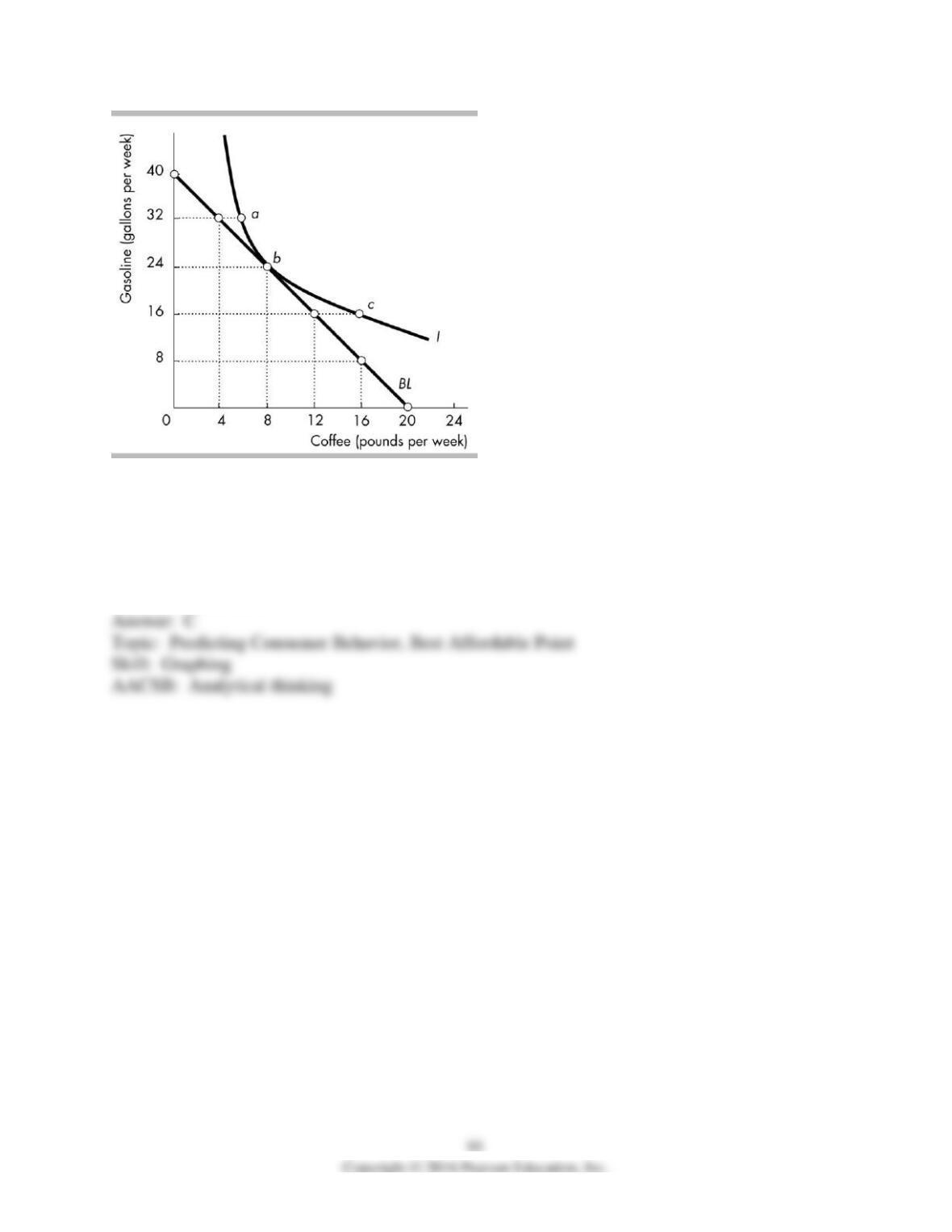
18) The above figure shows Sam’s budget line and one of his indifference curves. What
combination of coffee and gasoline will Sam select?
A) combination a because that contains all the gasoline he needs and still has some coffee
B) combination c because that contains all the coffee he needs and some gasoline
C) combination b because it is on his budget line and on the highest attainable indifference curve
D) none of the above
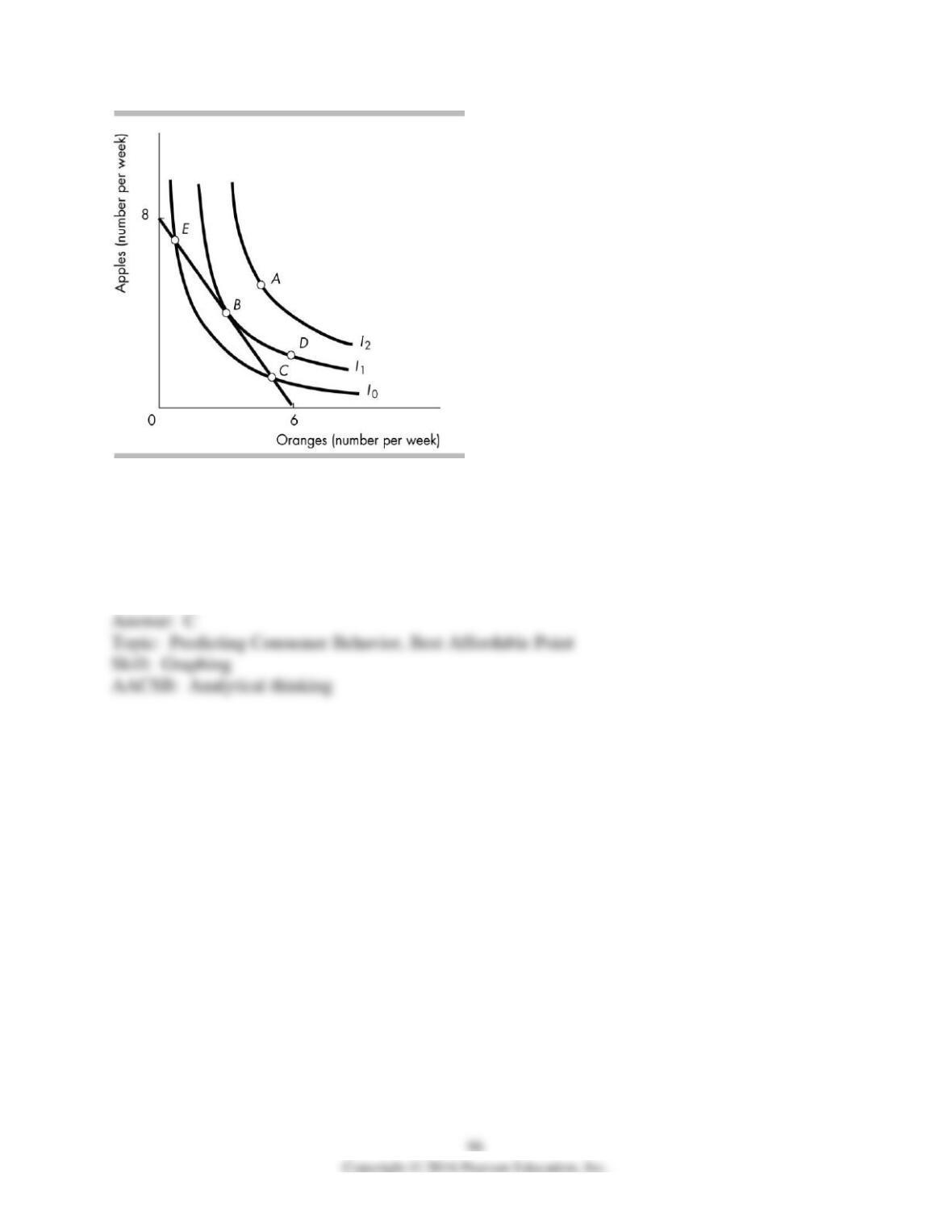
19) The figure illustrates Sally’s budget line and her preferences. Point ________ is Sally’s best
affordable point, and Sally prefers point ________ to point ________.
A) A; B; A
B) E; C; B
C) B; A; B
D) B; B; D
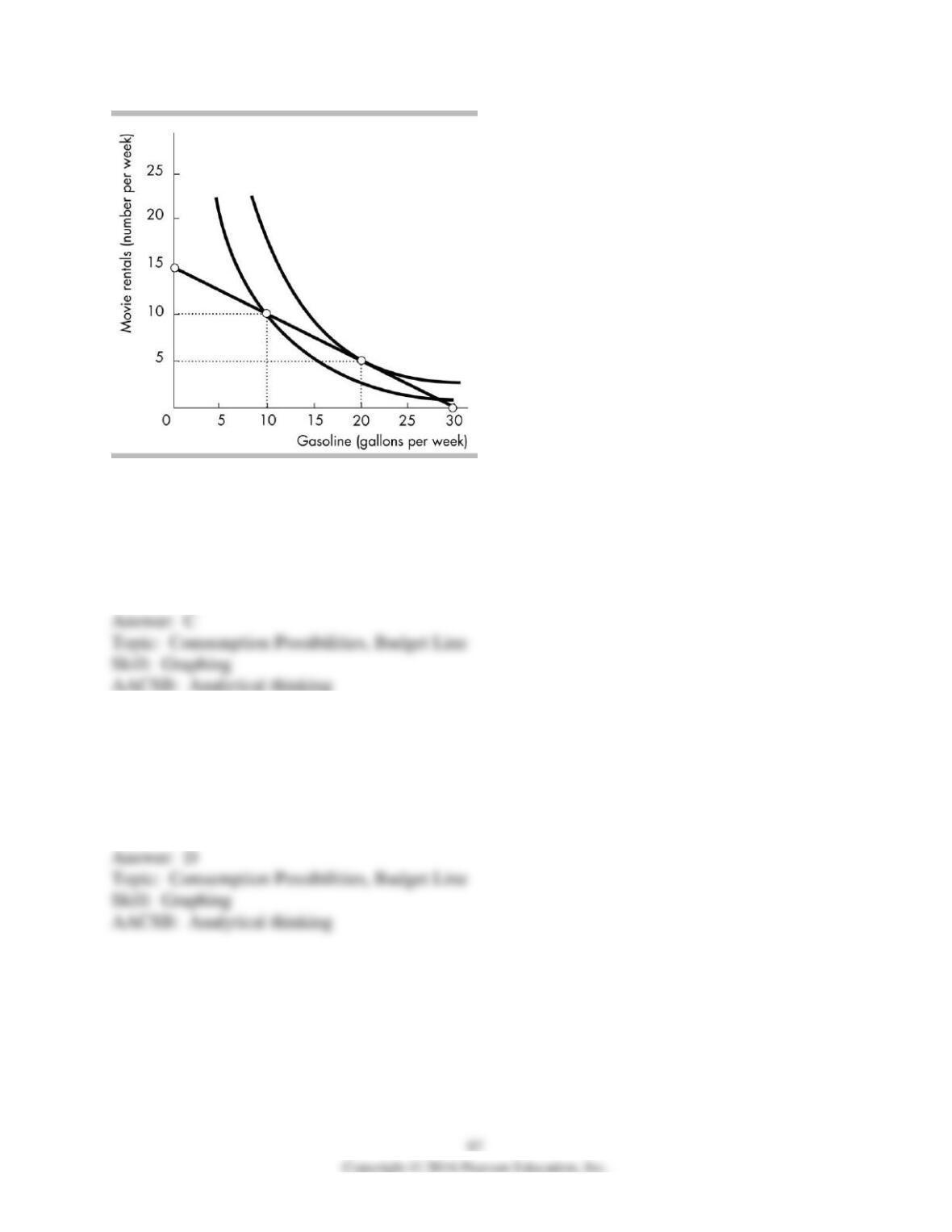
20) Your weekly budget for gasoline and movie rentals is $45.00. Referring to the figure above,
what is the price per gallon of gasoline?
A) $1.00
B) $1.25
C) $1.50
D) $1.75
21) Your weekly budget for gasoline and movie rentals is $45.00. Referring to the figure above,
what is the price per movie rental?
A) $2.00
B) $2.25
C) $2.50
D) $3.00
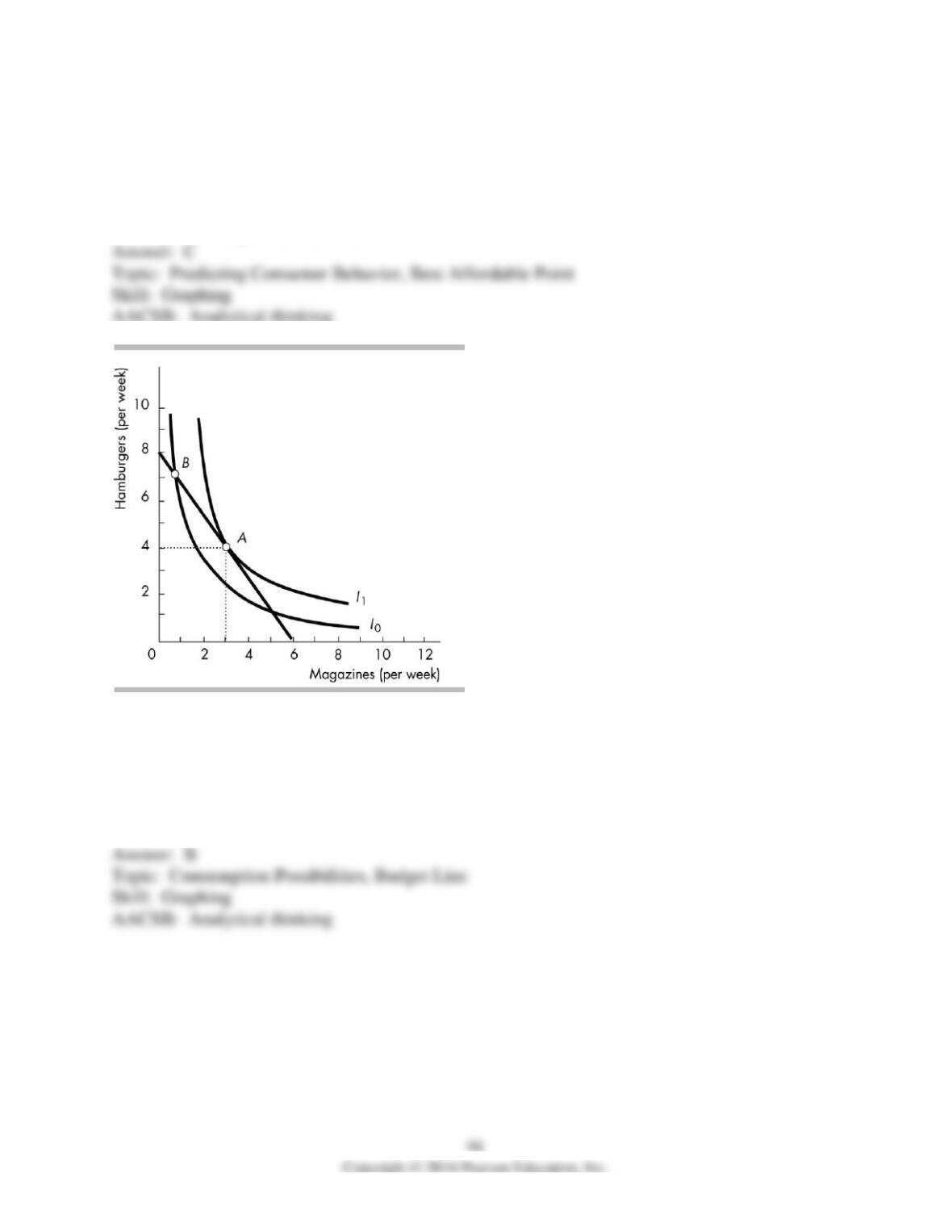
22) The above figure shows your budget line and indifference curves. What quantities of
gasoline and movie rentals would you choose?
A) 25 gallons of gasoline and 15 movie rentals
B) 10 gasoline and 10 movie rentals
C) 20 gallons of gasoline and 5 movie rentals
D) 15 gallons of gasoline and 8 movie rentals
23) Consider the budget line in the above figure. If the price of a magazine is $4, then the price
of a hamburger is
A) $1.75.
B) $3.00.
C) $4.00.
D) $5.33.
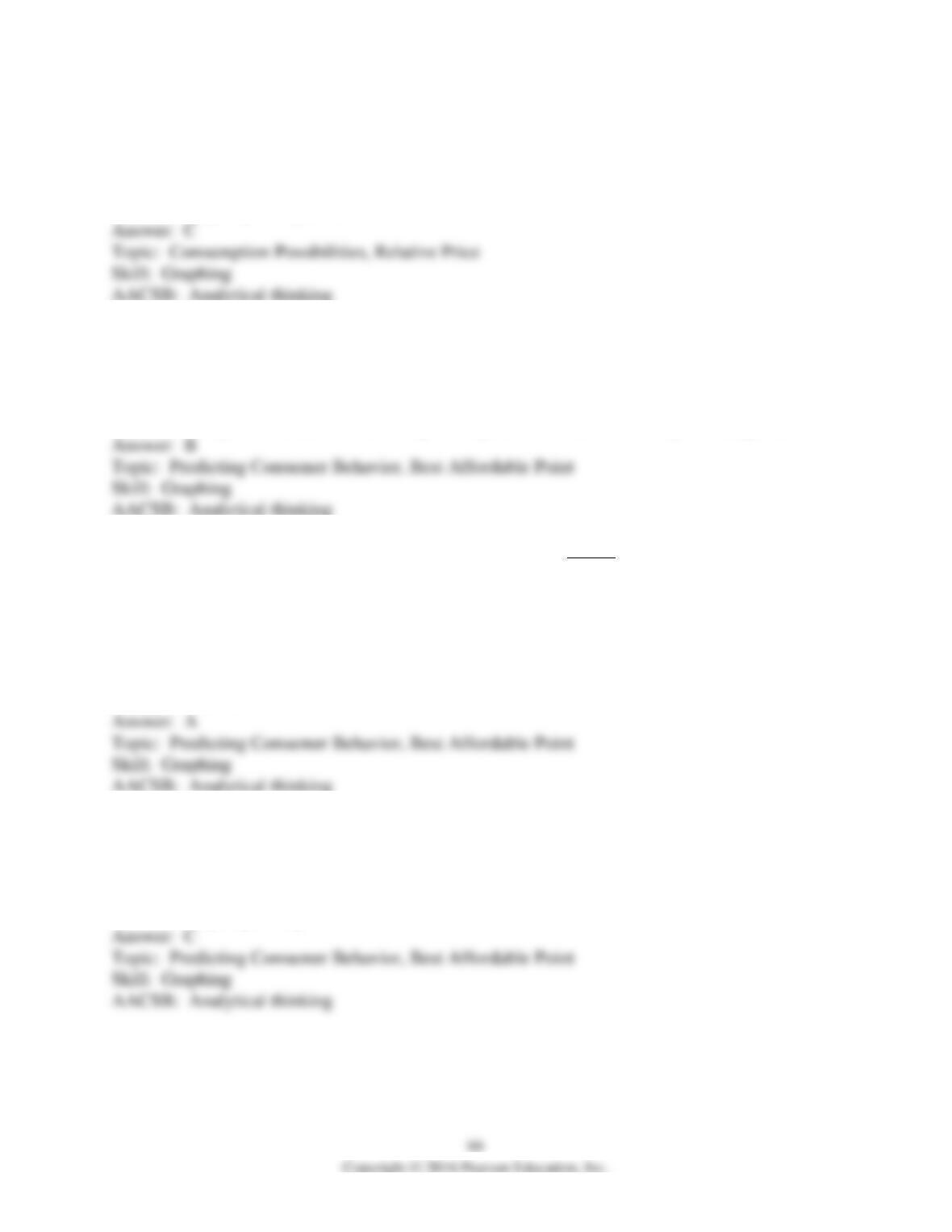
24) The relative price of a magazine in the above figure is
A) 0.5 of a hamburger per magazine.
B) 1 hamburger per magazine.
C) 1.33 hamburgers per magazine.
D) 8 hamburgers per magazine.
25) In the above figure, point B
A) is superior to point A.
B) is inferior to point A.
C) is as good as point A.
D) could be superior to, inferior to, or as good as point A but there is no way of telling which.
26) In the above figure, which of the following statements is TRUE?
I. The consumer maximizes utility by consuming at point A.
II. The marginal rate of substitution at point B and point A are equal because they are on the
same budget line.
A) only I
B) only II
C) both I and II
D) neither I nor II
27) In the above figure, at the best affordable point, the marginal rate of substitution is
A) 0.5 of a hamburger per magazine.
B) 1 hamburger per magazine.
C) 1.33 hamburgers per magazine.
D) 8 hamburgers per magazine.
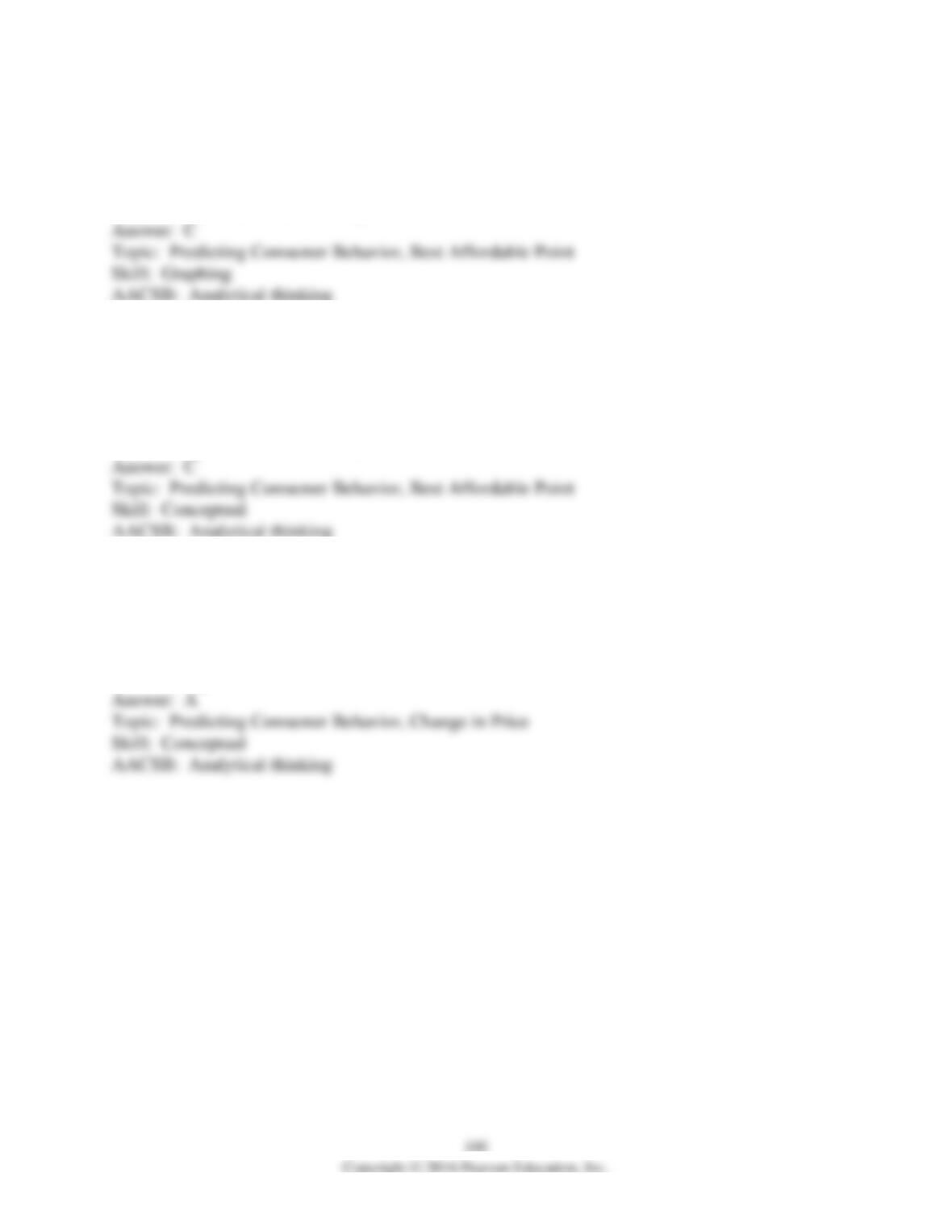
28) In the above figure, the best affordable point is
A) 8 hamburgers and 0 magazines.
B) 0 hamburgers and 6 magazines.
C) 4 hamburgers and 3 magazines.
D) some combination that is not given above.
29) Julie’s demand curve for video downloads is downward sloping because as the price of a
download decreases, ________ and she watches ________ videos.
A) the slope of her budget line changes; fewer
B) her budget line shifts inward; fewer
C) the slope of her budget line changes; more
D) her budget line shifts outward; more
30) In an indifference curve/budget line diagram, generally when the price of a good increases,
the consumer purchases ________ of the good and moves to a ________ indifference curve.
A) less; lower
B) less; higher
C) more; lower
D) more; higher