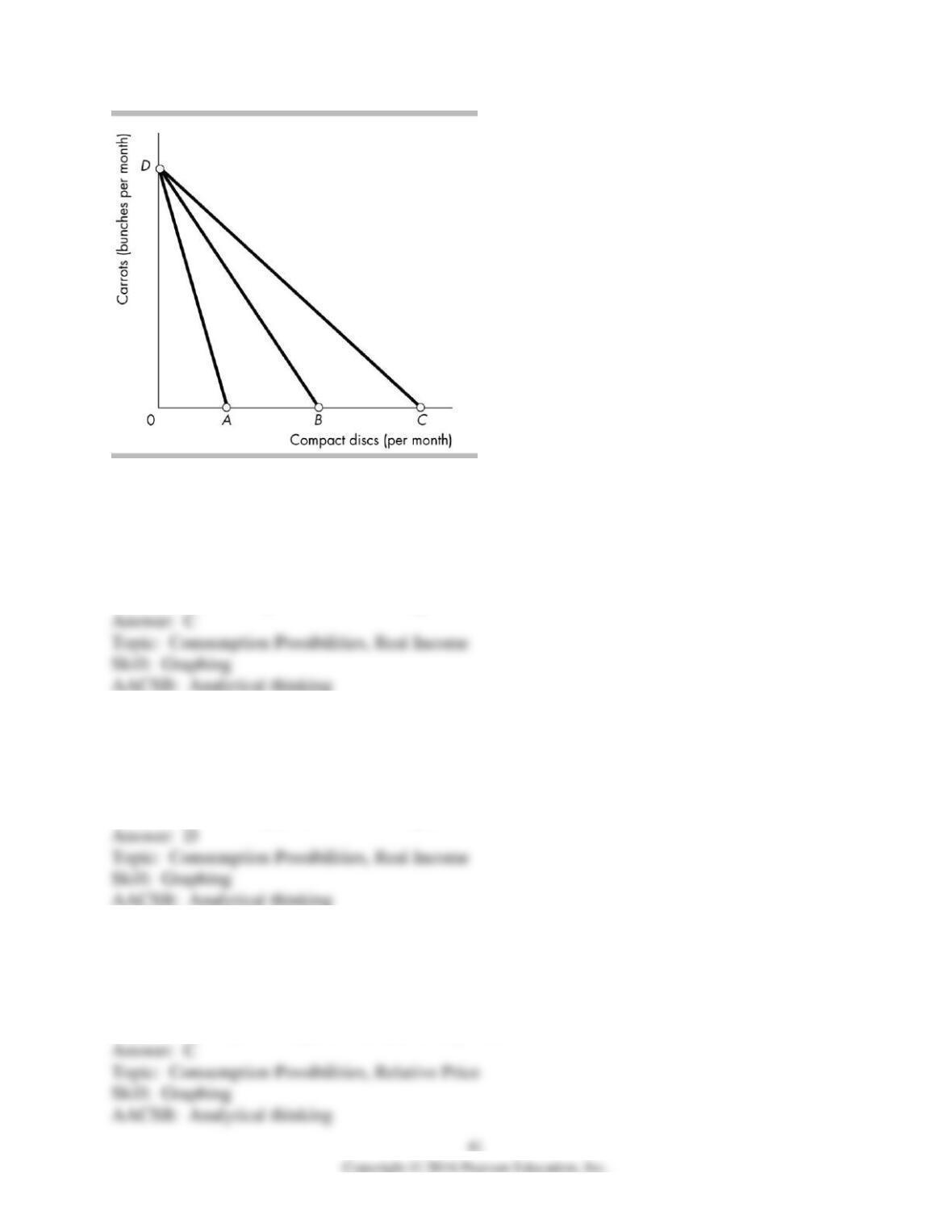
126) In the figure above, which budget line results in the most real income in terms of compact
discs?
A) AD
B) BD
C) CD
D) Real income is equal for all three budget lines.
127) In the figure above, which budget line results in the most real income in terms of carrots?
A) AD
B) BD
C) CD
D) Real income is equal for all three budget lines.
128) In the figure above, which budget line has the lowest relative price of compact discs?
A) AD
B) BD
C) CD
D) The relative price is equal for all three budget lines.
129) In the figure above, which budget line has the lowest relative price of carrots?
A) AD
B) BD
C) CD
D) The relative price is equal for all three budget lines.
130) In the figure above, suppose the original budget line is BD. A rise in the price of a compact
disc will
A) rotate the budget line to AD.
B) rotate the budget line to CD.
C) not move the budget line.
D) result in a parallel leftward shift of the budget line.
131) In the figure above, suppose the original budget line is BD. A fall in the price of a compact
disc will
A) rotate the budget line to AD.
B) rotate the budget line to CD.
C) not move the budget line.
D) result in a parallel leftward shift of the budget line.
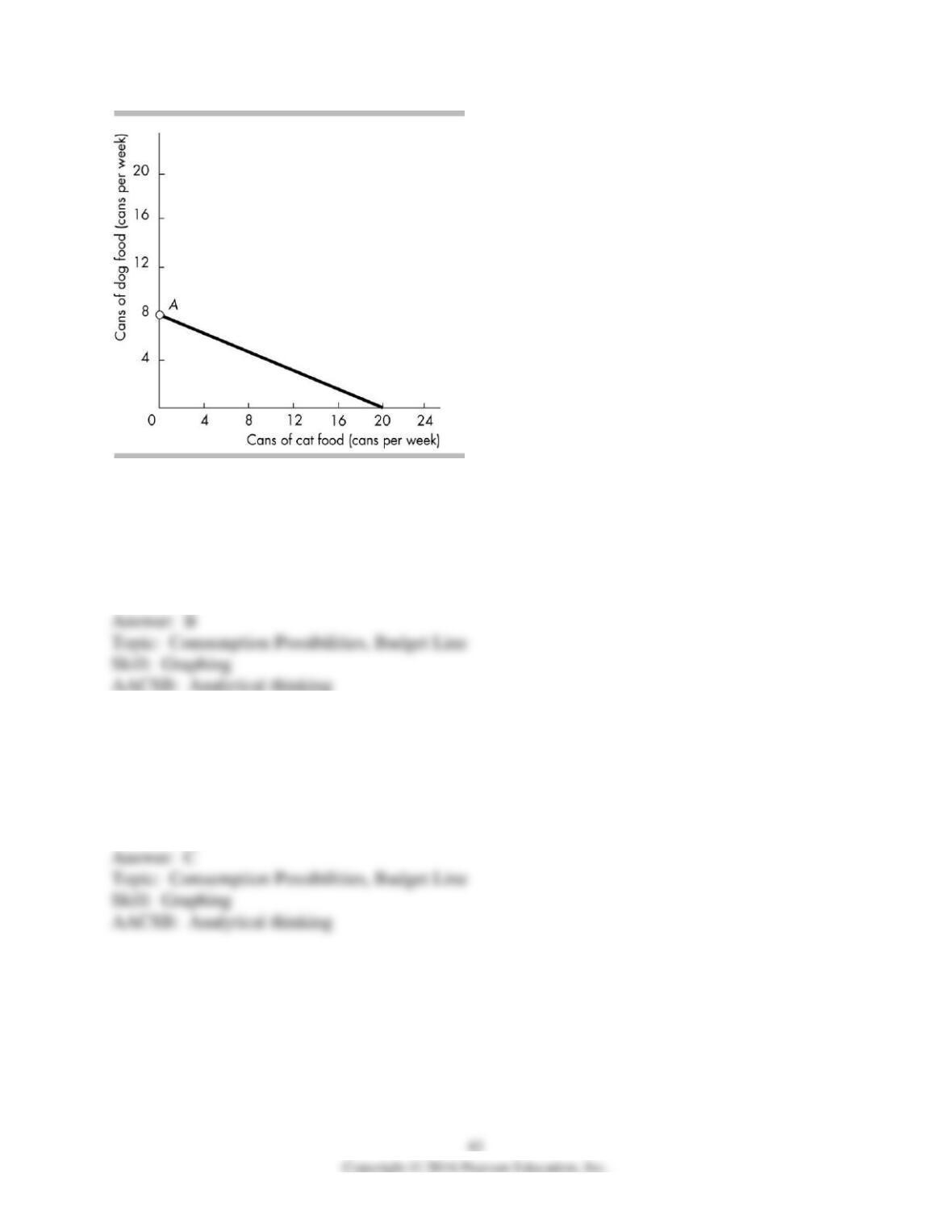
132) The figure above shows Ilene’s budget line. The price of a can of cat food is $2. Ilene’s
income per week is
A) $10.
B) $40.
C) $56.
D) $160.
133) The figure above shows Ilene’s budget line. The price of a can of cat food is $2. The price
of a can of dog food
A) is $1.60.
B) is $4.00.
C) is $5.00.
D) cannot be determined without more information.
134) The figure above shows Ilene’s budget line. If her dog, Muffin, runs away and she adopts
another cat, named Sphynx, the budget line shown in the figure will
A) become flatter.
B) become steeper.
C) shift outward (because cats eat less).
D) not move.
135) The figure above shows Ilene’s budget line. The price of a can of cat food is $2. If the price
of a can of cat food rises, her budget line will
A) rotate inward toward the origin.
B) rotate outward away from the origin.
C) shift leftward in a parallel manner.
D) shift rightward in a parallel manner.
136) The figure above shows Ilene’s budget line. If the price of a can of cat food rises, her budget
line rotates so that the vertical intercept is
A) unchanged, but the horizontal intercept is closer to the origin.
B) unchanged, but the horizontal intercept is farther away from the origin.
C) farther away from the origin, but the horizontal intercept is closer to the origin.
D) closer to the origin, but the horizontal intercept is farther away from the origin.
137) The figure above shows Ilene’s budget line. If Ilene‘s income rises, her budget line will
A) rotate and become flatter.
B) rotate and become steeper.
C) shift rightward and its slope will not change.
D) shift leftward and its slope will not change.
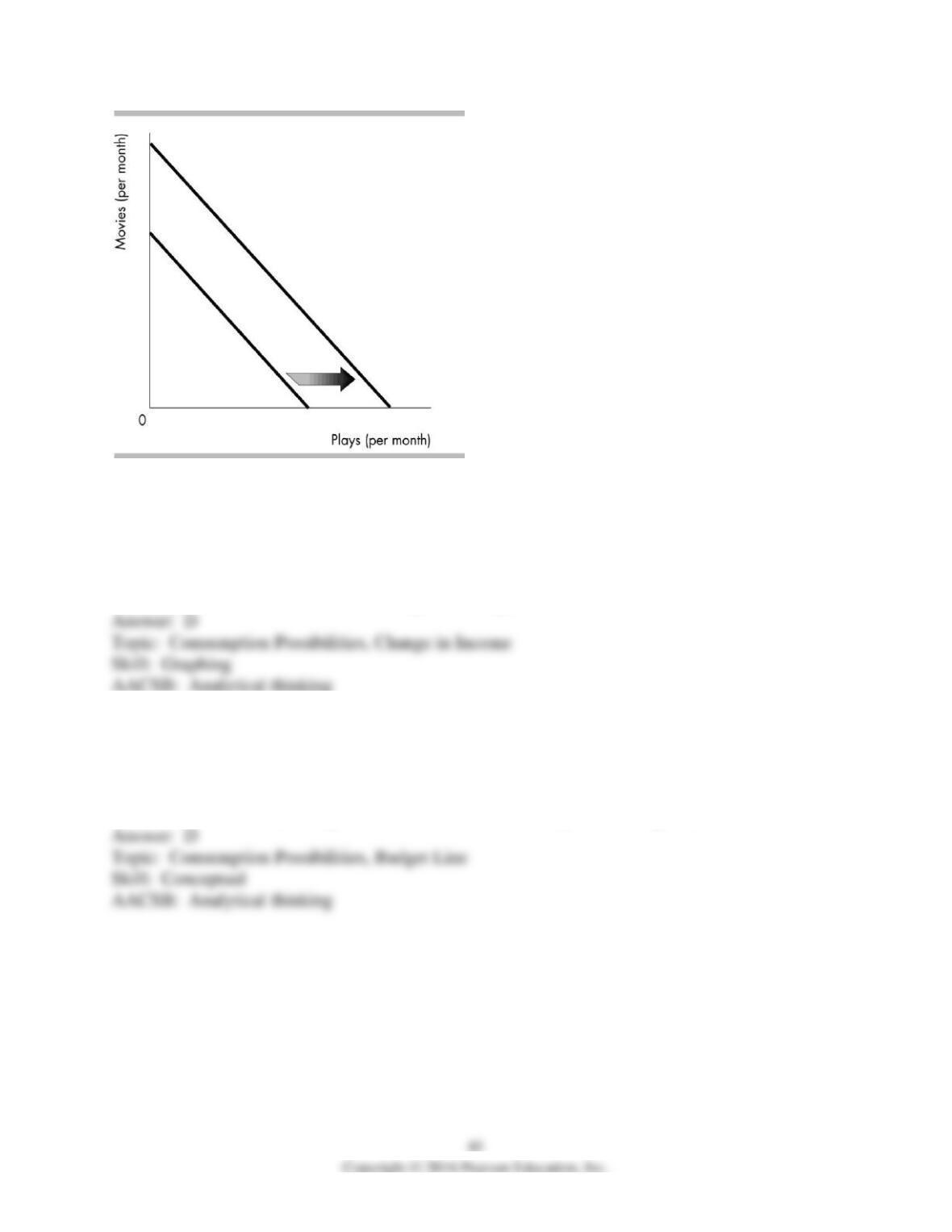
138) In the above figure, Sheryl’s monthly budget line for movies and plays shifted, as shown.
The shift in the budget line is parallel, so the shift might be because
A) the price of a movie fell and nothing else changed.
B) the price of a play fell and nothing else changed.
C) Sheryl’s income decreased and nothing else changed.
D) Sheryl’s income increased and nothing else changed.
139) As Judy moves down along her budget line, ________.
A) the opportunity cost of the good measured along the x-axis increases
B) the opportunity cost of the good measured along the y-axis increases
C) her income decreases
D) her income does not change and neither does the relative price of the goods
140) Waldo buys only two items, pretzels and ham sandwiches. Waldo has $24 in income,
pretzels cost $0.60 per bag and ham sandwiches cost $2.40 each. Which of the following
statements is TRUE for the information given above?
A) Waldo’s real income expressed in terms of pretzels is 40 bags of pretzels.
B) Waldo’s real income expressed in terms of ham sandwiches is 10 ham sandwiches.
C) The relative price of a ham sandwich in terms of pretzels is 4 bags of pretzels per ham
sandwich.
D) All of the above answers are correct.
141) Waldo buys only two items, pretzels and ham sandwiches. Waldo has $24 in income,
pretzels cost $0.60 per bag and ham sandwiches cost $2.40 each. If Waldo’s budget line is
constructed with ham sandwiches along the horizontal axis and bags of pretzels along the vertical
axis, then
A) the horizontal intercept of the budget line will be 40 ham sandwiches.
B) the vertical intercept of the budget line will be 10 bags of pretzels.
C) the slope of the budget line will be -4 bags of pretzels per ham sandwich.
D) All of the above answers are correct.
142) Melissa has an income of $240 a month to spend on tennis lessons and concert tickets. The
price of a tennis lesson is $20, and the price of a concert ticket is $40. If the quantity of tennis
lessons is QT, and the quantity of concert tickets is QC, Melissa’s budget line equation is
A) QC = 6 – 0.5QT.
B) QC = 12 – 2QT.
C) QC = 240 – 40QT.
D) QC = 20 + 40QT.
143) Melissa has an income of $240 a month to spend on tennis lessons and concert tickets. The
price of a tennis lesson is $20, and the price of a concert ticket is $40. The slope of Melissa’s
budget line, with tennis lessons on the horizontal axis, is
A) -2.
B) -0.5.
C) -6.
D) -12.
144) Melissa has an income of $240 a month to spend on tennis lessons and concert tickets. The
price of a tennis lesson is $20, and the price of a concert ticket is $40. Melissa’s real monthly
income in terms of concerts is
A) 40.
B) 20.
C) 6.
D) 12.
145) Melissa has an income of $240 a month to spend on tennis lessons and concert tickets. The
price of a tennis lesson is $20, and the price of a concert ticket is $40. If the price of a tennis
lesson rises to $30, Melissa’s budget line, with tennis lessons on the horizontal axis
A) shifts rightward with no change in its slope.
B) shifts leftward with no change in its slope.
C) becomes flatter.
D) becomes steeper.
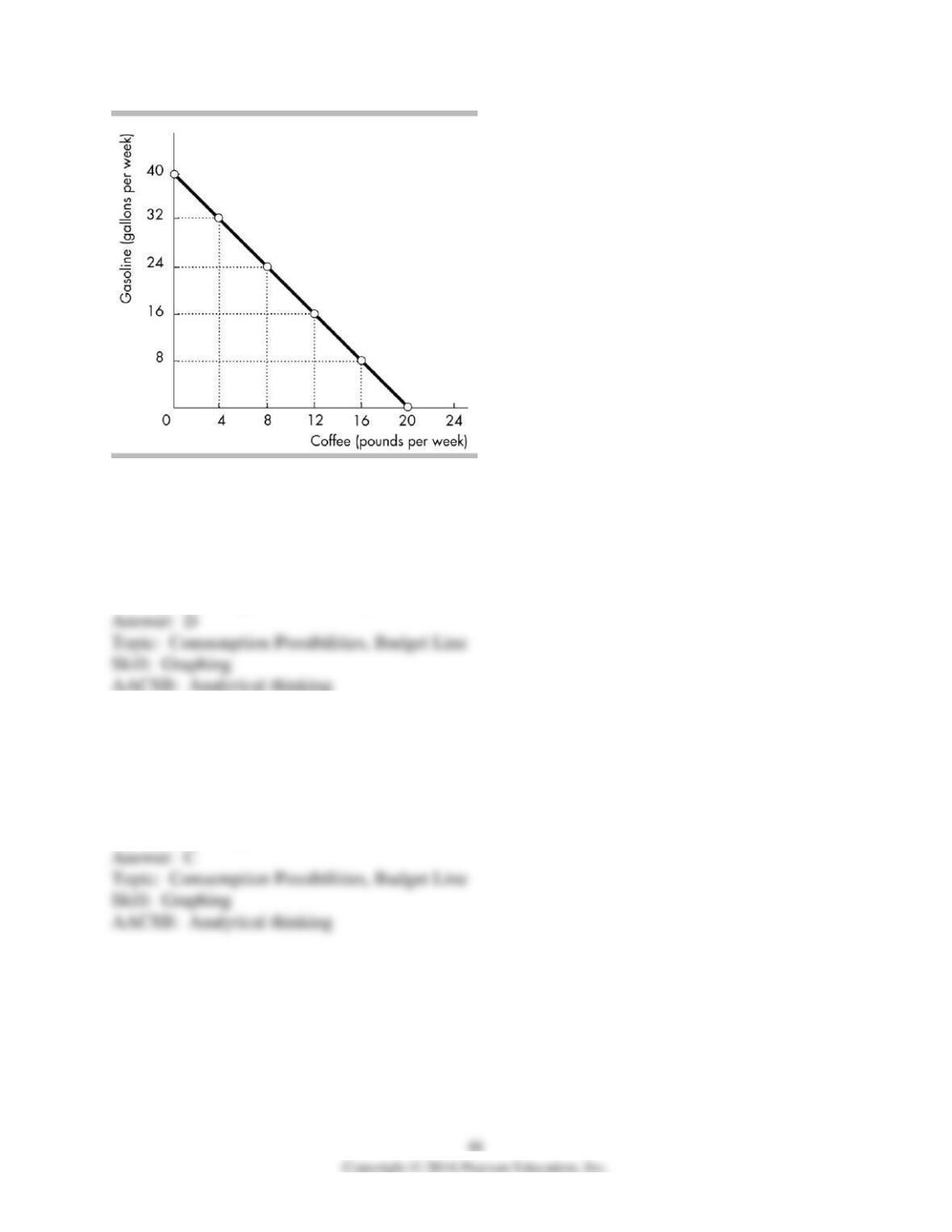
146) The figure above shows Sam’s budget line. Which of the following combinations of
gasoline and coffee are not available to Sam?
A) 40 gallons of gasoline and 0 pounds of coffee
B) 32 gallons of gasoline and 4 pounds of coffee
C) 8 gallons of gasoline and 8 pounds of coffee
D) 16 gallons of gasoline and 16 pounds of coffee
147) The figure above shows Sam’s budget line. Which of the following combinations of
gasoline and coffee are available to Sam?
A) 40 gallons of gasoline and 1 pound of coffee
B) 1 gallon of gasoline and 20 pounds of coffee
C) 16 gallons of gasoline and 12 pounds of coffee
D) 12 gallons of gasoline and 16 pounds of coffee
148) The figure above shows Sam’s budget line. Sam’s budget line shows
A) which combinations of gasoline and coffee Sam can afford.
B) which combinations of gasoline and coffee Sam is planning to purchase.
C) whether or not Sam thinks gasoline and coffee are worth their prices.
D) whether or not Sam currently has enough gasoline and enough coffee.
149) The figure above shows Sam’s budget line. Why will Sam not purchase 36 gallons of
gasoline and 4 pounds of coffee?
A) because he does not like this combination
B) because this combination does not contain enough coffee to satisfy him
C) because this combination contains more gasoline than his gasoline tank will hold
D) because he cannot afford this combination
150) The figure above shows Sam’s budget line. Which of the following formulas represents
Sam’s budget equation?
A) $60.00 = $1.50/Qg + $3.00/Qc
B) $60.00 = Qg /$1.50 + Qc /$3.00
C) $60.00 = $1.50(Qg) + $3.00(Qc)
D) $60.00 = $1.50(Qg) – $3.00(Qc)
151) The figure above shows Sam’s budget line. Which of the following equals the vertical
intercept of Sam’s budget line?
A) Y/Pc
B) Y/Pg
C) -(Pc/Pg)
D) -(Pg/Pc)
152) The figure above shows Sam’s budget line. The vertical intercept of Sam’s budget line is
equal to
A) the quantity of coffee purchased if zero gasoline is purchased.
B) Pc/Y.
C) the quantity of gasoline purchased if zero coffee is purchased.
D) Pg/Y.
153) The figure above shows Sam’s budget line. Which of the following equals the slope of
Sam’s budget line?
A) Y/Pc
B) Y/Pg
C) (Pc/Pg)
D) (Pg/Pc)
154) The figure above shows Sam’s budget line. The magnitude of the slope of Sam’s budget line
is equal to the
A) quantity of coffee purchased divided by the quantity of gasoline purchased.
B) price of coffee divided by the price of gasoline.
C) quantity of gasoline purchased divided by the quantity of coffee purchased.
D) price of gasoline divided by the price of coffee.
155) The figure above shows Sam’s budget line. Which of the following would result in Sam‘s
budget line rotating inward and not changing its vertical intercept?
A) a decline in his preference for coffee
B) a fall in the price of a gallon of gasoline
C) a decrease in Sam’s income
D) an increase in the price of a pound of coffee
156) The figure above shows Sam’s budget line. Which of the following would result in Sam’s
budget line rotating outward and not changing its horizontal intercept?
A) a fall in the price of a pound of coffee
B) a rise in the price of a pound of coffee
C) a fall in the price of a gallon of gasoline
D) a rise in the price of a gallon of gasoline
157) The figure above shows Sam’s budget line. Which of the following would result in Sam’s
budget line shifting leftward and not changing its slope?
A) a decline in his preferences for both gasoline and coffee
B) an equal percentage reduction in the prices of both a gallon of gasoline and a pound of coffee
C) a decrease in Sam’s income
D) a fall in the ratio of the price of a gallon of gasoline to the price of a pound of coffee
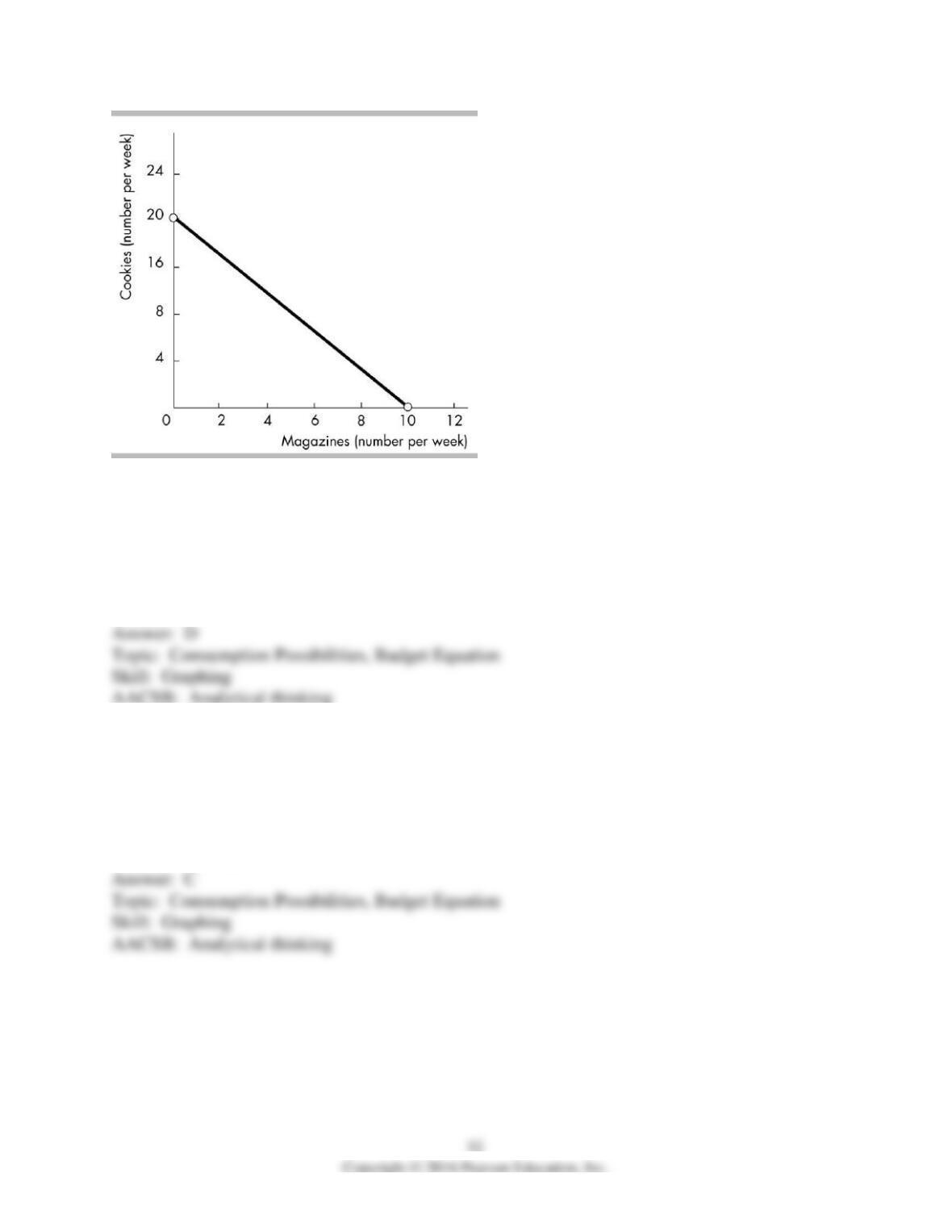
158) Lizzie’s budget line is shown in the figure above. If Lizzie’s income is $20, which of the
following formulas represents her budget equation?
A) QC = 20 + QM
B) QC = 20 – QM
C) QC = -20 + 2 QM
D) QC = 20 – 2QM
159) Lizzie’s budget line is shown in the figure above. If Lizzie’s income is $20, which of the
following formulas represents her budget equation?
A) QM = 20 – 2QC
B) 20 = QC + QM
C) 20 = QC + 2QM
D) QM = 20 + QC
160) Lizzie’s budget line is shown in the figure above. The slope of the budget line is ________
cookies per magazine.
A) 2
B) -2
C) 0.5
D) -0.5
161) Lizzie’s budget line is shown in the figure above. The relative price of a magazine is
________ per magazine.
A) 2 cookies
B) 0.5 of a cookie
C) $1
D) $2
162) Lizzie’s budget line is shown in the figure above. The relative price of a cookie is ________
per cookie.
A) 2 magazines
B) 0.5 of a magazine
C) $1
D) $2
163) Lizzie’s budget line is shown in the figure above. Lizzie’s real income in terms of magazines
is ________ magazines
A) 5
B) 10
C) 15
D) 20
164) Lizzie’s budget line is shown in the figure above. Lizzie’s real income in terms of cookies is
________ cookies.
A) 5
B) 10
C) 15
D) 20
165) Lizzie’s budget line is shown in the figure above. If the price of a cookie rises, Lizzie’s real
income in terms of cookies ________ and her real income in terms of magazines ________.
A) decreases; increases
B) increases; decreases
C) decreases; does not change
D) increases; does not change
166) Lizzie’s budget line is shown in the figure above. If the price of a magazine rises, Lizzie’s
real income in terms of magazines books ________ and her real income in terms of cookies
________.
A) increases; does not change
B) decreases; does not change
C) decreases; increases
D) increases; decreases
167) Lizzie’s budget line is shown in the figure above. If the price of a magazine falls, the budget
line
A) shifts rightward and its slope does not change.
B) shifts leftward and its slope does not change.
C) becomes flatter.
D) becomes steeper.
168) Lizzie’s budget line is shown in the figure above. If the price of a cookie falls, the budget
line
A) shifts rightward and its slope does not change.
B) shifts leftward and its slope does not change.
C) becomes flatter.
D) becomes steeper.
169) Lizzie’s budget line is shown in the figure above. If Lizzie’s income increases, her budget
line
A) shifts rightward and its slope does not change.
B) shifts leftward and its slope does not change.
C) becomes flatter.
D) becomes steeper.
170) Which of the following statements best describes a consumer’s budget line?
A) It shows all combinations of goods among which the consumer is indifferent.
B) It shows the limits to a consumer’s set of affordable consumption choices.
C) It shows the desired level of consumption for the consumer.
D) It shows the consumption choices made by a consumer.
171) The magnitude of the slope of the budget line
A) is defined as marginal rate of substitution.
B) equals the relative price of the good measured along the horizontal axis.
C) increases when income increases.
D) decreases when income increases.
172) The budget line can shift or rotate
A) only when income changes.
B) only when prices change.
C) when either income or prices change.
D) None of the above, because changes in income and prices do not shift or rotate the budget
line.
173) Sue consumes apples and bananas. Suppose Sue’s income doubles and the prices of apples
and bananas do not change. Sue’s budget line will
A) shift leftward and its slope will not change.
B) remain unchanged.
C) shift rightward and its slope will not change.
D) shift rightward and become steeper.
1) Preferences depend on
A) income but not relative prices.
B) relative prices but not income.
C) neither relative prices nor income.
D) both relative prices and income.
2) Preferences can be described as
A) what a person likes and dislikes.
B) the income opportunities of several activities.
C) feasible consumption combinations.
D) the relative prices of goods and services.
3) Consumers’ preferences are represented by
A) budget lines.
B) indifference curves.
C) relative prices.
D) household income.
4) Which of the following statements is FALSE?
A) A consumer has only one indifference curve.
B) A consumer possesses a preference map.
C) An indifference curve is a curve that shows the combination of goods among which a
consumer is indifferent.
D) The marginal rate of substitution is the rate at which a consumer will give up good y to get
more of good x and remain on the same indifference curve.
5) Which of the following results in a “parallel” shift outward of your indifference curves
between gasoline and movie rentals?
A) any decrease in the prices of gasoline and movie rentals
B) an equal percentage decrease in the prices of gasoline and movie rentals
C) an increase in your income
D) none of the above
6) Which of the following will change the slopes of your indifference curves between gasoline
and movie rentals?
A) a change in your preferences for either of the two goods
B) only a change in the price of either of the two goods
C) only a change in your income
D) Both a change in the price of either good and a change in income will change the slopes of
your indifference curves.
7) An indifference curve shows combinations of goods ________.
A) which the consumer prefers equally
B) that are affordable
C) that are inside or on the budget line
D) that have the same relative price
8) An indifference curve shows
A) the relationship between prices and a household’s budget.
B) all possible prices and preferences for a good.
C) combinations of goods among which a household is indifferent.
D) budget lines among which a consumer is indifferent.
9) The combinations of gasoline and coffee along one of Sam’s indifference curves are
combinations
A) which require the same total expenditure.
B) that he can afford with his $60.00 income.
C) among which he is “indifferent.”
D) that give him the same marginal rate of substitution.
10) An indifference curve shows
A) different combinations of two goods among which the consumer is indifferent.
B) consumption possibilities that a consumer faces at different prices and income.
C) affordable combinations of goods.
D) the opportunity cost of one good relative to another.
11) Indifference curves are drawn on a diagram with the
A) price of a good on the vertical axis and its quantity on the horizontal axis.
B) price of one good on the vertical axis and the price of another good on the horizontal axis.
C) quantity of a good on the vertical axis and its price on the horizontal axis.
D) quantity of one good on the vertical axis and the quantity of another good on the horizontal
axis.
12) An indifference curve is a line that shows combinations of goods among which a consumer
A) needs equally.
B) does not care which combination he or she receives.
C) can afford.
D) has readily available.
13) A curve/line that shows combinations of goods among which a consumer would not desire
one combination of goods to another combination of goods on that curve/line is called
A) a budget line.
B) an indifference curve.
C) a utility possibilities curve.
D) a demand curve.
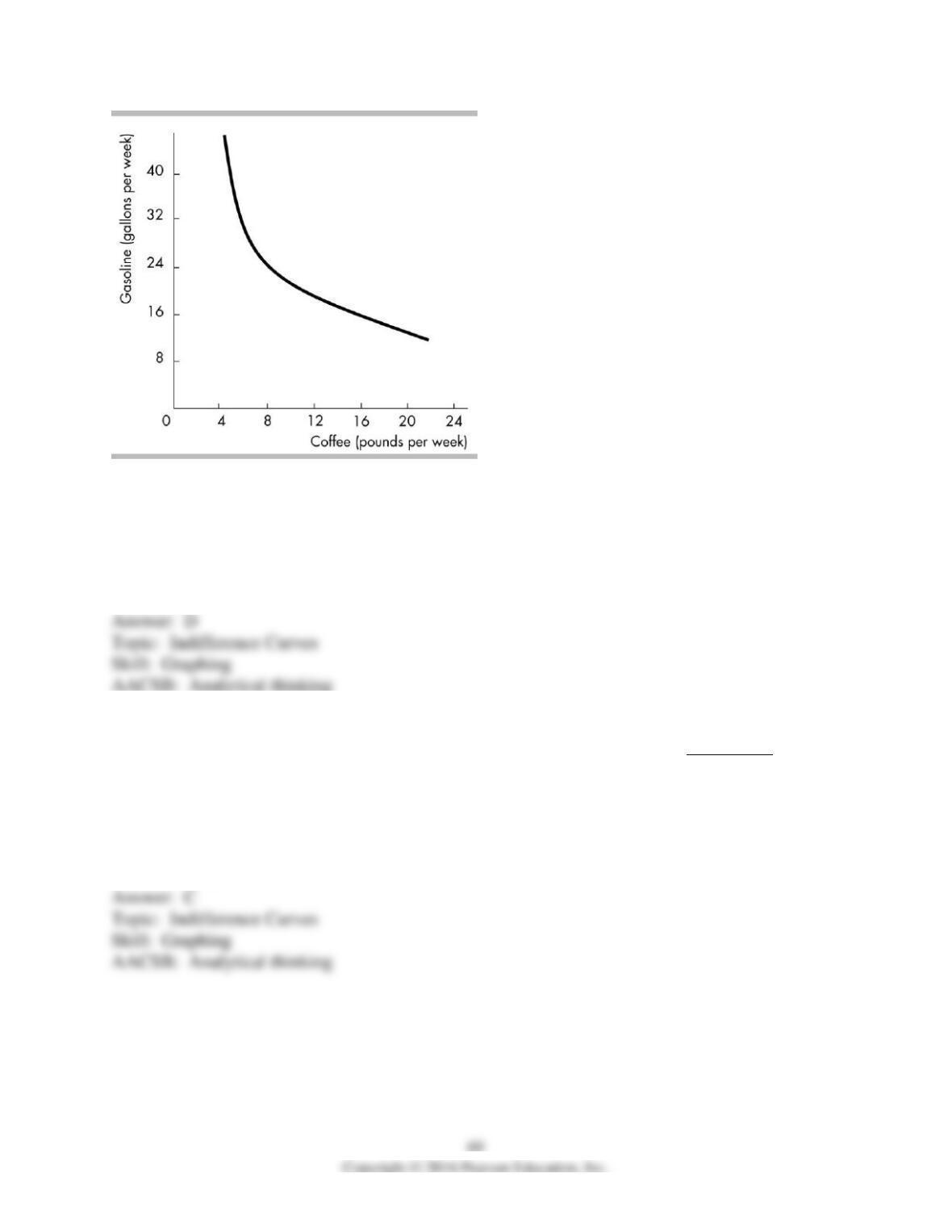
14) The curve in the above figure shows alternative combinations of gasoline and coffee that
Sam likes equally well. This curve is called
A) a budget line.
B) a demand curve.
C) a consumption curve.
D) an indifference curve.
15) The above figure shows one of Sam’s indifference curves between gasoline and coffee.
Which of the following about a movement along Sam’s indifference curve is CORRECT?
A) As he moves leftward along the curve, he likes the combinations of gasoline and coffee better
and better.
B) As he moves rightward along the curve, he likes the combinations of gasoline and coffee
better and better.
C) He likes all combinations of gasoline and coffee along the curve equally well.
D) None of the above is true.