9-37
105. Commitment strategies:
106. The tit-for-tat strategy is:
107. The tit-for-tat strategy:
108. If each player responds by imitating the action of his opponent in the previous round of a repeating
game, the players are following a:
109. If one player defects in a repeated game, and his opponent is following a tit-for-tat strategy, we can
predict the opponent will:
110. If you are following a tit-for-tat strategy in a repeated game, and your opponent makes a cooperative
move, you will:
111. Two players who are both playing tit-for-tat can quickly find their way toward:
112. For players in a repeated-play game to achieve cooperation:
113. Explicit agreements between businesses to keep prices high:
114. Which of the following is a subtle way for a company to reassure their competitors that it is
committed to a tit-for-tat strategy?
115. A key to gaining cooperative behavior in a repeated game is:
116. When one player has to make a decision before the other player, the situation is called a:
117. In sequential games, an especially important part of strategic behavior is to:
118. The process of analyzing a problem in reverse-starting with the last choice, then the second-to-last
choice, and so on, to determine the optimal strategy-is called:
9-40
119. Backward induction involves:
120. Backward induction is a useful tool for:
121. A way to summarize the actions and payoffs of a sequential game is to use a:
122. Using a decision tree:
123.
9-41
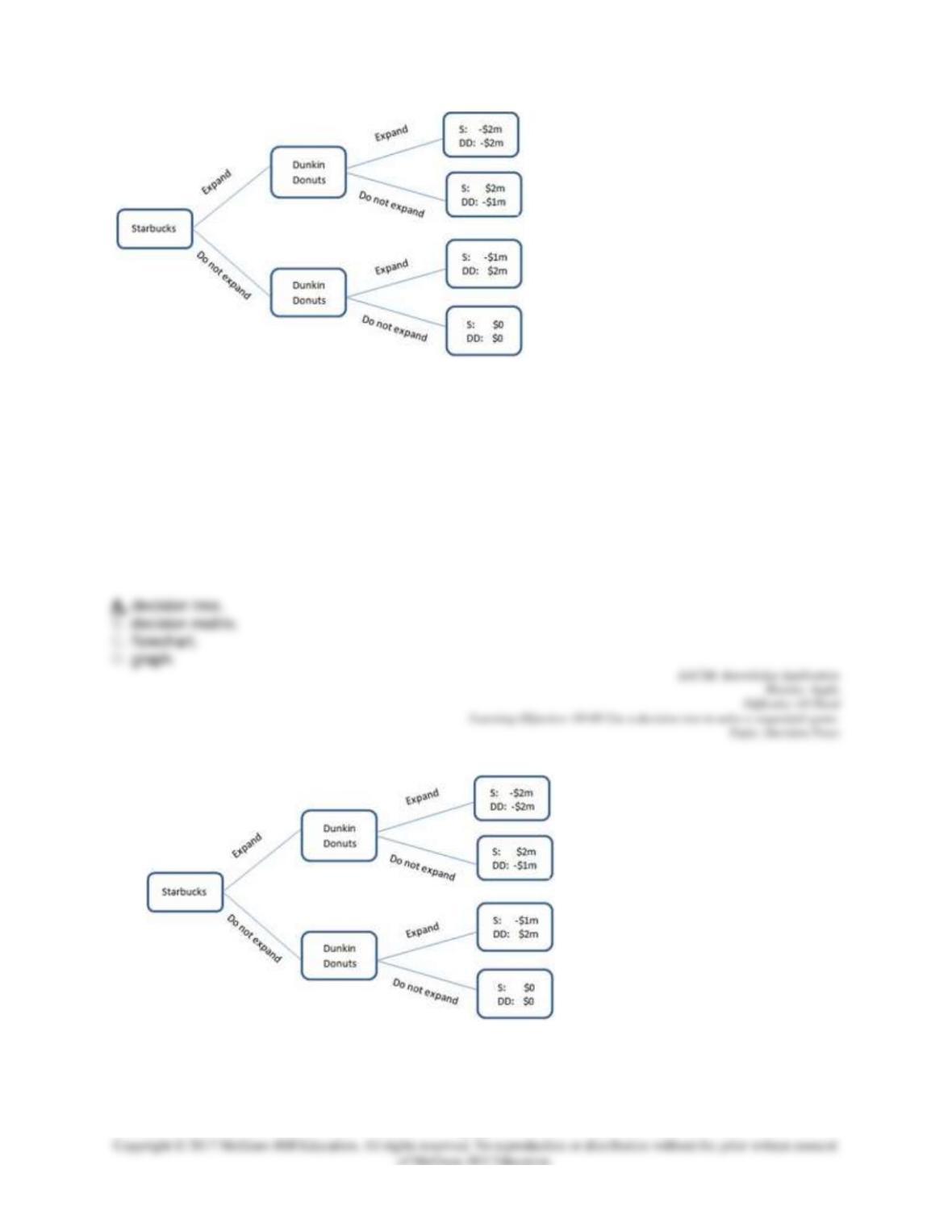
This figure displays the choices being made by two coffee shops: Starbucks and Dunkin Donuts. Both
companies are trying to decide whether or not to expand in an area. The area can handle only one of
them expanding, and whoever expands will cause the other to lose some business. If they both expand,
the market will be saturated, and neither company will do well. The payoffs are the additional profits (or
losses) they will earn.
The game in the figure is shown using a:
124.
9-42
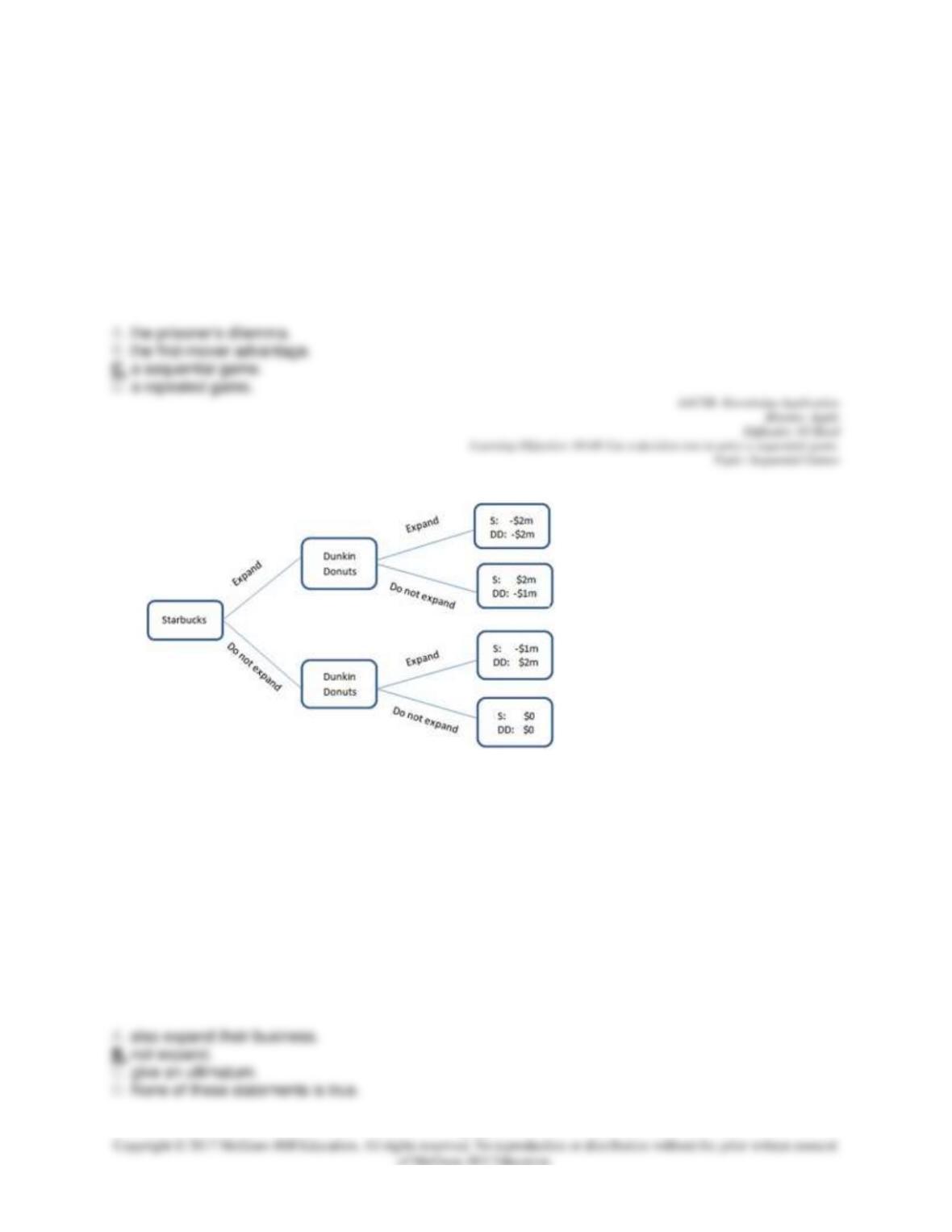
This figure displays the choices being made by two coffee shops: Starbucks and Dunkin Donuts. Both
companies are trying to decide whether or not to expand in an area. The area can handle only one of
them expanding, and whoever expands will cause the other to lose some business. If they both expand,
the market will be saturated, and neither company will do well. The payoffs are the additional profits (or
losses) they will earn.
The game in the figure shown is a version of:
125.
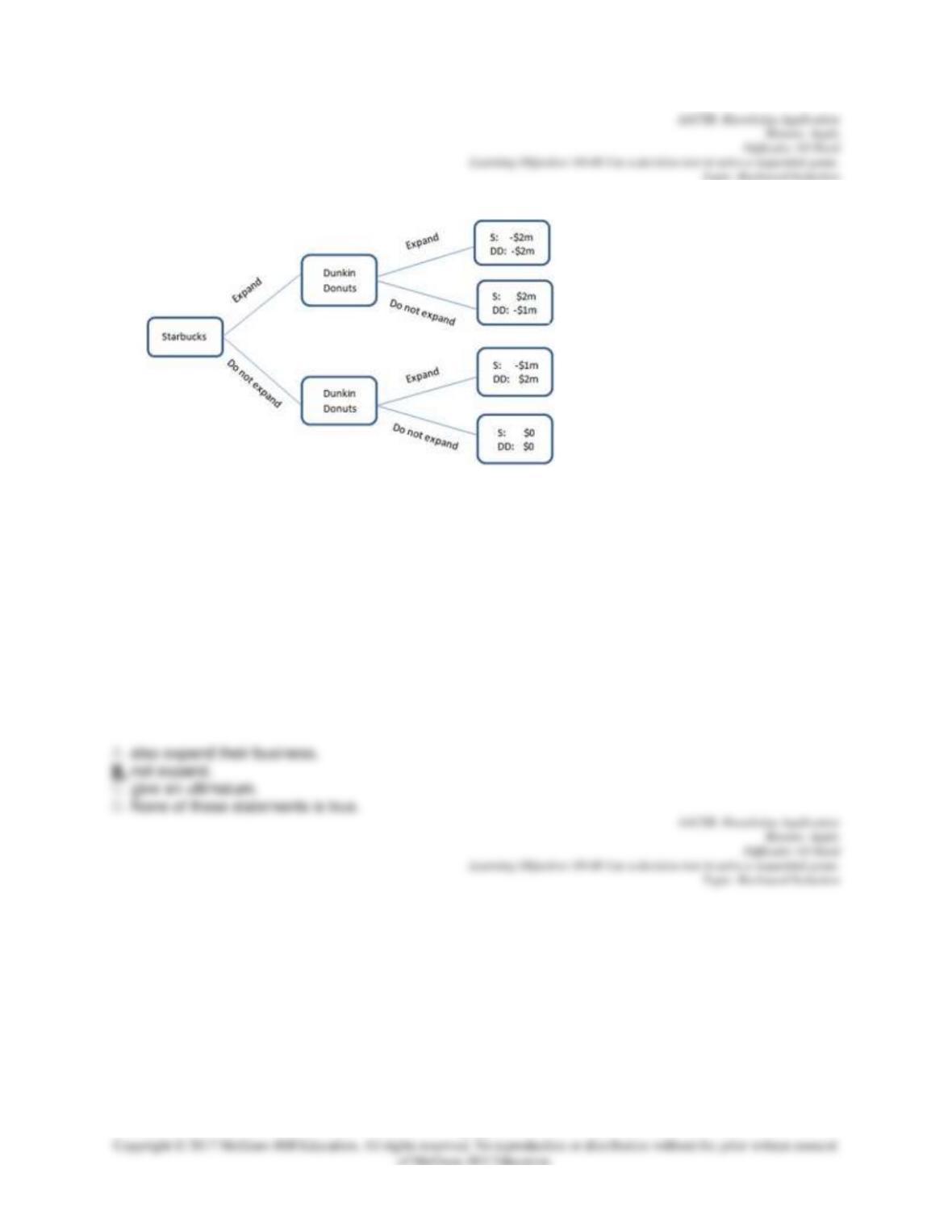
This figure displays the choices being made by two coffee shops: Starbucks and Dunkin Donuts. Both
companies are trying to decide whether or not to expand in an area. The area can handle only one of
them expanding, and whoever expands will cause the other to lose some business. If they both expand,
the market will be saturated, and neither company will do well. The payoffs are the additional profits (or
losses) they will earn.
According to the figure shown, if Starbucks expands in the market, then Dunkin Donuts should:
9-43
126.
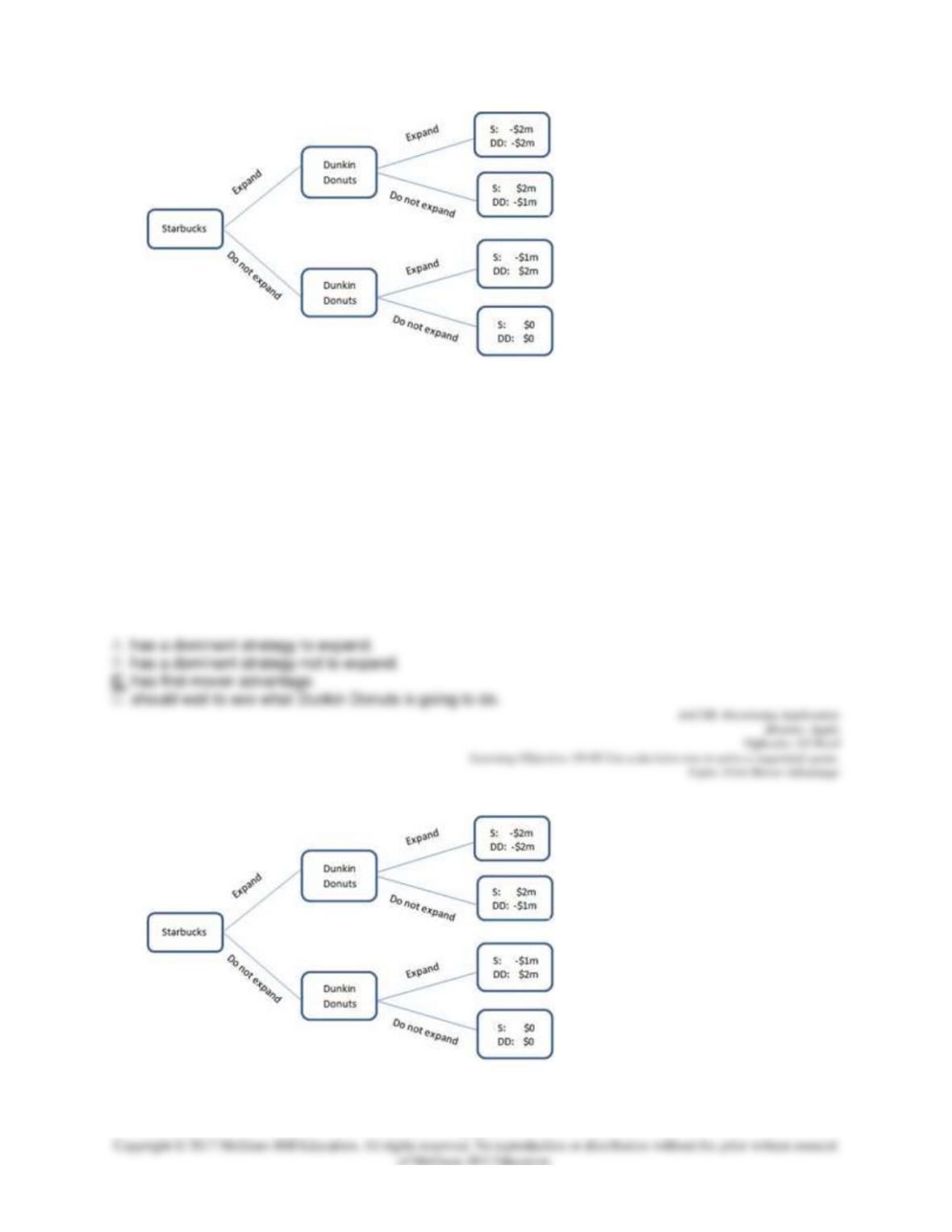
This figure displays the choices being made by two coffee shops: Starbucks and Dunkin Donuts. Both
companies are trying to decide whether or not to expand in an area. The area can handle only one of
them expanding, and whoever expands will cause the other to lose some business. If they both expand,
the market will be saturated, and neither company will do well. The payoffs are the additional profits (or
losses) they will earn.
According to the figure shown, if Dunkin Donuts expands, then Starbucks should:
9-44
127.
This figure displays the choices being made by two coffee shops: Starbucks and Dunkin Donuts. Both
companies are trying to decide whether or not to expand in an area. The area can handle only one of
them expanding, and whoever expands will cause the other to lose some business. If they both expand,
the market will be saturated, and neither company will do well. The payoffs are the additional profits (or
losses) they will earn.
According to the figure shown, Starbucks:
128.
9-45
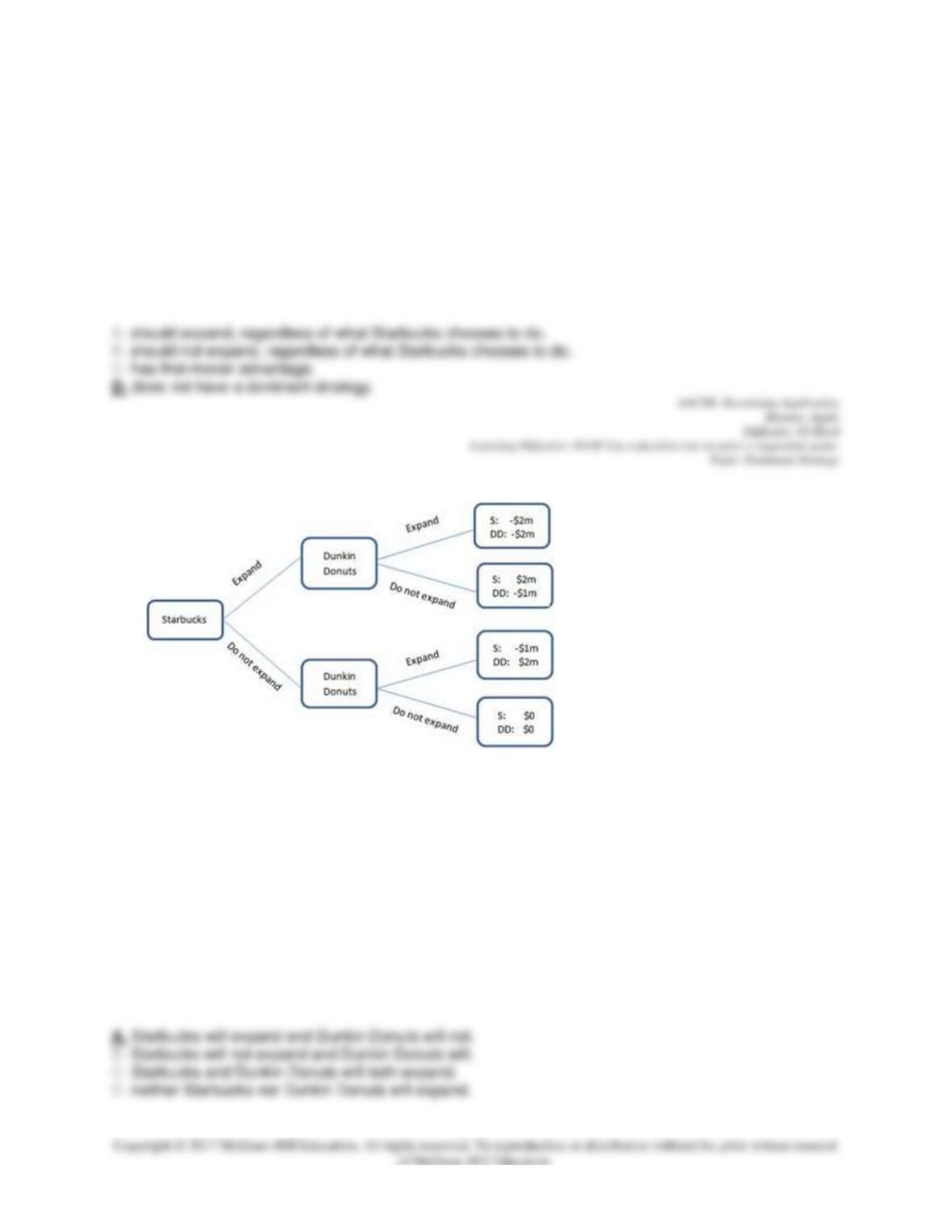
This figure displays the choices being made by two coffee shops: Starbucks and Dunkin Donuts. Both
companies are trying to decide whether or not to expand in an area. The area can handle only one of
them expanding, and whoever expands will cause the other to lose some business. If they both expand,
the market will be saturated, and neither company will do well. The payoffs are the additional profits (or
losses) they will earn.
According to the figure shown, Dunkin Donuts:
129.
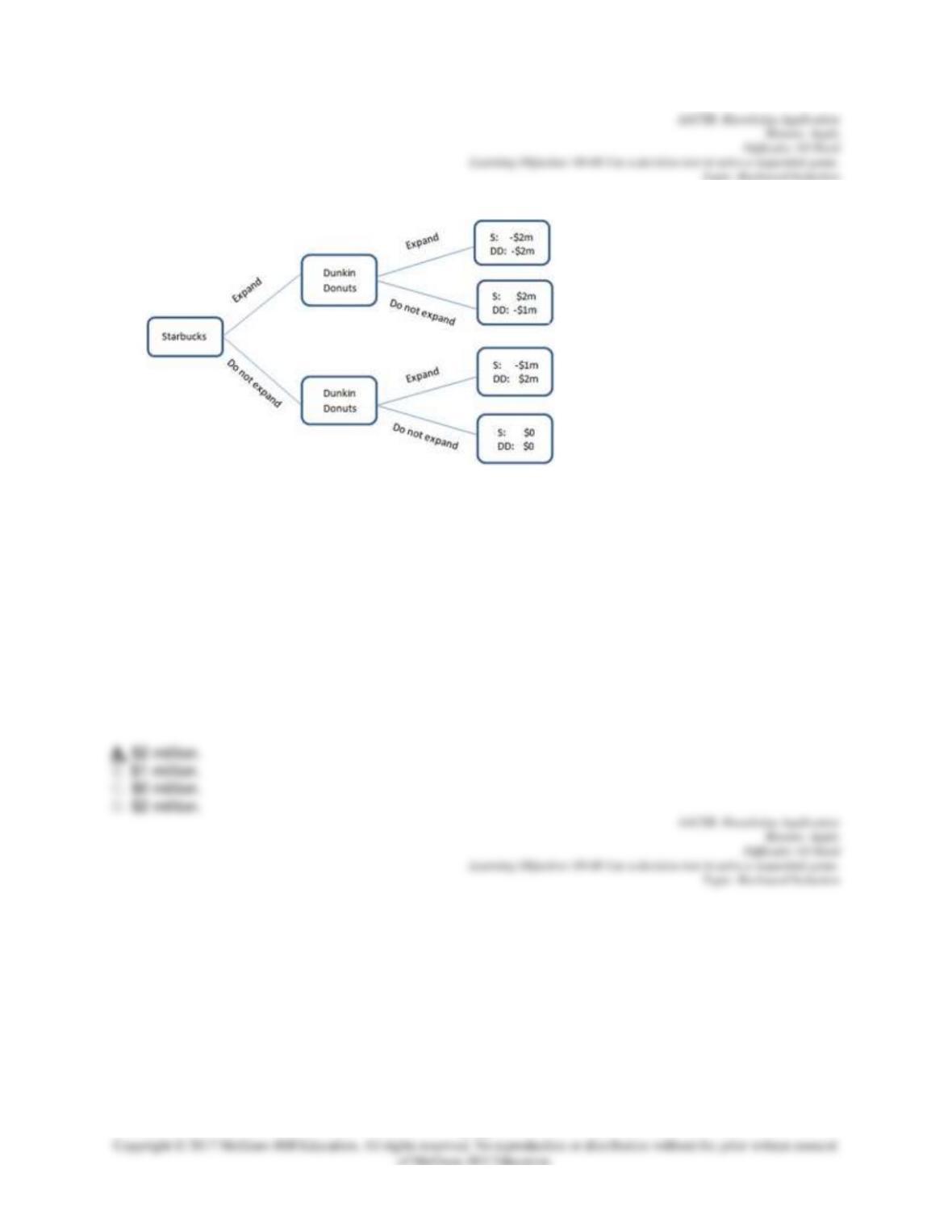
This figure displays the choices being made by two coffee shops: Starbucks and Dunkin Donuts. Both
companies are trying to decide whether or not to expand in an area. The area can handle only one of
them expanding, and whoever expands will cause the other to lose some business. If they both expand,
the market will be saturated, and neither company will do well. The payoffs are the additional profits (or
losses) they will earn.
The outcome of the game in the figure shown will be:
9-46
130.
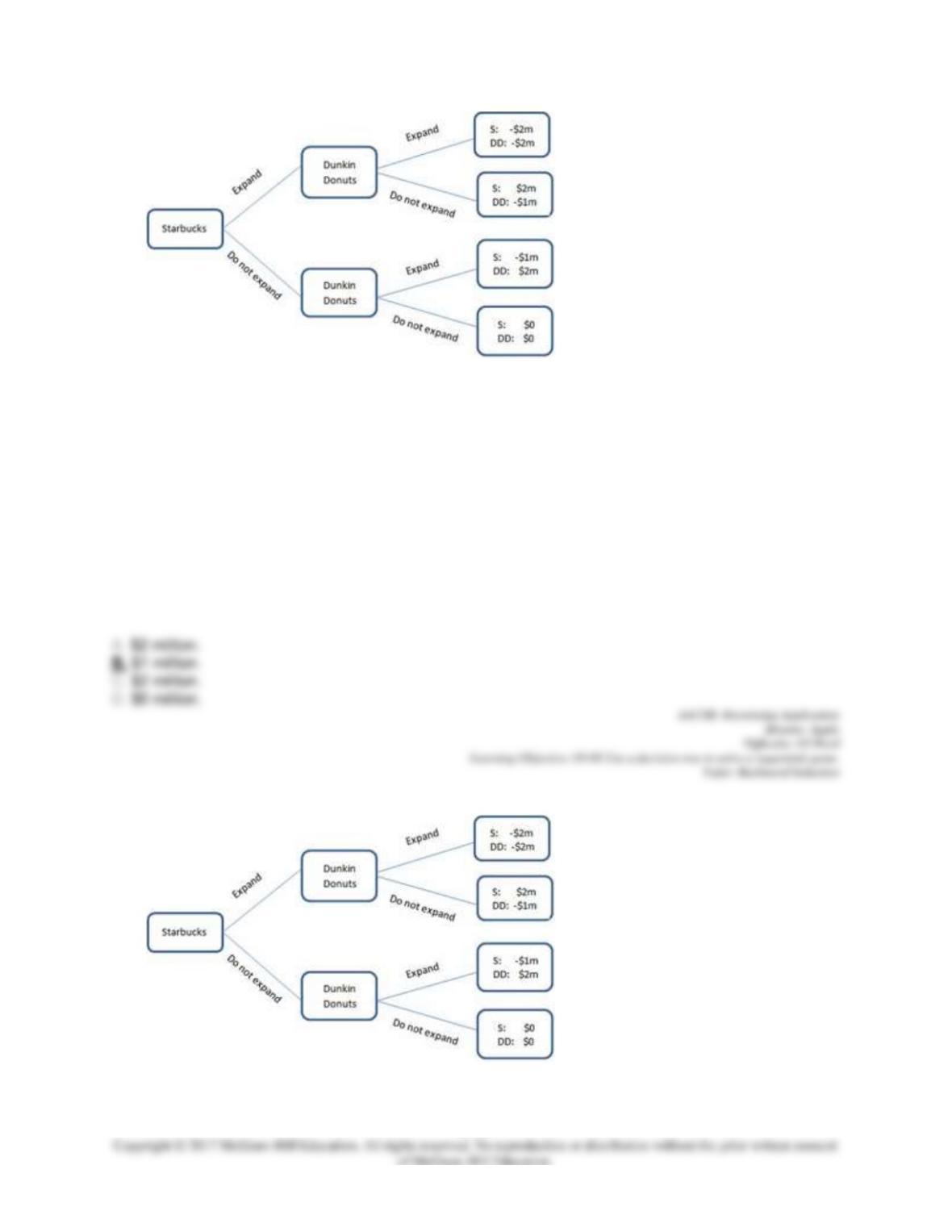
This figure displays the choices being made by two coffee shops: Starbucks and Dunkin Donuts. Both
companies are trying to decide whether or not to expand in an area. The area can handle only one of
them expanding, and whoever expands will cause the other to lose some business. If they both expand,
the market will be saturated, and neither company will do well. The payoffs are the additional profits (or
losses) they will earn.
The outcome of the game in the figure shown predicts that Starbucks will earn profits of:
9-47
131.
This figure displays the choices being made by two coffee shops: Starbucks and Dunkin Donuts. Both
companies are trying to decide whether or not to expand in an area. The area can handle only one of
them expanding, and whoever expands will cause the other to lose some business. If they both expand,
the market will be saturated, and neither company will do well. The payoffs are the additional profits (or
losses) they will earn.
If the players in the figure shown act in their own self-interest, then we know that Dunkin Donuts will earn:
132.
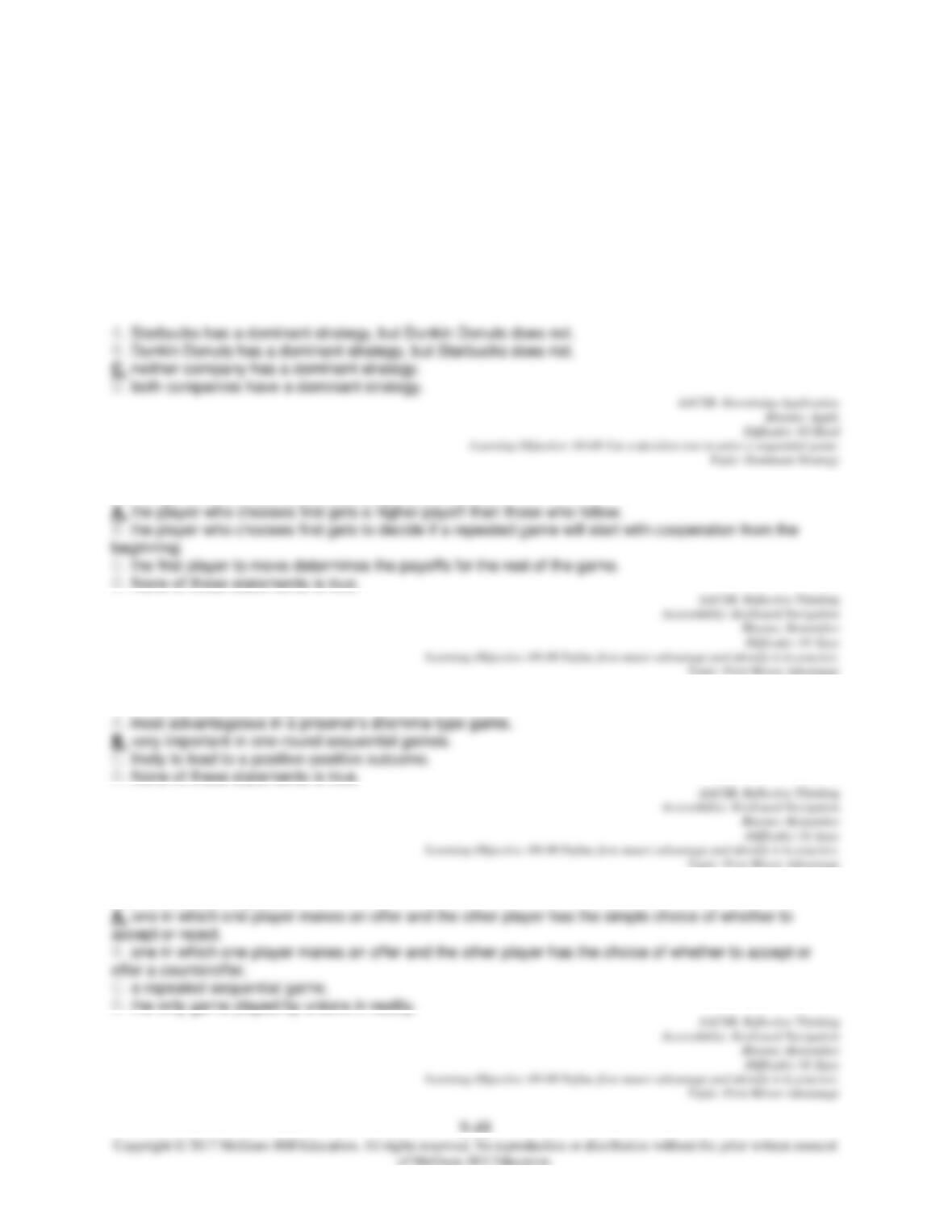
This figure displays the choices being made by two coffee shops: Starbucks and Dunkin Donuts. Both
companies are trying to decide whether or not to expand in an area. The area can handle only one of
them expanding, and whoever expands will cause the other to lose some business. If they both expand,
the market will be saturated, and neither company will do well. The payoffs are the additional profits (or
losses) they will earn.
If Starbucks and Dunkin Donuts are faced with the game in the figure shown, we can see that:
133. A game with a first-mover advantage is one in which:
134. First-mover advantage is:
135. An ultimatum game is:
9-49
136. An ultimatum game:
137. First-mover advantage is:
138. Repeated play can change the outcome in sequential games by:
139. The ability to make counteroffers transforms bargaining from a game in which ___________ trumps
everything to a game in which ____________ is the winning strategy.
140. ___________ is a winning strategy in a game of bargaining.
141. In a game of bargaining, those who _______________ will likely get the highest payoff.
142. In a game of bargaining, the player who is willing to:
143. In the real world, it is likely that wage negotiations:
144. In the real world, wage negotiations typically do not drag on for years:
145. Using a commitment strategy in:
9-51
146. By committing to reduce one’s options during a sequential game, a player can force a change in his
opponents’ strategy, and that commitment strategy results in a:
147. The famous historical example of the commitment strategy used by Cortes against the Aztecs is
sometimes referred to as:
Chapter 09 Test Bank Summary
Category
# of Questi
ons
AACSB: Knowledge Application
12
AACSB: Reflective Thinking
135
Accessibility: Keyboard Navigation
102
Blooms: Apply
12
Blooms: Remember
28
Blooms: Understand
107
Difficulty: 01 Easy
28
Difficulty: 02 Medium
108
Difficulty: 03 Hard
12
Learning Objective: 09-
01 Understand strategic behavior and describe the components of a strategic game.
25
Learning Objective: 09-
02 Explain why noncooperation is a dominant strategy in the prisoners’ dilemma.
43
Learning Objective: 09-
03 Identify whether or not a player has a dominant strategy in a one-time game.
11
Learning Objective: 09-
04 Identify whether or not a Nash equilibrium will be reached in a one-time game.
12

9-52
Learning Objective: 09-
05 Explain how a commitment strategy can be used to achieve cooperation in a one-
time game.
10
Learning Objective: 09-06 Explain how repeated play can enable cooperation.
15
Learning Objective: 09-
07 Explain how backward induction can be used to make decisions.
5
Learning Objective: 09-08 Use a decision tree to solve a sequential game.
12
Learning Objective: 09-09 Define first-mover advantage and identify it in practice.
5
Learning Objective: 09-
10 Explain why patient players have more bargaining power in repeated games.
7
Learning Objective: 09-
11 Explain how a commitment strategy can allow players to achieve their goals by limi
ting their options.
3
Topic: Backward Induction
9
Topic: Commitment Strategies
10
Topic: Commitment Strategies in Sequential Games
3
Topic: Decision Matrix
1
Topic: Decision Trees
3
Topic: Dominant Strategy
13
Topic: First Mover Advantage
6
Topic: Game Theory
31
Topic: Nash Equilibrium
5
Topic: Prisoners Dilemma
43
Topic: Repeated Games
15
Topic: Repeated Sequential Games
7
Topic: Sequential Games
2