OBJ: 9.2 MSC: Remembering
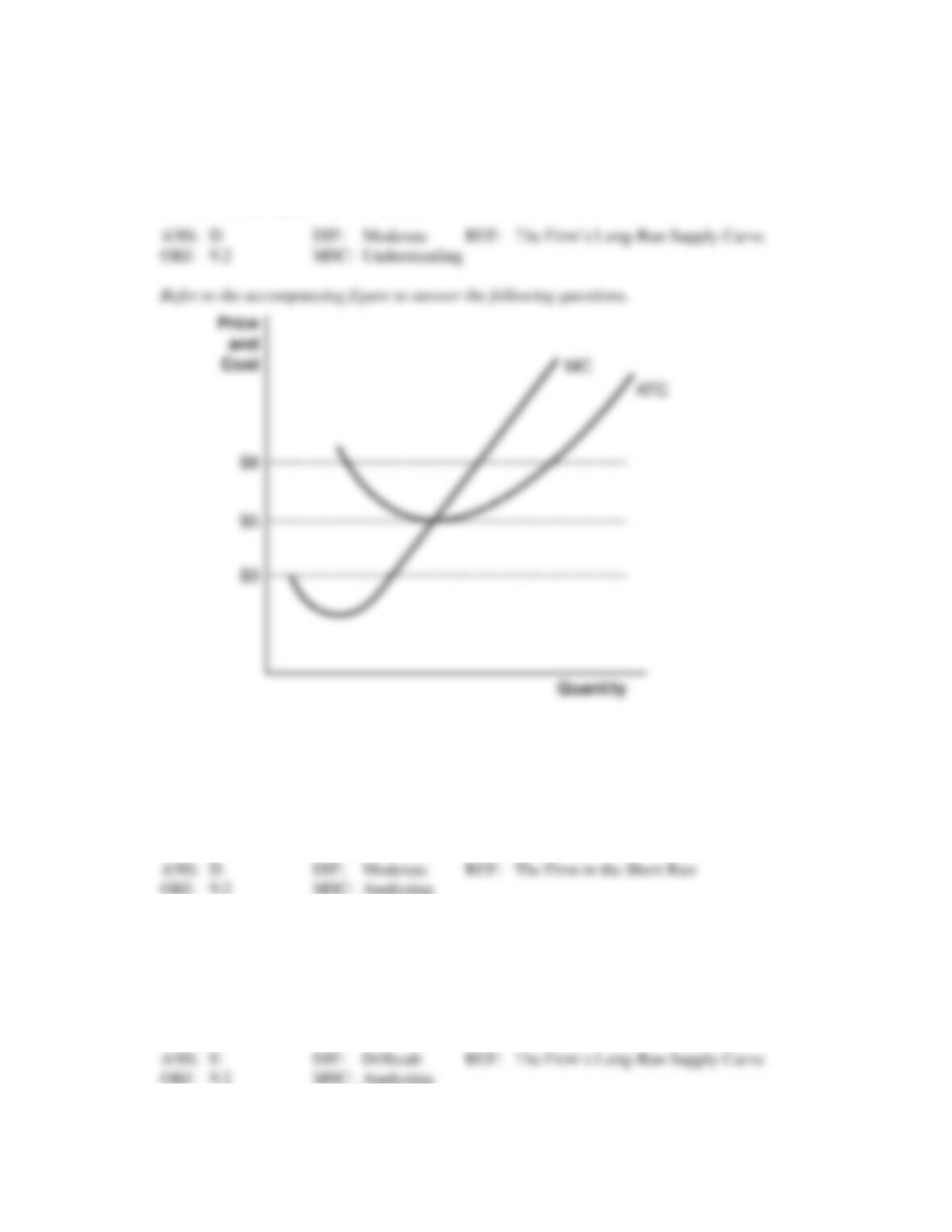
98. A firm will shut down in the long-run if the
a. price is above the minimum average total cost (ATC).
b. price is equal to the minimum average total cost (ATC).
c. price is anywhere above the minimum average variable cost (AVC).
d. price is anywhere below the minimum average total cost (ATC).
e. firm is making zero economic profits.
99. If the price is $8, the firm is making
a. a loss and will exit the market.
b. a profit and will exit the market.
c. a loss and more firms will enter the market.
d. a profit and more firms will enter the market in the long run.
e. zero profit and the market is at long-run equilibrium.
100. If the price is $5, the firm is making
a. a loss and will exit the market.
b. a profit and will exit the market.
c. a loss and more firms will enter the market.
d. a profit and more firms will enter the market.
e. zero profits and the market is at long-run equilibrium.
101. This firm would shut down in the long run if the price
a. fell below $3. d. rose above $8.
b. fell below $8. e. fell below $5.
c. rose above $5.
102. If the price is $3, the firm is making
a. a loss and will exit the market.
b. a profit and will exit the market.
c. a loss and more firms will enter the market.
d. a profit and more firms will enter the market.
e. zero profits and the market is at long-run equilibrium.
103. The long-run market supply curve would be a horizontal line
a. at $3. d. between $3 and $5.
b. at $5. e. between $5 and $8.
c. at $8.
104. A firm’s willingness to supply its product in the long run is represented on a graph by the
a. market supply curve.
b. entire marginal cost (MC) curve.
c. marginal revenue (MR) curve.
d. part of the marginal cost (MC) curve above minimum average total cost (ATC).
e. part of the marginal cost (MC) curve above minimum average variable cost (AVC).
105. Costs that have been incurred as a result of past decisions are known as ________ costs.
a. sunk d. opportunity
b. variable e. marginal
c. fixed
106. A good economist will ignore ________ and focus on ________ when it comes to making the right
decisions.
a. marginal value; sunk costs d. marginal cost; marginal revenue
b. sunk costs; marginal value e. opportunity costs; sunk costs
c. costs; revenues
107. Sunk costs
a. should be taken into consideration when making decisions about future production.
b. are costs that have been incurred as a result of past decisions.
c. cause the profit-maximizing rule to no longer be useful.
d. are future costs that one has to incur.
e. are included only in economic profits.
108. The city of Tustin, California, has spent $10 million on a project to build a new community
college. It will cost the city $40 million to finish the project. When making the decision to continue
the project, the city’s chief economist tells the city council to ignore the $10 million because
a. the $10 million is a sunk cost.
b. the $10 million doesn’t factor into the total cost of the project.
c. $10 million is only one-fifth of the entire project cost.
d. the $10 million is a variable cost.
e. the $10 million can be recovered if the project is stopped.
109. The perfectly competitive firm’s short-run supply curve is the
a. region of the firm’s marginal cost curve below the average variable cost curve.
b. region of the firm’s marginal cost curve above the average variable cost curve.
c. entire marginal revenue curve.
d. entire marginal cost curve.
e. region of the firm’s marginal cost curve above the average total cost curve.
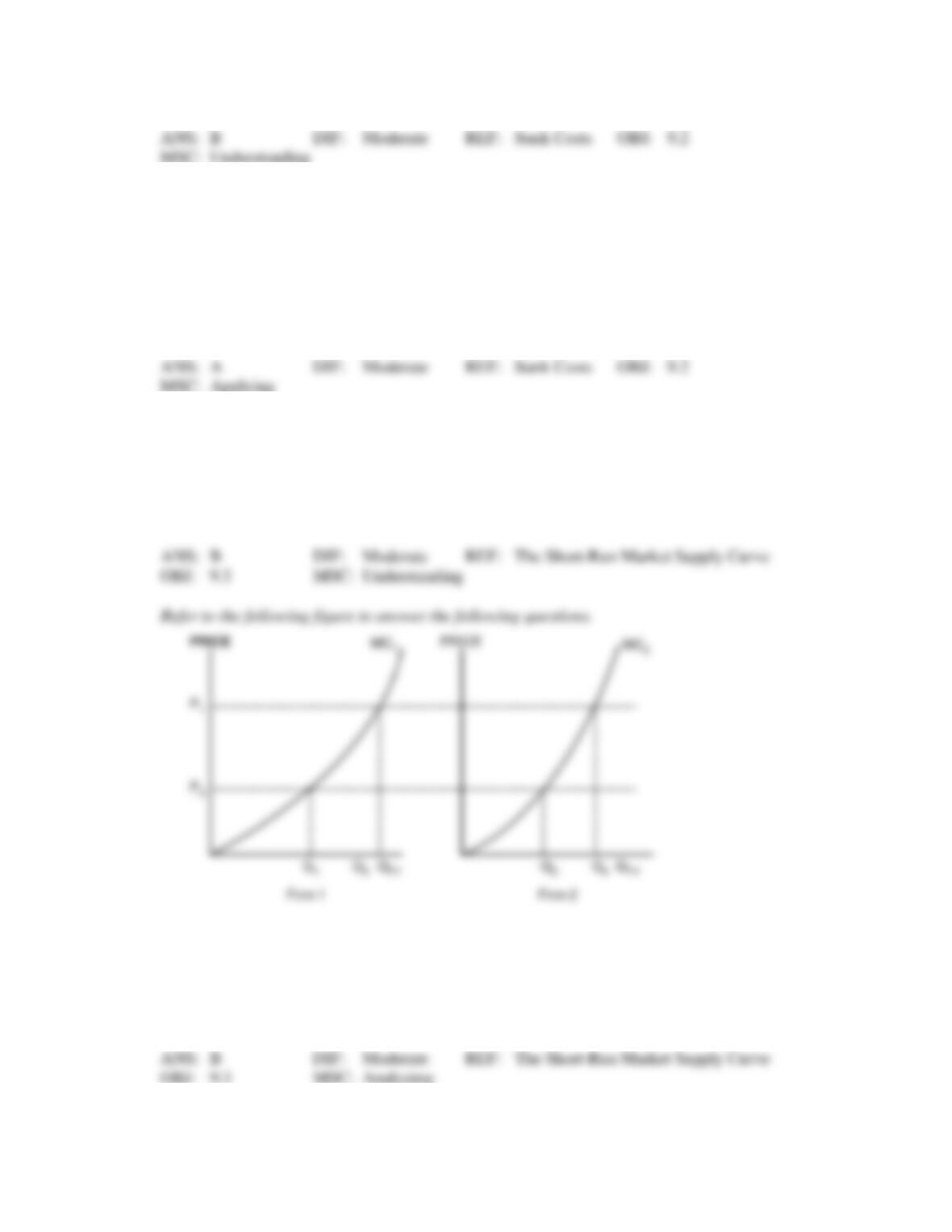
110. Firm 1 and firm 2 are the sole producers in the industry. At price P2, the industry’s total quantity
supplied is
a. Q1 + Q2 + Q3 + Q4. d. Q1 − Q4.
b. Q1 + Q3. e. Q4 − Q1.
c. Q2 + Q4.
111. Firm 1 and firm 2 are the sole producers in the industry. At price P1, the industry’s total quantity
supplied is
a. Q1 + Q2 + Q3 + Q4. d. Q1 − Q4.
b. Q1 + Q3. e. Q4 − Q1.
c. Q2 + Q4.
112. A perfectly competitive industry’s short-run supply curve is
a. horizontal.
b. perfectly elastic.
c. perfectly inelastic.
d. the upward-sloping portion of the largest firm’s marginal cost curve.
e. the horizontal summation of the supply curve for individual firms.
113. Signals
a. have no importance in economics.
b. convey information about the profitability of various markets.
c. are only a characteristic of competitive markets.
d. lead to less competition in markets.
e. result in less information in a market.
114. If the short-run supply curve, the demand curve, and the long-run supply curve all intersect at the
same point, firms will experience ________ economic profits, which means the price is ________
the minimum point on the average total cost curve.
a. positive; above d. negative; at
b. zero; at e. zero; above
c. negative; below
115. If the short-run market supply curve and the demand curve intersect above the long-run market
supply curve, firms will experience ________ economic profits, meaning the price is ________ the
minimum point on the average total cost curve.
a. positive; above d. negative; below
b. positive; below e. zero; above
c. negative; above
116. If the short-run supply curve and the demand curve intersect below the long-run supply curve,
firms will experience ________ economic profits, meaning the price is ________ the minimum
point on the average total cost curve.
a. positive; above d. negative; below
b. positive; below e. zero; above
c. negative; above
117. In its simplest form, the long-run market supply curve is a(n)
a. horizontal line at the minimum average total cost (ATC).
b. horizontal line at the price where accounting profits equal zero.
c. vertical line at the quantity produced by the firm.
d. upward-sloping line equal to the marginal cost curve.
e. upward-sloping line equal to the marginal cost curve only above the minimum average
variable cost (AVC).
118. If firms in a competitive market are making positive economic profits, the long-run market supply
curve
a. is above the point where the short-run market supply curve and the demand curve intersect.
b. is below the point where the short-run market supply curve and the demand curve intersect.
c. and the short-run market supply curve and the demand curve all intersect at the same point.
d. shifts upward.
e. shifts downward.
119. If firms in a competitive market are incurring economic losses, the long-run market supply curve
a. is above the point where the short-run market supply curve and the demand curve intersect.
b. is below the point where the short-run market supply curve and the demand curve intersect.
c. and the short-run market supply curve and the demand curve all intersect at the same point.
d. shifts upward.
e. shifts downward.
120. If firms in a competitive market are making zero economic profits, the long-run market supply
curve
a. is above the point where the short-run market supply curve and the demand curve intersect.
b. is below the point where the short-run market supply curve and the demand curve intersect.
c. and the short-run market supply curve and the demand curve all intersect at the same point.
d. shifts upward.
e. shifts downward.
121. An example of an implicit cost is
a. a payment on the loan for a piece of equipment not in use.
b. a payment on an electricity bill.
c. wages paid to employees.
d. gasoline costs.
e. forgone wages.
122. An example of an explicit cost is
a. a payment on a loan for a computer.
b. the savings interest lost by investing $10,000 in capital instead of saving the money.
c. forgone wages.
d. the opportunity cost of a $50,000 investment into a building.
e. the amount of money one could receive for renting a company truck to another business.
123. If Firm A is making zero economic profits,
a. Firm A is also making negative accounting profits.
b. Firm A is breaking even when opportunity cost is taken into consideration.
c. other firms want to enter the market.
d. Firm A wants to leave the market.
e. Firm A wants to shut down in the short run.
124. One difference between implicit costs and explicit costs is that
a. implicit costs are included in accounting profits, whereas explicit costs are not.
b. implicit costs are included in economic profits, whereas explicit costs are not.
c. explicit costs are included in accounting profits, whereas implicit costs are not.
d. explicit costs are included in economic profits, whereas implicit costs are not.
e. explicit costs involve opportunity costs, whereas implicit costs involve a monetary transaction.
125. Boston Batting Cages incurred ________ in implicit costs.
a. $9,500 d. $8,000
b. $7,000 e. $50,000
c. $51,500
126. If Boston Batting Cages received $80,000 in revenues, what were the economics profits?
a. $20,500 d. $80,000
b. $72,000 e. $50,000
c. $51,500
127. Boston Batting Cages incurred ________ in explicit costs.
a. $9,500 d. $8,000
b. $7,000 e. $50,000
c. $51,500
128. If Boston Batting Cages received $80,000 in revenues, what were the accounting profits?
a. $20,500 d. $80,000
b. $72,000 e. $50,000
c. $51,500
129. Carmela’s Churros’ economic profits are
a. $40,000. d. $0.
b. $15,000. e. $80,000.
c. $25,000.
130. Carmela’s Churros’ accounting profits are
a. $40,000. d. $0.
b. $15,000. e. $80,000.
c. $25,000.
131. Holding all else constant, the price of churros in this market will
a. increase in the long run. d. decrease in the short run.
b. decrease in the long run. e. stay where it is.
c. increase in the short run.
132. You can tell a firm is operating in a market that is in long-run competitive equilibrium if
a. economic profits are positive. d. accounting profits are zero.
b. economic profits are negative. e. economic profits are zero.
c. accounting profits are negative.
133. If Kang’s Knick-Knacks is a perfectly competitive firm and is making zero economic profits,
a. firms will enter the market.
b. firms will exit the market.
c. Kang’s Knick-Knacks will stay in the market.
d. the market supply curve will shift to the left.
e. the market supply curve will shift to the right.
134. If firms in a competitive market are making positive economic profits, you would expect firms to
________ the market, causing the ________ curve to shift to the ________.
a. enter; demand; right d. enter; market supply; left
b. enter; demand; left e. leave; market supply; left
c. enter; market supply; right
135. If firms in a competitive market are incurring economic losses, we would expect firms to
________ the market, causing the ________ curve to shift to the ________.
a. leave; demand; right d. enter; supply; left
b. enter; demand; left e. leave; supply; left
c. leave; supply; right
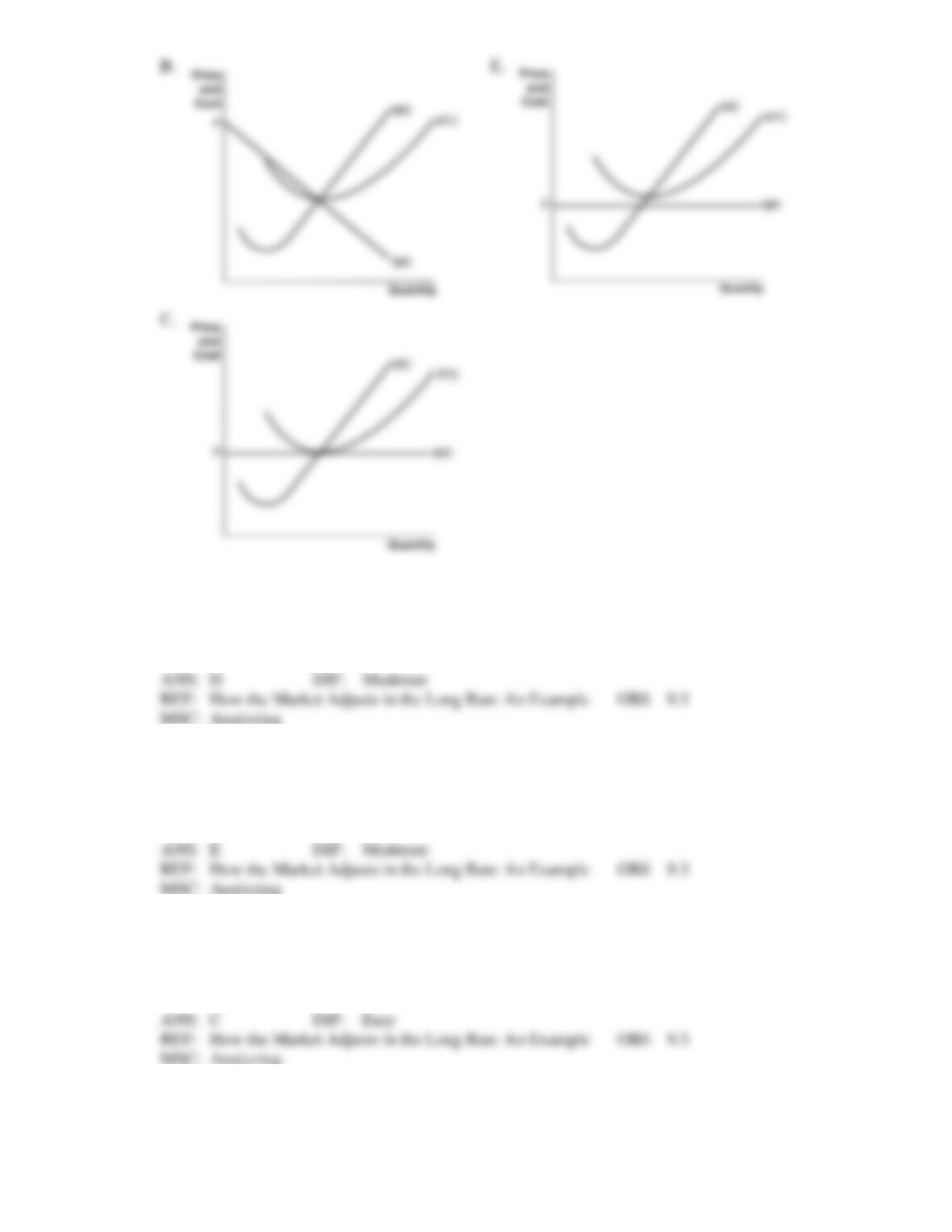
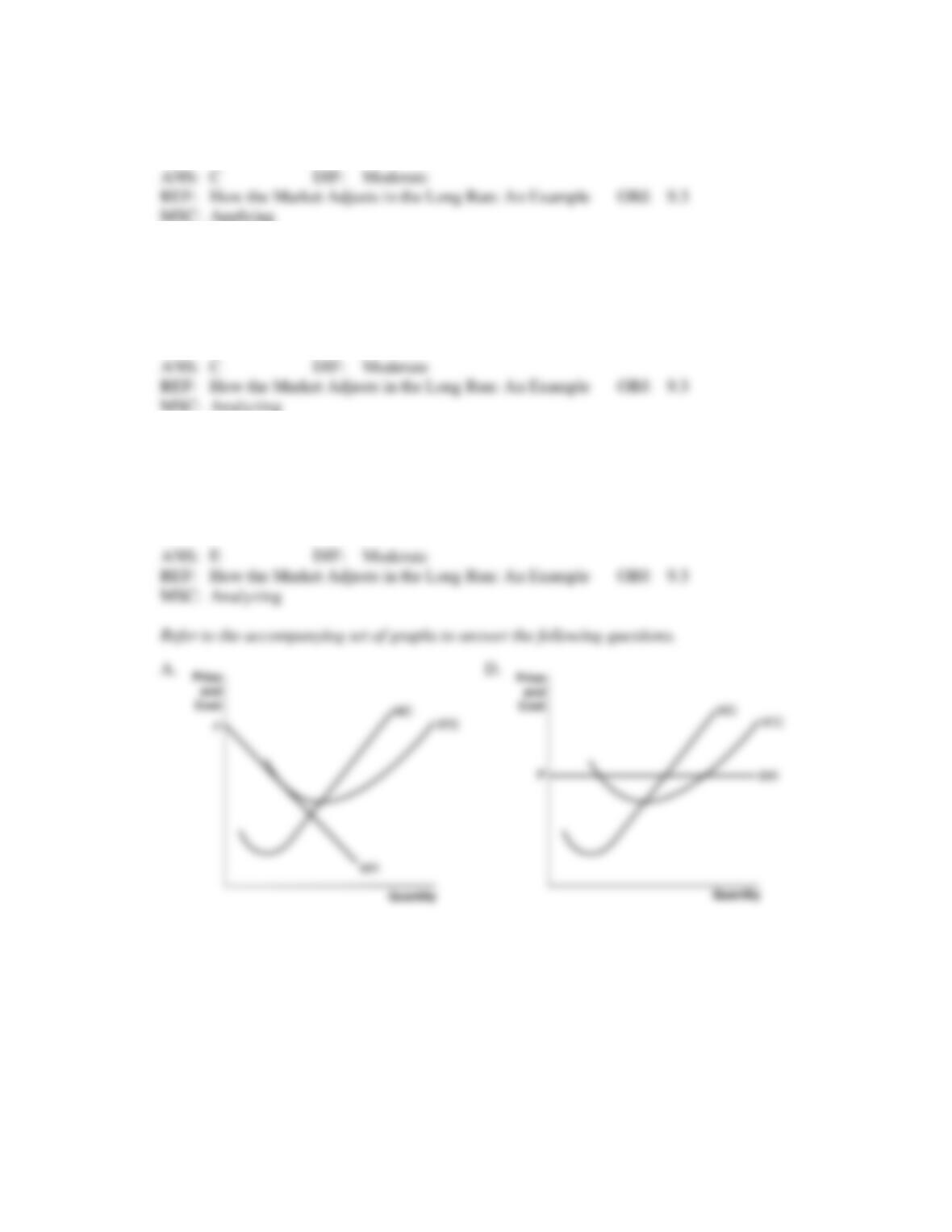
136. Which graph would result in firms entering a perfectly competitive market in the long run?
a. A d. D
b. B e. E
c. C
137. Which graph would result in firms exiting a perfectly competitive market in the long run?
a. A d. D
b. B e. E
c. C
138. Which graph would result in no firms entering or exiting the perfectly competitive market?
a. A d. D
b. B e. E
c. C
139. If Tamsin’s Tank Tops is a perfectly competitive firm and is currently making positive economic
profits of $1,000,
a. firms will enter the market.
b. firms will exit the market.
c. individuals will demand more tank tops.
d. individuals will demand fewer tank tops.
e. the market supply curve will shift to the left.
140. If Dorothy’s Doughnuts is a perfectly competitive firm and is currently incurring economic losses
of $500,
a. firms will enter the market.
b. firms will exit the market.
c. individuals will demand more doughnuts.
d. individuals will demand fewer doughnuts.
e. the market supply curve will shift to the right.
141. The market for watches is perfectly competitive and is currently in equilibrium. What will happen
if watches become more popular among college students?
a. In the short run, firms will experience economic profits, but in the long run, firms will leave
the market, bringing economic profits back down to zero.
b. In the short run, firms will experience economic profits, but in the long run, firms will enter
the market, bringing economic profits back down to zero.
c. In the short run, firms will incur economic losses, but in the long run, firms will leave the
market, bringing economic profits back down to zero.
d. In the short run, firms will incur economic losses, but in the long run, firms will enter the
market, bringing economic profits back down to zero.
e. In both the short run and the long run, firms will experience zero economic profits.
142. The market for candles is perfectly competitive and is currently in equilibrium. What will happen
if candles are later linked to more houses catching on fire?
a. In the short run, firms will experience economic profits, but in the long run, firms will leave
the market, bringing economic profits back down to zero.
b. In the short run, firms will experience economic profits, but in the long run, firms will enter
the market, bringing economic profits back down to zero.
c. In the short run, firms will incur economic losses, but in the long run, firms will leave the
market, bringing economic profits back up to zero.
d. In the short run, firms will incur economic losses, but in the long run, firms will enter the
market, bringing economic profits back up to zero.
e. In both the short run and the long run, firms will experience zero economic profits.
143. Holding all else constant, a decrease in the market demand for a product in a competitive market
would cause
a. the average total cost (ATC) curve of the firms to decrease.
b. an increase in the price a firm could charge for the product.
c. the marginal cost (MC) curve of the firms to decrease.
d. the marginal revenue (MR) curve of the firms to shift downward.
e. an increase in profits for a firm.
144. Holding all else constant, an increase in the market demand for a product in a competitive market
would cause
a. the average total cost (ATC) curve of the firms to increase.
b. a decrease in the price a firm could charge for the product.
c. the marginal revenue (MR) curve of the firms to increase.
d. the marginal cost (MC) curve of the firms to increase.
e. a decrease in profits for a firm.
145. Holding all else constant, an increase in the price of hot dogs would cause the
a. marginal revenue (MR) curve in the market for hot dog buns to increase.
b. marginal revenue (MR) curve in the market for hot dogs to decrease.
c. average total cost (ATC) curve in the market for hot dog buns to increase.
d. profits in the market for hot dog buns to increase.
e. marginal revenue (MR) curve in the market for hot dog buns to decrease.
146. When firms enter a market, the ________-run market supply curve shifts ________, causing
individual firms’ profits to ________.
a. long; right; decrease d. short; right; decrease
b. short; left; decrease e. short; right; increase
c. short; left; increase
147. When firms exit a market, the ________-run market supply curve shifts ________, causing
individual firms’ profits to ________.
a. long; right; decrease d. short; right; decrease
b. short; left; decrease e. short; right; increase
c. short; left; increase
148. As a firm attempts to expand production, it must ________ the wage it pays to attract additional
help. This leads to ________ costs, making the long-run supply curve slope ________.
a. increase; higher; upward d. decrease; lower; upward
b. increase; higher; downward e. decrease; higher; upward
c. increase; lower; upward
149. One reason why the long-run supply curve may slope upward in a competitive market is that
a. firms can exit the industry easily.
b. firms can enter the industry easily.
c. there are many buyers and many sellers.
d. some resources necessary to produce the product may be available only in limited supplies.
e. some resources necessary to produce the product are not limited.
150. The entry and exit of firms ensure that the market ________ curve is much ________ in the long
run than in the short run.
a. demand; more elastic d. supply; more inelastic
b. demand; more inelastic e. supply; more elastic
c. supply; closer to vertical
SHORT ANSWER
1. Describe, in detail, each of the following characteristics of a highly competitive firm and explain
why each characteristic is important:
a. many buyers and many sellers.
b. similar products.
c. no barriers to entry or exit.
2. What does it mean to be a price taker? Why does price taking occur among perfectly competitive
firms?
3. Explain how a market with no barriers to entry or exit results in long-run economic profits
equaling zero.
4. A firm sells its output in a competitive market. The firm’s total cost function is given in the
accompanying schedule:
Output Total Cost (in dollars)
0 $5
1 $11
2 $17
3 $21
4 $26
5 $33
6 $43
The market price is $7 per unit.
a. What is the firm’s profit-maximizing output level?
b. Is the industry in long-run equilibrium? Explain.
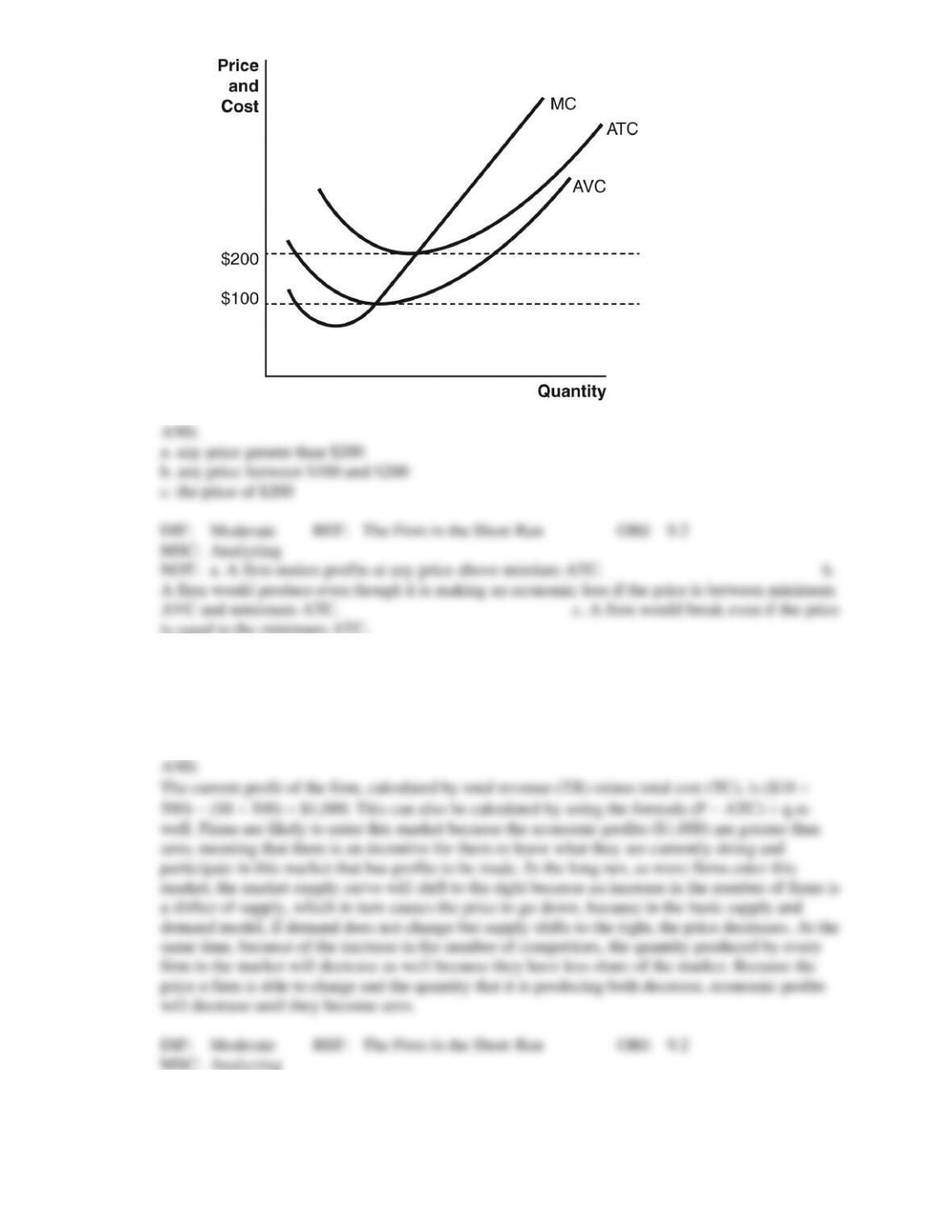
5. Refer to the accompanying graph to answer the following questions:
a. At what price levels would a firm make positive economic profits?
b. At what price level would a firm incurring economic losses continue to produce?
c. At what price level would a firm break even?
6. At its current level of production, a firm in a competitive market receives $10 for each unit it
produces. The firm also faces an average total cost of $8. At the market price of $10 per unit, the
firm’s profit–maximizing quantity is 500. What are the firm’s current profits? What is likely to
occur in this market? Why?