CHAPTER 9: Firms in a Competitive Market
MULTIPLE CHOICE
1. A firm characterized as a price taker
a. has control over the price it pays, or receives, in the market.
b. sets the price for the market.
c. has no control over the price it pays, or receives, in the market.
d. is not a characteristic of a perfectly competitive market.
e. takes the price that is determined from the lowest price consumers are willing to pay for an
item.
2. All of the following are characteristics of perfect competition EXCEPT
a. each firm is a price taker. d. product differentiation.
b. many buyers and sellers. e. homogenous products.
c. lack of barriers to entry or exit.
3. The perfectly competitive firm cannot influence the market price because
a. the firm has market power.
b. the firm is a price maker.
c. the firm’s production levels are too small to affect the market.
d. the firm faces less competition.
e. the firm has high costs.
4. Each firm in a perfectly competitive industry
a. is a price taker. d. is relatively large.
b. is a price maker. e. is producing a differentiated product.
c. faces low average total costs.
5. Which of the following is NOT a characteristic of a perfectly competitive industry?
a. The firms produce a homogenous product.
b. Sellers have better information about the product than consumers.
c. There is a large number of buyers and sellers.
d. The firms earn zero profit.
e. Firms can easily enter or exit the industry.
6. Under perfect competition what would happen to a firm that sets its price slightly above market
price?
a. The firm would lose all of its customers.
b. The firm could sell as much as it wanted in the market.
c. The firm would earn a lot of profit as long as the other firms charge the market price.
d. It would continue to earn a profit but revenue would be lower.
e. It would earn lower profits than other firms, but the level of reduction would depend on the
elasticity of demand.
7. What is the consequence of a firm in a competitive market selling a homogenous product?
a. The firms capture some market power.
b. All the firms in the industry are the same size.
c. Firms in the industry can produce the same product with a different quantity of inputs.
d. The product sold by one firm is a perfect complement for the products sold by other firms in
the industry.
e. The product sold by one firm is a perfect substitute for the products sold by other firms in the
same industry.
8. Which of the following is the closest example of a perfectly competitive market?
a. the market for cars d. the market for athletic shoes
b. the market for bread e. the market for newspapers
c. the market for handmade soaps
9. In competitive markets
a. firms set the prices for their products with little concern for the consumer.
b. firms control the prices they charge.
c. market forces are much stronger than individual firms are.
d. individual firms are much stronger than the market forces are.
e. market forces set the quantity in the market but not the prices.
10. In competitive markets
a. firms set the prices for their products with little concern for the consumer.
b. firms are considered to be price makers.
c. firms are at the mercy of market forces.
d. the individual firms are much stronger than the market forces are.
e. the market forces set the quantity in the market but not the prices.
11. In competitive markets
a. the products sold are different depending on the firm selling the product.
b. buyers can expect to find consistently low prices and wide availability of the goods that they
want.
c. producers can expect to be able to set prices at the level they choose.
d. it is hard for a seller to enter the market due to barriers to entry.
e. firms will leave the market if they are making economic profits.
12. Because of market forces, firms have ________ when competition is widespread.
a. control over the price that they can charge and they make little or no economic profit
b. control over the price that they can charge and they make positive economic profit
c. little or no control over the price that they can charge and they make negative economic profit
d. little or no control over the price that they can charge and they make little or no economic
profit
e. little or no control over the price that they can charge and they make extreme economic profits
13. Which of the following lists three main characteristics of a competitive market?
a. many buyers and sellers, similar products, easy entry into the market
b. many buyers and few sellers, similar products, easy entry into the market
c. many buyers and sellers, differentiated products, easy entry into the market
d. many buyers and sellers, similar products, barriers to entry into the market
e. many buyers and few sellers, unique products, barriers to entry into the market
14. Real-life examples of competitive markets
a. are more common than any other market structure.
b. are usually far short of perfection.
c. include the fast-food industry and soda industry.
d. are difficult to break into as an entrepreneur.
e. do not benefit society.
15. Which is an example of an almost perfectly competitive market?
a. Major League Baseball d. airlines
b. restaurants e. farmers’ markets
c. cruise liners
16. Competitive markets exist when
a. there are so many buyers and sellers that each has only a small impact on the market price and
the market output.
b. there are more buyers than sellers, giving the buyers market power.
c. there are more sellers than buyers, giving the sellers market power.
d. accounting profits become zero because of price wars.
e. prices are so low that everyone who wants the good or service gets the good or service.
17. A farmers’ market is close to being a perfectly competitive market. Which characteristic of a
perfectly competitive market do most farmers’ markets violate?
a. many buyers d. free exit from the market
b. many sellers e. similar goods produced
c. free entry into the market
18. The presence of many buyers and sellers is an important characteristic of competitive markets
because it allows
a. sellers in the market to have influence over the market price.
b. buyers in the market to have influence over the market price.
c. sellers in the market to have influence over the market quantity.
d. buyers in the market to have influence over the market quantity.
e. the price and quantity in the market to be determined by market forces.
19. The market for hot dogs on the streets of New York City can be considered close to a perfectly
competitive market. Because there are so many individuals buying and selling hot dogs
a. there is a shortage of hot dogs.
b. there is a surplus of hot dogs.
c. market forces set the price in the market.
d. firms are able to make large economic profits.
e. firms cannot make positive accounting profits.
20. In a competitive market, if one firm raises its price relative to the other firms in the market,
consumers are willing to go to another firm because
a. the products are similar, which makes them complements.
b. the products are similar, which makes them substitutes.
c. there are many sellers in the market selling different items.
d. consumers can get more producer surplus by going to a different firm.
e. consumers can set the price they want to pay.
21. Many economists believe that the market for wheat in the United States is an almost perfectly
competitive market. If one firm discovers a technology that makes its wheat taste better and have
fewer calories than all other wheat offered in the market, the wheat market would become less
competitive because
a. there would no longer be many buyers and many sellers of wheat.
b. it would no longer be easy to enter and exit the existing wheat market.
c. the products would no longer be similar in the wheat market.
d. the government would want to intervene.
e. individuals would not want to switch products.
22. Which characteristic of competitive markets is mainly responsible for ensuring that prices will be
kept low?
a. many buyers
b. many sellers
c. similar goods
d. easy entry into and exit from the market
e. differentiated goods
23. Which characteristic of competitive markets is mainly responsible for firms making zero economic
profits in the long run?
a. many buyers
b. many sellers
c. similar goods
d. differentiated goods
e. easy entry into and exit from the market
24. The University of California at Irvine (UCI) allows student organizations and private firms to sell
items on campus to raise funds for various activities. Many of the organizations sell boba, a
Taiwanese tea drink, because boba is popular with students. The market for boba on the UCI
campus is very competitive. If legislation is passed to restrict the entry of private firms into the
boba market at the UCI campus, the
a. market would become less competitive.
b. market would become more competitive.
c. demand for boba would fall.
d. supply for boba would increase.
e. demand for boba would increase.
25. Profit per unit is the difference between
a. revenue per unit and average total cost.
b. total revenue and average total cost.
c. marginal revenue and marginal cost.
d. total revenue and total cost.
e. revenue per unit and marginal cost.
26. If a perfectly competitive firm is maximizing profits in the short run, what does this mean?
a. The profit must be positive.
b. The profit equals zero.
c. The profit must be zero or positive.
d. The profit can be negative, zero, or positive.
e. The profit must be negative.
27. Firms in every market structure
a. make long-run economic profits.
b. are in competition with many other firms.
c. leave the market as soon as they experience loss of profits.
d. will attempt to maximize profits.
e. face a horizontal demand curve.
28. Suppose a perfectly competitive paper firm can produce six tons of paper at an output level where
marginal revenue is equal to marginal cost. The price per ton of paper is $100 and the average total
cost is $75. What is the total profit or loss that the paper firm is earning?
a. $150.00 d. −$150.00
b. $450.00 e. −$450.00
c. $600.00
29. Suppose a perfectly competitive broccoli farm can produce 35 crates at an output level where
marginal revenue equals marginal cost. The price per crate of broccoli is $25 and the average total
cost is $30. What is the total profit or loss that this farm is earning?
a. $175.00 d. $5
b. −$175.00 e. −$5
c. $875.00
30. Total revenue minus total cost equals
a. marginal revenue. d. profit.
b. marginal cost. e. quantity.
c. change in profit.
31. Marginal revenue is the change in total
a. cost when the firm produces additional units.
b. revenue when the firm spends more money.
c. revenue divided by the change in total cost.
d. revenue when the firm produces additional units.
e. cost divided by the change in total revenue.
32. Profit maximization occurs when
a. a firm expands output until marginal revenue is exceeded by marginal cost.
b. a firm expands output until marginal revenue is equal to marginal cost.
c. the price in the market is equal to the firm’s marginal revenue.
d. total costs equal total revenue.
e. a firm sets the price at a point above average total cost.
33. When marginal revenue equals marginal cost
a. profits are always equal to zero.
b. firms should increase production.
c. firms should decrease production.
d. firms should shut down.
e. firms are maximizing profits, so they should continue at that production level.
34. If the market price is $15 and marginal cost is represented by the equation 2 Q, where Q is in
thousands of units, what is the profit-maximizing quantity?
a. 15,000 d. 7,500
b. 8,000 e. 30,000
c. 7,000
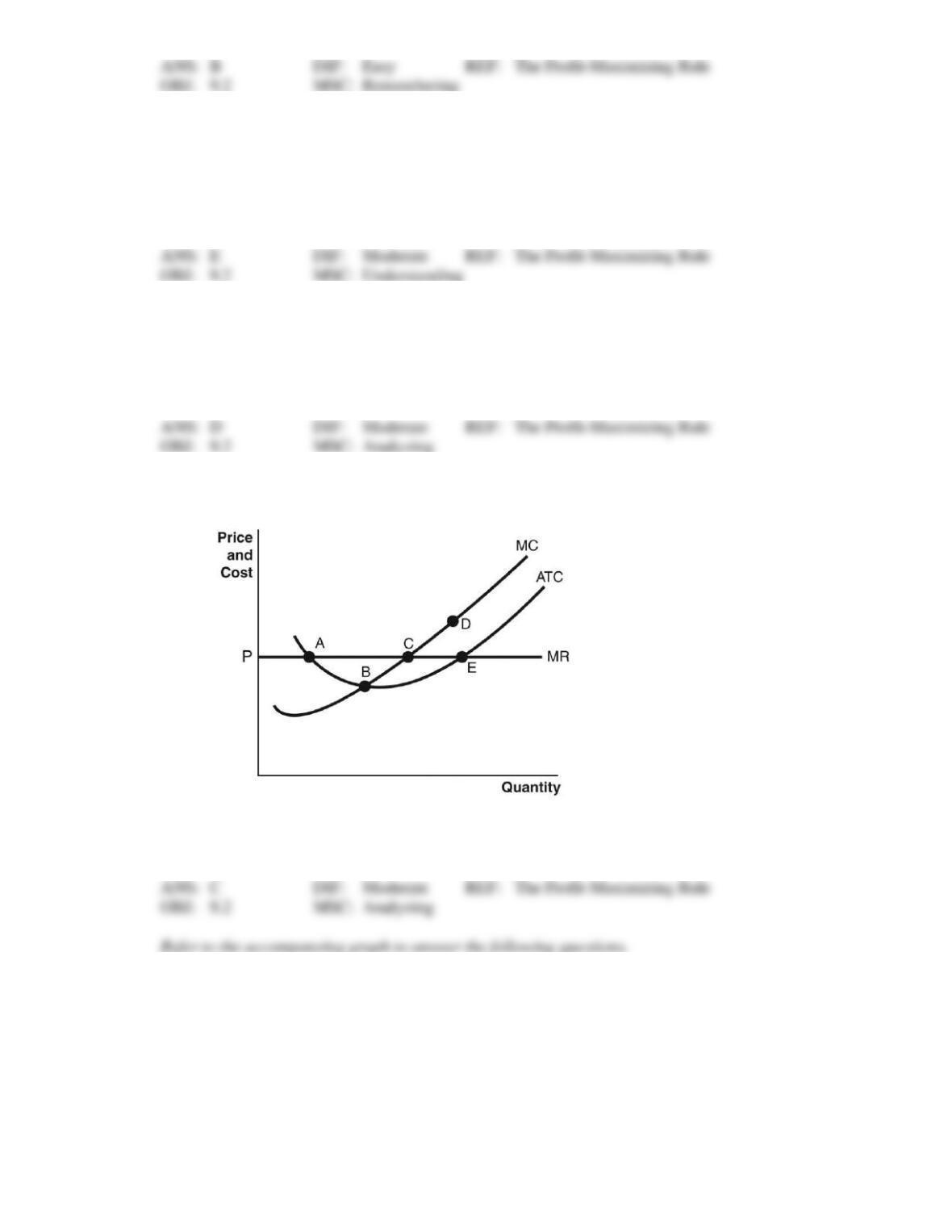
35. Refer to the accompanying figure. Point ________ corresponds to the profit-maximizing quantity
that a competitive firm would produce.
a. A d. D
b. B e. E
c. C
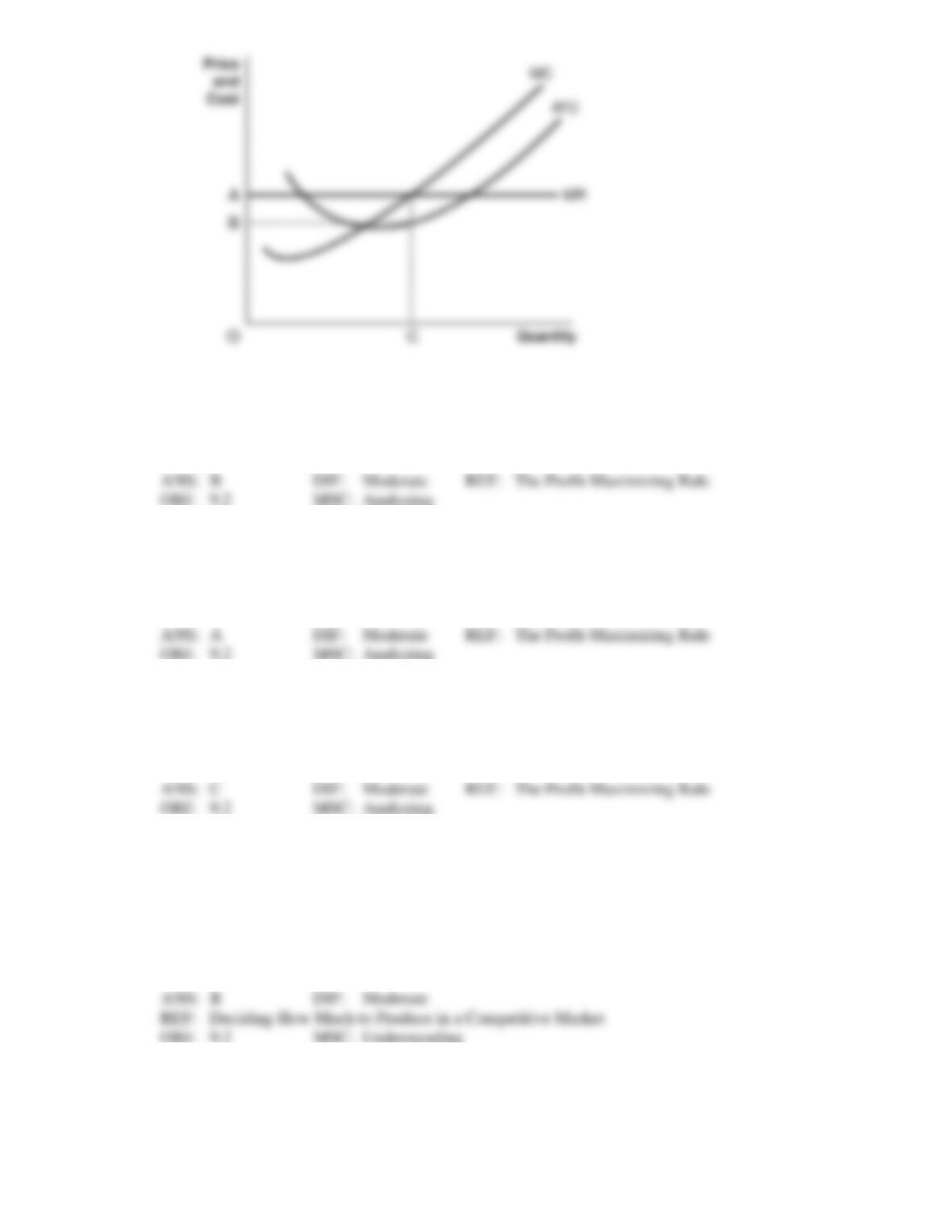
36. If this firm is maximizing profits, total revenue is represented by the area
a. B C. d. A B.
b. A C. e. (A + B) C.
c. (A − B) C.
37. If the firm is maximizing profits, total cost is represented by the area
a. B C. d. A B.
b. A C. e. (A + B) C.
c. (A − B) C.
38. If the firm is maximizing profits, profit is represented by the area
a. B C. d. A B.
b. A C. e. (A + B ) C.
c. (A − B) C.
39. All firms, no matter what type of firm structure they are producing in, make their production
decisions based on the point where their
a. total revenue equals total cost.
b. marginal revenue equals marginal costs.
c. profits are equal to zero.
d. marginal revenue equals price.
e. average total cost is minimized.
40. Profits are maximized when producing _______ unit(s).
a. 0 (zero) d. 3
b. 1 e. 4
c. 2
41. When profits are maximized, profits are equal to
a. $5. d. $10.
b. $3. e. $9.
c. $2.
42. Assuming that all firms have the same cost structure, the price is
a. $5. d. $2.
b. $3. e. $9.
c. $10.
43. At what point does the profit-maximizing perfectly competitive firm produce?
a. where total revenue minus marginal revenue is at a maximum
b. where marginal revenue minus marginal cost is at a maximum
c. where total revenue minus total cost is at a minimum
d. where marginal revenue minus marginal cost is at a maximum
e. where marginal revenue is equal to marginal cost
44. When marginal revenue is greater than marginal cost, the firm should
a. increase the level of output until price is equal to average variable cost.
b. stop producing.
c. stay at the same level of output.
d. reduce the level of output.
e. increase the level of output.
45. If the price is greater than both the marginal cost and the average variable cost, what should the
firm do?
a. increase its production level d. reduce the price
b. decrease its production level e. increase the price
c. stop producing
46. At the current level of output, the following data exists:
Price = $20
Marginal cost = $6
Average variable cost = $10
Average total cost = $13
What must be true at this level of output?
a. The firm should lower the price.
b. The firm should stay at the same level of output.
c. The firm should shut down.
d. The firm should increase output.
e. The firm should decrease output.
47. Kimiko owns a cupcake shop in Newport Beach, California. The market for cupcakes is very
competitive. At Kimiko’s current production level, her marginal cost is $25 and her marginal
revenue is $29. To maximize profits, Kimiko should
a. decrease production. d. decrease the price.
b. keep production the same. e. increase production.
c. increase the price.
48. Marcy owns a photography business in Mobile, Alabama. The market for photography is very
competitive. At Marcy’s current production level, her marginal cost is $15 and her marginal
revenue is $12. In order to maximize profits, Marcy should
a. decrease production. d. decrease the price.
b. keep production the same. e. increase production.
c. increase the price.
49. A company produces at an output level where marginal cost is equal to marginal revenue and has
the following revenue and cost levels:
Total revenue = $1,450
Total cost = $1,500
Total variable cost = $1,300
What would you suggest?
a. shut down
b. continue to produce because the loss is less than the total fixed cost
c. increase production to lower the marginal cost
d. reduce output to lower the marginal cost
e. raise the price
50. A company produces at an output level where marginal revenue is equal to marginal cost and has
the following revenue and cost levels:
Marginal cost curve intersects the average variable cost curve at $150.
Marginal cost curve intersects the average total cost curve at $200.
Marginal cost curve intersects the marginal revenue curve at $170.
What would you suggest this firm should do in the short run?
a. The firm should continue to produce at a profit level of $20 per unit.
b. The firm should continue to produce at a profit level of $30 per unit.
c. The firm should continue to produce at a profit level of $50 per unit.
d. The firm should shut down.
e. The firm should continue to produce at a loss.
51. A company produces at an output level where marginal revenue is equal to marginal cost and has
the following revenue and cost levels:
Marginal cost curve intersects the average variable cost curve at $140.
Marginal cost curve intersects the average total cost curve at $150.
Marginal cost curve intersects the marginal revenue curve at $200.
What would you suggest this firm should do in the short run?
a. The firm should shut down.
b. The firm should continue to produce at a loss.
c. The firm should continue to produce at a profit level of $10 per unit.
d. The firm should continue to produce at a profit level of $50 per unit.
e. The firm should continue to produce at a profit level of $60 per unit.
52. What is true for the perfectly competitive firm’s output level at the break-even point?
a. price = marginal revenue = average total cost
b. marginal revenue = price marginal cost
c. marginal revenue = price marginal cost
d. marginal revenue price = marginal cost
e. price marginal revenue = marginal cost
53. Where is a perfectly competitive firm’s break-even output level?
a. at the intersection of the marginal cost curve with the marginal revenue curve
b. at the intersection of the total cost curve with the marginal revenue curve
c. at the minimum point of the average total cost curve
d. at the minimum point of the marginal cost curve
e. at the minimum point of the average variable cost curve
54. What should the firm do when it faces the following conditions:
Average total cost = $60
Average variable cost = $40
Marginal cost = $35
Marginal revenue = $35
a. lower the price d. decrease production
b. shut down e. raise the price
c. increase production
55. In the short run, under what conditions should the firm shut down?
a. average total cost at the minimum point
b. price greater than average variable cost
c. price less than average variable cost
d. marginal revenue greater than marginal cost
e. marginal revenue greater than average total cost
56. The perfectly competitive firm’s short-run shutdown price equals
a. total variable costs.
b. the fixed costs.
c. marginal revenue.
d. the minimum of average total cost.
e. the minimum of average variable cost.
57. A firm will shut down in the short run
a. when price is below average variable costs at all levels of output.
b. when price is below average fixed costs at all levels of output.
c. when price is below average total costs at all levels of output.
d. when price is below marginal costs at all levels of output.
e. whenever the firm is losing money.
58. What should the firm do if there is no possible output where the price would at least be equal to
average variable costs?
a. The firm should lower the price.
b. The firm should raise the price.
c. The firm should shut down in the short run.
d. The firm should increase production.
e. The firm should decrease production.
59. If a competitive firm can make enough revenue to cover its variable costs, the firm will
a. always earn a profit. d. choose to remain open.
b. always earn a loss. e. shut down.
c. earn a profit in the long run.
60. Which of the following conditions will result in the firm making an economic profit?
a. P ATC d. P = AVC
b. P ATC e. ATC P AVC
c. P = ATC
61. Which of the following conditions will result in the firm making zero economic profits?
a. P ATC d. P = AVC
b. P ATC e. ATC P AVC
c. P = ATC
62. Firms will always make a positive economic profit if the price they charge is
a. less than their minimum average total cost (ATC).
b. less than their minimum average variable cost (AVC).
c. greater than their minimum average variable cost (AVC).
d. greater than their minimum average total cost (ATC).
e. equal to their minimum average total cost (ATC).
63. Firms will break even if the price they charge is
a. less than their minimum average total cost (ATC).
b. less than their minimum average variable cost (AVC).
c. greater than their minimum average variable cost (AVC).
d. greater than their minimum average total cost (ATC).
e. equal to their minimum average total cost (ATC).
64. When talking about economic profits in a perfectly competitive market, the difference between the
long run and the short run is that in the short run, firms
a. can earn positive economic profits, but in the long run, firms have zero economic profits.
b. can earn negative economic profits, but in the long run, firms have zero economic profits.
c. can earn positive or negative economic profits, but in the long run, firms have negative
economic profits.
d. earn negative economic profits, but in the long run, firms have positive economic profits.
e. can earn positive or negative economic profits, but in the long run, firms have zero economic
profits.
65. Chuck Diesel Burger will make a positive economic profit if the price is equal to
a. $4.00. d. $2.50.
b. $3.75. e. $2.00.
c. $3.00.
66. Chuck Diesel Burger will shut down if the price is equal to
a. $4.00. d. $2.50.
b. $3.75. e. $2.00.
c. $3.00.
67. Chuck Diesel Burger will break even if the price is equal to
a. $4.00. d. $2.50.
b. $3.75. e. $2.00.
c. $3.00.
68. Chuck Diesel Burger will suffer a loss but still produce if the price is equal to
a. $4.00. d. $2.50.
b. $3.75. e. $2.00.
c. $3.00.
69. Chuck Diesel Burger will be indifferent about staying open or shutting down if the price is
equal to
a. $4.00. d. $2.50.
b. $3.75. e. $2.00.
c. $3.00.
70. Refer to the accompanying table. A firm participating in a competitive market with these costs
would be making a profit if the price is
Price Average Fixed Cost Average Variable Cost
$2 $5 $6
$4 $3 $4
$6 $1 $5
$8 $0.50 $7
a. $6. d. $2.
b. $8. e. either $6 or $8.
c. $4.
71. Pawkeepsie Groomers will make positive economic profits if the market price is
a. $14. d. $22.
b. between $14 and $22. e. above $22.
c. below $14.
72. Pawkeepsie Groomers will make zero economic profits if the market price is
a. $14. d. $22.
b. between $14 and $22. e. above $14.
c. below $14.
73. Pawkeepsie Groomers will always shut down if the market price is
a. $14. d. $22.
b. between $14 and $22. e. above $14.
c. below $14.
74. Pawkeepsie Groomers’ short-run supply curve would be the
a. marginal revenue (MR) curve above $14.
b. marginal revenue (MR) curve above $22.
c. marginal cost (MC) curve above $14.
d. marginal cost (MC) curve above $22.
e. average variable cost (AVC) curve above $14.
75. Pawkeepsie Groomers’ long-run supply curve would be the
a. marginal revenue (MR) curve above $14.
b. marginal revenue (MR) curve above $22.
c. marginal cost (MC) curve above $14.
d. marginal cost (MC) curve above $22.
e. average variable cost (AVC) curve above $14.
76. A firm would be making positive profits if the price is
a. anywhere below $5. d. below $4.
b. below $5 but above $4. e. above $5.
c. anywhere above $4.
77. A firm would be suffering a loss but still be producing if the price is
a. anywhere below $5. d. below $4.
b. below $5 but above $4. e. above $5.
c. anywhere above $4.
78. A firm would shut down in the short run if the price is
a. anywhere below $5. d. below $4.
b. below $5 but above $4. e. above $5.
c. anywhere above $4.
79. When revenue is insufficient to cover cost, the firm
a. will always shut down. d. breaks even.
b. will always stay open. e. suffers a loss.
c. gains a profit.
80. Firms will always stay in the market in the short run if the price they charge is
a. less than their minimum average total cost (ATC).
b. less than their minimum average variable cost (AVC).
c. greater than their minimum average variable cost (AVC).
d. greater than their minimum average total cost (ATC) but not greater than their minimum
average variable cost (AVC).
e. equal to their minimum average variable cost (AVC).
81. Firms will always suffer a loss only if the price they charge is
a. less than their minimum average total cost (ATC).
b. equal to their minimum average variable cost (AVC).
c. greater than their minimum average variable cost (AVC).
d. greater than their minimum average total cost (ATC).
e. equal to their minimum average total cost (ATC).
82. In the short run, a competitive firm may choose to operate at a loss
a. to ensure that other firms make a loss as well.
b. only if those losses are economic losses.
c. to gain market power in the future.
d. only if those losses are accounting losses.
e. to recover a portion of its fixed costs.
83. Assume that a firm’s costs are split between variable costs and fixed costs. Once variable costs are
covered
a. any extra money is profit.
b. any extra money goes toward paying the fixed costs.
c. the firm will shut down.
d. the firm will make an economic profit.
e. the firm will break even.
84. Calvin’s Campgrounds is a firm conducting business in a competitive market. Calvin realizes he is
making a loss and is trying to decide whether to shut down or stay open. He should stay open
a. regardless of the price being charged.
b. if the price being charged is less than his minimum average variable cost (AVC).
c. if his revenues do not cover his variable costs.
d. if his revenues cover his variable costs.
e. as long as he is making revenue.
85. Refer to the accompanying table. A firm participating in a competitive market with these costs
would break even if the price is
Price Average Fixed Cost Average Variable Cost
$2 $5 $6
$4 $3 $4
$6 $1 $5
$8 $0.50 $7
a. $6. d. $2.
b. $8. e. either $6 or $8.
c. $4.
86. Firms will be indifferent about shutting down or producing if the price they charge is
a. less than their minimum average total cost (ATC).
b. less than their minimum average variable cost (AVC).
c. greater than their minimum average variable cost (AVC).
d. greater than their minimum average total cost (ATC).
e. equal to their minimum average variable cost (AVC).
87. Refer to the accompanying table. A firm participating in a competitive market with these costs
would always shut down if the price is
Price Average Fixed Cost Average Variable Cost
$2 $5 $6
$4 $3 $4
$6 $1 $5
$8 $0.50 $7
a. $6. d. $2.
b. $8. e. either $6 or $8.
c. $4.
88. Refer to the accompanying table. A firm participating in a competitive market with these costs
would be indifferent about producing or shutting down if the price is
Price Average Fixed Cost Average Variable Cost
$2 $5 $6
$4 $3 $4
$6 $1 $5
$8 $0.50 $7
a. $6. d. $2.
b. $8. e. either $6 or $8.
c. $4.
89. The marginal cost curve is the short-run supply curve
a. at all points.
b. as long as the firm is not operating.
c. as long as the firm is operating.
d. only between minimum average total cost (ATC) and minimum average variable cost (AVC).
e. only above minimum average total cost (ATC).
90. A firm’s short–run supply curve is equal to the firm’s
a. marginal revenue curve.
b. demand curve.
c. marginal cost curve above minimum average total cost (ATC).
d. marginal cost curve below minimum average variable cost (AVC).
e. marginal cost curve above minimum average variable cost (AVC).
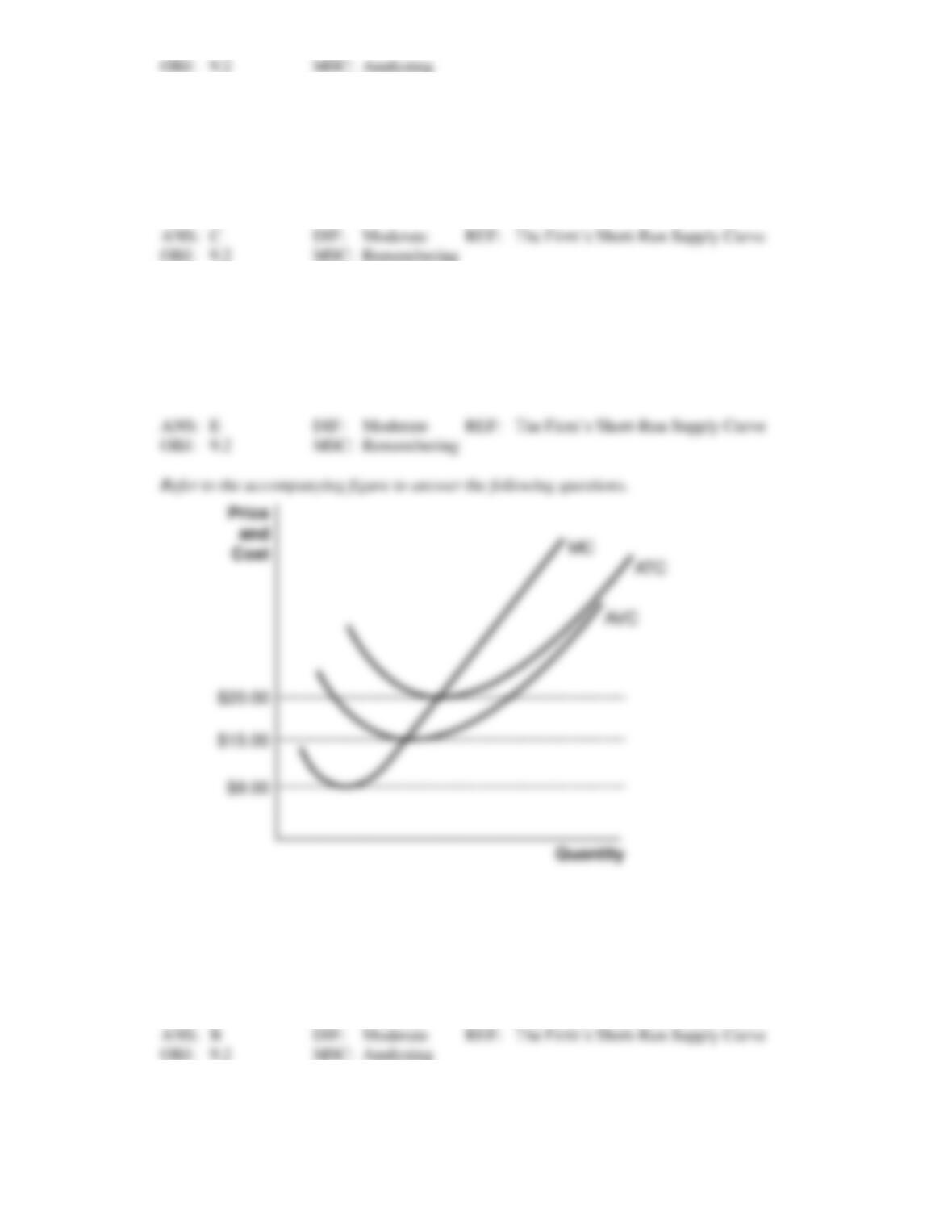
91. This firm’s short-run supply curve is represented by the
a. average total cost (ATC) curve above $20.
b. marginal cost (MC) curve above $15.
c. marginal cost (MC) curve above $8.
d. marginal cost (MC) curve above $20.
e. average variable cost (AVC) curve above $15.
92. A firm would produce in the long run only if the market price is
a. at or above $20. d. above $8.
b. above $15. e. between $8 and $15.
c. between $15 and $20.
93. A firm’s willingness to supply its product in the short run is represented on a graph by the
a. market supply curve.
b. entire marginal cost (MC) curve.
c. marginal revenue (MR) curve.
d. part of the marginal cost (MC) curve above minimum average total cost (ATC).
e. part of the marginal cost (MC) curve above minimum average variable cost (AVC).
94. It’s easy to determine if a firm is making long-run production decisions by looking at its cost
structure because, in the long run, a firm does NOT have any ________ costs.
a. opportunity d. variable
b. sunk e. marginal
c. fixed
95. If the market price of a product is between the minimum average variable cost (AVC) and
minimum average total cost (ATC) of a firm, that firm will
a. always shut down.
b. always continue to produce.
c. produce in the short run but shut down in the long run.
d. produce in the long run but shut down in the short run.
e. make positive economic profits.
96. At current production levels, the marginal revenue of a competitive firm is $15 and the marginal
cost of the firm is $15. The firm should
a. cut back on production.
b. stop production all together.
c. produce more.
d. continue producing at current levels.
e. raise its prices.
97. In the long run, if a firm is making a loss, it will
a. continue to operate no matter what.
b. continue to operate if it covers its fixed costs.
c. increase production in order to increase profits.
d. decrease production in order to increase profits.
e. stop producing and exit the market.