
Microeconomics: Theory and Applications with Calculus, 3e (Perloff)
Chapter 9 Properties and Applications of the Competitive Model
9.1 Zero Profit for Competitive Firms in the Long Run
1) A firm that generates zero economic profit usually faces
A) negative business profit.
B) zero business profit.
C) positive business profit.
D) business profit equal to half the total revenue.
2) In the long run, competitive firms MUST be profit maximizers because if they do not maximize profits,
A) they will not survive.
B) they will not be price takers.
C) they will attract entry.
D) the profits that they do earn will only cover variable costs.
3) Long-run economic rent or profit do not exist for fixed factors like land because
A) bidding drives up the price of the factor until no economic rent exists.
B) there is no market for such factors.
C) these factors have L-shaped isoquants.
D) these factors will earn economic profits.
4) Does a competitive long-run equilibrium require cost-minimization?
A) Yes, if firms fail to be as efficient as their competitors they are driven out of the market.
B) No, in the long-run firms make zero profits.
C) Yes, if they didn’t even less efficient firms would enter the industry.
D) No, because competition ensures their survival.
5) Firms are ________ with an economic profit of zero, they will ________ in the industry because they
________ be better off in another industry.
A) satisfied, stay, won’t
B) unsatisfied, leave, will
C) satisfied, leave, will
D) unsatisfied, stay, won’t
6) Competitive firms earn zero profit in the long run when
A) entry is completely free.
B) entry is limited.
C) Both A and B.
D) Neither A or B.
For the following, please answer “True” or “False” and explain why.
7) If entry is limited due to a limited input, firms in that market earn long run economic profit.
8) In the long run, firms in a competitive market make zero economic profit. This induces most firms to
leave the industry.
9) Even if two competitive firms in the same market have different production technologies, they will
each earn long-run zero profits. Why?

9.2 Producer Surplus
1) Producer surplus is equal to
A) the area under the supply curve.
B) the difference between price and average cost for all units sold.
C) the difference between price and marginal cost for all units sold.
D) the firm’s profit when fixed costs exist.
2) Producer surplus equals
A) total revenue minus total variable cost.
B) total revenue minus the sum of all marginal cost.
C) profit plus fixed cost.
D) All of the above.
3) Mister Jones was selling his house. The asking price was $220,000, and Jones decided he would take no
less than $200,000. After some negotiation, Mister Smith purchased the house for $205,000. Jones’
producer surplus is
A) $5,000.
B) $15,000.
C) $20,000.
D) Not able to be calculated from the information given.
4) Suppose the market supply curve is p = 5 + Q. At a price of 10, producer surplus equals
A) 50.
B) 25.
C) 12.50.
D) 10.
5) Suppose the market supply curve is p = 5Q. At a price of 10, producer surplus equals
A) 50.
B) 25.
C) 12.50.
D) 10.

6) Suppose the inverse supply curve in a market is Q = 6p2. What is the producer surplus when price is
equal to 4?
A) 96
B) 128
C) 28
D) 48
7) The difference between producer surplus and profit is always the associated
A) opportunity costs.
B) total costs.
C) variable costs.
D) fixed costs.
8) In the short run, if a firm operates, it earns a profit of $500. The fixed costs of the firm are $100. This
firm has a producer surplus of
A) $500.
B) $100.
C) $400.
D) $600.
9) Suppose the market supply curve is p = 5Q. If price increases from 10 to 15, the change in producer
surplus is
A) 25.
B) 5.
C) 12.5.
D) 20.
10) Suppose the market supply curve is p = 5 + Q. If price increases from 10 to 15, the change in producer
surplus is
A) 12.5.
B) 5.
C) 50.
D) 37.5.
11) Suppose the inverse supply curve in a market is Q=6p2. If price decreases from 5 to 4, the change in
producer surplus is
A) 150.
B) -54.
C) –6.
D) –122.
For the following, please answer “True” or “False” and explain why.
12) Producer surplus is the sum of the profits earned by all firms in a market.
13) Producer surplus equals total revenue minus the sum of all marginal cost.
14) When is the profit a firm earns equal to the producer surplus? Explain.
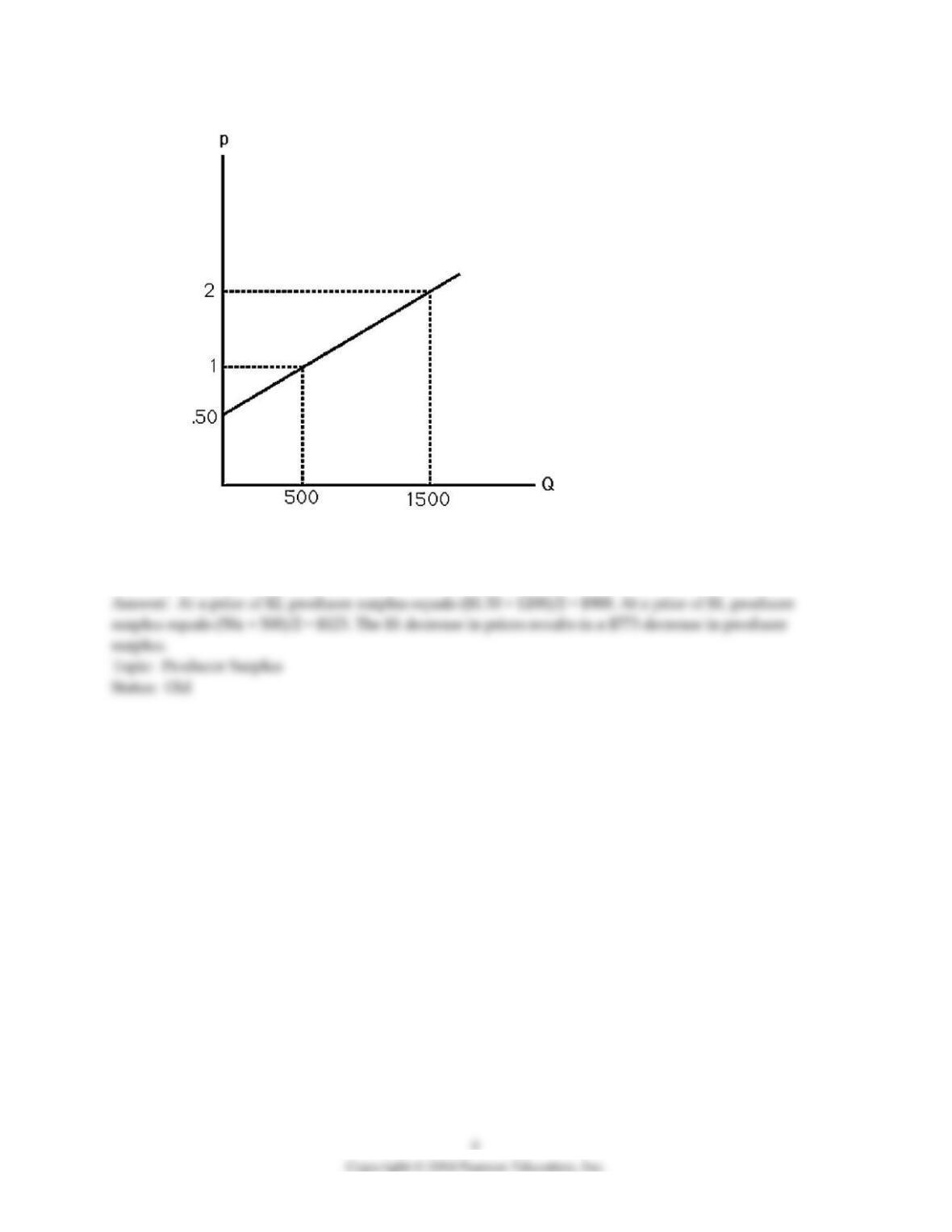
15) Suppose the market supply curve for wheat is shown in the above figure. Calculate the producer
surplus when price is $2 per bushel. If legislation mandates that the price be $1 per bushel, what is the
resulting loss in producer surplus?
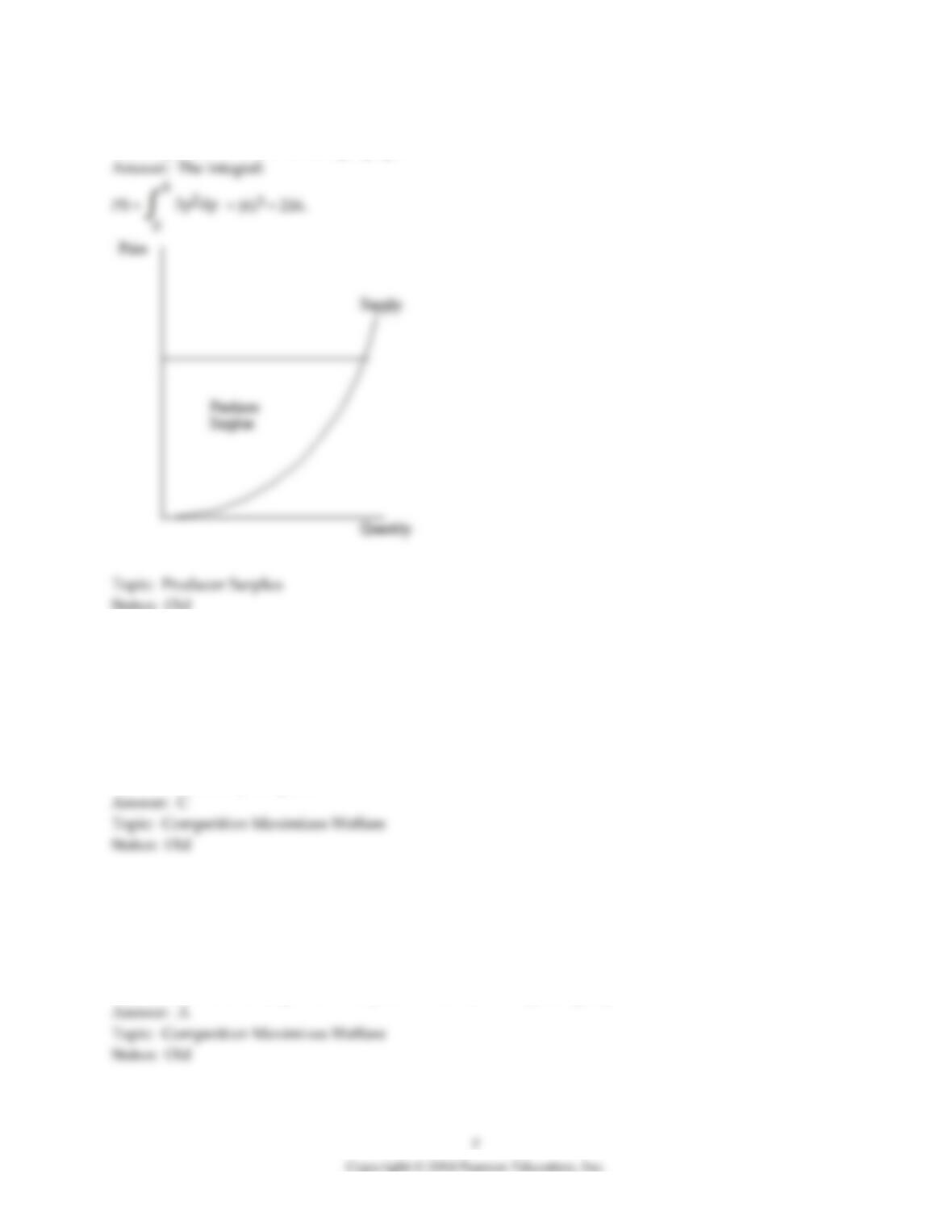
16) The inverse supply curve in a market is given by Q = 3p2. What is the producer surplus when the
market price is $6? Illustrate using a graph.
Status: Old
9.3 Competition Maximizes Welfare
1) Economists claim that measuring society’s welfare as CS + PS
A) is inappropriate since ultimately everyone is a consumer.
B) is valid only when the same person could be either a consumer or a producer.
C) treats the gains to consumers and producers equally.
D) is not commonly accepted.
2) Advocates of steel tariffs to protect American steel firms realize that when imposing such tariffs the
gains of firms are outweighed by the losses to consumers. This implies that
A) such advocates value producer surplus more than consumer surplus.
B) such advocates want to help consumers.
C) such advocates value consumer surplus more than producer surplus.
D) such advocates value producer surplus and consumer surplus equally.

3) If a market produces a level of output below the competitive equilibrium, then
A) social welfare is not maximized.
B) consumer surplus might still be maximized.
C) the actual price will be below the equilibrium price.
D) social welfare might still be enhanced if a price ceiling keeps price below the competitive price.
4) If in a market the last unit of output was sold at a price higher than marginal cost,
A) producers are better off producing more.
B) consumers are better off if less of the product is sold.
C) social welfare is not maximized.
D) the unit increased total profit.
5) A competitive market maximizes social welfare because in a competitive market,
A) profits are zero.
B) price equals marginal cost of the last unit produced.
C) price equals average cost of the last unit produced.
D) there is free entry and exit.
6) If a market produces a level of output that exceeds the competitive equilibrium output, then
A) social welfare will be higher.
B) producer surplus will be higher.
C) marginal cost will exceed price.
D) All of the above.
7) If an economist states that not enough of a good is being produced, she usually means that
A) not everyone can afford the good.
B) price exceeds marginal cost.
C) consumer surplus equals zero.
D) at equilibrium, some people who still wish to sell the good cannot find a buyer.
8) Deadweight loss occurs when
A) producer surplus is greater than consumer surplus.
B) the maximum level of total welfare is not achieved.
C) consumer surplus is reduced.
D) an inferior good is consumed.
9) Giving presents on Christmas does NOT generate a deadweight loss if
A) all gift are money.
B) everybody gets exactly want she wants.
C) nobody can be made better off by returning the gift and purchasing a different one.
D) All of the above.
10) The deadweight loss associated with output less than the competitive level can be determined by
A) subtracting the competitive level producer surplus from the producer surplus associated with less
output.
B) subtracting the consumer surplus from the producer surplus associated with less output.
C) summing the consumer and producer surplus associated with less output.
D) summing the change in the total consumer and producer surplus from moving from the competitive
level of output to less output.
For the following, please answer “True” or “False” and explain why.
11) As the quantity produced of a good increases, the social welfare generated by that good increases.
12) While producing less than the competitive output decreases social welfare, the same cannot be said
about producing more than the competitive output.
13) Explain why the competitive output maximizes welfare.
14) Suppose a consumer advocacy group has convinced legislators that vitamin pills should be free to
consumers. Such a policy would enhance the health of the citizenry, they argue. Assuming a downward–
sloping linear demand curve and a horizontal long-run supply curve, determine the resulting output and
social welfare from such a policy. Compare this result to the competitive equilibrium.
15) Suppose an industry trade group has convinced legislators that a price floor should be used so that
producer surplus is maximized in the market for milk. The group argues that such a policy would save
the “family farm.” Assuming a downward-sloping linear demand curve and a horizontal long-run supply
curve, determine the resulting price, output and social welfare from such a policy. Compare this result to
the competitive equilibrium.
9.4 Policies That Shift Supply Curves
1) The services of real estate brokers are provided in a competitive market. If the state Board of Realtors
enacts several requirements that limit the number of real estate brokers, which of the following is most
likely to occur?
A) The supply curve of real estate brokers will shift to the left.
B) The supply curve of real estate brokers will shift to the right.
C) Social welfare will remain unchanged.
D) The supply curve will remain unchanged.

2) Which of the following best describes the market reaction if a city restricts the number of firms that are
allowed to operate in a market?
A) The market supply curve shifts to the left.
B) The market demand curve shifts to the left.
C) Quantity supplied increases because price increases.
D) Price decreases.
3) The services of real estate brokers are provided in a competitive market. If the state Board of Realtors
enacts several requirements that limit the number of real estate brokers, which of the following is most
likely to occur?
A) Consumer surplus will increase.
B) Producer surplus will increase.
C) Entry of new brokers will increase.
D) Social welfare will increase.
4) The services of real estate brokers are provided in a competitive market. If the state Board of Realtors
enacts several requirements that limit the number of real estate brokers, then consumer surplus will most
likely
A) increase.
B) decrease.
C) remain unchanged.
D) There is not enough information to answer.
5) The services of real estate brokers are provided in a competitive market. If the state Board of Realtors
enacts several requirements that limit the number of real estate brokers, then social welfare will most
likely
A) not change but there will be a transfer from consumer to producer.
B) not change but there will be a transfer from producer to consumer.
C) decrease although producers are made better off.
D) decrease although consumers are made better off.
6) A new law applied to a competitive market that requires that laid off workers be paid a large severance
payment will
A) not generate a deadweight loss.
B) increase total welfare.
C) increase consumer surplus in the market.
D) decrease consumer surplus in the market.
7) If a city decides to restrict the number of pizza parlors
A) the price of pizza will increase.
B) pizza parlors will make higher profits.
C) total welfare will decrease.
D) All of the above.
8) The government requires the steel industry to adopt new eco–friendly machines, which cannot be used
in other industries. If the machines are very expensive and the capital market does not work efficiently,
then
A) entrants are encouraged to enter the market and adopt the new machines.
B) firms can easily leave the steel industry without loss.
C) entrants are discouraged by the new requirements.
D) None of the above.
For the following, please answer “True” or “False” and explain why.
9) Policies that restrict supply could generate an increase in social welfare because the increase in
producer surplus could exceed the decrease in consumer surplus.
10) If a city decides to lift restrictions on how many taxi cabs can operate, social welfare will increase.
11) Suppose anyone with a driver’s license is capable of supplying one trip from the airport to the
downtown business center on any given day. The long–run supply curve of such trips is horizontal at p =
$50, which is the average cost of such trips. Suppose daily demand is Q = 1000 – 10p. Calculate the change
in consumer surplus, producer surplus and social welfare if the city government requires those people
supplying such trips to possess a special license, and the government will issue only 300 licenses.
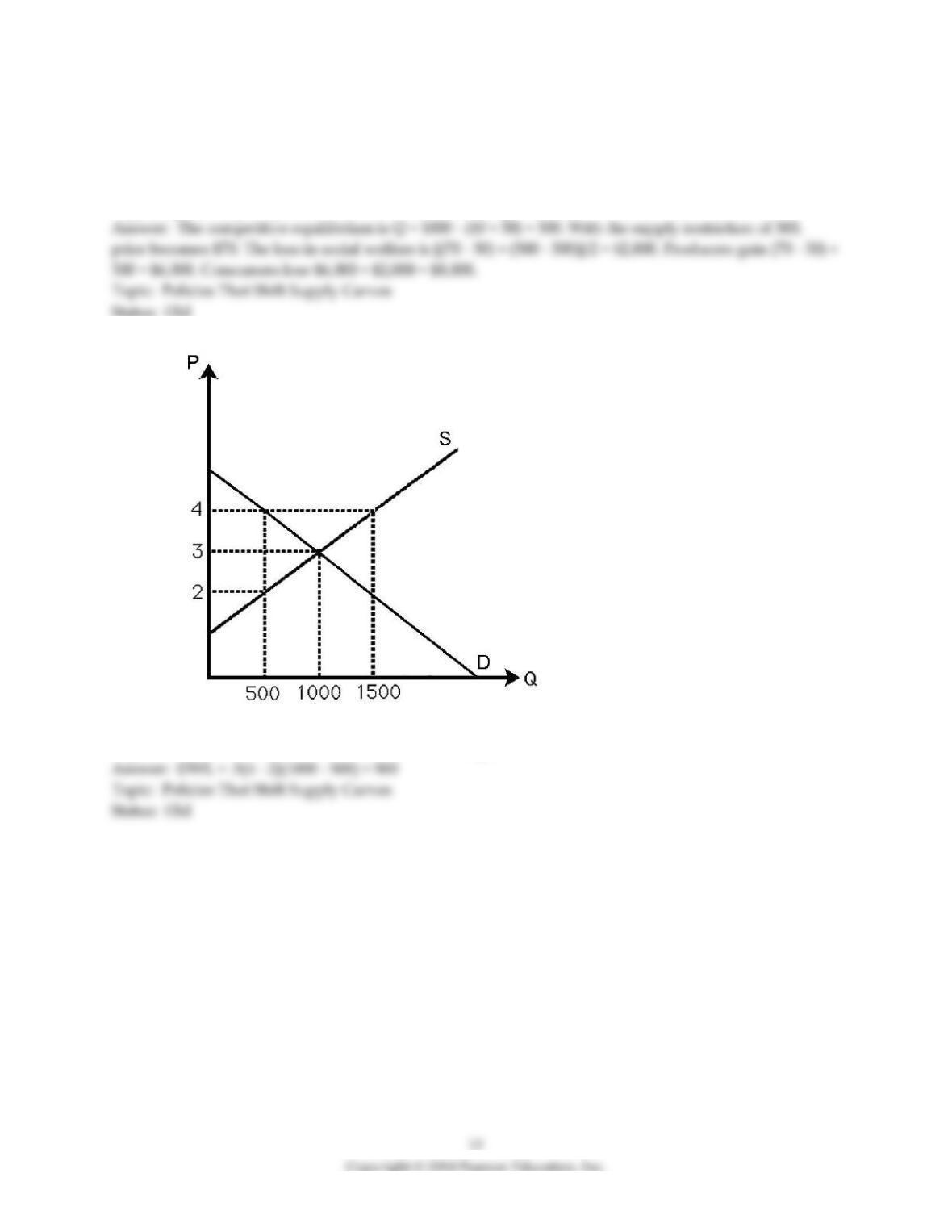
12) The above figure shows the demand and supply curves in the market for milk. If the government
imposes a quota at 500 gallons, calculate the deadweight loss.
13) Suppose that all firms in a constant-cost industry have the following long-run cost curve:
c(q) = 4q2 + 100q + 100
The demand in this market is given by QD = 1280 – 2p. Suppose the number of firms in the market is
restricted to 80
a. Derive the supply curve with this restriction. Find the market equilibrium price and quantity with the
restriction.
b. If firms are allowed to buy and sell these permits in an open market, what will be the rental price of
permits? Will firm’s that own permits make profit? Briefly explain.
c. How much deadweight loss is generated by the permit system? Provide a graph showing the region
of this deadweight loss.
d. Suppose the government abandons the permit system and simply imposes a fixed fee on firms in the
market. If the fee is set equal to the permit price you found in c., what will be the equilibrium price,
quantity, number of firms and deadweight loss?

9.5 Policies That Create a Wedge Between Supply and Demand Curves
1) The total welfare associated with a market that includes a government sales tax equals
A) consumer surplus plus producer surplus.
B) consumer surplus plus producer surplus minus government tax revenue.
C) consumer surplus plus producer surplus plus government tax revenue.
D) the government tax revenue.
2) If a city government enacts a maximum price on rent,
A) quantity supplied will decrease.
B) quantity demanded will increase.
C) allocational problems develop.
D) All of the above.