Chapter 9: Managerial Use of Price Discrimination
MULTIPLE CHOICE
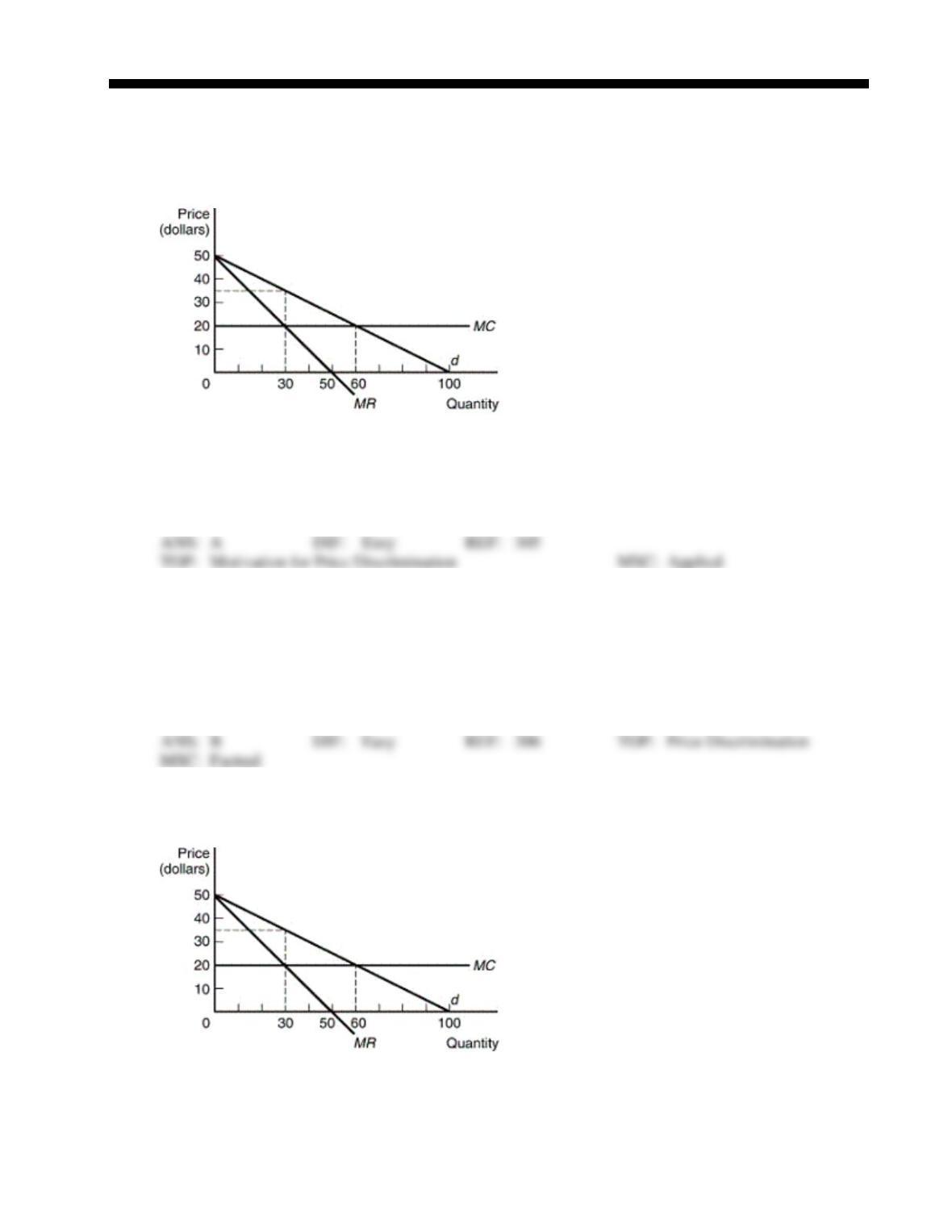
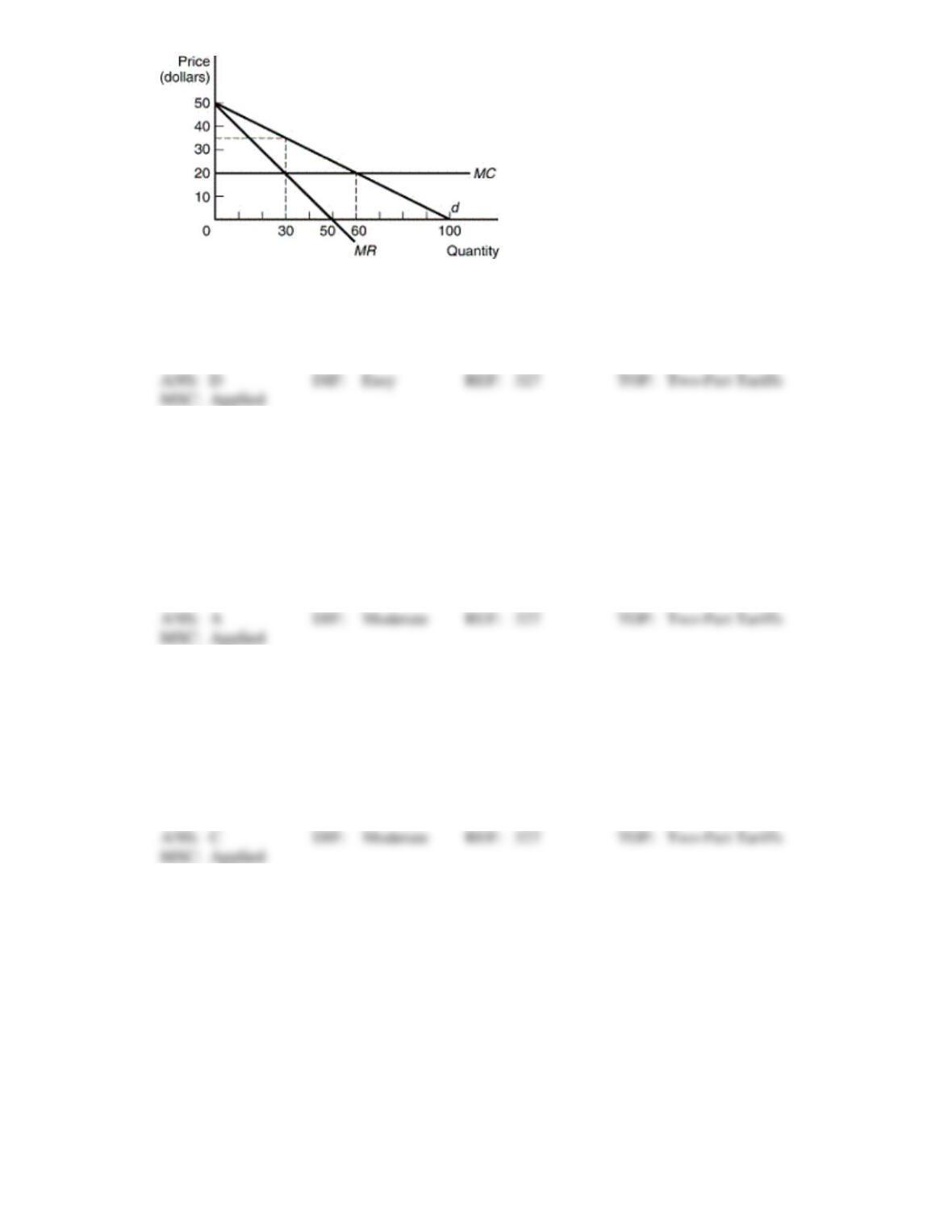
1. The optimal level of output and price for the profit-maximizing monopolist in the following figure
would be:
a.
Q = 30 and P = $35.
b.
Q = 60 and P = $20.
c.
Q = 30 and P = $20.
d.
Q = 100 and P = $35.
e.
none of the above.
2. Price discrimination is defined as:
a.
selling a product at the same price to each and every consumer.
b.
selling a product at more than one price.
c.
selling a product at its marginal cost plus a markup.
d.
selling more than one version of a product.
e.
producing goods and services for sale within the firm.
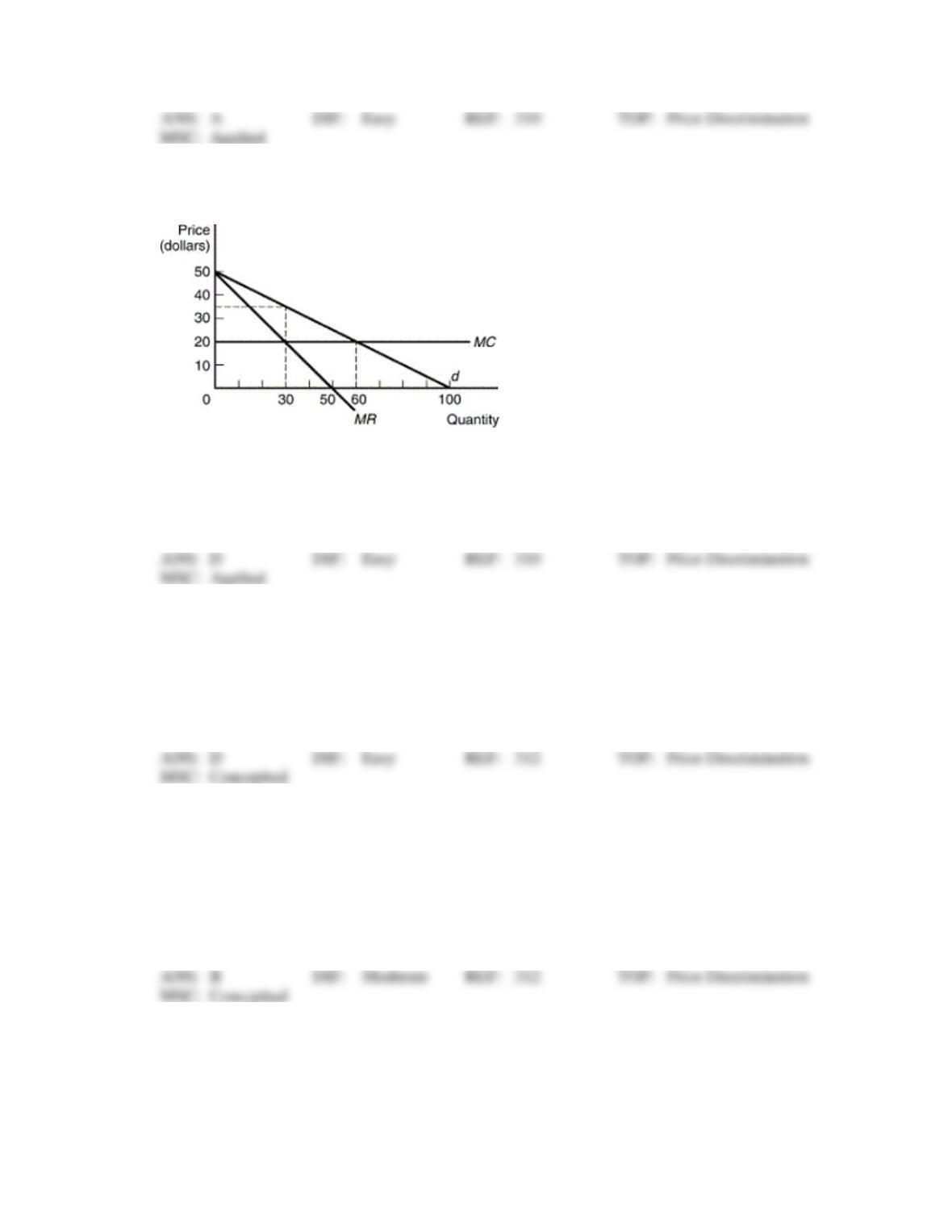
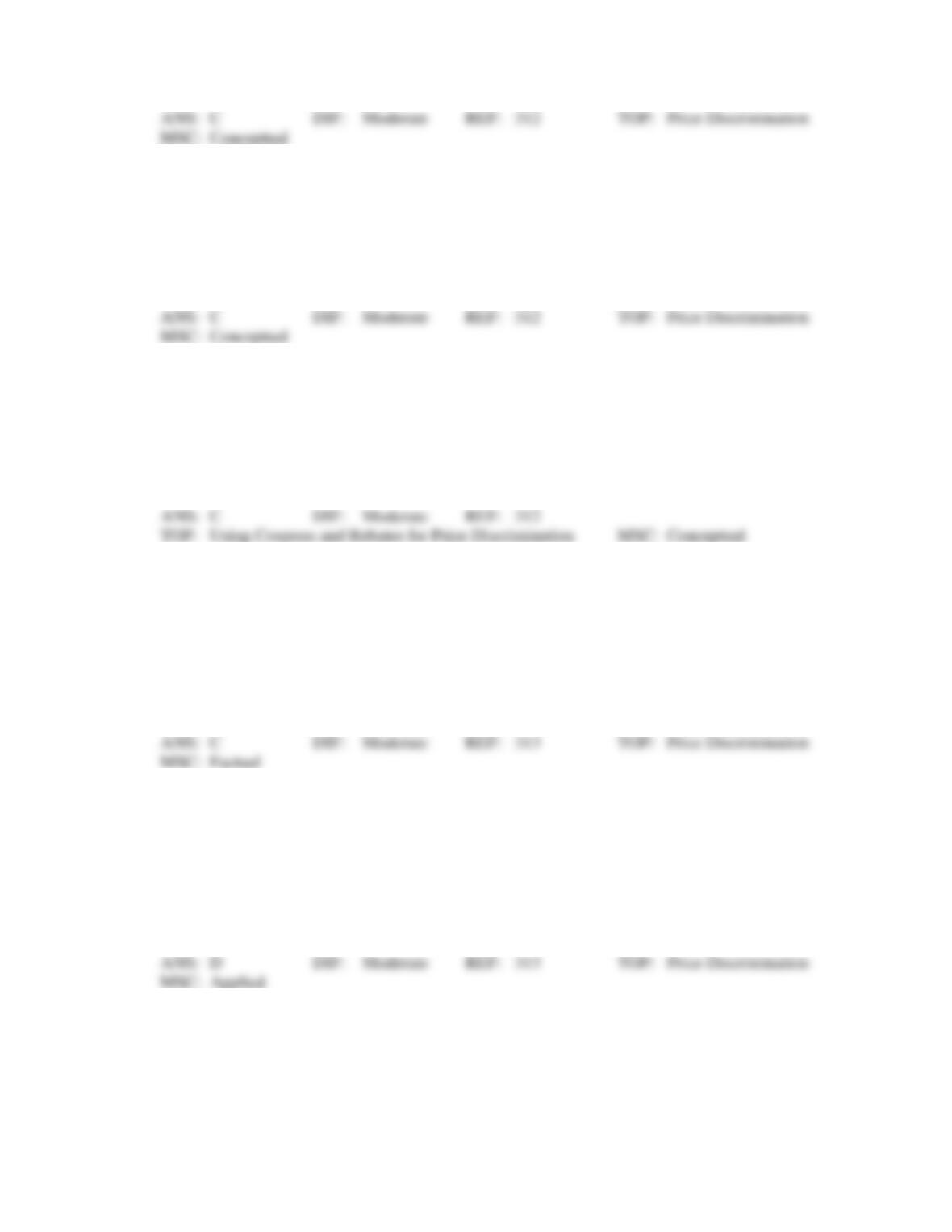
3. If the monopolist shown in the following figure could practice first-degree price discrimination, the
consumer surplus would be:
a.
$0.
b.
$225.
c.
$450.
d.
$900.
e.
$1,200.
4. If the monopolist shown in the following figure could practice first-degree price discrimination, the
producer surplus would be:
a.
$0.
b.
$225.
c.
$450.
d.
$900.
e.
$1,200.
5. When a movie theater charges a higher price during the evening than during the day, it is practicing:
a.
peak load pricing.
b.
first-degree price discrimination.
c.
second-degree price discrimination.
d.
third-degree price discrimination
e.
fourth-degree price discrimination.
6. When Exxoff Oil Corporation offers discounts based on credit card records of gas quantities
purchased, they are practicing:
a.
first-degree price discrimination.
b.
second-degree price discrimination.
c.
third-degree price discrimination.
d.
markup pricing.
e.
tying.
7. When Pan United Airlines gives a $400 fare discount to persons with student IDs, they are practicing:
a.
first-degree price discrimination.
b.
second-degree price discrimination.
c.
third-degree price discrimination.
d.
markup pricing.
e.
tying.
8. When a utility charges homeowners less than big industrial users, it is practicing:
a.
first-degree price discrimination.
b.
fourth-degree price discrimination.
c.
third-degree price discrimination.
d.
markup pricing.
e.
tying.
9. Cereal manufacturers’ use of coupons can be partially explained by:
a.
first-degree price discrimination.
b.
second-degree price discrimination.
c.
third-degree price discrimination.
d.
markup pricing.
e.
tying.
10. If a firm supplies separable markets with price elasticities
1 and
2, it should set prices P1 and P2 so
that:
a.
P1
1 = P2
2.
b.
P1 /
1 = P2 /
2.
c.
P1(1 + 1/
1) = P2 (1 + 1/
2).
d.
P1/(1 – 1 /
1) = P2 / (1 – 1/
2).
e.
P1 = 1 – 1/
1 and P2 = 1 – 1/
2.
11. If a firm supplies separable markets with price elasticities
1 = –3 and
2 = –2, it should set prices P1
and P2 so that:
a.
P1 = P2.
b.
3P1 = 2P2.
c.
2P1 = 3P2.
d.
2/3P1 = 1/2P2.
e.
2P1 = 2/3P2.
12. Women are often charged more than men for haircuts performed by the same haircutter. This is not
considered price discrimination because:
a.
women receive more consumer surplus from haircuts than men receive.
b.
haircutters claim to spend more time on women’s hair, raising the cost of the haircut to the
firm.
c.
firms make up the extra cost to consumers by giving women free samples of products.
d.
men receive more consumer surplus from haircuts than women receive.
e.
women have a lower price elasticity of demand for haircuts.
13. A firm with production located in a poor Georgia town sells toys locally for $10 each and ships the
same toys to sell in a wealthy North Carolina town for $15 each. They are not price discriminating if:
a.
laws in Georgia allow it.
b.
laws in North Carolina allow it.
c.
total advertising costs are $5 per unit.
d.
total transportation costs are $5 per unit.
e.
consumers in North Carolina would pay more than $15 for the toys.
14. Gliberace’s Fashion Accessories of Las Vegas produces gemstone-encrusted formal wear for sale in
Los Angeles and San Francisco subject to total cost TC = 100 + 5(QLA + QSF). Demand for Gliberace’s
stones in the two cities is given by QLA = 70 – 2PLA and QSF = 55 – PSF . If Gliberace price
discriminates between the two cities, how many stones will it sell in Los Angeles?
a.
30.
b.
36.
c.
38.
d.
43.
e.
48.
15. Gliberace’s Fashion Accessories of Las Vegas produces gemstone-encrusted formal wear for sale in
Los Angeles and San Francisco subject to total cost TC = 100 + 5(QLA + QSF). Demand for Gliberace’s
stones in the two cities is given by QLA = 70 – 2PLA and QSF = 55 – PSF. If Gliberace price discriminates
between the two cities, what will its maximum profits be?
a.
$750.
b.
$825.
c.
$1,075.
d.
$975.
e.
$1,175.
16. Crusty Cakes sells donuts in Eastown and Westown. Its total costs are given by TC = 10(QE + QW).
The demand in each neighborhood is given by QE = 100 – 2PE and QW = 100 – PW . If Crusty price
discriminates between the two neighborhoods, how much are its maximized profits?
a.
$850.
b.
$1,200.
c.
$2,475.
d.
$2,825.
e.
$3,250.
17. Gliberace’s Fashion Accessories of Las Vegas produces gemstone-encrusted formal wear for sale in
Los Angeles and San Francisco subject to total cost TC = 100 + 6(QLA + QSF). Demand for Gliberace’s
stones in the two cities is given by QLA = 70 – 2PLA and QSF = 50 – PSF. If Gliberace cannot price
discriminate between the two cities, and so charges the same price in each, how many stones will it
sell in Los Angeles?
a.
12.
b.
15.
c.
18.
d.
21.
e.
24.
18. When an electrical utility charges higher prices during the day than at night, it is practicing:
a.
peak load pricing.
b.
first-degree price discrimination.
c.
second-degree price discrimination.
d.
third-degree price discrimination.
e.
fourth-degree price discrimination.
19. The per-week demand for use of the Golden Gate Bridge in San Francisco is P = 13 – 0.15Q during
peak traffic periods and P = 7 – 0.1Q during off-peak hours, where Q is the number of cars crossing
the bridge in thousands and P is the toll in dollars. If the marginal congestion cost of using the bridge
is MC = 5 + 0.2Q, what is the optimal off-peak load toll for crossing the bridge?
a.
6.5.
b.
8.0.
c.
8.7.
d.
9.9.
e.
10.6.
20. The per-week demand for use of the Golden Gate Bridge in San Francisco is P = 12 – 0.15Q during
peak traffic periods and P = 9 – 0.1Q during off-peak hours, where Q is the number of cars crossing
the bridge in thousands and P is the toll in dollars. If the marginal congestion cost of using the bridge
is MC = 5 + 0.2Q, what is the optimal off-peak load toll for crossing the bridge?
a.
6.5.
b.
8.0.
c.
8.7.
d.
9.9.
e.
10.6.
21. The per-week demand for use of the Golden Gate Bridge in San Francisco is P = 12 – 0.15Q during
peak traffic periods and P = 9 – 0.1Q during off-peak hours, where Q is the number of cars crossing
the bridge in thousands and P is the toll in dollars. If the marginal congestion cost of using the bridge
is MC = 5 + 0.2Q, what is the optimal peak load toll for crossing the bridge?
a.
6.5.
b.
8.0.
c.
8.7.
d.
9.9.
e.
10.6.
22. The per-week demand for use of the Golden Gate Bridge in San Francisco is P = 13 – 0.15Q during
peak traffic periods and P = 10 – 0.1Q during off-peak hours, where Q is the number of cars crossing
the bridge in thousands and P is the toll in dollars. If the marginal congestion cost of using the bridge
is MC = 5 + 0.2Q, what is the optimal peak load toll for crossing the bridge?
a.
6.5.
b.
8.0.
c.
8.7.
d.
9.9.
e.
10.5.
23. When a monopolist requires a customer to pay an initial fee for the right to buy a product as well as a
usage fee for each unit of the product bought, this is known as a(n):
a.
bundling contract.
b.
price differentiation.
c.
oligopolistic device.
d.
two-part tariff.
e.
maximizing device.
24. The demand for health club services is Q = 350 – 2P and the marginal cost of providing these services
is MC = 110 + 2Q. If a two-part tariff pricing system is used, what is the optimal price and quantity
combination?
a.
P = 52 and Q = 240.
b.
P = 199 and Q = 52.
c.
P = 26 and Q = 162.
d.
P = 162 and Q = 26.
e.
None of the above.
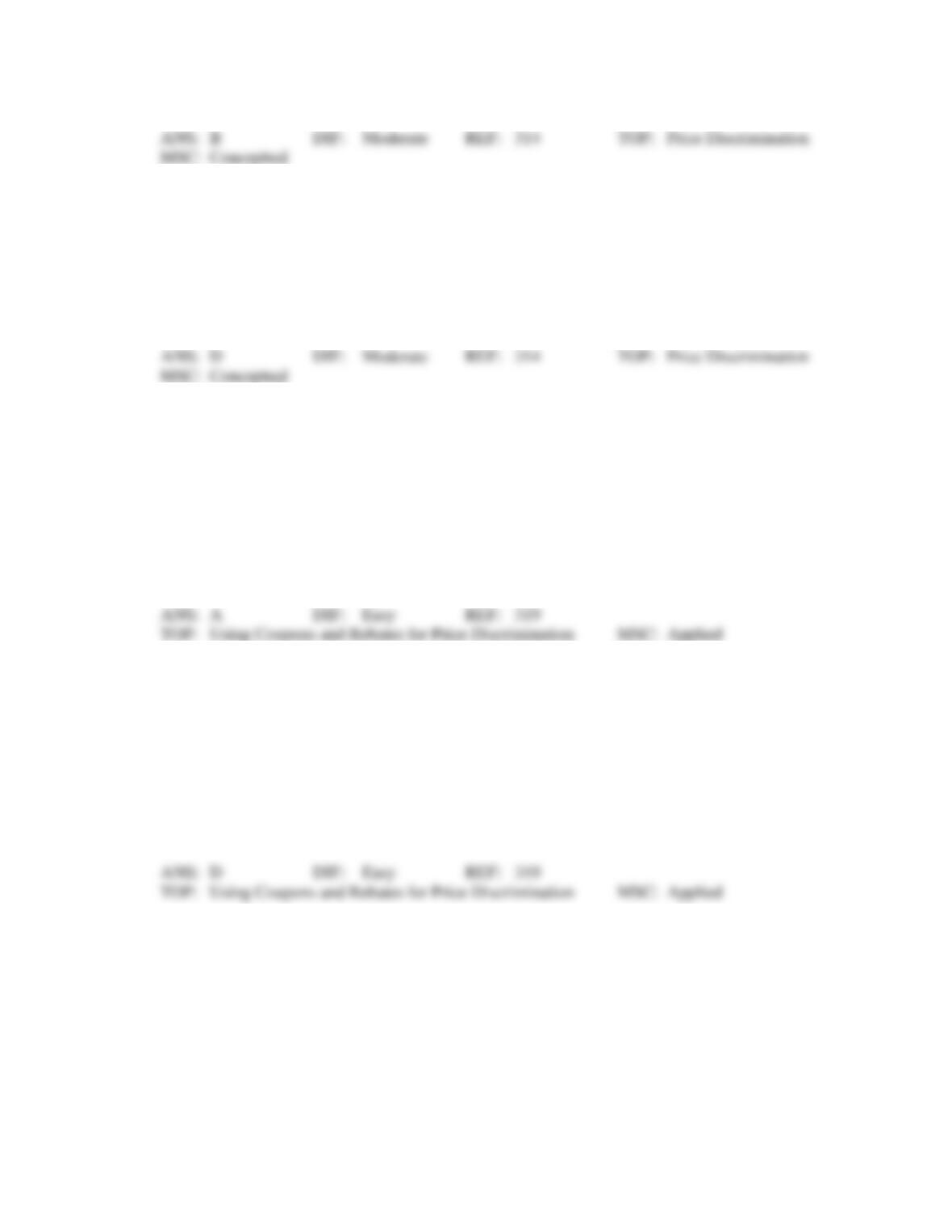
25. If the monopolist shown in the following figure could implement a two-part tariff, the entry fee would
be:
a.
$0.
b.
$225.
c.
$450.
d.
$900.
e.
$1,200.
26. The demand for health club services is Q = 100 – 2P, and the marginal cost of providing these services
is MC = –110 + 2Q. If a two-part tariff pricing system is used, what is the optimal price and quantity
combination?
a.
P = 18 and Q = 64.
b.
P = 199 and Q = 52.
c.
P = 26 and Q = 162.
d.
P = 162 and Q = 26.
e.
None of the above.
27. The demand for health club services is Q = 100 – 2P, and the marginal cost of providing these services
is MC = –110 + 2Q. If a two-part tariff pricing system is used, what is the optimal fixed fee?
a.
1,555.
b.
2,624.
c.
1,024.
d.
1,206.
e.
None of the above.