Microeconomics, 12e (Parkin)
Chapter 9 Possibilities, Preferences, and Choices
1 Consumption Possibilities
1) Goods that can be bought in any quantity desired are called
A) divisible goods.
B) indivisible goods.
C) invisible goods.
D) inferior goods.
2) Which of the following is NOT a divisible good?
A) gasoline
B) tap water
C) electricity
D) movies
3) Budget lines are drawn on a diagram with the
A) price of the good on the vertical axis and its quantity on the horizontal axis.
B) price of one good on the vertical axis and the price of another good on the horizontal axis.
C) quantity of the good on the vertical axis and its price on the horizontal axis.
D) quantity of one good on the vertical axis and the quantity of another good on the horizontal
axis.
4) The variables that determine a household’s budget line are
A) its preferences and income.
B) its preferences and prices.
C) prices and income.
D) None of the above are correct.
5) A budget line shows the
A) consumption possibilities of a consumer at a given level of income and prices.
B) complete set of preferences for a household at various incomes.
C) consumption possibilities for several sets of relative prices at a level of income.
D) rate at which consumers wish to substitute one good for another.
6) The budget line ________.
A) shows the limits to a household’s consumption choices
B) illustrates a household’s preferences
C) defines a household’s consumption when prices change
D) shows the income a household needs to be able to buy goods and services
7) For a consumer, a budget line shows the boundary between
A) what is desired and what is not desired.
B) what is needed and what is not needed.
C) what is affordable and what is not affordable.
D) what is available and what is not available.
8) A household’s consumption choices cannot exceed limits created by
A) only the household’s income.
B) only the prices of the goods and services that it buys.
C) both the household’s income and the prices of the goods and services that it buys.
D) neither the household’s income nor the prices of the goods and services that it buys.
9) In order to determine a household’s budget line, you must know the
A) prices of the goods bought and the household’s income.
B) prices of the goods bought, but not the household’s income.
C) household’s income, but not the prices of goods bought.
D) household’s income, prices of the goods bought, and the household’s preferences.
10) Sam buys gasoline and coffee each week. In order to draw his budget line between gasoline
and coffee, Sam would have to know
A) only how much income he has available to spend on gasoline and coffee.
B) only the prices of one gallon of gasoline and one pound of coffee.
C) only how much gasoline he wants to buy and how much coffee he wants to drink.
D) both how much income he has to spend and the prices of one gallon of gasoline and one
pound of coffee.
11) In order to draw an individual’s budget line, we must know
A) prices and preferences.
B) prices and income.
C) income and preferences.
D) prices, income, and preferences.
12) Lily is a college student who likes to buy only two goods: Cheetos and Pepsi. To determine
Lily’s budget line, you need to know
I. Lily’s preferences for Cheetos and Pepsi.
II. The prices of Cheetos and Pepsi.
III. Lily’s income.
A) II only
B) I and II
C) II and III
D) I, II and III
13) All points below the budget line are
A) inferior to every point on the budget line.
B) preferred to every point on the budget line.
C) affordable.
D) Answers A and C are correct.
14) All points above the budget line are
A) inferior to every point on the budget line.
B) preferred to every point on the budget line.
C) unaffordable.
D) Both answers B and C are correct.
15) Moving along a given budget line
A) prices and real income both decrease.
B) prices fall and real income is constant.
C) real income decreases and prices are constant.
D) prices and real income are constant.
16) Tonya, who is rich, and Jerome, who is poorer, both buy orange juice and croissants for
lunch at the student cafeteria. Their budget constraints on a diagram with orange juice on the
vertical axis and croissants on the horizontal have the same
A) horizontal intercepts.
B) vertical intercepts.
C) slopes.
D) midpoints.
17) Ernie has an income of $40 which he plans to spend on cookies and milk. The price of milk
is $1 per gallon, and the price of cookies is $2 per dozen. If Ernie buys 12 gallons of milk, how
many dozens of cookies will he buy if he spends all of his income?
A) 28
B) 20
C) 14
D) 12
18) Jake plans to spend $100 on fried chicken and Pepsi. The price of a fried chicken is $5 and
Pepsi is $2 per bottle. If Jake buys 10 fried chickens how many bottles of Pepsi can he buy?
A) 50
B) 10
C) 25
D) 75
19) Bob plans to spend $60 per month on DVD movie rentals and CDs. The price of a movie
rental is $3 and the price of a CD is $15. If Bob rents 5 DVDs per month, how many CDs can he
buy?
A) 1
B) 2
C) 3
D) 4
20) Larry spends all his $800 monthly income on pizza and gasoline. The price of pizza is $4 a
slice, and the price of gasoline is $2 per gallon. If Larry buys 150 slices of pizza per month, his
budget constraint will allow him to buy ________ gallons of gas per month.
A) 100
B) 80
C) 120
D) 200
21) Joe has $50 to spend on pizza and movies. If movies are $5 each and a pizza is $10 then,
assuming he spends all his money, he can buy which of the following bundle of goods?
A) 6 movies and 2 pizzas
B) 8 movies and 4 pizzas
C) 2 movies and 6 pizzas
D) 6 movies and 4 pizzas
22) Suppose that Dave has $200 to spend per week and he buys only magazines and pizza. The
price of a pizza is $10 and the price of a magazine is $5. What is the maximum amount of pizza
Dave can buy each week?
A) 40
B) 20
C) 200
D) 60
23) Suppose that Dave has $200 to spend per week and he buys only magazines and pizza. The
price of a pizza is $10 and the price of a magazine is $5. If Dave buys 15 pizza each week, what
is the maximum number of magazines can he buy?
A) 40
B) 20
C) 10
D) 200
24) Suppose that Dave has $200 to spend per week and he buys only magazines and pizza. The
price of a pizza is $10 and the price of a magazine is $5. If Dave buys 20 magazines per week,
which of the following amount of pizza is not affordable to him?
A) 10
B) 20
C) 9
D) All of the above answers are correct because none of the listed amounts of pizza are
affordable.
25) Junkfood Jill spends all of her income on jellybeans and Jolt cola. Suppose that Jill’s income
is $30, the price of a bag of jellybeans is $6, and the price of a bottle of Jolt cola is $2. Which of
the following combinations of jellybeans and Jolt cola lies inside of Jill’s budget line?
A) 5 bags of jellybeans and 0 bottles of Jolt
B) 4 bags of jellybeans and 4 bottles of Jolt
C) 3 bags of jellybeans and 6 bottles of Jolt
D) 2 bags of jellybeans and 8 bottles of Jolt
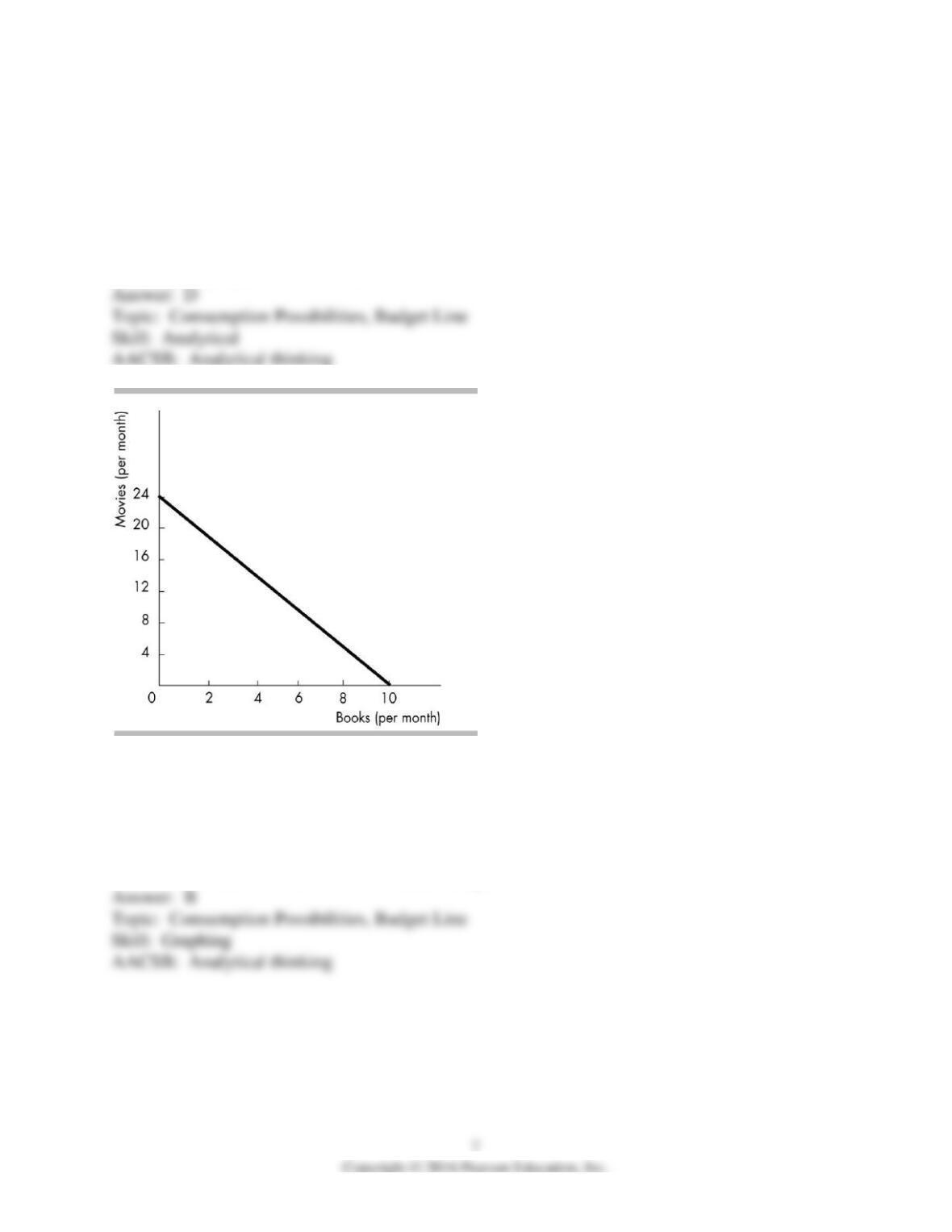
26) Consider the budget line in the above figure. If the consumer’s income is $120, then the price
of a book is
A) $10 per book.
B) $12 per book.
C) $6 per book.
D) More information is needed to determine the price of a book.
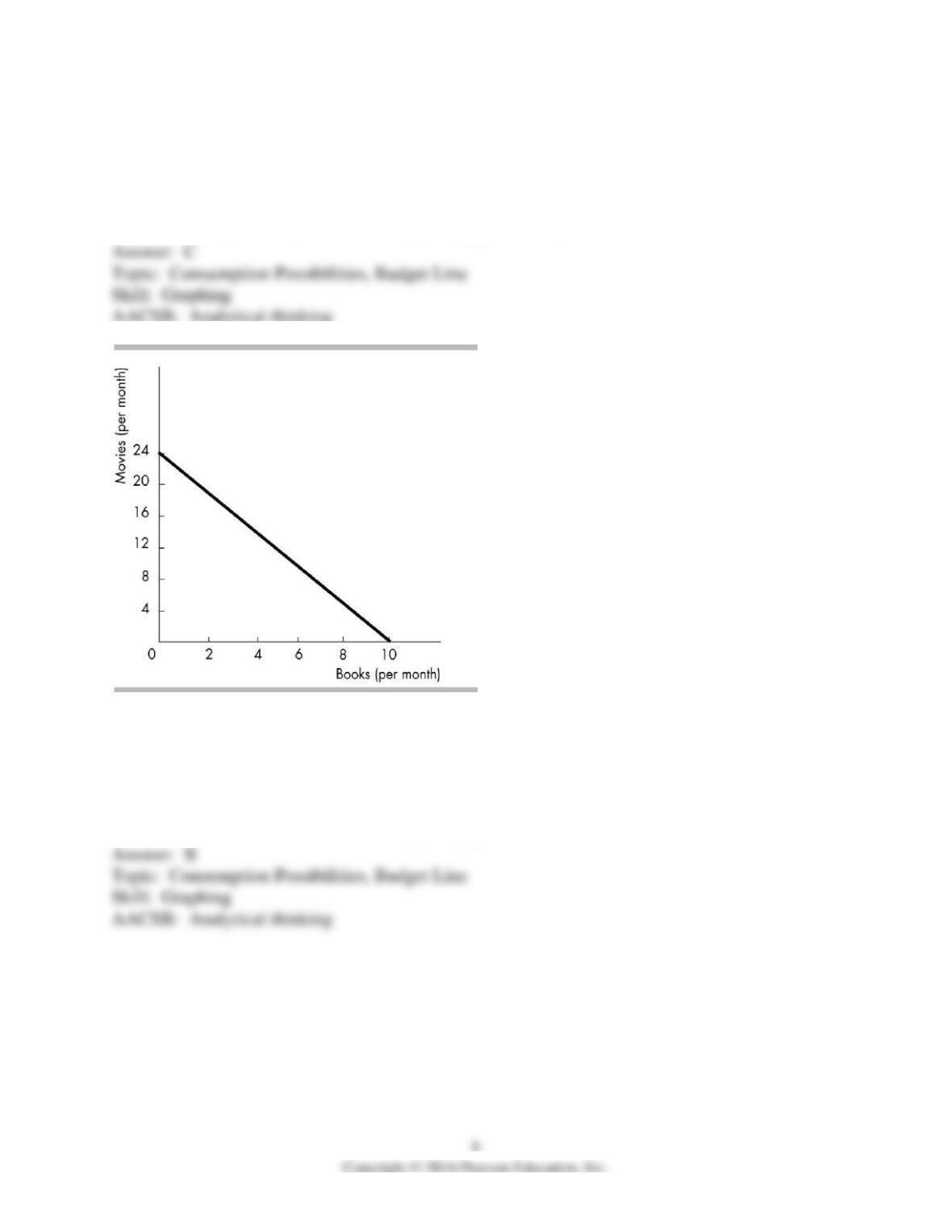
27) Consider the budget line in the above figure. If the consumer’s income is $120, then the price
of a movie is
A) $24 per movie.
B) $12 per movie.
C) $5 per movie.
D) More information is needed to determine the price of a movie.
28) Consider the budget line in the above figure. If the consumer’s income is $240, then the price
of a book is
A) $20 per book.
B) $24 per book.
C) $12 per book.
D) More information is needed to determine the price of a book.
29) Consider the budget line in the above figure. If the consumer’s income is $240, then the price
of a movie is
A) $24 per movie.
B) $12 per movie.
C) $10 per movie.
D) More information is needed to determine the price of a movie.
30) Consider the budget line in the above figure. If the consumer has income of $240, what is the
relative price of movies?
A) .42 books
B) 2.4 books
C) $10 per movie
D) $24 per movie
31) Suppose that Dave has $200 to spend per week and he buys only magazines and pizza. The
price of a pizza is $10 and the price of a magazine is $5. What is Dave’s real income in terms of
magazines?
A) 20
B) 40
C) 200
D) 10
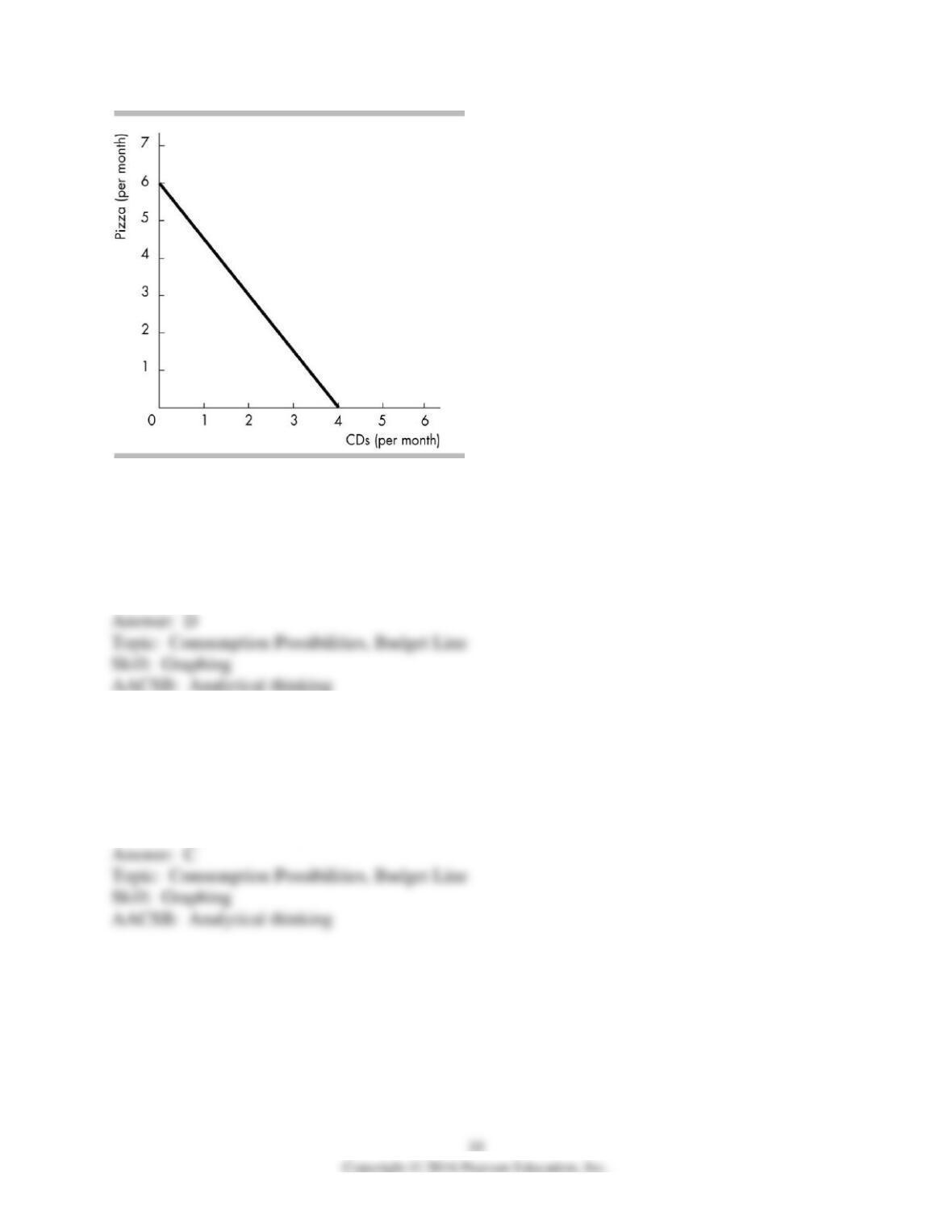
32) Given the budget line in the above figure, if income is $60, then the price of a pizza is
________ and the price of a CD is ________.
A) $5; $20
B) $6; $4
C) $15; 15
D) $10; $15
33) According to the budget line in the above figure, which of the following combinations is
unaffordable?
A) 1 pizza and 3 CDs
B) 3 pizzas and 2 CDs
C) 2 pizzas and 4 CDs
D) All of the above are affordable.
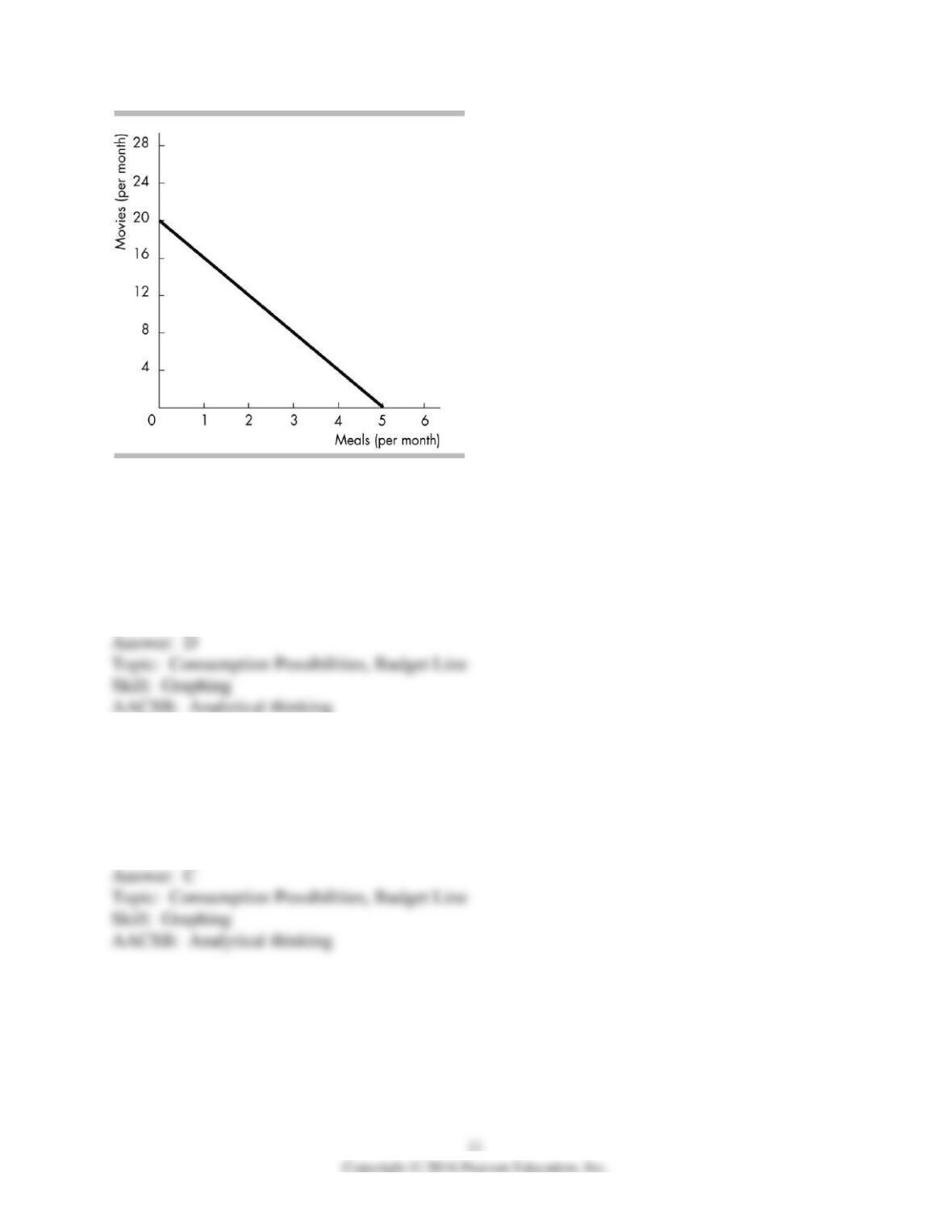
34) The figure above shows Tanya’s consumption possibilities. Tanya spends $100 per month on
movies and restaurant meals. The price of a movie ticket is ________ and the price of a
restaurant meal is ________.
A) $7; $15
B) $10; $10
C) $20; $5
D) $5; $20
35) The figure above shows Tanya’s consumption possibilities. Which of the following
combinations of goods is not affordable?
A) 8 movie tickets and 3 restaurant meals.
B) 12 movie tickets and 2 restaurant meals.
C) 10 movie tickets and 3 restaurant meals.
D) 6 movie tickets and 3 restaurant meals.
36) The figure above shows Tanya’s consumption possibilities when the price of a restaurant
meal is $20. If the price of a restaurant meal falls to $10 and Tanya buys 12 movie tickets, how
many restaurant meals can she buy?
A) 2
B) 3
C) 4
D) 5
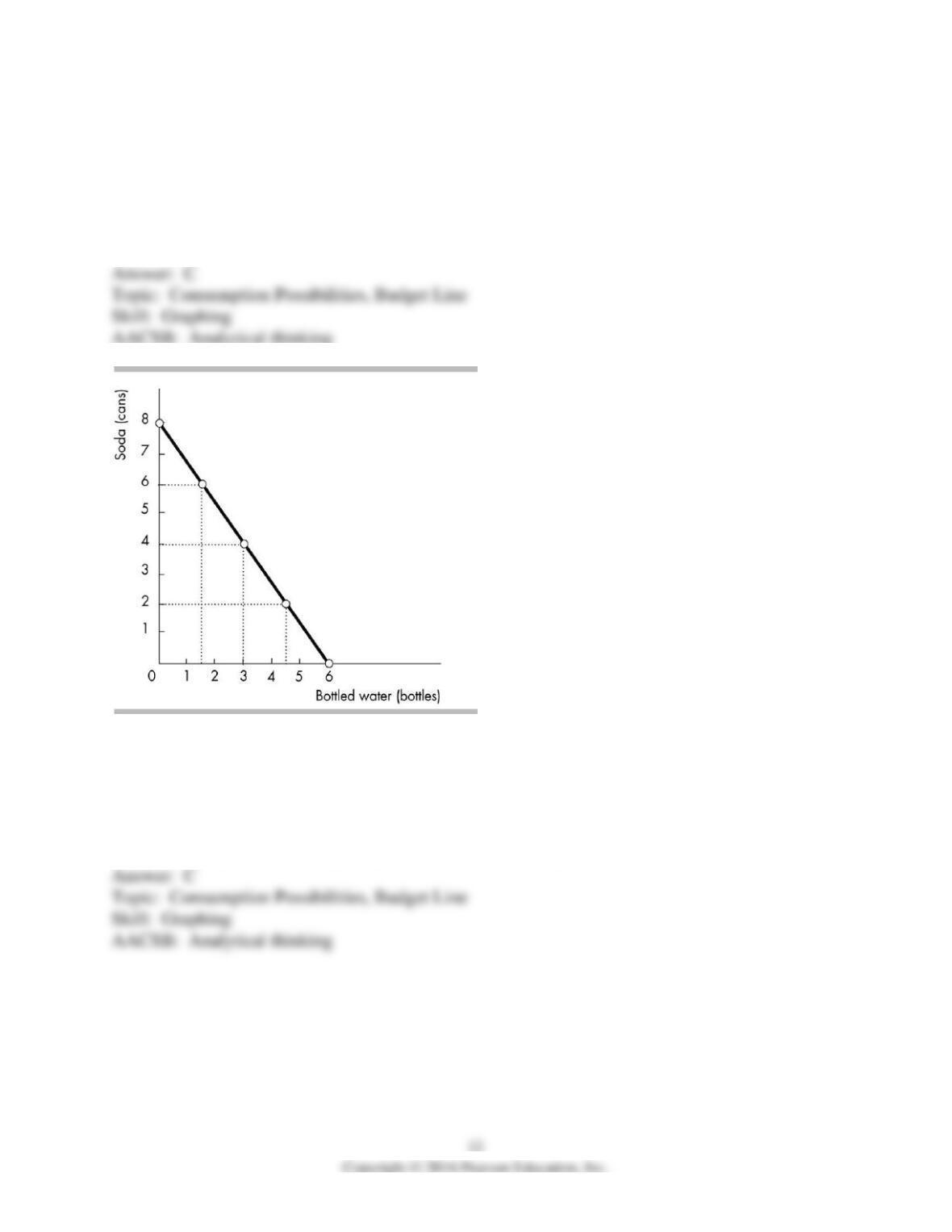
37) Based on the above figure showing a budget line, which of the following combinations of
soda and bottled water are not affordable?
A) 3 bottles of water and 4 cans of soda
B) 4 bottles of water and 2 cans of soda
C) 2 bottles of water and 6 cans of soda
D) None of the above, that is, all the combinations listed are affordable.
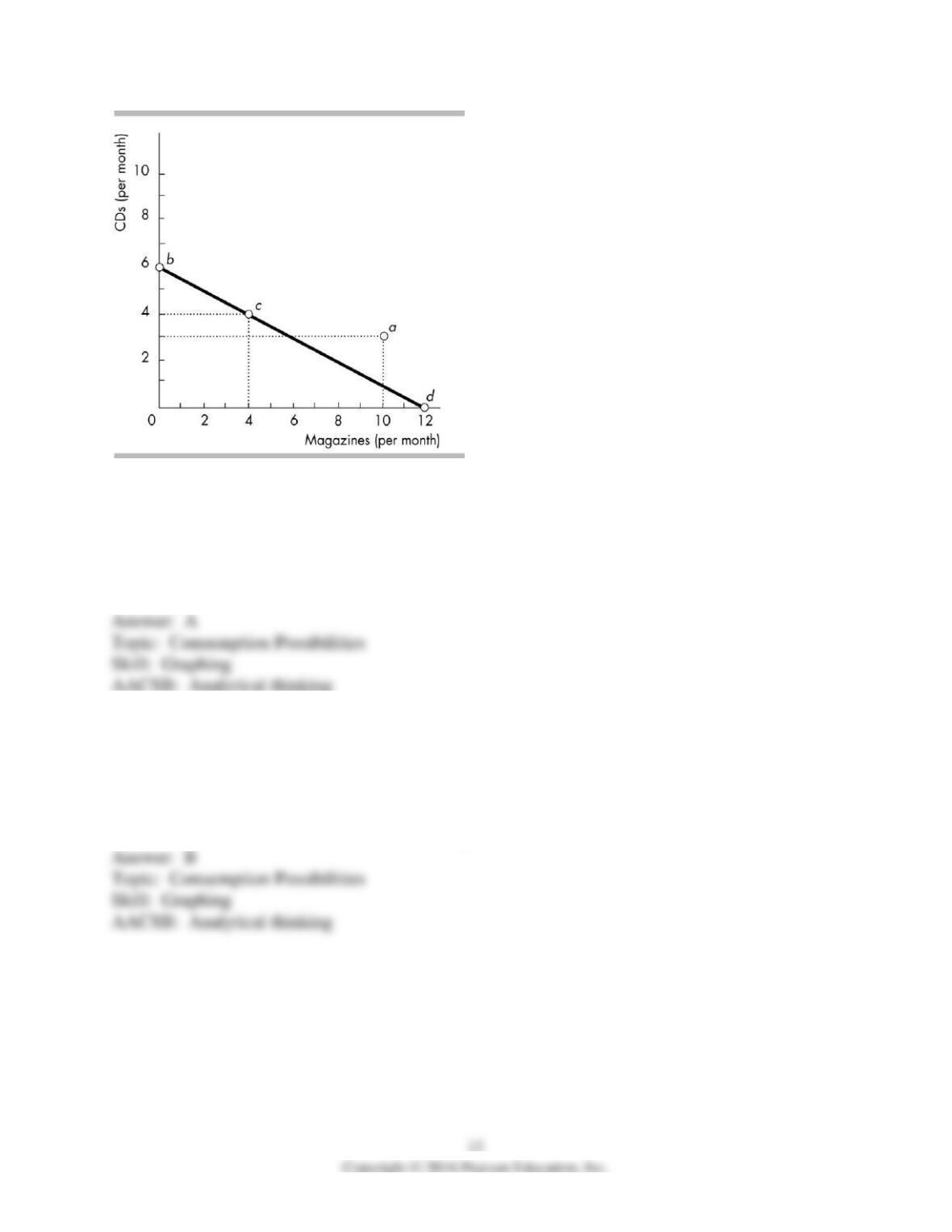
38) The above figure gives your budget line between CDs and magazines. Which combination of
CDs and magazines is not affordable?
A) combination a
B) combination b
C) combination c
D) both combinations b and d
39) The figure above gives your budget line for magazine and CDs per month. Given that your
income equals $60 per month, what is the price of a magazine and the price of a CD?
A) The price of a magazine is $12 per magazine and the price of a CD is $6 per CD.
B) The price of a magazine is $5 per magazine and the price of a CD is $10 per CD.
C) The price of a magazine is $4 per magazine and the price of a CD is $12 per CD.
D) It is impossible to tell from the information given.
40) The figure above gives your budget line for magazine and CDs per month. Given that your
income equals $60 per month, what is your real income in terms of CDs?
A) 3 CDs
B) 5 CDs
C) 6 CDs
D) $60/month
41) The figure above gives your budget line for magazine and CDs per month. Given that your
income equals $60 per month, what is your real income in terms of magazines?
A) 12 magazines
B) 6 magazines
C) 2 magazines
D) $60/month
42) The above figure gives your budget line between CDs and magazines. What would allow you
to buy more CDs?
A) a decrease in the relative price of CDs
B) an increase in income
C) a decrease in the price of magazines with no change in the price of CDs
D) All of the above changes would allow you to buy more CDs.
43) The above figure gives your budget line between CDs and magazines. If the price of a
magazine falls, then the budget line
A) shifts outward and the slope does not change.
B) rotates inward with no change in the horizontal intercept.
C) rotates inward with no change in the vertical intercept.
D) rotates outward with no change in the vertical axis.
44) The above figure gives your budget line between CDs and magazines. The slope of the
budget line is ________ CD per magazine.
A) 1/2
B) -1/2
C) -1
D) -2
45) Which of the following factors is NOT part of the budget equation?
A) relative prices
B) real income
C) quantities of goods
D) preferences
46) Shaniq consumes only magazine and CDs. Her income equals $60 per month. CDs are $12
each and magazines are $5 each. What is the equation for her budget line?
A) $60 = Qm + QCD
B) $60 = $12Qm + $5QCD
C) 12 = -2Qm + 6
D) $60 = 12QCD + 5Qm
47) If units of pizza are plotted on the horizontal axis, and units of hot dogs plotted on the
vertical axis, and the price of a hot dog increases the
A) x-intercept and the slope of the budget line will increase.
B) y-intercept and the slope of the budget line will increase.
C) x-intercept and the slope of the budget line will decrease.
D) y-intercept and the slope of the budget line will decrease.
48) If Sam has $60.00 each week to spend on gasoline and coffee, and their respective prices are
$1.50 per gallon and $3.00 per pound, which of the following equations represents his budget
line?
A) $60.00 = $1.50/Qg + $3.00/Qc
B) $60.00 = Qg /$1.50 + Qc /$3.00
C) $60.00 = $1.50(Qg) + $3.00(Qc)
D) $60.00 = $1.50(Qg) – $3.00(Qc)
49) If Sam has $80.00 each week to spend on tacos and magazines, and their respective prices
are $.50 per taco and $4.00 per magazine, which of the following equations represents his budget
line?
A) $80.00 = $.50/Qt + $4.00/Qm
B) $80.00 = Qt/Qm + $.50 /$4.00
C) $80.00 = $.50(Qm) + $4.00(Qt)
D) $80.00 = $.50(Qt) + $4.00(Qm)
50) Suppose the price of coffee is $3, the price of a bagel is $2 and a person’s budget is $40. The
budget line’s equation is
A) $2/Qbagel + $3/Qcoffee = $40.
B) $2(Qbagel) + $3(Qcoffee) = $40.
C) Qbagel /$2 + Qcoffee /$3 = $40.
D) Qbagel + Qcoffee = $40/($3 + $2).
51) Mary has $10 to spend each week on coffee, Qc and magazines, Qm. The price of a coffee is
$1, and the price of a magazine is $2. Mary’s budget equation is ________.
A) Qm = 10 – Qc
B) Qm + Qc = 20
C) $1 × Qc + $2 × Qm = $10
D) Qm = 10 – 2 × Qc
52) Hilda buys only cauliflower, Qc, and geraniums, Qg. The equation for Hilda’s initial budget
line is $40 = $2 × Qc + $4 × Qg. If Hilda’s income increases by $20, the price of cauliflower
decreases by $1, and the price of geraniums increases by $1, the equation of her new budget line
is ________.
A) $60 = $1 × Qc + $5 × Qg
B) $60 + $1 × Qc = $5 × Qg
C) $0 = $60 + $1 × Qc + $5 × Qg
D) $60 = $5 × Qc – $1 × Qg
53) Given the budget line in the above figure, which of the following combinations of pizza and
milk are affordable?
A) 0 pizzas, 12 gallons of milk
B) 2 pizzas, 2 gallons of milk
C) 4 pizzas, 4 gallons of milk
D) All of the above combinations are affordable.
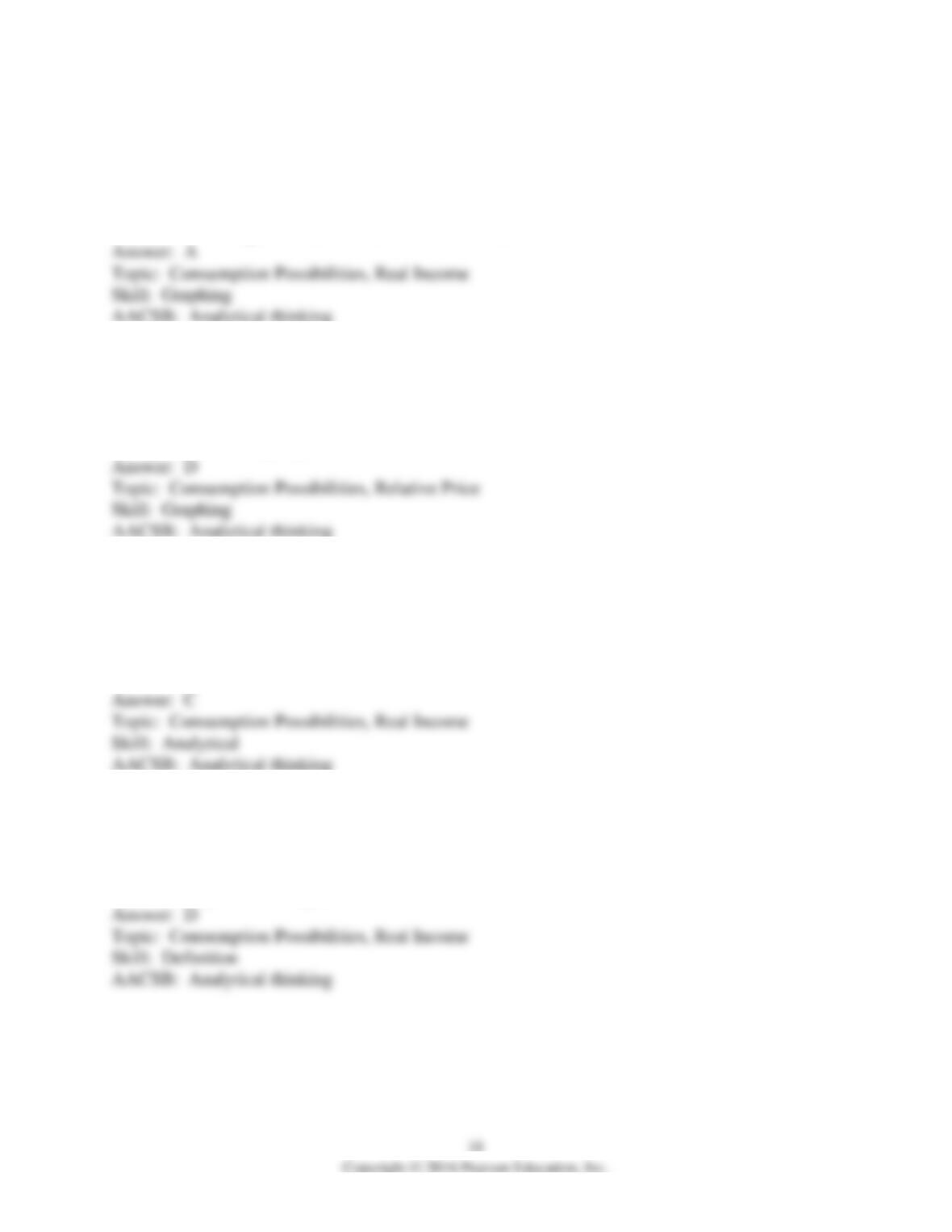
54) Given the budget line in the above figure, what is the household’s real income in terms of
pizzas per month?
A) 5 pizzas per month
B) 4 pizzas per month
C) 3 pizzas per month
D) All of above represent the household’s real income.
55) Given the budget line in the above figure, what is the relative price of pizza?
A) 10 gallons of milk per pizza
B) 6 gallons of milk per pizza
C) 4 gallons of milk per pizza
D) 2 gallons of milk per pizza
56) Larry spends all his $800 monthly income on pizza and milk. The price of pizza is $4 a slice,
and the price of milk is $2 per quart. Larry’s real monthly income in terms of pizza is
A) 400 slices.
B) $800.
C) 200 slices.
D) $400.
57) Real income can be measured by
A) the slope of the budget line.
B) the area under the budget line.
C) the length of the budget line.
D) an intercept of the budget line.
58) Real income measures the
A) slope of the budget line.
B) purchasing power of a given income.
C) slope of the preference map.
D) area under the indifference curve.
59) Real income is ________.
A) equal to money income minus taxes
B) equal to the income earned legally
C) equal to money income plus benefits minus taxes
D) the maximum amount of goods and services that a household can afford
60) Real income equals a household’s income
A) in terms of the quantity of goods the household can buy.
B) multiplied by the prices of the goods it buys.
C) divided by the prices of the goods it buys.
D) multiplied by the relative prices of the goods it buys.
61) Suppose you are graphing the quantity of bagels on the vertical axis and the quantity of
coffee on the horizontal axis. A household’s real income in terms of bagels is the
A) relative price of coffee.
B) relative price of bagels.
C) point at which the budget line intersects the x-axis.
D) point at which the budget line intersects the y-axis.
62) Suppose that Dave has $200 to spend per week and he buys only magazines and pizza. The
price of a pizza is $10 and the price of a magazine is $5. What is Dave’s real income in terms of
magazines?
A) 20
B) 40
C) 200
D) 10
63) John has $40 to spend on pizza and tacos. Pizza costs $10 each and tacos are $1 per taco.
John’s real income ________.
A) is $40
B) is 4 pizzas or 40 tacos
C) is 4 pizzas plus 40 tacos
D) depends only on his money wage
64) Suppose the price of coffee is $3 each, the price of bagels is $2 each and a person’s budget is
$40. The person’s real income is
A) $40.
B) $13.33 in terms of bagels.
C) $13.33 in terms of coffee.
D) $8.
65) The ________ is the price of one good ________ the price of another good.
A) relative price; times
B) relative price; divided by
C) budget; times
D) budget; divided by