Chapter 08 – Pure Competition in the Short Run
1. Economists would describe the U.S. automobile industry as:
2. In which of the following market structures is there clear-cut mutual interdependence with
respect to price-output policies?
Chapter 08 – Pure Competition in the Short Run
3. Which of the following industries most closely approximates pure competition?
4. Economists use the term imperfect competition to describe:
5. In which of the following industry structures is the entry of new firms the most difficult?
Chapter 08 – Pure Competition in the Short Run
6. An industry comprised of 40 firms, none of which has more than 3 percent of the total
market for a differentiated product is an example of:
7. An industry comprised of four firms, each with about 25 percent of the total market for a
product is an example of:
8. An industry comprised of a very large number of sellers producing a standardized product
is known as:
Chapter 08 – Pure Competition in the Short Run
9. An industry comprised of a small number of firms, each of which considers the potential
reactions of its rivals in making price-output decisions is called:
10. Which of the following statements applies to a purely competitive producer?
11. A purely competitive seller is:
Chapter 08 – Pure Competition in the Short Run
12. Which of the following is not a characteristic of pure competition?
13. Which of the following is not a basic characteristic of pure competition?
14. The demand schedule or curve confronted by the individual purely competitive firm is:
Chapter 08 – Pure Competition in the Short Run
15. Which of the following is characteristic of a purely competitive seller’s demand curve?
In answering the question, assume a graph in which dollars are measured on the vertical axis
and output on the horizontal axis.
16. Refer to the above information. For a purely competitive firm, total revenue graphs as a:
17. Refer to the above information. For a purely competitive firm, marginal revenue graphs as
a:
Chapter 08 – Pure Competition in the Short Run
18. Refer to the above information. For a purely competitive firm:
19. If a firm in a purely competitive industry is confronted with an equilibrium price of $5, its
marginal revenue:
20. Price is constant or given to the individual firm selling in a purely competitive market
because:
Chapter 08 – Pure Competition in the Short Run
21. For a purely competitive seller, price equals:
22. For a purely competitive firm total revenue:
23. The marginal revenue curve of a purely competitive firm:
Chapter 08 – Pure Competition in the Short Run
24. The demand curve in a purely competitive industry is _____, while the demand curve to a
single firm in that industry is _____.
25. A perfectly elastic demand curve implies that the firm:
26. The fact that a purely competitive firm’s total revenue curve is linear and upsloping to the
right implies that:
Chapter 08 – Pure Competition in the Short Run
8-10
27. Which of the following statements is correct?
Chapter 08 – Pure Competition in the Short Run
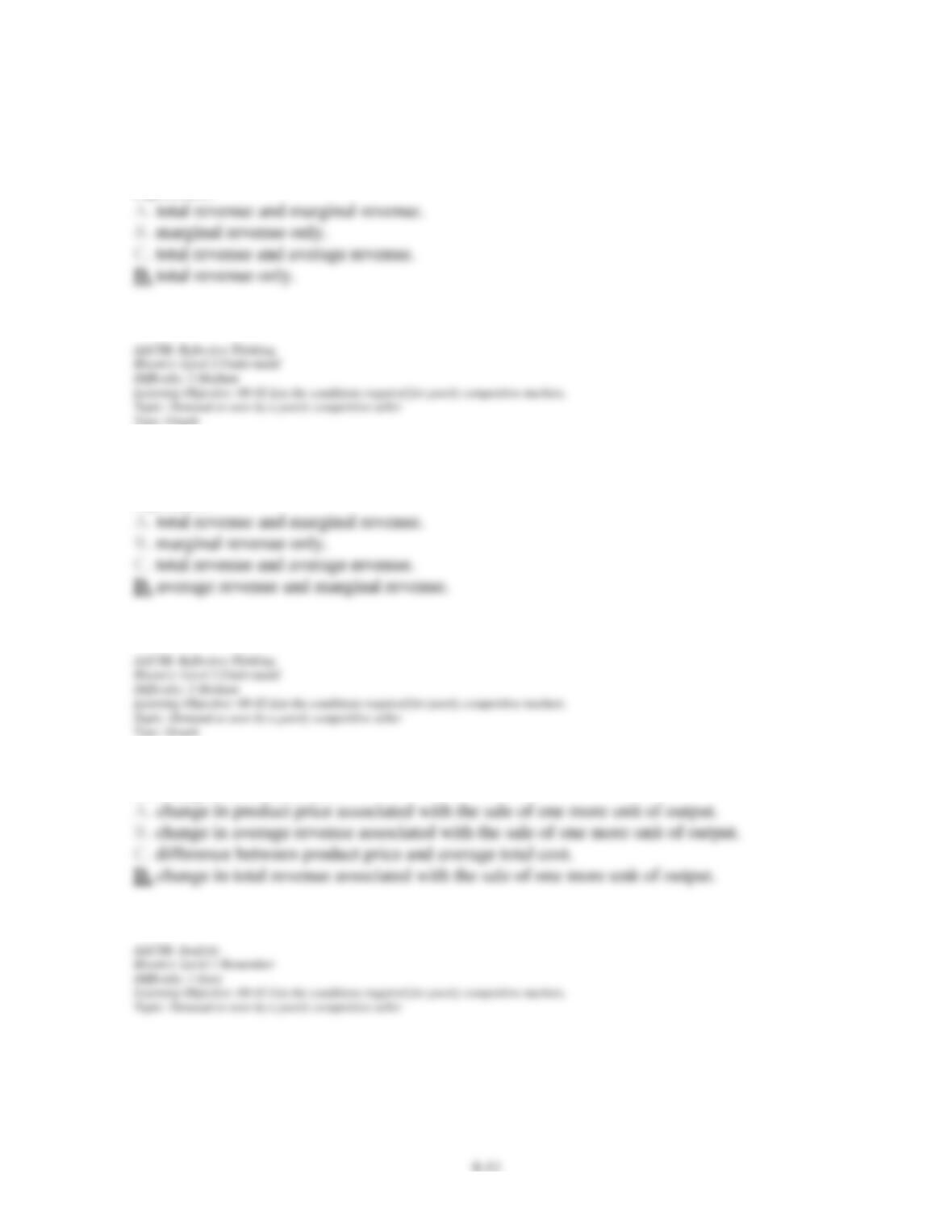
28. Refer to the above diagram, which pertains to a purely competitive firm. Curve A
represents:
29. Refer to the above diagram, which pertains to a purely competitive firm. Curve C
represents:
30. Marginal revenue is the:
Chapter 08 – Pure Competition in the Short Run
31. Firms seek to maximize:
32. A competitive firm in the short run can determine the profit-maximizing (or loss-
minimizing) output by equating:
33. In the short run a purely competitive firm that seeks to maximize profit will produce:
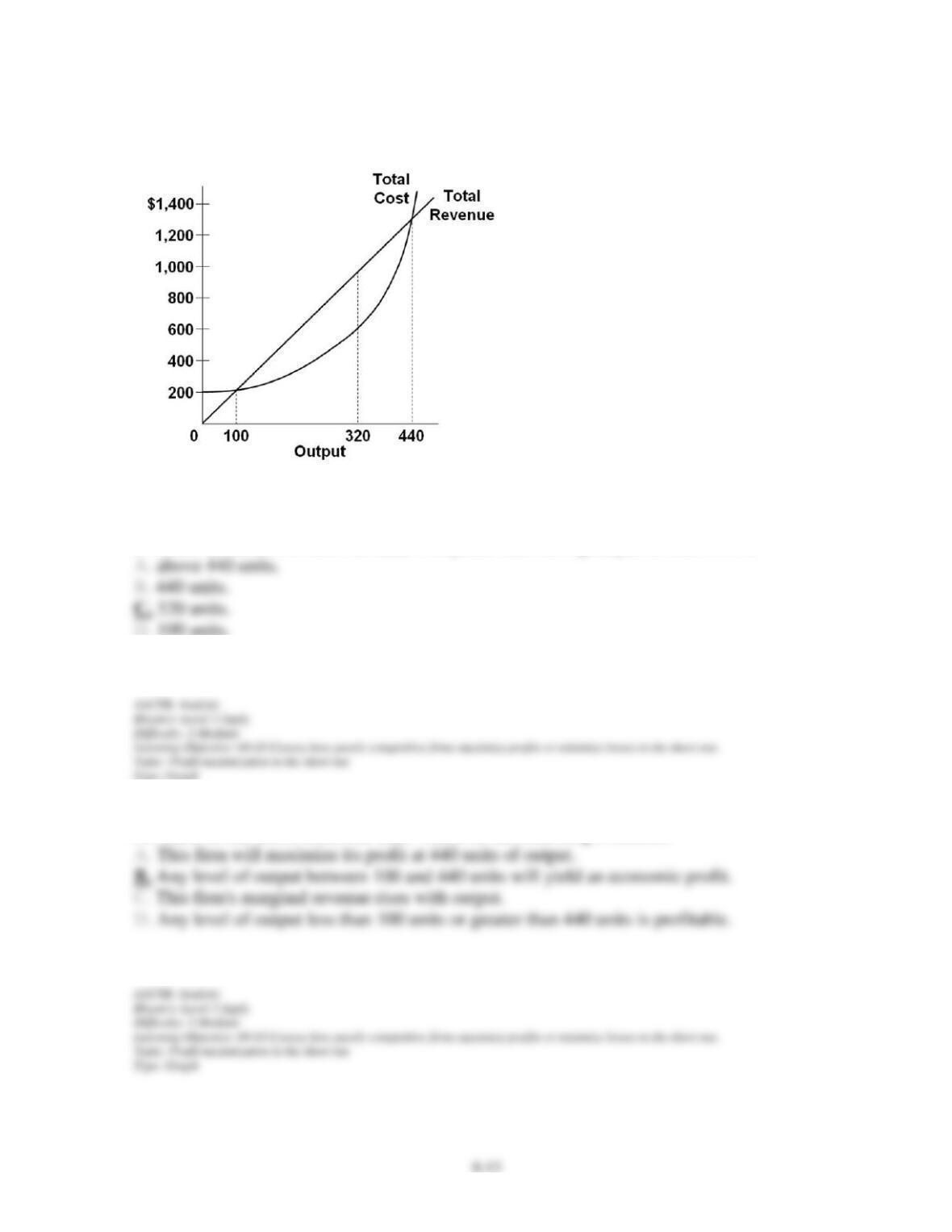
Chapter 08 – Pure Competition in the Short Run
34. Refer to the above short-run data. The profit-maximizing output for this firm is:
D. 100 units.
Chapter 08 – Pure Competition in the Short Run
36. A competitive firm will maximize profits at that output at which:
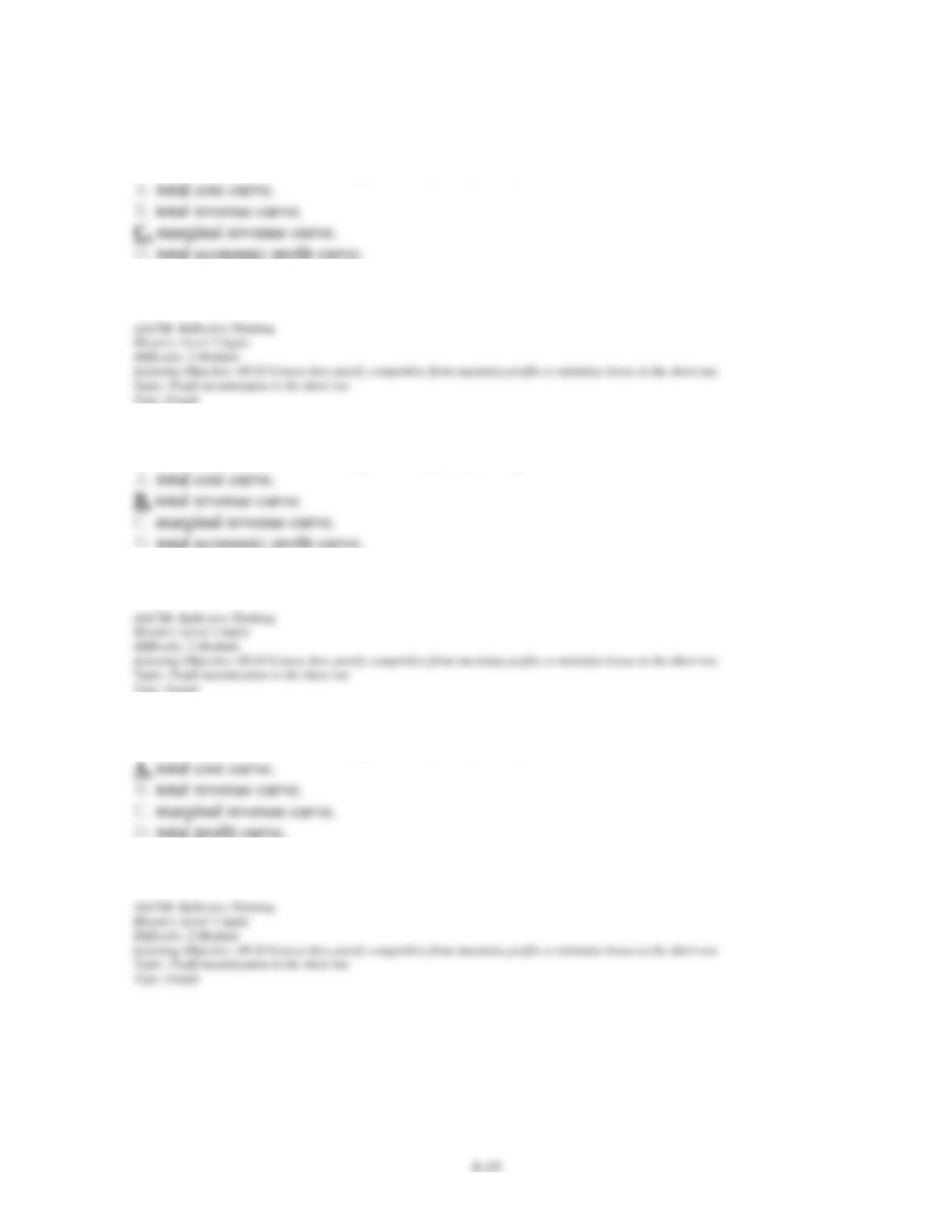
37. Curve (1) in the above diagram is a purely competitive firm’s:
Chapter 08 – Pure Competition in the Short Run
38. Curve (2) in the above diagram is a purely competitive firm’s:
39. Curve (3) in the above diagram is a purely competitive firm’s:
40. Curve (4) in the above diagram is a purely competitive firm’s:
Chapter 08 – Pure Competition in the Short Run
41. Refer to the above diagram. Other things equal, an increase of product price would be
shown as:
42. The firm represented by the above diagram would maximize its profit where:
43. A firm reaches a break-even point (normal profit position) where:
Chapter 08 – Pure Competition in the Short Run
44. The MR = MC rule applies:
45. When a firm is maximizing profit it will necessarily be:
46. The MR = MC rule can be restated for a purely competitive seller as P = MC because:
Chapter 08 – Pure Competition in the Short Run
47. In the short run the individual competitive firm’s supply curve is that segment of the:
48. Which of the following is not a valid generalization concerning the relationship between
price and costs for a purely competitive seller in the short run?
49. Assume the XYZ Corporation is producing 20 units of output. It is selling this output in a
purely competitive market at $10 per unit. Its total fixed costs are $100 and its average
variable cost is $3 at 20 units of output. This corporation:
Chapter 08 – Pure Competition in the Short Run
50. A purely competitive firm’s short-run supply curve is:
51. Suppose you find that the price of your product is less than minimum AVC. You should:
52. If a purely competitive firm shuts down in the short run:
Chapter 08 – Pure Competition in the Short Run
53. A purely competitive firm should produce in the short run if its total revenue is sufficient
to cover its:
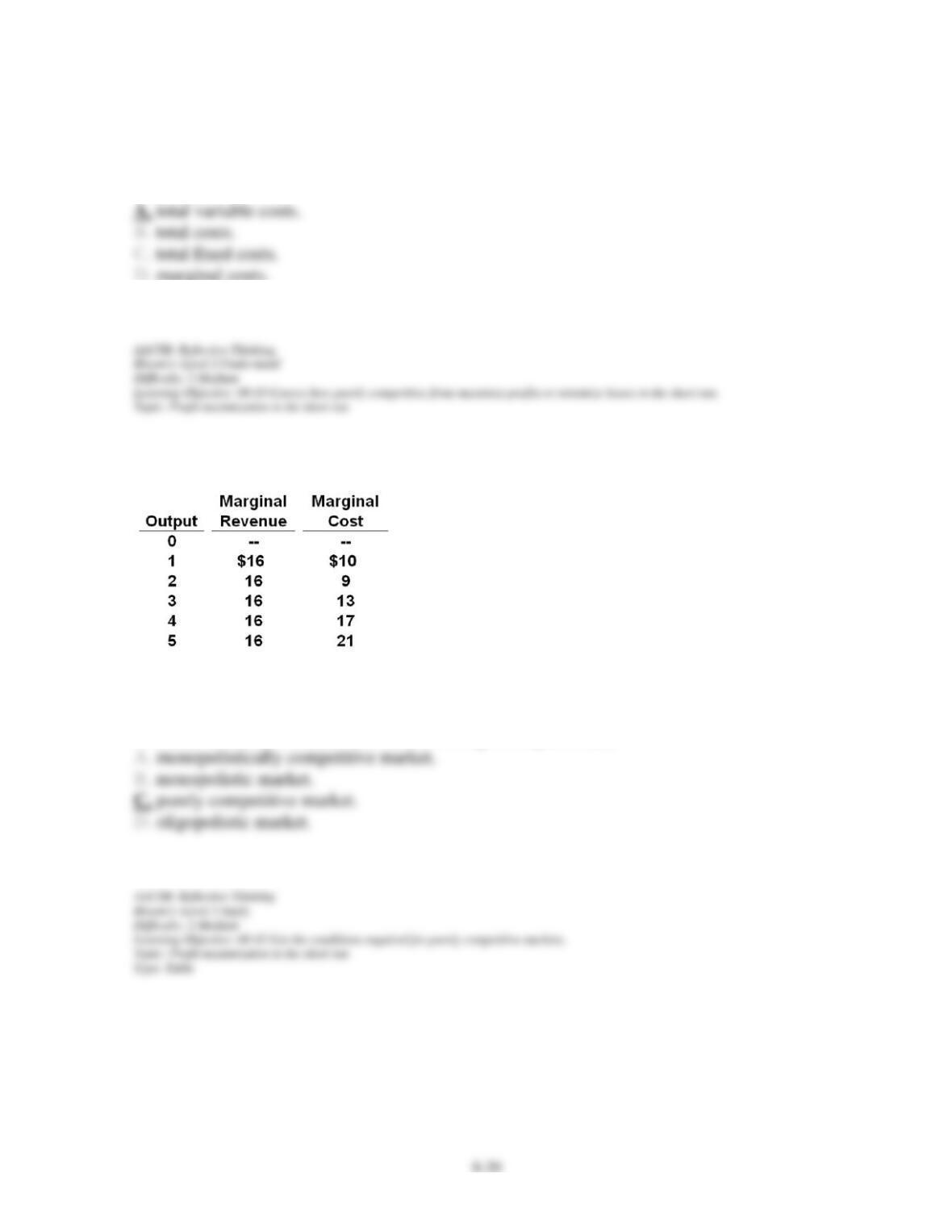
Answer the question on the basis of the following data confronting a firm:
54. Refer to the above data. This firm is selling its output in a(n):