Chapter 08 – Pure Competition in the Short Run
1. Which market model assumes the least number of firms in an industry?
2. In which market model would there be a unique product for which there are no close
substitutes?
Chapter 08 – Pure Competition in the Short Run
3. There would be some control over price within rather narrow limits in which market
model?
5. In which two market models would advertising be used most often?
Chapter 08 – Pure Competition in the Short Run
6. Under which market model are the conditions of entry into the market easiest?
7. Under which market model are the conditions of entry the most difficult?
8. Local electric or gas utility companies mostly operate in which market model?
Chapter 08 – Pure Competition in the Short Run
9. The fast-food restaurant industry would be an example of which market model?
10. The production of agricultural products such as wheat or corn would best be described by
which market model?
11. The steel and automobile industries would be examples of which market model?
Chapter 08 – Pure Competition in the Short Run
12. Which is not a basic market model?
13. Which idea is inconsistent with pure competition?
14. Which characteristic would best be associated with pure competition?
Chapter 08 – Pure Competition in the Short Run
15. If a firm has at least some control over the price of its product, then the firm cannot be in
which market model:
16. In a purely competitive industry, each firm:
17. Which is a feature of a purely competitive market?
Chapter 08 – Pure Competition in the Short Run
18. Which is true under conditions of pure competition?
19. Which is a reason why there is no advertising by individual firms under pure
competition?
20. Price is constant or “given” to the individual firm selling in a purely competitive market
because:
Chapter 08 – Pure Competition in the Short Run
21. Which is not a required characteristic of a purely competitive industry?
22. A purely competitive firm does not try to sell more of its product by lowering its price
below the market price because:
23. A purely competitive firm can be identified by the fact that:
Chapter 08 – Pure Competition in the Short Run
24. The demand curve faced by a purely competitive firm:
25. In pure competition, the demand for the product of a single firm is perfectly:
26. If a firm is a price taker, then the demand curve for the firm’s product is:
Chapter 08 – Pure Competition in the Short Run
27. Sam owns a firm that produces tomatoes in a purely competitive market. The firm’s
demand curve is:
28. In pure competition, each extra unit of output that a firm sells will yield a marginal
revenue that is:
29. Average revenue is conceptually equivalent to the:
Chapter 08 – Pure Competition in the Short Run
30. In a graph for a firm in pure competition with the quantity of output measured on the
horizontal axis, the total revenue curve is:
31. The total revenue of a purely competitive firm from 8 units of output is $48. Based on this
information, total revenue for 9 units of output must be:
32. A purely competitive firm currently producing 20 units of output earns marginal revenues
of $12 from each extra unit of output it sells. If it sells 30 units, then its total revenues would
be:
Chapter 08 – Pure Competition in the Short Run
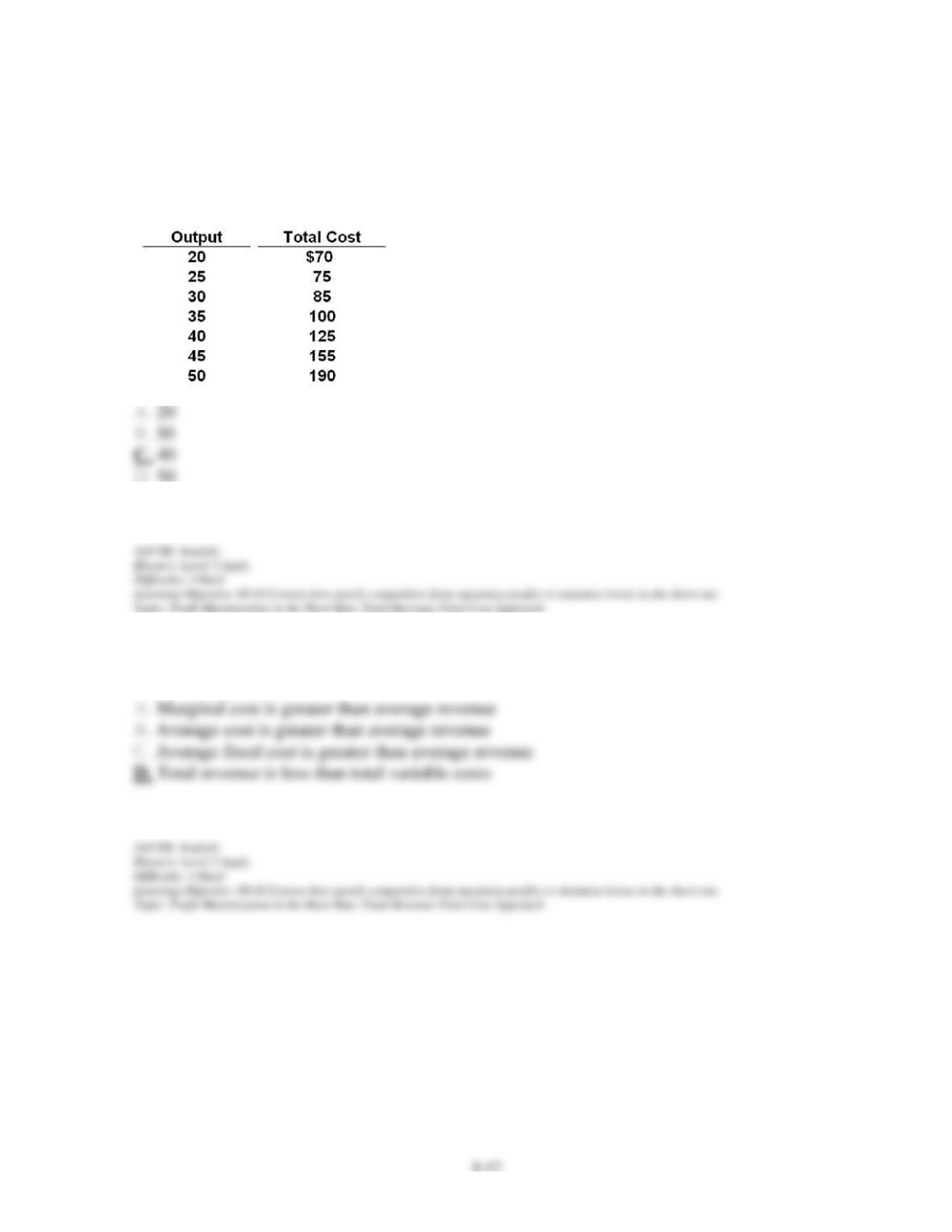
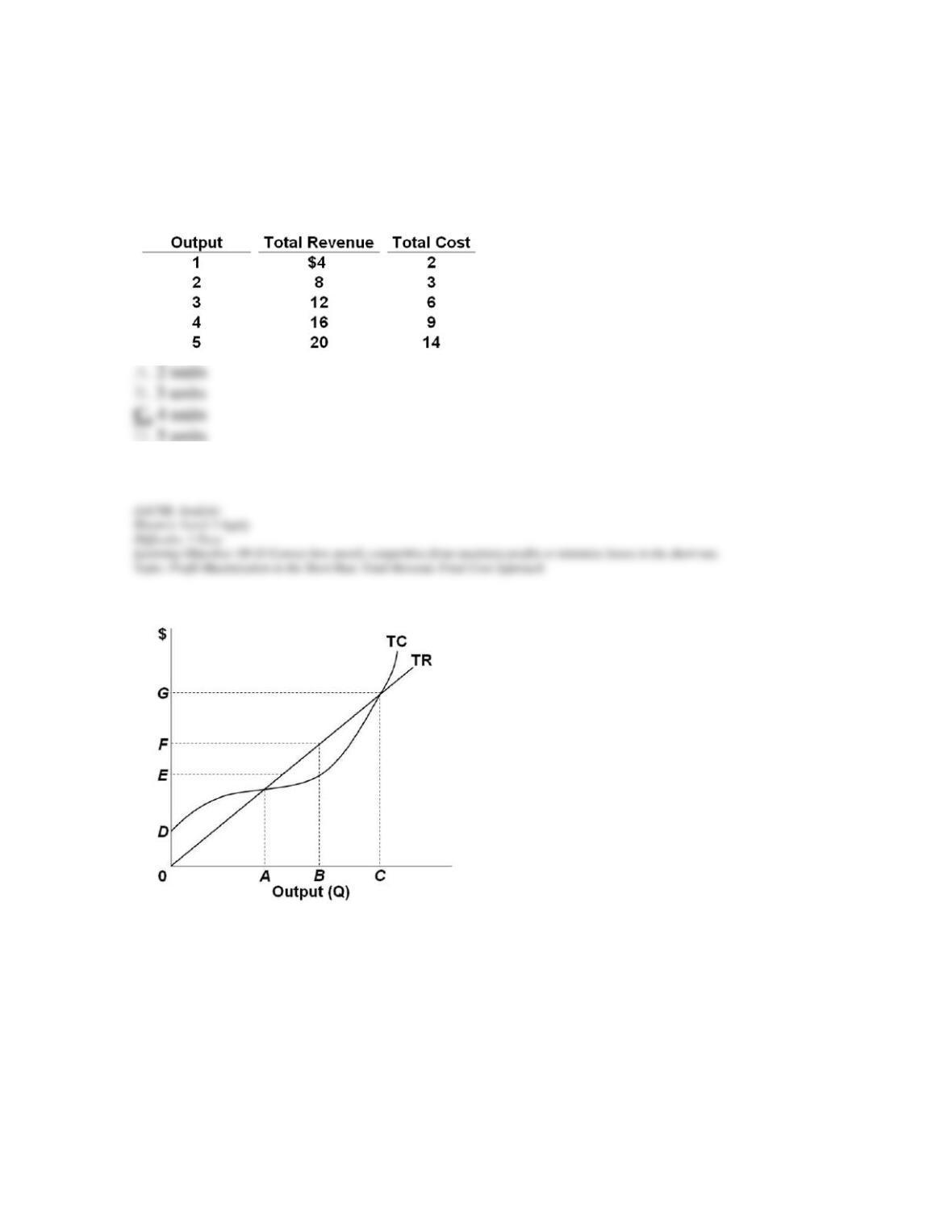
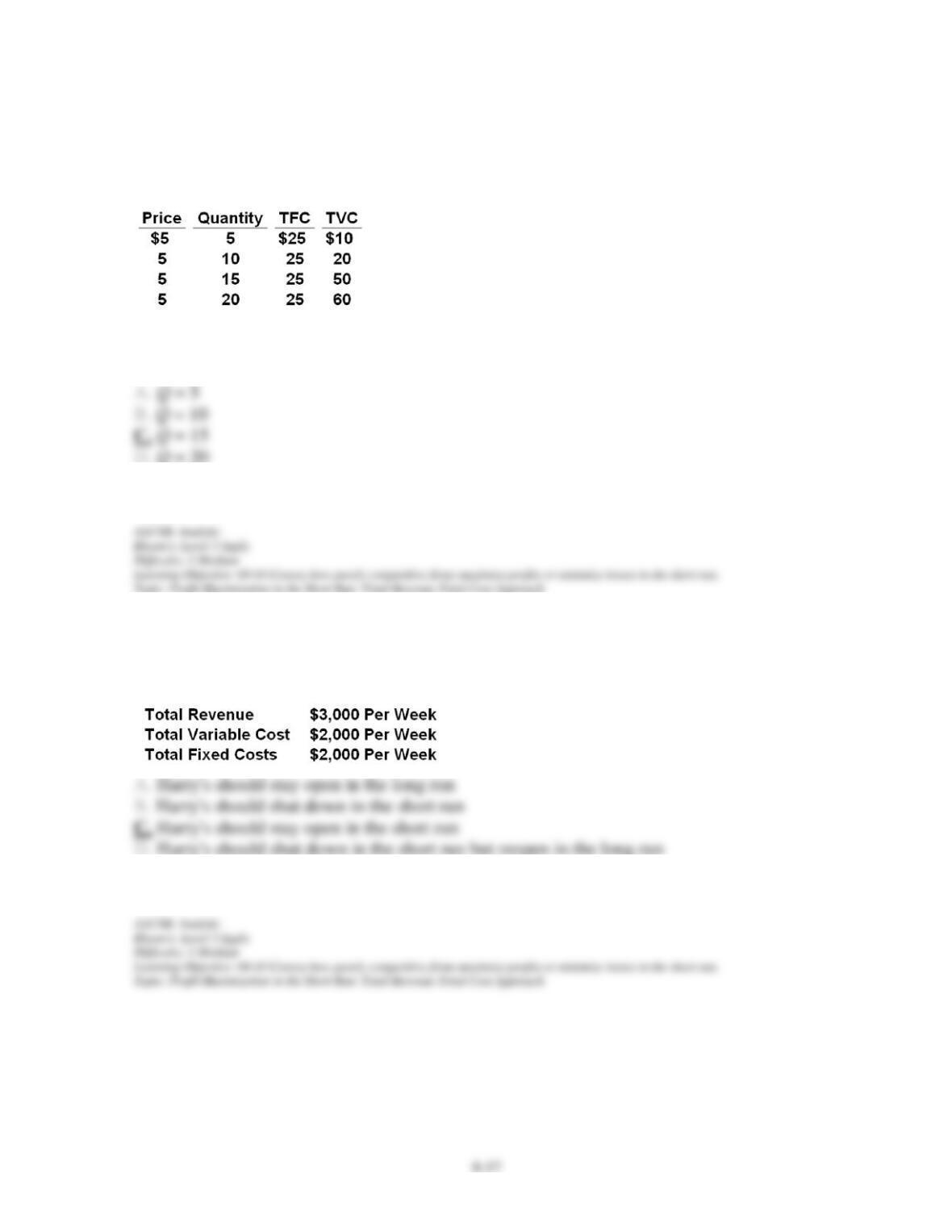
33. Assume the price of a product sold by a purely competitive firm is $5. Given the data in
the accompanying table, at what output level is total profit highest in the short run?
34. In the standard model of pure competition, a profit-maximizing entrepreneur will shut
down in the short run if:
Chapter 08 – Pure Competition in the Short Run
8-13
35. Given the table below, what is the short-run profit-maximizing level of output for the
firm?
Chapter 08 – Pure Competition in the Short Run
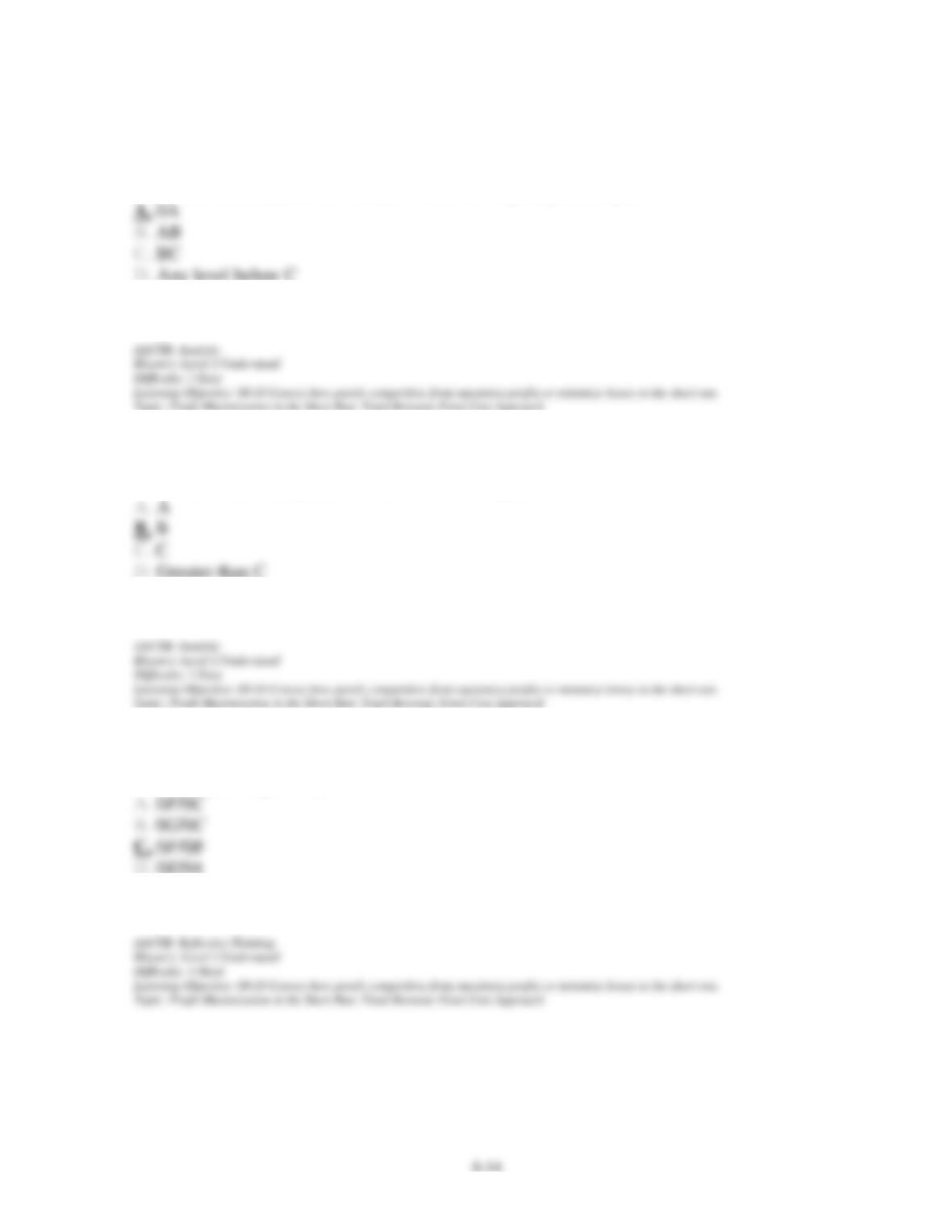
36. Refer to the above graph for a purely competitive firm in the short run. The firm would
suffer losses if it operates at which of the following range of output?
37. Refer to the above graph for a purely competitive firm in the short run. Profits would be
maximum if the firm produces which level of output?
38. Refer to the above graph for a purely competitive firm in the short run. The price of the
firm’s product is given by:
Chapter 08 – Pure Competition in the Short Run
8-15
39. Refer to the above graph for a purely competitive firm in the short run. What minimum
output level should the firm produce just for it to break even?
40. Refer to the above graph for a purely competitive firm in the short run. If the firm
increases its output level from B to C, then its total profits will be:
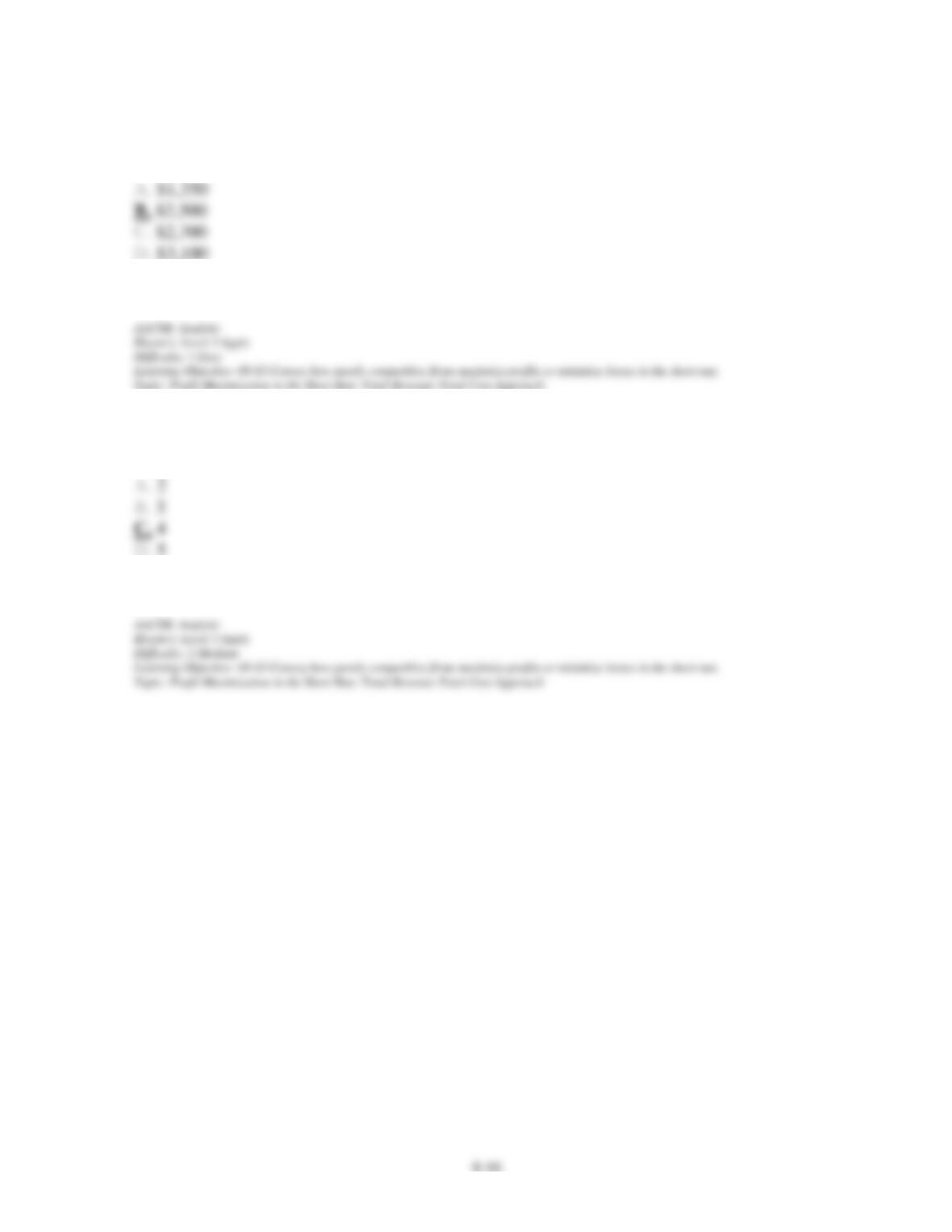
The table shows the total costs for a purely competitive firm.
Chapter 08 – Pure Competition in the Short Run
41. Refer to the above table. If the firm shuts down in the short run, the total cost will be:
42. Refer to the above table. If the product sells for $1,200 a unit, the firm’s profit-maximizing
output is:
Chapter 08 – Pure Competition in the Short Run
43. Answer the question based on the table below.
At what point on the table would a purely competitive firm cover all of its costs and earn only
normal profits?
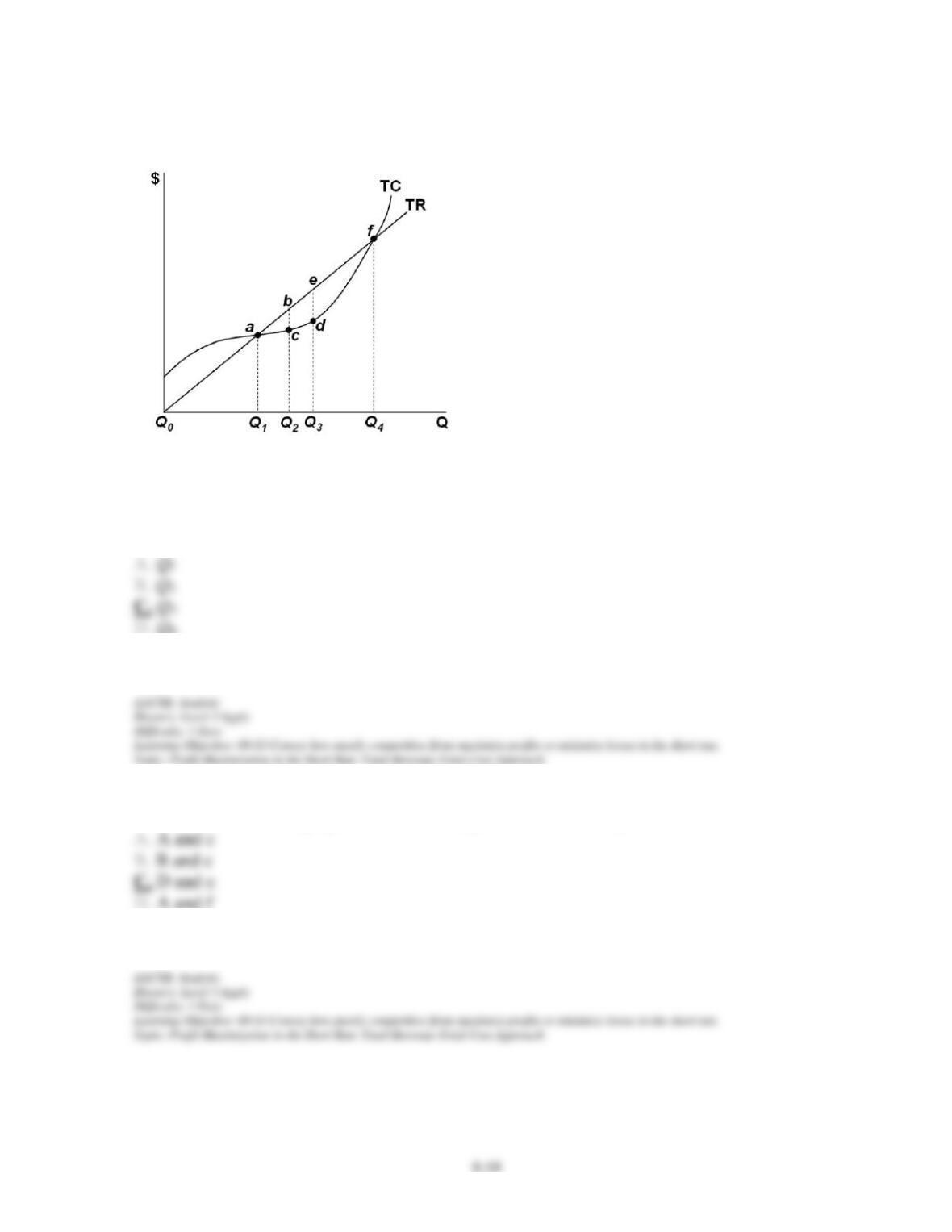
44. Let us suppose Harry’s, a local supplier of chili and pizza, has the following revenue and
cost structure:
Chapter 08 – Pure Competition in the Short Run
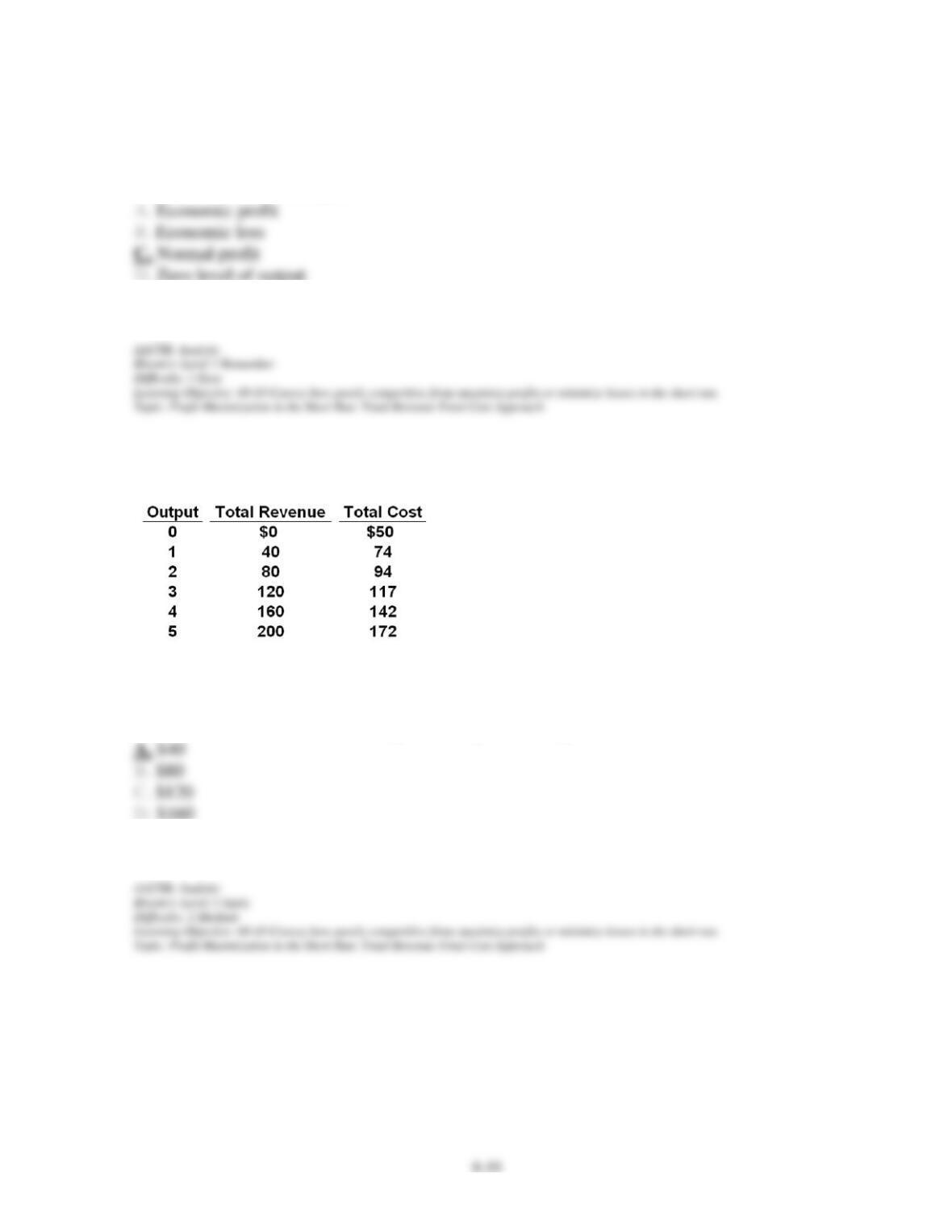
45. Refer to the above graph. Which of the output levels is the profit-maximizing output level
for this firm?
46. Refer to the above graph. The amount of profit is measured by the difference between:
Chapter 08 – Pure Competition in the Short Run
47. In a typical graph for a purely competitive firm, where the total cost and total revenue
curves intersect there is a(n):
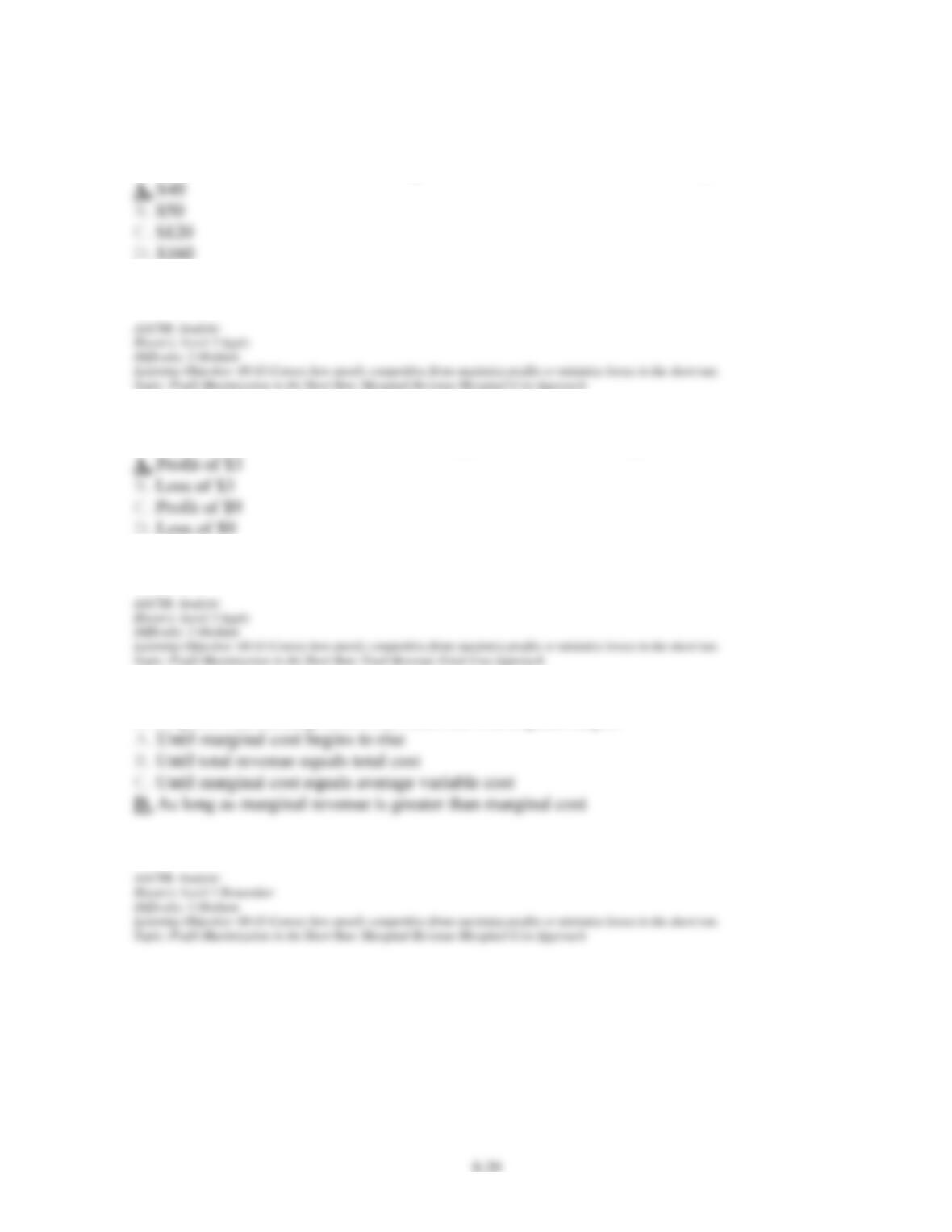
Use the table below to answer the question for a purely competitive firm.
48. Refer to the above table. The equilibrium price of the product is:
Chapter 08 – Pure Competition in the Short Run
49. Refer to the above table. The marginal revenue from the third unit of output is:
50. Refer to the above table. When the firm produces 3 units of output, it makes an economic:
51. A profit-maximizing firm in the short run will expand output: