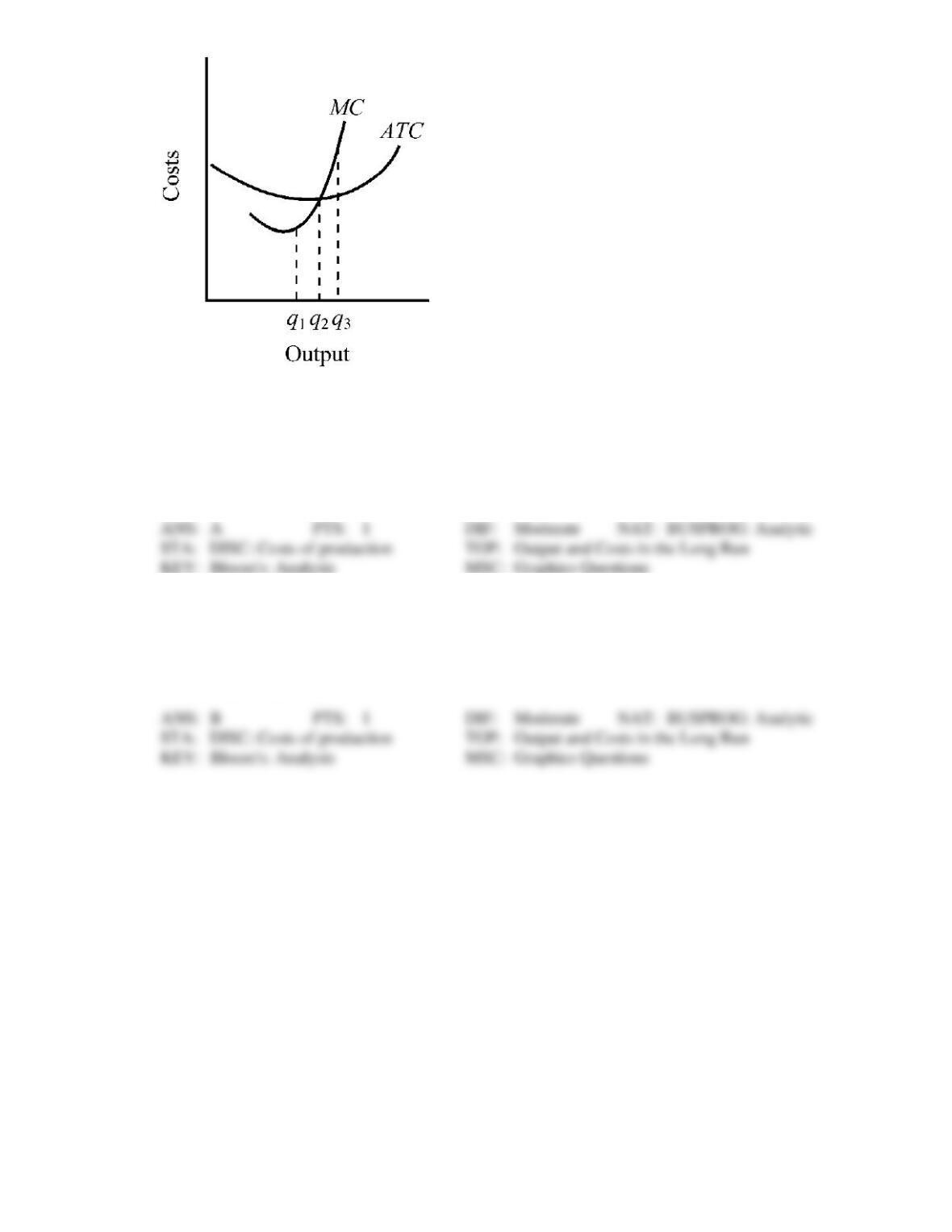
164. At what output does the firm depicted in Figure 8-6 begin to experience diminishing marginal returns
to its variable factors of production?
a.
q1
b.
q2
c.
q3
d.
an output beyond q3
165. At what output does the firm depicted in Figure 8-6 minimize its per-unit cost of production?
a.
q1
b.
q2
c.
q3
d.
an output beyond q3
Figure 8-7
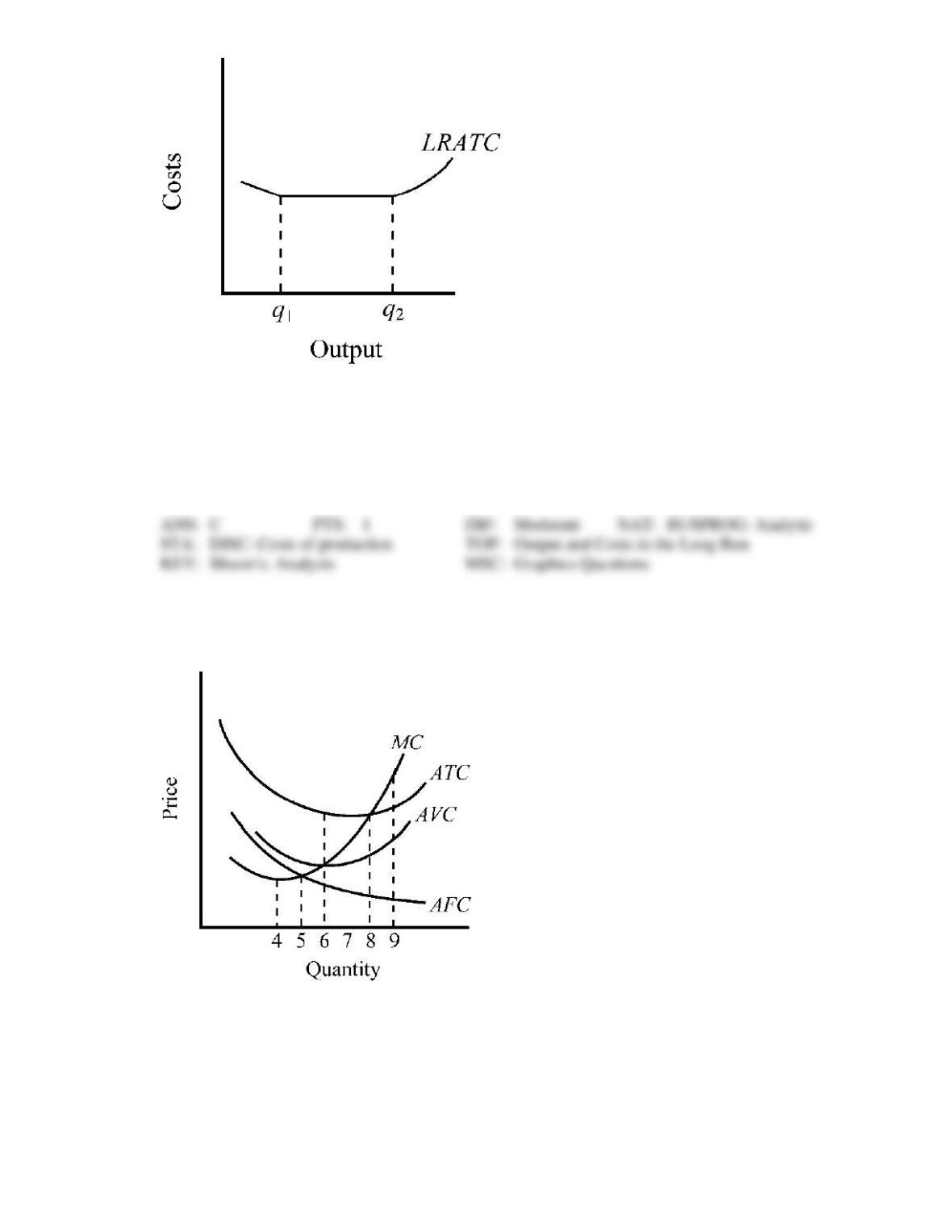
166. Which of the following is true for Figure 8-7?
a.
Firms in this industry begin to experience diminishing returns to their variable factors at
output q1.
b.
Between q1 and q2, firms in this industry experience economies of scale.
c.
Firms producing output rates less than q1 or more than q2 will find it difficult to survive.
d.
The largest firms in this industry have the lowest per-unit cost.
Use the figure to answer the following question(s).
Figure 8-8
167. In Figure 8-8, which output level would be most closely associated with the point where diminishing
marginal returns have begun?
a.
4
b.
5
c.
6
d.
8
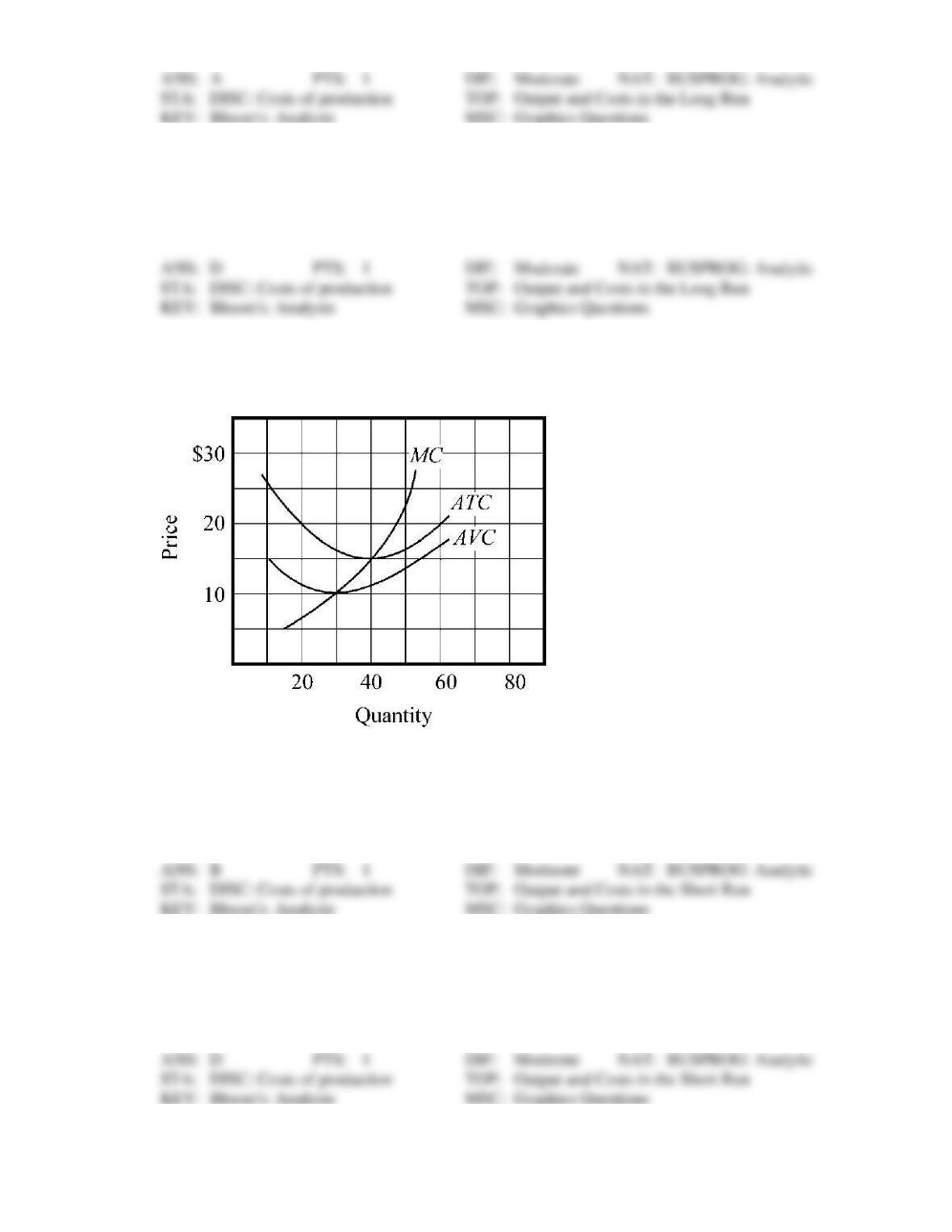
168. In Figure 8-8, which output minimizes per-unit cost?
a.
4
b.
6
c.
7
d.
8
Use the figure to answer the following question(s).
Figure 8-9
169. In Figure 8-9, which output would minimize the firm’s average total cost of production?
a.
30
b.
40
c.
50
d.
60
170. Using Figure 8-9, calculate the firm’s approximate total cost when average total cost is at a minimum.
a.
$100
b.
$160
c.
$480
d.
$600
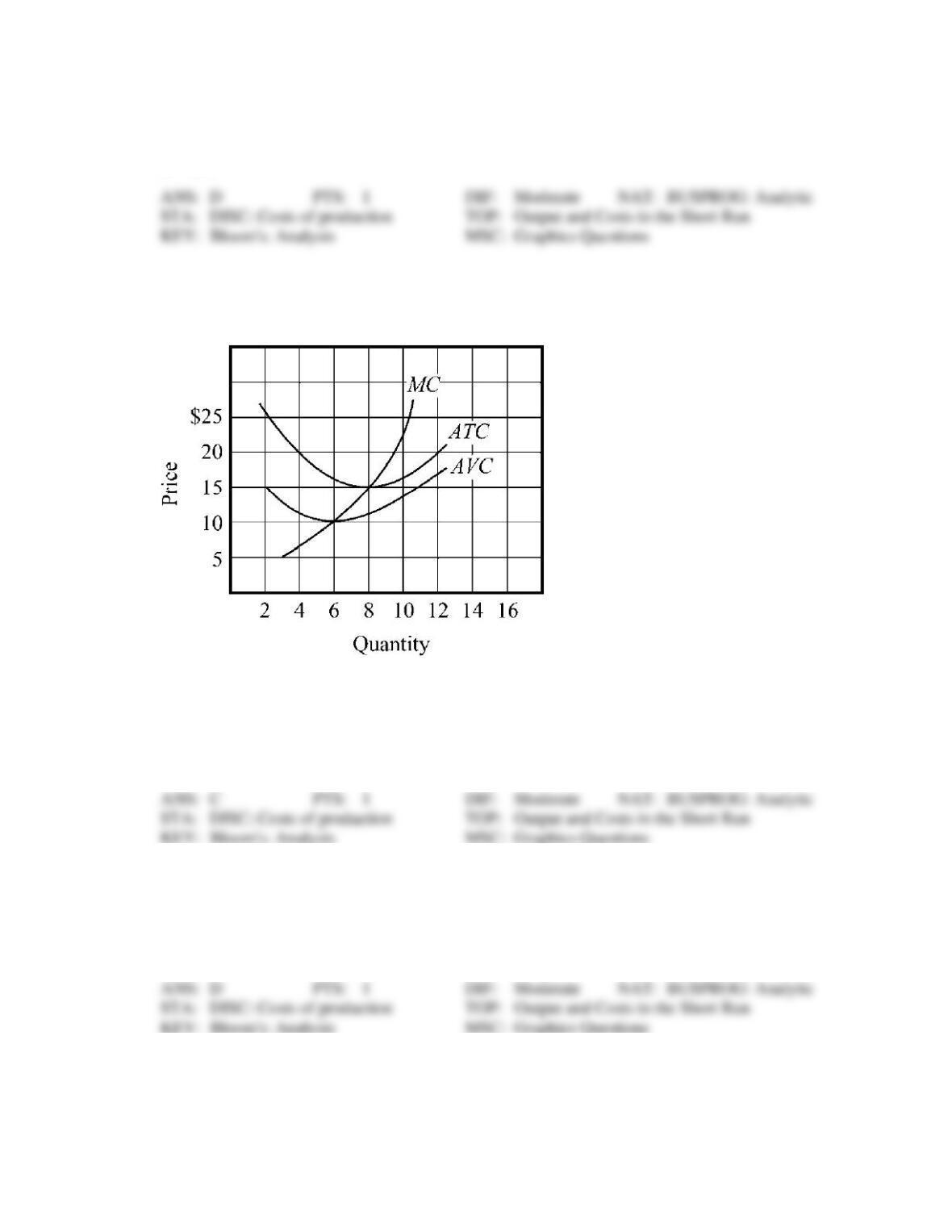
171. Using Figure 8-9, calculate the firm’s approximate average total cost when it produces 50 units.
a.
$10
b.
$13
c.
$15
d.
$17
Use the figure to answer the following question(s).
Figure 8-10
172. In Figure 8-10, which output would minimize the firm’s average total cost of production?
a.
4
b.
6
c.
8
d.
10
173. Using Figure 8-10, calculate the firm’s approximate total cost when average total cost is at a minimum.
a.
$60
b.
$80
c.
$100
d.
$120
174. Using Figure 8-10, calculate the firm’s approximate average total cost when it produces 12 units.
a.
$5
b.
$10
c.
$15
d.
$20
Use the figure to answer the following question(s).
Figure 8-11
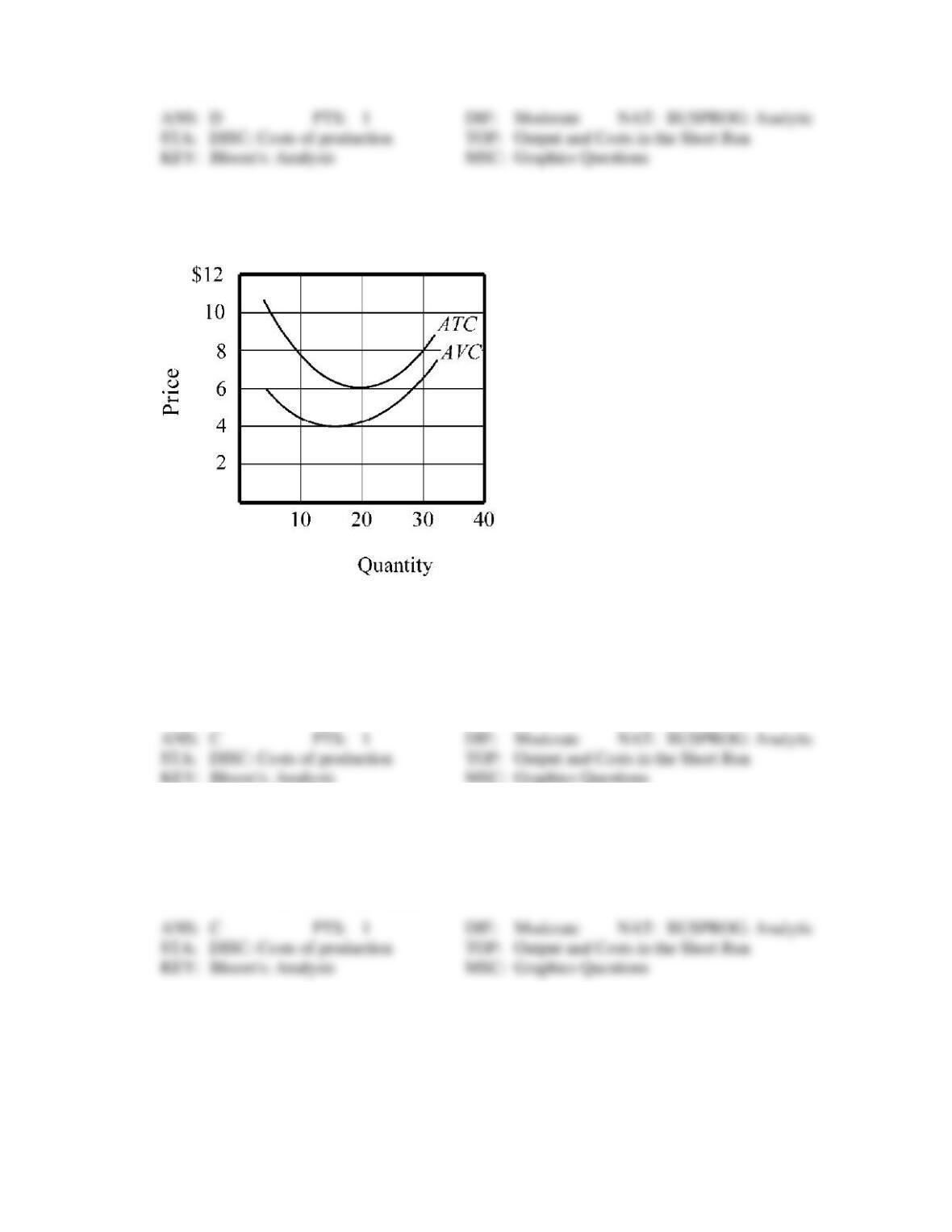
175. The average variable cost (AVC) and average total cost (ATC) for a firm are indicated in Figure 8-11.
The firm’s total cost of producing 20 units is
a.
$6.
b.
$84.
c.
$120.
d.
$150.
176. Which of the following is true for a firm with the costs illustrated in Figure 8-11?
a.
Marginal costs exceed average total cost when output is 15.
b.
Marginal costs exceed average total cost when output is 20.
c.
Marginal costs exceed average total cost when output is 25.
d.
The firm’s total fixed cost exceeds 40.
Figure 8-12
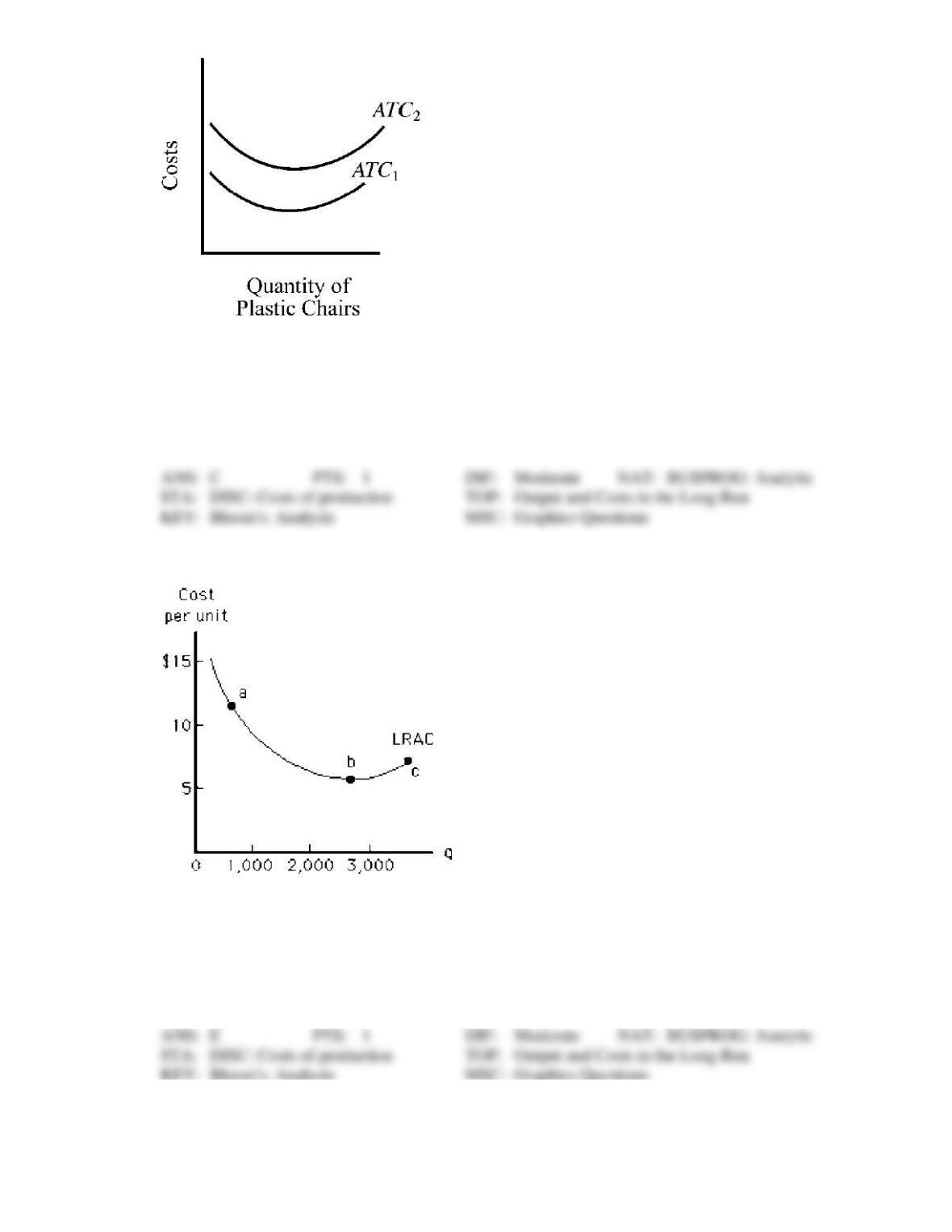
177. In Figure 8-12, which of the following would most likely cause the average total cost curve of a firm
producing molded plastic chairs to shift from ATC1 to ATC2?
a.
an increase in demand for plastic chairs
b.
an increase in the market price of plastic chairs
c.
an increase in the price of the plastic used to produce the chairs
d.
a reduction in corporate income taxes
Figure 8-13
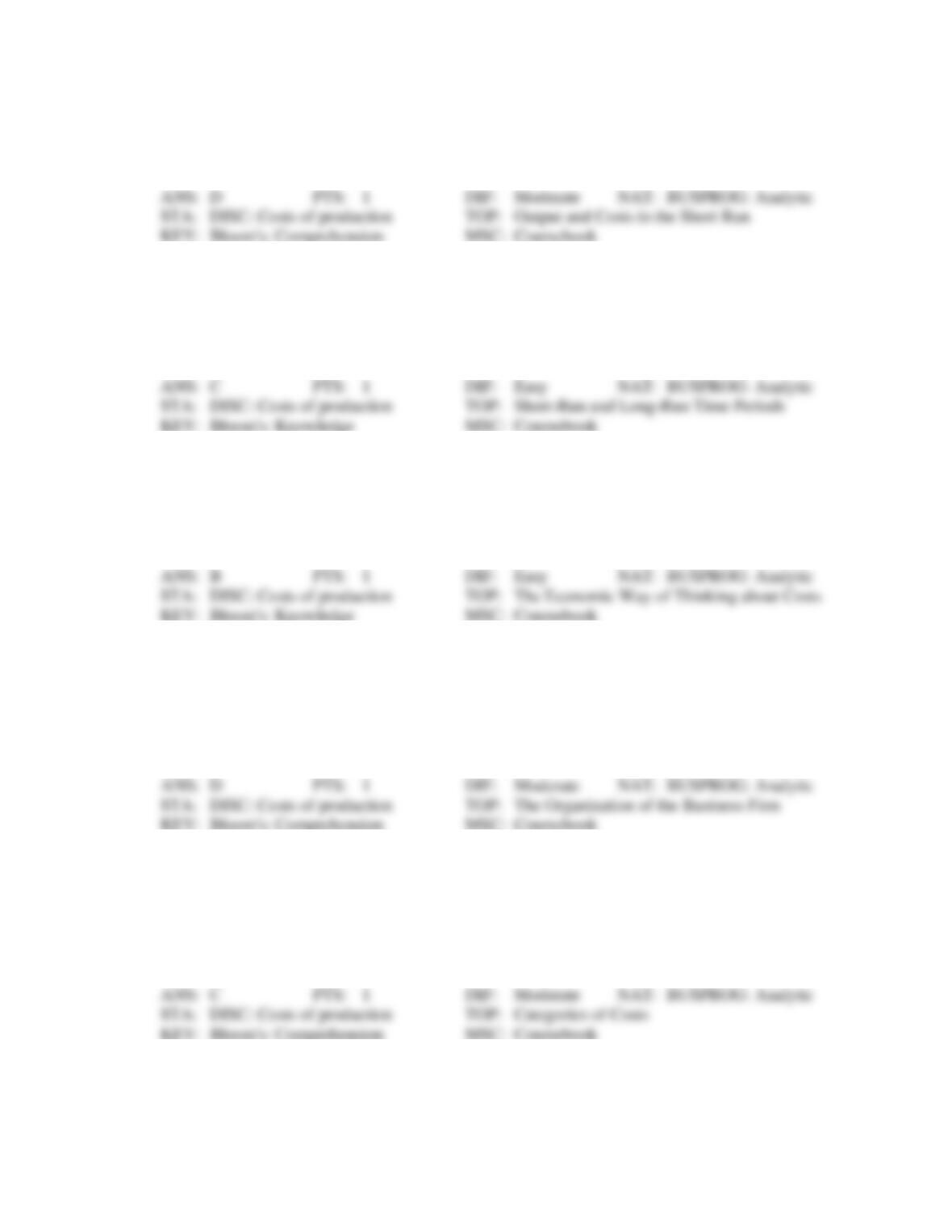
178. Movement from point b to point c in Figure 8-13 indicates that the firm is experiencing
a.
economies of scale.
b.
increasing average cost.
c.
economies of cost.
d.
a decrease in average plant size.
e.
diseconomies of scale.
179. The law of diminishing returns indicates why
a.
beyond some point, the extra utility derived from additional units of a product will yield
the consumer smaller and smaller amounts of additional satisfaction.
b.
the firm’s total fixed costs do not change with output in the short run.
c.
a firm’s long-run average total cost curve is U-shaped.
d.
a firm’s marginal costs will eventually increase as the firm expands output in the short run.
180. The short run is a time period of insufficient length for the firm to change its
a.
output.
b.
amount of labor employed.
c.
plant size and heavy equipment.
d.
price.
181. Sunk or “historical” costs are costs
a.
associated with current operational decisions.
b.
that have already been incurred as the result of past decisions.
c.
that add to the firm’s marginal costs.
d.
that form the major component of the firm’s variable costs.
182. Advantages of the corporate form of business organization include
a.
the ease of transferring ownership in a corporation.
b.
the limited liability concept that protects the stockholder from potential debts incurred by
the corporation.
c.
the lack of employee shirking that occurs in corporations.
d.
both a and b.
183. The average variable cost curve and average total cost curve become closer together as output
increases because
a.
the marginal cost curve intersects the average total cost curve at its minimum.
b.
average fixed cost remains constant as output rises.
c.
average fixed cost, which is the difference between them, declines with output.
d.
output is rising more rapidly than inputs are being increased.
184. Which of the following factors would not shift the cost curves of an automobile company upward?
a.
a regulation requiring all automobiles be equipped with improved safety equipment
b.
an increase in the price of steel used to make automobiles
c.
an increase in the property tax on buildings and equipment used by the automobile
company
d.
An employee develops a new method of installing doors on the cars that requires half as
many workers as before.
185. The firm’s average total costs will be a minimum at the output level where the
a.
firm just begins to confront diminishing returns to the variable factors.
b.
marginal costs are a minimum.
c.
firm’s average fixed costs are at their minimum.
d.
marginal cost curve crosses the firm’s average total cost curve.
186. The law of diminishing returns states that
a.
as we continually add variable factors to a fixed amount of other resources, output
eventually increases at a decreasing rate.
b.
as we increase plant size, costs must diminish.
c.
the additional output generated by the employment of additional units of a variable input
eventually decline.
d.
both a and c are correct.
Figure 8-14
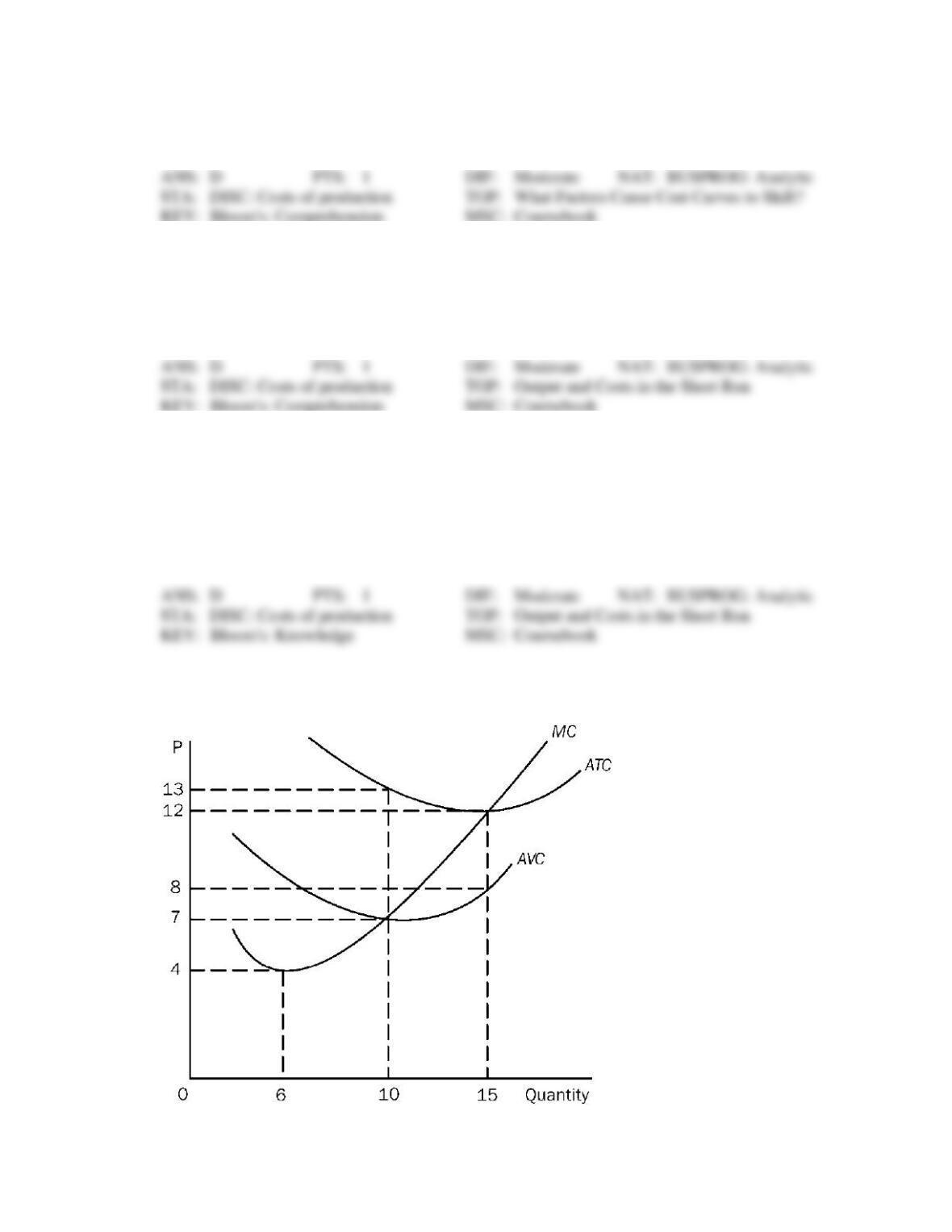
The following question(s) refer(s) to the below cost curves for one very small firm in a large market.
187. Refer to Figure 8-14. If the firm produces 10 units of output, its average total cost is
a.
6.
b.
7.
c.
12.
d.
13.
188. Refer to Figure 8-14. If the firm produces 15 units of output, its average fixed cost is
a.
4.
b.
5.
c.
6.
d.
60.
189. Refer to Figure 8-14. If the firm produces 10 units of output, its total cost is
a.
7.
b.
13.
c.
70.
d.
130.
190. Refer to Figure 8-14. If the firm produces 10 units of output, its total fixed cost is
a.
6.
b.
60.
c.
70.
d.
130.
191. Refer to Figure 8-14. The marginal cost of producing the tenth unit is
a.
7.
b.
13.
c.
70.
d.
130.
192. Refer to Figure 8-14. This firm minimizes its per-unit costs of production at an output level of
a.
Q = 6.
b.
Q = 10.
c.
Q = 15.
d.
none of the above.
193. Refer to Figure 8-14. Diminishing returns to the variable factor of production for this firm set in at
a.
Q = 6.
b.
Q = 10.
c.
Q = 15.
d.
none of the above.
194. A homeowner will be away from her house for six months. The monthly mortgage payment on the
house is $300. The utilities, to be paid by the owner, cost $100 per month if the house is occupied;
otherwise zero. If the owner wishes to minimize her losses from the house, she should rent the house
for as much as the market will bear, as long as monthly rent is greater than which of the following?
(Assume wear and tear to be zero regardless of whether the house is occupied.) (Hint: Remember the
concept of sunk cost.)
a.
$0
b.
$100
c.
$200
d.
$400
195. Suppose you value watching a movie at $5. You rent it from your local movie rental store for $3.50 for
one night. You do not get a chance to watch it, so you decide to keep it an extra day and pay a late fee
of $2. Your decision is
a.
incorrect; you paid $5.50 to watch a movie you valued at only $5. You should have taken
the movie back.
b.
incorrect; you should have returned the movie and rented it later.
c.
correct; the $3.50 paid for the first night is a sunk cost and is not relevant in your decision
to keep it an additional night.
d.
correct; you value watching the movie at $5 per night, so keeping it an extra day increases
your value of the movie to $10.
196. Which of the following factors is most likely to shift the cost curves of an Iowa corn farmer
downward?
a.
an increase in the price of fertilizer
b.
an increase in the tax on diesel fuel, which is used by the farmer
c.
the development of a new, more efficient corn harvester
d.
the adoption of a regulation requiring farmers to treat their crops with three new
pesticides.
197. Which of the following is true?
a.
Economic profits are generally lower than accounting profits.
b.
Economic profits are generally greater than accounting profits.
c.
Economic profits are generally equal to accounting profits.
d.
Economic profits plus accounting profits must equal zero.
198. When a firm increases its plant size in the long run and its per-unit costs fall, this is called
a.
diminishing returns and is shown by the downward-sloping portion of the MP curve (or
the upward-sloping portion of the MC curve).
b.
constant returns to scale and is shown by the flat portion of the LRATC curve.
c.
diseconomies of scale and is shown by the upward-sloping portion of the LRATC curve.
d.
economies of scale and is shown by the downward-sloping portion of the LRATC curve.
199. When the owner of a business invests his or her own money in the business, they give up the interest
this money could be earning in the bank. This forgone interest is called
a.
the marginal cost of diminishing financial services.
b.
the opportunity cost of equity capital.
c.
the opportunity cost of labor services.
d.
interest expense and is included as a cost in the accounting statements of the business.
200. Ron works for Betty at Betty’s Pizza Palace. Betty has many work rules, and Ron believes if there
were fewer rules and more flexibility, he could do a better job. Betty probably has the rules because
a.
Ron, like her other employees, is a residual claimant.
b.
due to the principal-agent problem, some employees are likely to shirk when the owner is
absent.
c.
she is maximizing sales rather than profits.
d.
with regard to their jobs, employees seldom know what is best.
201. Which of the following is true?
a.
Under the partnership form of business organization, the owners are not personally liable
for the debts of the business.
b.
When employees are paid by the hour, their incentive to shirk is removed.
c.
The limited liability of stockholders under the corporate business structure makes it easier
to raise equity capital.
d.
Under the corporate form of business organization, the owners of the firm are personally
liable for its debts.
202. Mary owns her own business and works full time in the store without paying herself a salary. She has
$20,000 of her own money invested in the store that she withdrew from her savings account, which
earned 10 percent interest. She was offered a job last year making $28,000 per year but turned it down.
If Mary’s accounting statements show revenues of $100,000 and accounting costs of $60,000, then
Mary’s
a.
accounting profit is $20,000 and her economic profit is zero.
b.
accounting profit is $40,000 and she is making an economic loss of $8,000.
c.
accounting profit is $40,000 and her economic profit is $10,000.
d.
accounting and economic profit is $40,000.
203. When an economist says a firm is earning zero economic profit, this implies that the firm
a.
will be forced out of business in the near future unless market conditions change.
b.
is earning a zero rate of return on its assets.
c.
is earning as high a rate of return now as could be earned in other industries.
d.
has an accounting profit of zero.
204. The long run is a period of
a.
at least one year.
b.
sufficient length to allow a firm to expand output by hiring additional workers.
c.
sufficient length to allow a firm to alter its plant size and capacity and all other factors of
production.
d.
sufficient length to allow a firm to transform economic losses into economic profits.
205. As output is expanded, if MC is more than ATC,
a.
ATC must be at its minimum.
b.
ATC must be at its maximum.
c.
ATC must be increasing.
d.
ATC must be constant.
206. Mr. Hudson notes that if he produces 10 pairs of shoes per day, his average fixed cost (AFC) is $14
and his marginal cost $8; if he produces 20 pairs of shoes per day, his MC is $15. What is his AFC
when output is 20 pairs of shoes per day?
a.
$5
b.
$7
c.
$8
d.
$15
207. Bill lives in Montana and likes to grow zucchini. He applies fertilizer to his crop twice during the
growing season and notices that the second layer of fertilizer increases his crop but not as much as the
first layer. What economic concept best explains this observation?
a.
the law of diminishing marginal utility
b.
the law of diminishing returns
c.
return equalization principle
d.
the principal-agent problem
208. Larger firms will often have lower minimum per-unit costs than smaller firms because
a.
employee shirking is less of a problem.
b.
large-scale output allows greater specialization for both labor and machines in the
production process.
c.
mass production techniques, with high setup and development costs, are appropriate only
when a small output is planned.
d.
all of the above are correct.
209. In the short run, the marginal cost curve crosses the average total cost curve at
a.
a point just below the average fixed cost curve.
b.
the minimum point on the average total cost curve.
c.
the maximum point of the average variable cost curve.
d.
all of the above points.
210. What amount must be earned to induce investors to continue to supply the funds necessary to maintain
a firm’s capital assets?
a.
stockholder equity
b.
the opportunity cost of capital
c.
economic profit
d.
accounting profit
211. Which of the following explains why business owners have a strong incentive to strive for operational
efficiency?
a.
they recognize that operational efficiency promotes the public interest.
b.
since the owners are residual income claimants, increased efficiency will mean a higher
income for the owners.
c.
if production is not conducted efficiently, the firm will ship jobs and capital out of the
domestic market in order to be able to compete effectively.
d.
Increased operational efficiency allows the firm to receive government tax breaks.
212. Which of the following is true?
a.
under the partnership form of business organization, the owners are not personally liable
for the debts of the business.
b.
when employees also own a business, their incentive to shirk is removed.
c.
the limited liability of stockholders under the corporate business structure makes it easier
to raise equity capital.
d.
under the corporate form of business organization, the owners of the firm are personally
liable for its debts.
213. If most firms in an industry are earning a 7 percent rate of return on their assets, but your business is
earning 9 percent, your rate of economic profit is
a.
minus 2 percent.
b.
2 percent.
c.
9 percent.
d.
16 percent.
214. Which of the following is the best example of a fixed cost for a business?
a.
the insurance payment for the protection of a building owned by the firm
b.
shipping charges for the delivery of products
c.
managerial salaries paid
d.
the total of medical insurance premiums on the firm’s employees
215. As a firm expands output, in the short run marginal costs will
a.
always decline as output expands.
b.
increase at first but eventually level off and decline.
c.
eventually increase as the firm experiences diminishing returns to the fixed factors of
production.
d.
initially increase at a decreasing rate but eventually increase at an increasing rate.
216. The optimal plant size depends on
a.
whether the firm confronts diminishing returns on its fixed factors of production.
b.
the output the firm expects to produce.
c.
whether the plant uses capital-intensive or labor-intensive production techniques.
d.
the preferences of the individual firm owners.
217. A 10-cent-per-box tax on producers of cigars will
a.
shift the firm’s ATC and MC curves upward by the full amount of the tax.
b.
induce the firm to produce less but will not shift the firm’s MC curve.
c.
shift the firm’s ATC and MC curves downward by the full amount of the tax.
d.
shift the MC curve upward but will not cause any shift in the ATC curve.
218. Sunk costs
a.
are expenditures made in the past that cannot be regained no matter what is done now or in
the future.
b.
are a component of variable costs, but not fixed costs.
c.
represent foregone opportunities, and therefore the firm’s managers should consider these
costs when they are making current decisions.
d.
can be avoided if the firm goes out of business.
219. The upward-sloping portion of a long-run average total cost curve is the result of
a.
economies of scale.
b.
diseconomies of scale.
c.
diminishing returns.
d.
the existence of fixed resources.
220. The three basic legal forms of business enterprise are
a.
monopolists, competitors, and enterprises.
b.
vertical, horizontal, and conglomerate corporations.
c.
conglomerates, multinationals, and partnerships.
d.
proprietorships, partnerships, and corporations.
221. Libby has a business using no owned capital and makes an accounting profit of $52,000 a year. Libby
could have worked for Verizon Wireless with a pay of $35,000 a year, but she would not have had
time to run her business. The economic profit from Libby’s business per year is
a.
$87,000.
b.
$35,000.
c.
$17,000.
d.
−$17,000.
222. If a firm’s per-unit costs fall as it produces a larger output,
a.
average variable cost must also decline as output expands.
b.
marginal cost must also decline as output expands.
c.
average fixed cost must be less than average variable costs.
d.
marginal cost must be less than average total cost.
223. What is the difference between accounting profit and economic profit?
a.
They are the same thing.
b.
They are only different if the accountant makes a mistake.
c.
Accounting profit is usually smaller than economic profits.
d.
Accounting profit makes no allowance for several implicit costs, including equity capital,
while economic profit takes these costs into account.