7) The total factor payments to all resource owners is called
A) net domestic product.
B) personal income.
C) national income.
D) gross domestic income.
8) Suppose net domestic product is $4.8 billion, net income earned abroad is $0.7 billion, other
business income adjustments net of indirect business taxes and transfers are $0.4 billion, and
personal income taxes are $0.8 billion. Then, national income equals
A) $2.9 billion.
B) $3.6 billion.
C) $5.9 billion.
D) $6.7 billion.
9) Gross Domestic Product (GDP) = $13.0 trillion, consumption = $9.5 trillion, depreciation =
$1.8 trillion, other business income adjustments less indirect business taxes = $0.2 trillion, and
net U.S. income earned abroad = $0.1 trillion. Use this information to calculate national income
(NI).
A) NI = $11.0 billion
B) NI = $11.3 billion
C) NI = $11.4 billion
D) NI = $11.5 billion
10) National income is income ________ the factors of production.
A) paid by
B) earned by
C) invested in
D) households owe to
11) Personal income is equal to
A) NDP minus national income.
B) disposable personal income plus personal income taxes.
C) disposable personal income plus personal and corporate income taxes.
D) national income minus (corporate income taxes and Social Security).
12) If you take national income and add transfer payments, then subtract income earned but not
received, the result will be
A) net national product.
B) disposable personal income.
C) personal income.
D) wages.
13) The difference between personal income and disposable personal income is that
A) disposable personal income includes only the funds available to spend on non-necessities.
B) personal income taxes are not included in disposable personal income.
C) personal income includes personal income taxes and indirect business taxes, which are not
included in disposable personal income.
D) personal income does not include transfer payments, such as Social Security payments or
welfare payments and disposable personal income includes them.
14) The amount of income received by households prior to the payment of personal income taxes
is called
A) disposable wages.
B) personal income.
C) national income.
D) net domestic product.
15) If disposable personal income (DPI) = $800 and personal income taxes = $100, then what is
personal income (PI)?
A) $900
B) $800
C) $700
D) can’t tell from the information provided
16) Which of the following will be the smallest in value?
A) national income
B) net domestic product
C) personal income
D) disposable personal income
17) Disposable personal income is found by taking
A) personal income taxes minus personal income.
B) personal income minus personal income taxes.
C) personal income taxes plus personal income.
D) personal income times personal income taxes.
18) Disposable personal income is equal to
A) national income minus personal income taxes.
B) personal income plus transfer payments.
C) Gross Domestic Product (GDP) minus depreciation.
D) personal income minus personal income tax payments.
19) Income earned by the factors of production is called
A) gross domestic income.
B) disposable personal income.
C) personal income.
D) national income.
20) Which of the following accurately represents income earned by all factors of production?
A) national income
B) personal income
C) disposable personal income
D) wages and salaries
21) Income received by the factors of production is called
A) gross domestic income.
B) disposable personal income.
C) personal income.
D) national income.
22) The income that individuals have after personal income taxes have been paid is called
A) gross domestic income.
B) disposable personal income.
C) personal income.
D) national income.
23) One key difference between national income and net domestic product is
A) net domestic product does not include income earned by the factors of production while
national income does.
B) net domestic product represents income that is available to individuals while national income
does not.
C) net domestic product includes indirect business taxes and transfers while national income
does not.
D) net domestic product only includes the net additions to the economy’s stock of capital while
national income does not.
24) Individuals receive income and pay taxes over the course of a year. The difference between
the income they receive and the taxes they pay is referred to as
A) net national income.
B) net domestic product.
C) per capita real GDP.
D) disposable personal income.
25) The difference between personal income and disposable personal income is
A) disposable personal income is what is left after personal income taxes have been paid while
personal income includes personal income taxes.
B) personal income is what is left after personal income taxes have been paid while disposable
income includes personal income taxes.
C) personal income includes transfer payments while disposable personal income does not.
D) personal income includes indirect business taxes while disposable income does not.
26) Suppose gross domestic product (GDP) is $5 billion, government transfer payments are $1.5
billion, indirect business taxes and transfers are $0.25 billion, and depreciation is $0.5 billion.
Then national income equals
A) $5 billion.
B) $4.25 billion.
C) $3.25 billion.
D) $2.75 billion.
27) Which of the following will have the smallest dollar value?
A) personal income
B) disposable personal income
C) national income
D) net domestic product
28) One difference between net domestic product and national income is that
A) net domestic product includes depreciation.
B) national income includes government and business transfer payments.
C) net domestic product includes indirect business taxes and transfers.
D) net domestic product doesn’t include Social Security taxes or corporate retained earnings.
29) An decrease in Social Security contributions will make
A) gross domestic product larger.
B) national income larger.
C) national income smaller.
D) personal income larger.
30) Personal income taxes are the difference between
A) national income and personal income.
B) personal income and disposable personal income.
C) national income and disposable personal income.
D) net domestic product and personal income.
31) National income is $500, corporate taxes are $20, Social Security contributions are $60,
retained earnings are $10, personal taxes are $100, and transfer payments are $80. Disposable
income is
A) $510.
B) $450.
C) $410.
D) $390.
32) An increase in corporate income taxes would reduce
A) net domestic product.
B) gross domestic product.
C) national income.
D) personal income.
33) Suppose Social Security contributions rise by $10 billion while Social Security benefits also
rise by $10 billion. Further, personal income taxes fall by $700 million. As a result
A) both personal and disposable personal income should increase.
B) national income, personal income, and disposable income should increase.
C) disposable income should increase while personal income and national income are
unchanged.
D) personal income, disposable personal income, and national income remain unchanged.
34) What is the difference between personal income and disposable personal income?
A) the amount of personal income taxes
B) indirect personal taxes and transfers
C) net U.S. income earned abroad
D) depreciation
35) Transfer payments are included in
A) gross domestic product.
B) net domestic product.
C) national income.
D) personal income.
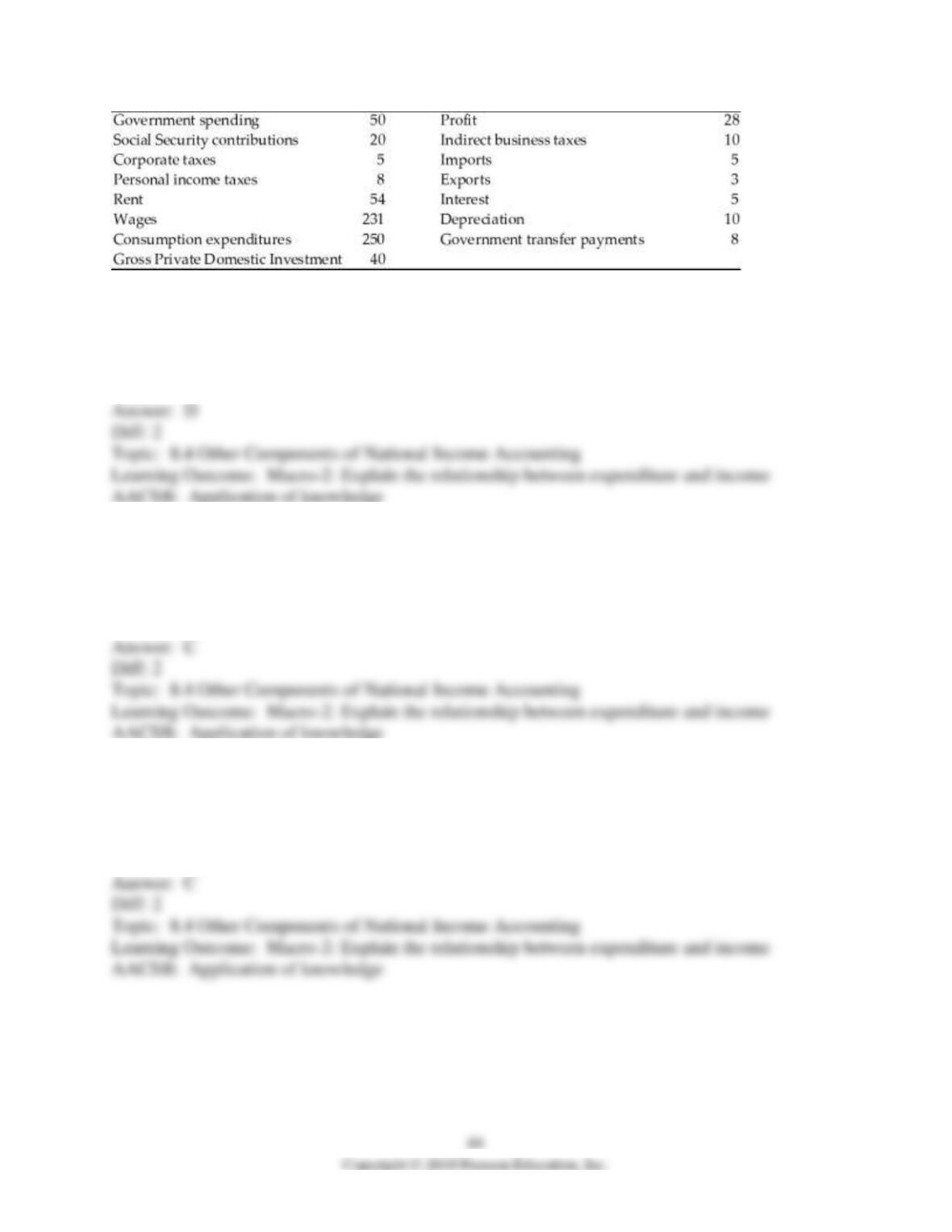
36) Using the above table, the Gross Domestic Product (GDP) for the country is
A) 662.
B) 84.
C) 746.
D) 338.
37) Using the above table, the Net Domestic Product (NDP) for the country is
A) 662.
B) 84.
C) 328.
D) 338.
38) Using the above table, the National Income (NI) for the country is
A) 338.
B) 228.
C) 318.
D) 662.
39) Using the above table, the Personal Income (PI) for the country is
A) 84.
B) 228.
C) 155.
D) 301.
40) Using the above table, the Disposable Personal Income (DPI) for the country is
A) 78.
B) 220.
C) 147.
D) 293.
41) Personal income is
A) the sum of all incomes received by households on welfare.
B) the income households have after paying federal taxes.
C) the sum of all incomes received by households.
D) the sum of all incomes earned by sole proprietorships and partnerships.
42) Which of the following would NOT be a part of personal income?
A) indirect business taxes
B) payments received from Social Security
C) retirement checks
D) corporate dividend payments to shareholders
43) The amount of income that households actually receive before they pay personal income
taxes defines
A) national income (NI).
B) personal income (PI).
C) disposable personal income (DPI).
D) net domestic product (NDP).
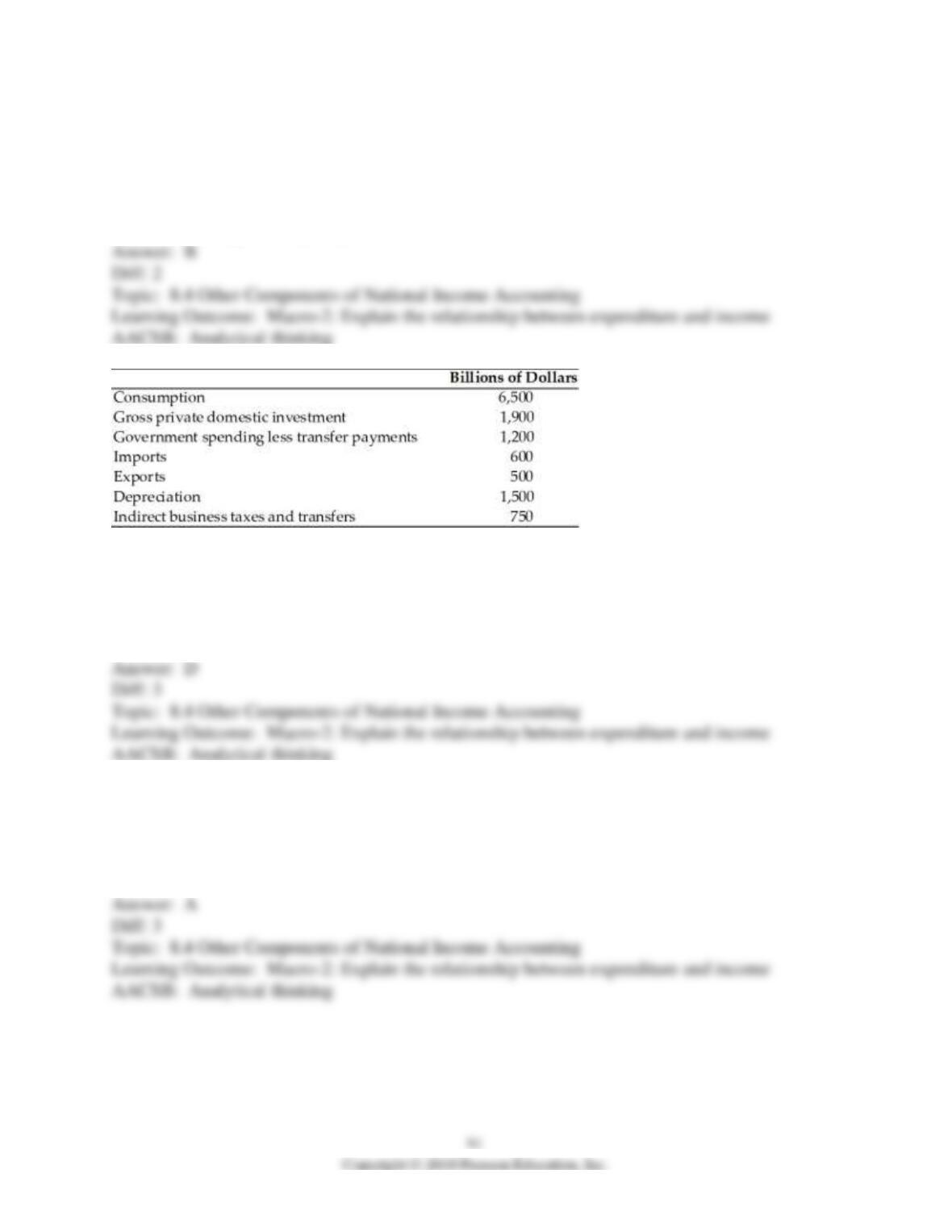
44) Using the above table, the GDP is (in billions of dollars)
A) 10,200.
B) 8,200.
C) 8,900.
D) 9,500.
45) Using the above table, the net domestic product is (in billions of dollars)
A) 8,000.
B) 9,700.
C) 8,300.
D) 6,500.
46) Using the above table, the national income is (in billions of dollars)
A) 8,950.
B) 7,250.
C) 6,850.
D) 8,050.
47) GDP minus depreciation equals
A) national income.
B) aggregate spending.
C) personal income.
D) net domestic product.
48) Which one of the following accounting identities is TRUE?
A) Disposable personal income plus indirect business taxes equals personal income.
B) Disposable personal income plus non-income expense items equals personal income.
C) Disposable personal income plus personal income taxes equals personal income.
D) National income plus profit equals personal income.
49) Social Security payments received by your grandmother
A) are excluded from GDP, but are included in personal income.
B) are included in both GDP and personal income.
C) are included in GDP, but are excluded from personal income.
D) are excluded in both GDP and personal income.
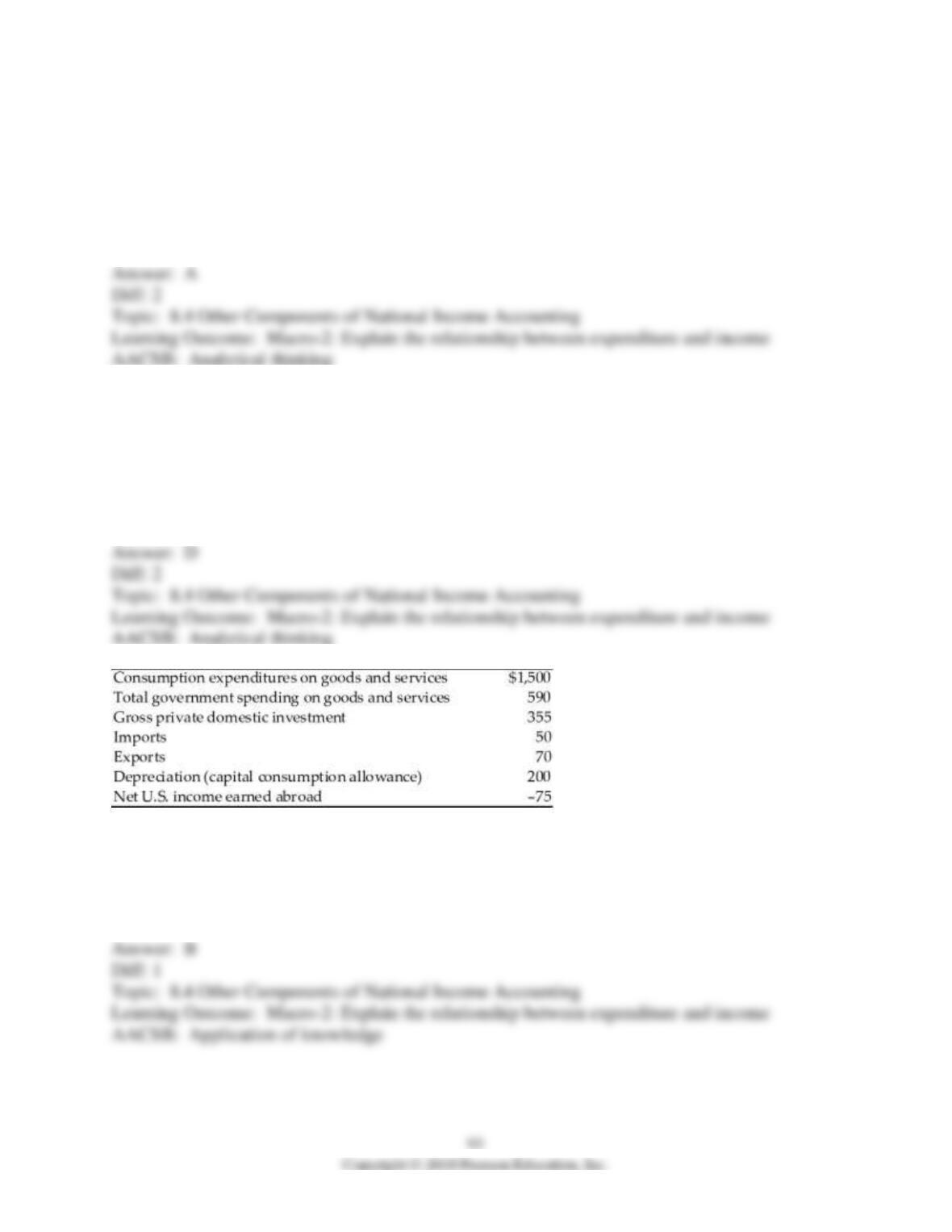
50) National income is
A) the total of factor payments to owners of resources.
B) the dollar value of all final goods and services produced in a country in a year.
C) the amount of monetary payments households actually receive before paying personal income
taxes.
D) the amount of monetary payments households actually receive after paying personal income
taxes.
51) Disposable personal income is
A) the total of factor payments to owners of resources.
B) the dollar value of all final goods and services produced in a country in a year.
C) the amount of monetary payments households actually receive before paying personal income
taxes.
D) the amount of monetary payments households actually receive after paying personal income
taxes.
52) According to the above table, net domestic product (NDP) is
A) $1,995.
B) $2,265.
C) $2,550.
D) $2,850.
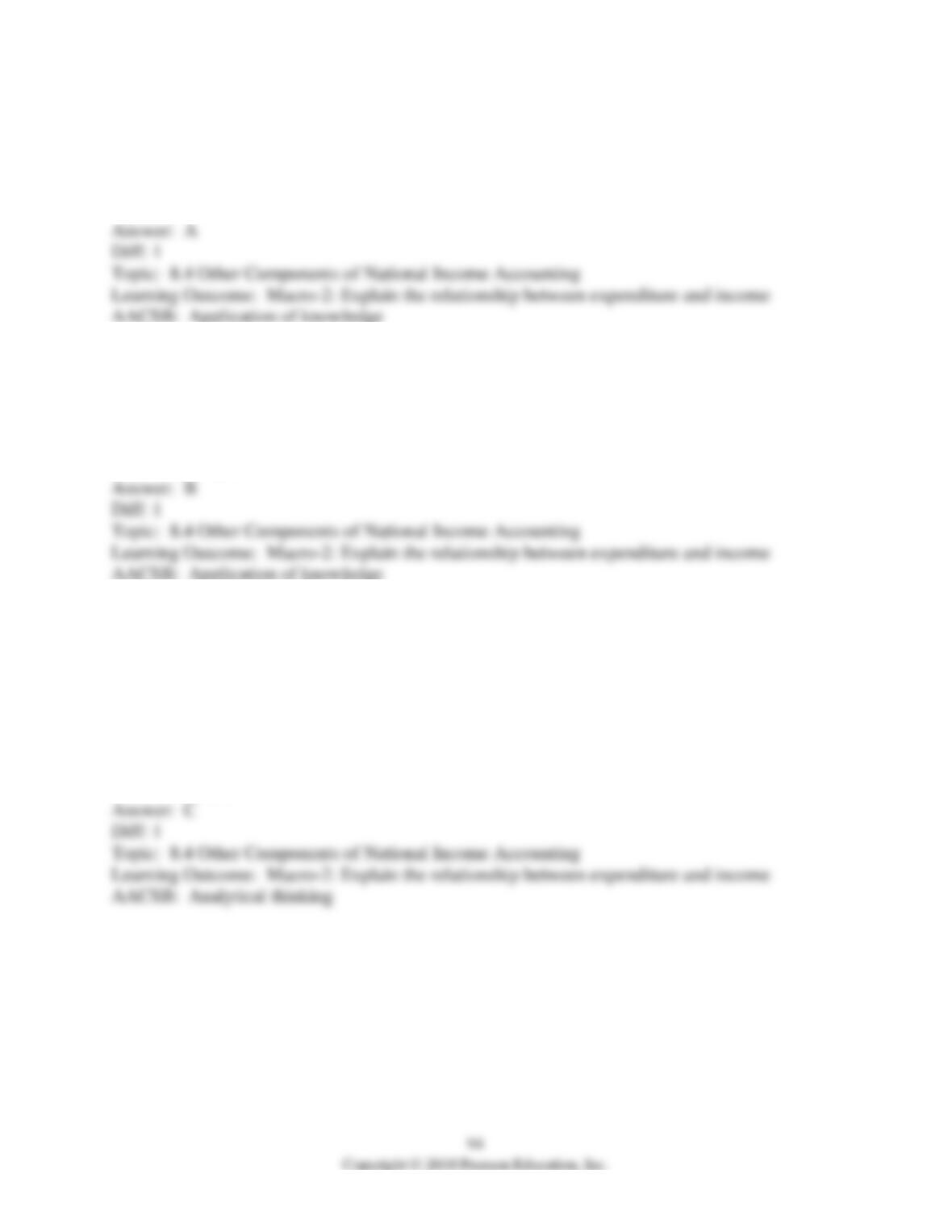
53) According to the above table, national income is
A) $2,190.
B) $2,550.
C) $2,465.
D) $2,750.
54) Which of the following is a component of net domestic product (NDP), but NOT of national
income?
A) capital consumption allowance
B) indirect business taxes
C) corporate taxes
D) personal taxes
55) To compute national income, which of the following items are added to net domestic product
(NDP)?
I. business income adjustments net of indirect business taxes and transfers
II. capital consumption allowance
III. U.S. net income earned abroad
A) I only
B) II only
C) both I and III
D) both II and III
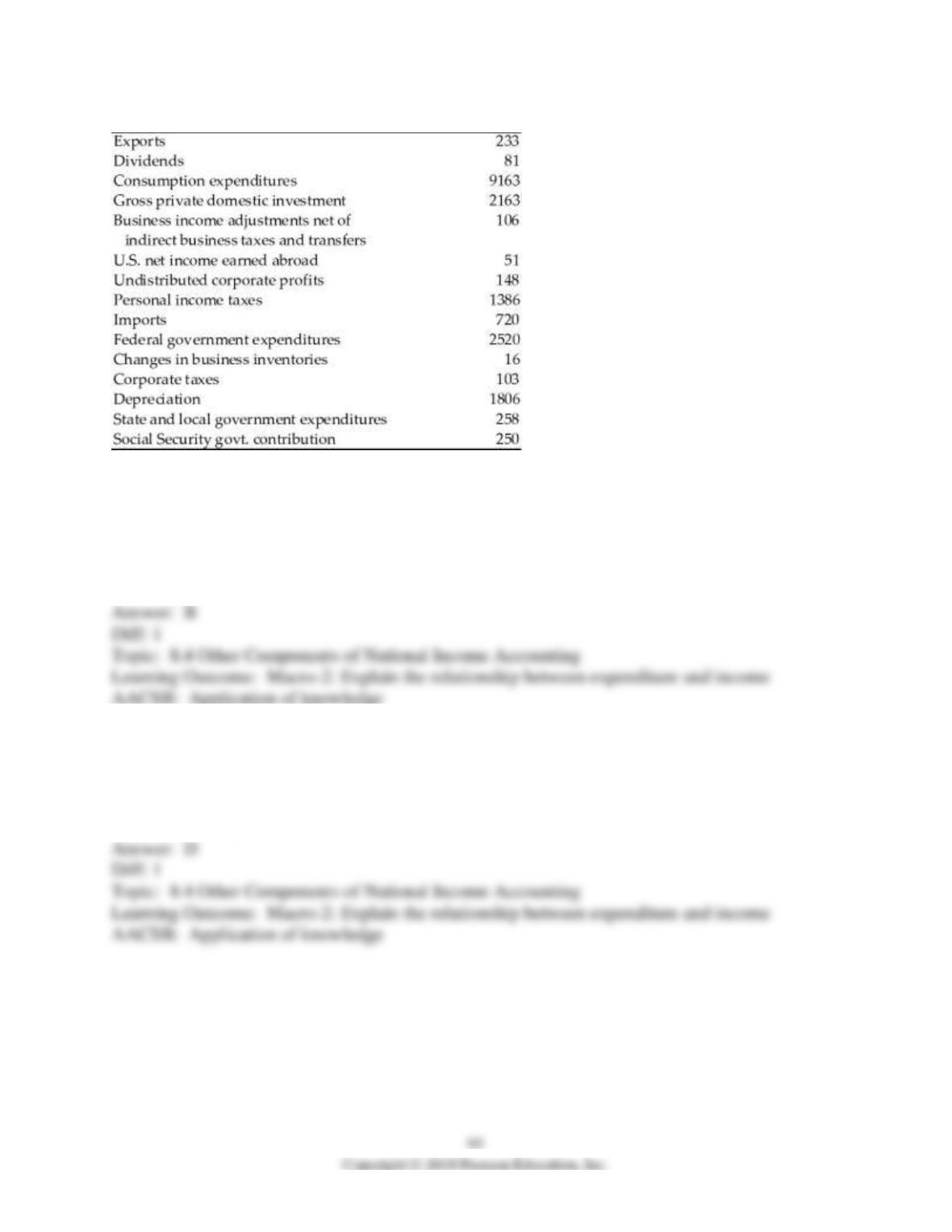
(amounts in billions of dollars)
56) According to the above table, Gross Domestic Product as calculated by the expenditure
approach is
A) $14,337 billion.
B) $13,617 billion.
C) $13,384 billion.
D) $13,278 billion.
57) According to the above table, net domestic product is
A) $12,531 billion.
B) $11,998 billion.
C) $11,892 billion.
D) $11,811 billion.
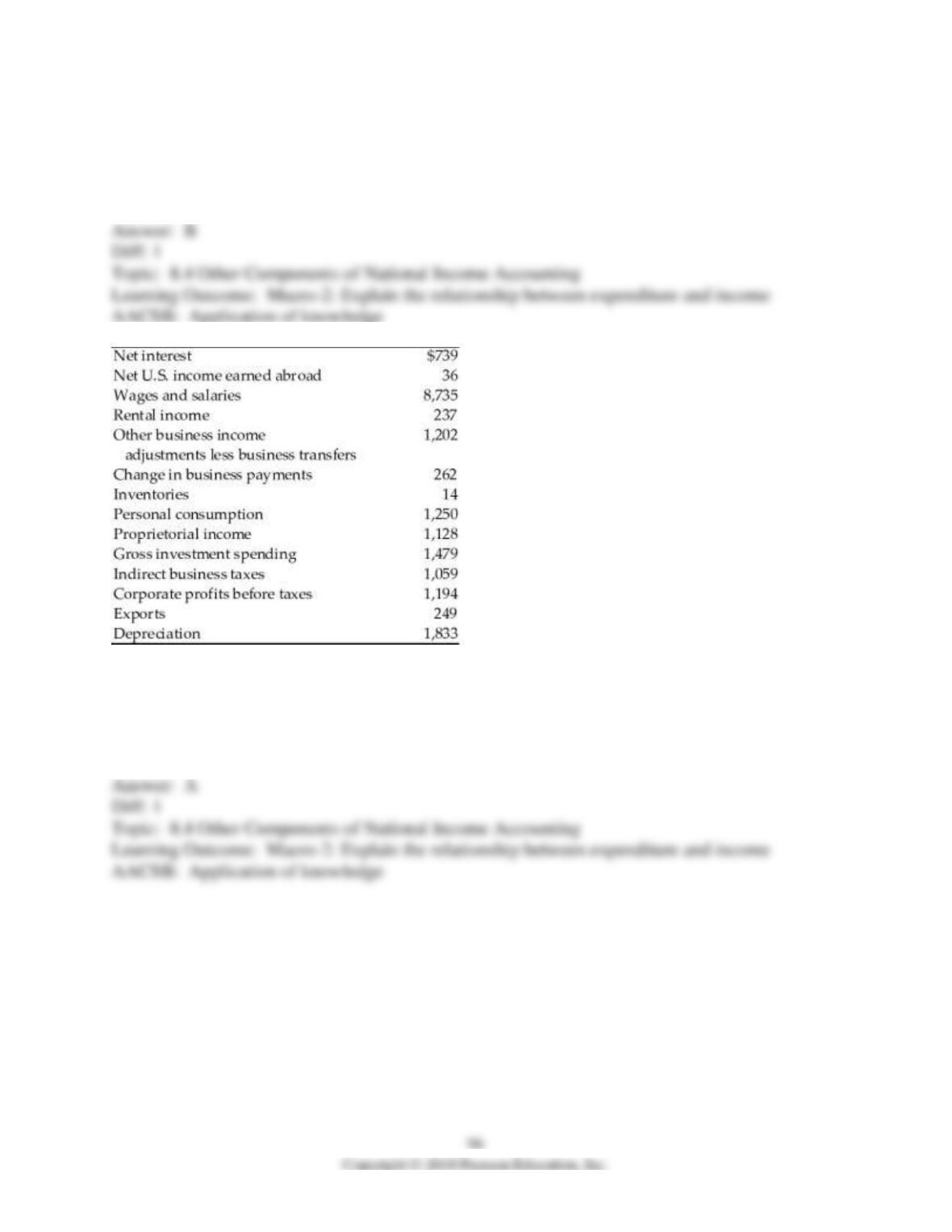
58) According to the above table, national income is
A) $12,637 billion.
B) $11,968 billion.
C) $11,943 billion.
D) $11,866 billion.
59) According to the above table, national income is
A) $13,271 billion.
B) $11,917 billion.
C) $10,770 billion.
D) $10,646 billion.
60) To calculate GDP once national income has been computed, we must
A) add indirect business taxes and transfers and subtract profits.
B) add depreciation and subtract indirect business taxes.
C) add depreciation and indirect business taxes and transfer payments and subtract other business
income adjustments and net U.S. income earned abroad.
D) add indirect business taxes and transfers and subtract depreciation, other business income
adjustments, and net U.S. income earned abroad.
61) Explain how disposable personal income is derived from Gross Domestic Product.
8.5 Distinguishing between Nominal and Real Values
1) When economists discuss the nominal value of an economic variable, the variable is
A) expressed in current dollars.
B) expressed as an index figure.
C) adjusted for a changing price level.
D) expressed as a percentage.
2) Suppose that in 2018, nominal Gross Domestic Product (GDP) for the economy of Chiconia
was $10 trillion and the Gross Domestic Product (GDP) price index was 200.0. What is
Chiconia’s real Gross Domestic Product (GDP) in 2018?
A) $5 trillion
B) $10 trillion
C) $20 trillion
D) $200 trillion
3) Which of the following statements does NOT describe the real value of an economic variable?
A) It is adjusted for changes in the price level.
B) It is expressed in constant dollars.
C) It is a measure of the purchasing power of the variable.
D) It is the variable’s nominal value adjusted for unemployment.
4) If nominal Gross Domestic Product (GDP) in 2008 was $500 billion with a price index of 100,
what would be the real Gross Domestic Product (GDP) in 2018 if the 2018 nominal Gross
Domestic Product (GDP) was $900 billion and the 2018 price index was 140?
A) $900 billion
B) $540 billion
C) $800 billion
D) $643 billion