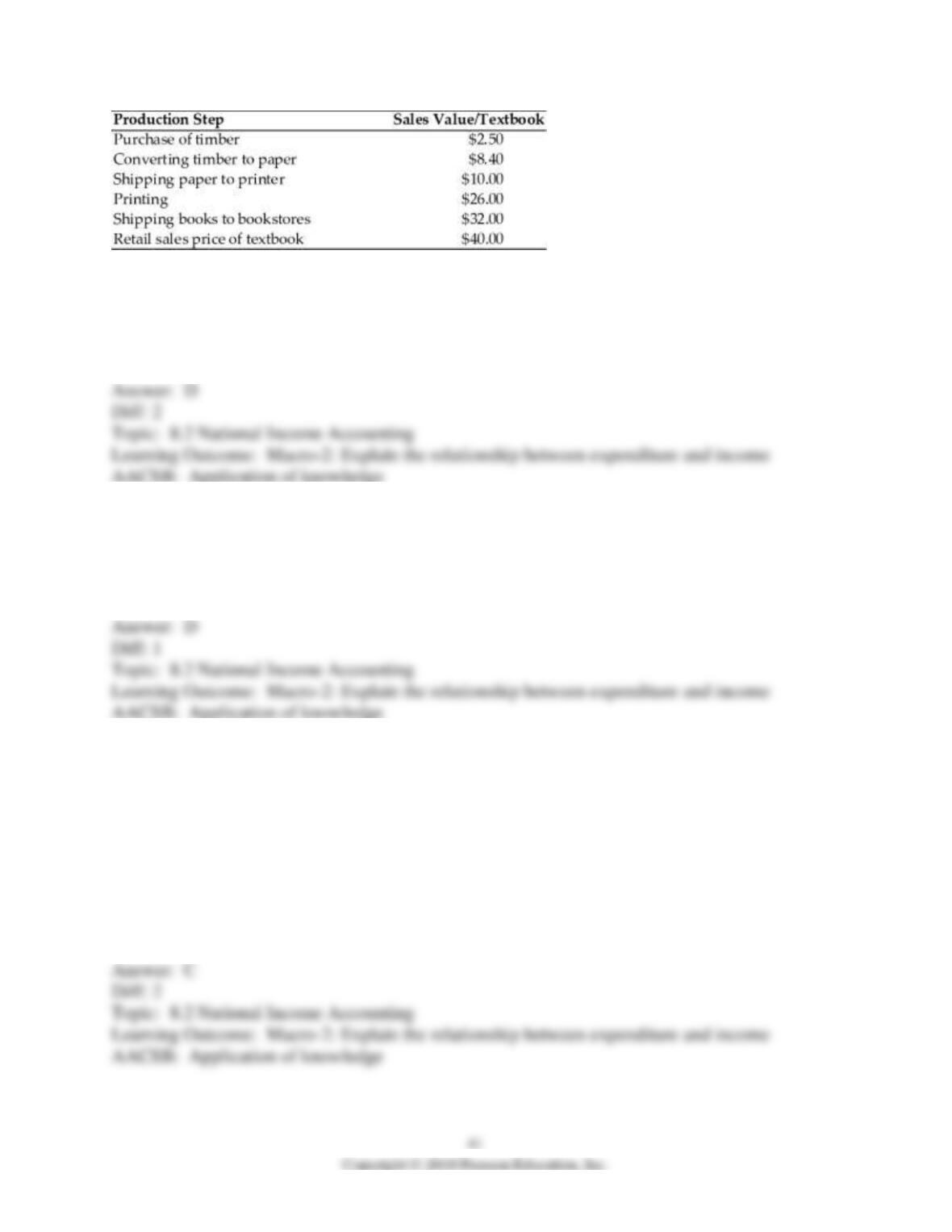
87) Using above table, how much is contributed to the GDP from the production of the textbook?
A) $118.90
B) $32.00
C) $78.90
D) $40.00
88) Using above table, the market price of the textbook is
A) $118.90.
B) $32.00.
C) $78.90.
D) $40.00.
89) Consider the following:
Farmer Jones bought seed and fertilizer for $100.
He grew wheat that he sold to the Acme Bread Company for $200.
Acme Bread produced and sold bread to the ABC Grocery Store for $250.
Consumers bought the bread from the grocery for $350.
How much was added to the GDP?
A) $700
B) $800
C) $350
D) $600
90) Which of the following transactions would NOT contribute to the GDP?
A) the purchase of 100 shares of Google stock
B) the purchase of a new Tesla automobile
C) the purchase of a package of chewing gum from a convenience store
D) the purchase of gasoline for your truck
91) Which of the following would NOT be included in the calculation of the GDP?
A) the value of the service of legally produced gambling services in Las Vegas
B) the value of the services of a homemaker
C) the value of legally produced liquor
D) the value of the production of nuclear weapons
92) The Social Security check received by your grandmother
A) is included in the GDP because it will be spent on goods and services.
B) is excluded from GDP calculations because it is a transfer payment.
C) is included in the GDP because she is entitled to it as a citizen.
D) is included in the GDP because it is part of her income.
93) Which of the following will be included in this year’s GDP?
A) a Pablo Picasso (1881-1973) painting purchased this year by the art museum
B) the purchase of a used textbook by your friend
C) the purchase of 100 shares of Google stock through your broker
D) the purchase of an insurance policy for your home
94) GDP measures
A) the nation’s economic welfare.
B) the nation’s economic activity.
C) the changes in the unemployment rate in a given year.
D) the amount of underground activity in a nation.
95) GDP measures
A) the annual total value of all services produced by factors of production located within a
national border.
B) the annual value of final goods and services produced by factors of production located within
a national border.
C) the annual value of goods and services produced by factors of production owned by
companies headquartered in a given country.
D) the value of all goods and services sold in a given country.
96) Goods used up entirely in the production of final goods are
A) intermediate goods.
B) production goods.
C) process goods.
D) inventory goods.
97) In calculating GDP, the value of intermediate goods is eliminated by using the
A) distributive method.
B) value association method.
C) value added method.
D) Federal Reserve method.
98) The sum of the value added at all stages of production for a product is
A) the product’s final price.
B) the product’s price plus the value of intermediate goods.
C) the product’s price minus the value of intermediate goods.
D) the sum of all the transactions in the production of the product.
99) Which of the following transactions is included in GDP?
A) sales of used goods
B) buying and selling of stocks and bonds
C) the sales of houses produced in that given year
D) government transfer payments
100) Many economists argue that real GDP is
A) not a good measure of economic well-being because it overvalues increases in leisure time.
B) not a good measure of economic well-being because it excludes increases in leisure time.
C) a good measure of economic well-being because it includes increases in leisure time.
D) a good measure of economic well-being because it includes changes in personal safety.
101) Many economists argue that real GDP is NOT a good measure of economic well-being
because
A) it overvalues the increases in nonmarket transactions.
B) it excludes Social Security payments made to retirees.
C) it includes the taxes we pay to the federal government.
D) it excludes the environmental quality of life.
102) Which of the following transactions is included in the GDP?
A) paying a lawyer for a divorce
B) giving your friend a gift worth of $20
C) selling your 2004 Toyota Camry
D) cleaning your own house
103) Suppose you buy a new Tesla Model S. The battery that comes with the car is a(n)
A) final good.
B) intermediate good.
C) transfer good.
D) financial good.
104) What is value added and how is it related to Gross Domestic Product (GDP)?
105) Suppose Gross Domestic Product (GDP) figures were changed to reflect household
production. How would the size of household production relative to Gross Domestic Product
(GDP) have changed over the last fifty years?
106) Define and explain gross domestic product.
107) Why aren’t financial transactions, sales of secondhand goods, and household production
included in measuring GDP?
8.3 Two Main Methods of Measuring GDP
1) The two principle methods of measuring Gross Domestic Product are the
A) flow approach and the stock approach.
B) expenditures approach and the income approach.
C) intermediate approach and the value-added approach.
D) domestic approach and the international approach.
2) Which of the following statements is TRUE?
A) The value of illegal activities is included in Gross Domestic Product (GDP).
B) The value of a homemaker’s services is included in Gross Domestic Product (GDP).
C) The value of intermediate goods is included in Gross Domestic Product (GDP).
D) Gross Domestic Product (GDP) may be calculated using the income or the expenditure
approach.
47
3) Which one of the following statements about GDP is TRUE?
A) GDP can be calculated using the income approach.
B) The value of household production is excluded from GDP.
C) GDP can be calculated using the expenditures approach.
D) all of the above.
4) When we use the term fixed investment, we include in investment
A) the purchase of stocks and bonds.
B) the purchase of consumer goods.
C) the purchase of private bonds, but not government bonds.
D) the purchase of equipment and other capital goods.
5) When one uses the expenditure approach to calculate Gross Domestic Product (GDP), which
of the following would be included?
A) government spending at the state level
B) household purchases of legal services
C) inventory investment
D) all of the above
6) Suppose that for the economy of Utopia, we have the following information for 2018:
consumption expenditures = $5,000; wages = $3,500; gross private domestic investment =
$1,200; government expenditures = $2,000; exports = $900; imports = $1,100. Using the
expenditure approach what would the Gross Domestic Product (GDP) be for Utopia in 2018?
A) $6,200
B) $8,000
C) $8,400
D) $11,500
E) $11,900
7) Which of the following spending components makes up the largest percentage of Gross
Domestic Product (GDP)?
A) consumption expenditures
B) government expenditures
C) gross private domestic investment expenditures
D) expenditures on net exports of goods and services
8) Durable consumer goods include all of the following EXCEPT
A) an automobile.
B) Google company stock.
C) a laptop.
D) a smartphone.
9) Examples of nondurable consumer goods include all of the following EXCEPT
A) a pizza delivered to your home.
B) a cup of coffee.
C) a mattress.
D) a movie ticket.
10) Services include all of the following EXCEPT
A) payment for a doctor’s visit.
B) the face value of a government bond.
C) school tuition.
D) payments for auto repair.
11) Which of the following is an example of the gross private domestic investment component of
Gross Domestic Product (GDP)?
A) You buy a share of Facebook stock.
B) Google buys an office desk.
C) You put money into your savings account.
D) You put money into your checking account.
12) Which of the following are examples of the gross private domestic investment component of
Gross Domestic Product (GDP)?
I. The purchase of production equipment
II. An increase in finished goods inventory
A) I only
B) II only
C) Both I and II
D) Neither I nor II
13) Which of the following is part of gross private domestic investment?
A) purchases of stocks and bonds
B) a decline in consumer debt
C) purchases of hamburgers for a family dinner
D) a positive change in business inventories
14) Which one of the following is a durable consumer good?
A) a home computer
B) gasoline
C) food
D) office supplies that will be used up this year
15) When the total quantity of unsold new Ford Fusion vehicles increases from 40,000 to 47,000
A) the economy experiences an increase in inventory investment.
B) the economy’s level of consumption has increased.
C) there is a decrease in aggregate output.
D) the economy experiences a decrease in investment.
16) Inventory investment occurs when
A) grocers sell stocks of canned goods off their shelves.
B) individuals buys more company stock shares online.
C) shopkeepers check their inventories.
D) automobile dealers add to their stocks of unsold cars.
17) Durable consumer goods are goods that
A) last for more than three years.
B) last for more than one year.
C) are used up within three years.
D) are used up within one year.
18) Food and gasoline can be classified as
A) nondurable goods.
B) durable goods.
C) capital goods.
D) long-term goods.
19) Calculating Gross Domestic Product (GDP) by the expenditure approach requires summing
the value of
A) all income paid to individuals.
B) all transactions in the economy.
C) all final goods and services produced in the economy.
D) all expenditures by individuals.
20) Which of the following is included in gross private domestic investment?
I. The purchase of new capital goods
II. An increase in business inventories
A) I only
B) II only
C) Both I and II
D) Neither I nor II
21) If a firm produces more output than it sells, there will be
I. An increase in the firm’s inventories
II. An increase in the gross private investment of the nation
A) I only
B) II only
C) Both I and II
D) Neither I nor II
22) Fixed investment includes
A) business spending on plant and equipment.
B) business spending on printing paper.
C) business salaries.
D) labor union contracts.
23) Which of the following is an example of investment in computing Gross Domestic Product
(GDP)?
A) an increase of inventory stock in a retail store
B) a deposit of $2,000 in a bank
C) a laptop purchased by a student
D) the purchase of government bonds by a retiree
24) Which of the following is included in Gross Domestic Product (GDP)?
A) purchases of stocks and bonds by individuals
B) purchases of stocks and bonds by firms
C) sales of financial assets to foreign firms
D) investment spending on capital goods
25) Depreciation is
A) added to Gross Domestic Product (GDP) to reach Net Domestic Product (NDP).
B) the reduction in the value of capital goods due to physical wear and tear.
C) not included in Gross Domestic Product (GDP) from the income side.
D) always higher than the capital consumption allowance.
26) Net domestic product (NDP) is
A) Gross Domestic Product (GDP) minus depreciation.
B) Gross Domestic Product (GDP) minus private investment.
C) Gross Domestic Product (GDP) minus the foreign sector.
D) Gross Domestic Product (GDP) minus government transfers.
27) The components of the expenditure approach to measuring Gross Domestic Product (GDP)
include all of the following EXCEPT
A) government purchases of goods and services.
B) government Social Security payments.
C) durable consumer goods.
D) nondurable consumer goods.
28) An example of an increase in gross private domestic investment spending that also increases
Gross Domestic Product (GDP) is when
A) a family sells its home because of a transfer.
B) a farmer buys a used tractor.
C) inventories of new cars accumulate on the lots of car dealers.
D) government increases spending on infrastructure.
29) A capital good is
A) one produced by the government.
B) part of investment spending when purchased by either private businesses or by the federal
government.
C) one that is purchased in order to make other goods and services.
D) not part of Gross Domestic Product (GDP) because it is an intermediate product.
30) If all other factors are held constant, an increase in imports
A) causes an increase in exports of the same size.
B) causes Gross Domestic Product (GDP) to increase.
C) causes Gross Domestic Product (GDP) to decrease.
D) can cause Gross Domestic Product (GDP) to increase or decrease, depending on whether the
imports are purchased by consumers or by business firms.
31) If Gross Domestic Product (GDP) equals $1 trillion, gross private investment expenditures
are $200 billion, exports equal imports, and government spending is $400 billion, then
A) consumption expenditures are $200 billion.
B) consumption expenditures are $400 billion.
C) spending on consumer durables must be $400 million.
D) we cannot determine what expenditures on consumption are without more information.
32) Because of improved productivity, wages increase 10 percent. As a result, gross domestic
income increases. What happens to Gross Domestic Product?
A) Gross Domestic Product also increases since consumption expenditures would increase.
B) Gross Domestic Product decreases as people pay more taxes on their higher incomes.
C) Gross Domestic Product would not change since consumption expenditures would rise but
investment spending would fall.
D) Gross Domestic Product would decrease because businesses are spending more on wages.
33) A decrease in U.S. income earned abroad will make all of the following smaller EXCEPT
A) national income.
B) net domestic product.
C) personal income.
D) disposable personal income.
34) If Net Domestic Product (NDP) is $50 less than Gross Domestic Product (GDP), we know
that
A) inventories increased over the year.
B) inventories decreased over the year.
C) net investment equals $50.
D) depreciation equals $50.
56
35) If C = consumption, G = government expenditures, and I = gross private investment
expenditures, the mathematical representation of Gross Domestic Product (GDP) using the
expenditure approach is
A) Gross Domestic Product (GDP) = C + I + G + Transfers.
B) Gross Domestic Product (GDP) = C + I + G + Imports.
C) Gross Domestic Product (GDP) = C + Imports.
D) Gross Domestic Product (GDP) = C + I + G + Net exports.
36) One method of calculating Gross Domestic Product (GDP) is to add together
A) investment, consumption, gross profits, and net exports.
B) consumption, investment, government spending, and net exports.
C) wages, gross profits, net investment, and net exports.
D) consumption, wages, interest, rental income, and exports.
37) Gross Domestic Product (GDP) exceeds net domestic product by an amount equal to
A) indirect business taxes.
B) corporate profits plus personal taxes.
C) the capital consumption allowance (depreciation).
D) transfer payments minus personal taxes.
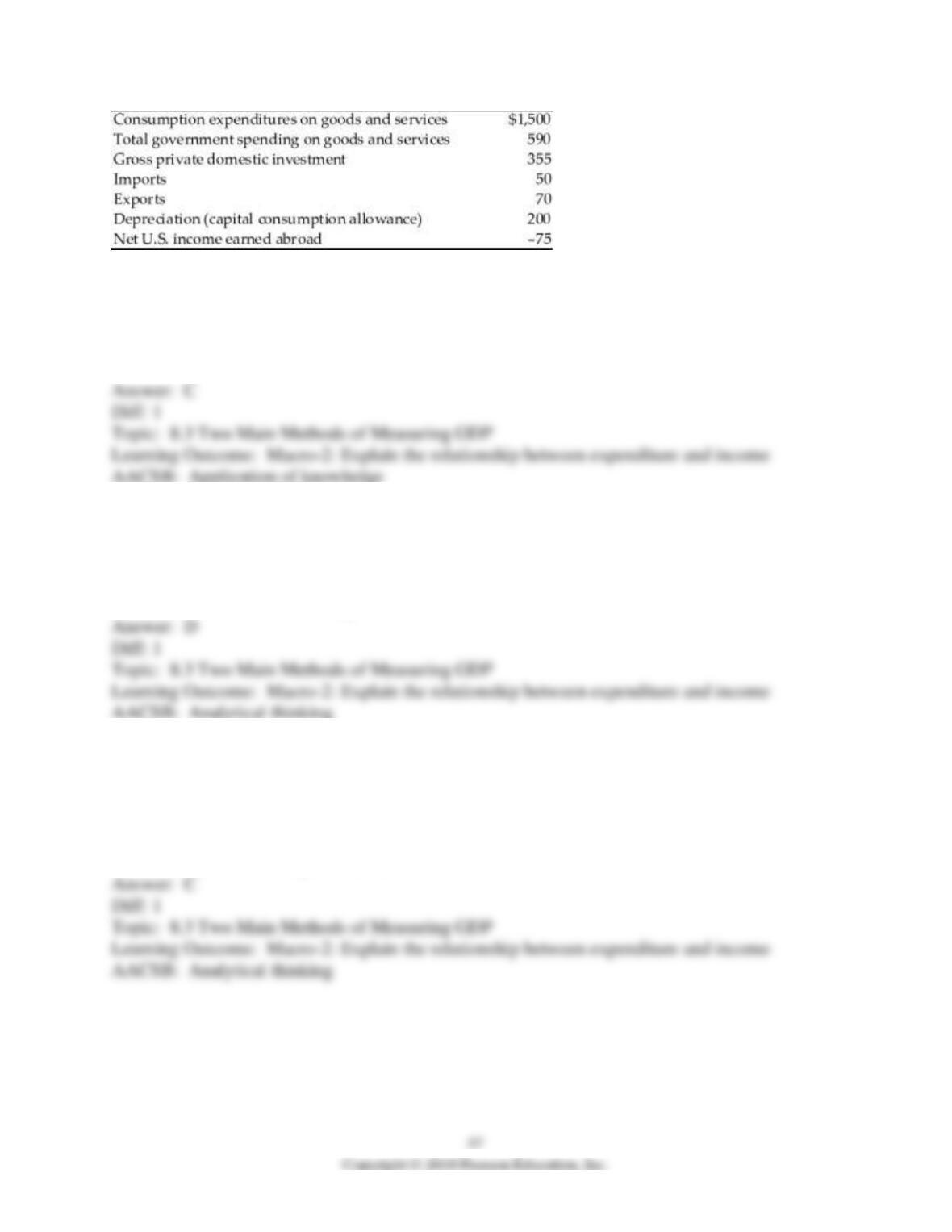
38) According to the above table, Gross Domestic Product (GDP) is
A) $2,190.
B) $2,840.
C) $2,465.
D) $2,750.
39) Which of the following is included when measuring Gross Domestic Product (GDP)?
A) the value of services of durable goods purchased in previous years
B) the value of leisure time
C) the value of services provided by homemakers
D) the rental income received by a landlord
40) When using the income approach to estimate Gross Domestic Product (GDP), which of the
following would NOT be included?
A) the implicit rental value of owner-occupied housing
B) proprietors’ income
C) personal consumption expenditures
D) net interest received by households
41) The value of Gross Domestic Product (GDP), when estimated by the income approach, is the
sum of
A) consumption expenditures, investment spending, and profits.
B) consumption, wages, rents, interest, and profits.
C) income earned by all factors of production, indirect business taxes, corporate income taxes,
and personal income taxes.
D) depreciation, business income adjustments less indirect business taxes, U.S. net income
earned abroad and income earned domestically by factors of production.
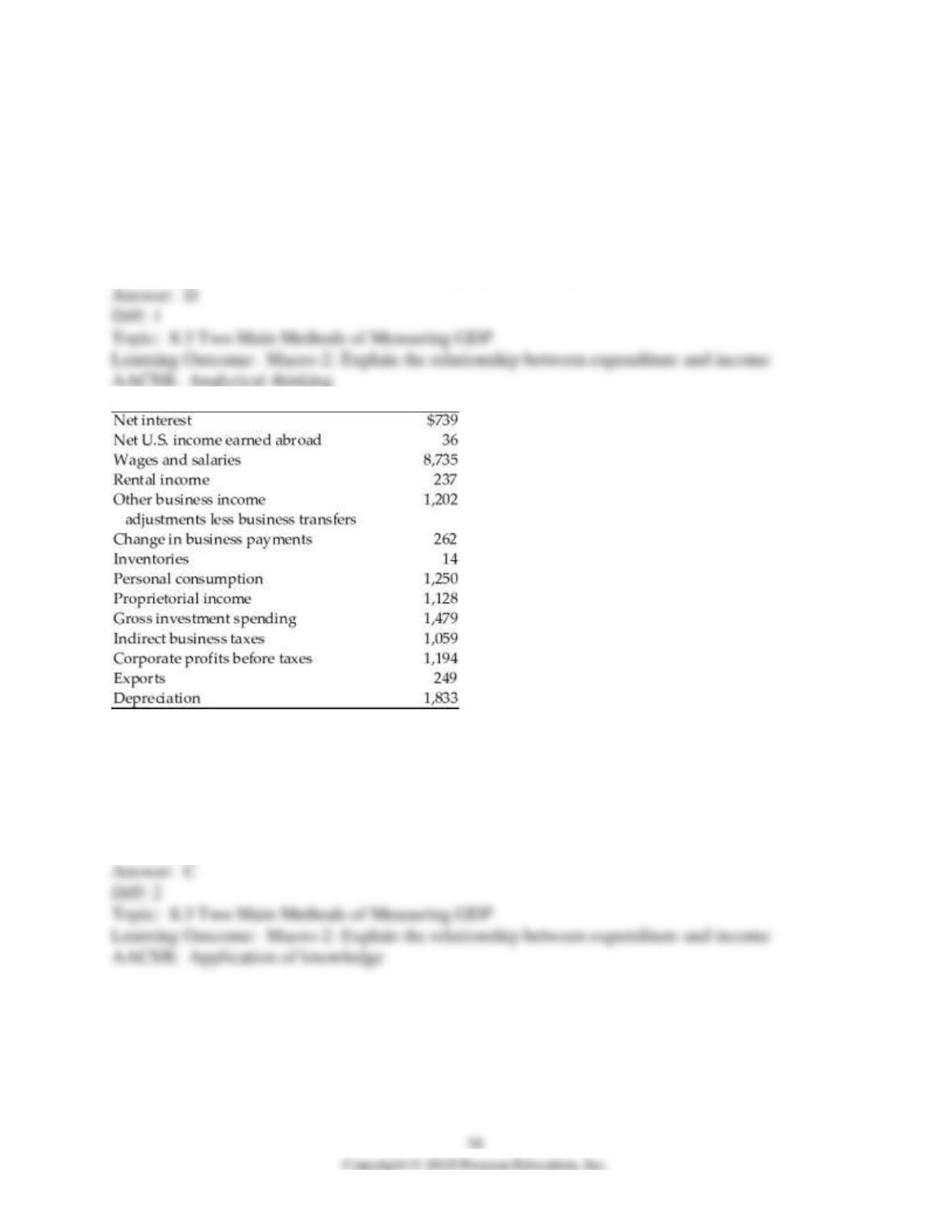
42) According to the above table, Gross Domestic Product as calculated by the income approach
is
A) $10,121 billion.
B) $10,646 billion.
C) $14,925 billion.
D) $15,619 billion.
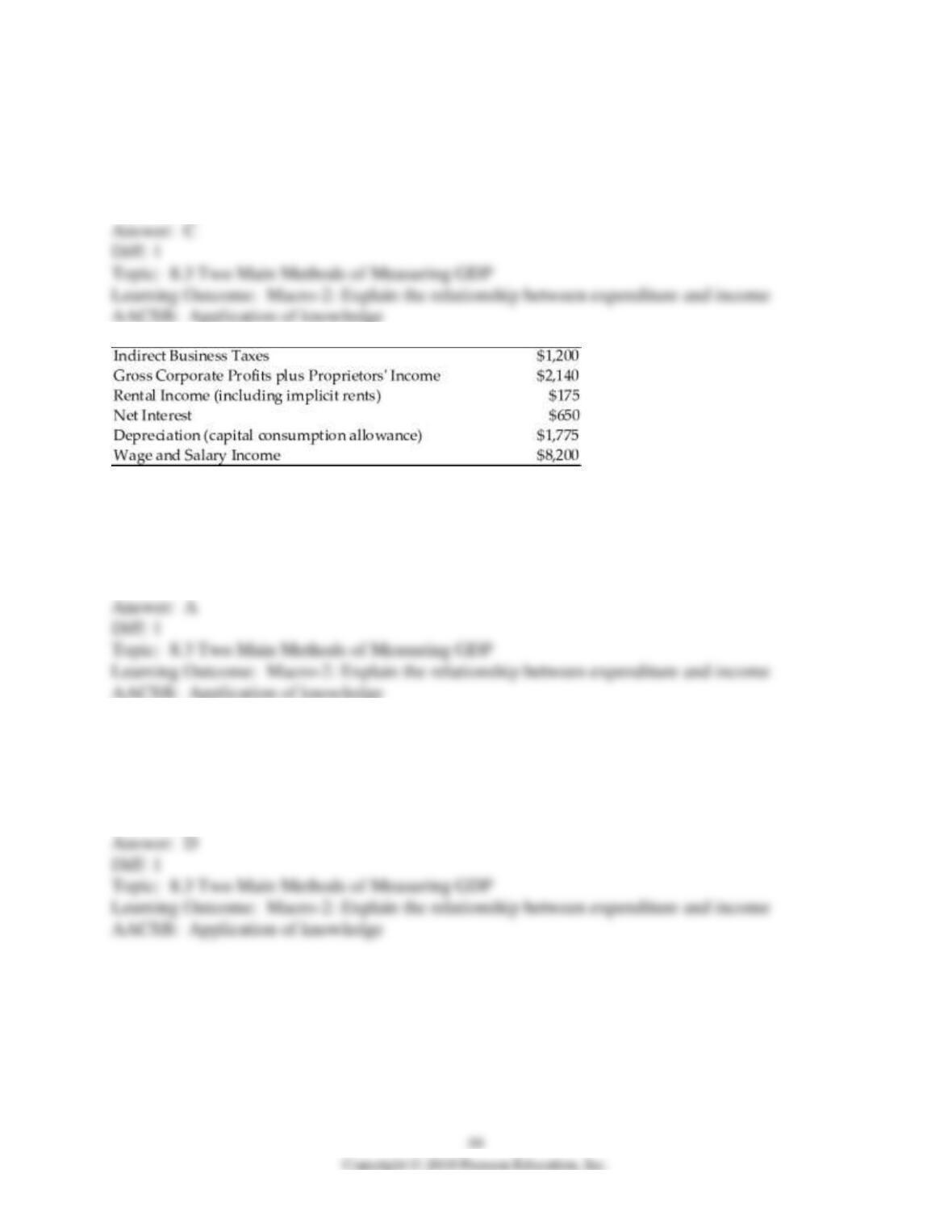
43) According to the above table, net domestic product is
A) $8,813 billion.
B) $12,603 billion.
C) $13,092 billion.
D) $13,750 billion.
44) According to the above table, Gross Domestic Product is
A) $14,140.
B) $13,965.
C) $13,315.
D) $12,115.
45) According to the above table, net domestic product is
A) $14,390.
B) $13,190.
C) $12,540.
D) $12,365.
46) Calculating Gross Domestic Product (GDP) by the income approach would require including
A) all transfer payments by the government.
B) all wages paid.
C) all restaurant sales.
D) the market value of all final goods and any profits.
47) Which of the following is included in the calculation of Gross Domestic Product (GDP)
using the income approach?
I. Wages and salaries.
II. Net exports.
A) I only
B) II only
C) Both I and II
D) Neither I nor II
48) Non-income expense items included in the Gross Domestic Product (GDP) calculation
include
A) depreciation and indirect business taxes.
B) depreciation and corporate profits.
C) corporate profits tax and indirect business taxes.
D) indirect business taxes and corporate profits.
49) Indirect business taxes refer to
A) depreciation expenses.
B) sales and local taxes paid by business.
C) payments for low-skilled labor.
D) dividend taxes paid by the corporation.