98. Marginal cost is defined as the increase in total cost resulting from an increase in
a.
one unit of output.
b.
output of 100 units.
c.
a firm’s plant size.
d.
one unit of labor.
99. Which of the following must be true if average variable costs are decreasing?
a.
Average fixed cost exceeds average total cost.
b.
Marginal cost exceeds average variable cost.
c.
Marginal cost is less than average variable cost.
d.
Marginal cost is less than average total cost.
100. Which of the following is always true?
a.
When marginal costs are less than average total costs, average total costs will be
decreasing.
b.
When average fixed costs are falling, marginal costs must be less than average fixed costs.
c.
When average fixed costs are rising, marginal costs must be greater than average total
costs.
d.
When marginal costs are greater than average total costs, average total costs will be
decreasing.
101. If a firm increases its output and finds that its average total cost decreases as a result, this implies that
a.
marginal cost exceeds average total cost.
b.
the cost of producing an additional unit of output is more than the average total cost.
c.
average fixed cost is increasing.
d.
average total cost exceeds marginal cost.
102. As output is expanded, if MC is less than ATC,
a.
ATC must be at its minimum.
b.
ATC must be at its maximum.
c.
ATC must be decreasing.
d.
the firm must be earning economic profit.
103. Which of the following must be true if average total costs are declining?
a.
Marginal cost is less than average total cost.
b.
Marginal cost is less than average variable cost.
c.
Marginal cost is greater than average total cost.
d.
Marginal cost equals average total cost.
104. Which of the following must be true if average total costs are rising?
a.
Average fixed costs must be rising.
b.
Total fixed costs must be rising.
c.
Average variable costs must be falling.
d.
Marginal costs must be greater than average total costs.
105. Which of the following explains most accurately why the firm’s short-run marginal cost curve will
eventually rise?
a.
As more of the variable factor is used, its price will rise.
b.
When diminishing marginal returns set in, it will take ever-larger quantities of the variable
resources to produce an additional unit of output.
c.
As the variable factor is used more intensely, its marginal product will rise, causing an
increase in marginal costs.
d.
As the size of the firm increases, the operational efficiency of the firm declines, causing an
increase in marginal costs.
106. Use the table below to answer the following question.
Units of Output
Variable Cost
Total Cost
Marginal
(dollars)
(dollars)
(dollars)
Cost
0
0
20
0
1
20
40
20
2
30
50
10
3
52
72
22
4
75
95
23
5
125
145
45
6
185
205
60
Average total cost is at a minimum when output is
a.
2 units.
b.
3 units.
c.
4 units.
d.
5 units.
107. In the short run, if average variable costs equal $45, average total costs equal $50, and output equals
100, the total fixed costs will equal
a.
$5.
b.
$500.
c.
$1,000.
d.
$5,000.
108. If a firm has a U-shaped long-run average cost curve,
a.
its fixed cost rises as output rises.
b.
it must have increasing returns to scale at low levels of production and decreasing returns
to scale at high levels of production.
c.
it must have increasing returns to each input at low levels of production and decreasing
returns to each input at high levels of production.
d.
the firm can maximize its output by operating at the point of minimum long-run average
cost.
109. In recent years, the number of farms has fallen while the average farm size has increased. What
concept may explain this phenomenon?
a.
diminishing marginal returns
b.
declining productivity
c.
diseconomies of scale
d.
economies of scale
e.
good weather in midwestern states
110. Which of the following reflects diseconomies of scale?
a.
Marginal product decreases as output increases.
b.
Short-run marginal cost increases as output increases.
c.
Long-run marginal cost increases as output increases.
d.
Short-run average cost increases as output increases.
e.
As output doubles, long-run total cost more than doubles.
111. If General Electric finds that when it doubles both its plant size and the amount of associated inputs, its
output level does not double, then
a.
the law of diminishing returns is in effect.
b.
long-run average costs must be decreasing.
c.
the firm is experiencing diseconomies of scale.
d.
the firm should increase production.
e.
the firm is experiencing constant returns to scale.
112. If a firm doubles all of its inputs and its output triples, it is said to be experiencing
a.
diminishing marginal returns.
b.
increasing marginal returns.
c.
diseconomies of scale.
d.
economies of scale.
e.
constant average costs.
113. Long-run economies of scale exist when the long-run average cost curve
a.
rises.
b.
remains constant.
c.
falls.
d.
does not exist.
114. Long-run diseconomies of scale exist over the range of output for which the long-run average cost
curve is
a.
rises.
b.
remains constant.
c.
falls.
d.
does not exist.
115. Economies of scale imply that within some range a firm can increase the size of operation and
a.
total cost will decrease.
b.
fixed cost will decrease.
c.
average total cost will decrease.
d.
average total cost will increase.
e.
average variable cost will decrease.
116. If a firm enlarges its factory size and realizes higher average costs of production then
a.
it has experienced economies of scale.
b.
it has experienced diseconomies of scale.
c.
it has experienced constant returns to scale.
d.
the long-run average cost curve slopes downward.
e.
the long-run average cost curve shifts upward.
117. The long-run average total cost curve
a.
is an envelope-shaped curve mapped out by the short-run average total cost curves for
alternative plant sizes.
b.
intersects the minimum point of each short-run average total cost curve for alternative
plant sizes.
c.
rises throughout its entire range when increasing returns are present.
d.
falls throughout its entire range due to the law of diminishing returns.
118. The long-run average total cost (LRATC) curve
a.
indicates the per-unit cost of producing various rates of output with a specific size of plant
but variable levels of labor and technology.
b.
indicates the minimum per-unit cost that can be achieved at various output rates when the
firm is free to choose among plant sizes.
c.
will be falling when diseconomies of scale are present and rising when economies of scale
are present.
d.
is a U-shaped curve.
e.
is both a and d above.
119. Larger firms will often have lower minimum per–unit costs than smaller firms because
a.
employee shirking is less of a problem.
b.
large-scale output allows greater specialization for both labor and machines in the
production process.
c.
mass production techniques, with high setup and development costs, are appropriate only
when a small output is planned.
d.
all of the above are correct.
120. If doubling the quantity of inputs more than doubles the quantity of outputs, the firm is experiencing
a.
increasing returns to scale.
b.
decreasing returns to scale.
c.
constant returns to scale.
d.
increasing costs per unit of output.
121. Which of the following provides the best explanation for diseconomies of scale?
a.
the firm is too small to take advantage of specialization.
b.
large management structures may be bureaucratic and inefficient.
c.
if there are too many employees, the work place becomes crowded and people become less
productive.
d.
average fixed costs are rising.
122. A downward-sloping portion of a long-run average total cost curve is the result of
a.
economies of scale.
b.
diseconomies of scale.
c.
diminishing returns.
d.
the existence of fixed resources.
123. In the long run, a firm might experience rising per-unit costs due to
a.
economies of scale.
b.
diseconomies of scale.
c.
the law of supply.
d.
the law of diminishing marginal returns.
124. In the long run, firms in many industries often experience falling average total costs as a result of
a.
gains through trade.
b.
increasing marginal returns.
c.
economies of scale.
d.
lower fixed costs.
125. A large aircraft manufacturer, like Boeing, may have a cost advantage over a new smaller
manufacturer because
a.
of diseconomies of scale.
b.
of economies of scale.
c.
of diminishing returns to a fixed factor of production.
d.
the principal agent problem is generally less severe for larger firms.
126. A car leasing company that expands its size by buying its competitors may run the risk of increasing
production costs due to
a.
diseconomies of scale.
b.
economies of scale.
c.
diminishing returns.
d.
greater use of large-volume purchases.
127. Al’s Donuts produces about 600 dozen doughnuts daily. If flour prices increase 20 percent
a.
only marginal cost will shift up.
b.
only marginal cost and average total cost will shift up.
c.
marginal cost, average variable cost, and average total cost will shift up.
d.
marginal cost, average total cost, and average fixed cost will shift up.
128. Which of the following would cause a firm’s cost curves to shift upward?
a.
a reduction in resource prices
b.
a decrease in taxes
c.
an improvement in technology
d.
an increase in government regulations
129. Which of the following would most likely cause a firm’s cost curve to shift downward?
a.
an increase in resource prices
b.
an increase in government regulations
c.
a decrease in taxes
d.
an increase in demand for the firm’s product
130. Which of the following would cause a firm’s cost curve to shift downward?
a.
a decrease in resource prices
b.
an increase in taxes
c.
an increase in demand for the firm’s product
d.
a reduction in output
131. Which of the following would increase a firm’s average total costs?
a.
economies of scale
b.
an increase in input prices
c.
an improvement in technology
d.
an increase in demand for the firm’s product
132. If the government levies a $1 excise tax on each unit of a good sold, what will happen to the producer’s
cost curve?
a.
The average total cost and marginal cost curves will shift downward by the amount of the
tax.
b.
The average total cost and marginal cost curves will shift upward by the amount of the tax.
c.
The marginal cost curve will shift upward by the amount of the tax; the average total cost
curve will remain unchanged.
d.
Both the marginal cost and average total costs will remain the same since taxes are not a
cost of production.
133. An airline can increase its profit by offering standby customers an unsold seat at a substantial discount
just before takeoff because
a.
additional passengers are needed to balance the load.
b.
the marginal cost of additional passengers is very small.
c.
additional passengers add little to fixed costs.
d.
such passengers add more to profits than do those with reserved seats.
134. A profit-maximizing firm would
a.
consider opportunity costs rather than accounting costs when making decisions about
output.
b.
expand current output if the revenues expected from doing so were less than the expected
costs.
c.
enlarge its current plant size if present depreciation costs were less than average variable
costs.
d.
increase output in the next period if accounting profits during the previous period were
positive.
135. Mr. Capps recently built a dental floss factory in Montana. It cost $500,000 and is expected to last ten
years. The plant can only be used to produce dental floss and will have no scrap value. When a
recession occurs, the yearly revenue from the plant declines to $35,000, compared to costs of $25,000
just for the variable resources required to produce the current rate of output. Mr. Capps should
a.
shut down since he is experiencing economic losses (in other words, he will not get his
$500,000 back).
b.
reduce the price of dental floss if his demand is inelastic in order to increase his revenue.
c.
raise the price of dental floss if his demand is elastic in order to increase his revenue.
d.
continue to operate since he is covering his variable costs and the cost of the plant is a
sunk cost.
136. In 1632, the Virginia Legislature decreed that all love apples must be sold for $1 per bushel (no more,
no less). At the time, Mr. McKintoch had 1,000 bushels of love apples ready for harvesting. His sunk
costs were $1,100, and his total costs (including sunk costs) would have been $1,800 if he harvested. If
McKintoch decided not to harvest because he did not think he could cover his total costs, he
a.
made the wrong decision, but for the right reason.
b.
made the wrong decision; the sunk cost component of total cost should not have affected
his decision to harvest.
c.
made the correct decision and considered the correct decision-making criteria; a firm
should never sell for less than its costs.
d.
One cannot determine from the data whether he should have harvested the love apples.
137. When making choices, suppliers should not allow sunk costs to directly affect their current decisions
because
a.
sunk costs do not reflect foregone opportunities accompanying current choices.
b.
sunk costs will not influence the accounting costs of a firm.
c.
sunk costs influence the demand for products, not the supply.
d.
past choices fail to provide any information relevant to current decision making.
138. Which one of the following decisions most clearly reflects a lack of understanding of the concept of
sunk costs?
a.
You pay to have your car towed back to the repair shop because it was not fixed properly
the first time.
b.
You decide to get a master’s degree because you cannot find a job in the field in which you
majored.
c.
You decide to purchase a piece of machinery for your business that will eliminate three
employees’ positions.
d.
You study eight hours for a final exam even though there is no way now that you can pass
the course.
139. If you paid $100 for a truckload of cabbage on Monday, how much should you be willing to sell it for
on Friday, the day before it spoils?
a.
$100
b.
$100 plus normal accounting profit
c.
$50 because it has lost value since Monday
d.
whatever you can get for it
140. When would sunk costs be irrelevant for current decision making?
a.
when the sunk costs are computed using accounting methods
b.
when the sunk costs are greater than variable costs
c.
when the sunk costs have been incurred only a short time ago
d.
Sunk cost are always irrelevant when making current decisions.
141. Economists refer to historical costs (irreversible costs already incurred) as
a.
implicit costs.
b.
sunk costs.
c.
opportunity costs.
d.
variable costs.
142. A family has decided to go away for the summer. The monthly mortgage payment on the family’s
house is $1,000. Water, electricity, natural gas, and maintenance bills, to be paid by the family, will be
$700 per month if the house is occupied and zero otherwise. If the family wishes to minimize losses
from being away, it should rent the house for as much as the market will bear, as long as the monthly
rent is above which of the following? (Assume wear and tear to be the same whether or not the house
is occupied.)
a.
$300
b.
$700
c.
$1,000
d.
$1,700
143. A homeowner will be away from her house for six months. The monthly mortgage payment on the
house is $1,000. The owner’s cost of utilities is $100 if the house is unoccupied but $300 if the owner
rents it out. If the owner wishes to minimize her losses from the house while away, she should rent the
house for as much as the market will bear, as long as monthly rent is greater than which of the
following? (Assume wear and tear to be zero regardless of whether the house is occupied.)
a.
$200
b.
$300
c.
$1,100
d.
$1,300
144. The landlord’s cost of continuing to rent a house to Smith is
a.
the maintenance cost on the house (a constant under all options).
b.
the maintenance cost plus depreciation on the house.
c.
zero, since the construction costs of the house are sunk costs.
d.
the revenue foregone as the result of not renting to the highest bidder other than Smith.
145. Before entry into an industry, a profit-maximizing decision maker will compare the expected market
price with the expected
a.
long-run average total cost.
b.
short-run marginal cost.
c.
long-run average variable cost.
d.
short-run average total cost.
146. You purchased an automobile two years ago for $10,000. Its current market price is $5,000, and the
expected market value one year from now is $4,500. If the interest rate is 10 percent, how much will it
cost you to keep the car for an additional year (over and above operation and maintenance costs)?
a.
$500
b.
$1,000
c.
$1,500
d.
$5,000
147. You purchased an automobile a year ago for $10,000. Its current market price is $6,000, and the
expected market value one year from now is $4,000. If the interest rate is 10 percent, how much will it
cost you to keep the car for an additional year (over and above operation and maintenance costs)?
a.
$2,000
b.
$2,600
c.
$4,000
d.
$6,000
148. “A good business decision maker will never sell a product for less than it costs to produce.” This
statement is
a.
true because diminishing returns always cause marginal costs to rise in the short run.
b.
false because diminishing returns always cause fixed costs to rise in the short run.
c.
true because it clearly differentiates between accounting profit and economic profit.
d.
false because a business decision maker may be covering his current variable costs even
though he has failed to cover all previous production costs.
Use the figure to answer the following question(s).
Figure 8-1
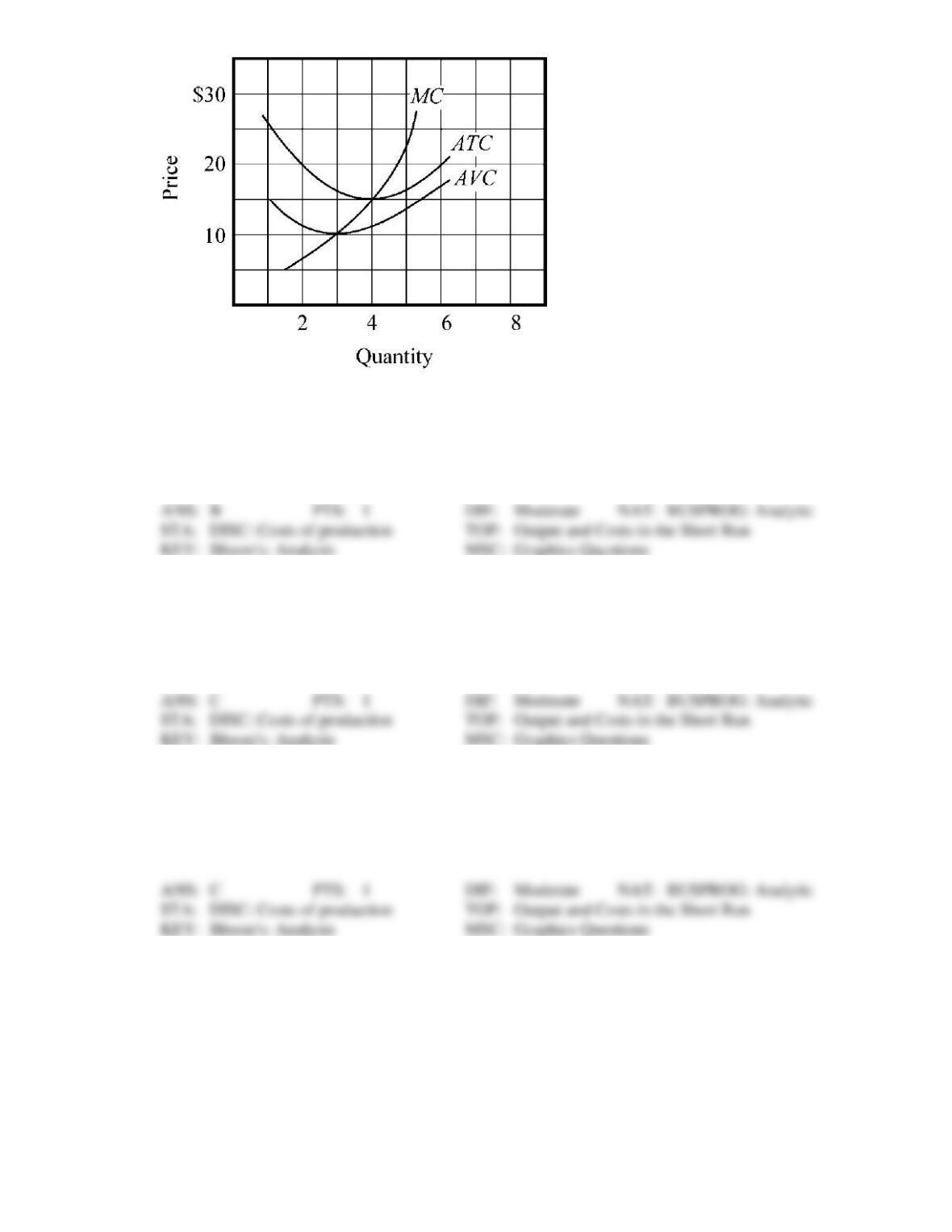
149. At what output in Figure 8-1 would the firm’s per-unit cost of production be minimized?
a.
3
b.
4
c.
5
d.
6
150. According to Figure 8-1, what is the firm’s approximate total cost when it produces three units?
a.
10
b.
16
c.
48
d.
60
151. What is the firm’s total cost in Figure 8-1 when it produces four units?
a.
11
b.
15
c.
60
d.
75
Use the figure to answer the following question(s).
Figure 8-2
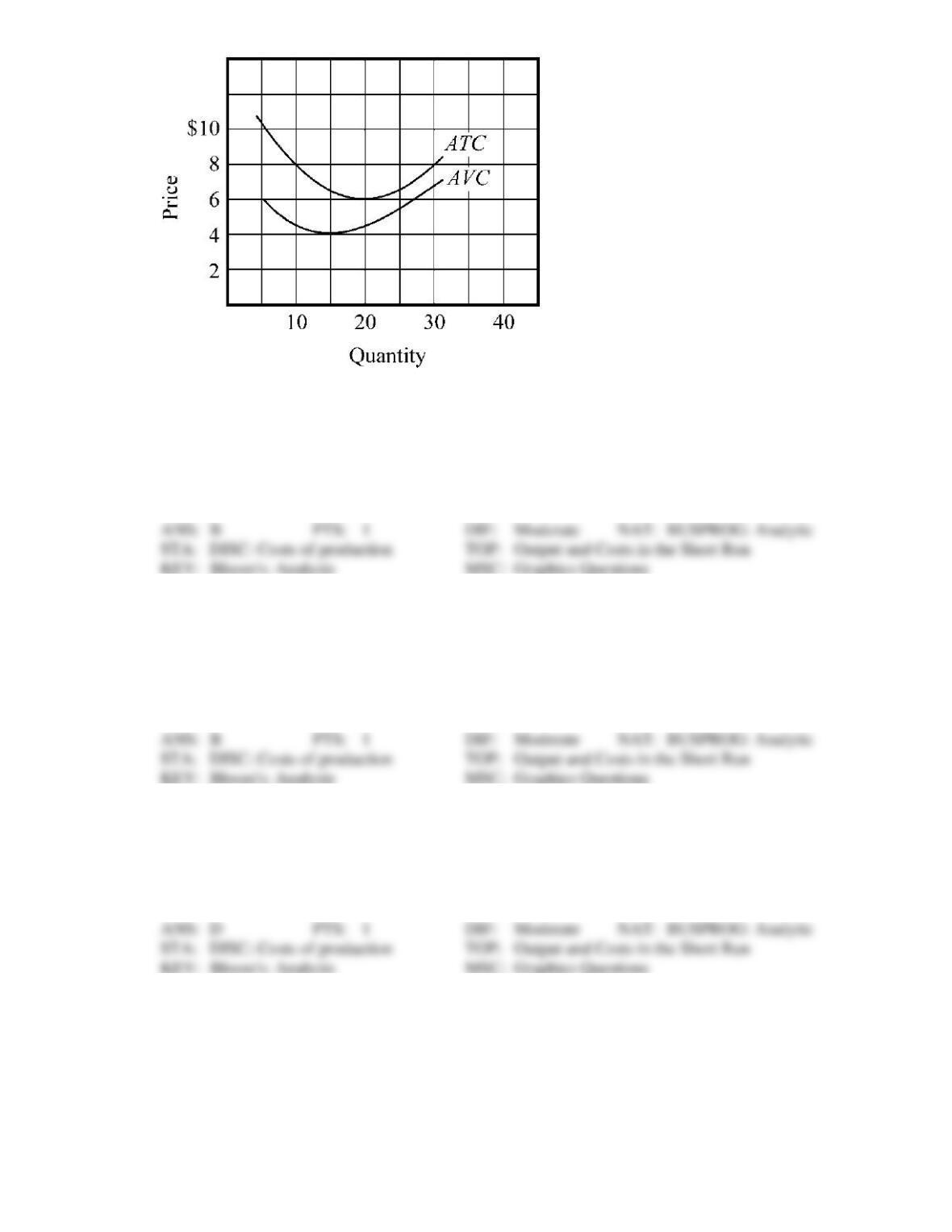
152. The average variable cost (AVC) and average total cost (ATC) for a firm are indicated in Figure 8-2. If
the marginal cost curve were constructed, at what output would it cross the AVC curve?
a.
10
b.
15
c.
20
d.
25
153. According to Figure 8-2, at what output would a properly constructed marginal cost curve cross the
ATC curve?
a.
15
b.
20
c.
25
d.
30
154. Using Figure 8-2, calculate the firm’s total cost of producing 30 units of output.
a.
$8
b.
$120
c.
$180
d.
$240
155. Using Figure 8-2, calculate the firm’s total cost of producing 20 units of output.
a.
$8
b.
$120
c.
$180
d.
$240
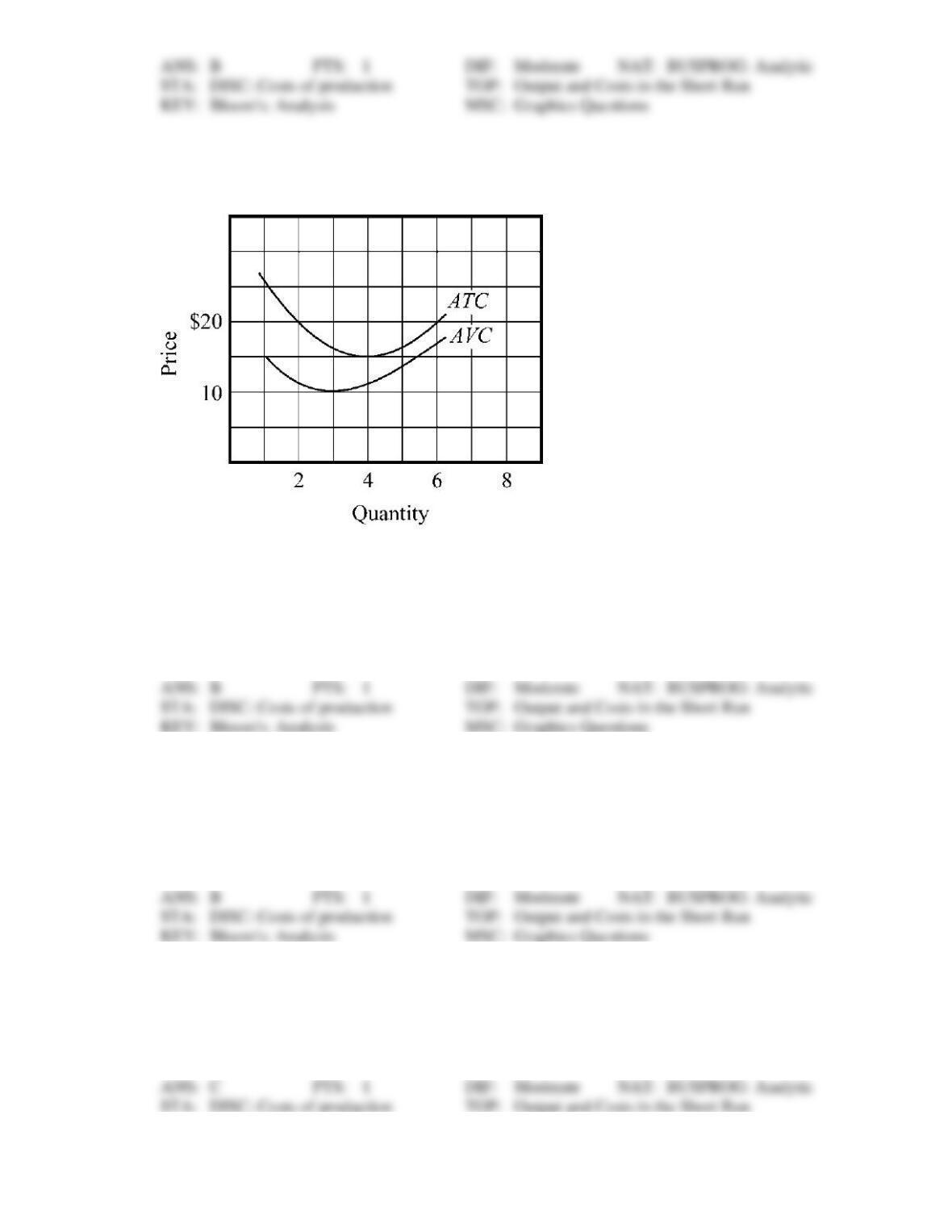
Use the figure to answer the following question(s).
Figure 8-3
156. The average variable cost (AVC) and average total cost (ATC) for a firm are indicated in Figure 8-3. If
the marginal cost curve were constructed, at what output would it cross the AVC curve?
a.
2
b.
3
c.
4
d.
5
157. According to Figure 8-3, at what output would a properly constructed marginal cost curve cross the
ATC curve?
a.
3
b.
4
c.
5
d.
6
158. Using Figure 8-3, calculate the total cost of producing four units.
a.
$10
b.
$15
c.
$60
d.
$75
159. Using Figure 8-3, calculate the total variable cost of producing three units.
a.
$10
b.
$15
c.
$30
d.
$45
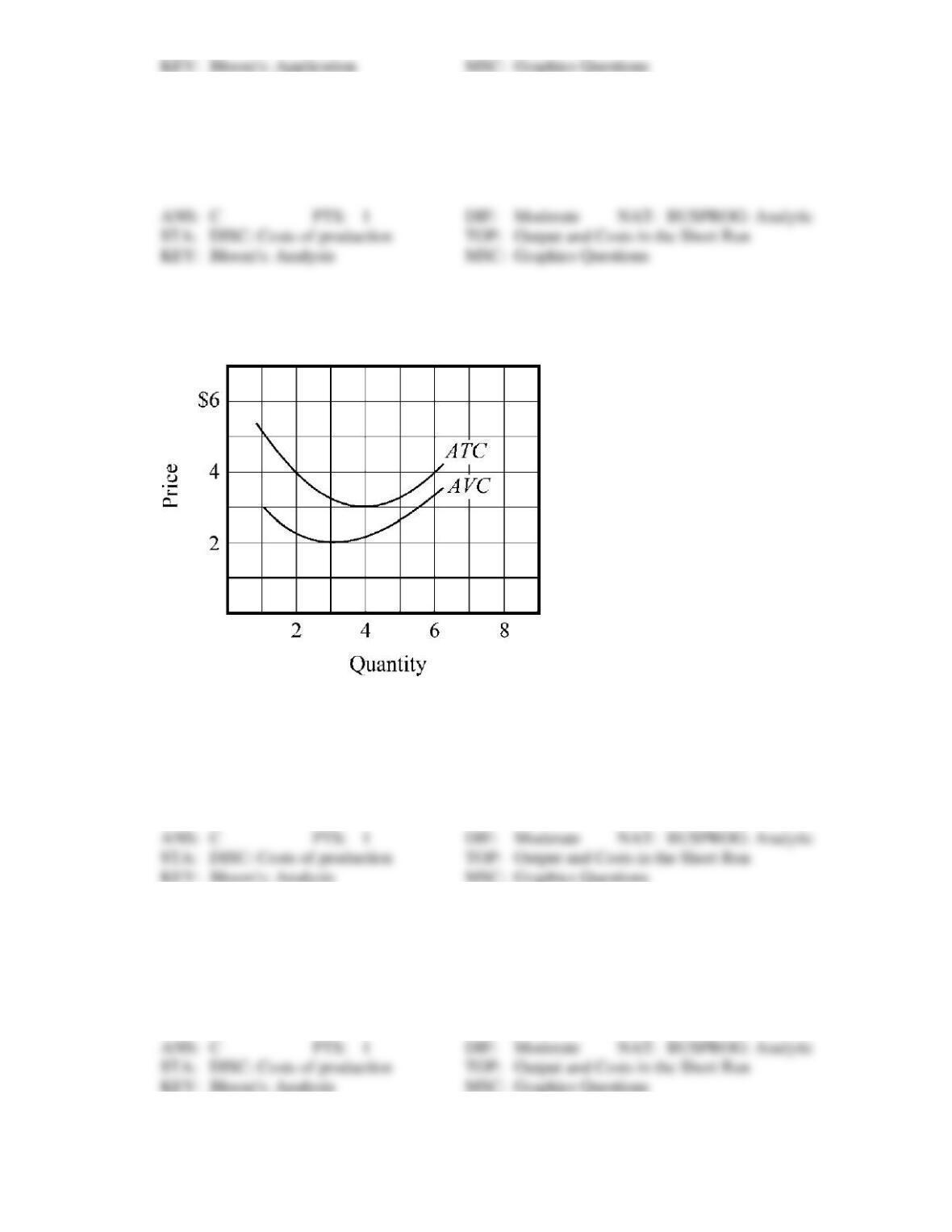
Use the figure to answer the following question(s).
Figure 8-4
160. The average variable cost (AVC) and average total cost (ATC) for a firm are indicated in Figure 8-4. If
the marginal cost curve were constructed, at what output would it cross the AVC curve?
a.
1
b.
2
c.
3
d.
4
161. According to Figure 8-4, at what output would a properly constructed marginal cost curve cross the
ATC curve?
a.
2
b.
3
c.
4
d.
5
162. Using Figure 8-4, calculate the firm’s total cost of producing four units of output.
a.
$4
b.
$8
c.
$12
d.
$16
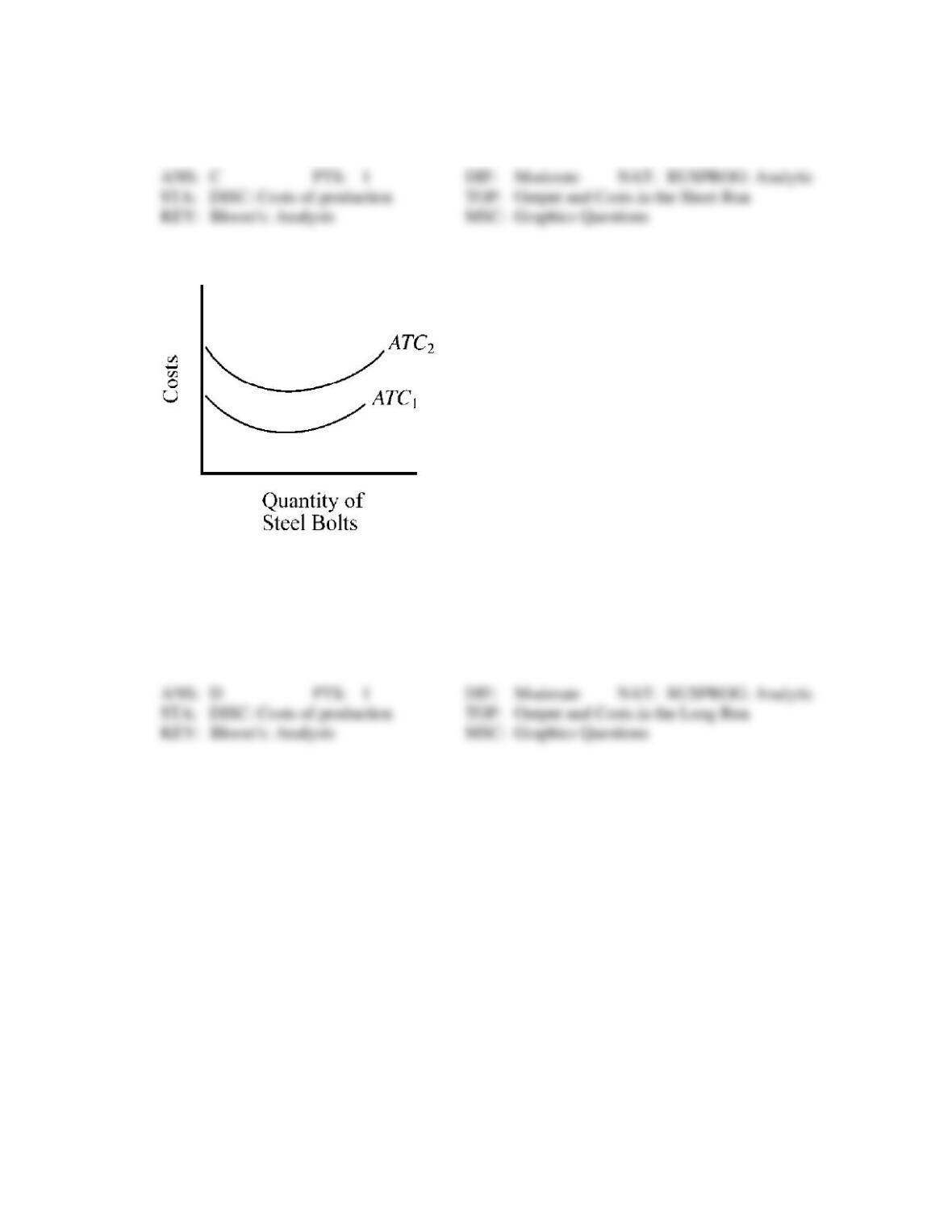
Figure 8-5
163. Refer to Figure 8-5. Which of the following would most likely cause the average total cost curve of a
firm producing steel bolts to shift from ATC1 to ATC2?
a.
an increase in demand for steel bolts
b.
an increase in the market price of steel bolts
c.
diminishing returns for the variable factors used to produce steel bolts
d.
an increase in the price of steel
Use the figure to answer the following question(s).
Figure 8-6