58) What is the money multiplier and what affects its size?
59) Suppose the Fed buys government securities from a commercial bank. Why is there a
multiplier effect on the quantity of money?
1) If you have assets that include $50 in cash, a checking account with $135, a savings account
with $500, and a jar of coins for laundry of $15.75, how much M1 do you have?
2) If you hold $25 in cash, have $150 in a checking account, and have $250 in a savings account,
how much of M2 do you have?
3) The First National Bank of Townville has $125,000 in U.S. government securities, $200,000
in savings accounts, $300,000 in checking accounts, $50,000 in its reserve account at the Fed,
$10,000 of currency in its vault, and loans of $250,000. What is the amount of its reserves?
4) The Second National Bank of Townville has $400,000 in checking deposits, $125,000 in
savings deposits, $500,000 in loans, $20,000 in its reserve account at the Fed, and $5,000 of
currency in its vault. What is the amount of its reserves?
5) The Second National Bank of Townville has $400,000 in checking deposits, $125,000 in
savings deposits, $500,000 in loans, $20,000 in its reserve account at the Fed, and $5,000 of
currency in its vault. What is the amount of these assets and liabilities that is in M1?
6) A bank has checking deposits of $400, saving deposits of $900, time deposits of $900, loans
of $950, government securities of $900, outstanding credit card balances of $400, currency in its
vault of $40, and deposits in its reserve account at the Fed of $40.
a) What is the amount of this bank’s deposits that are in M1?
b) What is the amount of this bank’s deposits that are in M2?
c) What is the amount of this bank’s reserves?
7) A bank has reserves of $50, deposits of $100, loans of $20, and government securities of $30.
Assume the desired reserve ratio is 20 percent.
a) How much does the bank have in excess reserves?
b) What can the bank do with its excess reserves? Name two options.
8) A bank reports reserves of $100,000, government securities of $50,000, loans of $750,000,
and checkable deposits of $900,000. The desired reserve ratio is 10 percent. What is the amount
of excess reserves for this bank? Show your work.
9) The desired reserve ratio is 10 percent. Fly By Night Bank has deposits of $250,000 and
reserves of $25,000. What is the amount of its excess reserves?
10) If a bank receives an additional deposit of $50,000 and the desired reserve ratio is 20 percent,
what is the amount of new loans the bank can make?
11) A bank receives new deposits equal to $200,000 and the desired reserve ratio is 10 percent.
What is the amount of new loans the bank can make?
12) The Fed buys $50,000 of government securities from Commerce Bank. The desired reserve
ratio is 25 percent. What is the change in Commerce Bank’s total reserves and its excess
reserves?
13) The Federal Reserve reports that it has coins valued at $10 billion, bank reserves at the Fed
of $15 billion, gold valued at $10 billion, Federal Reserve notes of $400 billion, and U.S.
government securities of $300 billion. What is the size of the monetary base?
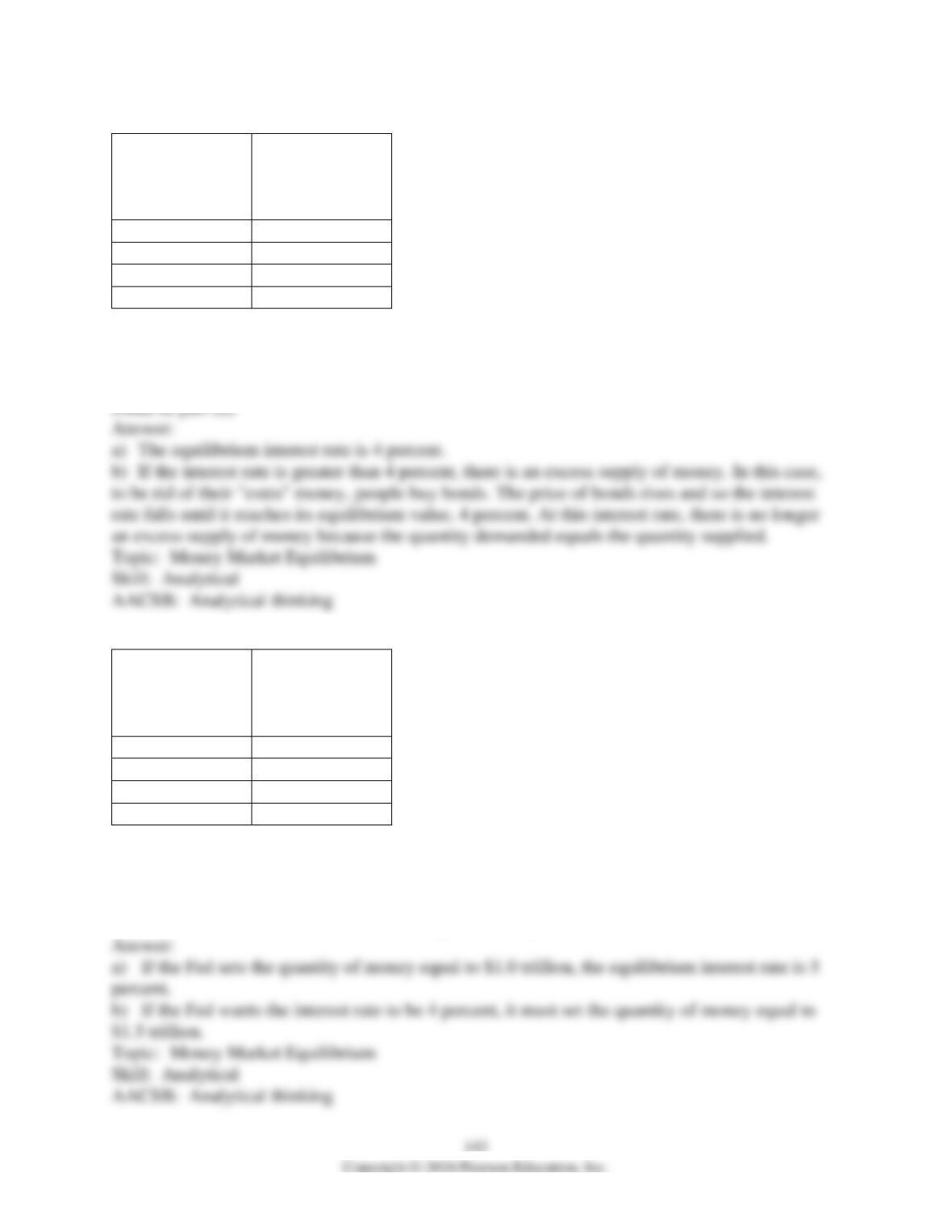
Interest rate
(percent per year)
Quantity of
money demanded
(trillions of 2009
dollars)
8
0.7
6
0.9
4
1.1
2
1.3
14) The above table has the demand for money schedule.
a) If the Fed supplies $1.1 trillion dollars, what is the equilibrium interest rate?
b) Discuss how equilibrium is restored if the interest rate is greater than the equilibrium rate
Interest rate
(percent per year)
Quantity of
money demanded
(trillions of 2005
dollars)
3
2.0
4
1.5
5
1.0
6
0.5
15) The above table has the demand for money schedule.
a) If the Fed sets the quantity of money equal to $1.0 trillion, what is the equilibrium interest
rate?
b) If the Fed wants the interest rate to be 4 percent, what must it do?
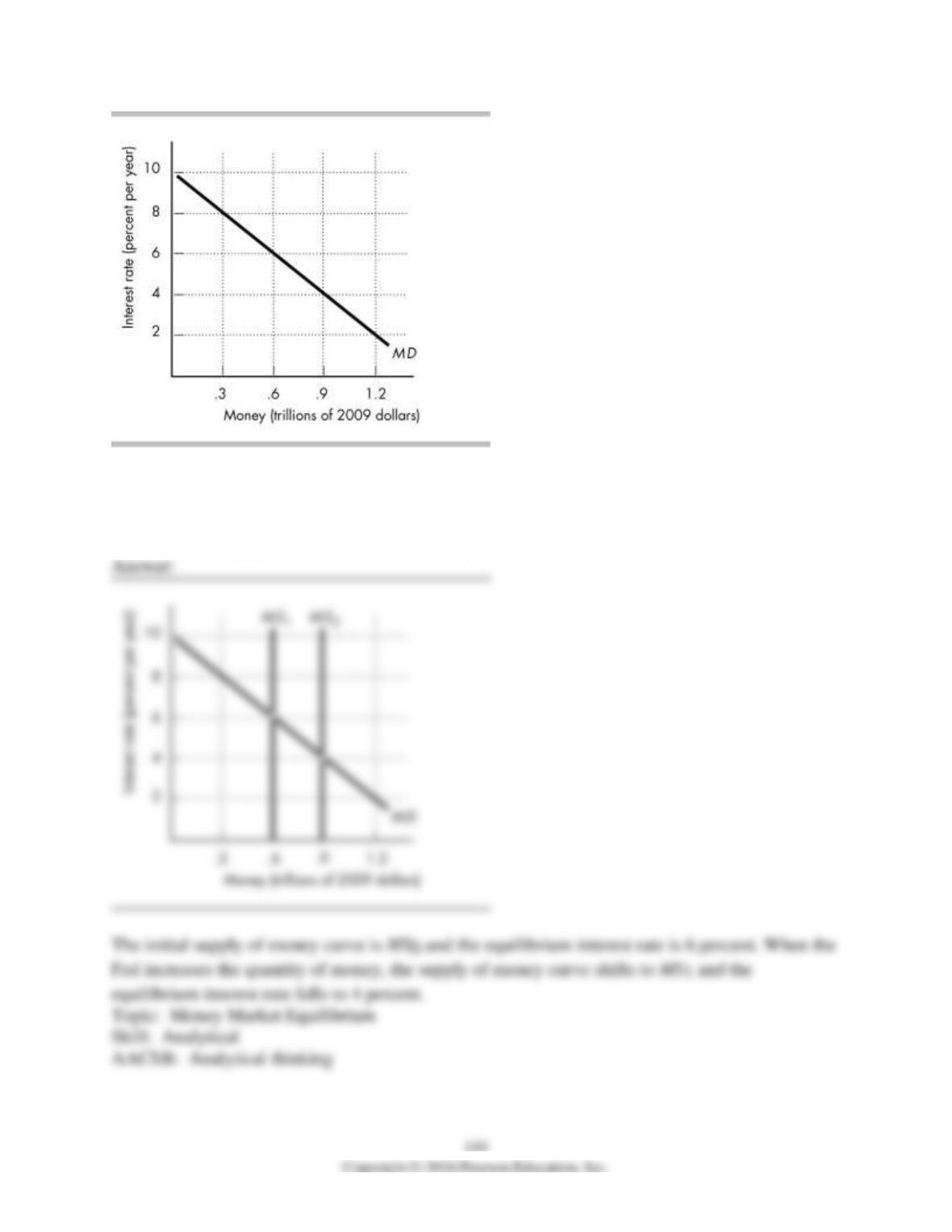
16) The above figure has the demand for money curve. Suppose the Fed initially sets the quantity
of money equal to $0.6 trillion. Draw the supply of money curve in the figure. What is the
equilibrium interest rate? Now suppose the Fed increases the quantity of money to $0.9 trillion.
Draw the new supply curve. What is the new equilibrium interest rate?
17) The quantity of money is $1 billion, the price level is 1.10, and real GDP is $10 billion. What
is the velocity of circulation?
10 True or False
1) The most direct way in which money eliminates the need for a double coincidence of wants is
through its use as a medium of exchange.
2) Barter eliminates the double coincidence of wants.
3) When Patty uses money to buy her lunch, she is showing the use of money as a “store of
value.”
4) Credit cards are not part of the nation’s money supply.
5) The money supply, as measured by M1, consists almost entirely of currency.
6) Traveler’s checks are included in M1 but not in M2.
7) M1 is usually larger than M2.
8) A depository institution receives deposits from lenders and makes loans to borrowers.
9) A depository institution creates liquidity and pools risk.
10) The Federal Reserve is divided into 7 districts.
11) The main policy-making body of the Federal Reserve System is the Federal Open Market
committee.
12) The FOMC is the agency that insures deposits up to $250,000.
13) The most powerful individual in the Federal Reserve is the Chairman of the Board of
Governors.
14) If the Fed sells securities to commercial banks, there is no money multiplier effect.
15) The desired reserve ratio helps determine the amount of money banks can create.
16) If actual reserves are 100 when deposits are 400, then definitely the desired reserve ratio is
0.25.
17) The term “currency drain” refers to an increase in currency held outside banks.
18) A currency drain occurs because people want to hold some of their money as currency rather
than as deposits.
19) A change in the price level changes the amount of nominal money people demand.
20) The opportunity cost of holding money is the nominal interest rate.
21) Suppose that nominal interest rates double. As a result, the quantity of money doubles as
well.
22) The increased use of automatic teller machines has decreased the demand for money.
23) If there is an excess quantity of money, people will buy bonds.
24) According to the quantity theory of money, in the long run, an increase in the quantity of
money does not change real GDP but does raise the price level.
25) According to the quantity theory of money, in the long run an increase in the quantity of
money creates an increase in the price level but does not increase real GDP.
26) The quantity theory of money asserts that an increase in the quantity of money leads to an
equal percentage increase in the price level in the long run.
27) Assuming velocity is constant, a 10 percent increase in the quantity of money leads to a 10
percent increase in nominal GDP in both the short run and the long run.
28) According to the quantity theory of money, inflation causes an increase in the money supply.
29) International data supports the quantity theory of money conclusion that high money growth
rates are associated with inflation.
30) In comparing growth rates of money growth and inflation across countries, the long-run
proposition of the quantity theory of money is supported.
1) The commercial banks in Fundland have
Reserves $500 million
Loans $3,500 million
Deposits $4,000 million
Total assets $5,000 million
The banks hold no excess reserves.
a) Calculate the banks’ desired reserve ratio.
b) An immigrant arrives in Fundland with $10 million, which she deposits in a bank. How much
does the immigrant’s bank lend initially?
2) The commercial banks in Lendland have
Reserves $400 million
Loans $3,600 million
Deposits $4,000 million
Total assets $4,600 million
The banks hold no excess reserves.
a) Calculate the banks’ reserve ratio.
b) An immigrant arrives in Lendland with $5 million, which he deposits in a bank. How much
does the immigrant’s bank lend initially?
3) In the economy of Briskland, the commercial banks have deposits of $500 billion. Their
reserves are $50 billion, 80 percent of which is in deposits with the Central Bank. There is $20
billion in Central Bank notes outside the banks, and there are no coins.
a) What is the monetary base?
b) If all the deposits are money, what is the total quantity of money?
c) What is the banks’ reserve ratio?
d) What is the currency drain as a percentage of the quantity of deposits?
4) Friedmania is a country in which the quantity theory of money operates. The country has a
constant population, capital stock, and technology so real GDP does not change. In 2014, real
GDP was $500 million, the price level, measured by the GDP deflator, was 150 and the velocity
of circulation of money was 10. (Because the price level is measured by the GDP deflator, it
must be divided by 100 before it is used in the equation of exchange.) In 2015, the quantity of
money increased by 20 percent.
a) What was the quantity of money in 2014?
b) What was the velocity of circulation in 2015?
c) What was the price level in 2015?
5) Fisheria is a country in which the quantity theory of money operates. The country has a
constant population, capital stock, and technology. In 2010, real GDP was $300 million, the
quantity of money was $60, and the velocity of circulation of money was 10. In 2015, the price
level rose by 20 percent.
a) What was the price level in 2014? (The price level is measured by the GDP deflator, which is
100 in the base year. So the price level from the equation of exchange needs to be multiplied by
100 to convert it to the GDP deflator.)
b) What was real GDP in 2015?
c) What was the velocity of circulation in 2015?
d) What was the quantity of money in 2015?
6) In the economy of Brightland, the commercial banks have deposits of $600 billion. Their
reserves are $60 billion. All reserves are in deposits with the Central Bank and the commercial
banks hold no excess reserves. There is $120 billion in Central Bank notes outside the banks, and
there are no coins.
a) What is the economy’s monetary base?
b) What is the quantity of money in the economy?
c) Calculate the money multiplier.
d) Suppose the Central Bank of Brightland undertakes an open market purchase of securities of
so that the monetary base increases by $5 billion. By how much will the quantity of money
change?
12 Mathematical Note: The Money Multiplier
1) ________ in the desired reserve ratio will ________ the money multiplier.
A) An increase; have no effect on
B) An increase; decrease
C) A decrease; decrease
D) A decrease; will have no effect on
2) ________ in the currency drain ________ the money multiplier.
A) A decrease; does not change
B) An increase; increases
C) A decrease; decreases
D) An increase; decreases
3) If the desired reserve ratio rises, the money multiplier
A) decreases.
B) increases.
C) stays the same.
D) probably changes but more information is needed to determine if it increases or decreases.
4) The smaller the currency drain, the
A) smaller the increase in the quantity of money from an increase in reserves.
B) more likely it is that the banking system will hold a larger proportion of excess reserves.
C) the smaller the effect of a change in the discount rate.
D) larger the increase in the quantity of money from an increase in reserves.
5) The banking system has just experienced an increase in deposits of $50,000. The currency
drain ratio is 20 percent and the desired reserve ratio is 10 percent. What does the money
multiplier equal?
A) 4.00
B) 3.33
C) 0.25
D) 10.00
6) In Zealand, banks’ desired reserve ratio is 20 percent and there is no currency drain. The
money multiplier equals ________.
A) 0.50
B) 0.20
C) 20.0
D) 5.0
155
7) In Zealand, banks’ desired reserve ratio is 20 percent and the currency drain also equals 20
percent. The money multiplier equals ________.
A) 2.18
B) 3.33
C) 5.0
D) 3.0