Economics Today, 19e (Miller)
Chapter 8 Measuring the Economy’s Performance
8.1 The Simple Circular Flow
1) The simple circular flow of income shows that the total income in an economy equals
A) total profits earned by firms.
B) all taxes paid by households.
C) the total amount of money supplied by the government.
D) total expenditures.
2) The observation that goods and services flow in one direction and money payments flow in
another direction is the principle behind
A) the double coincidence of wants.
B) a barter economy.
C) a pure command economy.
D) the circular flow of income.
3) Which of the following is TRUE about product markets?
A) Goods and services flow from households to firms.
B) Goods and services flow from firms to households.
C) Factors (land, labor, capital, and entrepreneurial ability) flow from households to firms.
D) Factors (land, labor, capital, and entrepreneurial ability) flow from firms to households.
4) According to the circular flow, the dollar value of a nation’s output is equal to
A) profits.
B) total income.
C) net income minus taxes.
D) wages.
5) In the factor market, households
A) sell resources.
B) buy resources.
C) are neither buyers nor sellers of resources.
D) are both buyers and sellers of resources.
6) Suppose Tina purchases an iTune download of her favorite song. This purchase has taken
place in the
A) product markets.
B) factor markets.
C) labor markets.
D) resource markets.
7) In the product markets, households
A) are the buyers of goods and services.
B) are the sellers of resources.
C) are neither buyers nor sellers in the market.
D) none of the above is correct.
8) Which of the following would most likely be sold in the product markets?
A) a portable power bank
B) stocks and bonds
C) plastic material
D) entrepreneurial ability
9) The value of total output and total income in the simple circular flow model
A) are measures of the economy’s level of savings.
B) include only intermediate goods.
C) are equal to each other.
D) are related in the sense that national income is less than national product.
10) Which of the following statements is FALSE?
A) One definition of total income is that it is the annual cost of producing the entire output of
final goods and services.
B) Transactions in which households buy final goods and services occur in the factor market.
C) The value of total output is identical to total income.
D) Saving is the difference between consumer income and expenditures.
11) Which of the following statements is FALSE?
A) The value of total income is equal in value to total output because profit is a cost of
production.
B) In the circular flow model, households sell factor services to businesses in return for factor
payments.
C) Businesses sell goods and services to households who use their income to pay for them.
D) Total income is always greater than total output.
12) Which of the following is consistent with the circular flow of income?
I. Goods and services flow in one direction.
II. Payments and incomes flow in one direction.
III. Sellers receive less than what buyers spend.
A) I only
B) II only
C) III only
D) Both I and II
13) According to the circular flow, the value of total output produced and total income
A) should differ by the value of intermediate goods.
B) should increase by the unanticipated rate of inflation.
C) will always be different by the amount of firm profits
D) will be equal.
14) One of the principles behind the concept of the circular flow is that
A) in every economic exchange, the seller receives exactly the same amount that the buyer
spends.
B) in every economic exchange, the seller receives less than the amount that the buyer spends.
C) the seller of goods receives exactly the same amount that the buyer spends, but the seller of
resources receives less than the buyer spends.
D) in exchange involving products, the seller receives less than the amount the buyer spends, but
in resource markets the seller receives more than the buyer spends.
15) The circular flow of income shows
A) goods, services, and money payments flowing in the same direction.
B) goods and money payments flowing in one direction and services flowing in the opposite
direction.
C) goods and services flowing in one direction and money payments in the other direction.
D) goods flowing in one direction and services and money payments flowing in the other
direction.
16) In the simple circular flow model
A) households spend the income they receive from labor services but save the income they
receive from selling the other factors of production.
B) businesses buy labor services from households, but supply other factors of production
themselves.
C) households spend their entire income on consumer products.
D) profits are a type of income that is not received by households.
17) In the circular flow model, profits are considered to be
A) a subtraction from the Gross Domestic Product (GDP).
B) a cost of doing business.
C) equal to zero, or else the circular flow would be out of balance.
D) a form of interest payment.
18) Economists consider profit to be
A) a cost of producing goods and services.
B) the same as a salary.
C) a reward for incurring losses.
D) something that should be eliminated by antitrust laws.
19) Profits represent
A) the income earned from a bond.
B) the payments firms make to their employees.
C) a reward to entrepreneurs.
D) the difference between total tax revenue and total government spending.
20) How do economists view profits?
A) Profits are an asset the business holds.
B) Profits are one of the costs paid to a factor of production.
C) Profits are guaranteed as long as a firm operates ethically.
D) The firm’s profit equals the sum of all payments to the 5 factors of production.
21) In the circular flow, ________ provide the factor services.
A) households
B) businesses
C) producers
D) businesses and households
22) The circular flow of income involves the idea that
A) in every economic exchange one party takes advantage of the other party.
B) the seller of a good receives less than the buyer spends.
C) the seller of a good receives more than the buyer spends.
D) the seller of a good receives exactly the same amount as the buyer spends.
23) The circular flow of income shows
A) the dollar value of output is less than the total income.
B) the dollar value of output is more than the total income because of the existence of profits.
C) the dollar value of output is exactly equal to the total income.
D) the dollar value of output is more or less than the total income, depending on whether profits
are positive or negative.
24) The circular flow of income assumes that
A) profit is not a cost of production.
B) the national income accounting approach is not an adequate way to measure the economy’s
performance.
C) goods and services flow in one direction and money payments flow in the other.
D) total income is the sum of the value of intermediate goods and final goods and services.
25) In the circular flow model
A) households demand goods and services which are supplied by firms, and the firms demand
resources that are supplied by intermediate firms.
B) households demand goods and services that are supplied by firms, while supplying resources
that are demanded by firms.
C) households buy goods and services and firms supply goods. Resources are supplied by other
firms.
D) households buy goods and services while firms sell goods and services. Firms obtain labor
from households, capital from government, and raw materials from firms.
26) Goods and services are sold
A) in the product markets.
B) in the factor markets.
C) by households.
D) only as intermediate goods.
27) Resources can be purchased
A) in the product markets.
B) in the factor markets.
C) exclusively through the government.
D) only in the black market or illegal market.
28) Total income
A) is the yearly amount earned by owners of the nation’s resources.
B) includes only wages received by workers.
C) includes only wages and interest payments.
D) excludes profits.
29) The amount earned by owners of the nation’s factors of production is
A) the wages and fringe benefits received by the nation’s workers.
B) all profits received by businesses.
C) total income.
D) private and government transfer payments.
30) Profits
A) are a cost of doing business because entrepreneurs would not incur the risk of starting a
business if they didn’t expect to earn profits.
B) are a cost of doing business because they are payments to others.
C) are not a cost of doing business because they are owed to resource owners.
D) are not a cost of doing business because they are often zero or negative.
31) Which of the following statements is TRUE about profits?
A) Profits are excluded from the circular flow of the income diagram.
B) The only portion of profits that are included in the circular flow diagram are the portion paid
out in the form of dividends.
C) Profits are considered one of the resources necessary for production.
D) Profits are considered a cost of doing business.
32) Total income is defined as
A) the total receipts of firms before taxes.
B) the total amount earned by all resource owners.
C) the sum of the total receipts of firms and the amount earned by households.
D) the sum of the total receipts of firms less the amount of tax that must be paid.
33) All of the following are incomes earned in the factor market EXCEPT
A) wages.
B) prices of goods and services.
C) profits.
D) rents.
34) The annual cost of producing the entire output of goods and services in the economy
A) includes financial transactions.
B) can be calculated entirely on the basis of financial transactions.
C) includes durable goods but excludes nondurable goods.
D) is total income.
35) Households receive their income in the circular flow diagram by
A) selling the use of their property.
B) selling the goods they produce at home.
C) obtaining dividends and interest payments.
D) selling resources they own to business firms.
36) In the simple circular flow model, the funds received by a carmaker when it sells a car goes
to
A) the workers who helped build the car.
B) the owners of firms who sold materials to the carmaker, and the rest stays with the firm.
C) only the owners of the carmaker.
D) the owners of all of the resources used to make the car.
37) Which of the following is most likely NOT a final good or service?
A) a portable power bank
B) bread in a grocery store
C) coffee beans in a coffee shop
D) a cookie sold in a bakery
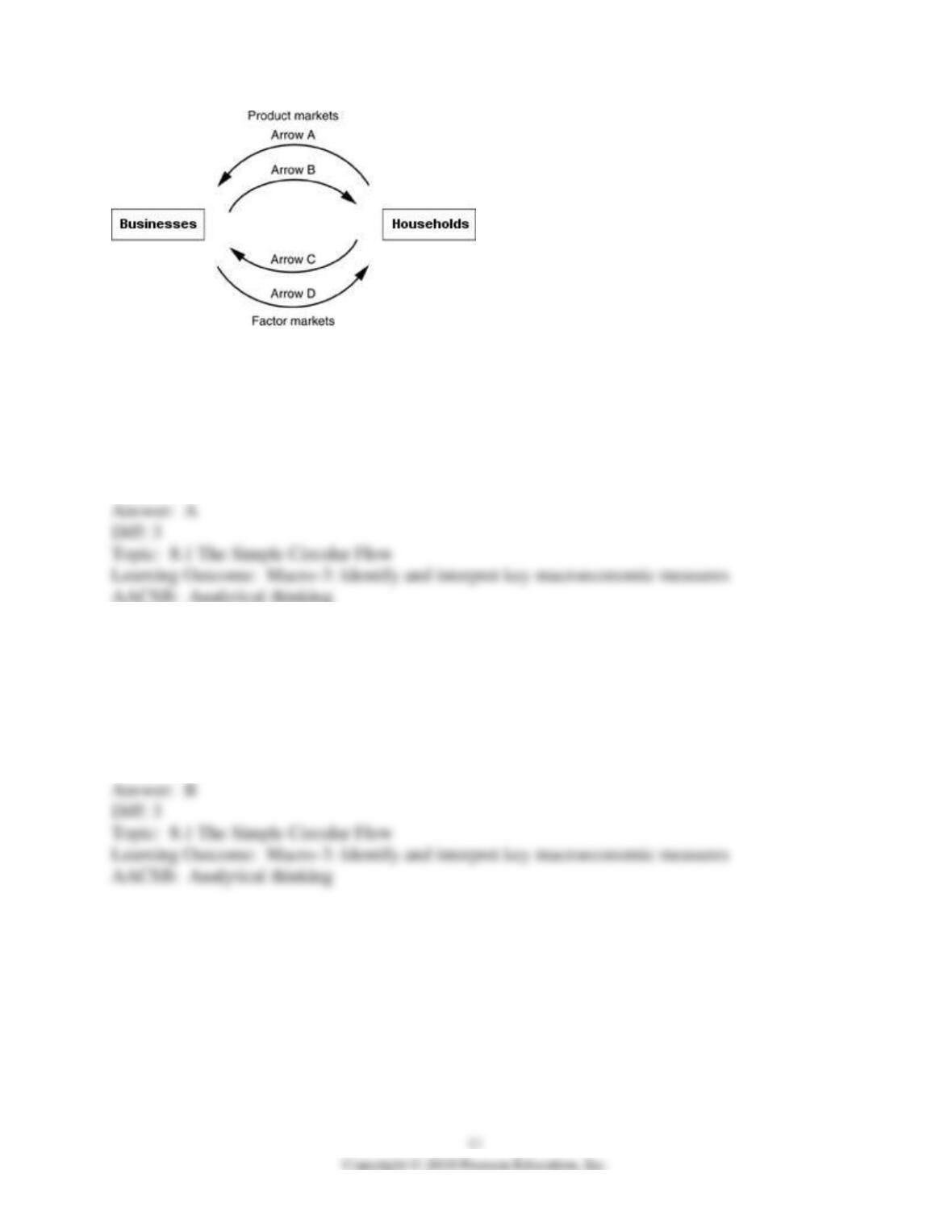
38) Refer to the above figure. The top two arrows of the figure refer to the product markets. The
bottom arrows refer to the factor markets. Which arrow represents the total monetary value of all
goods and services?
A) Arrow A
B) Arrow B
C) Arrow C
D) Arrow D
39) Refer to the above figure. The top two arrows of the figure refer to the product markets. The
bottom arrows refer to the factor markets. Which arrow represents the final consumer goods and
services?
A) Arrow A
B) Arrow B
C) Arrow C
D) Arrow D
40) Refer to the above figure. The top two arrows of the figure refer to the product markets. The
bottom arrows refer to the factor markets. Which arrow represents factor services?
A) Arrow A
B) Arrow B
C) Arrow C
D) Arrow D
41) Refer to the above figure. The top two arrows of the figure refer to the product markets. The
bottom arrows refer to the factor markets. Which arrow represents total income?
A) Arrow A
B) Arrow B
C) Arrow C
D) Arrow D
42) Refer to the above figure. Which arrows represent items that are measured in dollar terms?
A) Arrows A and B
B) Arrows C and D
C) Arrows A and D
D) Arrows B and C
43) Refer to the above figure. Which arrows represent items that are NOT measured in dollar
terms?
A) Arrows A and B
B) Arrows C and D
C) Arrows A and D
D) Arrows B and C
44) A firm produces a good and generates $5 million in receipts. Wages are $1 million, rent is
$500,000, and interest payments are $1 million. Then
A) profits are $500,000, the cost of production is $4.5 million, and households receive income
equal to $4.5 million.
B) profits are $1.5 million, the cost of production is $5 million, and households receive income
equal to $4.5 million.
C) profits are $1.5 million, the cost of production is $5 million, and households receive income
equal to $5 million.
D) profits are $500,000, the cost of production is $5 million, and households receive income
equal to $4.5 million.
45) In an economy, households receive a total income of $4 million. Of this, $2.5 million are
wages received for labor services, $1 million are rental payments, and $250,000 are interest
payments received. In this economy, what are the costs of production and profits equal to
respectively?
A) $4 million; $500,000
B) $4 million; $250,000
C) $7.75 million; $250,000
D) $7.75 million; 0
46) The dollar value of final output
A) is less than total income.
B) is equal to total income.
C) is greater than total income.
D) equals profits.
47) Which of the following statements is NOT true about the relationship between the dollar
value of total output and total income?
A) The dollar value of total output equals total income because the spending of one group is the
income of another.
B) The dollar value of total output equals total income because profit is considered a cost of
production.
C) The dollar value of total output equals total income because profit is not considered a cost of
production.
D) The dollar value of total output equals total income because of the economic definition of
profit.
48) How much of each dollar spent by a consumer ultimately becomes income to someone else?
A) one dollar
B) less than one dollar
C) It depends on how much labor was needed to produce the good that the consumer buys.
D) It depends on how much the cost there is in the distribution channel that delivers the good
from the manufacturer to the consumer.
49) The two sectors of the economy in the simple circular flow model are
A) the employed and the unemployed.
B) foreign markets and domestic markets.
C) households and businesses.
D) the private sector and the public sector.
50) In the simple circular flow model, total income in one nation must equal
A) the sum of wages, rents, interest and profits.
B) the total monetary value of all final goods and services.
C) the yearly amount earned by that nation’s resources.
D) All of the above are correct.
51) Which of the following would most likely be defined as a final good?
A) iron ore
B) wheat
C) a computer tablet
D) lumber
52) In the simple circular flow
A) businesses trade goods and services for resources in the product market.
B) consumers trade resources for goods and services in the factor market.
C) consumers trade goods and services for monetary payments in the factor market.
D) producers trade goods and services for monetary payments in the product market.
53) In the product market
A) businesses trade goods and services for resources.
B) consumers trade resources for goods and services.
C) consumers trade goods and services for resources.
D) consumers trade monetary payments for goods and services.
54) Which of the following occurs in the factor market?
A) firms exchange goods and services for resources.
B) households exchange resources for goods and services.
C) households exchange money for goods and services.
D) firms exchange money for resources.
55) Profits are part of the
A) total income.
B) monetary value of output.
C) final consumer goods.
D) factor services.
56) Explain the concept of the circular flow.
57) Why must total income be identical to the dollar value of total output?
58) Where does profit enter in the circular flow? Why?
8.2 National Income Accounting
1) The dollar value of total output in the United States
A) equals the value of all physical goods sold in the United States.
B) equals the market value of all final goods and services produced in the United States.
C) equals all the value of U.S. stocks on the world’s stock exchanges.
D) equals the value of all resources that can be found in the United States.
2) The measurement system used by the U.S. government to estimate national income is
A) the GDP deflator.
B) national income accounting.
C) the sum of financial transactions, transfer payments and secondhand goods.
D) the sum of consumption plus investment expenditures.
3) The approach used in the U.S. to measure the economy’s aggregate performance is
A) national income accounting.
B) to add up the value of intermediate goods.
C) the total value of securities.
D) to add up the total value of financial transactions, transfer payments, and secondhand goods.
E) all of the above.
4) Which of the following would be included in the calculation of Gross Domestic Product
(GDP)?
A) the value of transfer payments
B) the value of the sale of a used guitar
C) the value of the sale of 100 shares of Facebook stock
D) the value of spending on a truck
5) U.S. Gross Domestic Product (GDP) does NOT include which of the following?
A) business investment in the United States
B) the value of goods produced in Mexico by a U.S. owned firm
C) U.S. exports to other countries
D) the purchase of all final goods and services by U.S. households
6) Which of the following best describes a nation’s Gross Domestic Product?
A) the market value of all goods and services produced in the economy, including intermediate
goods
B) the total market value of all final goods and services produced in the economy during a year
C) the constant dollar value of all goods produced in the economy during a year period
D) the market value of all goods and services less depreciation
7) The total market value of final goods and services produced in an economy during a one-year
period is
A) Gross Domestic Product.
B) net national product.
C) profit.
D) personal income.
8) Gross Domestic Product measures
A) the total value of labor used in the economy.
B) the total market value of final goods and services produced within a nation’s borders.
C) the total income received by residents of a nation.
D) the total worth of all goods consumed within the borders of a nation.
9) Gross Domestic Product is best defined as
A) the total market value of all final goods and services produced during a year by factors of
production located within a nation’s borders.
B) the total market value of all intermediate goods and services produced during a year by
factors of production located within a nation’s borders.
C) the value added to all goods produced in an economy during a year.
D) the total market value of all final goods and services that exist in an economy at a given point
in time.
10) Suppose the total value of all assets in the Country X is $10 trillion. In 2018, the total value
of all final services produced in Country X was $150 billion, the total value of all final goods
produced in Country X was $350 billion, and the total value of all final goods and services
produced by Country X’s firms in other countries was $100 billion. In this situation, Country X’s
Gross Domestic Product for 2018 was
A) $600 billion.
B) $510 billion.
C) $500 billion.
D) $10.5 trillion.
11) Which of the following transactions is included in Gross Domestic Product?
A) a Social Security check received by a retired couple
B) a gift card that a mother gives her son
C) a used textbook that one student gives another student in exchange for an iPod
D) tips received by a waitress who reports them to the IRS
12) Which of the following is included in determining Gross Domestic Product?
A) the purchase of a new car
B) the purchase of a used car
C) a housewife preparing breakfast
D) a gardener canning vegetables for consumption during the winter
13) Goods that are used up entirely in the production of final goods are known as
A) durable goods.
B) value added goods.
C) intermediate goods.
D) capital goods.
14) Which of the following would be included when calculating Gross Domestic Product?
A) the purchase of a previously owned house for $270,000
B) the purchase of a used $10,000 automobile from a friend
C) a Social Security check for $800
D) none of the above