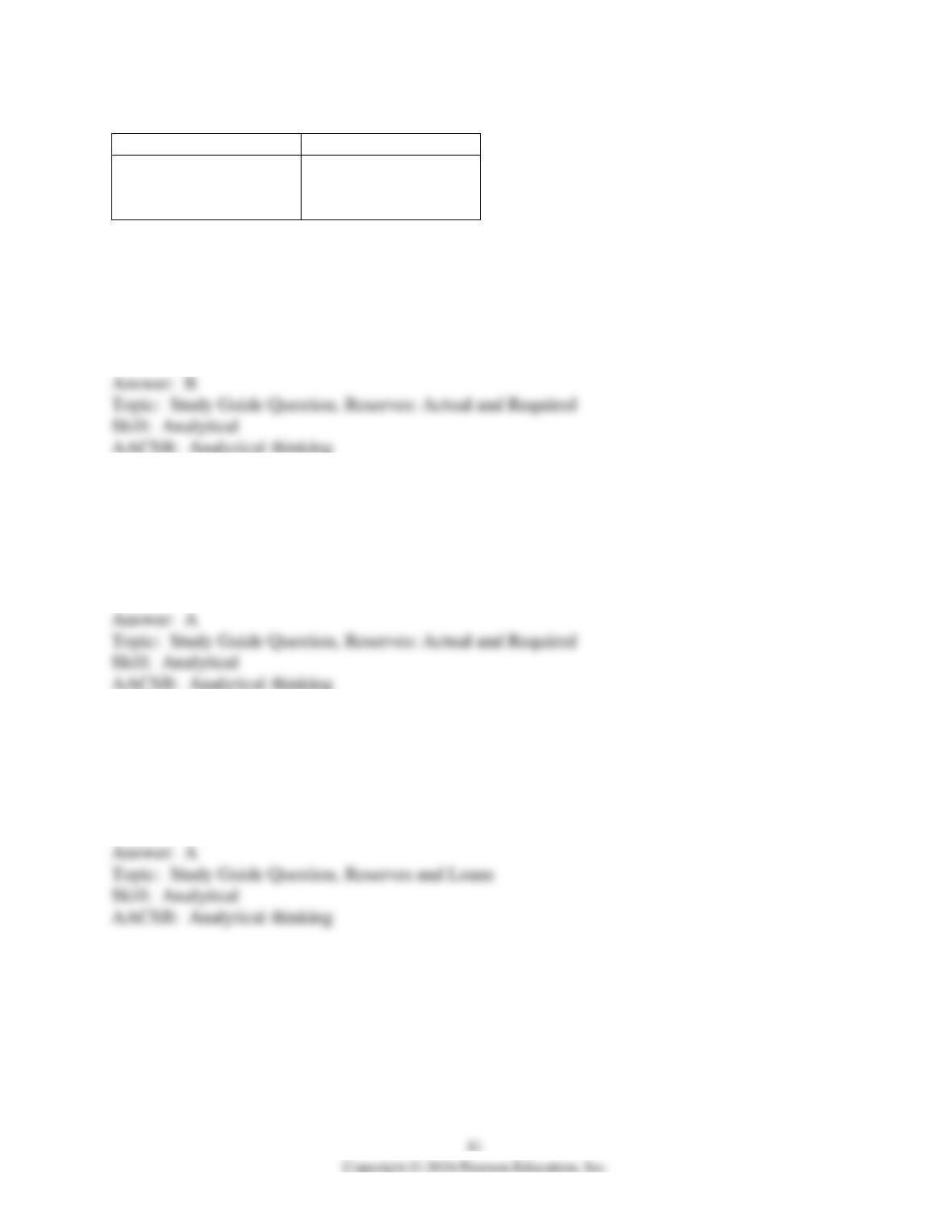
Assets
Liabilities
Reserves $400
Loans $800
Total $1,200
Deposits $1,200
Total $1,200
60) In the balance sheet for the FBN bank above, the entries are in millions of dollars. If the
desired reserve ratio is 10 percent, FBN Bank has desired reserves of
A) $360 million.
B) $120 million.
C) $280 million.
D) $0.
61) In the balance sheet for the FBN bank above, the entries are in millions of dollars. If the
desired reserve ratio equals 10 percent, FBN Bank has excess reserves of
A) $280 million.
B) $200 million.
C) $360 million.
D) $0.
62) In the balance sheet for the FBN bank above, the entries are in millions of dollars. If the
desired reserve ratio is 10 percent, FBN Bank can loan an additional
A) $280 million.
B) $200 million.
C) $100 million.
D) $360 million.
63) In the balance sheet for the FBN bank above, the entries are in millions of dollars.. After
FBN Bank loans the maximum amount it can, the loans have been spent, and the proceeds have
been deposited in other banks, FBN Bank has excess reserves of
A) $360 million.
B) $280 million.
C) $100 million.
D) $0.
64) If the money multiplier is 3.5, a $10 billion increase in the monetary base
A) increases the quantity of money by $35 billion.
B) increases the quantity of money by $2.86 billion.
C) increases the quantity of money by $3.5 billion.
D) increases the quantity of money by $10 billion.
1) The quantity of money that people choose to hold depends on which of the following?
I. The price level
II. Financial innovation
III. The exchange rate
A) I
B) I and II
C) I and III
D) I, II, and III
2) Which of the following affects the amount of money a person is willing to hold?
A) The use of credit cards increases.
B) The price level rises from 103 to 107.
C) The interest rate that you earn on your savings account increases.
D) All of the above are correct.
3) If the price level rises, the quantity of
A) nominal money people demand increases.
B) real money people demand increases.
C) nominal money people demand decreases.
D) real money people demand decreases.
4) The demand for nominal money
A) increases as the price level increases.
B) decreases as the price level increases.
C) depends on the quantity of money.
D) is the same as the demand for real money.
5) Which of the following decreases the demand for nominal money?
A) a decrease in the nominal interest rate
B) an increase in real GDP
C) an increase in the quantity of money
D) a decrease in the price level
6) If the price level doubles, the
A) nominal demand for money doubles.
B) nominal demand for money drops by half.
C) real demand for money drops by half.
D) real demand for money doubles.
7) Suppose you hold $50 to buy groceries weekly and then the price of groceries increases by 5
percent. To be able to buy the same amount of groceries, what must happen to your nominal
money holdings?
A) They must increase by $5.
B) They can decrease by $5.
C) They must increase by $2.50.
D) They must increase, but the amount of the increase depends on income.
8) The quantity of real money demanded is
A) negatively related to the price level.
B) positively related to the price level.
C) independent of the price level.
D) proportional to the price level
9) The real quantity of money is
A) inversely related to GDP.
B) measured in current dollars.
C) inversely related to the price level.
D) measured in constant dollars.
10) When price levels rise, the quantity of nominal money demanded will ________ and the
quantity of real money demanded will ________.
A) increase; stay the same
B) increase; increase
C) increase; decrease
D) decrease; increase
11) When the nominal interest rate rises, the
A) quantity of money demanded decreases.
B) demand for money decreases.
C) demand for money increases.
D) quantity of money demanded increases.
12) The opportunity cost of holding money balances rather than holding other assets is
A) the nominal interest rate.
B) the price level.
C) forgone consumption.
D) forgone liquidity.
13) The opportunity cost of holding money is the
A) nominal interest rate on assets other than money.
B) price of goods and services.
C) level of wage and rental income.
D) ease with which an asset can be converted into a means of payment.
14) The opportunity cost of holding money is
A) the price level.
B) real GDP.
C) the inverse of the price level multiplied by the nominal interest rate.
D) the nominal interest rate.
15) The demand for money is ________ related to the nominal interest rate.
A) positively
B) negatively
C) not
D) None of the above answers is correct because the relationship between the demand for money
and the nominal interest rate changes with the inflation rate.
16) The opportunity cost of holding money increases when
A) the purchasing power of money rises.
B) the nominal interest rate rises.
C) the price level falls.
D) consumers’ real incomes increase.
17) A decrease in the nominal interest rate ________ the opportunity cost of holding money.
A) increases
B) decreases
C) can increase or decrease
D) None of the above answers is correct because the nominal interest rate does not affect the
opportunity cost of holding money.
18) The opportunity cost of holding money refers to
A) the service fees charged to withdraw currency from an ATM.
B) the price level.
C) the interest that could have been earned if the money balances had been changed into an
interest-bearing asset.
D) the utility that would have been received if the money balances had been used to buy a good
or service.
19) The demand for money is ________ related to the nominal interest rate.
A) positively
B) negatively
C) not related
D) None of the above answers is correct because the relationship between the demand for money
and the interest rate varies with the inflation rate.
20) When the nominal interest rate rises, the opportunity cost of holding money
A) rises and people hold more money.
B) falls and people hold less money.
C) falls and people hold more money.
D) rises and people hold less money.
21) The higher the nominal interest rate, the
A) greater the opportunity cost of holding money.
B) lower the quantity of money demanded.
C) more the demand for money curve shifts leftward.
D) Both answers A and B are correct.
22) In October of 2014, the nominal interest rate earned on money market accounts was around
0.20 percent. This interest rate is a measure of which of the following?
A) the opportunity cost of holding money
B) the inflation rate
C) the demand for money
D) the real interest rate
23) When the nominal interest rate rises, the quantity of money demanded decreases because
A) people will buy fewer goods and hence hold less money.
B) the price level also rises and people decrease their demand for money.
C) people shift funds from interest-bearing assets into money.
D) people shift funds from money holdings to interest-bearing assets.
24) Which of the following is CORRECT? The demand for money
A) increases as real GDP increases.
B) decreases as the price level increases.
C) depends on the quantity of money.
D) increases when the nominal interest rate rises.
25) When real GDP increases, the demand for money
A) increases.
B) decreases.
C) stays the same.
D) we cannot make a prediction without additional information.
26) The quantity of money that people choose to hold is
A) positively related to the nominal interest rate.
B) positively related to real GDP.
C) negatively related to the price level.
D) positively related to the availability of ATM machines.
27) The quantity of money people want to hold increases if
A) the price level falls.
B) the nominal interest rate rises.
C) real GDP increases.
D) All of the above answers are correct.
28) Which of the following decreases the demand for money?
A) an increase in the price level
B) an increase in the quantity of money
C) a decrease in real GDP
D) a decrease in the cost of printing money
29) When real GDP increases, people demand
A) the same quantity of real money.
B) less real money.
C) more real money.
D) more money in nominal terms but less in real terms.
30) ________ real GDP increases the demand for money and ________ the nominal interest rate
decreases the quantity of money demanded.
A) Increasing; increasing
B) Increasing; decreasing
C) Decreasing; increasing
D) Decreasing; decreasing
31) Financial innovations can have the effect of
A) only decreasing the demand for money.
B) only increasing the demand for money.
C) either increasing or decreasing the demand for money depending on what the innovation is.
D) increasing the Fed’s monetary policy.
32) The demand for money curve is the relationship between ________ and ________, other
things remaining the same.
A) the quantity of nominal money demanded; the real interest rate
B) the quantity of real money demanded; the real interest rate
C) the quantity of nominal money demanded; the nominal interest rate
D) the quantity of real money demanded; the nominal interest rate
33) An increase in the nominal interest rate
A) shifts the demand for money curve rightward.
B) shifts the demand for money curve leftward.
C) leads to an upward movement along the demand for money curve.
D) leads to a downward movement along the demand for money curve.
34) There is a movement along the demand for money curve if
A) the nominal interest rate rises.
B) there is an economic expansion so that real GDP increases.
C) banking customers use ATM machines more.
D) the price level increases.
35) In October of 20142, the interest rate on money market accounts was about 0.2 percent. In
2007, the interest rate on money market accounts was about 4.0 percent. What has been the
impact on the demand for money curve from this fall in the interest rate?
A) the money demand curve shifted to the right
B) the money demand curve shifted to the left
C) there was a downward movement along the demand for money curve
D) there was an upward movement along the demand for money curve
36) An increase in real GDP
A) shifts the demand for money curve rightward.
B) shifts the demand for money curve leftward.
C) leads to an upward movement along the demand for money curve.
D) leads to a downward movement along the demand for money curve.
37) The demand for money curve shifts rightward if
A) the price level increases.
B) real GDP increases.
C) the nominal interest rate increases.
D) the real interest rate decreases.
38) The demand for money curve shifts rightward if
A) the nominal interest rate falls.
B) financial innovation creates new substitutes for cash.
C) real GDP increases.
D) the price level falls.
39) An increase in the nominal interest rate creates a ________ the money demand curve, and an
increase in real GDP creates a ________ the money demand curve.
A) movement down along; leftward shift of
B) rightward shift of; movement up along
C) movement up along; rightward shift of
D) leftward shift of; rightward shift of
40) An increase in the opportunity cost of holding money creates a ________ the money demand
curve and an increase in real GDP creates a ________ the money demand curve.
A) leftward shift of; movement down along
B) rightward shift of; movement down along
C) movement up along; leftward shift of
D) movement up along; rightward shift of
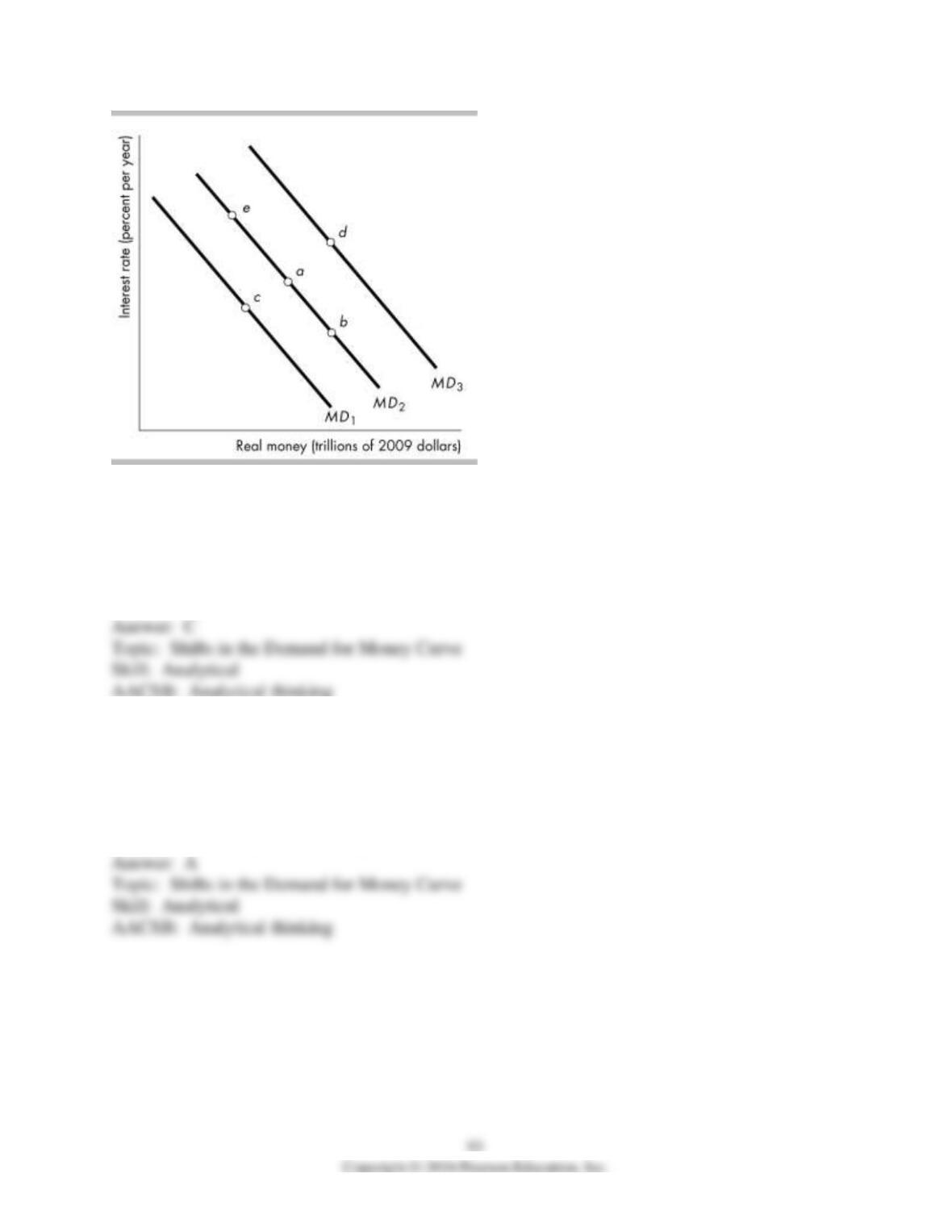
41) Use the figure above to answer this question. Suppose the economy is operating at point a. A
move to ________ could be explained by ________.
A) point e; a decrease in the nominal interest rate
B) point c; an increase in the nominal interest rate
C) point d; an increase in real GDP
D) point b; an increase in real GDP
42) Use the figure above to answer this question. Suppose the economy is operating at point a. A
move to ________ could be explained by ________.
A) point c; an increase in the use of credit cards
B) point b; an increase in real GDP
C) point b; an increase in the nominal interest rate
D) point e; an increase in U.S. exports
43) In the above figure, suppose the economy is initially at point a. If the nominal interest rate
increases, there is a movement to point such as
A) b.
B) c.
C) d.
D) e.
44) In the above figure, suppose the economy is at point a. If there is an increase in real GDP,
there is a movement to point such as
A) b.
B) c.
C) d.
D) e.
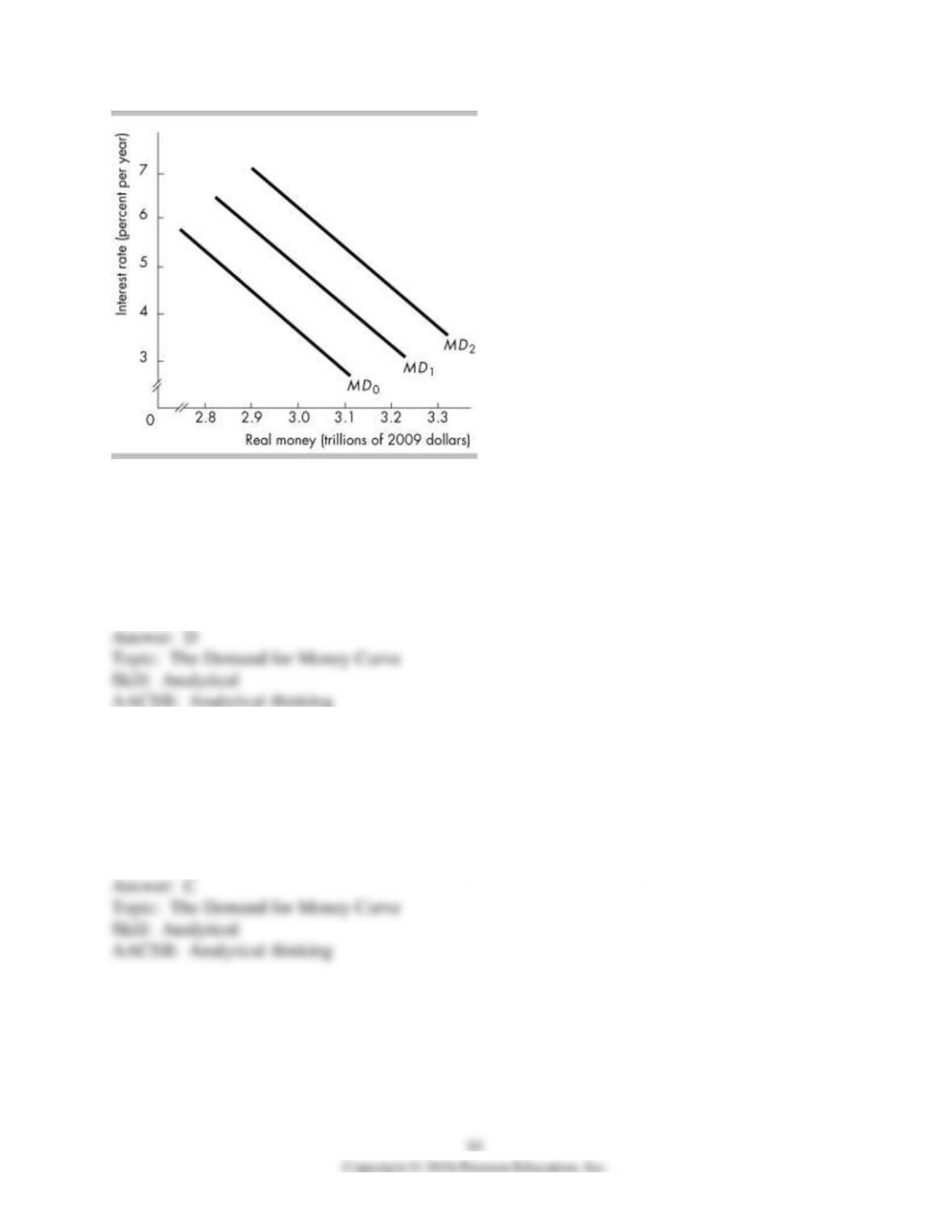
45) In the above figure, suppose the economy is initially on the demand for money curve MD1.
What is the effect of a fall in the nominal interest rate?
A) The demand for money curve would shift rightward to MD2.
B) The demand for money curve would shift leftward to MD0.
C) There would be a movement upward along the demand for money curve MD1.
D) There would be a movement downward along the demand for money curve MD1.
46) In the above figure, suppose the economy is initially on the demand for money curve MD1.
What is the effect of a rise in the nominal interest rate?
A) The demand for money curve would shift rightward to MD2.
B) The demand for money curve would shift leftward to MD0.
C) There would be a movement upward along the demand for money curve MD1.
D) There would be a movement downward along the demand for money curve MD1.
47) In the above figure, suppose the economy is initially on the demand for money curve MD1.
What is the effect of an increase in real GDP?
A) The demand for money curve would shift rightward to MD2.
B) The demand for money curve would shift leftward to MD0.
C) There would be a movement upward along the demand for money curve MD1.
D) There would be a movement downward along the demand for money curve MD1.
48) In the above figure, suppose the economy is initially on the demand for money curve MD1.
What is the effect of an increase in financial innovation such as the introduction of ATMs?
A) The demand for money curve would shift rightward to MD2.
B) The demand for money curve would shift leftward to MD0.
C) There would be a movement upward along the demand for money curve MD1.
D) There would be a movement downward along the demand for money curve MD1.
49) In the above figure, suppose the economy is initially on the demand for money curve MD1.
What is the effect of an increase in the use of credit cards?
A) The demand for money curve would shift rightward to MD2.
B) The demand for money curve would shift leftward to MD0.
C) There would be a movement upward along the demand for money curve MD1.
D) There would be a movement downward along the demand for money curve MD1.
50) On a given day the quantity of money is ________ and the supply of money curve is
________.
A) fixed; horizontal
B) fixed; vertical
C) variable; horizontal
D) variable; vertical
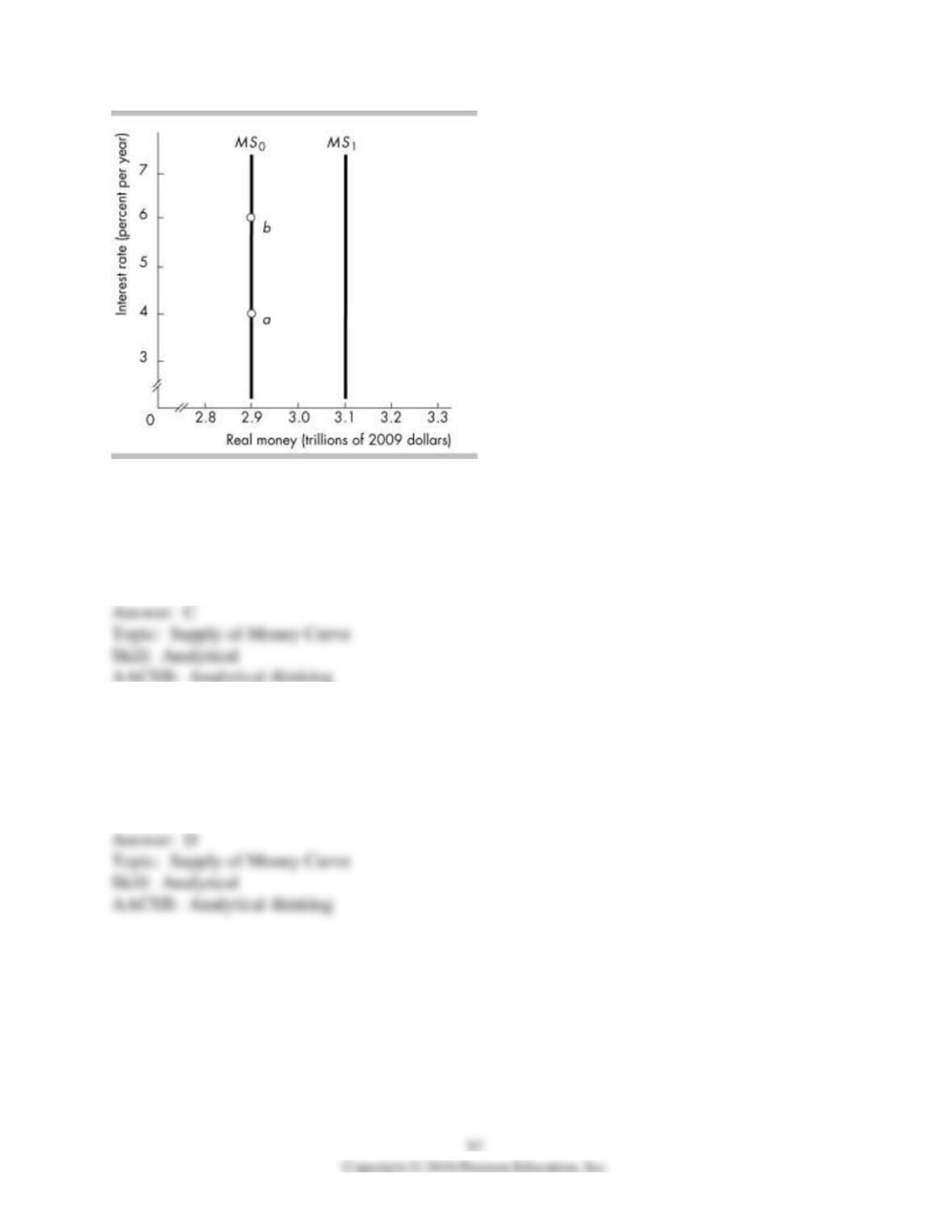
51) In the figure above, an increase in the monetary base would create a change such as a
A) movement from point a to point b along the supply of money curve MS0.
B) movement from point b to point a along the supply of money curve MS0.
C) shift from the supply of money curve MS0 to the supply of money curve MS1.
D) shift from the supply of money curve MS1 to the supply of money curve MS0.
52) In the figure above, a decrease in the monetary base would create a change such as a
A) movement from point a to point b along the supply of money curve MS0.
B) movement from point b to point a along the supply of money curve MS0.
C) shift from the supply of money curve MS0 to the supply of money curve MS1.
D) shift from the supply of money curve MS1 to the supply of money curve MS0.
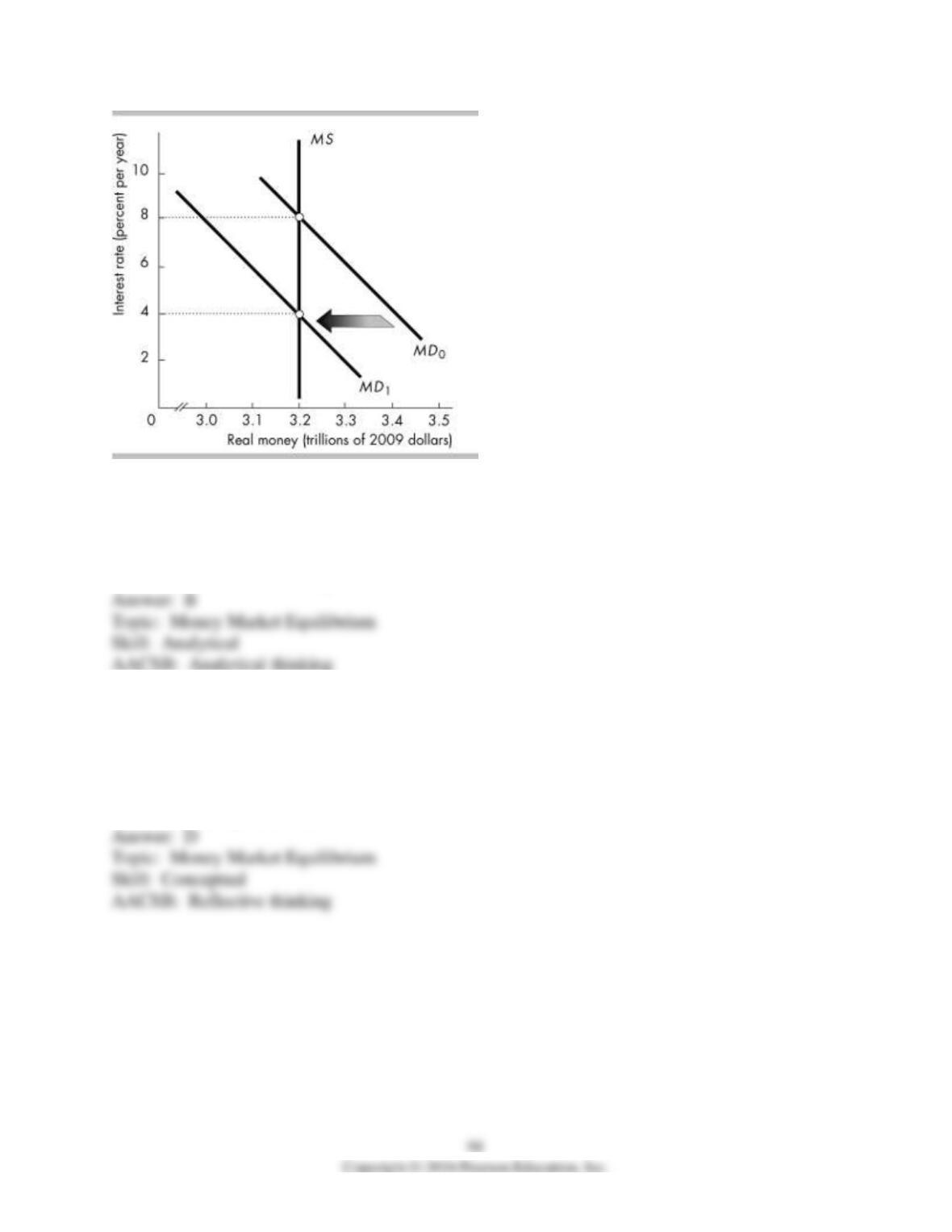
53) The figure above illustrates the effect of
A) an increase in real GDP.
B) a decrease in real GDP.
C) an increase in the monetary base.
D) a decrease in the monetary base.
54) When the interest rate falls in the money market, the quantity of money demanded ________
and the quantity of money supplied ________.
A) increases; decreases
B) decreases; increases
C) stays the same; decreases
D) increases; stays the same
55) When the quantity of money demanded is greater than the quantity of money supplied,
people ________ bonds and the interest rate ________.
A) sell; rises
B) sell; falls
C) buy; rises
D) buy; falls
56) Suppose that the interest rate is greater than the equilibrium interest rate. Which of the
following occurs?
I. There is an excess quantity of money.
II. The quantity of money automatically increases.
III. The interest rate falls.
A) I
B) I and II
C) I and III
D) I, II and III
57) In the money market, if the interest rate exceeds the equilibrium interest, there is a surplus of
money. How is the surplus eliminated?
A) People buy bonds to rid themselves of the surplus money, bidding up their price and pushing
interest rates down.
B) Banks will lend out the surplus, lowering interest rates.
C) The Federal Reserve will destroy currency, reducing the quantity of money.
D) The high interest rate increases the demand for money, eliminating the surplus.
58) When the interest rate is above the equilibrium interest rate there is an
A) excess quantity of money and people will sell bonds.
B) excess demand for money and people will sell bonds.
C) excess quantity of money and people will buy bonds.
D) excess demand for money and people will buy bonds.
59) If the interest rate is above the equilibrium interest rate, then
A) there is an excess demand for money.
B) the quantity of money demanded exceeds the quantity supplied.
C) people will sell bonds and the interest rate will fall.
D) people will buy bonds and the interest rate will fall.
60) Suppose the equilibrium interest rate in the money market is 5 percent and the current
interest rate is 7 percent. As a result
A) the interest rate rises.
B) real GDP increases.
C) the demand for money curve shifts rightward.
D) people buy bonds and the interest rate falls.
61) Suppose the money market has an equilibrium interest rate of 10 percent. If the actual
interest is 8 percent, which of the following occurs to bring the money market back to
equilibrium?
A) People buy bonds, the price of bonds rises and the interest rate rises.
B) People buy bonds, the price of bonds falls and the interest rate rises.
C) People sell bonds, the price of bonds rises and the interest rate rises.
D) People sell bonds, the price of bonds falls and the interest rate rises.