CHAPTER 8—COST ANALYSIS AND ESTIMATION Key
1. The foregone value associated with the current rather than next-best use of a given asset is called:
2. Sunk costs:
3. In the short run, the:
4. In the long run, the:
5. The amount that must be paid for an item under prevailing market conditions is:
6. The acquisition cost of an asset is:
7. Incremental cost is the change in:
8. Noncash expenses are:
9. In the decision process, management should ignore:
10. In the decision process, management should always consider:
11. Fixed costs include:
12. Marginal cost equals:
13. Incremental cost:
14. If the productivity of variable factors is decreasing in the short-run:
15. If the slope of a long-run total cost function decreases as output increases, the firm’s underlying production
function exhibits:
16. Average cost declines as output expands in a production process with:
17. If a total product curve exhibits increasing returns to a variable input, the cost elasticity is:
18. Each point on a long-run average cost curve is the minimum:
19. A firm’s capacity is the output:
20. The amount paid is:
21. The change in cost caused by a given managerial decision is:
22. Costs that do not vary across decision alternatives are:
23. A cost-output relation for a specific plant and operating environment is the:
24. The output level at which short-run average costs are minimized is:
25. Opportunity cost is not:
26. Cost Concepts. Answer each of the following as true or false.
A.
If ec > 1, increasing returns to scale and decreasing average costs are indicated.
B.
Average cost exceeds marginal cost at the minimum efficient scale of plant.
C.
When total fixed cost and price are held constant, a reduction in average variable cost will typically cause a reduction in the breakeven
activity level.
D.
An increase in total fixed cost will always increase the degree of operating leverage for firms making a positive net profit.
E.
When long-run average cost is decreasing, it can pay to operate smaller plants at their peak efficiency rather than larger plants with
some excess capacity.
B.
False. The point of minimum average cost identifies the minimum efficient scale of plant. By definition, average and marginal costs are
equal at this point.
True. The degree of operating leverage is defined DOL = Q(P – AVC)/[Q(P – AVC) – TFC)]. Therefore, when total fixed costs rise,
DOL will increase as well.
27. Cost Analysis. Demand and supply conditions in the market for unskilled labor are an important concern to
business and government decision makers. Consider the case of a federally-mandated minimum wage set above
the equilibrium or market clearing wage level. Some of the following factors have the potential to influence the
demand or quantity demanded of unskilled labor. Influences on the supply or quantity supplied can also result.
Holding all else equal, describe these influences as increasing or decreasing, and indicate the direction of the
resulting movement along or shift in the relevant labor demand and/or supply curve(s). Will wage rates rise or
fall?
A.
An increase in the popularity of self-service restaurants, gas stations, and so on.
B.
A rise in welfare benefits.
C.
A decrease in the quality of secondary education.
D.
A rise in interest rates.
E.
An increase in the minimum wage.
28. Incremental Costs. Electron Control, Inc., sells voltage regulators to other manufacturers, who then
customize and distribute the products to quality assurance labs for their sensitive test equipment. The yearly
volume of output is 15,000 units. The selling price and cost per unit are shown below:
Selling price
$200
Costs:
Direct material
$35
Direct labor
50
Variable overhead
25
Variable selling expenses
25
Fixed selling expenses
15
150
Unit profit before tax
$ 50
Management is evaluating the alternative of performing the necessary customizing to allow Electron Control to sell its output directly to Q/A labs for
$275 per unit. Although no added investment is required in productive facilities, additional processing costs are estimated as:
Direct labor
$25 per unit
Variable overhead
$15 per unit
Variable selling expenses
$10 per unit
Fixed selling expenses
$100,000 per year
A.
Calculate the incremental profit Electron Control would earn by customizing its instruments and marketing directly to end users.
associated with the decision to engage in further processing.
Incremental revenue per unit ($275 – $200)
$75
Incremental variable cost per unit ($25 + $15 + $10)
–50
Incremental profit contribution per unit
$25
Yearly output volume in units
´ 15,000
Incremental variable profit per year
$375,000
Incremental fixed cost per year
-100,000
present operating policy.
observed. Wage rates will fall.
29. Incremental Costs. Fluff Rite, Inc., manufactures stove top popcorn poppers that it sells to distributors,
who then customize and distribute the products to retailers as house-brand poppers. The yearly volume of
output is 100,000 units. The selling price and cost per unit are shown below:
Selling price
$20
Costs:
Direct material
$2
Direct labor
5
Variable overhead
2
Variable selling expenses
3
Fixed selling expenses
1
13
Unit profit before tax
$ 7
Management is evaluating the alternative of performing the necessary customizing to allow Fluff Rite to sell its output directly to retailers for $26 per
unit. Although no added investment is required in productive facilities, additional processing costs are estimated as:
Direct labor
$2 per unit
Variable overhead
$1 per unit
Variable selling expenses
$1 per unit
Fixed selling expenses
$50,000 per year
A.
Calculate the incremental profit Fluff Rite would earn by customizing its poppers and marketing directly to retailers.
Incremental revenue per unit ($26 – $20)
$6
Incremental variable cost per unit ($2 + $1 + $1)
-4
Incremental profit contribution per unit
$2
Yearly output volume in units
´ 100,000
Incremental variable profit per year
$200,000
Incremental fixed cost per year
-50,000
Yearly incremental profit
$150,000
30. Incremental Costs. Infinite Audio, Inc., manufactures car speakers which it sells to other resellers, who
then customize and distribute the products to retailers which sell hi-fi auto equipment. The yearly volume of
output is 300,000 pairs. The selling price and cost per unit are shown below:
Selling price
$150
Costs:
Direct material
$25
Direct labor
45
Variable overhead
20
Variable selling expenses
15
Fixed selling expenses
10
115
Unit profit before tax
$ 35
Management is evaluating the alternative of performing the necessary customizing to allow Infinite Audio to sell its output directly to car stereo
retailers for $200 per unit under an in-house marquee. Although no added investment is required in productive facilities, additional processing costs
are estimated as:
Direct labor
$20 per unit
Variable overhead
$15 per unit
Variable selling expenses
$10 per unit
Fixed selling expenses
$300,000 per year
A.
Calculate the incremental profit Infinite Audio would earn by customizing its instruments and marketing directly to end users.
Incremental revenue per unit ($200 – $150)
$50
Incremental variable cost per unit ($20 + $15 + $10)
Incremental profit contribution per unit
$ 5
Yearly output volume in units
´ 300,000
Incremental variable profit per year
$1,500,000
Incremental fixed cost per year
-300,000
Yearly incremental profit
$1,200,000
31. Breakeven Analysis. The Truck Stop is a repair facility specializing in the maintenance and repair of diesel
engines just outside of Carlisle, Pennsylvania—one of the largest trucking hubs in the U.S. The business
manager of the Truck Stop has been asked by the owners to prepare a financial analysis of the potential of a
24-hour repair operation. Opening such a center would require remodeling the facility and the hiring of some
additional staff. Estimated first year expenses for the Truck Stop’s diesel service center are:
Support staff salary expense
$ 15,000
Mechanic Salary expense
80,000
Supplies
4,000
Equipment
5,000
Remodeling
10,000
Electricity, heat, and taxes
8,000
Total expenses
$122,000
Mechanic and staff salary expenses are estimated on an hourly basis, reflecting additional salary and overtime costs. Supplies and remodeling
expenses are above and beyond those required for normal facility operations. Equipment costs represent a prorated share of the centers fixed
equipment-leasing costs. Electricity costs of $2,000 reflect additional anticipated usage, whereas heat and taxes of $6,000 reflect an allocated share of
fixed expenses.
A.
Calculate breakeven revenue for the Truck Stop’s proposed 24-hour diesel service center.
32. Breakeven Analysis. Betty’s Boutique, Inc. is a beauty salon specializing in full-service beauty treatments:
facials, manicures, waxes and tanning booths. The business manager for Betty’s has been asked by the owner to
prepare a financial analysis of the potential of an extended hours operation. Such a move would require
remodeling the facility and the hiring of additional staff. Estimated first year expenses for an extended hours
operation are:
Support staff salary expense
$ 12,000
Beautician salary expense
90,000
Beauty supplies
8,000
Equipment
10,000
Remodeling
24,000
Electricity, heat, and taxes
25,000
Total expenses
$169,000
A.
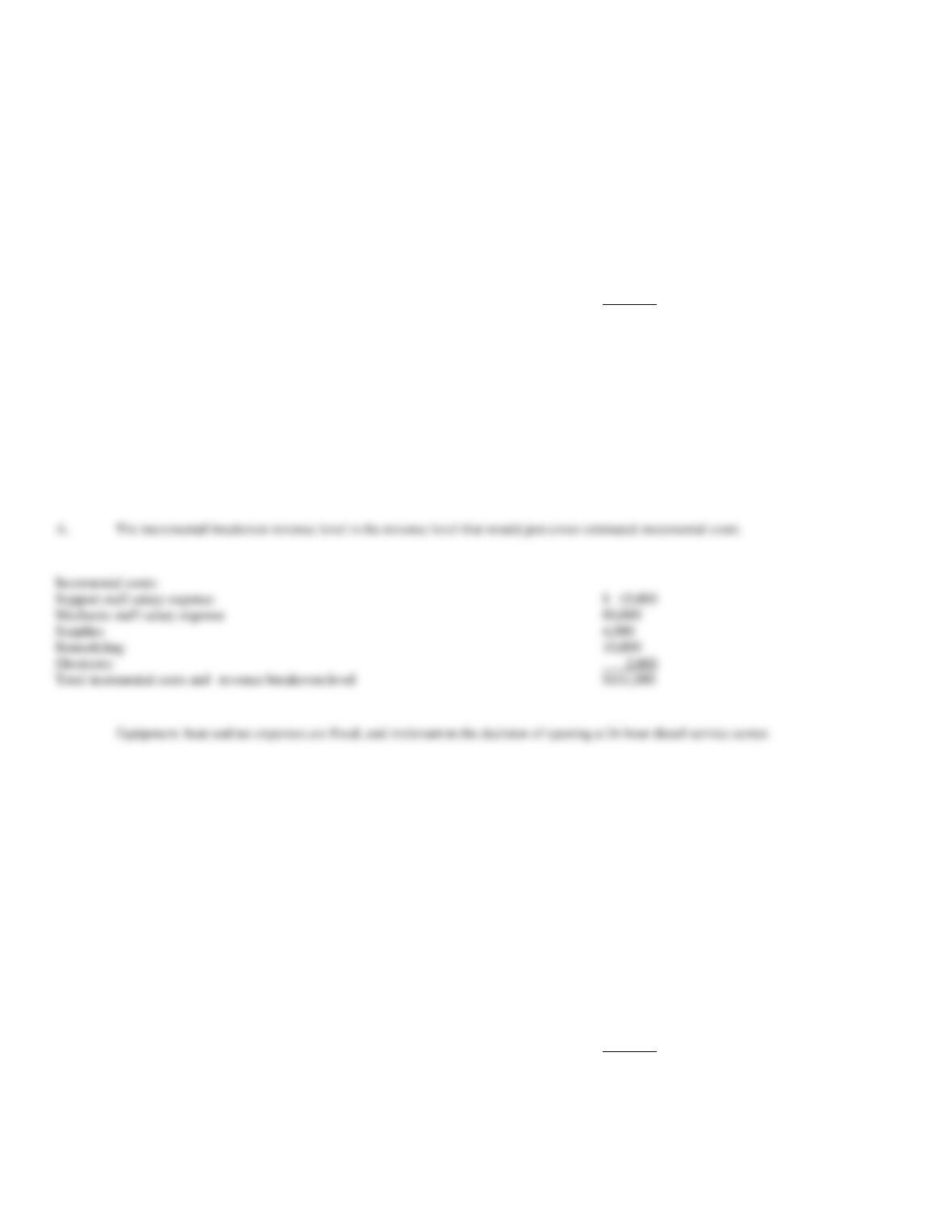
The incremental breakeven revenue level is the revenue level that would just cover estimated incremental costs.
Incremental costs:
Support staff salary expense
$ 15,000
Mechanic staff salary expense
80,000
Supplies
4,000
Remodeling
10,000
Electricity
2,000
Total incremental costs and revenue breakeven level
$111,000
Equipment, heat and tax expenses are fixed, and irrelevant to the decision of opening a 24-hour diesel service center.
Beautician and staff salary expenses are estimated on an hourly basis, reflecting additional salary and overtime costs. Supplies and remodeling
expenses are above and beyond those required for normal facility operations. Equipment costs represent a prorated share of the centers fixed
equipment-leasing costs. Electricity costs of $4,000 reflect additional anticipated usage, whereas heat and taxes of $5,000 reflect an allocated share of
fixed beauty shop expenses.
A.
Calculate breakeven revenue for the proposed extended hours operation.
33. Breakeven Analysis. The Midtown Filling Station is a gasoline retailer in Denton, Texas. Louie DePalma,
proprietor of Midtown, has decided to prepare a financial analysis of the potential of a 24-hour convenience
store operation. Opening such a center would require remodeling the filling station and the hiring of additional
cash register attendants, but mechanics would still work only from 8 am to 5 pm. Estimated first year expenses
for the Midtown’s service and convenience center are:
Cash register attendant salary expense
$ 30,000
Mechanic salary expense
80,000
Supplies
8,000
Equipment
10,000
Remodeling
45,000
Electricity, heat, and taxes
15,000
Total expenses
$188,000
Mechanic and attendant salary expenses are estimated on an hourly basis, reflecting any additional salary and overtime costs. Supplies and
remodeling expenses are above and beyond those required for normal facility operations. Equipment costs represent a prorated share of the centers
fixed equipment-leasing costs. Electricity costs of $3,000 reflect additional anticipated usage, whereas heat and taxes of $2,000 reflect an allocated
share of fixed expenses.
A.
Calculate breakeven revenue for the proposed 24 hour service and convenience center.
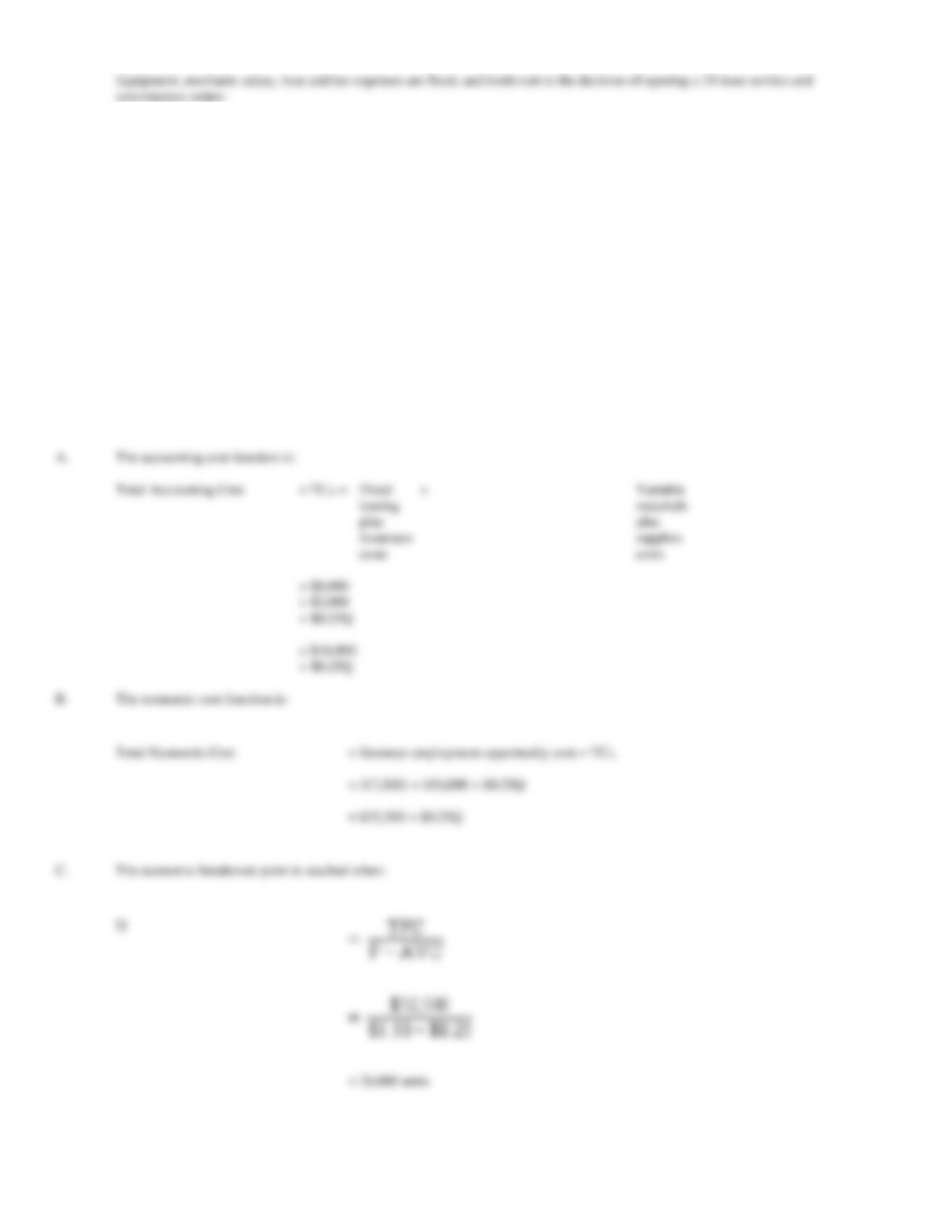
The incremental breakeven revenue level is the revenue level that would just cover estimated incremental costs.
Incremental costs:
Support staff salary expense
$30,000
Supplies
8,000
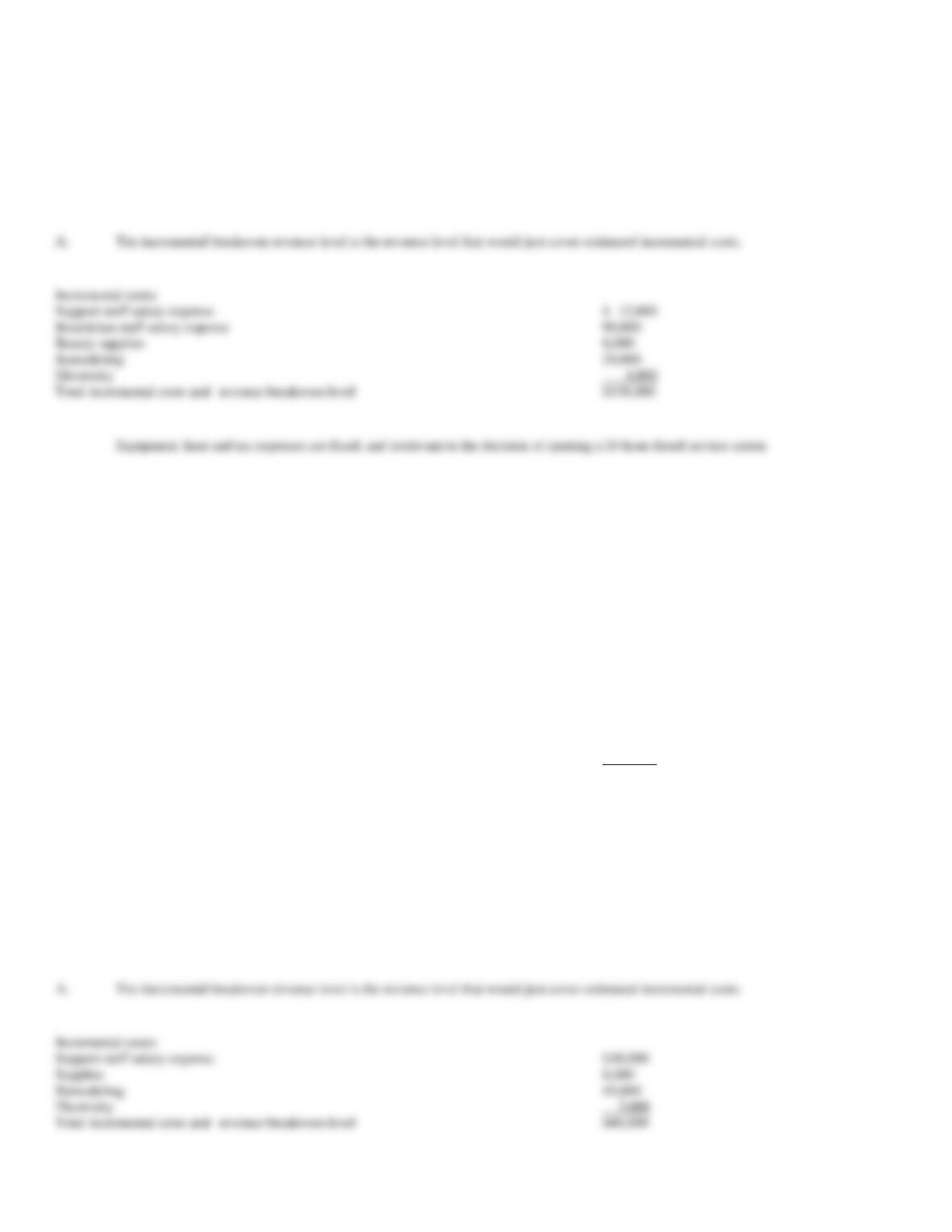
The incremental breakeven revenue level is the revenue level that would just cover estimated incremental costs.
Incremental costs:
Support staff salary expense
$ 12,000
Beautician staff salary expense
90,000
Beauty supplies
8,000
Remodeling
24,000
Electricity
4,000
Total incremental costs and revenue breakeven level
$138,000
Equipment, heat and tax expenses are fixed, and irrelevant to the decision of opening a 24 hour diesel service center.
34. Opportunity Costs. Three graduate business students are considering operating a tofu burger stand in the
Dalles, Oregon, windsurfing resort area during their summer break. This is an alternative to summer
employment with a local fruit cannery where they would earn $7,500 each over the three-month summer period.
A fully equipped facility can be leased at a cost of $8,000 for the summer. Additional projected costs are $2,000
for insurance, and 25¢ per unit for materials and supplies. Their tofu burgers would be priced at $1.50 per unit.
A.
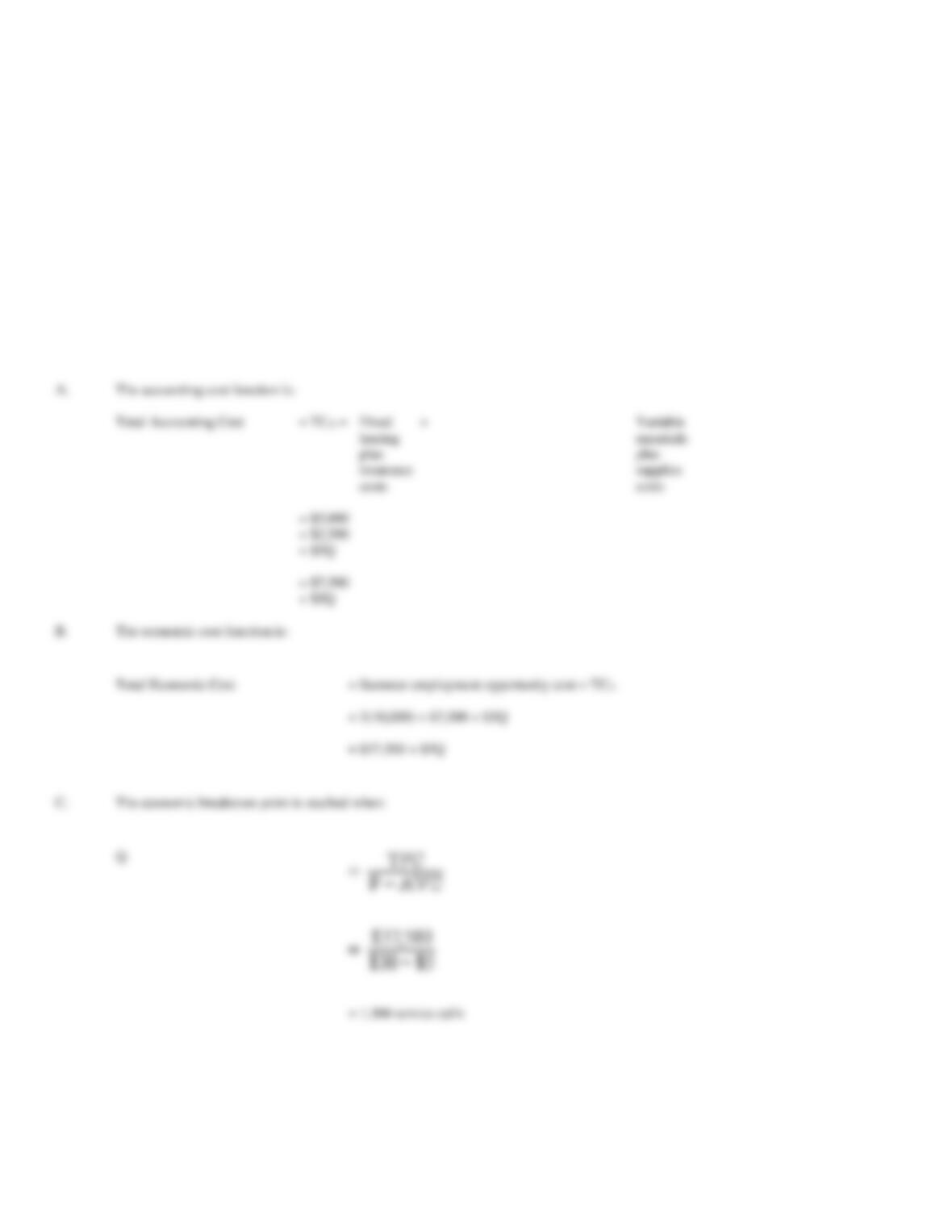
What is the accounting cost function for this business?
B.
What is the economic cost function for this business?
C.
What is the economic breakeven number of units for this operation? (Assume a $1.50 price and ignore interest costs associated with the
timing of the lease payments.)
A.
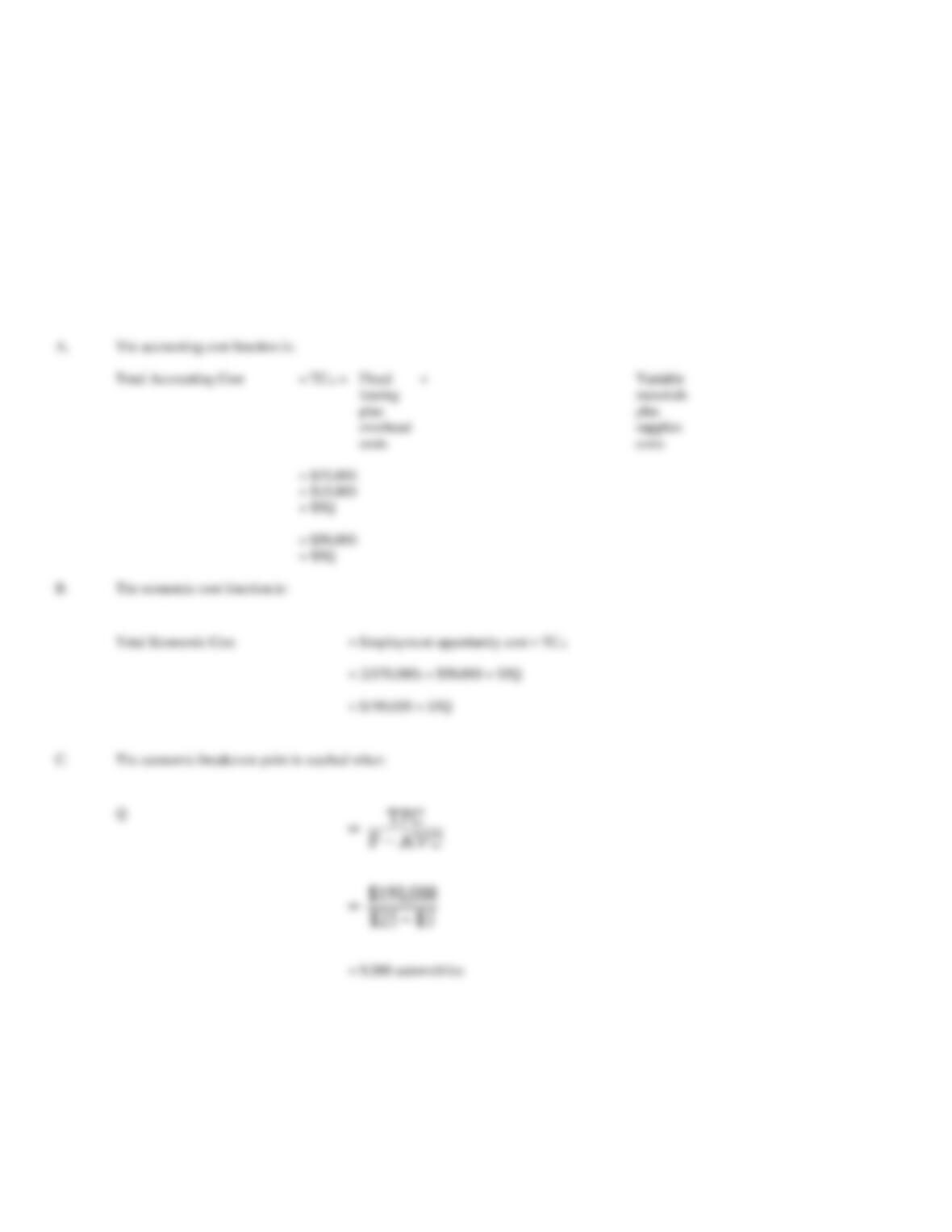
The accounting cost function is:
Total Economic Cost
= Summer employment opportunity cost + TCA
= $32,500 + $0.25Q
C.
The economic breakeven point is reached when:
Equipment, mechanic salary, heat and tax expenses are fixed, and irrelevant to the decision of opening a 24 hour service and
convenience center.
35. Opportunity Costs. Two graduate business students are considering opening a full-service car wash in
Greenville, North Carolina, after graduation. This is an alternative to employment with a local manufacturing
firm where they would each earn $70,000 per year. A fully equipped facility can be leased at a cost of $35,000
for the year. Additional projected costs are $15,000 for overhead, and $5 per automobile for materials and
supplies. Full detail automobile cleaning would be priced at $25.
A.
What is the accounting cost function for this business?
B.
What is the economic cost function for this business?
C.
What is the economic breakeven number of units for this operation? (Assume a $25 price and ignore interest costs associated with the
timing of the lease payments.)
A.
The accounting cost function is:
Total Economic Cost
= Employment opportunity cost + TCA
= $190,000 + $5Q
= 9,000 automobiles
36. Opportunity Costs. Three University of Florida engineering students are considering operating a mobile
car clinic in Gainesville, Florida, during their summer break. This is an alternative to summer employment
stacking plastic cups at a local injection molding manufacturer where they would earn $10,000 each over the
three-month summer period. A van equipped for such service can be leased at a cost of $5,000 for the summer
from an owner taking a long vacation in the Bahamas. Additional projected costs are $2,500 for insurance, and
$5 per service call for materials and supplies. Their service calls would be priced at $30 per unit, plus any parts
costs (parts will not be inventoried, but purchased from local parts outlets).
A.
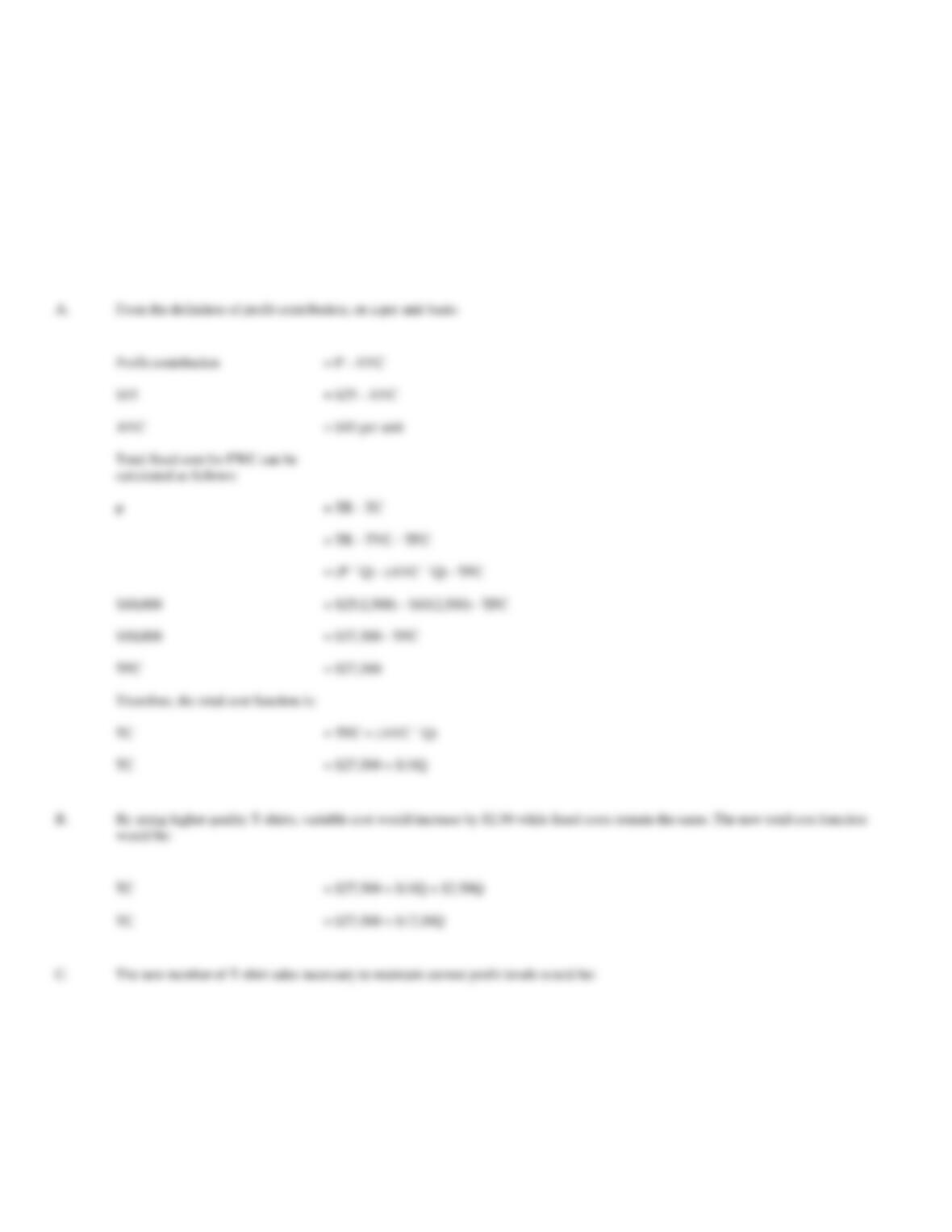
What is the accounting cost function for this business (ignoring parts)?
B.
What is the economic cost function for this business?
C.
What is the economic breakeven number of units for this operation? (Assume a $30 price and ignore interest costs associated with the
timing of the lease payments.)
A.
The accounting cost function is:
+ $5Q
Total Economic Cost
= Summer employment opportunity cost + TCA
= $37,500 + $5Q
= 1,500 service calls
37. Profit Contribution Analysis. San Francisco’s Pier 9, Inc., sells souvenir T-shirts at a price of $25. Of this
amount, $15 is profit contribution. Pier 9 is considering differentiating its product from several other
competitors by using higher quality T-shirts. Doing so would increase unit cost by $2.50 per shirt. Current
monthly profits are $10,000 on 2,500 unit sales.
A.
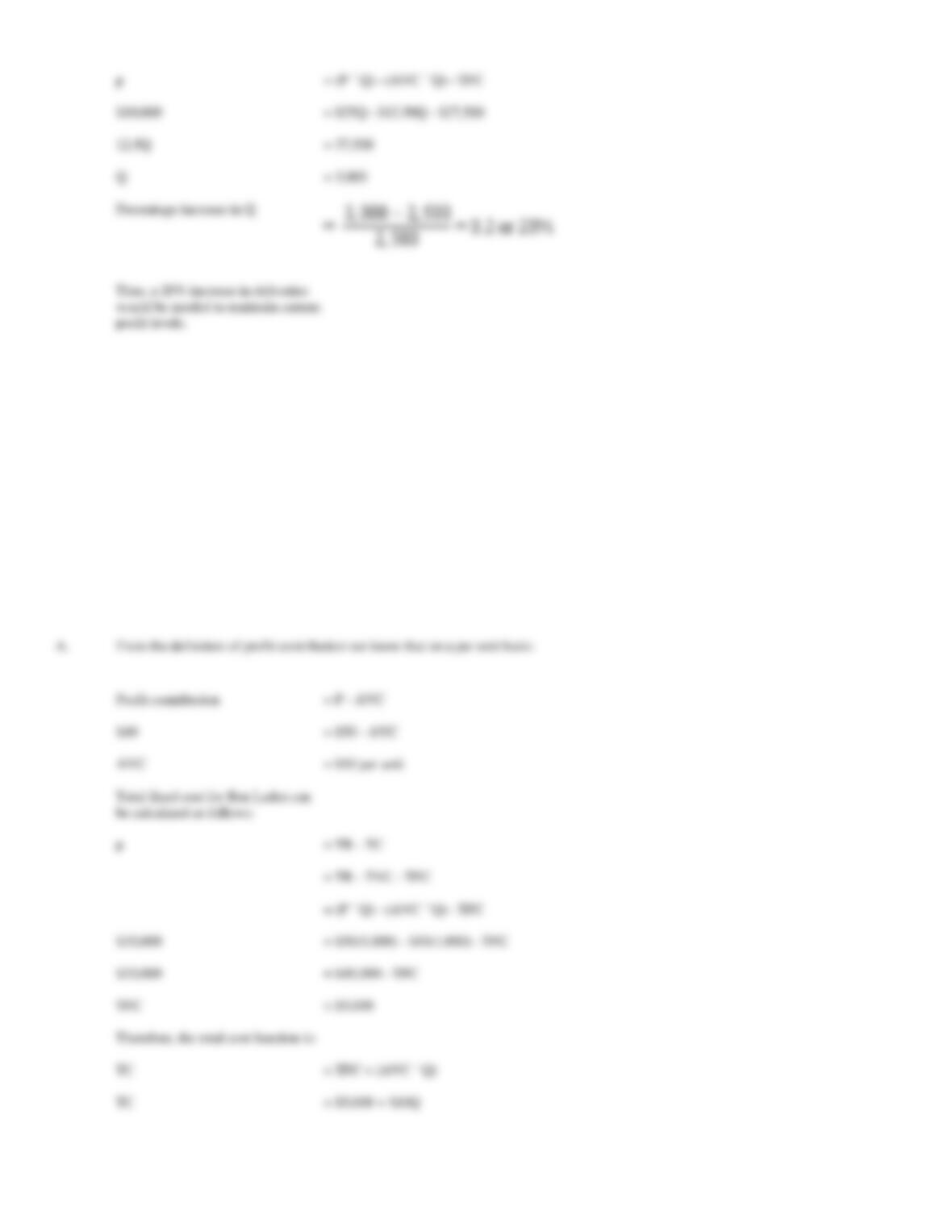
Assuming average variable costs are constant at all output levels, what is FWC’s total cost function before the proposed change?
B.
What will the total cost function be if higher quality t-shirts are used?
C.
Assume shirt prices remain stable at $25. What percentage increase in sales would be necessary to maintain current profit levels?
A.
From the definition of profit contribution, on a per unit basis:
Profit contribution
= P – AVC
= $25 – AVC
AVC
= $10 per unit
p
= TR – TC
= TR – TVC – TFC
= (P ´ Q) – (AVC ´ Q) – TFC
$10,000
= $25(2,500) – $10(2,500) – TFC
$10,000
= $37,500 – TFC
TFC
= $27,500
Therefore, the total cost function is:
= TFC + (AVC ´ Q)
= $27,500 + $10Q
= $27,500 + $10Q + $2.50Q
= $27,500 + $12.50Q
C.
The new number of T-shirt sales necessary to maintain current profit levels would be:
38. Profit Contribution Analysis. Ben Laden Rugs, Inc., sells hand-made cotton rugs to tourists at a price of
$50. Of this amount, $40 is profit contribution. Ben Laden is considering an attempt to differentiate his product
from several other competitors by using high quality natural herb dyes. Doing so would increase Ben Laden’s
unit cost by $15 per rug. Current annual profits are $35,000 on 1,000 rug sales.
A.
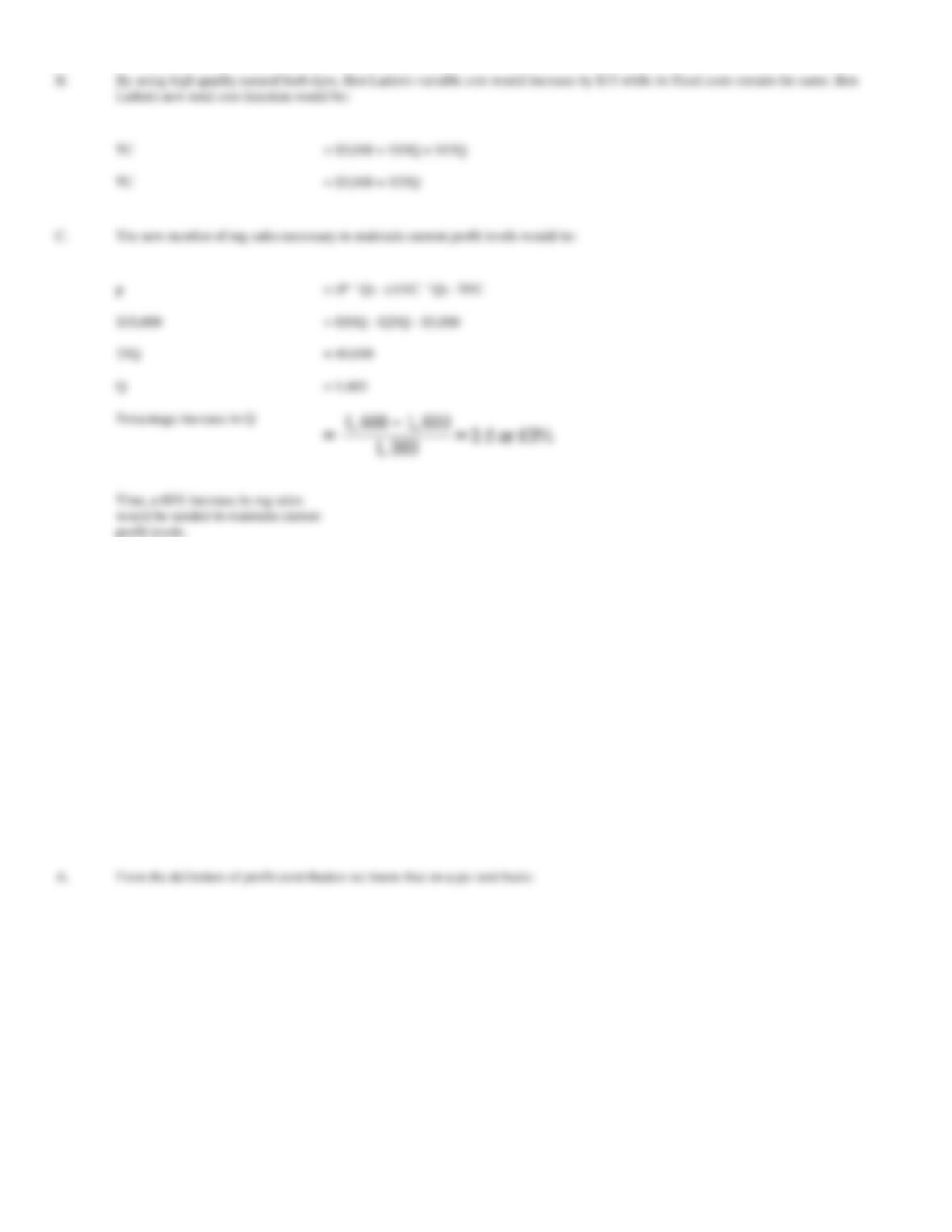
Assuming average variable costs are constant at all output levels, what is Ben Laden’s total cost function before the proposed change?
B.
What will the total cost function be if high quality natural herb dyes are used?
C.
Assume rug prices remain stable at $50. What percentage increase in sales would be necessary to maintain current profit levels?
A.
From the definition of profit contribution we know that on a per unit basis:
Profit contribution
= P – AVC
= $50 – AVC
= $10 per unit
p
= TR – TC
= TR – TVC – TFC
= (P ´ Q) – (AVC ´ Q) – TFC
$35,000
= $50(1,000) – $10(1,000) – TFC
$35,000
= $40,000 – TFC
TFC
= $5,000
Therefore, the total cost function is:
p
= (P ´ Q) – (AVC ´ Q) – TFC
$10,000
= $25Q – $12.50Q – $27,500
12.5Q
= 37,500
Q
= 3,000
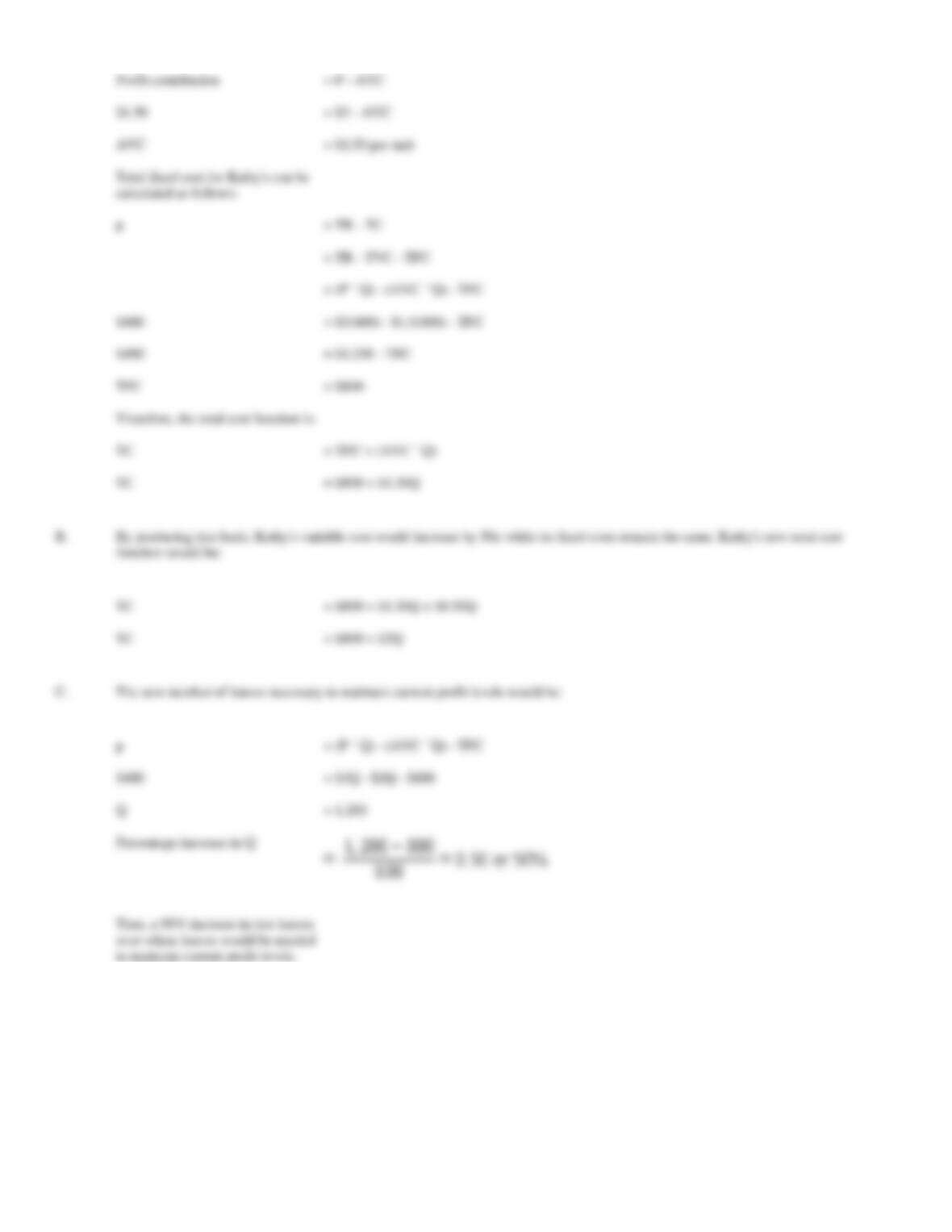
39. Profit Contribution Analysis. Kathy’s Bakery is a local full-service bakery in Omaha, Nebraska. Kathy
sells loaves of wheat bread for $3 a loaf. Of this amount, $1.50 is profit contribution. She is considering an
attempt to differentiate her shop from several other competitors by only producing a special rice bread for
customers allergic to wheat. Doing so would increase her unit cost by 50¢ per rice loaf. Current monthly profits
are $400 on 800 unit sales.
A.
Assuming average variable costs are constant at all output levels, what is Kathy’s total cost function before the proposed change?
B.
What will the total cost function be if rice loafs are produced?
C.
Assume rice loaf prices remain stable at $3. What percentage increase in sales would be necessary to maintain current profit levels?
From the definition of profit contribution we know that on a per unit basis:
= $5,000 + $10Q + $15Q
= $5,000 + $25Q
C.
The new number of rug sales necessary to maintain current profit levels would be:
p
= (P ´ Q) – (AVC ´ Q) – TFC
$35,000
= $50Q – $25Q – $5,000
= 40,000
Q
= 1,600
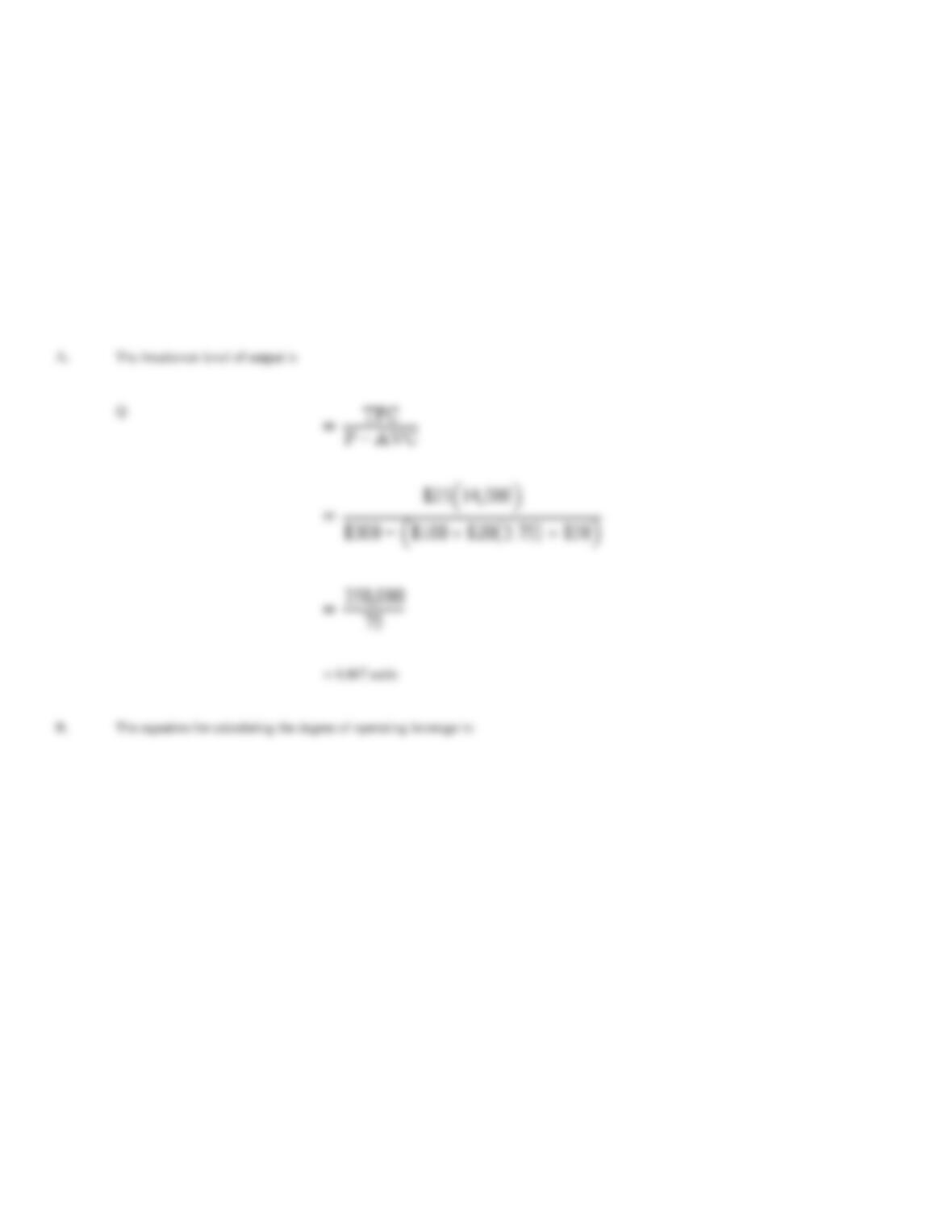
40. Degree of Operating Leverage. DynaLinear, Ltd., produces digital-to-analog converters for compact disk
players used by radio stations and audio enthusiasts. It is contemplating an expansion into the moderately-priced
home audio market by producing a CD player that would sell at a price of $300. The production of each CD
player would require $100 in materials, and 3.75 hours of labor at the rate of $20 per hour for wages and fringe
benefits plus variable overhead tied to labor. Energy, supervisory and other variable overhead costs would
amount to $50 per unit. The accounting department has derived an allocated fixed overhead charge of $25 per
CD player (at a projected volume of 14,000 units) to account for the expected increase in fixed costs.
A.
What is DynaLinear’s breakeven sales volume (in units) for home audio CD players?
B.
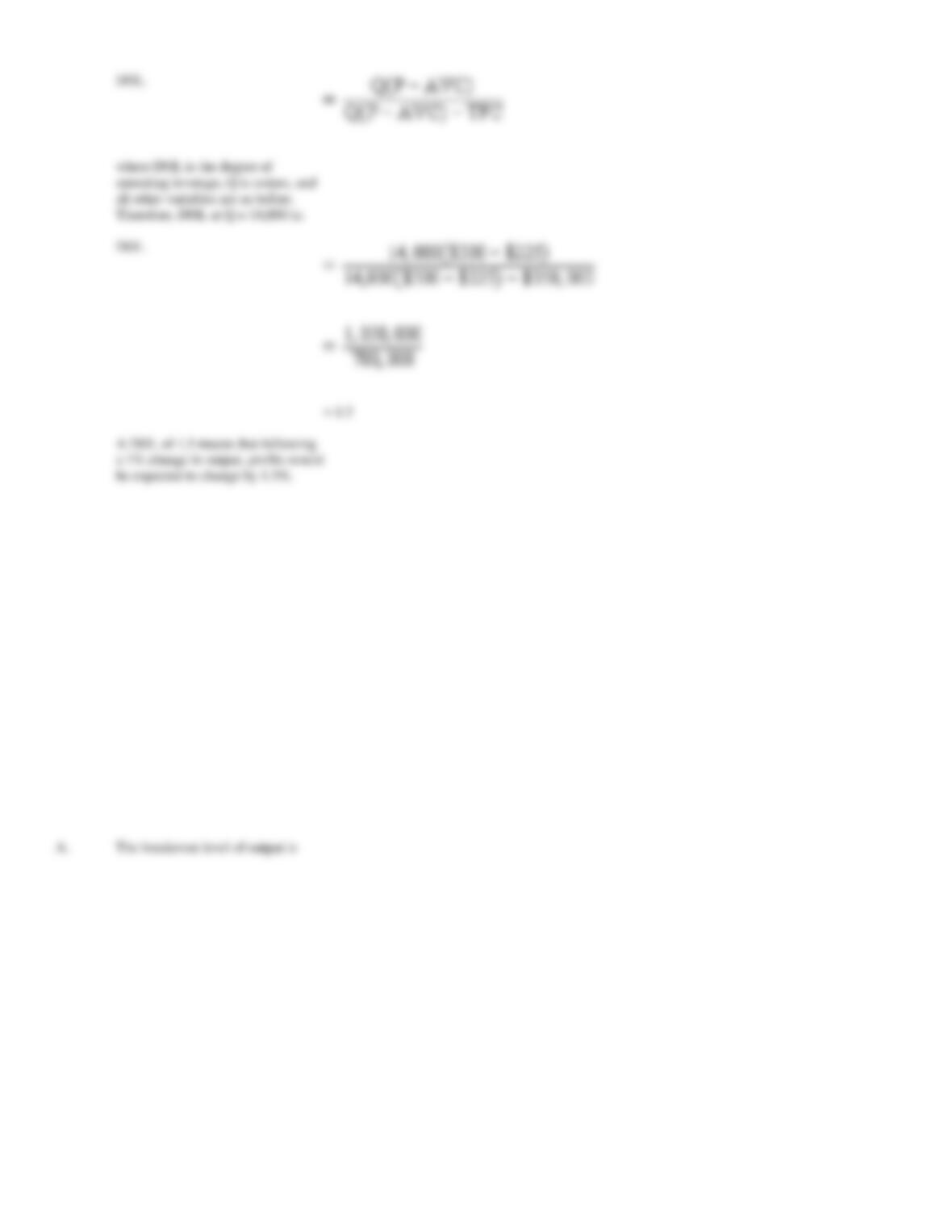
Calculate the degree of operating leverage at a projected volume of 14,000 units and explain what the DOL means.
B.
The equation for calculating the degree of operating leverage is:
41. Degree of Operating Leverage. Heat Tamers, Inc., of Bend, Oregon produces special heat-resistant boots
used primarily by firefighters, smoke-jumpers and steelworkers. It is contemplating an expansion into the heat
resistant leather market charging a price of $150 per pair of boots. The production of each pair of boots would
require $60 in materials, and 1.5 hours of labor at the rate of $20 per hour. Energy, supervisory and other
variable overhead costs would amount to $25 per unit. The accounting department has derived an allocated
fixed overhead charge of $30 per pair of boots (at a projected volume of 280,000 pairs) to account for the
expected increase in fixed costs.
A.
What is Heat Tamers’ breakeven sales volume (in pairs) for heat-resistant boots?
B.
Calculate the degree of operating leverage at a projected volume of 280,000 units and explain what the DOL means.
A.
The breakeven level of output is
= 1.5