following will be observed in this economy?
a.
The cost of labor, that is the real wage will decline
b.
The current profits of the firm will rise
c.
Aggregate supply in the economy will increase
d.
Annual production in the economy will remain unaffected
e.
The aggregate supply curve will move to the left
62. The movement of the vertical _____ curve to the _____ reflects the increase in potential output on account of the
development of new technologies, and increase in the quantity and quality of resources.
a.
long-run aggregate supply; right
b.
short-run aggregate supply; right
c.
short-run aggregate demand; left
d.
long-run aggregate demand curve; left
e.
long-run aggregate supply; left
MACR.BOYE.16.39 – ch. 08, 6
Aggregate Supply
63. In the 1970s the international price of crude oil rocketed because:
a.
the demand for crude oil fell short of its supply.
b.
a new source of natural gas was discovered.
c.
the demand for automobiles increased drastically.
d.
the supply of oil was restricted by the oil exporting countries.
e.
of the appreciation of dollar in the international market.
MACR.BOYE.16.39 – ch. 08, 6
Global Business Insight – Oil and Aggregate Supply
MACR.BOYE.16.39 – ch. 08, 6
Aggregate Supply
64. To determine short-run equilibrium in the economy, we use an aggregate supply curve that is:
a.
downward-sloping.
b.
vertical.
c.
upward-sloping.
d.
horizontal.
e.
parabolic.
65. The intersection of the aggregate demand and the aggregate supply curve defines the equilibrium level of _____ and
the price level.
a.
real interest rate
b.
nominal interest rate
c.
nominal GDP
d.
real GDP
e.
unemployment
d
Easy
MACR.BOYE.16.40 – ch. 08, 7
United States – Analytic – BB-Legal
Aggregate Demand, Aggregate Supply, and Business Cycles
Knowledge
66. Identify the correct statement.
a.
Aggregate demand alone determines equilibrium price and output.
b.
Aggregate supply alone determines equilibrium price and output.
c.
Aggregate demand and aggregate supply determine equilibrium price and output.
d.
Aggregate demand shows the positive relationship between price level and real GDP.
e.
Aggregate supply shows the negative relationship between price level and real GDP.
Easy
MACR.BOYE.16.40 – ch. 08, 7
Aggregate Demand, Aggregate Supply, and Business Cycles
Knowledge
67. Other things equal, an increase in aggregate demand will result in:
Easy
MACR.BOYE.16.40 – ch. 08, 7
Aggregate Demand and Supply Equilibrium
Knowledge
a.
an economic expansion.
b.
higher unemployment and a lower equilibrium price level.
c.
an economic recession.
d.
a decrease in equilibrium real GDP and an increase in the equilibrium price level.
e.
a decrease in the overall economic welfare.
68. Other things equal, an increase in aggregate spending tends to be associated with:
a.
cost-push inflation.
b.
an economic depression.
c.
a lower level of equilibrium real GDP.
d.
demand-pull inflation.
e.
an increase in the quality of goods and services produced.
MACR.BOYE.16.40 – ch. 08, 7
Aggregate Demand, Aggregate Supply, and Business Cycles
69. Other things equal, an increase in aggregate supply will cause:
a.
a decrease in equilibrium real GDP and a decrease in the equilibrium price level.
b.
an economic contraction.
c.
an increase in equilibrium real GDP and an increase in the equilibrium price level.
d.
cost-push inflation.
e.
a reduction in unemployment and a decline in inflation.
MACR.BOYE.16.40 – ch. 08, 7
Aggregate Demand, Aggregate Supply, and Business Cycles
70. Which of the following is true of cost-push inflation?
a.
Cost-push inflation is associated with an economic expansion.
MACR.BOYE.16.40 – ch. 08, 7
Aggregate Demand, Aggregate Supply, and Business Cycles
b.
Cost-push inflation is rarely experienced in developed economies.
c.
Cost-push inflation is caused by a decrease in aggregate supply.
d.
Cost-push inflation is identical to demand-pull inflation.
e.
Cost-push inflation is the result of increased consumer spending.
71. A simultaneous increase in inflation and decrease in economic growth in a country can be associated with:
a.
a decrease in aggregate demand with no change in aggregate supply.
b.
an increase in aggregate demand and aggregate supply.
c.
an increase in aggregate supply with no change in aggregate demand.
d.
a decrease in aggregate supply and aggregate demand.
e.
a decrease in aggregate supply with no change in aggregate demand.
MACR.BOYE.16.40 – ch. 08, 7
Aggregate Demand, Aggregate Supply, and Business Cycles
72. The degree to which _____ declines during a recession or increases during an expansion depends on the amount by
which the AD and/or AS curves shift.
a.
real GDP
b.
government tax revenue
c.
the money supply
d.
real interest rate
e.
the consumer price index
MACR.BOYE.16.40 – ch. 08, 7
United States – Analytic – BB-Legal
Aggregate Demand, Aggregate Supply, and Business Cycles
73. Assume that the AD curve is held constant and short-run aggregate supply decreases. The result is a(n):
a.
increase in both equilibrium real GDP and the price level.
MACR.BOYE.16.40 – ch. 08, 7
Aggregate Demand, Aggregate Supply, and Business Cycles
b.
decrease in equilibrium real GDP and an increase in the price level.
c.
decrease in both equilibrium real GDP and the price level.
d.
decrease in equilibrium real GDP, while the price level remains fixed.
e.
increase in the price level, while equilibrium real GDP remains fixed.
74. A simultaneous increase in both unemployment and inflation is most likely to be the result of a(n):
a.
increase in long-run aggregate supply.
b.
increase in short-run aggregate supply.
c.
decrease in the aggregate demand.
d.
simultaneous outward shift of the aggregate demand and supply curves.
e.
decrease in the short-run aggregate supply.
MACR.BOYE.16.40 – ch. 08, 7
Aggregate Demand and Supply Equilibrium
75. Assume that the aggregate demand increases while the short-run aggregate supply decreases. The result is a(n):
a.
increase in both equilibrium real GDP and the price level.
b.
decrease in equilibrium real GDP and an increase in the price level.
c.
decrease in both equilibrium real GDP and the price level.
d.
decrease in equilibrium real GDP, while the price level remains fixed.
e.
increase in the price level, while the change in equilibrium real GDP is ambiguous.
MACR.BOYE.16.40 – ch. 08, 7
United States – Reflective Thinking
Aggregate Demand and Supply Equilibrium
MACR.BOYE.16.40 – ch. 08, 7
Aggregate Demand and Supply Equilibrium
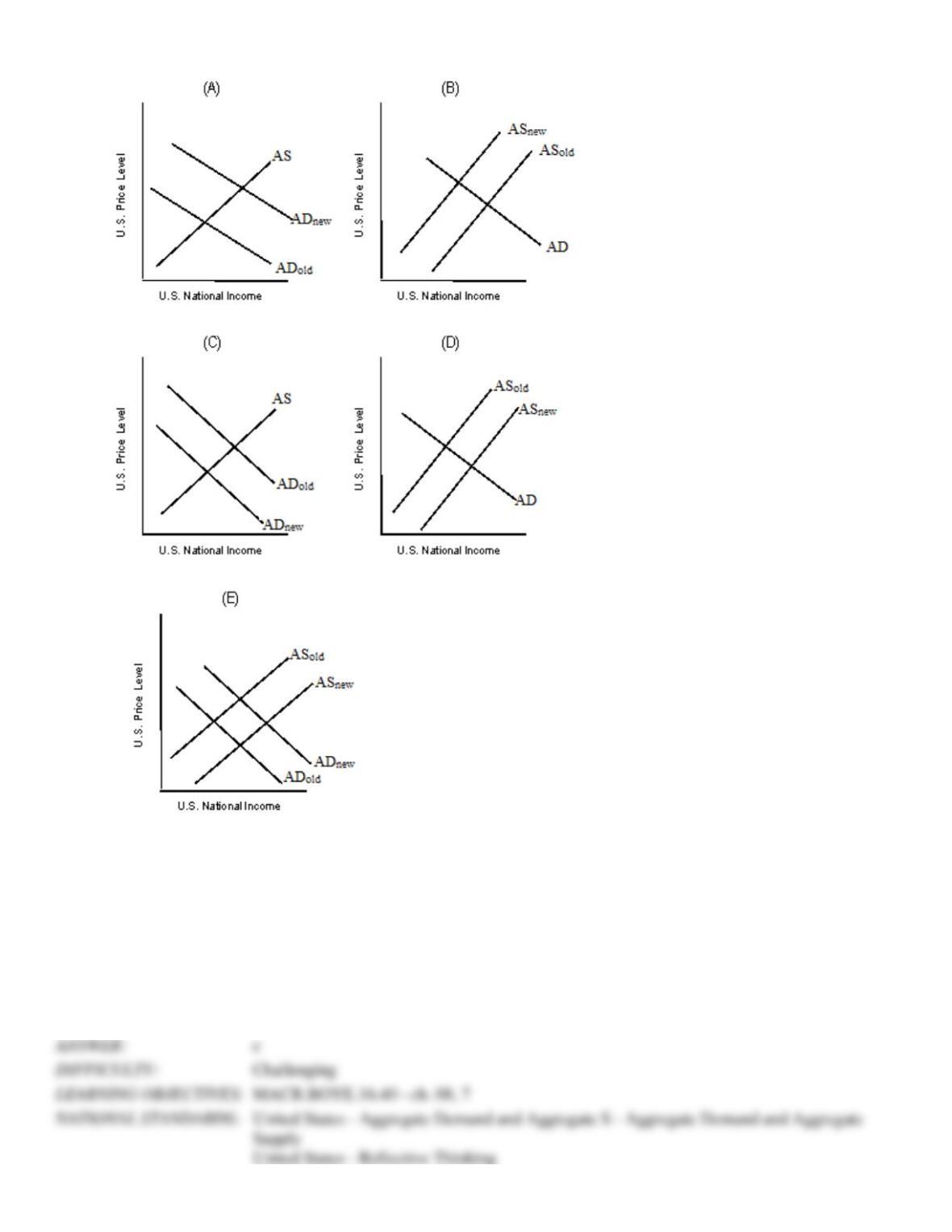
76. Refer to Figure 8.1. Which of the graphs in the figure best describes the impact of lower real income in Germany on
U.S. equilibrium real GDP and the U.S. equilibrium price level?
a.
Panel A
b.
Panel B
c.
Panel C
d.
Panel D
e.
Panel E
MACR.BOYE.16.40 – ch. 08, 7
United States – Reflective Thinking
77. Refer to Figure 8.1. Which of the graphs in the figure best describes the impact of an effective oil embargo that raises
the price of gasoline?
a.
Panel A
b.
Panel B
c.
Panel C
d.
Panel D
e.
Panel E
b
Challenging
MACR.BOYE.16.40 – ch. 08, 7
United States – Reflective Thinking
Aggregate Demand and Supply Equilibrium
Application
78. Refer to Figure 8.1. Which of the graphs in the figure best describes the impact of a generalized more optimistic view
of the future by consumers?
a.
Panel A
b.
Panel B
c.
Panel C
d.
Panel D
e.
Panel E
Challenging
MACR.BOYE.16.40 – ch. 08, 7
Aggregate Demand and Supply Equilibrium
Application
79. Aggregate demand–aggregate supply analysis shows that in the long run the effect of increased aggregate spending on
real GDP is:
a.
negative.
b.
close to infinity.
c.
indeterminate.
d.
zero.
e.
positive.
d
Moderate
MACR.BOYE.16.40 – ch. 08, 7
Supply
Aggregate Demand and Supply Equilibrium
Application
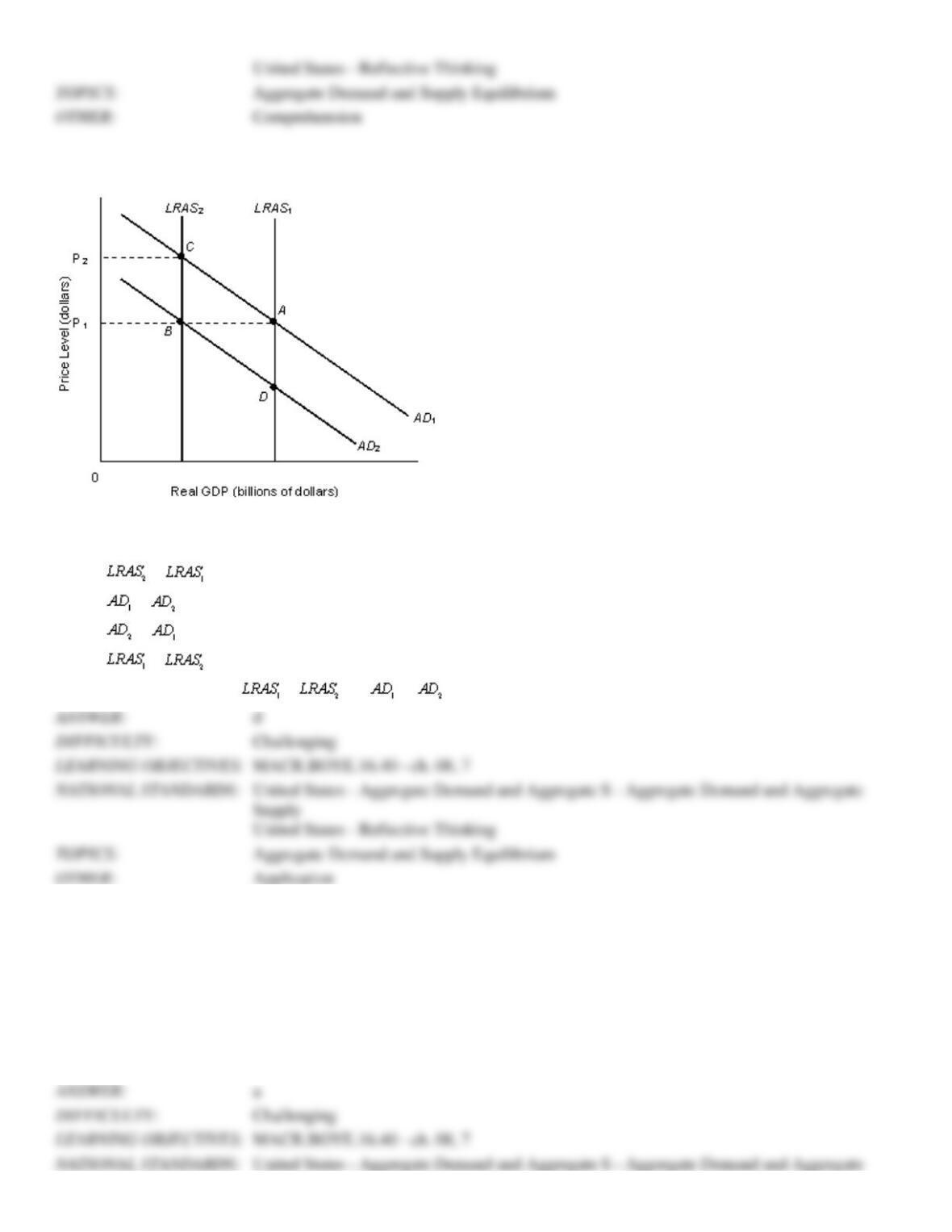
The figure given below represents the long-run equilibrium in the aggregate demand and aggregate supply model.
Figure 8.2
80. Refer to Figure 8.2. The combination of rising prices and falling output is known as stagflation. This phenomenon is
represented by which of the following shifts?
a.
to
b.
to
c.
to
d.
to
e.
The combination of to and to
MACR.BOYE.16.40 – ch. 08, 7
Aggregate Demand and Supply Equilibrium
81. Refer to Figure 8.2. Suppose major oil-exporting countries restrict oil output, thus increasing the price of oil. In the
figure this would be represented by:
a.
a movement from A to C.
b.
a movement from A to B to C.
c.
a movement from B to C.
d.
a movement from B to A.
e.
a movement from C to A.
United States – Aggregate Demand and Aggregate S – Aggregate Demand and Aggregate
United States – Reflective Thinking
Aggregate Demand and Supply Equilibrium
82. Refer to Figure 8.2. A movement from equilibrium point A to equilibrium point B would be the result of a(n):
a.
increase in consumer confidence and a decrease in productivity.
b.
technological advances and domestic price decreases.
c.
decrease in productivity and a decrease in government spending.
d.
increase in production costs and greater consumer confidence.
e.
decrease in domestic prices and decrease in direct taxes.
Challenging
MACR.BOYE.16.40 – ch. 08, 7
Aggregate Demand and Supply Equilibrium
Application
The figure given below represents the equilibrium real GDP and price level in the aggregate demand and aggregate supply
model.
Figure 8.3
83. Refer to Figure 8.3. If AS1 and AD1 represent the initial aggregate demand and supply in the economy, the long-run
equilibrium real GDP will be _____ billion.
a.
$100
b.
$200
c.
$300
d.
$400
e.
$500
Application
Revised
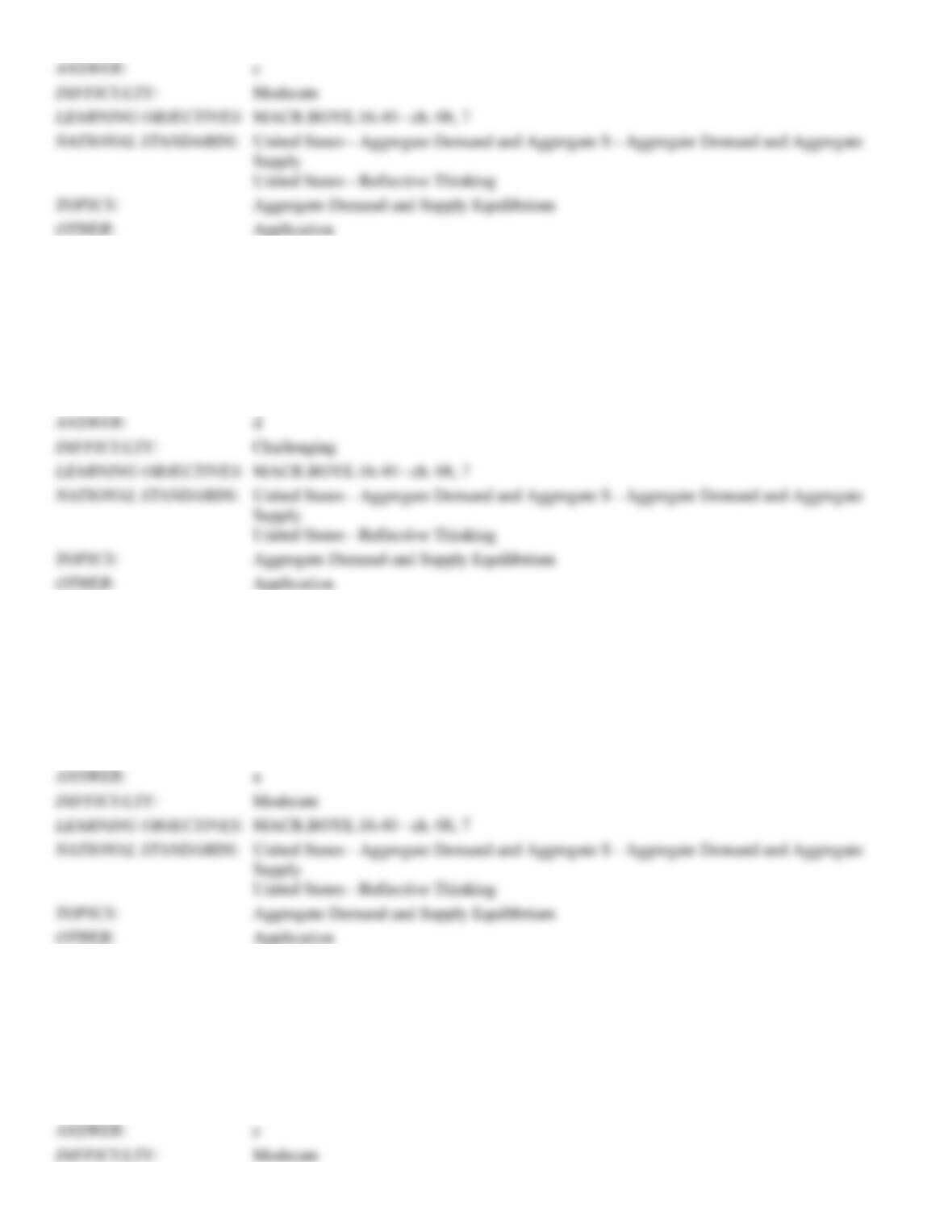
84. Refer to Figure 8.3. Potential GDP is greater than real GDP at all output levels:
a.
above $300 billion.
b.
between $300 billion and $400 billion.
c.
above $400 billion.
d.
below $300 billion.
e.
above $500 billion.
MACR.BOYE.16.40 – ch. 08, 7
United States – Reflective Thinking
Aggregate Demand and Supply Equilibrium
85. Refer to Figure 8.3. Movement from point B to point D could be initiated by:
a.
a stock market crash that undermines consumer confidence.
b.
a tax code changes that improve investor expectations.
c.
a national emergency that increases government spending.
d.
a higher net exports because of economic expansion in European countries.
e.
a technological advancement.
MACR.BOYE.16.40 – ch. 08, 7
United States – Reflective Thinking
Aggregate Demand and Supply Equilibrium
86. Consider Figure 8.3. Which of the following is most likely to have led to the movement from point B to point E?
a.
Declining net exports
b.
Increased investment spending
c.
A decline in the domestic price level
d.
An improvement in the quality of labor
e.
An increase in the real wage rates
MACR.BOYE.16.40 – ch. 08, 7
Aggregate Demand and Supply Equilibrium
87. In Figure 8.3, which of the following shifts would result in stagflation (economic stagnation and inflation)?
a.
AS1 to AS2
b.
AD1 to AD2
c.
AD2 to AD1
d.
AD2 toAD3
e.
AS1 to AS3
Challenging
Aggregate Demand and Supply Equilibrium
Application
88. An increase in aggregate demand normally does not cause inflation.
a.
True
b.
False
False
Easy
MACR.BOYE.16.34 – ch. 08, 1
Aggregate Demand, Aggregate Supply, and Business Cycles
Knowledge
89. A demand-pull inflation is caused by an increase in the demand for output. Therefore, economists say that this type of
inflation is actually good for the economy.
a.
True
b.
False
False
Easy
MACR.BOYE.16.34 – ch. 08, 1
Aggregate Demand, Aggregate Supply, and Business Cycles
Knowledge
MACR.BOYE.16.40 – ch. 08, 7
Application
90. A rightward shift in the aggregate supply curve with no change in the aggregate demand curve signals an economic
expansion.
a.
True
b.
False
91. The economic reasons that underlie the shape of the aggregate supply curve are different from those that underlie the
shape of the supply curve for a particular good.
a.
True
b.
False
True
Easy
MACR.BOYE.16.36 – ch. 08, 3
Aggregate Demand, Aggregate Supply, and Business Cycles
Knowledge
92. A change in foreign demand does not affect aggregate demand.
a.
True
b.
False
False
Easy
MACR.BOYE.16.34 – ch. 08, 1
Factors that Influence Aggregate Demand
Knowledge
93. Increased household spending reduces aggregate expenditures.
a.
True
b.
False
False
MACR.BOYE.16.34 – ch. 08, 1
United States – Analytic – BB-Legal
True
Easy
MACR.BOYE.16.34 – ch. 08, 1
Aggregate Demand, Aggregate Supply, and Business Cycles
Knowledge
94. The purchase of fifty new food-processing machines by the Campbell Soup Corporation would be classified as
investment spending.
a.
True
b.
False
True
Moderate
MACR.BOYE.16.34 – ch. 08, 1
Factors that Influence Aggregate Demand
Application
95. Government spending is set by the federal authorities in such a way that aggregate supply just equals aggregate
spending.
a.
True
b.
False
False
Easy
Factors that Influence Aggregate Demand
Knowledge
96. In 2009, a nation reported total imports worth $250,000 and total exports worth $225,000. This implies the nation had
net exports worth $25,000 during this year.
a.
True
b.
False
False
Moderate
Factors that Influence Aggregate Demand
Application
97. A lower domestic price level raises aggregate expenditures and, therefore, shifts the aggregate demand curve to the
right.
a.
True
b.
False
False
Moderate
Factors that Influence Aggregate Demand
Knowledge
98. If there is a sudden jump in the inflation rate, the purchasing power of financial assets will immediately fall.
a.
True
b.
False
True
Moderate
The Aggregate Demand Curve
Comprehension
99. An increase in the real value of assets is associated with a reduction in planned aggregate expenditures.
a.
True
b.
False
False
Moderate
MACR.BOYE.16.34 – ch. 08, 1
The Aggregate Demand Curve
Knowledge
100. The interest rate effect suggests that investment spending and planned aggregate expenditures fall when the general
price level rises.
a.
True
b.
False
True
Easy
MACR.BOYE.16.34 – ch. 08, 1
The Aggregate Demand Curve
Comprehension
101. A decrease in the relative price of economics textbooks will raise the aggregate quantity of an economy’s goods and
services demanded.
a.
True
b.
False
MACR.BOYE.16.34 – ch. 08, 1
Knowledge
102. If people expect the economy to do well in the future, they will increase their consumption today at every price level.
a.
True
b.
False
True
MACR.BOYE.16.34 – ch. 08, 1
Factors that Influence Aggregate Demand
Knowledge
103. The fact that the aggregate demand curve slopes downward means that aggregate expenditures increase when the
price level decreases.
a.
True
b.
False
True
Easy
The Aggregate Demand Curve
Knowledge
104. When the foreign price level falls, domestic goods become more expensive relative to foreign goods, causing
domestic net exports and aggregate demand to fall.
a.
True
b.
False
True
Moderate
The Aggregate Demand Curve
105. The wealth effect of a change in the price level refers to the fact that wealthier individuals tend to spend more on
False
Challenging
The Aggregate Demand Curve
Comprehension
foreign goods.
a.
True
b.
False
106. If the average price level falls, the real value of wealth also falls.
a.
True
b.
False
False
Easy
MACR.BOYE.16.35 – ch. 08, 2
United States – Analytic – BB-Legal
The Aggregate Demand Curve
Knowledge
Revised
107. A higher domestic price level lowers aggregate expenditures and, therefore, shifts the aggregate demand curve to the
left.
a.
True
b.
False
False
Moderate
MACR.BOYE.16.35 – ch. 08, 2
The Aggregate Demand Curve
Knowledge
108. The aggregate supply curve shows the negative relationship between general price level and real GDP.
a.
True
b.
False
False
Easy
MACR.BOYE.16.36 – ch. 08, 3
United States – Analytic – BB-Legal
False
Easy
MACR.BOYE.16.35 – ch. 08, 2
The Aggregate Demand Curve
Knowledge
109. The main reason why the short-run aggregate supply curve slopes upward is that as the average price level increases,
larger scales of production become more profitable.
a.
True
b.
False
False
Moderate
MACR.BOYE.16.36 – ch. 08, 3
Aggregate Supply
Comprehension
110. In the short run, a decrease in the general price level will cause business profits to rise and, hence, the total quantity
of output to increase.
a.
True
b.
False
False
Moderate
MACR.BOYE.16.36 – ch. 08, 3
Aggregate Supply
Comprehension
111. The slope of the aggregate supply curve becomes steeper, the faster the costs of production adjust to prices and the
smaller the amount of excess capacity in the economy.
a.
True
b.
False
True
Moderate
MACR.BOYE.16.37 – ch. 08, 4
United States – Analytic – BB-Legal
Aggregate Supply
Knowledge
112. In the long-run, the aggregate supply curve normally is downward-sloping.
a.
True
b.
False
False
MACR.BOYE.16.38 – ch. 08, 5
United States – Aggregate Demand and Aggregate S – Aggregate Demand and Aggregate
Knowledge
113. If a large number of laborers shift from fixed-wage contracts to wages that depend on the cost of living adjustments,
the long-run aggregate supply curve for the economy will become relatively steeper.
a.
True
b.
False
True
Challenging
MACR.BOYE.16.38 – ch. 08, 5
United States – Reflective Thinking
Aggregate Supply
Application
114. The aggregate quantity of goods and services produced will decrease at every price level when resource price rises.
a.
True
b.
False
True
Moderate
MACR.BOYE.16.39 – ch. 08, 6
Aggregate Supply
Knowledge
115. A rightward shift in the aggregate supply curve is generally associated with a reduction in resource prices.
a.
True
b.
False
True
Easy
MACR.BOYE.16.39 – ch. 08, 6
United States – Analytic – BB-Legal
Aggregate Supply
Knowledge
116. When the actual inflation rate rises more rapidly than nominal wage rates, we would expect the short-run aggregate
supply curve to shift to the right.
a.
True
b.
False
True
Moderate
Knowledge
117. Suppose an increase in investment spending results in an increase in equilibrium real GDP and a rise in the
equilibrium price level. This implies that the aggregate supply curve for this economy is vertical.
a.
True
b.
False
False
Challenging
MACR.BOYE.16.40 – ch. 08, 7
Aggregate Demand and Supply Equilibrium
Comprehension
118. In the long run, increased consumption spending raises only the price level.
a.
True
b.
False
True
Easy
MACR.BOYE.16.40 – ch. 08, 7
Aggregate Demand and Supply Equilibrium
Knowledge
119. If the aggregate supply curve is vertical, then shifts in aggregate demand will not change aggregate output.
a.
True
b.
False
True
Challenging
MACR.BOYE.16.40 – ch. 08, 7
Aggregate Demand and Supply Equilibrium
Comprehension
120. The steeper the slope of the aggregate supply curve in the long run indicates that an increase in aggregate demand
will cause an increase in the price level and an even greater increase in output in the long run.
a.
True
b.
False
MACR.BOYE.16.39 – ch. 08, 6
Aggregate Supply
Knowledge
121. In the long run, increased government spending is ineffective in raising equilibrium real GDP.
a.
True
b.
False
True
MACR.BOYE.16.40 – ch. 08, 7
Aggregate Demand and Supply Equilibrium
Comprehension
122. Suppose the long-run aggregate supply curve shifts to the right as a consequence of the discovery of more efficient
production technologies. Given unchanged aggregate expenditure, this implies a rise in long-run equilibrium output and a
decline in the equilibrium price level.
a.
True
b.
False
True
Challenging
MACR.BOYE.16.40 – ch. 08, 7
Aggregate Demand and Supply Equilibrium
Comprehension
False
Moderate
MACR.BOYE.16.40 – ch. 08, 7
Aggregate Demand and Supply Equilibrium
Comprehension