Chapter 8: Analysis of Risk and Return
69. Don has $3,000 invested in AT&T with an expected return of 11.6 percent; $10,000 in IBM with an expected
return of 12.8 percent; and $6,000 in GM with an expected return of 12.2 percent. What is Don’s expected
return on his portfolio?
a. 12.42%
b. 12.20%
c. 11.81%
d. Cannot be determined
70. Sally’s broker told her that the expected return from her portfolio was 14.2%. If 40% of her securities have an
expected return of 10.3 percent and 20% have an expected return of 12.8 percent, what is the expected return
of the remaining portion of her portfolio?
a. 20.9%
b. 18.8%
c. 12.5%
d. cannot be determined
71. Dana has a portfolio of 8 securities, each with a market value of $5,000. The current beta of the portfolio is
1.28 and the beta of the riskiest security is 1.75. Dana wishes to reduce her portfolio beta to 1.15 by selling the
riskiest security and replacing it with another security with a lower beta. What must be the beta of the
replacement security?
e. 1.21
f. 0.91
g. 0.73
h. 1.62
Chapter 8: Analysis of Risk and Return
72. A college student owns two securities: Apple and Coca- Cola. Apple has an expected return of 15 percent
with a standard deviation of those returns being 11 percent. Coca-Cola has an expected return of 12 percent,
and a standard deviation of 7 percent. The correlation of returns between Apple and Coca–Cola is 0.81. If the
portfolio consist of $6,000 in Coca-Cola and $4,000 in Apple, what is the expected standard deviation of
portfolio returns?
a. 8.18%
b. 13.20%
c. 8.60%
d. 9.71%
73. Assume you want to construct a portfolio with a 14 percent return from the following two securities:
Security
Expected Return
Beta
1
16%
1.12
2
12.5%
0.94
What percentage of your portfolio should be invested in Security 1?
a. 57%
b. 47%
c. 43%
d. 53%
74. Over the 10-year period from 1978 through 1987, the compound annual rate of return on U.S. Treasury bills
was 9.17 percent. Over the same time period, the average annual inflation rate was 6.39 percent. Therefore,
a. the inflation premium was 2.78 percentage points
b. the real expected rate of return was 9.17 percentage points
c. the realized real rate of return was 2.78 percentage points
d. the required rate of return was 6.39 percentage points
Chapter 8: Analysis of Risk and Return
75. The real rate of interest is expected to be 3 percent and the expected rate of inflation for next year is expected
to be 5.5 percent. If the default risk premium is 1.1 percentage points, and the seniority risk premium is 0.4
percentage points, what is the required return on a 1 year U.S. Treasury security?
a. 9.6%
b. 10.0%
c. 8.5%
d. 8.9%
76. If the return on U.S. Treasury bills is 7.02%, the risk premium is 2.32%, and the inflation rate is 4.16%, then
the real rate of return is:
a. 2.86%
b. 7.02%
c. 4.70%
d. 6.48%
77. The yield to maturity on ACL bonds maturing in 2005 is 8.75 percent. The yield to maturity on a similar
maturity U.S. Government Treasury bond in 7.06 percent and the yield on Treasury bills is 6.51 percent. What
is the default risk premium on the ACL bond?
a. 2.24%
b. 1.69%
c. 0.55%
d. 8.75%
78. The risk-free rate of return is 5.51 percent, based on an expected inflation premium of 2.54 percent. The
expected return on the market is 12.8 percent. What is the required rate of return for Envoy common stock
which has a beta of 1.35?
a. 6.98%
b. 16.24%
c. 15.35%
d. 12.80%
Chapter 8: Analysis of Risk and Return
79. Determine the beta of a portfolio consisting of equal investments in the following common stocks:
Security
Beta
Apple Computer
1.15
Coca-Cola
1.05
Harley-Davidson
1.50
Homestake Mining
a. 1.05
0.50
b. 1.00
c. 1.10
d. 0.95
80. Twin City Knitting (TCK) pays a current dividend of $2.20 and dividends are expected to grow at a rate of 7
percent annually in the foreseeable future. The beta of TCK is 1.2. If the risk-free rate is 9.2 percent and the
market risk premium is 6 percent, at what price would you expect TCK’s common stock to sell?
a. $14.35
b. $33.63
c. $23.40
d. $25.04
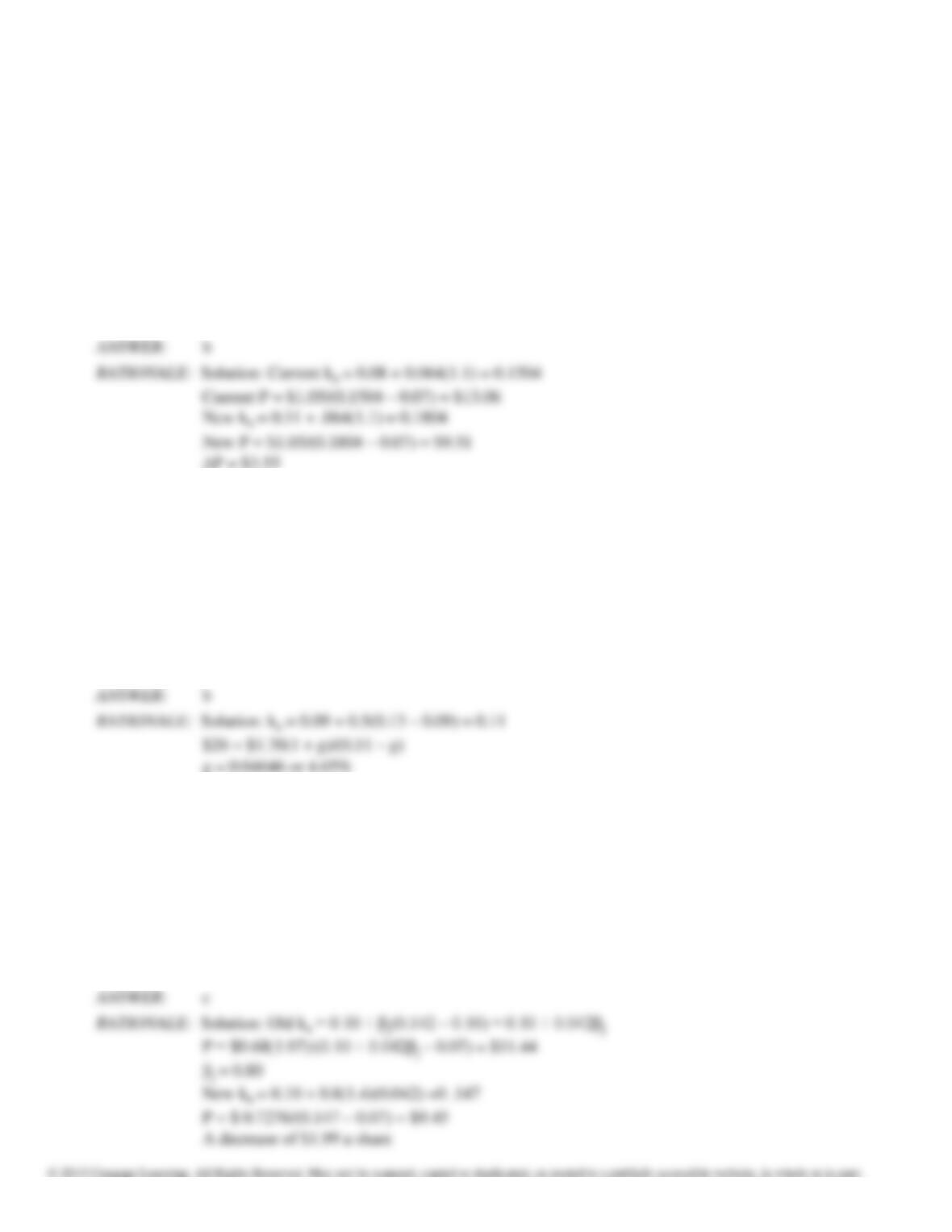
81. Micromatic is considering expanding into a new product area. Micromatic’s current beta is 1.2 and its beta is
expected to increase to 1.45 after the expansion. The long-term growth rate of the firm’s earnings is expected
to increase from 6.5 percent to 10 percent. Micromatic’s current dividend is $1.70 per share, the current risk–
free rate is 9.1 percent, and the expected market return is 12.9 percent. Should Micromatic undertake the
planned expansion?
a. No, stock price decreases $10.15
b. Yes, stock price increases $15.27
c. Yes, stock price increases $0.45
d. No, stock price decreases $15.27
Chapter 8: Analysis of Risk and Return
82. Quick Start, Inc. is expected to pay a dividend of $1.05 next year and dividends are expected to continue their
7 percent annual growth rate. The SML has been estimated as follows:
kj = 0.08 + 0.064βj
If Quick Start has a beta of 1.1, what would happen to its stock price if inflation expectations went from the
current 5 percent to 8 percent?
a. decrease $8.14
b. decrease $3.55
c. decrease $3.18
d. stock price will not change
83. Richtex Brick has a current dividend of $1.70 and the market value of its common stock is $28. The expected
market return is 13 percent and the risk-free rate is 9 percent. If Richtex stock is half as volatile as the market,
and the market is in equilibrium, what rate of growth is expected for Richtex’s dividends assuming a constant
growth valuation model is appropriate for Richtex?
a. 4.93%
b. 4.65%
c. 5.37%
d. 5.41%
84. AKA’s stock is currently selling for $11.44. This year the firm had earnings per share of $2.80 and the current
dividend is $0.68. Earnings are expected to grow 7% a year in the foreseeable future. The risk-free rate is 10
percent and the expected market return is 14.2 percent. What will be the effect on the price of AKAs’ stock if
systematic risk increases by 40 percent, all other factors remaining constant?
a. an increase of $1.14
b. a decrease of $0.40
c. a decrease of $1.99
d. cannot determine from the given data
Chapter 8: Analysis of Risk and Return
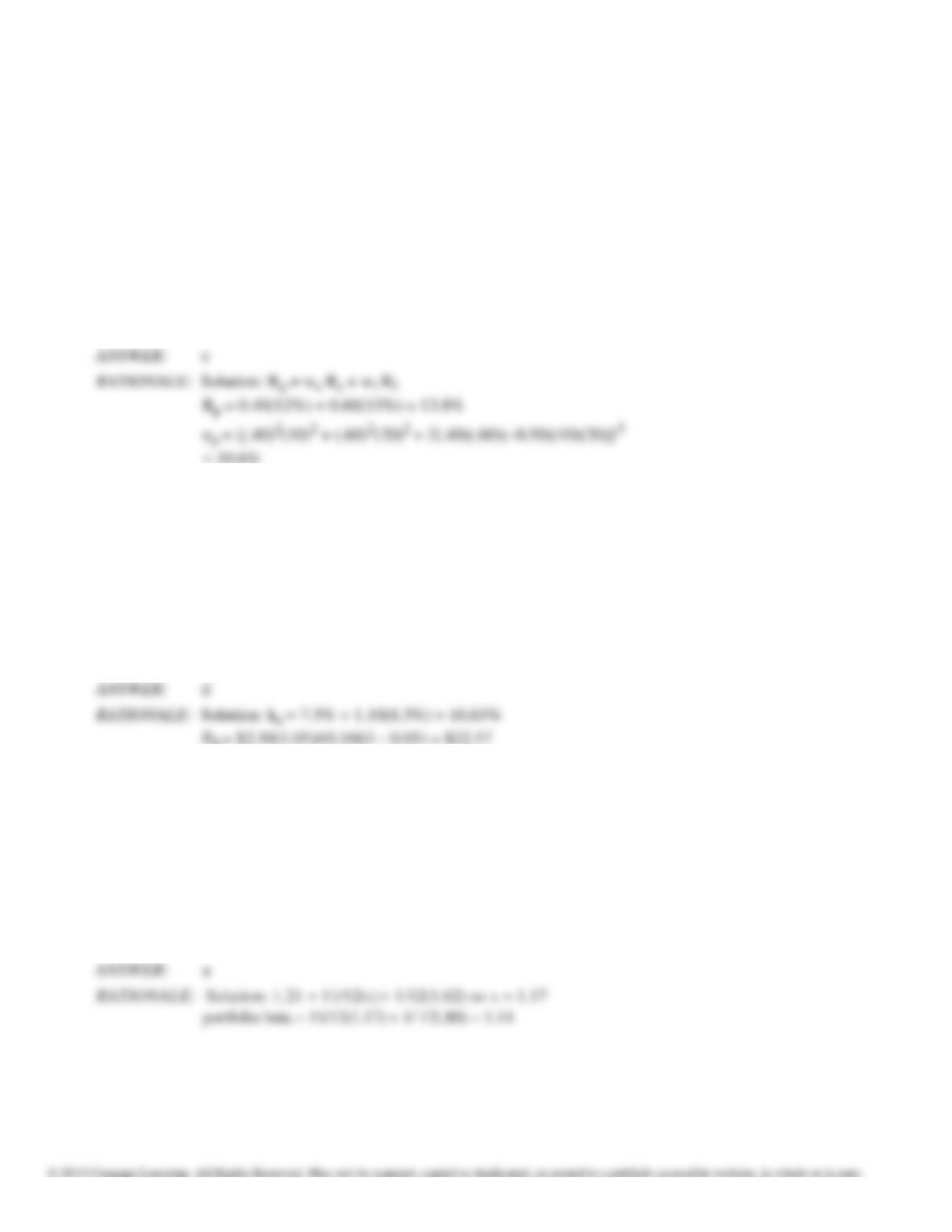
85. Given the following information on securities E and F, calculate the expected return and standard deviation of
returns on a portfolio consisting of 40% invested in E and 60% invested in F.
Security E Security F
Expected Return 12% 5%
Standard Deviation of Returns 10% 20%
Correlation coefficient of returns –0.50
a. 13.5%; 15%
b. 13.8%; 14.4%
c. 13.8%; 10.6%
d. 13.5%; 8.7%
86. Gates Industries current common stock dividend (year 0) is $2.50 per share and is expected to continue
growing at a rate of 5% per year for the foreseeable future. Currently the risk-free rate is 7.5% and the
estimated market risk premium (i.e., km – rf) is 8.3%. Value Line has estimated Gates Industries beta to be
1.10. Determine the expected price for Gates Industries common stock.
a. $21.50
b. $15.03
c. $15.78
d. $22.57
87. An investor, who believes the economy is slowing down, wishes to reduce the risk of her portfolio. She
currently owns 12 securities, each with a market value of $3,000. The current beta of the portfolio is 1.21 and
the beta of the riskiest security is 1.62. What will the portfolio beta be if the riskiest security is replaced with a
security of equal market value but a beta of 0.80?
a. 1.14
b. 1.18
c. 1.05
d. 1.10
Chapter 8: Analysis of Risk and Return
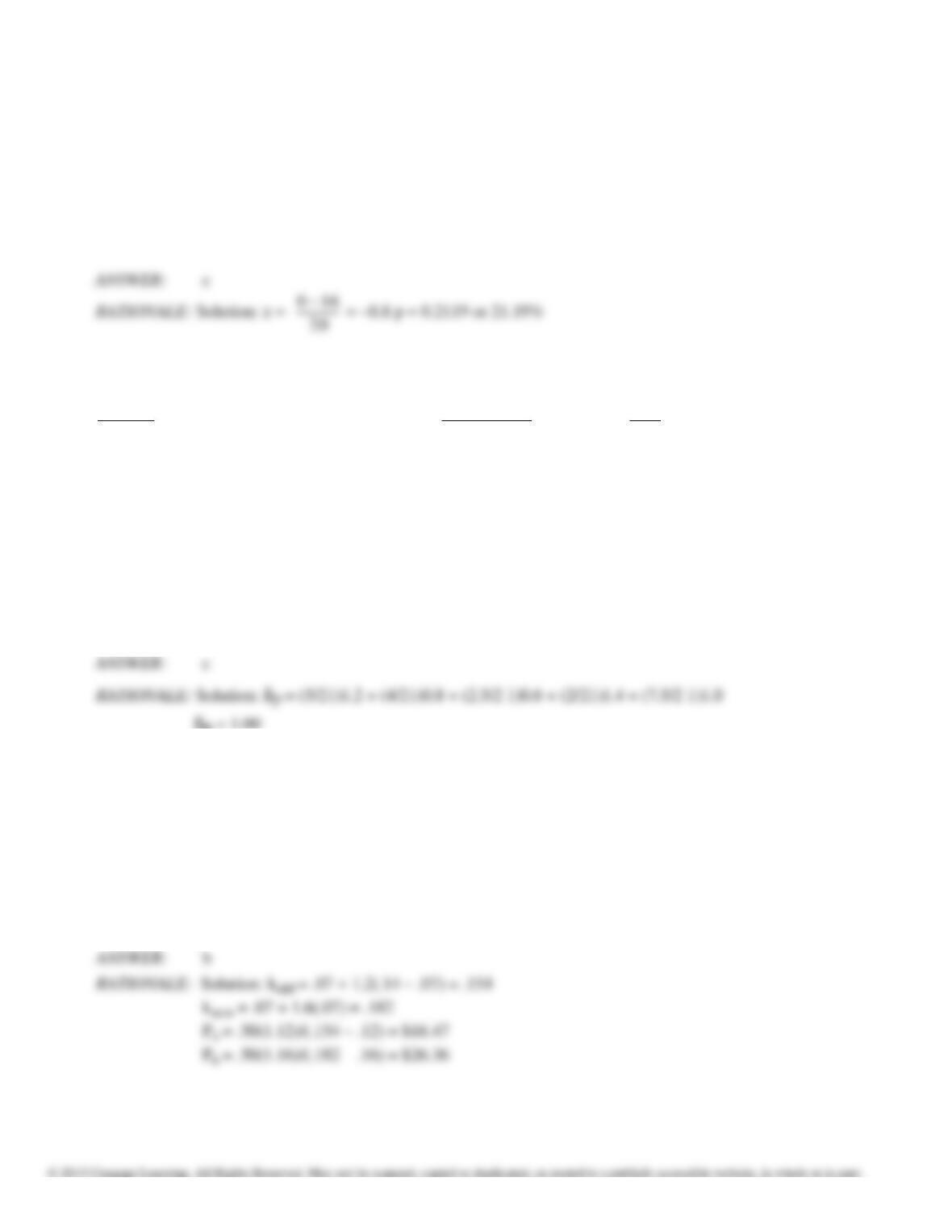
88. Assume that the rate of return on Calengry common stock over the coming year is normally distributed with
an expected value of 16% and a standard deviation of 20%. What is the probability of earning a negative rate
of return? (Note: Table Vis required to work this problem.)
a. 10.56%
b. 40.13%
c. 21.19%
d. 3.59%
89. Determine the beta of a portfolio consisting of the following common stocks:
Security
Boeing
Market Value
$5,00
Beta
1.2
Exxon
$4,000
0.8
Duke Power
$2,50
0.6
Blockbuster Video
$2,00
1.4
Coca–Cola
$7,50
1.0
a. 0.93
b. 0.85
c. 1.00
d. 1.14
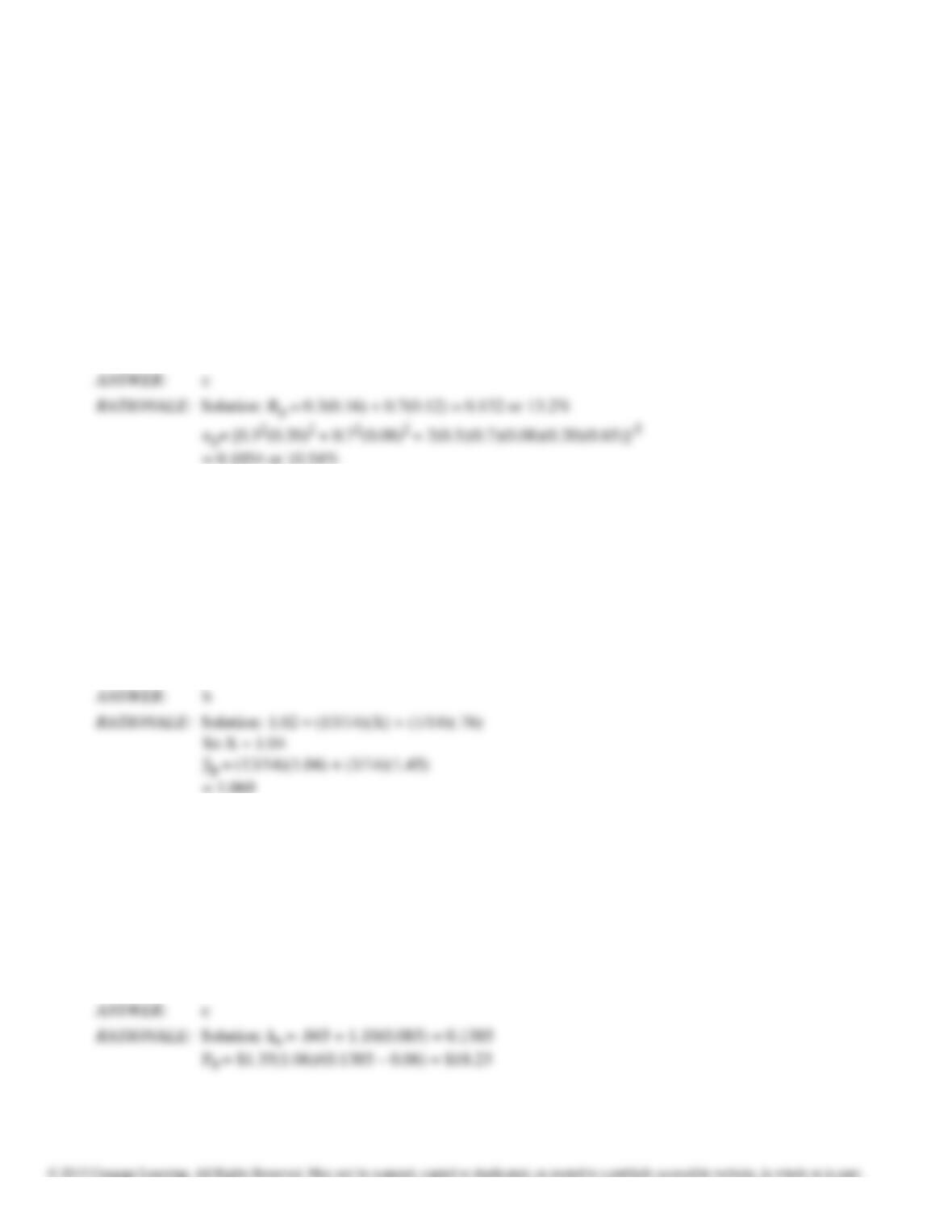
90. HDTV has planned on diversifying into the dual-VCR field. As a result, HDTV’s beta would rise to 1.6 from
1.2 and the expected future long-term growth rate in the firm’s earnings would increase from 12% to 16%.
The expected market return, km, is 14%; the risk free rate, rf, is 7%; and the current dividend, Do, is $0.50.
Should HDTV go into the dual-VCR field?
a. No-stock price decrease $7.82
b. Yes-stock price increase $9.89
c. Yes-stock price increase $3.81
d. No-stock price decrease $3.78
Chapter 8: Analysis of Risk and Return
91. Christy is considering investing in the common stock of One Liberty and Heico. The following data are
available for these two securities:
One Liberty
Heico
Expected return
.12
.16
Standard deviation of returns
.08
.20
If she invests 30% of her funds in Heico and 70% in One Liberty, and if the correlation of returns between
these securities is +0.65, what is the portfolio’s expected return and standard deviation?
a. 14% and 15.67%
b. 14.8% and 9.44%
c. 13.2% and 10.54%
d. 13.1% and 9.67%
92. Jim Bowles is an investor who believes the economy is gaining strength and, therefore, wishes to increase the
risk of his 14 security portfolio. Each security has a current market value of $5,000 and the current beta of the
portfolio is 1.02. The beta of the least risky security is .76. If Jim replaces the least risky security with another
security with the same market value but a beta of 1.45, what will the portfolio beta be then?
a. 1.03
b. 1.07
c. 1.08
d. 1.04
93. Kermit Industries current common stock dividend is $1.35 per share and the dividend is expected to grow at
6% per year into the foreseeable future. Currently the risk-free rate is 4.5% and the estimated market risk
premium is 8.5%. Merrill Lynch has estimated KI’s beta to be 1.10. Compute the expected price for KI’s
common stock.
a. $17.20
b. $10.33
c. $18.23
d. $49.35
94. Determine the beta of a portfolio consisting of the following common stocks:
Security
Market Value
Beta
Glaxo
$2,600
1.24
SCANA
3,700
.88
BancOne
2,900
.95
Pepsi
3,400
1.05
AFLAC
3,000
1.09
Votec
a. 1.00
4,400
1.41
b. 1.12
c. 1.09
d. 1.11
95. The beta of Sanafil is 1.2. Sanafil is evaluating a merger with Matra, a firm that has a beta of 0.95. Sanafil’s
stock sells for $40 per share and there are 10 million shares outstanding. Matra’s stock sells for $60, but there
are only 2 million shares outstanding. If these two firms merge, what will be the merged firm’s beta?
MVS = $40(10,000,000) = $400,000,000
MVM = $60(2,000,000) = $120,000,000
a. 1.00
b. 1.14
c. 1.05
d. 1.16
96. Lotte Group is planning on diversifying into the transportation industry. As a result, Lotte’s beta would rise to
1.3 from 1.1 and the expected long-term growth rate in the firm’s earnings would increase from 11% to 14%.
Currently the risk-free rate is 5.0% and the market risk premium is 8.6%. If Lotte’s current dividend is $1.30,
should Lotte diversify into the transportation industry?
a. No, stock price does not increase
b. No, stock price declines about $10.11
c. Yes, stock price increases about $19.42
d. Yes, stock price increases by about $26.27
Chapter 8: Analysis of Risk and Return
97. Security A offers an expected return of 14% with a standard deviation of 8%. Security B offers an expected
return of 11% with a standard deviation of 6%. If you wish to construct a portfolio with a 12.8% expected
return, what percentage of the portfolio will consist of security A?
a. 55%
b. 60%
c. 65%
d. 45%
98. Which of the following statements is/are correct?
I. Unsystematic risk can be eliminated through diversification.
II. Unsystematic risk is the relevant portion of an asset’s risk attributable to market factors that affect all
firms, like inflation, political events, etc.
a. Only statement I is correct
b. Only statement II is correct
c. Both statements I and II are correct
d. Neither statement I nor II is correct
99. Correlation is a statistical measure of the relationship between a series of numbers representing data. Which of
the following statements about correlation is/are correct?
I. Perfectly negatively correlated describes two negatively correlated stocks that have a correlation
coefficient of -1.
II. Perfectly positively correlated describes two positively correlated stocks that have a correlation coefficient
of 0.
a. Only statement I is correct
b. Only statement II is correct
c. Both statements I and II are correct
d. Neither statement I nor II is correct
100. Total risk of a security can be viewed as consisting of two parts. Which of the following apply?
I. verifiable risk
II. non-verifiable risk
a. Only statement I is correct
b. Only statement II is correct
c. Both statements I and II are correct
d. Neither statement I nor II is correct
Chapter 8: Analysis of Risk and Return
101. All of the following statements about risk are correct EXCEPT:
a. Risk can be defined as the chance for financial loss.
b. The term risk is used interchangeably with uncertainty.
c. Risk refers to the certainty of returns associated with a given asset.
d. The more certain the return from an asset, the less variability and therefore less risk.
102. Which of the following statements regarding risk is/are correct?
I. A portfolio of two negatively correlated assets has less risk than either of the individual assets and risk
could be further reduced to 0 or below.
II. There is no case where creating a portfolio of assets will result in greater risk than that of the riskiest
asset included in the portfolio.
a. Only statement I is correct
b. Only statement II is correct
c. Both statements I and II are correct
d. Neither statement I nor II is correct
103. What kind of probability distribution shows all possible outcomes for a given event?
a. discrete
b. expected value
c. bar chart
d. continuous
104. That portion of the risk premium that is based on the ability of the borrower to repay principal and interest is
the:
a. Maturity risk
b. Default risk
c. Seniority risk
d. Business risk
105. An investor, by investing in combinations of stocks, develops a portfolio
a. simple
b. structured
c. diversified
d. energetic
Chapter 8: Analysis of Risk and Return
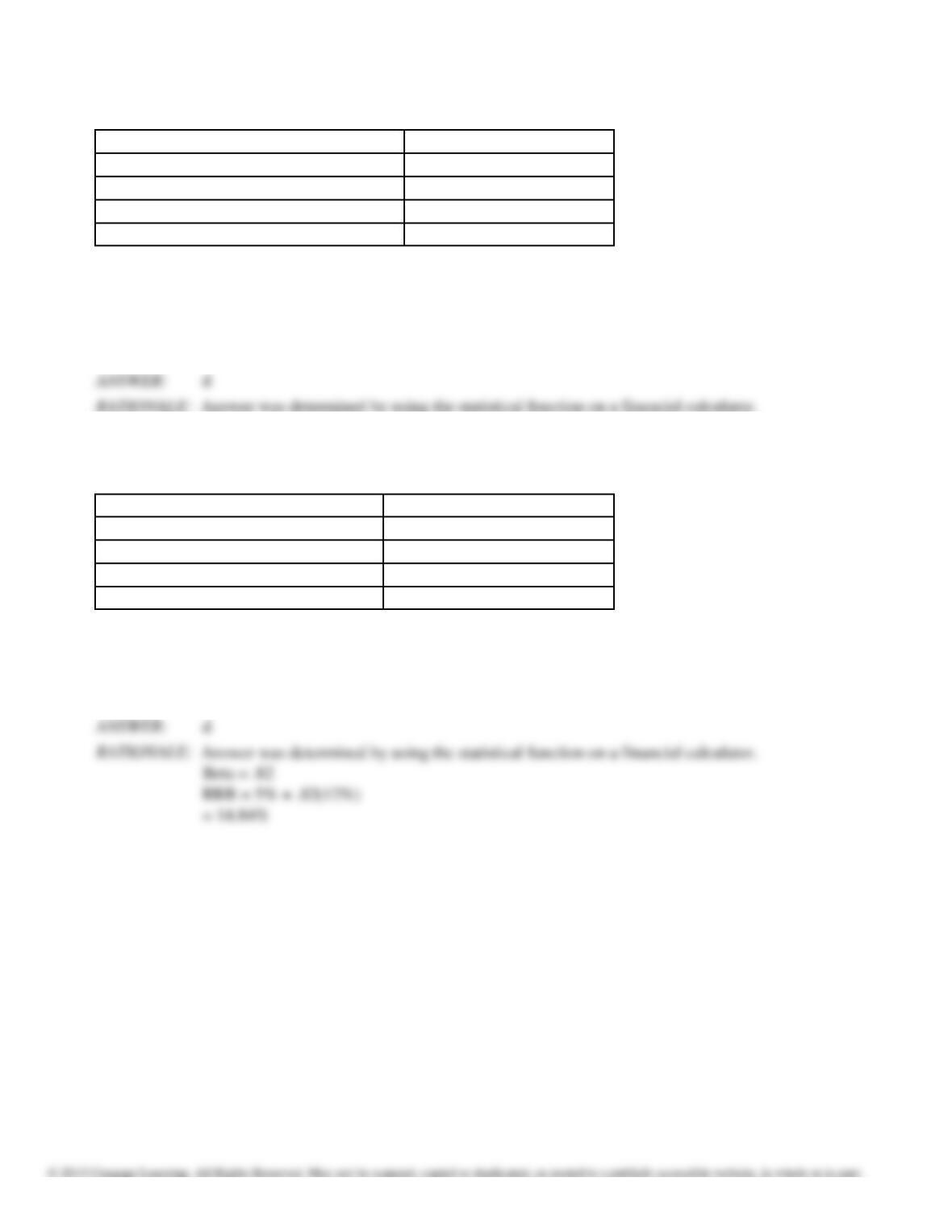
106. What is the beta of the following project?
Comparative Returns on Past Projects
Project’s Returns
12%
15%
10%
8%
6.5%
7%
2%
–1%
a. 1.11
b. .95
c. 2.15
d. 1.43
107. Find beta and determine the required rate of return. The market risk premium is 12% and the risk-free rate is
5%.
Comparative Returns in the Market
Returns on the Stock
8%
4%
9%
10%
2%
1%
10%
6%
a. 12.61%
b. 8.27%
c. 10.11%
d. 14.84%
Chapter 8: Analysis of Risk and Return
108. Find beta and determine the risk premium. The market risk premium is 8% and the risk-free rate is 2%.
Comparative Returns in the Market
Returns on the Stock
10%
8%
11%
12%
6%
2%
5%
1%
a. 16.82%
b. 20.76%
c. 10.15%
d. 18.11%
109. What is an efficient portfolio?
110. List types of events that influence systematic (non-diversifiable) risk.
111. List the various risk elements that are considered when determining the risk premium.
112. How can standard deviation, a statistical measure of dispersion, be used in investment analysis?
Chapter 8: Analysis of Risk and Return
113. Explain marketability risk and marketability premium.
114. Why is risk an increasing function of time?
115. A diversified portfolio has many stocks as opposed to a single stock. Diversification can occur with a little as
stocks.
a. 5
b. 10
c. 20
d. 100
116. Which of the following would be considered a risk-free investment?
a. U.S. Treasury securities
b. blue chip stocks
c. AAA rated corporate bonds
d. real estate
117. The kind of probability distribution that shows all possible outcomes for a given event results in:
a. a bell curve
b. a bar chart
c. a synchronous table
d. an a synchronous table
Chapter 8: Analysis of Risk and Return
118. When looking at measures of risk and return, the notation “σ” represents:
a. risk
b. return
c. standard deviation
d. probability