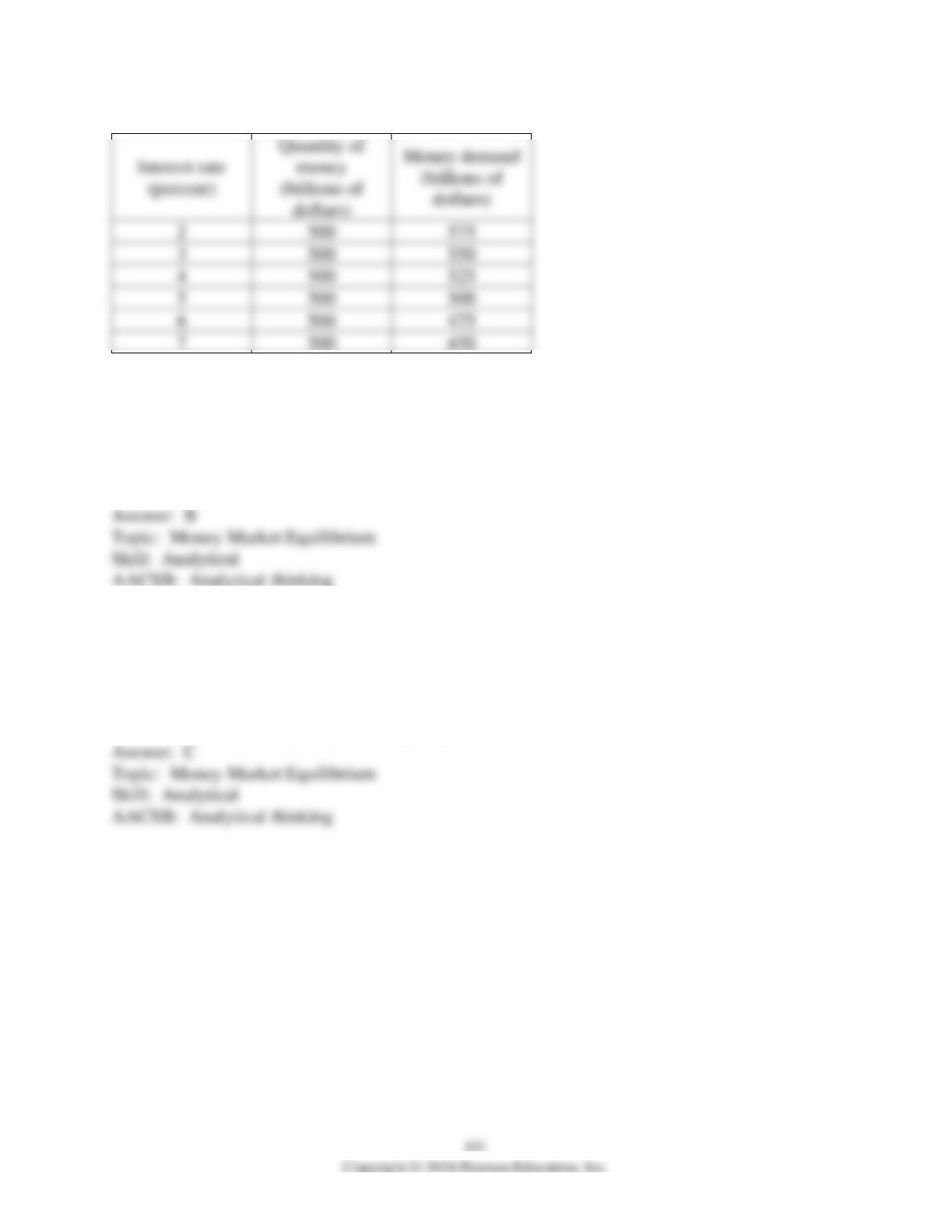
62) The table above gives the quantity of money and money demand schedules. Suppose that the
interest rate is equal to 6 percent. The effect of this interest rate in the money market is that
A) the money market is in equilibrium.
B) people buy bonds and the interest rate falls.
C) people sell bonds and the interest rate falls.
D) bond prices fall and so the interest rate falls.
63) The table above gives the quantity of money and money demand schedules. Suppose that the
interest rate is equal to 3 percent. The effect of this interest rate in the money market is that
A) the money market is in equilibrium.
B) people buy bonds and the interest rate falls.
C) people sell bonds and the interest rate rises.
D) bond prices rise so that the interest rate rises.
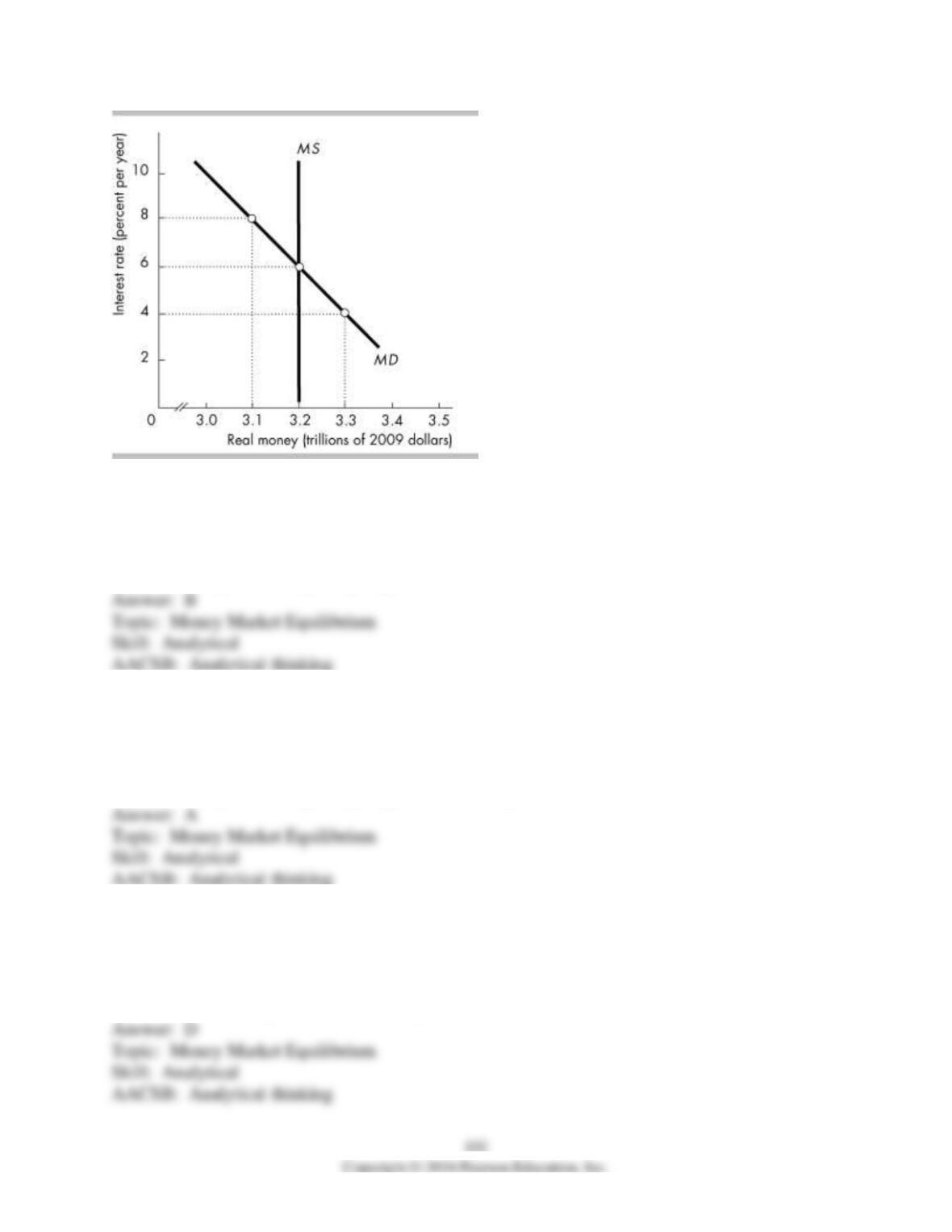
64) In the figure above, if the interest rate is 8 percent, people demand $0.1 trillion
A) less money than the quantity supplied and the interest rate will rise.
B) less money than the quantity supplied and the interest rate will fall.
C) more money than the quantity supplied and the interest rate will fall.
D) more money than the quantity supplied and the interest rate will rise.
65) In the figure above, if the interest rate is 8 percent, people demand $0.1 trillion
A) less money than the quantity supplied and bond prices will rise.
B) less money than the quantity supplied and bond prices will fall.
C) more money than the quantity supplied and bond prices will fall.
D) more money than the quantity supplied and bond prices will rise.
66) In the figure above, if the interest rate is 4 percent, there is a $0.1 trillion excess
A) quantity of money and the interest rate will rise.
B) quantity of money and the interest rate will fall.
C) demand for money and the interest rate will fall.
D) demand for money and the interest rate will rise.
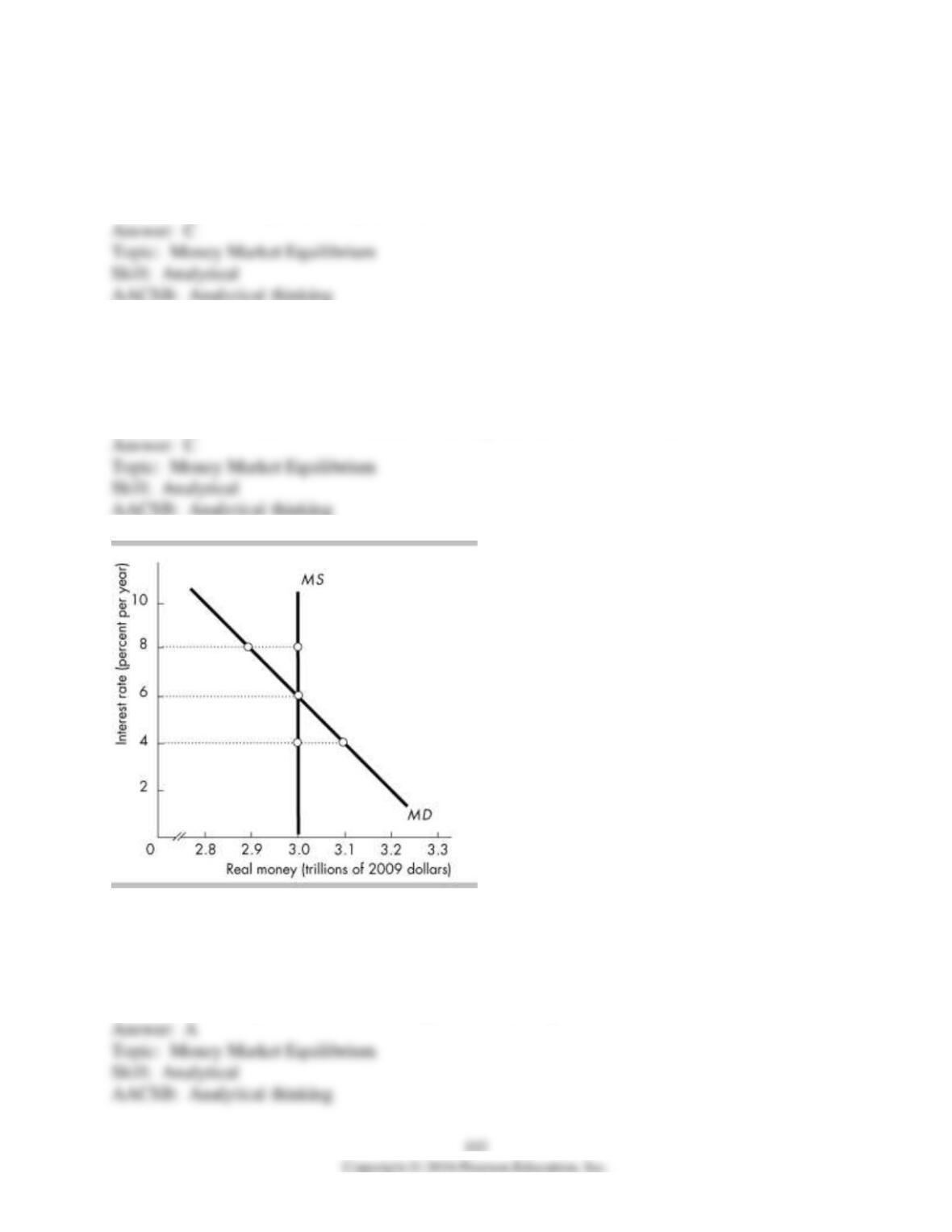
67) In the figure above, if the interest rate is 4 percent, there is a $0.1 trillion excess
A) quantity of money and bond prices will rise.
B) quantity of money and bond prices will fall.
C) demand for money and bond prices will fall.
D) demand for money and bond prices will rise.
68) In the figure above, if the interest rate is 6 percent
A) there is a $0.1 trillion excess quantity of money and the interest rate will rise.
B) there is a $0.1 trillion excess quantity of money and the interest rate will fall.
C) the money market is in equilibrium and the interest rate will remain constant.
D) there is a $0.1 trillion excess demand for money and the interest rate will rise.
69) In the above figure, if the interest rate is 4 percent, people
A) sell bonds so as to convert them into money.
B) buy bonds so as to have a better store of value.
C) petition the Fed to tighten the quantity of money.
D) buy stocks, because stocks are more liquid than currency.
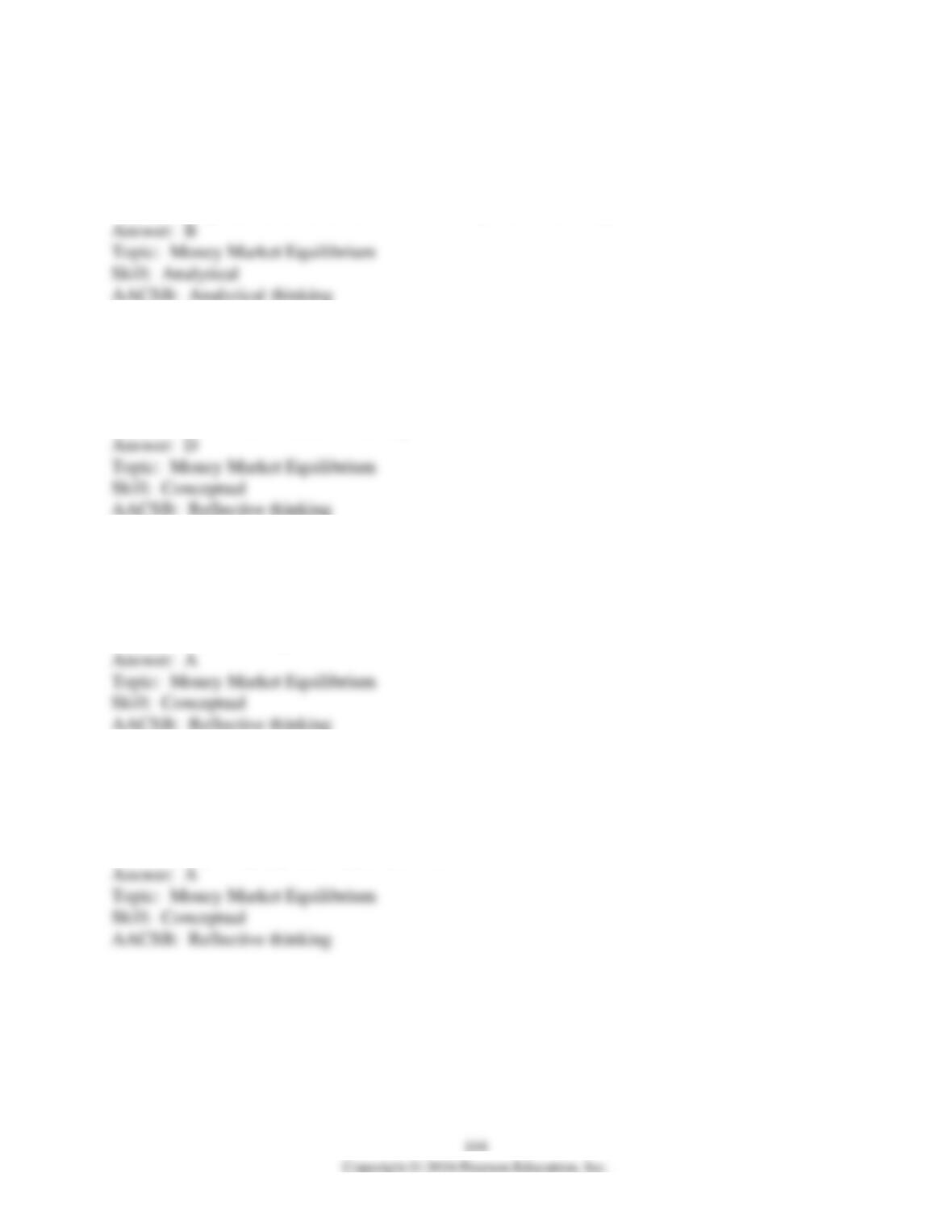
70) In the above figure, if the interest rate is 8 percent
A) people sell bonds so as to convert them into money.
B) people buy bonds and the interest rate falls.
C) the Fed increases the quantity of money.
D) people buy stocks, because stocks are more liquid than currency.
71) In the short run, which of the following actions raises the interest rate?
A) a decrease in the demand for money
B) an increase in bond prices
C) an increase in the quantity of money
D) an increase in the demand for money
72) In the short run, which of the following actions lower the interest rate?
A) a decrease in the demand for money
B) an increase in the demand for money
C) a decrease in the quantity of money
D) a decrease in bond prices
73) In the short run, when the Fed increases the quantity of money
A) bond prices rise and the interest rate falls.
B) bond prices fall and the interest rate rises.
C) the demand for money increases.
D) the supply of money curve shifts leftward.
74) In the short run, when the Fed decreases the quantity of money
A) bond prices fall and the interest rate rises.
B) bond prices rise and the interest rate falls.
C) the demand for money increases.
D) the supply of money curve shifts rightward.
75) In the long run, when the Fed increases the quantity of money the
A) no real variable changes.
B) price level falls.
C) real interest rate rises.
D) nominal interest rate falls.
76) An increase in ________ decreases the quantity of money people want to hold.
A) the price level
B) real GDP
C) the interest rate
D) the quantity of money
77) A decrease in ________ decreases the demand for money.
A) the discount rate
B) real GDP
C) the interest rate
D) the quantity of money
78) If real GDP decreases, the demand for money curve will shift
A) leftward and the interest rate will rise.
B) leftward and the interest rate will fall.
C) rightward and the interest rate will rise.
D) rightward and the interest rate will fall.
79) In October of 2014, the interest rate on money market accounts was about 0.2 percent. In
2007, the interest rate on money market accounts was about 4.0 percent. What has been the
impact on money demand from this fall in the interest rate?
A) the money demand curve shifted to the right
B) the money demand curve shifted to the left
C) the quantity of money demanded increased
D) the quantity of money demanded decreased
6 The Quantity Theory of Money
1) The velocity of circulation is
A) the rate of change of the GDP deflator.
B) the average number of times a dollar of money is used in a year to buy goods and services in
GDP.
C) the changes in the purchasing power of money over a given time period.
D) constant.
2) The velocity of circulation is
A) the relationship between income and spending.
B) the relationship between increases in income and investment.
C) the ratio of currency to demand deposits.
D) the average number of times per year a dollar is spent on goods and services in GDP.
3) The velocity of circulation is
A) equal to the price level multiplied by real GDP.
B) equal to the quantity of money multiplied by nominal GDP.
C) the average number of times a dollar bill is used in a year to buy the goods and services in
GDP.
D) average quantity of money that exists during a year.
4) If an economy has a velocity of circulation of 3, then
A) the quantity of money is 3 times real GDP.
B) in a year the average dollar is exchanged 3 times to purchase goods and services in GDP.
C) nominal GDP is 1/3 the size of the quantity of money.
D) the quantity of money is $3 for every dollar of GDP.
5) In the quantity theory of money, the quantity of money is assumed to
A) not influence the velocity of circulation.
B) rise during recessions.
C) fall during recessions.
D) be constant.
6) When the velocity of circulation equals 4 in 2010, this fact means that
A) consumers held four dollars in wealth for each dollar they spent in 2010.
B) on average, each dollar of money in the economy purchased four dollars of goods and
services in GDP in 2010.
C) for each additional dollar of money injected into the economy, the price level rose 4 percent
in 2010.
D) real output of goods and services in GDP rose by four dollars for each additional dollar of
money consumers saved.
7) If nominal GDP is $12 trillion, the price level is 120, and the quantity of money is $4 trillion,
what is the velocity of circulation?
A) 3
B) 2.5
C) 30
D) 25
8) Suppose that M = 300, P = 150, and Y = 6. Then the velocity of circulation equals
A) 0.02.
B) 0.50.
C) 2.00.
D) 3.00.
9) If nominal GDP = $15 trillion and the quantity of money is $3 trillion, what is the velocity of
circulation?
A) 45
B) 18
C) 5
D) 12
10) Which of the following equations represents the equation of exchange?
A) PM = VY
B) MY = PV
C) MV = PY
D) M = VP/Y
11) The equation of exchange
A) is MV = PY.
B) becomes the quantity theory if velocity and the price level are constant.
C) cannot be used in an economy with inflation.
D) All of the above answers are correct.
12) The equation of exchange states that the price level is equal to
A) the quantity of money.
B) velocity of circulation multiplied by the quantity of money divided by real GDP.
C) real GDP multiplied by the velocity of circulation divided by nominal GDP.
D) the velocity of circulation.
13) The equation of exchange states that the quantity of money
A) multiplied by the velocity of circulation equals nominal GDP.
B) divided by price level equals real GDP.
C) multiplied by nominal GDP equals the price level.
D) divided by nominal GDP equals real GDP.
14) If velocity is 6 and the quantity of money is $2 trillion, what is nominal GDP?
A) $12 trillion
B) $6 trillion
C) $3 trillion
D) $333 billion
15) The quantity of money in an economy is $9 million, and the velocity of circulation is 3.
Nominal GDP in this economy is ________.
A) $6 million
B) $9 million
C) $3 million
D) $27 million
16) If real GDP is $10 trillion and the velocity of circulation is 2, the quantity of money
A) is $2 trillion.
B) is $5 trillion.
C) is $20 trillion.
D) cannot be determined from the information given.
17) The quantity theory asserts that real GDP is
A) not influenced by the quantity of money.
B) never different from potential GDP.
C) equal to nominal GDP multiplied by the quantity of money.
D) equal to nominal GDP divided by the quantity of money.
18) The equation of exchange becomes the same as the quantity theory of money by assuming
that the velocity of circulation ________ when the quantity of money changes and potential GDP
________ when the quantity of money changes.
A) changes; changes
B) changes; does not change
C) does not change; changes
D) does not change; does not change
19) According to the quantity theory of money
A) V and M are constant.
B) V and Y are not affected by the quantity of money.
C) V and P are not affected by the quantity of money.
D) V and M are not affected by changes in the price level.
20) If V = 5, P = $3, and Y = 50, then the quantity of money equals
A) $10.
B) $30.
C) $150.
D) $300.
21) If M = $100, Y = $500 and P = $2, then V is equal to
A) 0.10
B) 1.
C) 10.
D) 50.
22) If nominal GDP equals $10 trillion and the velocity of circulation is 5, then
A) real GDP is $2 trillion.
B) the quantity of money is $50 trillion.
C) the quantity of money is $2 trillion.
D) the real value of the quantity of money is $10 trillion.
23) Suppose that the nominal quantity of money is $200 billion and the value of nominal GDP is
$1 trillion. It must be the case that
A) the economy is suffering from inflation.
B) the average price paid for a “typical” good is $5.
C) there will be a shortage of money balances in the economy.
D) the velocity of circulation is 5.
24) The quantity theory of money predicts how changes in
A) the price level affect nominal GDP.
B) the price level affect real GDP.
C) the quantity of money affect the price level.
D) real GDP affect the nominal GDP.
25) The quantity theory of money addresses the
A) long-run effect the quantity of money has on the price level.
B) determinants of potential GDP.
C) determinants of the equilibrium unemployment rate.
D) short-run effect the quantity of money has on the price level.
26) The quantity theory of money asserts that inflation is the result of growth in
A) the quantity of money.
B) potential GDP.
C) the natural rate of unemployment.
D) money wage rates.
27) The quantity theory of money asserts that an increase in the quantity of money
A) will decrease the price level by an offsetting amount.
B) by n percent will lead to an increase in the price level by n + 1 percent.
C) will lead to an equal percentage increase in real GDP.
D) will lead to an equal percentage increase in the price level.
28) The quantity theory of money argues that, in the long run, the percentage change in money
will create an equal percentage change in
A) velocity.
B) real GDP.
C) potential GDP.
D) the price level.
29) The quantity theory of money predicts that in the ________, a 10 percent increase in the
quantity of money leads to a 10 percent increase in ________.
A) long run; real GDP
B) short run; velocity
C) long run; velocity
D) long run; price level
30) The quantity theory of money states that in the long run
A) the price level will not consistently rise, it will fluctuate.
B) an increase in the quantity of money results in an equal percentage increase in the price level.
C) a rise in the price level rises causes the quantity of money to increase.
D) an increase in the quantity of money increases real GDP by a smaller percentage.
31) According to the quantity theory of money, a 10 percent increase in the quantity of money
ultimately leads to a 10 percent increase in
A) real national income.
B) real GDP.
C) the price level.
D) velocity.
32) According to the quantity theory of money, changes in the price level are the result of
changes in the
A) prime interest rate.
B) real interest rate.
C) quantity of money.
D) velocity of circulation.
33) Other things constant, the quantity theory of money concludes that any increase in the
quantity of money
A) decreases the demand for money.
B) decreases in the aggregate price level.
C) decreases the aggregate level of nominal income.
D) proportionally increases the price level.
34) The quantity theory of money states that
A) inflation increases when the money growth rate increases.
B) as the price level increases, the demand for money increases.
C) as the interest rate rises, the demand for money decreases.
D) changes in the quantity of money are determined by the commercial banks and not the
Federal Reserve.
35) According to the quantity theory of money, a 15 percent increase in the quantity of money
creates a 15 percent rise in
A) the price level.
B) the velocity of circulation.
C) real GDP.
D) the unemployment rate.
36) According to the quantity theory of money, money growth and inflation are
A) positively correlated.
B) negatively correlated.
C) independent, that is, not correlated.
D) positively correlated if the inflation rate is positive and negatively correlated if the inflation
rate is negative.
37) According to the quantity theory of money, in the long run
A) an increase in the quantity of money creates an increase the price level but no increase in real
GDP.
B) the quantity of money in the economy will always be just the right amount.
C) an increase in the quantity of money creates an increase in the price level and in real GDP.
D) None of the above answers are correct.
38) According to the quantity theory of money, a 25 percent change in M, the quantity of money,
leads to a 25 percent change in
A) V, the velocity of circulation.
B) P, the price level.
C) Y, real GDP.
D) R, the interest rate.
39) Suppose the money growth rate is 3 percent, velocity is constant, and real GDP is growing at
2 percent. What is the inflation rate?
A) 1 percent
B) 5 percent
C) 3 percent
D) 6 percent
40) Read the following statements and determine if they are true or false.
I. According to the quantity theory of money, an increase in the growth rate of the quantity of
money increases inflation in the long run.
II. Historical and international data show that there is no correlation between inflation and
money growth.
A) I and II are both true.
B) I and II are both false.
C) I is true and II is false.
D) I is false and II is true.
41) Which of the following is TRUE regarding the quantity theory of money?
I. The theory predicts that in the long run the inflation rate equals the money growth rate minus
the growth rate of real GDP.
II. The theory predicts that countries with high growth rates of money will have high inflation
rates.
III. The theory predicts that increases in the growth rate of velocity lowers the inflation rate.
A) I and II
B) II and III
C) I and III
D) I, II and III
42) According to the quantity theory of money, in the long run, an increase in the quantity of
money results in an equal percentage increase in ________.
A) the price level
B) the growth rate of real GDP
C) the inflation level
D) the growth rate of potential GDP
43) The data show that money growth and inflation are
A) positively correlated.
B) negatively correlated.
C) not correlated.
D) independent phenomena.
44) The U.S. historical evidence
A) generally supports the quantity theory of money in the long run.
B) does not support the quantity theory of money.
C) demonstrates that there is no correlation between the money growth rate and inflation.
D) shows that a higher inflation rate causes an increase in the money growth rate.
45) Looking at historical evidence for the United States and other countries, which of the
following are TRUE?
I. There is a correlation between the growth rate of the quantity theory of money and the
growth rate of real GDP.
II. There is a correlation between the growth rate of the quantity theory of money and the
inflation rate.
A) Only I is true.
B) Only II is true.
C) Both I and II are true.
D) Neither I or II is true.
46) According to the quantity theory, in the long run, an increase in the growth rate of ________
leads to an increase in the ________.
A) real GDP; inflation rate
B) the quantity of money; growth rate of real GDP
C) the quantity of money; inflation rate
D) real GDP; growth rate of velocity
47) The quantity theory of money is the idea that in the long run
A) the quantity of money is determined by banks.
B) the quantity of money serves as a good indicator of how well money functions as a store of
value.
C) the quantity of money determines real GDP.
D) an increase in the growth rate of the quantity of money leads to an equal increase in the
inflation rate.
48) Nominal GDP, PY, is $7.5 trillion. The quantity of money is $3 trillion. The velocity of
circulation is
A) 22.5.
B) 10.5.
C) 2.5.
7 News Based Questions
1) Which of the following is an example of money functioning as a medium of exchange?
A) Walmart accepting your $20 when you buy a Blu-ray.
B) Apple pricing an iPhone at $299.
C) Bank of America paying you 3 percent on your saving account.
D) You saving your spare change in a jar before depositing them in your savings account.
2) Which of the following is an example of money functioning as a unit of account?
A) Bank of America charging 7 percent on an auto loan.
B) Pepsi charging $1 for a can of soda.
C) eBay using PayPal as a method of payment.
D) Your writing a check at Target to pay for new clothes.
3) Which of the following is an example of money functioning as a store of value?
A) Comcast charging $99 for internet, phone and cable service.
B) McDonalds charging 99 cents for a burger.
C) Your saving your spare change in a jar in order to afford an end-of-term party.
D) Amazon.com charging $9.95 for shipping.
4) In September 2008, Regions Bank has $89 million in M1 deposits, $3 million in reserves and
$81 million in loans. Regions Bank’s desired reserve ratio is
A) 3.4 percent.
B) 3.7 percent.
C) 91 percent.
D) 29.67 percent.
5) In September 2007, Regions Bank held $3 million in reserves against M1 deposits and made
$83 million in loans. Between September 2007 and September 2008, deposits decreased from
$114 million to $95 million. If Regions Bank wants to maintain its desired reserve ratio in 2008,
it will
A) increase its reserves.
B) definitely make more loans.
C) cannot make more loans.
D) decrease its reserves.
6) In August 2007, Sun Trust Bank has $83 million in loans and $114 million in M1 deposits. If
Sun Trust is holding $4 million in reserves, the bank’s reserve ratio is
A) $31 million.
B) 4.8 percent
C) 3.5 percent.
D) 72.8 percent.
7) The table below shows data (in millions) for Sun Trust Banks in September 2007 and
September 2008.
2007
2008
Loans
$83
$78
Reserves
$4
$5
Deposits
$114
$95
The data show that Sun Trust
A) increased its reserve ratio to 5.3 percent over the 12 months.
B) increased its reserve ratio to 6.4 percent over the 12 months.
C) has fewer excess reserves in 2008.
D) faced a higher currency drain ratio in 2008.
8) The table below shows data (in millions) for Sun Trust Banks in September 2007 and
September 2008. Suppose that the required reserve ratio is 3 percent.
2007
2008
Loans
$83
$78
Reserves
$4
$5
Deposits
$114
$95
The data show that Sun Trust ________ make more loans in 2007 and ________ make more
loans in 2008.
A) can; can
B) can; cannot
C) cannot; cannot
D) cannot; can